
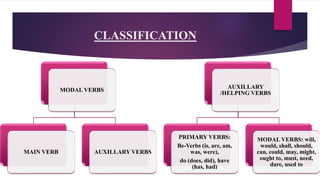
CLASSIFICATION
MODAL VERBS
MAIN VERB AUXILLARY VERBS
AUXILLARY
/HELPING VERBS
PRIMARY VERBS:
Be-Verbs (is, are, am,
was, were),
do (does, did), have
(has, had)
MODAL VERBS: will,
would, shall, should,
can, could, may, might,
ought to, must, need,
dare, used to
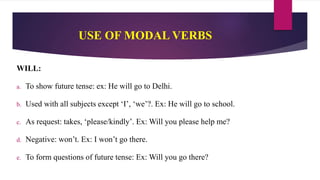
USE OF MODAL VERBS
WILL:
a. To show future tense: ex: He will go to Delhi.
b. Used with all subjects except ‘I’, ‘we’?. Ex: He will go to school.
c. As request: takes, ‘please/kindly’. Ex: Will you please help me?
d. Negative: won’t. Ex: I won’t go there.
e. To form questions of future tense: Ex: Will you go there?
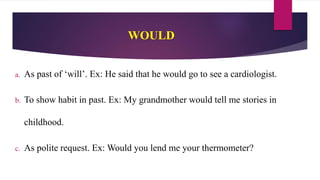
WOULD
a. As past of ‘will’. Ex: He said that he would go to see a cardiologist.
b. To show habit in past. Ex: My grandmother would tell me stories in
childhood.
c. As polite request. Ex: Would you lend me your thermometer?
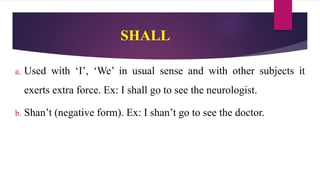
SHALL
a. Used with ‘I’, ‘We’ in usual sense and with other subjects it
exerts extra force. Ex: I shall go to see the neurologist.
b. Shan’t (negative form). Ex: I shan’t go to see the doctor.
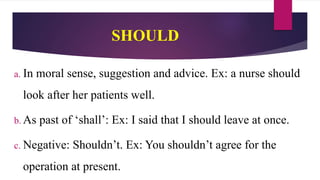
SHOULD
a. In moral sense, suggestion and advice. Ex: a nurse should
look after her patients well.
b. As past of ‘shall’: Ex: I said that I should leave at once.
c. Negative: Shouldn’t. Ex: You shouldn’t agree for the
operation at present.
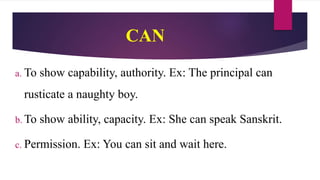
CAN
a. To show capability, authority. Ex: The principal can
rusticate a naughty boy.
b. To show ability, capacity. Ex: She can speak Sanskrit.
c. Permission. Ex: You can sit and wait here.
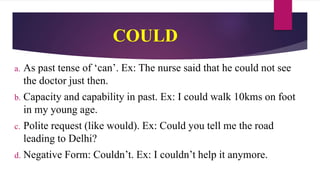
COULD
a. As past tense of ‘can’. Ex: The nurse said that he could not see
the doctor just then.
b. Capacity and capability in past. Ex: I could walk 10kms on foot
in my young age.
c. Polite request (like would). Ex: Could you tell me the road
leading to Delhi?
d. Negative Form: Couldn’t. Ex: I couldn’t help it anymore.
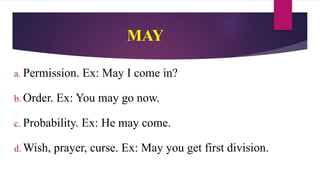
MAY
a. Permission. Ex: May I come in?
b. Order. Ex: You may go now.
c. Probability. Ex: He may come.
d. Wish, prayer, curse. Ex: May you get first division.
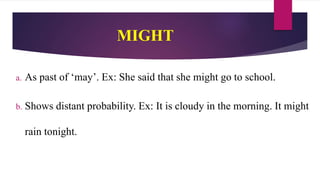
MIGHT
a. As past of ‘may’. Ex: She said that she might go to school.
b. Shows distant probability. Ex: It is cloudy in the morning. It might
rain tonight.
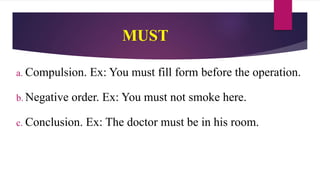
MUST
a. Compulsion. Ex: You must fill form before the operation.
b. Negative order. Ex: You must not smoke here.
c. Conclusion. Ex: The doctor must be in his room.
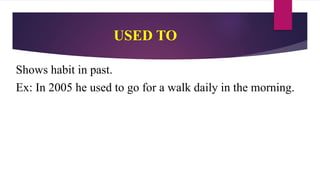
USED TO
Shows habit in past.
Ex: In 2005 he used to go for a walk daily in the morning.
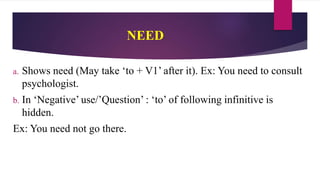
NEED
a. Shows need (May take ‘to + V1’ after it). Ex: You need to consult
psychologist.
b. In ‘Negative’ use/’Question’ : ‘to’ of following infinitive is
hidden.
Ex: You need not go there.
DARE
a. Following infinitive takes ‘to’ in assertive sentences. Ex: I dare to
meet the principal.
b. Negative and Interrogative forms. Infinitive following (to + V1)
does not take ‘to’.
Correct: You dare not insult me.
Incorrect: You dare not to insult me.
OUGHT TO
a. Mostly used in the sense of duty. Ex: We ought to obey
our parents.
b. Moral advice. Ex: You ought to go for a walk daily.
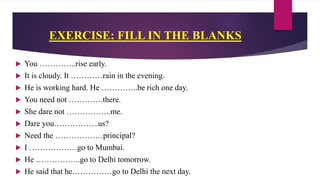
EXERCISE: FILL IN THE BLANKS
 You …………..rise early.
 It is cloudy. It …………rain in the evening.
 He is working hard. He …………..be rich one day.
 You need not ………….there.
 She dare not ……………..me.
 Dare you……………..us?
 Need the ………………principal?
 I ………………go to Mumbai.
 He ……………..go to Delhi tomorrow.
 He said that he……………go to Delhi the next day.

Modal verbs

  • 2.
    CLASSIFICATION MODAL VERBS MAIN VERBAUXILLARY VERBS AUXILLARY /HELPING VERBS PRIMARY VERBS: Be-Verbs (is, are, am, was, were), do (does, did), have (has, had) MODAL VERBS: will, would, shall, should, can, could, may, might, ought to, must, need, dare, used to
  • 3.
    USE OF MODALVERBS WILL: a. To show future tense: ex: He will go to Delhi. b. Used with all subjects except ‘I’, ‘we’?. Ex: He will go to school. c. As request: takes, ‘please/kindly’. Ex: Will you please help me? d. Negative: won’t. Ex: I won’t go there. e. To form questions of future tense: Ex: Will you go there?
  • 4.
    WOULD a. As pastof ‘will’. Ex: He said that he would go to see a cardiologist. b. To show habit in past. Ex: My grandmother would tell me stories in childhood. c. As polite request. Ex: Would you lend me your thermometer?
  • 5.
    SHALL a. Used with‘I’, ‘We’ in usual sense and with other subjects it exerts extra force. Ex: I shall go to see the neurologist. b. Shan’t (negative form). Ex: I shan’t go to see the doctor.
  • 6.
    SHOULD a. In moralsense, suggestion and advice. Ex: a nurse should look after her patients well. b. As past of ‘shall’: Ex: I said that I should leave at once. c. Negative: Shouldn’t. Ex: You shouldn’t agree for the operation at present.
  • 7.
    CAN a. To showcapability, authority. Ex: The principal can rusticate a naughty boy. b. To show ability, capacity. Ex: She can speak Sanskrit. c. Permission. Ex: You can sit and wait here.
  • 8.
    COULD a. As pasttense of ‘can’. Ex: The nurse said that he could not see the doctor just then. b. Capacity and capability in past. Ex: I could walk 10kms on foot in my young age. c. Polite request (like would). Ex: Could you tell me the road leading to Delhi? d. Negative Form: Couldn’t. Ex: I couldn’t help it anymore.
  • 9.
    MAY a. Permission. Ex:May I come in? b. Order. Ex: You may go now. c. Probability. Ex: He may come. d. Wish, prayer, curse. Ex: May you get first division.
  • 10.
    MIGHT a. As pastof ‘may’. Ex: She said that she might go to school. b. Shows distant probability. Ex: It is cloudy in the morning. It might rain tonight.
  • 11.
    MUST a. Compulsion. Ex:You must fill form before the operation. b. Negative order. Ex: You must not smoke here. c. Conclusion. Ex: The doctor must be in his room.
  • 12.
    USED TO Shows habitin past. Ex: In 2005 he used to go for a walk daily in the morning.
  • 13.
    NEED a. Shows need(May take ‘to + V1’ after it). Ex: You need to consult psychologist. b. In ‘Negative’ use/’Question’ : ‘to’ of following infinitive is hidden. Ex: You need not go there.
  • 14.
    DARE a. Following infinitivetakes ‘to’ in assertive sentences. Ex: I dare to meet the principal. b. Negative and Interrogative forms. Infinitive following (to + V1) does not take ‘to’. Correct: You dare not insult me. Incorrect: You dare not to insult me.
  • 15.
    OUGHT TO a. Mostlyused in the sense of duty. Ex: We ought to obey our parents. b. Moral advice. Ex: You ought to go for a walk daily.
  • 16.
    EXERCISE: FILL INTHE BLANKS  You …………..rise early.  It is cloudy. It …………rain in the evening.  He is working hard. He …………..be rich one day.  You need not ………….there.  She dare not ……………..me.  Dare you……………..us?  Need the ………………principal?  I ………………go to Mumbai.  He ……………..go to Delhi tomorrow.  He said that he……………go to Delhi the next day.