MODAL AND PHRASAL MODAL
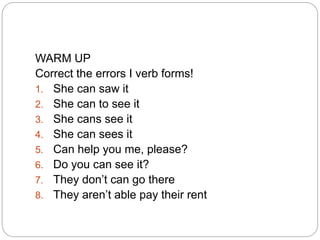
WARM UP
Correct the errors I verb forms!
1. She can saw it
2. She can to see it
3. She cans see it
4. She can sees it
5. Can help you me, please?
6. Do you can see it?
7. They don’t can go there
8. They aren’t able pay their rent
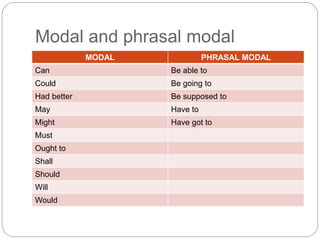
Modal and phrasal modal
MODAL PHRASAL MODAL
Can Be able to
Could Be going to
Had better Be supposed to
May Have to
Might Have got to
Must
Ought to
Shall
Should
Will
Would
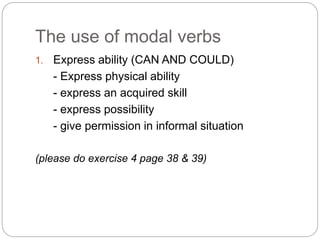
The use of modal verbs
1. Express ability (CAN AND COULD)
- Express physical ability
- express an acquired skill
- express possibility
- give permission in informal situation
(please do exercise 4 page 38 & 39)
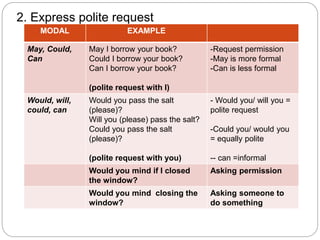
2. Express polite request
MODAL EXAMPLE
May, Could,
Can
May I borrow your book?
Could I borrow your book?
Can I borrow your book?
(polite request with I)
-Request permission
-May is more formal
-Can is less formal
Would, will,
could, can
Would you pass the salt
(please)?
Will you (please) pass the salt?
Could you pass the salt
(please)?
(polite request with you)
- Would you/ will you =
polite request
-Could you/ would you
= equally polite
-- can =informal
Would you mind if I closed
the window?
Asking permission
Would you mind closing the
window?
Asking someone to
do something
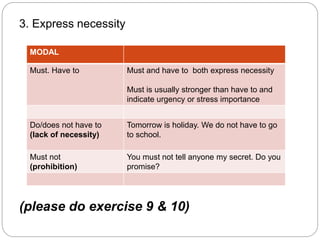
3. Express necessity
(please do exercise 9 & 10)
MODAL
Must. Have to Must and have to both express necessity
Must is usually stronger than have to and
indicate urgency or stress importance
Do/does not have to
(lack of necessity)
Tomorrow is holiday. We do not have to go
to school.
Must not
(prohibition)
You must not tell anyone my secret. Do you
promise?
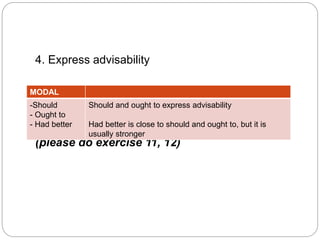
4. Express advisability
(please do exercise 11, 12)
MODAL
-Should
- Ought to
- Had better
Should and ought to express advisability
Had better is close to should and ought to, but it is
usually stronger

MODAL AND PHRASAL MODAL.pptx

  • 1.
  • 2.
    WARM UP Correct theerrors I verb forms! 1. She can saw it 2. She can to see it 3. She cans see it 4. She can sees it 5. Can help you me, please? 6. Do you can see it? 7. They don’t can go there 8. They aren’t able pay their rent
  • 3.
    Modal and phrasalmodal MODAL PHRASAL MODAL Can Be able to Could Be going to Had better Be supposed to May Have to Might Have got to Must Ought to Shall Should Will Would
  • 4.
    The use ofmodal verbs 1. Express ability (CAN AND COULD) - Express physical ability - express an acquired skill - express possibility - give permission in informal situation (please do exercise 4 page 38 & 39)
  • 5.
    2. Express politerequest MODAL EXAMPLE May, Could, Can May I borrow your book? Could I borrow your book? Can I borrow your book? (polite request with I) -Request permission -May is more formal -Can is less formal Would, will, could, can Would you pass the salt (please)? Will you (please) pass the salt? Could you pass the salt (please)? (polite request with you) - Would you/ will you = polite request -Could you/ would you = equally polite -- can =informal Would you mind if I closed the window? Asking permission Would you mind closing the window? Asking someone to do something
  • 6.
    3. Express necessity (pleasedo exercise 9 & 10) MODAL Must. Have to Must and have to both express necessity Must is usually stronger than have to and indicate urgency or stress importance Do/does not have to (lack of necessity) Tomorrow is holiday. We do not have to go to school. Must not (prohibition) You must not tell anyone my secret. Do you promise?
  • 7.
    4. Express advisability (pleasedo exercise 11, 12) MODAL -Should - Ought to - Had better Should and ought to express advisability Had better is close to should and ought to, but it is usually stronger