MobileDiagnosis®: an appropriate technology for tele-microscopy, an effective tool for trainingL. Bellina and E. Missoni**Corresponding author: eduardo.missoni@unibocconi.it
BackgroundWepreviouslyshowedthatcurrent mobile phones can be easilyusedwithoutanyadaptor to take images from the microscope and sendthem for remote reference.ObjectiveTo test the appropriateness of direct m-phone-based tele-microscopy, as one possible application of MobileDiagnosis® based on locally available technology, in limited-resource settings and its effectiveness as training tool.
MethodsWe tested MobileDiagnosis® with local health workers in rural health units in Uganda, Bangladesh, and in the Paediatric Hospital of Herat, AfghanistanIn Bangladesh (Dinajpur, Bhuapur and Comilla)
structured interviews to define parameters such as diagnostic capacities, workload, extension services, use of clinical and laboratory equipment, availability and use of m-phones.
testing link with reference centre in Dhaka
In Uganda (St. Mary Hospital, Lacor Gulu)
we tested use in training and as didactic tool.
In AfghanistanLaboratory technicians were trained using the MobileDiagnosis® approachinternational second opinion was tested (via internet) Methods2009-2011  - 80 individuals participated in the testing.
Italy -  20 randomly chosen people, completely foreign to microscopy where asked to take pictures on the sole basis of simple written instructions.
Uganda and Bangladesh  - 60 health workers and laboratory technicians - all with very basic previous laboratory training - where involved through “on the job” training. Only locally available materials and technology were used
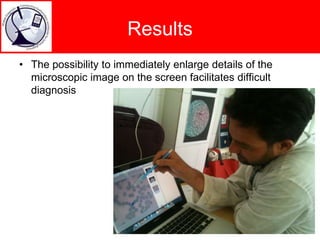
Afghanistan 10 local fully trained laboratory technicians (9 males, 1 female), with an average of one year experience in the lab were involvedResultsWith few standardized written instructions all participants rapidly learned to use m-phones to take quality pictures from the microscope.ResultsThe possibility to immediately enlarge details of the microscopic image on the screen facilitates difficult diagnosisResultsJointly observing and discussing images of the microscopic field on the m-phone screen and possibly on wider portable PC screen, enhanced learning speed and health workers interest.ResultsOr even on the wall...ResultsImages shared on a web-based platform allowed distant diagnosis and both clinical and educational support from experts overseas, including timely response over SMS.
Different cultural attitudes toward  the use of available equipment were noted between involved Bengali, African and Afghani health workers.Final considerationsInitial experience shows that this approach can be easily exploited in distance learning and tutoring
Local healthworker enthusiastically respond to the method feeling to be part of a wider network

MobileDiagnosis:an appropriate technology

  • 1.
    MobileDiagnosis®: an appropriatetechnology for tele-microscopy, an effective tool for trainingL. Bellina and E. Missoni**Corresponding author: eduardo.missoni@unibocconi.it
  • 2.
    BackgroundWepreviouslyshowedthatcurrent mobile phonescan be easilyusedwithoutanyadaptor to take images from the microscope and sendthem for remote reference.ObjectiveTo test the appropriateness of direct m-phone-based tele-microscopy, as one possible application of MobileDiagnosis® based on locally available technology, in limited-resource settings and its effectiveness as training tool.
  • 3.
    MethodsWe tested MobileDiagnosis®with local health workers in rural health units in Uganda, Bangladesh, and in the Paediatric Hospital of Herat, AfghanistanIn Bangladesh (Dinajpur, Bhuapur and Comilla)
  • 4.
    structured interviews todefine parameters such as diagnostic capacities, workload, extension services, use of clinical and laboratory equipment, availability and use of m-phones.
  • 5.
    testing link withreference centre in Dhaka
  • 6.
    In Uganda (St.Mary Hospital, Lacor Gulu)
  • 7.
    we tested usein training and as didactic tool.
  • 8.
    In AfghanistanLaboratory technicianswere trained using the MobileDiagnosis® approachinternational second opinion was tested (via internet) Methods2009-2011 - 80 individuals participated in the testing.
  • 9.
    Italy - 20 randomly chosen people, completely foreign to microscopy where asked to take pictures on the sole basis of simple written instructions.
  • 10.
    Uganda and Bangladesh - 60 health workers and laboratory technicians - all with very basic previous laboratory training - where involved through “on the job” training. Only locally available materials and technology were used
  • 11.
    Afghanistan 10 localfully trained laboratory technicians (9 males, 1 female), with an average of one year experience in the lab were involvedResultsWith few standardized written instructions all participants rapidly learned to use m-phones to take quality pictures from the microscope.ResultsThe possibility to immediately enlarge details of the microscopic image on the screen facilitates difficult diagnosisResultsJointly observing and discussing images of the microscopic field on the m-phone screen and possibly on wider portable PC screen, enhanced learning speed and health workers interest.ResultsOr even on the wall...ResultsImages shared on a web-based platform allowed distant diagnosis and both clinical and educational support from experts overseas, including timely response over SMS.
  • 12.
    Different cultural attitudestoward the use of available equipment were noted between involved Bengali, African and Afghani health workers.Final considerationsInitial experience shows that this approach can be easily exploited in distance learning and tutoring
  • 13.
    Local healthworker enthusiasticallyrespond to the method feeling to be part of a wider network