MOBILE WEBSITE DEVELOPMENT
Mobile Boot Camp
Presented by:
Michael Wakahe
Tawi Commercial Services Ltd
Nov 18th 2010
Table of Contents
Copyright © Tawi Commercial Services Ltd.
2015. All Rights Reserved.
 The Need for Mobile Web
 Mobile Web History
 Mobile Web Standards
 Comparison with Desktop & Mobile Apps
 Best Practices
The Need for Mobile Web
Copyright © Tawi Commercial Services Ltd.
2015. All Rights Reserved.
 Limitations of mobile phones
 Limited Processor Power and Memory
 Limited Battery Life
 Limited Input and Output Facilities
 Low Bandwidth
 Unpredictable Availability and Stability
The Need for Mobile Web
Copyright © Tawi Commercial Services Ltd.
2015. All Rights Reserved.
 TCP/IP protocol suite was not designed for a
wireless environment
 Bandwidth resource is expensive
 HTML pages are not suitable for use in mobile
devices with limited processor power and
screen.
Mobile Web History
Copyright © Tawi Commercial Services Ltd.
2015. All Rights Reserved.
 Wireless Application Protocol (WAP) Forum was
founded in 1997 by Ericsson, Motorola, Nokia, and
Phone.com.
 WAP 1.1 was published in 1999
 WAP 2.0 was published in 2001
Mobile Web History
Copyright © Tawi Commercial Services Ltd.
2015. All Rights Reserved.
 In 2002, the WAP Forum consolidated into the Open
Mobile Alliance (OMA) and the specification work
from WAP continues within OMA
Mobile Web History
Copyright © Tawi Commercial Services Ltd.
2015. All Rights Reserved.
 WAP is designed with two main goals
 to minimize bandwidth requirement
 to maximize the number of supported network
types (e.g., 9.6 Kbps in GSM).
Mobile Web History
Copyright © Tawi Commercial Services Ltd.
2015. All Rights Reserved.
 WAP protocol stack is a lightweight protocol stack
that is designed to address the limitations of wireless
devices and the wireless network.
 To access ordinary web servers, WAP-enabled mobile
devices can rely on a WAP gateway to provide
protocol conversion between WWW protocol stack
and WAP protocol stack.
Mobile Web History
Copyright © Tawi Commercial Services Ltd.
2015. All Rights Reserved.
 WAP tries to utilize existing Internet protocols and
standards as much as possible
 For example XML, HTML, HTTP & TLS
Mobile Web History
Copyright © Tawi Commercial Services Ltd.
2015. All Rights Reserved.
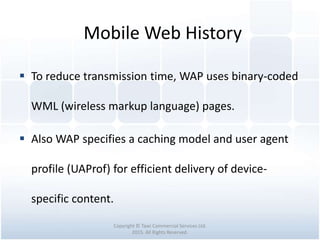
 To reduce transmission time, WAP uses binary-coded
WML (wireless markup language) pages.
 Also WAP specifies a caching model and user agent
profile (UAProf) for efficient delivery of device-
specific content.
Mobile Web History
Copyright © Tawi Commercial Services Ltd.
2015. All Rights Reserved.
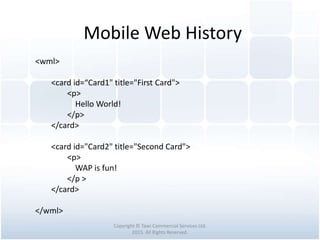
<wml>
<card id=“Card1" title="First Card">
<p>
Hello World!
</p>
</card>
<card id="Card2" title="Second Card">
<p>
WAP is fun!
</p >
</card>
</wml>
Mobile Web Standards
Copyright © Tawi Commercial Services Ltd.
2015. All Rights Reserved.
 Various standards involved in:
 Structure
 Presentation
 Client Side Scripting
Mobile Web Standards
Copyright © Tawi Commercial Services Ltd.
2015. All Rights Reserved.
 XML-formatted markup defines the document
structure
 Handsets may support WML, XHTML, HTML4, HTML5
in varying degrees
 These XML standards have various versions &
derivations
Mobile Web Standards
Copyright © Tawi Commercial Services Ltd.
2015. All Rights Reserved.
 Cascading Style Sheets (CSS) control the
presentation.
 Most XHTML-MP mobile browsers support Wireless
CSS, CSS Mobile Profile, and/or CSS 2.
 CSS 3 is new, coming along with HTML5
Mobile Web Standards
Copyright © Tawi Commercial Services Ltd.
2015. All Rights Reserved.
 Client-side scripting mainly through Javascript
 ECMAScript-MP or mobile JavaScript targets mobile
phones
 WMLScript is a scripting language which
complements WML.
Mobile Web Standards
Copyright © Tawi Commercial Services Ltd.
2015. All Rights Reserved.
 XHTML-MP (Extensible Hypertext Markup Language -
Mobile Profile) is a specialization XHTML designed to
incorporate features useful to mobile devices.
 XHTML-MP 1.0 was defined by the OMA and is
currently (2010) the best markup choice for HTML-
capable mobile browsers.
Mobile Web Standards
Copyright © Tawi Commercial Services Ltd.
2015. All Rights Reserved.
 Over time, OMA has developed XHTML-MP and now
has a proposed 1.2 version of its specification.
 XHTML-MP comes with a mobile-friendly means of
using CSS to separate presentation from the markup,
just like on the desktop.
Comparison with Desktop &
Mobile Apps
Copyright © Tawi Commercial Services Ltd.
2015. All Rights Reserved.
 Client side scripting (like Javascript, Java applets) &
AJAX usually not possible
 Does not require installation unlike apps; many
feature phones & smart phones have in-built
browsers
 Minimal or no client side caching
Comparison with Desktop &
Mobile Apps
Copyright © Tawi Commercial Services Ltd.
2015. All Rights Reserved.
 Mobile websites require much greater developer
understanding & attention to detail than Desktop
 Also may require use of proprietary technologies e.g.
for Content Adaptation
Best Practices
Copyright © Tawi Commercial Services Ltd.
2015. All Rights Reserved.
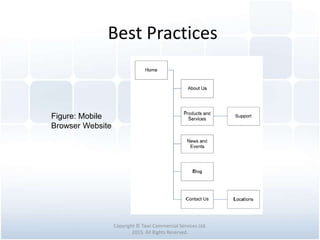
 While building the mobile information architecture,
think about users’ “click investment”
 You might also want to have condensed versions of
the stories.
 When presenting the information on a mobile device
you will probably want to change the navigation
structure
Best Practices
Copyright © Tawi Commercial Services Ltd.
2015. All Rights Reserved.
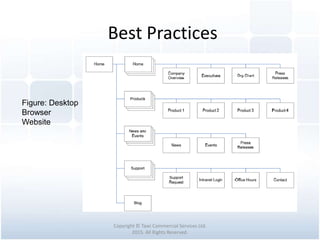
Figure: Desktop
Browser
Website
Best Practices
Copyright © Tawi Commercial Services Ltd.
2015. All Rights Reserved.
Figure: Mobile
Browser Website
Best Practices
Copyright © Tawi Commercial Services Ltd.
2015. All Rights Reserved.
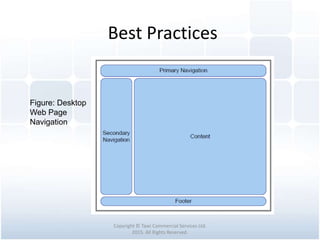
Figure: Desktop
Web Page
Navigation
Best Practices
Copyright © Tawi Commercial Services Ltd.
2015. All Rights Reserved.
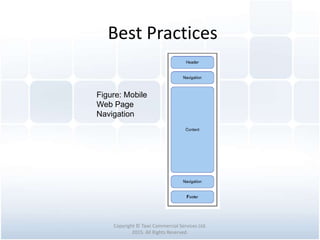
Figure: Mobile
Web Page
Navigation
Best Practices
Copyright © Tawi Commercial Services Ltd.
2015. All Rights Reserved.
 Content Adaptation – changing content to suit
mobiles
 A .mobi domain is recommended as a clear way to
indicate to the user that a site is mobile-friendly
 .mobi.ke is controlled by Kenic – in charge of country
code top-level domain (ccTLD) for Kenya
References
Copyright © Tawi Commercial Services Ltd.
2015. All Rights Reserved.
 Cremin R., Rabin, J., Fling B., Robinson D. K. (2007). DotMobi Mobile Web
Developer Guide. Dublin 1, Ireland: mobile Top Level Domain.
 Mehta N., (2008). Mobile Web Development: Building mobile websites,
SMS and MMS messaging, mobile payments, and automated voice call
systems with XHTML MP, WCSS, and mobile AJAX. Birmingham, B27 6PA,
UK: Packt Publishing
 Frederick G.R., Lal R., (2009). Beginning Smartphone Web Development:
Building JavaScript, CSS, HTML and Ajax-based Applications for iPhone,
Android, Palm Pre, BlackBerry, Windows Mobile, and Nokia S60. United
States of America: Paul Manning
The End
Michael Wakahe
michael@tawi.mobi
+254 (0) 20 239 3052
www.tawi.mobi

Mobile Website Development

  • 1.
    MOBILE WEBSITE DEVELOPMENT MobileBoot Camp Presented by: Michael Wakahe Tawi Commercial Services Ltd Nov 18th 2010
  • 2.
    Table of Contents Copyright© Tawi Commercial Services Ltd. 2015. All Rights Reserved.  The Need for Mobile Web  Mobile Web History  Mobile Web Standards  Comparison with Desktop & Mobile Apps  Best Practices
  • 3.
    The Need forMobile Web Copyright © Tawi Commercial Services Ltd. 2015. All Rights Reserved.  Limitations of mobile phones  Limited Processor Power and Memory  Limited Battery Life  Limited Input and Output Facilities  Low Bandwidth  Unpredictable Availability and Stability
  • 4.
    The Need forMobile Web Copyright © Tawi Commercial Services Ltd. 2015. All Rights Reserved.  TCP/IP protocol suite was not designed for a wireless environment  Bandwidth resource is expensive  HTML pages are not suitable for use in mobile devices with limited processor power and screen.
  • 5.
    Mobile Web History Copyright© Tawi Commercial Services Ltd. 2015. All Rights Reserved.  Wireless Application Protocol (WAP) Forum was founded in 1997 by Ericsson, Motorola, Nokia, and Phone.com.  WAP 1.1 was published in 1999  WAP 2.0 was published in 2001
  • 6.
    Mobile Web History Copyright© Tawi Commercial Services Ltd. 2015. All Rights Reserved.  In 2002, the WAP Forum consolidated into the Open Mobile Alliance (OMA) and the specification work from WAP continues within OMA
  • 7.
    Mobile Web History Copyright© Tawi Commercial Services Ltd. 2015. All Rights Reserved.  WAP is designed with two main goals  to minimize bandwidth requirement  to maximize the number of supported network types (e.g., 9.6 Kbps in GSM).
  • 8.
    Mobile Web History Copyright© Tawi Commercial Services Ltd. 2015. All Rights Reserved.  WAP protocol stack is a lightweight protocol stack that is designed to address the limitations of wireless devices and the wireless network.  To access ordinary web servers, WAP-enabled mobile devices can rely on a WAP gateway to provide protocol conversion between WWW protocol stack and WAP protocol stack.
  • 9.
    Mobile Web History Copyright© Tawi Commercial Services Ltd. 2015. All Rights Reserved.  WAP tries to utilize existing Internet protocols and standards as much as possible  For example XML, HTML, HTTP & TLS
  • 10.
    Mobile Web History Copyright© Tawi Commercial Services Ltd. 2015. All Rights Reserved.  To reduce transmission time, WAP uses binary-coded WML (wireless markup language) pages.  Also WAP specifies a caching model and user agent profile (UAProf) for efficient delivery of device- specific content.
  • 11.
    Mobile Web History Copyright© Tawi Commercial Services Ltd. 2015. All Rights Reserved. <wml> <card id=“Card1" title="First Card"> <p> Hello World! </p> </card> <card id="Card2" title="Second Card"> <p> WAP is fun! </p > </card> </wml>
  • 12.
    Mobile Web Standards Copyright© Tawi Commercial Services Ltd. 2015. All Rights Reserved.  Various standards involved in:  Structure  Presentation  Client Side Scripting
  • 13.
    Mobile Web Standards Copyright© Tawi Commercial Services Ltd. 2015. All Rights Reserved.  XML-formatted markup defines the document structure  Handsets may support WML, XHTML, HTML4, HTML5 in varying degrees  These XML standards have various versions & derivations
  • 14.
    Mobile Web Standards Copyright© Tawi Commercial Services Ltd. 2015. All Rights Reserved.  Cascading Style Sheets (CSS) control the presentation.  Most XHTML-MP mobile browsers support Wireless CSS, CSS Mobile Profile, and/or CSS 2.  CSS 3 is new, coming along with HTML5
  • 15.
    Mobile Web Standards Copyright© Tawi Commercial Services Ltd. 2015. All Rights Reserved.  Client-side scripting mainly through Javascript  ECMAScript-MP or mobile JavaScript targets mobile phones  WMLScript is a scripting language which complements WML.
  • 16.
    Mobile Web Standards Copyright© Tawi Commercial Services Ltd. 2015. All Rights Reserved.  XHTML-MP (Extensible Hypertext Markup Language - Mobile Profile) is a specialization XHTML designed to incorporate features useful to mobile devices.  XHTML-MP 1.0 was defined by the OMA and is currently (2010) the best markup choice for HTML- capable mobile browsers.
  • 17.
    Mobile Web Standards Copyright© Tawi Commercial Services Ltd. 2015. All Rights Reserved.  Over time, OMA has developed XHTML-MP and now has a proposed 1.2 version of its specification.  XHTML-MP comes with a mobile-friendly means of using CSS to separate presentation from the markup, just like on the desktop.
  • 18.
    Comparison with Desktop& Mobile Apps Copyright © Tawi Commercial Services Ltd. 2015. All Rights Reserved.  Client side scripting (like Javascript, Java applets) & AJAX usually not possible  Does not require installation unlike apps; many feature phones & smart phones have in-built browsers  Minimal or no client side caching
  • 19.
    Comparison with Desktop& Mobile Apps Copyright © Tawi Commercial Services Ltd. 2015. All Rights Reserved.  Mobile websites require much greater developer understanding & attention to detail than Desktop  Also may require use of proprietary technologies e.g. for Content Adaptation
  • 20.
    Best Practices Copyright ©Tawi Commercial Services Ltd. 2015. All Rights Reserved.  While building the mobile information architecture, think about users’ “click investment”  You might also want to have condensed versions of the stories.  When presenting the information on a mobile device you will probably want to change the navigation structure
  • 21.
    Best Practices Copyright ©Tawi Commercial Services Ltd. 2015. All Rights Reserved. Figure: Desktop Browser Website
  • 22.
    Best Practices Copyright ©Tawi Commercial Services Ltd. 2015. All Rights Reserved. Figure: Mobile Browser Website
  • 23.
    Best Practices Copyright ©Tawi Commercial Services Ltd. 2015. All Rights Reserved. Figure: Desktop Web Page Navigation
  • 24.
    Best Practices Copyright ©Tawi Commercial Services Ltd. 2015. All Rights Reserved. Figure: Mobile Web Page Navigation
  • 25.
    Best Practices Copyright ©Tawi Commercial Services Ltd. 2015. All Rights Reserved.  Content Adaptation – changing content to suit mobiles  A .mobi domain is recommended as a clear way to indicate to the user that a site is mobile-friendly  .mobi.ke is controlled by Kenic – in charge of country code top-level domain (ccTLD) for Kenya
  • 26.
    References Copyright © TawiCommercial Services Ltd. 2015. All Rights Reserved.  Cremin R., Rabin, J., Fling B., Robinson D. K. (2007). DotMobi Mobile Web Developer Guide. Dublin 1, Ireland: mobile Top Level Domain.  Mehta N., (2008). Mobile Web Development: Building mobile websites, SMS and MMS messaging, mobile payments, and automated voice call systems with XHTML MP, WCSS, and mobile AJAX. Birmingham, B27 6PA, UK: Packt Publishing  Frederick G.R., Lal R., (2009). Beginning Smartphone Web Development: Building JavaScript, CSS, HTML and Ajax-based Applications for iPhone, Android, Palm Pre, BlackBerry, Windows Mobile, and Nokia S60. United States of America: Paul Manning
  • 27.
    The End Michael Wakahe michael@tawi.mobi +254(0) 20 239 3052 www.tawi.mobi