Niso forum mobile technologies in libraries May 20, 2011 Mobile reading comes of age
Today’ s presentation A mobile context Current options for mobile content consumption Expected developments Implications for content creation and management
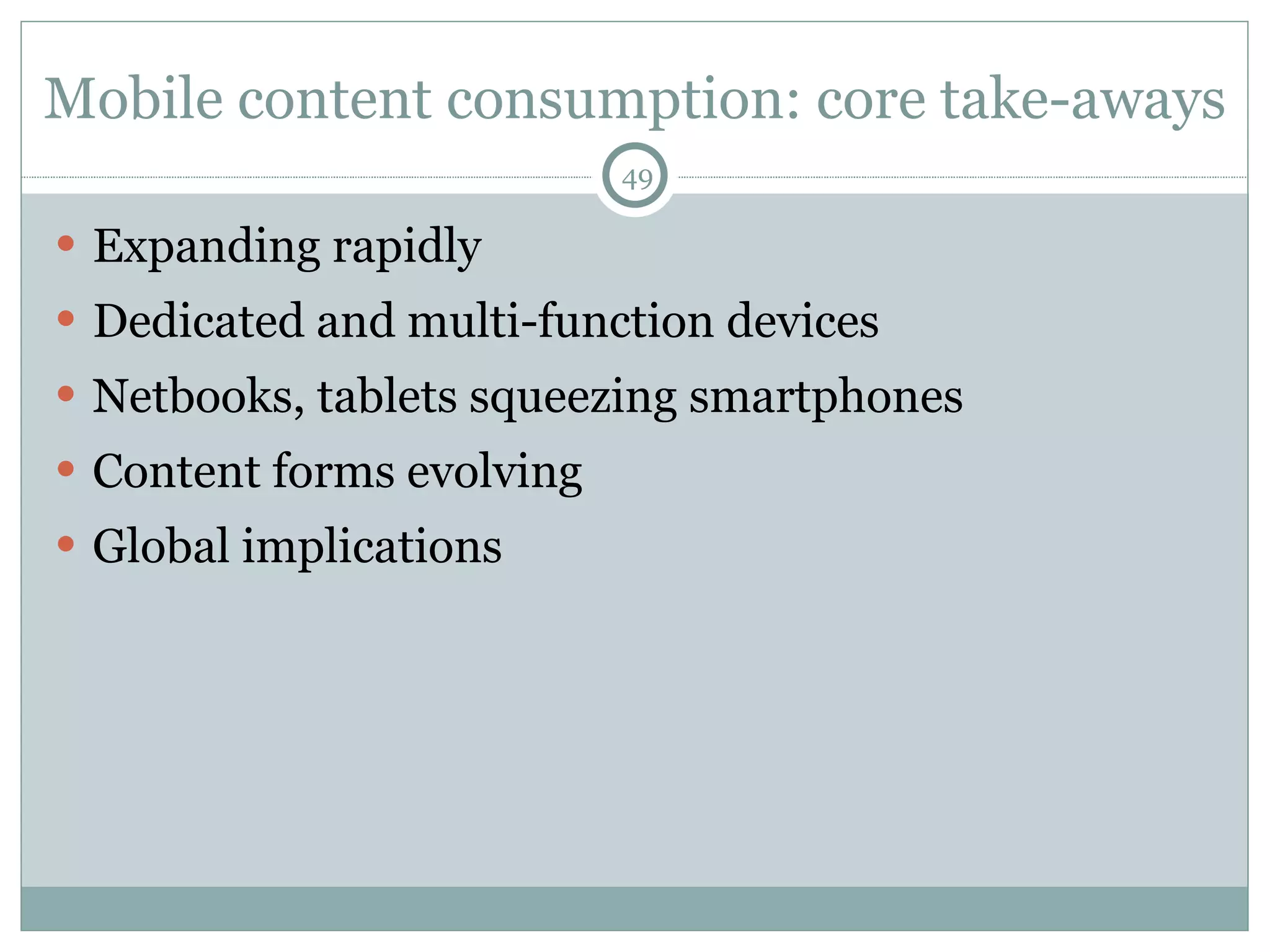
Mobile content consumption: core take-aways Expanding rapidly Dedicated and multi-function devices Netbooks, tablets squeezing smartphones Content forms evolving Global implications
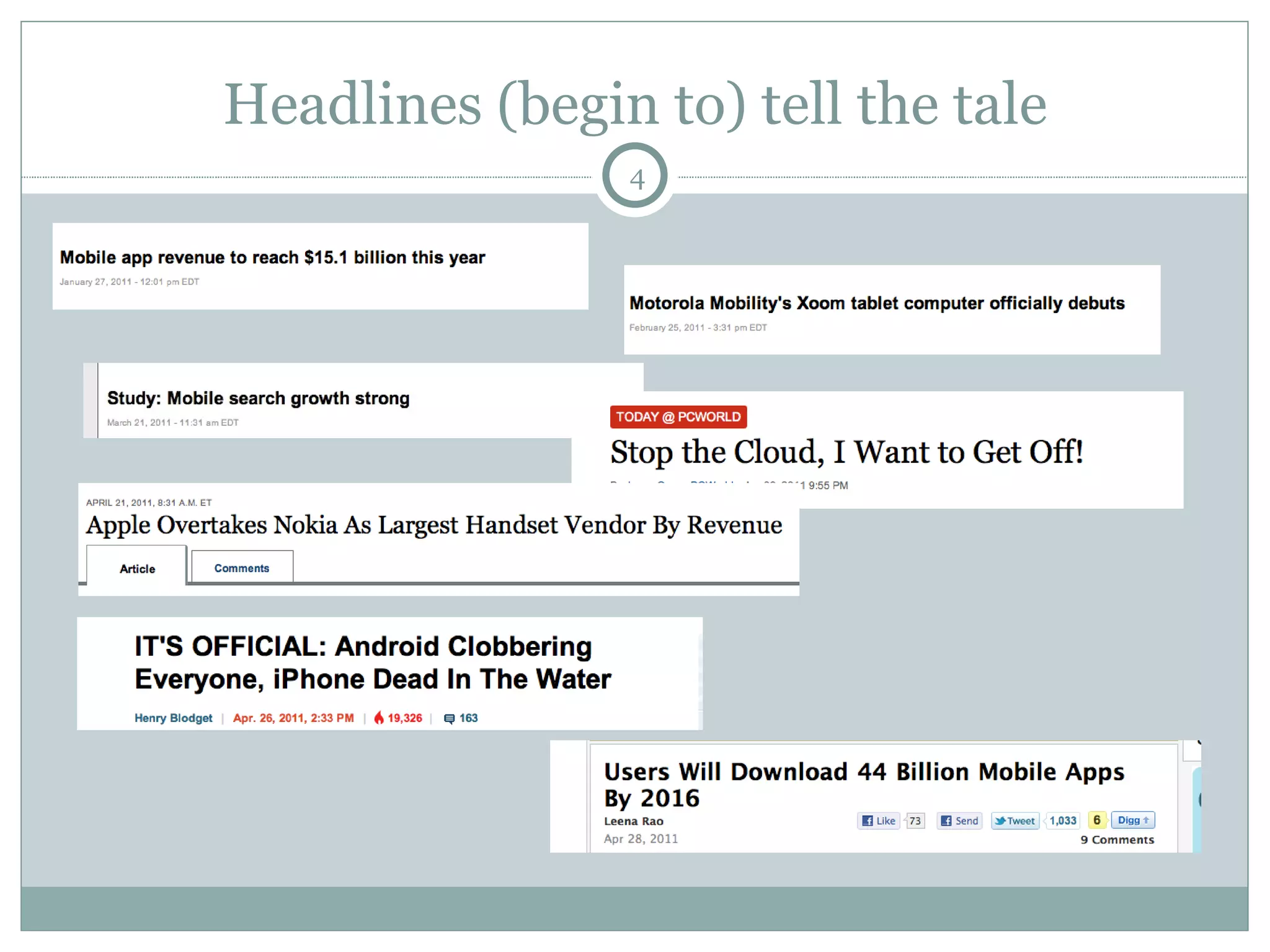
Headlines (begin to) tell the tale
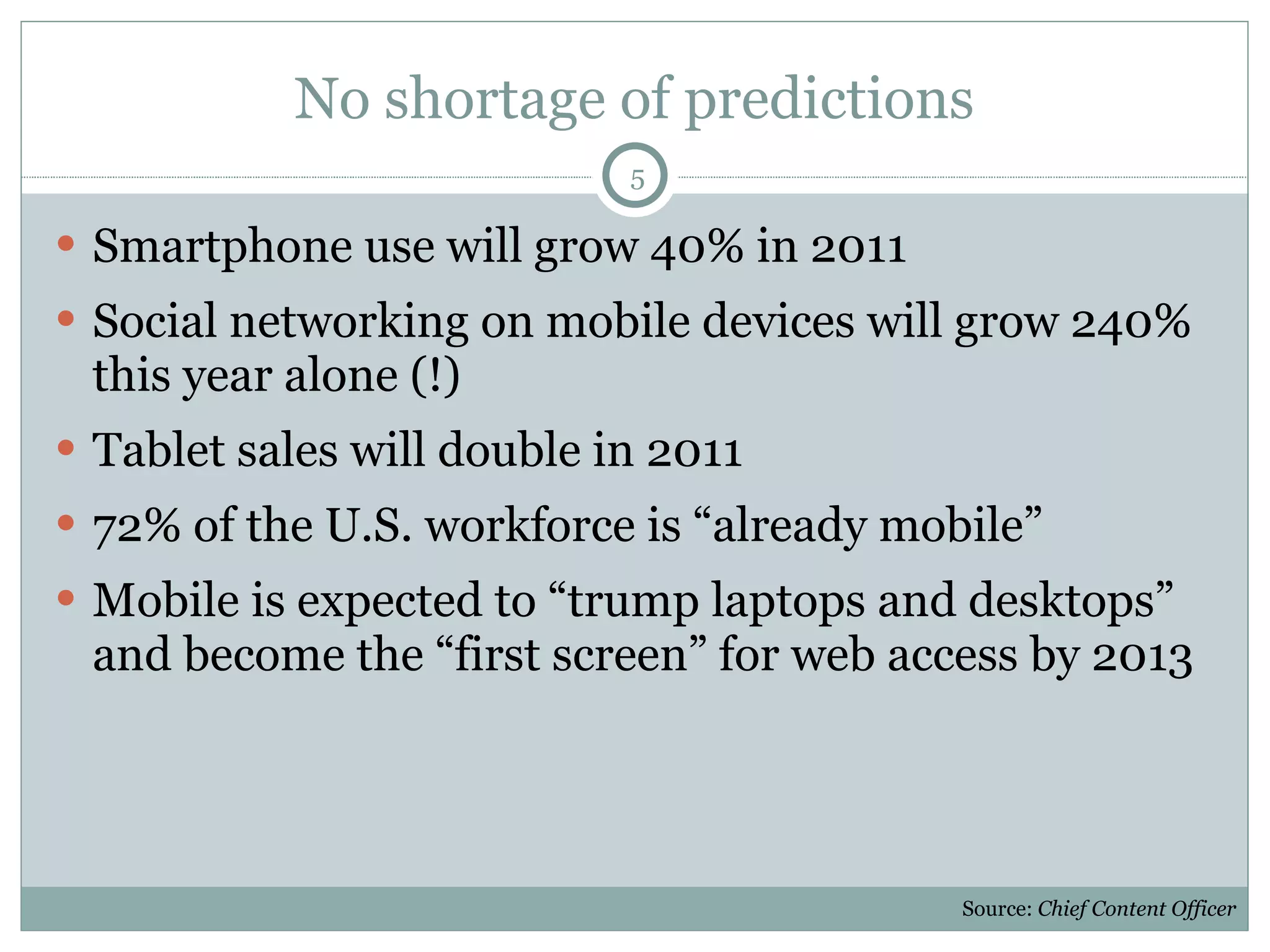
No shortage of predictions Smartphone use will grow 40% in 2011 Social networking on mobile devices will grow 240% this year alone (!) Tablet sales will double in 2011 72% of the U.S. workforce is “already mobile” Mobile is expected to “trump laptops and desktops” and become the “first screen” for web access by 2013 Source:  Chief Content Officer
Already: iPad eating away at print news University of Missouri survey of 1,600 iPad users 84.4% cited “following current events” as a primary use for their iPad [good news] Almost half claimed an hour or more per day is spent reading news Of those heavy news consumers, 58% said they were likely to cancel print; 10% had already cancelled Key factor: price [bad news] Sources: Journalism Institute at the University of Missouri;  Macworld  March 2011
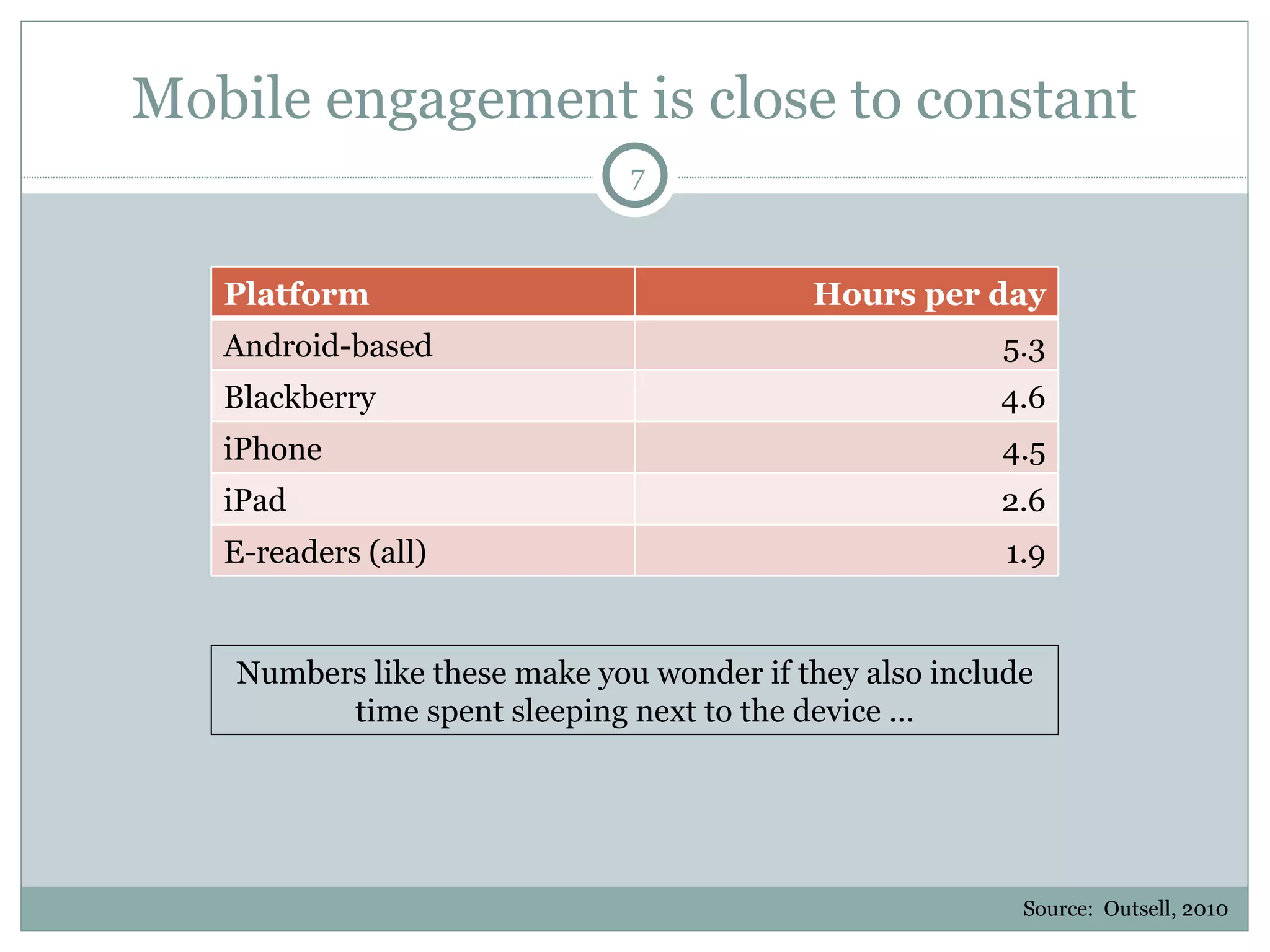
Mobile engagement is close to constant Source:  Outsell, 2010 Numbers like these make you wonder if they also include time spent sleeping next to the device … Platform Hours per day Android-based 5.3 Blackberry 4.6 iPhone 4.5 iPad 2.6 E-readers (all) 1.9
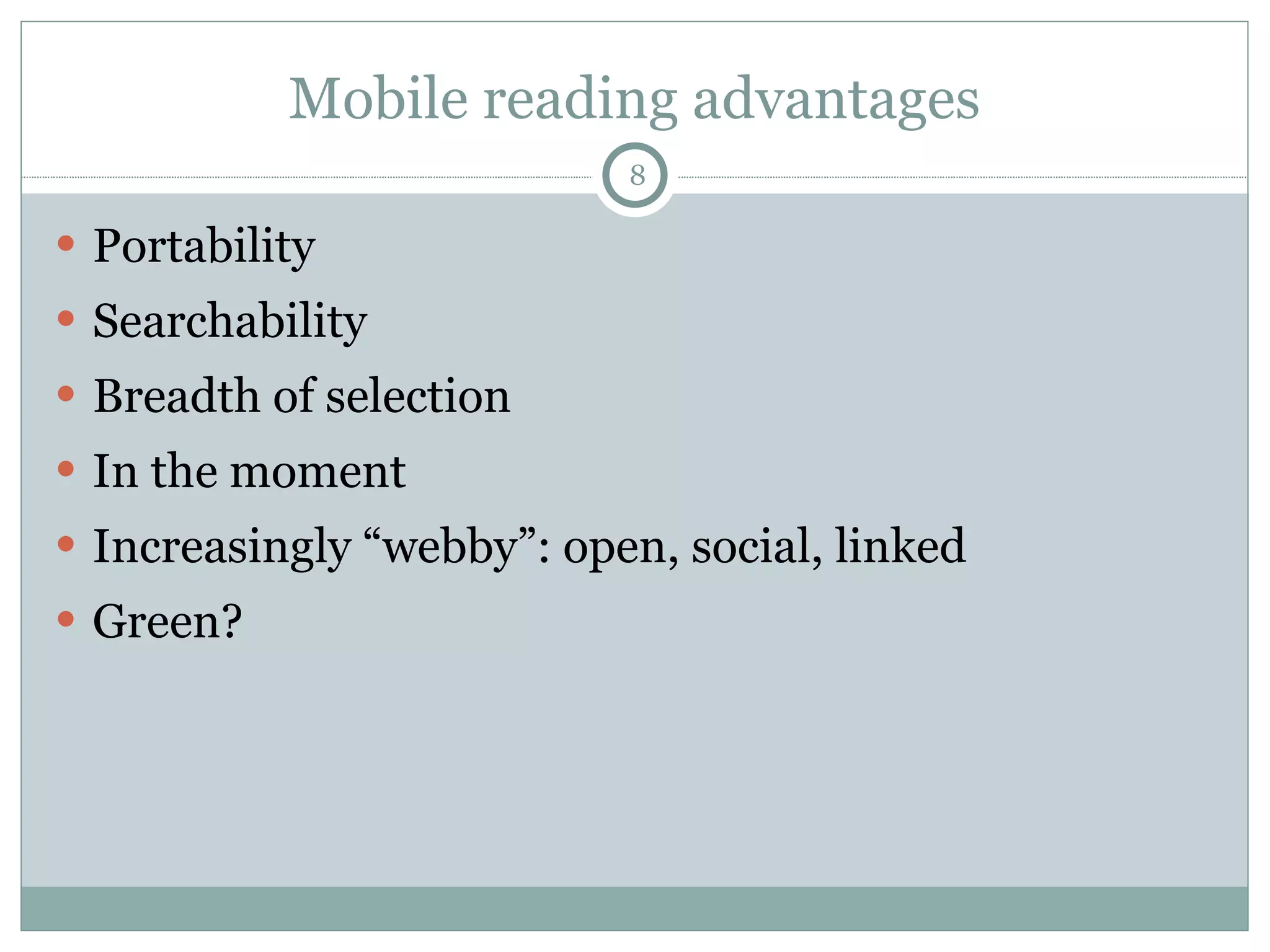
Mobile reading advantages Portability Searchability Breadth of selection In the moment Increasingly  “webby”: open, social, linked Green?
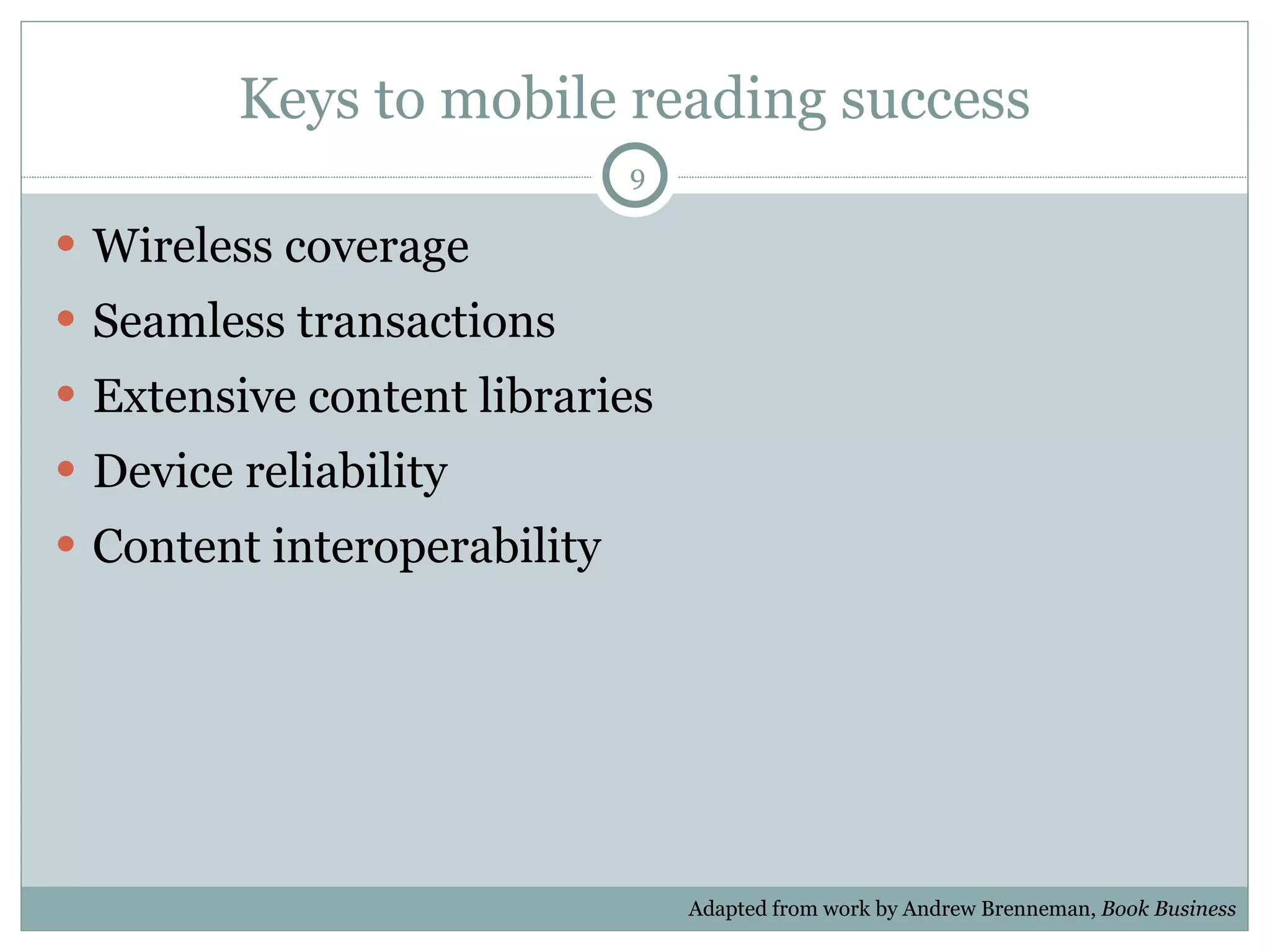
Keys to mobile reading success Wireless coverage Seamless transactions Extensive content libraries Device reliability Content interoperability Adapted from work by Andrew Brenneman,  Book Business
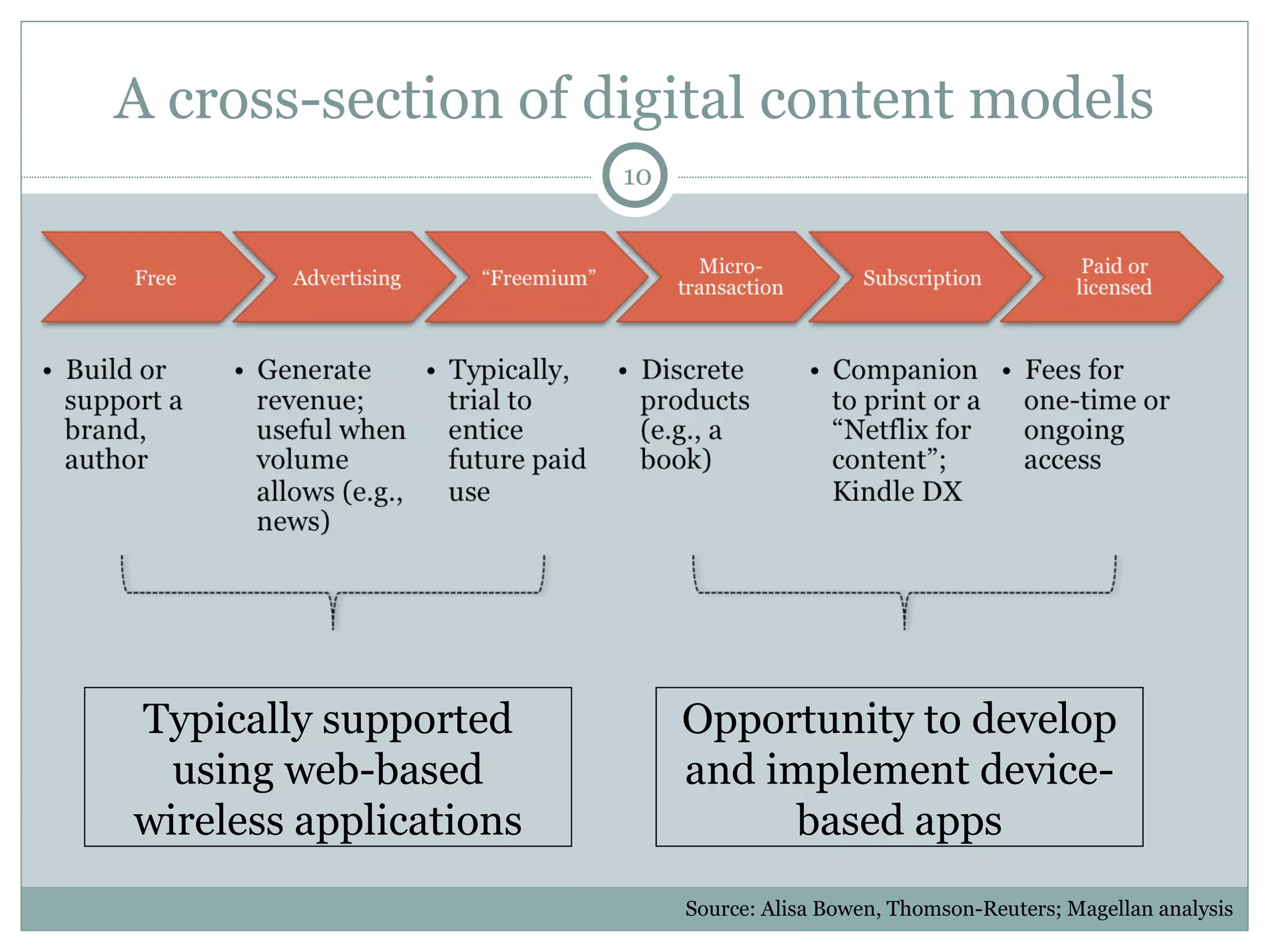
A cross-section of digital content models Typically supported using web-based wireless applications Opportunity to develop and implement device-based apps Source: Alisa Bowen, Thomson-Reuters; Magellan analysis
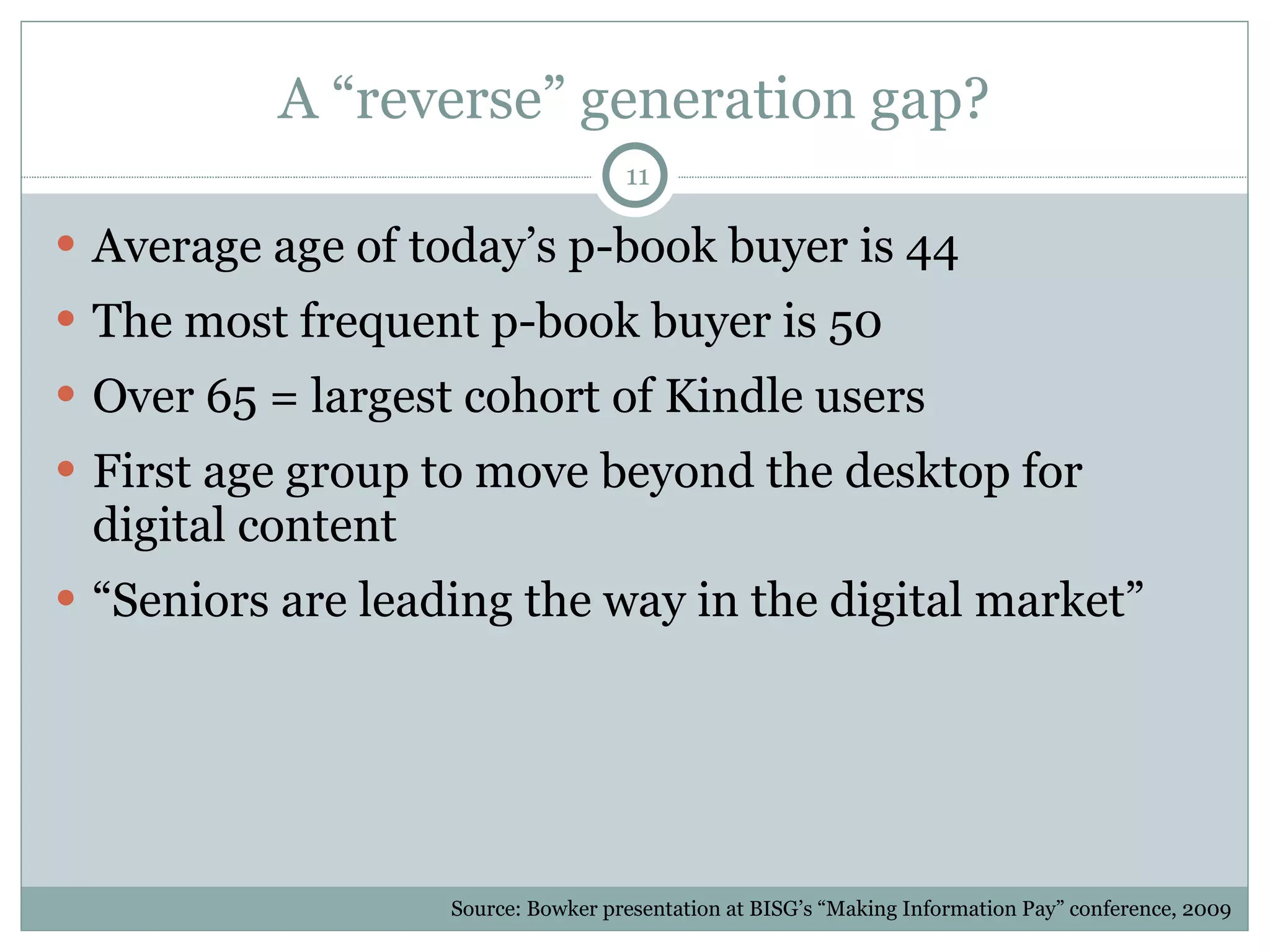
A  “reverse” generation gap? Average age of today’ s p-book buyer is 44 The most frequent p-book buyer is 50 Over 65 = largest cohort of Kindle users First age group to move beyond the desktop for digital content “ Seniors are leading the way in the digital market” Source: Bowker presentation at BISG’s “Making Information Pay” conference, 2009
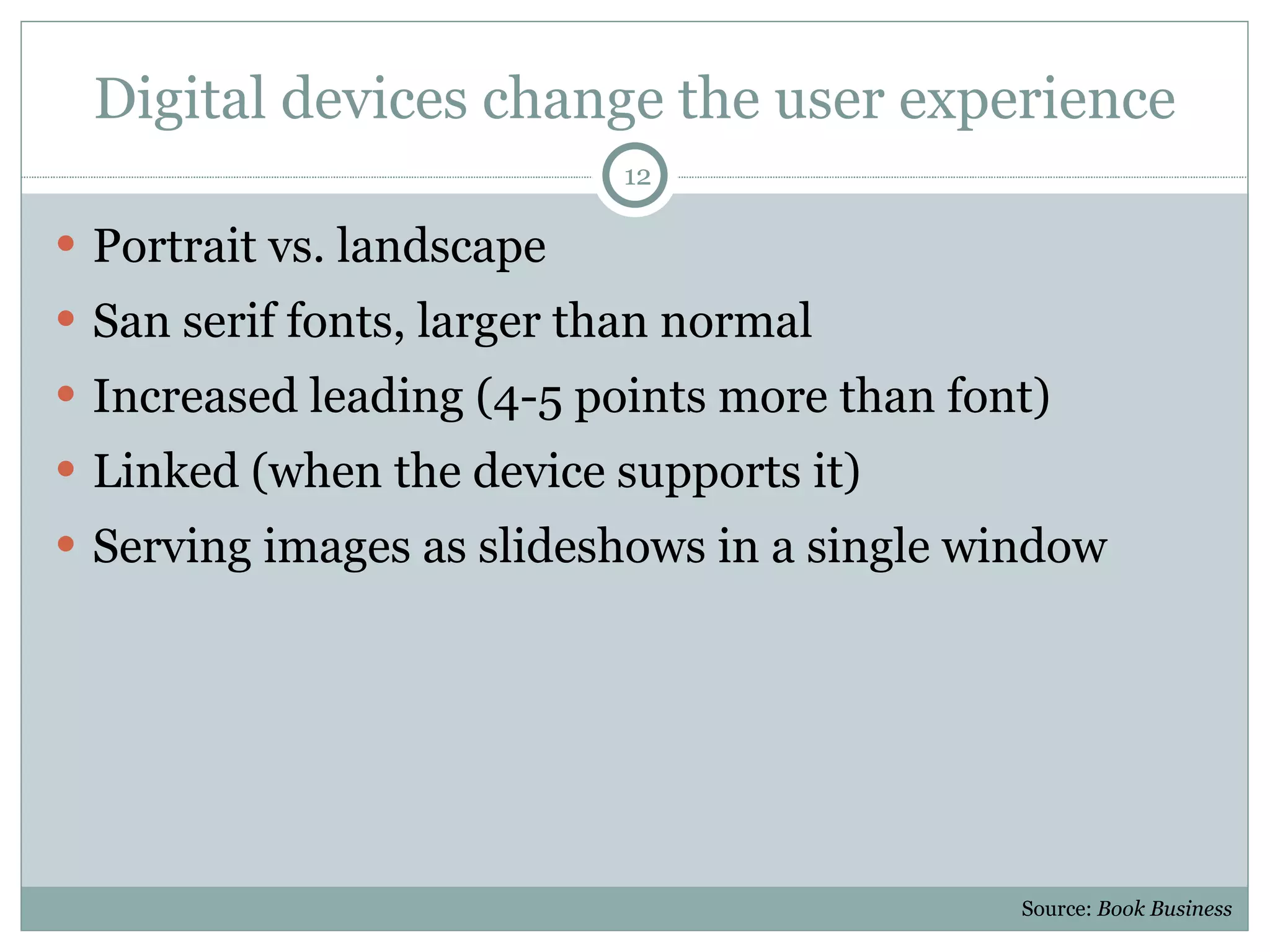
Digital devices change the user experience Portrait vs. landscape San serif fonts, larger than normal Increased leading (4-5 points more than font) Linked (when the device supports it) Serving images as slideshows in a single window Source:  Book Business
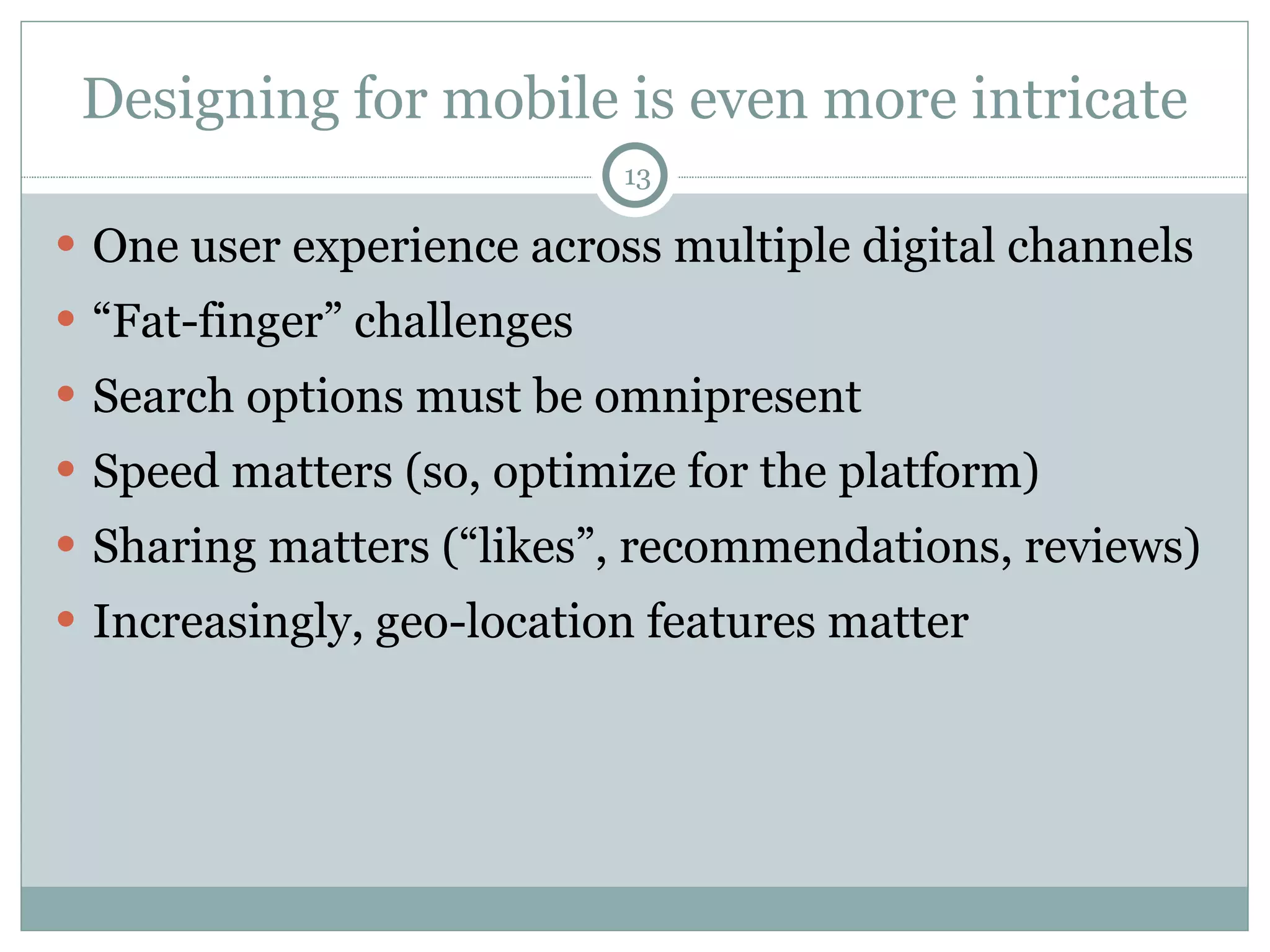
Designing for mobile is even more intricate One user experience across multiple digital channels “ Fat-finger” challenges Search options must be omnipresent Speed matters (so, optimize for the platform) Sharing matters (“likes”, recommendations, reviews) Increasingly, geo-location features matter
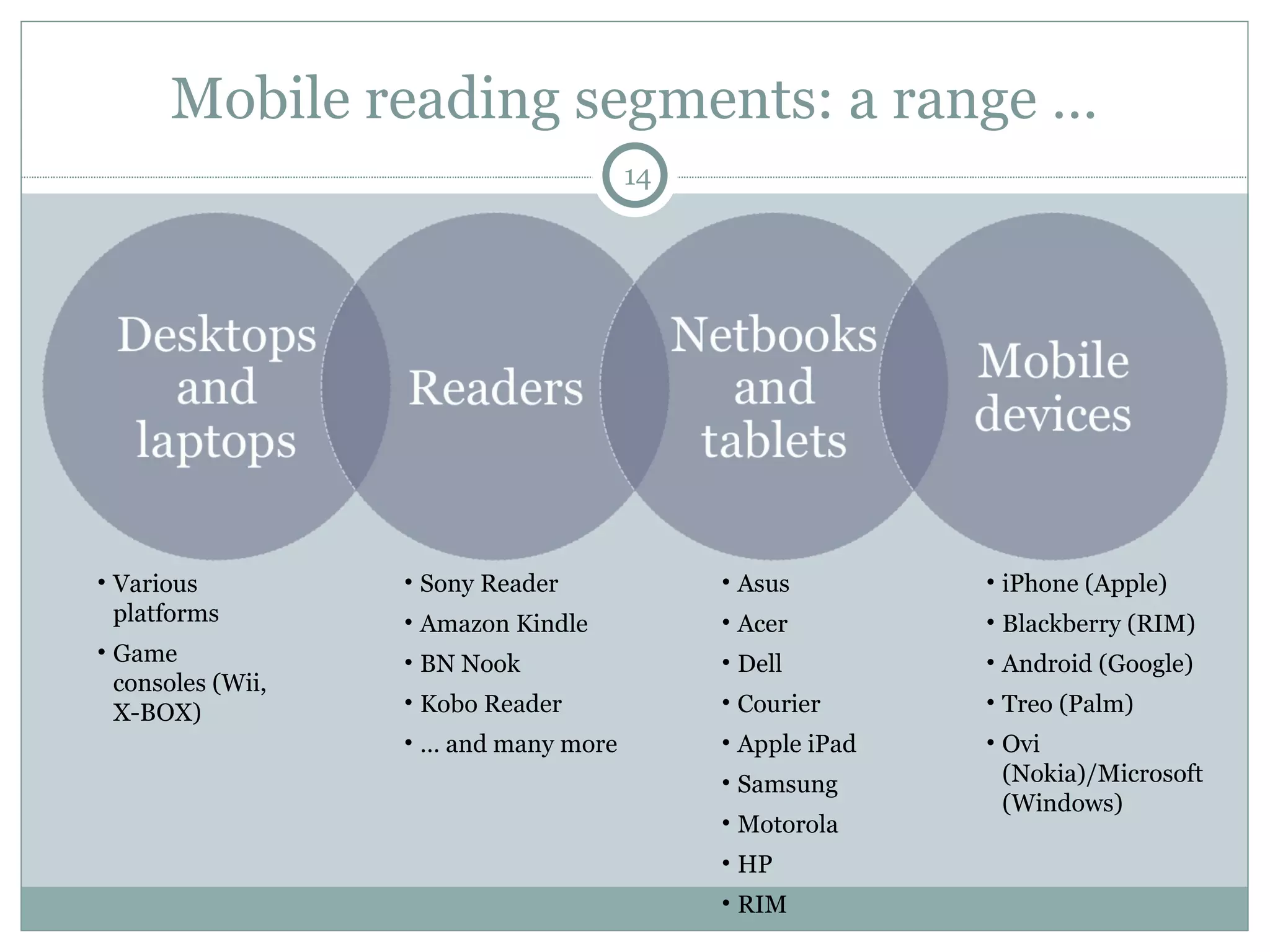
Mobile reading segments: a range … Various platforms Game consoles (Wii, X-BOX) Sony Reader Amazon Kindle BN Nook Kobo Reader …  and many more iPhone (Apple) Blackberry (RIM) Android (Google) Treo (Palm) Ovi (Nokia)/Microsoft (Windows) Asus Acer Dell Courier Apple iPad Samsung Motorola HP RIM
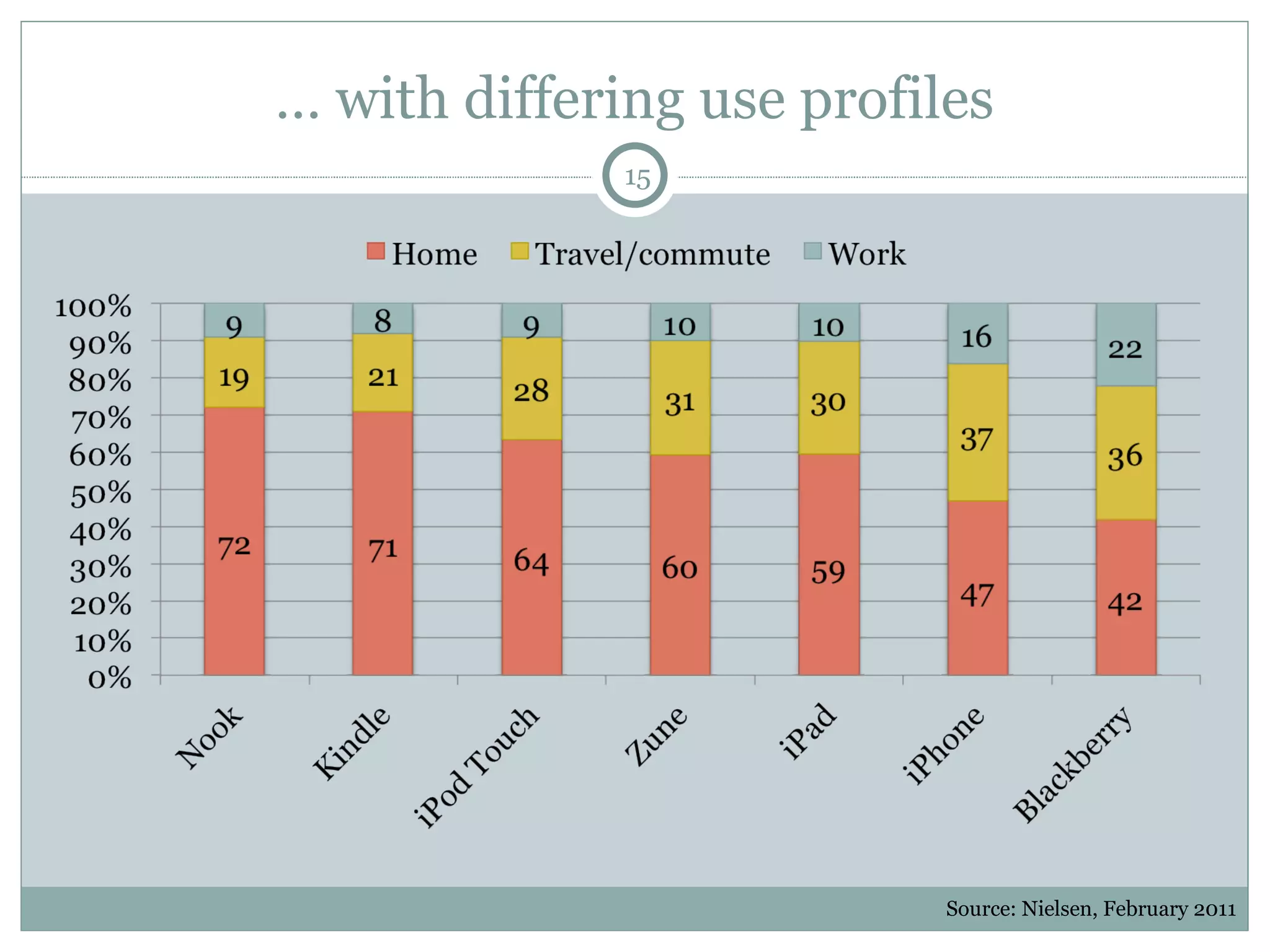
… with differing use profiles Source: Nielsen, February 2011
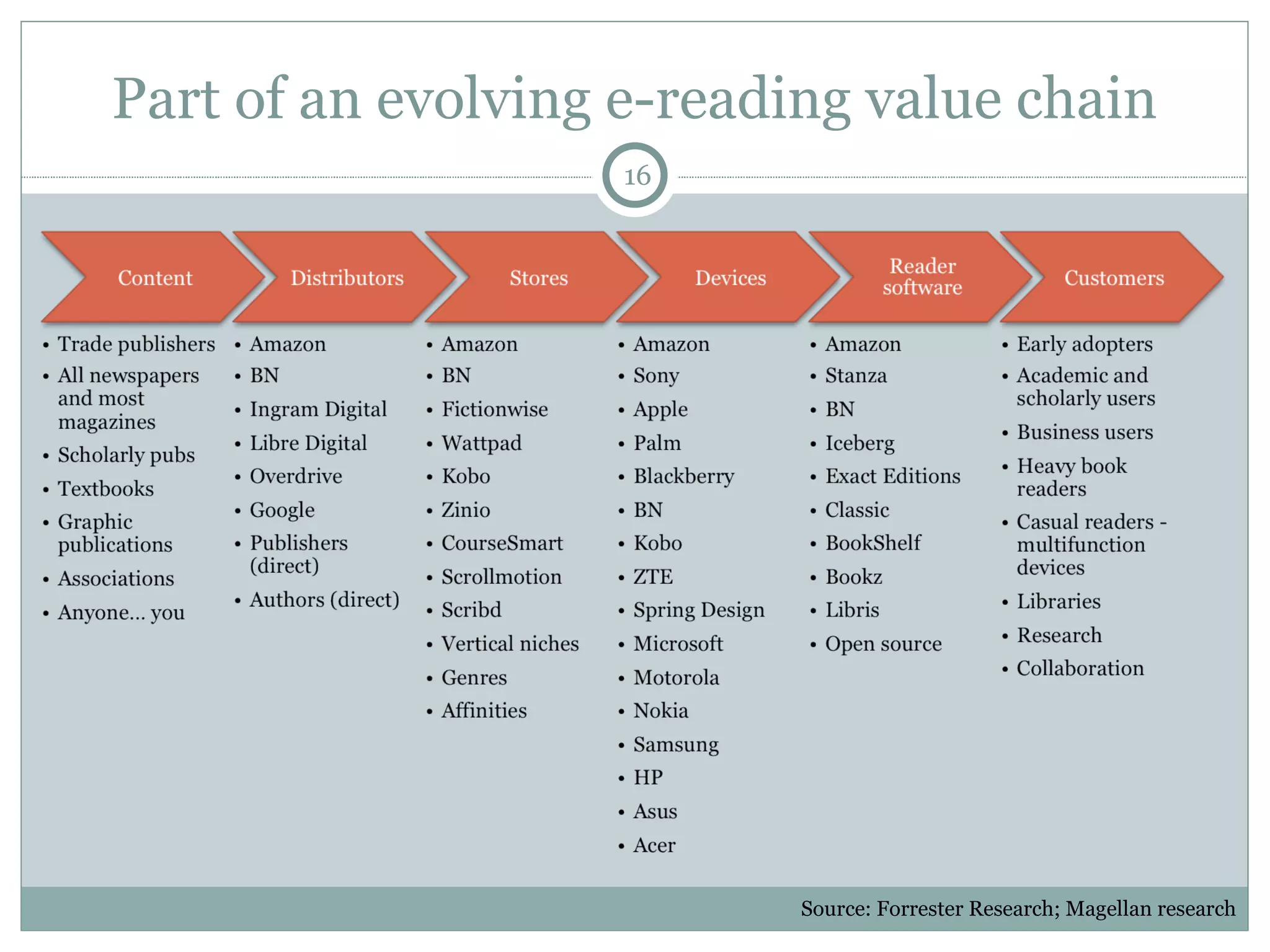
Part of an evolving e-reading value chain Source: Forrester Research; Magellan research
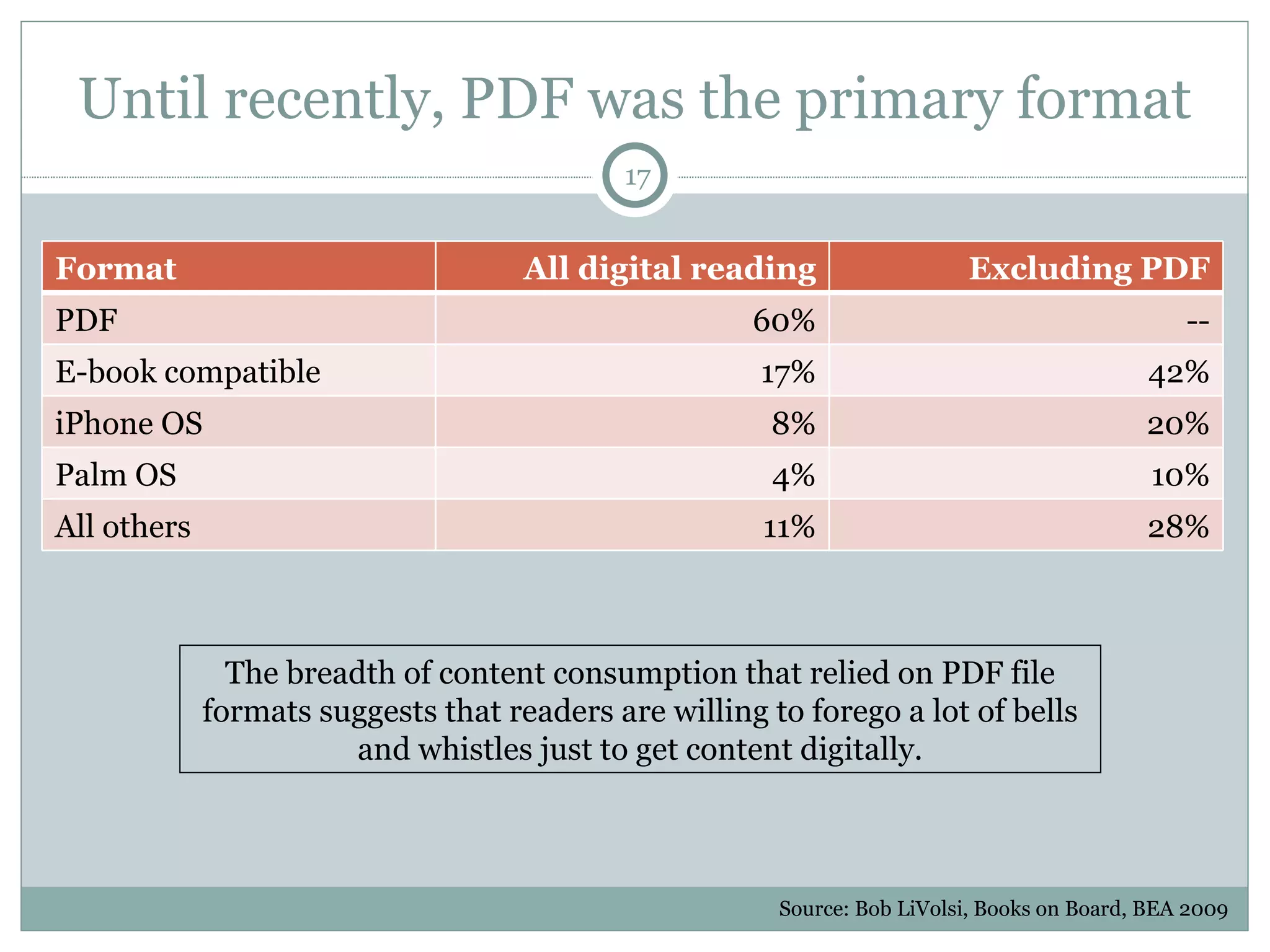
Until recently, PDF was the primary format The breadth of content consumption that relied on PDF file formats suggests that readers are willing to forego a lot of bells and whistles just to get content digitally. Source: Bob LiVolsi, Books on Board, BEA 2009 Format All digital reading Excluding PDF PDF 60% -- E-book compatible 17% 42% iPhone OS 8% 20% Palm OS 4% 10% All others 11% 28%
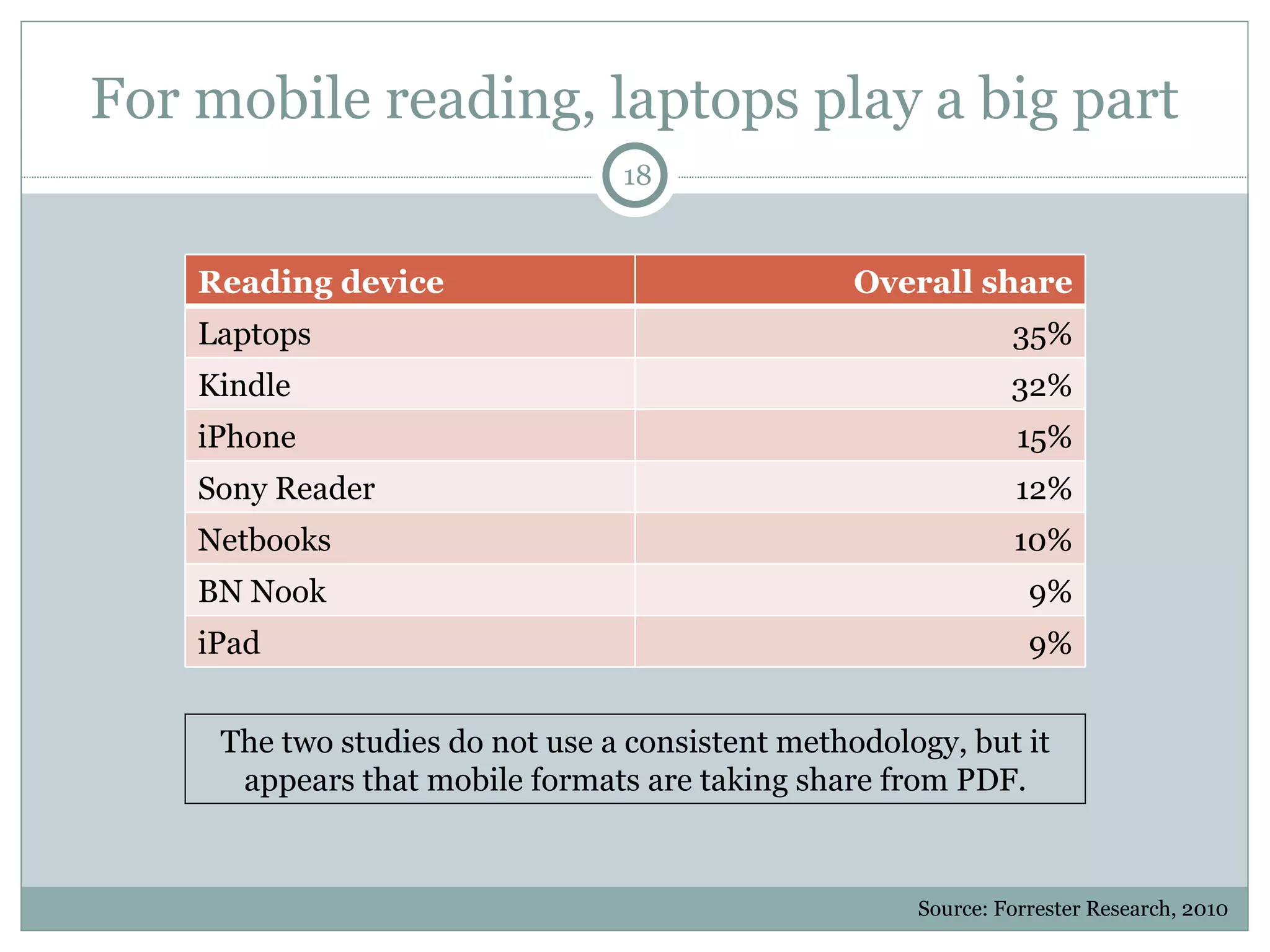
For mobile reading, laptops play a big part Source: Forrester Research, 2010 The two studies do not use a consistent methodology, but it appears that mobile formats are taking share from PDF. Reading device Overall share Laptops 35% Kindle 32% iPhone 15% Sony Reader 12% Netbooks 10% BN Nook 9% iPad 9%
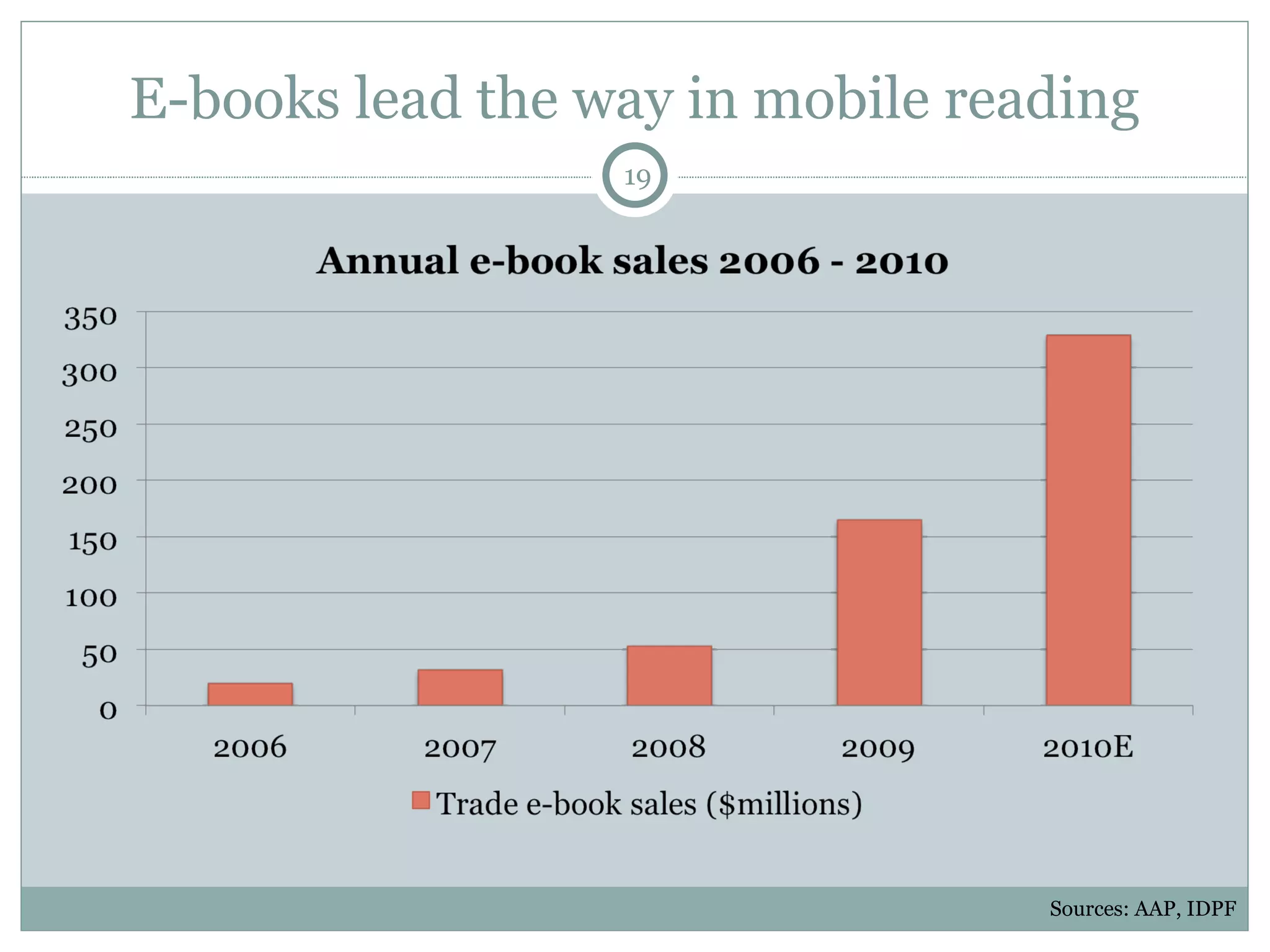
E-books lead the way in mobile reading Sources: AAP, IDPF
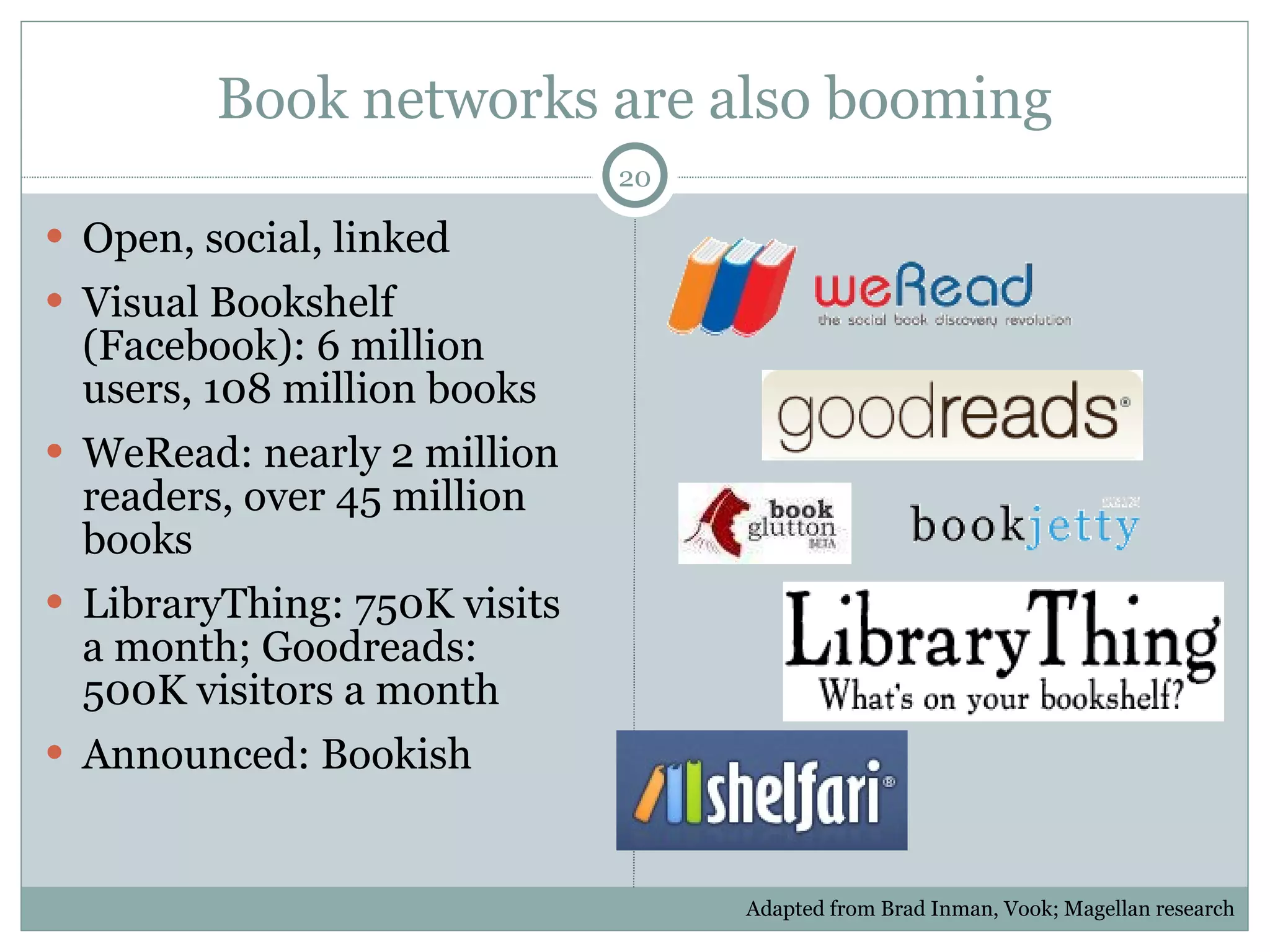
Book networks are also booming Open, social, linked Visual Bookshelf (Facebook): 6 million users, 108 million books WeRead: nearly 2 million readers, over 45 million books LibraryThing: 750K visits a month; Goodreads: 500K visitors a month Announced: Bookish Adapted from Brad Inman, Vook; Magellan research
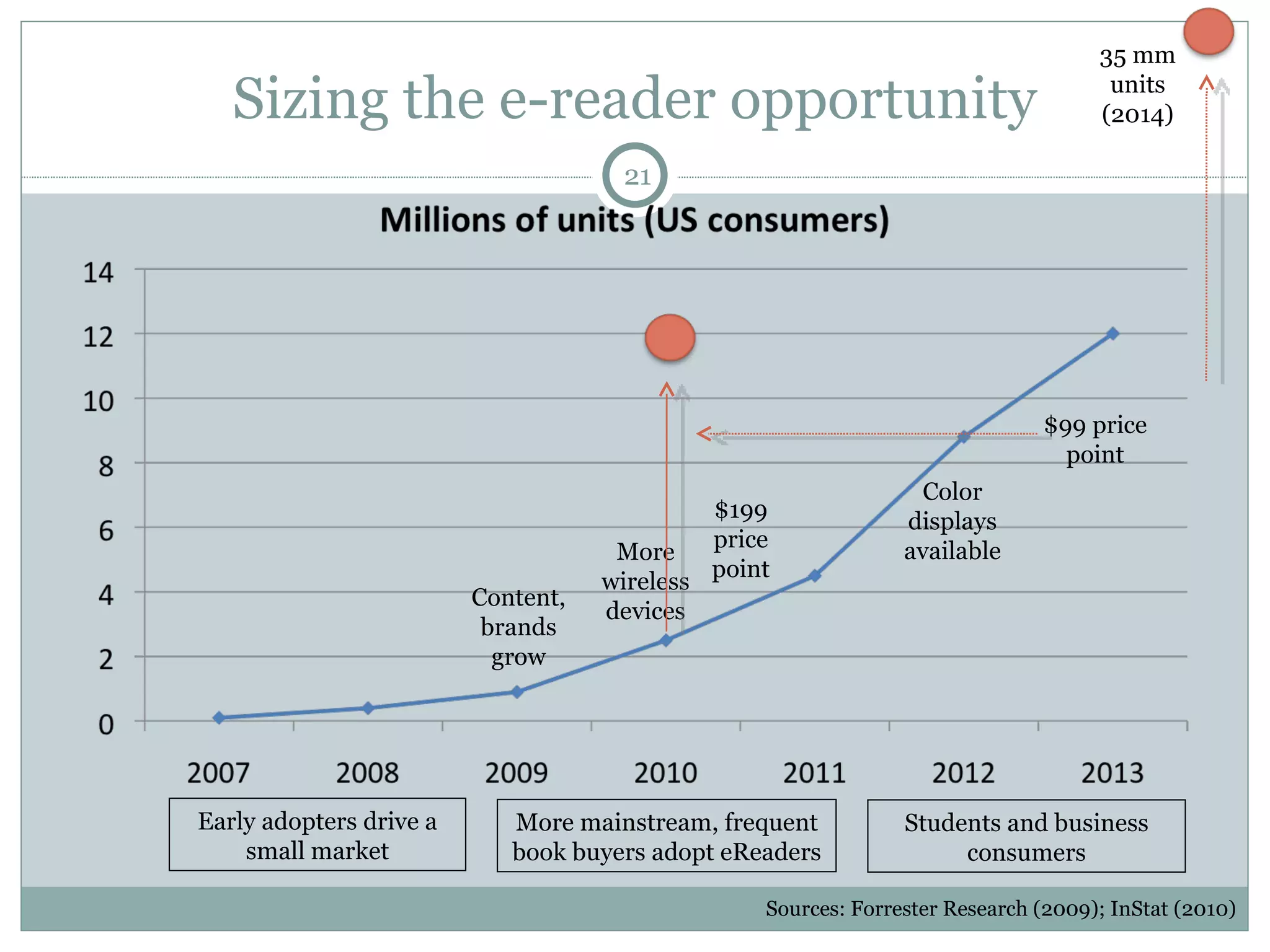
Sizing the e-reader opportunity $199 price point $99 price point More wireless devices Color displays available Content, brands grow Early adopters drive a small market More mainstream, frequent book buyers adopt eReaders Students and business consumers Sources: Forrester Research (2009); InStat (2010) 35 mm units (2014)
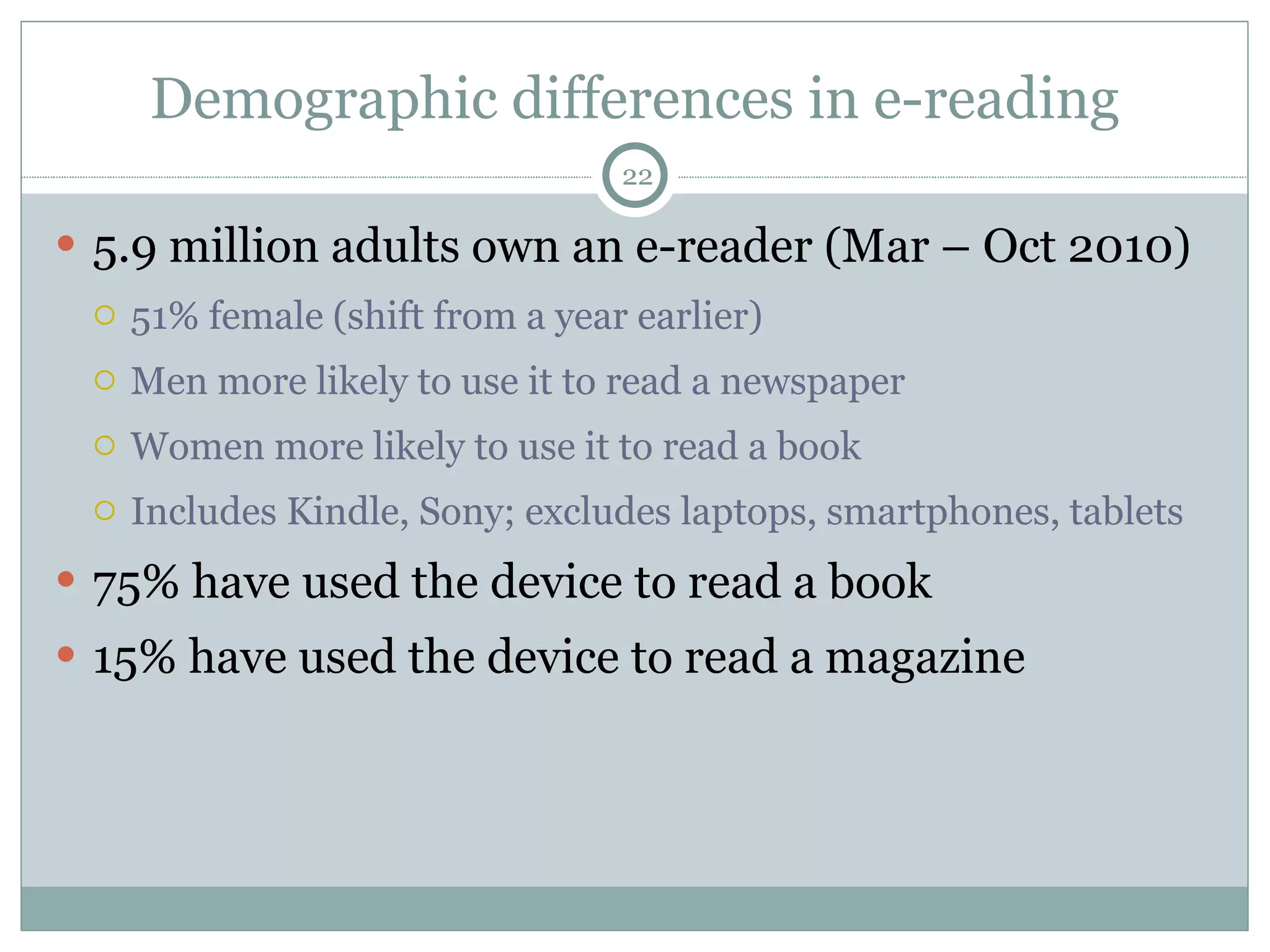
Demographic differences in e-reading 5.9 million adults own an e-reader (Mar – Oct 2010) 51% female (shift from a year earlier) Men more likely to use it to read a newspaper Women more likely to use it to read a book Includes Kindle, Sony; excludes laptops, smartphones, tablets 75% have used the device to read a book 15% have used the device to read a magazine
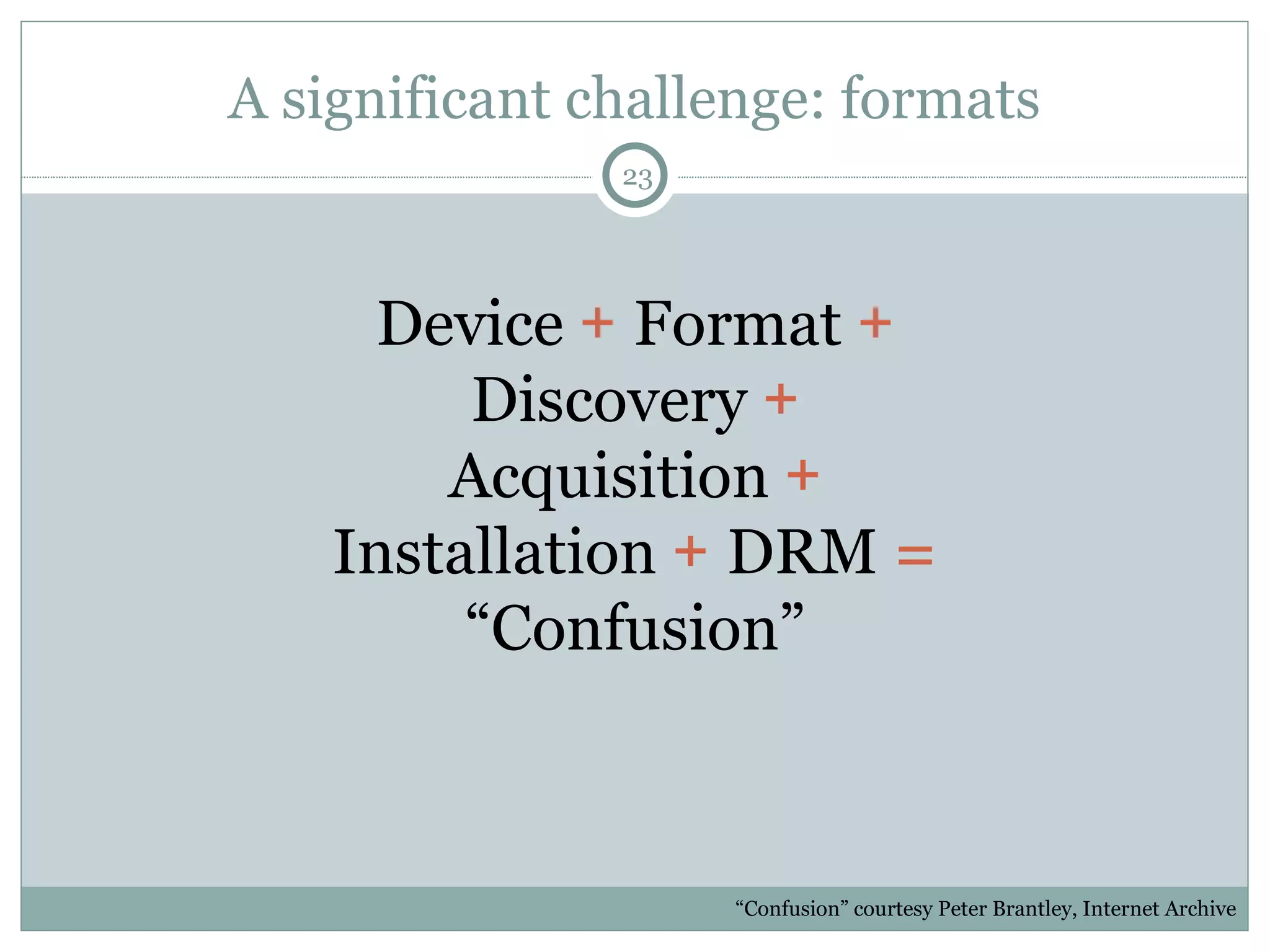
A significant challenge: formats Device  +  Format  +  Discovery  +  Acquisition  +  Installation  +  DRM  =  “Confusion” “ Confusion” courtesy Peter Brantley, Internet Archive
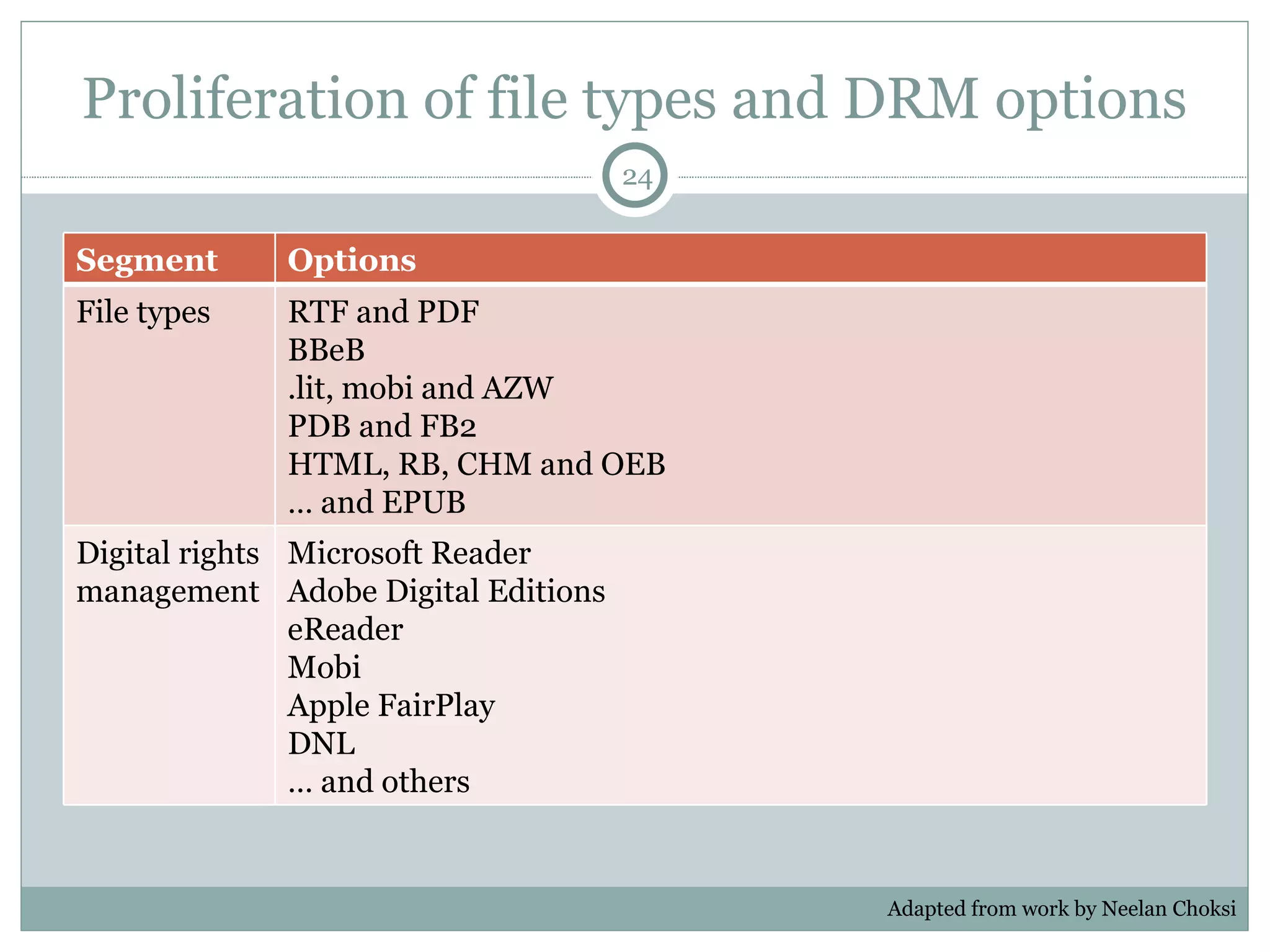
Proliferation of file types and DRM options Adapted from work by Neelan Choksi Segment Options File types RTF and PDF BBeB .lit, mobi and AZW PDB and FB2 HTML, RB, CHM and OEB …  and EPUB Digital rights management Microsoft Reader Adobe Digital Editions eReader Mobi Apple FairPlay DNL …  and others
A format/DRM example Source: Fictionwise.com FAQ Explanation “ What formats are available for Secure Mobipocket Format eBooks and what devices can I read them on?” “ EBooks marked [Secure Mobipocket] are available as encrypted Mobipocket files. Mobipocket is a free reader application that is currently available on these platforms: Personal Computers Palm and Palm compatible; PocketPC; Franklin eBookMan; Symbian OS, including the Psion5, Psion5mx, Psion Revo, Psion Revo+, and Diamond MAKO organizers, and the Nokia 9210 (European model), 9290 (American model), Ericsson R380, R380e and R380 Smartphones.”
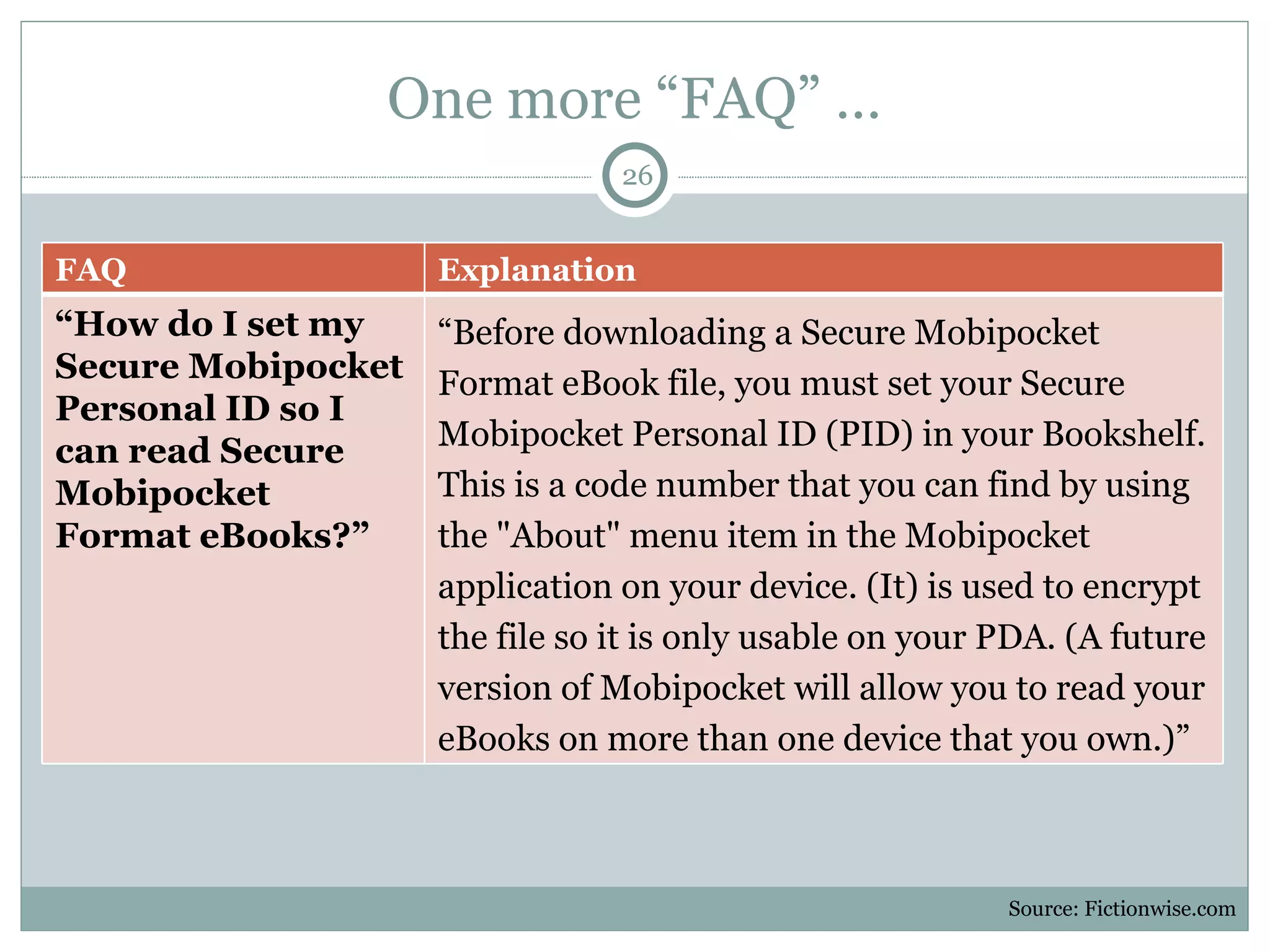
One more  “FAQ” … Source: Fictionwise.com FAQ Explanation “ How do I set my Secure Mobipocket Personal ID so I can read Secure Mobipocket Format eBooks?” “ Before downloading a Secure Mobipocket Format eBook file, you must set your Secure Mobipocket Personal ID (PID) in your Bookshelf. This is a code number that you can find by using the "About" menu item in the Mobipocket application on your device. (It) is used to encrypt the file so it is only usable on your PDA. (A future version of Mobipocket will allow you to read your eBooks on more than one device that you own.)”
Salvation in the cloud (?)
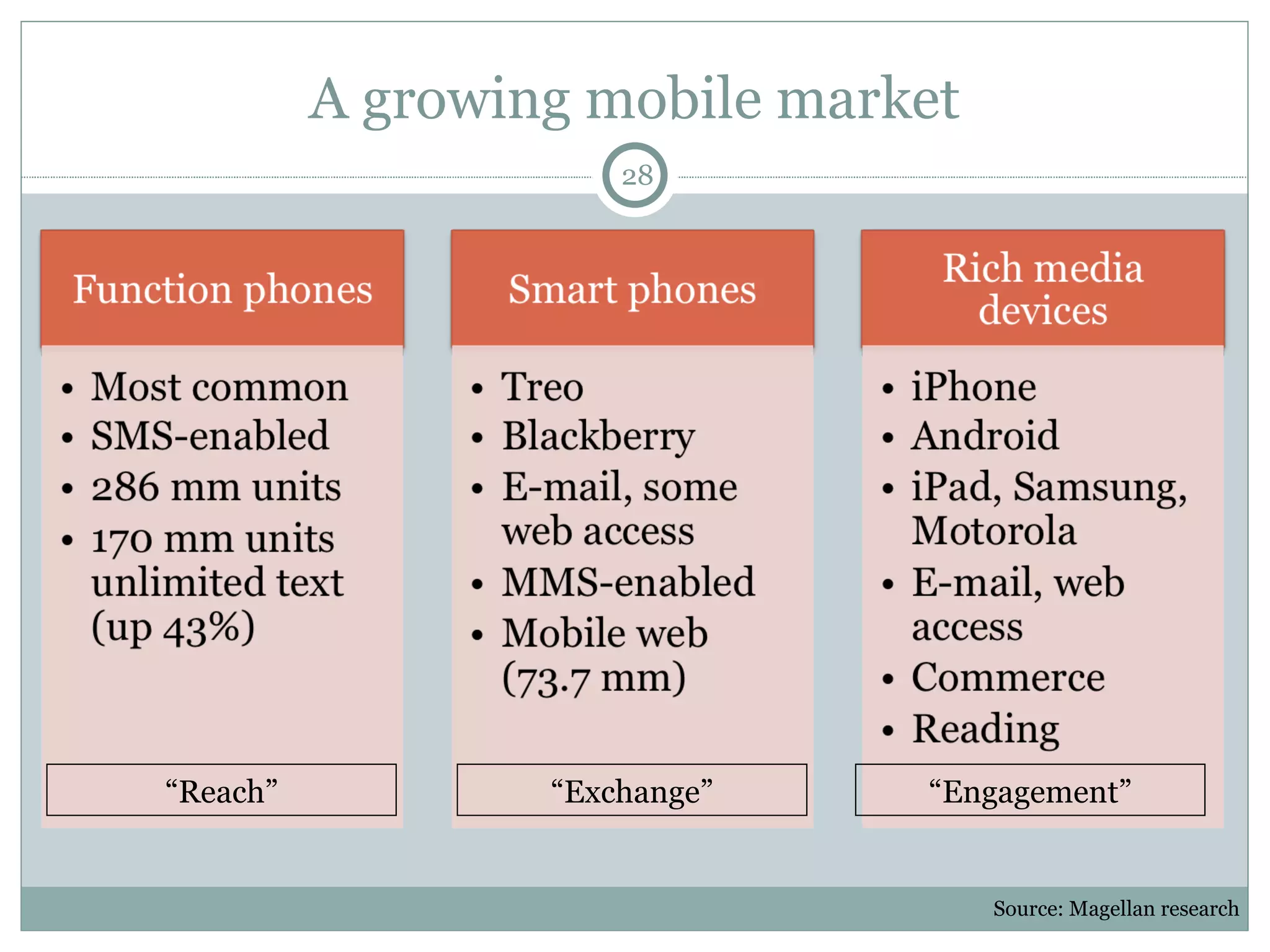
A growing mobile market “ Reach” “ Exchange” “ Engagement” Source: Magellan research
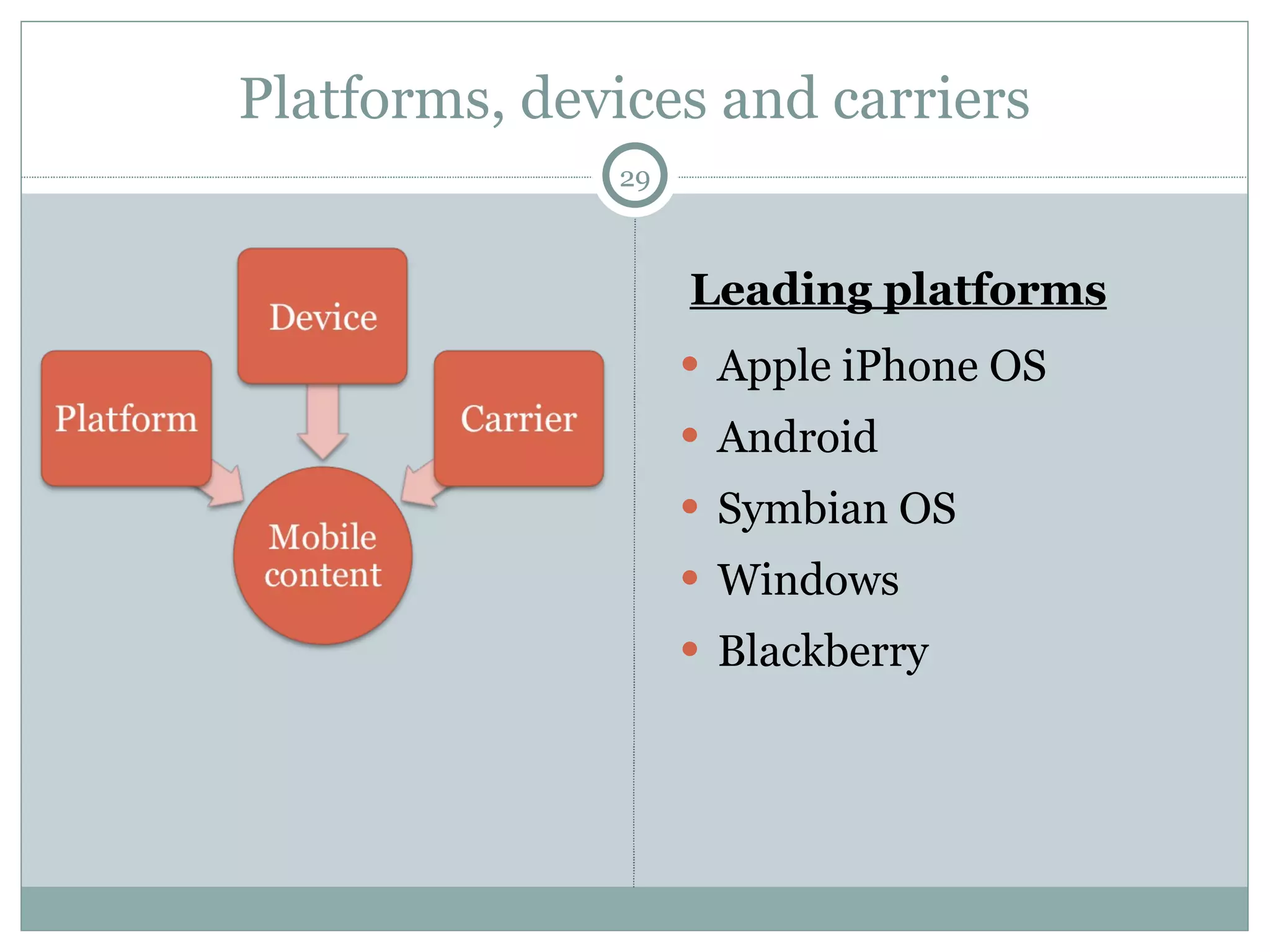
Platforms, devices and carriers Apple iPhone OS Android Symbian OS Windows Blackberry Leading platforms
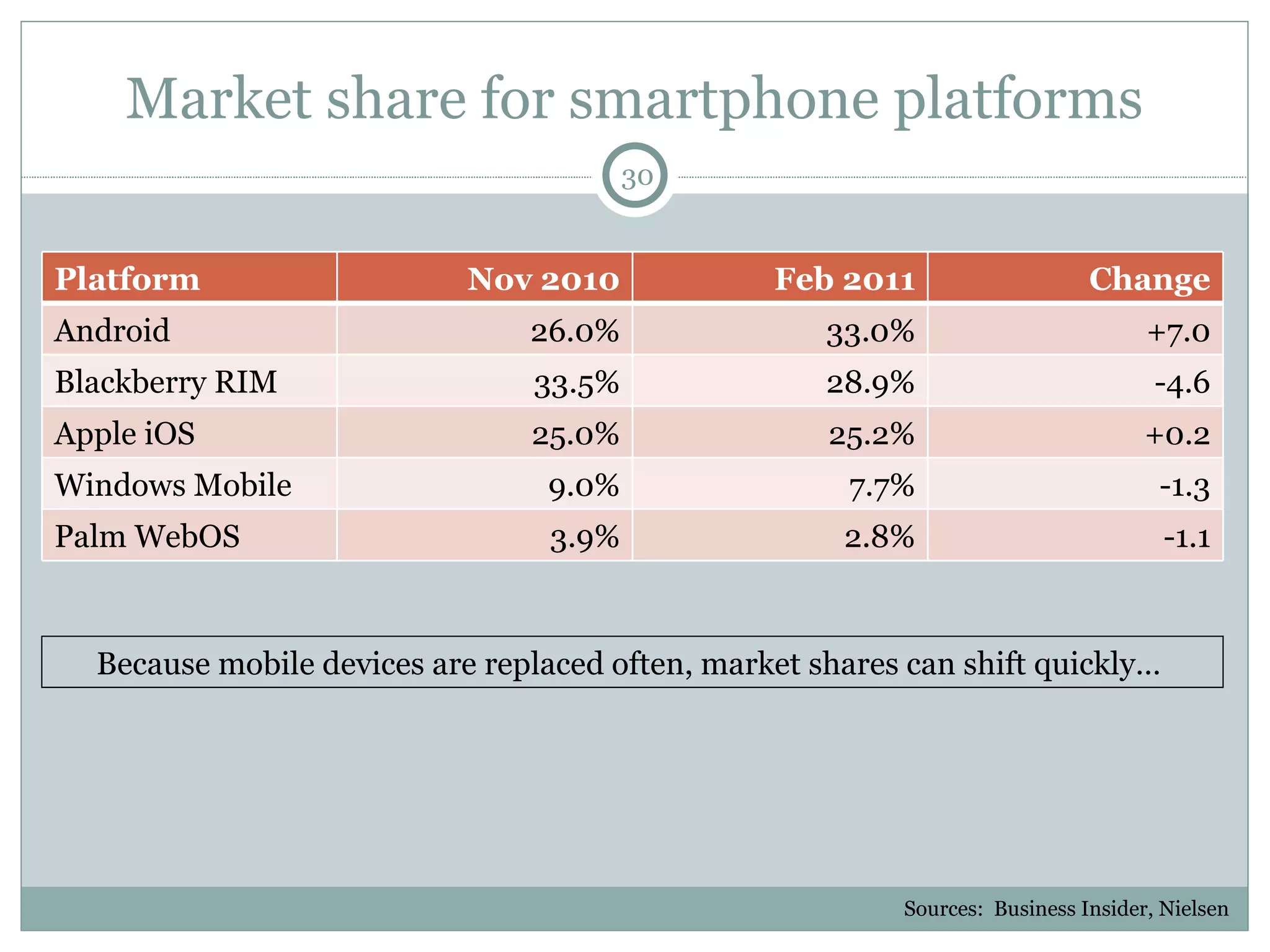
Market share for smartphone platforms Sources:  Business Insider, Nielsen Because mobile devices are replaced often, market shares can shift quickly…  Platform Nov 2010 Feb 2011 Change Android 26.0% 33.0% +7.0 Blackberry RIM 33.5% 28.9% -4.6 Apple iOS 25.0% 25.2% +0.2 Windows Mobile 9.0% 7.7% -1.3 Palm WebOS 3.9% 2.8% -1.1
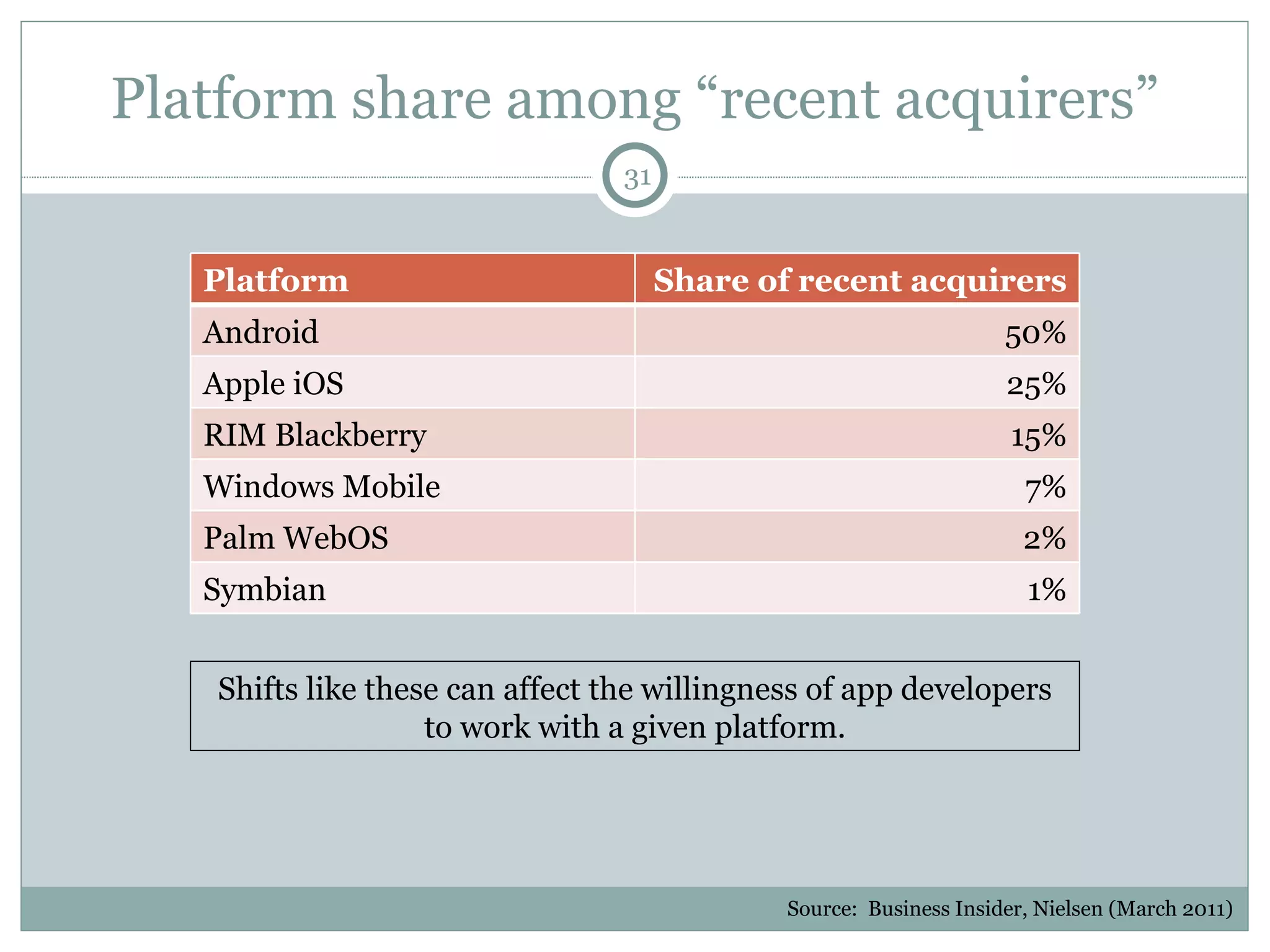
Platform share among “recent acquirers” Source:  Business Insider, Nielsen (March 2011) Shifts like these can affect the willingness of app developers to work with a given platform. Platform Share of recent acquirers Android 50% Apple iOS 25% RIM Blackberry 15% Windows Mobile 7% Palm WebOS 2% Symbian 1%
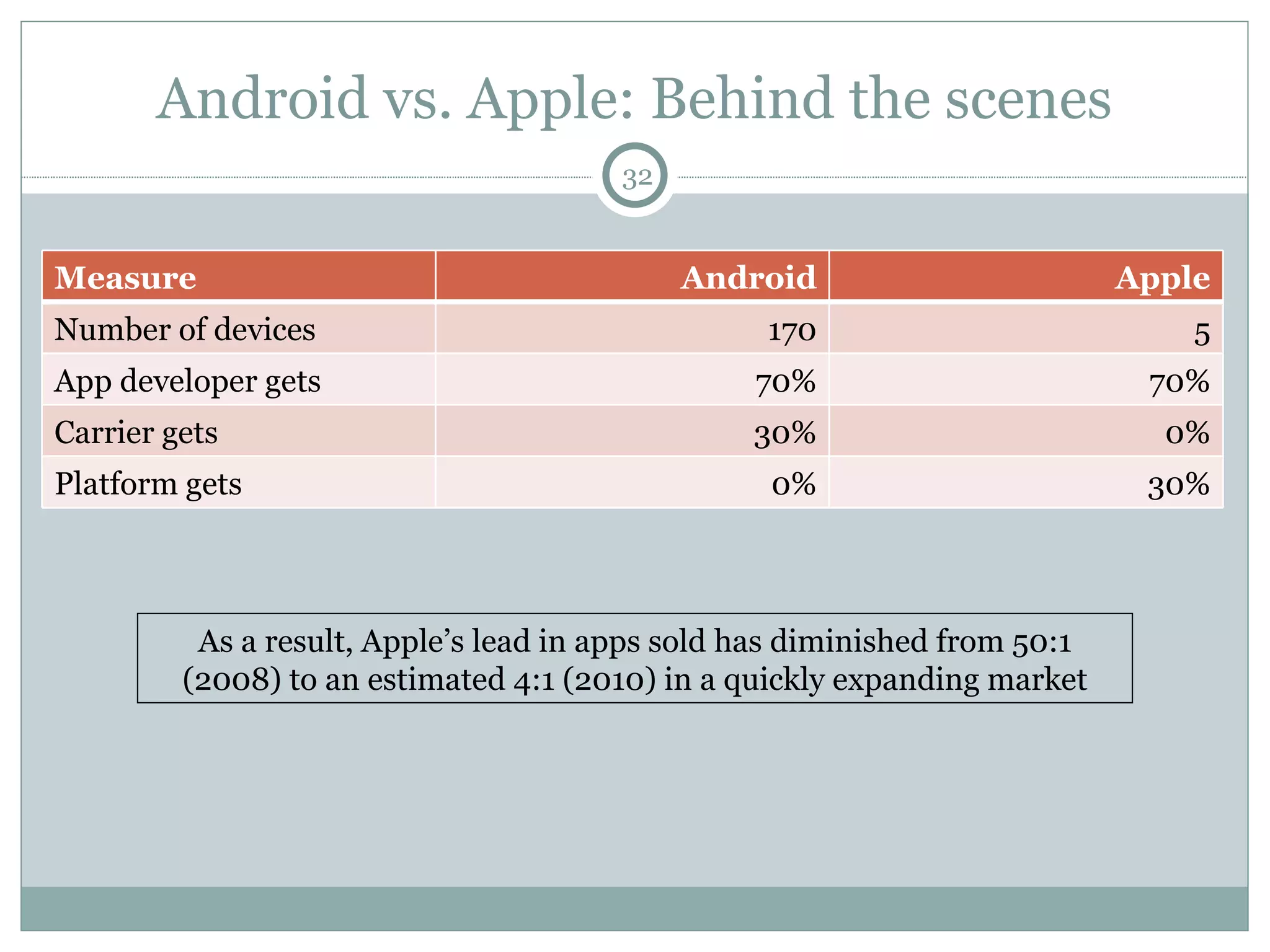
Android vs. Apple: Behind the scenes As a result, Apple’s lead in apps sold has diminished from 50:1 (2008) to an estimated 4:1 (2010) in a quickly expanding market Measure Android Apple Number of devices 170 5 App developer gets 70% 70% Carrier gets 30% 0% Platform gets 0% 30%
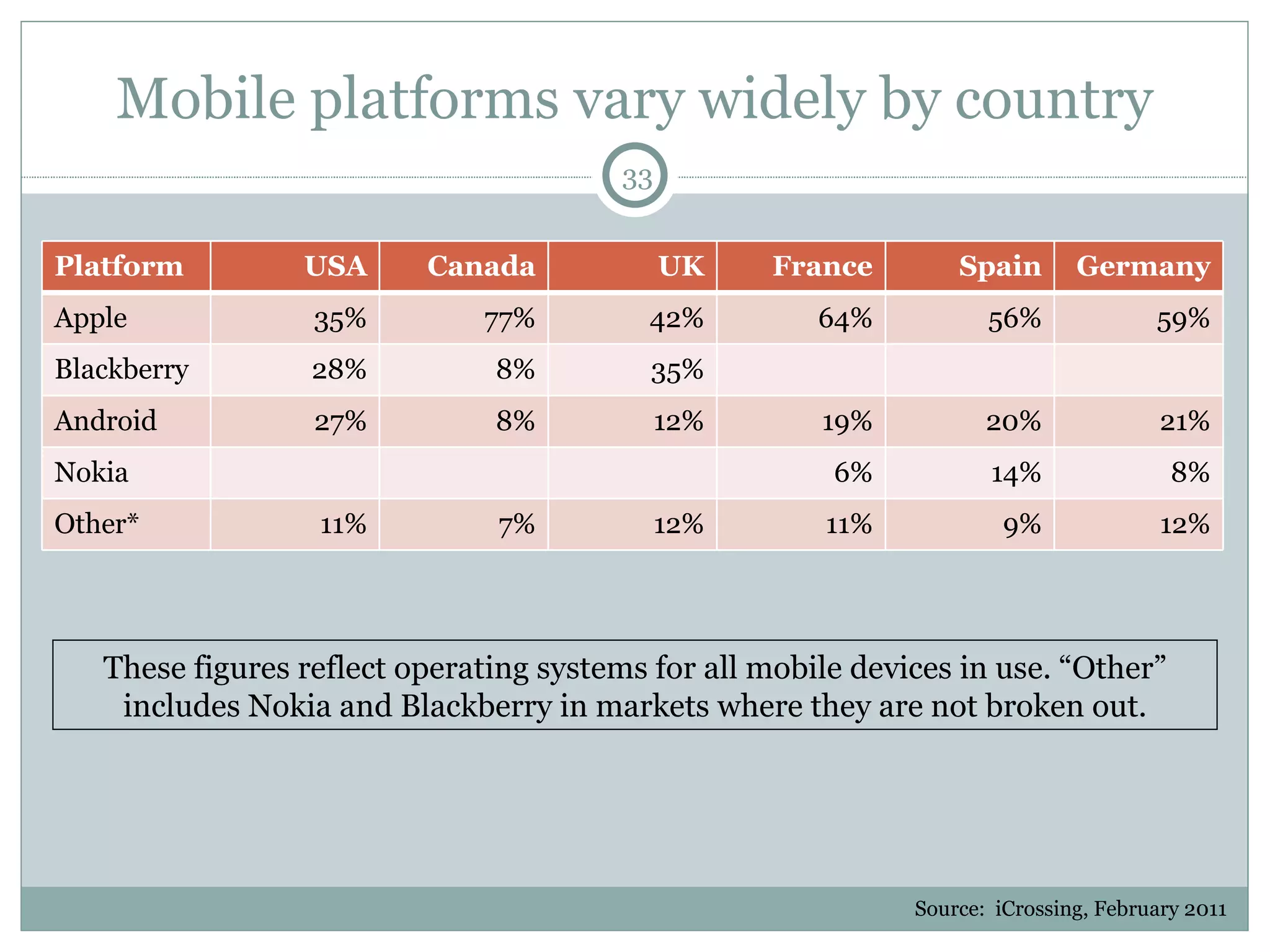
Mobile platforms vary widely by country Source:  iCrossing, February 2011 These figures reflect operating systems for all mobile devices in use. “Other” includes Nokia and Blackberry in markets where they are not broken out. Platform USA Canada UK France Spain Germany Apple 35% 77% 42% 64% 56% 59% Blackberry 28% 8% 35% Android 27% 8% 12% 19% 20% 21% Nokia 6% 14% 8% Other* 11% 7% 12% 11% 9% 12%
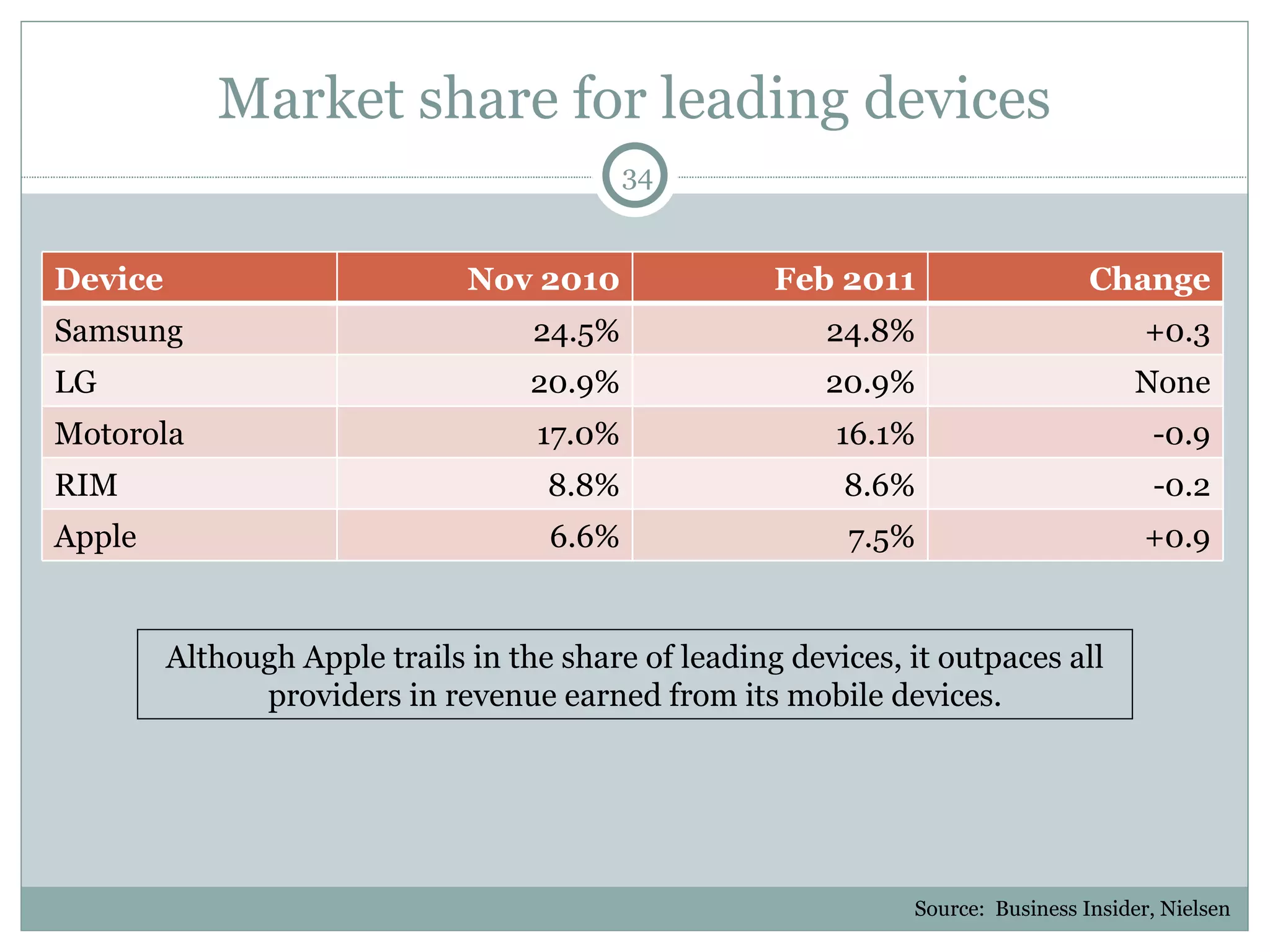
Market share for leading devices Source:  Business Insider, Nielsen Although Apple trails in the share of leading devices, it outpaces all providers in revenue earned from its mobile devices. Device Nov 2010 Feb 2011 Change Samsung 24.5% 24.8% +0.3 LG 20.9% 20.9% None Motorola 17.0% 16.1% -0.9 RIM 8.8% 8.6% -0.2 Apple 6.6% 7.5% +0.9
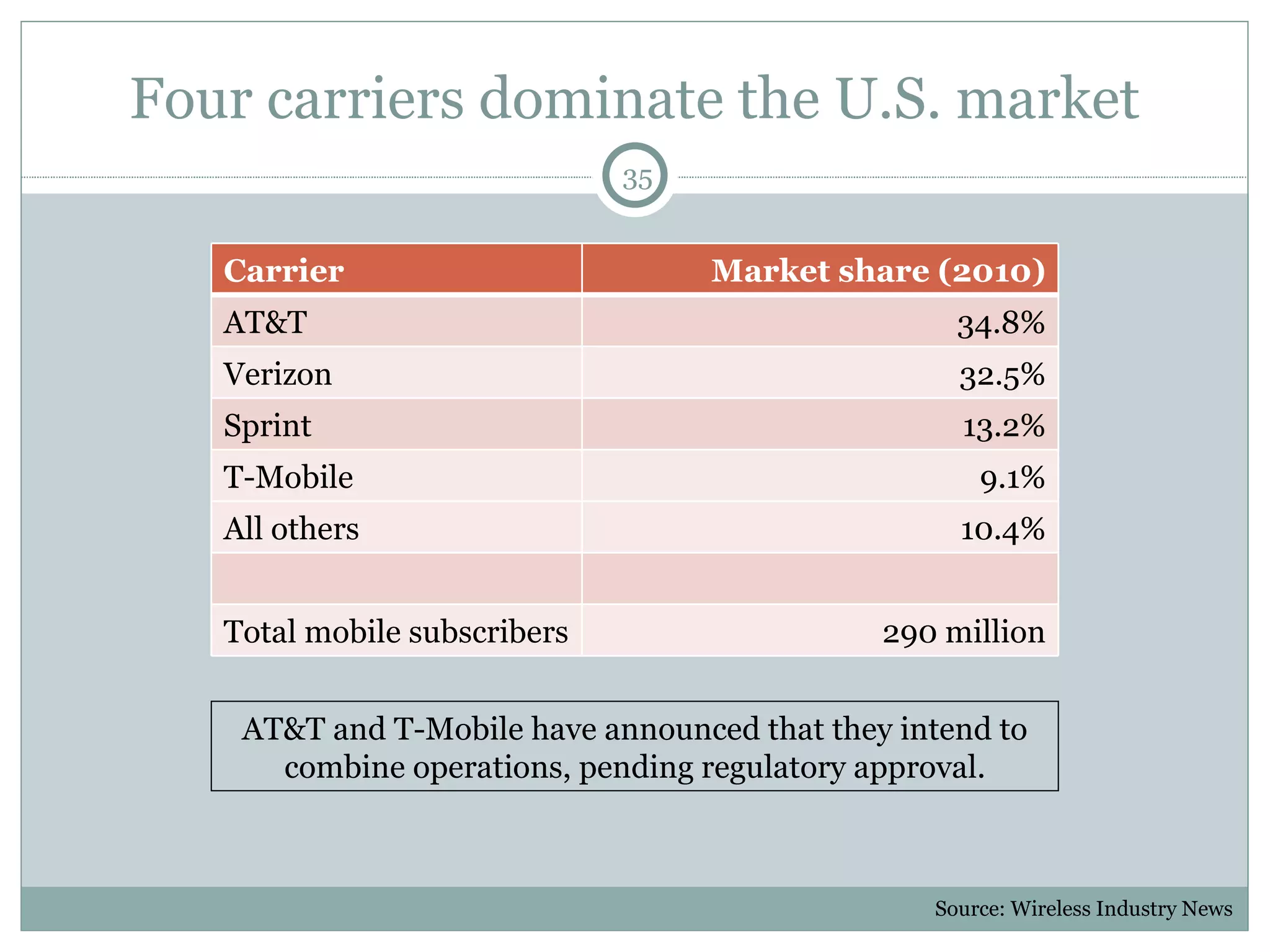
Four carriers dominate the U.S. market Source: Wireless Industry News AT&T and T-Mobile have announced that they intend to combine operations, pending regulatory approval. Carrier Market share (2010) AT&T 34.8% Verizon 32.5% Sprint 13.2% T-Mobile 9.1% All others 10.4% Total mobile subscribers 290 million
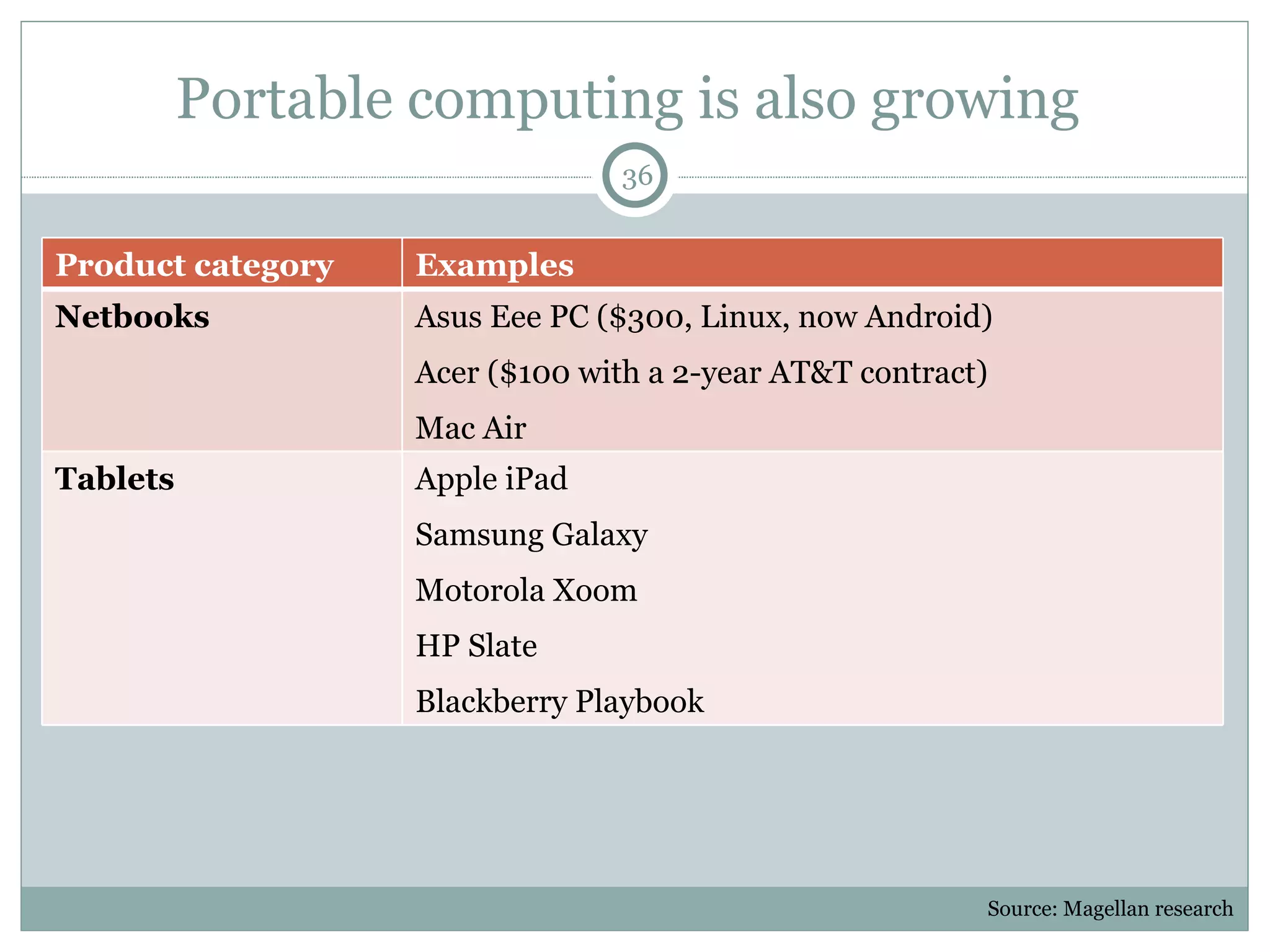
Portable computing is also growing  Source: Magellan research Product category Examples Netbooks Asus Eee PC ($300, Linux, now Android) Acer ($100 with a 2-year AT&T contract) Mac Air Tablets Apple iPad Samsung Galaxy Motorola Xoom HP Slate Blackberry Playbook
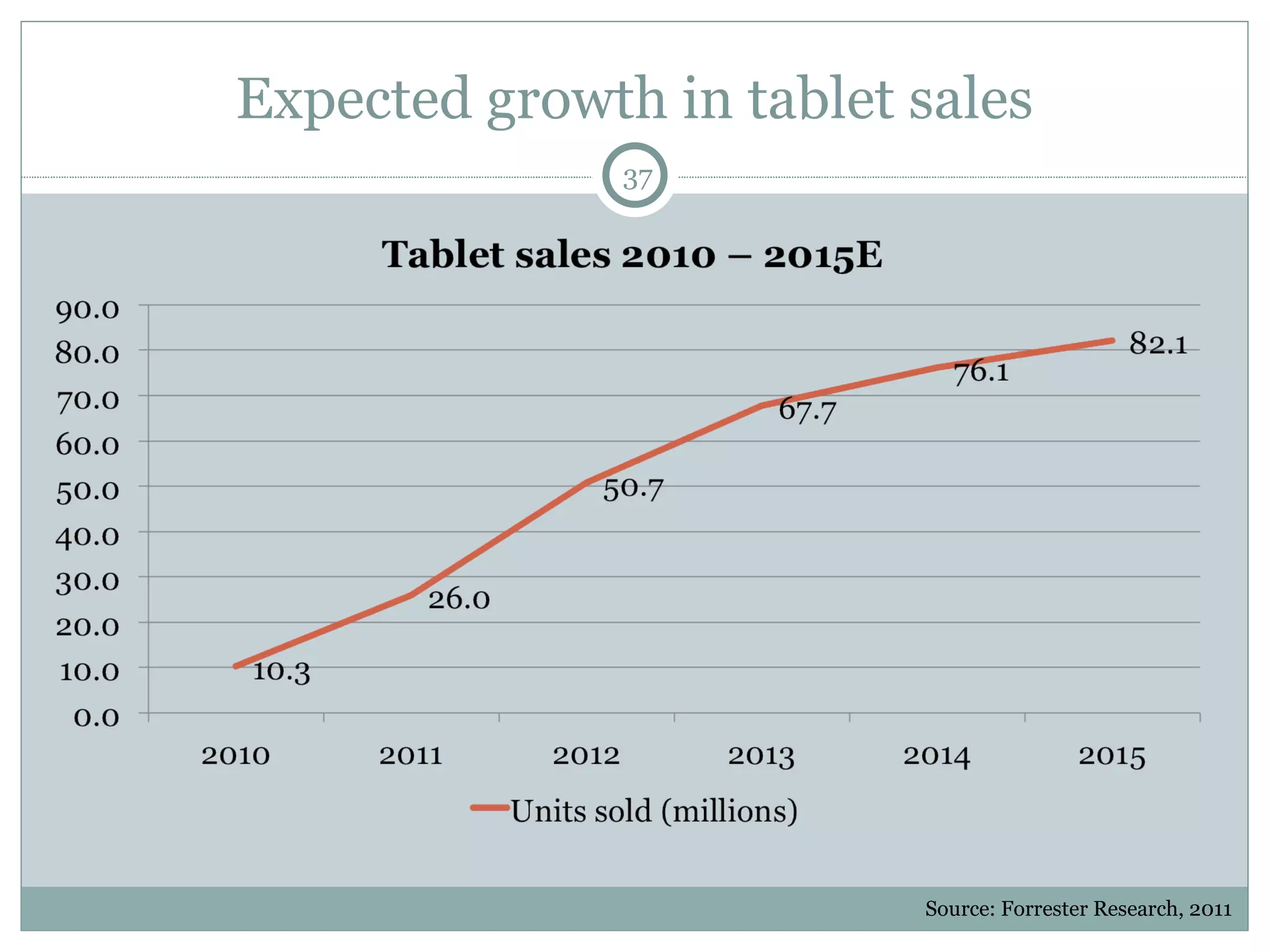
Expected growth in tablet sales Source: Forrester Research, 2011
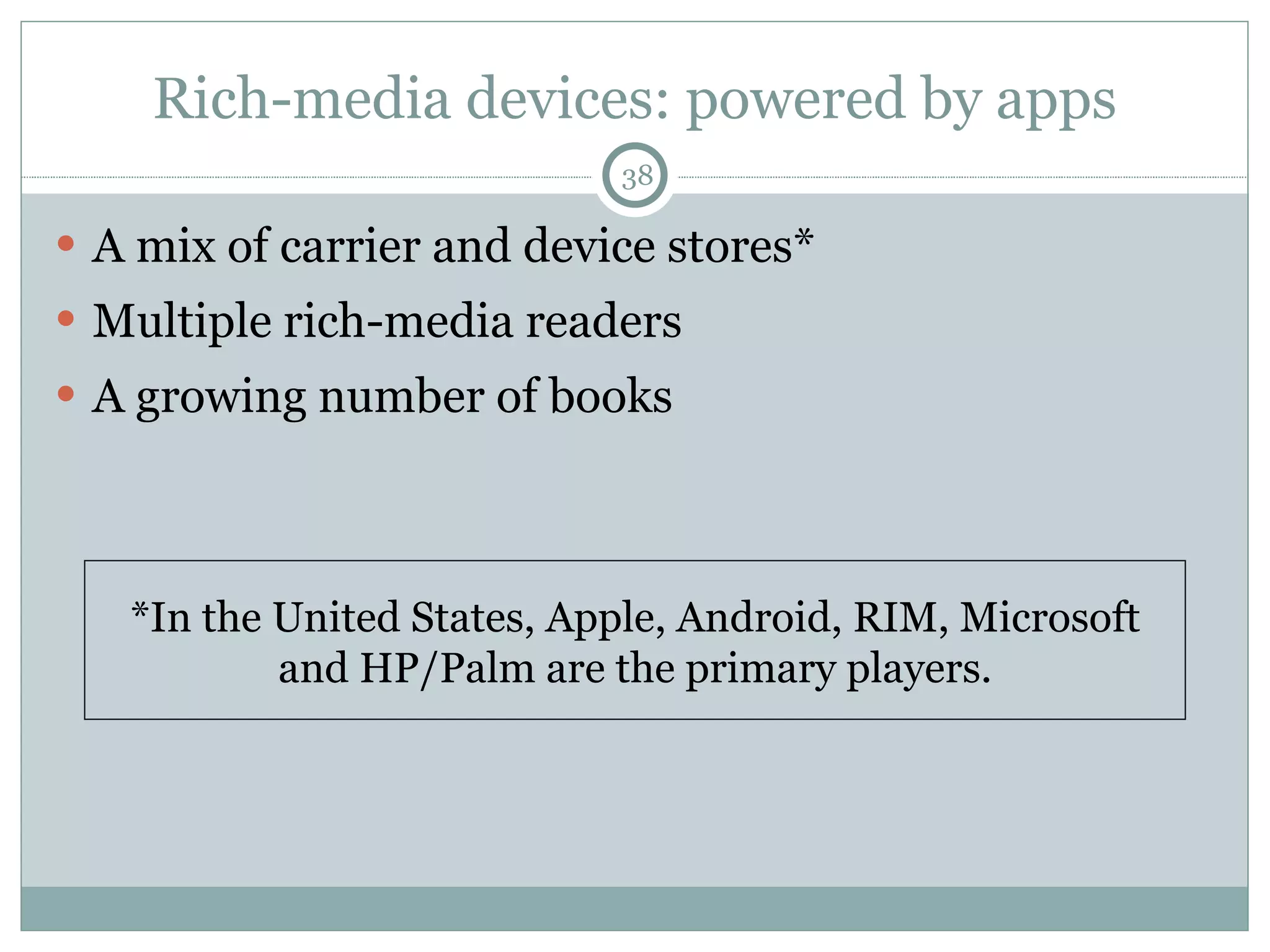
Rich-media devices: powered by apps A mix of carrier and device stores* Multiple rich-media readers A growing number of books *In the United States, Apple, Android, RIM, Microsoft and HP/Palm are the primary players.
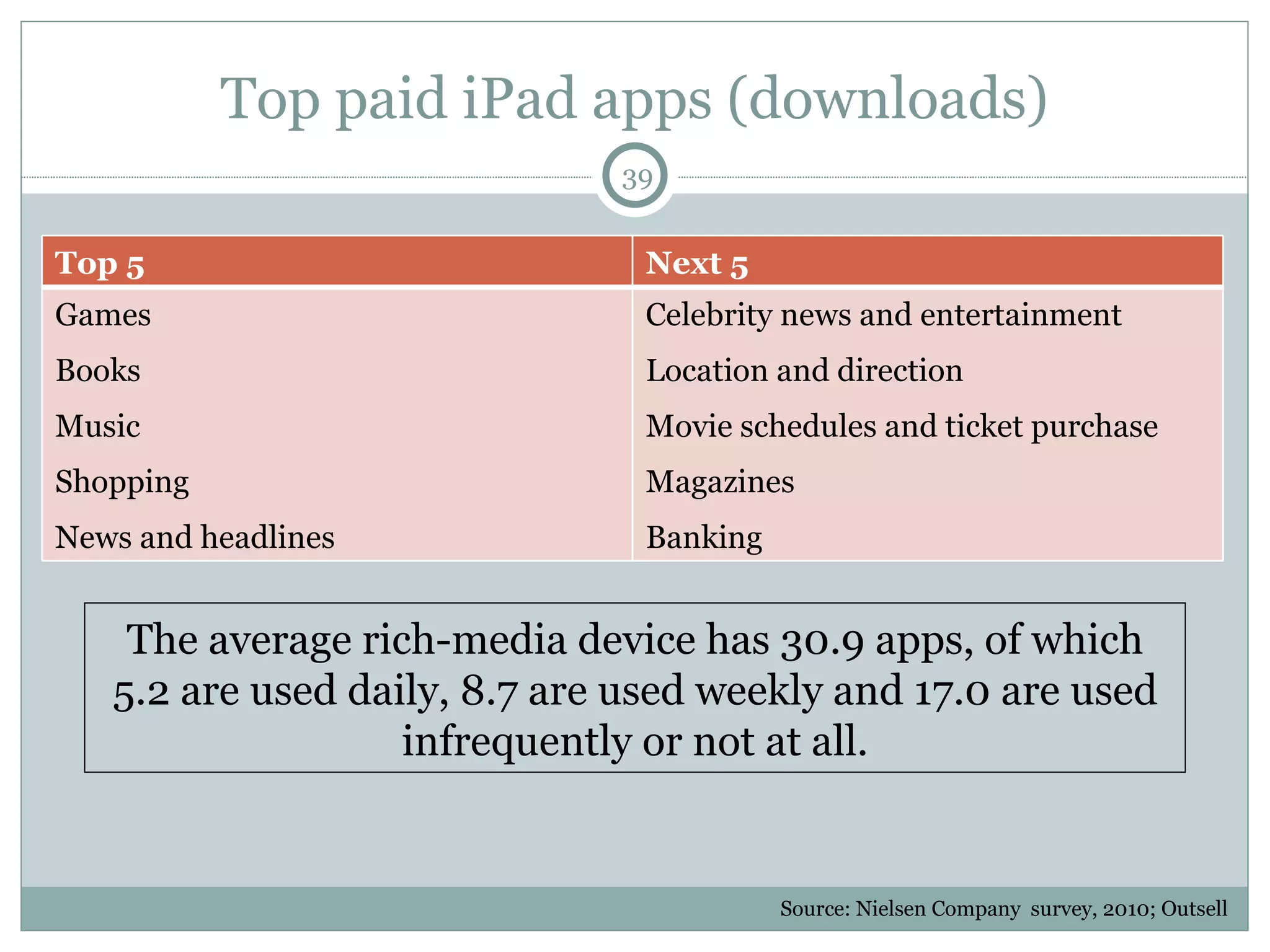
Top paid iPad apps (downloads) The average rich-media device has 30.9 apps, of which 5.2 are used daily, 8.7 are used weekly and 17.0 are used infrequently or not at all. Source: Nielsen Company  survey, 2010; Outsell  Top 5 Next 5 Games Books Music Shopping News and headlines Celebrity news and entertainment Location and direction Movie schedules and ticket purchase Magazines Banking
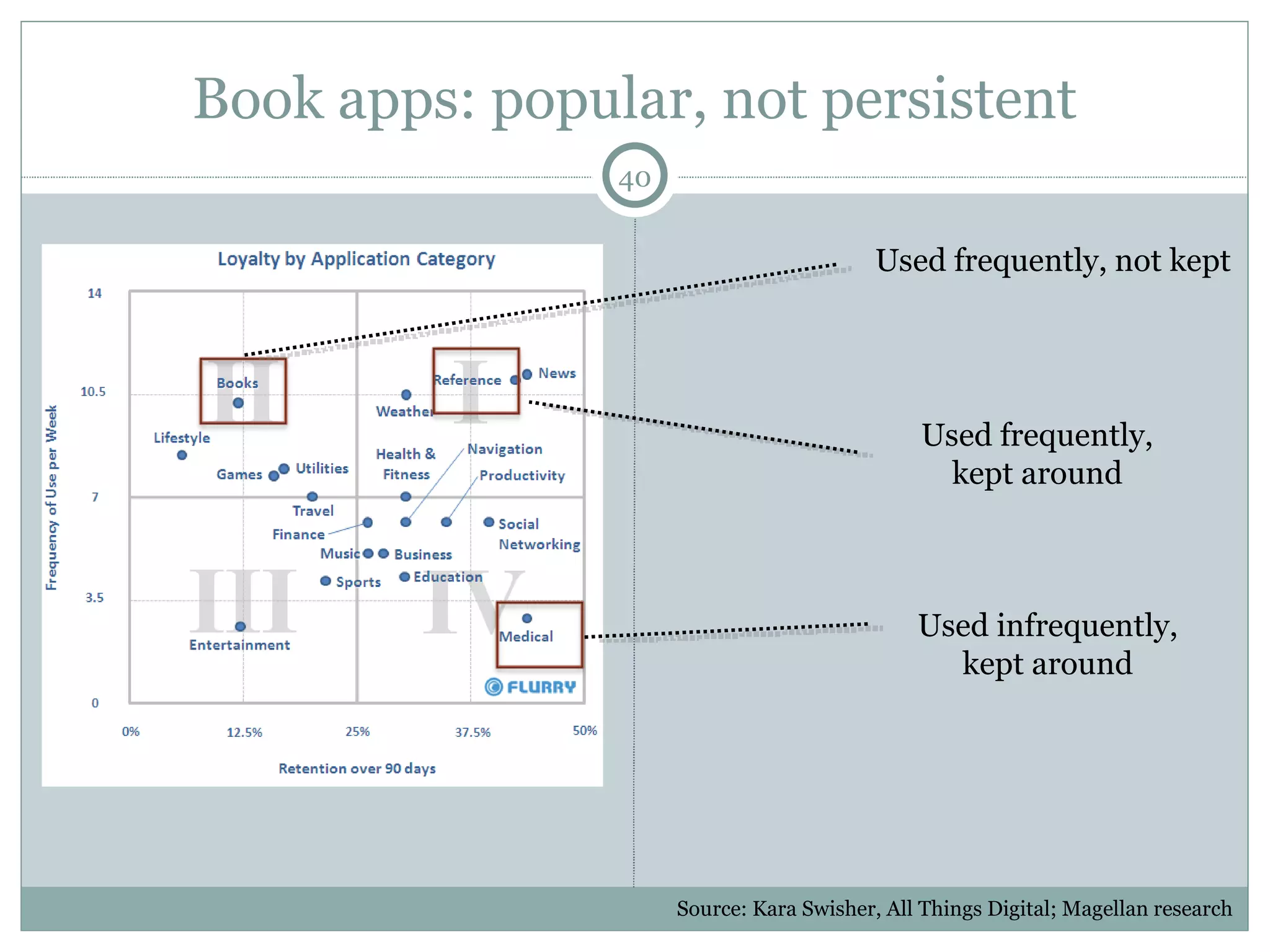
Book apps: popular, not persistent Used frequently, not kept Used frequently, kept around Used infrequently, kept around Source: Kara Swisher, All Things Digital; Magellan research
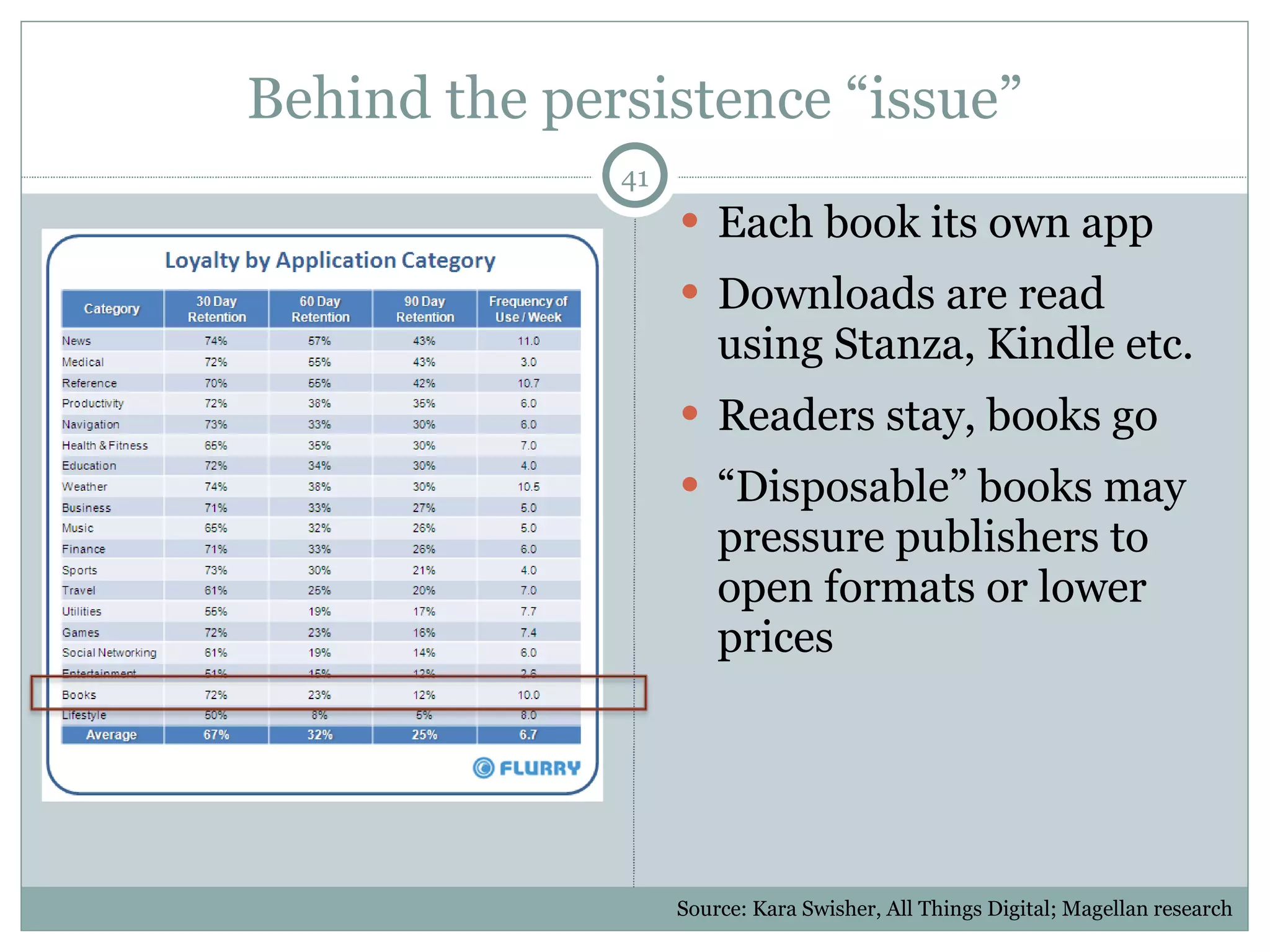
Behind the persistence  “issue” Each book its own app Downloads are read using Stanza, Kindle etc. Readers stay, books go “ Disposable” books may pressure publishers to open formats or lower prices Source: Kara Swisher, All Things Digital; Magellan research
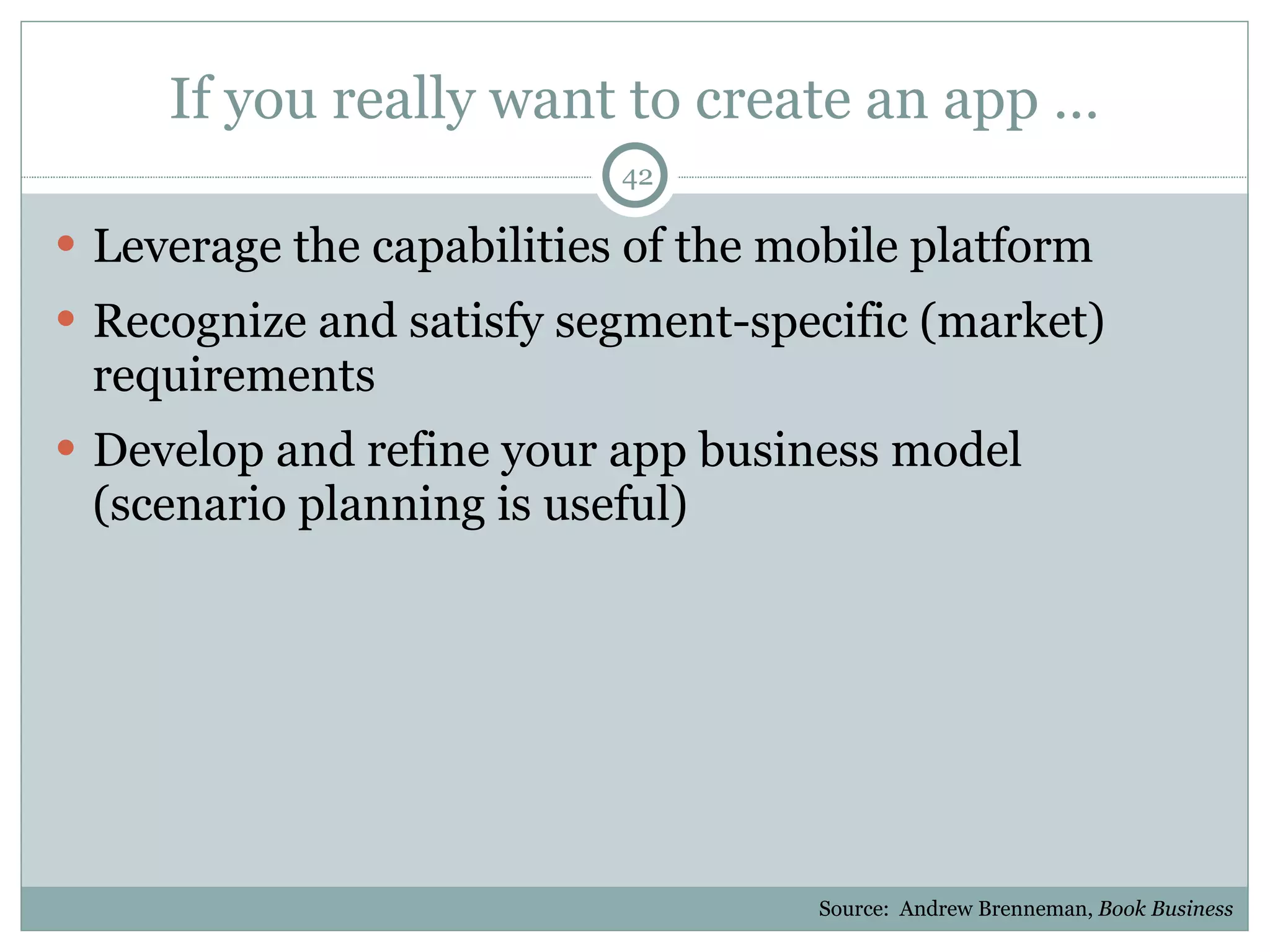
If you really want to create an app … Leverage the capabilities of the mobile platform Recognize and satisfy segment-specific (market) requirements Develop and refine your app business model (scenario planning is useful) Source:  Andrew Brenneman,  Book Business
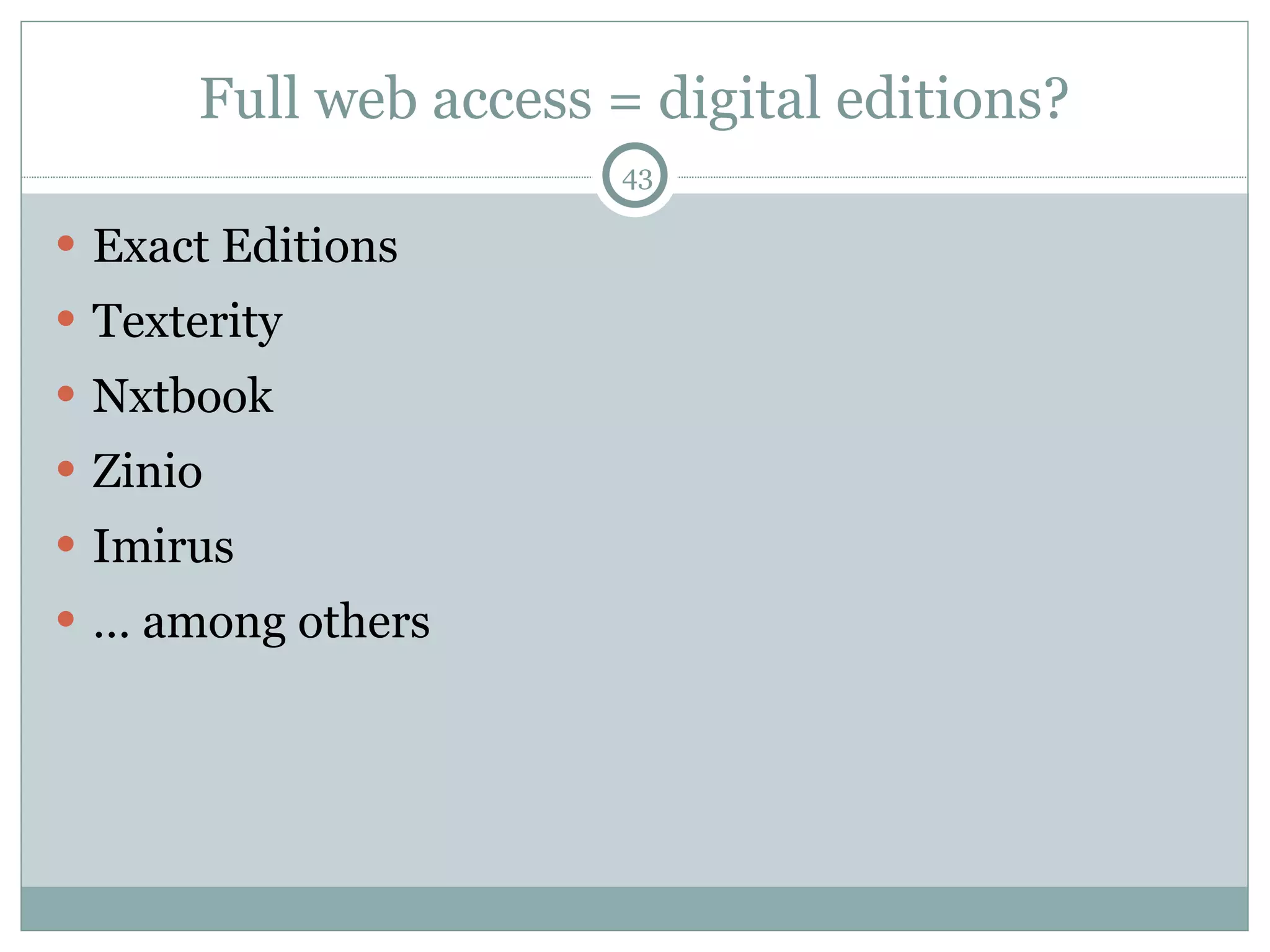
Full web access = digital editions? Exact Editions Texterity Nxtbook Zinio Imirus …  among others
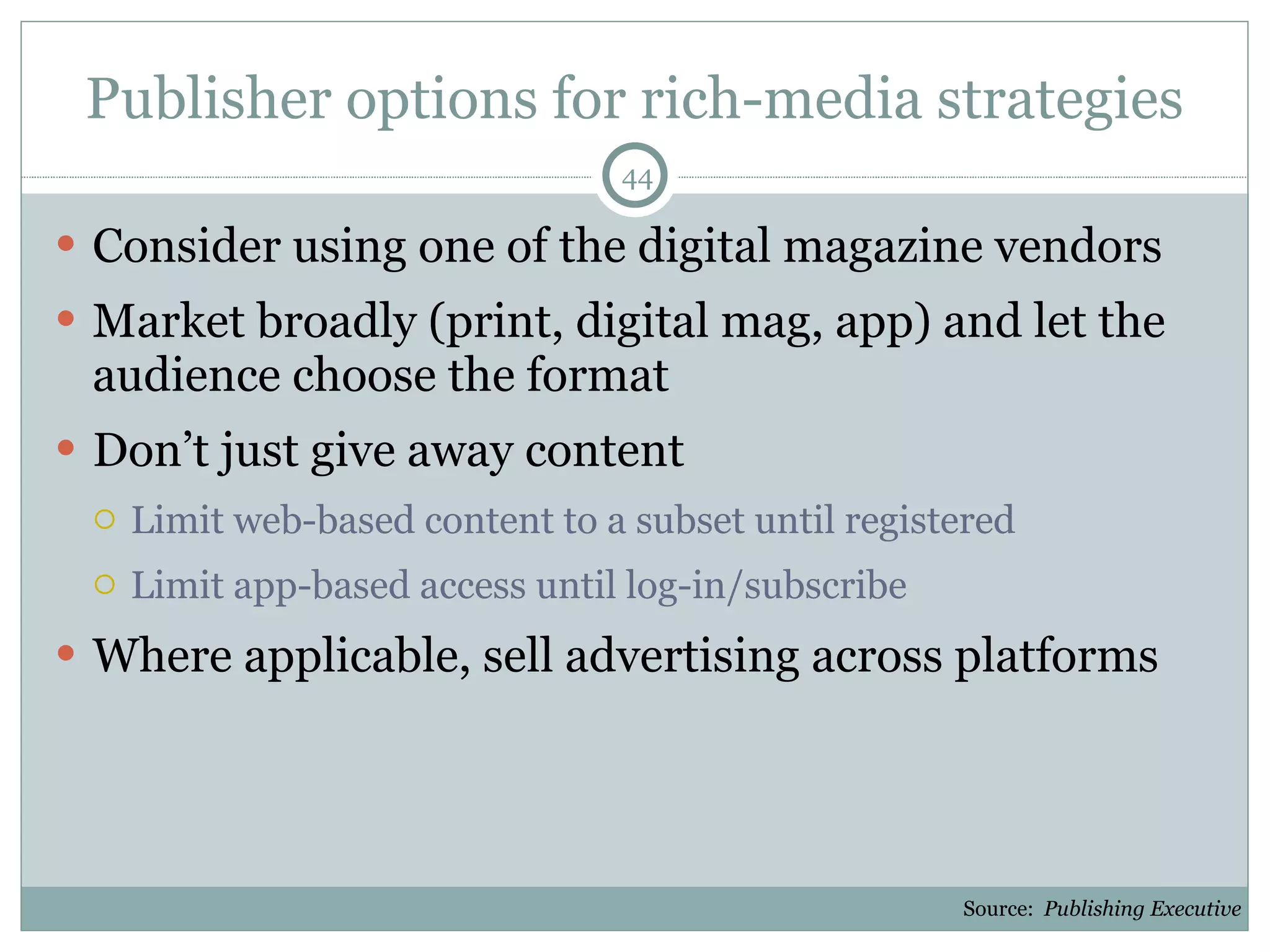
Publisher options for rich-media strategies Consider using one of the digital magazine vendors Market broadly (print, digital mag, app) and let the audience choose the format Don’t just give away content Limit web-based content to a subset until registered Limit app-based access until log-in/subscribe Where applicable, sell advertising across platforms Source:  Publishing Executive
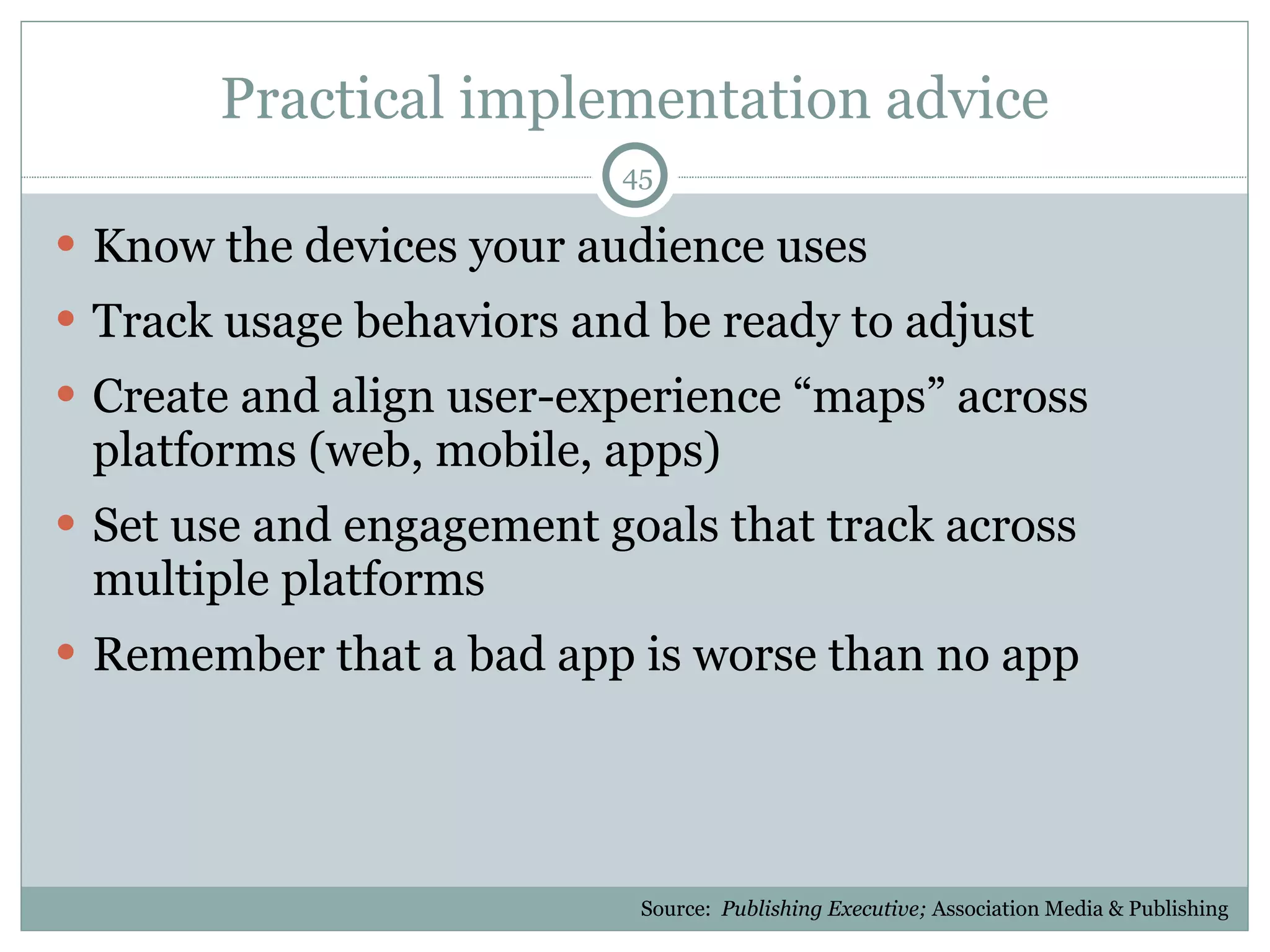
Practical implementation advice Know the devices your audience uses Track usage behaviors and be ready to adjust Create and align user-experience “maps” across platforms (web, mobile, apps) Set use and engagement goals that track across multiple platforms Remember that a bad app is worse than no app Source:  Publishing Executive;  Association Media & Publishing
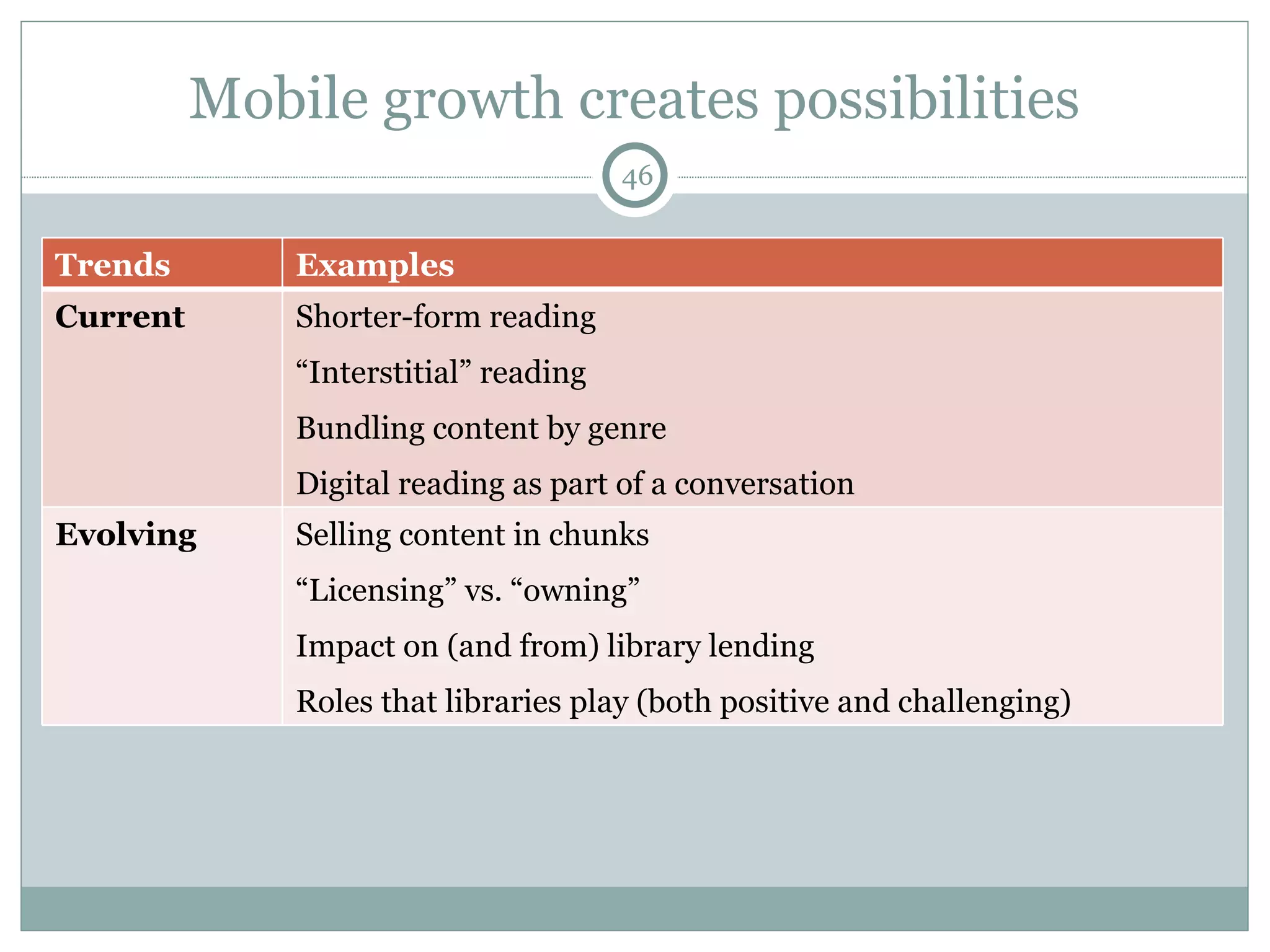
Mobile growth creates possibilities Trends Examples Current Shorter-form reading “ Interstitial” reading Bundling content by genre Digital reading as part of a conversation Evolving Selling content in chunks “ Licensing” vs. “owning” Impact on (and from) library lending Roles that libraries play (both positive and challenging)
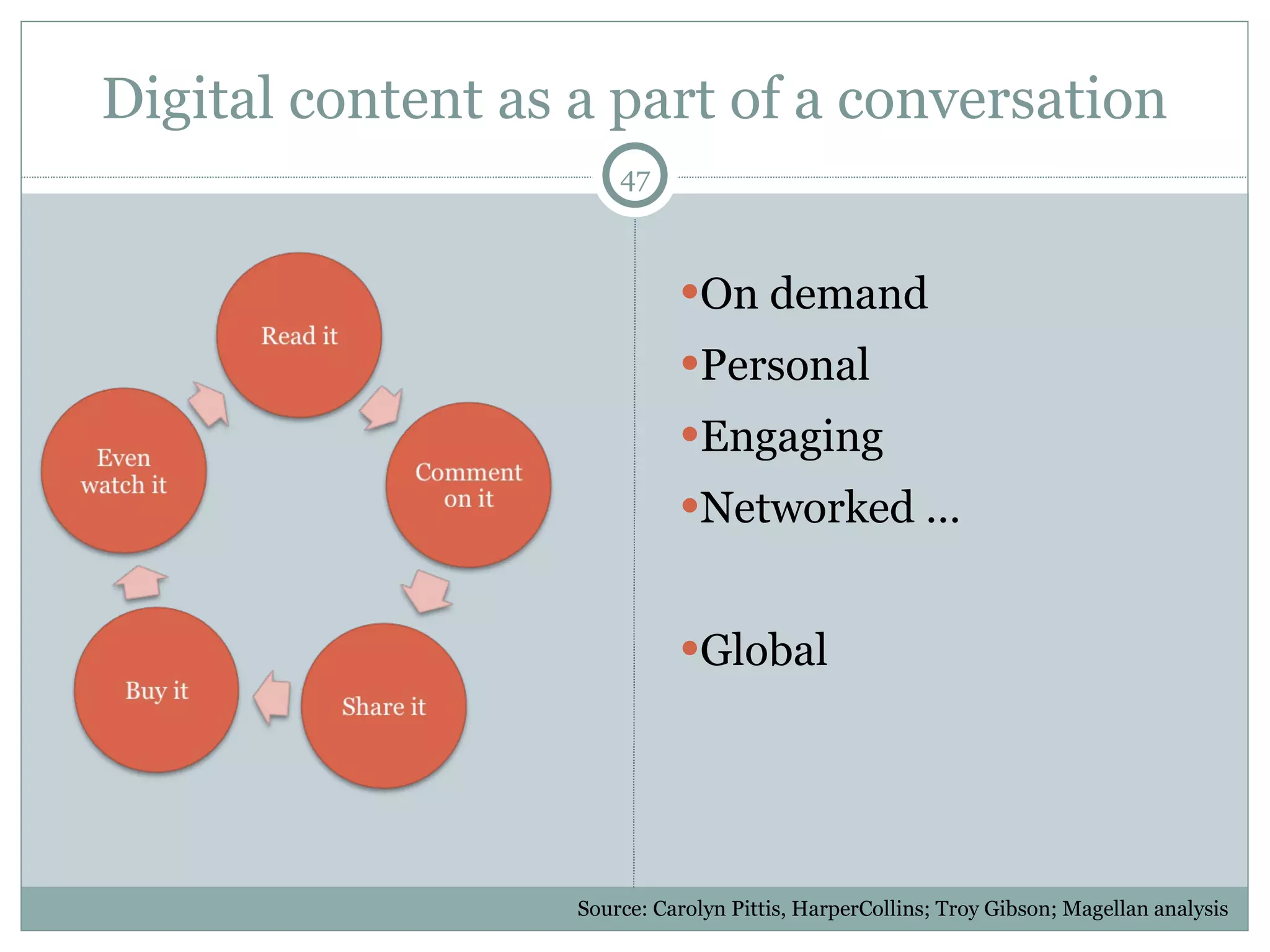
Digital content as a part of a conversation On demand Personal Engaging Networked … Global Source: Carolyn Pittis, HarperCollins; Troy Gibson; Magellan analysis
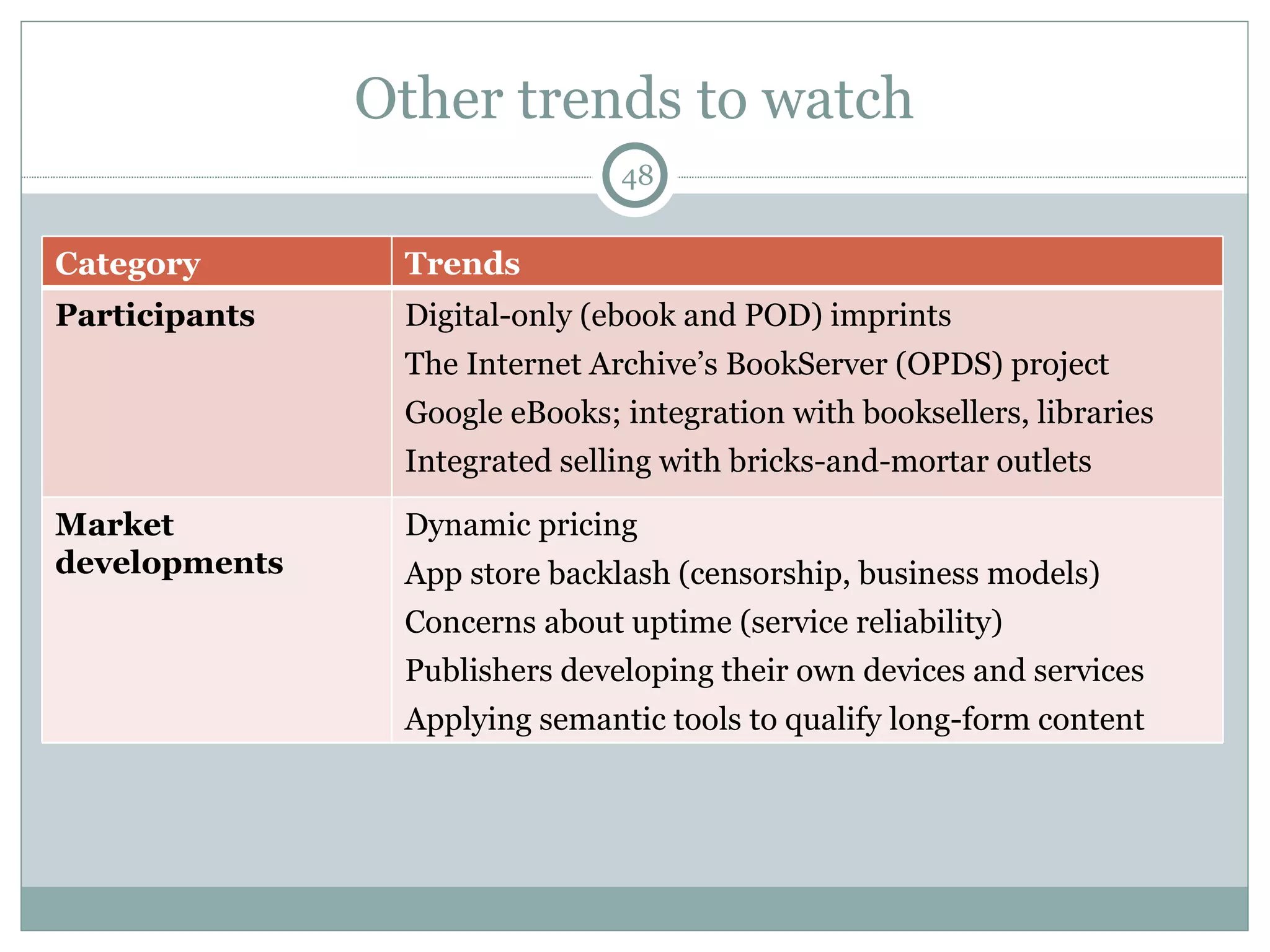
Other trends to watch Category Trends Participants Digital-only (ebook and POD) imprints The Internet Archive’s BookServer (OPDS) project Google eBooks; integration with booksellers, libraries Integrated selling with bricks-and-mortar outlets Market developments Dynamic pricing App store backlash (censorship, business models) Concerns about uptime (service reliability) Publishers developing their own devices and services Applying semantic tools to qualify long-form content
Mobile content consumption: core take-aways Expanding rapidly Dedicated and multi-function devices Netbooks, tablets squeezing smartphones Content forms evolving Global implications
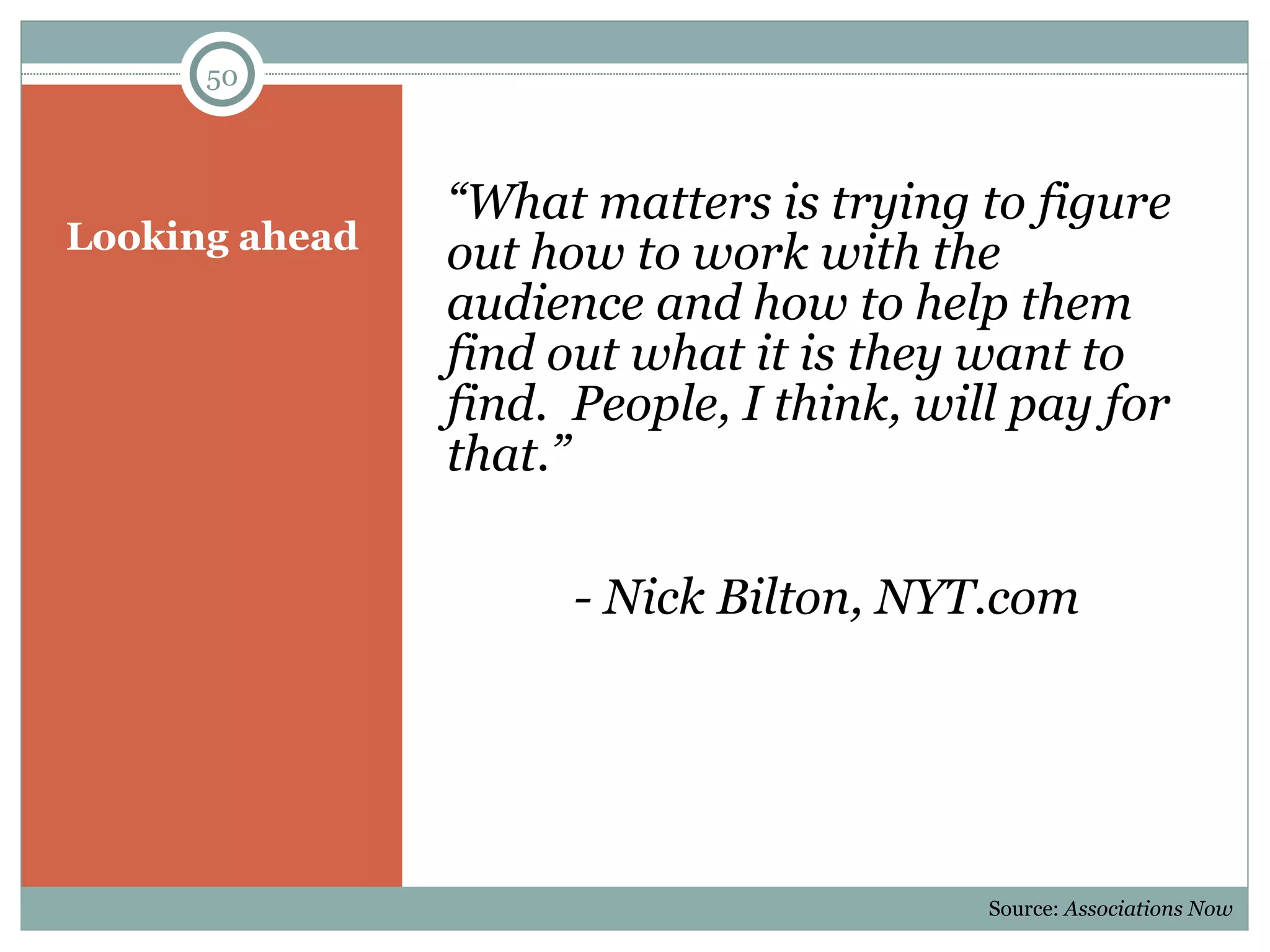
Looking ahead “ What matters is trying to figure out how to work with the audience and how to help them find out what it is they want to find.  People, I think, will pay for that.” - Nick Bilton, NYT.com Source:  Associations Now
For more information Book Industry Study Group (www.bisg.org) ,  “Consumer Attitudes Toward Digital Publishing” Two-volume study A mobile bibliography:  http://bit.ly/ jdH60s brian.oleary @ magellanmediapartners.com

Mobile reading comes of age (NISO Forum)

  • 1.
    Niso forum mobiletechnologies in libraries May 20, 2011 Mobile reading comes of age
  • 2.
    Today’ s presentationA mobile context Current options for mobile content consumption Expected developments Implications for content creation and management
  • 3.
    Mobile content consumption:core take-aways Expanding rapidly Dedicated and multi-function devices Netbooks, tablets squeezing smartphones Content forms evolving Global implications
  • 4.
    Headlines (begin to)tell the tale
  • 5.
    No shortage ofpredictions Smartphone use will grow 40% in 2011 Social networking on mobile devices will grow 240% this year alone (!) Tablet sales will double in 2011 72% of the U.S. workforce is “already mobile” Mobile is expected to “trump laptops and desktops” and become the “first screen” for web access by 2013 Source: Chief Content Officer
  • 6.
    Already: iPad eatingaway at print news University of Missouri survey of 1,600 iPad users 84.4% cited “following current events” as a primary use for their iPad [good news] Almost half claimed an hour or more per day is spent reading news Of those heavy news consumers, 58% said they were likely to cancel print; 10% had already cancelled Key factor: price [bad news] Sources: Journalism Institute at the University of Missouri; Macworld March 2011
  • 7.
    Mobile engagement isclose to constant Source: Outsell, 2010 Numbers like these make you wonder if they also include time spent sleeping next to the device … Platform Hours per day Android-based 5.3 Blackberry 4.6 iPhone 4.5 iPad 2.6 E-readers (all) 1.9
  • 8.
    Mobile reading advantagesPortability Searchability Breadth of selection In the moment Increasingly “webby”: open, social, linked Green?
  • 9.
    Keys to mobilereading success Wireless coverage Seamless transactions Extensive content libraries Device reliability Content interoperability Adapted from work by Andrew Brenneman, Book Business
  • 10.
    A cross-section ofdigital content models Typically supported using web-based wireless applications Opportunity to develop and implement device-based apps Source: Alisa Bowen, Thomson-Reuters; Magellan analysis
  • 11.
    A “reverse”generation gap? Average age of today’ s p-book buyer is 44 The most frequent p-book buyer is 50 Over 65 = largest cohort of Kindle users First age group to move beyond the desktop for digital content “ Seniors are leading the way in the digital market” Source: Bowker presentation at BISG’s “Making Information Pay” conference, 2009
  • 12.
    Digital devices changethe user experience Portrait vs. landscape San serif fonts, larger than normal Increased leading (4-5 points more than font) Linked (when the device supports it) Serving images as slideshows in a single window Source: Book Business
  • 13.
    Designing for mobileis even more intricate One user experience across multiple digital channels “ Fat-finger” challenges Search options must be omnipresent Speed matters (so, optimize for the platform) Sharing matters (“likes”, recommendations, reviews) Increasingly, geo-location features matter
  • 14.
    Mobile reading segments:a range … Various platforms Game consoles (Wii, X-BOX) Sony Reader Amazon Kindle BN Nook Kobo Reader … and many more iPhone (Apple) Blackberry (RIM) Android (Google) Treo (Palm) Ovi (Nokia)/Microsoft (Windows) Asus Acer Dell Courier Apple iPad Samsung Motorola HP RIM
  • 15.
    … with differinguse profiles Source: Nielsen, February 2011
  • 16.
    Part of anevolving e-reading value chain Source: Forrester Research; Magellan research
  • 17.
    Until recently, PDFwas the primary format The breadth of content consumption that relied on PDF file formats suggests that readers are willing to forego a lot of bells and whistles just to get content digitally. Source: Bob LiVolsi, Books on Board, BEA 2009 Format All digital reading Excluding PDF PDF 60% -- E-book compatible 17% 42% iPhone OS 8% 20% Palm OS 4% 10% All others 11% 28%
  • 18.
    For mobile reading,laptops play a big part Source: Forrester Research, 2010 The two studies do not use a consistent methodology, but it appears that mobile formats are taking share from PDF. Reading device Overall share Laptops 35% Kindle 32% iPhone 15% Sony Reader 12% Netbooks 10% BN Nook 9% iPad 9%
  • 19.
    E-books lead theway in mobile reading Sources: AAP, IDPF
  • 20.
    Book networks arealso booming Open, social, linked Visual Bookshelf (Facebook): 6 million users, 108 million books WeRead: nearly 2 million readers, over 45 million books LibraryThing: 750K visits a month; Goodreads: 500K visitors a month Announced: Bookish Adapted from Brad Inman, Vook; Magellan research
  • 21.
    Sizing the e-readeropportunity $199 price point $99 price point More wireless devices Color displays available Content, brands grow Early adopters drive a small market More mainstream, frequent book buyers adopt eReaders Students and business consumers Sources: Forrester Research (2009); InStat (2010) 35 mm units (2014)
  • 22.
    Demographic differences ine-reading 5.9 million adults own an e-reader (Mar – Oct 2010) 51% female (shift from a year earlier) Men more likely to use it to read a newspaper Women more likely to use it to read a book Includes Kindle, Sony; excludes laptops, smartphones, tablets 75% have used the device to read a book 15% have used the device to read a magazine
  • 23.
    A significant challenge:formats Device + Format + Discovery + Acquisition + Installation + DRM = “Confusion” “ Confusion” courtesy Peter Brantley, Internet Archive
  • 24.
    Proliferation of filetypes and DRM options Adapted from work by Neelan Choksi Segment Options File types RTF and PDF BBeB .lit, mobi and AZW PDB and FB2 HTML, RB, CHM and OEB … and EPUB Digital rights management Microsoft Reader Adobe Digital Editions eReader Mobi Apple FairPlay DNL … and others
  • 25.
    A format/DRM exampleSource: Fictionwise.com FAQ Explanation “ What formats are available for Secure Mobipocket Format eBooks and what devices can I read them on?” “ EBooks marked [Secure Mobipocket] are available as encrypted Mobipocket files. Mobipocket is a free reader application that is currently available on these platforms: Personal Computers Palm and Palm compatible; PocketPC; Franklin eBookMan; Symbian OS, including the Psion5, Psion5mx, Psion Revo, Psion Revo+, and Diamond MAKO organizers, and the Nokia 9210 (European model), 9290 (American model), Ericsson R380, R380e and R380 Smartphones.”
  • 26.
    One more “FAQ” … Source: Fictionwise.com FAQ Explanation “ How do I set my Secure Mobipocket Personal ID so I can read Secure Mobipocket Format eBooks?” “ Before downloading a Secure Mobipocket Format eBook file, you must set your Secure Mobipocket Personal ID (PID) in your Bookshelf. This is a code number that you can find by using the "About" menu item in the Mobipocket application on your device. (It) is used to encrypt the file so it is only usable on your PDA. (A future version of Mobipocket will allow you to read your eBooks on more than one device that you own.)”
  • 27.
  • 28.
    A growing mobilemarket “ Reach” “ Exchange” “ Engagement” Source: Magellan research
  • 29.
    Platforms, devices andcarriers Apple iPhone OS Android Symbian OS Windows Blackberry Leading platforms
  • 30.
    Market share forsmartphone platforms Sources: Business Insider, Nielsen Because mobile devices are replaced often, market shares can shift quickly… Platform Nov 2010 Feb 2011 Change Android 26.0% 33.0% +7.0 Blackberry RIM 33.5% 28.9% -4.6 Apple iOS 25.0% 25.2% +0.2 Windows Mobile 9.0% 7.7% -1.3 Palm WebOS 3.9% 2.8% -1.1
  • 31.
    Platform share among“recent acquirers” Source: Business Insider, Nielsen (March 2011) Shifts like these can affect the willingness of app developers to work with a given platform. Platform Share of recent acquirers Android 50% Apple iOS 25% RIM Blackberry 15% Windows Mobile 7% Palm WebOS 2% Symbian 1%
  • 32.
    Android vs. Apple:Behind the scenes As a result, Apple’s lead in apps sold has diminished from 50:1 (2008) to an estimated 4:1 (2010) in a quickly expanding market Measure Android Apple Number of devices 170 5 App developer gets 70% 70% Carrier gets 30% 0% Platform gets 0% 30%
  • 33.
    Mobile platforms varywidely by country Source: iCrossing, February 2011 These figures reflect operating systems for all mobile devices in use. “Other” includes Nokia and Blackberry in markets where they are not broken out. Platform USA Canada UK France Spain Germany Apple 35% 77% 42% 64% 56% 59% Blackberry 28% 8% 35% Android 27% 8% 12% 19% 20% 21% Nokia 6% 14% 8% Other* 11% 7% 12% 11% 9% 12%
  • 34.
    Market share forleading devices Source: Business Insider, Nielsen Although Apple trails in the share of leading devices, it outpaces all providers in revenue earned from its mobile devices. Device Nov 2010 Feb 2011 Change Samsung 24.5% 24.8% +0.3 LG 20.9% 20.9% None Motorola 17.0% 16.1% -0.9 RIM 8.8% 8.6% -0.2 Apple 6.6% 7.5% +0.9
  • 35.
    Four carriers dominatethe U.S. market Source: Wireless Industry News AT&T and T-Mobile have announced that they intend to combine operations, pending regulatory approval. Carrier Market share (2010) AT&T 34.8% Verizon 32.5% Sprint 13.2% T-Mobile 9.1% All others 10.4% Total mobile subscribers 290 million
  • 36.
    Portable computing isalso growing Source: Magellan research Product category Examples Netbooks Asus Eee PC ($300, Linux, now Android) Acer ($100 with a 2-year AT&T contract) Mac Air Tablets Apple iPad Samsung Galaxy Motorola Xoom HP Slate Blackberry Playbook
  • 37.
    Expected growth intablet sales Source: Forrester Research, 2011
  • 38.
    Rich-media devices: poweredby apps A mix of carrier and device stores* Multiple rich-media readers A growing number of books *In the United States, Apple, Android, RIM, Microsoft and HP/Palm are the primary players.
  • 39.
    Top paid iPadapps (downloads) The average rich-media device has 30.9 apps, of which 5.2 are used daily, 8.7 are used weekly and 17.0 are used infrequently or not at all. Source: Nielsen Company survey, 2010; Outsell Top 5 Next 5 Games Books Music Shopping News and headlines Celebrity news and entertainment Location and direction Movie schedules and ticket purchase Magazines Banking
  • 40.
    Book apps: popular,not persistent Used frequently, not kept Used frequently, kept around Used infrequently, kept around Source: Kara Swisher, All Things Digital; Magellan research
  • 41.
    Behind the persistence “issue” Each book its own app Downloads are read using Stanza, Kindle etc. Readers stay, books go “ Disposable” books may pressure publishers to open formats or lower prices Source: Kara Swisher, All Things Digital; Magellan research
  • 42.
    If you reallywant to create an app … Leverage the capabilities of the mobile platform Recognize and satisfy segment-specific (market) requirements Develop and refine your app business model (scenario planning is useful) Source: Andrew Brenneman, Book Business
  • 43.
    Full web access= digital editions? Exact Editions Texterity Nxtbook Zinio Imirus … among others
  • 44.
    Publisher options forrich-media strategies Consider using one of the digital magazine vendors Market broadly (print, digital mag, app) and let the audience choose the format Don’t just give away content Limit web-based content to a subset until registered Limit app-based access until log-in/subscribe Where applicable, sell advertising across platforms Source: Publishing Executive
  • 45.
    Practical implementation adviceKnow the devices your audience uses Track usage behaviors and be ready to adjust Create and align user-experience “maps” across platforms (web, mobile, apps) Set use and engagement goals that track across multiple platforms Remember that a bad app is worse than no app Source: Publishing Executive; Association Media & Publishing
  • 46.
    Mobile growth createspossibilities Trends Examples Current Shorter-form reading “ Interstitial” reading Bundling content by genre Digital reading as part of a conversation Evolving Selling content in chunks “ Licensing” vs. “owning” Impact on (and from) library lending Roles that libraries play (both positive and challenging)
  • 47.
    Digital content asa part of a conversation On demand Personal Engaging Networked … Global Source: Carolyn Pittis, HarperCollins; Troy Gibson; Magellan analysis
  • 48.
    Other trends towatch Category Trends Participants Digital-only (ebook and POD) imprints The Internet Archive’s BookServer (OPDS) project Google eBooks; integration with booksellers, libraries Integrated selling with bricks-and-mortar outlets Market developments Dynamic pricing App store backlash (censorship, business models) Concerns about uptime (service reliability) Publishers developing their own devices and services Applying semantic tools to qualify long-form content
  • 49.
    Mobile content consumption:core take-aways Expanding rapidly Dedicated and multi-function devices Netbooks, tablets squeezing smartphones Content forms evolving Global implications
  • 50.
    Looking ahead “What matters is trying to figure out how to work with the audience and how to help them find out what it is they want to find. People, I think, will pay for that.” - Nick Bilton, NYT.com Source: Associations Now
  • 51.
    For more informationBook Industry Study Group (www.bisg.org) , “Consumer Attitudes Toward Digital Publishing” Two-volume study A mobile bibliography: http://bit.ly/ jdH60s brian.oleary @ magellanmediapartners.com