Mobile Marketer
THE  NEWS  LEADER  IN  MOBILE  MARKETING,  MEDIA  AND  COMMERCE
www.MobileMarketer.com
A  CLASSIC  GUIDE
February  2014
$595
Mobile
Outlook 2014
TM
CONTENTS
PAGE
3 INTRODUCTION
Growing mobile usage calls for more budgetary allocations
By Mickey Alam Khan
4 ADVERTISING AGENCIES
The struggle to adapt to mobile continues for many ad agencies
By Chantal Tode
6 APPAREL AND ACCESSORIES
Apparel and accessories live dangeriously, double mobile
marketing investments
By Kari Jensen
8 ARTS AND ENTERTAINMENT
Arts and entertinament brands get back to basics
By Rebecca Borison
10 AUTOMOTIVE
Automakers hone in on targeting to justify mobile investments
By Lauren Johnson
12 BUSINESS TO BUSINESS
Hyperlocal focus underpins business-to-business 2014
mobile investments
By Lauren Johnson
14 CONSUMER ELECTRONICS
Consumer electronics leverages mobile to be “it” brand
By Kari Jensen
16 CONSUMER PACKAGED GOODS
Segmentation, personlization will boost CPGs’ mobile success
By Lauren Johnson
18 EDUCATION
Surge in mobile education creates opportunities for marketers
By Kari Jensen
20 FINANCIAL SERVICES
Financial services up investments in activity-based marketing, MMS
By Rebecca Borison
22 FOOD AND BEVERAGE
Location and timing are key for food and beverage sector
By Rebecca Borison
24 GOVERNMENT
Government builds on mobile apps and Web sites in 2014
By Kari Jensen
25 HEALTHCARE
Healthcare prescribes patient-centered, technology-driven
mobile solutions
By Kari Jensen
PAGE
27 HOME FURNISHINGS
Home furnishing retailers step up tablet efforts for inspiration
By Lauren Johnson
29 LEGAL/PRIVACY
Biggest areas of legals concern will be SMS, locaiton and
non-essential patients
By Chantal Tode
30 MARKETING
Mobile marketing becomes more strategic as understanding
deepens
By Chantal Tode
32 MEDIA/PUBLISHING
Publishers look beyond streamlined reading to enhance mobile
experiences
By Lauren Johnson
34 NONPROFITS
Nonprofits must tackle new SMS issues as mobile’s importance
grows
By Chantal Tode
36 POLITICS
Politicians embrace segementation to better target constituents
on mobile
By Rebecca Borison
37 REAL ESTATE
Real estate industry embraces mobile for real-time information
By Lauren Johnson
39 RETAIL
Retailers to benefit as contextual relevance leaps forward
By Chantal Tode
41 SOFTWARE AND TECHNOLOGY
Beacon technology brings lcoation strategies into focus
By Rebecca Borison
43 SPORTS
Sports marketing tap mobile to play to fans’ competitiveness
By Rebecca Borison
44 TELECOMMUNICATIONS
Wireless carriers seek bigger role driving relevant mobile
brand engagements
By Chantal Tode
45 TRAVEL
Travel unleases mobile marketing and soars to new heights
Kari Jensen
PAGE 2 Mobile Marketer MOBILE OUTLOOK 2014
Mobile  Marketer  covers  news  and  analysis  of  mobile  marketing,  media  and  commerce.  The  Napean  franchise  comprises  Mobile  Marketer,  MobileMarketer.com,  the  Mobile  Marketer  Dai-­
ly  newsletter,  MobileMarketingDaily.com,  MobileCommerceDaily.com,  McommerceDaily.com,  the  Mobile  Commerce  Daily  site  and  newsletter,  MobileNewsLeader.com,  Classic  Guides,    
webinars,  Mobile  FirstLook,  the  Mobile  Marketing  Summit  and  the  Mcommerce  Summit  and  awards.                    ©2014  Napean  LLC.  All  rights  reserved.  No  part  of  this  publication  may  be  reproduced  without    permission.
401  Broadway,  Suite  1408
New  York,  NY  10013
Tel:  212-­334-­6305
Fax:  212-­334-­6339
Email:  news@mobilemarketer.com
Web  site:  www.MobileMarketer.com
For  newsletter  subscriptions:
http://www.mobilemarketer.com/newsletter.php  
For  advertising:
http://www.mobilemarketer.com/cms/general/1.html
For  reprints:
reprints@mobilemarketer.com
Mickey  Alam  Khan
Editor  in  Chief
mickey@
napean.com
Chantal  Tode
Associate  Editor
chantal@  
mobilemarketer.com
Lauren  Johnson
Associate  Reporter
lauren@  
mobilemarketer.com
Jodie  Solomon
Director,  Ad  Sales
ads@
mobilemarketer.com
Rebecca  Borison
Editorial  Assistant
rebecca@  
mobilemarketer.com
May  
Content  Assistant
may@  
mobilemarketer.com
Kari  Jensen
Staff  Writer
kari@  
mobilemarketer.com
INTRODUCTION
Growing mobile usage calls for more budgetary allocations
The outlook for mobile advertising, marketing and me-
dia is bright for 2014 – but it could be brighter. What
is obvious is the wholesale consumer migration to mobile
media for content, commerce and communications. But
marketers have been rather slow in catching on.
As this edition of Mobile Marketer’s Mobile Outlook 2014
points out, marketers across categories are embracing
mobile in the multichannel – OK, omnichannel – mar-
keting mix with gusto. But their progress seems at times
a little too cautious for their own good. This is not the
year to prevaricate or wring hands or even ask ques-
tions over the efficacy of mobile – that horse has long
bolted. The discussions this year should center on budgets
and integration.
Plumbing and wiring
Marketing spend follows eyeballs, but that is not happen-
ing with mobile. Why advertising agencies are still coy
about mobile spend is a puzzle. Why marketers are not
questioning conventional wisdom on media spend alloca-
tion based on audience aggregation is also puzzling. If
they are waiting for a catalyst or a hallelujah moment, do
not expect that in mobile.
Indeed, mobile usage is growing by stealth. By some ac-
counts, more than two-thirds of all mobile phones in U.S.
hands are smartphones with the ability to do everything a
computer can and then some. Consumption of some cat-
egories threatens to become a one- or two-medium af-
fair: news, books, travel and entertainment, for instance.
But advertising is not trending in that direction, and for
that brands and agencies have to jump off the fence, pull
the trigger, show their hands – choose the cliché, but they
have got to integrate their brand presence into consum-
ers’ mobile lifestyles or else.
As time passes, it is also becoming clear that mobile may
not be the panacea for certain sectors. News publishers,
much to their chagrin, are learning that advertisers are
not migrating ad spend to mobile in the numbers they
had anticipated. Add to that woes resulting from pro-
grammatic buying. The process of media buying now is
commoditized and ad rates are not holding up. The only
PAGE 3 Mobile Marketer MOBILE OUTLOOK 2014
way out for media then is to charge for consuming con-
tent – take a hit in the first year or so, but readers will
come around if the content is unique and the media brand
strong. But that trigger has to be pulled this year and next.
The deterioration in the fiscal health of media brands is
a danger to the growth of mobile advertising. There is
no sugar-coating that. And no, native advertising will not
pay the bills, not when advertisers realize that it is hard
to measure and that consumers may get turned off if ads
get confused for content.
On the other hand, retailers are getting mobile right, even
if brands are overly cautious. Mobile has become the wir-
ing and plumbing of retail, with impressive progress in
integrating mobile calls to action in-store and in the vi-
cinity. Much to their credit, retailers in the Fortune 100
are developing sophisticated mobile programs including
everything from acquisition to retention to reactiva-
tion initiatives. That is where other sectors should look
for inspiration.
PLEASE GO THROUGH this Mobile Outlook. Editorial team
members Chantal Tode, Lauren Johnson, Rebecca Borison
and Kari Jensen have broken a leg to offer up the best
intelligence on what to expect in mobile this year. Much
thanks to them and to ad sales director Jodie Solomon for
their hard work. Also, many thanks to our awesome art
director for putting together this edition.
Overall, mobile usage is up. Online companies are restyl-
ing themselves as mobile firms. Smart marketers are in-
tegrating mobile across departments. The discussion this
year has to center on how much more money to allocate
to integrate mobile into overall marketing and retail ini-
tiatives. Those sitting on the fence may find the land sold
on either side.
Mickey Alam Khan
mickey@napean.com
The struggle to adapt to mobile continues for many ad agencies
By Chantal Tode
A
s the urgency continues to grow around the need
for ad agencies to take on mobile in a meaningful
way, something they have been slow to do so far,
PAGE 4 Mobile Marketer MOBILE OUTLOOK 2014
ADVERTISING AGENCIES
The volume of mobile inventory is exploding, open-
ing up important opportunities for agencies to develop
impactful campaigns for their clients. However, many
agencies will be challenged to put in place the proper
planning and execution capabilities to take advantage of
these opportunities.
some will finally take plunge in 2014 while others will
get left behind.
“Agencies in 2014 are go-
ing to have to develop more
comprehensive and sophis-
ticated channel planning
processes to account for
new mobile modes and op-
portunities, will have to
learn how to measure new
social mobile and TV-mobile
integrations, and will have
to learn to shift dollars from
other channels to mobile,”
said Eric Bader, chief mar-
keting officer at RadiumO-
ne, San Francisco.
“If they don’t make progress
in those areas, they will get
stuck buying paid mobile
advertising on ad networks
and fall behind on new de-
velopments in mobile ad-
vertising that are productive
for their clients,” he said.
Increased inventory
One of the more signifi-
cant changes in mobile this
year for ad agencies will
be in the increased inven-
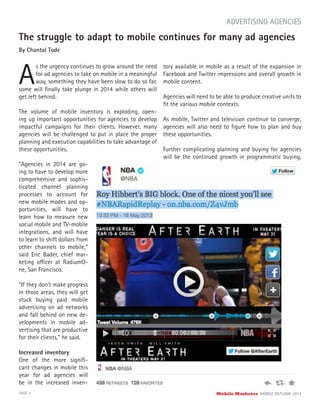
tory available in mobile as a result of the expansion in
Facebook and Twitter impressions and overall growth in
mobile content.
Agencies will need to be able to produce creative units to
fit the various mobile contexts.
As mobile, Twitter and television continue to converge,
agencies will also need to figure how to plan and buy
these opportunities.
Further complicating planning and buying for agencies
will be the continued growth in programmatic buying,
which grew significantly in 2013. Programmatic buying
is expected to play an even bigger role this year, with
more marketers investing in the space.
Other challenges will include uncovering the secret to
developing campaigns that take advantage of mobile’s
personal nature to be relevant.
Additionally, tackling the growth in native ad formats
and the need to customize campaigns for individual me-
dia companies will be important.
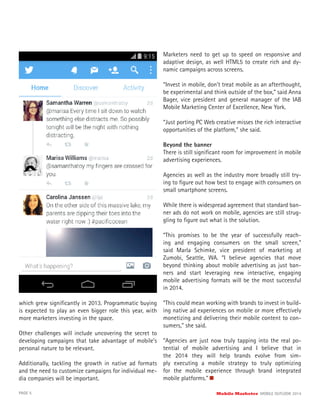
Marketers need to get up to speed on responsive and
adaptive design, as well HTML5 to create rich and dy-
namic campaigns across screens.
“Invest in mobile, don’t treat mobile as an afterthought,
be experimental and think outside of the box,” said Anna
Bager, vice president and general manager of the IAB
Mobile Marketing Center of Excellence, New York.
“Just porting PC Web creative misses the rich interactive
opportunities of the platform,” she said.
Beyond the banner
There is still significant room for improvement in mobile
advertising experiences.
Agencies as well as the industry more broadly still try-
ing to figure out how best to engage with consumers on
small smartphone screens.
While there is widespread agreement that standard ban-
ner ads do not work on mobile, agencies are still strug-
gling to figure out what is the solution.
“This promises to be the year of successfully reach-
ing and engaging consumers on the small screen,”
said Marla Schimke, vice president of marketing at
Zumobi, Seattle, WA. “I believe agencies that move
beyond thinking about mobile advertising as just ban-
ners and start leveraging new interactive, engaging
mobile advertising formats will be the most successful
in 2014.
“This could mean working with brands to invest in build-
ing native ad experiences on mobile or more effectively
monetizing and delivering their mobile content to con-
sumers,” she said.
“Agencies are just now truly tapping into the real po-
tential of mobile advertising and I believe that in
the 2014 they will help brands evolve from sim-
ply executing a mobile strategy to truly optimizing
for the mobile experience through brand integrated
mobile platforms.”
PAGE 5 Mobile Marketer MOBILE OUTLOOK 2014
Apparel and accessories live dangerously, double mobile marketing investments
By Kari Jensen
A
pparel and accessories retailers will show no re-
straint in 2014, spending up to twice as much as
in 2013 to build relationships with consumers
PAGE 6 Mobile Marketer MOBILE OUTLOOK 2014
APPAREL AND ACCESSORIES
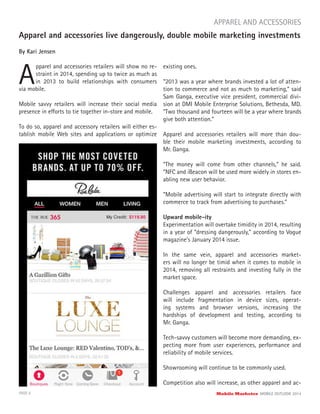
Mobile savvy retailers will increase their social media
presence in efforts to tie together in-store and mobile.
To do so, apparel and accessory retailers will either es-
tablish mobile Web sites and applications or optimize
via mobile.
existing ones.
“2013 was a year where brands invested a lot of atten-
tion to commerce and not as much to marketing,” said
Sam Ganga, executive vice president, commercial divi-
sion at DMI Mobile Enterprise Solutions, Bethesda, MD.
“Two thousand and fourteen will be a year where brands
give both attention.”
Apparel and accessories retailers will more than dou-
ble their mobile marketing investments, according to
Mr. Ganga.
“The money will come from other channels,” he said.
“NFC and iBeacon will be used more widely in stores en-
abling new user behavior.
“Mobile advertising will start to integrate directly with
commerce to track from advertising to purchases.”
Upward mobile-ity
Experimentation will overtake timidity in 2014, resulting
in a year of “dressing dangerously,” according to Vogue
magazine’s January 2014 issue.
In the same vein, apparel and accessories market-
ers will no longer be timid when it comes to mobile in
2014, removing all restraints and investing fully in the
market space.
Challenges apparel and accessories retailers face
will include fragmentation in device sizes, operat-
ing systems and browser versions, increasing the
hardships of development and testing, according to
Mr. Ganga.
Tech-savvy customers will become more demanding, ex-
pecting more from user experiences, performance and
reliability of mobile services.
Showrooming will continue to be commonly used.
Competition also will increase, as other apparel and ac-
PAGE 7 Mobile Marketer MOBILE OUTLOOK 2014
cessories retailers and department stores offer similar
service and mobile marketing upgrades.
Mobilizing social
“Two thousand and fourteen will show steady increases
in the use of mobile marketing by the more successful
and innovative retailers,” said Perry Kramer, vice presi-
dent and practice lead at Boston Retail Partners, Boston.
“Specialty, fashion, and accessory retailers have the
greatest opportunity to drive conversion rates and an in-
crease in average transaction rates through the use of
social media,” he said.
Investments in mobile marketing will include making
sure brands are available on customers’ mobile devices
as well as on retailer-owned in-store mobile devices.
“Mobile marketing is a large piece of the rapidly chang-
ing and expanding move from a traditional single POS
experience to a broad set of customer engagement inter-
actions expected in retail,” Mr. Kramer said.
“These retailers are continuing to invest in a more full
circle view of the customer in their CRM environments,”
he said.
“This is a critical part of the holistic approach to a
customer engagement.”
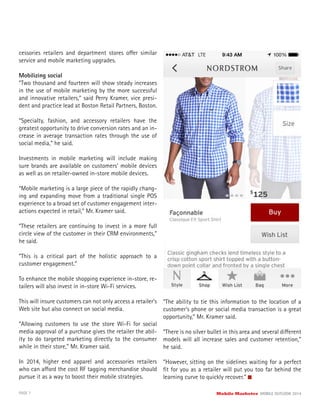
To enhance the mobile shopping experience in-store, re-
tailers will also invest in in-store Wi-Fi services.
This will insure customers can not only access a retailer’s
Web site but also connect on social media.
“Allowing customers to use the store Wi-Fi for social
media approval of a purchase gives the retailer the abil-
ity to do targeted marketing directly to the consumer
while in their store,” Mr. Kramer said.
In 2014, higher end apparel and accessories retailers
who can afford the cost RF tagging merchandise should
pursue it as a way to boost their mobile strategies.
“The ability to tie this information to the location of a
customer’s phone or social media transaction is a great
opportunity,” Mr. Kramer said.
“There is no silver bullet in this area and several different
models will all increase sales and customer retention,”
he said.
“However, sitting on the sidelines waiting for a perfect
fit for you as a retailer will put you too far behind the
learning curve to quickly recover.”
Arts and entertainment brands do not need to curb the
innovation necessarily, but they need to make sure that
the basics are solid.
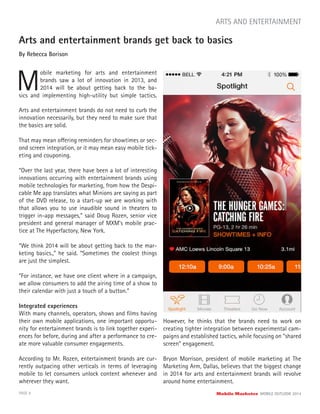
That may mean offering reminders for showtimes or sec-
ond screen integration, or it may mean easy mobile tick-
eting and couponing.
“Over the last year, there have been a lot of interesting
innovations occurring with entertainment brands using
mobile technologies for marketing, from how the Despi-
cable Me app translates what Minions are saying as part
of the DVD release, to a start-up we are working with
that allows you to use inaudible sound in theaters to
trigger in-app messages,” said Doug Rozen, senior vice
president and general manager of MXM’s mobile prac-
tice at The Hyperfactory, New York.
“We think 2014 will be about getting back to the mar-
keting basics.,” he said. “Sometimes the coolest things
are just the simplest.
“For instance, we have one client where in a campaign,
we allow consumers to add the airing time of a show to
their calendar with just a touch of a button.”
Integrated experiences
With many channels, operators, shows and films having
their own mobile applications, one important opportu-
nity for entertainment brands is to link together experi-
ences for before, during and after a performance to cre-
ate more valuable consumer engagements.
According to Mr. Rozen, entertainment brands are cur-
rently outpacing other verticals in terms of leveraging
mobile to let consumers unlock content whenever and
wherever they want.
Arts and entertainment brands get back to basics
By Rebecca Borison
M
obile marketing for arts and entertainment
brands saw a lot of innovation in 2013, and
2014 will be about getting back to the ba-
PAGE 8 Mobile Marketer MOBILE OUTLOOK 2014
sics and implementing high-utility but simple tactics.
ARTS AND ENTERTAINMENT
However, he thinks that the brands need to work on
creating tighter integration between experimental cam-
paigns and established tactics, while focusing on “shared
screen” engagement.
Bryon Morrison, president of mobile marketing at The
Marketing Arm, Dallas, believes that the biggest change
in 2014 for arts and entertainment brands will revolve
around home entertainment.
PAGE 9 Mobile Marketer MOBILE OUTLOOK 2014
“The console market will compete for digital spend, but
that won’t be a dramatic impact on the spend against
mobile since they are two very different audiences,” Mr.
Morrison said. “What will be dramatic is the role the mo-
bile device plays in interacting with consoles.
“As commerce moves to the console the mobile device
has the ability to be a major influencer in that process,
as well,” he said.
“The consoles that have done a good job building mo-
bile into their experience, as Microsoft did with the
Xbox One, will likely make the process seamless between
the devices.”
Analyze and refine
Beyond returning to the basics and focusing on second
screen, arts and entertainment brands should focus on
analysis and refinement in 2014.
Marketers should reevaluate their current mobile solu-
tions and use analytics and research to make changes
to their mobile program in order to more effectively
reach audiences.
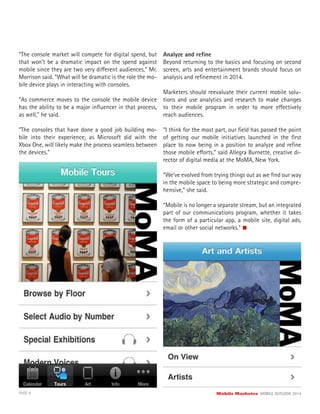
“I think for the most part, our field has passed the point
of getting our mobile initiatives launched in the first
place to now being in a position to analyze and refine
those mobile efforts,” said Allegra Burnette, creative di-
rector of digital media at the MoMA, New York.
“We’ve evolved from trying things out as we find our way
in the mobile space to being more strategic and compre-
hensive,” she said.
“Mobile is no longer a separate stream, but an integrated
part of our communications program, whether it takes
the form of a particular app, a mobile site, digital ads,
email or other social networks.”
In 2013, automakers continued to be a leading sector in
the mobile advertising space with brand-building cam-
paigns that tested a variety of different technologies.
Going forward, the challenge will be to incorporate mo-
bile into every step of the often long car-buying process.
“Autos are unique compared to many other industries as
the path to conversion is much longer,” said Amy Peet,
senior manager of digital marketing at Chrysler Group,
Auburn Hills, MI.
“Examining user’s behaviors and media consumption will
help to determine where mobile plays in the involved
process of trying to sell a car,” she said.
“We are also looking to vendors to increase their tar-
geting capabilities for household device stitching so we
are able to effectively market messaging throughout the
consumer’s path to purchase.”
In the right lane
With more consumers researching and comparing vehi-
cles on their mobile devices before visiting a car dealer,
automakers significantly geared up their mobile efforts
in 2013.
In particular, geo-conquesting, or the ability to geo-tar-
get messages around a competitor’s location, became a
way for automakers to gain a competitive advantage.
The notion that consumers will buy a car through
their mobile device is still far-fetched and therefore
automakers will need to continue to focus on driv-
ing foot traffic to dealerships through location-based
mobile advertising.
Additionally, search was a big priority for many auto
Automakers hone in on targeting to justify mobile investments
By Lauren Johnson
A
utomakers will step up efforts to understand the
role mobile plays in the path to purchase with an
increased focus on targeting consumers with rel-
PAGE 10 Mobile Marketer MOBILE OUTLOOK 2014
evant messages at each step of the research process.
AUTOMOTIVE
brands in 2013 with the ability to bid against keywords
in real-time to target consumers that made mobile
searches for a competitor’s brand.
According to Monica Ho, vice president of marketing at
xAd, New York, layering in location data on top of mobile
searches to make results more contextually-relevant will
be important in 2014.
Additionally, programmatic ad buying will be a big area
for automakers around techniques such as real-time
bidding, giving marketers have the ability to target
PAGE 11 Mobile Marketer MOBILE OUTLOOK 2014
consumers with relevant ads instantaneously on mobile
sites and applications.
Given that automakers are constantly looking to quan-
tify and measure a campaign’s impact, the sector is one
of the areas where real-time bidding’s impact will be felt
the most in 2014.
“To drive automotive conversions, marketers should pro-
vide targeted and timely information to provide real val-
ue including clear communication of location and price,
as well as ad targeting based on user search intent,” Ms.
Ho said.
Proving mobile’s worth
Since there is often times not a clear path to purchase,
proving mobile’s value versus desktop will still be a prior-
ity for Chrysler and other auto brands in 2014.
To stay ahead this year, auto marketers will need to run
test campaigns and work to find the tactic that is most
effective at building context.
For example, Chrysler plans to hone in on daypart-
ing, location and behavioral targeting this year. Ad-
ditionally, cross-screen targeting and attribution are
top priorities.
“[Our priorities for 2014 include] proving that mobile can
be just as efficient, if not more efficient, than desktop,”
Chrysler’s Ms. Peet said. “However there are different ac-
tions the users are looking to accomplish.”
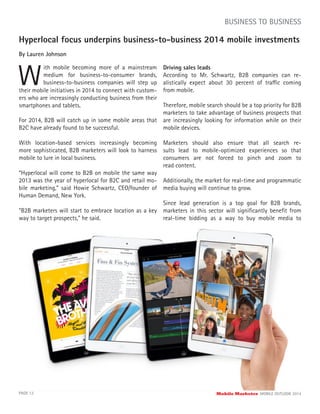
For 2014, B2B will catch up in some mobile areas that
B2C have already found to be successful.
With location-based services increasingly becoming
more sophisticated, B2B marketers will look to harness
mobile to lure in local business.
“Hyperlocal will come to B2B on mobile the same way
2013 was the year of hyperlocal for B2C and retail mo-
bile marketing,” said Howie Schwartz, CEO/founder of
Human Demand, New York.
“B2B marketers will start to embrace location as a key
way to target prospects,” he said.
Hyperlocal focus underpins business-to-business 2014 mobile investments
By Lauren Johnson
W
ith mobile becoming more of a mainstream
medium for business-to-consumer brands,
business-to-business companies will step up
PAGE 12 Mobile Marketer MOBILE OUTLOOK 2014
their mobile initiatives in 2014 to connect with custom-
ers who are increasingly conducting business from their
smartphones and tablets.
BUSINESS TO BUSINESS
Driving sales leads
According to Mr. Schwartz, B2B companies can re-
alistically expect about 30 percent of traffic coming
from mobile.
Therefore, mobile search should be a top priority for B2B
marketers to take advantage of business prospects that
are increasingly looking for information while on their
mobile devices.
Marketers should also ensure that all search re-
sults lead to mobile-optimized experiences so that
consumers are not forced to pinch and zoom to
read content.
Additionally, the market for real-time and programmatic
media buying will continue to grow.
Since lead generation is a top goal for B2B brands,
marketers in this sector will significantly benefit from
real-time bidding as a way to buy mobile media to
target consumers in real-time as they are searching
for keywords.
While attribution is one of the biggest challenges
for mobile marketers with advertising, click-based
attribution can still be an effective measure for
the sector.
“Click-based attribution on mobile is perfect for
lead generation and does not rely on cookies,” Mr.
Schwartz said.
PAGE 13 Mobile Marketer MOBILE OUTLOOK 2014
Going beyond the basics
Mobile has moved from being a siloed medium to
an integrated part of a media mix in the past few
years for B2C brands.
Despite B2B companies being a bit slower to mo-
bile, brands will boost their budget spends and test
out more sophisticated forms of mobile marketing
in 2014.
Take mobile video, for example.
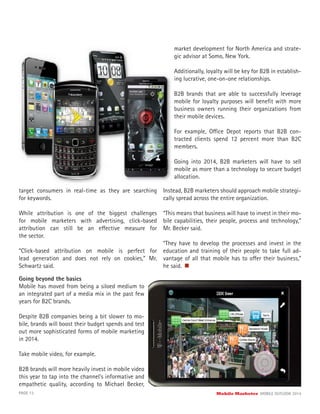
B2B brands will more heavily invest in mobile video
this year to tap into the channel’s informative and
empathetic quality, according to Michael Becker,
market development for North America and strate-
gic advisor at Somo, New York.
Additionally, loyalty will be key for B2B in establish-
ing lucrative, one-on-one relationships.
B2B brands that are able to successfully leverage
mobile for loyalty purposes will benefit with more
business owners running their organizations from
their mobile devices.
For example, Office Depot reports that B2B con-
tracted clients spend 12 percent more than B2C
members.
Going into 2014, B2B marketers will have to sell
mobile as more than a technology to secure budget
allocation.
Instead, B2B marketers should approach mobile strategi-
cally spread across the entire organization.
“This means that business will have to invest in their mo-
bile capabilities, their people, process and technology,”
Mr. Becker said.
“They have to develop the processes and invest in the
education and training of their people to take full ad-
vantage of all that mobile has to offer their business,”
he said.
Consumer electronics leverages mobile to be “it” brand
By Kari Jensen
C
onsumer electronics brands and retailers will pur-
sue their 15 minutes of fame in 2014, waging mo-
bile marketing campaigns to garner loyalty and
PAGE 14 Mobile Marketer MOBILE OUTLOOK 2014
CONSUMER ELECTRONICS
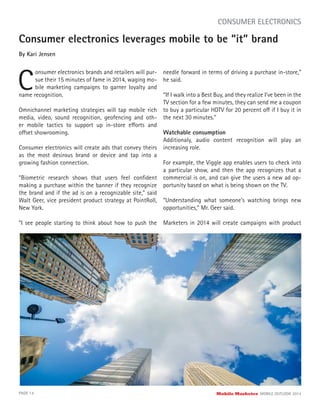
Omnichannel marketing strategies will tap mobile rich
media, video, sound recognition, geofencing and oth-
er mobile tactics to support up in-store efforts and
offset showrooming.
Consumer electronics will create ads that convey theirs
as the most desirous brand or device and tap into a
growing fashion connection.
“Biometric research shows that users feel confident
making a purchase within the banner if they recognize
the brand and if the ad is on a recognizable site,” said
Walt Geer, vice president product strategy at PointRoll,
New York.
“I see people starting to think about how to push the
name recognition.
needle forward in terms of driving a purchase in-store,”
he said.
“If I walk into a Best Buy, and they realize I’ve been in the
TV section for a few minutes, they can send me a coupon
to buy a particular HDTV for 20 percent off if I buy it in
the next 30 minutes.”
Watchable consumption
Additionaly, audio content recognition will play an
increasing role.
For example, the Viggle app enables users to check into
a particular show, and then the app recognizes that a
commercial is on, and can give the users a new ad op-
portunity based on what is being shown on the TV.
“Understanding what someone’s watching brings new
opportunities,” Mr. Geer said.
Marketers in 2014 will create campaigns with product
PAGE 15 Mobile Marketer MOBILE OUTLOOK 2014
relevance, geo-fencing and duplication in mind.
Going forward, consumer electronics mobile marketers
will strive to engage consumers on mobile devices in
ways that are customized, tailor-made and interactive.
Privacy will become a hot topic in 2014, as consumer
devices obtain and share more information.
Wearable mobility
Consumer electronics brands will also increasingly play
up a growing fashion connection.
“Two thousand and fourteen promises to be an excit-
ing time for technology lovers, as consumer electronics
meets fashion,” said Dale Carr, founder and CEO of Lead-
Bolt, Los Angeles.
“Get ready for wearable devices - Google Glasses and
Pebble Smart Watches - to gain consumer acceptance,
as well as TVs that integrate Web widgets and mobile
technology to facilitate the discovery and purchase of
the items you see in movies/shows – directly from the
screen,” he said.
“[For example], say you’re watching Top Gun. Like
Tom Cruise’s aviator glasses? Just click on your TV to
view the product details, and make the purchase from
your screen.”
As wearable devices and cross-platform integration gain
momentum, marketers will look for relevant ways to
promote these new environments and engage consum-
ers with them.
“Mobile devices will continue to attract the lion’s share
of attention from marketers and app developers, devices
due to their ability to reach consumers anytime, any-
where,” Mr. Carr said.
“In 2013, it became second nature for shoppers to use a
mobile device to showroom,” he said.
This year will see mobile apps bringing even deeper
search and targeting capabilities.
Also, the development of more branded apps and subtle
branded integrations - such as branded playlists - for
the sake of building long-term, loyal audiences will rise
- versus direct marketing efforts.
“Additionally, the free app economy is alive and well, as
free - or freemium - apps continuing to drive the mar-
ket,” Mr. Carr said.
“If Gartner predictions are true, by 2017, annual app
downloads are expected to reach 268.7 billion, by which
point 94.5 percent of app downloads will be free, and
in-app purchases will be generating 48 percent of rev-
enues,” he said.
Segmentation, personalization will boost CPGs’ mobile success
By Lauren Johnson
W
hile 2013 was the year that big consumer
packaged good brands such as Mondelēz In-
ternational began to embrace mobile’s poten-
PAGE 16 Mobile Marketer MOBILE OUTLOOK 2014
CONSUMER PACKAGED GOODS
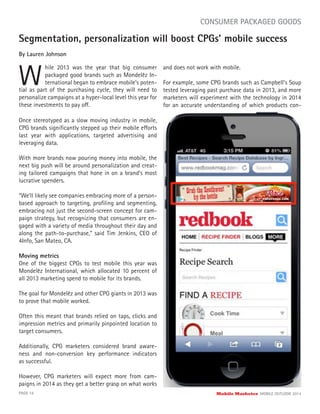
Once stereotyped as a slow moving industry in mobile,
CPG brands significantly stepped up their mobile efforts
last year with applications, targeted advertising and
leveraging data.
With more brands now pouring money into mobile, the
next big push will be around personalization and creat-
ing tailored campaigns that hone in on a brand’s most
lucrative spenders.
“We’ll likely see companies embracing more of a person-
based approach to targeting, profiling and segmenting,
embracing not just the second-screen concept for cam-
paign strategy, but recognizing that consumers are en-
gaged with a variety of media throughout their day and
along the path-to-purchase,” said Tim Jenkins, CEO of
4Info, San Mateo, CA.
Moving metrics
One of the biggest CPGs to test mobile this year was
Mondelēz International, which allocated 10 percent of
all 2013 marketing spend to mobile for its brands.
The goal for Mondelēz and other CPG giants in 2013 was
to prove that mobile worked.
Often this meant that brands relied on taps, clicks and
impression metrics and primarily pinpointed location to
target consumers.
Additionally, CPG marketers considered brand aware-
ness and non-conversion key performance indicators
as successful.
However, CPG marketers will expect more from cam-
paigns in 2014 as they get a better grasp on what works
tial as part of the purchasing cycle, they will need to
personalize campaigns at a hyper-local level this year for
these investments to pay off.
and does not work with mobile.
For example, some CPG brands such as Campbell’s Soup
tested leveraging past purchase data in 2013, and more
marketers will experiment with the technology in 2014
for an accurate understanding of which products con-
PAGE 17 Mobile Marketer MOBILE OUTLOOK 2014
sumers are likely to buy. This data can then either be
used to target against a brand or push offers to consum-
ers that already have a preference for a product.
Additionally, more sophisticated forms of location-based
targeting, including geo-fencing and geo-conquest-
ing, will give brands new ways to target consumers at
granular levels.
On the content side, CPG brands will rapidly roll out re-
sponsive sites in 2014, according to Stephen Burke, vice
president of mobile at Resource, Columbus, OH.
Moreover, the focus on personalization will be critical.
“We will see more brands explore the value of person-
alization driven by engagement with owned mobile
properties and also more activity with retailers to ex-
plore ‘test and learns’ around mobile engagement,” Mr.
Burke said.
Measurement challenges
As CPG brands delve into more personalization, mea-
surement will continue to be an issue for marketers.
Location-based targeting is a big opportunity but also a
challenge for CPG brands given their massive reach.
To target consumers on a hyperlocal level requires that
marketers have a great deal of information on a con-
sumer that can be spun into a targeted ad in real-time
when a shopper is making a split-second decision be-
tween brands at the grocery store.
In fact, research from Catalina Marketing has found that
30 percent of advertising is wasted on consumers who
do not buy a product.
Additionally, two-thirds of advertising is focused on a
tiny group of consumers who only represent two percent
of a brand’s sales.
“One of the most influential places for a CPG brand is in
the store and in the aisle,” said John Caron, vice president
of marketing at Catalina Marketing, St. Petersburg, FL.
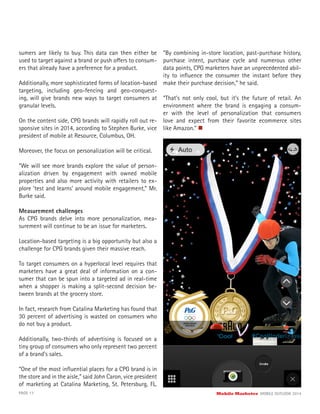
“By combining in-store location, past-purchase history,
purchase intent, purchase cycle and numerous other
data points, CPG marketers have an unprecedented abil-
ity to influence the consumer the instant before they
make their purchase decision,” he said.
“That’s not only cool, but it’s the future of retail. An
environment where the brand is engaging a consum-
er with the level of personalization that consumers
love and expect from their favorite ecommerce sites
like Amazon.”
New surge mobile education creates opportunities for marketers
By Kari Jensen
M
obile instruction will be among education’s
best practices in 2014, opening up new oppor-
tunities for hardware manufacturers, brands
PAGE 18 Mobile Marketer MOBILE OUTLOOK 2014
EDUCATION
and education companies.
Education companies, brands and institutions that inte-
grate mobile in their marketing plans will engage con-
sumers, including students and instructors.
With smart devices increasingly being used for teaching
and learning, competition will increase among hardware
manufacturers for a piece of the pie.
“I think we will continue to see a surge in mobile tech-
nology used in education, and we will see an expand-
ing library of apps that are educational and engaging,”
said Daylene Long, chief marketing officer and partner at
Vernier Software and Technology, Beaverton, OR. “In the
education market, I project that we will see an increase
in the number of devices that compete with iPad.
“Chromebook, the Amplify Tablet, and tablets using
Microsoft 8.1 are getting a lot of buzz in educational
technology,” she said.
Mobile methods
Tablets greatly enhanced elementary and secondary stu-
dents’ learning and instructors teaching, according to a
PAGE 19 Mobile Marketer MOBILE OUTLOOK 2014
study released in November 2013 by Project Tomorrow.
As of September 2013, 24 percent of Americans ages 16
and older own an e-reader, while 35 percent of Ameri-
cans ages 16 and older own a tablet computer, according
to the Pew Research Center.
About 62 percent of respondents to The 2013 National
Survey on Mobile Technology for [Kindergarten through
grade 12] Education cited that they are looking for apps
that are engaging.
About 43 percent said they were looking for apps
that personalize instruction to meet the needs of
different students.
About 36 percent stated they were looking for apps that
provide interactive learning.
Data direction
As mobile technology continues to evolve, so, too,
will the ways that mobile can be put to use in an
educational environment.
“In science education, we are going to see a big shift
in the type of data-collection technology available for
hands-on experiments,” Ms. Long said.
“In 2014, we can expect to see innovative sensors that
collect scientific data and wirelessly transmit that data
to tablet devices for students to analyze and share,”
she said.
Moving ahead in 2014, mobile device management -
configuring, monitoring, updating, securing, filtering,
deploying apps, erasing devices remotely - will continue
to be a leading challenge for educators, according to
Ms. Long.
“It’s a huge issue for education, which means that it
presents a great business opportunity for mobile mar-
keters,” she said.
Education brands, companies and institutions have only
just begun to understand and take advantage of mobile’s
capabilities, from contacting students, parents and in-
structors, to disseminating information, to tracking data,
to helping systems raise funds.
To meet consumers’ increasing mobile demands, edu-
cation systems will need to adopt messaging systems,
such as Twitter, Facebook and SMS, according to Scott
Goodstein, founder and CEO of Revolution Messaging,
LLC, Washington, D.C.
Communication systems that lack mobile components
and are not mobile friendly only will serve to frustrate
consumers, per Mr. Goodstein.
“The real challenge to meeting these changing demands
is that they will need to weigh the costs of mobile pro-
grams, against the speed and the reliability of these new
services,” Mr. Goodstein said.
PAGE 20 Mobile Marketer MOBILE OUTLOOK 2014
FINANCIAL SERVICES
Financial services up investments in activity-based marketing, MMS
By Rebecca Borison
I
n 2014, financial services marketers will expand their
focus in mobile marketing to include more activity-
based marketing and MMS strategies.
While inbound marketing has become more popular re-
cently, activity-based marketing must be embraced to
take financial services to the next level. Inbound mar-
keting waits for a consumer to make contact with the
company before applying marketing efforts, but activity-
based marketing works in the context of an activity be-
ing performed by a consumer.
“Historically, banks’ point of interaction with customers
or prospects is the point of purchase when the consumer
is ready to buy the house and now needs to find a loan,
or when the consumer is sitting down with the car deal-
er negotiating price,” said Ron Shevlin, senior analyst at
Aite Group, Boston.
“Activity-based marketing changes the point of inter-
action for banks, moving that point much closer to the
identification of the need or want for the product or ser-
vice,” he said.
Activity-based marketing
Activity-based marketing is similar to asking “Would you
like fries with that?” at a quick-service restaurant.
For financial services marketers it means creating a
new point of interaction. A few current examples are
USAA’s Auto Circle application, Commonwealth Bank of
Australia’s home buying app and Caixa Bank’s ticket-
purchasing app.
Unlike with other verticals, however, financial institu-
tions tend to face more pushback internally when look-
ing to innovative mobile tactics.
One of their challenges in 2014 will be overcoming the
reluctance to innovate and move forward in mobile.
“An issue the financial industry faces is speed,” said Dirk
R. Rients, senior vice president and director of mobile at
DDB Chicago. “Financial institutions are known for being
very large and slowing moving which can be difficult in
the fast paced world of mobile.”
Rich messaging
While financial services widely banked on SMS for mar-
keting in 2013, expect to these organization expand into
richer messages going forward, with MMS as a way of
PAGE 21 Mobile Marketer MOBILE OUTLOOK 2014
delivering better ROI. MMS brings high engagement,
with rich media and a widespread reach.
“Two thousand and fourteen will see more financial
services marketers engage in MMS as a way of reach-
ing consumers,” said James Citron, founder of Mogreet,
Venice, CA. “SMS has been the dominant medium for text
message marketing for some time but that will change
in 2014.”
According to Mr. Citron, MMS is growing at a rate of
about 40 percent year over year and yields three times
the engagement as SMS.
Financial services can leverage MMS for all sorts of cam-
paigns. They can message their consumers to remind
them about payments and bills, or they can encourage
app downloads.
Traditional means of communication such as direct mail
and print advertisements are costly and show little ROI,
with most consumers throwing it out.
SMS has a higher capability of reaching consum-
ers at a lower cost, and MMS takes the creativ-
ity level of the message to the next level, leading to
more engagement.
With MMS, it is important to have consumers opt-in and
to send targeted, relevant and valuable content.
One pitfall financial services will need to be careful to
avoid in 2014 is sending messages too frequently or at
inappropriate times.
“Text message marketing is appealing for financial ser-
vices companies because it’s ubiquitous, almost any
phone can do it and most people use it, and because of
its open rates which at around 95 percent are signifi-
cantly higher than that of email,” Mr. Citron said.
“But consumers are now more used to creating, sharing
and consuming rich media and SMS doesn’t allow for
that,” he said.
“In the last few years some marketers turned to apps
as a way of sharing rich media, but they lack the wide-
spread reach of text messaging, so they failed to deliver
the same ROI.”
Location and timing are key for food and beverage sector
By Rebecca Borison
F
ood and beverage marketers need to do a better
job of embracing the key benefits of mobile such as
location and timing in order to take their strategies
PAGE 22 Mobile Marketer MOBILE OUTLOOK 2014
FOOD AND BEVERAGE
to the next level in 2014.
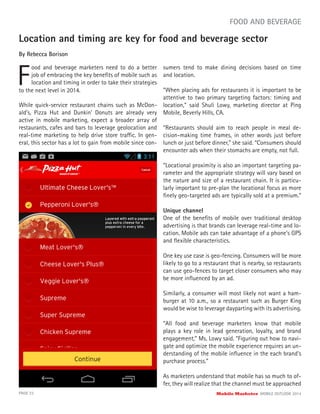
While quick-service restaurant chains such as McDon-
ald’s, Pizza Hut and Dunkin’ Donuts are already very
active in mobile marketing, expect a broader array of
restaurants, cafes and bars to leverage geolocation and
real-time marketing to help drive store traffic. In gen-
eral, this sector has a lot to gain from mobile since con-
sumers tend to make dining decisions based on time
and location.
“When placing ads for restaurants it is important to be
attentive to two primary targeting factors: timing and
location,” said Shuli Lowy, marketing director at Ping
Mobile, Beverly Hills, CA.
“Restaurants should aim to reach people in meal de-
cision-making time frames, in other words just before
lunch or just before dinner,” she said. “Consumers should
encounter ads when their stomachs are empty, not full.
“Locational proximity is also an important targeting pa-
rameter and the appropriate strategy will vary based on
the nature and size of a restaurant chain. It is particu-
larly important to pre-plan the locational focus as more
finely geo-targeted ads are typically sold at a premium.”
Unique channel
One of the benefits of mobile over traditional desktop
advertising is that brands can leverage real-time and lo-
cation. Mobile ads can take advantage of a phone’s GPS
and flexible characteristics.
One key use case is geo-fencing. Consumers will be more
likely to go to a restaurant that is nearby, so restaurants
can use geo-fences to target closer consumers who may
be more influenced by an ad.
Similarly, a consumer will most likely not want a ham-
burger at 10 a.m., so a restaurant such as Burger King
would be wise to leverage dayparting with its advertising.
“All food and beverage marketers know that mobile
plays a key role in lead generation, loyalty, and brand
engagement,” Ms. Lowy said. “Figuring out how to navi-
gate and optimize the mobile experience requires an un-
derstanding of the mobile influence in the each brand’s
purchase process.”
As marketers understand that mobile has so much to of-
fer, they will realize that the channel must be approached
PAGE 23 Mobile Marketer MOBILE OUTLOOK 2014
in a unique manner.
Copying a desktop ad onto mobile will not cut it in 2014.
Marketers need to embrace the unique qualities of the
channel to optimize campaigns with features such as
geolocation and dayparting.
“Brands will stop treating mobile like desktop,” said Pa-
mela Naumes, director of brand engagement at Bolt-
house Farms, Bakersfield, CA. “Brands are evolving their
mobile advertising strategy and will move away from one
that’s driven largely by banner ads to one that mirrors
the mobile behavior of the consumer driven by insights.”
Social video
After getting the basics of mobile Web and mobile ads
down, food and beverage marketers should get creative.
The merging of mobile and social is the perfect combina-
tion for food and beverage retailers. They can leverage
the immediacy of mobile and virality of social to forward
creative efforts.
Restaurants and others in the food and beverage sector
can create a strong social media presence using fun and
witty videos.
“We think that the main difference in 2014 will be the
growing emphasis on social video,” said Todd Leeloy, gen-
eral manager at OrangeSoda, American Fork, UT. “Ser-
vices like Vines and Instagram Video will continue enable
users to evolve from photos to short videos shared with
friends.
“The Food and beverage industry is positioned in a unique
position between artistry and lifestyle,” he said. “There
are opportunities to showcase products and events
through mobile videos that could really drive virality,
loyalty and revenue.”
Government builds on mobile apps and Web sites in 2014
By Kari Jensen
F
ollowing some recent successes in leveraging mo-
bile to support various agencies’ outreach efforts,
government will ramp up efforts to optimize exist-
PAGE 24 Mobile Marketer MOBILE OUTLOOK 2014
GOVERNMENT
ing offerings and establish new mobile Web sites and
apps in 2014.
With mobile giving government a way to easily engage
consumers by simplifying, streamlining and enlivening
content, expect agencies and municipalities of all sizes
and levels to begin leveraging mobile in order to keep
pace with businesses.
“Government had some huge successes in using mobile
effectively in 2013,” said Scott Goodstein, founder and
CEO of Revolution Messaging, LLC, Washington, DC.
“[For example,] Text4Baby gave consistent and timely
information to low-income pregnant women, while the
Federal Emergency Management Agency’s text message
shelter look up system gave users the ability to text in
their ZIP codes during a disaster and easily find their
closest shelter.
“FEMA’s system was used during several earthquakes,
hurricanes and fires this past year,” he said.
Stepping up mobile
As more consumers rely on their mobile devices, the gov-
ernment is going to have to meet their needs by offering
mobile apps and optimized sites.
“Citizens will start to become more and more frustrated
if our government Web sites are not mobile friendly and
if their user experience does not include a mobile com-
ponent,” Mr. Goodstein said.
In 2014, governments will play catch up to try and meet
their mobilized population’s demands.
Local governments, schools, and special service organi-
zations will need to adopt messaging systems. However,
they are likely to face some challenges with traditional
SMS messaging that could bring about a bigger role for
alternative messaging strategies such as Twitter or Face-
book messaging in government.
“The real challenge to these local governments try-
ing to meet these changing demands is that they will
need to weigh the costs of mobile programs, against
the speed and the reliability of these new services,” Mr.
Goodstein said.
“Simply put busy governments and organizations don’t
have the bandwidth, budget or capacity to deal with the
amount of carrier red-tape to set up and run SMS pro-
grams and will look to cheaper options if the CTIA, MMA,
and carriers don’t get their act together and streamline
the process and bring the costs down,” he said.
“There are so many rules and changes to the MMA play-
book, CTIA’s auditing system, Neustar’s registry, set up
costs, monthly fees, etc. that local governments could
simply use other messaging options. These other options
include 10-digit phone numbers, Twitter, Facebook mes-
saging, and possibly iMessaging in the near future.
Building consumer confidence
The government will continue to need to reassure users
of their privacy, and to safeguard user data, especially in
light of NSA revelations.
“The government needs to assure consumers that new
safeguards are in place for their transactions, for user
data and ecommerce,” said Chad Estes, executive vice
president of product management at Blinq Media, Atlan-
ta. “The government should continue to be a strong ad-
vocate, lowering any barriers that could slow the growth
of mobile, especially when it comes to online taxation.
“The government may even consider developing some
kind of incentive, monetary or not, to increase the adop-
tion of smart mobile devices in order to promote the
growth of this important market,” he said.
“At the bare minimum, make your Web site work on mo-
bile phones and tablet computers,” Revolution Messag-
ing’s Mr. Goodstein said.
Healthcare prescribes patient-centered, technology-driven mobile solutions
By Kari Jensen
A
s the complex United States healthcare system
continues to frustrate consumers and providers,
expect healthcare brands to devote more re-
PAGE 25 Mobile Marketer MOBILE OUTLOOK 2014
HEALTHCARE
sources to mobile marketing in 2014 in order to enhance
user support.
Mobile wields enormous potential and possibilities,
which healthcare and medical entities are just begin-
ning to tap. They can look to top mobile retailers, such
as Target and Walmart for inspiration and best practices
for engaging consumers and increasing mobile traffic
and sales.
“Mobile marketers are still trying to break the code of
how they can interact with people on a long-term basis
and move the compliance needle,” said Michael Mat-
thews, managing director and founder of The Mobile
Culture, New York. “We’ve tried text reminders to utility-
based apps and the quantified self, but those mainly ex-
perience short-term success.
“The burn-out rate is high and will always be when we
focus on the patient who just wants to forget they even
have a health issue,” he said. “So, in 2014 you’ll see more
of a true focus on the patient’s support group.
“No patient wants to let their family, friends or [health
care provider] down and technology will help broaden
the patient’s accountability to them.”
Fitness and mhealth
An increasing number of mobile device owners and a
rise in mobile sophistication are driving the demand for
smartphones and mhealth care products.
There are more than 40,000 health and medical mobile
applications, according to Happtique.
The global mobile health, or mhealth, market is estimat-
ed to reach $58.8 billion by the end of 2020, according
to Reportlinker.com.
MediSafe, a mobile medication management system, is
one basic model that will be commonly seen in 2014.
MediSafe alerts designated caregivers when a patient is
being non-compliant.
Other more innovative solutions are expected in 2014
but could face challenges if they are overly complex.
“[With MediSafe] the caregivers are then given options
to text, call or email the patient in the very moment
when they need it most,” Mr. Matthews said. “It’s already
seen high adherence rates for Type 2 Diabetics.
“Even radically innovative products like the Tellspec Food
Spectrometer, launching August 2014, that beams ingre-
dients found in your food over to your phone or Alive-
Cor’s smartphone heart monitor accessory will require
greater involvement outside of just the patient in order
to survive,” he said.
Coverage and care
Since the implementation of healthcare reform and, more
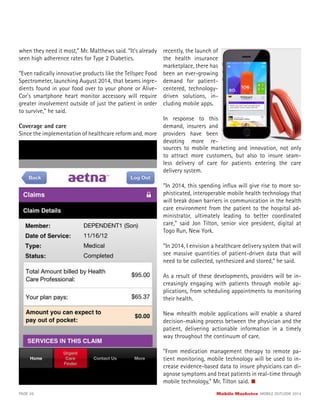
recently, the launch of
the health insurance
marketplace, there has
been an ever-growing
demand for patient-
centered, technology-
driven solutions, in-
cluding mobile apps.
In response to this
demand, insurers and
providers have been
devoting more re-
sources to mobile marketing and innovation, not only
to attract more customers, but also to insure seam-
less delivery of care for patients entering the care
delivery system.
“In 2014, this spending influx will give rise to more so-
phisticated, interoperable mobile health technology that
will break down barriers in communication in the health
care environment from the patient to the hospital ad-
ministrator, ultimately leading to better coordinated
care,” said Jon Tilton, senior vice president, digital at
Togo Run, New York.
“In 2014, I envision a healthcare delivery system that will
see massive quantities of patient-driven data that will
need to be collected, synthesized and stored,” he said.
As a result of these developments, providers will be in-
creasingly engaging with patients through mobile ap-
plications, from scheduling appointments to monitoring
their health.
New mhealth mobile applications will enable a shared
decision-making process between the physician and the
patient, delivering actionable information in a timely
way throughout the continuum of care.
“From medication management therapy to remote pa-
tient monitoring, mobile technology will be used to in-
crease evidence-based data to insure physicians can di-
agnose symptoms and treat patients in real-time through
mobile technology,” Mr. Tilton said.
PAGE 26 Mobile Marketer MOBILE OUTLOOK 2014
Home furnishing retailers step up tablet efforts for inspiration
By Lauren Johnson
H
ome furnishing marketers that prioritize tablets
for inspiring consumers with creative ideas will
be more successful with mobile this year than the
PAGE 27 Mobile Marketer MOBILE OUTLOOK 2014
HOME FURNISHINGS
retailers purely looking to drive sales through smaller-
sized screens.
Mobile commerce has continued to grow significantly
year-over-year for the past few years, and 2014 will be
no different. However, getting consumers to transact for
big-ticket items including furniture, artwork or other
home goods will likely continue to be a stretch for some
home furnishing retailers this year.
“[Home furnishing retailers will use mobile] primarily as
an effective browsing channel, as home furnishings are
less of an impulse buy than say, clothes,” said Bob Moul,
CEO of Artisan, Philadelphia.
“Consumers want to see a lot of detail and sharp images,
so tablets will be the better form factor than phones,”
he said.
Tablet-led inspiration
In 2013, home furnishing companies including Pier One
Imports, Sherwin Williams and IKEA rolled out new mo-
bile initiatives to target an increasing group of tablet
and smartphone owners that are turning to their de-
vices as their first resource when making major home
design changes.
Although there are certainly consumers who are buy-
ing big-ticket items straight from their mobile devices,
the vast majority of mobile commerce is happening for
smaller, everyday purchases such as coffee.
With the bigger screen-size, it seems like the tablet
would be the first place for many of these retailers with
mobile investments. However, retailers are still getting
the hang of creating tablet-optimized sites and applica-
tions and many home furnishing marketers have identi-
cal presences on smartphones and tablets.
As tablets inch closer to replacing laptops and desktops
for consumers, home furnishing retailers that get tablet
experiences wrong risk not only relevance, but a bigger
opportunity in driving foot traffic and sales.
Home Depot and IKEA are already tackling the growth
in tablet use with augmented reality tablet app features
that let consumers virtually pull objects into a picture
frame to give consumers a better perspective on the size
of a product.
Mobile-only promotions that drive in-store traffic will
also gain traction in 2014.
Given the time and budget-extensive decisions that go
into buying home furnishing products, personalized con-
tent and product customization should be No. 1 on every
home furnishing retailer’s to-do list for 2014.
“They will invest more in optimizing and personalizing
the mobile and tablet experience to drive engagement,
retention and revenue,” Mr. Moul said.
Busting showrooming
Once retailers have mastered the at-home tablet ex-
perience, improving the in-store experience with de-
vices is likely to be another big priority for home
furnishing retailers.
Since home furnishing items are not necessarily impulse
buys, consumers are willing to go to great lengths with
researching products before visiting a store.
In 2014, retailers will need to pour more investments
into in-store initiatives that up customer service and
keep consumers from showrooming.
In 2012, Sears began arming in-store employees with
tablets to better educate consumers about the retailer’s
home furnishing products.
The tablets let associates look up product reviews, inven-
tory and color choices to help consumers find what they
are looking for.
Going forward, Sears is banking on these kinds of in-
store initiatives to propel the company into a member-
driven retailer with its Shop Your Way loyalty program.
“Our Shop Your Way member and customers are at the
core and future of our business, and that’s why we in-
vest in better technology, deals, integrated retail options
and quality products to ensure our members always get
more,” said Amy Dimond, spokeswoman at Sears, Hoff-
man Estates, IL.
“Key categories where members are using this technol-
ogy include big-ticket purchases like mattresses; bed-
room, dining and living furniture; kitchen appliances;
entertaining; cooking; and home décor,” she said.
PAGE 28 Mobile Marketer MOBILE OUTLOOK 2014
Biggest areas of legal concern will be SMS, location and non-essential patents
By Chantal Tode
O
n the legal and privacy front, mobile marketers
will face growing scrutiny in 2014 related to their
location data policies, ongoing confusion over
PAGE 29 Mobile Marketer MOBILE OUTLOOK 2014
LEGAL?PRIVACY
new texting regulation and a shift in which patents will
be most important in the smartphone patent wars.
As mobile’s influence continues to grow across many as-
pects of business and society, regulators and consumer
advocates will pay more attention than ever to the prac-
tices of mobile companies. Text messaging is one impor-
tant area of focus, with the updated Telephone Consumer
Protection Act rules having caused significant confusion
and the possibility of more law suits.
“There is a giant muddle and there have been petitions
filed by the MMA, CTIA and by groups of texting compa-
nies and others, seeking clarification from the FCC,” said
Jules Polonetsky, director and co-chair of the Future of
Privacy Forum, Washington, DC.
“This is one area where we are going to see more litigation
around TCPA just because the stakes are so high,” he said.
“Plaintiffs have gotten $10, $20, $50 million dollar settle-
ments because it is a $1,500 or $1,600 fine per message.”
Sharing location information
After the updated TCPA rules were introduced in October
2013, many SMS marketers have tried to get new per-
mission from their opted in users in order to continue
communicating with them and avoid the possibility of a
law suit because of how the rules could be misconstrued.
The hope is that the FCC will clarify the rules later in
the year. Mobile location data, already a hot topic in
2013, will only grow in significance in 2014.
Late last year, the Federal Trade Commission, in a settle-
ment with the makers of the Flashlight app, found that
it is deceptive for app developers to not inform users
that their location information is being shared with
ad networks.
“Itisincrediblycommonthatappssharelocationinforma-
tion,” Mr. Polonetsky said. “Many have assumed that just
because they ask for location, they have got permission.
“The FTC has made it very clear that they consider loca-
tion very sensitive and if you don’t say you are giving it
to other parties, you could be subject to liability,” he said.
Patent wars persist
There is also growing scrutiny on how companies are
tracking mobile users’ location around bricks-and-mor-
tar stores. The FTC is holding a program in February of
this year dedicated to taking a closer look at this issue.
“Location is going to be a bigger focus because now we
are starting to see the enforcement when regulators
think it has gotten out of hand,” Mr. Polonetsky said.
“We’ve reached a critical mass of location in the physical
space,” he said. “You’ve got Macy’s launching very prom-
inently a deal with shopkick that is going to help people
get offers in the store, you have Apple rolling out iBea-
con program and you have the retail tracking companies.
“Because the standards are not clear, it is critical that
companies figure out what the best practices are because
we are already seeing regulatory and media push back.
On the intellectual property front, the patent wars kicked
into high gear again at the end of the year when the
Apple-backed Rockstar Consortium brought suits against
a number of Android handset manufacturers.
“The smartphone patent wars are here to say for at least
another year and possibly quite longer,” said C. Graham
Gerst, partner at Global IP Law Group, LLC, Chicago.
“Up until the last year, patents that were essential to
wireless communications standards were viewed as the
Holy Grail,” he said. “Instead, what you are likely to see
is that patents that are directly related to features that
drive consumers to engage with those products, those
are the patents that everyone is going to be asserting
just because of the way things are developing.”
Mobile marketing becomes more strategic as understanding deepens
By Chantal Tode
N
ow that marketers have grasped the potential of
mobile to connect with consumers, they will take
a more strategic approach to mobile in 2014 and
PAGE 30 Mobile Marketer MOBILE OUTLOOK 2014
MARKETING
focus less on individual tactics.
Mobile marketing will grow size, sophistication and im-
pact in 2014 as marketers up their efforts on both the
direct response and branding fronts. As the types of
mobile-enabled devices expand to wearables and con-
nected cars, the understanding of mobile will evolve
and deepen.
“Marketers now understand that the mobile device is the
door to their customer which can be opened anytime,
whether they’re on the go or at home,” said Steve Brum-
er, partner at 151 Advisors, New York. “What they don’t
understand is how to unlock the door.
“There is clearly room for improvement, and we’ll see
success from those who realize that it’s not about fitting
digital strategies into a smaller screen, but rather creat-
ing new strategies to address a unique customer need,”
he said.
“We’ll also see significant organizational restructuring as
marketers figure out how to support mobile across their
company as a whole.”
Throwing away caution
In 2013, marketers focused heavily on mobile tactics
such as mobile Web, applications, responsive design and
native advertising.
In 2014, marketers will move away from making having
an app their mobile strategy towards putting at the cen-
ter of their overall marketing strategy.
“Marketers also realize that the time for being cautious
with mobile is over - mobile is core to both their market-
ing innovation and ROI and those marketers who em-
brace mobile will ultimately have the competitive edge,”
said Sheryl Daija, chief strategy officer at the Mobile
Marketing Association, New York.
There will be a pivot towards better understanding how
customers engage with each channel differently. Mar-
keters will increasingly develop a mobile-first under-
standing of the customer and integrate these insights
into their programs and campaigns across all channels.
Expect marketers to do a better job of leveraging lo-
cation, time and behaviors to tailor messages to
specific platforms.
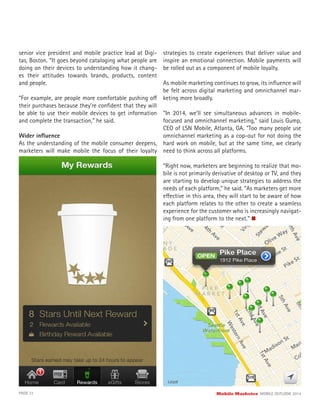
“Marketers should seek to understand how customer be-
haviors and expectations have changed because of their
embrace of always-on connectivity,” said Chia Chen,
senior vice president and mobile practice lead at Digi-
tas, Boston. “It goes beyond cataloging what people are
doing on their devices to understanding how it chang-
es their attitudes towards brands, products, content
and people.
“For example, are people more comfortable pushing off
their purchases because they’re confident that they will
be able to use their mobile devices to get information
and complete the transaction,” he said.
Wider influence
As the understanding of the mobile consumer deepens,
marketers will make mobile the focus of their loyalty
strategies to create experiences that deliver value and
inspire an emotional connection. Mobile payments will
be rolled out as a component of mobile loyalty.
As mobile marketing continues to grow, its influence will
be felt across digital marketing and omnichannel mar-
keting more broadly.
“In 2014, we’ll see simultaneous advances in mobile-
focused and omnichannel marketing,” said Louis Gump,
CEO of LSN Mobile, Atlanta, GA. “Too many people use
omnichannel marketing as a cop-out for not doing the
hard work on mobile, but at the same time, we clearly
need to think across all platforms.
“Right now, marketers are beginning to realize that mo-
bile is not primarily derivative of desktop or TV, and they
are starting to develop unique strategies to address the
needs of each platform,” he said. “As marketers get more
effective in this area, they will start to be aware of how
each platform relates to the other to create a seamless
experience for the customer who is increasingly navigat-
ing from one platform to the next.”
PAGE 31 Mobile Marketer MOBILE OUTLOOK 2014
Publishers look beyond streamlined reading to enhance mobile experiences
By Lauren Johnson
W
ith most publishers already nailing the basic
mobile reading experience, the next phase of
development will focus on context, dayparting
PAGE 32 Mobile Marketer MOBILE OUTLOOK 2014
MEDIA/PUBLISHING
and leveraging reader data.
Mobile hit a tipping point for some publishers in 2013
with more than 50 percent of digital traffic coming from
smartphone and tablets. In addition to more contextual-
ly-relevant applications and sites, new forms of moneti-
zation will need to take shape for publishers in 2014 to
catch up with digital readers who assume that all digital
content is free.
“Every publisher who is at least breathing understands
the incredible potential mobile represents for them,”
said Matt de Ganon, vice president of mobile products at
Gannett Digital, Washington.
“Our USA Today tablet experience is gorgeous, but in mo-
bile it’s just no longer sufficient to have the best reader
experience,” he said.
“The tantalus is the growth of our consumer base on a
device that can integrate content, context, daypart and
data, and what this combination of capabilities can
mean in terms of value and utility to a consumer and
to advertisers.”
Building for mobile
Understanding readers’ behavior will be key for publish-
ers in 2014.
Gannett’s USA Today mobile priorities in the upcom-
ing year hone in on analytics to examine readers’ habits
and characteristics.
Publishers have been quick to develop content for mo-
bile, but many of these products are bare-bones sites
and apps tailored for consumers quickly reading a piece
of news.
Instead, publishers should leverage mobile’s native fea-
tures such as location and time of day to encourage con-
sumers to use a mobile app to read the news instead of
a Web site or print publication.
“In the coming year, the opportunity for publishers will
be to focus on evolving their products and provide deep
utility for users based on all that mobile has to offer,” Mr.
Ganon said.
“When we solve that equation for consumers, the adver-
tisers will follow,” he said.
In-stream ads
Native advertising was a big buzzword last year with ads
that appeared as sponsored content within a stream of
news content as an alternative to static banner ads that
readers may find interruptive.
“Publishers need to care about their ads as much as they
care about their content or journalism,” said Nils Forsb-
lom, CEO/founder of Adtil, San Diego.
“I think 2014 is going to be the year that the mobile ad
tech industry finally starts to understand the opportuni-
ties available surrounding mobility.”
A study conducted by the Online Publishers Association
estimates that close to 90 percent of publishers offered
native advertising by the end of 2013.
As of June 2013, 73 percent of publishers polled said that
they were offering some form of native advertising.
Additionally, publishers will continue to tackle de-
vice fragmentation with adaptive and responsive
Web designs.
“I think we’ll see even more publishers turning to respon-
sive sites, and for that they’ll need ad units that span
across desktop, tablet, and smartphones in-site and in-
app,” said Tony Vlismas, senior director of marketing at
Polar, Toronto.
“We’ll see them turning more and more to native ads
since this spans across all devices,” he said.
However, as more publishers rely on native advertising,
the Federal Trade Commission will crack down on pub-
lishers to create standards that better distinguish edito-
rial from advertising content.
Based on initial tests with native advertising this year,
publishers including Time Inc. plan to make a bigger bet
on it in 2014.
Time Inc.’s native efforts for the upcoming year are fo-
cused on helping marketers scale their digital campaigns
with ads that distribute content across smartphone, tab-
let and desktop inventory.
Multi-screen ad formats and content is the common
thread for how all big publishers are approaching mobile
in 2014.
“The responsibility to have a mobile-optimized site and
creative for traditional ad campaigns generally falls on
the marketer,” said Sol Masch, director of mobile sales
and strategy at Time Inc., New York.
“For native, the responsibility falls on the publisher since
the native ad units and landing destination must be
specific to the publisher’s site,” he said. “So the mar-
keter’s focus becomes more about audience and less
about platform.
“And with audiences consuming content on mobile de-
vices more and more every day, native ad dollars will end
up largely being allocated against mobile.”
PAGE 33 Mobile Marketer MOBILE OUTLOOK 2014
Nonprofits must tackle new SMS issues as mobile’s importance grows
By Chantal Tode
T
he year 2014 will be pivotal for the nonprofits sec-
tor as mobile marketing starts to play a meaning-
ful role for charities both large and small at the
PAGE 34 Mobile Marketer MOBILE OUTLOOK 2014
NONPROFITS
same time that they look to address several important
changes affecting text messaging.
Nonprofits are still reeling from the two major mobile
marketing developments impacting them – new regu-
latory guidelines covering text messaging and carriers
dropping support for premium billing – the aftereffects
of which are likely to be felt for a while.
At the same time, many are still figuring out how best to
leverages mobile’s capabilities to create a more personal
relationship with constituents.
“I expect a significant increase in nonprofits making sure
their engagement and communication is mobile friend-
ly,” said Steve MacLaughlin, director of Blackbaud’s Idea
Lab, Charleston, SC.
“The steady increase in mobile traffic to their Web sites,
the importance of mobile friendly email, and other mul-
tichannel behavior by supporters means big things for
2014,” he said.
“Mobile app usage is likely to still remain specialized and
native mobile readiness is likely to produce the best ROI
for nonprofit organizations.”
Written consent
While carriers have dropped support for premium bill-
ing, two exceptions are charitable donations and
political contributions.
Still, the industry in support of these services is in flux
because of this development.
This means nonprofits will need to be extra vigilant
about following industry compliance guidelines as chari-
table donation campaigns are likely to come under extra
scrutiny from the carriers working to insure that such
campaigns are what they purport to be.
Nonprofits will also need to adjust to an update to the
Telephone Consumer Protection Act that went into effect
in October and which has raised many questions about
how to handle opt-in text messaging lists.
“Nonprofits working with agencies or working on cause-
related marketing need to ensure they have the appro-
priate written express consent before reaching out to
donors due to changes to the TCPA effective in October
2013—this applies to cell phones, ‘robocalling,’ use of
auto-dialers, texts via mobile,” said Senny Boone, gen-
eral counsel at the Direct Marketing Association and the
DMA Nonprofit Federation, New York.
Reaching young donors
Nonprofits will also need to continue to focus on obtain-
ing the proper consent for collecting user data for their
mobile applications and being transparent about how
they use it in order to retain the trust of donors.
Getting their mobile strategies in order is imperative for
nonprofits as their constituents age and a new genera-
tion of donors embraces mobile.
“Many nonprofits are still not using the mobile chan-
nel enough or correctly,” said Jenifer Snyder, executive
director of The mGive Foundation, Denver, CO.
“We’re worried if they don’t assign resources to use the
mobile channel frequently and effectively they’ll get left
behind,” she said. “This is a channel that’s open rates
have increased in the recent years.
“Most recent studies show open rates for text messages
is between 97 and 99 percent.”
Mobile email
Expect more nonprofits to focus on building a mobile do-
nor profile in 2014 as they look to mobile to support their
retention efforts, with more than 83 percent of mobile
donors that opt-in to a nonprofit’s mobile community
staying, per mGive.
As the percentage of emails opened via email continues
to grow, nonprofits will also step up their efforts to opti-
mize email for mobile and tie these efforts together with
their fundraising efforts.
“Nonprofits are going to be much more focused on the
convergence of mobile friendly email marketing and on-
line giving,” said Blackbaud’s Mr. MacLaughlin. “These
have often been thought of separately but we’re now
over the tipping point of mobile email usage and that
has a direct transaction to online giving.”
PAGE 35 Mobile Marketer MOBILE OUTLOOK 2014
Politicians embrace segmentation to better target constituents on mobile
By Rebecca Borison
W
hile a number of politicians have explored SMS
and Twitter for mobile marketing, the true use
case for politicians in 2014 will come down to
PAGE 36 Mobile Marketer MOBILE OUTLOOK 2014
POLITICS
segmentation and targeting.
Politicians are already utilizing mobile to send messages,
remind citizens to vote and even ask for donations. With
the advancements in mobile targeting and data, politi-
cians should take these campaigns to the next level in
2014 so that they can reach the exact constituent they
are looking for.
“With mobile, political organizations have the opportu-
nity to segment different data sets to hypertarget their
audiences and to reach them whenever and wherever
they are,” said Arjun Arora, founder/CEO of ReTargeter,
San Francisco. “For example, a political organization
could target mothers who are between the ages of 25
to 35, who live in Alameda County in California, who
earn $80,000 to $100,000 a year and who have an
Android phone.
“With that kind of targeting, messages can be crafted
very specifically to the interests and concerns of con-
stituents and delivered on the devices that they primar-
ily use,” he said. “Additionally, device targeting with
the iPad specifically will be an important part of mobile
political advertising.
“IPad users tend to be a powerful and important con-
stituent considering their level of education, socioeco-
nomic status, and the fact that they are tech savvy. These
things will give political groups a powerful advantage.”
Target away
While targeting and segmenting can benefit all market-
ers, politicians especially can gain from these advances.
Politicians can personalize messaging on SMS or mobile
ads so that different constituents of different ages, loca-
tions, etc. receive relevant content.
“The coming year will see the continued advances in the
advertising industry’s approach to mobile data targeting
and cross-platform strategies,” said Zac Moffat, digital
director for Mitt Romney and cofounder of Targeted Vic-
tory, Washington, DC.
“Companies such as Targeted Victory are working to
utilize developing technologies to map offline data to
mobile ID’s and replicate the refined targeting abilities
in the mobile space,” he said. “The advancement of ca-
pabilities of Data Management Platforms means that we
are constantly furthering our advancements in mobile
targeting capabilities by working closely with numerous
media partners to reach mobile users with the same pre-
cision we execute in desktop campaigns.”
Next level
There a number of different opportunities for politicians
in mobile in the coming year. Mr. Moffat also expects
mobile email to play a larger role in politics in 2014. Re-
sponsive design will help politicians reach constituents
in the way that they prefer to interact.
There are also other more creative use cases.
“With smartphone penetration being so high, you’re go-
ing to see a significant increase in political campaigns
engaging with voters on their mobile devices through
such things as mobile video, SMS/push messaging, apps,
mobile Web and even different forms of mobile dona-
tion methods,” said Derek Johnson, CEO of Tatango,
Seattle, WA.
The biggest use case for political campaigns in mobile
comes down to donations, per Mr. Johnson.
“This in my opinion is going to have a huge impact on the
amount of contributions a political candidate or group
is going to be able to raise during an election,” he said.
“Unfortunately though, this concept of being able to
donate to a political candidate or group with a mobile
device is a huge challenge for many campaigns, as the
rules and regulations are currently a few steps behind
the technology.”
Real estate industry embraces mobile for real-time information
By Lauren Johnson
R
eal estate agents and companies will be forced to
keep one step ahead of the house hunter through
mobile and real-time information to stay relevant
PAGE 37 Mobile Marketer MOBILE OUTLOOK 2014
REAL ESTATE
in 2014.
The combination of more sophisticated mobile ap-
plications, sites and super-targeted mobile advertis-
ing are all examples of the evolving role of real estate
agents. While some speculate the dying role of the real
estate agent thanks in part to mobile, others say the
medium gives companies a way to be more responsive
to customers.
“The real estate industry has a history of doing busi-
ness on its own terms and own time, a very myopic view,
which will ultimately break down as consumers demand
doing business on their terms,” said Sean Blankenship,
vice president of marketing at Coldwell Banker Real Es-
tate, Madison, NJ.
“IT infrastructure of real estate brands will be challenged
and stretched to provide secure and accurate data that
power exceptional consumer experiences,” he said.
“Today’s consumers expect data in real-time, and no
longer view it as proprietary corporate data but rather
shared data which ultimately creates a better relation-
ship with the brand.”
First impression
In 2014, mobile will drive more brand perception and en-
gagement than desktop for the first time, according to
Mr. Blankenship.
One part of this will be empowering sellers with mobile
tools to better serve clients with the information needed
to help find a home.
As mobile devices and data networks get better, the ex-
pectation for real estate agents is that consumers have
instant access to a plethora of information, meaning that
the role of the agent is changing as a way home seekers
understand the stream of information that is available.
A study from The Search Agency this past summer found
that 52 percent of real estate impressions come from
mobile, highlighting the amount of queries that interest-
ed house hunters are making from their mobile device.
However, there will be greater opportunities beyond
search ads when it comes to mobile advertising in the
real estate industry in 2014.
With more sophisticated data and geo-fencing capabili-
ties, real estate agents will leverage rich media, social
media and utility features such as click-to-call to pre-
cisely target mobile searchers.
This could also force some real estate companies to re-
think and tailor their mobile content strategy.
“We need to work smarter with our content targeting,
so that we’re delivering the right content, to the right
person, in the right place, and at the right time,” said
Matthew Shadbolt, director of interactive product and
marketing for the Corcoran Group, New York.
“If we can achieve those four goals, I believe we can create
some magical mobile marketing opportunities,” he said.
Getting personal
As consumers rely on their smartphones and tablets more
to research home listings, real estate applications and
sites will become more sophisticated and personalized.
For example, real estate apps now let consumers draw
their own boundaries on a map for more personal
home searches.
Additionally, apps send out push notifications to keep
house hunters up to date with every step of buying
a home.
The next phase of real estate apps and sites will be
more contextually-based and pick up on multiple pieces
of information.
Take the Google Now app, for example. Zillow powers
home listings in the app and can pull in additional infor-
mation such as listing price and time on market into a
search listing.
At the same time, agents will need to focus more on
personalization in 2014 as a result of these mobile tools.
“The biggest challenge for agents is that home shoppers
will have greater expectations of their agent partner,”
said Jeremy Wacksman, vice president of marketing and
mobile at Zillow, Seattle.
“Mobile means immediacy, and shoppers are going to
expect that agents will be available 24/7, which means
they are going to have to quickly adapt to this high-
touch, quick-response environment,” he said.
PAGE 38 Mobile Marketer MOBILE OUTLOOK 2014
Retailers to benefit as contextual relevance leaps forward
By Chantal Tode
A
ggressive mobile marketing strategies will help
some retailers gain from burgeoning mcommerce
and mobile-assisted sales while those still sitting
PAGE 39 Mobile Marketer MOBILE OUTLOOK 2014
RETAIL
on the sidelines will see their customer relationships
and revenues suffer in 2014 unless they quickly scale up
in mobile.
Many big retailers and innovative smaller ones have al-
ready been very active in mobile marketing, recognizing
its potential to directly reach consumers with the shop-
ping information they need. One important advancement
in these efforts 2014 will be more widespread and en-
hanced use of contextually aware ads.
“I’m particularly excited about the ability to make mo-
bile ads context sensitive and therefore more relevant,”
said Jason Goldberg, Chicago-based vice president of the
commerce practice at Razorfish.
“The emergence of cheap, indoor micro-location tech-
nologies like Apple’s iBeacon and Qualcomm’s Gimbal
are going to enable in a wave of new highly context rel-
evant mobile ads, and fundamentally change consumer
expectations for mobile advertisements,” he said.
Personalized interactions
IBeacon and Gimbal use Bluetooth Low Energy to enable
retailers to target communications to consumers on a
hyperlocal level, such as when they are in a specific aisle
of store.
Several preliminary efforts to leverage the technology
debuted at the end of 2013 but these are expected to
ramp up significantly in 2014. Such contextually relevant
communications could be well received by consumers as
recent research shows consumers are more willing than
ever to share their personal information with retailers
when they get personalized interactions in exchange.
With high attrition rates for apps, retailers are increas-
ingly showcasing their mobile apps via advertising on
traditional channels as they look to position them as
on-the-go shopping personal assistants. Going forward,
more TV, radio and print ads will reference retail apps or
be entirely focused on promoting them.
Retailers will also leverage digital channels more aggres-
sively to promote their mobile offerings, including app
install ads on Facebook and mobile video.
Social shopping
Retailers have recently made significant gains in lever-
aging social media to enhance the mobile shopping ex-
perience and these efforts will continue to ramp and be
further refined in 2014. For example, Target’s new The
Awesome Shop showcases the retailer’s most pinned
items on Pinterest and best-reviewed products, enabling
users on mobile are able to quickly view the items other
shoppers are most excited about.
Retailers are leveraging mobile to engage directly with
consumers via a variety of advertising strategies, ads
that deep link to product page on a retailer’s Web site or
that use geotargeting to drive in-store traffic.
Retailers will also increasingly use indoor Wi-Fi to sup-
port a range of in-store shoppers’ mobile activities, in-
cluding finding what they are looking for and research-
ing products online.
One mobile strategy likely to see less use in 2014 is QR
code, with some retailers reporting less than spectacular
downloads when users are required to go find and down-
load an app and then scan a QR code. In 2014, more will
be exploring visual recognition technology.
Retailers will also increasingly look to insert them-
selves into mobile users’ growing content consumption
habits. For example, Macy’s recently launched its own
digital radio station while Sephora introduced an app
recommendation program.
“Mobile advertising vehicles have the potential to be
much more effective than their desktop predecessors,”
Mr. Goldberg said. “At the moment Google’s paid search
ads, dominate much more of the screen real estate than
do desktop ads for example, and that have a significant
impact on click-through rates.
“The challenge is that user intent on mobile devices
tends to be different, and usually more direct, than
desktop user intent, so the content and calls to actions
of successful mobile ads need to be different,” he said.
“It’s not enough to simply reformat desktop ads for
mobile devices.”
PAGE 40 Mobile Marketer MOBILE OUTLOOK 2014
Beacon technology brings location strategies into focus
By Rebecca Borison
A
n important focus in 2014 for software and tech-
nology firms will be on leveraging Bluetooth Low
Energy technology to enable innovative location-
PAGE 41 Mobile Marketer MOBILE OUTLOOK 2014
SOFTWARE AND TECHNOLOGY
based mobile marketing for retailers and brands.
Apple introduced iBeacon and PayPal came out with
Beacon in the later part of 2013 but, in 2014, the num-
ber of similar offerings from other companies is expected
to explode.
Location-based and proximity marketing will allow re-
tailers to personalize messaging and attract consumers
on a personal basis.
“Location based and proximity based mobile marketing
will be a key theme for the sector in 2014 with PayPal
launching PayPal Beacon and starting trials/ soft launch-
es of proximity marketing/ payment with retailers and
store,” said Nitesh Patel, director of wireless media strat-
egies at Strategy Analytics. “Retailers looking to counter
‘showrooming’ will be interested in using such solutions
to help drive in-store engagement with customers, and
ultimately sales.
“Keep an eye on developments in proximity-based mar-
keting, and start to think about creative and engaging
experiences that could be delivered using these types of
solution,” he said.
“Also, remain technology agnostic as there are no stan-
dards in place, despite strong momentum behind NFC.”
Geolocation 2.0
Location has always been one of the perks of mobile
marketing, but Beacon technology has taken geoloca-
tion to the next level.
“In 2013, there was lots of work in geo-fencing and geo-
targeting,” said Scott Michaels, executive vice president
and partner at Atimi Software, Vancouver.
“In 2014, that will move up a notch with iBeacons and
more Bluetooth LE location systems being able to really
ping the consumer and wake them up to an offer or re-
ward to get them to change direction and come into the
store, or to drive awareness of new product within the
retail space,” he said.
Apple has already rolled out iBeacons in its stores, but
there is still a lot of room for improvement, meaning
another software and technology company could along
with a better solution.
For instance, the technology currently pings every cus-
tomer that enters the store with a message asking them
to upgrade to iPhone 5S.
For customers that already have the newest iPhone, this
message is irrelevant.
Look for Apple and other software and technology com-
panies to look for ways to help retailers and brands
leverage all information possible about a consumer to
personalize the experience based on location, time and
customer profile.
Blended worlds
By utilizing Beacons and location-based marketing, soft-
ware and technology firms can help marketers blend the
virtual world and real life.
They can bring the benefits of online marketing into the
physical world.
“Expect to see increased interaction between the digi-
tal and physical worlds, while geolocation has risen in
popularity – it was impossible to determine the precise
location of indoor users in order to deliver the most rel-
evant offers,” said John Sprunger, architect in West Mon-
roe Partners’ mobility practice, Chicago.
Beacons have changed that and taken this interaction to
the next level.
Additionally, location will not only continue to be impor-
tant for marketers in-store, but also out-of-store.
Reaching the right consumers who are nearby a store at
the right time is key for marketers.
Hyperlocal campaigns can take marketers into 2014
with increased consumer engagement and stronger
consumer relationships.
“As new technologies continue to enter the market, one
big change we’ll see this year is that mobile advertising
will become more localized,” said Ambarish Mitra, CEO/
founder of Blippar, London.
“I predict that these hyperlocal environments will pro-
duce stronger conversion rates, resulting in increased
engagement between consumers and brands,” he said.
PAGE 42 Mobile Marketer MOBILE OUTLOOK 2014
Sports marketers tap mobile to play to fans’ competitiveness
By Rebecca Borison
I
n 2014, sports teams, stadiums and marketers will in-
creasingly play to the competitive nature of fans with
interactive mobile marketing.
PAGE 43 Mobile Marketer MOBILE OUTLOOK 2014
SPORTS
To engage fans, sports marketers can move beyond static
and dull ads to include fans in the ads themselves. Ads
can be games or trivia questions, any form that engages
fans in a bit of competition.
“Your audience enjoys watching competitive sporting
events,” said Alex Kutsishin, director of business devel-
opment at FiddleFly, Columbia, MD. “Most of these peo-
ple imagine themselves as being that athlete. They want
to compete and they want to win.
“Mobilemarketinginsportsneedstoevolvebeyondames-
sage and grow into a completely interactive experience,”
he said. “Create a play to win environment, allow fans or
rivals to compete through peer to peer communication.
Start simple, give a reward and then add complexity.
For example, marketers could create an ad that reads
“Six out of ten football fans got this question wrong.
Can you answer it? Get it right and move on to the next
stage. Who won such-and-such game?”
Competition
Sports fans are inherently competitive, and market-
ers should cater to this characteristic with interactive
mobile ads.
Trivia questions or games are a great way to engage
sports fans in a mobile ad. It almost dares them to click-
through on the ad.
Beyond games, Mr. Kutsishin suggests including lots of
video in mobile marketing. Let fans see what they are
interested in to reel them in.
“Making your message sticky on mobile is challenging
because you could be doing one of a thousand different
things when you see a marketing message,” Mr. Kutsishin
said. “Meaning you could be anywhere doing anything.
Attention span could be an issue.”
It is therefore crucial to make an ad as engaging as pos-
sible to keep an audience’s attention.
In-stadium marketing
While sports teams should improve on mobile ads, they
also need to continue to improve on the in-stadium ex-
perience. To attract fans to games, teams need to com-
pete with HDTV, La-Z-boy chairs and easy access to food.
“Fans are now able to watch games in high definition
with all the comforts of home, so a new level of fan en-
gagement is needed in order to increase attendance at
games,” said John Brams, director of hospitality solu-
tions, Extreme Networks, San Jose, CA. “Mobile market-
ing presents a perfect vehicle to personalize the game
day experience for the fan.
“They can now have personalized content sent directly to
their smartphone and get additional insights that would
not be possible at home,” he said. “For example, the Pa-
triots are providing fans unique instant replay camera
angles on demand via their game day application.
“Fans can go back to that play they might have missed
in the first quarter and see exactly how it unfolded. It is
this type of unique multimedia content which will make
fans want to come back again to the stadium.”
Teams and stadiums can also take in-stadium marketing
to the next level by pinging fans with deals for snacks
based on their past purchases.
Or they can even take orders via mobile and bring the
snacks to the fans’ seats.
“Sports teams have an incredible opportunity to increase
interaction with their fan base through mobile market-
ing,” Mr. Brams said. “In 2014, you will see a lot more
teams across both the professional and collegiate level
deploy stadium-specific wireless in order to increase fan
engagement at games.”
Wireless carriers seek bigger role driving relevant mobile brand engagements
By Chantal Tode
W
ith wireless carriers continuing to look for ways
to tap into mobile marketing revenues, the fo-
cus in 2014 will be more on leveraging custom-
PAGE 44 Mobile Marketer MOBILE OUTLOOK 2014
TELECOMMUNICATIONS
Sprint’s new Eureka application, which encourages cus-
tomers to opt-in to receive relevant offers, is one ex-
ample of how carriers are harnessing what they know
about their customers to help marketers market more ef-
ficiently. Big data will be a big topic in 2014 and carriers
will find themselves competing with mobile ad networks
as a partner for helping brands to glean actionable in-
sights from the data.
“The carriers have stepped in, and said hey, we have a lot
of interesting data and delivery mechanisms, just like a
native opportunity, where we are connecting brands and
businesses with our customers,” said Evan Conway, vice
president of monetization and strategy at Sprint-owned
Pinsight Media+, Kansas City, MO.
“If our customers chose to allow us to use this informa-
tion to provide a better experience, this combination of
data combined with a native or distribution capability,
those are things that are growing,” he said.
Opt-in and share
Look for wireless carriers to step up efforts in 2014 around
encouraging customers to opt-in and share information
about themselves in exchange for relevant offers. For
example, Sprint’s Eureka app offers a variety of useful
shopping features for users who opt-in and share their
interests. Users can find, share and redeem deals, read
reviews, load savings cards and create shopping lists.
“We are going way out of our way to get people to opt
in and say, we’ll give you something of value and we can
now serve more targeted information to you and I think
you will a lot more of that in 2014,” Mr. Conway said.
One challenge telecommunications, as well as other
industries will face in 2014 is an increase in litigation
resulting from the Telephone Consumer Protection Act,
where new requirements related to calls and texts have
come with a lot of confusion.
“New requirements from the FCC that went into effect
on October 16, 2013 around auto-dialed and/or pre-re-
corded calls and texts were the latest development, cre-
ating uncertainty and doubt around mobile marketing,”
said Mark Friedman, vice president of mobile marketing
at Genesys, Daly City, CA. “Until loopholes can be closed
and class action lawsuits are dismissed, TCPA litigation
will continue to be a strong headwind in 2014.”
Scaling up
With a growing focus on omnichannel campaigns, wire-
less carriers will need to focus on making it easier for
brands to deploy campaigns at scale that enable brands to
communicate instantly with consumers across channels.
“In 2014, brands need to make strides in connecting their
internal systems for more targeted mobile marketing
campaigns,” Mr. Friedman said. “Integrating campaigns
across channels and across departments will improve
customer experience by seamlessly continuing the con-
versation from one channel to another.
“Being able to track customer interaction across channels
isimportantespeciallyforcompaniesthatwanttooptimize
their marketing spend and resource allocation,” he said.
Wireless carriers will also continue to look for innovative
ways to reach their customers and potential subscribers
via mobile, leveraging data such as what device someone
owns to deliver compelling upgrade offers.
“Mobile operators should think of the possible benefits
in the wider context with mobile marketing/advertising,”
said Shailendra Pandey, London-based senior analyst at
Informa Telecoms & Media. “They might not get signifi-
cant direct revenues from mobile marketing, but it can
help them to develop and offer a more compelling suite
of mcommerce services, increase subscriber loyalty, and
help to reduce churn on their networks.”
er data to deliver relevant offers and less on messaging,
where a new legal challenge could dampen enthusiasm.
Travel unleashes mobile marketing and soars to new heights
By Kari Jensen
G
iven the popularity of travel-related content and
services on mobile, marketers in this sector will
need sophisticated strategies to connect with
PAGE Mobile Marketer MOBILE OUTLOOK 2014
TRAVEL
Savvy marketers will further leverage mobile through
applications, mobile sites and promotions that connect
consumers and businesses worldwide. It is not enough to
help consumers plan, book and take a trip anymore, sav-
vy marketers help them experience travel to the fullest.
“Think beyond the booking,” said Cree Lawson, founder
and CEO of Arrivalist, New York. “Since the evolution of
the Internet, the Web browser has primarily been used as
the ‘cash register’ of travel booking, but the computer’s
gone from being a paper weight to a travel companion.
“We’re seeing a profound increase in mobile usage in the
‘dreaming’ stage of travel planning and the ‘traveling’
stage of the travel cycle, not just the ‘booking stage,’”
he said.
“Develop a strategy for user who dream on their mo-
bile device and travel with their device, rather than just
planning, searching and booking. Adapt your content
and functionality for changes in a user’s location and
use mobile to either speak or be spoken to by annoyed
customers.”
consumers planning a trip and on the road.
Tied to mobile
With travelers facing shrinking flight options, higher
prices and frequent delays, travel brands whose strategy
is to be a “travel companion” and not just a booking site
will likely be the winners.
The trend will continue to move toward mobile travel
sites in 2014. However, marketers will need to determine
the best strategy for delivering Web content to travelers
across a variety of devices.
Marketers will also need to take into consideration that
consumers use mobile media very differently when they
are at home or work versus when they are traveling.
“Responsive design is the buzzword in travel media now,
but that is just the beginning and kind of misses the
point,” Mr. Lawson said. “Responsive content and respon-
sive functionality will drive the winning mobile strategy.”
“Having the right content for the right person at the
right time is not enough anymore,” he said. “You need
the right content for the right person at the right time
and the right place.”
The app opportunity
Travel marketers will be divided into the “App-Haves”
and “App-Have-Nots,” according to Mr. Lawson.
“You literally have to have a killer [application] now
or spend a fortune to drive adoption of an app,” said
Mr. Lawson. “The Have Nots will be left with a mobile
Web strategy.
“The app door is closing for accessing travel audiences.”
Look for apps such as Waze, Uber, Lyft and Hotel Tonight
to continue to disrupt the lodging and car rental space.
In 2014, the travel industry will continue to see cross
over from other sectors. For example, the Hong Kong
Trade Development Council develops trade in that city,
yet inadvertently promotes tourism, specifically via its
trade shows.
Rebecca So, marketing communications manager in the
exhibitions department at HKTDC, said the organization
has two major applications, which can be downloaded
for free.
One lists trade fairs and events and the other enables
consumers to search for products and locate exhibitors.
All are reasons for people to travel to Hong Kong.
Trade show attendees can reserve their admissions badg-
es via the HKTDC app, according to Ms. So.
“Users can obtain insightful market intelligence catego-
rized by region, industry and topic,” Ms. So said.
PAGE 2 Mobile Marketer MOBILE OUTLOOK 2014

Mobile Marketer - Mobile Marketer's Mobile Outlook 2014

  • 1.
    Mobile Marketer THE  NEWS LEADER  IN  MOBILE  MARKETING,  MEDIA  AND  COMMERCE www.MobileMarketer.com A  CLASSIC  GUIDE February  2014 $595 Mobile Outlook 2014 TM
  • 2.
    CONTENTS PAGE 3 INTRODUCTION Growing mobileusage calls for more budgetary allocations By Mickey Alam Khan 4 ADVERTISING AGENCIES The struggle to adapt to mobile continues for many ad agencies By Chantal Tode 6 APPAREL AND ACCESSORIES Apparel and accessories live dangeriously, double mobile marketing investments By Kari Jensen 8 ARTS AND ENTERTAINMENT Arts and entertinament brands get back to basics By Rebecca Borison 10 AUTOMOTIVE Automakers hone in on targeting to justify mobile investments By Lauren Johnson 12 BUSINESS TO BUSINESS Hyperlocal focus underpins business-to-business 2014 mobile investments By Lauren Johnson 14 CONSUMER ELECTRONICS Consumer electronics leverages mobile to be “it” brand By Kari Jensen 16 CONSUMER PACKAGED GOODS Segmentation, personlization will boost CPGs’ mobile success By Lauren Johnson 18 EDUCATION Surge in mobile education creates opportunities for marketers By Kari Jensen 20 FINANCIAL SERVICES Financial services up investments in activity-based marketing, MMS By Rebecca Borison 22 FOOD AND BEVERAGE Location and timing are key for food and beverage sector By Rebecca Borison 24 GOVERNMENT Government builds on mobile apps and Web sites in 2014 By Kari Jensen 25 HEALTHCARE Healthcare prescribes patient-centered, technology-driven mobile solutions By Kari Jensen PAGE 27 HOME FURNISHINGS Home furnishing retailers step up tablet efforts for inspiration By Lauren Johnson 29 LEGAL/PRIVACY Biggest areas of legals concern will be SMS, locaiton and non-essential patients By Chantal Tode 30 MARKETING Mobile marketing becomes more strategic as understanding deepens By Chantal Tode 32 MEDIA/PUBLISHING Publishers look beyond streamlined reading to enhance mobile experiences By Lauren Johnson 34 NONPROFITS Nonprofits must tackle new SMS issues as mobile’s importance grows By Chantal Tode 36 POLITICS Politicians embrace segementation to better target constituents on mobile By Rebecca Borison 37 REAL ESTATE Real estate industry embraces mobile for real-time information By Lauren Johnson 39 RETAIL Retailers to benefit as contextual relevance leaps forward By Chantal Tode 41 SOFTWARE AND TECHNOLOGY Beacon technology brings lcoation strategies into focus By Rebecca Borison 43 SPORTS Sports marketing tap mobile to play to fans’ competitiveness By Rebecca Borison 44 TELECOMMUNICATIONS Wireless carriers seek bigger role driving relevant mobile brand engagements By Chantal Tode 45 TRAVEL Travel unleases mobile marketing and soars to new heights Kari Jensen PAGE 2 Mobile Marketer MOBILE OUTLOOK 2014 Mobile  Marketer  covers  news  and  analysis  of  mobile  marketing,  media  and  commerce.  The  Napean  franchise  comprises  Mobile  Marketer,  MobileMarketer.com,  the  Mobile  Marketer  Dai-­ ly  newsletter,  MobileMarketingDaily.com,  MobileCommerceDaily.com,  McommerceDaily.com,  the  Mobile  Commerce  Daily  site  and  newsletter,  MobileNewsLeader.com,  Classic  Guides,     webinars,  Mobile  FirstLook,  the  Mobile  Marketing  Summit  and  the  Mcommerce  Summit  and  awards.                    ©2014  Napean  LLC.  All  rights  reserved.  No  part  of  this  publication  may  be  reproduced  without    permission. 401  Broadway,  Suite  1408 New  York,  NY  10013 Tel:  212-­334-­6305 Fax:  212-­334-­6339 Email:  news@mobilemarketer.com Web  site:  www.MobileMarketer.com For  newsletter  subscriptions: http://www.mobilemarketer.com/newsletter.php   For  advertising: http://www.mobilemarketer.com/cms/general/1.html For  reprints: reprints@mobilemarketer.com Mickey  Alam  Khan Editor  in  Chief mickey@ napean.com Chantal  Tode Associate  Editor chantal@   mobilemarketer.com Lauren  Johnson Associate  Reporter lauren@   mobilemarketer.com Jodie  Solomon Director,  Ad  Sales ads@ mobilemarketer.com Rebecca  Borison Editorial  Assistant rebecca@   mobilemarketer.com May   Content  Assistant may@   mobilemarketer.com Kari  Jensen Staff  Writer kari@   mobilemarketer.com
  • 3.
    INTRODUCTION Growing mobile usagecalls for more budgetary allocations The outlook for mobile advertising, marketing and me- dia is bright for 2014 – but it could be brighter. What is obvious is the wholesale consumer migration to mobile media for content, commerce and communications. But marketers have been rather slow in catching on. As this edition of Mobile Marketer’s Mobile Outlook 2014 points out, marketers across categories are embracing mobile in the multichannel – OK, omnichannel – mar- keting mix with gusto. But their progress seems at times a little too cautious for their own good. This is not the year to prevaricate or wring hands or even ask ques- tions over the efficacy of mobile – that horse has long bolted. The discussions this year should center on budgets and integration. Plumbing and wiring Marketing spend follows eyeballs, but that is not happen- ing with mobile. Why advertising agencies are still coy about mobile spend is a puzzle. Why marketers are not questioning conventional wisdom on media spend alloca- tion based on audience aggregation is also puzzling. If they are waiting for a catalyst or a hallelujah moment, do not expect that in mobile. Indeed, mobile usage is growing by stealth. By some ac- counts, more than two-thirds of all mobile phones in U.S. hands are smartphones with the ability to do everything a computer can and then some. Consumption of some cat- egories threatens to become a one- or two-medium af- fair: news, books, travel and entertainment, for instance. But advertising is not trending in that direction, and for that brands and agencies have to jump off the fence, pull the trigger, show their hands – choose the cliché, but they have got to integrate their brand presence into consum- ers’ mobile lifestyles or else. As time passes, it is also becoming clear that mobile may not be the panacea for certain sectors. News publishers, much to their chagrin, are learning that advertisers are not migrating ad spend to mobile in the numbers they had anticipated. Add to that woes resulting from pro- grammatic buying. The process of media buying now is commoditized and ad rates are not holding up. The only PAGE 3 Mobile Marketer MOBILE OUTLOOK 2014 way out for media then is to charge for consuming con- tent – take a hit in the first year or so, but readers will come around if the content is unique and the media brand strong. But that trigger has to be pulled this year and next. The deterioration in the fiscal health of media brands is a danger to the growth of mobile advertising. There is no sugar-coating that. And no, native advertising will not pay the bills, not when advertisers realize that it is hard to measure and that consumers may get turned off if ads get confused for content. On the other hand, retailers are getting mobile right, even if brands are overly cautious. Mobile has become the wir- ing and plumbing of retail, with impressive progress in integrating mobile calls to action in-store and in the vi- cinity. Much to their credit, retailers in the Fortune 100 are developing sophisticated mobile programs including everything from acquisition to retention to reactiva- tion initiatives. That is where other sectors should look for inspiration. PLEASE GO THROUGH this Mobile Outlook. Editorial team members Chantal Tode, Lauren Johnson, Rebecca Borison and Kari Jensen have broken a leg to offer up the best intelligence on what to expect in mobile this year. Much thanks to them and to ad sales director Jodie Solomon for their hard work. Also, many thanks to our awesome art director for putting together this edition. Overall, mobile usage is up. Online companies are restyl- ing themselves as mobile firms. Smart marketers are in- tegrating mobile across departments. The discussion this year has to center on how much more money to allocate to integrate mobile into overall marketing and retail ini- tiatives. Those sitting on the fence may find the land sold on either side. Mickey Alam Khan mickey@napean.com
  • 4.
    The struggle toadapt to mobile continues for many ad agencies By Chantal Tode A s the urgency continues to grow around the need for ad agencies to take on mobile in a meaningful way, something they have been slow to do so far, PAGE 4 Mobile Marketer MOBILE OUTLOOK 2014 ADVERTISING AGENCIES The volume of mobile inventory is exploding, open- ing up important opportunities for agencies to develop impactful campaigns for their clients. However, many agencies will be challenged to put in place the proper planning and execution capabilities to take advantage of these opportunities. some will finally take plunge in 2014 while others will get left behind. “Agencies in 2014 are go- ing to have to develop more comprehensive and sophis- ticated channel planning processes to account for new mobile modes and op- portunities, will have to learn how to measure new social mobile and TV-mobile integrations, and will have to learn to shift dollars from other channels to mobile,” said Eric Bader, chief mar- keting officer at RadiumO- ne, San Francisco. “If they don’t make progress in those areas, they will get stuck buying paid mobile advertising on ad networks and fall behind on new de- velopments in mobile ad- vertising that are productive for their clients,” he said. Increased inventory One of the more signifi- cant changes in mobile this year for ad agencies will be in the increased inven- tory available in mobile as a result of the expansion in Facebook and Twitter impressions and overall growth in mobile content. Agencies will need to be able to produce creative units to fit the various mobile contexts. As mobile, Twitter and television continue to converge, agencies will also need to figure how to plan and buy these opportunities. Further complicating planning and buying for agencies will be the continued growth in programmatic buying,
  • 5.
    which grew significantlyin 2013. Programmatic buying is expected to play an even bigger role this year, with more marketers investing in the space. Other challenges will include uncovering the secret to developing campaigns that take advantage of mobile’s personal nature to be relevant. Additionally, tackling the growth in native ad formats and the need to customize campaigns for individual me- dia companies will be important. Marketers need to get up to speed on responsive and adaptive design, as well HTML5 to create rich and dy- namic campaigns across screens. “Invest in mobile, don’t treat mobile as an afterthought, be experimental and think outside of the box,” said Anna Bager, vice president and general manager of the IAB Mobile Marketing Center of Excellence, New York. “Just porting PC Web creative misses the rich interactive opportunities of the platform,” she said. Beyond the banner There is still significant room for improvement in mobile advertising experiences. Agencies as well as the industry more broadly still try- ing to figure out how best to engage with consumers on small smartphone screens. While there is widespread agreement that standard ban- ner ads do not work on mobile, agencies are still strug- gling to figure out what is the solution. “This promises to be the year of successfully reach- ing and engaging consumers on the small screen,” said Marla Schimke, vice president of marketing at Zumobi, Seattle, WA. “I believe agencies that move beyond thinking about mobile advertising as just ban- ners and start leveraging new interactive, engaging mobile advertising formats will be the most successful in 2014. “This could mean working with brands to invest in build- ing native ad experiences on mobile or more effectively monetizing and delivering their mobile content to con- sumers,” she said. “Agencies are just now truly tapping into the real po- tential of mobile advertising and I believe that in the 2014 they will help brands evolve from sim- ply executing a mobile strategy to truly optimizing for the mobile experience through brand integrated mobile platforms.” PAGE 5 Mobile Marketer MOBILE OUTLOOK 2014
  • 6.
    Apparel and accessorieslive dangerously, double mobile marketing investments By Kari Jensen A pparel and accessories retailers will show no re- straint in 2014, spending up to twice as much as in 2013 to build relationships with consumers PAGE 6 Mobile Marketer MOBILE OUTLOOK 2014 APPAREL AND ACCESSORIES Mobile savvy retailers will increase their social media presence in efforts to tie together in-store and mobile. To do so, apparel and accessory retailers will either es- tablish mobile Web sites and applications or optimize via mobile. existing ones. “2013 was a year where brands invested a lot of atten- tion to commerce and not as much to marketing,” said Sam Ganga, executive vice president, commercial divi- sion at DMI Mobile Enterprise Solutions, Bethesda, MD. “Two thousand and fourteen will be a year where brands give both attention.” Apparel and accessories retailers will more than dou- ble their mobile marketing investments, according to Mr. Ganga. “The money will come from other channels,” he said. “NFC and iBeacon will be used more widely in stores en- abling new user behavior. “Mobile advertising will start to integrate directly with commerce to track from advertising to purchases.” Upward mobile-ity Experimentation will overtake timidity in 2014, resulting in a year of “dressing dangerously,” according to Vogue magazine’s January 2014 issue. In the same vein, apparel and accessories market- ers will no longer be timid when it comes to mobile in 2014, removing all restraints and investing fully in the market space. Challenges apparel and accessories retailers face will include fragmentation in device sizes, operat- ing systems and browser versions, increasing the hardships of development and testing, according to Mr. Ganga. Tech-savvy customers will become more demanding, ex- pecting more from user experiences, performance and reliability of mobile services. Showrooming will continue to be commonly used. Competition also will increase, as other apparel and ac-
  • 7.
    PAGE 7 MobileMarketer MOBILE OUTLOOK 2014 cessories retailers and department stores offer similar service and mobile marketing upgrades. Mobilizing social “Two thousand and fourteen will show steady increases in the use of mobile marketing by the more successful and innovative retailers,” said Perry Kramer, vice presi- dent and practice lead at Boston Retail Partners, Boston. “Specialty, fashion, and accessory retailers have the greatest opportunity to drive conversion rates and an in- crease in average transaction rates through the use of social media,” he said. Investments in mobile marketing will include making sure brands are available on customers’ mobile devices as well as on retailer-owned in-store mobile devices. “Mobile marketing is a large piece of the rapidly chang- ing and expanding move from a traditional single POS experience to a broad set of customer engagement inter- actions expected in retail,” Mr. Kramer said. “These retailers are continuing to invest in a more full circle view of the customer in their CRM environments,” he said. “This is a critical part of the holistic approach to a customer engagement.” To enhance the mobile shopping experience in-store, re- tailers will also invest in in-store Wi-Fi services. This will insure customers can not only access a retailer’s Web site but also connect on social media. “Allowing customers to use the store Wi-Fi for social media approval of a purchase gives the retailer the abil- ity to do targeted marketing directly to the consumer while in their store,” Mr. Kramer said. In 2014, higher end apparel and accessories retailers who can afford the cost RF tagging merchandise should pursue it as a way to boost their mobile strategies. “The ability to tie this information to the location of a customer’s phone or social media transaction is a great opportunity,” Mr. Kramer said. “There is no silver bullet in this area and several different models will all increase sales and customer retention,” he said. “However, sitting on the sidelines waiting for a perfect fit for you as a retailer will put you too far behind the learning curve to quickly recover.”
  • 8.
    Arts and entertainmentbrands do not need to curb the innovation necessarily, but they need to make sure that the basics are solid. That may mean offering reminders for showtimes or sec- ond screen integration, or it may mean easy mobile tick- eting and couponing. “Over the last year, there have been a lot of interesting innovations occurring with entertainment brands using mobile technologies for marketing, from how the Despi- cable Me app translates what Minions are saying as part of the DVD release, to a start-up we are working with that allows you to use inaudible sound in theaters to trigger in-app messages,” said Doug Rozen, senior vice president and general manager of MXM’s mobile prac- tice at The Hyperfactory, New York. “We think 2014 will be about getting back to the mar- keting basics.,” he said. “Sometimes the coolest things are just the simplest. “For instance, we have one client where in a campaign, we allow consumers to add the airing time of a show to their calendar with just a touch of a button.” Integrated experiences With many channels, operators, shows and films having their own mobile applications, one important opportu- nity for entertainment brands is to link together experi- ences for before, during and after a performance to cre- ate more valuable consumer engagements. According to Mr. Rozen, entertainment brands are cur- rently outpacing other verticals in terms of leveraging mobile to let consumers unlock content whenever and wherever they want. Arts and entertainment brands get back to basics By Rebecca Borison M obile marketing for arts and entertainment brands saw a lot of innovation in 2013, and 2014 will be about getting back to the ba- PAGE 8 Mobile Marketer MOBILE OUTLOOK 2014 sics and implementing high-utility but simple tactics. ARTS AND ENTERTAINMENT However, he thinks that the brands need to work on creating tighter integration between experimental cam- paigns and established tactics, while focusing on “shared screen” engagement. Bryon Morrison, president of mobile marketing at The Marketing Arm, Dallas, believes that the biggest change in 2014 for arts and entertainment brands will revolve around home entertainment.
  • 9.
    PAGE 9 MobileMarketer MOBILE OUTLOOK 2014 “The console market will compete for digital spend, but that won’t be a dramatic impact on the spend against mobile since they are two very different audiences,” Mr. Morrison said. “What will be dramatic is the role the mo- bile device plays in interacting with consoles. “As commerce moves to the console the mobile device has the ability to be a major influencer in that process, as well,” he said. “The consoles that have done a good job building mo- bile into their experience, as Microsoft did with the Xbox One, will likely make the process seamless between the devices.” Analyze and refine Beyond returning to the basics and focusing on second screen, arts and entertainment brands should focus on analysis and refinement in 2014. Marketers should reevaluate their current mobile solu- tions and use analytics and research to make changes to their mobile program in order to more effectively reach audiences. “I think for the most part, our field has passed the point of getting our mobile initiatives launched in the first place to now being in a position to analyze and refine those mobile efforts,” said Allegra Burnette, creative di- rector of digital media at the MoMA, New York. “We’ve evolved from trying things out as we find our way in the mobile space to being more strategic and compre- hensive,” she said. “Mobile is no longer a separate stream, but an integrated part of our communications program, whether it takes the form of a particular app, a mobile site, digital ads, email or other social networks.”
  • 10.
    In 2013, automakerscontinued to be a leading sector in the mobile advertising space with brand-building cam- paigns that tested a variety of different technologies. Going forward, the challenge will be to incorporate mo- bile into every step of the often long car-buying process. “Autos are unique compared to many other industries as the path to conversion is much longer,” said Amy Peet, senior manager of digital marketing at Chrysler Group, Auburn Hills, MI. “Examining user’s behaviors and media consumption will help to determine where mobile plays in the involved process of trying to sell a car,” she said. “We are also looking to vendors to increase their tar- geting capabilities for household device stitching so we are able to effectively market messaging throughout the consumer’s path to purchase.” In the right lane With more consumers researching and comparing vehi- cles on their mobile devices before visiting a car dealer, automakers significantly geared up their mobile efforts in 2013. In particular, geo-conquesting, or the ability to geo-tar- get messages around a competitor’s location, became a way for automakers to gain a competitive advantage. The notion that consumers will buy a car through their mobile device is still far-fetched and therefore automakers will need to continue to focus on driv- ing foot traffic to dealerships through location-based mobile advertising. Additionally, search was a big priority for many auto Automakers hone in on targeting to justify mobile investments By Lauren Johnson A utomakers will step up efforts to understand the role mobile plays in the path to purchase with an increased focus on targeting consumers with rel- PAGE 10 Mobile Marketer MOBILE OUTLOOK 2014 evant messages at each step of the research process. AUTOMOTIVE brands in 2013 with the ability to bid against keywords in real-time to target consumers that made mobile searches for a competitor’s brand. According to Monica Ho, vice president of marketing at xAd, New York, layering in location data on top of mobile searches to make results more contextually-relevant will be important in 2014. Additionally, programmatic ad buying will be a big area for automakers around techniques such as real-time bidding, giving marketers have the ability to target
  • 11.
    PAGE 11 MobileMarketer MOBILE OUTLOOK 2014 consumers with relevant ads instantaneously on mobile sites and applications. Given that automakers are constantly looking to quan- tify and measure a campaign’s impact, the sector is one of the areas where real-time bidding’s impact will be felt the most in 2014. “To drive automotive conversions, marketers should pro- vide targeted and timely information to provide real val- ue including clear communication of location and price, as well as ad targeting based on user search intent,” Ms. Ho said. Proving mobile’s worth Since there is often times not a clear path to purchase, proving mobile’s value versus desktop will still be a prior- ity for Chrysler and other auto brands in 2014. To stay ahead this year, auto marketers will need to run test campaigns and work to find the tactic that is most effective at building context. For example, Chrysler plans to hone in on daypart- ing, location and behavioral targeting this year. Ad- ditionally, cross-screen targeting and attribution are top priorities. “[Our priorities for 2014 include] proving that mobile can be just as efficient, if not more efficient, than desktop,” Chrysler’s Ms. Peet said. “However there are different ac- tions the users are looking to accomplish.”
  • 12.
    For 2014, B2Bwill catch up in some mobile areas that B2C have already found to be successful. With location-based services increasingly becoming more sophisticated, B2B marketers will look to harness mobile to lure in local business. “Hyperlocal will come to B2B on mobile the same way 2013 was the year of hyperlocal for B2C and retail mo- bile marketing,” said Howie Schwartz, CEO/founder of Human Demand, New York. “B2B marketers will start to embrace location as a key way to target prospects,” he said. Hyperlocal focus underpins business-to-business 2014 mobile investments By Lauren Johnson W ith mobile becoming more of a mainstream medium for business-to-consumer brands, business-to-business companies will step up PAGE 12 Mobile Marketer MOBILE OUTLOOK 2014 their mobile initiatives in 2014 to connect with custom- ers who are increasingly conducting business from their smartphones and tablets. BUSINESS TO BUSINESS Driving sales leads According to Mr. Schwartz, B2B companies can re- alistically expect about 30 percent of traffic coming from mobile. Therefore, mobile search should be a top priority for B2B marketers to take advantage of business prospects that are increasingly looking for information while on their mobile devices. Marketers should also ensure that all search re- sults lead to mobile-optimized experiences so that consumers are not forced to pinch and zoom to read content. Additionally, the market for real-time and programmatic media buying will continue to grow. Since lead generation is a top goal for B2B brands, marketers in this sector will significantly benefit from real-time bidding as a way to buy mobile media to
  • 13.
    target consumers inreal-time as they are searching for keywords. While attribution is one of the biggest challenges for mobile marketers with advertising, click-based attribution can still be an effective measure for the sector. “Click-based attribution on mobile is perfect for lead generation and does not rely on cookies,” Mr. Schwartz said. PAGE 13 Mobile Marketer MOBILE OUTLOOK 2014 Going beyond the basics Mobile has moved from being a siloed medium to an integrated part of a media mix in the past few years for B2C brands. Despite B2B companies being a bit slower to mo- bile, brands will boost their budget spends and test out more sophisticated forms of mobile marketing in 2014. Take mobile video, for example. B2B brands will more heavily invest in mobile video this year to tap into the channel’s informative and empathetic quality, according to Michael Becker, market development for North America and strate- gic advisor at Somo, New York. Additionally, loyalty will be key for B2B in establish- ing lucrative, one-on-one relationships. B2B brands that are able to successfully leverage mobile for loyalty purposes will benefit with more business owners running their organizations from their mobile devices. For example, Office Depot reports that B2B con- tracted clients spend 12 percent more than B2C members. Going into 2014, B2B marketers will have to sell mobile as more than a technology to secure budget allocation. Instead, B2B marketers should approach mobile strategi- cally spread across the entire organization. “This means that business will have to invest in their mo- bile capabilities, their people, process and technology,” Mr. Becker said. “They have to develop the processes and invest in the education and training of their people to take full ad- vantage of all that mobile has to offer their business,” he said.
  • 14.
    Consumer electronics leveragesmobile to be “it” brand By Kari Jensen C onsumer electronics brands and retailers will pur- sue their 15 minutes of fame in 2014, waging mo- bile marketing campaigns to garner loyalty and PAGE 14 Mobile Marketer MOBILE OUTLOOK 2014 CONSUMER ELECTRONICS Omnichannel marketing strategies will tap mobile rich media, video, sound recognition, geofencing and oth- er mobile tactics to support up in-store efforts and offset showrooming. Consumer electronics will create ads that convey theirs as the most desirous brand or device and tap into a growing fashion connection. “Biometric research shows that users feel confident making a purchase within the banner if they recognize the brand and if the ad is on a recognizable site,” said Walt Geer, vice president product strategy at PointRoll, New York. “I see people starting to think about how to push the name recognition. needle forward in terms of driving a purchase in-store,” he said. “If I walk into a Best Buy, and they realize I’ve been in the TV section for a few minutes, they can send me a coupon to buy a particular HDTV for 20 percent off if I buy it in the next 30 minutes.” Watchable consumption Additionaly, audio content recognition will play an increasing role. For example, the Viggle app enables users to check into a particular show, and then the app recognizes that a commercial is on, and can give the users a new ad op- portunity based on what is being shown on the TV. “Understanding what someone’s watching brings new opportunities,” Mr. Geer said. Marketers in 2014 will create campaigns with product
  • 15.
    PAGE 15 MobileMarketer MOBILE OUTLOOK 2014 relevance, geo-fencing and duplication in mind. Going forward, consumer electronics mobile marketers will strive to engage consumers on mobile devices in ways that are customized, tailor-made and interactive. Privacy will become a hot topic in 2014, as consumer devices obtain and share more information. Wearable mobility Consumer electronics brands will also increasingly play up a growing fashion connection. “Two thousand and fourteen promises to be an excit- ing time for technology lovers, as consumer electronics meets fashion,” said Dale Carr, founder and CEO of Lead- Bolt, Los Angeles. “Get ready for wearable devices - Google Glasses and Pebble Smart Watches - to gain consumer acceptance, as well as TVs that integrate Web widgets and mobile technology to facilitate the discovery and purchase of the items you see in movies/shows – directly from the screen,” he said. “[For example], say you’re watching Top Gun. Like Tom Cruise’s aviator glasses? Just click on your TV to view the product details, and make the purchase from your screen.” As wearable devices and cross-platform integration gain momentum, marketers will look for relevant ways to promote these new environments and engage consum- ers with them. “Mobile devices will continue to attract the lion’s share of attention from marketers and app developers, devices due to their ability to reach consumers anytime, any- where,” Mr. Carr said. “In 2013, it became second nature for shoppers to use a mobile device to showroom,” he said. This year will see mobile apps bringing even deeper search and targeting capabilities. Also, the development of more branded apps and subtle branded integrations - such as branded playlists - for the sake of building long-term, loyal audiences will rise - versus direct marketing efforts. “Additionally, the free app economy is alive and well, as free - or freemium - apps continuing to drive the mar- ket,” Mr. Carr said. “If Gartner predictions are true, by 2017, annual app downloads are expected to reach 268.7 billion, by which point 94.5 percent of app downloads will be free, and in-app purchases will be generating 48 percent of rev- enues,” he said.
  • 16.
    Segmentation, personalization willboost CPGs’ mobile success By Lauren Johnson W hile 2013 was the year that big consumer packaged good brands such as Mondelēz In- ternational began to embrace mobile’s poten- PAGE 16 Mobile Marketer MOBILE OUTLOOK 2014 CONSUMER PACKAGED GOODS Once stereotyped as a slow moving industry in mobile, CPG brands significantly stepped up their mobile efforts last year with applications, targeted advertising and leveraging data. With more brands now pouring money into mobile, the next big push will be around personalization and creat- ing tailored campaigns that hone in on a brand’s most lucrative spenders. “We’ll likely see companies embracing more of a person- based approach to targeting, profiling and segmenting, embracing not just the second-screen concept for cam- paign strategy, but recognizing that consumers are en- gaged with a variety of media throughout their day and along the path-to-purchase,” said Tim Jenkins, CEO of 4Info, San Mateo, CA. Moving metrics One of the biggest CPGs to test mobile this year was Mondelēz International, which allocated 10 percent of all 2013 marketing spend to mobile for its brands. The goal for Mondelēz and other CPG giants in 2013 was to prove that mobile worked. Often this meant that brands relied on taps, clicks and impression metrics and primarily pinpointed location to target consumers. Additionally, CPG marketers considered brand aware- ness and non-conversion key performance indicators as successful. However, CPG marketers will expect more from cam- paigns in 2014 as they get a better grasp on what works tial as part of the purchasing cycle, they will need to personalize campaigns at a hyper-local level this year for these investments to pay off. and does not work with mobile. For example, some CPG brands such as Campbell’s Soup tested leveraging past purchase data in 2013, and more marketers will experiment with the technology in 2014 for an accurate understanding of which products con-
  • 17.
    PAGE 17 MobileMarketer MOBILE OUTLOOK 2014 sumers are likely to buy. This data can then either be used to target against a brand or push offers to consum- ers that already have a preference for a product. Additionally, more sophisticated forms of location-based targeting, including geo-fencing and geo-conquest- ing, will give brands new ways to target consumers at granular levels. On the content side, CPG brands will rapidly roll out re- sponsive sites in 2014, according to Stephen Burke, vice president of mobile at Resource, Columbus, OH. Moreover, the focus on personalization will be critical. “We will see more brands explore the value of person- alization driven by engagement with owned mobile properties and also more activity with retailers to ex- plore ‘test and learns’ around mobile engagement,” Mr. Burke said. Measurement challenges As CPG brands delve into more personalization, mea- surement will continue to be an issue for marketers. Location-based targeting is a big opportunity but also a challenge for CPG brands given their massive reach. To target consumers on a hyperlocal level requires that marketers have a great deal of information on a con- sumer that can be spun into a targeted ad in real-time when a shopper is making a split-second decision be- tween brands at the grocery store. In fact, research from Catalina Marketing has found that 30 percent of advertising is wasted on consumers who do not buy a product. Additionally, two-thirds of advertising is focused on a tiny group of consumers who only represent two percent of a brand’s sales. “One of the most influential places for a CPG brand is in the store and in the aisle,” said John Caron, vice president of marketing at Catalina Marketing, St. Petersburg, FL. “By combining in-store location, past-purchase history, purchase intent, purchase cycle and numerous other data points, CPG marketers have an unprecedented abil- ity to influence the consumer the instant before they make their purchase decision,” he said. “That’s not only cool, but it’s the future of retail. An environment where the brand is engaging a consum- er with the level of personalization that consumers love and expect from their favorite ecommerce sites like Amazon.”
  • 18.
    New surge mobileeducation creates opportunities for marketers By Kari Jensen M obile instruction will be among education’s best practices in 2014, opening up new oppor- tunities for hardware manufacturers, brands PAGE 18 Mobile Marketer MOBILE OUTLOOK 2014 EDUCATION and education companies. Education companies, brands and institutions that inte- grate mobile in their marketing plans will engage con- sumers, including students and instructors. With smart devices increasingly being used for teaching and learning, competition will increase among hardware manufacturers for a piece of the pie. “I think we will continue to see a surge in mobile tech- nology used in education, and we will see an expand- ing library of apps that are educational and engaging,” said Daylene Long, chief marketing officer and partner at Vernier Software and Technology, Beaverton, OR. “In the education market, I project that we will see an increase in the number of devices that compete with iPad. “Chromebook, the Amplify Tablet, and tablets using Microsoft 8.1 are getting a lot of buzz in educational technology,” she said. Mobile methods Tablets greatly enhanced elementary and secondary stu- dents’ learning and instructors teaching, according to a
  • 19.
    PAGE 19 MobileMarketer MOBILE OUTLOOK 2014 study released in November 2013 by Project Tomorrow. As of September 2013, 24 percent of Americans ages 16 and older own an e-reader, while 35 percent of Ameri- cans ages 16 and older own a tablet computer, according to the Pew Research Center. About 62 percent of respondents to The 2013 National Survey on Mobile Technology for [Kindergarten through grade 12] Education cited that they are looking for apps that are engaging. About 43 percent said they were looking for apps that personalize instruction to meet the needs of different students. About 36 percent stated they were looking for apps that provide interactive learning. Data direction As mobile technology continues to evolve, so, too, will the ways that mobile can be put to use in an educational environment. “In science education, we are going to see a big shift in the type of data-collection technology available for hands-on experiments,” Ms. Long said. “In 2014, we can expect to see innovative sensors that collect scientific data and wirelessly transmit that data to tablet devices for students to analyze and share,” she said. Moving ahead in 2014, mobile device management - configuring, monitoring, updating, securing, filtering, deploying apps, erasing devices remotely - will continue to be a leading challenge for educators, according to Ms. Long. “It’s a huge issue for education, which means that it presents a great business opportunity for mobile mar- keters,” she said. Education brands, companies and institutions have only just begun to understand and take advantage of mobile’s capabilities, from contacting students, parents and in- structors, to disseminating information, to tracking data, to helping systems raise funds. To meet consumers’ increasing mobile demands, edu- cation systems will need to adopt messaging systems, such as Twitter, Facebook and SMS, according to Scott Goodstein, founder and CEO of Revolution Messaging, LLC, Washington, D.C. Communication systems that lack mobile components and are not mobile friendly only will serve to frustrate consumers, per Mr. Goodstein. “The real challenge to meeting these changing demands is that they will need to weigh the costs of mobile pro- grams, against the speed and the reliability of these new services,” Mr. Goodstein said.
  • 20.
    PAGE 20 MobileMarketer MOBILE OUTLOOK 2014 FINANCIAL SERVICES Financial services up investments in activity-based marketing, MMS By Rebecca Borison I n 2014, financial services marketers will expand their focus in mobile marketing to include more activity- based marketing and MMS strategies. While inbound marketing has become more popular re- cently, activity-based marketing must be embraced to take financial services to the next level. Inbound mar- keting waits for a consumer to make contact with the company before applying marketing efforts, but activity- based marketing works in the context of an activity be- ing performed by a consumer. “Historically, banks’ point of interaction with customers or prospects is the point of purchase when the consumer is ready to buy the house and now needs to find a loan, or when the consumer is sitting down with the car deal- er negotiating price,” said Ron Shevlin, senior analyst at Aite Group, Boston. “Activity-based marketing changes the point of inter- action for banks, moving that point much closer to the identification of the need or want for the product or ser- vice,” he said. Activity-based marketing Activity-based marketing is similar to asking “Would you like fries with that?” at a quick-service restaurant. For financial services marketers it means creating a new point of interaction. A few current examples are USAA’s Auto Circle application, Commonwealth Bank of Australia’s home buying app and Caixa Bank’s ticket- purchasing app. Unlike with other verticals, however, financial institu- tions tend to face more pushback internally when look- ing to innovative mobile tactics. One of their challenges in 2014 will be overcoming the reluctance to innovate and move forward in mobile. “An issue the financial industry faces is speed,” said Dirk R. Rients, senior vice president and director of mobile at DDB Chicago. “Financial institutions are known for being very large and slowing moving which can be difficult in the fast paced world of mobile.” Rich messaging While financial services widely banked on SMS for mar- keting in 2013, expect to these organization expand into richer messages going forward, with MMS as a way of
  • 21.
    PAGE 21 MobileMarketer MOBILE OUTLOOK 2014 delivering better ROI. MMS brings high engagement, with rich media and a widespread reach. “Two thousand and fourteen will see more financial services marketers engage in MMS as a way of reach- ing consumers,” said James Citron, founder of Mogreet, Venice, CA. “SMS has been the dominant medium for text message marketing for some time but that will change in 2014.” According to Mr. Citron, MMS is growing at a rate of about 40 percent year over year and yields three times the engagement as SMS. Financial services can leverage MMS for all sorts of cam- paigns. They can message their consumers to remind them about payments and bills, or they can encourage app downloads. Traditional means of communication such as direct mail and print advertisements are costly and show little ROI, with most consumers throwing it out. SMS has a higher capability of reaching consum- ers at a lower cost, and MMS takes the creativ- ity level of the message to the next level, leading to more engagement. With MMS, it is important to have consumers opt-in and to send targeted, relevant and valuable content. One pitfall financial services will need to be careful to avoid in 2014 is sending messages too frequently or at inappropriate times. “Text message marketing is appealing for financial ser- vices companies because it’s ubiquitous, almost any phone can do it and most people use it, and because of its open rates which at around 95 percent are signifi- cantly higher than that of email,” Mr. Citron said. “But consumers are now more used to creating, sharing and consuming rich media and SMS doesn’t allow for that,” he said. “In the last few years some marketers turned to apps as a way of sharing rich media, but they lack the wide- spread reach of text messaging, so they failed to deliver the same ROI.”
  • 22.
    Location and timingare key for food and beverage sector By Rebecca Borison F ood and beverage marketers need to do a better job of embracing the key benefits of mobile such as location and timing in order to take their strategies PAGE 22 Mobile Marketer MOBILE OUTLOOK 2014 FOOD AND BEVERAGE to the next level in 2014. While quick-service restaurant chains such as McDon- ald’s, Pizza Hut and Dunkin’ Donuts are already very active in mobile marketing, expect a broader array of restaurants, cafes and bars to leverage geolocation and real-time marketing to help drive store traffic. In gen- eral, this sector has a lot to gain from mobile since con- sumers tend to make dining decisions based on time and location. “When placing ads for restaurants it is important to be attentive to two primary targeting factors: timing and location,” said Shuli Lowy, marketing director at Ping Mobile, Beverly Hills, CA. “Restaurants should aim to reach people in meal de- cision-making time frames, in other words just before lunch or just before dinner,” she said. “Consumers should encounter ads when their stomachs are empty, not full. “Locational proximity is also an important targeting pa- rameter and the appropriate strategy will vary based on the nature and size of a restaurant chain. It is particu- larly important to pre-plan the locational focus as more finely geo-targeted ads are typically sold at a premium.” Unique channel One of the benefits of mobile over traditional desktop advertising is that brands can leverage real-time and lo- cation. Mobile ads can take advantage of a phone’s GPS and flexible characteristics. One key use case is geo-fencing. Consumers will be more likely to go to a restaurant that is nearby, so restaurants can use geo-fences to target closer consumers who may be more influenced by an ad. Similarly, a consumer will most likely not want a ham- burger at 10 a.m., so a restaurant such as Burger King would be wise to leverage dayparting with its advertising. “All food and beverage marketers know that mobile plays a key role in lead generation, loyalty, and brand engagement,” Ms. Lowy said. “Figuring out how to navi- gate and optimize the mobile experience requires an un- derstanding of the mobile influence in the each brand’s purchase process.” As marketers understand that mobile has so much to of- fer, they will realize that the channel must be approached
  • 23.
    PAGE 23 MobileMarketer MOBILE OUTLOOK 2014 in a unique manner. Copying a desktop ad onto mobile will not cut it in 2014. Marketers need to embrace the unique qualities of the channel to optimize campaigns with features such as geolocation and dayparting. “Brands will stop treating mobile like desktop,” said Pa- mela Naumes, director of brand engagement at Bolt- house Farms, Bakersfield, CA. “Brands are evolving their mobile advertising strategy and will move away from one that’s driven largely by banner ads to one that mirrors the mobile behavior of the consumer driven by insights.” Social video After getting the basics of mobile Web and mobile ads down, food and beverage marketers should get creative. The merging of mobile and social is the perfect combina- tion for food and beverage retailers. They can leverage the immediacy of mobile and virality of social to forward creative efforts. Restaurants and others in the food and beverage sector can create a strong social media presence using fun and witty videos. “We think that the main difference in 2014 will be the growing emphasis on social video,” said Todd Leeloy, gen- eral manager at OrangeSoda, American Fork, UT. “Ser- vices like Vines and Instagram Video will continue enable users to evolve from photos to short videos shared with friends. “The Food and beverage industry is positioned in a unique position between artistry and lifestyle,” he said. “There are opportunities to showcase products and events through mobile videos that could really drive virality, loyalty and revenue.”
  • 24.
    Government builds onmobile apps and Web sites in 2014 By Kari Jensen F ollowing some recent successes in leveraging mo- bile to support various agencies’ outreach efforts, government will ramp up efforts to optimize exist- PAGE 24 Mobile Marketer MOBILE OUTLOOK 2014 GOVERNMENT ing offerings and establish new mobile Web sites and apps in 2014. With mobile giving government a way to easily engage consumers by simplifying, streamlining and enlivening content, expect agencies and municipalities of all sizes and levels to begin leveraging mobile in order to keep pace with businesses. “Government had some huge successes in using mobile effectively in 2013,” said Scott Goodstein, founder and CEO of Revolution Messaging, LLC, Washington, DC. “[For example,] Text4Baby gave consistent and timely information to low-income pregnant women, while the Federal Emergency Management Agency’s text message shelter look up system gave users the ability to text in their ZIP codes during a disaster and easily find their closest shelter. “FEMA’s system was used during several earthquakes, hurricanes and fires this past year,” he said. Stepping up mobile As more consumers rely on their mobile devices, the gov- ernment is going to have to meet their needs by offering mobile apps and optimized sites. “Citizens will start to become more and more frustrated if our government Web sites are not mobile friendly and if their user experience does not include a mobile com- ponent,” Mr. Goodstein said. In 2014, governments will play catch up to try and meet their mobilized population’s demands. Local governments, schools, and special service organi- zations will need to adopt messaging systems. However, they are likely to face some challenges with traditional SMS messaging that could bring about a bigger role for alternative messaging strategies such as Twitter or Face- book messaging in government. “The real challenge to these local governments try- ing to meet these changing demands is that they will need to weigh the costs of mobile programs, against the speed and the reliability of these new services,” Mr. Goodstein said. “Simply put busy governments and organizations don’t have the bandwidth, budget or capacity to deal with the amount of carrier red-tape to set up and run SMS pro- grams and will look to cheaper options if the CTIA, MMA, and carriers don’t get their act together and streamline the process and bring the costs down,” he said. “There are so many rules and changes to the MMA play- book, CTIA’s auditing system, Neustar’s registry, set up costs, monthly fees, etc. that local governments could simply use other messaging options. These other options include 10-digit phone numbers, Twitter, Facebook mes- saging, and possibly iMessaging in the near future. Building consumer confidence The government will continue to need to reassure users of their privacy, and to safeguard user data, especially in light of NSA revelations. “The government needs to assure consumers that new safeguards are in place for their transactions, for user data and ecommerce,” said Chad Estes, executive vice president of product management at Blinq Media, Atlan- ta. “The government should continue to be a strong ad- vocate, lowering any barriers that could slow the growth of mobile, especially when it comes to online taxation. “The government may even consider developing some kind of incentive, monetary or not, to increase the adop- tion of smart mobile devices in order to promote the growth of this important market,” he said. “At the bare minimum, make your Web site work on mo- bile phones and tablet computers,” Revolution Messag- ing’s Mr. Goodstein said.
  • 25.
    Healthcare prescribes patient-centered,technology-driven mobile solutions By Kari Jensen A s the complex United States healthcare system continues to frustrate consumers and providers, expect healthcare brands to devote more re- PAGE 25 Mobile Marketer MOBILE OUTLOOK 2014 HEALTHCARE sources to mobile marketing in 2014 in order to enhance user support. Mobile wields enormous potential and possibilities, which healthcare and medical entities are just begin- ning to tap. They can look to top mobile retailers, such as Target and Walmart for inspiration and best practices for engaging consumers and increasing mobile traffic and sales. “Mobile marketers are still trying to break the code of how they can interact with people on a long-term basis and move the compliance needle,” said Michael Mat- thews, managing director and founder of The Mobile Culture, New York. “We’ve tried text reminders to utility- based apps and the quantified self, but those mainly ex- perience short-term success. “The burn-out rate is high and will always be when we focus on the patient who just wants to forget they even have a health issue,” he said. “So, in 2014 you’ll see more of a true focus on the patient’s support group. “No patient wants to let their family, friends or [health care provider] down and technology will help broaden the patient’s accountability to them.” Fitness and mhealth An increasing number of mobile device owners and a rise in mobile sophistication are driving the demand for smartphones and mhealth care products. There are more than 40,000 health and medical mobile applications, according to Happtique. The global mobile health, or mhealth, market is estimat- ed to reach $58.8 billion by the end of 2020, according to Reportlinker.com. MediSafe, a mobile medication management system, is one basic model that will be commonly seen in 2014. MediSafe alerts designated caregivers when a patient is being non-compliant. Other more innovative solutions are expected in 2014 but could face challenges if they are overly complex. “[With MediSafe] the caregivers are then given options to text, call or email the patient in the very moment
  • 26.
    when they needit most,” Mr. Matthews said. “It’s already seen high adherence rates for Type 2 Diabetics. “Even radically innovative products like the Tellspec Food Spectrometer, launching August 2014, that beams ingre- dients found in your food over to your phone or Alive- Cor’s smartphone heart monitor accessory will require greater involvement outside of just the patient in order to survive,” he said. Coverage and care Since the implementation of healthcare reform and, more recently, the launch of the health insurance marketplace, there has been an ever-growing demand for patient- centered, technology- driven solutions, in- cluding mobile apps. In response to this demand, insurers and providers have been devoting more re- sources to mobile marketing and innovation, not only to attract more customers, but also to insure seam- less delivery of care for patients entering the care delivery system. “In 2014, this spending influx will give rise to more so- phisticated, interoperable mobile health technology that will break down barriers in communication in the health care environment from the patient to the hospital ad- ministrator, ultimately leading to better coordinated care,” said Jon Tilton, senior vice president, digital at Togo Run, New York. “In 2014, I envision a healthcare delivery system that will see massive quantities of patient-driven data that will need to be collected, synthesized and stored,” he said. As a result of these developments, providers will be in- creasingly engaging with patients through mobile ap- plications, from scheduling appointments to monitoring their health. New mhealth mobile applications will enable a shared decision-making process between the physician and the patient, delivering actionable information in a timely way throughout the continuum of care. “From medication management therapy to remote pa- tient monitoring, mobile technology will be used to in- crease evidence-based data to insure physicians can di- agnose symptoms and treat patients in real-time through mobile technology,” Mr. Tilton said. PAGE 26 Mobile Marketer MOBILE OUTLOOK 2014
  • 27.
    Home furnishing retailersstep up tablet efforts for inspiration By Lauren Johnson H ome furnishing marketers that prioritize tablets for inspiring consumers with creative ideas will be more successful with mobile this year than the PAGE 27 Mobile Marketer MOBILE OUTLOOK 2014 HOME FURNISHINGS retailers purely looking to drive sales through smaller- sized screens. Mobile commerce has continued to grow significantly year-over-year for the past few years, and 2014 will be no different. However, getting consumers to transact for big-ticket items including furniture, artwork or other home goods will likely continue to be a stretch for some home furnishing retailers this year. “[Home furnishing retailers will use mobile] primarily as an effective browsing channel, as home furnishings are less of an impulse buy than say, clothes,” said Bob Moul, CEO of Artisan, Philadelphia. “Consumers want to see a lot of detail and sharp images, so tablets will be the better form factor than phones,” he said. Tablet-led inspiration In 2013, home furnishing companies including Pier One Imports, Sherwin Williams and IKEA rolled out new mo- bile initiatives to target an increasing group of tablet and smartphone owners that are turning to their de- vices as their first resource when making major home design changes. Although there are certainly consumers who are buy- ing big-ticket items straight from their mobile devices, the vast majority of mobile commerce is happening for smaller, everyday purchases such as coffee. With the bigger screen-size, it seems like the tablet would be the first place for many of these retailers with mobile investments. However, retailers are still getting the hang of creating tablet-optimized sites and applica- tions and many home furnishing marketers have identi- cal presences on smartphones and tablets. As tablets inch closer to replacing laptops and desktops for consumers, home furnishing retailers that get tablet experiences wrong risk not only relevance, but a bigger opportunity in driving foot traffic and sales. Home Depot and IKEA are already tackling the growth in tablet use with augmented reality tablet app features that let consumers virtually pull objects into a picture frame to give consumers a better perspective on the size of a product.
  • 28.
    Mobile-only promotions thatdrive in-store traffic will also gain traction in 2014. Given the time and budget-extensive decisions that go into buying home furnishing products, personalized con- tent and product customization should be No. 1 on every home furnishing retailer’s to-do list for 2014. “They will invest more in optimizing and personalizing the mobile and tablet experience to drive engagement, retention and revenue,” Mr. Moul said. Busting showrooming Once retailers have mastered the at-home tablet ex- perience, improving the in-store experience with de- vices is likely to be another big priority for home furnishing retailers. Since home furnishing items are not necessarily impulse buys, consumers are willing to go to great lengths with researching products before visiting a store. In 2014, retailers will need to pour more investments into in-store initiatives that up customer service and keep consumers from showrooming. In 2012, Sears began arming in-store employees with tablets to better educate consumers about the retailer’s home furnishing products. The tablets let associates look up product reviews, inven- tory and color choices to help consumers find what they are looking for. Going forward, Sears is banking on these kinds of in- store initiatives to propel the company into a member- driven retailer with its Shop Your Way loyalty program. “Our Shop Your Way member and customers are at the core and future of our business, and that’s why we in- vest in better technology, deals, integrated retail options and quality products to ensure our members always get more,” said Amy Dimond, spokeswoman at Sears, Hoff- man Estates, IL. “Key categories where members are using this technol- ogy include big-ticket purchases like mattresses; bed- room, dining and living furniture; kitchen appliances; entertaining; cooking; and home décor,” she said. PAGE 28 Mobile Marketer MOBILE OUTLOOK 2014
  • 29.
    Biggest areas oflegal concern will be SMS, location and non-essential patents By Chantal Tode O n the legal and privacy front, mobile marketers will face growing scrutiny in 2014 related to their location data policies, ongoing confusion over PAGE 29 Mobile Marketer MOBILE OUTLOOK 2014 LEGAL?PRIVACY new texting regulation and a shift in which patents will be most important in the smartphone patent wars. As mobile’s influence continues to grow across many as- pects of business and society, regulators and consumer advocates will pay more attention than ever to the prac- tices of mobile companies. Text messaging is one impor- tant area of focus, with the updated Telephone Consumer Protection Act rules having caused significant confusion and the possibility of more law suits. “There is a giant muddle and there have been petitions filed by the MMA, CTIA and by groups of texting compa- nies and others, seeking clarification from the FCC,” said Jules Polonetsky, director and co-chair of the Future of Privacy Forum, Washington, DC. “This is one area where we are going to see more litigation around TCPA just because the stakes are so high,” he said. “Plaintiffs have gotten $10, $20, $50 million dollar settle- ments because it is a $1,500 or $1,600 fine per message.” Sharing location information After the updated TCPA rules were introduced in October 2013, many SMS marketers have tried to get new per- mission from their opted in users in order to continue communicating with them and avoid the possibility of a law suit because of how the rules could be misconstrued. The hope is that the FCC will clarify the rules later in the year. Mobile location data, already a hot topic in 2013, will only grow in significance in 2014. Late last year, the Federal Trade Commission, in a settle- ment with the makers of the Flashlight app, found that it is deceptive for app developers to not inform users that their location information is being shared with ad networks. “Itisincrediblycommonthatappssharelocationinforma- tion,” Mr. Polonetsky said. “Many have assumed that just because they ask for location, they have got permission. “The FTC has made it very clear that they consider loca- tion very sensitive and if you don’t say you are giving it to other parties, you could be subject to liability,” he said. Patent wars persist There is also growing scrutiny on how companies are tracking mobile users’ location around bricks-and-mor- tar stores. The FTC is holding a program in February of this year dedicated to taking a closer look at this issue. “Location is going to be a bigger focus because now we are starting to see the enforcement when regulators think it has gotten out of hand,” Mr. Polonetsky said. “We’ve reached a critical mass of location in the physical space,” he said. “You’ve got Macy’s launching very prom- inently a deal with shopkick that is going to help people get offers in the store, you have Apple rolling out iBea- con program and you have the retail tracking companies. “Because the standards are not clear, it is critical that companies figure out what the best practices are because we are already seeing regulatory and media push back. On the intellectual property front, the patent wars kicked into high gear again at the end of the year when the Apple-backed Rockstar Consortium brought suits against a number of Android handset manufacturers. “The smartphone patent wars are here to say for at least another year and possibly quite longer,” said C. Graham Gerst, partner at Global IP Law Group, LLC, Chicago. “Up until the last year, patents that were essential to wireless communications standards were viewed as the Holy Grail,” he said. “Instead, what you are likely to see is that patents that are directly related to features that drive consumers to engage with those products, those are the patents that everyone is going to be asserting just because of the way things are developing.”
  • 30.
    Mobile marketing becomesmore strategic as understanding deepens By Chantal Tode N ow that marketers have grasped the potential of mobile to connect with consumers, they will take a more strategic approach to mobile in 2014 and PAGE 30 Mobile Marketer MOBILE OUTLOOK 2014 MARKETING focus less on individual tactics. Mobile marketing will grow size, sophistication and im- pact in 2014 as marketers up their efforts on both the direct response and branding fronts. As the types of mobile-enabled devices expand to wearables and con- nected cars, the understanding of mobile will evolve and deepen. “Marketers now understand that the mobile device is the door to their customer which can be opened anytime, whether they’re on the go or at home,” said Steve Brum- er, partner at 151 Advisors, New York. “What they don’t understand is how to unlock the door. “There is clearly room for improvement, and we’ll see success from those who realize that it’s not about fitting digital strategies into a smaller screen, but rather creat- ing new strategies to address a unique customer need,” he said. “We’ll also see significant organizational restructuring as marketers figure out how to support mobile across their company as a whole.” Throwing away caution In 2013, marketers focused heavily on mobile tactics such as mobile Web, applications, responsive design and native advertising. In 2014, marketers will move away from making having an app their mobile strategy towards putting at the cen- ter of their overall marketing strategy. “Marketers also realize that the time for being cautious with mobile is over - mobile is core to both their market- ing innovation and ROI and those marketers who em- brace mobile will ultimately have the competitive edge,” said Sheryl Daija, chief strategy officer at the Mobile Marketing Association, New York. There will be a pivot towards better understanding how customers engage with each channel differently. Mar- keters will increasingly develop a mobile-first under- standing of the customer and integrate these insights into their programs and campaigns across all channels. Expect marketers to do a better job of leveraging lo- cation, time and behaviors to tailor messages to specific platforms. “Marketers should seek to understand how customer be- haviors and expectations have changed because of their embrace of always-on connectivity,” said Chia Chen,
  • 31.
    senior vice presidentand mobile practice lead at Digi- tas, Boston. “It goes beyond cataloging what people are doing on their devices to understanding how it chang- es their attitudes towards brands, products, content and people. “For example, are people more comfortable pushing off their purchases because they’re confident that they will be able to use their mobile devices to get information and complete the transaction,” he said. Wider influence As the understanding of the mobile consumer deepens, marketers will make mobile the focus of their loyalty strategies to create experiences that deliver value and inspire an emotional connection. Mobile payments will be rolled out as a component of mobile loyalty. As mobile marketing continues to grow, its influence will be felt across digital marketing and omnichannel mar- keting more broadly. “In 2014, we’ll see simultaneous advances in mobile- focused and omnichannel marketing,” said Louis Gump, CEO of LSN Mobile, Atlanta, GA. “Too many people use omnichannel marketing as a cop-out for not doing the hard work on mobile, but at the same time, we clearly need to think across all platforms. “Right now, marketers are beginning to realize that mo- bile is not primarily derivative of desktop or TV, and they are starting to develop unique strategies to address the needs of each platform,” he said. “As marketers get more effective in this area, they will start to be aware of how each platform relates to the other to create a seamless experience for the customer who is increasingly navigat- ing from one platform to the next.” PAGE 31 Mobile Marketer MOBILE OUTLOOK 2014
  • 32.
    Publishers look beyondstreamlined reading to enhance mobile experiences By Lauren Johnson W ith most publishers already nailing the basic mobile reading experience, the next phase of development will focus on context, dayparting PAGE 32 Mobile Marketer MOBILE OUTLOOK 2014 MEDIA/PUBLISHING and leveraging reader data. Mobile hit a tipping point for some publishers in 2013 with more than 50 percent of digital traffic coming from smartphone and tablets. In addition to more contextual- ly-relevant applications and sites, new forms of moneti- zation will need to take shape for publishers in 2014 to catch up with digital readers who assume that all digital content is free. “Every publisher who is at least breathing understands the incredible potential mobile represents for them,” said Matt de Ganon, vice president of mobile products at Gannett Digital, Washington. “Our USA Today tablet experience is gorgeous, but in mo- bile it’s just no longer sufficient to have the best reader experience,” he said. “The tantalus is the growth of our consumer base on a device that can integrate content, context, daypart and data, and what this combination of capabilities can mean in terms of value and utility to a consumer and to advertisers.” Building for mobile Understanding readers’ behavior will be key for publish- ers in 2014. Gannett’s USA Today mobile priorities in the upcom- ing year hone in on analytics to examine readers’ habits and characteristics. Publishers have been quick to develop content for mo- bile, but many of these products are bare-bones sites and apps tailored for consumers quickly reading a piece of news. Instead, publishers should leverage mobile’s native fea- tures such as location and time of day to encourage con- sumers to use a mobile app to read the news instead of a Web site or print publication. “In the coming year, the opportunity for publishers will be to focus on evolving their products and provide deep utility for users based on all that mobile has to offer,” Mr. Ganon said. “When we solve that equation for consumers, the adver- tisers will follow,” he said. In-stream ads Native advertising was a big buzzword last year with ads that appeared as sponsored content within a stream of news content as an alternative to static banner ads that readers may find interruptive. “Publishers need to care about their ads as much as they care about their content or journalism,” said Nils Forsb- lom, CEO/founder of Adtil, San Diego. “I think 2014 is going to be the year that the mobile ad tech industry finally starts to understand the opportuni- ties available surrounding mobility.” A study conducted by the Online Publishers Association estimates that close to 90 percent of publishers offered native advertising by the end of 2013. As of June 2013, 73 percent of publishers polled said that they were offering some form of native advertising. Additionally, publishers will continue to tackle de- vice fragmentation with adaptive and responsive Web designs. “I think we’ll see even more publishers turning to respon- sive sites, and for that they’ll need ad units that span across desktop, tablet, and smartphones in-site and in- app,” said Tony Vlismas, senior director of marketing at Polar, Toronto. “We’ll see them turning more and more to native ads
  • 33.
    since this spansacross all devices,” he said. However, as more publishers rely on native advertising, the Federal Trade Commission will crack down on pub- lishers to create standards that better distinguish edito- rial from advertising content. Based on initial tests with native advertising this year, publishers including Time Inc. plan to make a bigger bet on it in 2014. Time Inc.’s native efforts for the upcoming year are fo- cused on helping marketers scale their digital campaigns with ads that distribute content across smartphone, tab- let and desktop inventory. Multi-screen ad formats and content is the common thread for how all big publishers are approaching mobile in 2014. “The responsibility to have a mobile-optimized site and creative for traditional ad campaigns generally falls on the marketer,” said Sol Masch, director of mobile sales and strategy at Time Inc., New York. “For native, the responsibility falls on the publisher since the native ad units and landing destination must be specific to the publisher’s site,” he said. “So the mar- keter’s focus becomes more about audience and less about platform. “And with audiences consuming content on mobile de- vices more and more every day, native ad dollars will end up largely being allocated against mobile.” PAGE 33 Mobile Marketer MOBILE OUTLOOK 2014
  • 34.
    Nonprofits must tacklenew SMS issues as mobile’s importance grows By Chantal Tode T he year 2014 will be pivotal for the nonprofits sec- tor as mobile marketing starts to play a meaning- ful role for charities both large and small at the PAGE 34 Mobile Marketer MOBILE OUTLOOK 2014 NONPROFITS same time that they look to address several important changes affecting text messaging. Nonprofits are still reeling from the two major mobile marketing developments impacting them – new regu- latory guidelines covering text messaging and carriers dropping support for premium billing – the aftereffects of which are likely to be felt for a while. At the same time, many are still figuring out how best to leverages mobile’s capabilities to create a more personal relationship with constituents. “I expect a significant increase in nonprofits making sure their engagement and communication is mobile friend- ly,” said Steve MacLaughlin, director of Blackbaud’s Idea Lab, Charleston, SC. “The steady increase in mobile traffic to their Web sites, the importance of mobile friendly email, and other mul- tichannel behavior by supporters means big things for 2014,” he said. “Mobile app usage is likely to still remain specialized and native mobile readiness is likely to produce the best ROI for nonprofit organizations.” Written consent While carriers have dropped support for premium bill- ing, two exceptions are charitable donations and political contributions. Still, the industry in support of these services is in flux because of this development. This means nonprofits will need to be extra vigilant about following industry compliance guidelines as chari- table donation campaigns are likely to come under extra scrutiny from the carriers working to insure that such campaigns are what they purport to be. Nonprofits will also need to adjust to an update to the Telephone Consumer Protection Act that went into effect in October and which has raised many questions about how to handle opt-in text messaging lists. “Nonprofits working with agencies or working on cause- related marketing need to ensure they have the appro- priate written express consent before reaching out to donors due to changes to the TCPA effective in October 2013—this applies to cell phones, ‘robocalling,’ use of auto-dialers, texts via mobile,” said Senny Boone, gen-
  • 35.
    eral counsel atthe Direct Marketing Association and the DMA Nonprofit Federation, New York. Reaching young donors Nonprofits will also need to continue to focus on obtain- ing the proper consent for collecting user data for their mobile applications and being transparent about how they use it in order to retain the trust of donors. Getting their mobile strategies in order is imperative for nonprofits as their constituents age and a new genera- tion of donors embraces mobile. “Many nonprofits are still not using the mobile chan- nel enough or correctly,” said Jenifer Snyder, executive director of The mGive Foundation, Denver, CO. “We’re worried if they don’t assign resources to use the mobile channel frequently and effectively they’ll get left behind,” she said. “This is a channel that’s open rates have increased in the recent years. “Most recent studies show open rates for text messages is between 97 and 99 percent.” Mobile email Expect more nonprofits to focus on building a mobile do- nor profile in 2014 as they look to mobile to support their retention efforts, with more than 83 percent of mobile donors that opt-in to a nonprofit’s mobile community staying, per mGive. As the percentage of emails opened via email continues to grow, nonprofits will also step up their efforts to opti- mize email for mobile and tie these efforts together with their fundraising efforts. “Nonprofits are going to be much more focused on the convergence of mobile friendly email marketing and on- line giving,” said Blackbaud’s Mr. MacLaughlin. “These have often been thought of separately but we’re now over the tipping point of mobile email usage and that has a direct transaction to online giving.” PAGE 35 Mobile Marketer MOBILE OUTLOOK 2014
  • 36.
    Politicians embrace segmentationto better target constituents on mobile By Rebecca Borison W hile a number of politicians have explored SMS and Twitter for mobile marketing, the true use case for politicians in 2014 will come down to PAGE 36 Mobile Marketer MOBILE OUTLOOK 2014 POLITICS segmentation and targeting. Politicians are already utilizing mobile to send messages, remind citizens to vote and even ask for donations. With the advancements in mobile targeting and data, politi- cians should take these campaigns to the next level in 2014 so that they can reach the exact constituent they are looking for. “With mobile, political organizations have the opportu- nity to segment different data sets to hypertarget their audiences and to reach them whenever and wherever they are,” said Arjun Arora, founder/CEO of ReTargeter, San Francisco. “For example, a political organization could target mothers who are between the ages of 25 to 35, who live in Alameda County in California, who earn $80,000 to $100,000 a year and who have an Android phone. “With that kind of targeting, messages can be crafted very specifically to the interests and concerns of con- stituents and delivered on the devices that they primar- ily use,” he said. “Additionally, device targeting with the iPad specifically will be an important part of mobile political advertising. “IPad users tend to be a powerful and important con- stituent considering their level of education, socioeco- nomic status, and the fact that they are tech savvy. These things will give political groups a powerful advantage.” Target away While targeting and segmenting can benefit all market- ers, politicians especially can gain from these advances. Politicians can personalize messaging on SMS or mobile ads so that different constituents of different ages, loca- tions, etc. receive relevant content. “The coming year will see the continued advances in the advertising industry’s approach to mobile data targeting and cross-platform strategies,” said Zac Moffat, digital director for Mitt Romney and cofounder of Targeted Vic- tory, Washington, DC. “Companies such as Targeted Victory are working to utilize developing technologies to map offline data to mobile ID’s and replicate the refined targeting abilities in the mobile space,” he said. “The advancement of ca- pabilities of Data Management Platforms means that we are constantly furthering our advancements in mobile targeting capabilities by working closely with numerous media partners to reach mobile users with the same pre- cision we execute in desktop campaigns.” Next level There a number of different opportunities for politicians in mobile in the coming year. Mr. Moffat also expects mobile email to play a larger role in politics in 2014. Re- sponsive design will help politicians reach constituents in the way that they prefer to interact. There are also other more creative use cases. “With smartphone penetration being so high, you’re go- ing to see a significant increase in political campaigns engaging with voters on their mobile devices through such things as mobile video, SMS/push messaging, apps, mobile Web and even different forms of mobile dona- tion methods,” said Derek Johnson, CEO of Tatango, Seattle, WA. The biggest use case for political campaigns in mobile comes down to donations, per Mr. Johnson. “This in my opinion is going to have a huge impact on the amount of contributions a political candidate or group is going to be able to raise during an election,” he said. “Unfortunately though, this concept of being able to donate to a political candidate or group with a mobile device is a huge challenge for many campaigns, as the rules and regulations are currently a few steps behind the technology.”
  • 37.
    Real estate industryembraces mobile for real-time information By Lauren Johnson R eal estate agents and companies will be forced to keep one step ahead of the house hunter through mobile and real-time information to stay relevant PAGE 37 Mobile Marketer MOBILE OUTLOOK 2014 REAL ESTATE in 2014. The combination of more sophisticated mobile ap- plications, sites and super-targeted mobile advertis- ing are all examples of the evolving role of real estate agents. While some speculate the dying role of the real estate agent thanks in part to mobile, others say the medium gives companies a way to be more responsive to customers. “The real estate industry has a history of doing busi- ness on its own terms and own time, a very myopic view, which will ultimately break down as consumers demand doing business on their terms,” said Sean Blankenship, vice president of marketing at Coldwell Banker Real Es- tate, Madison, NJ. “IT infrastructure of real estate brands will be challenged and stretched to provide secure and accurate data that power exceptional consumer experiences,” he said. “Today’s consumers expect data in real-time, and no longer view it as proprietary corporate data but rather shared data which ultimately creates a better relation- ship with the brand.”
  • 38.
    First impression In 2014,mobile will drive more brand perception and en- gagement than desktop for the first time, according to Mr. Blankenship. One part of this will be empowering sellers with mobile tools to better serve clients with the information needed to help find a home. As mobile devices and data networks get better, the ex- pectation for real estate agents is that consumers have instant access to a plethora of information, meaning that the role of the agent is changing as a way home seekers understand the stream of information that is available. A study from The Search Agency this past summer found that 52 percent of real estate impressions come from mobile, highlighting the amount of queries that interest- ed house hunters are making from their mobile device. However, there will be greater opportunities beyond search ads when it comes to mobile advertising in the real estate industry in 2014. With more sophisticated data and geo-fencing capabili- ties, real estate agents will leverage rich media, social media and utility features such as click-to-call to pre- cisely target mobile searchers. This could also force some real estate companies to re- think and tailor their mobile content strategy. “We need to work smarter with our content targeting, so that we’re delivering the right content, to the right person, in the right place, and at the right time,” said Matthew Shadbolt, director of interactive product and marketing for the Corcoran Group, New York. “If we can achieve those four goals, I believe we can create some magical mobile marketing opportunities,” he said. Getting personal As consumers rely on their smartphones and tablets more to research home listings, real estate applications and sites will become more sophisticated and personalized. For example, real estate apps now let consumers draw their own boundaries on a map for more personal home searches. Additionally, apps send out push notifications to keep house hunters up to date with every step of buying a home. The next phase of real estate apps and sites will be more contextually-based and pick up on multiple pieces of information. Take the Google Now app, for example. Zillow powers home listings in the app and can pull in additional infor- mation such as listing price and time on market into a search listing. At the same time, agents will need to focus more on personalization in 2014 as a result of these mobile tools. “The biggest challenge for agents is that home shoppers will have greater expectations of their agent partner,” said Jeremy Wacksman, vice president of marketing and mobile at Zillow, Seattle. “Mobile means immediacy, and shoppers are going to expect that agents will be available 24/7, which means they are going to have to quickly adapt to this high- touch, quick-response environment,” he said. PAGE 38 Mobile Marketer MOBILE OUTLOOK 2014
  • 39.
    Retailers to benefitas contextual relevance leaps forward By Chantal Tode A ggressive mobile marketing strategies will help some retailers gain from burgeoning mcommerce and mobile-assisted sales while those still sitting PAGE 39 Mobile Marketer MOBILE OUTLOOK 2014 RETAIL on the sidelines will see their customer relationships and revenues suffer in 2014 unless they quickly scale up in mobile. Many big retailers and innovative smaller ones have al- ready been very active in mobile marketing, recognizing its potential to directly reach consumers with the shop- ping information they need. One important advancement in these efforts 2014 will be more widespread and en- hanced use of contextually aware ads. “I’m particularly excited about the ability to make mo- bile ads context sensitive and therefore more relevant,” said Jason Goldberg, Chicago-based vice president of the commerce practice at Razorfish. “The emergence of cheap, indoor micro-location tech- nologies like Apple’s iBeacon and Qualcomm’s Gimbal are going to enable in a wave of new highly context rel- evant mobile ads, and fundamentally change consumer expectations for mobile advertisements,” he said. Personalized interactions IBeacon and Gimbal use Bluetooth Low Energy to enable retailers to target communications to consumers on a hyperlocal level, such as when they are in a specific aisle of store. Several preliminary efforts to leverage the technology debuted at the end of 2013 but these are expected to ramp up significantly in 2014. Such contextually relevant communications could be well received by consumers as recent research shows consumers are more willing than ever to share their personal information with retailers when they get personalized interactions in exchange. With high attrition rates for apps, retailers are increas- ingly showcasing their mobile apps via advertising on traditional channels as they look to position them as on-the-go shopping personal assistants. Going forward, more TV, radio and print ads will reference retail apps or be entirely focused on promoting them. Retailers will also leverage digital channels more aggres- sively to promote their mobile offerings, including app install ads on Facebook and mobile video. Social shopping Retailers have recently made significant gains in lever- aging social media to enhance the mobile shopping ex-
  • 40.
    perience and theseefforts will continue to ramp and be further refined in 2014. For example, Target’s new The Awesome Shop showcases the retailer’s most pinned items on Pinterest and best-reviewed products, enabling users on mobile are able to quickly view the items other shoppers are most excited about. Retailers are leveraging mobile to engage directly with consumers via a variety of advertising strategies, ads that deep link to product page on a retailer’s Web site or that use geotargeting to drive in-store traffic. Retailers will also increasingly use indoor Wi-Fi to sup- port a range of in-store shoppers’ mobile activities, in- cluding finding what they are looking for and research- ing products online. One mobile strategy likely to see less use in 2014 is QR code, with some retailers reporting less than spectacular downloads when users are required to go find and down- load an app and then scan a QR code. In 2014, more will be exploring visual recognition technology. Retailers will also increasingly look to insert them- selves into mobile users’ growing content consumption habits. For example, Macy’s recently launched its own digital radio station while Sephora introduced an app recommendation program. “Mobile advertising vehicles have the potential to be much more effective than their desktop predecessors,” Mr. Goldberg said. “At the moment Google’s paid search ads, dominate much more of the screen real estate than do desktop ads for example, and that have a significant impact on click-through rates. “The challenge is that user intent on mobile devices tends to be different, and usually more direct, than desktop user intent, so the content and calls to actions of successful mobile ads need to be different,” he said. “It’s not enough to simply reformat desktop ads for mobile devices.” PAGE 40 Mobile Marketer MOBILE OUTLOOK 2014
  • 41.
    Beacon technology bringslocation strategies into focus By Rebecca Borison A n important focus in 2014 for software and tech- nology firms will be on leveraging Bluetooth Low Energy technology to enable innovative location- PAGE 41 Mobile Marketer MOBILE OUTLOOK 2014 SOFTWARE AND TECHNOLOGY based mobile marketing for retailers and brands. Apple introduced iBeacon and PayPal came out with Beacon in the later part of 2013 but, in 2014, the num- ber of similar offerings from other companies is expected to explode. Location-based and proximity marketing will allow re- tailers to personalize messaging and attract consumers on a personal basis. “Location based and proximity based mobile marketing will be a key theme for the sector in 2014 with PayPal launching PayPal Beacon and starting trials/ soft launch- es of proximity marketing/ payment with retailers and store,” said Nitesh Patel, director of wireless media strat- egies at Strategy Analytics. “Retailers looking to counter ‘showrooming’ will be interested in using such solutions to help drive in-store engagement with customers, and ultimately sales. “Keep an eye on developments in proximity-based mar- keting, and start to think about creative and engaging experiences that could be delivered using these types of solution,” he said. “Also, remain technology agnostic as there are no stan- dards in place, despite strong momentum behind NFC.” Geolocation 2.0 Location has always been one of the perks of mobile
  • 42.
    marketing, but Beacontechnology has taken geoloca- tion to the next level. “In 2013, there was lots of work in geo-fencing and geo- targeting,” said Scott Michaels, executive vice president and partner at Atimi Software, Vancouver. “In 2014, that will move up a notch with iBeacons and more Bluetooth LE location systems being able to really ping the consumer and wake them up to an offer or re- ward to get them to change direction and come into the store, or to drive awareness of new product within the retail space,” he said. Apple has already rolled out iBeacons in its stores, but there is still a lot of room for improvement, meaning another software and technology company could along with a better solution. For instance, the technology currently pings every cus- tomer that enters the store with a message asking them to upgrade to iPhone 5S. For customers that already have the newest iPhone, this message is irrelevant. Look for Apple and other software and technology com- panies to look for ways to help retailers and brands leverage all information possible about a consumer to personalize the experience based on location, time and customer profile. Blended worlds By utilizing Beacons and location-based marketing, soft- ware and technology firms can help marketers blend the virtual world and real life. They can bring the benefits of online marketing into the physical world. “Expect to see increased interaction between the digi- tal and physical worlds, while geolocation has risen in popularity – it was impossible to determine the precise location of indoor users in order to deliver the most rel- evant offers,” said John Sprunger, architect in West Mon- roe Partners’ mobility practice, Chicago. Beacons have changed that and taken this interaction to the next level. Additionally, location will not only continue to be impor- tant for marketers in-store, but also out-of-store. Reaching the right consumers who are nearby a store at the right time is key for marketers. Hyperlocal campaigns can take marketers into 2014 with increased consumer engagement and stronger consumer relationships. “As new technologies continue to enter the market, one big change we’ll see this year is that mobile advertising will become more localized,” said Ambarish Mitra, CEO/ founder of Blippar, London. “I predict that these hyperlocal environments will pro- duce stronger conversion rates, resulting in increased engagement between consumers and brands,” he said. PAGE 42 Mobile Marketer MOBILE OUTLOOK 2014
  • 43.
    Sports marketers tapmobile to play to fans’ competitiveness By Rebecca Borison I n 2014, sports teams, stadiums and marketers will in- creasingly play to the competitive nature of fans with interactive mobile marketing. PAGE 43 Mobile Marketer MOBILE OUTLOOK 2014 SPORTS To engage fans, sports marketers can move beyond static and dull ads to include fans in the ads themselves. Ads can be games or trivia questions, any form that engages fans in a bit of competition. “Your audience enjoys watching competitive sporting events,” said Alex Kutsishin, director of business devel- opment at FiddleFly, Columbia, MD. “Most of these peo- ple imagine themselves as being that athlete. They want to compete and they want to win. “Mobilemarketinginsportsneedstoevolvebeyondames- sage and grow into a completely interactive experience,” he said. “Create a play to win environment, allow fans or rivals to compete through peer to peer communication. Start simple, give a reward and then add complexity. For example, marketers could create an ad that reads “Six out of ten football fans got this question wrong. Can you answer it? Get it right and move on to the next stage. Who won such-and-such game?” Competition Sports fans are inherently competitive, and market- ers should cater to this characteristic with interactive mobile ads. Trivia questions or games are a great way to engage sports fans in a mobile ad. It almost dares them to click- through on the ad. Beyond games, Mr. Kutsishin suggests including lots of video in mobile marketing. Let fans see what they are interested in to reel them in. “Making your message sticky on mobile is challenging because you could be doing one of a thousand different things when you see a marketing message,” Mr. Kutsishin said. “Meaning you could be anywhere doing anything. Attention span could be an issue.” It is therefore crucial to make an ad as engaging as pos- sible to keep an audience’s attention. In-stadium marketing While sports teams should improve on mobile ads, they also need to continue to improve on the in-stadium ex- perience. To attract fans to games, teams need to com- pete with HDTV, La-Z-boy chairs and easy access to food. “Fans are now able to watch games in high definition with all the comforts of home, so a new level of fan en- gagement is needed in order to increase attendance at games,” said John Brams, director of hospitality solu- tions, Extreme Networks, San Jose, CA. “Mobile market- ing presents a perfect vehicle to personalize the game day experience for the fan. “They can now have personalized content sent directly to their smartphone and get additional insights that would not be possible at home,” he said. “For example, the Pa- triots are providing fans unique instant replay camera angles on demand via their game day application. “Fans can go back to that play they might have missed in the first quarter and see exactly how it unfolded. It is this type of unique multimedia content which will make fans want to come back again to the stadium.” Teams and stadiums can also take in-stadium marketing to the next level by pinging fans with deals for snacks based on their past purchases. Or they can even take orders via mobile and bring the snacks to the fans’ seats. “Sports teams have an incredible opportunity to increase interaction with their fan base through mobile market- ing,” Mr. Brams said. “In 2014, you will see a lot more teams across both the professional and collegiate level deploy stadium-specific wireless in order to increase fan engagement at games.”
  • 44.
    Wireless carriers seekbigger role driving relevant mobile brand engagements By Chantal Tode W ith wireless carriers continuing to look for ways to tap into mobile marketing revenues, the fo- cus in 2014 will be more on leveraging custom- PAGE 44 Mobile Marketer MOBILE OUTLOOK 2014 TELECOMMUNICATIONS Sprint’s new Eureka application, which encourages cus- tomers to opt-in to receive relevant offers, is one ex- ample of how carriers are harnessing what they know about their customers to help marketers market more ef- ficiently. Big data will be a big topic in 2014 and carriers will find themselves competing with mobile ad networks as a partner for helping brands to glean actionable in- sights from the data. “The carriers have stepped in, and said hey, we have a lot of interesting data and delivery mechanisms, just like a native opportunity, where we are connecting brands and businesses with our customers,” said Evan Conway, vice president of monetization and strategy at Sprint-owned Pinsight Media+, Kansas City, MO. “If our customers chose to allow us to use this informa- tion to provide a better experience, this combination of data combined with a native or distribution capability, those are things that are growing,” he said. Opt-in and share Look for wireless carriers to step up efforts in 2014 around encouraging customers to opt-in and share information about themselves in exchange for relevant offers. For example, Sprint’s Eureka app offers a variety of useful shopping features for users who opt-in and share their interests. Users can find, share and redeem deals, read reviews, load savings cards and create shopping lists. “We are going way out of our way to get people to opt in and say, we’ll give you something of value and we can now serve more targeted information to you and I think you will a lot more of that in 2014,” Mr. Conway said. One challenge telecommunications, as well as other industries will face in 2014 is an increase in litigation resulting from the Telephone Consumer Protection Act, where new requirements related to calls and texts have come with a lot of confusion. “New requirements from the FCC that went into effect on October 16, 2013 around auto-dialed and/or pre-re- corded calls and texts were the latest development, cre- ating uncertainty and doubt around mobile marketing,” said Mark Friedman, vice president of mobile marketing at Genesys, Daly City, CA. “Until loopholes can be closed and class action lawsuits are dismissed, TCPA litigation will continue to be a strong headwind in 2014.” Scaling up With a growing focus on omnichannel campaigns, wire- less carriers will need to focus on making it easier for brands to deploy campaigns at scale that enable brands to communicate instantly with consumers across channels. “In 2014, brands need to make strides in connecting their internal systems for more targeted mobile marketing campaigns,” Mr. Friedman said. “Integrating campaigns across channels and across departments will improve customer experience by seamlessly continuing the con- versation from one channel to another. “Being able to track customer interaction across channels isimportantespeciallyforcompaniesthatwanttooptimize their marketing spend and resource allocation,” he said. Wireless carriers will also continue to look for innovative ways to reach their customers and potential subscribers via mobile, leveraging data such as what device someone owns to deliver compelling upgrade offers. “Mobile operators should think of the possible benefits in the wider context with mobile marketing/advertising,” said Shailendra Pandey, London-based senior analyst at Informa Telecoms & Media. “They might not get signifi- cant direct revenues from mobile marketing, but it can help them to develop and offer a more compelling suite of mcommerce services, increase subscriber loyalty, and help to reduce churn on their networks.” er data to deliver relevant offers and less on messaging, where a new legal challenge could dampen enthusiasm.
  • 45.
    Travel unleashes mobilemarketing and soars to new heights By Kari Jensen G iven the popularity of travel-related content and services on mobile, marketers in this sector will need sophisticated strategies to connect with PAGE Mobile Marketer MOBILE OUTLOOK 2014 TRAVEL Savvy marketers will further leverage mobile through applications, mobile sites and promotions that connect consumers and businesses worldwide. It is not enough to help consumers plan, book and take a trip anymore, sav- vy marketers help them experience travel to the fullest. “Think beyond the booking,” said Cree Lawson, founder and CEO of Arrivalist, New York. “Since the evolution of the Internet, the Web browser has primarily been used as the ‘cash register’ of travel booking, but the computer’s gone from being a paper weight to a travel companion. “We’re seeing a profound increase in mobile usage in the ‘dreaming’ stage of travel planning and the ‘traveling’ stage of the travel cycle, not just the ‘booking stage,’” he said. “Develop a strategy for user who dream on their mo- bile device and travel with their device, rather than just planning, searching and booking. Adapt your content and functionality for changes in a user’s location and use mobile to either speak or be spoken to by annoyed customers.” consumers planning a trip and on the road.
  • 46.
    Tied to mobile Withtravelers facing shrinking flight options, higher prices and frequent delays, travel brands whose strategy is to be a “travel companion” and not just a booking site will likely be the winners. The trend will continue to move toward mobile travel sites in 2014. However, marketers will need to determine the best strategy for delivering Web content to travelers across a variety of devices. Marketers will also need to take into consideration that consumers use mobile media very differently when they are at home or work versus when they are traveling. “Responsive design is the buzzword in travel media now, but that is just the beginning and kind of misses the point,” Mr. Lawson said. “Responsive content and respon- sive functionality will drive the winning mobile strategy.” “Having the right content for the right person at the right time is not enough anymore,” he said. “You need the right content for the right person at the right time and the right place.” The app opportunity Travel marketers will be divided into the “App-Haves” and “App-Have-Nots,” according to Mr. Lawson. “You literally have to have a killer [application] now or spend a fortune to drive adoption of an app,” said Mr. Lawson. “The Have Nots will be left with a mobile Web strategy. “The app door is closing for accessing travel audiences.” Look for apps such as Waze, Uber, Lyft and Hotel Tonight to continue to disrupt the lodging and car rental space. In 2014, the travel industry will continue to see cross over from other sectors. For example, the Hong Kong Trade Development Council develops trade in that city, yet inadvertently promotes tourism, specifically via its trade shows. Rebecca So, marketing communications manager in the exhibitions department at HKTDC, said the organization has two major applications, which can be downloaded for free. One lists trade fairs and events and the other enables consumers to search for products and locate exhibitors. All are reasons for people to travel to Hong Kong. Trade show attendees can reserve their admissions badg- es via the HKTDC app, according to Ms. So. “Users can obtain insightful market intelligence catego- rized by region, industry and topic,” Ms. So said. PAGE 2 Mobile Marketer MOBILE OUTLOOK 2014