Smart Card Forum
May 21st, 2009


     New trends in smart-cards technology
Agenda


                           Gemalto introduction

                     Computer Authentication Solutions

                         Biometrics on Computers

                  Smart Card, Biometrics and Convenience


Reference, date
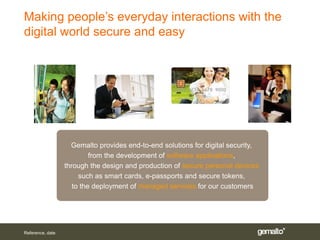
Making people’s everyday interactions with the
digital world secure and easy


                    Gemalto provides end-to-end solutions for digital security,
                           from the development of software applications,
                  through the design and production of secure personal devices
                       such as smart cards, e-passports and secure tokens,
                     to the deployment of managed services for our customers


Reference, date
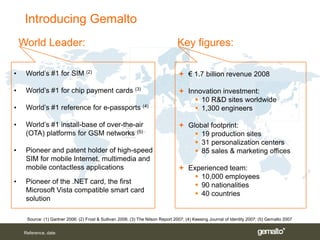
Introducing Gemalto
    World Leader:                                                                 Key figures:

•    World’s #1 for SIM (2)                                                        € 1.7 billion revenue 2008

•    World’s #1 for chip payment cards (3)                                         Innovation investment:
                                                                                       10 R&D sites worldwide
•    World’s #1 reference for e-passports (4)                                          1,300 engineers

•    World’s #1 install-base of over-the-air                                       Global footprint:
     (OTA) platforms for GSM networks (5)                                              19 production sites
                                                                                       31 personalization centers
•    Pioneer and patent holder of high-speed                                           85 sales & marketing offices
     SIM for mobile Internet, multimedia and
     mobile contactless applications                                               Experienced team:
                                                                                       10,000 employees
•    Pioneer of the .NET card, the first
                                                                                       90 nationalities
     Microsoft Vista compatible smart card
                                                                                       40 countries
     solution

      Source: (1) Gartner 2006; (2) Frost & Sullivan 2006; (3) The Nilson Report 2007; (4) Keesing Journal of Identity 2007; (5) Gemalto 2007


     Reference, date
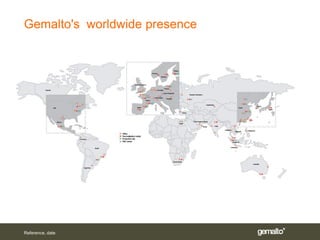
Gemalto's worldwide presence


Reference, date
Agenda


                           Gemalto introduction

                     Computer Authentication Solutions

                         Biometrics on Computers

                  Smart Card, Biometrics and Convenience


Reference, date
Computer Authentication Solutions
 There are many ways to authenticate to a computer:
          Username/Password
          Tokens storing credentials
          Tokens storing digital certificates
          Biometrics unlocking credentials or digital certificates stored on PC
          Dynamic passwords (OTP), challenge & response
          ... to name a few


 Multifactor is recognised as necessary
        Something you know, something you are, something you own
 Simplicity is key
        Complex solutions lead users to look for shortcuts!
 Strong link to users is necessary
        Avoid credential passing/borrowing
        Enables non-repudiation


Reference, date                                                                    7
The need for strong authentication
 High profile cases
        UK aide to Gordon Brown gets blackberry stolen
                  – http://www.timesonline.co.uk/tol/news/politics/article4364353.ece
                  – “Downing Street BlackBerrys are password-protected but security officials said
                    most are not encrypted”
        FBI loses 3-4 laptops a month (2007)
                  – AP, http://www.msnbc.msn.com/id/17115660/
                  – “"Perhaps most troubling, the FBI could not determine in many cases whether
                    the lost or stolen laptop computers contained sensitive or classified information”
 Regulatory compliance
 Non repudiation
 Strong Authentication is an enabler
        High mobility
        Home office
        Trust management
 Real Strong authentication is mutual!
        Not only user to computer/network, but also the other way around

Reference, date                                                                                          8
Strong Authentication on computers
 What is “Strong Authentication” ?
       Multifactor
       Mutual
       Secure
 Digital certificates on smart cards/tokens enable all three
       Only solution today
 Remaining issues
       Strong but not absolute binding with user (lending of smart card)
       Potential day to day issues
              – Lost cards
              – Blocked cards
 Enter biometrics
       Enables 3rd factor if needed
       Makes it more convenient!
       Boosts user adoption


Reference, date                                                             9
Agenda


                           Gemalto introduction

                     Computer Authentication Solutions

                         Biometrics on Computers

                  Smart Card, Biometrics and Convenience


Reference, date
Biometrics and Identity
       “Any distinguishing element of a physical person/entity that can be
                              considered as unique”
 Remains constant over time – mostly
 Public – most of the time
 Difficult to revoke
 Sensitive – cultural bias

                  → Needs to be considered carefully before using!


 Principle of Psychological Acceptability:

 A security mechanism should not make accessing a resource, or
 taking some action more difficult than it would be if security
 mechanism were not present.

Reference, date                                                              11
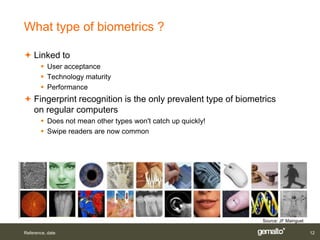
What type of biometrics ?

 Linked to
        User acceptance
        Technology maturity
        Performance
 Fingerprint recognition is the only prevalent type of biometrics
  on regular computers
        Does not mean other types won't catch up quickly!
        Swipe readers are now common


                                                              Source: JF Mainguet

Reference, date                                                                     12
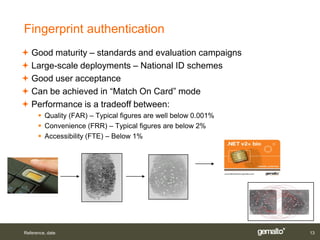
Fingerprint authentication
 Good maturity – standards and evaluation campaigns
 Large-scale deployments – National ID schemes
 Good user acceptance
 Can be achieved in “Match On Card” mode
 Performance is a tradeoff between:
       Quality (FAR) – Typical figures are well below 0.001%
       Convenience (FRR) – Typical figures are below 2%
       Accessibility (FTE) – Below 1%


Reference, date                                                 13
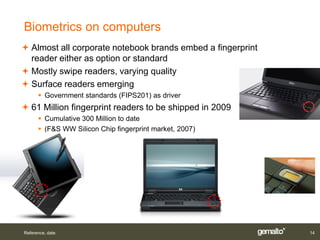
Biometrics on computers
 Almost all corporate notebook brands embed a fingerprint
  reader either as option or standard
 Mostly swipe readers, varying quality
 Surface readers emerging
       Government standards (FIPS201) as driver
 61 Million fingerprint readers to be shipped in 2009
       Cumulative 300 Million to date
       (F&S WW Silicon Chip fingerprint market, 2007)


Reference, date                                              14
Biometrics and regulations
 The use of biometrics needs to take local regulations into
  account
       CNIL in France
       European data privacy directives (data protection working party Art 29)
       UK Data Protection Act
 Regulations mostly require
       Justification of means
       Appropriate protection of biometric data


Reference, date                                                                   15
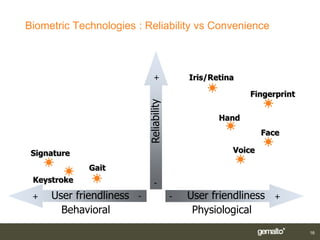
Biometric Technologies : Reliability vs Convenience


                             +       Iris/Retina

                                                   Fingerprint

                                            Hand
                                                       Face

 Signature                                     Voice

             Gait
 Keystroke                   -
 +   User friendliness   -       -   User friendliness   +
       Behavioral                     Physiological
                                                                 16
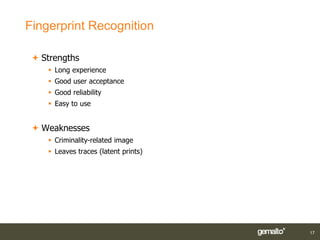
Fingerprint Recognition

  Strengths
     Long experience
     Good user acceptance
     Good reliability
     Easy to use


  Weaknesses
     Criminality-related image
     Leaves traces (latent prints)


                                      17
Agenda


                           Gemalto introduction

                     Computer Authentication Solutions

                         Biometrics on Computers

                  Smart Card, Biometrics and Convenience


Reference, date
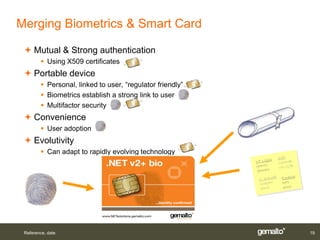
Merging Biometrics & Smart Card

  Mutual & Strong authentication
         Using X509 certificates
  Portable device
         Personal, linked to user, “regulator friendly”
         Biometrics establish a strong link to user
         Multifactor security
  Convenience
         User adoption
  Evolutivity
         Can adapt to rapidly evolving technology


 Reference, date                                           19
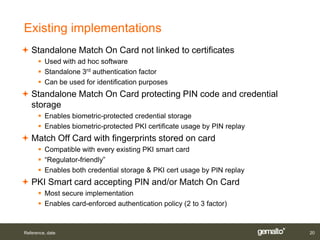
Existing implementations
 Standalone Match On Card not linked to certificates
       Used with ad hoc software
       Standalone 3rd authentication factor
       Can be used for identification purposes
 Standalone Match On Card protecting PIN code and credential
  storage
       Enables biometric-protected credential storage
       Enables biometric-protected PKI certificate usage by PIN replay
 Match Off Card with fingerprints stored on card
       Compatible with every existing PKI smart card
       “Regulator-friendly”
       Enables both credential storage & PKI cert usage by PIN replay
 PKI Smart card accepting PIN and/or Match On Card
       Most secure implementation
       Enables card-enforced authentication policy (2 to 3 factor)


Reference, date                                                           20
Current limitations and way forward
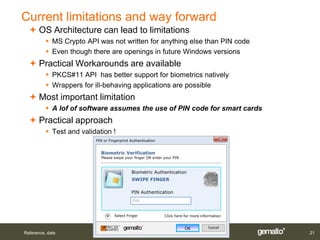
   OS Architecture can lead to limitations
           MS Crypto API was not written for anything else than PIN code
           Even though there are openings in future Windows versions
   Practical Workarounds are available
           PKCS#11 API has better support for biometrics natively
           Wrappers for ill-behaving applications are possible
   Most important limitation
           A lof of software assumes the use of PIN code for smart cards
   Practical approach
           Test and validation !
                          PIN or Fingerprint Authentication


                            Biometric Verification
                            Please swipe your finger OR enter your PIN


                                             Biometric Authentication
                                             SWIPE FINGER

                                             PIN Authentication
                                              PIN

                                    Select Finger             Click here for more information


                                                                         OK           Cancel
Reference, date                                                                                 21
Why Smart Card with Biometrics?

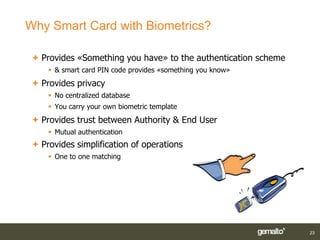
  Provides «Something you have» to the authentication scheme
      & smart card PIN code provides «something you know»
  Provides privacy
      No centralized database
      You carry your own biometric template
  Provides trust between Authority & End User
      Mutual authentication
  Provides simplification of operations
      One to one matching


                                                                23
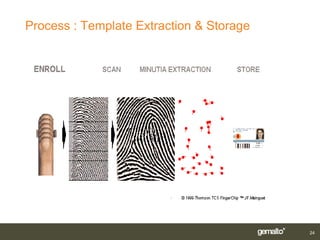
Process : Template Extraction & Storage


                                          24
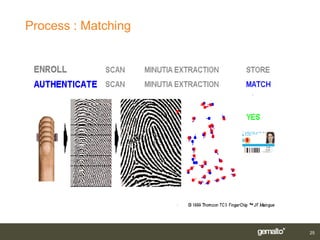
Process : Matching


                     25
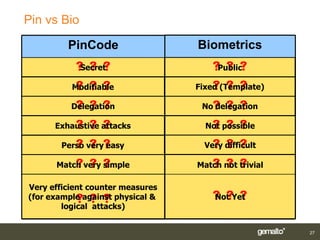
Pin vs Bio

         PinCode                  Biometrics
           
           Secret                    
                                     Public

          
          Modifiable                  
                                  Fixed (Template)

           
          Delegation                 
                                   No delegation

          
      Exhaustive attacks             
                                    Not possible

          
       Perso very easy              Very  
                                      difficult
      Match very 
            simple              Match not 
                                       trivial

Very efficient counter measures
(for example against physical &
                                  
                                     Not Yet
        logical attacks)


                                                     27
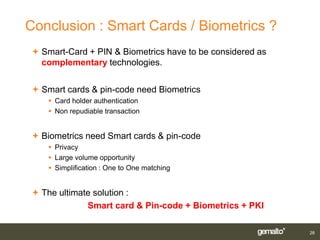
Conclusion : Smart Cards / Biometrics ?
 Smart-Card + PIN & Biometrics have to be considered as
  complementary technologies.


 Smart cards & pin-code need Biometrics
    Card holder authentication
    Non repudiable transaction


 Biometrics need Smart cards & pin-code
    Privacy
    Large volume opportunity
    Simplification : One to One matching


 The ultimate solution :
             Smart card & Pin-code + Biometrics + PKI

                                                           28
THANK YOU

SmartCard Forum 2009 - New trends in smart-cards technology

  • 1.
    Smart Card Forum May21st, 2009 New trends in smart-cards technology
  • 2.
    Agenda Gemalto introduction Computer Authentication Solutions Biometrics on Computers Smart Card, Biometrics and Convenience Reference, date
  • 3.
    Making people’s everydayinteractions with the digital world secure and easy Gemalto provides end-to-end solutions for digital security, from the development of software applications, through the design and production of secure personal devices such as smart cards, e-passports and secure tokens, to the deployment of managed services for our customers Reference, date
  • 4.
    Introducing Gemalto World Leader: Key figures: • World’s #1 for SIM (2)  € 1.7 billion revenue 2008 • World’s #1 for chip payment cards (3)  Innovation investment:  10 R&D sites worldwide • World’s #1 reference for e-passports (4)  1,300 engineers • World’s #1 install-base of over-the-air  Global footprint: (OTA) platforms for GSM networks (5)  19 production sites  31 personalization centers • Pioneer and patent holder of high-speed  85 sales & marketing offices SIM for mobile Internet, multimedia and mobile contactless applications  Experienced team:  10,000 employees • Pioneer of the .NET card, the first  90 nationalities Microsoft Vista compatible smart card  40 countries solution Source: (1) Gartner 2006; (2) Frost & Sullivan 2006; (3) The Nilson Report 2007; (4) Keesing Journal of Identity 2007; (5) Gemalto 2007 Reference, date
  • 5.
  • 6.
    Agenda Gemalto introduction Computer Authentication Solutions Biometrics on Computers Smart Card, Biometrics and Convenience Reference, date
  • 7.
    Computer Authentication Solutions There are many ways to authenticate to a computer:  Username/Password  Tokens storing credentials  Tokens storing digital certificates  Biometrics unlocking credentials or digital certificates stored on PC  Dynamic passwords (OTP), challenge & response  ... to name a few  Multifactor is recognised as necessary  Something you know, something you are, something you own  Simplicity is key  Complex solutions lead users to look for shortcuts!  Strong link to users is necessary  Avoid credential passing/borrowing  Enables non-repudiation Reference, date 7
  • 8.
    The need forstrong authentication  High profile cases  UK aide to Gordon Brown gets blackberry stolen – http://www.timesonline.co.uk/tol/news/politics/article4364353.ece – “Downing Street BlackBerrys are password-protected but security officials said most are not encrypted”  FBI loses 3-4 laptops a month (2007) – AP, http://www.msnbc.msn.com/id/17115660/ – “"Perhaps most troubling, the FBI could not determine in many cases whether the lost or stolen laptop computers contained sensitive or classified information”  Regulatory compliance  Non repudiation  Strong Authentication is an enabler  High mobility  Home office  Trust management  Real Strong authentication is mutual!  Not only user to computer/network, but also the other way around Reference, date 8
  • 9.
    Strong Authentication oncomputers  What is “Strong Authentication” ?  Multifactor  Mutual  Secure  Digital certificates on smart cards/tokens enable all three  Only solution today  Remaining issues  Strong but not absolute binding with user (lending of smart card)  Potential day to day issues – Lost cards – Blocked cards  Enter biometrics  Enables 3rd factor if needed  Makes it more convenient!  Boosts user adoption Reference, date 9
  • 10.
    Agenda Gemalto introduction Computer Authentication Solutions Biometrics on Computers Smart Card, Biometrics and Convenience Reference, date
  • 11.
    Biometrics and Identity “Any distinguishing element of a physical person/entity that can be considered as unique”  Remains constant over time – mostly  Public – most of the time  Difficult to revoke  Sensitive – cultural bias → Needs to be considered carefully before using! Principle of Psychological Acceptability: A security mechanism should not make accessing a resource, or taking some action more difficult than it would be if security mechanism were not present. Reference, date 11
  • 12.
    What type ofbiometrics ?  Linked to  User acceptance  Technology maturity  Performance  Fingerprint recognition is the only prevalent type of biometrics on regular computers  Does not mean other types won't catch up quickly!  Swipe readers are now common Source: JF Mainguet Reference, date 12
  • 13.
    Fingerprint authentication  Goodmaturity – standards and evaluation campaigns  Large-scale deployments – National ID schemes  Good user acceptance  Can be achieved in “Match On Card” mode  Performance is a tradeoff between:  Quality (FAR) – Typical figures are well below 0.001%  Convenience (FRR) – Typical figures are below 2%  Accessibility (FTE) – Below 1% Reference, date 13
  • 14.
    Biometrics on computers Almost all corporate notebook brands embed a fingerprint reader either as option or standard  Mostly swipe readers, varying quality  Surface readers emerging  Government standards (FIPS201) as driver  61 Million fingerprint readers to be shipped in 2009  Cumulative 300 Million to date  (F&S WW Silicon Chip fingerprint market, 2007) Reference, date 14
  • 15.
    Biometrics and regulations The use of biometrics needs to take local regulations into account  CNIL in France  European data privacy directives (data protection working party Art 29)  UK Data Protection Act  Regulations mostly require  Justification of means  Appropriate protection of biometric data Reference, date 15
  • 16.
    Biometric Technologies :Reliability vs Convenience + Iris/Retina Fingerprint Hand Face Signature Voice Gait Keystroke - + User friendliness - - User friendliness + Behavioral Physiological 16
  • 17.
    Fingerprint Recognition Strengths  Long experience  Good user acceptance  Good reliability  Easy to use  Weaknesses  Criminality-related image  Leaves traces (latent prints) 17
  • 18.
    Agenda Gemalto introduction Computer Authentication Solutions Biometrics on Computers Smart Card, Biometrics and Convenience Reference, date
  • 19.
    Merging Biometrics &Smart Card  Mutual & Strong authentication  Using X509 certificates  Portable device  Personal, linked to user, “regulator friendly”  Biometrics establish a strong link to user  Multifactor security  Convenience  User adoption  Evolutivity  Can adapt to rapidly evolving technology Reference, date 19
  • 20.
    Existing implementations  StandaloneMatch On Card not linked to certificates  Used with ad hoc software  Standalone 3rd authentication factor  Can be used for identification purposes  Standalone Match On Card protecting PIN code and credential storage  Enables biometric-protected credential storage  Enables biometric-protected PKI certificate usage by PIN replay  Match Off Card with fingerprints stored on card  Compatible with every existing PKI smart card  “Regulator-friendly”  Enables both credential storage & PKI cert usage by PIN replay  PKI Smart card accepting PIN and/or Match On Card  Most secure implementation  Enables card-enforced authentication policy (2 to 3 factor) Reference, date 20
  • 21.
    Current limitations andway forward  OS Architecture can lead to limitations  MS Crypto API was not written for anything else than PIN code  Even though there are openings in future Windows versions  Practical Workarounds are available  PKCS#11 API has better support for biometrics natively  Wrappers for ill-behaving applications are possible  Most important limitation  A lof of software assumes the use of PIN code for smart cards  Practical approach  Test and validation ! PIN or Fingerprint Authentication Biometric Verification Please swipe your finger OR enter your PIN Biometric Authentication SWIPE FINGER PIN Authentication PIN Select Finger Click here for more information OK Cancel Reference, date 21
  • 22.
    Why Smart Cardwith Biometrics?  Provides «Something you have» to the authentication scheme  & smart card PIN code provides «something you know»  Provides privacy  No centralized database  You carry your own biometric template  Provides trust between Authority & End User  Mutual authentication  Provides simplification of operations  One to one matching 23
  • 23.
    Process : TemplateExtraction & Storage 24
  • 24.
  • 25.
    Pin vs Bio PinCode Biometrics  Secret  Public  Modifiable  Fixed (Template)  Delegation  No delegation  Exhaustive attacks  Not possible  Perso very easy Very    difficult Match very    simple Match not    trivial Very efficient counter measures (for example against physical &   Not Yet logical attacks) 27
  • 26.
    Conclusion : SmartCards / Biometrics ?  Smart-Card + PIN & Biometrics have to be considered as complementary technologies.  Smart cards & pin-code need Biometrics  Card holder authentication  Non repudiable transaction  Biometrics need Smart cards & pin-code  Privacy  Large volume opportunity  Simplification : One to One matching  The ultimate solution : Smart card & Pin-code + Biometrics + PKI 28
  • 27.