mobile “context-awareness”
@neal_lathia
computer laboratory, university of cambridge
mobcom workshop
“by 2025, when most of today’s
psychology undergraduates will be
in their mid-30s, more than 5
billion people on our planet will be
using ultra-broadband, sensor-rich
smartphones far beyond the
abilities of today’s iPhones,
Androids, and Blackberries.”
Miller
how can we leverage the
data that they capture?
what applications can this
data support?
my research:
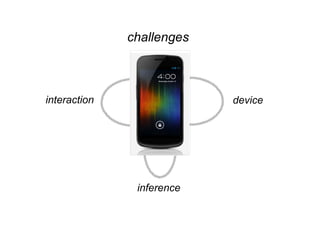
interaction device
challenges
inference
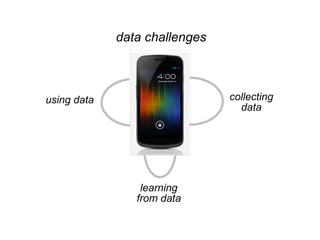
using data collecting
data
data challenges
learning
from data
“mobile devices and the mobile internet
represent an extremely challenging
search environment. Limited screen
space, restricted text-input and
interactivity and impatient users all
conspire...”
Church & Smyth
“...data harvesting through mobile
phones still presents a variety of
challenges […] energy consumption is
still very high for both data transmission
and resource-intensive local
computation...”
Rachuri et al. (2011)
modern-day applications do not take full
advantage of devices' potential
capabilities
as a result,
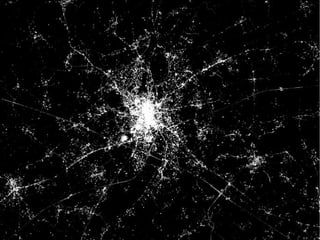
but still,...
foursquare
apps lack “context”
i try to avoid this word.
why? well, what is “context?”
time, place, intent, weather, social setting, mood,
product sales, application, interaction device…
“...decision making, rather than
being invariant, is contingent on
the context...”
Adomavicius & Tuzhilin
user perspective
“...the context of the user […] is
defned as the co-located
Bluetooth devices...”
Rachuri et al. (2013)
systems perspective
“... it is diffcult to fnd a relevant
defnition satisfying in any
discipline.”
Bazire & Brezillon
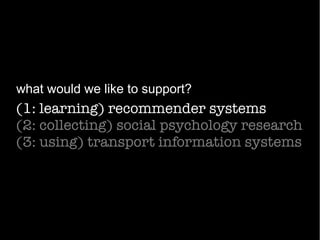
(1: learning) recommender systems
(2: collecting) social psychology research
(3: using) transport information systems
what would we like to support?
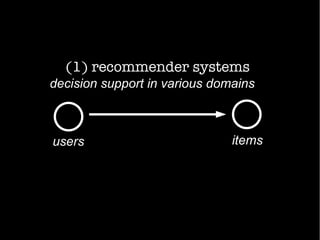
(1) recommender systems
users items
decision support in various domains
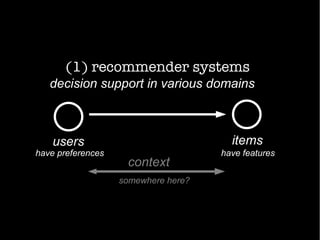
(1) recommender systems
users items
decision support in various domains
have preferences have features
context
somewhere here?
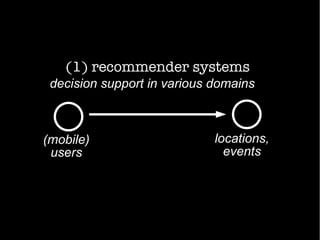
(1) recommender systems
(mobile)
users
locations,
events
decision support in various domains
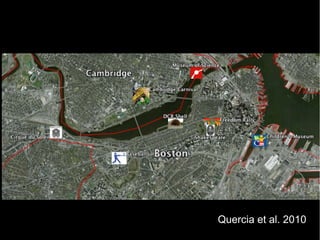
Quercia et al. 2010
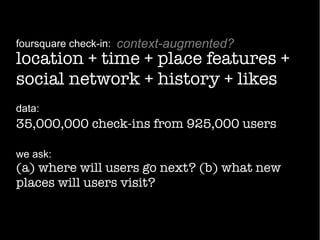
location + time + place features +
social network + history + likes
foursquare check-in:
data:
35,000,000 check-ins from 925,000 users
we ask:
(a) where will users go next? (b) what new
places will users visit?
context-augmented?
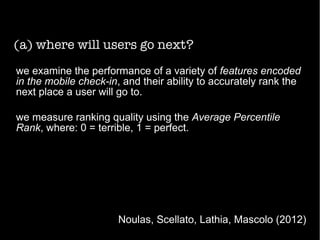
(a) where will users go next?
Noulas, Scellato, Lathia, Mascolo (2012)
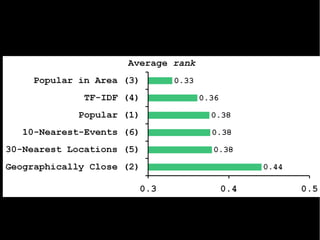
we examine the performance of a variety of features encoded
in the mobile check-in, and their ability to accurately rank the
next place a user will go to.
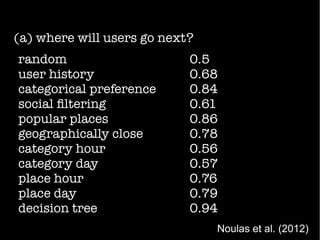
we measure ranking quality using the Average Percentile
Rank, where: 0 = terrible, 1 = perfect.
(a) where will users go next?
Noulas et al. (2012)
random 0.5
user history 0.68
categorical preference 0.84
social fltering 0.61
popular places 0.86
geographically close 0.78
category hour 0.56
category day 0.57
place hour 0.76
place day 0.79
decision tree 0.94
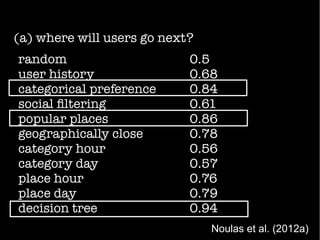
(a) where will users go next?
Noulas et al. (2012a)
random 0.5
user history 0.68
categorical preference 0.84
social fltering 0.61
popular places 0.86
geographically close 0.78
category hour 0.56
category day 0.57
place hour 0.76
place day 0.79
decision tree 0.94
why consider each check-in in isolation?
follow-up work:
Noulas et al. (2012b)
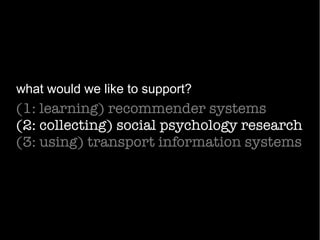
(1: learning) recommender systems
(2: collecting) social psychology research
(3: using) transport information systems
what would we like to support?
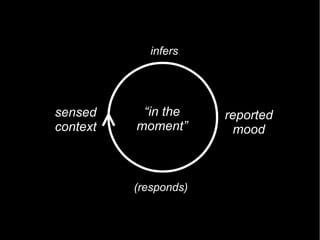
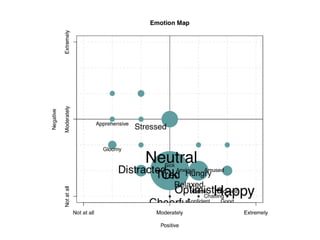
sensed
context
reported
mood
“in the
moment”
infers
(responds)
what kind of problem is this?
device + application + user... combined
in the following: just the sensors
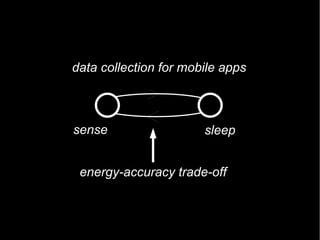
data collection for mobile apps
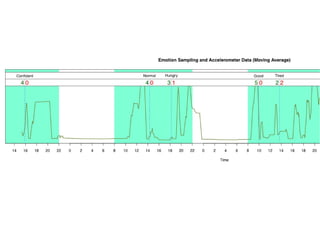
sense sleep
energy-accuracy trade-off
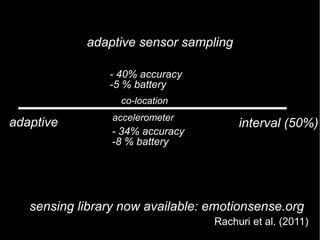
adaptive sensor sampling
interval (50%)
adaptive
-5 % battery
- 40% accuracy
co-location
-8 % battery
- 34% accuracy
Rachuri et al. (2011)
accelerometer
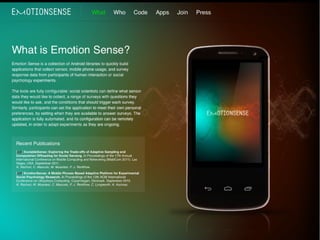
sensing library now available: emotionsense.org
ongoing work...
(1: learning) recommender systems
(2: collecting) social psychology research
(3: using) transport information systems
what would we like to support?
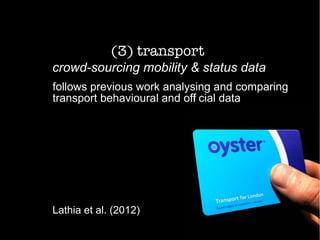
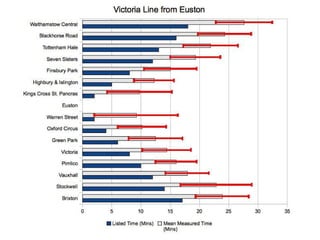
(3) transport
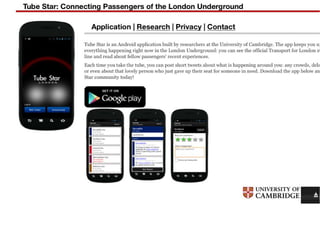
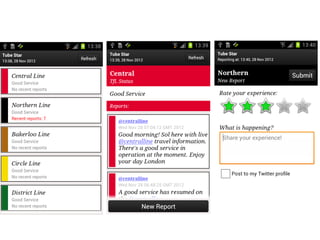
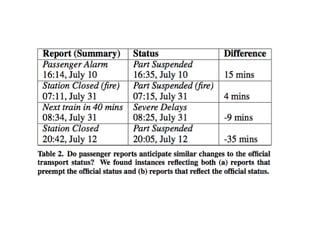
crowd-sourcing mobility & status data
follows previous work analysing and comparing
transport behavioural and off
i cial data
Lathia et al. (2012)
some open questions:
(1) privacy vs. effectiveness
the “security” of linking data
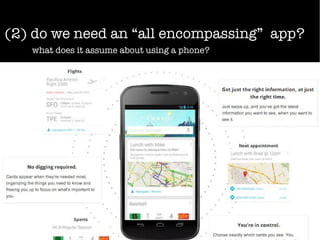
(2) do we need an “all encompassing” app?
what does it assume about using a phone?
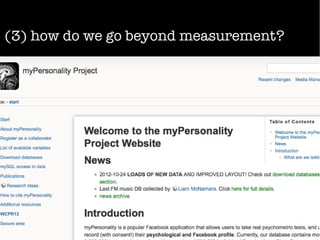
(3) how do we go beyond measurement?
(4) software vs.
hardware race
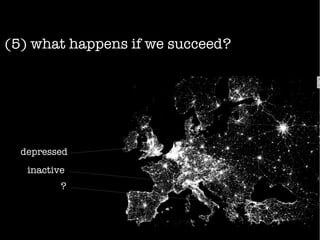
(5) what happens if we succeed?
depressed
inactive
?
G. Adomavicius, A. Tuzhilin. “Context-Aware Recommender Systems.” In Recommender Systems
Handbook.
M. Bazire, P. Brezillon. “Understanding Context Before Using it.” In 5th
International Conference on
Modeling and Using Context, 2005.
K. Church, B. Smyth. “Who, What, Where, & When: A New Approach to Mobile Search.” In IUI 2008.
N. Lathia et al. “Individuals Among Commuters: Building Personalised Transport Information
Services from Fare Collection Systems” In Pervasive and Mobile Computing, 2012.
A. Noulas, S. Scellato, N. Lathia, C. Mascolo. “Mining User Mobility Features for Next Place
Prediction in Location-based Services.” In IEEE International Conference on Data Mining 2012a.
A. Noulas, S. Scellato, N. Lathia, C. Mascolo. “A Random Walk Around the City: New Venue
Recommendation in Location-Based Social Networks.” In International Conference on Social
Computing 2012b.
G. Miller. “The Smartphone Psychology Manifesto.” In Perspectives on Psychological Science 7(3).
2012.
D. Quercia, N. Lathia, F. Calabrese, G. Di Lorenzo, J. Crowcroft. “Recommending Social Events from
Mobile Phone Location Data.” In IEEE ICDM 2010, Sydney, Australia.
K. Rachuri et al. “SociableSense: Exploring the Trade-Offs of Adaptive Sampling and Computation
Off
l oading for Social Sensing.” In MobiCom 2011.
K. Rachuri et al. “METIS: Exploring Mobile Phone Sensing Off
l oading for Eff
i ciently Supporting
Social Sensing Applications.” To appear, 2013.
Applications: http://www.emotionsense.org, http://www.tubestar.co.uk
References:
contact:
neal.lathia@cl.cam.ac.uk
@neal_lathia

Mobile "Context Awareness"

  • 1.
  • 2.
    “by 2025, whenmost of today’s psychology undergraduates will be in their mid-30s, more than 5 billion people on our planet will be using ultra-broadband, sensor-rich smartphones far beyond the abilities of today’s iPhones, Androids, and Blackberries.” Miller
  • 3.
    how can weleverage the data that they capture? what applications can this data support? my research:
  • 4.
  • 5.
    using data collecting data datachallenges learning from data
  • 6.
    “mobile devices andthe mobile internet represent an extremely challenging search environment. Limited screen space, restricted text-input and interactivity and impatient users all conspire...” Church & Smyth
  • 7.
    “...data harvesting throughmobile phones still presents a variety of challenges […] energy consumption is still very high for both data transmission and resource-intensive local computation...” Rachuri et al. (2011)
  • 8.
    modern-day applications donot take full advantage of devices' potential capabilities as a result, but still,...
  • 9.
  • 11.
    apps lack “context” itry to avoid this word.
  • 12.
    why? well, whatis “context?” time, place, intent, weather, social setting, mood, product sales, application, interaction device…
  • 13.
    “...decision making, ratherthan being invariant, is contingent on the context...” Adomavicius & Tuzhilin user perspective
  • 14.
    “...the context ofthe user […] is defned as the co-located Bluetooth devices...” Rachuri et al. (2013) systems perspective
  • 15.
    “... it isdiffcult to fnd a relevant defnition satisfying in any discipline.” Bazire & Brezillon
  • 16.
    (1: learning) recommendersystems (2: collecting) social psychology research (3: using) transport information systems what would we like to support?
  • 17.
    (1) recommender systems usersitems decision support in various domains
  • 18.
    (1) recommender systems usersitems decision support in various domains have preferences have features context somewhere here?
  • 19.
  • 20.
  • 22.
    location + time+ place features + social network + history + likes foursquare check-in: data: 35,000,000 check-ins from 925,000 users we ask: (a) where will users go next? (b) what new places will users visit? context-augmented?
  • 23.
    (a) where willusers go next? Noulas, Scellato, Lathia, Mascolo (2012) we examine the performance of a variety of features encoded in the mobile check-in, and their ability to accurately rank the next place a user will go to. we measure ranking quality using the Average Percentile Rank, where: 0 = terrible, 1 = perfect.
  • 24.
    (a) where willusers go next? Noulas et al. (2012) random 0.5 user history 0.68 categorical preference 0.84 social fltering 0.61 popular places 0.86 geographically close 0.78 category hour 0.56 category day 0.57 place hour 0.76 place day 0.79 decision tree 0.94
  • 25.
    (a) where willusers go next? Noulas et al. (2012a) random 0.5 user history 0.68 categorical preference 0.84 social fltering 0.61 popular places 0.86 geographically close 0.78 category hour 0.56 category day 0.57 place hour 0.76 place day 0.79 decision tree 0.94
  • 26.
    why consider eachcheck-in in isolation? follow-up work: Noulas et al. (2012b)
  • 27.
    (1: learning) recommendersystems (2: collecting) social psychology research (3: using) transport information systems what would we like to support?
  • 28.
  • 29.
    what kind ofproblem is this? device + application + user... combined in the following: just the sensors
  • 30.
    data collection formobile apps sense sleep energy-accuracy trade-off
  • 32.
    adaptive sensor sampling interval(50%) adaptive -5 % battery - 40% accuracy co-location -8 % battery - 34% accuracy Rachuri et al. (2011) accelerometer sensing library now available: emotionsense.org
  • 33.
  • 35.
    (1: learning) recommendersystems (2: collecting) social psychology research (3: using) transport information systems what would we like to support?
  • 36.
    (3) transport crowd-sourcing mobility& status data follows previous work analysing and comparing transport behavioural and off i cial data Lathia et al. (2012)
  • 41.
  • 42.
    (1) privacy vs.effectiveness the “security” of linking data
  • 43.
    (2) do weneed an “all encompassing” app? what does it assume about using a phone?
  • 44.
    (3) how dowe go beyond measurement?
  • 45.
  • 46.
    (5) what happensif we succeed? depressed inactive ?
  • 47.
    G. Adomavicius, A.Tuzhilin. “Context-Aware Recommender Systems.” In Recommender Systems Handbook. M. Bazire, P. Brezillon. “Understanding Context Before Using it.” In 5th International Conference on Modeling and Using Context, 2005. K. Church, B. Smyth. “Who, What, Where, & When: A New Approach to Mobile Search.” In IUI 2008. N. Lathia et al. “Individuals Among Commuters: Building Personalised Transport Information Services from Fare Collection Systems” In Pervasive and Mobile Computing, 2012. A. Noulas, S. Scellato, N. Lathia, C. Mascolo. “Mining User Mobility Features for Next Place Prediction in Location-based Services.” In IEEE International Conference on Data Mining 2012a. A. Noulas, S. Scellato, N. Lathia, C. Mascolo. “A Random Walk Around the City: New Venue Recommendation in Location-Based Social Networks.” In International Conference on Social Computing 2012b. G. Miller. “The Smartphone Psychology Manifesto.” In Perspectives on Psychological Science 7(3). 2012. D. Quercia, N. Lathia, F. Calabrese, G. Di Lorenzo, J. Crowcroft. “Recommending Social Events from Mobile Phone Location Data.” In IEEE ICDM 2010, Sydney, Australia. K. Rachuri et al. “SociableSense: Exploring the Trade-Offs of Adaptive Sampling and Computation Off l oading for Social Sensing.” In MobiCom 2011. K. Rachuri et al. “METIS: Exploring Mobile Phone Sensing Off l oading for Eff i ciently Supporting Social Sensing Applications.” To appear, 2013. Applications: http://www.emotionsense.org, http://www.tubestar.co.uk References:
  • 48.