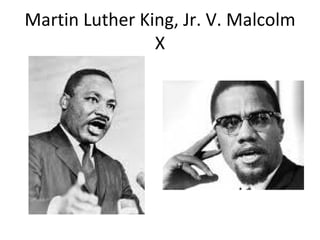
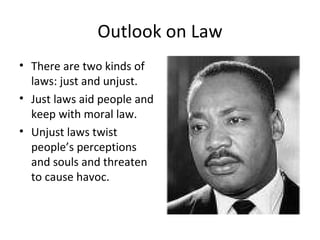
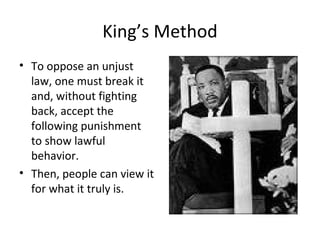
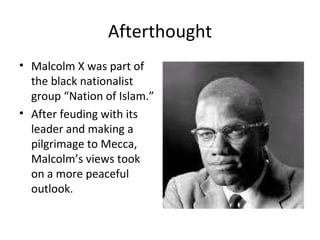
The document compares the civil rights approaches of Martin Luther King Jr. and Malcolm X. King advocated for nonviolent direct action and civil disobedience to oppose unjust segregation laws. Malcolm X initially proposed more militant action including separation from the US if black Americans did not receive equal rights and protection. Later in life, Malcolm X moved towards more moderate, nonviolent views after leaving the Nation of Islam. The document discusses both leaders' arguments and concludes that while King's nonviolent approach is preferable, Malcolm X's separatist plan could have served as a valid contingency if nonviolence failed.







![Civil[Rights]Movement](https://cdn.slidesharecdn.com/ss_thumbnails/civilrightsmovement-1204425966345031-4-thumbnail.jpg?width=640&height=640&fit=bounds)


