2 
What is Motivation? 
•‘Motivation’ has been derived from the word ‘motive’. 
•It is inner state of our mind that moves or activates or energizes and 
directs our behavior towards our goal. 
•According to Dalton E. McFarland, “Motivation refers to the way in 
which urges, drives, desires, striving, aspirations or needs direct, 
control or explain the behavior of human being”
3 
Motivation Theories 
The importance of motivation to human life and work can be judged by the 
number of theories that have been propounded to explain people’s behavior. 
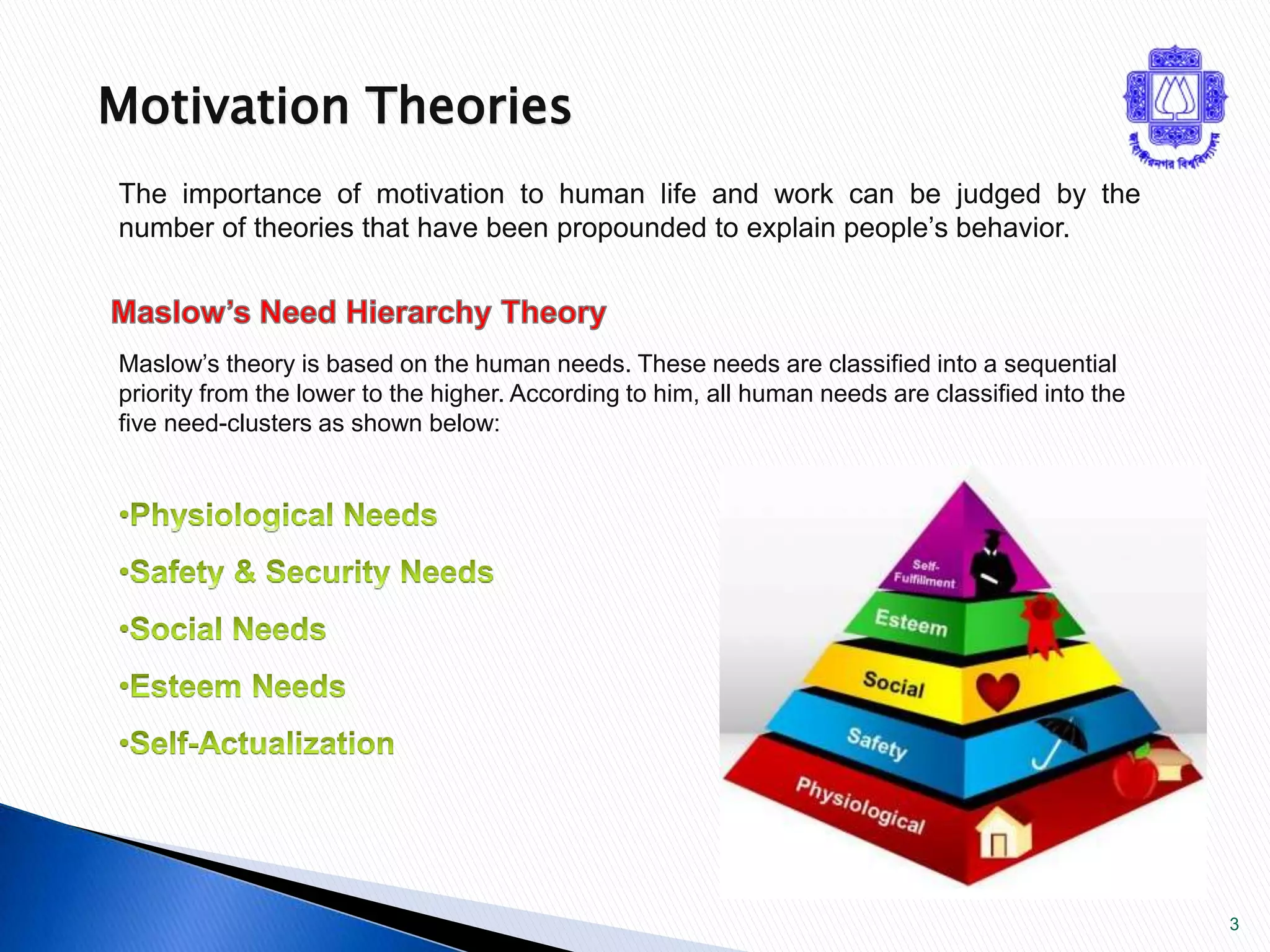
Maslow’s theory is based on the human needs. These needs are classified into a sequential 
priority from the lower to the higher. According to him, all human needs are classified into the 
five need-clusters as shown below:
4 
According to David McClelland a person acquires three types of needs as a result of one’s life 
experience. These needs are: 
•Need for Affiliation 
•Need for Power 
•Need for Achievement 
McClelland also suggests that these three needs may simultaneously be acting on an 
individual. But, in case of an entrepreneur, the high need for achievement is found dominating 
one. In his view, the people with high need for achievement are characterized by the following: 
I. They set moderate, realistic and attainable goals for them. 
II. Prefers to situations in which they can find solutions for solving personal responsibility. 
III. They need concrete feedback on how well they are doing. 
IV. They have need for achievement for attaining personal accomplishment. 
V. They look for challenging tasks.
5 
•Internal Factors: These included the following 
a) Desire to do something new 
b) Educational background 
c) Occupational background or experience 
•External Factors: These included 
a) Government assistance and support 
b) Availability of labour and raw material 
c) Encouragement from big business houses 
d) Promising demand for the product
6 
•The need for achievement plays an important role in 
making an entrepreneur as successful. 
•It is an inner spirit that activates an entrepreneur to strive 
for success. 
• In simple terms, need for achievement is the desire to do 
well.
7
8 
Factors Influencing Mobility 
Movement of Entrepreneurs from and into each location and 
occupation has certain distinct features of its own kind which affect 
the pace and pattern of entrepreneurship development. 
Education 
Experience 
Availability of Facilities 
Political Condition 
Size of Enterprise
9 
Occupational Mobility 
The occupational mobility denotes movement or changes in occupation. This may take 
place in two forms: 
• It may be movement of a son/daughter from the principal occupation of his/her father. 
This type of movement is called as ‘inter-generation movement 
• it may be drift in one’s own occupation during his/her occupational career, this type of 
change as ‘intra-generation occupational movement. 
Location Mobility 
Earlier locational and spatial diversification were simply determined by an adjustment 
between location and weight distance characteristics of inputs and outputs. The reason 
is that the then industrial structure was heavily dominated by the natural resources 
base and consumer-oriented industries. But over the period, the very consideration for 
locating industries in a particular region has undergone a considerable change.

Mkt#210 lecture 3 entrepreneurial motivation & mobility

  • 2.
    2 What isMotivation? •‘Motivation’ has been derived from the word ‘motive’. •It is inner state of our mind that moves or activates or energizes and directs our behavior towards our goal. •According to Dalton E. McFarland, “Motivation refers to the way in which urges, drives, desires, striving, aspirations or needs direct, control or explain the behavior of human being”
  • 3.
    3 Motivation Theories The importance of motivation to human life and work can be judged by the number of theories that have been propounded to explain people’s behavior. Maslow’s theory is based on the human needs. These needs are classified into a sequential priority from the lower to the higher. According to him, all human needs are classified into the five need-clusters as shown below:
  • 4.
    4 According toDavid McClelland a person acquires three types of needs as a result of one’s life experience. These needs are: •Need for Affiliation •Need for Power •Need for Achievement McClelland also suggests that these three needs may simultaneously be acting on an individual. But, in case of an entrepreneur, the high need for achievement is found dominating one. In his view, the people with high need for achievement are characterized by the following: I. They set moderate, realistic and attainable goals for them. II. Prefers to situations in which they can find solutions for solving personal responsibility. III. They need concrete feedback on how well they are doing. IV. They have need for achievement for attaining personal accomplishment. V. They look for challenging tasks.
  • 5.
    5 •Internal Factors:These included the following a) Desire to do something new b) Educational background c) Occupational background or experience •External Factors: These included a) Government assistance and support b) Availability of labour and raw material c) Encouragement from big business houses d) Promising demand for the product
  • 6.
    6 •The needfor achievement plays an important role in making an entrepreneur as successful. •It is an inner spirit that activates an entrepreneur to strive for success. • In simple terms, need for achievement is the desire to do well.
  • 7.
  • 8.
    8 Factors InfluencingMobility Movement of Entrepreneurs from and into each location and occupation has certain distinct features of its own kind which affect the pace and pattern of entrepreneurship development. Education Experience Availability of Facilities Political Condition Size of Enterprise
  • 9.
    9 Occupational Mobility The occupational mobility denotes movement or changes in occupation. This may take place in two forms: • It may be movement of a son/daughter from the principal occupation of his/her father. This type of movement is called as ‘inter-generation movement • it may be drift in one’s own occupation during his/her occupational career, this type of change as ‘intra-generation occupational movement. Location Mobility Earlier locational and spatial diversification were simply determined by an adjustment between location and weight distance characteristics of inputs and outputs. The reason is that the then industrial structure was heavily dominated by the natural resources base and consumer-oriented industries. But over the period, the very consideration for locating industries in a particular region has undergone a considerable change.