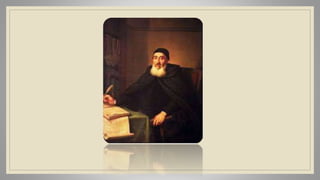
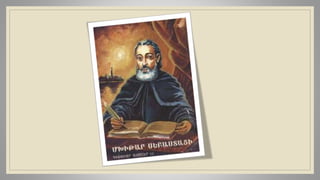
MKHITAR
SEBASTATSI
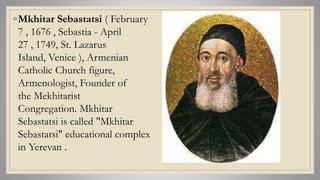
◦Mkhitar Sebastatsi ( February
7 , 1676 , Sebastia - April
27 , 1749, St. Lazarus
Island, Venice ), Armenian
Catholic Church figure,
Armenologist, Founder of
the Mekhitarist
Congregation. Mkhitar
Sebastatsi is called "Mkhitar
Sebastatsi" educational complex
in Yerevan .
Biography
◦ Mkhitar Sebastatsi studied at St. Sebastia Church in Sebastia . Sign , then,
in Echmiadzin , Sevan , and Karin Monastery. 1693 traveled to Beroea, now Aleppo,
where he met Catholic missionaries. 1696 ordained a celibate priest in 1699, received a
doctrinal rod. 1701 He founded the Congregation in Constantinople . 1705 By obtaining
a consensus to establish a monastery from the Roman authorities, 1706 In the metropolis
of Athens, Greece, the monastery was built.
◦ 1712 The pope gave Sebastatsi the title of Abbot. Avoiding Turkish attacks,
1715 union moved to Venice In 1717, the Venetian Nativity was issued by St.
Gregory the Illuminator. The island of Ghazar was granted to the Congregation. Here,
Sebastatsi built a church, opened a school, and prepared brothers and sisters. St. In Lazar,
he engaged in bibliographic work, directing his students' philological research,
performing translations, publishing books. After the death of Sebastatsi,
the congregation , in honor of him, was called Mkhitaryan. During his lifetime, he was
honored by the Second Enlightener nation, the Second Mesrob and other emissaries.
Early life
◦ On January 17, 1676, Sebastia was born in Manoog, the son of Peter and
Shahristan. In the years that followed, she received a high-quality education from
her parents that would prepare her for continuing her family business.
◦ Even at an early age Manuk dreamed of becoming a priest.
◦ He found a friend with whom he fled to the mountains where he lived as hermits.
◦ The babies' parents found them and took her home. Upon learning about this
incident, St. Nicholas, the monastery, offered Manuk to carry out public works in
the monastery, which was again denied by parents.
◦ He began to visit a home of one of the neighbors, where a mother lived with her
two daughters as a monk. The purpose of his visits was to talk to a priest living in
the same house who taught him much about monastic life.
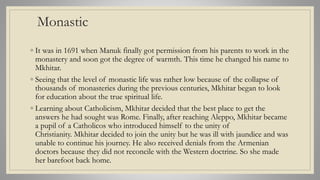
Monastic
◦ It was in 1691 when Manuk finally got permission from his parents to work in the
monastery and soon got the degree of warmth. This time he changed his name to
Mkhitar.
◦ Seeing that the level of monastic life was rather low because of the collapse of
thousands of monasteries during the previous centuries, Mkhitar began to look
for education about the true spiritual life.
◦ Learning about Catholicism, Mkhitar decided that the best place to get the
answers he had sought was Rome. Finally, after reaching Aleppo, Mkhitar became
a pupil of a Catholicos who introduced himself to the unity of
Christianity. Mkhitar decided to join the unity but he was ill with jaundice and was
unable to continue his journey. He also received denials from the Armenian
doctors because they did not reconcile with the Western doctrine. So she made
her barefoot back home.
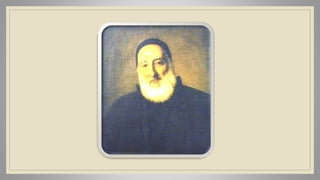
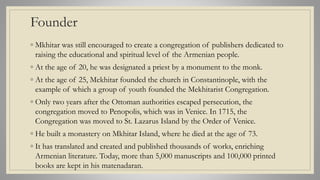
Founder
◦ Mkhitar was still encouraged to create a congregation of publishers dedicated to
raising the educational and spiritual level of the Armenian people.
◦ At the age of 20, he was designated a priest by a monument to the monk.
◦ At the age of 25, Mekhitar founded the church in Constantinople, with the
example of which a group of youth founded the Mekhitarist Congregation.
◦ Only two years after the Ottoman authorities escaped persecution, the
congregation moved to Penopolis, which was in Venice. In 1715, the
Congregation was moved to St. Lazarus Island by the Order of Venice.
◦ He built a monastery on Mkhitar Island, where he died at the age of 73.
◦ It has translated and created and published thousands of works, enriching
Armenian literature. Today, more than 5,000 manuscripts and 100,000 printed
books are kept in his matenadaran.
Works
◦ Mkhitar Sebastatsi is the author of the first textbook in the world of grammar,
"The World of Dramatic Grammar in Armenian Language" (1727). It is also
worth mentioning that in his "Grammar of Armenian Language in Grammar"
(1730), he studied the Grabar's morphology, syntax, set rules, touched upon
spelling and other questions. The great achievement of Armenology is the work
of Sebastatsi's "Word of the Armenian Language" (2 volumes, 1749-69), which
today has a unique value. Includes Armenian manuscripts and printed wordbase
of over 100 thousand times. Article It is also remarkable that his book
"Tagharan" (1727), part of his poems, as a singing song by Sebastatsi, sings so
far. Compared to the finest manuscripts, he has published the Bible (1733-35),
and has also compiled the "Geography of the Evangelist Earth" (1746).
The end…

Mkhitar sebastatsi

  • 1.
  • 2.
    ◦Mkhitar Sebastatsi (February 7 , 1676 , Sebastia - April 27 , 1749, St. Lazarus Island, Venice ), Armenian Catholic Church figure, Armenologist, Founder of the Mekhitarist Congregation. Mkhitar Sebastatsi is called "Mkhitar Sebastatsi" educational complex in Yerevan .
  • 3.
    Biography ◦ Mkhitar Sebastatsistudied at St. Sebastia Church in Sebastia . Sign , then, in Echmiadzin , Sevan , and Karin Monastery. 1693 traveled to Beroea, now Aleppo, where he met Catholic missionaries. 1696 ordained a celibate priest in 1699, received a doctrinal rod. 1701 He founded the Congregation in Constantinople . 1705 By obtaining a consensus to establish a monastery from the Roman authorities, 1706 In the metropolis of Athens, Greece, the monastery was built. ◦ 1712 The pope gave Sebastatsi the title of Abbot. Avoiding Turkish attacks, 1715 union moved to Venice In 1717, the Venetian Nativity was issued by St. Gregory the Illuminator. The island of Ghazar was granted to the Congregation. Here, Sebastatsi built a church, opened a school, and prepared brothers and sisters. St. In Lazar, he engaged in bibliographic work, directing his students' philological research, performing translations, publishing books. After the death of Sebastatsi, the congregation , in honor of him, was called Mkhitaryan. During his lifetime, he was honored by the Second Enlightener nation, the Second Mesrob and other emissaries.
  • 5.
    Early life ◦ OnJanuary 17, 1676, Sebastia was born in Manoog, the son of Peter and Shahristan. In the years that followed, she received a high-quality education from her parents that would prepare her for continuing her family business. ◦ Even at an early age Manuk dreamed of becoming a priest. ◦ He found a friend with whom he fled to the mountains where he lived as hermits. ◦ The babies' parents found them and took her home. Upon learning about this incident, St. Nicholas, the monastery, offered Manuk to carry out public works in the monastery, which was again denied by parents. ◦ He began to visit a home of one of the neighbors, where a mother lived with her two daughters as a monk. The purpose of his visits was to talk to a priest living in the same house who taught him much about monastic life.
  • 7.
    Monastic ◦ It wasin 1691 when Manuk finally got permission from his parents to work in the monastery and soon got the degree of warmth. This time he changed his name to Mkhitar. ◦ Seeing that the level of monastic life was rather low because of the collapse of thousands of monasteries during the previous centuries, Mkhitar began to look for education about the true spiritual life. ◦ Learning about Catholicism, Mkhitar decided that the best place to get the answers he had sought was Rome. Finally, after reaching Aleppo, Mkhitar became a pupil of a Catholicos who introduced himself to the unity of Christianity. Mkhitar decided to join the unity but he was ill with jaundice and was unable to continue his journey. He also received denials from the Armenian doctors because they did not reconcile with the Western doctrine. So she made her barefoot back home.
  • 9.
    Founder ◦ Mkhitar wasstill encouraged to create a congregation of publishers dedicated to raising the educational and spiritual level of the Armenian people. ◦ At the age of 20, he was designated a priest by a monument to the monk. ◦ At the age of 25, Mekhitar founded the church in Constantinople, with the example of which a group of youth founded the Mekhitarist Congregation. ◦ Only two years after the Ottoman authorities escaped persecution, the congregation moved to Penopolis, which was in Venice. In 1715, the Congregation was moved to St. Lazarus Island by the Order of Venice. ◦ He built a monastery on Mkhitar Island, where he died at the age of 73. ◦ It has translated and created and published thousands of works, enriching Armenian literature. Today, more than 5,000 manuscripts and 100,000 printed books are kept in his matenadaran.
  • 11.
    Works ◦ Mkhitar Sebastatsiis the author of the first textbook in the world of grammar, "The World of Dramatic Grammar in Armenian Language" (1727). It is also worth mentioning that in his "Grammar of Armenian Language in Grammar" (1730), he studied the Grabar's morphology, syntax, set rules, touched upon spelling and other questions. The great achievement of Armenology is the work of Sebastatsi's "Word of the Armenian Language" (2 volumes, 1749-69), which today has a unique value. Includes Armenian manuscripts and printed wordbase of over 100 thousand times. Article It is also remarkable that his book "Tagharan" (1727), part of his poems, as a singing song by Sebastatsi, sings so far. Compared to the finest manuscripts, he has published the Bible (1733-35), and has also compiled the "Geography of the Evangelist Earth" (1746).
  • 12.