Armenia: A History
Overview of Armenia and the Caucasus region
2 January 2017
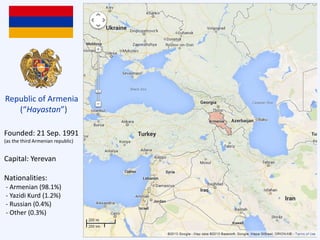
Founded: 21 Sep. 1991
(as the third Armenian republic)
Capital: Yerevan
Nationalities:
- Armenian (98.1%)
- Yazidi Kurd (1.2%)
- Russian (0.4%)
- Other (0.3%)
Republic of Armenia
(“Hayastan”)
5 facts about Armenia
• Armenia, the smallest of the former Soviet republics, is located in the South Caucasus
– About the same size as Maryland, but with half the population (3.0 million in 2011)
• A distinct Armenian culture emerged as early as the 6th century B.C.
– The Armenians have not always had a country, but they do have a historical homeland
– Historic Armenia included the territory of the modern Republic of Armenia, much of eastern
Turkey, and parts of southwestern Azerbaijan, southern Georgia, and northwestern Iran
• Armenia is known as the first nation to adopt Christianity as the state religion
– The traditional date for the foundation of the Armenian Apostolic Church is 301 A.D.
• More ethnic Armenians live outside the Republic of Armenia than inside it
– Mostly “Western Armenians” who fled the Ottoman Empire because of 19th-century
pogroms and the WWI-era Armenian Genocide
– The diaspora fled locally to the Caucasus and Levant or abroad to the U.S., France, etc.
– Russia has the largest population of Armenians outside of the Republic of Armenia
• Armenia is locked in a “frozen conflict” with Azerbaijan over the Armenian-populated
enclave of Nagorno-Karabakh
– Conflict began before the fall of the Soviet Union and continued into the 1990s
– N-K Armenians won de facto independence and N-K forces occupy a land bridge to Armenia
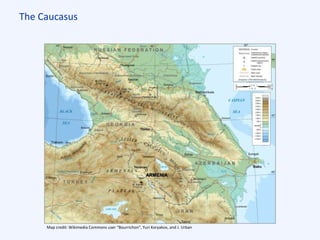
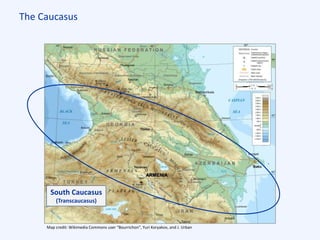
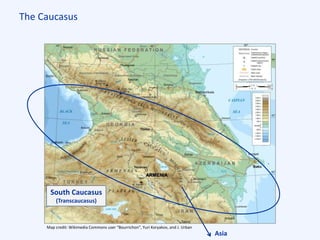
The Caucasus
Map credit: Wikimedia Commons user “Bourrichon”, Yuri Koryakov, and J. Urban
ARMENIA
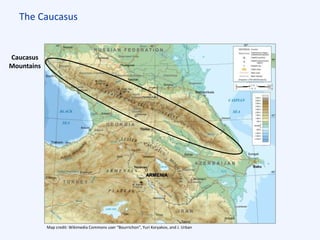
The Caucasus
Map credit: Wikimedia Commons user “Bourrichon”, Yuri Koryakov, and J. Urban
Caucasus
Mountains
ARMENIA
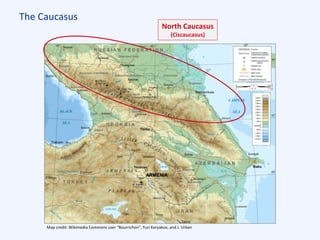
The Caucasus
Map credit: Wikimedia Commons user “Bourrichon”, Yuri Koryakov, and J. Urban
North Caucasus
(Ciscaucasus)
ARMENIA
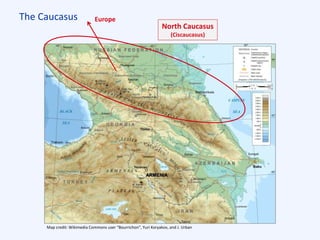
The Caucasus
Map credit: Wikimedia Commons user “Bourrichon”, Yuri Koryakov, and J. Urban
North Caucasus
(Ciscaucasus)
Europe
ARMENIA
The Caucasus
Map credit: Wikimedia Commons user “Bourrichon”, Yuri Koryakov, and J. Urban
South Caucasus
(Transcaucasus)
ARMENIA
The Caucasus
Map credit: Wikimedia Commons user “Bourrichon”, Yuri Koryakov, and J. Urban
South Caucasus
(Transcaucasus)
Asia
ARMENIA
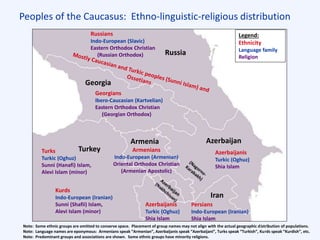
Peoples of the Caucasus: Ethno-linguistic-religious distribution
Georgians
Ibero-Caucasian (Kartvelian)
Eastern Orthodox Christian
(Georgian Orthodox)
Turks
Turkic (Oghuz)
Sunni (Hanafi) Islam,
Alevi Islam (minor)
Kurds
Indo-European (Iranian)
Sunni (Shafii) Islam,
Alevi Islam (minor)
Persians
Indo-European (Iranian)
Shia Islam
Azerbaijanis
Turkic (Oghuz)
Shia Islam
Azerbaijanis
Turkic (Oghuz)
Shia Islam
Russians
Indo-European (Slavic)
Eastern Orthodox Christian
(Russian Orthodox)
Armenians
Indo-European (Armenian)
Oriental Orthodox Christian
(Armenian Apostolic)
Russia
Turkey
Georgia
Iran
AzerbaijanArmenia
Legend:
Ethnicity
Language family
Religion
Note: Some ethnic groups are omitted to conserve space. Placement of group names may not align with the actual geographic distribution of populations.
Note: Language names are eponymous: Armenians speak “Armenian”, Azerbaijanis speak “Azerbaijani”, Turks speak “Turkish”, Kurds speak “Kurdish”, etc.
Note: Predominant groups and associations are shown. Some ethnic groups have minority religions.
Contents
Part I: Armenia and its culture
Part II: Armenian history and geography
Part III: Yerevan and its surroundings
Part I: Armenia and its culture
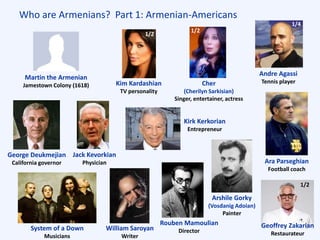
Who are Armenians? Part 1: Armenian-Americans
Martin the Armenian
Jamestown Colony (1618) Kim Kardashian
TV personality
Cher
(Cherilyn Sarkisian)
Singer, entertainer, actress
1/2
1/2
1/4
Andre Agassi
Tennis player
Jack Kevorkian
Physician
System of a Down
Musicians
Kirk Kerkorian
Entrepreneur
George Deukmejian
California governor
William Saroyan
Writer
Geoffrey Zakarian
Restaurateur
1/2
Ara Parseghian
Football coach
Arshile Gorky
(Vosdanig Adoian)
Painter
Rouben Mamoulian
Director
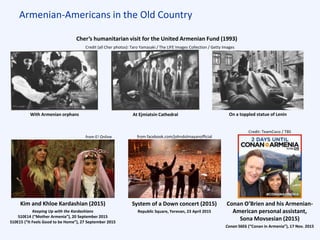
Armenian-Americans in the Old Country
Conan O’Brien and his Armenian-
American personal assistant,
Sona Movsesian (2015)
Conan S6E6 (“Conan in Armenia”), 17 Nov. 2015
Kim and Khloe Kardashian (2015)
Keeping Up with the Kardashians
S10E14 (“Mother Armenia”), 20 September 2015
S10E15 (“It Feels Good to be Home”), 27 September 2015
Cher’s humanitarian visit for the United Armenian Fund (1993)
Credit (all Cher photos): Taro Yamasaki / The LIFE Images Collection / Getty Images
With Armenian orphans At Ejmiatsin Cathedral On a toppled statue of Lenin
from E! Online
Credit: TeamCoco / TBS
System of a Down concert (2015)
Republic Square, Yerevan, 23 April 2015
from facebook.com/johndolmayanofficial
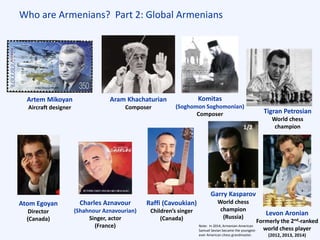
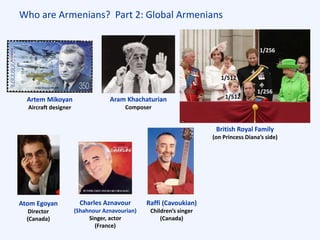
Who are Armenians? Part 2: Global Armenians
Artem Mikoyan
Aircraft designer
Charles Aznavour
(Shahnour Aznavourian)
Singer, actor
(France)
Raffi (Cavoukian)
Children’s singer
(Canada)
Aram Khachaturian
Composer
Tigran Petrosian
World chess
champion
Levon Aronian
Formerly the 2nd-ranked
world chess player
(2012, 2013, 2014)
Garry Kasparov
World chess
champion
(Russia)
1/2
Komitas
(Soghomon Soghomonian)
Composer
Atom Egoyan
Director
(Canada)
Note: In 2014, Armenian-American
Samuel Sevian became the youngest-
ever American chess grandmaster.
British Royal Family
(on Princess Diana’s side)
1/256
1/256
1/512
1/512
Who are Armenians? Part 2: Global Armenians
Artem Mikoyan
Aircraft designer
Charles Aznavour
(Shahnour Aznavourian)
Singer, actor
(France)
Raffi (Cavoukian)
Children’s singer
(Canada)
Aram Khachaturian
Composer
Atom Egoyan
Director
(Canada)
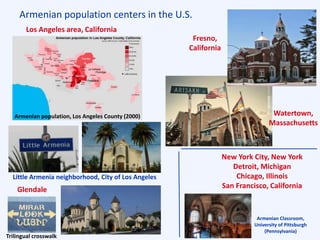
Armenian population centers in the U.S.
Glendale
Armenian population, Los Angeles County (2000)
Fresno, California
Holy Trinity Church Watertown,
Massachusetts
Los Angeles area, California
Little Armenia neighborhood, City of Los Angeles
New York City, New York
Detroit, Michigan
Chicago, Illinois
San Francisco, California
Armenian Classroom,
University of Pittsburgh
(Pennsylvania)
Fresno,
California
Trilingual crosswalk
Armenian traces in Northern Virginia
Credit: J. Urban
Closed in 2012
Credit: J. Urban
Credit:J.Urban
Credit:J.Urban
Credit: J. Urban
“Akhtamar’s Haven” tract
Great Falls, VA
[L] Memorial plaque (and tree) for the American-Armenian
volunteers at the Battle of the Argonne Forest (WWI)
[R] Memorial to Flight 60528 downed over Soviet Armenia
Arlington National Cemetery
Performance of “Erebuni-Yerevan”
Jamey Turner playing the glass harp
Torpedo Factory Art Center, Old Town Alexandria
Mama Lavash
Bakery
Falls Church, VA
Alexandria, VA and Gyumri, Armenia
Sister Cities since 1990
Arax Café
Arlington, VA
Credit: J. Urban
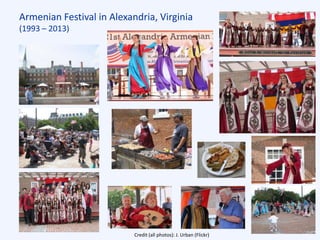
Armenian Festival in Alexandria, Virginia
(1993 – 2013)
Credit (all photos): J. Urban (Flickr)
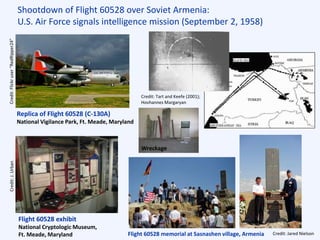
Shootdown of Flight 60528 over Soviet Armenia:
U.S. Air Force signals intelligence mission (September 2, 1958)
Replica of Flight 60528 (C-130A)
National Vigilance Park, Ft. Meade, Maryland
Flight 60528 exhibit
National Cryptologic Museum,
Ft. Meade, Maryland Flight 60528 memorial at Sasnashen village, Armenia
Credit: Tart and Keefe (2001);
Hovhannes Margaryan
Credit: Jared Nielson
Credit:J.UrbanCredit:Flickruser“RedRipper24”
Wreckage
Armenian traces outside Armenia: Venice and Jerusalem
Venice
Isla di San Lazzaro degli Armeni
Mekhitarist Order (Armenian Catholic)
Jerusalem
The Armenian Quarter of the Old City
Credit: Sally Turner (Flickr)
Lord Byron, leading figure of the Romantic movement,
studied at the monastery at St. Lazarus Island in 1816
“. . . their country [Armenia] must ever be one of the most
interesting on the globe”
Mekhitar of Sebaste
Cathedral of Sts. James from armenica.org
from jerusalemite.net Credit: Ariela Ross (Flickr)
fromoliaklodvenitiens.wordpress.com
frominsidetheevatican.com
Credit: Ron Peled frommapsof.net
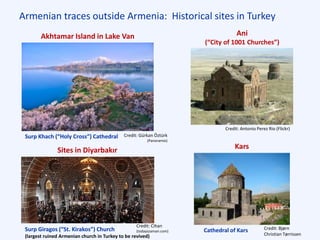
Armenian traces outside Armenia: Historical sites in Turkey
Ani
(“City of 1001 Churches”)
Credit: Antonio Perez Rio (Flickr)
Credit: Bjørn
Christian Tørrissen
Kars
Credit: Cihan
(todayszaman.com)
Sites in Diyarbakır
Surp Giragos (“St. Kirakos”) Church
(largest ruined Armenian church in Turkey to be revived)
Cathedral of Kars
Akhtamar Island in Lake Van
Credit: Gürkan Öztürk
(Panoramio)
Surp Khach (“Holy Cross”) Cathedral
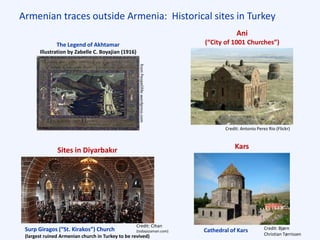
Armenian traces outside Armenia: Historical sites in Turkey
Ani
(“City of 1001 Churches”)
Credit: Antonio Perez Rio (Flickr)
Credit: Bjørn
Christian Tørrissen
Kars
Credit: Cihan
(todayszaman.com)
Sites in Diyarbakır
Surp Giragos (“St. Kirakos”) Church
(largest ruined Armenian church in Turkey to be revived)
Cathedral of Kars
The Legend of Akhtamar
Illustration by Zabelle C. Boyajian (1916)
Armenian traces outside Armenia: Historical sites in Turkey
Ani
(“City of 1001 Churches”)
Credit: Antonio Perez Rio (Flickr)
Credit: Bjørn
Christian Tørrissen
Kars
Credit: Cihan
(todayszaman.com)
Sites in Diyarbakır
Surp Giragos (“St. Kirakos”) Church
(largest ruined Armenian church in Turkey to be revived)
Cathedral of Kars
Statue depicting the
legend of Akhtamar
Lake Sevan, Armenia
Credit:AlexOunanians[cropped]
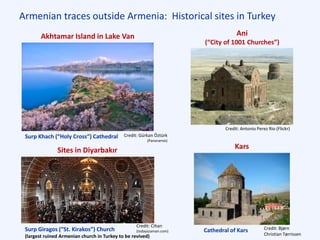
Armenian traces outside Armenia: Historical sites in Turkey
Ani
(“City of 1001 Churches”)
Credit: Antonio Perez Rio (Flickr)
Credit: Bjørn
Christian Tørrissen
Kars
Credit: Cihan
(todayszaman.com)
Sites in Diyarbakır
Surp Giragos (“St. Kirakos”) Church
(largest ruined Armenian church in Turkey to be revived)
Cathedral of Kars
Akhtamar Island in Lake Van
Credit: Gürkan Öztürk
(Panoramio)
Surp Khach (“Holy Cross”) Cathedral
Credit:StudioAshnag
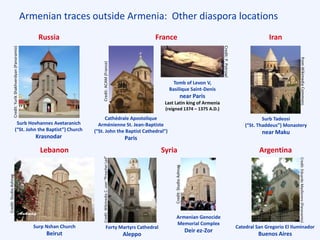
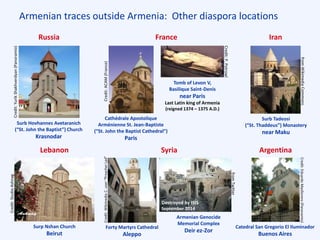
Armenian traces outside Armenia: Other diaspora locations
Russia
Lebanon
France
Syria Argentina
Iran
Surb Hovhannes Avetaranich
(“St. John the Baptist”) Church
Krasnodar
Cathédrale Apostolique
Arménienne St. Jean-Baptiste
(“St. John the Baptist Cathedral”)
Paris
Tomb of Levon V,
Basilique Saint-Denis
near Paris
Last Latin king of Armenia
(reigned 1374 – 1375 A.D.)
Surb Tadeosi
(“St. Thaddeus”) Monastery
near Maku
Surp Nshan Church
Beirut
Armenian Genocide
Memorial Complex
Deir ez-Zor
Forty Martyrs Cathedral
Aleppo
Catedral San Gregorio El Iluminador
Buenos Aires
Credit:YurikShakhverdyan(Panoramio)
Credit:ACAM(France)
Credit:P.Potrowl
fromWikimediaCommons
Credit:StudioAshnag
Credit:WikimediaC.user“PreacherLad”
Credit:EduardoMasllorens(Panoramio)
Credit:StudioAshnag
Armenian traces outside Armenia: Other diaspora locations
Russia
Lebanon
France
Syria Argentina
Iran
Surb Hovhannes Avetaranich
(“St. John the Baptist”) Church
Krasnodar
Cathédrale Apostolique
Arménienne St. Jean-Baptiste
(“St. John the Baptist Cathedral”)
Paris
Tomb of Levon V,
Basilique Saint-Denis
near Paris
Last Latin king of Armenia
(reigned 1374 – 1375 A.D.)
Surb Tadeosi
(“St. Thaddeus”) Monastery
near Maku
Surp Nshan Church
Beirut
Armenian Genocide
Memorial Complex
Deir ez-Zor
Destroyed by ISIS
September 2014
Forty Martyrs Cathedral
Aleppo
Catedral San Gregorio El Iluminador
Buenos Aires
Credit:YurikShakhverdyan(Panoramio)
Credit:ACAM(France)
Credit:P.Potrowl
fromWikimediaCommons
Credit:StudioAshnag
Credit:WikimediaC.user“PreacherLad”
fromTwitter
Credit:EduardoMasllorens(Panoramio)
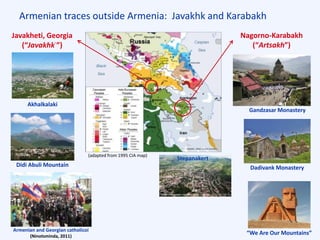
Armenian traces outside Armenia: Javakhk and Karabakh
“We Are Our Mountains”
Dadivank MonasteryDidi Abuli Mountain
Akhalkalaki
Gandzasar Monastery
Armenian and Georgian catholicoi
(Ninotsminda, 2011)
(adapted from 1995 CIA map)
Javakheti, Georgia
(“Javakhkʿ”)
Nagorno-Karabakh
(“Artsakh”)
Stepanakert
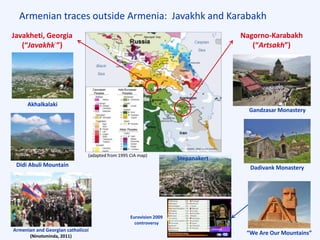
Armenian traces outside Armenia: Javakhk and Karabakh
“We Are Our Mountains”
Dadivank MonasteryDidi Abuli Mountain
Akhalkalaki
Gandzasar Monastery
Armenian and Georgian catholicoi
(Ninotsminda, 2011)
(adapted from 1995 CIA map)
Javakheti, Georgia
(“Javakhkʿ”)
Nagorno-Karabakh
(“Artsakh”)
Stepanakert
Eurovision 2009
controversy
National symbol of Armenia: Mount Ararat (“Masis”)
Credit: Julius M. (Flickr user “Ogmus”) [adjusted]
Credit: Wikimedia commons user “Самый древний” Credit: J. Urban
Ararat seen from the Arch of Charents,
Voghjaberd, Armenia
16,854 ft.
12,782 ft.
Ararat Anomaly
1673 sketch from Chardin’s travels
1949 USAF
photo
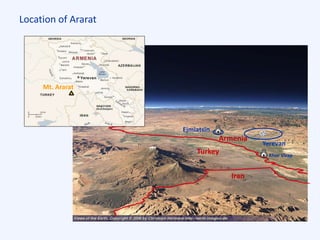
Location of Ararat
Mt. Ararat
Ararat
Khor Virap
Yerevan
Ejmiatsin
Turkey
Armenia
Iran
Mt. Ararat
National symbols of Armenia: Fruits
from armenianwinefestival.am
from noahstravelarmenia.blogspot.com
Apricot = Prunus Armeniaca
[Called simply “Armeniaca” by the Roman-era
Greek physician Dioscorides (1st century A.D.)]
Credit: Photolure [adjusted]
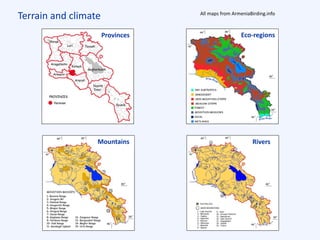
Terrain and climate All maps from ArmeniaBirding.info
Rivers
Eco-regions
Mountains
Provinces
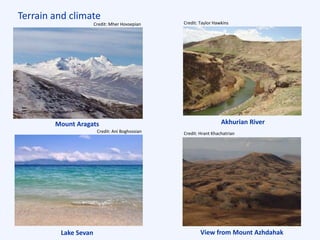
Terrain and climate
View from Mount Azhdahak
Credit: Hrant Khachatrian
Akhurian RiverMount Aragats
Lake Sevan
Credit: Taylor HawkinsCredit: Mher Hovsepian
Credit: Ani Boghossian
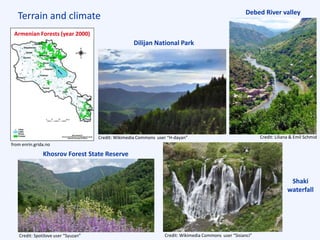
Terrain and climate
Armenian Forests (year 2000)
Shaki
waterfall
Debed River valley
Dilijan National Park
Khosrov Forest State Reserve
from enrin.grida.no
Credit: Spotilove user “Syuzan” Credit: Wikimedia Commons user “Sisianci”
Credit: Wikimedia Commons user “H-dayan” Credit: Liliana & Emil Schmid
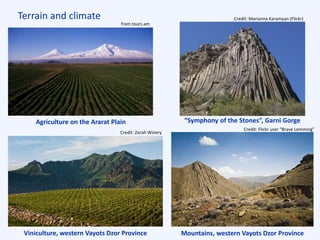
Terrain and climate
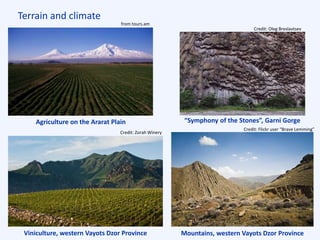
Agriculture on the Ararat Plain
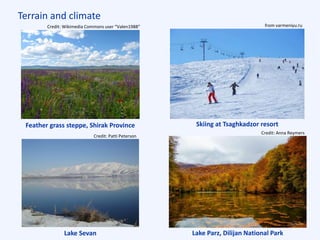
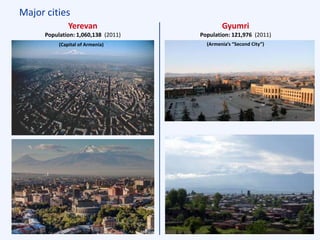
Viniculture, western Vayots Dzor Province Mountains, western Vayots Dzor Province
from tours.am
Credit: Zorah Winery
Credit: Flickr user “Brave Lemming”
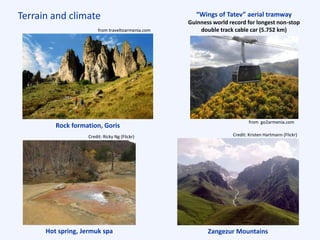
“Symphony of the Stones”, Garni Gorge
Credit: Marianna Karamyan (Flickr)
Terrain and climate
Agriculture on the Ararat Plain
Viniculture, western Vayots Dzor Province Mountains, western Vayots Dzor Province
from tours.am
Credit: Zorah Winery
Credit: Flickr user “Brave Lemming”
“Symphony of the Stones”, Garni Gorge
Credit: Oleg Breslavtsev
Terrain and climate “Wings of Tatev” aerial tramway
Guinness world record for longest non-stop
double track cable car (5.752 km)
Rock formation, Goris
Hot spring, Jermuk spa Zangezur Mountains
from traveltoarmenia.com
Credit: Ricky Ng (Flickr) Credit: Kristen Hartmann (Flickr)
from go2armenia.com
Terrain and climate
Lake Sevan
Skiing at Tsaghkadzor resort
Lake Parz, Dilijan National Park
Feather grass steppe, Shirak Province
Credit: Wikimedia Commons user “Valen1988” from varmeniyu.ru
Credit: Patti Peterson
Credit: Anna Reymers
Major cities
Yerevan
Population: 1,060,138 (2011)
Gyumri
Population: 121,976 (2011)
(Capital of Armenia) (Armenia’s “Second City”)
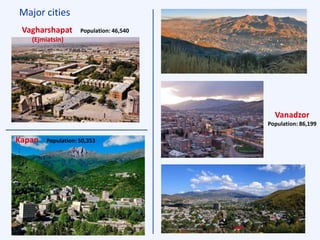
Major cities
Vanadzor
Population: 86,199
Vagharshapat Population: 46,540
(Ejmiatsin)
Kapan Population: 50,353
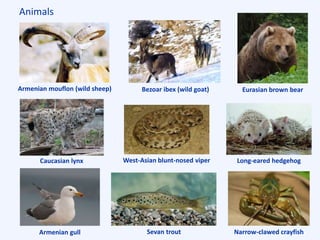
Animals
Armenian mouflon (wild sheep) Bezoar ibex (wild goat) Eurasian brown bear
Armenian gull Sevan trout Narrow-clawed crayfish
West-Asian blunt-nosed viperCaucasian lynx Long-eared hedgehog
Armenian culture: Traditional costumes
“Armenian woman in
national costume, Artvin”
(ca. 1905 – 1915)
S.M. Produkin-Gorskii
color tri-plate / digital composite
from U.S. Library of Congress
from barevarmenia.com
Map of Armenian
national costumes
from 1800 – 1925
Credit: Homeland Development Initiative Foundation (Taraz Fest 2014, Arpeni, Armenia)
[cropped]
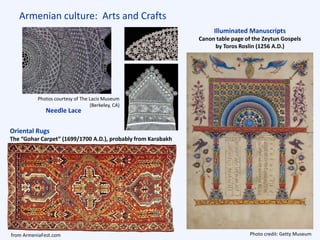
Armenian culture: Arts and Crafts
Illuminated Manuscripts
Canon table page of the Zeytun Gospels
by Toros Roslin (1256 A.D.)
Photo credit: Getty Museum
Oriental Rugs
The “Gohar Carpet” (1699/1700 A.D.), probably from Karabakh
Needle Lace
Photos courtesy of The Lacis Museum
(Berkeley, CA)
from ArmeniaFest.com
Armenian art in the collections of Washington, D.C.-area institutions
The National Gallery of Art
The Artist and His Mother
Arshile Gorky (ca. 1926 – ca. 1942)
The White House
The “Armenian Orphan Rug” from
Ghazir, Lebanon presented to
President Calvin Coolidge in 1925
The Library of Congress
The History of the Acts of St. John
the Evangelist (copied 1755)
[from the collection of Rouben Mamoulian]
(Most items usually are not on exhibit.)
Embroidered textile from
Marash (modern Turkey)
Embroidered woven textile
from the Caucasus
The Textile Museum at the
George Washington University Museum
Embroidered, beaded
apron from Erzurum
(modern Turkey)
Page from The Romance of
Alexander (1525)
Needle lace from
Kharpert (modern
Turkey) (ca. 1915)
Dumbarton Oaks
Museum
Vordan Karmir (“Worm’s Red”): a variety of natural crimson dye
Porphyrophora hamelii
(“Armenian cochineal”, “Ararat scale”, etc.)
Critically-endangered species
Vordan karmir ceiling art
Noravank Monastery, Armenia
Vordan Karmir
State Reservation
Salt meadow habitat
(2.20 km2)
Armavir Province
Credit: Wikimedia Commons user “Հանուման”
Credit: Vaghinak Petrosyan
Credit:G.Karagyan[adjusted]
from PeopleOfAr.wordpress.com (Credit: Yerevan Magazine)
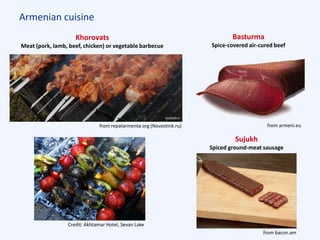
Armenian cuisine
Khorovats
Meat (pork, lamb, beef, chicken) or vegetable barbecue
from repatarmenta.org (Novostink.ru)
Credit: Akhtamar Hotel, Sevan Lake
Sujukh
Spiced ground-meat sausage
from bacon.am
Basturma
Spice-covered air-cured beef
from armeni.eu
Armenian cuisine
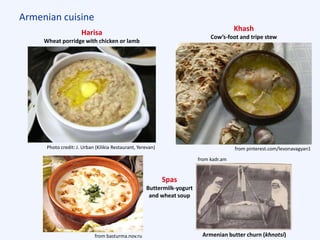
Harisa
Wheat porridge with chicken or lamb
Khash
Cow’s-foot and tripe stew
Spas
Buttermilk-yogurt
and wheat soup
from kadr.am
from basturma.nov.ru
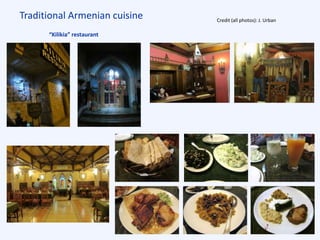
Photo credit: J. Urban (Kilikia Restaurant, Yerevan) from pinterest.com/levonavagyan1
Armenian butter churn (khnotsi)
Armenian cuisine
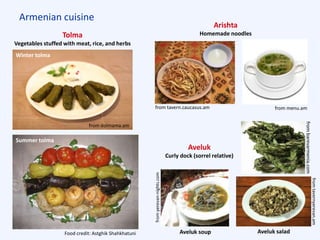
Arishta
Homemade noodles
from tavern.caucasus.am from menu.am
Aveluk
Curly dock (sorrel relative)
Aveluk soup Aveluk salad
frombarevarmenia.com
fromtavernyerevan.am
Tolma
Vegetables stuffed with meat, rice, and herbs
Food credit: Astghik Shahkhatuni
from dolmama.am
Winter tolma
Summer tolma
Armenian cuisine
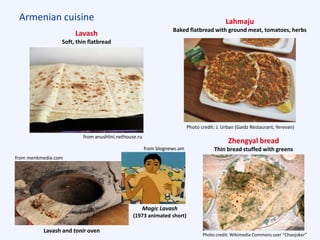
Lavash
Soft, thin flatbread
Lahmaju
Baked flatbread with ground meat, tomatoes, herbs
Zhengyal bread
Thin bread stuffed with greens
from anushlini.nethouse.ru
from menkmedia.com
from blognews.am
Photo credit: J. Urban (Gaidz Restaurant, Yerevan)
Photo credit: Wikimedia Commons user “Chaojoker”
Lavash and tonir oven
Magic Lavash
(1973 animated short)
Armenian cuisine
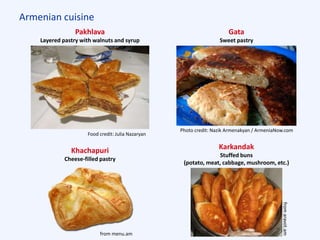
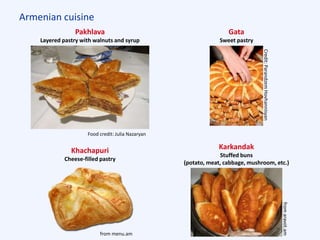
Pakhlava
Layered pastry with walnuts and syrup
Gata
Sweet pastry
Karkandak
Stuffed buns
(potato, meat, cabbage, mushroom, etc.)
Food credit: Julia Nazaryan
Photo credit: Nazik Armenakyan / ArmeniaNow.com
Khachapuri
Cheese-filled pastry
from menu.am
fromaravot.am
Credit:ParandzemHovhannisyan
Armenian cuisine
Pakhlava
Layered pastry with walnuts and syrup
Gata
Sweet pastry
Karkandak
Stuffed buns
(potato, meat, cabbage, mushroom, etc.)
Food credit: Julia Nazaryan
Khachapuri
Cheese-filled pastry
from menu.am
fromaravot.am
Armenian cuisine
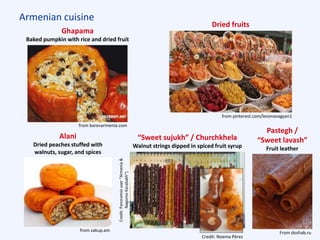
Ghapama
Baked pumpkin with rice and dried fruit
Dried fruits
from barevarmenia.com
“Sweet sujukh” / Churchkhela
Walnut strings dipped in spiced fruit syrup
Alani
Dried peaches stuffed with
walnuts, sugar, and spices
Pastegh /
“Sweet lavash”
Fruit leather
from pinterest.com/levonavagyan1
from zakup.am
Credit:Panoramiouser“Armenia&
NagornoKarabakh”)
Credit: Noema Pérez
From doshab.ru
Armenian cuisine
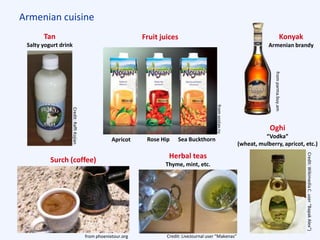
Tan
Salty yogurt drink
Fruit juices
Apricot Rose Hip Sea Buckthorn
Surch (coffee)
Oghi
“Vodka”
(wheat, mulberry, apricot, etc.)
Herbal teas
Thyme, mint, etc.
Konyak
Armenian brandy
Credit:RaffiKojian
fromsostav.ru
fromparma.buy.am
Credit:WikimediaC.user“BapakAlex”)
Credit: LiveJournal user “Makenas”from phoenixtour.org
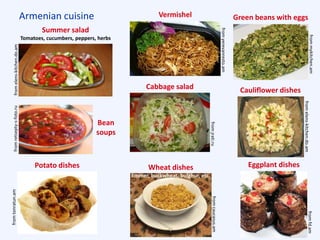
Armenian cuisine Green beans with eggs
Eggplant dishes
Cabbage salad
Bean
soups
Vermishel
Summer salad
Tomatoes, cucumbers, peppers, herbs
Wheat dishes
Emmer, buckwheat, bulghur, etc.
Potato dishes
Cauliflower dishes
fromelens-kitchen.do.am
fromfd.amfrommykitchen.am
fromretsepty-s-foto.rufromtonratun.am
fromcaucasus.amfromjrati.ru
fromyerevanresto.am
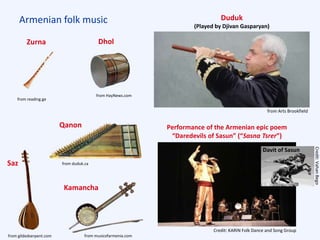
Armenian folk music Duduk
(Played by Djivan Gasparyan)
Performance of the Armenian epic poem
“Daredevils of Sasun” (“Sasna Tsrer”)
Davit of Sasun
Credit: KARIN Folk Dance and Song Group
Credit:VahanBego
from Arts Brookfield
from duduk.ca
Qanon
DholZurna
Saz
Kamancha
from musicofarmenia.comfrom gildedserpent.com
from HayNews.com
from reading.ge
Armenian culture: Folk dances
“Ishkhanats Par” (“Lords’ Dance”) “Berd” (“Fortress”)
“Yarkhushta” (martial dance) “Kochari”
Soviet Armenian soldiers
dancing Kochari in Berlin, 1945
Credit:SahakMuradyan[cropped]
Credit:BERTDanceEnsemble
Credit:TigranMadoyan/KARINFolkDanceGroup
from YouTube / Armenica.org
Credit:KARINFolkDanceGroup
Sports and games
Soccer
(“Futbol”)
Backgammon
(“Nardi”)
Chess
(“Shakhmat”)
Weightlifting
Boxing
Wrestling
Credit:FIDE(Qatar2011)Credit:BirthrightArmenia[adjusted]
Credit:PanARMENIAN/V.StepanyanfromHayNews.am
Credit:AIBA(Flickr)
Credit: Mike Hewitt / Getty Images Europe
Credit:V.Baghdasaryan/Photolure
Part II: Armenian history and geography
“For even though we are small and very limited in numbers and have
been conquered many times by foreign kingdoms, yet too, many acts
of bravery have been performed in our land, worthy of being written
and remembered, but of which no one has bothered to write down.”
Movses Khorenatsi [Moses of Chorene], Armenian historian
History of Armenia (Book 1, Chapter 3, Sentence 7)
ca. 482 A.D. (traditional date)
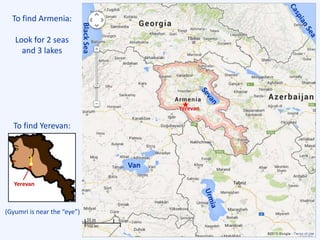
Yerevan
Van
To find Armenia:
Look for 2 seas
and 3 lakes
To find Yerevan:
BlackSea
Yerevan
(Gyumri is near the “eye”)
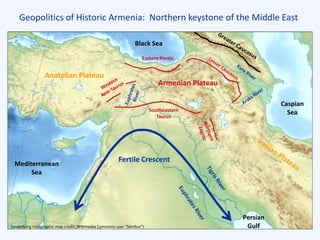
Geopolitics of Historic Armenia: Northern keystone of the Middle East
Anatolian Plateau
Fertile Crescent
Southeastern
Taurus
Eastern Pontic
Armenian Plateau
Black Sea
Caspian
Sea
Mediterranean
Sea
Persian
Gulf(underlying topographic map credit: Wikimedia Commons user “Sémhur”)
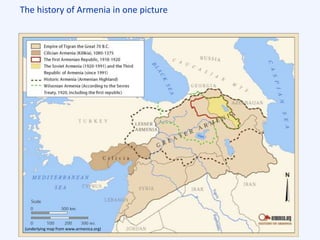
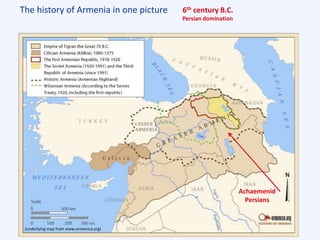
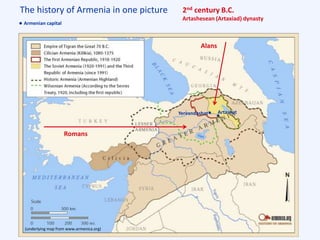
The history of Armenia in one picture
(underlying map from www.armenica.org)
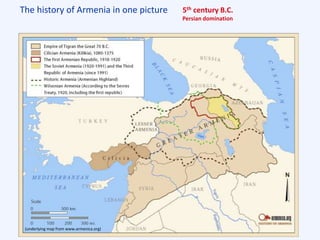
The history of Armenia in one picture
(underlying map from www.armenica.org)
6th century B.C.
Persian domination
Achaemenid
Persians
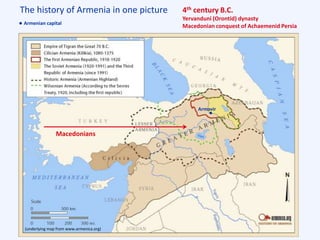
The history of Armenia in one picture
(underlying map from www.armenica.org)
5th century B.C.
Persian domination
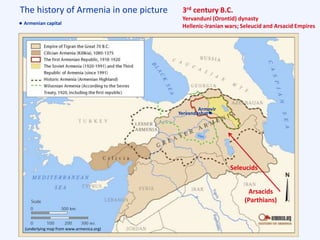
The history of Armenia in one picture
(underlying map from www.armenica.org)
4th century B.C.
Yervanduni (Orontid) dynasty
Macedonian conquest of Achaemenid Persia
Armavir
Macedonians
Armenian capital
The history of Armenia in one picture
(underlying map from www.armenica.org)
3rd century B.C.
Yervanduni (Orontid) dynasty
Hellenic-Iranian wars; Seleucid and Arsacid Empires
Armavir
Yervandashat
Seleucids
Arsacids
(Parthians)
Armenian capital
The history of Armenia in one picture
(underlying map from www.armenica.org)
2nd century B.C.
Artashesean (Artaxiad) dynasty
Yervandashat Artashat
Romans
Alans
Armenian capital
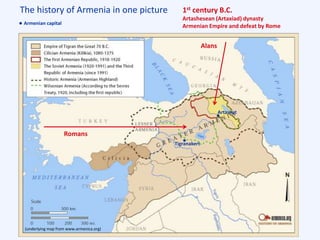
The history of Armenia in one picture
(underlying map from www.armenica.org)
1st century B.C.
Artashesean (Artaxiad) dynasty
Armenian Empire and defeat by Rome
Artashat
Tigranakert
Romans
Alans
Armenian capital
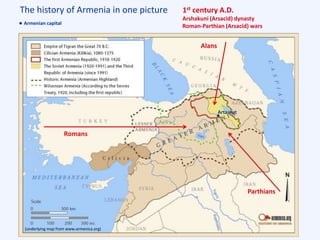
The history of Armenia in one picture
(underlying map from www.armenica.org)
1st century A.D.
Arshakuni (Arsacid) dynasty
Roman-Parthian (Arsacid) wars
Artashat
Romans
Parthians
Alans
Armenian capital
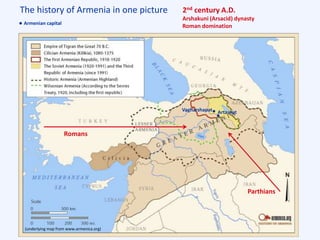
The history of Armenia in one picture
(underlying map from www.armenica.org)
2nd century A.D.
Arshakuni (Arsacid) dynasty
Roman domination
ArtashatVagharshapat
Romans
Parthians
Armenian capital
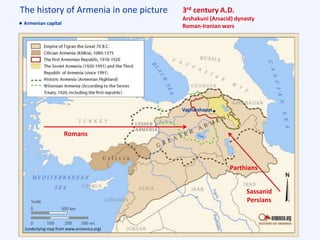
The history of Armenia in one picture
(underlying map from www.armenica.org)
3rd century A.D.
Arshakuni (Arsacid) dynasty
Roman-Iranian wars
Vagharshapat
Romans
Parthians
Sassanid
Persians
Armenian capital
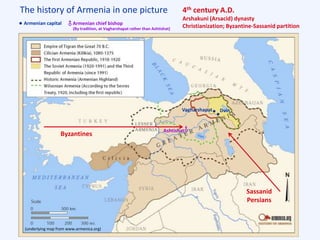
The history of Armenia in one picture
(underlying map from www.armenica.org)
4th century A.D.
Arshakuni (Arsacid) dynasty
Christianization; Byzantine-Sassanid partition
Vagharshapat Dvin
Ashtishat
Byzantines
Sassanid
Persians
Armenian capital Armenian chief bishop
(By tradition, at Vagharshapat rather than Ashtishat)
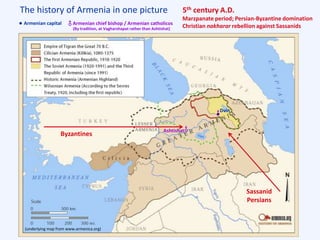
The history of Armenia in one picture
(underlying map from www.armenica.org)
5th century A.D.
Marzpanate period; Persian-Byzantine domination
Christian nakharar rebellion against Sassanids
Dvin
Ashtishat
Byzantines
Sassanid
Persians
Armenian capital Armenian chief bishop / Armenian catholicos
(By tradition, at Vagharshapat rather than Ashtishat)
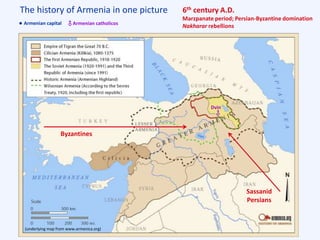
The history of Armenia in one picture
(underlying map from www.armenica.org)
6th century A.D.
Marzpanate period; Persian-Byzantine domination
Nakharar rebellions
Dvin
Byzantines
Sassanid
Persians
Armenian capital Armenian catholicos
The history of Armenia in one picture
(underlying map from www.armenica.org)
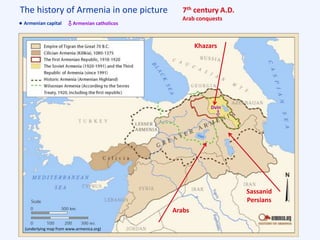
7th century A.D.
Arab conquests
Dvin
Arabs
Khazars
Sassanid
Persians
Armenian capital Armenian catholicos
The history of Armenia in one picture
(underlying map from www.armenica.org)
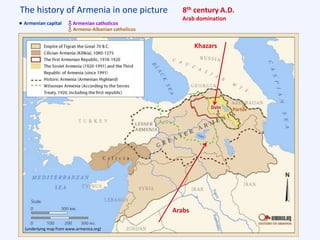
8th century A.D.
Arab domination
Dvin Partav
Arabs
Khazars
Armenian capital Armenian catholicos
Armeno-Albanian catholicos
The history of Armenia in one picture
(underlying map from www.armenica.org)
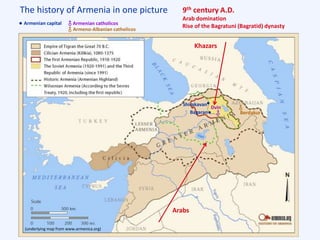
9th century A.D.
Arab domination
Rise of the Bagratuni (Bagratid) dynasty
Bagaran
Shirakavan
Dvin
Berdakur
Arabs
Khazars
Armenian capital Armenian catholicos
Armeno-Albanian catholicos
The history of Armenia in one picture
(underlying map from www.armenica.org)
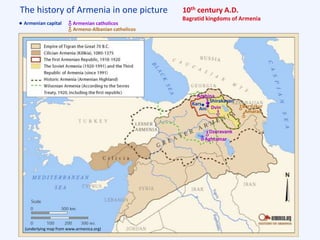
10th century A.D.
Bagratid kingdoms of Armenia
Shirakavan
Dvin
Dzoravank
Aghtamar
Kars
Arghina
Ani Berdakur
Amaras
Armenian capital Armenian catholicos
Armeno-Albanian catholicos
The history of Armenia in one picture
(underlying map from www.armenica.org)
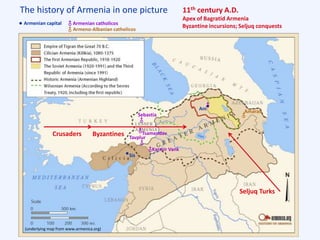
11th century A.D.
Apex of Bagratid Armenia
Byzantine incursions; Seljuq conquests
Ani
Sebastia
Tavplur
Tsamendav
Sis
Karmir Vank
Amaras
Seljuq Turks
ByzantinesCrusaders
Armenian capital Armenian catholicos
Armeno-Albanian catholicos
The history of Armenia in one picture
(underlying map from www.armenica.org)
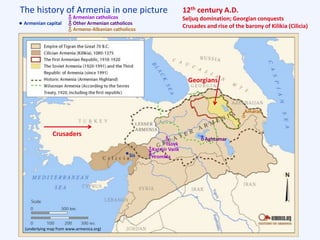
12th century A.D.
Seljuq domination; Georgian conquests
Crusades and rise of the barony of Kilikia (Cilicia)
Sis
Karmir Vank
Aghtamar
Tsovk
Hromkla
Amaras
Crusaders
Georgians
Armenian capital
Armenian catholicos
Other Armenian catholicos
Armeno-Albanian catholicos
The history of Armenia in one picture
(underlying map from www.armenica.org)
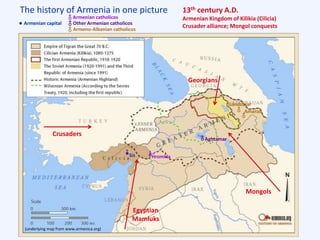
13th century A.D.
Armenian Kingdom of Kilikia (Cilicia)
Crusader alliance; Mongol conquests
HromklaSis
Aghtamar
Amaras
Gandzasar
Mongols
Crusaders
Georgians
Egyptian
Mamluks
Armenian capital
Armenian catholicos
Other Armenian catholicos
Armeno-Albanian catholicos
The history of Armenia in one picture
(underlying map from www.armenica.org)
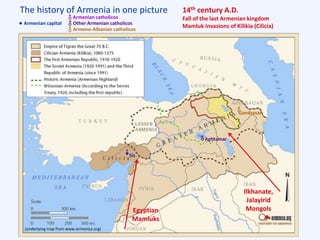
14th century A.D.
Fall of the last Armenian kingdom
Mamluk invasions of Kilikia (Cilicia)
Sis
Aghtamar
Gandzasar
Egyptian
Mamluks
Ilkhanate,
Jalayirid
Mongols
Armenian capital
Armenian catholicos
Other Armenian catholicos
Armeno-Albanian catholicos
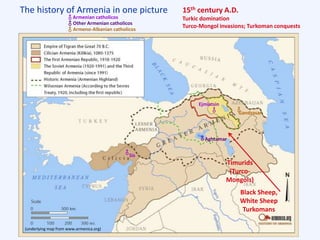
The history of Armenia in one picture
(underlying map from www.armenica.org)
15th century A.D.
Turkic domination
Turco-Mongol invasions; Turkoman conquests
Sis
Ejmiatsin
Aghtamar
Gandzasar
Timurids
(Turco-
Mongols)
Black Sheep,
White Sheep
Turkomans
Armenian catholicos
Other Armenian catholicos
Armeno-Albanian catholicos
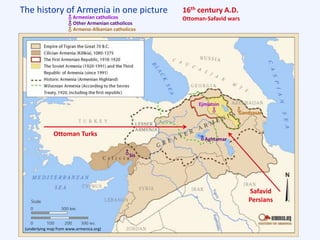
The history of Armenia in one picture
(underlying map from www.armenica.org)
16th century A.D.
Ottoman-Safavid wars
Ejmiatsin
Sis
Aghtamar
Gandzasar
Ottoman Turks
Safavid
Persians
Armenian catholicos
Other Armenian catholicos
Armeno-Albanian catholicos
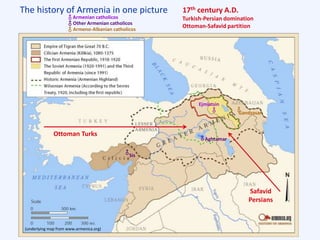
The history of Armenia in one picture
(underlying map from www.armenica.org)
17th century A.D.
Turkish-Persian domination
Ottoman-Safavid partition
Ejmiatsin
Sis
Aghtamar
Gandzasar
Ottoman Turks
Safavid
Persians
Armenian catholicos
Other Armenian catholicos
Armeno-Albanian catholicos
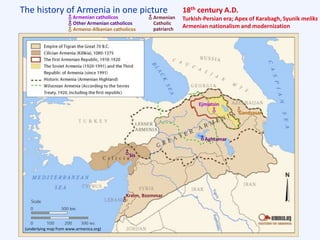
The history of Armenia in one picture
(underlying map from www.armenica.org)
18th century A.D.
Turkish-Persian era; Apex of Karabagh, Syunik meliks
Armenian nationalism and modernization
Ejmiatsin
Sis
Aghtamar
Gandzasar
Kreim, Bzommar
Armenian catholicos
Other Armenian catholicos
Armeno-Albanian catholicos
Armenian
Catholic
patriarch
The history of Armenia in one picture
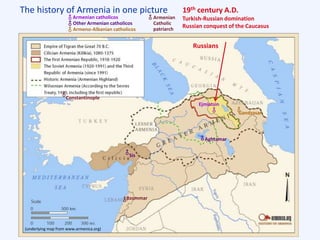
(underlying map from www.armenica.org)
19th century A.D.
Turkish-Russian domination
Russian conquest of the Caucasus
Ejmiatsin
Sis
Aghtamar
Gandzasar
Bzommar
Constantinople
Russians
Armenian catholicos
Other Armenian catholicos
Armeno-Albanian catholicos
Armenian
Catholic
patriarch
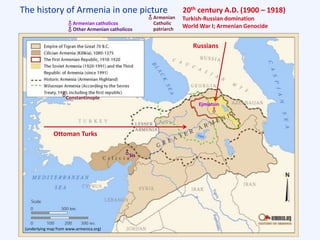
The history of Armenia in one picture
(underlying map from www.armenica.org)
20th century A.D. (1900 – 1918)
Turkish-Russian domination
World War I; Armenian Genocide
Ejmiatsin
Sis
Constantinople
Ottoman Turks
Russians
Armenian catholicos
Other Armenian catholicos
Armenian
Catholic
patriarch
The history of Armenia in one picture
(underlying map from www.armenica.org)
20th century A.D. (1918 – 1920)
First Armenian republic
Transcaucasian wars and Sovietization
Yerevan
Ejmiatsin
Sis
Constantinople
Turkish nationalists
[Turks]
[Georgians]
Soviet
Russians
[Azerbaijanis]
British
Empire
Armenian capital Armenian catholicos
Other Armenian catholicos
Armenian
Catholic
patriarch
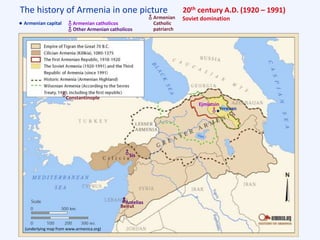
The history of Armenia in one picture
(underlying map from www.armenica.org)
20th century A.D. (1920 – 1991)
Soviet domination
Yerevan
Ejmiatsin
Sis
Constantinople
Beirut
Antelias
Armenian capital Armenian catholicos
Other Armenian catholicos
Armenian
Catholic
patriarch
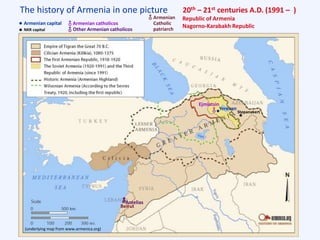
The history of Armenia in one picture
(underlying map from www.armenica.org)
20th – 21st centuries A.D. (1991 – )
Republic of Armenia
Nagorno-Karabakh Republic
Yerevan
Stepanakert
Ejmiatsin
Beirut
Antelias
Armenian capital Armenian catholicos
Other Armenian catholicos
Armenian
Catholic
patriarchNKR capital
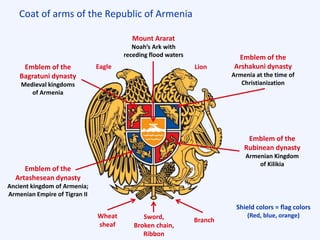
Coat of arms of the Republic of Armenia
Emblem of the
Rubinean dynasty
Armenian Kingdom
of Kilikia
Emblem of the
Bagratuni dynasty
Medieval kingdoms
of Armenia
Emblem of the
Artashesean dynasty
Ancient kingdom of Armenia;
Armenian Empire of Tigran II
Emblem of the
Arshakuni dynasty
Armenia at the time of
Christianization
Mount Ararat
Noah’s Ark with
receding flood waters
Sword,
Broken chain,
Ribbon
Wheat
sheaf
Branch
Shield colors = flag colors
(Red, blue, orange)
LionEagle
Early Armenian history and pre-history
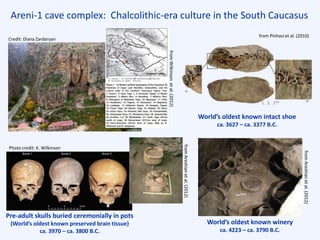
Areni-1 cave complex: Chalcolithic-era culture in the South Caucasus
World’s oldest known intact shoe
ca. 3627 – ca. 3377 B.C.
Pre-adult skulls buried ceremonially in pots
(World’s oldest known preserved brain tissue)
ca. 3970 – ca. 3800 B.C.
World’s oldest known winery
ca. 4223 – ca. 3790 B.C.
Photo credit: K. Wilkinson
fromAreshianetal.(2012)
Credit: Diana Zardaryan
fromWilkinsonetal.(2012)
fromAreshianetal.(2012)
from Pinhasi et al. (2010)
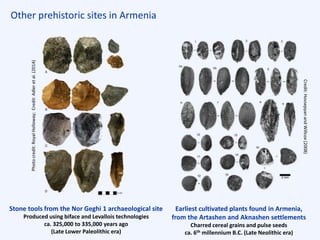
Other prehistoric sites in Armenia
Earliest cultivated plants found in Armenia,
from the Artashen and Aknashen settlements
Charred cereal grains and pulse seeds
ca. 6th millennium B.C. (Late Neolithic era)
Stone tools from the Nor Geghi 1 archaeological site
Produced using biface and Levallois technologies
ca. 325,000 to 335,000 years ago
(Late Lower Paleolithic era)
Photocredit:RoyalHolloway;Credit:Adleretal.(2014)
Credit:HovsepyanandWillcox(2008)
Other prehistoric sites in Armenia
Karahunj (“Zorats Karer”), Syunik Province
3rd – 2nd millennia B.C.
Metsamor site, Armavir Province
3rd – 2nd millennia B.C.
Petroglyphs of Mt. Ughtasar, Syunik Province
4th – 3rd millennia B.C.
Shengavit settlement, Yerevan
3rd millennium B.C. (Kura-Araxes culture)
Credit:WikimediaC.user“Sonashen”
fromtours-armenia.com
Credit:AndrewSelkirk
fromEnjoyArmenia.com
Credit:MarcTailly[adjusted]
fromsobstvennost.net
fromhushardzan.am from widener.edu/~msrothma
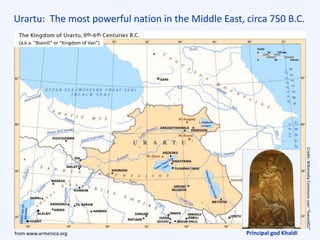
Urartu: The most powerful nation in the Middle East, circa 750 B.C.
from www.armenica.org Principal god Khaldi
Credit:WikimediaCommonsuser“liveon001”
((a.k.a. “Biainili” or “Kingdom of Van”)
Erebuni Fortress: an Urartian citadel in Yerevan
Erebuni Fortress, founded in 782 B.C. by the Urartian
king Argishti I, is considered the namesake of Yerevan
Google Sketchup by Vahe Hambardzumyan (3D Warehouse user “Vahe Armenia”)
Credit: Armen Manukov (Wikimedia Commons)
Artist’s rendition
By the grace of the god Khaldi, Argishti, son of Menua,
built this mighty stronghold and proclaimed it Erebuni for
the glory of Bianili [Urartu] and to instill fear among the
enemy countries. Argishti says: The land was a desert;
great works I accomplished upon it. By the will of Khaldi,
Argishti, son of Menua, is a mighty king, king of Bianili
land, and ruler of Tushpa [Van] city.
Credit: Wikimedia Commons user “EvgenyGenkin”
Credit: J. Urban
Statue of Argishti I
Erebuni Fortress
Credit: J. Urban
Armenian ethnogenesis: four ideas
Statue of Hayk the Patriarch
Credit:ValeriKhachatryan
• The Armenian tradition: Armenian patriarch Hayk conquered
the Armenian plateau from the Babylonian tyrant Bel
– Armenian tradition dates the battle to 2492 B.C.*
– Hayk is considered the great-great-grandson of the biblical Noah
[Noah → Japheth → Gomer → Torgom (Togarmah) → Hayk]
• The ancient Greek tradition: The Armenians were a colony of Phrygians
– Phrygia was a kingdom in west-central Anatolia that dominated much of the
peninsula following the Hittite collapse circa 1200 B.C.
• The 19th-/20th-century consensus: The Armenians are descended from a
(possibly Phrygian-related) tribe called the Armens that migrated onto the
Armenian plateau after the fall of Urartu (ca. 590 B.C.) and mixed with the
non-Indo-European natives
– Some historians suggest that the Armens intermarried with peoples of the Hayasa-
Azzi confederation who had migrated into the Armenian highlands
• A new theory: Armenians were included among, or identical to, the Urartian
peoples (and the pre-Urartian Hurrian peoples)
* The 19th-century Armenian Mekhitarist priest Ghevond Alishan calculated the date 2492 B.C. and checked it against the date of death of the
legendary Babylonian king Belus calculated in the chronographies of Sextus Julius Africanus (3rd c. A.D.) and Eusebius of Caesarea (4th c. A.D.).
The ancient foreign names of Armenia and its predecessors
Darius I’s trilingual inscription (Mount Bīsitūn, Iran):
Conquests of the Achaemenid Persian king, mostly
carved between 520 B.C. and 518 B.C.
Sargon II’s cylinder (Khorsabad, Iraq):
Dedication of Dûr-Sharrukin, capital of
the Neo-Assyrian king, in 706 B.C.
The land of Armenia The land of Urartu
(according to Median geography)
(according to Achaemenid geography)
ARMINA
Old Persian
Achaemenid Akkadian
(“Late Babylonian”) Neo-Assyrian Akkadian
[land of] URASHTU [land of] URARTU
The Achaemenids recorded
Armenia and Urartu as sharing a
geography (if not a people)
“Ararat” (Hebrew: ʾRRT) is considered to
be a pronunciation variant of “Urartu”
ARARAT
[Semitic languages like Akkadian, Hebrew, Aramaic,
Arabic, etc. are based on roots of 3 (or 4) consonants]
The biblical land of Ararat
Credit: Musée du Louvre
Hebrew
[Urartu was archaic to the Achaemenids:
Urartu was absorbed by Media circa 590 B.C.]
(Vowels not written in Biblical-era Hebrew)
5 cm
5 meters
The native names of Armenia and its predecessors
The land of Armenia The land of Urartu
[land of] BIAINILI
HAYKʿ
(or “HAYQ”)
Մեծ Հայք = Greater Armenia
Փոքր Հայք = Lesser Armenia
HAYASTAN
Inscriptions at the Rock of Van (Van, Turkey)
Citadel of Tushpa, capital of Urartu
[land of] BIAINA
Urartian
[“Van”, the modern name of the city and lake where the Urartian
capital was located, is thought to be derived from “Biaina“.]“Book of History” by Arakel Davrizhetsi (1669)
“Koryun Vardapet and His Translations”
by Norayr Buzandatsi (1900)
[Koryun was a 5th-c. A.D. Armenian historian.]
(archaic name)
(modern name)
Photo credit: Mirjo Salvini
Armenian
Armenian
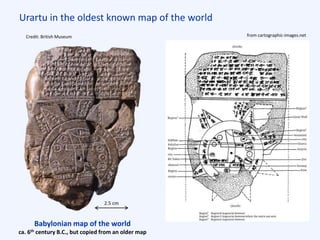
Urartu in the oldest known map of the world
Babylonian map of the world
ca. 6th century B.C., but copied from an older map
Credit: British Museum
2.5 cm
from cartographic-images.net
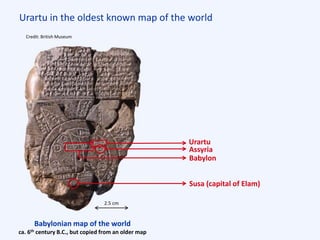
Urartu in the oldest known map of the world
Babylonian map of the world
ca. 6th century B.C., but copied from an older map
Credit: British Museum
2.5 cm
Susa (capital of Elam)
Babylon
Assyria
Urartu
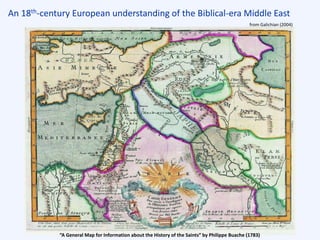
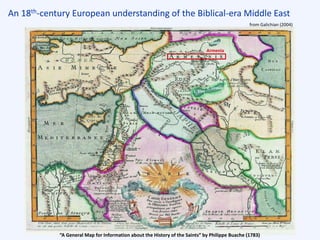
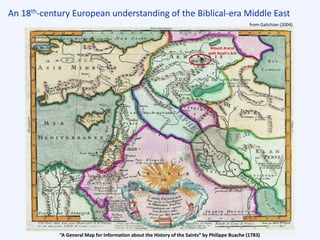
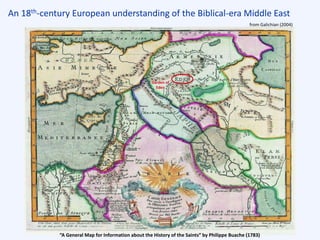
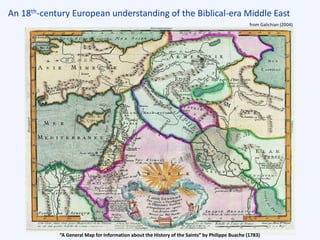
An 18th-century European understanding of the Biblical-era Middle East
“A General Map for Information about the History of the Saints” by Philippe Buache (1783)
from Galichian (2004)
An 18th-century European understanding of the Biblical-era Middle East
“A General Map for Information about the History of the Saints” by Philippe Buache (1783)
from Galichian (2004)
Armenia
L. Van
L. Urmia
L. Sevan
An 18th-century European understanding of the Biblical-era Middle East
“A General Map for Information about the History of the Saints” by Philippe Buache (1783)
from Galichian (2004)
Mount Ararat
with Noah’s Ark
An 18th-century European understanding of the Biblical-era Middle East
“A General Map for Information about the History of the Saints” by Philippe Buache (1783)
from Galichian (2004)
Garden of
Eden
An 18th-century European understanding of the Biblical-era Middle East
“A General Map for Information about the History of the Saints” by Philippe Buache (1783)
from Galichian (2004)
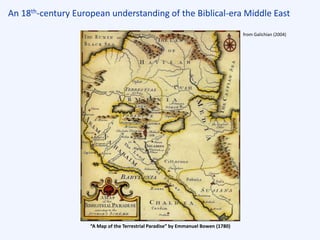
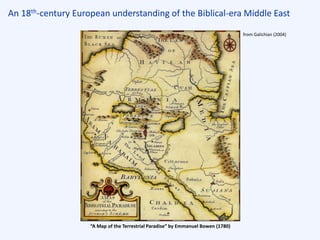
An 18th-century European understanding of the Biblical-era Middle East
“A Map of the Terrestrial Paradise” by Emmanuel Bowen (1780)
from Galichian (2004)
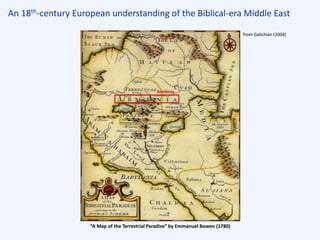
An 18th-century European understanding of the Biblical-era Middle East
“A Map of the Terrestrial Paradise” by Emmanuel Bowen (1780)
from Galichian (2004)
Armenia
L. Van
L. Urmia
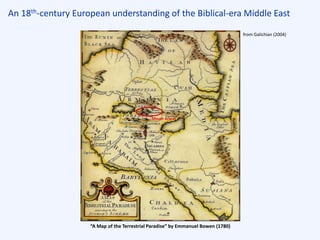
An 18th-century European understanding of the Biblical-era Middle East
“A Map of the Terrestrial Paradise” by Emmanuel Bowen (1780)
from Galichian (2004)
Mount Ararat
An 18th-century European understanding of the Biblical-era Middle East
“A Map of the Terrestrial Paradise” by Emmanuel Bowen (1780)
from Galichian (2004)
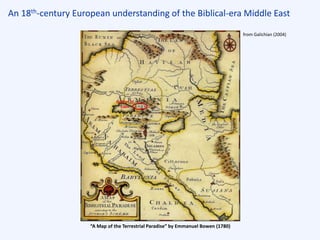
Garden of
Eden
An 18th-century European understanding of the Biblical-era Middle East
“A Map of the Terrestrial Paradise” by Emmanuel Bowen (1780)
from Galichian (2004)
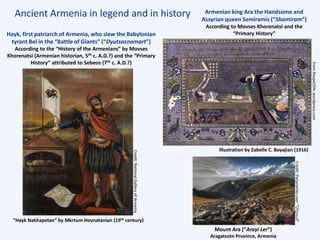
Ancient Armenia in legend and in history Armenian king Ara the Handsome and
Assyrian queen Semiramis (“Shamiram”)
According to Movses Khorenatsi and the
“Primary History”Hayk, first patriarch of Armenia, who slew the Babylonian
tyrant Bel in the “Battle of Giants” (“Dyutsaznamart”)
According to the “History of the Armenians” by Movses
Khorenatsi (Armenian historian, 5th c. A.D.?) and the “Primary
History” attributed to Sebeos (7th c. A.D.?)
“Hayk Nakhapetan” by Mkrtum Hovnatanian (19th century)
Illustration by Zabelle C. Boyajian (1916)
Mount Ara (“Arayi Ler”)
Aragatsotn Province, Armenia
Credit:Panoramiouser“Սէրուժ”
fromPeopeOfAr.wordpress.com
Credit:NationalGalleryofArmenia
Ancient Armenia in legend and in history
Armenus of Thessaly,
one of Jason’s Argonauts
Namesake of Armenia, according to Strabo
(Roman-era Greek geographer, 1st c. B.C. – 1st c. A.D.)
[But not included in other Greek lists of Argonauts or
mentioned in the Armenian histories.]
Armenian patriarch Zarmayr,
killed defending Troy in the Trojan War
Assisted King Priam with an Ethiopian army on behalf of Assyria,
according to Movses Khorenatsi (Armenian historian, 5th c. A.D.)
[But not mentioned in the Greek sources. Possibly equated with Memnon.]
Ancient Greek vase depicting several Argonauts
(but not depicting Armenus)
Credit: Musée du Louvre
19th-century illustration of Zarmayr
Credit:NationalGalleryofArmenia
Ancient Armenia in legend and in history
Armenian bearing tribute to
Persian king Darius the Great
Carving at Persepolis (the acropolis
of Parsa, capital of the Achaemenid
Persian Empire), 6th c. B.C.
(late 6th century B.C.)
Tigranes, Armenian prince and hunting
partner of Persian king Cyrus the Great
According to the semi-fictional Cyropaedia
by Xenophon (Greek mercenary and
historian, 4th c. B.C.)
Armenian soldier in the army of
Persian king Xerxes the Great
Illustrated according to the
description of Herodotus
(Greek historian, 5th c. B.C.)
Eastern staircase of the Apadana of Persepolis, Iran
Early 20th-century illustration
19th-century illustration of
Tigran Yervanduni
[sometimes equated with
Xenophon’s Tigranes]
Reigns of the great
Achaemenid Persian kings:
Cyrus the Great:
Darius the Great:
Xerxes the Great:
549 – 530 B.C.
522 – 486 B.C.
486 – 465 B.C.
Credit:NationalGalleryofArmenia
Photocredit:WikimediaC.user“Aryamahasattva”
Credit:BookbyOskarJägerandA.F.Marx
Ancient Armenia in legend and in history
Armenian commanders Orontes and Mithraustes in the army
of Persian king Darius III at the Battle of Gaugamela in 331 B.C.
According to Arrian (Roman-era Greek historian, 2nd c. A.D.)
Carved ivory relief of the Battle of Gaugamela
Anonymous artist (18th c.), after Charles Le Brun’s 17th-c. painting
[The relief does not depict Orontes or Mithraustes specifically.]
Photocredit:LuisGarcía
Ancient Artashat, the “Armenian Carthage”
According to Plutarch (Roman-era Greek historian, 2nd c.
A.D.) and Strabo (Greek geographer, 1st c. B.C. – 1st c. A.D.)
[But no association with Carthage in the Armenian histories or
from archaeological investigations.]
[Note: Alexander of Macedon (“Alexander the Great”) ended the
Achaemenid Persian Empire by winning this battle.]
[Note: Strabo and Plutarch wrote that Artashat was designed and
built on the advice of Hannibal of Carthage in the 2nd century B.C.]
Credit:Tonikian(1992)
Site plan of the ruined ancient city of
Artashat in Ararat Province, Armenia
m
Ancient Armenia in legend and in history
17th-century Flemish tapestry depicting Marc Antony,
Cleopatra, and the captive Armenian royal family
Workshop of Everard III Leyniers, Flanders, Brussels (ca. 1670)
Credit:ArtInstituteofChicago
The captive King Artavazd (“Artavasdes”) II of Armenia,
son of Tigran II, who refused to bow to Cleopatra at
Marc Antony’s triumph in Alexandria in 34 A.D.
According to Roman-era historians (Lucius Cassius Dio, plus
Tacitus, Plutarch, Flavius Josephus, etc.) and Armenian
historian Movses Khorenatsi
Tigran II (“Tigranes the Great”), known as the “King of Kings”
of the Armenian Empire in the 1st century B.C.
According to Roman-era Greek historians Plutarch and Appian
(2nd c. A.D.), and coins minted under the reign of Tigran II
19th-century Italian illustration of Tigran the Great
accompanied by four vassal kings
G. Fusaro, 19th century
[Note: Plutarch wrote that after the Battle of Carrhae in 53 B.C., the head of
Marcus Crassus (member of the First Triumvirate of Rome with Julius Caesar and
Pompey the Great) was used as a prop in the performance of a Greek tragedy at
the wedding of Artavasdes’ sister to the Parthian king’s son in Artashat.]
Credit:Fusaro,citedin“ArmenianHistoryinItalianArt”
Ancient Armenia in legend and in history
Trdat (Tiridates) I, prince of Parthia and king of the Armenians, who traveled to Rome with
his magi in 66 A.D. to receive his crown from Emperor Nero
According to 1st/2nd c. A.D. Roman historians Suetonius, Cassius Dio, Tacitus, and Pliny the Elder
17th-century copy of an ancient Roman statue
Gardens of the Palace of Versailles, France
By Antoine André (ca. 1687), after one of the “Farnese Captives”
Statues sometimes associated with Tiridates I of Armenia:
Ancient Roman statue
Louvre Museum, Paris, France
Borghese Collection; ancient head attached to
a 2nd-century body, with other restorations
[Note: Some scholars have suggested that the
journey of Tiridates and his magi inspired the
Biblical story of the Magi and the nativity of
Jesus. The year of Tiridates’ visit, 66 A.D., is
near the time that the Gospel of Matthew is
thought to have been written, and is also the
year of a notable apparition of Halley’s Comet.]
fromandrelenorte.com[cropped]
fromPeopleOfAr.com
Tiridates I was the first king of the
Armenian Arshakuni (Arsacid) dynasty
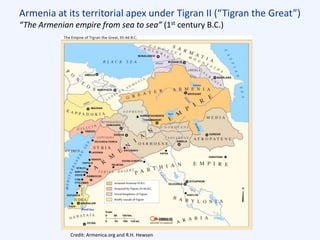
Credit: Armenica.org and R.H. Hewsen
Armenia at its territorial apex under Tigran II (“Tigran the Great”)
“The Armenian empire from sea to sea” (1st century B.C.)
Map credit: Wikipedia user “Andrei nacu” [adapted]
Armenia as a possession of imperial Rome
The Roman Empire at its greatest extent in 117 A.D.: 3 years after Roman emperor Trajan made Armenia an imperial
province; 182 years after the Armenian king Tigran the Great surrendered to the Roman general Pompey the Great
Roman province
of Armenia
(114 – 118 A.D.)
Roman sestertius
(ca. 114 – 117 A.D.)
Celebrating Trajan’s
conquest of Armenia
and Mesopotamia
Euphrates Tigris
Armenia
Trajan
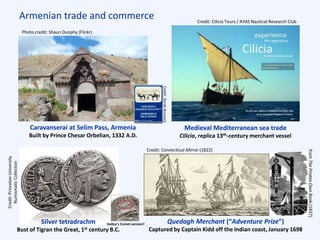
Armenian trade and commerce
Caravanserai at Selim Pass, Armenia
Built by Prince Chesar Orbelian, 1332 A.D.
Photo credit: Shaun Dunphy (Flickr)
Medieval Mediterranean sea trade
Cilicia, replica 13th-century merchant vessel
Quedagh Merchant (“Adventure Prize”)
Captured by Captain Kidd off the Indian coast, January 1698
Credit: Cilicia Tours / AYAS Nautical Research Club
Silver tetradrachm
Bust of Tigran the Great, 1st century B.C.
Credit:PrincetonUniversity
NumismaticCollection
fromThePiratesOwnBook(1837)
Credit: Connecticut Mirror (1822)
Halley’s Comet version?
Religion in Armenia
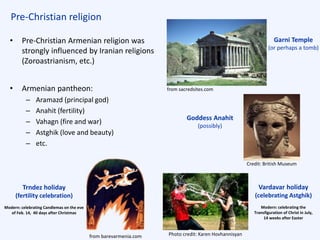
Pre-Christian religion
• Pre-Christian Armenian religion was
strongly influenced by Iranian religions
(Zoroastrianism, etc.)
• Armenian pantheon:
– Aramazd (principal god)
– Anahit (fertility)
– Vahagn (fire and war)
– Astghik (love and beauty)
– etc.
Goddess Anahit
(possibly)
Garni Temple
(or perhaps a tomb)
Vardavar holiday
(celebrating Astghik)
Modern: celebrating the
Transfiguration of Christ in July,
14 weeks after Easter
Photo credit: Karen Hovhannisyan
Credit: British Museum
from sacredsites.com
Trndez holiday
(fertility celebration)
Modern: celebrating Candlemas on the eve
of Feb. 14, 40 days after Christmas
from barevarmenia.com
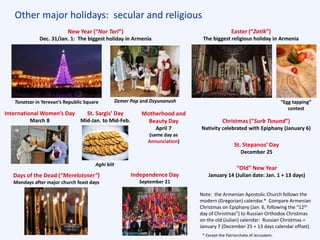
Other major holidays: secular and religious
Christmas (“Surb Tsnund”)
Nativity celebrated with Epiphany (January 6)
New Year (“Nor Tari”)
Dec. 31/Jan. 1: The biggest holiday in Armenia
Dzmer Pap and Dzyunanush
St. Stepanos’ Day
December 25
“Old” New Year
January 14 (Julian date: Jan. 1 + 13 days)
Note: the Armenian Apostolic Church follows the
modern (Gregorian) calendar.* Compare Armenian
Christmas on Epiphany (Jan. 6, following the “12th
day of Christmas”) to Russian Orthodox Christmas
on the old (Julian) calendar: Russian Christmas =
January 7 (December 25 + 13 days calendar offset).
Tonatsar in Yerevan’s Republic Square
Easter (“Zatik”)
The biggest religious holiday in Armenia
Independence Day
September 21
International Women’s Day
March 8
St. Sargis’ Day
Mid-Jan. to Mid-Feb.
Motherhood and
Beauty Day
April 7
(same day as
Annunciation)
Aghi blit
Days of the Dead (“Merelotsner”)
Mondays after major church feast days
“Egg tapping”
contest
* Except the Patriarchate of Jerusalem.
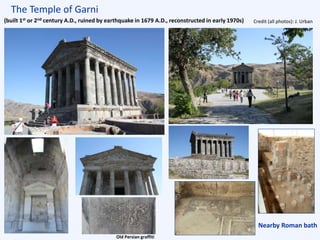
The Temple of Garni
Nearby Roman bath
Credit (all photos): J. Urban
Old Persian graffiti
(built 1st or 2nd century A.D., ruined by earthquake in 1679 A.D., reconstructed in early 1970s)
The traditional account of Christianity in Armenia
1st century A.D.:
Apostles Thaddeus and
Bartholomew
3rd/4th centuries A.D.:
St. Grigor (Gregory) the Illuminator, King Trdat III
(Tiridates the Great), and the Christian maidens
Baptism of Trdat III by Grigor
[In 301 A.D. according to tradition, but possibly as late as 314 A.D.]
Khor Virap (“Deep Pit”)
St. Hripsime
fromstmaryaac.org
fromstmaryaac.orgCredit:AlexAmirbekyan
Armenian Apostolic Church
fromarmenische-kirche.ch
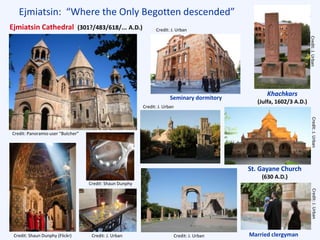
Ejmiatsin: “Where the Only Begotten descended”
St. Gayane Church
(630 A.D.)
Married clergyman
Seminary dormitory
Credit: J. Urban
Credit:J.UrbanCredit:J.UrbanCredit:J.Urban
Credit: J. Urban Credit: J. Urban
Credit: J. Urban
Credit: Shaun Dunphy (Flickr)
Credit: Shaun Dunphy
Credit: Panoramio user “Butcher”
Khachkars
(Julfa, 1602/3 A.D.)
Ejmiatsin Cathedral (301?/483/618/... A.D.)
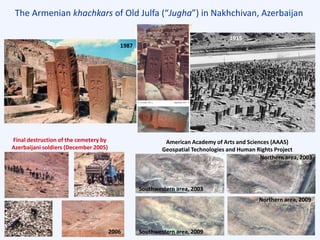
The Armenian khachkars of Old Julfa (“Jugha”) in Nakhchivan, Azerbaijan
Southwestern area, 2003
Southwestern area, 2009
Northern area, 2009
Northern area, 2003
American Academy of Arts and Sciences (AAAS)
Geospatial Technologies and Human Rights Project
Final destruction of the cemetery by
Azerbaijani soldiers (December 2005)
2006
1987
1915
Ruins of Zvartnots Cathedral
Toramanian (1905) Mnatsakanyan (1971)
Proposed structures
(built in mid-7th century A.D., destroyed in late-10th century A.D.)
Credit:TimofeyKispoevCredit:ShaunDunphy(Flickr)
Credit: Michal Hoskovec (DeviantArt user “Dorcadion”) [adjusted]
Credit: Sean Dunphy (Flickr) [adjusted]Credit: Rita Willaert (Flickr)
Credit:TheGreatSovietEncyclopedia
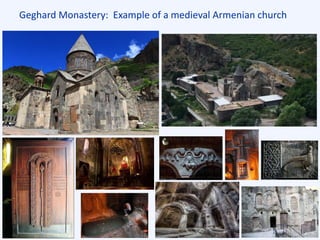
Geghard Monastery: Example of a medieval Armenian church
Other medieval monasteries in Armenia
Khor Virap
Noravank
Photo credit: Grigory Gusev (Flickr)
Sanahin
Haghpat
Photo credit: Agnieszka Skieterska (TrekEarth user “Skieter”) Photo credit: Thomas Frederick Martinez
Tatev
fromofficespace.am
Photo credit: Karen Bars (Panoramio) [cropped]
Struggle for religious freedom: Battle of Avarayr (451 A.D.)
Vardan Mamikonean
(St. Vardan)
Sparapet of the Armenian armies
from armenica.org
from armenica.org from armenian-history.com
Armenian hymnal (written 1482 A.D., manuscript 1620 A.D.)
Christian Armenians [right] battling Sassanid Persians [left]
fromWikimediaCommons
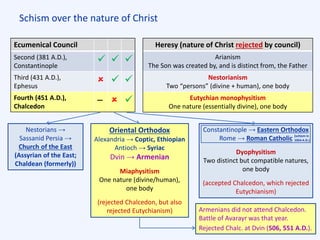
Schism over the nature of Christ
Ecumenical Council
Second (381 A.D.),
Constantinople
  
Third (431 A.D.),
Ephesus
  
Fourth (451 A.D.),
Chalcedon
–  
Heresy (nature of Christ rejected by council)
Arianism
The Son was created by, and is distinct from, the Father
Nestorianism
Two “persons” (divine + human), one body
Eutychian monophysitism
One nature (essentially divine), one body
Oriental Orthodox
Alexandria → Coptic, Ethiopian
Antioch → Syriac
Dvin → Armenian
Miaphysitism
One nature (divine/human),
one body
(rejected Chalcedon, but also
rejected Eutychianism)
Constantinople → Eastern Orthodox
Rome → Roman Catholic
Dyophysitism
Two distinct but compatible natures,
one body
(accepted Chalcedon, which rejected
Eutychianism)
Nestorians →
Sassanid Persia →
Church of the East
(Assyrian of the East;
Chaldean (formerly))
Armenians did not attend Chalcedon.
Battle of Avarayr was that year.
Rejected Chalc. at Dvin (506, 551 A.D.).
(schism in
1054 A.D.)
Common traditions in Oriental Orthodoxy: The story of St. Hripsime
St. Arsema
Ethiopian Orthodox Tewahedo Church
St. Hripsime
Armenian Apostolic Church
St. Arbsima
Coptic Orthodox Church
St. Hripsime Church (618 A.D.)
Ejmiatsin, Armenia
18th – 19th c. triptych of the life of Arsema
Arsema Semaetat Church (13th c.), Lake Tana, Ethiopia
Credit:WikimediaCommonsuser“Gegman”[adapted]
Tombstone of St. Hripsime
ca. 17th c. diptych
depicting St. Arsema
fromrofa100100.blogspot.com
fromBosc-Tiessé(2000)
Credit:HailemariamShimelis
fromgriqor.livejournal.ru
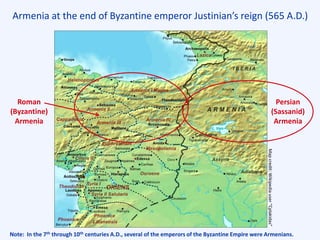
Armenia at the end of Byzantine emperor Justinian’s reign (565 A.D.)
Roman
(Byzantine)
Armenia
Persian
(Sassanid)
Armenia
Note: In the 7th through 10th centuries A.D., several of the emperors of the Byzantine Empire were Armenians.
Mapcredit:Wikipediauser“Cplakidas”
L. Van
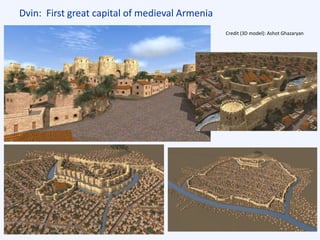
Dvin: First great capital of medieval Armenia
Credit (3D model): Ashot Ghazaryan
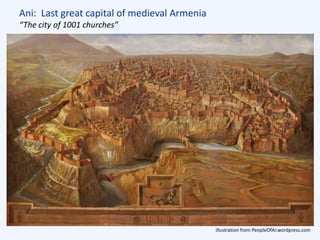
Ani: Last great capital of medieval Armenia
“The city of 1001 churches”
illustration from PeopleOfAr.wordpress.com
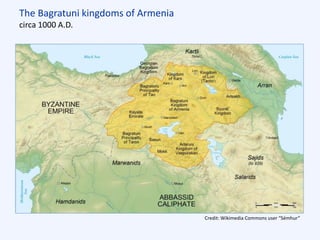
The Bagratuni kingdoms of Armenia
circa 1000 A.D.
Credit: Wikimedia Commons user “Sémhur”
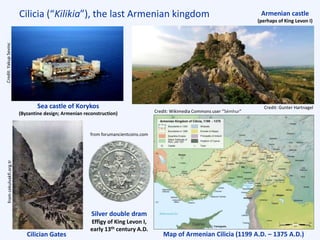
Cilicia (“Kilikia”), the last Armenian kingdom
Cilician Gates
Silver double dram
Effigy of King Levon I,
early 13th century A.D.
Sea castle of Korykos
(Byzantine design; Armenian reconstruction)
Map of Armenian Cilicia (1199 A.D. – 1375 A.D.)
Armenian castle
(perhaps of King Levon I)
Credit:YakupSevinc
Credit: Gunter Hartnagel
fromcekulvakfi.org.tr
from forumancientcoins.com
Credit: Wikimedia Commons user “Sémhur”
Cyprus
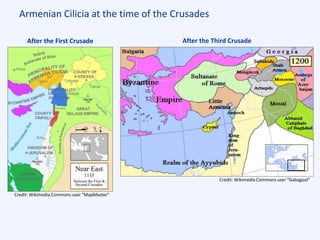
Armenian Cilicia at the time of the Crusades
After the First Crusade After the Third Crusade
Credit: Wikimedia Commons user “MapMaster”
Credit: Wikimedia Commons user “Gabagool”
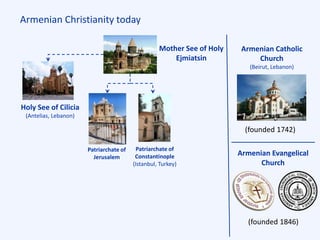
Armenian Christianity today
Patriarchate of
Jerusalem
Patriarchate of
Constantinople
(Istanbul, Turkey)
Mother See of Holy
Ejmiatsin
Holy See of Cilicia
(Antelias, Lebanon)
Armenian Catholic
Church
(Beirut, Lebanon)
Armenian Evangelical
Church
(founded 1742)
(founded 1846)
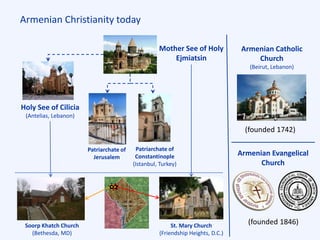
Armenian Christianity today
Patriarchate of
Jerusalem
Patriarchate of
Constantinople
(Istanbul, Turkey)
Mother See of Holy
Ejmiatsin
Holy See of Cilicia
(Antelias, Lebanon)
Armenian Catholic
Church
(Beirut, Lebanon)
Armenian Evangelical
Church
(founded 1742)
(founded 1846)Soorp Khatch Church
(Bethesda, MD)
St. Mary Church
(Friendship Heights, D.C.)
Religion in Armenia
Ejmiatsin Cathedral
Vagharshapat, Armenia
Surb Nahatakats (“Holy Martyrs”) Cathedral
Gyumri, Armenia
Ziarat Temple
Aknalich village, Armenia
Quba Mere Diwane Temple
Planned to be the world’s largest Yazidi temple
Aknalich village, Armenia
Artist’s conception
Armenian Catholic (Christian)
Yazidi
Armenian Apostolic (Christian)
Armenian Evangelical (Christian)
Evangelical Church of Armenia
(and AMA-A Headquarters)
Yerevan, Armenia
fromgazeta.lv
Note: The vast majority of
the religious population of
Armenia belongs to the
Armenian Apostolic faith.
Credit:ArmenianMissionary
Association–Armenia(AMA-A)
frompresident.am
Credit:VaheMartirosyan
Credit:ArtukGhulyan[cropped]
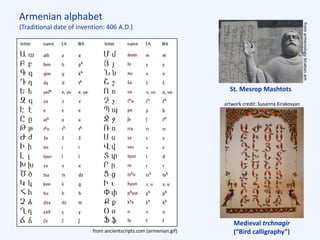
Armenian alphabet
(Traditional date of invention: 406 A.D.)
Medieval trchnagir
(“Bird calligraphy”)from ancientscripts.com (armenian.gif)
fromarmenology.bnaban.am
artwork credit: Susanna Kirakosyan
St. Mesrop Mashtots
Armenian language
Credit: Win Corduan
Credit: Wikipedia user “Yerevanci”
Armenian dialect map (1909)
Armenian is a singular branch of
the Indo-European language family
Armenian has two main dialects:
Western (from Ottoman Armenia)
Eastern (Persian, Russian Armenia)
The Soviets reformed the Armenian
writing system in 1922 and 1940
Armenian surnames
-եան (traditional) [-ean] → -ian /
-յան (reformed) (Russian -ян) -yan
Western Eastern
bakhlava pakhlava
dolma tolma
parev barev
Bedros Petros
Kevork Gevorg
Krikor Grigor
Echmiadzin Ejmiatsin
kisher pari bari gisher
Armenia in the 20th century
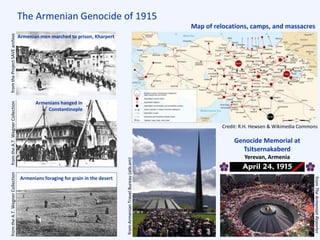
The Armenian Genocide of 1915
Genocide Memorial at
Tsitsernakaberd
Yerevan, Armenia
Map of relocations, camps, and massacres
Armenian men marched to prison, Kharpert
Armenians hanged in
Constantinople
Armenians foraging for grain in the desert
fromtheA.T.WegnerCollection
Credit: R.H. Hewsen & Wikimedia Commons
fromtheA.T.WegnerCollectionfromtheProjectSAVEarchive
fromTheArmenianReporter
fromArmenianTravelBureau(atb.am)
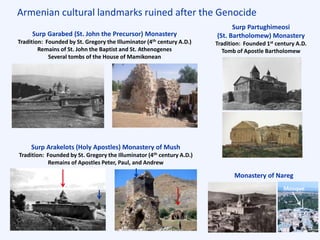
Armenian cultural landmarks ruined after the Genocide
Surp Garabed (St. John the Precursor) Monastery
Tradition: Founded by St. Gregory the Illuminator (4th century A.D.)
Remains of St. John the Baptist and St. Athenogenes
Several tombs of the House of Mamikonean
Surp Arakelots (Holy Apostles) Monastery of Mush
Tradition: Founded by St. Gregory the Illuminator (4th century A.D.)
Remains of Apostles Peter, Paul, and Andrew
Surp Partughimeosi
(St. Bartholomew) Monastery
Tradition: Founded 1st century A.D.
Tomb of Apostle Bartholomew
Monastery of Nareg
Mosque
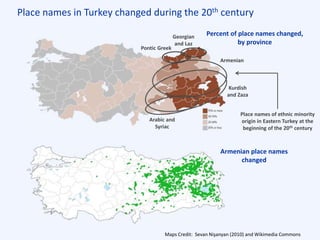
Place names in Turkey changed during the 20th century
Maps Credit: Sevan Nişanyan (2010) and Wikimedia Commons
Kurdish
and Zaza
Armenian
Pontic Greek
Georgian
and Laz
Percent of place names changed,
by province
Armenian place names
changed
Place names of ethnic minority
origin in Eastern Turkey at the
beginning of the 20th century
Arabic and
Syriac
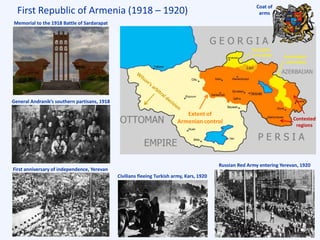
First Republic of Armenia (1918 – 1920)
Civilians fleeing Turkish army, Kars, 1920
General Andranik’s southern partisans, 1918
Russian Red Army entering Yerevan, 1920
First anniversary of independence, Yerevan
Memorial to the 1918 Battle of Sardarapat
Extent of
Armenian control
Coat of
arms
Contested
regions
Georgian-
controlled Azerbaijani-
controlled
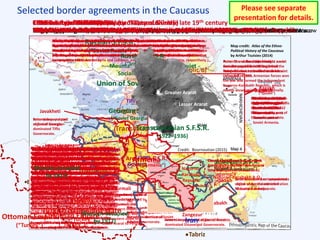
Selected border agreements in the Caucasus
Armenia Azerbaijan
Georgia
Turkey
Iran
Russia
Note: Due to differences between maps
of different eras, cartographic errors in
original maps, and map rectification and
transcription errors in this presentation,
some minor apparent changes in border
delimitation do not actually correspond
to real border changes. The depicted
borders are not guaranteed to be exact.
Mount
Ararat
1639 Treaty of Zuhab (or Treaty of Qasr-e Shirin)
Treaty concluding the final war between the Ottoman Empire and the Safavid Empire of Persia
Safavid Empire
(“Persia” / “Iran”)
Ottoman Empire
(“Turkey”)
The Treaty of Zuhab in 1639 was the last major
peace treaty defining the partition of the Middle
East between the Ottoman and Safavid empires.
The treaty roughly affirmed the Peace of Amasya,
the first Ottoman-Safavid peace treaty in 1555.
The modern border between Turkey and the
South Caucasus / Iran largely derives from the
Zuhab partition. The Zuhab-defined border was,
however, poorly delimited and not demarcated,
and was later contested.
Caucasus borders in 1800
Following a period of competition between the Russians, Persians, and Ottomans
Western Caucasus
Mountain Peoples
Russian Empire
Kingdoms and territories
contested during the late 1700s
Caucasus borders in 1800
Kingdoms, principalities, vassal states, imperial provinces, and ethno-toponyms
Qajar Persia
(“Iran”)
Somkhetia
Armenia
Nakhichevan
Azarbaijan
Karabagh
Talysh
Shirvan
Kartli-Kakhetia
Pambak
Ajaria
Svanetia
Circassia
Chechnya
Avaria
Kabardia
Ganja
Quba
1813 Treaty of Gulistan
Treaty between the Russian and Persian empires to conclude the 1804–1813 Russo-Persian War
Qajar Persia
(“Iran”)
Russian Empire
The Treaty of Gulistan, which concluded the first
large-scale Russo-Persian War, transferred most of
the Persian South Caucasus to the Russian Empire.
The Treaty of Gulistan left the delimitation of the
Russo-Persian border in the Talysh region on the
Caspian Sea to be determined by later agreements.
1828 Treaty of Turkmenchay
Treaty between the Russian and Persian empires to conclude the 1826–1828 Russo-Persian War
The Treaty of Turkmenchay concluded Russia’s
conquest of the Persian South Caucasus. The Aras
(Araxes / Araks) River became the border
between the Russian and Persian empires. After
the treaty, the Russian, Persian, and Ottoman
borders joined at Lesser Ararat.
The treaty permitted captives taken during the
war and in the previous few decades to return to
their respective homes. It also allowed
inhabitants of Iranian Azerbaijan (south of the
Aras River) to immigrate freely to Russian
territories within one year. These provisions
started a wave of Armenian immigration from
Persia to the newly Russian-held South Caucasus.
1829 Treaty of Adrianople
Treaty between the Russian and Ottoman empires to conclude the 1828–1829 Russo-Turkish War
The Treaty of Adrianople formalized the Russian-
Ottoman frontier. The Ottomans recognized Russian
sovereignty over Georgia and eastern Armenia. The
Ottomans also recognized the Russo-Persian frontier
as determined by the Treaty of Turkmenchay.
The treaty permitted inhabitants of both sides to
emigrate freely within eighteen months. Significant
Armenian emigration from the Ottoman and Persian
empires to the Russian South Caucasus occurred
after the treaties of Turkmenchay and Adrianople.
Note: In the previous few decades, a number of
Armenians had immigrated to Georgia. In the early
17th century, many Armenians were forcibly resettled
from eastern (Persian) Armenia to the Iranian
interior. Thus, the unfavorable demographic trends
for Armenians in eastern Armenia were reversed
after the Turkmenchay and Adrianople treaties.
1878 Treaty of San Stefano
Preliminary treaty between the Russian and Ottoman empires to conclude the 1877–1878 Russo-Turkish War
The Preliminary Treaty of San
Stefano principally addressed
the sovereignty and boundaries
of states in the region of the
Balkan Peninsula. In the
Caucasus, Russia gained territory
that had long been part of the
Ottoman Empire, including
historic Armenian lands with
sizeable Armenian populations,
most notably in Kars Eyalet.
Note: Prior to the San Stefano
treaty, the disputed Russo-
Turkish frontier was further
delimited according to the
Protocol of Constantinople
(1857) that supplemented the
Treaty of Paris (1856) that
concluded the Crimean War.
1878 Treaty of Berlin
Treaty between the major world powers to revise the preliminary Treaty of San Stefano
The Treaty of Berlin was signed
after the Western European
powers, chiefly Britain, pushed
for the curtailment of the
previous expansion of the
Russian sphere of influence
under the San Stefano treaty.
In the Caucasus, the Ottomans
regained Bayazit and the Plain of
Alashkert, which contained a
major trade route.
The Treaty of Berlin also
recognized the Qotur district as
part of Persia – the result of
successful lobbying by Russia,
which Persia supported in its war
against the Ottomans.
The Treaty of Berlin additionally
required the Ottoman Empire to
address the “Armenian Question”
by implementing reforms in its
Armenian-inhabited provinces.
These reforms generally were not
implemented.
The European powers also tried
to impose reforms aiding
Armenians in the Ottoman
Empire in 1895 and in 1912–
1914. The 1914 accord, signed
by the Russians and Ottomans in
Yeniköy in February, provided
for the deployment of European
inspectors to enforce the accord.
These reforms also were not
implemented.
Alexandropol
(Gyumri)
Erivan
Nakhichevan
Shusha
Elizavetpol
(Ganja)
Baku
Derbent
Tiflis
Kutais
Batum
ArdahanArtvin
Olti Kars
Trebizond
Baiburt
ErzurumErzincan
Bayazit
Surmalu
Van Khoy
Qotur
Maku
Bitlis
Mush
Kagizman
Alashkert
Vladikavkaz
Grozny
Shemakha
Lenkoran
Akhaltsikh
Akhalkalaki
Poti
Nukha
Quba
Gori Telav
Tabriz
Sukhum-Kale
Pyatigorsk
Ardabil
Ethnic distribution of the Russian Caucasus in the late 19th century
The seeds of later ethnic conflict
Map credit: Atlas of the Ethno-
Political History of the Caucasus
by Arthur Tsutsiev (2014)
Elizavetpol Governorate
Karabakh
Highland
(“Nagorno”)
Karabakh Armenian-and-Azeri-populated
region of Azeri-dominated
Elizavetpol Governorate.
Later to become an autonomous
oblast under the administration
of Soviet Azerbaijan.
Zangezur
Armenian-populated region of Azeri-
dominated Elizavetpol Governorate.
Later to become part of Soviet Armenia.
Kazakh
(“Qazakh”)
Armenian-and-Azeri-
populated region of
Azeri-dominated
Elizavetpol
Governorate.
Southwestern part
of Kazakh Uyezd
(former Kazakh
Sultanate) later to
become part of
Soviet Armenia.
Erivan
Governorate
Nakhichevan
Azeri-and-Armenian-
populated region of
Armenian-dominated
Erivan Governorate.
Later to become an
autonomous republic under
the administration of Soviet
Azerbaijan.
Surmali
Mixed-populated region of
Armenian-dominated
Erivan Governorate.
The northeastern slopes of
Mount Ararat belonged to
Russian Surmali, the
southwestern slopes to
Ottoman Turkey, and the
southeastern slope of
Lesser Ararat to Persia.
Later to become part of
Turkey.
Kars Oblast
Mixed-populated
region seized in the
1877–1878 Russo-
Turkish War.
Later to become part
of Turkey (mostly).
The Aghbaba district
containing Lake Arpi, the
headwaters of the
Arpachay (“Akhurian”)
River, later became part
of Soviet Armenia.
Tiflis Governorate
Javakheti
Armenian-populated
region of Georgian-
dominated Tiflis
Governorate.
Later to become part
of Soviet Georgia.
Borchali
Mixed-populated
region of Georgian-
dominated Tiflis
Governorate.
Northern part later
to become part of
Soviet Georgia.
Lori
Armenian-populated
region of Georgian-
dominated Tiflis
Governorate.
Attached to Borchali
Uyezd (District) in Tiflis
Governorate in 1862
but previously part of
Erivan Governorate.
Later to become part
of Soviet Armenia.
International borders in the Caucasus on the eve of World War IWorld War I and the Caucasus Campaign
World War I began in July 1914 and fighting between the Ottoman Empire and Russian
Empire had broken out in the Caucasus by November 1914. The Russians quickly gained
the upper hand and by 1917 occupied a substantial portion of eastern Ottoman territory,
including much of “Ottoman Armenia” (i.e., the provinces with large Armenian minorities).
Russian Armenia provided several volunteer battalions to supplement the Russian forces.
The Russian and Armenian forces were able to relieve the Ottoman Army’s siege of Van in
July 1915 long enough for the city’s Armenian inhabitants to escape to Russian Armenia.
Russian forces arrived in the Ottoman provinces of Erzurum and Bitlis too late to prevent
the massacres and deportations of Armenians there in the summer of 1915. During the
war, Russian forces never occupied the prominently Armenian-populated Ottoman
provinces farther west, which were also depopulated during the Armenian Genocide.
Russian military power in the Caucasus began to collapse after the February 1917
revolution in Russia. The military power vacuum was eventually filled by Armenian and
Georgian forces. By early 1918, however, the Ottomans had retaken most of the territory
that Russia had captured earlier in the war.
1918 Treaty of Brest-Litovsk
Treaty between Bolshevist Russia and the Central Powers to conclude Russia’s participation in World War I
Russian S.F.S.R.
(“Soviet Russia”)
Transcaucasian Commissariat
and Sejm
Mountainous Republic of
the Northern Caucasus
The Treaty of Brest-Litovsk marked the withdrawal
of Russia, now controlled by Bolsheviks after the
revolution of October 1917, from World War I.
In Europe, Russia lost control over Poland, the
Baltics, and Ukraine. In the Caucasus, Russia
ceded its claims to the Batum, Ardahan, and Kars
districts, returning the Russian border to its pre-
1878 position. The Russians and Ottomans had
signed the Armistice of Erzincan in December 1917.
The Brest-Litovsk border in the Caucasus did not
legally form a new Russo-Turkish frontier, as the
ceded districts were allowed to organize their own
independent governments. The possession of
these districts later became disputed between the
Turks, Georgians, and Armenians; the latter two
governments did not sign the Brest-Litovsk treaty.
At the time of the Treaty of Brest-Litovsk, Russia
was no longer exerting central control over the
Transcaucasus. This allowed the Transcaucasian
peoples to form an independent governing body,
the Transcaucasian Commissariat, which convoked
a diet (“sejm”) with Georgian, Armenian, and
Azerbaijani representatives.
1918 Treaty of Batum
Peace treaty between the Ottoman Empire and newly-independent Armenia, Georgia, and Azerbaijan
Georgia
Armenia Azerbaijan
Ottoman Empire
(“Turkey”)
The Treaty of Batum followed a period of conflict
within the Transcaucasus. Delegates from the
Transcaucasian states entered negotiations with the
Ottomans at Trebizond following the Russian-
Ottoman Brest-Litovsk Treaty. At the time, the
Russian Army, supplemented by Armenians and a
small contingent of Georgians, still occupied parts of
the eastern Ottoman Empire (i.e., historic Armenia).
The Ottomans wanted the Transcaucasian states to
recognize the Brest-Litovsk Treaty, but the
Armenians refused, as they wished to retain the
territories with sizable Armenian populations that
the Russians had seized in 1878 (e.g., Kars District).
The Ottoman Army invaded the occupied eastern
Ottoman provinces in the name of protecting the
Muslim population from atrocities perpetrated by
Armenians. The Armenians and Georgians broke off
negotiations at Trebizond. During the Ottoman
campaign, Georgia, Armenia, and Azerbaijan formed
a Menshevik-controlled independent Transcaucasian
Democratic Federative Republic (TDFR). Eventually
Erzurum, Batum, Kars, and Alexandropol fell to the
Ottomans. During new peace negotiations between
the Ottomans and the TDFR at Batum, the Armenians
won a series of last-ditch battles at Bash Abaran,
Karakilisa, and Sardarapat, possibly saving Armenia
from being overrun by the Ottoman Third Army.Turkish nationalist state
(“Turkey”)
At the end of the Batum negotiations the TDFR fell
apart: the Georgians secretly allied with the
Germans for protection from the Ottomans, and the
Azerbaijanis would not oppose their Turkic brethren.
The ensuing Treaty of Batum had harsh terms for the
newly-independent Transcaucasian states,
particularly the Armenians – much worse than the
terms of the Treaty of Brest-Litovsk. The Armenians’
last-ditch victories won them only a small territorial
concession from the Ottomans.
The First Republic of Armenia
Established on 28 May 1918 with de facto boundaries and disestablished on 2 December 1920
Armenia
Ottoman Empire
(“Turkey”)
The First Republic of Armenia was the first sizeable
independent Armenian state since the fall of
Armenian Cilicia in 1375, and the first within
Historic Armenia since the fall of Bagratid Armenia
in 1045.
In October 1918 the Allies and the Ottoman Empire
signed an armistice at Port Mudros, ending the
Ottoman Empire’s participation in World War I. The
Armistice of Mudros called for the demobilization
of the Ottoman Army and included a provision
allowing Allied intervention in Ottoman Armenia in
the case of disorder. In November 1918 the warring
parties in Europe signed their own armistice. The
signatories to the November armistice, including
Germany but excluding Russia and the Ottoman
Empire, renounced the Treaty of Brest-Litovsk.
The power vacuum in the Transcaucasus, which
now had been abandoned by the armies of the
Russian and Ottoman empires, led to independent
Armenia establishing de facto control of much of
the western Transcaucasus that had been under
Russian control before World War I. Bitter fighting
between Armenia and Azerbaijan ensued over the
territories of Nakhichevan, Zangezur, and Karabakh.
A smaller conflict arose between Armenia and
Georgia led to the Lori region becoming a neutral
zone, according to the Shulaveri Condominium.
Before the Armistice of Mudros, the British Empire
sent an occupying force to Baku to deny Baku’s oil
and other resources to the Ottomans and Germans,
but this force was defeated by the Ottomans and
Azerbaijanis. The armistice allowed the British to
reoccupy Baku. The British also established a
military command in Tiflis from which to stabilize
and control the region and resist the Bolsheviks.
The British withdrew from the Transcaucasus in
August 1919 after the Bolsheviks gained the upper-
hand over the British-backed White Russians.
1920 Treaty of Sèvres
Treaty between several of the European Allied Powers and the Ottoman Empire following World War I
Mountainous Autonomous Soviet
Socialist Republic (A.S.S.R.)
Armenia
The Treaty of Sèvres, signed in August 1920, formalized the Ottoman defeat in World War I
that was initiated with the October 1918 Armistice of Mudros. Imposing this treaty was part
of the process of the partitioning of the Ottoman Empire by the Allied powers.
During the San Remo session of the Paris Peace Conference, the European Allied powers
approached U.S. President Woodrow Wilson to request that the United States assume a
mandate over Armenia and that he draw the frontier of sovereign Armenia. In June 1920 the
U.S. Senate rejected the proposed American mandate over Armenia. (France and Britain
accepted the mandates for Syria and Lebanon, and Palestine and Mesopotamia, respectively.)
Wilson’s delimitation of the Armenian frontier, included in an annex to the Treaty of Sèvres,
included much of Historic Armenia plus a significant coastline along the Black Sea, including
the port of Trebizond. The treaty was signed by the representatives of the Ottoman sultan,
but it was not ratified by the General Assembly due to the Turkish War of Independence that
had begun in 1919.
The Treaty of Sèvres, which was never implemented, was renounced in further treaties
signed by Turkey, the core successor state to the Ottoman Empire. The Treaty of Sèvres was
eventually superseded by the 1923 Treaty of Lausanne, which was signed after the First
Republic of Armenia had been absorbed into the USSR, and therefore included no provisions
for an independent Armenia.
1920 Treaty of Alexandropol (or Treaty of Gümrü)
Treaty between Armenia & the new Turkish nationalist government concluding the 1920 Turkish-Armenian war
Azerbaijani S.S.R.
(“Soviet Azerbaijan”)
Ottoman Empire
(“Turkey”)
The Treaty of Alexandropol concluded the brief
Turkish-Armenian war during the fall of 1920. The
Turkish nationalist forces, which were in the process
of overthrowing the Ottoman sultan, had decided to
avoid any further partition of the Ottoman Empire,
as had been attempted in the Treaty of Sèvres. They
fought to secure the core of the empire from
Anatolia to the Caucasus to create a fait accompli.
The Turkish nationalists invaded Armenia in
September 1920, captured Kars and Alexandropol,
and finally defeated the Armenians in November.
The Treaty of Alexandropol roughly returned the
Turkish-Armenian frontier to the Russo-Turkish
frontier prior to 1878, except the Armenians lost
Surmalu district (which included most of Mount
Ararat) and gained the small Aghbaba district.
Armenia also renounced the Treaty of Sèvres.
The Treaty of Alexandropol also created an
independent state in Nakhichevan under Turkish
protection, whose borders were loosely defined. The
Nakhichevan district’s frontier was defined by this
treaty, and by a Soviet-Turkish treaty the next year,
to include a small border with the newly-Turkish
Surmalu district. These agreements resulted in
Turkey and Azerbaijan having a small shared border
after Nakhichevan became an autonomous republic
under Soviet Azerbaijan, since the small subdistrict
of Sharur across the new border with Turkey was
awarded to Nakhichevan.
The Treaty of Alexandropol did not address the
Turkish-Georgian frontier. The frontier according to
the Treaty of Brest-Litovsk is shown here.
1921 Treaty of Moscow
Friendship treaty between the Turkish nationalist (Kemalist) government in Ankara and Bolshevist Russia
Armenian S.S.R.
(“Soviet Armenia”)
Georgian S.S.R.
(“Soviet Georgia”)
The Treaty of Moscow was a friendship agreement
between Soviet Russia and the Turkish nationalists,
whom the Bolshevists wished to influence toward
their ideology. During the negotiations for the
Treaty of Alexandropol between the Turks and
Armenians, Bolshevist Russia had invaded Armenia
with the intent of incorporating it into the new
Soviet state.
The Treaty of Moscow defined the frontier beyond
wish the Turkish nationalists surrendered their
claims to territories in the Caucasus. Since the
Georgian and Armenian republics were not
signatories to this treaty, this boundary did not yet
form a legal border with those states.
Under the Treaty of Moscow, Turkey claimed a small
strip of land (approximately 3 × 30 km) across the
river from Alexandropol that had been awarded to
Armenia under the Treaty of Alexandropol.
Nakhichevan was established as an autonomous
territory under the protection of Azerbaijan and its
borders were adjusted slightly. The Turks ceded
their claim to the region of Adjara, including the port
of Batum, which became part of Soviet Georgia.
Under the Treaty of Moscow, Turkey and Russia
agreed to not to recognize any prior treaties imposed
on either nation against its will, nor any treaty not
recognized by the new national government of
Turkey based in Ankara (e.g., the Treaty of Sèvres).
1921 Treaty of Kars
Treaty between Kemalist Turkey and the Russian and Transcaucasian Soviet republics affirming the Treaty of Moscow
The Treaty of Kars confirmed the terms of the earlier
Treaty of Moscow. The Kars treaty was between the
Turkish nationalists and the newly-Soviet states of
Georgia, Armenia, and Azerbaijan; thus, all the states
in the Transcaucasus agreed upon the Turco-
Caucasian frontier. This treaty also clarified the
delimitation of the borders in the Caucasus.
Under the Treaty of Kars, Turkey and the Soviet
republics of Georgia, Armenia, and Azerbaijan
declared null and void all territorial agreements
involving the previous governments of those states,
as well as all agreements between those states and
third party powers.
The Treaty of Kars of 1921 is the basis for the modern
Turco-Caucasian frontier. The Treaty of
Turkmenchay of 1828 is the basis for the modern
Iranian-Caucasian frontier (along with a tiny border
change specified in the Russo-Persian treaty of 1893).
The early Soviet era (1920s – 1930s)
Union of Soviet Socialist Republics
(1922–1991)
Russian S.F.S.R.
(“Soviet Russia”)
Armenian S.S.R.
(“Soviet Armenia”)
Georgian S.S.R.
(“Soviet Georgia”)
Azerbaijani S.S.R.
(“Soviet Azerbaijan”)
Iran
Turkey
NAKHICHEVAN
ARMENIA SSR
KURDISTANI
DISTRICT
REST OF
AZERBAIJAN
SSR
IRAN
NAGORNO-
KARABAKH
From 1922 to 1936 Soviet Georgia, Armenia, and
Azerbaijan were consolidated into a Transcaucasian
Socialist Federative Socialist Republic (TSFSR), which
was a founding member of the USSR in 1922.
During the 1920s and 1930s the USSR made a number
of small border adjustments and administrative
reorganizations in the Transcaucasus.
The status of Nagorno-Karabakh was debated for the
first few years of the Soviet era. In December 1920
when Armenia was Sovietized, the Azerbaijan
Revolutionary Committee offered to cede Nagorno-
Karabakh to Armenia (or, according to Azerbaijani
accounts, to give Nagorno-Karabakh the right to self-
determination).
In June 1921, the Caucasian Bureau of the Central
Committee of the Russian Communist Party
(“Kavburo”) agreed that Soviet Armenia should
announce that Nagorno-Karabakh belonged to Soviet
Armenia. In July 1921, the Kavburo decided that
Nagorno-Karabakh should be joined to Soviet
Armenia, but reversed itself the next day by
announcing that Nagorno Karabakh would remain in
Soviet Azerbaijan (on Josef Stalin’s order, according
to Armenian allegations).
Soviet Azerbaijan created the Autonomous Oblast of
Nagorno Karabakh (AONK, later renamed the
Nagorno Karabakh Autonomous Oblast (NKAO)) in
1923 (formalized in 1924). The AONK was placed
under the administration of Soviet Azerbaijan and its
borders were mostly determined between 1923 and
1925 by subcommittees of the Central Committee of
the Azerbaijan Communist Party.
The final borders of the Nagorno-Karabakh
Autonomous Oblast roughly coincided with the
territories of four out of the five Armenian
melikdoms (principalities) – excluding Gulistan –
that had been mostly autonomous under Persian
rule before their decline in the late 18th century.
From 1923 to 1930 a district for Shia Kurds was
established in Soviet Azerbaijan between Nagorno-
Karabakh and the border with Soviet Armenia.
The Nakhichevan Autonomous Soviet Socialist
Republic (ASSR) was created in 1924 and placed
under the administration of Soviet Azerbaijan.
1932 Turco-Persian frontier agreement
In the mid-1920s a series of Kurdish uprisings in
Turkey led to a full rebellion in the vicinity of Mount
Ararat and the declaration of an independent
Kurdish Republic of Ararat in 1927. Greater Ararat
had come into complete Turkish possession after the
1921 Treaty of Kars, but the southern slopes of Lesser
Ararat belonged to Persia, allowing the Kurdish
rebels a cross-border route of escape and supply.
After Turkey crushed the Kurdish Ararat rebellion in
1930, the Turkish and Persian defense ministers
signed a new border agreement in 1932, which in
part traded the Persian slopes of Lesser Ararat to
Turkey in exchange for Turkish border lands in the
vicinity of Qotur and farther south. The border
agreement was finally approved in 1934, bringing all
of Mount Ararat under the control of Turkey.
Credit: Bournoutian (2015)
Greater Ararat
Lesser Ararat
Armenian Soviet Socialist Republic (the second republic, until 1991)
Armenian S.S.R.
(“Soviet Armenia”)
Nakhchivan
A.S.S.R.
(admin. by
Azerbaijan)
Nagorno-Karabakh Autonomous Oblast (administered by the Azerbaijani S.S.R.)
Nagorno-Karabakh A.O.
Note: The various autonomous soviet
socialist republics in Georgia and the
North Caucasus are not shown here.
Fall of the Soviet Union (1991) and the Nagorno-Karabakh War (1988 – 1994)
Armenia and the other South
Caucasus republics declared their
independence as the Soviet Union
collapsed in 1991.
Armenia and Azerbaijan fought a war
over the possession of Nagorno-
Karabakh that intensified as the Soviet
Union fell. Ethnic Armenian forces won
the war and formed the independent
Nagorno-Karabakh Republic, which is
mostly unrecognized internationally.
Line of Contact separating ethnic
Armenian forces from Azerbaijani
forces after the 1994 ceasefire.
The Line of Contact has changed
position very slightly from time to
time (changes not shown here).
Modern Armenia (the third republic, 1991 – present) and the Nagorno-Karabakh Republic
Armenia
Nagorno-
Karabakh
Republic
(de facto)
(Russian-occupied
by 1917)
(Russian-occupied
by 1917)
Transcaucasian S.F.S.R.
(1922–1936)
Please see separate
presentation for details.
Nagorno-Karabakh War (1988 – 1994)
Khojaly Massacre (1992)
awareness campaign
Washington, D.C. Metro (2013)
1988 Karabakh Movement
Yerevan Stepanakert
1988 Karabakh Movement
Flag of the Nagorno-
Karabakh Republic
Aftermath of the 1988
Sumgait, Azerbaijan Pogrom
Refugee crisis
Nagorno-Karabakh War (1988 – 1994)
Khojaly Massacre (1992)
awareness campaign
Washington, D.C. Metro (2013)
1988 Karabakh Movement
Yerevan Stepanakert
1988 Karabakh Movement
Flag of the Nagorno-
Karabakh Republic
Aftermath of the 1988
Sumgait, Azerbaijan Pogrom
Refugee crisis
Nagorno-
Karabakh
Autonomous
Oblast (NKAO)
[USSR]
NKAO territory
claimed by NKR
and controlled by
Azerbaijan
Non-NKAO territory claimed by
NKR and controlled by AzerbaijanAzerbaijan territory
controlled by Nagorno-
Karabakh Republic (NKR)
All territory inside
the red dashed line is
controlled by the
Nagorno-Karabakh
Republic (NKR)
1988 Spitak Earthquake (M6.8)
Surp Amenaprkich Church, Leninakan (Gyumri)
Stone masonry building, Spitak
Thrust fault (1.3 m uplift)
Photo credit: G. Sobolev (USSR Academy of Sciences)Photo credit: C.J. Langer (U.S. Geological Survey)
Photo credit: C.J. Langer (U.S. Geological Survey)
Credit: National Geographic News
Status of borders; Russian security presence
Turkey
Border closed (air border open)
Border patrolled by Russian FSB
No diplomatic relations / visas granted
Trade embargo
Azerbaijan
Border closed
No diplomatic relations / visas not granted
Blockade
Iran
Border open
Border patrolled by Russian FSB
Georgia
Border open
102nd Military Base
[Gyumri]
3624th Aviation Base
[Erebuni Airport (Yerevan)]
International Borders
Russian military presence
102nd Military Base (leased until 2044)
3 motor rifle regiments
1 air defense missile regiment (S-300V)
1 artillery regiment (howitzer; MLRS)
1 tank battalion (T-72)
1 anti-tank battalion
3624th Aviation Base
1 fighter squadron (MiG-29SMT [upgraded])
1 composite helicopter squadron
(Mi-24P, Mi-8MT, Mi-8SMV)
Gyumri
Armavir
Artashat
Meghri
(as of 2014)
(as of 2007)
Azerbaijan
Azerbaijan
Turkey
Iran
Georgia
Line of Contact
controlled by
Nagorno Karabakh
Republic
Iran
1988
Nagorno
Karabakh
Autonomous
Oblast
1988
Azerbaijan
S.S.R.
Natural resources and energy security
Baku-Tbilisi-Ceyhan and
other pipelines
Ownership of Armenian energy infrastructure
Mining of metals (especially
copper) and diamonds makes
up ~50% of Armenia’s exports
No proven oil reserves
No proven natural gas reserves
No coal mines in Armenia (one mine in Nagorno-Karabakh)
Natural gas imports:
~80% Russia
~20% Iran
National natural
gas distributor
100% owned by
Russia’s Gazprom
National railway
system 100%
owned by
Russian Railways
Armenian Nuclear P.P.
[408 MW capacity]
Hrazdan Thermal P.P.
[1580 MW capacity]
Sevan-Hrazdan Cascade
Hydroelectric Power Plants
[562 MW capacity]
Yerevan Thermal
Power Plant
[792 MW capacity]
Vorotan Cascade
Hydro P.P.s
[404 MW
capacity]
Foreign ownership of mines
National power distribution
company ENA owned by
Russian-based Tashir Group
(exchanged for
electricity)
Note: Over 90% of Armenia’s energy
production capacity is depicted below
Production Capacity
RusHydro
[ 90% ]
Tashir
Group
ENA
Tashir
Group
Contour-
Global
SCR
Russian
Railways
State-
owned
State-
owned
Credit: Thomas Blomberg
Gazprom
Armenia
Gazprom
Credit: The Armenian Weekly
Note: the thermal power plants
are powered by natural gas, all
of which is imported. Some
planned use of N-K coal.
Most oil is
imported by rail
Natural resources and energy security
Baku-Tbilisi-Ceyhan and
other pipelines
Ownership of Armenian energy infrastructure
Mining of metals (especially
copper) and diamonds makes
up ~50% of Armenia’s exports
No proven oil reserves
No proven natural gas reserves
No coal mines in Armenia (one mine in Nagorno-Karabakh)
Natural gas imports:
~80% Russia
~20% Iran
National natural
gas distributor
100% owned by
Russia’s Gazprom
National railway
system 100%
owned by
Russian Railways
Armenian Nuclear P.P.
[408 MW capacity]
Hrazdan Thermal P.P.
[1580 MW capacity]
Sevan-Hrazdan Cascade
Hydroelectric Power Plants
[562 MW capacity]
Yerevan Thermal
Power Plant
[792 MW capacity]
Vorotan Cascade
Hydro P.P.s
[404 MW
capacity]
Foreign ownership of mines
National power distribution
company ENA owned by
Russian-based Tashir Group
(exchanged for
electricity)
Note: Over 90% of Armenia’s energy
production capacity is depicted below
Production Capacity
RusHydro
[ 90% ]
Tashir
Group
ENA
Tashir
Group
Contour-
Global
SCR
Russian
Railways
State-
owned
State-
owned
Credit: Thomas Blomberg
Gazprom
Armenia
Gazprom
Credit: The Armenian Weekly
Note: the thermal power plants
are powered by natural gas, all
of which is imported. Some
planned use of N-K coal.
Most oil is
imported by rail
The World is Not Enough (1999)
Other notable events in Armenia (1991 – Present)
1991 independence from the Soviet Union
1999 parliament
assassinations
1990s energy crisis
1988 earthquake and
nuclear reactor shutdown
Independence
Nagorno-Karabakh war
and blockades
2008 presidential election protests
2014, 2015 ceasefire violations;
2016 conflict in Nagorno-Karabakh
2015 accession to the
Eurasian Economic Union
Armenian military helicopter
downed by Azerbaijan, 2014
fromayfwest.orgCredit:PhotolureCredit:PSRCofArmenia
Credit:WikimediaC.user“Serouj”fromtrend.az 2015 constitutional reform
fromArmeniaNow.com
Azerbaijani military helicopter
downed by N-K Armenians, 2016
fromnkrmil.am
Part III: Yerevan and its surroundings
“My ancient Erebuni that has become Yerevan
You are our new Dvin, our new Ani
A dream gracing our small corner of the earth
After centuries of longing, with rocks carved into facades of lace
Yerevan, my ancient Erebuni
Centuries have come and gone, but you remain youthful
….”
from the lyrics to “Erebuni-Yerevan”, anthem of Yerevan
Written by Paruyr Sevak, composed by Edgar Hovhannisyan
First performed in 1968 to celebrate the 2750th anniversary of the founding of Erebuni Fortress
Old Yerevan
1673 sketch by J. Chardin
1920s
1796 sketch by G. Sergeevich
Main square, 1916
from Wikimedia Commons from Encyclopaedia Iranica
from Wikimedia Commons from Wikimedia Commons
Old Yerevan
Bazaar, late 19th – early 20th century
Main street, 1925
Main street (flooded), 1925
Camel caravan, 1925
Credit:Kunstkamera.ru/MAERAS
Credit:FridtjofNansenbildearkivCredit:FridtjofNansenbildearkiv
Credit:FridtjofNansenbildearkiv
Population changes in Yerevan and other South Caucasus cities
Ethnic distribution of the Russian Transcaucasus, 1897
Credit: J. Urban [data: Tsutsiev (2014) and the 2011 Armenian census]
Credit: Wikimedia Commons user “DragonTiger23”
Aerial view of Yerevan
Erebuni Fortress
Karmir BlurU.S. Embassy
N
Annotated photo credit: ANCA WR
Kentron: Yerevan’s central district
Credit: “Virtual Yerevan” (haias.net)
Kentron: Yerevan’s central district
Credit: “Virtual Yerevan” (haias.net)
Freedom
Square
Kentron: Yerevan’s central district
Credit: “Virtual Yerevan” (haias.net)
Freedom
Square
Republic
Square
Kentron: Yerevan’s central district
Credit: “Virtual Yerevan” (haias.net)
Freedom
Square
Republic
Square
Kentron: Yerevan’s central district
Credit: “Virtual Yerevan” (haias.net)
Cascade
Kentron: Yerevan’s central district
Credit: “Virtual Yerevan” (haias.net)
Victory Park
Kentron: Yerevan’s central district
Credit: “Virtual Yerevan” (haias.net)
Matenadaran
Kentron: Yerevan’s central district
Credit: “Virtual Yerevan” (haias.net)
Presidential
Palace
National
Assembly
NAS
Kentron: Yerevan’s central district
Credit: “Virtual Yerevan” (haias.net)
Vernissage
Bazaar
Rosia
Mall
Shuka No. 2
Pak Shuka
Kentron: Yerevan’s central district
Credit: “Virtual Yerevan” (haias.net)
St. Gregory the Illuminator
Cathedral
Katoghike
Church
Kentron: Yerevan’s central district
Credit: “Virtual Yerevan” (haias.net)
Blue
Mosque
Kentron: Yerevan’s central district
Credit: “Virtual Yerevan” (haias.net)
YSU
AUA
Kentron: Yerevan’s central district
Credit: “Virtual Yerevan” (haias.net)
Tsitsernakaberd
Kentron: Yerevan’s central district
Credit: “Virtual Yerevan” (haias.net)
Freedom Square (“Opera Square”) and Swan Lake
Credit: J. Urban
Swan Lake
Yerevan Opera Theater
from facebook.com
Credit: Nazik Armenakyan / ArmeniaNow.com
Ad for Khachaturian’s ballet Gayane 3D chalk art
Credit: J. Urban Artwork Credit: Nikolaj Arndt
Republic Square
History Museum and National Gallery of Art
Credit: Photolure News
Credit: J. Urban
Credit: J. UrbanCredit: J. UrbanCredit: J. Urban
Republic Square
Freemasons’ Square and Compasses
Soviet Star and Sickle
Weekend evening
musical fountain show
Credit:J.Urban
Credit:J.Urban
Credit:J.UrbanCredit:J.UrbanCredit:J.Urban
Credit: Suren Manvelyan
Northern Avenue
Modern pedestrian avenue from Freedom Square almost to Republic Square
Credit: Suren Manvelyan
Credit: J. UrbanCredit: J. Urban
from cityinfo.am
Yerevan Cascade (“Kaskad”)
Credit: J. Urban
Credit: J. Urban
Credit: J. Urban
Credit: Justyna Mielnikiewicz / The New York Times
Cascade Park and sculpture garden
Credit (all photos): J. Urban
Cafesjian Museum of Art at the Yerevan Cascade
from pinterest.com/ara_adonian
Credit: Anne-Sophie Redisch (Flickr) Credit: J. Urban
Credit: Aleksei Trofimov (alekseitrofimov.eu)
Victory Park
“Mother Armenia” statue
Lake Areni
Afghanistan War memorialWWII memorial – eternal flame
“Katyusha” rocket launcher
T-34-85 tank
Credit: Wikimedia Commons user “Mosinyan”
Credit:LindsayFincher
Credit:VladimirStepanov
Credit: Levon Kiurkchian Credit: Niko Lipsanen [cropped] Credit: Wikimedia Commons user “Bouarf”
Government of the Republic of Armenia
Constitutional CourtPresidential Palace
National Assembly
Credit:MartinKonsek(WikimediaCommons)
Credit:VahanAghajanyan(Flickr)[adjusted]
Credit:ArtakArzumanyan(Panoramio)[adapted]
American traces in Yerevan
Embassy of the United States of America
Opened in 1992
American University of Armenia
Established in 1991
KFC and Pizza Hut restaurants
(No McDonald’s or Starbucks in Armenia)
American Corner in Yerevan
Established in 2005 (partnership w/ U.S. State Dept.)
Credit:IlyaVarlamov(Flickr)
fromcomtourist.com
Credit:AmericanCornerYerevan
Credit:J.Urban
Credit: Sarhat
Petrossian
Yerevan Vernissage: Weekend bazaar (mostly arts and crafts)
Credit (all photos): J. Urban
Yerevan Vernissage Credit (all photos): J. Urban
Yerevan Vernissage
Credit (all photos): J. Urban
Haykakan (“Armenian”) Covered Market (“G.U.M.” / “Shuka No. 2”)
Credit: J. Urban
Credit: J. UrbanCredit: Mark Grigoryan
Credit: Panoramio user “PALLYCH72”
Haykakan Covered Market Credit (all photos): J. Urban
Pak Shuka (“Covered Market”)
The modern renovated market (2013 – )
The old covered market (1952 – 2012)
from haypressnews.wordpress.com
from haypressnews.wordpress.com Credit: PanARMENIAN / Tigran Mehrabyan
fromhaypressnews.wordpress.com
Rosia (“Russia”) Shopping Center
Credit: J. Urban
Credit: J. Urban
Credit: Carmelo Pappalardo
Shopping malls
Dalma Garden Mall
(opened in 2012)
Yerevan Mall
(opened in 2014)
Credit:VahramBaghdasaryan/PhotolurefromCosmo.am
fromPrimer.amCredit:Flickruser“Mysterons54”
Other Yerevan landmarks
Credit:Flickruser“eesti”
Yerevan central railway station
“Ararat” Yerevan brandy factory
“Moskva” Cinema
Credit:Anne-SophieRedisch(Flickr)
Statue of
St. Vardan
fromComeToArmenia.am
Credit:J.Urban
Yervand Kochar Museum “Painting in space”
Sculptures in Yerevan
Credit: Ervand Kochar Museum
(all other images)
[Note: Some images are cropped.]Credit: Armenian News Network / Groong
Self-portrait of Kochar (b. 1899, d. 1979)
National Gallery of Armenia
“Salomé” (1907) by Vardges Sureniants
“Descent of Noah from Ararat” (1889)
by Ivan Aivazovsky (Hovhannes Aivazian)
“Madonna with Child”
by Donatello [replica]
“Storm” (1899) by Ivan Aivazovsky
“Apollo and Pan” by Tintoretto
from agbu.org
from gallery.amCredit: TripAdvsior.com user “Elli-elf” [adapted]
fromgallery.am
fromgallery.am
fromgallery.am
History Museum of Armenia Photos credit: History Museum of Armenia
Sports in Yerevan
Hrazdan Stadium
Demirchyan Sports and Concerts
Complex (“Hamalir”)
Tigran Petrosian Chess HouseHovik Hayrapetyan Equestrian Centre
from justpics.ruCredit: Photolure News
Credit: Hayrapetyan Equestrian Centre Credit: Jesse Schupack (Flickr)
Yerevan Botanical Garden
Ultimate Frisbee
fromArmenianpages.com
Credit: Wikimedia Commons user “Berezni”
Credit: Artak Gevorgyan / Frisbee Lovers Yerevan
Credit:EdgarVarjapetyanCredit:SchoolNo.55afterA.Chekhov
Other parks in Yerevan
Lovers’ Park
from mywanderlust.pl
from MYYerevan.am
Circular
Park
Credit: Niko Lipansen
English
Park
Credit: Rafael Torossian
from globespots.com
fromoneweekinarmenia.com
Credit:Flickruser“gadiemp”
Other attractions in Yerevan
Yerevan Zoo Haghtanak Amusement Park in Victory Park
Yerevan Water World
Credit: Alex Kantorovich / Zooinstitutes.com
Credit: Wikimedia Commons user “Eupator”
Credit: Panoramio user “Armenia & Nagorno Karabakh”
from MYYerevan.am
Children’s Railway
Religious life in Yerevan
St. Gregory the Illuminator Cathedral
Largest church in Armenia (built in 2001)
Holy Mother of God Church (“Katoghike Church”);
St. Anna Church
13th-century church and 21st-century church in the city center
St. Gregory: Interior
Streetside khachkar studio
Credit:J.Urban
fromWikimediaCommons
Credit:J.Urban
Credit:J.UrbanCredit:J.Urban
Credit:Phil&Vanessa,otpwg.wordpress.com
The Blue Mosque
from agbu.org
Credit: Simon Hooks
Credit: Fran Sellies (Flickr)
Credit: Panoramio user “rredan” from gallivantinggrandma.com
The Mesrop Mashtots Institute of Ancient Manuscripts
(a.k.a. The Matenadaran (“Repository of Manuscripts”))
Credit: J. Urban
The Matenadaran
Toros Roslin
(manuscript painter, 13th c.)
St. Mesrop Mashtots, with pupil Koryun
(linguist and creator of the Armenian alphabet,
4th – 5th century A.D.)
St. Grigor Tatevatsi
(philosopher, educator,
14th c.)
Anania Shirakatsi
(scientist, 7th c.)
Movses Khorenatsi
(historian, 5th c.?)
Mkhitar Gosh
(writer, legal scholar, 12th c.)
Frik
(poet, 13th c.)
Credit: J. Urban
Credit:RitaWillaert(Flickr)Credit:RitaWillaert(Flickr)
The Matenadaran
Arnats village, 1498 14th century
1676 Palimpsest of 986 on 5th-century manuscript
The Gospels
Credit (all photos): J. Urban
The Matenadaran
Sultania (Tabriz), 1676 Sis, 1336
Syunik, 1323 Melitena (Malatia), 1057
The Gospels
Credit (all photos): J. Urban
The Matenadaran
Ejmiatsin Gospels, 6th century, 989 ivory binding
Gospels
(1452, 17th century,
Aghjots Monastery)
Credit (all photos): J. Urban
The Matenadaran
Homilies (left) and prayer book (right)
(15th century)
History of Alexander of Macedon
(translated from Greek in 5th c., manuscript 17th c.)
Breviary
(Ejmiatsin, 1785)
Synaxarion
(Van, 1596)
Credit (all photos): J. Urban
The Matenadaran
The largest and smallest books
in the Matenadaran
Homilies of Mush (“Msho charentir”)
Completed in 1202 at Avag Monastery in Yerznka (Erzincan)
in Western Armenia (modern Turkey).
Rescued from ruined Surp Arakelots Monastery in Mush
during the Genocide; split in half and transported by two
women, with one half later buried; parts rejoined years later.
Calendar
Crimea, 1432
Credit (all photos): J. Urban
The Matenadaran
Collection of
historical and
philosophical works
Oldest Armenian
manuscript on paper,
981 A.D.
Movses Khorenatsi, History of Armenia
(written 5th century (traditional date), manuscript 16th century)
Founding inscription, second church of Khatravank Monastery
(Khachen (modern Nagorno-Karabakh), 1204)
Ritual book (“Mashtots”), 1461 A.D
(Ejmiatsin, 1461)
Credit (all photos): J. Urban
The Matenadaran
Russian manuscript
18th century
Hebrew manuscript
Fragment of Syriac
manuscript
Ethiopian prayer book
16th century
Fragment of old
Greek manuscript
Old Indian manuscript
on palm leaves
Credit (all photos):
J. Urban
The Matenadaran
Poems by Saadi Shirazi
(written 13th c., manuscript 1841, in Persian)
Mohammad Bagher, Book on the Other World
(manuscript 1844, in Persian)
Mecca and Medina, Book of Prayers
(manuscript 18th – 19th c., in Arabic)
Manuscript by Hokusai
(1812, in Japanese)
Ibn Siba (“Avicenna”), Book of Deliverance
(written 11th c., manuscript 1626, in Arabic)
Copernicus, Opus de revolutionibus caelestibus
(written 16th century, in Latin)
Credit (all photos): J. Urban
The Matenadaran
French map (G. Delisle, 1730)
Ottoman military map, 1870
Map of the Asian part of the Ottoman Empire
(Ankara, 1803 – 1804)
Credit (all photos): J. Urban
16th-century Ptolemaic map (Tabula Asiae III)
The Matenadaran 12th – 13th c. world map (in Armenian)
(15th century manuscript)
Celestial
constellations
(in Armenian)
Credit (all photos): J. Urban
Matenadaran conservation department
The Gospels
1339 A.D.
Metsop Monastery
Replica
manuscript
Credit (all photos): J. Urban
Matenadaran conservation department
“Wheat binding”
Credit (all photos): J. Urban
Matenadaran conservation department
The “Japanese [Equipment]
Room”
Credit (all photos): J. Urban
Matenadaran conservation department
Book binding
Credit (all photos): J. Urban
Matenadaran conservation department
Credit (all photos): J. Urban
Matenadaran conservation department
Credit (all photos): J. Urban
Transportation
Minibus (“Marshrutni”) Credit (all photos): J. Urban
Transportation
Taxi
Bus
Tram
Credit (all photos): J. Urban
Transportation
Metro
Line 1 / Shuttle
Line 1 construction
Line 2 (planned)
Yerevan Metro
Credit (all photos): J. Urban
Credit: Wikimedia C. user “Bouarf”
Transportation
Credit (all photos): J. Urban
Transportation Credit (all photos): J. Urban
Transportation
Yerevan’s underground parking garage
Yerevan’s bike lane
Self-service car wash
Credit (all photos): J. Urban
Transportation
Bicycle transport in the city of Vagharshapat
Credit: J. UrbanCredit: Sona Kocharyan / Yerevan Productions
Credit: Igor Stepanov (Flickr) Credit: PanARMENIAN / Varo Rafaelyan
Traditional Armenian cuisine Credit (all photos): J. Urban
“Kilikia” restaurant
Foreign fast food: “Shuarma”
“Tumanyan Shuarma” restaurant
“Mr. Gyro” restaurant
“Artashi Mot” restaurant
Credit (all photos): J. Urban
Foreign fast food: Doughnuts
Russian-style doughnuts (“Ponchikner”) at “Grand Candy” American-style doughnuts at
“Yum Yum Doughnuts”
Credit: J. Urban [Grand Candy photos]
from INMAGNAT.com [Yum Yum Doughnuts photos]
Foreign food: Georgian cuisine
“Tumanyan Khinkali” restaurant
“Khinkali”
“Genatsvale” restaurant
Credit (all photos): J. Urban
Other foreign cuisine
“Samurai” sushi bar “Taco Maco” Mexican restaurant Belgian waffles stand
“Queen Burger” fast food restaurant “Pioneer” Brazilian restaurant
Credit (all photos): J. Urban
Cafes
Cafe Malócco
Credit (all photos): J. Urban
Cafes
Twelve Tables Cafe
Vintage store
Photos credit: Twelve Tables Cafe
fromhy.blackseasilkroad.com
Kaziryok Cafe
Jean-Paul Existential Cafe
Credit:KaziryokCafé[adjusted]
Credit:Jean-PaulExistentialCafé[adjusted]
Anti-cafes
AEON Anticafe
“Loups-Garous” game in the Hassocks Room Halloween party Tea Room
Main Hall
Paul McCartney birthday tribute
“Women in architecture” lecture
Photos credit: AEON
from YerevanResto.am
Pubs
80’s Pub
Urban Pub
26 Irish Pub
Credit: J. Urban
Credit: 80’s Pub
Credit: Edgar Barseghyan [adjusted]
fromYerevanResto.amCredit:J.UrbanCredit:UrbanPub[adjusted]
Pubs
Art Cafe “Van Gogh” “In Sane” Pub Cafe
Photos credit: Art Cafe “Van Gogh” [adjusted] Photos credit: In Sane
Casino “Shangri La”
Photos credit: Casino Shangri La
Gaming and betting
Toto Gaming
VivaroBet
Credit: VivaroBet / vivaronews.com
Credit: Toto Gaming / spyur.am
Neighborhoods in the Kentron District Credit (all photos): J. Urban
Neighborhoods in the Kentron District
Credit (all photos): J. Urban
Neighborhoods in the Kentron District Credit (all photos): J. Urban
Other neighborhoods
Erebuni District Nor Nork District, 2nd Massiv
Malatia-Sebastia DistrictArabkir District
fromofficespace.am
Credit:EliteGroup
Credit:KaroManukyan(Panoramio)[adjusted]
Credit:HakobSununu(Panoramio)[adjusted]
A Yerevan apartment
Soviet-style table-glass
Credit: Levon B. / airbnb.com
Credit:J.Urban
Hotels
Republica Hotel Yerevan Ani Plaza Hotel
Credit:RepublicaHotelYerevan
Credit:TripAdvistor.comuser“Machaboy”
Credit:TripAdvistoruser“OmarAbuOmar”[adjusted]
Hotels
Marriott Armenia Hotel Yerevan Best Western Congress Hotel
Credit:MarriottArmeniaHotelYerevan
Credit:BestWesternCongressHotelCredit:BestWesternCongressHotel
Banks
VTB Bank (Russia)
(Viewed from Republic Square Metro Station)
HSBC (UK)
Credit:KarénMelkonyan/GoogleMaps
Unibank
Armenian currency
(1000 dram note)
Ameriabank
Credit:J.Urban
frombanks.am
fromasbarez.comCredit:J.Urban
Computing and telecommunications
Notebook computersTUMO Center for Creative Technologies
(after-school learning center for teenagers)
Mobile phones
Credit: Mkhitar Sebastatsi Educomplex
ArmPhone and
ArmTab
(Armenia’s first native smartphone
and tablet computer, by TSD, Inc.)
PicsArt app
(Armenia-developed app
for photo editing, drawing,
collaging, and sharing.)
Public statues Credit (all photos): J. Urban
Komitas
(composer)
“Melancholy”
(by Yervand Kochar)
Alexander Tamanyan
(architect of modern Yerevan)
Tork Angegh
(pre-Iranian-era Armenian hero/deity)
Arno Babajanian
(composer)
Characters from The Men (1972 film) “The Woman from
Gharabagh (Karabakh)”
“Loves Me, Loves Me Not”
Public water fountains (“Pulpulakner”)
Credit (all photos): J. Urban
Public restrooms
The Yerevan bio-toilet
from Noratert.am
Cost: AMD 62,000,000 (US $170,000)
from Hraparak.am
Street scenes Credit (all photos): J. Urban
Around the Yerevan Cascade
Street scenes Credit (all photos): J. Urban
Around the Yerevan Cascade
Street scenes Credit (all photos): J. Urban
Above the Yerevan Cascade
Street scenes Credit (all photos): J. Urban
Yerevan Cascade at night
Street scenes Credit (all photos): J. Urban
Around the Matenadaran
Street scenes Credit (all photos): J. Urban
Around Erebuni Fortress
Street scenes Credit (all photos): J. Urban
Around Erebuni Fortress
Portico at the entrance to the citadel
Street scenes Credit (all photos): J. Urban
Around Tsitsernakaberd
Memorial trees
Street scenes Credit (all photos): J. Urban
“Hamalir” sports complex Hrazdan River gorge
Street scenes Neighborhood market “Evrika”
Credit (all photos): J. Urban
Street scenes Credit (all photos): J. Urban
Street scenes
Wholesale meats
Credit (all photos): J. Urban
Lahmajun “Gaidz” restaurant
(old location)
Street scenes Credit (all photos): J. Urban
Grand Candy
Street scenes
Zvartnots Cathedral, west of Yerevan
Weddings and engagements
Credit (all photos): J. Urban
Street scenes Credit (all photos): J. Urban
Yerevan State University
Street scenes Credit (all photos): J. Urban
Northern Avenue
Street scenes Credit (all photos): J. Urban
Northern Avenue
Street scenes Credit (all photos): J. Urban
Republic Square fountain show
Credit (all photos): J. Urban
Cemetery at Holy Ejmiatsin
(west of Yerevan)
The road to Garni and Geghard
(east of Yerevan)
Credit (all photos): J. Urban
Symbols from the ruins of Teghenyats Monastery (Katoghike Church), 13th century A.D.
(north of Yerevan)
Armenian symbols
Armenian “eternity symbol”
Symbols from the “Revived Armenia” monument at the Yerevan Cascade
Armenian “eternity symbol”Armenian “Tree of Life” symbols
Credit: Gagik G. Sargsyan
Credit:VahramMekhitarian[dropped]
Credit:VahramMekhitarian[cropped]
Credit:VahramMekhitarian

Armenia: A History

  • 1.
  • 2.
    Overview of Armeniaand the Caucasus region 2 January 2017
  • 3.
    Founded: 21 Sep.1991 (as the third Armenian republic) Capital: Yerevan Nationalities: - Armenian (98.1%) - Yazidi Kurd (1.2%) - Russian (0.4%) - Other (0.3%) Republic of Armenia (“Hayastan”)
  • 4.
    5 facts aboutArmenia • Armenia, the smallest of the former Soviet republics, is located in the South Caucasus – About the same size as Maryland, but with half the population (3.0 million in 2011) • A distinct Armenian culture emerged as early as the 6th century B.C. – The Armenians have not always had a country, but they do have a historical homeland – Historic Armenia included the territory of the modern Republic of Armenia, much of eastern Turkey, and parts of southwestern Azerbaijan, southern Georgia, and northwestern Iran • Armenia is known as the first nation to adopt Christianity as the state religion – The traditional date for the foundation of the Armenian Apostolic Church is 301 A.D. • More ethnic Armenians live outside the Republic of Armenia than inside it – Mostly “Western Armenians” who fled the Ottoman Empire because of 19th-century pogroms and the WWI-era Armenian Genocide – The diaspora fled locally to the Caucasus and Levant or abroad to the U.S., France, etc. – Russia has the largest population of Armenians outside of the Republic of Armenia • Armenia is locked in a “frozen conflict” with Azerbaijan over the Armenian-populated enclave of Nagorno-Karabakh – Conflict began before the fall of the Soviet Union and continued into the 1990s – N-K Armenians won de facto independence and N-K forces occupy a land bridge to Armenia
  • 5.
    The Caucasus Map credit:Wikimedia Commons user “Bourrichon”, Yuri Koryakov, and J. Urban ARMENIA
  • 6.
    The Caucasus Map credit:Wikimedia Commons user “Bourrichon”, Yuri Koryakov, and J. Urban Caucasus Mountains ARMENIA
  • 7.
    The Caucasus Map credit:Wikimedia Commons user “Bourrichon”, Yuri Koryakov, and J. Urban North Caucasus (Ciscaucasus) ARMENIA
  • 8.
    The Caucasus Map credit:Wikimedia Commons user “Bourrichon”, Yuri Koryakov, and J. Urban North Caucasus (Ciscaucasus) Europe ARMENIA
  • 9.
    The Caucasus Map credit:Wikimedia Commons user “Bourrichon”, Yuri Koryakov, and J. Urban South Caucasus (Transcaucasus) ARMENIA
  • 10.
    The Caucasus Map credit:Wikimedia Commons user “Bourrichon”, Yuri Koryakov, and J. Urban South Caucasus (Transcaucasus) Asia ARMENIA
  • 11.
    Peoples of theCaucasus: Ethno-linguistic-religious distribution Georgians Ibero-Caucasian (Kartvelian) Eastern Orthodox Christian (Georgian Orthodox) Turks Turkic (Oghuz) Sunni (Hanafi) Islam, Alevi Islam (minor) Kurds Indo-European (Iranian) Sunni (Shafii) Islam, Alevi Islam (minor) Persians Indo-European (Iranian) Shia Islam Azerbaijanis Turkic (Oghuz) Shia Islam Azerbaijanis Turkic (Oghuz) Shia Islam Russians Indo-European (Slavic) Eastern Orthodox Christian (Russian Orthodox) Armenians Indo-European (Armenian) Oriental Orthodox Christian (Armenian Apostolic) Russia Turkey Georgia Iran AzerbaijanArmenia Legend: Ethnicity Language family Religion Note: Some ethnic groups are omitted to conserve space. Placement of group names may not align with the actual geographic distribution of populations. Note: Language names are eponymous: Armenians speak “Armenian”, Azerbaijanis speak “Azerbaijani”, Turks speak “Turkish”, Kurds speak “Kurdish”, etc. Note: Predominant groups and associations are shown. Some ethnic groups have minority religions.
  • 12.
    Contents Part I: Armeniaand its culture Part II: Armenian history and geography Part III: Yerevan and its surroundings
  • 13.
    Part I: Armeniaand its culture
  • 14.
    Who are Armenians?Part 1: Armenian-Americans Martin the Armenian Jamestown Colony (1618) Kim Kardashian TV personality Cher (Cherilyn Sarkisian) Singer, entertainer, actress 1/2 1/2 1/4 Andre Agassi Tennis player Jack Kevorkian Physician System of a Down Musicians Kirk Kerkorian Entrepreneur George Deukmejian California governor William Saroyan Writer Geoffrey Zakarian Restaurateur 1/2 Ara Parseghian Football coach Arshile Gorky (Vosdanig Adoian) Painter Rouben Mamoulian Director
  • 15.
    Armenian-Americans in theOld Country Conan O’Brien and his Armenian- American personal assistant, Sona Movsesian (2015) Conan S6E6 (“Conan in Armenia”), 17 Nov. 2015 Kim and Khloe Kardashian (2015) Keeping Up with the Kardashians S10E14 (“Mother Armenia”), 20 September 2015 S10E15 (“It Feels Good to be Home”), 27 September 2015 Cher’s humanitarian visit for the United Armenian Fund (1993) Credit (all Cher photos): Taro Yamasaki / The LIFE Images Collection / Getty Images With Armenian orphans At Ejmiatsin Cathedral On a toppled statue of Lenin from E! Online Credit: TeamCoco / TBS System of a Down concert (2015) Republic Square, Yerevan, 23 April 2015 from facebook.com/johndolmayanofficial
  • 16.
    Who are Armenians?Part 2: Global Armenians Artem Mikoyan Aircraft designer Charles Aznavour (Shahnour Aznavourian) Singer, actor (France) Raffi (Cavoukian) Children’s singer (Canada) Aram Khachaturian Composer Tigran Petrosian World chess champion Levon Aronian Formerly the 2nd-ranked world chess player (2012, 2013, 2014) Garry Kasparov World chess champion (Russia) 1/2 Komitas (Soghomon Soghomonian) Composer Atom Egoyan Director (Canada) Note: In 2014, Armenian-American Samuel Sevian became the youngest- ever American chess grandmaster.
  • 17.
    British Royal Family (onPrincess Diana’s side) 1/256 1/256 1/512 1/512 Who are Armenians? Part 2: Global Armenians Artem Mikoyan Aircraft designer Charles Aznavour (Shahnour Aznavourian) Singer, actor (France) Raffi (Cavoukian) Children’s singer (Canada) Aram Khachaturian Composer Atom Egoyan Director (Canada)
  • 18.
    Armenian population centersin the U.S. Glendale Armenian population, Los Angeles County (2000) Fresno, California Holy Trinity Church Watertown, Massachusetts Los Angeles area, California Little Armenia neighborhood, City of Los Angeles New York City, New York Detroit, Michigan Chicago, Illinois San Francisco, California Armenian Classroom, University of Pittsburgh (Pennsylvania) Fresno, California Trilingual crosswalk
  • 19.
    Armenian traces inNorthern Virginia Credit: J. Urban Closed in 2012 Credit: J. Urban Credit:J.Urban Credit:J.Urban Credit: J. Urban “Akhtamar’s Haven” tract Great Falls, VA [L] Memorial plaque (and tree) for the American-Armenian volunteers at the Battle of the Argonne Forest (WWI) [R] Memorial to Flight 60528 downed over Soviet Armenia Arlington National Cemetery Performance of “Erebuni-Yerevan” Jamey Turner playing the glass harp Torpedo Factory Art Center, Old Town Alexandria Mama Lavash Bakery Falls Church, VA Alexandria, VA and Gyumri, Armenia Sister Cities since 1990 Arax Café Arlington, VA Credit: J. Urban
  • 20.
    Armenian Festival inAlexandria, Virginia (1993 – 2013) Credit (all photos): J. Urban (Flickr)
  • 21.
    Shootdown of Flight60528 over Soviet Armenia: U.S. Air Force signals intelligence mission (September 2, 1958) Replica of Flight 60528 (C-130A) National Vigilance Park, Ft. Meade, Maryland Flight 60528 exhibit National Cryptologic Museum, Ft. Meade, Maryland Flight 60528 memorial at Sasnashen village, Armenia Credit: Tart and Keefe (2001); Hovhannes Margaryan Credit: Jared Nielson Credit:J.UrbanCredit:Flickruser“RedRipper24” Wreckage
  • 22.
    Armenian traces outsideArmenia: Venice and Jerusalem Venice Isla di San Lazzaro degli Armeni Mekhitarist Order (Armenian Catholic) Jerusalem The Armenian Quarter of the Old City Credit: Sally Turner (Flickr) Lord Byron, leading figure of the Romantic movement, studied at the monastery at St. Lazarus Island in 1816 “. . . their country [Armenia] must ever be one of the most interesting on the globe” Mekhitar of Sebaste Cathedral of Sts. James from armenica.org from jerusalemite.net Credit: Ariela Ross (Flickr) fromoliaklodvenitiens.wordpress.com frominsidetheevatican.com Credit: Ron Peled frommapsof.net
  • 23.
    Armenian traces outsideArmenia: Historical sites in Turkey Ani (“City of 1001 Churches”) Credit: Antonio Perez Rio (Flickr) Credit: Bjørn Christian Tørrissen Kars Credit: Cihan (todayszaman.com) Sites in Diyarbakır Surp Giragos (“St. Kirakos”) Church (largest ruined Armenian church in Turkey to be revived) Cathedral of Kars Akhtamar Island in Lake Van Credit: Gürkan Öztürk (Panoramio) Surp Khach (“Holy Cross”) Cathedral
  • 24.
    Armenian traces outsideArmenia: Historical sites in Turkey Ani (“City of 1001 Churches”) Credit: Antonio Perez Rio (Flickr) Credit: Bjørn Christian Tørrissen Kars Credit: Cihan (todayszaman.com) Sites in Diyarbakır Surp Giragos (“St. Kirakos”) Church (largest ruined Armenian church in Turkey to be revived) Cathedral of Kars The Legend of Akhtamar Illustration by Zabelle C. Boyajian (1916)
  • 25.
    Armenian traces outsideArmenia: Historical sites in Turkey Ani (“City of 1001 Churches”) Credit: Antonio Perez Rio (Flickr) Credit: Bjørn Christian Tørrissen Kars Credit: Cihan (todayszaman.com) Sites in Diyarbakır Surp Giragos (“St. Kirakos”) Church (largest ruined Armenian church in Turkey to be revived) Cathedral of Kars Statue depicting the legend of Akhtamar Lake Sevan, Armenia Credit:AlexOunanians[cropped]
  • 26.
    Armenian traces outsideArmenia: Historical sites in Turkey Ani (“City of 1001 Churches”) Credit: Antonio Perez Rio (Flickr) Credit: Bjørn Christian Tørrissen Kars Credit: Cihan (todayszaman.com) Sites in Diyarbakır Surp Giragos (“St. Kirakos”) Church (largest ruined Armenian church in Turkey to be revived) Cathedral of Kars Akhtamar Island in Lake Van Credit: Gürkan Öztürk (Panoramio) Surp Khach (“Holy Cross”) Cathedral
  • 27.
    Credit:StudioAshnag Armenian traces outsideArmenia: Other diaspora locations Russia Lebanon France Syria Argentina Iran Surb Hovhannes Avetaranich (“St. John the Baptist”) Church Krasnodar Cathédrale Apostolique Arménienne St. Jean-Baptiste (“St. John the Baptist Cathedral”) Paris Tomb of Levon V, Basilique Saint-Denis near Paris Last Latin king of Armenia (reigned 1374 – 1375 A.D.) Surb Tadeosi (“St. Thaddeus”) Monastery near Maku Surp Nshan Church Beirut Armenian Genocide Memorial Complex Deir ez-Zor Forty Martyrs Cathedral Aleppo Catedral San Gregorio El Iluminador Buenos Aires Credit:YurikShakhverdyan(Panoramio) Credit:ACAM(France) Credit:P.Potrowl fromWikimediaCommons Credit:StudioAshnag Credit:WikimediaC.user“PreacherLad” Credit:EduardoMasllorens(Panoramio)
  • 28.
    Credit:StudioAshnag Armenian traces outsideArmenia: Other diaspora locations Russia Lebanon France Syria Argentina Iran Surb Hovhannes Avetaranich (“St. John the Baptist”) Church Krasnodar Cathédrale Apostolique Arménienne St. Jean-Baptiste (“St. John the Baptist Cathedral”) Paris Tomb of Levon V, Basilique Saint-Denis near Paris Last Latin king of Armenia (reigned 1374 – 1375 A.D.) Surb Tadeosi (“St. Thaddeus”) Monastery near Maku Surp Nshan Church Beirut Armenian Genocide Memorial Complex Deir ez-Zor Destroyed by ISIS September 2014 Forty Martyrs Cathedral Aleppo Catedral San Gregorio El Iluminador Buenos Aires Credit:YurikShakhverdyan(Panoramio) Credit:ACAM(France) Credit:P.Potrowl fromWikimediaCommons Credit:StudioAshnag Credit:WikimediaC.user“PreacherLad” fromTwitter Credit:EduardoMasllorens(Panoramio)
  • 29.
    Armenian traces outsideArmenia: Javakhk and Karabakh “We Are Our Mountains” Dadivank MonasteryDidi Abuli Mountain Akhalkalaki Gandzasar Monastery Armenian and Georgian catholicoi (Ninotsminda, 2011) (adapted from 1995 CIA map) Javakheti, Georgia (“Javakhkʿ”) Nagorno-Karabakh (“Artsakh”) Stepanakert
  • 30.
    Armenian traces outsideArmenia: Javakhk and Karabakh “We Are Our Mountains” Dadivank MonasteryDidi Abuli Mountain Akhalkalaki Gandzasar Monastery Armenian and Georgian catholicoi (Ninotsminda, 2011) (adapted from 1995 CIA map) Javakheti, Georgia (“Javakhkʿ”) Nagorno-Karabakh (“Artsakh”) Stepanakert Eurovision 2009 controversy
  • 31.
    National symbol ofArmenia: Mount Ararat (“Masis”) Credit: Julius M. (Flickr user “Ogmus”) [adjusted] Credit: Wikimedia commons user “Самый древний” Credit: J. Urban Ararat seen from the Arch of Charents, Voghjaberd, Armenia 16,854 ft. 12,782 ft. Ararat Anomaly 1673 sketch from Chardin’s travels 1949 USAF photo
  • 32.
    Location of Ararat Mt.Ararat Ararat Khor Virap Yerevan Ejmiatsin Turkey Armenia Iran Mt. Ararat
  • 33.
    National symbols ofArmenia: Fruits from armenianwinefestival.am from noahstravelarmenia.blogspot.com Apricot = Prunus Armeniaca [Called simply “Armeniaca” by the Roman-era Greek physician Dioscorides (1st century A.D.)] Credit: Photolure [adjusted]
  • 34.
    Terrain and climateAll maps from ArmeniaBirding.info Rivers Eco-regions Mountains Provinces
  • 35.
    Terrain and climate Viewfrom Mount Azhdahak Credit: Hrant Khachatrian Akhurian RiverMount Aragats Lake Sevan Credit: Taylor HawkinsCredit: Mher Hovsepian Credit: Ani Boghossian
  • 36.
    Terrain and climate ArmenianForests (year 2000) Shaki waterfall Debed River valley Dilijan National Park Khosrov Forest State Reserve from enrin.grida.no Credit: Spotilove user “Syuzan” Credit: Wikimedia Commons user “Sisianci” Credit: Wikimedia Commons user “H-dayan” Credit: Liliana & Emil Schmid
  • 37.
    Terrain and climate Agricultureon the Ararat Plain Viniculture, western Vayots Dzor Province Mountains, western Vayots Dzor Province from tours.am Credit: Zorah Winery Credit: Flickr user “Brave Lemming” “Symphony of the Stones”, Garni Gorge Credit: Marianna Karamyan (Flickr)
  • 38.
    Terrain and climate Agricultureon the Ararat Plain Viniculture, western Vayots Dzor Province Mountains, western Vayots Dzor Province from tours.am Credit: Zorah Winery Credit: Flickr user “Brave Lemming” “Symphony of the Stones”, Garni Gorge Credit: Oleg Breslavtsev
  • 39.
    Terrain and climate“Wings of Tatev” aerial tramway Guinness world record for longest non-stop double track cable car (5.752 km) Rock formation, Goris Hot spring, Jermuk spa Zangezur Mountains from traveltoarmenia.com Credit: Ricky Ng (Flickr) Credit: Kristen Hartmann (Flickr) from go2armenia.com
  • 40.
    Terrain and climate LakeSevan Skiing at Tsaghkadzor resort Lake Parz, Dilijan National Park Feather grass steppe, Shirak Province Credit: Wikimedia Commons user “Valen1988” from varmeniyu.ru Credit: Patti Peterson Credit: Anna Reymers
  • 41.
    Major cities Yerevan Population: 1,060,138(2011) Gyumri Population: 121,976 (2011) (Capital of Armenia) (Armenia’s “Second City”)
  • 42.
    Major cities Vanadzor Population: 86,199 VagharshapatPopulation: 46,540 (Ejmiatsin) Kapan Population: 50,353
  • 43.
    Animals Armenian mouflon (wildsheep) Bezoar ibex (wild goat) Eurasian brown bear Armenian gull Sevan trout Narrow-clawed crayfish West-Asian blunt-nosed viperCaucasian lynx Long-eared hedgehog
  • 44.
    Armenian culture: Traditionalcostumes “Armenian woman in national costume, Artvin” (ca. 1905 – 1915) S.M. Produkin-Gorskii color tri-plate / digital composite from U.S. Library of Congress from barevarmenia.com Map of Armenian national costumes from 1800 – 1925 Credit: Homeland Development Initiative Foundation (Taraz Fest 2014, Arpeni, Armenia) [cropped]
  • 45.
    Armenian culture: Artsand Crafts Illuminated Manuscripts Canon table page of the Zeytun Gospels by Toros Roslin (1256 A.D.) Photo credit: Getty Museum Oriental Rugs The “Gohar Carpet” (1699/1700 A.D.), probably from Karabakh Needle Lace Photos courtesy of The Lacis Museum (Berkeley, CA) from ArmeniaFest.com
  • 46.
    Armenian art inthe collections of Washington, D.C.-area institutions The National Gallery of Art The Artist and His Mother Arshile Gorky (ca. 1926 – ca. 1942) The White House The “Armenian Orphan Rug” from Ghazir, Lebanon presented to President Calvin Coolidge in 1925 The Library of Congress The History of the Acts of St. John the Evangelist (copied 1755) [from the collection of Rouben Mamoulian] (Most items usually are not on exhibit.) Embroidered textile from Marash (modern Turkey) Embroidered woven textile from the Caucasus The Textile Museum at the George Washington University Museum Embroidered, beaded apron from Erzurum (modern Turkey) Page from The Romance of Alexander (1525) Needle lace from Kharpert (modern Turkey) (ca. 1915) Dumbarton Oaks Museum
  • 47.
    Vordan Karmir (“Worm’sRed”): a variety of natural crimson dye Porphyrophora hamelii (“Armenian cochineal”, “Ararat scale”, etc.) Critically-endangered species Vordan karmir ceiling art Noravank Monastery, Armenia Vordan Karmir State Reservation Salt meadow habitat (2.20 km2) Armavir Province Credit: Wikimedia Commons user “Հանուման” Credit: Vaghinak Petrosyan Credit:G.Karagyan[adjusted] from PeopleOfAr.wordpress.com (Credit: Yerevan Magazine)
  • 48.
    Armenian cuisine Khorovats Meat (pork,lamb, beef, chicken) or vegetable barbecue from repatarmenta.org (Novostink.ru) Credit: Akhtamar Hotel, Sevan Lake Sujukh Spiced ground-meat sausage from bacon.am Basturma Spice-covered air-cured beef from armeni.eu
  • 49.
    Armenian cuisine Harisa Wheat porridgewith chicken or lamb Khash Cow’s-foot and tripe stew Spas Buttermilk-yogurt and wheat soup from kadr.am from basturma.nov.ru Photo credit: J. Urban (Kilikia Restaurant, Yerevan) from pinterest.com/levonavagyan1 Armenian butter churn (khnotsi)
  • 50.
    Armenian cuisine Arishta Homemade noodles fromtavern.caucasus.am from menu.am Aveluk Curly dock (sorrel relative) Aveluk soup Aveluk salad frombarevarmenia.com fromtavernyerevan.am Tolma Vegetables stuffed with meat, rice, and herbs Food credit: Astghik Shahkhatuni from dolmama.am Winter tolma Summer tolma
  • 51.
    Armenian cuisine Lavash Soft, thinflatbread Lahmaju Baked flatbread with ground meat, tomatoes, herbs Zhengyal bread Thin bread stuffed with greens from anushlini.nethouse.ru from menkmedia.com from blognews.am Photo credit: J. Urban (Gaidz Restaurant, Yerevan) Photo credit: Wikimedia Commons user “Chaojoker” Lavash and tonir oven Magic Lavash (1973 animated short)
  • 52.
    Armenian cuisine Pakhlava Layered pastrywith walnuts and syrup Gata Sweet pastry Karkandak Stuffed buns (potato, meat, cabbage, mushroom, etc.) Food credit: Julia Nazaryan Photo credit: Nazik Armenakyan / ArmeniaNow.com Khachapuri Cheese-filled pastry from menu.am fromaravot.am
  • 53.
    Credit:ParandzemHovhannisyan Armenian cuisine Pakhlava Layered pastrywith walnuts and syrup Gata Sweet pastry Karkandak Stuffed buns (potato, meat, cabbage, mushroom, etc.) Food credit: Julia Nazaryan Khachapuri Cheese-filled pastry from menu.am fromaravot.am
  • 54.
    Armenian cuisine Ghapama Baked pumpkinwith rice and dried fruit Dried fruits from barevarmenia.com “Sweet sujukh” / Churchkhela Walnut strings dipped in spiced fruit syrup Alani Dried peaches stuffed with walnuts, sugar, and spices Pastegh / “Sweet lavash” Fruit leather from pinterest.com/levonavagyan1 from zakup.am Credit:Panoramiouser“Armenia& NagornoKarabakh”) Credit: Noema Pérez From doshab.ru
  • 55.
    Armenian cuisine Tan Salty yogurtdrink Fruit juices Apricot Rose Hip Sea Buckthorn Surch (coffee) Oghi “Vodka” (wheat, mulberry, apricot, etc.) Herbal teas Thyme, mint, etc. Konyak Armenian brandy Credit:RaffiKojian fromsostav.ru fromparma.buy.am Credit:WikimediaC.user“BapakAlex”) Credit: LiveJournal user “Makenas”from phoenixtour.org
  • 56.
    Armenian cuisine Greenbeans with eggs Eggplant dishes Cabbage salad Bean soups Vermishel Summer salad Tomatoes, cucumbers, peppers, herbs Wheat dishes Emmer, buckwheat, bulghur, etc. Potato dishes Cauliflower dishes fromelens-kitchen.do.am fromelens-kitchen.do.am fromfd.amfrommykitchen.am fromretsepty-s-foto.rufromtonratun.am fromcaucasus.amfromjrati.ru fromyerevanresto.am
  • 57.
    Armenian folk musicDuduk (Played by Djivan Gasparyan) Performance of the Armenian epic poem “Daredevils of Sasun” (“Sasna Tsrer”) Davit of Sasun Credit: KARIN Folk Dance and Song Group Credit:VahanBego from Arts Brookfield from duduk.ca Qanon DholZurna Saz Kamancha from musicofarmenia.comfrom gildedserpent.com from HayNews.com from reading.ge
  • 58.
    Armenian culture: Folkdances “Ishkhanats Par” (“Lords’ Dance”) “Berd” (“Fortress”) “Yarkhushta” (martial dance) “Kochari” Soviet Armenian soldiers dancing Kochari in Berlin, 1945 Credit:SahakMuradyan[cropped] Credit:BERTDanceEnsemble Credit:TigranMadoyan/KARINFolkDanceGroup from YouTube / Armenica.org Credit:KARINFolkDanceGroup
  • 59.
  • 60.
    Part II: Armenianhistory and geography “For even though we are small and very limited in numbers and have been conquered many times by foreign kingdoms, yet too, many acts of bravery have been performed in our land, worthy of being written and remembered, but of which no one has bothered to write down.” Movses Khorenatsi [Moses of Chorene], Armenian historian History of Armenia (Book 1, Chapter 3, Sentence 7) ca. 482 A.D. (traditional date)
  • 61.
    Yerevan Van To find Armenia: Lookfor 2 seas and 3 lakes To find Yerevan: BlackSea Yerevan (Gyumri is near the “eye”)
  • 62.
    Geopolitics of HistoricArmenia: Northern keystone of the Middle East Anatolian Plateau Fertile Crescent Southeastern Taurus Eastern Pontic Armenian Plateau Black Sea Caspian Sea Mediterranean Sea Persian Gulf(underlying topographic map credit: Wikimedia Commons user “Sémhur”)
  • 63.
    The history ofArmenia in one picture (underlying map from www.armenica.org)
  • 64.
    The history ofArmenia in one picture (underlying map from www.armenica.org) 6th century B.C. Persian domination Achaemenid Persians
  • 65.
    The history ofArmenia in one picture (underlying map from www.armenica.org) 5th century B.C. Persian domination
  • 66.
    The history ofArmenia in one picture (underlying map from www.armenica.org) 4th century B.C. Yervanduni (Orontid) dynasty Macedonian conquest of Achaemenid Persia Armavir Macedonians Armenian capital
  • 67.
    The history ofArmenia in one picture (underlying map from www.armenica.org) 3rd century B.C. Yervanduni (Orontid) dynasty Hellenic-Iranian wars; Seleucid and Arsacid Empires Armavir Yervandashat Seleucids Arsacids (Parthians) Armenian capital
  • 68.
    The history ofArmenia in one picture (underlying map from www.armenica.org) 2nd century B.C. Artashesean (Artaxiad) dynasty Yervandashat Artashat Romans Alans Armenian capital
  • 69.
    The history ofArmenia in one picture (underlying map from www.armenica.org) 1st century B.C. Artashesean (Artaxiad) dynasty Armenian Empire and defeat by Rome Artashat Tigranakert Romans Alans Armenian capital
  • 70.
    The history ofArmenia in one picture (underlying map from www.armenica.org) 1st century A.D. Arshakuni (Arsacid) dynasty Roman-Parthian (Arsacid) wars Artashat Romans Parthians Alans Armenian capital
  • 71.
    The history ofArmenia in one picture (underlying map from www.armenica.org) 2nd century A.D. Arshakuni (Arsacid) dynasty Roman domination ArtashatVagharshapat Romans Parthians Armenian capital
  • 72.
    The history ofArmenia in one picture (underlying map from www.armenica.org) 3rd century A.D. Arshakuni (Arsacid) dynasty Roman-Iranian wars Vagharshapat Romans Parthians Sassanid Persians Armenian capital
  • 73.
    The history ofArmenia in one picture (underlying map from www.armenica.org) 4th century A.D. Arshakuni (Arsacid) dynasty Christianization; Byzantine-Sassanid partition Vagharshapat Dvin Ashtishat Byzantines Sassanid Persians Armenian capital Armenian chief bishop (By tradition, at Vagharshapat rather than Ashtishat)
  • 74.
    The history ofArmenia in one picture (underlying map from www.armenica.org) 5th century A.D. Marzpanate period; Persian-Byzantine domination Christian nakharar rebellion against Sassanids Dvin Ashtishat Byzantines Sassanid Persians Armenian capital Armenian chief bishop / Armenian catholicos (By tradition, at Vagharshapat rather than Ashtishat)
  • 75.
    The history ofArmenia in one picture (underlying map from www.armenica.org) 6th century A.D. Marzpanate period; Persian-Byzantine domination Nakharar rebellions Dvin Byzantines Sassanid Persians Armenian capital Armenian catholicos
  • 76.
    The history ofArmenia in one picture (underlying map from www.armenica.org) 7th century A.D. Arab conquests Dvin Arabs Khazars Sassanid Persians Armenian capital Armenian catholicos
  • 77.
    The history ofArmenia in one picture (underlying map from www.armenica.org) 8th century A.D. Arab domination Dvin Partav Arabs Khazars Armenian capital Armenian catholicos Armeno-Albanian catholicos
  • 78.
    The history ofArmenia in one picture (underlying map from www.armenica.org) 9th century A.D. Arab domination Rise of the Bagratuni (Bagratid) dynasty Bagaran Shirakavan Dvin Berdakur Arabs Khazars Armenian capital Armenian catholicos Armeno-Albanian catholicos
  • 79.
    The history ofArmenia in one picture (underlying map from www.armenica.org) 10th century A.D. Bagratid kingdoms of Armenia Shirakavan Dvin Dzoravank Aghtamar Kars Arghina Ani Berdakur Amaras Armenian capital Armenian catholicos Armeno-Albanian catholicos
  • 80.
    The history ofArmenia in one picture (underlying map from www.armenica.org) 11th century A.D. Apex of Bagratid Armenia Byzantine incursions; Seljuq conquests Ani Sebastia Tavplur Tsamendav Sis Karmir Vank Amaras Seljuq Turks ByzantinesCrusaders Armenian capital Armenian catholicos Armeno-Albanian catholicos
  • 81.
    The history ofArmenia in one picture (underlying map from www.armenica.org) 12th century A.D. Seljuq domination; Georgian conquests Crusades and rise of the barony of Kilikia (Cilicia) Sis Karmir Vank Aghtamar Tsovk Hromkla Amaras Crusaders Georgians Armenian capital Armenian catholicos Other Armenian catholicos Armeno-Albanian catholicos
  • 82.
    The history ofArmenia in one picture (underlying map from www.armenica.org) 13th century A.D. Armenian Kingdom of Kilikia (Cilicia) Crusader alliance; Mongol conquests HromklaSis Aghtamar Amaras Gandzasar Mongols Crusaders Georgians Egyptian Mamluks Armenian capital Armenian catholicos Other Armenian catholicos Armeno-Albanian catholicos
  • 83.
    The history ofArmenia in one picture (underlying map from www.armenica.org) 14th century A.D. Fall of the last Armenian kingdom Mamluk invasions of Kilikia (Cilicia) Sis Aghtamar Gandzasar Egyptian Mamluks Ilkhanate, Jalayirid Mongols Armenian capital Armenian catholicos Other Armenian catholicos Armeno-Albanian catholicos
  • 84.
    The history ofArmenia in one picture (underlying map from www.armenica.org) 15th century A.D. Turkic domination Turco-Mongol invasions; Turkoman conquests Sis Ejmiatsin Aghtamar Gandzasar Timurids (Turco- Mongols) Black Sheep, White Sheep Turkomans Armenian catholicos Other Armenian catholicos Armeno-Albanian catholicos
  • 85.
    The history ofArmenia in one picture (underlying map from www.armenica.org) 16th century A.D. Ottoman-Safavid wars Ejmiatsin Sis Aghtamar Gandzasar Ottoman Turks Safavid Persians Armenian catholicos Other Armenian catholicos Armeno-Albanian catholicos
  • 86.
    The history ofArmenia in one picture (underlying map from www.armenica.org) 17th century A.D. Turkish-Persian domination Ottoman-Safavid partition Ejmiatsin Sis Aghtamar Gandzasar Ottoman Turks Safavid Persians Armenian catholicos Other Armenian catholicos Armeno-Albanian catholicos
  • 87.
    The history ofArmenia in one picture (underlying map from www.armenica.org) 18th century A.D. Turkish-Persian era; Apex of Karabagh, Syunik meliks Armenian nationalism and modernization Ejmiatsin Sis Aghtamar Gandzasar Kreim, Bzommar Armenian catholicos Other Armenian catholicos Armeno-Albanian catholicos Armenian Catholic patriarch
  • 88.
    The history ofArmenia in one picture (underlying map from www.armenica.org) 19th century A.D. Turkish-Russian domination Russian conquest of the Caucasus Ejmiatsin Sis Aghtamar Gandzasar Bzommar Constantinople Russians Armenian catholicos Other Armenian catholicos Armeno-Albanian catholicos Armenian Catholic patriarch
  • 89.
    The history ofArmenia in one picture (underlying map from www.armenica.org) 20th century A.D. (1900 – 1918) Turkish-Russian domination World War I; Armenian Genocide Ejmiatsin Sis Constantinople Ottoman Turks Russians Armenian catholicos Other Armenian catholicos Armenian Catholic patriarch
  • 90.
    The history ofArmenia in one picture (underlying map from www.armenica.org) 20th century A.D. (1918 – 1920) First Armenian republic Transcaucasian wars and Sovietization Yerevan Ejmiatsin Sis Constantinople Turkish nationalists [Turks] [Georgians] Soviet Russians [Azerbaijanis] British Empire Armenian capital Armenian catholicos Other Armenian catholicos Armenian Catholic patriarch
  • 91.
    The history ofArmenia in one picture (underlying map from www.armenica.org) 20th century A.D. (1920 – 1991) Soviet domination Yerevan Ejmiatsin Sis Constantinople Beirut Antelias Armenian capital Armenian catholicos Other Armenian catholicos Armenian Catholic patriarch
  • 92.
    The history ofArmenia in one picture (underlying map from www.armenica.org) 20th – 21st centuries A.D. (1991 – ) Republic of Armenia Nagorno-Karabakh Republic Yerevan Stepanakert Ejmiatsin Beirut Antelias Armenian capital Armenian catholicos Other Armenian catholicos Armenian Catholic patriarchNKR capital
  • 93.
    Coat of armsof the Republic of Armenia Emblem of the Rubinean dynasty Armenian Kingdom of Kilikia Emblem of the Bagratuni dynasty Medieval kingdoms of Armenia Emblem of the Artashesean dynasty Ancient kingdom of Armenia; Armenian Empire of Tigran II Emblem of the Arshakuni dynasty Armenia at the time of Christianization Mount Ararat Noah’s Ark with receding flood waters Sword, Broken chain, Ribbon Wheat sheaf Branch Shield colors = flag colors (Red, blue, orange) LionEagle
  • 94.
    Early Armenian historyand pre-history
  • 95.
    Areni-1 cave complex:Chalcolithic-era culture in the South Caucasus World’s oldest known intact shoe ca. 3627 – ca. 3377 B.C. Pre-adult skulls buried ceremonially in pots (World’s oldest known preserved brain tissue) ca. 3970 – ca. 3800 B.C. World’s oldest known winery ca. 4223 – ca. 3790 B.C. Photo credit: K. Wilkinson fromAreshianetal.(2012) Credit: Diana Zardaryan fromWilkinsonetal.(2012) fromAreshianetal.(2012) from Pinhasi et al. (2010)
  • 96.
    Other prehistoric sitesin Armenia Earliest cultivated plants found in Armenia, from the Artashen and Aknashen settlements Charred cereal grains and pulse seeds ca. 6th millennium B.C. (Late Neolithic era) Stone tools from the Nor Geghi 1 archaeological site Produced using biface and Levallois technologies ca. 325,000 to 335,000 years ago (Late Lower Paleolithic era) Photocredit:RoyalHolloway;Credit:Adleretal.(2014) Credit:HovsepyanandWillcox(2008)
  • 97.
    Other prehistoric sitesin Armenia Karahunj (“Zorats Karer”), Syunik Province 3rd – 2nd millennia B.C. Metsamor site, Armavir Province 3rd – 2nd millennia B.C. Petroglyphs of Mt. Ughtasar, Syunik Province 4th – 3rd millennia B.C. Shengavit settlement, Yerevan 3rd millennium B.C. (Kura-Araxes culture) Credit:WikimediaC.user“Sonashen” fromtours-armenia.com Credit:AndrewSelkirk fromEnjoyArmenia.com Credit:MarcTailly[adjusted] fromsobstvennost.net fromhushardzan.am from widener.edu/~msrothma
  • 98.
    Urartu: The mostpowerful nation in the Middle East, circa 750 B.C. from www.armenica.org Principal god Khaldi Credit:WikimediaCommonsuser“liveon001” ((a.k.a. “Biainili” or “Kingdom of Van”)
  • 99.
    Erebuni Fortress: anUrartian citadel in Yerevan Erebuni Fortress, founded in 782 B.C. by the Urartian king Argishti I, is considered the namesake of Yerevan Google Sketchup by Vahe Hambardzumyan (3D Warehouse user “Vahe Armenia”) Credit: Armen Manukov (Wikimedia Commons) Artist’s rendition By the grace of the god Khaldi, Argishti, son of Menua, built this mighty stronghold and proclaimed it Erebuni for the glory of Bianili [Urartu] and to instill fear among the enemy countries. Argishti says: The land was a desert; great works I accomplished upon it. By the will of Khaldi, Argishti, son of Menua, is a mighty king, king of Bianili land, and ruler of Tushpa [Van] city. Credit: Wikimedia Commons user “EvgenyGenkin” Credit: J. Urban Statue of Argishti I Erebuni Fortress Credit: J. Urban
  • 100.
    Armenian ethnogenesis: fourideas Statue of Hayk the Patriarch Credit:ValeriKhachatryan • The Armenian tradition: Armenian patriarch Hayk conquered the Armenian plateau from the Babylonian tyrant Bel – Armenian tradition dates the battle to 2492 B.C.* – Hayk is considered the great-great-grandson of the biblical Noah [Noah → Japheth → Gomer → Torgom (Togarmah) → Hayk] • The ancient Greek tradition: The Armenians were a colony of Phrygians – Phrygia was a kingdom in west-central Anatolia that dominated much of the peninsula following the Hittite collapse circa 1200 B.C. • The 19th-/20th-century consensus: The Armenians are descended from a (possibly Phrygian-related) tribe called the Armens that migrated onto the Armenian plateau after the fall of Urartu (ca. 590 B.C.) and mixed with the non-Indo-European natives – Some historians suggest that the Armens intermarried with peoples of the Hayasa- Azzi confederation who had migrated into the Armenian highlands • A new theory: Armenians were included among, or identical to, the Urartian peoples (and the pre-Urartian Hurrian peoples) * The 19th-century Armenian Mekhitarist priest Ghevond Alishan calculated the date 2492 B.C. and checked it against the date of death of the legendary Babylonian king Belus calculated in the chronographies of Sextus Julius Africanus (3rd c. A.D.) and Eusebius of Caesarea (4th c. A.D.).
  • 101.
    The ancient foreignnames of Armenia and its predecessors Darius I’s trilingual inscription (Mount Bīsitūn, Iran): Conquests of the Achaemenid Persian king, mostly carved between 520 B.C. and 518 B.C. Sargon II’s cylinder (Khorsabad, Iraq): Dedication of Dûr-Sharrukin, capital of the Neo-Assyrian king, in 706 B.C. The land of Armenia The land of Urartu (according to Median geography) (according to Achaemenid geography) ARMINA Old Persian Achaemenid Akkadian (“Late Babylonian”) Neo-Assyrian Akkadian [land of] URASHTU [land of] URARTU The Achaemenids recorded Armenia and Urartu as sharing a geography (if not a people) “Ararat” (Hebrew: ʾRRT) is considered to be a pronunciation variant of “Urartu” ARARAT [Semitic languages like Akkadian, Hebrew, Aramaic, Arabic, etc. are based on roots of 3 (or 4) consonants] The biblical land of Ararat Credit: Musée du Louvre Hebrew [Urartu was archaic to the Achaemenids: Urartu was absorbed by Media circa 590 B.C.] (Vowels not written in Biblical-era Hebrew) 5 cm 5 meters
  • 102.
    The native namesof Armenia and its predecessors The land of Armenia The land of Urartu [land of] BIAINILI HAYKʿ (or “HAYQ”) Մեծ Հայք = Greater Armenia Փոքր Հայք = Lesser Armenia HAYASTAN Inscriptions at the Rock of Van (Van, Turkey) Citadel of Tushpa, capital of Urartu [land of] BIAINA Urartian [“Van”, the modern name of the city and lake where the Urartian capital was located, is thought to be derived from “Biaina“.]“Book of History” by Arakel Davrizhetsi (1669) “Koryun Vardapet and His Translations” by Norayr Buzandatsi (1900) [Koryun was a 5th-c. A.D. Armenian historian.] (archaic name) (modern name) Photo credit: Mirjo Salvini Armenian Armenian
  • 103.
    Urartu in theoldest known map of the world Babylonian map of the world ca. 6th century B.C., but copied from an older map Credit: British Museum 2.5 cm from cartographic-images.net
  • 104.
    Urartu in theoldest known map of the world Babylonian map of the world ca. 6th century B.C., but copied from an older map Credit: British Museum 2.5 cm Susa (capital of Elam) Babylon Assyria Urartu
  • 105.
    An 18th-century Europeanunderstanding of the Biblical-era Middle East “A General Map for Information about the History of the Saints” by Philippe Buache (1783) from Galichian (2004)
  • 106.
    An 18th-century Europeanunderstanding of the Biblical-era Middle East “A General Map for Information about the History of the Saints” by Philippe Buache (1783) from Galichian (2004) Armenia L. Van L. Urmia L. Sevan
  • 107.
    An 18th-century Europeanunderstanding of the Biblical-era Middle East “A General Map for Information about the History of the Saints” by Philippe Buache (1783) from Galichian (2004) Mount Ararat with Noah’s Ark
  • 108.
    An 18th-century Europeanunderstanding of the Biblical-era Middle East “A General Map for Information about the History of the Saints” by Philippe Buache (1783) from Galichian (2004) Garden of Eden
  • 109.
    An 18th-century Europeanunderstanding of the Biblical-era Middle East “A General Map for Information about the History of the Saints” by Philippe Buache (1783) from Galichian (2004)
  • 110.
    An 18th-century Europeanunderstanding of the Biblical-era Middle East “A Map of the Terrestrial Paradise” by Emmanuel Bowen (1780) from Galichian (2004)
  • 111.
    An 18th-century Europeanunderstanding of the Biblical-era Middle East “A Map of the Terrestrial Paradise” by Emmanuel Bowen (1780) from Galichian (2004) Armenia L. Van L. Urmia
  • 112.
    An 18th-century Europeanunderstanding of the Biblical-era Middle East “A Map of the Terrestrial Paradise” by Emmanuel Bowen (1780) from Galichian (2004) Mount Ararat
  • 113.
    An 18th-century Europeanunderstanding of the Biblical-era Middle East “A Map of the Terrestrial Paradise” by Emmanuel Bowen (1780) from Galichian (2004) Garden of Eden
  • 114.
    An 18th-century Europeanunderstanding of the Biblical-era Middle East “A Map of the Terrestrial Paradise” by Emmanuel Bowen (1780) from Galichian (2004)
  • 115.
    Ancient Armenia inlegend and in history Armenian king Ara the Handsome and Assyrian queen Semiramis (“Shamiram”) According to Movses Khorenatsi and the “Primary History”Hayk, first patriarch of Armenia, who slew the Babylonian tyrant Bel in the “Battle of Giants” (“Dyutsaznamart”) According to the “History of the Armenians” by Movses Khorenatsi (Armenian historian, 5th c. A.D.?) and the “Primary History” attributed to Sebeos (7th c. A.D.?) “Hayk Nakhapetan” by Mkrtum Hovnatanian (19th century) Illustration by Zabelle C. Boyajian (1916) Mount Ara (“Arayi Ler”) Aragatsotn Province, Armenia Credit:Panoramiouser“Սէրուժ” fromPeopeOfAr.wordpress.com Credit:NationalGalleryofArmenia
  • 116.
    Ancient Armenia inlegend and in history Armenus of Thessaly, one of Jason’s Argonauts Namesake of Armenia, according to Strabo (Roman-era Greek geographer, 1st c. B.C. – 1st c. A.D.) [But not included in other Greek lists of Argonauts or mentioned in the Armenian histories.] Armenian patriarch Zarmayr, killed defending Troy in the Trojan War Assisted King Priam with an Ethiopian army on behalf of Assyria, according to Movses Khorenatsi (Armenian historian, 5th c. A.D.) [But not mentioned in the Greek sources. Possibly equated with Memnon.] Ancient Greek vase depicting several Argonauts (but not depicting Armenus) Credit: Musée du Louvre 19th-century illustration of Zarmayr Credit:NationalGalleryofArmenia
  • 117.
    Ancient Armenia inlegend and in history Armenian bearing tribute to Persian king Darius the Great Carving at Persepolis (the acropolis of Parsa, capital of the Achaemenid Persian Empire), 6th c. B.C. (late 6th century B.C.) Tigranes, Armenian prince and hunting partner of Persian king Cyrus the Great According to the semi-fictional Cyropaedia by Xenophon (Greek mercenary and historian, 4th c. B.C.) Armenian soldier in the army of Persian king Xerxes the Great Illustrated according to the description of Herodotus (Greek historian, 5th c. B.C.) Eastern staircase of the Apadana of Persepolis, Iran Early 20th-century illustration 19th-century illustration of Tigran Yervanduni [sometimes equated with Xenophon’s Tigranes] Reigns of the great Achaemenid Persian kings: Cyrus the Great: Darius the Great: Xerxes the Great: 549 – 530 B.C. 522 – 486 B.C. 486 – 465 B.C. Credit:NationalGalleryofArmenia Photocredit:WikimediaC.user“Aryamahasattva” Credit:BookbyOskarJägerandA.F.Marx
  • 118.
    Ancient Armenia inlegend and in history Armenian commanders Orontes and Mithraustes in the army of Persian king Darius III at the Battle of Gaugamela in 331 B.C. According to Arrian (Roman-era Greek historian, 2nd c. A.D.) Carved ivory relief of the Battle of Gaugamela Anonymous artist (18th c.), after Charles Le Brun’s 17th-c. painting [The relief does not depict Orontes or Mithraustes specifically.] Photocredit:LuisGarcía Ancient Artashat, the “Armenian Carthage” According to Plutarch (Roman-era Greek historian, 2nd c. A.D.) and Strabo (Greek geographer, 1st c. B.C. – 1st c. A.D.) [But no association with Carthage in the Armenian histories or from archaeological investigations.] [Note: Alexander of Macedon (“Alexander the Great”) ended the Achaemenid Persian Empire by winning this battle.] [Note: Strabo and Plutarch wrote that Artashat was designed and built on the advice of Hannibal of Carthage in the 2nd century B.C.] Credit:Tonikian(1992) Site plan of the ruined ancient city of Artashat in Ararat Province, Armenia m
  • 119.
    Ancient Armenia inlegend and in history 17th-century Flemish tapestry depicting Marc Antony, Cleopatra, and the captive Armenian royal family Workshop of Everard III Leyniers, Flanders, Brussels (ca. 1670) Credit:ArtInstituteofChicago The captive King Artavazd (“Artavasdes”) II of Armenia, son of Tigran II, who refused to bow to Cleopatra at Marc Antony’s triumph in Alexandria in 34 A.D. According to Roman-era historians (Lucius Cassius Dio, plus Tacitus, Plutarch, Flavius Josephus, etc.) and Armenian historian Movses Khorenatsi Tigran II (“Tigranes the Great”), known as the “King of Kings” of the Armenian Empire in the 1st century B.C. According to Roman-era Greek historians Plutarch and Appian (2nd c. A.D.), and coins minted under the reign of Tigran II 19th-century Italian illustration of Tigran the Great accompanied by four vassal kings G. Fusaro, 19th century [Note: Plutarch wrote that after the Battle of Carrhae in 53 B.C., the head of Marcus Crassus (member of the First Triumvirate of Rome with Julius Caesar and Pompey the Great) was used as a prop in the performance of a Greek tragedy at the wedding of Artavasdes’ sister to the Parthian king’s son in Artashat.] Credit:Fusaro,citedin“ArmenianHistoryinItalianArt”
  • 120.
    Ancient Armenia inlegend and in history Trdat (Tiridates) I, prince of Parthia and king of the Armenians, who traveled to Rome with his magi in 66 A.D. to receive his crown from Emperor Nero According to 1st/2nd c. A.D. Roman historians Suetonius, Cassius Dio, Tacitus, and Pliny the Elder 17th-century copy of an ancient Roman statue Gardens of the Palace of Versailles, France By Antoine André (ca. 1687), after one of the “Farnese Captives” Statues sometimes associated with Tiridates I of Armenia: Ancient Roman statue Louvre Museum, Paris, France Borghese Collection; ancient head attached to a 2nd-century body, with other restorations [Note: Some scholars have suggested that the journey of Tiridates and his magi inspired the Biblical story of the Magi and the nativity of Jesus. The year of Tiridates’ visit, 66 A.D., is near the time that the Gospel of Matthew is thought to have been written, and is also the year of a notable apparition of Halley’s Comet.] fromandrelenorte.com[cropped] fromPeopleOfAr.com Tiridates I was the first king of the Armenian Arshakuni (Arsacid) dynasty
  • 121.
    Credit: Armenica.org andR.H. Hewsen Armenia at its territorial apex under Tigran II (“Tigran the Great”) “The Armenian empire from sea to sea” (1st century B.C.)
  • 122.
    Map credit: Wikipediauser “Andrei nacu” [adapted] Armenia as a possession of imperial Rome The Roman Empire at its greatest extent in 117 A.D.: 3 years after Roman emperor Trajan made Armenia an imperial province; 182 years after the Armenian king Tigran the Great surrendered to the Roman general Pompey the Great Roman province of Armenia (114 – 118 A.D.) Roman sestertius (ca. 114 – 117 A.D.) Celebrating Trajan’s conquest of Armenia and Mesopotamia Euphrates Tigris Armenia Trajan
  • 123.
    Armenian trade andcommerce Caravanserai at Selim Pass, Armenia Built by Prince Chesar Orbelian, 1332 A.D. Photo credit: Shaun Dunphy (Flickr) Medieval Mediterranean sea trade Cilicia, replica 13th-century merchant vessel Quedagh Merchant (“Adventure Prize”) Captured by Captain Kidd off the Indian coast, January 1698 Credit: Cilicia Tours / AYAS Nautical Research Club Silver tetradrachm Bust of Tigran the Great, 1st century B.C. Credit:PrincetonUniversity NumismaticCollection fromThePiratesOwnBook(1837) Credit: Connecticut Mirror (1822) Halley’s Comet version?
  • 124.
  • 125.
    Pre-Christian religion • Pre-ChristianArmenian religion was strongly influenced by Iranian religions (Zoroastrianism, etc.) • Armenian pantheon: – Aramazd (principal god) – Anahit (fertility) – Vahagn (fire and war) – Astghik (love and beauty) – etc. Goddess Anahit (possibly) Garni Temple (or perhaps a tomb) Vardavar holiday (celebrating Astghik) Modern: celebrating the Transfiguration of Christ in July, 14 weeks after Easter Photo credit: Karen Hovhannisyan Credit: British Museum from sacredsites.com Trndez holiday (fertility celebration) Modern: celebrating Candlemas on the eve of Feb. 14, 40 days after Christmas from barevarmenia.com
  • 126.
    Other major holidays:secular and religious Christmas (“Surb Tsnund”) Nativity celebrated with Epiphany (January 6) New Year (“Nor Tari”) Dec. 31/Jan. 1: The biggest holiday in Armenia Dzmer Pap and Dzyunanush St. Stepanos’ Day December 25 “Old” New Year January 14 (Julian date: Jan. 1 + 13 days) Note: the Armenian Apostolic Church follows the modern (Gregorian) calendar.* Compare Armenian Christmas on Epiphany (Jan. 6, following the “12th day of Christmas”) to Russian Orthodox Christmas on the old (Julian) calendar: Russian Christmas = January 7 (December 25 + 13 days calendar offset). Tonatsar in Yerevan’s Republic Square Easter (“Zatik”) The biggest religious holiday in Armenia Independence Day September 21 International Women’s Day March 8 St. Sargis’ Day Mid-Jan. to Mid-Feb. Motherhood and Beauty Day April 7 (same day as Annunciation) Aghi blit Days of the Dead (“Merelotsner”) Mondays after major church feast days “Egg tapping” contest * Except the Patriarchate of Jerusalem.
  • 127.
    The Temple ofGarni Nearby Roman bath Credit (all photos): J. Urban Old Persian graffiti (built 1st or 2nd century A.D., ruined by earthquake in 1679 A.D., reconstructed in early 1970s)
  • 128.
    The traditional accountof Christianity in Armenia 1st century A.D.: Apostles Thaddeus and Bartholomew 3rd/4th centuries A.D.: St. Grigor (Gregory) the Illuminator, King Trdat III (Tiridates the Great), and the Christian maidens Baptism of Trdat III by Grigor [In 301 A.D. according to tradition, but possibly as late as 314 A.D.] Khor Virap (“Deep Pit”) St. Hripsime fromstmaryaac.org fromstmaryaac.orgCredit:AlexAmirbekyan Armenian Apostolic Church fromarmenische-kirche.ch
  • 129.
    Ejmiatsin: “Where theOnly Begotten descended” St. Gayane Church (630 A.D.) Married clergyman Seminary dormitory Credit: J. Urban Credit:J.UrbanCredit:J.UrbanCredit:J.Urban Credit: J. Urban Credit: J. Urban Credit: J. Urban Credit: Shaun Dunphy (Flickr) Credit: Shaun Dunphy Credit: Panoramio user “Butcher” Khachkars (Julfa, 1602/3 A.D.) Ejmiatsin Cathedral (301?/483/618/... A.D.)
  • 130.
    The Armenian khachkarsof Old Julfa (“Jugha”) in Nakhchivan, Azerbaijan Southwestern area, 2003 Southwestern area, 2009 Northern area, 2009 Northern area, 2003 American Academy of Arts and Sciences (AAAS) Geospatial Technologies and Human Rights Project Final destruction of the cemetery by Azerbaijani soldiers (December 2005) 2006 1987 1915
  • 131.
    Ruins of ZvartnotsCathedral Toramanian (1905) Mnatsakanyan (1971) Proposed structures (built in mid-7th century A.D., destroyed in late-10th century A.D.) Credit:TimofeyKispoevCredit:ShaunDunphy(Flickr) Credit: Michal Hoskovec (DeviantArt user “Dorcadion”) [adjusted] Credit: Sean Dunphy (Flickr) [adjusted]Credit: Rita Willaert (Flickr) Credit:TheGreatSovietEncyclopedia
  • 132.
    Geghard Monastery: Exampleof a medieval Armenian church
  • 133.
    Other medieval monasteriesin Armenia Khor Virap Noravank Photo credit: Grigory Gusev (Flickr) Sanahin Haghpat Photo credit: Agnieszka Skieterska (TrekEarth user “Skieter”) Photo credit: Thomas Frederick Martinez Tatev fromofficespace.am Photo credit: Karen Bars (Panoramio) [cropped]
  • 134.
    Struggle for religiousfreedom: Battle of Avarayr (451 A.D.) Vardan Mamikonean (St. Vardan) Sparapet of the Armenian armies from armenica.org from armenica.org from armenian-history.com Armenian hymnal (written 1482 A.D., manuscript 1620 A.D.) Christian Armenians [right] battling Sassanid Persians [left] fromWikimediaCommons
  • 135.
    Schism over thenature of Christ Ecumenical Council Second (381 A.D.), Constantinople    Third (431 A.D.), Ephesus    Fourth (451 A.D.), Chalcedon –   Heresy (nature of Christ rejected by council) Arianism The Son was created by, and is distinct from, the Father Nestorianism Two “persons” (divine + human), one body Eutychian monophysitism One nature (essentially divine), one body Oriental Orthodox Alexandria → Coptic, Ethiopian Antioch → Syriac Dvin → Armenian Miaphysitism One nature (divine/human), one body (rejected Chalcedon, but also rejected Eutychianism) Constantinople → Eastern Orthodox Rome → Roman Catholic Dyophysitism Two distinct but compatible natures, one body (accepted Chalcedon, which rejected Eutychianism) Nestorians → Sassanid Persia → Church of the East (Assyrian of the East; Chaldean (formerly)) Armenians did not attend Chalcedon. Battle of Avarayr was that year. Rejected Chalc. at Dvin (506, 551 A.D.). (schism in 1054 A.D.)
  • 136.
    Common traditions inOriental Orthodoxy: The story of St. Hripsime St. Arsema Ethiopian Orthodox Tewahedo Church St. Hripsime Armenian Apostolic Church St. Arbsima Coptic Orthodox Church St. Hripsime Church (618 A.D.) Ejmiatsin, Armenia 18th – 19th c. triptych of the life of Arsema Arsema Semaetat Church (13th c.), Lake Tana, Ethiopia Credit:WikimediaCommonsuser“Gegman”[adapted] Tombstone of St. Hripsime ca. 17th c. diptych depicting St. Arsema fromrofa100100.blogspot.com fromBosc-Tiessé(2000) Credit:HailemariamShimelis fromgriqor.livejournal.ru
  • 137.
    Armenia at theend of Byzantine emperor Justinian’s reign (565 A.D.) Roman (Byzantine) Armenia Persian (Sassanid) Armenia Note: In the 7th through 10th centuries A.D., several of the emperors of the Byzantine Empire were Armenians. Mapcredit:Wikipediauser“Cplakidas” L. Van
  • 138.
    Dvin: First greatcapital of medieval Armenia Credit (3D model): Ashot Ghazaryan
  • 139.
    Ani: Last greatcapital of medieval Armenia “The city of 1001 churches” illustration from PeopleOfAr.wordpress.com
  • 140.
    The Bagratuni kingdomsof Armenia circa 1000 A.D. Credit: Wikimedia Commons user “Sémhur”
  • 141.
    Cilicia (“Kilikia”), thelast Armenian kingdom Cilician Gates Silver double dram Effigy of King Levon I, early 13th century A.D. Sea castle of Korykos (Byzantine design; Armenian reconstruction) Map of Armenian Cilicia (1199 A.D. – 1375 A.D.) Armenian castle (perhaps of King Levon I) Credit:YakupSevinc Credit: Gunter Hartnagel fromcekulvakfi.org.tr from forumancientcoins.com Credit: Wikimedia Commons user “Sémhur” Cyprus
  • 142.
    Armenian Cilicia atthe time of the Crusades After the First Crusade After the Third Crusade Credit: Wikimedia Commons user “MapMaster” Credit: Wikimedia Commons user “Gabagool”
  • 143.
    Armenian Christianity today Patriarchateof Jerusalem Patriarchate of Constantinople (Istanbul, Turkey) Mother See of Holy Ejmiatsin Holy See of Cilicia (Antelias, Lebanon) Armenian Catholic Church (Beirut, Lebanon) Armenian Evangelical Church (founded 1742) (founded 1846)
  • 144.
    Armenian Christianity today Patriarchateof Jerusalem Patriarchate of Constantinople (Istanbul, Turkey) Mother See of Holy Ejmiatsin Holy See of Cilicia (Antelias, Lebanon) Armenian Catholic Church (Beirut, Lebanon) Armenian Evangelical Church (founded 1742) (founded 1846)Soorp Khatch Church (Bethesda, MD) St. Mary Church (Friendship Heights, D.C.)
  • 145.
    Religion in Armenia EjmiatsinCathedral Vagharshapat, Armenia Surb Nahatakats (“Holy Martyrs”) Cathedral Gyumri, Armenia Ziarat Temple Aknalich village, Armenia Quba Mere Diwane Temple Planned to be the world’s largest Yazidi temple Aknalich village, Armenia Artist’s conception Armenian Catholic (Christian) Yazidi Armenian Apostolic (Christian) Armenian Evangelical (Christian) Evangelical Church of Armenia (and AMA-A Headquarters) Yerevan, Armenia fromgazeta.lv Note: The vast majority of the religious population of Armenia belongs to the Armenian Apostolic faith. Credit:ArmenianMissionary Association–Armenia(AMA-A) frompresident.am Credit:VaheMartirosyan Credit:ArtukGhulyan[cropped]
  • 146.
    Armenian alphabet (Traditional dateof invention: 406 A.D.) Medieval trchnagir (“Bird calligraphy”)from ancientscripts.com (armenian.gif) fromarmenology.bnaban.am artwork credit: Susanna Kirakosyan St. Mesrop Mashtots
  • 147.
    Armenian language Credit: WinCorduan Credit: Wikipedia user “Yerevanci” Armenian dialect map (1909) Armenian is a singular branch of the Indo-European language family Armenian has two main dialects: Western (from Ottoman Armenia) Eastern (Persian, Russian Armenia) The Soviets reformed the Armenian writing system in 1922 and 1940 Armenian surnames -եան (traditional) [-ean] → -ian / -յան (reformed) (Russian -ян) -yan Western Eastern bakhlava pakhlava dolma tolma parev barev Bedros Petros Kevork Gevorg Krikor Grigor Echmiadzin Ejmiatsin kisher pari bari gisher
  • 148.
    Armenia in the20th century
  • 149.
    The Armenian Genocideof 1915 Genocide Memorial at Tsitsernakaberd Yerevan, Armenia Map of relocations, camps, and massacres Armenian men marched to prison, Kharpert Armenians hanged in Constantinople Armenians foraging for grain in the desert fromtheA.T.WegnerCollection Credit: R.H. Hewsen & Wikimedia Commons fromtheA.T.WegnerCollectionfromtheProjectSAVEarchive fromTheArmenianReporter fromArmenianTravelBureau(atb.am)
  • 150.
    Armenian cultural landmarksruined after the Genocide Surp Garabed (St. John the Precursor) Monastery Tradition: Founded by St. Gregory the Illuminator (4th century A.D.) Remains of St. John the Baptist and St. Athenogenes Several tombs of the House of Mamikonean Surp Arakelots (Holy Apostles) Monastery of Mush Tradition: Founded by St. Gregory the Illuminator (4th century A.D.) Remains of Apostles Peter, Paul, and Andrew Surp Partughimeosi (St. Bartholomew) Monastery Tradition: Founded 1st century A.D. Tomb of Apostle Bartholomew Monastery of Nareg Mosque
  • 151.
    Place names inTurkey changed during the 20th century Maps Credit: Sevan Nişanyan (2010) and Wikimedia Commons Kurdish and Zaza Armenian Pontic Greek Georgian and Laz Percent of place names changed, by province Armenian place names changed Place names of ethnic minority origin in Eastern Turkey at the beginning of the 20th century Arabic and Syriac
  • 152.
    First Republic ofArmenia (1918 – 1920) Civilians fleeing Turkish army, Kars, 1920 General Andranik’s southern partisans, 1918 Russian Red Army entering Yerevan, 1920 First anniversary of independence, Yerevan Memorial to the 1918 Battle of Sardarapat Extent of Armenian control Coat of arms Contested regions Georgian- controlled Azerbaijani- controlled
  • 153.
    Selected border agreementsin the Caucasus Armenia Azerbaijan Georgia Turkey Iran Russia Note: Due to differences between maps of different eras, cartographic errors in original maps, and map rectification and transcription errors in this presentation, some minor apparent changes in border delimitation do not actually correspond to real border changes. The depicted borders are not guaranteed to be exact. Mount Ararat 1639 Treaty of Zuhab (or Treaty of Qasr-e Shirin) Treaty concluding the final war between the Ottoman Empire and the Safavid Empire of Persia Safavid Empire (“Persia” / “Iran”) Ottoman Empire (“Turkey”) The Treaty of Zuhab in 1639 was the last major peace treaty defining the partition of the Middle East between the Ottoman and Safavid empires. The treaty roughly affirmed the Peace of Amasya, the first Ottoman-Safavid peace treaty in 1555. The modern border between Turkey and the South Caucasus / Iran largely derives from the Zuhab partition. The Zuhab-defined border was, however, poorly delimited and not demarcated, and was later contested. Caucasus borders in 1800 Following a period of competition between the Russians, Persians, and Ottomans Western Caucasus Mountain Peoples Russian Empire Kingdoms and territories contested during the late 1700s Caucasus borders in 1800 Kingdoms, principalities, vassal states, imperial provinces, and ethno-toponyms Qajar Persia (“Iran”) Somkhetia Armenia Nakhichevan Azarbaijan Karabagh Talysh Shirvan Kartli-Kakhetia Pambak Ajaria Svanetia Circassia Chechnya Avaria Kabardia Ganja Quba 1813 Treaty of Gulistan Treaty between the Russian and Persian empires to conclude the 1804–1813 Russo-Persian War Qajar Persia (“Iran”) Russian Empire The Treaty of Gulistan, which concluded the first large-scale Russo-Persian War, transferred most of the Persian South Caucasus to the Russian Empire. The Treaty of Gulistan left the delimitation of the Russo-Persian border in the Talysh region on the Caspian Sea to be determined by later agreements. 1828 Treaty of Turkmenchay Treaty between the Russian and Persian empires to conclude the 1826–1828 Russo-Persian War The Treaty of Turkmenchay concluded Russia’s conquest of the Persian South Caucasus. The Aras (Araxes / Araks) River became the border between the Russian and Persian empires. After the treaty, the Russian, Persian, and Ottoman borders joined at Lesser Ararat. The treaty permitted captives taken during the war and in the previous few decades to return to their respective homes. It also allowed inhabitants of Iranian Azerbaijan (south of the Aras River) to immigrate freely to Russian territories within one year. These provisions started a wave of Armenian immigration from Persia to the newly Russian-held South Caucasus. 1829 Treaty of Adrianople Treaty between the Russian and Ottoman empires to conclude the 1828–1829 Russo-Turkish War The Treaty of Adrianople formalized the Russian- Ottoman frontier. The Ottomans recognized Russian sovereignty over Georgia and eastern Armenia. The Ottomans also recognized the Russo-Persian frontier as determined by the Treaty of Turkmenchay. The treaty permitted inhabitants of both sides to emigrate freely within eighteen months. Significant Armenian emigration from the Ottoman and Persian empires to the Russian South Caucasus occurred after the treaties of Turkmenchay and Adrianople. Note: In the previous few decades, a number of Armenians had immigrated to Georgia. In the early 17th century, many Armenians were forcibly resettled from eastern (Persian) Armenia to the Iranian interior. Thus, the unfavorable demographic trends for Armenians in eastern Armenia were reversed after the Turkmenchay and Adrianople treaties. 1878 Treaty of San Stefano Preliminary treaty between the Russian and Ottoman empires to conclude the 1877–1878 Russo-Turkish War The Preliminary Treaty of San Stefano principally addressed the sovereignty and boundaries of states in the region of the Balkan Peninsula. In the Caucasus, Russia gained territory that had long been part of the Ottoman Empire, including historic Armenian lands with sizeable Armenian populations, most notably in Kars Eyalet. Note: Prior to the San Stefano treaty, the disputed Russo- Turkish frontier was further delimited according to the Protocol of Constantinople (1857) that supplemented the Treaty of Paris (1856) that concluded the Crimean War. 1878 Treaty of Berlin Treaty between the major world powers to revise the preliminary Treaty of San Stefano The Treaty of Berlin was signed after the Western European powers, chiefly Britain, pushed for the curtailment of the previous expansion of the Russian sphere of influence under the San Stefano treaty. In the Caucasus, the Ottomans regained Bayazit and the Plain of Alashkert, which contained a major trade route. The Treaty of Berlin also recognized the Qotur district as part of Persia – the result of successful lobbying by Russia, which Persia supported in its war against the Ottomans. The Treaty of Berlin additionally required the Ottoman Empire to address the “Armenian Question” by implementing reforms in its Armenian-inhabited provinces. These reforms generally were not implemented. The European powers also tried to impose reforms aiding Armenians in the Ottoman Empire in 1895 and in 1912– 1914. The 1914 accord, signed by the Russians and Ottomans in Yeniköy in February, provided for the deployment of European inspectors to enforce the accord. These reforms also were not implemented. Alexandropol (Gyumri) Erivan Nakhichevan Shusha Elizavetpol (Ganja) Baku Derbent Tiflis Kutais Batum ArdahanArtvin Olti Kars Trebizond Baiburt ErzurumErzincan Bayazit Surmalu Van Khoy Qotur Maku Bitlis Mush Kagizman Alashkert Vladikavkaz Grozny Shemakha Lenkoran Akhaltsikh Akhalkalaki Poti Nukha Quba Gori Telav Tabriz Sukhum-Kale Pyatigorsk Ardabil Ethnic distribution of the Russian Caucasus in the late 19th century The seeds of later ethnic conflict Map credit: Atlas of the Ethno- Political History of the Caucasus by Arthur Tsutsiev (2014) Elizavetpol Governorate Karabakh Highland (“Nagorno”) Karabakh Armenian-and-Azeri-populated region of Azeri-dominated Elizavetpol Governorate. Later to become an autonomous oblast under the administration of Soviet Azerbaijan. Zangezur Armenian-populated region of Azeri- dominated Elizavetpol Governorate. Later to become part of Soviet Armenia. Kazakh (“Qazakh”) Armenian-and-Azeri- populated region of Azeri-dominated Elizavetpol Governorate. Southwestern part of Kazakh Uyezd (former Kazakh Sultanate) later to become part of Soviet Armenia. Erivan Governorate Nakhichevan Azeri-and-Armenian- populated region of Armenian-dominated Erivan Governorate. Later to become an autonomous republic under the administration of Soviet Azerbaijan. Surmali Mixed-populated region of Armenian-dominated Erivan Governorate. The northeastern slopes of Mount Ararat belonged to Russian Surmali, the southwestern slopes to Ottoman Turkey, and the southeastern slope of Lesser Ararat to Persia. Later to become part of Turkey. Kars Oblast Mixed-populated region seized in the 1877–1878 Russo- Turkish War. Later to become part of Turkey (mostly). The Aghbaba district containing Lake Arpi, the headwaters of the Arpachay (“Akhurian”) River, later became part of Soviet Armenia. Tiflis Governorate Javakheti Armenian-populated region of Georgian- dominated Tiflis Governorate. Later to become part of Soviet Georgia. Borchali Mixed-populated region of Georgian- dominated Tiflis Governorate. Northern part later to become part of Soviet Georgia. Lori Armenian-populated region of Georgian- dominated Tiflis Governorate. Attached to Borchali Uyezd (District) in Tiflis Governorate in 1862 but previously part of Erivan Governorate. Later to become part of Soviet Armenia. International borders in the Caucasus on the eve of World War IWorld War I and the Caucasus Campaign World War I began in July 1914 and fighting between the Ottoman Empire and Russian Empire had broken out in the Caucasus by November 1914. The Russians quickly gained the upper hand and by 1917 occupied a substantial portion of eastern Ottoman territory, including much of “Ottoman Armenia” (i.e., the provinces with large Armenian minorities). Russian Armenia provided several volunteer battalions to supplement the Russian forces. The Russian and Armenian forces were able to relieve the Ottoman Army’s siege of Van in July 1915 long enough for the city’s Armenian inhabitants to escape to Russian Armenia. Russian forces arrived in the Ottoman provinces of Erzurum and Bitlis too late to prevent the massacres and deportations of Armenians there in the summer of 1915. During the war, Russian forces never occupied the prominently Armenian-populated Ottoman provinces farther west, which were also depopulated during the Armenian Genocide. Russian military power in the Caucasus began to collapse after the February 1917 revolution in Russia. The military power vacuum was eventually filled by Armenian and Georgian forces. By early 1918, however, the Ottomans had retaken most of the territory that Russia had captured earlier in the war. 1918 Treaty of Brest-Litovsk Treaty between Bolshevist Russia and the Central Powers to conclude Russia’s participation in World War I Russian S.F.S.R. (“Soviet Russia”) Transcaucasian Commissariat and Sejm Mountainous Republic of the Northern Caucasus The Treaty of Brest-Litovsk marked the withdrawal of Russia, now controlled by Bolsheviks after the revolution of October 1917, from World War I. In Europe, Russia lost control over Poland, the Baltics, and Ukraine. In the Caucasus, Russia ceded its claims to the Batum, Ardahan, and Kars districts, returning the Russian border to its pre- 1878 position. The Russians and Ottomans had signed the Armistice of Erzincan in December 1917. The Brest-Litovsk border in the Caucasus did not legally form a new Russo-Turkish frontier, as the ceded districts were allowed to organize their own independent governments. The possession of these districts later became disputed between the Turks, Georgians, and Armenians; the latter two governments did not sign the Brest-Litovsk treaty. At the time of the Treaty of Brest-Litovsk, Russia was no longer exerting central control over the Transcaucasus. This allowed the Transcaucasian peoples to form an independent governing body, the Transcaucasian Commissariat, which convoked a diet (“sejm”) with Georgian, Armenian, and Azerbaijani representatives. 1918 Treaty of Batum Peace treaty between the Ottoman Empire and newly-independent Armenia, Georgia, and Azerbaijan Georgia Armenia Azerbaijan Ottoman Empire (“Turkey”) The Treaty of Batum followed a period of conflict within the Transcaucasus. Delegates from the Transcaucasian states entered negotiations with the Ottomans at Trebizond following the Russian- Ottoman Brest-Litovsk Treaty. At the time, the Russian Army, supplemented by Armenians and a small contingent of Georgians, still occupied parts of the eastern Ottoman Empire (i.e., historic Armenia). The Ottomans wanted the Transcaucasian states to recognize the Brest-Litovsk Treaty, but the Armenians refused, as they wished to retain the territories with sizable Armenian populations that the Russians had seized in 1878 (e.g., Kars District). The Ottoman Army invaded the occupied eastern Ottoman provinces in the name of protecting the Muslim population from atrocities perpetrated by Armenians. The Armenians and Georgians broke off negotiations at Trebizond. During the Ottoman campaign, Georgia, Armenia, and Azerbaijan formed a Menshevik-controlled independent Transcaucasian Democratic Federative Republic (TDFR). Eventually Erzurum, Batum, Kars, and Alexandropol fell to the Ottomans. During new peace negotiations between the Ottomans and the TDFR at Batum, the Armenians won a series of last-ditch battles at Bash Abaran, Karakilisa, and Sardarapat, possibly saving Armenia from being overrun by the Ottoman Third Army.Turkish nationalist state (“Turkey”) At the end of the Batum negotiations the TDFR fell apart: the Georgians secretly allied with the Germans for protection from the Ottomans, and the Azerbaijanis would not oppose their Turkic brethren. The ensuing Treaty of Batum had harsh terms for the newly-independent Transcaucasian states, particularly the Armenians – much worse than the terms of the Treaty of Brest-Litovsk. The Armenians’ last-ditch victories won them only a small territorial concession from the Ottomans. The First Republic of Armenia Established on 28 May 1918 with de facto boundaries and disestablished on 2 December 1920 Armenia Ottoman Empire (“Turkey”) The First Republic of Armenia was the first sizeable independent Armenian state since the fall of Armenian Cilicia in 1375, and the first within Historic Armenia since the fall of Bagratid Armenia in 1045. In October 1918 the Allies and the Ottoman Empire signed an armistice at Port Mudros, ending the Ottoman Empire’s participation in World War I. The Armistice of Mudros called for the demobilization of the Ottoman Army and included a provision allowing Allied intervention in Ottoman Armenia in the case of disorder. In November 1918 the warring parties in Europe signed their own armistice. The signatories to the November armistice, including Germany but excluding Russia and the Ottoman Empire, renounced the Treaty of Brest-Litovsk. The power vacuum in the Transcaucasus, which now had been abandoned by the armies of the Russian and Ottoman empires, led to independent Armenia establishing de facto control of much of the western Transcaucasus that had been under Russian control before World War I. Bitter fighting between Armenia and Azerbaijan ensued over the territories of Nakhichevan, Zangezur, and Karabakh. A smaller conflict arose between Armenia and Georgia led to the Lori region becoming a neutral zone, according to the Shulaveri Condominium. Before the Armistice of Mudros, the British Empire sent an occupying force to Baku to deny Baku’s oil and other resources to the Ottomans and Germans, but this force was defeated by the Ottomans and Azerbaijanis. The armistice allowed the British to reoccupy Baku. The British also established a military command in Tiflis from which to stabilize and control the region and resist the Bolsheviks. The British withdrew from the Transcaucasus in August 1919 after the Bolsheviks gained the upper- hand over the British-backed White Russians. 1920 Treaty of Sèvres Treaty between several of the European Allied Powers and the Ottoman Empire following World War I Mountainous Autonomous Soviet Socialist Republic (A.S.S.R.) Armenia The Treaty of Sèvres, signed in August 1920, formalized the Ottoman defeat in World War I that was initiated with the October 1918 Armistice of Mudros. Imposing this treaty was part of the process of the partitioning of the Ottoman Empire by the Allied powers. During the San Remo session of the Paris Peace Conference, the European Allied powers approached U.S. President Woodrow Wilson to request that the United States assume a mandate over Armenia and that he draw the frontier of sovereign Armenia. In June 1920 the U.S. Senate rejected the proposed American mandate over Armenia. (France and Britain accepted the mandates for Syria and Lebanon, and Palestine and Mesopotamia, respectively.) Wilson’s delimitation of the Armenian frontier, included in an annex to the Treaty of Sèvres, included much of Historic Armenia plus a significant coastline along the Black Sea, including the port of Trebizond. The treaty was signed by the representatives of the Ottoman sultan, but it was not ratified by the General Assembly due to the Turkish War of Independence that had begun in 1919. The Treaty of Sèvres, which was never implemented, was renounced in further treaties signed by Turkey, the core successor state to the Ottoman Empire. The Treaty of Sèvres was eventually superseded by the 1923 Treaty of Lausanne, which was signed after the First Republic of Armenia had been absorbed into the USSR, and therefore included no provisions for an independent Armenia. 1920 Treaty of Alexandropol (or Treaty of Gümrü) Treaty between Armenia & the new Turkish nationalist government concluding the 1920 Turkish-Armenian war Azerbaijani S.S.R. (“Soviet Azerbaijan”) Ottoman Empire (“Turkey”) The Treaty of Alexandropol concluded the brief Turkish-Armenian war during the fall of 1920. The Turkish nationalist forces, which were in the process of overthrowing the Ottoman sultan, had decided to avoid any further partition of the Ottoman Empire, as had been attempted in the Treaty of Sèvres. They fought to secure the core of the empire from Anatolia to the Caucasus to create a fait accompli. The Turkish nationalists invaded Armenia in September 1920, captured Kars and Alexandropol, and finally defeated the Armenians in November. The Treaty of Alexandropol roughly returned the Turkish-Armenian frontier to the Russo-Turkish frontier prior to 1878, except the Armenians lost Surmalu district (which included most of Mount Ararat) and gained the small Aghbaba district. Armenia also renounced the Treaty of Sèvres. The Treaty of Alexandropol also created an independent state in Nakhichevan under Turkish protection, whose borders were loosely defined. The Nakhichevan district’s frontier was defined by this treaty, and by a Soviet-Turkish treaty the next year, to include a small border with the newly-Turkish Surmalu district. These agreements resulted in Turkey and Azerbaijan having a small shared border after Nakhichevan became an autonomous republic under Soviet Azerbaijan, since the small subdistrict of Sharur across the new border with Turkey was awarded to Nakhichevan. The Treaty of Alexandropol did not address the Turkish-Georgian frontier. The frontier according to the Treaty of Brest-Litovsk is shown here. 1921 Treaty of Moscow Friendship treaty between the Turkish nationalist (Kemalist) government in Ankara and Bolshevist Russia Armenian S.S.R. (“Soviet Armenia”) Georgian S.S.R. (“Soviet Georgia”) The Treaty of Moscow was a friendship agreement between Soviet Russia and the Turkish nationalists, whom the Bolshevists wished to influence toward their ideology. During the negotiations for the Treaty of Alexandropol between the Turks and Armenians, Bolshevist Russia had invaded Armenia with the intent of incorporating it into the new Soviet state. The Treaty of Moscow defined the frontier beyond wish the Turkish nationalists surrendered their claims to territories in the Caucasus. Since the Georgian and Armenian republics were not signatories to this treaty, this boundary did not yet form a legal border with those states. Under the Treaty of Moscow, Turkey claimed a small strip of land (approximately 3 × 30 km) across the river from Alexandropol that had been awarded to Armenia under the Treaty of Alexandropol. Nakhichevan was established as an autonomous territory under the protection of Azerbaijan and its borders were adjusted slightly. The Turks ceded their claim to the region of Adjara, including the port of Batum, which became part of Soviet Georgia. Under the Treaty of Moscow, Turkey and Russia agreed to not to recognize any prior treaties imposed on either nation against its will, nor any treaty not recognized by the new national government of Turkey based in Ankara (e.g., the Treaty of Sèvres). 1921 Treaty of Kars Treaty between Kemalist Turkey and the Russian and Transcaucasian Soviet republics affirming the Treaty of Moscow The Treaty of Kars confirmed the terms of the earlier Treaty of Moscow. The Kars treaty was between the Turkish nationalists and the newly-Soviet states of Georgia, Armenia, and Azerbaijan; thus, all the states in the Transcaucasus agreed upon the Turco- Caucasian frontier. This treaty also clarified the delimitation of the borders in the Caucasus. Under the Treaty of Kars, Turkey and the Soviet republics of Georgia, Armenia, and Azerbaijan declared null and void all territorial agreements involving the previous governments of those states, as well as all agreements between those states and third party powers. The Treaty of Kars of 1921 is the basis for the modern Turco-Caucasian frontier. The Treaty of Turkmenchay of 1828 is the basis for the modern Iranian-Caucasian frontier (along with a tiny border change specified in the Russo-Persian treaty of 1893). The early Soviet era (1920s – 1930s) Union of Soviet Socialist Republics (1922–1991) Russian S.F.S.R. (“Soviet Russia”) Armenian S.S.R. (“Soviet Armenia”) Georgian S.S.R. (“Soviet Georgia”) Azerbaijani S.S.R. (“Soviet Azerbaijan”) Iran Turkey NAKHICHEVAN ARMENIA SSR KURDISTANI DISTRICT REST OF AZERBAIJAN SSR IRAN NAGORNO- KARABAKH From 1922 to 1936 Soviet Georgia, Armenia, and Azerbaijan were consolidated into a Transcaucasian Socialist Federative Socialist Republic (TSFSR), which was a founding member of the USSR in 1922. During the 1920s and 1930s the USSR made a number of small border adjustments and administrative reorganizations in the Transcaucasus. The status of Nagorno-Karabakh was debated for the first few years of the Soviet era. In December 1920 when Armenia was Sovietized, the Azerbaijan Revolutionary Committee offered to cede Nagorno- Karabakh to Armenia (or, according to Azerbaijani accounts, to give Nagorno-Karabakh the right to self- determination). In June 1921, the Caucasian Bureau of the Central Committee of the Russian Communist Party (“Kavburo”) agreed that Soviet Armenia should announce that Nagorno-Karabakh belonged to Soviet Armenia. In July 1921, the Kavburo decided that Nagorno-Karabakh should be joined to Soviet Armenia, but reversed itself the next day by announcing that Nagorno Karabakh would remain in Soviet Azerbaijan (on Josef Stalin’s order, according to Armenian allegations). Soviet Azerbaijan created the Autonomous Oblast of Nagorno Karabakh (AONK, later renamed the Nagorno Karabakh Autonomous Oblast (NKAO)) in 1923 (formalized in 1924). The AONK was placed under the administration of Soviet Azerbaijan and its borders were mostly determined between 1923 and 1925 by subcommittees of the Central Committee of the Azerbaijan Communist Party. The final borders of the Nagorno-Karabakh Autonomous Oblast roughly coincided with the territories of four out of the five Armenian melikdoms (principalities) – excluding Gulistan – that had been mostly autonomous under Persian rule before their decline in the late 18th century. From 1923 to 1930 a district for Shia Kurds was established in Soviet Azerbaijan between Nagorno- Karabakh and the border with Soviet Armenia. The Nakhichevan Autonomous Soviet Socialist Republic (ASSR) was created in 1924 and placed under the administration of Soviet Azerbaijan. 1932 Turco-Persian frontier agreement In the mid-1920s a series of Kurdish uprisings in Turkey led to a full rebellion in the vicinity of Mount Ararat and the declaration of an independent Kurdish Republic of Ararat in 1927. Greater Ararat had come into complete Turkish possession after the 1921 Treaty of Kars, but the southern slopes of Lesser Ararat belonged to Persia, allowing the Kurdish rebels a cross-border route of escape and supply. After Turkey crushed the Kurdish Ararat rebellion in 1930, the Turkish and Persian defense ministers signed a new border agreement in 1932, which in part traded the Persian slopes of Lesser Ararat to Turkey in exchange for Turkish border lands in the vicinity of Qotur and farther south. The border agreement was finally approved in 1934, bringing all of Mount Ararat under the control of Turkey. Credit: Bournoutian (2015) Greater Ararat Lesser Ararat Armenian Soviet Socialist Republic (the second republic, until 1991) Armenian S.S.R. (“Soviet Armenia”) Nakhchivan A.S.S.R. (admin. by Azerbaijan) Nagorno-Karabakh Autonomous Oblast (administered by the Azerbaijani S.S.R.) Nagorno-Karabakh A.O. Note: The various autonomous soviet socialist republics in Georgia and the North Caucasus are not shown here. Fall of the Soviet Union (1991) and the Nagorno-Karabakh War (1988 – 1994) Armenia and the other South Caucasus republics declared their independence as the Soviet Union collapsed in 1991. Armenia and Azerbaijan fought a war over the possession of Nagorno- Karabakh that intensified as the Soviet Union fell. Ethnic Armenian forces won the war and formed the independent Nagorno-Karabakh Republic, which is mostly unrecognized internationally. Line of Contact separating ethnic Armenian forces from Azerbaijani forces after the 1994 ceasefire. The Line of Contact has changed position very slightly from time to time (changes not shown here). Modern Armenia (the third republic, 1991 – present) and the Nagorno-Karabakh Republic Armenia Nagorno- Karabakh Republic (de facto) (Russian-occupied by 1917) (Russian-occupied by 1917) Transcaucasian S.F.S.R. (1922–1936) Please see separate presentation for details.
  • 154.
    Nagorno-Karabakh War (1988– 1994) Khojaly Massacre (1992) awareness campaign Washington, D.C. Metro (2013) 1988 Karabakh Movement Yerevan Stepanakert 1988 Karabakh Movement Flag of the Nagorno- Karabakh Republic Aftermath of the 1988 Sumgait, Azerbaijan Pogrom Refugee crisis
  • 155.
    Nagorno-Karabakh War (1988– 1994) Khojaly Massacre (1992) awareness campaign Washington, D.C. Metro (2013) 1988 Karabakh Movement Yerevan Stepanakert 1988 Karabakh Movement Flag of the Nagorno- Karabakh Republic Aftermath of the 1988 Sumgait, Azerbaijan Pogrom Refugee crisis Nagorno- Karabakh Autonomous Oblast (NKAO) [USSR] NKAO territory claimed by NKR and controlled by Azerbaijan Non-NKAO territory claimed by NKR and controlled by AzerbaijanAzerbaijan territory controlled by Nagorno- Karabakh Republic (NKR) All territory inside the red dashed line is controlled by the Nagorno-Karabakh Republic (NKR)
  • 156.
    1988 Spitak Earthquake(M6.8) Surp Amenaprkich Church, Leninakan (Gyumri) Stone masonry building, Spitak Thrust fault (1.3 m uplift) Photo credit: G. Sobolev (USSR Academy of Sciences)Photo credit: C.J. Langer (U.S. Geological Survey) Photo credit: C.J. Langer (U.S. Geological Survey) Credit: National Geographic News
  • 157.
    Status of borders;Russian security presence Turkey Border closed (air border open) Border patrolled by Russian FSB No diplomatic relations / visas granted Trade embargo Azerbaijan Border closed No diplomatic relations / visas not granted Blockade Iran Border open Border patrolled by Russian FSB Georgia Border open 102nd Military Base [Gyumri] 3624th Aviation Base [Erebuni Airport (Yerevan)] International Borders Russian military presence 102nd Military Base (leased until 2044) 3 motor rifle regiments 1 air defense missile regiment (S-300V) 1 artillery regiment (howitzer; MLRS) 1 tank battalion (T-72) 1 anti-tank battalion 3624th Aviation Base 1 fighter squadron (MiG-29SMT [upgraded]) 1 composite helicopter squadron (Mi-24P, Mi-8MT, Mi-8SMV) Gyumri Armavir Artashat Meghri (as of 2014) (as of 2007) Azerbaijan Azerbaijan Turkey Iran Georgia Line of Contact controlled by Nagorno Karabakh Republic Iran 1988 Nagorno Karabakh Autonomous Oblast 1988 Azerbaijan S.S.R.
  • 158.
    Natural resources andenergy security Baku-Tbilisi-Ceyhan and other pipelines Ownership of Armenian energy infrastructure Mining of metals (especially copper) and diamonds makes up ~50% of Armenia’s exports No proven oil reserves No proven natural gas reserves No coal mines in Armenia (one mine in Nagorno-Karabakh) Natural gas imports: ~80% Russia ~20% Iran National natural gas distributor 100% owned by Russia’s Gazprom National railway system 100% owned by Russian Railways Armenian Nuclear P.P. [408 MW capacity] Hrazdan Thermal P.P. [1580 MW capacity] Sevan-Hrazdan Cascade Hydroelectric Power Plants [562 MW capacity] Yerevan Thermal Power Plant [792 MW capacity] Vorotan Cascade Hydro P.P.s [404 MW capacity] Foreign ownership of mines National power distribution company ENA owned by Russian-based Tashir Group (exchanged for electricity) Note: Over 90% of Armenia’s energy production capacity is depicted below Production Capacity RusHydro [ 90% ] Tashir Group ENA Tashir Group Contour- Global SCR Russian Railways State- owned State- owned Credit: Thomas Blomberg Gazprom Armenia Gazprom Credit: The Armenian Weekly Note: the thermal power plants are powered by natural gas, all of which is imported. Some planned use of N-K coal. Most oil is imported by rail
  • 159.
    Natural resources andenergy security Baku-Tbilisi-Ceyhan and other pipelines Ownership of Armenian energy infrastructure Mining of metals (especially copper) and diamonds makes up ~50% of Armenia’s exports No proven oil reserves No proven natural gas reserves No coal mines in Armenia (one mine in Nagorno-Karabakh) Natural gas imports: ~80% Russia ~20% Iran National natural gas distributor 100% owned by Russia’s Gazprom National railway system 100% owned by Russian Railways Armenian Nuclear P.P. [408 MW capacity] Hrazdan Thermal P.P. [1580 MW capacity] Sevan-Hrazdan Cascade Hydroelectric Power Plants [562 MW capacity] Yerevan Thermal Power Plant [792 MW capacity] Vorotan Cascade Hydro P.P.s [404 MW capacity] Foreign ownership of mines National power distribution company ENA owned by Russian-based Tashir Group (exchanged for electricity) Note: Over 90% of Armenia’s energy production capacity is depicted below Production Capacity RusHydro [ 90% ] Tashir Group ENA Tashir Group Contour- Global SCR Russian Railways State- owned State- owned Credit: Thomas Blomberg Gazprom Armenia Gazprom Credit: The Armenian Weekly Note: the thermal power plants are powered by natural gas, all of which is imported. Some planned use of N-K coal. Most oil is imported by rail The World is Not Enough (1999)
  • 160.
    Other notable eventsin Armenia (1991 – Present) 1991 independence from the Soviet Union 1999 parliament assassinations 1990s energy crisis 1988 earthquake and nuclear reactor shutdown Independence Nagorno-Karabakh war and blockades 2008 presidential election protests 2014, 2015 ceasefire violations; 2016 conflict in Nagorno-Karabakh 2015 accession to the Eurasian Economic Union Armenian military helicopter downed by Azerbaijan, 2014 fromayfwest.orgCredit:PhotolureCredit:PSRCofArmenia Credit:WikimediaC.user“Serouj”fromtrend.az 2015 constitutional reform fromArmeniaNow.com Azerbaijani military helicopter downed by N-K Armenians, 2016 fromnkrmil.am
  • 161.
    Part III: Yerevanand its surroundings “My ancient Erebuni that has become Yerevan You are our new Dvin, our new Ani A dream gracing our small corner of the earth After centuries of longing, with rocks carved into facades of lace Yerevan, my ancient Erebuni Centuries have come and gone, but you remain youthful ….” from the lyrics to “Erebuni-Yerevan”, anthem of Yerevan Written by Paruyr Sevak, composed by Edgar Hovhannisyan First performed in 1968 to celebrate the 2750th anniversary of the founding of Erebuni Fortress
  • 162.
    Old Yerevan 1673 sketchby J. Chardin 1920s 1796 sketch by G. Sergeevich Main square, 1916 from Wikimedia Commons from Encyclopaedia Iranica from Wikimedia Commons from Wikimedia Commons
  • 163.
    Old Yerevan Bazaar, late19th – early 20th century Main street, 1925 Main street (flooded), 1925 Camel caravan, 1925 Credit:Kunstkamera.ru/MAERAS Credit:FridtjofNansenbildearkivCredit:FridtjofNansenbildearkiv Credit:FridtjofNansenbildearkiv
  • 164.
    Population changes inYerevan and other South Caucasus cities Ethnic distribution of the Russian Transcaucasus, 1897 Credit: J. Urban [data: Tsutsiev (2014) and the 2011 Armenian census] Credit: Wikimedia Commons user “DragonTiger23”
  • 165.
    Aerial view ofYerevan Erebuni Fortress Karmir BlurU.S. Embassy N Annotated photo credit: ANCA WR
  • 166.
    Kentron: Yerevan’s centraldistrict Credit: “Virtual Yerevan” (haias.net)
  • 167.
    Kentron: Yerevan’s centraldistrict Credit: “Virtual Yerevan” (haias.net) Freedom Square
  • 168.
    Kentron: Yerevan’s centraldistrict Credit: “Virtual Yerevan” (haias.net) Freedom Square Republic Square
  • 169.
    Kentron: Yerevan’s centraldistrict Credit: “Virtual Yerevan” (haias.net) Freedom Square Republic Square
  • 170.
    Kentron: Yerevan’s centraldistrict Credit: “Virtual Yerevan” (haias.net) Cascade
  • 171.
    Kentron: Yerevan’s centraldistrict Credit: “Virtual Yerevan” (haias.net) Victory Park
  • 172.
    Kentron: Yerevan’s centraldistrict Credit: “Virtual Yerevan” (haias.net) Matenadaran
  • 173.
    Kentron: Yerevan’s centraldistrict Credit: “Virtual Yerevan” (haias.net) Presidential Palace National Assembly NAS
  • 174.
    Kentron: Yerevan’s centraldistrict Credit: “Virtual Yerevan” (haias.net) Vernissage Bazaar Rosia Mall Shuka No. 2 Pak Shuka
  • 175.
    Kentron: Yerevan’s centraldistrict Credit: “Virtual Yerevan” (haias.net) St. Gregory the Illuminator Cathedral Katoghike Church
  • 176.
    Kentron: Yerevan’s centraldistrict Credit: “Virtual Yerevan” (haias.net) Blue Mosque
  • 177.
    Kentron: Yerevan’s centraldistrict Credit: “Virtual Yerevan” (haias.net) YSU AUA
  • 178.
    Kentron: Yerevan’s centraldistrict Credit: “Virtual Yerevan” (haias.net) Tsitsernakaberd
  • 179.
    Kentron: Yerevan’s centraldistrict Credit: “Virtual Yerevan” (haias.net)
  • 180.
    Freedom Square (“OperaSquare”) and Swan Lake Credit: J. Urban Swan Lake Yerevan Opera Theater from facebook.com Credit: Nazik Armenakyan / ArmeniaNow.com Ad for Khachaturian’s ballet Gayane 3D chalk art Credit: J. Urban Artwork Credit: Nikolaj Arndt
  • 181.
    Republic Square History Museumand National Gallery of Art Credit: Photolure News Credit: J. Urban Credit: J. UrbanCredit: J. UrbanCredit: J. Urban
  • 182.
    Republic Square Freemasons’ Squareand Compasses Soviet Star and Sickle Weekend evening musical fountain show Credit:J.Urban Credit:J.Urban Credit:J.UrbanCredit:J.UrbanCredit:J.Urban Credit: Suren Manvelyan
  • 183.
    Northern Avenue Modern pedestrianavenue from Freedom Square almost to Republic Square Credit: Suren Manvelyan Credit: J. UrbanCredit: J. Urban from cityinfo.am
  • 184.
    Yerevan Cascade (“Kaskad”) Credit:J. Urban Credit: J. Urban Credit: J. Urban Credit: Justyna Mielnikiewicz / The New York Times
  • 185.
    Cascade Park andsculpture garden Credit (all photos): J. Urban
  • 186.
    Cafesjian Museum ofArt at the Yerevan Cascade from pinterest.com/ara_adonian Credit: Anne-Sophie Redisch (Flickr) Credit: J. Urban Credit: Aleksei Trofimov (alekseitrofimov.eu)
  • 187.
    Victory Park “Mother Armenia”statue Lake Areni Afghanistan War memorialWWII memorial – eternal flame “Katyusha” rocket launcher T-34-85 tank Credit: Wikimedia Commons user “Mosinyan” Credit:LindsayFincher Credit:VladimirStepanov Credit: Levon Kiurkchian Credit: Niko Lipsanen [cropped] Credit: Wikimedia Commons user “Bouarf”
  • 188.
    Government of theRepublic of Armenia Constitutional CourtPresidential Palace National Assembly Credit:MartinKonsek(WikimediaCommons) Credit:VahanAghajanyan(Flickr)[adjusted] Credit:ArtakArzumanyan(Panoramio)[adapted]
  • 189.
    American traces inYerevan Embassy of the United States of America Opened in 1992 American University of Armenia Established in 1991 KFC and Pizza Hut restaurants (No McDonald’s or Starbucks in Armenia) American Corner in Yerevan Established in 2005 (partnership w/ U.S. State Dept.) Credit:IlyaVarlamov(Flickr) fromcomtourist.com Credit:AmericanCornerYerevan Credit:J.Urban Credit: Sarhat Petrossian
  • 190.
    Yerevan Vernissage: Weekendbazaar (mostly arts and crafts) Credit (all photos): J. Urban
  • 191.
    Yerevan Vernissage Credit(all photos): J. Urban
  • 192.
    Yerevan Vernissage Credit(all photos): J. Urban
  • 193.
    Yerevan Vernissage Credit(all photos): J. Urban
  • 194.
    Yerevan Vernissage Credit(all photos): J. Urban
  • 195.
    Yerevan Vernissage Credit(all photos): J. Urban
  • 196.
    Yerevan Vernissage Credit(all photos): J. Urban
  • 197.
  • 198.
    Haykakan (“Armenian”) CoveredMarket (“G.U.M.” / “Shuka No. 2”) Credit: J. Urban Credit: J. UrbanCredit: Mark Grigoryan Credit: Panoramio user “PALLYCH72”
  • 199.
    Haykakan Covered MarketCredit (all photos): J. Urban
  • 200.
    Haykakan Covered MarketCredit (all photos): J. Urban
  • 201.
    Haykakan Covered MarketCredit (all photos): J. Urban
  • 202.
    Pak Shuka (“CoveredMarket”) The modern renovated market (2013 – ) The old covered market (1952 – 2012) from haypressnews.wordpress.com from haypressnews.wordpress.com Credit: PanARMENIAN / Tigran Mehrabyan fromhaypressnews.wordpress.com
  • 203.
    Rosia (“Russia”) ShoppingCenter Credit: J. Urban Credit: J. Urban Credit: Carmelo Pappalardo
  • 204.
    Shopping malls Dalma GardenMall (opened in 2012) Yerevan Mall (opened in 2014) Credit:VahramBaghdasaryan/PhotolurefromCosmo.am fromPrimer.amCredit:Flickruser“Mysterons54”
  • 205.
    Other Yerevan landmarks Credit:Flickruser“eesti” Yerevancentral railway station “Ararat” Yerevan brandy factory “Moskva” Cinema Credit:Anne-SophieRedisch(Flickr) Statue of St. Vardan fromComeToArmenia.am Credit:J.Urban
  • 206.
    Yervand Kochar Museum“Painting in space” Sculptures in Yerevan Credit: Ervand Kochar Museum (all other images) [Note: Some images are cropped.]Credit: Armenian News Network / Groong Self-portrait of Kochar (b. 1899, d. 1979)
  • 207.
    National Gallery ofArmenia “Salomé” (1907) by Vardges Sureniants “Descent of Noah from Ararat” (1889) by Ivan Aivazovsky (Hovhannes Aivazian) “Madonna with Child” by Donatello [replica] “Storm” (1899) by Ivan Aivazovsky “Apollo and Pan” by Tintoretto from agbu.org from gallery.amCredit: TripAdvsior.com user “Elli-elf” [adapted] fromgallery.am fromgallery.am fromgallery.am
  • 208.
    History Museum ofArmenia Photos credit: History Museum of Armenia
  • 209.
    Sports in Yerevan HrazdanStadium Demirchyan Sports and Concerts Complex (“Hamalir”) Tigran Petrosian Chess HouseHovik Hayrapetyan Equestrian Centre from justpics.ruCredit: Photolure News Credit: Hayrapetyan Equestrian Centre Credit: Jesse Schupack (Flickr)
  • 210.
    Yerevan Botanical Garden UltimateFrisbee fromArmenianpages.com Credit: Wikimedia Commons user “Berezni” Credit: Artak Gevorgyan / Frisbee Lovers Yerevan Credit:EdgarVarjapetyanCredit:SchoolNo.55afterA.Chekhov
  • 211.
    Other parks inYerevan Lovers’ Park from mywanderlust.pl from MYYerevan.am Circular Park Credit: Niko Lipansen English Park Credit: Rafael Torossian from globespots.com fromoneweekinarmenia.com Credit:Flickruser“gadiemp”
  • 212.
    Other attractions inYerevan Yerevan Zoo Haghtanak Amusement Park in Victory Park Yerevan Water World Credit: Alex Kantorovich / Zooinstitutes.com Credit: Wikimedia Commons user “Eupator” Credit: Panoramio user “Armenia & Nagorno Karabakh” from MYYerevan.am Children’s Railway
  • 213.
    Religious life inYerevan St. Gregory the Illuminator Cathedral Largest church in Armenia (built in 2001) Holy Mother of God Church (“Katoghike Church”); St. Anna Church 13th-century church and 21st-century church in the city center St. Gregory: Interior Streetside khachkar studio Credit:J.Urban fromWikimediaCommons Credit:J.Urban Credit:J.UrbanCredit:J.Urban Credit:Phil&Vanessa,otpwg.wordpress.com
  • 214.
    The Blue Mosque fromagbu.org Credit: Simon Hooks Credit: Fran Sellies (Flickr) Credit: Panoramio user “rredan” from gallivantinggrandma.com
  • 215.
    The Mesrop MashtotsInstitute of Ancient Manuscripts (a.k.a. The Matenadaran (“Repository of Manuscripts”)) Credit: J. Urban
  • 216.
    The Matenadaran Toros Roslin (manuscriptpainter, 13th c.) St. Mesrop Mashtots, with pupil Koryun (linguist and creator of the Armenian alphabet, 4th – 5th century A.D.) St. Grigor Tatevatsi (philosopher, educator, 14th c.) Anania Shirakatsi (scientist, 7th c.) Movses Khorenatsi (historian, 5th c.?) Mkhitar Gosh (writer, legal scholar, 12th c.) Frik (poet, 13th c.) Credit: J. Urban Credit:RitaWillaert(Flickr)Credit:RitaWillaert(Flickr)
  • 217.
    The Matenadaran Arnats village,1498 14th century 1676 Palimpsest of 986 on 5th-century manuscript The Gospels Credit (all photos): J. Urban
  • 218.
    The Matenadaran Sultania (Tabriz),1676 Sis, 1336 Syunik, 1323 Melitena (Malatia), 1057 The Gospels Credit (all photos): J. Urban
  • 219.
    The Matenadaran Ejmiatsin Gospels,6th century, 989 ivory binding Gospels (1452, 17th century, Aghjots Monastery) Credit (all photos): J. Urban
  • 220.
    The Matenadaran Homilies (left)and prayer book (right) (15th century) History of Alexander of Macedon (translated from Greek in 5th c., manuscript 17th c.) Breviary (Ejmiatsin, 1785) Synaxarion (Van, 1596) Credit (all photos): J. Urban
  • 221.
    The Matenadaran The largestand smallest books in the Matenadaran Homilies of Mush (“Msho charentir”) Completed in 1202 at Avag Monastery in Yerznka (Erzincan) in Western Armenia (modern Turkey). Rescued from ruined Surp Arakelots Monastery in Mush during the Genocide; split in half and transported by two women, with one half later buried; parts rejoined years later. Calendar Crimea, 1432 Credit (all photos): J. Urban
  • 222.
    The Matenadaran Collection of historicaland philosophical works Oldest Armenian manuscript on paper, 981 A.D. Movses Khorenatsi, History of Armenia (written 5th century (traditional date), manuscript 16th century) Founding inscription, second church of Khatravank Monastery (Khachen (modern Nagorno-Karabakh), 1204) Ritual book (“Mashtots”), 1461 A.D (Ejmiatsin, 1461) Credit (all photos): J. Urban
  • 223.
    The Matenadaran Russian manuscript 18thcentury Hebrew manuscript Fragment of Syriac manuscript Ethiopian prayer book 16th century Fragment of old Greek manuscript Old Indian manuscript on palm leaves Credit (all photos): J. Urban
  • 224.
    The Matenadaran Poems bySaadi Shirazi (written 13th c., manuscript 1841, in Persian) Mohammad Bagher, Book on the Other World (manuscript 1844, in Persian) Mecca and Medina, Book of Prayers (manuscript 18th – 19th c., in Arabic) Manuscript by Hokusai (1812, in Japanese) Ibn Siba (“Avicenna”), Book of Deliverance (written 11th c., manuscript 1626, in Arabic) Copernicus, Opus de revolutionibus caelestibus (written 16th century, in Latin) Credit (all photos): J. Urban
  • 225.
    The Matenadaran French map(G. Delisle, 1730) Ottoman military map, 1870 Map of the Asian part of the Ottoman Empire (Ankara, 1803 – 1804) Credit (all photos): J. Urban 16th-century Ptolemaic map (Tabula Asiae III)
  • 226.
    The Matenadaran 12th– 13th c. world map (in Armenian) (15th century manuscript) Celestial constellations (in Armenian) Credit (all photos): J. Urban
  • 227.
    Matenadaran conservation department TheGospels 1339 A.D. Metsop Monastery Replica manuscript Credit (all photos): J. Urban
  • 228.
    Matenadaran conservation department “Wheatbinding” Credit (all photos): J. Urban
  • 229.
    Matenadaran conservation department The“Japanese [Equipment] Room” Credit (all photos): J. Urban
  • 230.
    Matenadaran conservation department Bookbinding Credit (all photos): J. Urban
  • 231.
  • 232.
  • 233.
  • 234.
  • 235.
    Transportation Metro Line 1 /Shuttle Line 1 construction Line 2 (planned) Yerevan Metro Credit (all photos): J. Urban Credit: Wikimedia C. user “Bouarf”
  • 236.
  • 237.
    Transportation Credit (allphotos): J. Urban
  • 238.
    Transportation Yerevan’s underground parkinggarage Yerevan’s bike lane Self-service car wash Credit (all photos): J. Urban
  • 239.
    Transportation Bicycle transport inthe city of Vagharshapat Credit: J. UrbanCredit: Sona Kocharyan / Yerevan Productions Credit: Igor Stepanov (Flickr) Credit: PanARMENIAN / Varo Rafaelyan
  • 240.
    Traditional Armenian cuisineCredit (all photos): J. Urban “Kilikia” restaurant
  • 241.
    Foreign fast food:“Shuarma” “Tumanyan Shuarma” restaurant “Mr. Gyro” restaurant “Artashi Mot” restaurant Credit (all photos): J. Urban
  • 242.
    Foreign fast food:Doughnuts Russian-style doughnuts (“Ponchikner”) at “Grand Candy” American-style doughnuts at “Yum Yum Doughnuts” Credit: J. Urban [Grand Candy photos] from INMAGNAT.com [Yum Yum Doughnuts photos]
  • 243.
    Foreign food: Georgiancuisine “Tumanyan Khinkali” restaurant “Khinkali” “Genatsvale” restaurant Credit (all photos): J. Urban
  • 244.
    Other foreign cuisine “Samurai”sushi bar “Taco Maco” Mexican restaurant Belgian waffles stand “Queen Burger” fast food restaurant “Pioneer” Brazilian restaurant Credit (all photos): J. Urban
  • 245.
  • 246.
    Cafes Twelve Tables Cafe Vintagestore Photos credit: Twelve Tables Cafe fromhy.blackseasilkroad.com Kaziryok Cafe Jean-Paul Existential Cafe Credit:KaziryokCafé[adjusted] Credit:Jean-PaulExistentialCafé[adjusted]
  • 247.
    Anti-cafes AEON Anticafe “Loups-Garous” gamein the Hassocks Room Halloween party Tea Room Main Hall Paul McCartney birthday tribute “Women in architecture” lecture Photos credit: AEON from YerevanResto.am
  • 248.
    Pubs 80’s Pub Urban Pub 26Irish Pub Credit: J. Urban Credit: 80’s Pub Credit: Edgar Barseghyan [adjusted] fromYerevanResto.amCredit:J.UrbanCredit:UrbanPub[adjusted]
  • 249.
    Pubs Art Cafe “VanGogh” “In Sane” Pub Cafe Photos credit: Art Cafe “Van Gogh” [adjusted] Photos credit: In Sane
  • 250.
    Casino “Shangri La” Photoscredit: Casino Shangri La Gaming and betting Toto Gaming VivaroBet Credit: VivaroBet / vivaronews.com Credit: Toto Gaming / spyur.am
  • 251.
    Neighborhoods in theKentron District Credit (all photos): J. Urban
  • 252.
    Neighborhoods in theKentron District Credit (all photos): J. Urban
  • 253.
    Neighborhoods in theKentron District Credit (all photos): J. Urban
  • 254.
    Other neighborhoods Erebuni DistrictNor Nork District, 2nd Massiv Malatia-Sebastia DistrictArabkir District fromofficespace.am Credit:EliteGroup Credit:KaroManukyan(Panoramio)[adjusted] Credit:HakobSununu(Panoramio)[adjusted]
  • 255.
    A Yerevan apartment Soviet-styletable-glass Credit: Levon B. / airbnb.com Credit:J.Urban
  • 256.
    Hotels Republica Hotel YerevanAni Plaza Hotel Credit:RepublicaHotelYerevan Credit:RepublicaHotelYerevan Credit:TripAdvistor.comuser“Machaboy” Credit:TripAdvistoruser“OmarAbuOmar”[adjusted]
  • 257.
    Hotels Marriott Armenia HotelYerevan Best Western Congress Hotel Credit:MarriottArmeniaHotelYerevan Credit:MarriottArmeniaHotelYerevan Credit:BestWesternCongressHotelCredit:BestWesternCongressHotel
  • 258.
    Banks VTB Bank (Russia) (Viewedfrom Republic Square Metro Station) HSBC (UK) Credit:KarénMelkonyan/GoogleMaps Unibank Armenian currency (1000 dram note) Ameriabank Credit:J.Urban frombanks.am fromasbarez.comCredit:J.Urban
  • 259.
    Computing and telecommunications NotebookcomputersTUMO Center for Creative Technologies (after-school learning center for teenagers) Mobile phones Credit: Mkhitar Sebastatsi Educomplex ArmPhone and ArmTab (Armenia’s first native smartphone and tablet computer, by TSD, Inc.) PicsArt app (Armenia-developed app for photo editing, drawing, collaging, and sharing.)
  • 260.
    Public statues Credit(all photos): J. Urban Komitas (composer) “Melancholy” (by Yervand Kochar) Alexander Tamanyan (architect of modern Yerevan) Tork Angegh (pre-Iranian-era Armenian hero/deity) Arno Babajanian (composer) Characters from The Men (1972 film) “The Woman from Gharabagh (Karabakh)” “Loves Me, Loves Me Not”
  • 261.
    Public water fountains(“Pulpulakner”) Credit (all photos): J. Urban
  • 262.
    Public restrooms The Yerevanbio-toilet from Noratert.am Cost: AMD 62,000,000 (US $170,000) from Hraparak.am
  • 263.
    Street scenes Credit(all photos): J. Urban Around the Yerevan Cascade
  • 264.
    Street scenes Credit(all photos): J. Urban Around the Yerevan Cascade
  • 265.
    Street scenes Credit(all photos): J. Urban Above the Yerevan Cascade
  • 266.
    Street scenes Credit(all photos): J. Urban Yerevan Cascade at night
  • 267.
    Street scenes Credit(all photos): J. Urban Around the Matenadaran
  • 268.
    Street scenes Credit(all photos): J. Urban Around Erebuni Fortress
  • 269.
    Street scenes Credit(all photos): J. Urban Around Erebuni Fortress Portico at the entrance to the citadel
  • 270.
    Street scenes Credit(all photos): J. Urban Around Tsitsernakaberd Memorial trees
  • 271.
    Street scenes Credit(all photos): J. Urban “Hamalir” sports complex Hrazdan River gorge
  • 272.
    Street scenes Neighborhoodmarket “Evrika” Credit (all photos): J. Urban
  • 273.
    Street scenes Credit(all photos): J. Urban
  • 274.
    Street scenes Wholesale meats Credit(all photos): J. Urban Lahmajun “Gaidz” restaurant (old location)
  • 275.
    Street scenes Credit(all photos): J. Urban Grand Candy
  • 276.
    Street scenes Zvartnots Cathedral,west of Yerevan Weddings and engagements Credit (all photos): J. Urban
  • 277.
    Street scenes Credit(all photos): J. Urban
  • 278.
    Street scenes Credit(all photos): J. Urban
  • 279.
    Street scenes Credit(all photos): J. Urban
  • 280.
    Street scenes Credit(all photos): J. Urban
  • 281.
    Street scenes Credit(all photos): J. Urban
  • 282.
    Street scenes Credit(all photos): J. Urban
  • 283.
    Street scenes Credit(all photos): J. Urban
  • 284.
    Street scenes Credit(all photos): J. Urban
  • 285.
    Street scenes Credit(all photos): J. Urban
  • 286.
    Street scenes Credit(all photos): J. Urban
  • 287.
    Street scenes Credit(all photos): J. Urban
  • 288.
    Street scenes Credit(all photos): J. Urban
  • 289.
    Street scenes Credit(all photos): J. Urban
  • 290.
    Street scenes Credit(all photos): J. Urban Yerevan State University
  • 291.
    Street scenes Credit(all photos): J. Urban
  • 292.
    Street scenes Credit(all photos): J. Urban
  • 293.
    Street scenes Credit(all photos): J. Urban
  • 294.
    Street scenes Credit(all photos): J. Urban Northern Avenue
  • 295.
    Street scenes Credit(all photos): J. Urban Northern Avenue
  • 296.
    Street scenes Credit(all photos): J. Urban Republic Square fountain show
  • 297.
    Credit (all photos):J. Urban Cemetery at Holy Ejmiatsin (west of Yerevan)
  • 298.
    The road toGarni and Geghard (east of Yerevan) Credit (all photos): J. Urban
  • 299.
    Symbols from theruins of Teghenyats Monastery (Katoghike Church), 13th century A.D. (north of Yerevan) Armenian symbols Armenian “eternity symbol” Symbols from the “Revived Armenia” monument at the Yerevan Cascade Armenian “eternity symbol”Armenian “Tree of Life” symbols Credit: Gagik G. Sargsyan Credit:VahramMekhitarian[dropped] Credit:VahramMekhitarian[cropped] Credit:VahramMekhitarian