Methods of Mixture Separation
1) Mechanical Separation (often by hand)
takes advantage of physical properties
such as color and shape.
Example: Recycling Plastic, Paper, Metal
Methods of Mixture Separation
2) Magnetic Separation takes advantage of
the physical property of magnetism.
Example:
Separating Metals in
a Scrap Yard
Magnetic Separation Example
• Turbo Beads Animation
• This video clip illustrate how tiny
(nanoparticle size) magnetic beads called
Turbo Beads can be used to separate
dissolved impurities (magnetic chemical
compounds) from water.
• https://www.youtube.com/watch?v=vlGQ6
wd8_Jk
Methods of Mixture Separation
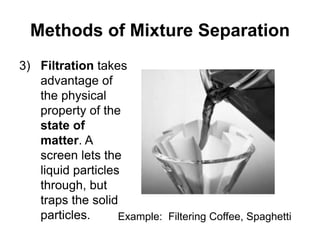
3) Filtration takes
advantage of
the physical
property of the
state of
matter. A
screen lets the
liquid particles
through, but
traps the solid
particles. Example: Filtering Coffee, Spaghetti
A filter can
also be used
to separate
solid
particles of
different
sizes.
(ex. a window
screen, an air
filter, a sand
sieve)
Methods of Mixture Separation
4) Decanting:
To pour off a
liquid, leaving
another liquid
or solid behind.
Takes
advantage of
differences in
density.
Example: To decant a liquid from a precipitate
or water from rice.
Methods of Mixture Separation
5 ) Distillation:
The
separation of
a mixture of
liquids based
on the
physical
property of
boiling
point.
Example: the distillation of alcohol or oil
Distillation Animation
• This animation shows how two liquids
dissolved together can be separated by
distillation at their respective and different
boiling points.
• http://www.footprints-
science.co.uk/index.php?module=2&type=
Distillation&section=Section1&info=10
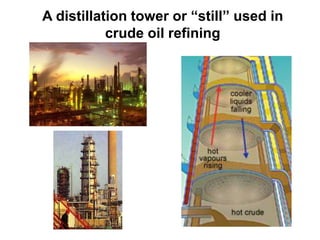
A distillation tower or “still” used in
crude oil refining
Methods of Mixture Separation
6) Evaporation:
Vaporizing a
liquid and
leaving the
dissolved
solid(s)
behind.
Used to
separate salt
solutions.
Example: Obtaining sea salt from sea water evaporation ponds
Methods of Mixture Separation
7) Density Separation:
More dense components
sink to the bottom and
less dense components
float. The components
cannot be soluble within
each other.
Methods of Mixture Separation
8) Centrifuge:
Circular
motion helps
denser
components
sink to the
bottom faster.
Examples: The separation of blood or DNA from blood
DNA Separation Animation
• This video animation explains how DNA is
separated out of blood. Centrifuging is
used multiple times in the process.
• http://mmia.iupui.edu/application/files/dna_
isolation_rev.swf
• https://www.youtube.com/watch?v=8cYvy
YOjzOc
Methods of Mixture Separation
9) Paper
chromatography:
Uses the property of
molecular attraction
(molecular polarity) to
separate a mixture.
Different molecules
have varying molecular
attractions for the paper
(the stationary phase)
vs. the solvent (the
mobile phase)
Example: the separation of
plant pigments and dyes
Chromatography Animation
• This animation shows how the different
molecular components of a mixture are
separated out based upon their varying
molecular attractions for the mobile phase
(a solvent like water) and the stationary
phase (like paper or resin beads).
• https://www.youtube.com/watch?v=0m8b
WKHmRMM
Methods of Mixture Separation
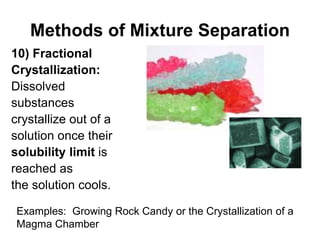
10) Fractional
Crystallization:
Dissolved
substances
crystallize out of a
solution once their
solubility limit is
reached as
the solution cools.
Examples: Growing Rock Candy or the Crystallization of a
Magma Chamber
Fractional Crystallization
Animation
• This animation shows how fractional
crystallization occurs in natural magma
chambers (below ground) as the magma
cools and the different mineral
components reach their solubility limits at
different temperatures during the cooling
process.
• https://davehirsch.com/other/animations/s
ettling.shtml

MixtureSeparation.ppt

  • 1.
    Methods of MixtureSeparation 1) Mechanical Separation (often by hand) takes advantage of physical properties such as color and shape. Example: Recycling Plastic, Paper, Metal
  • 2.
    Methods of MixtureSeparation 2) Magnetic Separation takes advantage of the physical property of magnetism. Example: Separating Metals in a Scrap Yard
  • 3.
    Magnetic Separation Example •Turbo Beads Animation • This video clip illustrate how tiny (nanoparticle size) magnetic beads called Turbo Beads can be used to separate dissolved impurities (magnetic chemical compounds) from water. • https://www.youtube.com/watch?v=vlGQ6 wd8_Jk
  • 4.
    Methods of MixtureSeparation 3) Filtration takes advantage of the physical property of the state of matter. A screen lets the liquid particles through, but traps the solid particles. Example: Filtering Coffee, Spaghetti
  • 5.
    A filter can alsobe used to separate solid particles of different sizes. (ex. a window screen, an air filter, a sand sieve)
  • 6.
    Methods of MixtureSeparation 4) Decanting: To pour off a liquid, leaving another liquid or solid behind. Takes advantage of differences in density. Example: To decant a liquid from a precipitate or water from rice.
  • 7.
    Methods of MixtureSeparation 5 ) Distillation: The separation of a mixture of liquids based on the physical property of boiling point. Example: the distillation of alcohol or oil
  • 8.
    Distillation Animation • Thisanimation shows how two liquids dissolved together can be separated by distillation at their respective and different boiling points. • http://www.footprints- science.co.uk/index.php?module=2&type= Distillation&section=Section1&info=10
  • 9.
    A distillation toweror “still” used in crude oil refining
  • 10.
    Methods of MixtureSeparation 6) Evaporation: Vaporizing a liquid and leaving the dissolved solid(s) behind. Used to separate salt solutions. Example: Obtaining sea salt from sea water evaporation ponds
  • 11.
    Methods of MixtureSeparation 7) Density Separation: More dense components sink to the bottom and less dense components float. The components cannot be soluble within each other.
  • 12.
    Methods of MixtureSeparation 8) Centrifuge: Circular motion helps denser components sink to the bottom faster. Examples: The separation of blood or DNA from blood
  • 13.
    DNA Separation Animation •This video animation explains how DNA is separated out of blood. Centrifuging is used multiple times in the process. • http://mmia.iupui.edu/application/files/dna_ isolation_rev.swf • https://www.youtube.com/watch?v=8cYvy YOjzOc
  • 14.
    Methods of MixtureSeparation 9) Paper chromatography: Uses the property of molecular attraction (molecular polarity) to separate a mixture. Different molecules have varying molecular attractions for the paper (the stationary phase) vs. the solvent (the mobile phase) Example: the separation of plant pigments and dyes
  • 15.
    Chromatography Animation • Thisanimation shows how the different molecular components of a mixture are separated out based upon their varying molecular attractions for the mobile phase (a solvent like water) and the stationary phase (like paper or resin beads). • https://www.youtube.com/watch?v=0m8b WKHmRMM
  • 16.
    Methods of MixtureSeparation 10) Fractional Crystallization: Dissolved substances crystallize out of a solution once their solubility limit is reached as the solution cools. Examples: Growing Rock Candy or the Crystallization of a Magma Chamber
  • 17.
    Fractional Crystallization Animation • Thisanimation shows how fractional crystallization occurs in natural magma chambers (below ground) as the magma cools and the different mineral components reach their solubility limits at different temperatures during the cooling process. • https://davehirsch.com/other/animations/s ettling.shtml