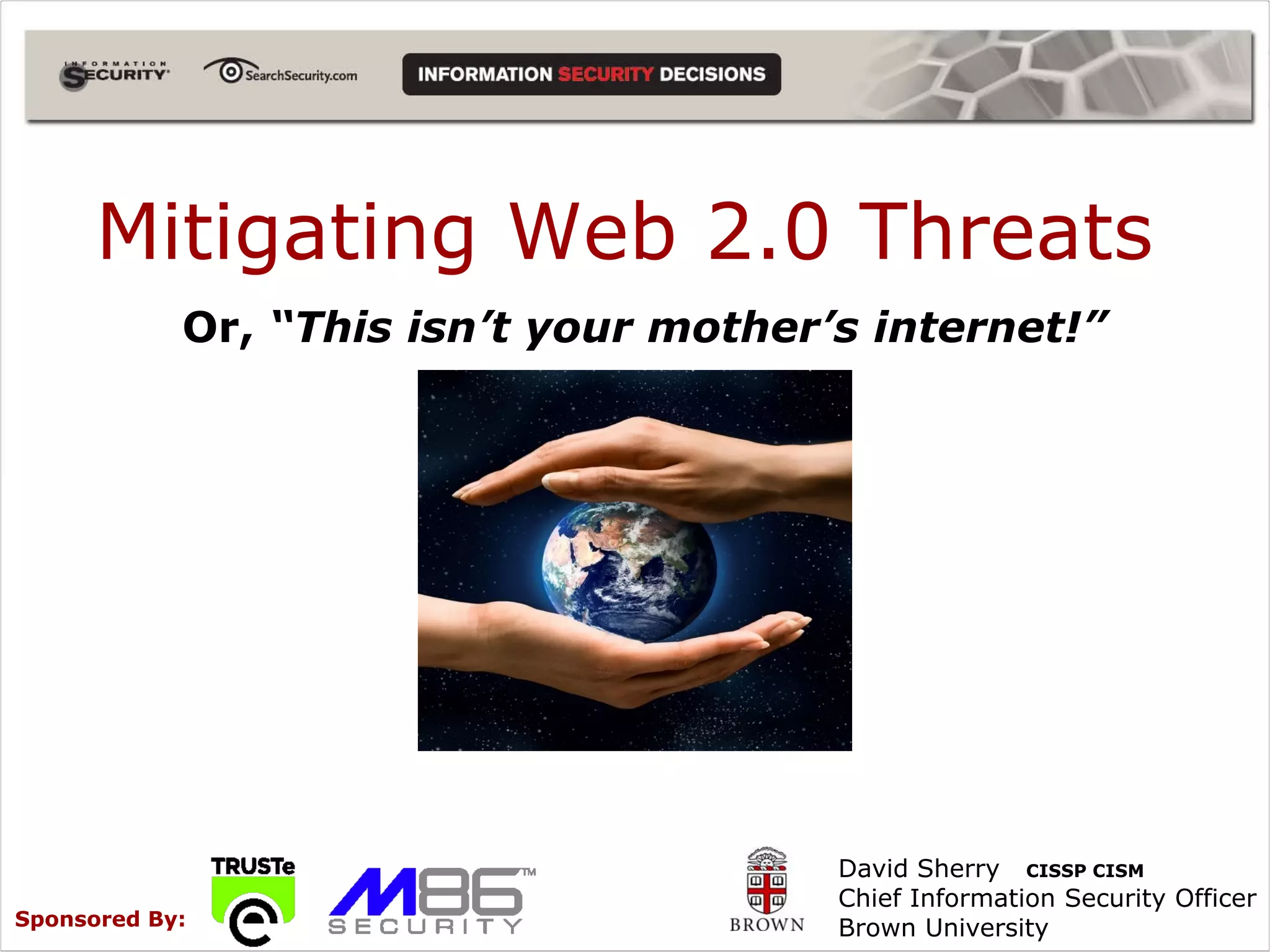
Mitigating Web 2.0 Threats
            Or, “This isn’t your mother’s internet!”


                                        David Sherry CISSP CISM
                                        Chief Information Security Officer
Sponsored By:                           Brown University
Security @ Brown


•Security evangelism         •Public Safety support
•Incident Response Team      •Human Resources support
•Audit support               •Records Management
•Compliance and legal        •Business Continuity
standards                    •Disaster Recovery
•Firewalls, IDS, IPS, VPN,   •Copyright / DMCA agent
sniffers, A/V, DNS, etc….    •Discipline Committee
•Security audits and         •Mandatory / elective training
certifications               •Awareness
                                                        2
Today’s Agenda (or is it a mashup?)
• Our changing world of security

• What is web 2.0?

• Attack vectors and areas of concern

• The evolution of the threats….they’re nothing new!

• What should be focused on

• Recommendations to reduce the threat
Our World is Changing
                            May you live in interesting times…..
                                                 Chinese Proverb


    • Compliance is a key competency of security pros

    • Identity Theft is fastest growing crime

    • President’s Cyber Security Initiative provides spotlight

    • Online underground economy has matured

    • National and global economy means “do more with less”

    •   Threat evolution:
        •   Infrastructure > web/messaging > DLP > Web 2.0
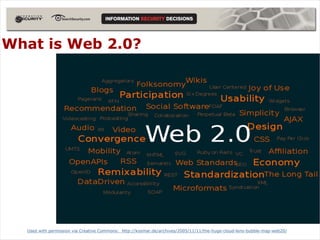
What is Web 2.0?


  Used with permission via Creative Commons: http://kosmar.de/archives/2005/11/11/the-huge-cloud-lens-bubble-map-web20/
What is Web 2.0?
 From Wikipedia:                (which is, itself, a 2.0 phenomenon)


"Web 2.0" refers to web development and web design that
  facilitates interactive information sharing, interoperability,
  user-centered design and collaboration on the World Wide
  Web. Examples of Web 2.0 include web-based communities,
  hosted services, web applications, social-networking sites,
  video-sharing sites, wikis, blogs, mashups and
  folksonomies. A Web 2.0 site allows its users to interact
  with other users or to change website content, in contrast
  to non-interactive websites where users are limited to the
  passive viewing of information that is provided to them.
Common Web 2.0 Descriptors

•   “User generated content”
•   “Mashups and web services”
•   “Consumer and enterprise convergence”
•   “Diversity of client software”
•   “Complexity and asynchronous operations”
The Enterprise Triple-Threat of 2.0

     1. Loss of productivity

     2. Vulnerable to data leaks
     3. Increased security risks
Characteristics of Web 2.0 Security
• Web filtering is no longer adequate

• AJAX, SAML, XML create problems for
  detection

• RSS and RIA can enter directly into networks

• Non-static makes identification difficult

• High bandwidth use can hinder availability

• User generated content hard to contain
Web 2.0 Attack Vectors
• Blogs

• Social networks

• Web portals

• Mashups

• Pop-ups

• Anonymizing proxies

• Spamdexing

• Widgets
Web 2.0 Areas of Concern
    • Client side issues
      •   Transparency and cross-domain communications; AJAX and
          JavaScript attacks on the rise

    • Protocols
      •   New protocols on top of HTTP/S (SOAP, XML, etc)

    • Information sources
      •   Concerns over integrity, transiency, and diversity

    • Information structures
      •   Variations of data structures, injection attacks

    • Server side
      •   Architecture, authorization, and authentication weaknesses
Evolution of the Threats in 2.0
• USB and auto-run malicious code

• Insiders are a threat, but they don’t know it

• Adobe PDFs and Flash replace Word and Excel

• Worms travel through social spaces into offices

• DOS attacks against social networks

• Malware travels via all conduits

• Pop-ups advertise seemingly legitimate
  services and take advantage of current events
So what do you focus on?
From Secure Enterprise 2.0, the dangers come from:
     1. Insufficient authentication controls
     2. Cross-site scripting
     3. Cross-site request forgery
     4. Phishing
     5. Information leakage
     6. Injection flaws
     7. Information integrity
     8. Insufficient anti-automation

        www.secure-enterprise20.org
Recommendations for Web 2.0
  Technical:
• Experts recommend a three-tiered, integrated data
  protection approach:
   •   Maintain vigilant anti-virus protection
   •   Establish a robust anti-malware protection program
   •   Utilize an AJAX-aware analysis platform

• Use real-time content and security scanning

• Make sure browsers and plug-ins are patched
   •   Don’t just patch “high” rated patches!

• Remember your end points

• Use encryption as a key strategic defense
Recommendations for Web 2.0
Managerial:
   • Ensure that your policies are current and address 2.0
      •   Subjective policy setting
      •   Group level access
      •   Productivity based policies

   • Use a Data Loss Prevention as an essential teaching tool

   • Education and awareness must go beyond passwords

   • Ensure cross-functional response and participation

   • Speak with data!
Ensuring a Defensive Web 2.0 Policy
 • Revisit your Acceptable Use Policy
   • View the policy from a web 2.0 lens
   • Be sure to cover new technologies like anonymizing proxies

 • Include other groups for strength
    • Human Resources, Risk Management, Privacy, Physical
      Security, Audit, and Legal

 • Step up your training and awareness for Web
   2.0 concerns
Support your policy through technology
• IDS / IPS

• Bandwidth shaping and throttling

• Standard images

• Group policy objects

• Firewall rules

• Anti-virus, spyware, and malware

• Monitor for your good name!
Summary
• We are living in a changing world, and Web
  2.0 is part of it

• 2.0 brings added challenges and
  characteristics to security professionals

• There are technical and managerial solutions
  to reduce Web 2.0 concerns

• Like all emerging technologies and their
  related threats, a holistic security approach
  is needed
There is never enough time;
thank you for some of yours.

    David Sherry, CISSP CISM
    Chief Information Security Officer
    Brown University
    Campus Box 1885
    Providence, RI 02912
    401.863-7266
    david_sherry@brown.edu
Thanks to our Sponsors


   Product trial download page


   Free Whitepaper: Reduce
   shopping cart abandonment.
   Increase revenue.

Mitigating Web 2.0 Threats

  • 1.
    Mitigating Web 2.0Threats Or, “This isn’t your mother’s internet!” David Sherry CISSP CISM Chief Information Security Officer Sponsored By: Brown University
  • 2.
    Security @ Brown •Securityevangelism •Public Safety support •Incident Response Team •Human Resources support •Audit support •Records Management •Compliance and legal •Business Continuity standards •Disaster Recovery •Firewalls, IDS, IPS, VPN, •Copyright / DMCA agent sniffers, A/V, DNS, etc…. •Discipline Committee •Security audits and •Mandatory / elective training certifications •Awareness 2
  • 3.
    Today’s Agenda (oris it a mashup?) • Our changing world of security • What is web 2.0? • Attack vectors and areas of concern • The evolution of the threats….they’re nothing new! • What should be focused on • Recommendations to reduce the threat
  • 4.
    Our World isChanging May you live in interesting times….. Chinese Proverb • Compliance is a key competency of security pros • Identity Theft is fastest growing crime • President’s Cyber Security Initiative provides spotlight • Online underground economy has matured • National and global economy means “do more with less” • Threat evolution: • Infrastructure > web/messaging > DLP > Web 2.0
  • 5.
    What is Web2.0? Used with permission via Creative Commons: http://kosmar.de/archives/2005/11/11/the-huge-cloud-lens-bubble-map-web20/
  • 7.
    What is Web2.0? From Wikipedia: (which is, itself, a 2.0 phenomenon) "Web 2.0" refers to web development and web design that facilitates interactive information sharing, interoperability, user-centered design and collaboration on the World Wide Web. Examples of Web 2.0 include web-based communities, hosted services, web applications, social-networking sites, video-sharing sites, wikis, blogs, mashups and folksonomies. A Web 2.0 site allows its users to interact with other users or to change website content, in contrast to non-interactive websites where users are limited to the passive viewing of information that is provided to them.
  • 8.
    Common Web 2.0Descriptors • “User generated content” • “Mashups and web services” • “Consumer and enterprise convergence” • “Diversity of client software” • “Complexity and asynchronous operations”
  • 9.
    The Enterprise Triple-Threatof 2.0 1. Loss of productivity 2. Vulnerable to data leaks 3. Increased security risks
  • 10.
    Characteristics of Web2.0 Security • Web filtering is no longer adequate • AJAX, SAML, XML create problems for detection • RSS and RIA can enter directly into networks • Non-static makes identification difficult • High bandwidth use can hinder availability • User generated content hard to contain
  • 11.
    Web 2.0 AttackVectors • Blogs • Social networks • Web portals • Mashups • Pop-ups • Anonymizing proxies • Spamdexing • Widgets
  • 12.
    Web 2.0 Areasof Concern • Client side issues • Transparency and cross-domain communications; AJAX and JavaScript attacks on the rise • Protocols • New protocols on top of HTTP/S (SOAP, XML, etc) • Information sources • Concerns over integrity, transiency, and diversity • Information structures • Variations of data structures, injection attacks • Server side • Architecture, authorization, and authentication weaknesses
  • 13.
    Evolution of theThreats in 2.0 • USB and auto-run malicious code • Insiders are a threat, but they don’t know it • Adobe PDFs and Flash replace Word and Excel • Worms travel through social spaces into offices • DOS attacks against social networks • Malware travels via all conduits • Pop-ups advertise seemingly legitimate services and take advantage of current events
  • 14.
    So what doyou focus on? From Secure Enterprise 2.0, the dangers come from: 1. Insufficient authentication controls 2. Cross-site scripting 3. Cross-site request forgery 4. Phishing 5. Information leakage 6. Injection flaws 7. Information integrity 8. Insufficient anti-automation www.secure-enterprise20.org
  • 15.
    Recommendations for Web2.0 Technical: • Experts recommend a three-tiered, integrated data protection approach: • Maintain vigilant anti-virus protection • Establish a robust anti-malware protection program • Utilize an AJAX-aware analysis platform • Use real-time content and security scanning • Make sure browsers and plug-ins are patched • Don’t just patch “high” rated patches! • Remember your end points • Use encryption as a key strategic defense
  • 16.
    Recommendations for Web2.0 Managerial: • Ensure that your policies are current and address 2.0 • Subjective policy setting • Group level access • Productivity based policies • Use a Data Loss Prevention as an essential teaching tool • Education and awareness must go beyond passwords • Ensure cross-functional response and participation • Speak with data!
  • 17.
    Ensuring a DefensiveWeb 2.0 Policy • Revisit your Acceptable Use Policy • View the policy from a web 2.0 lens • Be sure to cover new technologies like anonymizing proxies • Include other groups for strength • Human Resources, Risk Management, Privacy, Physical Security, Audit, and Legal • Step up your training and awareness for Web 2.0 concerns
  • 18.
    Support your policythrough technology • IDS / IPS • Bandwidth shaping and throttling • Standard images • Group policy objects • Firewall rules • Anti-virus, spyware, and malware • Monitor for your good name!
  • 19.
    Summary • We areliving in a changing world, and Web 2.0 is part of it • 2.0 brings added challenges and characteristics to security professionals • There are technical and managerial solutions to reduce Web 2.0 concerns • Like all emerging technologies and their related threats, a holistic security approach is needed
  • 20.
    There is neverenough time; thank you for some of yours. David Sherry, CISSP CISM Chief Information Security Officer Brown University Campus Box 1885 Providence, RI 02912 401.863-7266 david_sherry@brown.edu
  • 21.
    Thanks to ourSponsors Product trial download page Free Whitepaper: Reduce shopping cart abandonment. Increase revenue.