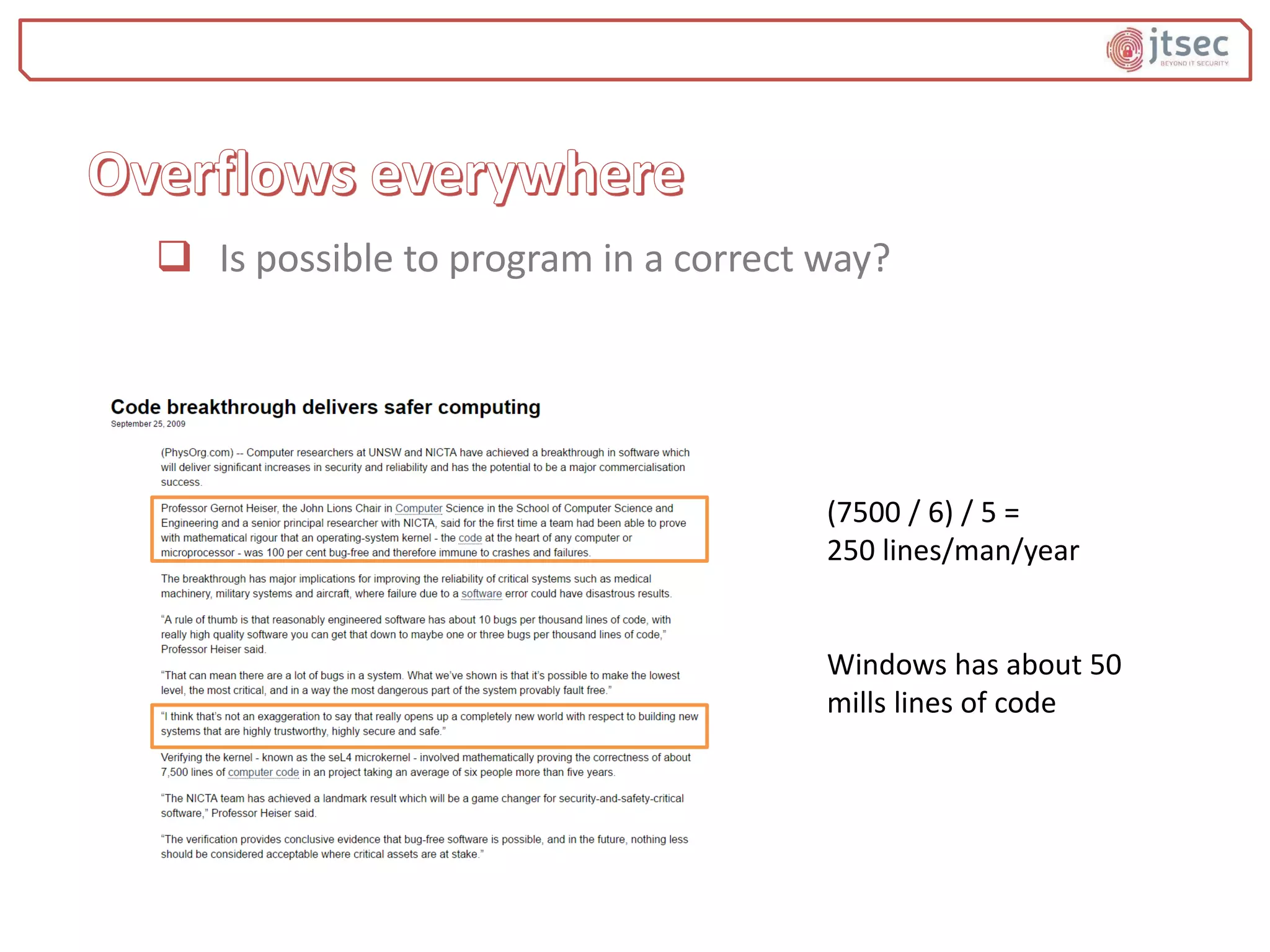
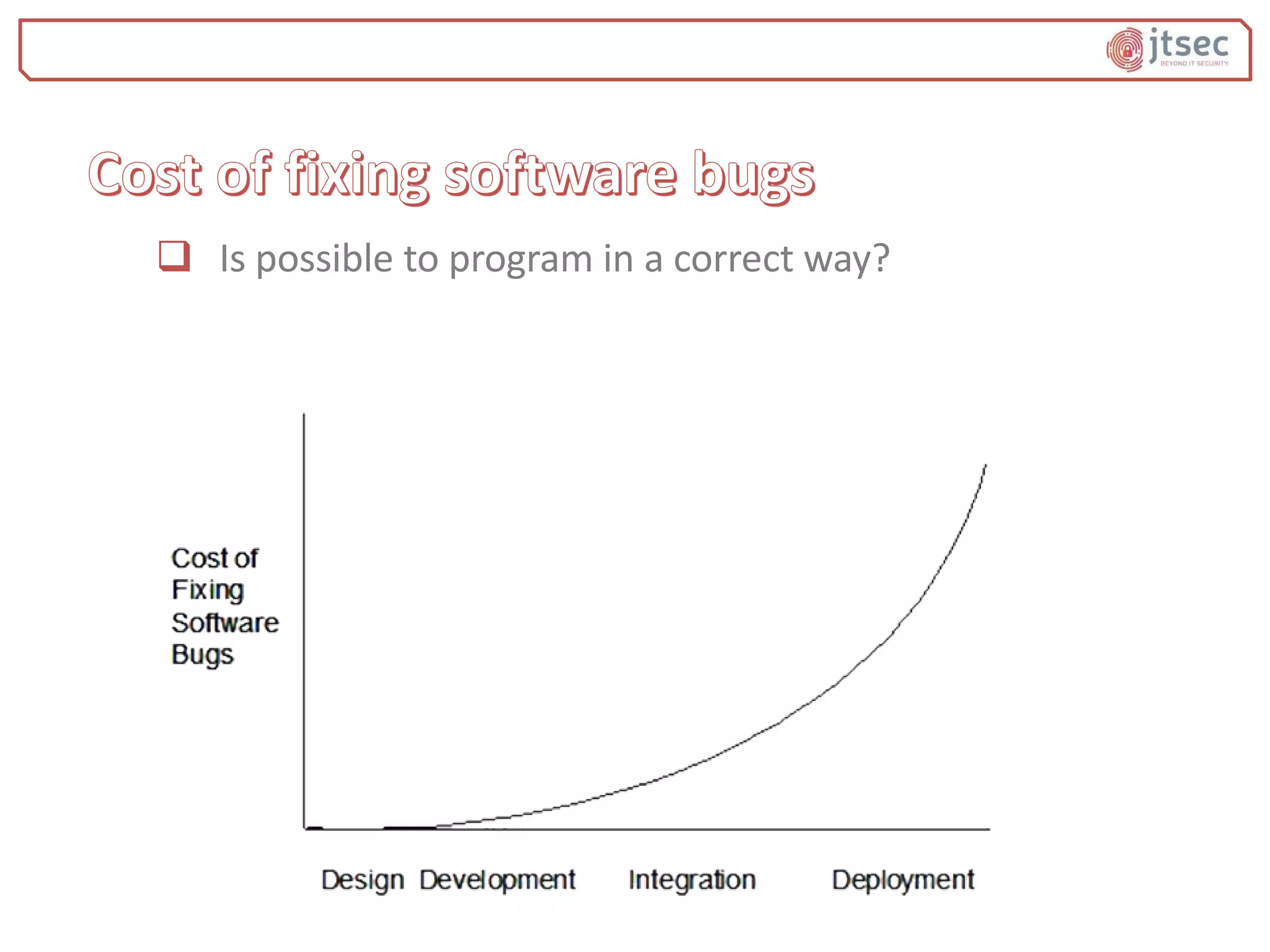
 Is possible to program in a correct way?
(7500 / 6) / 5 =
250 lines/man/year
Windows has about 50
mills lines of code
 Is possible to program in a correct way?
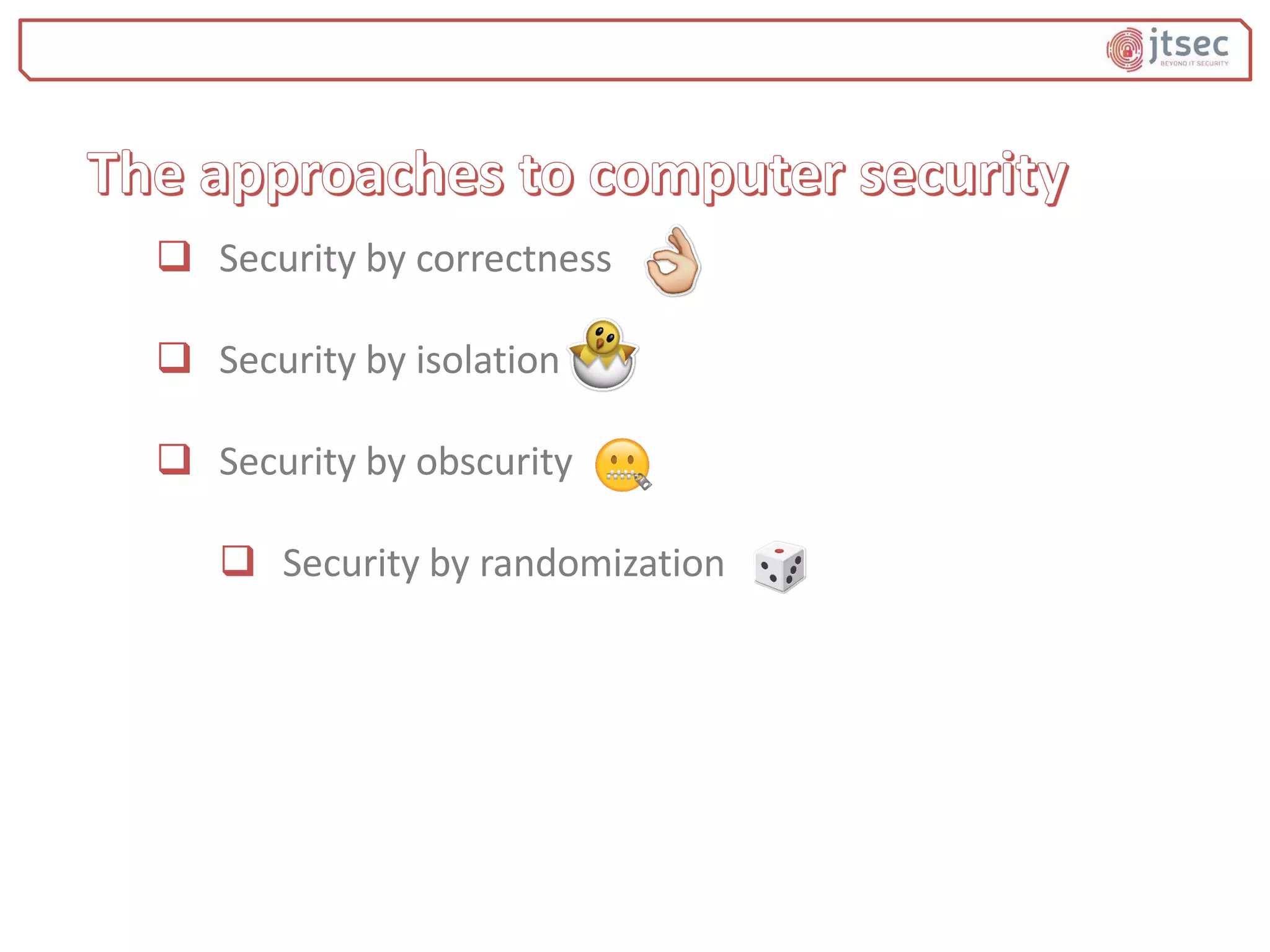
 Security by correctness
 Security by isolation
 Security by obscurity
 Security by randomization
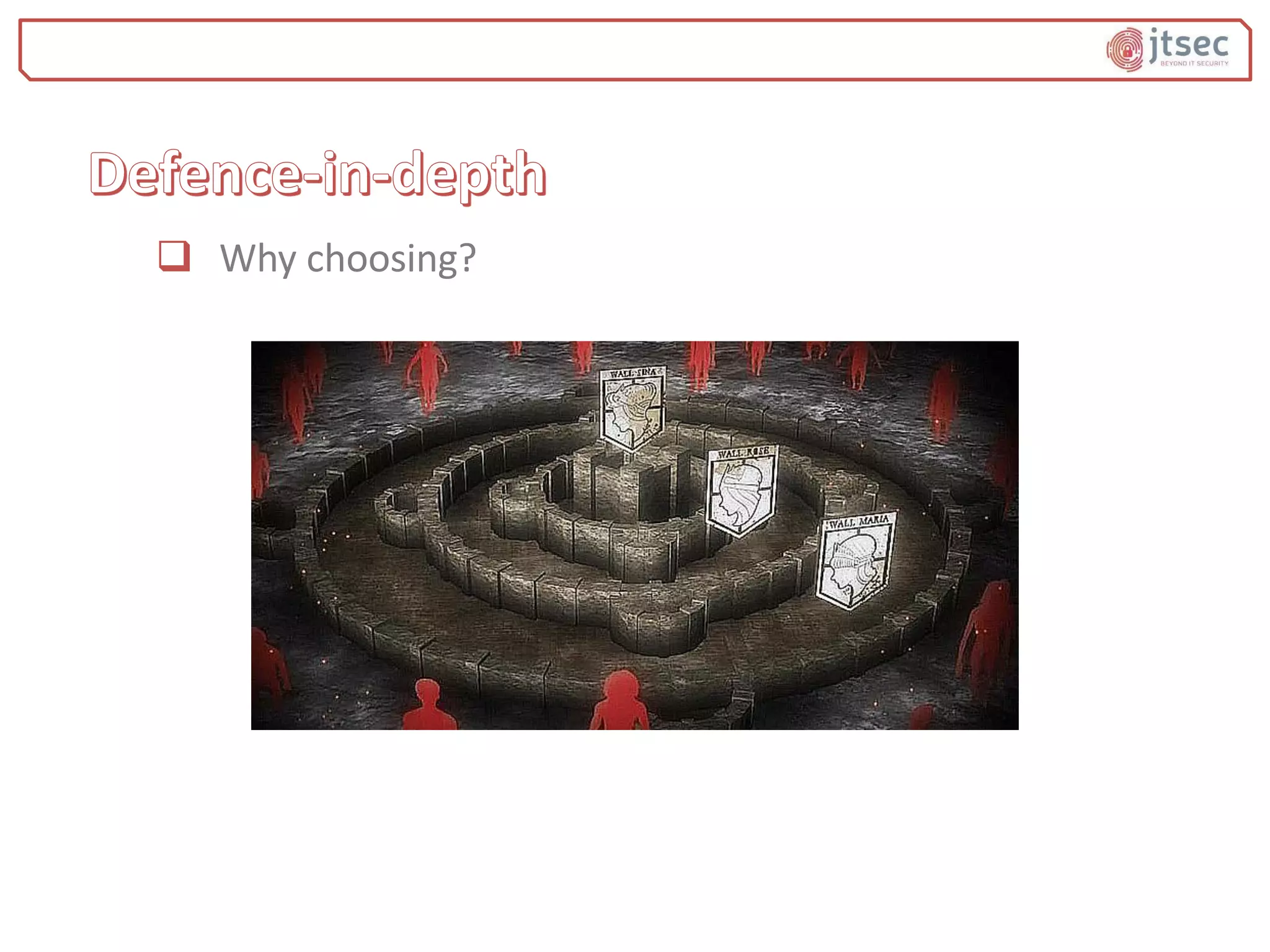
 Why choosing?
 According to the SDL
 Designed to stop the attacker
 If the countermeasure does not stop the
attacker, it is a vulnerable
countermeasure.
 Designed to slow the attacker
 Effective
 Low - effort
 Can be located at…
 … the compiler
 … the operating system
 … the hardware
LLVM / CLANG
 -FORTIFY_SOURCE (buffer overflow detection).
 works by computing the number of bytes that are going
to be copied
 provides buffer overflow checks for the following
functions (and wide character variants):
 memcpy, mempcpy, memmove, memset, strcpy,
stpcpy, strncpy, strcat, strncat, sprintf, vsprintf,
snprintf, vsnprintf, gets.
 argument consistency is checked
 -D_FORTIFY_SOURCE=1  checks that shouldn't change the
behavior of conforming programs are performed. Checks at
compile-time only.
 -D_FORTIFY_SOURCE=2  some more checking is added,
but some conforming programs might fail. Checks at
compile-time and runtime.
 Enable warnings:
 -Warray-bounds: Compile time out of bounds checks
 -Wformat=2 -Wformat-security: Format string warnings
 /WE4789
 Warns about buffer overrun when specific C run-time
(CRT) functions are used, parameters are passed, and
assignments are performed, such that the data sizes are
known at compile time. This warning is for situations
that might elude typical data-size mismatch detection.
 strcpy, memset, memcpy, wmemcpy
 Replace with secure version of the functions
#define _CRT_SECURE_CPP_OVERLOAD_STANDARD_NAMES 1
#define _CRT_SECURE_CPP_OVERLOAD_STANDARD_NAMES_COUNT 1
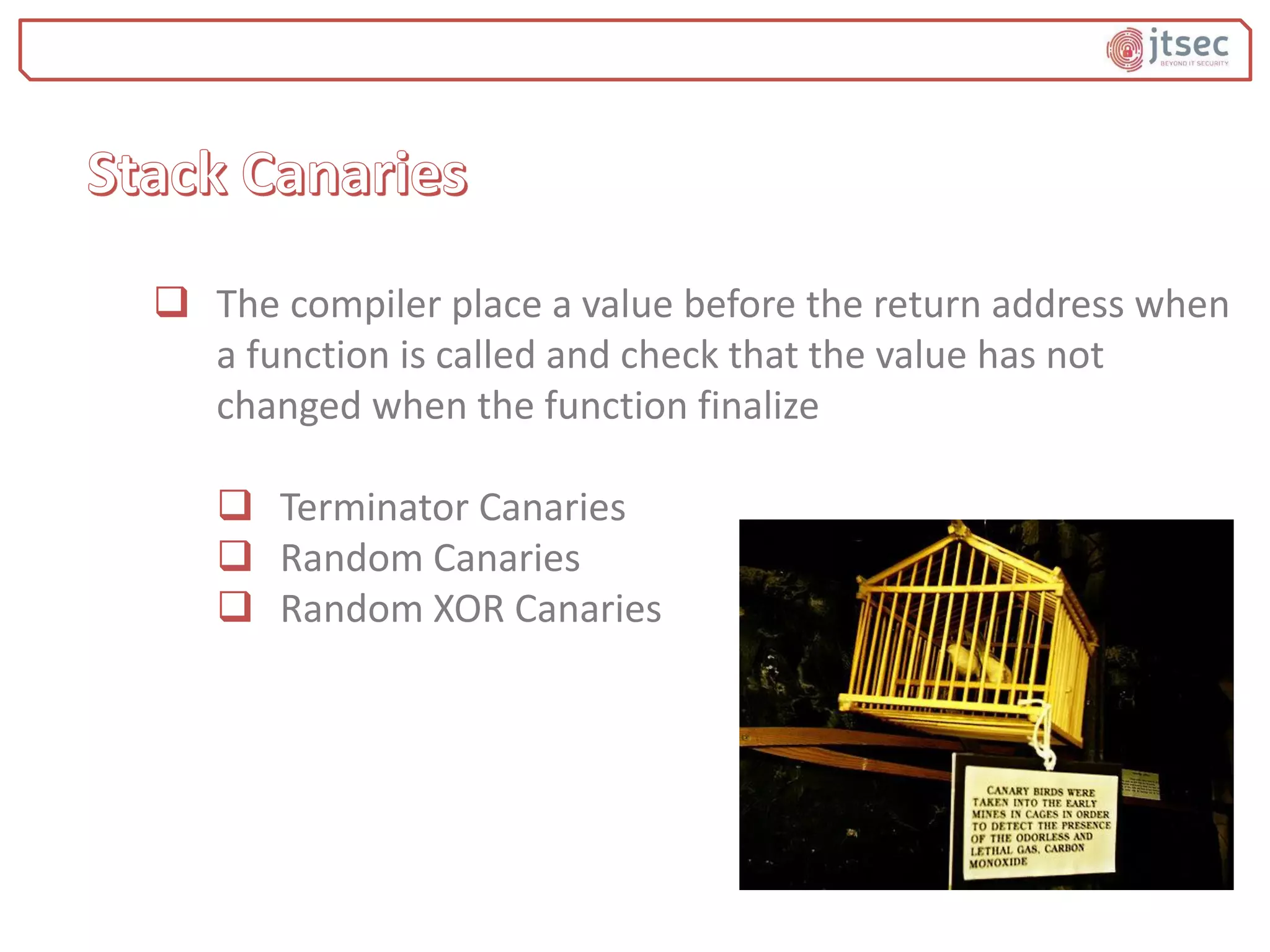
 The compiler place a value before the return address when
a function is called and check that the value has not
changed when the function finalize
 Terminator Canaries
 Random Canaries
 Random XOR Canaries
 Deprecated:
 StackGuard
 ProPolice (reorders variables)
 -fstack-protector: Buffer size > 8B && functions that call alloc
 -fstack-protector-explicit: stack_protect attrb.
 -fstack-protector-all: All 
 -fstack-protector-strong: paranoid conditions
 AddressSanitizer (en gcc desde 4.8)
 -fsanitize=address
 UndefinedBehaviorSanitizer (UBSan)
 -fsanitize=undefined All kind of undefined behaviours
 -fsanitize=integer undefined or suspicious integer behavior
 -fsanitize=nullability While violating nullability does not have
undefined behavior, it is often unintentional
 -fsanitize=bounds Detects out-of-bounds access of arrays.
 -fsanitize=bounds-strict Enables strict checking
 ThreadSanitizer
 -fsanitize=thread Detects data races
 Microsoft Visual C++ 2003
 /GS Stack-Based Buffer Overrun Detection
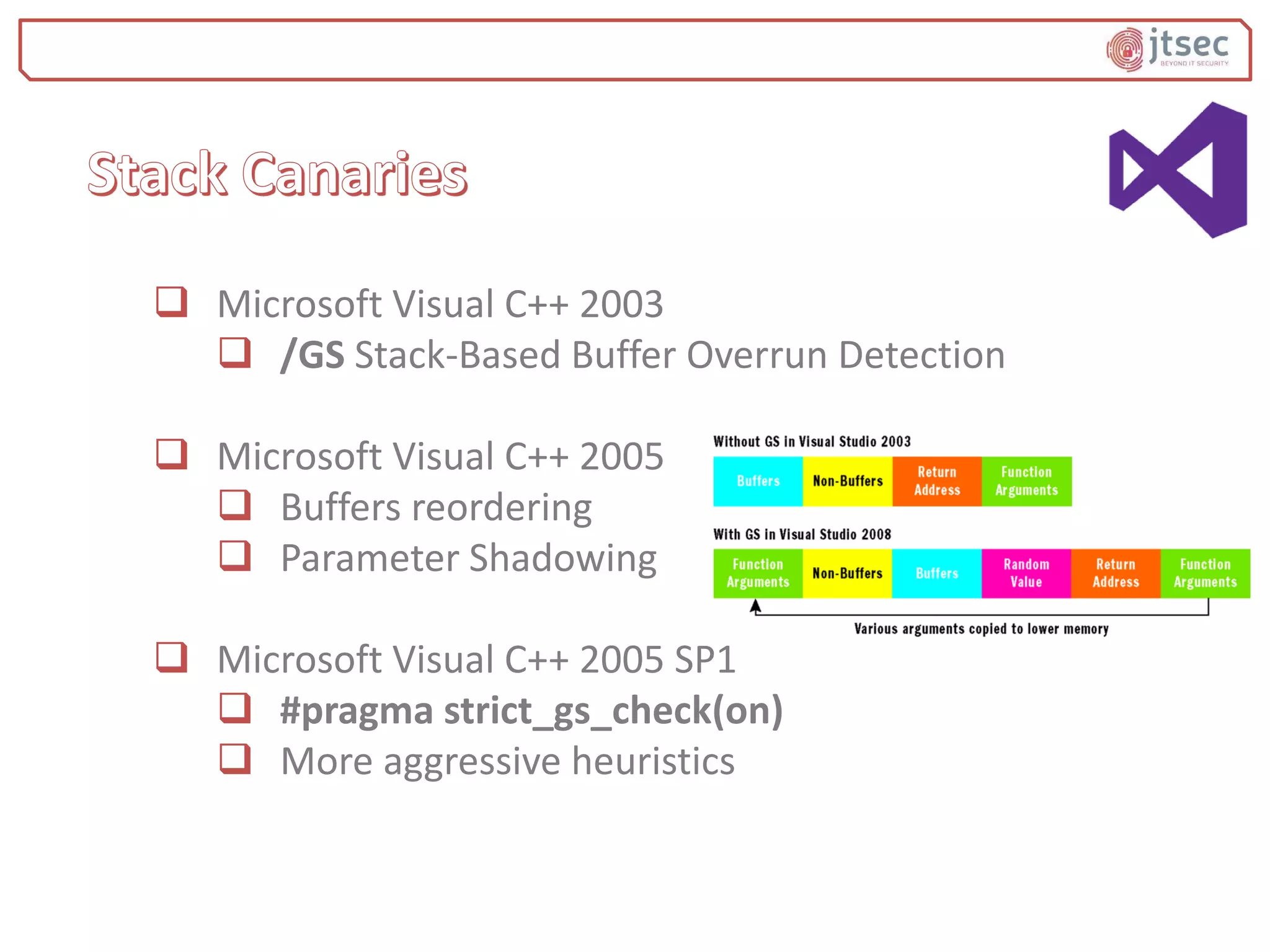
 Microsoft Visual C++ 2005
 Buffers reordering
 Parameter Shadowing
 Microsoft Visual C++ 2005 SP1
 #pragma strict_gs_check(on)
 More aggressive heuristics
 Microsoft Visual C++ 2010
 wider scope of protected functions
 optimize away the unneeded security cookies
 disable for specific functions with __declspec(safebuffers)
 choose different level of GS protections through /GS:n:
 /GS:1 VC++ 2005 and 2008
 /GS:2 widened scope (default)
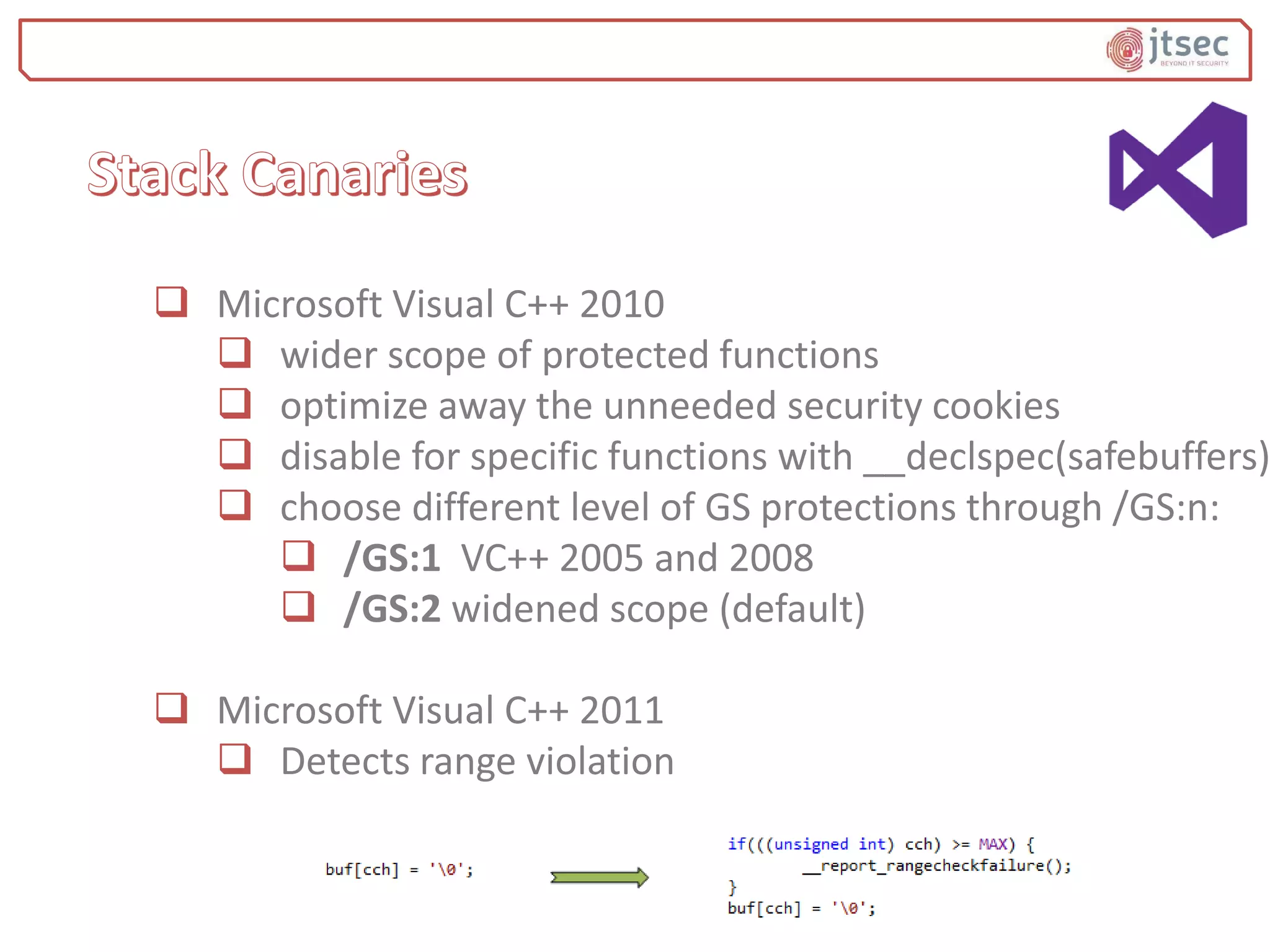
 Microsoft Visual C++ 2011
 Detects range violation
 /SAFESEH
 /GS does not protect exception handler records
 Instead of protection the stack (by putting a cookie before
the return address), modules compiled with this flag will
include a list of all known addresses that can be used as
exception handler functions.
 If an exception occurs, the application will check if the
address in the SEH chain records belongs to the list with
"known" functions, if the address belongs to a module
that was compiled with SafeSEH. If that is not the case,
the application will be terminated without jumping to the
corrupted handler.
 /RTC Runtime error checks
 /RTCs: stack-frame runtime error checking
 /RTCu: variable used before initialization
 /RTCc: value assigned to a smaller data type
 /RTC1 === /RTCsu
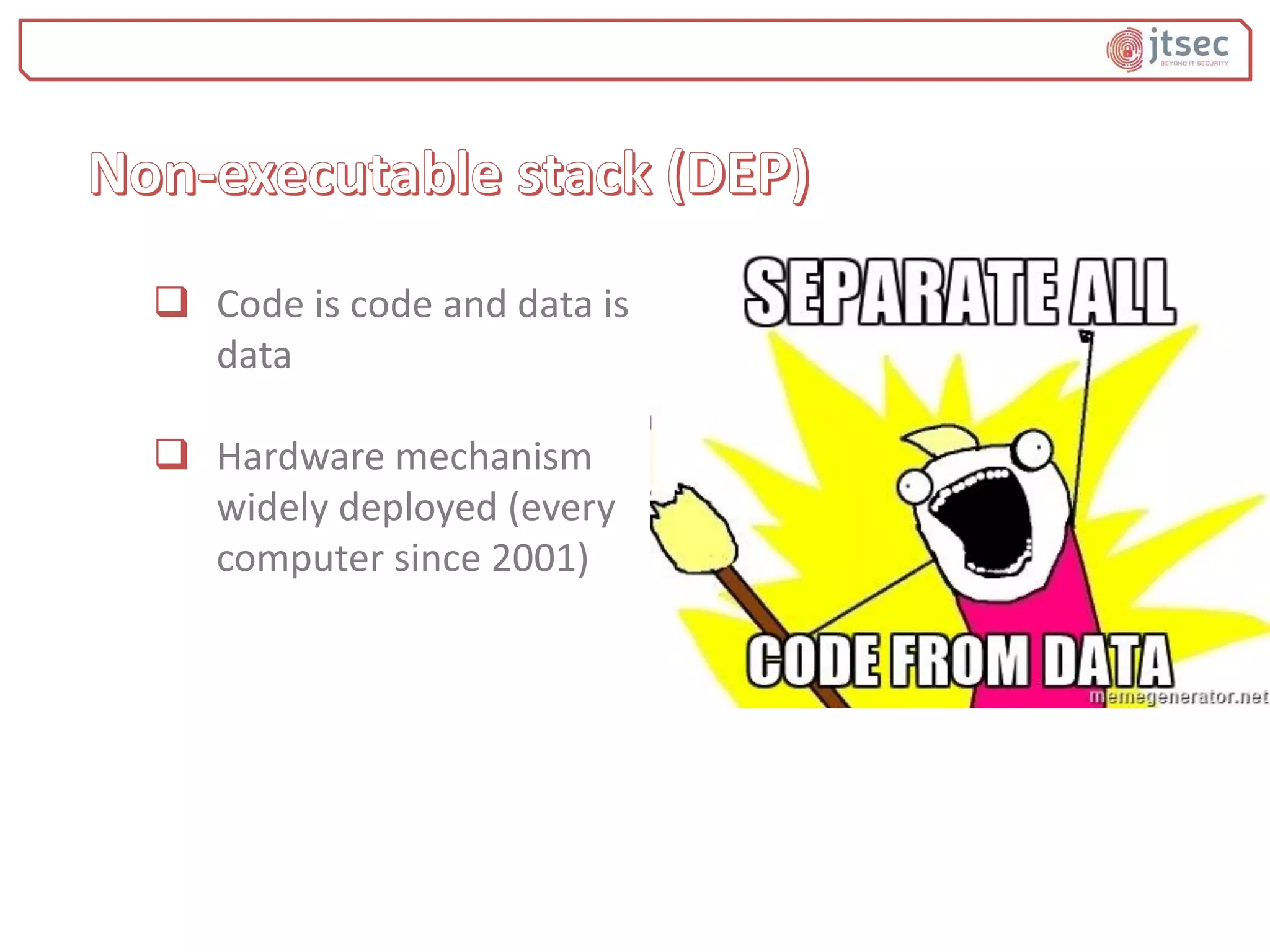
 Code is code and data is
data
 Hardware mechanism
widely deployed (every
computer since 2001)
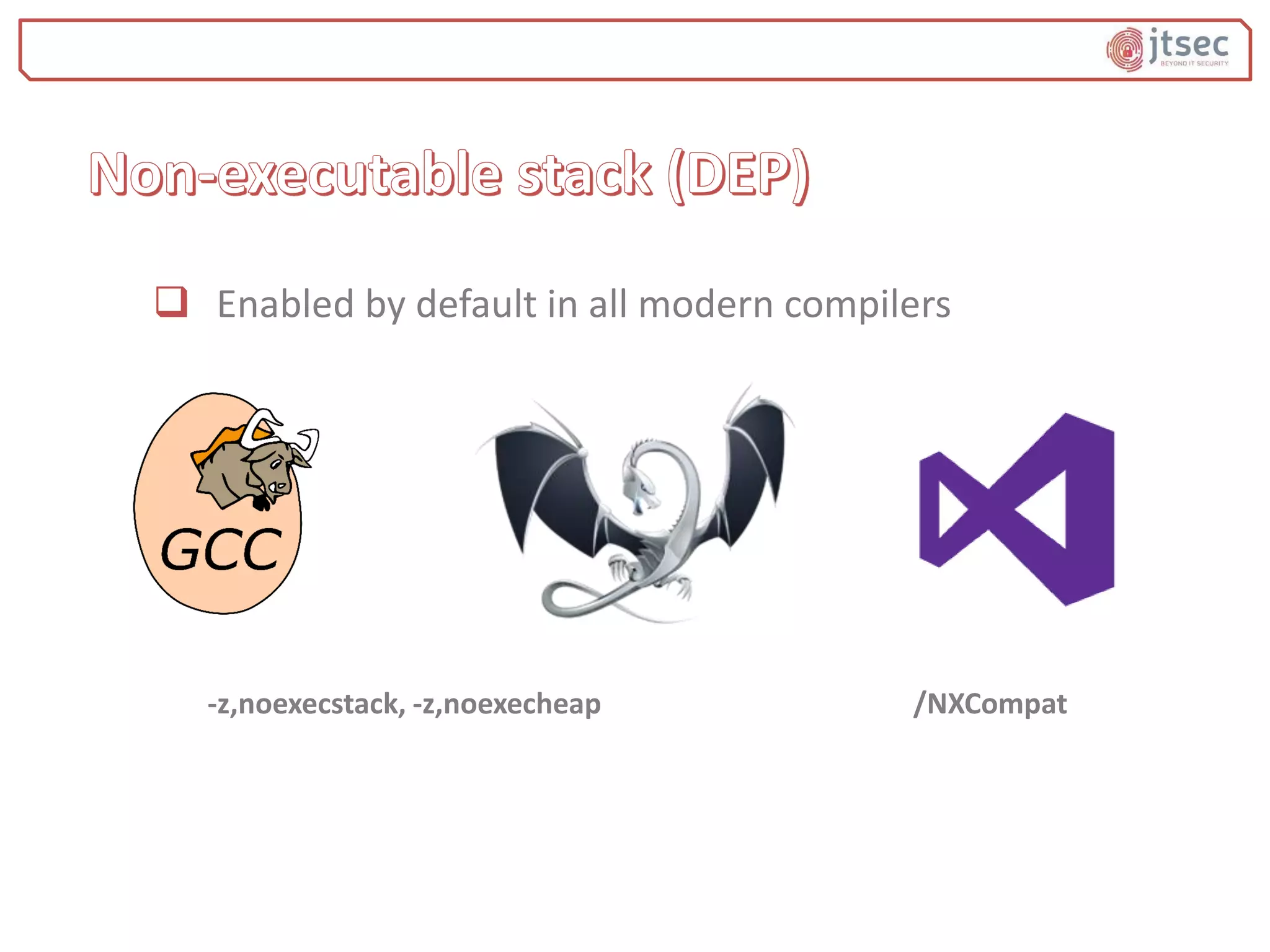
 Enabled by default in all modern compilers
-z,noexecstack, -z,noexecheap /NXCompat
 Address Space Layout Randomization
 The code is loaded in different memory regions each time
 Implemented by the operating system
 To be of any use, you must also have DEP enabled
 But code needs to be “position independant”
 Compiled with
 -fPIE -pie for binaries
 -fPIC for shared libraries.
 By default, Windows® will only juggle system components
around. If you want your image to be moved around by the
operating system (highly recommended), then you should link
with:
 /DYNAMICBASE (since VS 2005 SP1)
 /HIGHENTROPYVA (since VS 2012) uses ASLR with 64 bits
addresses
 It also randomizes the stack
 Restricts the control-flow of an application
to valid execution traces. CFI enforces this property by
monitoring the program at runtime and comparing its
state to a set of precomputed valid states. If an invalid
state is detected, an alert is raised, usually terminating the
application.
 CFI detects control-flow hijacking attacks by limiting the
targets of control-flow transfers. In a control-flow hijack
attack an attacker redirects the control-flow of the
application to locations that would not be reached in a
benign execution, e.g., to injected code or to code that is
reused in an alternate context.
 -fsanitize=cfi
 Optimized for performance
 To allow the checks to be implemented efficiently, the
program must be structured such that certain object files are
compiled with CFI enabled, and are statically linked into the
program. This may preclude the use of shared libraries in
some cases.
 -fvisibility=hidden otherwise would disable CFI checks for
classes without visibility attributes
 Control Flow Guard: operates by creating a per-process
bitmap, where a set bit indicates that the address is a valid
destination. Before performing each indirect function call, the
application checks if the destination address is in the bitmap.
If the destination address is not in the bitmap, the program
terminates.
 /guard:cf linker flag (VS2015)
 Requires OS support: Windows 10 or 8.1 U3
 C++ polymorphism  vtables
 An attacker could exploit an use-after-free error to hijack
the vtable using heap spraying (80% attacks)
 Detects modifications in the vtable
 Extra entry added to vtable
 ASLR makes this entry’s value unknown to the
attacker
 Check added:
 if vtable[vtguard_vte] != vtguard then
terminate the process
Celement::`vftable´
VirtualMethod1
VirtualMethod2
…
vtguard
 gcc > 4.9
 -fvtable-verify=std
 -fvtable-verify=preinit
 Much more complex implementation by Google team
 Not dependent on ASLR
 https://gcc.gnu.org/wiki/cauldron2012?action=AttachFile
&do=get&target=cmtice.pdf
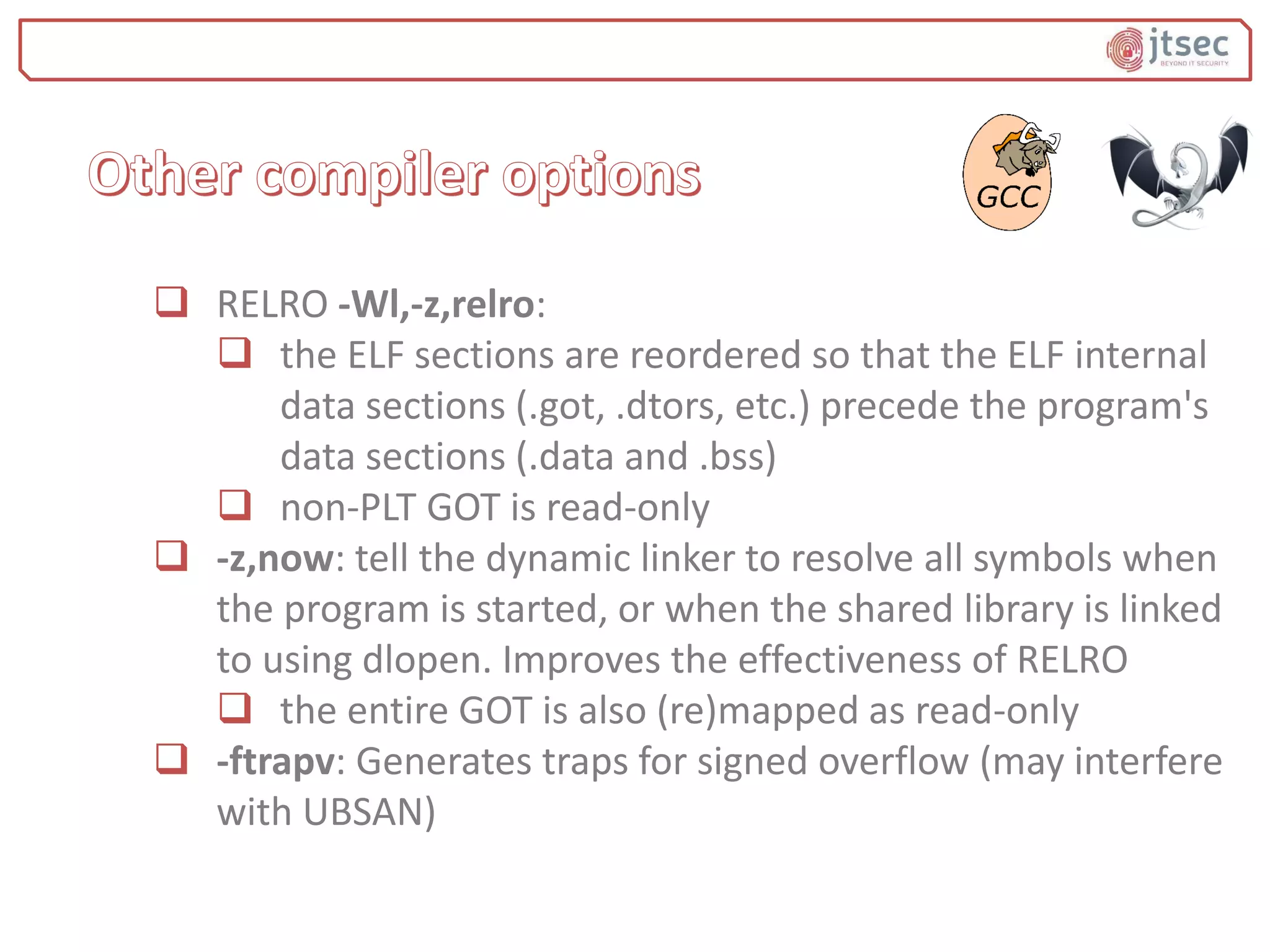
 RELRO -Wl,-z,relro:
 the ELF sections are reordered so that the ELF internal
data sections (.got, .dtors, etc.) precede the program's
data sections (.data and .bss)
 non-PLT GOT is read-only
 -z,now: tell the dynamic linker to resolve all symbols when
the program is started, or when the shared library is linked
to using dlopen. Improves the effectiveness of RELRO
 the entire GOT is also (re)mapped as read-only
 -ftrapv: Generates traps for signed overflow (may interfere
with UBSAN)
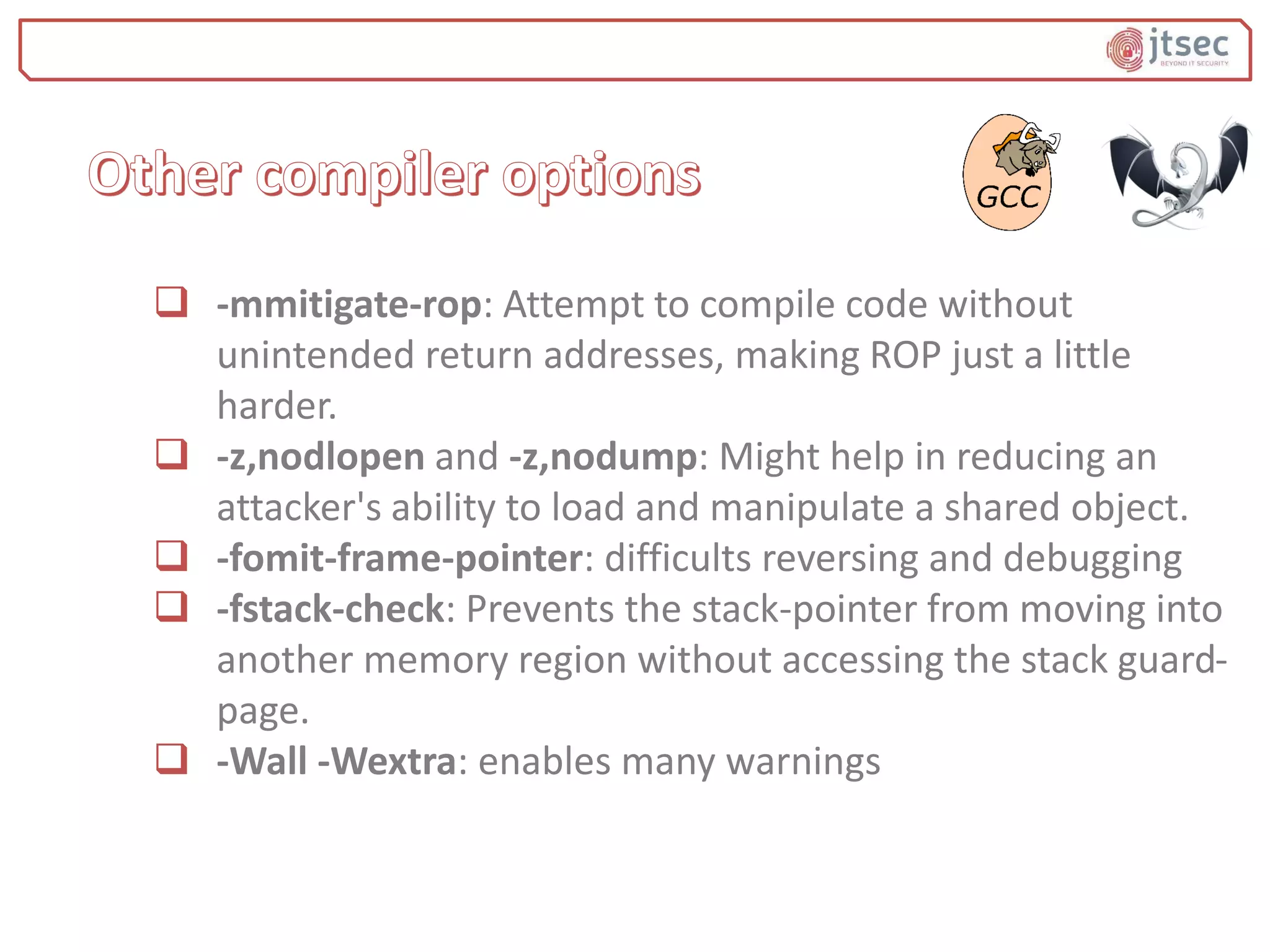
 -mmitigate-rop: Attempt to compile code without
unintended return addresses, making ROP just a little
harder.
 -z,nodlopen and -z,nodump: Might help in reducing an
attacker's ability to load and manipulate a shared object.
 -fomit-frame-pointer: difficults reversing and debugging
 -fstack-check: Prevents the stack-pointer from moving into
another memory region without accessing the stack guard-
page.
 -Wall -Wextra: enables many warnings
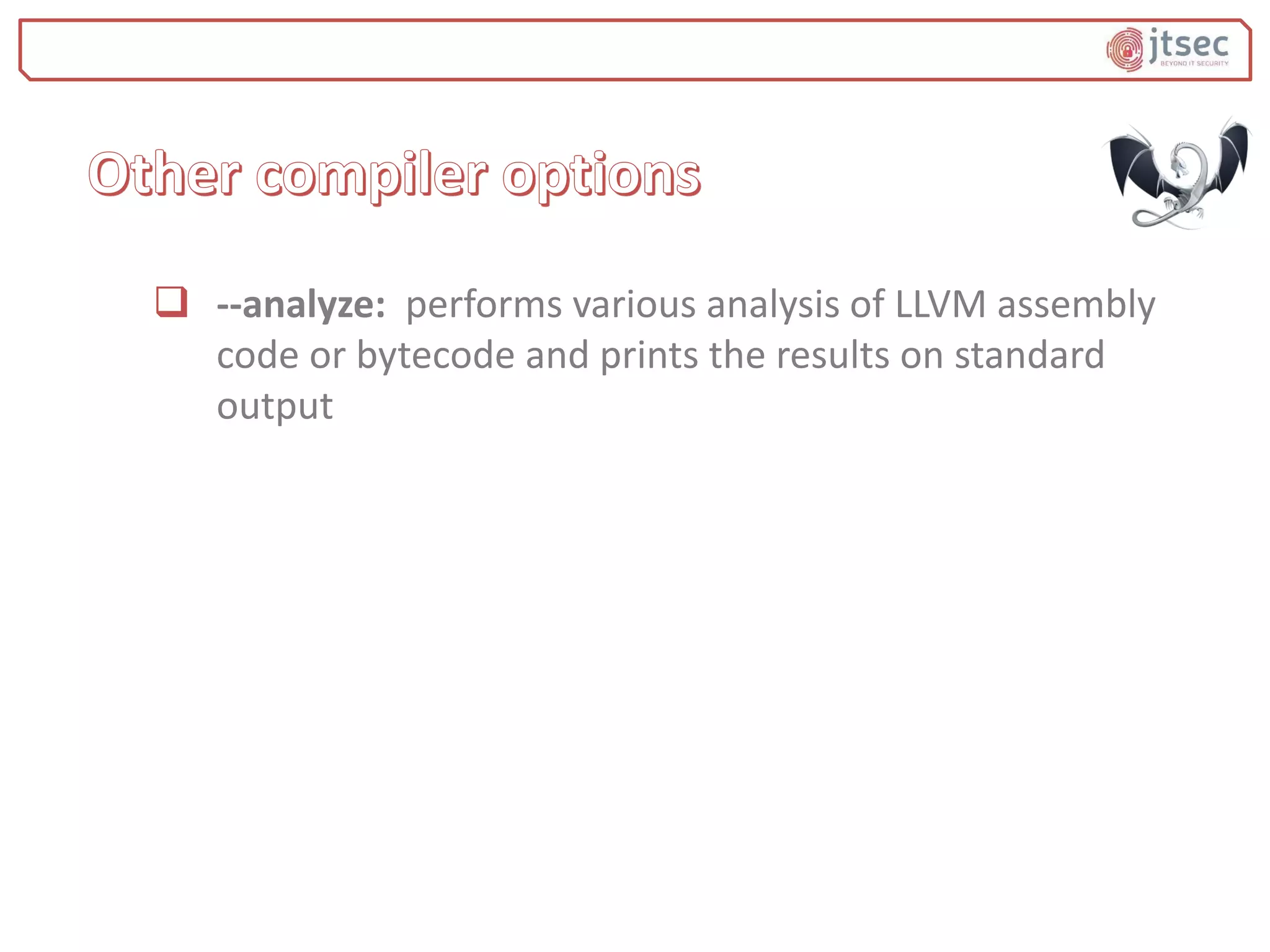
 --analyze: performs various analysis of LLVM assembly
code or bytecode and prints the results on standard
output
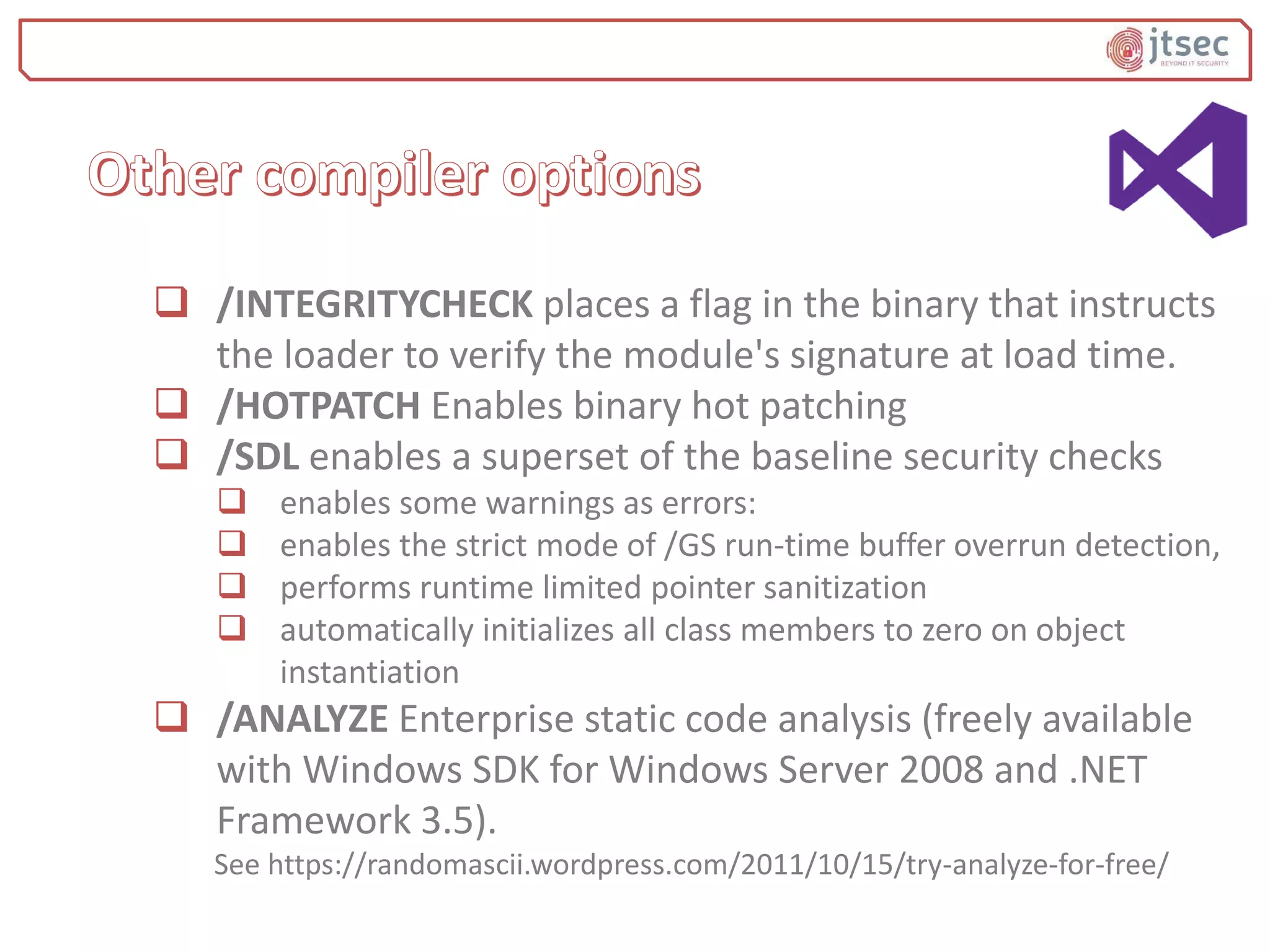
 /INTEGRITYCHECK places a flag in the binary that instructs
the loader to verify the module's signature at load time.
 /HOTPATCH Enables binary hot patching
 /SDL enables a superset of the baseline security checks
 enables some warnings as errors:
 enables the strict mode of /GS run-time buffer overrun detection,
 performs runtime limited pointer sanitization
 automatically initializes all class members to zero on object
instantiation
 /ANALYZE Enterprise static code analysis (freely available
with Windows SDK for Windows Server 2008 and .NET
Framework 3.5).
See https://randomascii.wordpress.com/2011/10/15/try-analyze-for-free/
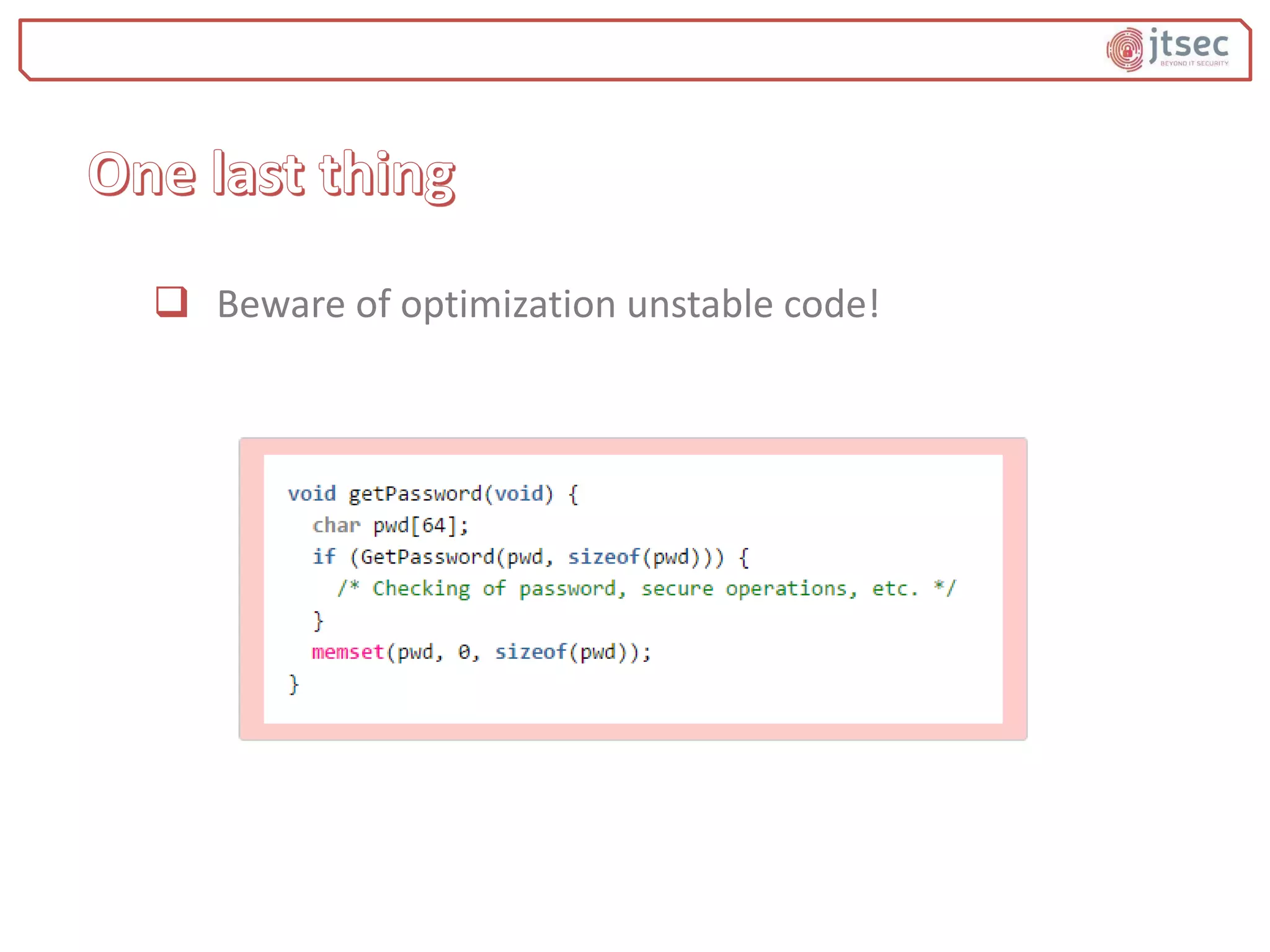
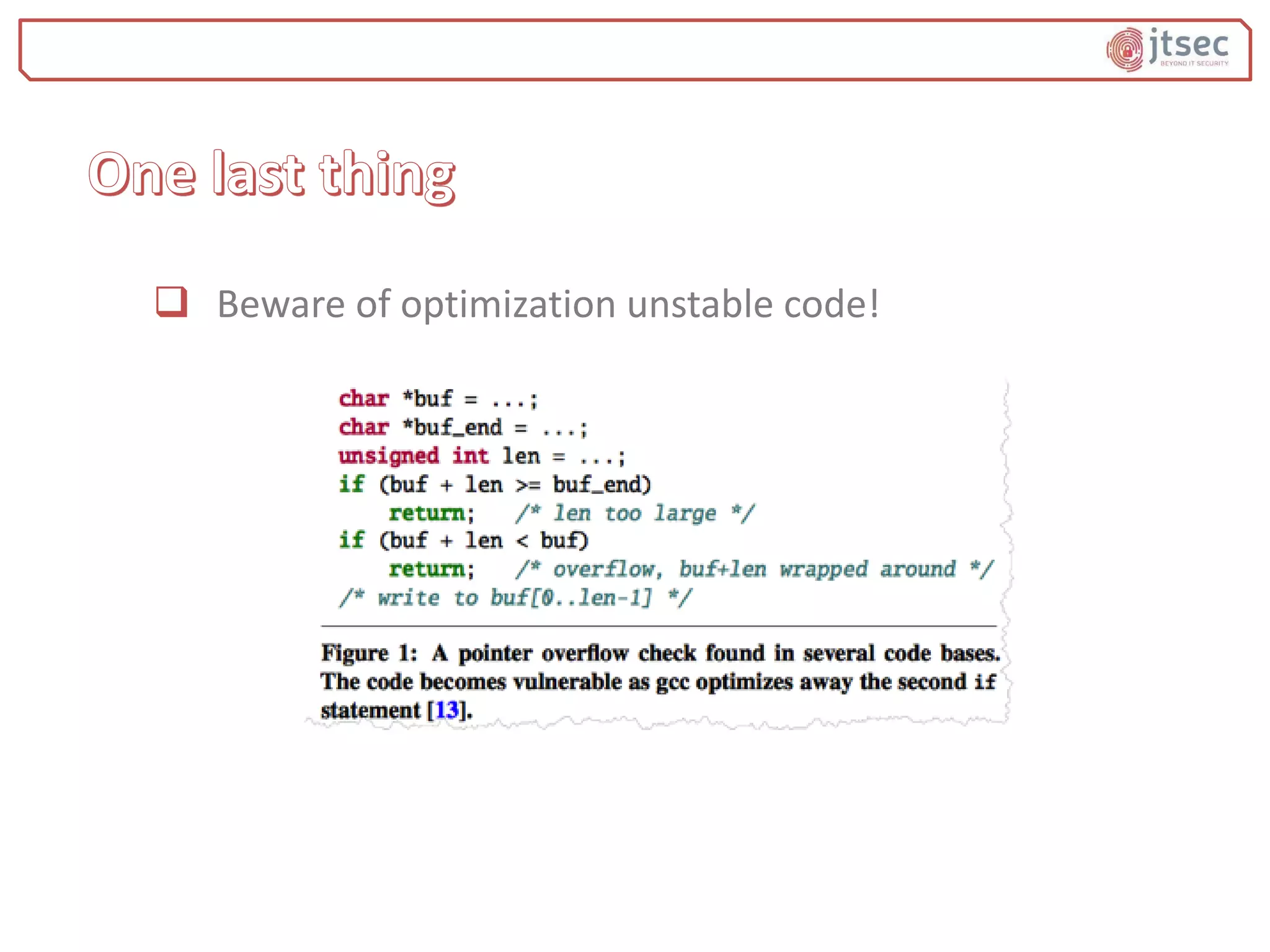
 Beware of optimization unstable code!
jtsec: Beyond IT Security
c/ Abeto s/n Edificio CEG Oficina 2B
CP 18230 Granada – Atarfe – Spain
hello@jtsec.es
@jtsecES
www.jtsec.es

Mitigating overflows using defense in-depth. What can your compiler do for you?

  • 4.
     Is possibleto program in a correct way? (7500 / 6) / 5 = 250 lines/man/year Windows has about 50 mills lines of code
  • 5.
     Is possibleto program in a correct way?
  • 6.
     Security bycorrectness  Security by isolation  Security by obscurity  Security by randomization
  • 7.
  • 8.
     According tothe SDL  Designed to stop the attacker  If the countermeasure does not stop the attacker, it is a vulnerable countermeasure.  Designed to slow the attacker
  • 9.
     Effective  Low- effort  Can be located at…  … the compiler  … the operating system  … the hardware
  • 10.
  • 11.
     -FORTIFY_SOURCE (bufferoverflow detection).  works by computing the number of bytes that are going to be copied  provides buffer overflow checks for the following functions (and wide character variants):  memcpy, mempcpy, memmove, memset, strcpy, stpcpy, strncpy, strcat, strncat, sprintf, vsprintf, snprintf, vsnprintf, gets.  argument consistency is checked
  • 12.
     -D_FORTIFY_SOURCE=1 checks that shouldn't change the behavior of conforming programs are performed. Checks at compile-time only.  -D_FORTIFY_SOURCE=2  some more checking is added, but some conforming programs might fail. Checks at compile-time and runtime.
  • 13.
     Enable warnings: -Warray-bounds: Compile time out of bounds checks  -Wformat=2 -Wformat-security: Format string warnings
  • 14.
     /WE4789  Warnsabout buffer overrun when specific C run-time (CRT) functions are used, parameters are passed, and assignments are performed, such that the data sizes are known at compile time. This warning is for situations that might elude typical data-size mismatch detection.  strcpy, memset, memcpy, wmemcpy
  • 15.
     Replace withsecure version of the functions #define _CRT_SECURE_CPP_OVERLOAD_STANDARD_NAMES 1 #define _CRT_SECURE_CPP_OVERLOAD_STANDARD_NAMES_COUNT 1
  • 16.
     The compilerplace a value before the return address when a function is called and check that the value has not changed when the function finalize  Terminator Canaries  Random Canaries  Random XOR Canaries
  • 17.
     Deprecated:  StackGuard ProPolice (reorders variables)  -fstack-protector: Buffer size > 8B && functions that call alloc  -fstack-protector-explicit: stack_protect attrb.  -fstack-protector-all: All   -fstack-protector-strong: paranoid conditions
  • 18.
     AddressSanitizer (engcc desde 4.8)  -fsanitize=address  UndefinedBehaviorSanitizer (UBSan)  -fsanitize=undefined All kind of undefined behaviours  -fsanitize=integer undefined or suspicious integer behavior  -fsanitize=nullability While violating nullability does not have undefined behavior, it is often unintentional  -fsanitize=bounds Detects out-of-bounds access of arrays.  -fsanitize=bounds-strict Enables strict checking  ThreadSanitizer  -fsanitize=thread Detects data races
  • 19.
     Microsoft VisualC++ 2003  /GS Stack-Based Buffer Overrun Detection  Microsoft Visual C++ 2005  Buffers reordering  Parameter Shadowing  Microsoft Visual C++ 2005 SP1  #pragma strict_gs_check(on)  More aggressive heuristics
  • 20.
     Microsoft VisualC++ 2010  wider scope of protected functions  optimize away the unneeded security cookies  disable for specific functions with __declspec(safebuffers)  choose different level of GS protections through /GS:n:  /GS:1 VC++ 2005 and 2008  /GS:2 widened scope (default)  Microsoft Visual C++ 2011  Detects range violation
  • 21.
     /SAFESEH  /GSdoes not protect exception handler records  Instead of protection the stack (by putting a cookie before the return address), modules compiled with this flag will include a list of all known addresses that can be used as exception handler functions.  If an exception occurs, the application will check if the address in the SEH chain records belongs to the list with "known" functions, if the address belongs to a module that was compiled with SafeSEH. If that is not the case, the application will be terminated without jumping to the corrupted handler.
  • 22.
     /RTC Runtimeerror checks  /RTCs: stack-frame runtime error checking  /RTCu: variable used before initialization  /RTCc: value assigned to a smaller data type  /RTC1 === /RTCsu
  • 23.
     Code iscode and data is data  Hardware mechanism widely deployed (every computer since 2001)
  • 24.
     Enabled bydefault in all modern compilers -z,noexecstack, -z,noexecheap /NXCompat
  • 25.
     Address SpaceLayout Randomization  The code is loaded in different memory regions each time  Implemented by the operating system  To be of any use, you must also have DEP enabled  But code needs to be “position independant”
  • 26.
     Compiled with -fPIE -pie for binaries  -fPIC for shared libraries.
  • 27.
     By default,Windows® will only juggle system components around. If you want your image to be moved around by the operating system (highly recommended), then you should link with:  /DYNAMICBASE (since VS 2005 SP1)  /HIGHENTROPYVA (since VS 2012) uses ASLR with 64 bits addresses  It also randomizes the stack
  • 28.
     Restricts thecontrol-flow of an application to valid execution traces. CFI enforces this property by monitoring the program at runtime and comparing its state to a set of precomputed valid states. If an invalid state is detected, an alert is raised, usually terminating the application.  CFI detects control-flow hijacking attacks by limiting the targets of control-flow transfers. In a control-flow hijack attack an attacker redirects the control-flow of the application to locations that would not be reached in a benign execution, e.g., to injected code or to code that is reused in an alternate context.
  • 29.
     -fsanitize=cfi  Optimizedfor performance  To allow the checks to be implemented efficiently, the program must be structured such that certain object files are compiled with CFI enabled, and are statically linked into the program. This may preclude the use of shared libraries in some cases.  -fvisibility=hidden otherwise would disable CFI checks for classes without visibility attributes
  • 30.
     Control FlowGuard: operates by creating a per-process bitmap, where a set bit indicates that the address is a valid destination. Before performing each indirect function call, the application checks if the destination address is in the bitmap. If the destination address is not in the bitmap, the program terminates.  /guard:cf linker flag (VS2015)  Requires OS support: Windows 10 or 8.1 U3
  • 31.
     C++ polymorphism vtables  An attacker could exploit an use-after-free error to hijack the vtable using heap spraying (80% attacks)  Detects modifications in the vtable
  • 32.
     Extra entryadded to vtable  ASLR makes this entry’s value unknown to the attacker  Check added:  if vtable[vtguard_vte] != vtguard then terminate the process Celement::`vftable´ VirtualMethod1 VirtualMethod2 … vtguard
  • 33.
     gcc >4.9  -fvtable-verify=std  -fvtable-verify=preinit  Much more complex implementation by Google team  Not dependent on ASLR  https://gcc.gnu.org/wiki/cauldron2012?action=AttachFile &do=get&target=cmtice.pdf
  • 34.
     RELRO -Wl,-z,relro: the ELF sections are reordered so that the ELF internal data sections (.got, .dtors, etc.) precede the program's data sections (.data and .bss)  non-PLT GOT is read-only  -z,now: tell the dynamic linker to resolve all symbols when the program is started, or when the shared library is linked to using dlopen. Improves the effectiveness of RELRO  the entire GOT is also (re)mapped as read-only  -ftrapv: Generates traps for signed overflow (may interfere with UBSAN)
  • 35.
     -mmitigate-rop: Attemptto compile code without unintended return addresses, making ROP just a little harder.  -z,nodlopen and -z,nodump: Might help in reducing an attacker's ability to load and manipulate a shared object.  -fomit-frame-pointer: difficults reversing and debugging  -fstack-check: Prevents the stack-pointer from moving into another memory region without accessing the stack guard- page.  -Wall -Wextra: enables many warnings
  • 36.
     --analyze: performsvarious analysis of LLVM assembly code or bytecode and prints the results on standard output
  • 37.
     /INTEGRITYCHECK placesa flag in the binary that instructs the loader to verify the module's signature at load time.  /HOTPATCH Enables binary hot patching  /SDL enables a superset of the baseline security checks  enables some warnings as errors:  enables the strict mode of /GS run-time buffer overrun detection,  performs runtime limited pointer sanitization  automatically initializes all class members to zero on object instantiation  /ANALYZE Enterprise static code analysis (freely available with Windows SDK for Windows Server 2008 and .NET Framework 3.5). See https://randomascii.wordpress.com/2011/10/15/try-analyze-for-free/
  • 38.
     Beware ofoptimization unstable code!
  • 39.
     Beware ofoptimization unstable code!
  • 40.
    jtsec: Beyond ITSecurity c/ Abeto s/n Edificio CEG Oficina 2B CP 18230 Granada – Atarfe – Spain hello@jtsec.es @jtsecES www.jtsec.es