MIT/GNU Scheme Reference Manual
                                       Edition 1.99
                          for Scheme Release 7.7.90
                                 18 September 2003


by Chris Hanson
the MIT Scheme Team
and a cast of thousands
Copyright c 1991,1992,1993,1994,1995 Massachusetts Institute of Technology
Copyright c 1996,1997,1999,2000,2001 Massachusetts Institute of Technology
Copyright c 2002,2003 Massachusetts Institute of Technology

Permission is granted to copy, distribute and/or modify this document under the terms of
the GNU Free Documentation License, Version 1.2 or any later version published by the
Free Software Foundation; with no Invariant Sections, with no Front-Cover Texts, and with
no Back-Cover Texts. A copy of the license is included in the section entitled "GNU Free
Documentation License".
Acknowledgements                                                                          1


Acknowledgements
   While "a cast of thousands" may be an overstatement, it is certainly the case that this
document represents the work of many people. First and foremost, thanks go to the authors
of the Revised^4 Report on the Algorithmic Language Scheme, from which much of this
document is derived. Thanks also to BBN Advanced Computers Inc. for the use of parts of
their Butterfly Scheme Reference, and to Margaret O’Connell for translating it from BBN’s
text-formatting language to ours.
   Special thanks to Richard Stallman, Bob Chassell, and Brian Fox, all of the Free Software
Foundation, for creating and maintaining the Texinfo formatting language in which this
document is written.
   This report describes research done at the Artificial Intelligence Laboratory and the
Laboratory for Computer Science, both of the Massachusetts Institute of Technology. Sup-
port for this research is provided in part by the Advanced Research Projects Agency of the
Department of Defense and by the National Science Foundation.
2   MIT/GNU Scheme Reference
Chapter 1: Overview                                                                          3


1 Overview
    This manual is a detailed description of the MIT/GNU Scheme runtime system. It is
intended to be a reference document for programmers. It does not describe how to run
Scheme or how to interact with it — that is the subject of the MIT/GNU Scheme User’s
Manual.
    This chapter summarizes the semantics of Scheme, briefly describes the MIT/GNU
Scheme programming environment, and explains the syntactic and lexical conventions of
the language. Subsequent chapters describe special forms, numerous data abstractions, and
facilities for input and output.
    Throughout this manual, we will make frequent references to standard Scheme, which
is the language defined by the document Revised^4 Report on the Algorithmic Language
Scheme, by William Clinger, Jonathan Rees, et al., or by ieee Std. 1178-1990, IEEE Stan-
dard for the Scheme Programming Language (in fact, several parts of this document are
copied from the Revised Report). MIT/GNU Scheme is an extension of standard Scheme.
    These are the significant semantic characteristics of the Scheme language:
Variables are statically scoped
            Scheme is a statically scoped programming language, which means that each
            use of a variable is associated with a lexically apparent binding of that variable.
            Algol is another statically scoped language.
Types are latent
            Scheme has latent types as opposed to manifest types, which means that Scheme
            associates types with values (or objects) rather than with variables. Other
            languages with latent types (also referred to as weakly typed or dynamically
            typed languages) include APL, Snobol, and other dialects of Lisp. Languages
            with manifest types (sometimes referred to as strongly typed or statically typed
            languages) include Algol 60, Pascal, and C.
Objects have unlimited extent
           All objects created during a Scheme computation, including procedures and
           continuations, have unlimited extent; no Scheme object is ever destroyed. The
           system doesn’t run out of memory because the garbage collector reclaims the
           storage occupied by an object when the object cannot possibly be needed by
           a future computation. Other languages in which most objects have unlimited
           extent include APL and other Lisp dialects.
Proper tail recursion
            Scheme is properly tail-recursive, which means that iterative computation can
            occur in constant space, even if the iterative computation is described by a syn-
            tactically recursive procedure. With a tail-recursive implementation, you can
            express iteration using the ordinary procedure-call mechanics; special iteration
            expressions are provided only for syntactic convenience.
Procedures are objects
           Scheme procedures are objects, which means that you can create them dy-
           namically, store them in data structures, return them as the results of other
           procedures, and so on. Other languages with such procedure objects include
           Common Lisp and ML.
4                                                               MIT/GNU Scheme Reference


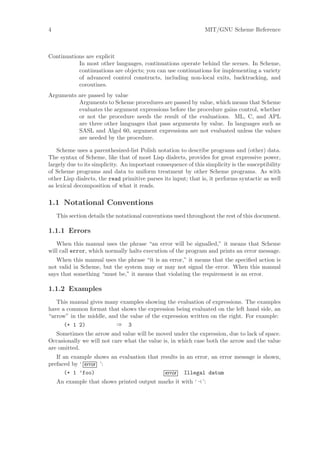
Continuations are explicit
           In most other languages, continuations operate behind the scenes. In Scheme,
           continuations are objects; you can use continuations for implementing a variety
           of advanced control constructs, including non-local exits, backtracking, and
           coroutines.
Arguments are passed by value
          Arguments to Scheme procedures are passed by value, which means that Scheme
          evaluates the argument expressions before the procedure gains control, whether
          or not the procedure needs the result of the evaluations. ML, C, and APL
          are three other languages that pass arguments by value. In languages such as
          SASL and Algol 60, argument expressions are not evaluated unless the values
          are needed by the procedure.

    Scheme uses a parenthesized-list Polish notation to describe programs and (other) data.
The syntax of Scheme, like that of most Lisp dialects, provides for great expressive power,
largely due to its simplicity. An important consequence of this simplicity is the susceptibility
of Scheme programs and data to uniform treatment by other Scheme programs. As with
other Lisp dialects, the read primitive parses its input; that is, it performs syntactic as well
as lexical decomposition of what it reads.

1.1 Notational Conventions
    This section details the notational conventions used throughout the rest of this document.

1.1.1 Errors
   When this manual uses the phrase “an error will be signalled,” it means that Scheme
will call error, which normally halts execution of the program and prints an error message.
   When this manual uses the phrase “it is an error,” it means that the specified action is
not valid in Scheme, but the system may or may not signal the error. When this manual
says that something “must be,” it means that violating the requirement is an error.

1.1.2 Examples
   This manual gives many examples showing the evaluation of expressions. The examples
have a common format that shows the expression being evaluated on the left hand side, an
“arrow” in the middle, and the value of the expression written on the right. For example:
      (+ 1 2)             ⇒ 3
   Sometimes the arrow and value will be moved under the expression, due to lack of space.
Occasionally we will not care what the value is, in which case both the arrow and the value
are omitted.
   If an example shows an evaluation that results in an error, an error message is shown,
prefaced by ‘ error ’:
      (+ 1 ’foo)                            error Illegal datum
    An example that shows printed output marks it with ‘       ’:
Chapter 1: Overview                                                                      5


      (begin (write ’foo) ’bar)
               foo
           ⇒ bar
   When this manual indicates that the value returned by some expression is unspecified,
it means that the expression will evaluate to some object without signalling an error, but
that programs should not depend on the value in any way.

1.1.3 Entry Format
   Each description of an MIT/GNU Scheme variable, special form, or procedure begins
with one or more header lines in this format:

template                                                                             category
where category specifies the kind of item (“variable”, “special form”, or “procedure”). The
form of template is interpreted depending on category.
Variable    Template consists of the variable’s name.
Special Form
           Template starts with the syntactic keyword of the special form, followed by a
           description of the special form’s syntax. The description is written using the
           following conventions.
           Named components are italicized in the printed manual, and uppercase in the
           Info file. “Noise” keywords, such as the else keyword in the cond special form,
           are set in a fixed width font in the printed manual; in the Info file they are not
           distinguished. Parentheses indicate themselves.
           A horizontal ellipsis (. . . ) is describes repeated components. Specifically,
                  thing . . .
           indicates zero or more occurrences of thing, while
                  thing thing . . .
           indicates one or more occurrences of thing.
           Brackets, [ ], enclose optional components.
           Several special forms (e.g. lambda) have an internal component consisting of a
           series of expressions; usually these expressions are evaluated sequentially un-
           der conditions that are specified in the description of the special form. This
           sequence of expressions is commonly referred to as the body of the special form.
Procedure Template starts with the name of the variable to which the procedure is bound,
          followed by a description of the procedure’s arguments. The arguments are
          described using “lambda list” notation (see Section 2.1 [Lambda Expressions],
          page 15), except that brackets are used to denote optional arguments, and
          ellipses are used to denote “rest” arguments.
          The names of the procedure’s arguments are italicized in the printed manual,
          and uppercase in the Info file.
          When an argument names a Scheme data type, it indicates that the argument
          must be that type of data object. For example,
6                                                             MIT/GNU Scheme Reference


             cdr pair                                                                procedure
             indicates that the standard Scheme procedure cdr takes one argument, which
             must be a pair.
             Many procedures signal an error when an argument is of the wrong type; usually
             this error is a condition of type condition-type:wrong-type-argument.
             In addition to the standard data-type names (pair, list, boolean, string, etc.),
             the following names as arguments also imply type restrictions:
               • object: any object
               • thunk: a procedure of no arguments
               • x, y: real numbers
               • q, n: integers
               • k: an exact non-negative integer
    Some examples:

list object . . .                                                               procedure
indicates that the standard Scheme procedure list takes zero or more arguments, each of
which may be any Scheme object.

write-char char [output-port]                                                    procedure
indicates that the standard Scheme procedure write-char must be called with a character,
char, and may also be called with a character and an output port.

1.2 Scheme Concepts

1.2.1 Variable Bindings
   Any identifier that is not a syntactic keyword may be used as a variable (see Section 1.3.3
[Identifiers], page 10). A variable may name a location where a value can be stored. A
variable that does so is said to be bound to the location. The value stored in the location
to which a variable is bound is called the variable’s value. (The variable is sometimes said
to name the value or to be bound to the value.)
   A variable may be bound but still not have a value; such a variable is said to be unas-
signed. Referencing an unassigned variable is an error. When this error is signalled, it is
a condition of type condition-type:unassigned-variable; sometimes the compiler does
not generate code to signal the error. Unassigned variables are useful only in combination
with side effects (see Section 2.5 [Assignments], page 22).

1.2.2 Environment Concepts
   An environment is a set of variable bindings. If an environment has no binding for a
variable, that variable is said to be unbound in that environment. Referencing an unbound
variable signals a condition of type condition-type:unbound-variable.
   A new environment can be created by extending an existing environment with a set of
new bindings. Note that “extending an environment” does not modify the environment;
Chapter 1: Overview                                                                       7


rather, it creates a new environment that contains the new bindings and the old ones. The
new bindings shadow the old ones; that is, if an environment that contains a binding for x
is extended with a new binding for x, then only the new binding is seen when x is looked
up in the extended environment. Sometimes we say that the original environment is the
parent of the new one, or that the new environment is a child of the old one, or that the
new environment inherits the bindings in the old one.
   Procedure calls extend an environment, as do let, let*, letrec, and do expressions.
Internal definitions (see Section 2.4.2 [Internal Definitions], page 21) also extend an envi-
ronment. (Actually, all the constructs that extend environments can be expressed in terms
of procedure calls, so there is really just one fundamental mechanism for environment ex-
tension.) A top-level definition (see Section 2.4.1 [Top-Level Definitions], page 21) may add
a binding to an existing environment.

1.2.3 Initial and Current Environments
    MIT/GNU Scheme provides an initial environment that contains all of the variable
bindings described in this manual. Most environments are ultimately extensions of this
initial environment. In Scheme, the environment in which your programs execute is actually
a child (extension) of the environment containing the system’s bindings. Thus, system
names are visible to your programs, but your names do not interfere with system programs.
   The environment in effect at some point in a program is called the current environment
at that point. In particular, every rep loop has a current environment. (rep stands for
“read-eval-print”; the rep loop is the Scheme program that reads your input, evaluates it,
and prints the result.) The environment of the top-level rep loop (the one you are in when
Scheme starts up) starts as user-initial-environment, although it can be changed by
the ge procedure. When a new rep loop is created, its environment is determined by the
program that creates it.

1.2.4 Static Scoping
   Scheme is a statically scoped language with block structure. In this respect, it is like
Algol and Pascal, and unlike most other dialects of Lisp except for Common Lisp.
   The fact that Scheme is statically scoped (rather than dynamically bound) means that
the environment that is extended (and becomes current) when a procedure is called is the
environment in which the procedure was created (i.e. in which the procedure’s defining
lambda expression was evaluated), not the environment in which the procedure is called.
Because all the other Scheme binding expressions can be expressed in terms of procedures,
this determines how all bindings behave.
    Consider the following definitions, made at the top-level rep loop (in the initial envi-
ronment):
       (define x 1)
       (define (f x) (g 2))
       (define (g y) (+ x y))
       (f 5)                                                  ⇒ 3 ; not 7
    Here f and g are bound to procedures created in the initial environment. Because Scheme
is statically scoped, the call to g from f extends the initial environment (the one in which
8                                                               MIT/GNU Scheme Reference


g was created) with a binding of y to 2. In this extended environment, y is 2 and x is 1.
(In a dynamically bound Lisp, the call to g would extend the environment in effect during
the call to f, in which x is bound to 5 by the call to f, and the answer would be 7.)
    Note that with static scoping, you can tell what binding a variable reference refers
to just from looking at the text of the program; the referenced binding cannot depend
on how the program is used. That is, the nesting of environments (their parent-child
relationship) corresponds to the nesting of binding expressions in program text. (Because
of this connection to the text of the program, static scoping is also called lexical scoping.)
For each place where a variable is bound in a program there is a corresponding region
of the program text within which the binding is effective. For example, the region of a
binding established by a lambda expression is the entire body of the lambda expression.
The documentation of each binding expression explains what the region of the bindings it
makes is. A use of a variable (that is, a reference to or assignment of a variable) refers to
the innermost binding of that variable whose region contains the variable use. If there is no
such region, the use refers to the binding of the variable in the global environment (which
is an ancestor of all other environments, and can be thought of as a region in which all your
programs are contained).

1.2.5 True and False
    In Scheme, the boolean values true and false are denoted by #t and #f. However, any
Scheme value can be treated as a boolean for the purpose of a conditional test. This manual
uses the word true to refer to any Scheme value that counts as true, and the word false to
refer to any Scheme value that counts as false. In conditional tests, all values count as true
except for #f, which counts as false (see Section 2.7 [Conditionals], page 24).
    Implementation note: In MIT/GNU Scheme, #f and the empty list are the same object,
and the printed representation of #f is always ‘()’. As this contradicts the Scheme standard,
MIT/GNU Scheme will be changed to make #f and the empty list different objects.

1.2.6 External Representations
   An important concept in Scheme is that of the external representation of an object as
a sequence of characters. For example, an external representation of the integer 28 is the
sequence of characters ‘28’, and an external representation of a list consisting of the integers
8 and 13 is the sequence of characters ‘(8 13)’.
   The external representation of an object is not necessarily unique. The integer 28 also
has representations ‘#e28.000’ and ‘#x1c’, and the list in the previous paragraph also has
the representations ‘( 08 13 )’ and ‘(8 . (13 . ( )))’.
   Many objects have standard external representations, but some, such as procedures
and circular data structures, do not have standard representations (although particular
implementations may define representations for them).
   An external representation may be written in a program to obtain the corresponding
object (see Section 2.6 [Quoting], page 22).
   External representations can also be used for input and output. The procedure read
parses external representations, and the procedure write generates them. Together, they
provide an elegant and powerful input/output facility.
Chapter 1: Overview                                                                         9


    Note that the sequence of characters ‘(+ 2 6)’ is not an external representation of the
integer 8, even though it is an expression that evaluates to the integer 8; rather, it is an
external representation of a three-element list, the elements of which are the symbol + and
the integers 2 and 6. Scheme’s syntax has the property that any sequence of characters
that is an expression is also the external representation of some object. This can lead to
confusion, since it may not be obvious out of context whether a given sequence of characters
is intended to denote data or program, but it is also a source of power, since it facilitates
writing programs such as interpreters and compilers that treat programs as data or data as
programs.

1.2.7 Disjointness of Types
   Every object satisfies at most one of the following predicates (but see Section 1.2.5 [True
and False], page 8, for an exception):
      bit-string?         environment?        port?               symbol?
      boolean?            null?               procedure?          vector?
      cell?               number?             promise?            weak-pair?
      char?               pair?               string?
      condition?

1.2.8 Storage Model
   This section describes a model that can be used to understand Scheme’s use of storage.
   Variables and objects such as pairs, vectors, and strings implicitly denote locations or
sequences of locations. A string, for example, denotes as many locations as there are
characters in the string. (These locations need not correspond to a full machine word.) A
new value may be stored into one of these locations using the string-set! procedure, but
the string continues to denote the same locations as before.
   An object fetched from a location, by a variable reference or by a procedure such as car,
vector-ref, or string-ref, is equivalent in the sense of eqv? to the object last stored in
the location before the fetch.
    Every location is marked to show whether it is in use. No variable or object ever refers
to a location that is not in use. Whenever this document speaks of storage being allocated
for a variable or object, what is meant is that an appropriate number of locations are chosen
from the set of locations that are not in use, and the chosen locations are marked to indicate
that they are now in use before the variable or object is made to denote them.
    In many systems it is desirable for constants (i.e. the values of literal expressions) to
reside in read-only memory. To express this, it is convenient to imagine that every object
that denotes locations is associated with a flag telling whether that object is mutable or
immutable. The constants and the strings returned by symbol->string are then the im-
mutable objects, while all objects created by other procedures are mutable. It is an error to
attempt to store a new value into a location that is denoted by an immutable object. Note
that the MIT/GNU Scheme compiler takes advantage of this property to share constants,
but that these constants are not immutable. Instead, two constants that are equal? may
be eq? in compiled code.
10                                                            MIT/GNU Scheme Reference


1.3 Lexical Conventions
     This section describes Scheme’s lexical conventions.

1.3.1 Whitespace
    Whitespace characters are spaces, newlines, tabs, and page breaks. Whitespace is used
to improve the readability of your programs and to separate tokens from each other, when
necessary. (A token is an indivisible lexical unit such as an identifier or number.) White-
space is otherwise insignificant. Whitespace may occur between any two tokens, but not
within a token. Whitespace may also occur inside a string, where it is significant.

1.3.2 Delimiters
   All whitespace characters are delimiters. In addition, the following characters act as
delimiters:
       (   )   ;   "   ’   ‘   |
   Finally, these next characters act as delimiters, despite the fact that Scheme does not
define any special meaning for them:
       [   ]   {   }
     For example, if the value of the variable name is "max":
        (list"Hi"name(+ 1 2))                            ⇒ ("Hi" "max" 3)

1.3.3 Identifiers
    An identifier is a sequence of one or more non-delimiter characters. Identifiers are used
in several ways in Scheme programs:
 • An identifier can be used as a variable or as a syntactic keyword.
 • When an identifier appears as a literal or within a literal, it denotes a symbol.
  Scheme accepts most of the identifiers that other programming languages allow.
MIT/GNU Scheme allows all of the identifiers that standard Scheme does, plus many
more.
   MIT/GNU Scheme defines a potential identifier to be a sequence of non-delimiter char-
acters that does not begin with either of the characters ‘#’ or ‘,’. Any such sequence of
characters that is not a syntactically valid number (see Chapter 4 [Numbers], page 61) is
considered to be a valid identifier. Note that, although it is legal for ‘#’ and ‘,’ to appear
in an identifier (other than in the first character position), it is poor programming practice.
     Here are some examples of identifiers:
       lambda             q
       list->vector       soup
       +                  V17a
       <=?                a34kTMNs
       the-word-recursion-has-many-meanings
Chapter 1: Overview                                                                       11


1.3.4 Uppercase and Lowercase
   Scheme doesn’t distinguish uppercase and lowercase forms of a letter except within
character and string constants; in other words, Scheme is case-insensitive. For example,
‘Foo’ is the same identifier as ‘FOO’, and ‘#x1AB’ is the same number as ‘#X1ab’. But ‘#a’
and ‘#A’ are different characters.

1.3.5 Naming Conventions
   A predicate is a procedure that always returns a boolean value (#t or #f). By convention,
predicates usually have names that end in ‘?’.
   A mutation procedure is a procedure that alters a data structure. By convention, mu-
tation procedures usually have names that end in ‘!’.

1.3.6 Comments
   The beginning of a comment is indicated with a semicolon (;). Scheme ignores everything
on a line in which a semicolon appears, from the semicolon until the end of the line. The
entire comment, including the newline character that terminates it, is treated as whitespace.
   An alternative form of comment (sometimes called an extended comment) begins with
the characters ‘#|’ and ends with the characters ‘|#’. This alternative form is an MIT/GNU
Scheme extension. As with ordinary comments, all of the characters in an extended com-
ment, including the leading ‘#|’ and trailing ‘|#’, are treated as whitespace. Comments
of this form may extend over multiple lines, and additionally may be nested (unlike the
comments of the programming language C, which have a similar syntax).
      ;;; This is a comment about the FACT procedure. Scheme
      ;;; ignores all of this comment. The FACT procedure computes
      ;;; the factorial of a non-negative integer.
      #|
      This is an extended comment.
      Such comments are useful for commenting out code fragments.
      |#
      (define fact
        (lambda (n)
          (if (= n 0)                              ;This is another comment:
              1                                    ;Base case: return 1
              (* n (fact (- n 1))))))

1.3.7 Additional Notations
   The following list describes additional notations used in Scheme. See Chapter 4 [Num-
bers], page 61, for a description of the notations used for numbers.
+-.         The plus sign, minus sign, and period are used in numbers, and may also occur
            in an identifier. A delimited period (not occurring within a number or identifier)
            is used in the notation for pairs and to indicate a “rest” parameter in a formal
            parameter list (see Section 2.1 [Lambda Expressions], page 15).
12                                                            MIT/GNU Scheme Reference


()         Parentheses are used for grouping and to notate lists (see Chapter 7 [Lists],
           page 113).
"          The double quote delimits strings (see Chapter 6 [Strings], page 95).
          The backslash is used in the syntax for character constants (see Chapter 5
           [Characters], page 81) and as an escape character within string constants (see
           Chapter 6 [Strings], page 95).
;          The semicolon starts a comment.
’          The single quote indicates literal data; it suppresses evaluation (see Section 2.6
           [Quoting], page 22).
‘          The backquote indicates almost-constant data (see Section 2.6 [Quoting],
           page 22).
,          The comma is used in conjunction with the backquote (see Section 2.6 [Quoting],
           page 22).
,@         A comma followed by an at-sign is used in conjunction with the backquote (see
           Section 2.6 [Quoting], page 22).
#          The sharp (or pound) sign has different uses, depending on the character that
           immediately follows it:
#t #f      These character sequences denote the boolean constants (see Section 10.1
           [Booleans], page 135).
#         This character sequence introduces a character constant (see Chapter 5 [Char-
           acters], page 81).
#(         This character sequence introduces a vector constant (see Chapter 8 [Vectors],
           page 127). A close parenthesis, ‘)’, terminates a vector constant.
#e #i #b #o #d #l #s #x
           These character sequences are used in the notation for numbers (see Chapter 4
           [Numbers], page 61).
#|         This character sequence introduces an extended comment. The comment is
           terminated by the sequence ‘|#’. This notation is an MIT/GNU Scheme exten-
           sion.
#!         This character sequence is used to denote a small set of named constants. Cur-
           rently there are only two of these, #!optional and #!rest, both of which are
           used in the lambda special form to mark certain parameters as being “optional”
           or “rest” parameters. This notation is an MIT/GNU Scheme extension.
#*         This character sequence introduces a bit string (see Chapter 9 [Bit Strings],
           page 131). This notation is an MIT/GNU Scheme extension.
#[         This character sequence is used to denote objects that do not have a readable
           external representation (see Section 14.7 [Custom Output], page 201). A close
           bracket, ‘]’, terminates the object’s notation. This notation is an MIT/GNU
           Scheme extension.
Chapter 1: Overview                                                                       13


#@          This character sequence is a convenient shorthand used to refer to objects by
            their hash number (see Section 14.7 [Custom Output], page 201). This notation
            is an MIT/GNU Scheme extension.
#=
##          These character sequences introduce a notation used to show circular structures
            in printed output, or to denote them in input. The notation works much like
            that in Common Lisp, and is an MIT/GNU Scheme extension.

1.4 Expressions
   A Scheme expression is a construct that returns a value. An expression may be a literal,
a variable reference, a special form, or a procedure call.

1.4.1 Literal Expressions
   Literal constants may be written by using an external representation of the data. In
general, the external representation must be quoted (see Section 2.6 [Quoting], page 22);
but some external representations can be used without quotation.
      "abc"                                           ⇒ "abc"
      145932                                          ⇒ 145932
      #t                                              ⇒ #t
      #a                                             ⇒ #a
   The external representation of numeric constants, string constants, character constants,
and boolean constants evaluate to the constants themselves. Symbols, pairs, lists, and
vectors require quoting.

1.4.2 Variable References
   An expression consisting of an identifier (see Section 1.3.3 [Identifiers], page 10) is a
variable reference; the identifier is the name of the variable being referenced. The value of
the variable reference is the value stored in the location to which the variable is bound. An
error is signalled if the referenced variable is unbound or unassigned.
       (define x 28)
       x                                                 ⇒ 28

1.4.3 Special Form Syntax
       (keyword component ...)
   A parenthesized expression that starts with a syntactic keyword is a special form. Each
special form has its own syntax, which is described later in the manual.
   Note that syntactic keywords and variable bindings share the same namespace. A local
variable binding may shadow a syntactic keyword, and a local syntactic-keyword definition
may shadow a variable binding.
   The following list contains all of the syntactic keywords that are defined when MIT/GNU
Scheme is initialized:
access                             and                            begin
14                                                              MIT/GNU Scheme Reference


case                             cond                            cons-stream
declare                          default-object?                 define
define-integrable                 define-structure                 define-syntax
delay                            do                              er-macro-transformer
fluid-let                         if                              lambda
let                              let*                            let*-syntax
let-syntax                       letrec                          letrec-syntax
local-declare                    named-lambda                    non-hygienic-macro-
                                                                 transformer
or                               quasiquote                      quote
rsc-macro-transformer            sc-macro-transformer            set!
syntax-rules                     the-environment

1.4.4 Procedure Call Syntax
        (operator operand ...)
    A procedure call is written by simply enclosing in parentheses expressions for the proce-
dure to be called (the operator) and the arguments to be passed to it (the operands). The
operator and operand expressions are evaluated and the resulting procedure is passed the
resulting arguments. See Section 2.1 [Lambda Expressions], page 15, for a more complete
description of this.
    Another name for the procedure call expression is combination. This word is more
specific in that it always refers to the expression; “procedure call” sometimes refers to the
process of calling a procedure.
    Unlike some other dialects of Lisp, Scheme always evaluates the operator expression
and the operand expressions with the same evaluation rules, and the order of evaluation is
unspecified.
        (+ 3 4)                                         ⇒ 7
        ((if #f = *) 3 4)                               ⇒ 12
    A number of procedures are available as the values of variables in the initial environment;
for example, the addition and multiplication procedures in the above examples are the values
of the variables + and *. New procedures are created by evaluating lambda expressions.
    If the operator is a syntactic keyword, then the expression is not treated as a procedure
call: it is a special form.
Chapter 2: Special Forms                                                                   15


2 Special Forms
    A special form is an expression that follows special evaluation rules. This chapter de-
scribes the basic Scheme special forms.

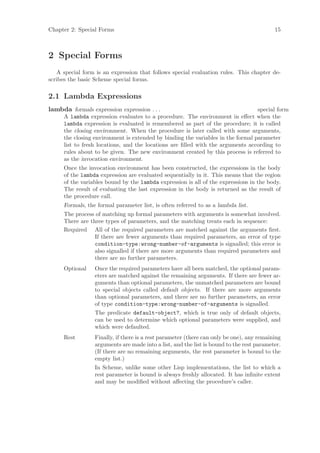
2.1 Lambda Expressions
lambda formals expression expression . . .                                        special form
      A lambda expression evaluates to a procedure. The environment in effect when the
      lambda expression is evaluated is remembered as part of the procedure; it is called
      the closing environment. When the procedure is later called with some arguments,
      the closing environment is extended by binding the variables in the formal parameter
      list to fresh locations, and the locations are filled with the arguments according to
      rules about to be given. The new environment created by this process is referred to
      as the invocation environment.
      Once the invocation environment has been constructed, the expressions in the body
      of the lambda expression are evaluated sequentially in it. This means that the region
      of the variables bound by the lambda expression is all of the expressions in the body.
      The result of evaluating the last expression in the body is returned as the result of
      the procedure call.
      Formals, the formal parameter list, is often referred to as a lambda list.
      The process of matching up formal parameters with arguments is somewhat involved.
      There are three types of parameters, and the matching treats each in sequence:
      Required All of the required parameters are matched against the arguments first.
                  If there are fewer arguments than required parameters, an error of type
                  condition-type:wrong-number-of-arguments is signalled; this error is
                  also signalled if there are more arguments than required parameters and
                  there are no further parameters.
      Optional    Once the required parameters have all been matched, the optional param-
                  eters are matched against the remaining arguments. If there are fewer ar-
                  guments than optional parameters, the unmatched parameters are bound
                  to special objects called default objects. If there are more arguments
                  than optional parameters, and there are no further parameters, an error
                  of type condition-type:wrong-number-of-arguments is signalled.
                  The predicate default-object?, which is true only of default objects,
                  can be used to determine which optional parameters were supplied, and
                  which were defaulted.
      Rest        Finally, if there is a rest parameter (there can only be one), any remaining
                  arguments are made into a list, and the list is bound to the rest parameter.
                  (If there are no remaining arguments, the rest parameter is bound to the
                  empty list.)
                  In Scheme, unlike some other Lisp implementations, the list to which a
                  rest parameter is bound is always freshly allocated. It has infinite extent
                  and may be modified without affecting the procedure’s caller.
16                                                          MIT/GNU Scheme Reference


     Specially recognized keywords divide the formals parameters into these three classes.
     The keywords used here are ‘#!optional’, ‘.’, and ‘#!rest’. Note that only ‘.’ is
     defined by standard Scheme — the other keywords are MIT/GNU Scheme extensions.
     ‘#!rest’ has the same meaning as ‘.’ in formals.
     The use of these keywords is best explained by means of examples. The following
     are typical lambda lists, followed by descriptions of which parameters are required,
     optional, and rest. We will use ‘#!rest’ in these examples, but anywhere it appears
     ‘.’ could be used instead.
     (a b c)      a, b, and c are all required. The procedure must be passed exactly three
                  arguments.
     (a b #!optional c)
                a and b are required, c is optional. The procedure may be passed either
                two or three arguments.
     (#!optional a b c)
               a, b, and c are all optional. The procedure may be passed any number
               of arguments between zero and three, inclusive.
     a
     (#!rest a)
                  These two examples are equivalent. a is a rest parameter. The procedure
                  may be passed any number of arguments. Note: this is the only case in
                  which ‘.’ cannot be used in place of ‘#!rest’.
     (a b #!optional c d #!rest e)
                a and b are required, c and d are optional, and e is rest. The procedure
                may be passed two or more arguments.
     Some examples of lambda expressions:
          (lambda (x) (+ x x))                    ⇒   #[compound-procedure 53]

           ((lambda (x) (+ x x)) 4)                        ⇒    8

           (define reverse-subtract
             (lambda (x y)
               (- y x)))
           (reverse-subtract 7 10)                         ⇒    3

           (define foo
             (let ((x 4))
               (lambda (y) (+ x y))))
           (foo 6)                                         ⇒    10

named-lambda formals expression expression . . .                              special form
     The named-lambda special form is similar to lambda, except that the first “required
     parameter” in formals is not a parameter but the name of the resulting procedure;
     thus formals must have at least one required parameter. This name has no semantic
     meaning, but is included in the external representation of the procedure, making
Chapter 2: Special Forms                                                                  17


      it useful for debugging. In MIT/GNU Scheme, lambda is implemented as named-
      lambda, with a special name that means “unnamed”.
            (named-lambda (f x) (+ x x))        ⇒ #[compound-procedure 53 f]
            ((named-lambda (f x) (+ x x)) 4)            ⇒ 8

2.2 Lexical Binding
   The three binding constructs let, let*, and letrec, give Scheme block structure. The
syntax of the three constructs is identical, but they differ in the regions they establish for
their variable bindings. In a let expression, the initial values are computed before any
of the variables become bound. In a let* expression, the evaluations and bindings are
sequentially interleaved. And in a letrec expression, all the bindings are in effect while
the initial values are being computed (thus allowing mutually recursive definitions).

let ((variable init) . . . ) expression expression . . .                           special form
      The inits are evaluated in the current environment (in some unspecified order), the
      variables are bound to fresh locations holding the results, the expressions are evalu-
      ated sequentially in the extended environment, and the value of the last expression is
      returned. Each binding of a variable has the expressions as its region.
      MIT/GNU Scheme allows any of the inits to be omitted, in which case the corre-
      sponding variables are unassigned.
      Note that the following are equivalent:
            (let ((variable init) ...) expression expression ...)
            ((lambda (variable ...) expression expression ...) init ...)
      Some examples:
            (let ((x 2) (y 3))
               (* x y))                                     ⇒ 6
            (let ((x 2) (y 3))
              (let ((foo (lambda (z) (+ x y z)))
                      (x 7))
                 (foo 4)))                                    ⇒ 9
      See Section 2.9 [Iteration], page 27, for information on “named let”.

let* ((variable init) . . . ) expression expression . . .                          special form
      let* is similar to let, but the bindings are performed sequentially from left to right,
      and the region of a binding is that part of the let* expression to the right of the
      binding. Thus the second binding is done in an environment in which the first binding
      is visible, and so on.
      Note that the following are equivalent:
             (let* ((variable1 init1)
                      (variable2 init2)
                      ...
                      (variableN initN ))
                  expression
                  expression ...)
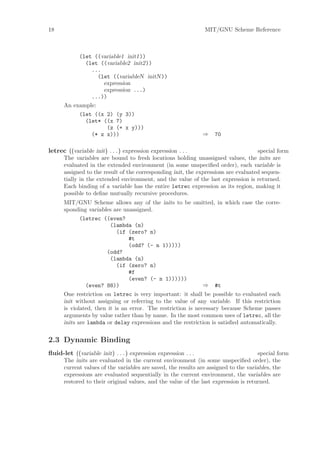
18                                                              MIT/GNU Scheme Reference


           (let ((variable1 init1))
             (let ((variable2 init2))
               ...
                  (let ((variableN initN ))
                    expression
                    expression ...)
               ...))
      An example:
             (let ((x 2) (y 3))
               (let* ((x 7)
                      (z (+ x y)))
                 (* z x)))                                      ⇒   70

letrec ((variable init) . . . ) expression expression . . .                         special form
      The variables are bound to fresh locations holding unassigned values, the inits are
      evaluated in the extended environment (in some unspecified order), each variable is
      assigned to the result of the corresponding init, the expressions are evaluated sequen-
      tially in the extended environment, and the value of the last expression is returned.
      Each binding of a variable has the entire letrec expression as its region, making it
      possible to define mutually recursive procedures.
      MIT/GNU Scheme allows any of the inits to be omitted, in which case the corre-
      sponding variables are unassigned.
             (letrec ((even?
                         (lambda (n)
                            (if (zero? n)
                                 #t
                                 (odd? (- n 1)))))
                       (odd?
                         (lambda (n)
                            (if (zero? n)
                                 #f
                                 (even? (- n 1))))))
               (even? 88))                                    ⇒ #t
      One restriction on letrec is very important: it shall be possible to evaluated each
      init without assigning or referring to the value of any variable. If this restriction
      is violated, then it is an error. The restriction is necessary because Scheme passes
      arguments by value rather than by name. In the most common uses of letrec, all the
      inits are lambda or delay expressions and the restriction is satisfied automatically.


2.3 Dynamic Binding
fluid-let ((variable init) . . . ) expression expression . . .                         special form
      The inits are evaluated in the current environment (in some unspecified order), the
      current values of the variables are saved, the results are assigned to the variables, the
      expressions are evaluated sequentially in the current environment, the variables are
      restored to their original values, and the value of the last expression is returned.
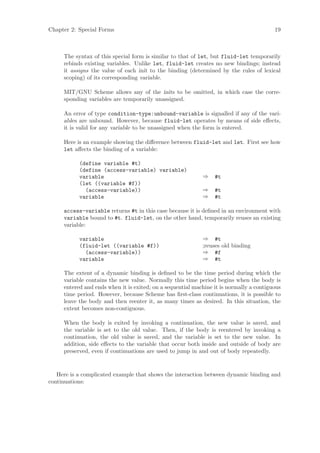
Chapter 2: Special Forms                                                                 19


     The syntax of this special form is similar to that of let, but fluid-let temporarily
     rebinds existing variables. Unlike let, fluid-let creates no new bindings; instead
     it assigns the value of each init to the binding (determined by the rules of lexical
     scoping) of its corresponding variable.
     MIT/GNU Scheme allows any of the inits to be omitted, in which case the corre-
     sponding variables are temporarily unassigned.

     An error of type condition-type:unbound-variable is signalled if any of the vari-
     ables are unbound. However, because fluid-let operates by means of side effects,
     it is valid for any variable to be unassigned when the form is entered.

     Here is an example showing the difference between fluid-let and let. First see how
     let affects the binding of a variable:

           (define variable #t)
           (define (access-variable) variable)
           variable                                         ⇒    #t
           (let ((variable #f))
             (access-variable))                             ⇒    #t
           variable                                         ⇒    #t

     access-variable returns #t in this case because it is defined in an environment with
     variable bound to #t. fluid-let, on the other hand, temporarily reuses an existing
     variable:

           variable                                         ⇒ #t
           (fluid-let ((variable #f))                       ;reuses old binding
             (access-variable))                             ⇒ #f
           variable                                         ⇒ #t

     The extent of a dynamic binding is defined to be the time period during which the
     variable contains the new value. Normally this time period begins when the body is
     entered and ends when it is exited; on a sequential machine it is normally a contiguous
     time period. However, because Scheme has first-class continuations, it is possible to
     leave the body and then reenter it, as many times as desired. In this situation, the
     extent becomes non-contiguous.

     When the body is exited by invoking a continuation, the new value is saved, and
     the variable is set to the old value. Then, if the body is reentered by invoking a
     continuation, the old value is saved, and the variable is set to the new value. In
     addition, side effects to the variable that occur both inside and outside of body are
     preserved, even if continuations are used to jump in and out of body repeatedly.


   Here is a complicated example that shows the interaction between dynamic binding and
continuations:
20                                                           MIT/GNU Scheme Reference


     (define (complicated-dynamic-binding)
       (let ((variable 1)
             (inside-continuation))
         (write-line variable)
         (call-with-current-continuation
          (lambda (outside-continuation)
            (fluid-let ((variable 2))
              (write-line variable)
              (set! variable 3)
              (call-with-current-continuation
               (lambda (k)
                 (set! inside-continuation k)
                 (outside-continuation #t)))
              (write-line variable)
              (set! inside-continuation #f))))
         (write-line variable)
         (if inside-continuation
             (begin
               (set! variable 4)
               (inside-continuation #f)))))
Evaluating ‘(complicated-dynamic-binding)’ writes the following on the console:
     1
     2
     1
     3
     4
Commentary: the first two values written are the initial binding of variable and its
new binding after the fluid-let’s body is entered. Immediately after they are written,
variable is set to ‘3’, and then outside-continuation is invoked, causing us to exit the
body. At this point, ‘1’ is written, demonstrating that the original value of variable has
been restored, because we have left the body. Then we set variable to ‘4’ and reenter the
body by invoking inside-continuation. At this point, ‘3’ is written, indicating that the
side effect that previously occurred within the body has been preserved. Finally, we exit
body normally, and write ‘4’, demonstrating that the side effect that occurred outside of
the body was also preserved.


2.4 Definitions
define variable [expression]                                                        special form
define formals expression expression . . .                                          special form
     Definitions are valid in some but not all contexts where expressions are allowed.
     Definitions may only occur at the top level of a program and at the beginning of
     a lambda body (that is, the body of a lambda, let, let*, letrec, fluid-let, or
     “procedure define” expression). A definition that occurs at the top level of a program
     is called a top-level definition, and a definition that occurs at the beginning of a body
     is called an internal definition.
Chapter 2: Special Forms                                                                  21


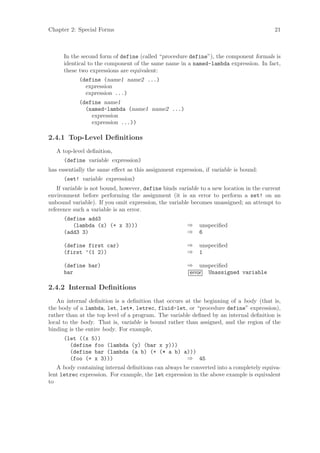
      In the second form of define (called “procedure define”), the component formals is
      identical to the component of the same name in a named-lambda expression. In fact,
      these two expressions are equivalent:
            (define (name1 name2 ...)
              expression
              expression ...)
            (define name1
              (named-lambda (name1 name2 ...)
                expression
                expression ...))

2.4.1 Top-Level Definitions
   A top-level definition,
      (define variable expression)
has essentially the same effect as this assignment expression, if variable is bound:
      (set! variable expression)
    If variable is not bound, however, define binds variable to a new location in the current
environment before performing the assignment (it is an error to perform a set! on an
unbound variable). If you omit expression, the variable becomes unassigned; an attempt to
reference such a variable is an error.
      (define add3
         (lambda (x) (+ x 3)))                         ⇒    unspecified
      (add3 3)                                         ⇒    6

      (define first car)                               ⇒    unspecified
      (first ’(1 2))                                   ⇒    1

      (define bar)                                     ⇒ unspecified
      bar                                              error Unassigned variable

2.4.2 Internal Definitions
   An internal definition is a definition that occurs at the beginning of a body (that is,
the body of a lambda, let, let*, letrec, fluid-let, or “procedure define” expression),
rather than at the top level of a program. The variable defined by an internal definition is
local to the body. That is, variable is bound rather than assigned, and the region of the
binding is the entire body. For example,
      (let ((x 5))
        (define foo (lambda (y) (bar x y)))
        (define bar (lambda (a b) (+ (* a b) a)))
        (foo (+ x 3)))                        ⇒ 45
   A body containing internal definitions can always be converted into a completely equiva-
lent letrec expression. For example, the let expression in the above example is equivalent
to
22                                                             MIT/GNU Scheme Reference


      (let ((x 5))
        (letrec ((foo (lambda (y) (bar x y)))
                 (bar (lambda (a b) (+ (* a b) a))))
          (foo (+ x 3))))


2.5 Assignments
set! variable [expression]                                                           special form
      If expression is specified, evaluates expression and stores the resulting value in the
      location to which variable is bound. If expression is omitted, variable is altered to be
      unassigned; a subsequent reference to such a variable is an error. In either case, the
      value of the set! expression is unspecified.
      Variable must be bound either in some region enclosing the set! expression, or at
      the top level. However, variable is permitted to be unassigned when the set! form
      is entered.
            (define x 2)                                      ⇒    unspecified
            (+ x 1)                                           ⇒    3
            (set! x 4)                                        ⇒    unspecified
            (+ x 1)                                           ⇒    5
      Variable may be an access expression (see Chapter 13 [Environments], page 181).
      This allows you to assign variables in an arbitrary environment. For example,
            (define x (let ((y 0)) (the-environment)))
            (define y ’a)
            y                                       ⇒              a
            (access y x)                            ⇒              0
            (set! (access y x) 1)                   ⇒              unspecified
            y                                       ⇒              a
            (access y x)                            ⇒              1


2.6 Quoting
   This section describes the expressions that are used to modify or prevent the evaluation
of objects.


quote datum                                                                     special form
      (quote datum) evaluates to datum. Datum may be any external representation of a
      Scheme object (see Section 1.2.6 [External Representations], page 8). Use quote to
      include literal constants in Scheme code.
            (quote a)                                         ⇒    a
            (quote #(a b c))                                  ⇒    #(a b c)
            (quote (+ 1 2))                                   ⇒    (+ 1 2)
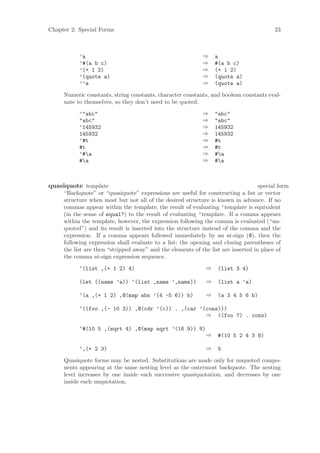
      (quote datum) may be abbreviated as ’datum. The two notations are equivalent in
      all respects.
Chapter 2: Special Forms                                                                 23


           ’a                                               ⇒    a
           ’#(a b c)                                        ⇒    #(a b c)
           ’(+ 1 2)                                         ⇒    (+ 1 2)
           ’(quote a)                                       ⇒    (quote a)
           ’’a                                              ⇒    (quote a)
     Numeric constants, string constants, character constants, and boolean constants eval-
     uate to themselves, so they don’t need to be quoted.

           ’"abc"                                           ⇒    "abc"
           "abc"                                            ⇒    "abc"
           ’145932                                          ⇒    145932
           145932                                           ⇒    145932
           ’#t                                              ⇒    #t
           #t                                               ⇒    #t
           ’#a                                             ⇒    #a
           #a                                              ⇒    #a


quasiquote template                                                                special form
     “Backquote” or “quasiquote” expressions are useful for constructing a list or vector
     structure when most but not all of the desired structure is known in advance. If no
     commas appear within the template, the result of evaluating ‘template is equivalent
     (in the sense of equal?) to the result of evaluating ’template. If a comma appears
     within the template, however, the expression following the comma is evaluated (“un-
     quoted”) and its result is inserted into the structure instead of the comma and the
     expression. If a comma appears followed immediately by an at-sign (@), then the
     following expression shall evaluate to a list; the opening and closing parentheses of
     the list are then “stripped away” and the elements of the list are inserted in place of
     the comma at-sign expression sequence.

           ‘(list ,(+ 1 2) 4)                                ⇒    (list 3 4)

           (let ((name ’a)) ‘(list ,name ’,name))            ⇒    (list a ’a)

           ‘(a ,(+ 1 2) ,@(map abs ’(4 -5 6)) b)             ⇒    (a 3 4 5 6 b)

           ‘((foo ,(- 10 3)) ,@(cdr ’(c)) . ,(car ’(cons)))
                                                    ⇒ ((foo 7) . cons)

           ‘#(10 5 ,(sqrt 4) ,@(map sqrt ’(16 9)) 8)
                                                             ⇒    #(10 5 2 4 3 8)

           ‘,(+ 2 3)                                         ⇒    5
     Quasiquote forms may be nested. Substitutions are made only for unquoted compo-
     nents appearing at the same nesting level as the outermost backquote. The nesting
     level increases by one inside each successive quasiquotation, and decreases by one
     inside each unquotation.
24                                                            MIT/GNU Scheme Reference


            ‘(a ‘(b ,(+ 1 2) ,(foo ,(+ 1 3) d) e) f)
                 ⇒ (a ‘(b ,(+ 1 2) ,(foo 4 d) e) f)

            (let ((name1 ’x)
                  (name2 ’y))
               ‘(a ‘(b ,,name1 ,’,name2 d) e))
                 ⇒ (a ‘(b ,x ,’y d) e)
      The notations ‘template and (quasiquote template) are identical in all respects.
      ,expression is identical to (unquote expression) and ,@expression is identical to
      (unquote-splicing expression).
            (quasiquote (list (unquote (+ 1 2)) 4))
                 ⇒ (list 3 4)

           ’(quasiquote (list (unquote (+ 1 2)) 4))
                 ⇒ ‘(list ,(+ 1 2) 4)
                 i.e., (quasiquote (list (unquote (+ 1 2)) 4))
      Unpredictable behavior can result if any of the symbols quasiquote, unquote, or
      unquote-splicing appear in a template in ways otherwise than as described above.


2.7 Conditionals
   The behavior of the conditional expressions is determined by whether objects are true
or false. The conditional expressions count only #f as false. They count everything else,
including #t, pairs, symbols, numbers, strings, vectors, and procedures as true (but see
Section 1.2.5 [True and False], page 8).
   In the descriptions that follow, we say that an object has “a true value” or “is true”
when the conditional expressions treat it as true, and we say that an object has “a false
value” or “is false” when the conditional expressions treat it as false.

if predicate consequent [alternative]                                               special form
      Predicate, consequent, and alternative are expressions. An if expression is evaluated
      as follows: first, predicate is evaluated. If it yields a true value, then consequent is
      evaluated and its value is returned. Otherwise alternative is evaluated and its value
      is returned. If predicate yields a false value and no alternative is specified, then the
      result of the expression is unspecified.
      An if expression evaluates either consequent or alternative, never both. Programs
      should not depend on the value of an if expression that has no alternative.
            (if (> 3 2) ’yes ’no)                          ⇒ yes
            (if (> 2 3) ’yes ’no)                          ⇒ no
            (if (> 3 2)
                (- 3 2)
                (+ 3 2))                                   ⇒ 1

cond clause clause . . .                                                           special form
      Each clause has this form:
Chapter 2: Special Forms                                                                     25


             (predicate expression ...)
      where predicate is any expression. The last clause may be an else clause, which has
      the form:
             (else expression expression ...)
      A cond expression does the following:
       1. Evaluates the predicate expressions of successive clauses in order, until one of
           the predicates evaluates to a true value.
       2. When a predicate evaluates to a true value, cond evaluates the expressions in
           the associated clause in left to right order, and returns the result of evaluating
           the last expression in the clause as the result of the entire cond expression.
           If the selected clause contains only the predicate and no expressions, cond returns
           the value of the predicate as the result.
       3. If all predicates evaluate to false values, and there is no else clause, the result of
           the conditional expression is unspecified; if there is an else clause, cond evaluates
           its expressions (left to right) and returns the value of the last one.
             (cond ((> 3 2) ’greater)
                     ((< 3 2) ’less))                           ⇒ greater

             (cond ((> 3 3) ’greater)
                    ((< 3 3) ’less)
                    (else ’equal))                            ⇒ equal
      Normally, programs should not depend on the value of a cond expression that has no
      else clause. However, some Scheme programmers prefer to write cond expressions
      in which at least one of the predicates is always true. In this style, the final clause is
      equivalent to an else clause.
      Scheme supports an alternative clause syntax:
             (predicate => recipient)
      where recipient is an expression. If predicate evaluates to a true value, then recipient
      is evaluated. Its value must be a procedure of one argument; this procedure is then
      invoked on the value of the predicate.
             (cond ((assv ’b ’((a 1) (b 2))) => cadr)
                    (else #f))                                ⇒ 2

case key clause clause . . .                                                        special form
      Key may be any expression. Each clause has this form:
            ((object ...) expression expression ...)
      No object is evaluated, and all the objects must be distinct. The last clause may be
      an else clause, which has the form:
            (else expression expression ...)
      A case expression does the following:
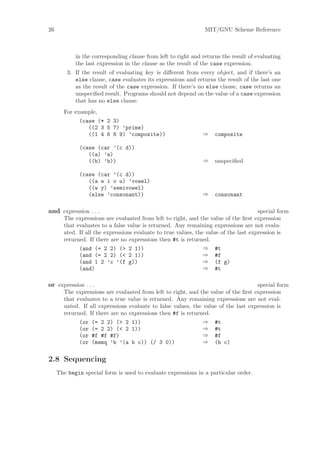
       1. Evaluates key and compares the result with each object.
       2. If the result of evaluating key is equivalent (in the sense of eqv?; see Chapter 3
          [Equivalence Predicates], page 55) to an object, case evaluates the expressions
26                                                              MIT/GNU Scheme Reference


            in the corresponding clause from left to right and returns the result of evaluating
            the last expression in the clause as the result of the case expression.
         3. If the result of evaluating key is different from every object, and if there’s an
            else clause, case evaluates its expressions and returns the result of the last one
            as the result of the case expression. If there’s no else clause, case returns an
            unspecified result. Programs should not depend on the value of a case expression
            that has no else clause.
       For example,
              (case (* 2 3)
                 ((2 3 5 7) ’prime)
                 ((1 4 6 8 9) ’composite))                     ⇒    composite

              (case (car ’(c d))
                 ((a) ’a)
                 ((b) ’b))                                     ⇒    unspecified

              (case (car ’(c d))
                 ((a e i o u) ’vowel)
                 ((w y) ’semivowel)
                 (else ’consonant))                            ⇒    consonant

and expression . . .                                                                  special form
       The expressions are evaluated from left to right, and the value of the first expression
       that evaluates to a false value is returned. Any remaining expressions are not evalu-
       ated. If all the expressions evaluate to true values, the value of the last expression is
       returned. If there are no expressions then #t is returned.
             (and (= 2 2) (> 2 1))                              ⇒ #t
             (and (= 2 2) (< 2 1))                              ⇒ #f
             (and 1 2 ’c ’(f g))                                ⇒ (f g)
             (and)                                              ⇒ #t

or expression . . .                                                                 special form
       The expressions are evaluated from left to right, and the value of the first expression
       that evaluates to a true value is returned. Any remaining expressions are not eval-
       uated. If all expressions evaluate to false values, the value of the last expression is
       returned. If there are no expressions then #f is returned.
             (or (= 2 2) (> 2 1))                              ⇒ #t
             (or (= 2 2) (< 2 1))                              ⇒ #t
             (or #f #f #f)                                     ⇒ #f
             (or (memq ’b ’(a b c)) (/ 3 0))                   ⇒ (b c)


2.8 Sequencing
     The begin special form is used to evaluate expressions in a particular order.
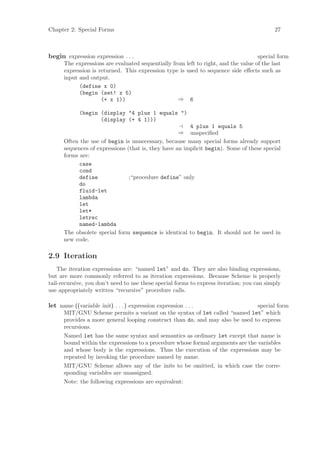
Chapter 2: Special Forms                                                                   27


begin expression expression . . .                                                   special form
      The expressions are evaluated sequentially from left to right, and the value of the last
      expression is returned. This expression type is used to sequence side effects such as
      input and output.
            (define x 0)
            (begin (set! x 5)
                     (+ x 1))                      ⇒ 6

             (begin (display "4 plus 1 equals ")
                    (display (+ 4 1)))
                                                        4 plus 1 equals 5
                                                    ⇒ unspecified
      Often the use of begin is unnecessary, because many special forms already support
      sequences of expressions (that is, they have an implicit begin). Some of these special
      forms are:
            case
            cond
            define              ;“procedure define” only
            do
            fluid-let
            lambda
            let
            let*
            letrec
            named-lambda
      The obsolete special form sequence is identical to begin. It should not be used in
      new code.

2.9 Iteration
    The iteration expressions are: “named let” and do. They are also binding expressions,
but are more commonly referred to as iteration expressions. Because Scheme is properly
tail-recursive, you don’t need to use these special forms to express iteration; you can simply
use appropriately written “recursive” procedure calls.

let name ((variable init) . . . ) expression expression . . .                  special form
      MIT/GNU Scheme permits a variant on the syntax of let called “named let” which
      provides a more general looping construct than do, and may also be used to express
      recursions.
      Named let has the same syntax and semantics as ordinary let except that name is
      bound within the expressions to a procedure whose formal arguments are the variables
      and whose body is the expressions. Thus the execution of the expressions may be
      repeated by invoking the procedure named by name.
      MIT/GNU Scheme allows any of the inits to be omitted, in which case the corre-
      sponding variables are unassigned.
      Note: the following expressions are equivalent:
28                                                                MIT/GNU Scheme Reference


             (let name ((variable init) ...)
               expression
               expression ...)

            ((letrec ((name
                         (named-lambda (name variable ...)
                           expression
                           expression ...)))
                name)
             init ...)
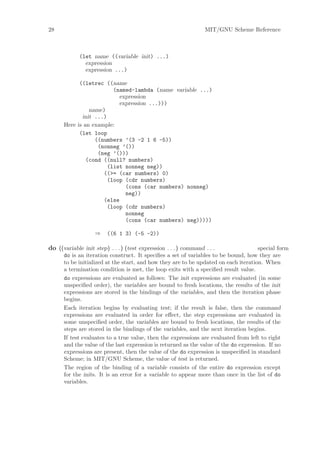
      Here is an example:
            (let loop
                  ((numbers ’(3 -2 1 6 -5))
                   (nonneg ’())
                   (neg ’()))
               (cond ((null? numbers)
                       (list nonneg neg))
                     ((>= (car numbers) 0)
                       (loop (cdr numbers)
                             (cons (car numbers) nonneg)
                             neg))
                     (else
                       (loop (cdr numbers)
                             nonneg
                             (cons (car numbers) neg)))))

                   ⇒     ((6 1 3) (-5 -2))

do ((variable init step) . . . ) (test expression . . . ) command . . .              special form
      do is an iteration construct. It specifies a set of variables to be bound, how they are
      to be initialized at the start, and how they are to be updated on each iteration. When
      a termination condition is met, the loop exits with a specified result value.
      do expressions are evaluated as follows: The init expressions are evaluated (in some
      unspecified order), the variables are bound to fresh locations, the results of the init
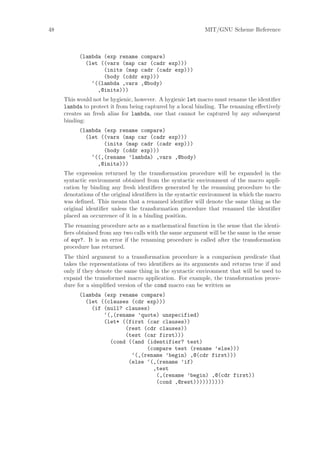
      expressions are stored in the bindings of the variables, and then the iteration phase
      begins.
      Each iteration begins by evaluating test; if the result is false, then the command
      expressions are evaluated in order for effect, the step expressions are evaluated in
      some unspecified order, the variables are bound to fresh locations, the results of the
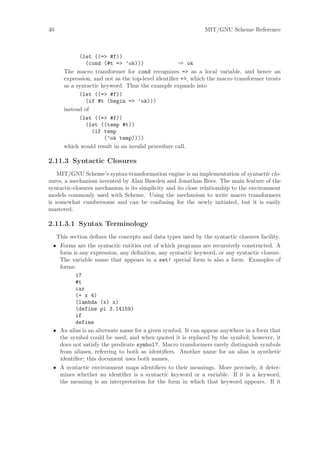
      steps are stored in the bindings of the variables, and the next iteration begins.
      If test evaluates to a true value, then the expressions are evaluated from left to right
      and the value of the last expression is returned as the value of the do expression. If no
      expressions are present, then the value of the do expression is unspecified in standard
      Scheme; in MIT/GNU Scheme, the value of test is returned.
      The region of the binding of a variable consists of the entire do expression except
      for the inits. It is an error for a variable to appear more than once in the list of do
      variables.
Chapter 2: Special Forms                                                                  29


      A step may be omitted, in which case the effect is the same as if (variable init
      variable) had been written instead of (variable init).
            (do ((vec (make-vector 5))
                  (i 0 (+ i 1)))
                ((= i 5) vec)
               (vector-set! vec i i))                        ⇒    #(0 1 2 3 4)
            (let ((x ’(1 3 5 7 9)))
               (do ((x x (cdr x))
                    (sum 0 (+ sum (car x))))
                   ((null? x) sum)))                         ⇒    25


2.10 Structure Definitions
   This section provides examples and describes the options and syntax of define-
structure, an MIT/GNU Scheme macro that is very similar to defstruct in Common
Lisp. The differences between them are summarized at the end of this section. For more
information, see Steele’s Common Lisp book.


define-structure (name structure-option . . . ) slot-description . . .              special form
      Each slot-description takes one of the following forms:
            slot-name
            (slot-name default-init [slot-option value]*)
      The fields name and slot-name must both be symbols. The field default-init is an
      expression for the initial value of the slot. It is evaluated each time a new instance
      is constructed. If it is not specified, the initial content of the slot is undefined.
      Default values are only useful with a boa constructor with argument list or a keyword
      constructor (see below).
      Evaluation of a define-structure expression defines a structure descriptor and a
      set of procedures to manipulate instances of the structure. These instances are repre-
      sented as records by default (see Section 10.4 [Records], page 140) but may alternately
      be lists or vectors. The accessors and modifiers are marked with compiler declara-
      tions so that calls to them are automatically transformed into appropriate references.
      Often, no options are required, so a simple call to define-structure looks like:
            (define-structure foo a b c)
      This defines a type descriptor rtd:foo, a constructor make-foo, a predicate foo?,
      accessors foo-a, foo-b, and foo-c, and modifiers set-foo-a!, set-foo-b!, and
      set-foo-c!.
      In general, if no options are specified, define-structure defines the following (using
      the simple call above as an example):

      type descriptor
                  The name of the type descriptor is "rtd:" followed by the name of
                  the structure, e.g. ‘rtd:foo’. The type descriptor satisfies the predicate
                  record-type?.
30                                                               MIT/GNU Scheme Reference


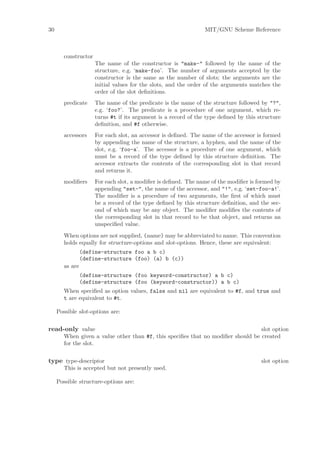
        constructor
                      The name of the constructor is "make-" followed by the name of         the
                      structure, e.g. ‘make-foo’. The number of arguments accepted by        the
                      constructor is the same as the number of slots; the arguments are      the
                      initial values for the slots, and the order of the arguments matches   the
                      order of the slot definitions.
        predicate     The name of the predicate is the name of the structure followed by "?",
                      e.g. ‘foo?’. The predicate is a procedure of one argument, which re-
                      turns #t if its argument is a record of the type defined by this structure
                      definition, and #f otherwise.
        accessors     For each slot, an accessor is defined. The name of the accessor is formed
                      by appending the name of the structure, a hyphen, and the name of the
                      slot, e.g. ‘foo-a’. The accessor is a procedure of one argument, which
                      must be a record of the type defined by this structure definition. The
                      accessor extracts the contents of the corresponding slot in that record
                      and returns it.
        modifiers      For each slot, a modifier is defined. The name of the modifier is formed by
                      appending "set-", the name of the accessor, and "!", e.g. ‘set-foo-a!’.
                      The modifier is a procedure of two arguments, the first of which must
                      be a record of the type defined by this structure definition, and the sec-
                      ond of which may be any object. The modifier modifies the contents of
                      the corresponding slot in that record to be that object, and returns an
                      unspecified value.
        When options are not supplied, (name) may be abbreviated to name. This convention
        holds equally for structure-options and slot-options. Hence, these are equivalent:
                 (define-structure foo a b c)
                 (define-structure (foo) (a) b (c))
        as are
                 (define-structure (foo keyword-constructor) a b c)
                 (define-structure (foo (keyword-constructor)) a b c)
        When specified as option values, false and nil are equivalent to #f, and true and
        t are equivalent to #t.

     Possible slot-options are:


read-only value                                                                   slot option
        When given a value other than #f, this specifies that no modifier should be created
        for the slot.


type type-descriptor                                                                   slot option
        This is accepted but not presently used.

     Possible structure-options are:
Chapter 2: Special Forms                                                                  31


predicate [name]                                                              structure option
     This option controls the definition of a predicate procedure for the structure. If name
     is not given, the predicate is defined with the default name (see above). If name is
     #f, the predicate is not defined at all. Otherwise, name must be a symbol, and the
     predicate is defined with that symbol as its name.

copier [name]                                                               structure option
     This option controls the definition of a procedure to copy instances of the struc-
     ture. This is a procedure of one argument, a structure instance, that makes a newly
     allocated copy of the structure and returns it. If name is not given, the copier is
     defined, and the name of the copier is "copy-" followed by the structure name (e.g.
     ‘copy-foo’). If name is #f, the copier is not defined. Otherwise, name must be a
     symbol, and the copier is defined with that symbol as its name.

print-procedure expression                                                  structure option
     Evaluating expression must yield a procedure of two arguments, which is used to print
     instances of the structure. The procedure is an unparser method (see Section 14.7
     [Custom Output], page 201). If the structure instances are records, this option has
     the same effect as calling set-record-type-unparser-method!.

constructor [name [argument-list]]                                              structure option
     This option controls the definition of constructor procedures. These constructor pro-
     cedures are called “boa constructors”, for “By Order of Arguments”, because the
     arguments to the constructor specify the initial contents of the structure’s slots by
     the order in which they are given. This is as opposed to “keyword constructors”, which
     specify the initial contents using keywords, and in which the order of arguments is
     irrelevant.
     If name is not given, a constructor is defined with the default name and arguments (see
     above). If name is #f, no constructor is defined; argument-list may not be specified
     in this case. Otherwise, name must be a symbol, and a constructor is defined with
     that symbol as its name. If name is a symbol, argument-list is optionally allowed;
     if it is omitted, the constructor accepts one argument for each slot in the structure
     definition, in the same order in which the slots appear in the definition. Otherwise,
     argument-list must be a lambda list (see Section 2.1 [Lambda Expressions], page 15),
     and each of the parameters of the lambda list must be the name of a slot in the
     structure. The arguments accepted by the constructor are defined by this lambda
     list. Any slot that is not specified by the lambda list is initialized to the default-init
     as specified above; likewise for any slot specified as an optional parameter when the
     corresponding argument is not supplied.
     If the constructor option is specified, the default constructor is not defined. Addi-
     tionally, the constructor option may be specified multiple times to define multiple
     constructors with different names and argument lists.
             (define-structure (foo
                                    (constructor make-foo (#!optional a b)))
               (a 6 read-only #t)
               (b 9))
32                                                           MIT/GNU Scheme Reference


keyword-constructor [name]                                                 structure option
     This option controls the definition of keyword constructor procedures. A keyword
     constructor is a procedure that accepts arguments that are alternating slot names
     and values. If name is omitted, a keyword constructor is defined, and the name of
     the constructor is "make-" followed by the name of the structure (e.g. ‘make-foo’).
     Otherwise, name must be a symbol, and a keyword constructor is defined with this
     symbol as its name.
     If the keyword-constructor option is specified, the default constructor is not defined.
     Additionally, the keyword-constructor option may be specified multiple times to
     define multiple keyword constructors; this is usually not done since such constructors
     would all be equivalent.
            (define-structure (foo (keyword-constructor make-bar)) a b)
            (foo-a (make-bar ’b 20 ’a 19))                ⇒ 19

type-descriptor name                                                          structure option
     This option cannot be used with the type or named options.
     By default, structures are implemented as records. The name of the structure is
     defined to hold the type descriptor of the record defined by the structure. The type-
     descriptor option specifies a different name to hold the type descriptor.
          (define-structure foo a b)
          foo                 ⇒ #[record-type 18]

           (define-structure (bar (type-descriptor <bar>)) a b)
           bar              error Unbound variable: bar
           <bar>         ⇒ #[record-type 19]

conc-name [name]                                                               structure option
     By default, the prefix for naming accessors and modifiers is the name of the structure
     followed by a hyphen. The conc-name option can be used to specify an alternative.
     If name is not given, the prefix is the name of the structure followed by a hyphen (the
     default). If name is #f, the slot names are used directly, without prefix. Otherwise,
     name must a symbol, and that symbol is used as the prefix.
           (define-structure (foo (conc-name moby/)) a b)
     defines accessors moby/a and moby/b, and modifiers set-moby/a! and set-moby/b!.
          (define-structure (foo (conc-name #f)) a b)
     defines accessors a and b, and modifiers set-a! and set-b!.

type representation-type                                                      structure option
     This option cannot be used with the type-descriptor option.
     By default, structures are implemented as records. The type option overrides this
     default, allowing the programmer to specify that the structure be implemented using
     another data type. The option value representation-type specifies the alternate data
     type; it is allowed to be one of the symbols vector or list, and the data type used
     is the one corresponding to the symbol.
Chapter 2: Special Forms                                                                     33


     If this option is given, and the named option is not specified, the representation will
     not be tagged, and neither a predicate nor a type descriptor will be defined; also, the
     print-procedure option may not be given.
            (define-structure (foo (type list)) a b)
            (make-foo 1 2)                                  ⇒ (1 2)

named [expression]                                                                 structure option
     This is valid only in conjunction with the type option and specifies that the structure
     instances be tagged to make them identifiable as instances of this structure type. This
     option cannot be used with the type-descriptor option.
     In the usual case, where expression is not given, the named option causes a type
     descriptor and predicate to be defined for the structure (recall that the type option
     without named suppresses their definition), and also defines a default unparser method
     for the structure instances (which can be overridden by the print-procedure option).
     If the default unparser method is not wanted then the print-procedure option should
     be specified as #F. This causes the structure to be printed in its native representation,
     as a list or vector, which includes the type descriptor. The type descriptor is a unique
     object, not a record type, that describes the structure instances and is additionally
     stored in the structure instances to identify them: if the representation type is vector,
     the type descriptor is stored in the zero-th slot of the vector, and if the representation
     type is list, it is stored as the first element of the list.
            (define-structure (foo (type vector) named) a b c)
            (vector-ref (make-foo 1 2 3) 0) ⇒ #[structure-type 52]
     If expression is specified, it is an expression that is evaluated to yield a tag object. The
     expression is evaluated once when the structure definition is evaluated (to specify the
     unparser method), and again whenever a predicate or constructor is called. Because
     of this, expression is normally a variable reference or a constant. The value yielded by
     expression may be any object at all. That object is stored in the structure instances
     in the same place that the type descriptor is normally stored, as described above. If
     expression is specified, no type descriptor is defined, only a predicate.
            (define-structure (foo (type vector) (named ’foo)) a b c)
            (vector-ref (make-foo 1 2 3) 0) ⇒ foo

safe-accessors [boolean]                                                         structure option
     This option allows the programmer to have some control over the safety of the slot
     accessors (and modifiers) generated by define-structure. If safe-accessors is not
     specified, or if boolean is #f, then the accessors are optimized for speed at the expense
     of safety; when compiled, the accessors will turn into very fast inline sequences, usually
     one to three machine instructions in length. However, if safe-accessors is specified
     and boolean is either omitted or #t, then the accessors are optimized for safety, will
     check the type and structure of their argument, and will be close-coded.
            (define-structure (foo safe-accessors) a b c)

initial-offset offset                                                        structure option
     This is valid only in conjunction with the type option. Offset must be an exact non-
     negative integer and specifies the number of slots to leave open at the beginning of
34                                                          MIT/GNU Scheme Reference


     the structure instance before the specified slots are allocated. Specifying an offset of
     zero is equivalent to omitting the initial-offset option.
     If the named option is specified, the structure tag appears in the first slot, followed
     by the “offset” slots, and then the regular slots. Otherwise, the “offset” slots come
     first, followed by the regular slots.
            (define-structure (foo (type vector) (initial-offset 3))
               a b c)
            (make-foo 1 2 3)                      ⇒ #(() () () 1 2 3)

   The essential differences between MIT/GNU Scheme’s define-structure and Common
Lisp’s defstruct are:
  • The default constructor procedure takes positional arguments, in the same order as
    specified in the definition of the structure. A keyword constructor may be specified by
    giving the option keyword-constructor.
  • boa constructors are described using Scheme lambda lists. Since there is nothing
    corresponding to &aux in Scheme lambda lists, this functionality is not implemented.
  • By default, no copier procedure is defined.
  • The side-effect procedure corresponding to the accessor foo is given the name set-
    foo!.
  • Keywords are ordinary symbols – use foo instead of :foo.
  • The option values false, nil, true, and t are treated as if the appropriate boolean
    constant had been specified instead.
  • The print-function option is named print-procedure. Its argument is a procedure
    of two arguments (the unparser state and the structure instance) rather than three as
    in Common Lisp.
  • By default, named structures are tagged with a unique object of some kind. In Common
    Lisp, the structures are tagged with symbols. This depends on the Common Lisp
    package system to help generate unique tags; MIT/GNU Scheme has no such way to
    generate unique symbols.
  • The named option may optionally take an argument, which is normally the name of
    a variable (any expression may be used, but it is evaluated whenever the tag name is
    needed). If used, structure instances will be tagged with that variable’s value. The
    variable must be defined when define-structure is evaluated.
  • The type option is restricted to the values vector and list.
  • The include option is not implemented.

2.11 Macros
   (This section is largely taken from the Revised^4 Report on the Algorithmic Language
Scheme. The section on Syntactic Closures is derived from a document written by Chris
Hanson. The section on Explicit Renaming is derived from a document written by William
Clinger.)
   Scheme programs can define and use new derived expression types, called macros.
Program-defined expression types have the syntax
Chapter 2: Special Forms                                                                  35


      (keyword datum ...)
where keyword is an identifier that uniquely determines the expression type. This identifier
is called the syntactic keyword, or simply keyword, of the macro. The number of the datums,
and their syntax, depends on the expression type.
    Each instance of a macro is called a use of the macro. The set of rules that specifies how
a use of a macro is transcribed into a more primitive expression is called the transformer
of the macro.
   MIT/GNU Scheme also supports anonymous syntactic keywords. This means that it’s
not necessary to bind a macro transformer to a syntactic keyword before it is used. Instead,
any macro-transformer expression can appear as the first element of a form, and the form
will be expanded by the transformer.
   The macro definition facility consists of these parts:
 • A set of expressions used to establish that certain identifiers are macro keywords,
   associate them with macro transformers, and control the scope within which a macro
   is defined.
 • A standard high-level pattern language for specifying macro transformers, introduced
   by the syntax-rules special form.
 • Two non-standard low-level languages for specifying macro transformers, syntactic clo-
   sures and explicit renaming.

   The syntactic keyword of a macro may shadow variable bindings, and local variable
bindings may shadow keyword bindings. All macros defined using the pattern language are
“hygienic” and “referentially transparent” and thus preserve Scheme’s lexical scoping:
 • If a macro transformer inserts a binding for an identifier (variable or keyword), the
   identifier will in effect be renamed throughout its scope to avoid conflicts with other
   identifiers.
 • If a macro transformer inserts a free reference to an identifier, the reference refers to
   the binding that was visible where the transformer was specified, regardless of any local
   bindings that may surround the use of the macro.

2.11.1 Binding Constructs for Syntactic Keywords
   let-syntax, letrec-syntax, let*-syntax and define-syntax are analogous to let,
letrec, let* and define, but they bind syntactic keywords to macro transformers instead
of binding variables to locations that contain values.
    Any argument named transformer-spec must be a macro-transformer expression, which
is one of the following:
 • A macro transformer defined by the pattern language and denoted by the syntactic
   keyword syntax-rules.
 • A macro transformer defined by one of the low-level mechanisms and denoted by one
   of the syntactic keywords sc-macro-transformer, rsc-macro-transformer, or er-
   macro-transformer.
 • A syntactic keyword bound in the enclosing environment. This is used to bind another
   name to an existing macro transformer.
36                                                          MIT/GNU Scheme Reference


let-syntax bindings expression expression . . .                                 special form
     Bindings should have the form


           ((keyword transformer-spec) ...)


     Each keyword is an identifier, each transformer-spec is a a macro-transformer ex-
     pression, and the body is a sequence of one or more expressions. It is an error for a
     keyword to appear more than once in the list of keywords being bound.


     The expressions are expanded in the syntactic environment obtained by extending the
     syntactic environment of the let-syntax expression with macros whose keywords are
     the keywords, bound to the specified transformers. Each binding of a keyword has
     the expressions as its region.


           (let-syntax ((when (syntax-rules ()
                                ((when test stmt1 stmt2 ...)
                                 (if test
                                     (begin stmt1
                                            stmt2 ...))))))
             (let ((if #t))
               (when if (set! if ’now))
               if))                            ⇒ now

           (let ((x ’outer))
             (let-syntax ((m (syntax-rules () ((m) x))))
               (let ((x ’inner))
                 (m))))                       ⇒ outer


letrec-syntax bindings expression expression . . .                              special form
     The syntax of letrec-syntax is the same as for let-syntax.


     The expressions are expanded in the syntactic environment obtained by extending the
     syntactic environment of the letrec-syntax expression with macros whose keywords
     are the keywords, bound to the specified transformers. Each binding of a keyword
     has the bindings as well as the expressions within its region, so the transformers
     can transcribe expressions into uses of the macros introduced by the letrec-syntax
     expression.
Chapter 2: Special Forms                                                             37


           (letrec-syntax
             ((my-or (syntax-rules ()
                        ((my-or) #f)
                        ((my-or e) e)
                        ((my-or e1 e2 ...)
                         (let ((temp e1))
                           (if temp
                               temp
                               (my-or e2 ...)))))))
             (let ((x #f)
                   (y 7)
                   (temp 8)
                   (let odd?)
                   (if even?))
               (my-or x
                      (let temp)
                      (if y)
                      y)))          ⇒ 7

let*-syntax bindings expression expression . . .                               special form
     The syntax of let*-syntax is the same as for let-syntax.
     The expressions are expanded in the syntactic environment obtained by extending the
     syntactic environment of the letrec-syntax expression with macros whose keywords
     are the keywords, bound to the specified transformers. Each binding of a keyword
     has the subsequent bindings as well as the expressions within its region. Thus
           (let*-syntax
               ((a (syntax-rules ...))
                (b (syntax-rules ...)))
              ...)
     is equivalent to
           (let-syntax ((a (syntax-rules ...)))
              (let-syntax ((b (syntax-rules ...)))
                ...))

define-syntax keyword transformer-spec                                          special form
     Keyword is an identifier, and transformer-spec is a macro transformer expression.
     The syntactic environment is extended by binding the keyword to the specified trans-
     former.
     The region of the binding introduced by define-syntax is the entire block in which
     it appears. However, the keyword may only be used after it has been defined.
     MIT/GNU Scheme permits define-syntax to appear both at top level and within
     lambda bodies. The Revised^4 Report permits only top-level uses of define-syntax.
     When compiling a program, a top-level instance of define-syntax both defines the
     syntactic keyword and generates code that will redefine the keyword when the program
     is loaded. This means that the same syntax can be used for defining macros that will
     be used during compilation and for defining macros to be used at run time.
38                                                           MIT/GNU Scheme Reference


      Although macros may expand into definitions and syntax definitions in any context
      that permits them, it is an error for a definition or syntax definition to shadow a
      syntactic keyword whose meaning is needed to determine whether some form in the
      group of forms that contains the shadowing definition is in fact a definition, or, for
      internal definitions, is needed to determine the boundary between the group and the
      expressions that follow the group. For example, the following are errors:
            (define define 3)

            (begin (define begin list))

            (let-syntax
              ((foo (syntax-rules ()
                      ((foo (proc args ...) body ...)
                       (define proc
                         (lambda (args ...)
                           body ...))))))
              (let ((x 3))
                (foo (plus x y) (+ x y))
                (define foo x)
                (plus foo x)))

2.11.2 Pattern Language
   MIT/GNU Scheme supports a high-level pattern language for specifying macro trans-
formers. This pattern language is defined by the Revised^4 Report and is portable to other
conforming Scheme implementations. To use the pattern language, specify a transformer-
spec as a syntax-rules form:

syntax-rules literals syntax-rule . . .                                           special form
      Literals is a list of identifiers and each syntax-rule should be of the form
            (pattern template)
      The pattern in a syntax-rule is a list pattern that begins with the keyword for the
      macro.
      A pattern is either an identifier, a constant, or one of the following
            (pattern ...)
            (pattern pattern ... . pattern)
            (pattern ... pattern ellipsis)
      and a template is either an identifier, a constant, or one of the following
            (element ...)
            (element element ... . template)
      where an element is a template optionally followed by an ellipsis and an ellipsis is
      the identifier ‘...’ (which cannot be used as an identifier in either a template or a
      pattern).
      An instance of syntax-rules produces a new macro transformer by specifying a
      sequence of hygienic rewrite rules. A use of a macro whose keyword is associated with
      a transformer specified by syntax-rules is matched against the patterns contained
Chapter 2: Special Forms                                                                      39


     in the syntax-rules, beginning with the leftmost syntax-rule. When a match is found,
     the macro use is transcribed hygienically according to the template.
     An identifier that appears in the pattern of a syntax-rule is a pattern-variable, unless
     it is the keyword that begins the pattern, is listed in literals, or is the identifier ‘...’.
     Pattern variables match arbitrary input elements and are used to refer to elements
     of the input in the template. It is an error for the same pattern variable to appear
     more than once in a pattern.
     The keyword at the beginning of the pattern in a syntax-rule is not involved in the
     matching and is not considered a pattern variable or literal identifier.
     Identifiers that appear in literals are interpreted as literal identifiers to be matched
     against corresponding subforms of the input. A subform in the input matches a literal
     identifier if and only if it is an identifier and either both its occurrence in the macro
     expression and its occurrence in the macro definition have the same lexical binding,
     or the two identifiers are equal and both have no lexical binding.
     A subpattern followed by ‘...’ can match zero or more elements of the input. It is an
     error for ‘...’ to appear in literals. Within a pattern the identifier ‘...’ must follow
     the last element of a nonempty sequence of subpatterns.
     More formally, an input form F matches a pattern P if and only if:
       • P is a non-literal identifier; or
       • P is a literal identifier and F is an identifier with the same binding; or
       • P is a list (P 1 ... P n) and F is a list of n forms that match P 1 through P n,
         respectively; or
       • P is an improper list (P 1 P 2 ... P n . P n+1) and F is a list or improper
         list of n or more forms that match P 1 through P n, respectively, and whose nth
         “cdr” matches P n+1; or
       • P is of the form (P 1 ... P n P n+1 ellipsis) where ellipsis is the identifier ‘...’
         and F is a proper list of at least n forms, the first n of which match P 1 through
         P n, respectively, and each remaining element of F matches P n+1; or
       • P is a datum and F is equal to P in the sense of the equal? procedure.
     It is an error to use a macro keyword, within the scope of its binding, in an expression
     that does not match any of the patterns.
     When a macro use is transcribed according to the template of the matching syntax
     rule, pattern variables that occur in the template are replaced by the subforms they
     match in the input. Pattern variables that occur in subpatterns followed by one
     or more instances of the identifier ‘...’ are allowed only in subtemplates that are
     followed by as many instances of ‘...’. They are replaced in the output by all of
     the subforms they match in the input, distributed as indicated. It is an error if the
     output cannot be built up as specified.
     Identifiers that appear in the template but are not pattern variables or the identifier
     ‘...’ are inserted into the output as literal identifiers. If a literal identifier is inserted
     as a free identifier then it refers to the binding of that identifier within whose scope
     the instance of syntax-rules appears. If a literal identifier is inserted as a bound
     identifier then it is in effect renamed to prevent inadvertent captures of free identifiers.
40                                                             MIT/GNU Scheme Reference


             (let ((=> #f))
                (cond (#t => ’ok)))                  ⇒ ok
       The macro transformer for cond recognizes => as a local variable, and hence an
       expression, and not as the top-level identifier =>, which the macro transformer treats
       as a syntactic keyword. Thus the example expands into
             (let ((=> #f))
                (if #t (begin => ’ok)))
       instead of
             (let ((=> #f))
                (let ((temp #t))
                  (if temp
                       (’ok temp))))
       which would result in an invalid procedure call.

2.11.3 Syntactic Closures
    MIT/GNU Scheme’s syntax-transformation engine is an implementation of syntactic clo-
sures, a mechanism invented by Alan Bawden and Jonathan Rees. The main feature of the
syntactic-closures mechanism is its simplicity and its close relationship to the environment
models commonly used with Scheme. Using the mechanism to write macro transformers
is somewhat cumbersome and can be confusing for the newly initiated, but it is easily
mastered.

2.11.3.1 Syntax Terminology
     This section defines the concepts and data types used by the syntactic closures facility.
 • Forms are the syntactic entities out of which programs are recursively constructed. A
   form is any expression, any definition, any syntactic keyword, or any syntactic closure.
   The variable name that appears in a set! special form is also a form. Examples of
   forms:
         17
         #t
         car
         (+ x 4)
         (lambda (x) x)
         (define pi 3.14159)
         if
         define
 • An alias is an alternate name for a given symbol. It can appear anywhere in a form that
   the symbol could be used, and when quoted it is replaced by the symbol; however, it
   does not satisfy the predicate symbol?. Macro transformers rarely distinguish symbols
   from aliases, referring to both as identifiers. Another name for an alias is synthetic
   identifier; this document uses both names.
 • A syntactic environment maps identifiers to their meanings. More precisely, it deter-
   mines whether an identifier is a syntactic keyword or a variable. If it is a keyword,
   the meaning is an interpretation for the form in which that keyword appears. If it
Chapter 2: Special Forms                                                                  41


   is a variable, the meaning identifies which binding of that variable is referenced. In
   short, syntactic environments contain all of the contextual information necessary for
   interpreting the meaning of a particular form.
 • A syntactic closure consists of a form, a syntactic environment, and a list of identifiers.
   All identifiers in the form take their meaning from the syntactic environment, except
   those in the given list. The identifiers in the list are to have their meanings determined
   later.
   A syntactic closure may be used in any context in which its form could have been used.
   Since a syntactic closure is also a form, it may not be used in contexts where a form
   would be illegal. For example, a form may not appear as a clause in the cond special
   form.
   A syntactic closure appearing in a quoted structure is replaced by its form.

2.11.3.2 Transformer Definition
   This section describes the special forms for defining syntactic-closures macro transform-
ers, and the associated procedures for manipulating syntactic closures and syntactic envi-
ronments.

sc-macro-transformer expression                                                    special form
      The expression is expanded in the syntactic environment of the sc-macro-
      transformer expression, and the expanded expression is evaluated in the
      transformer environment to yield a macro transformer as described below. This
      macro transformer is bound to a macro keyword by the special form in which the
      transformer expression appears (for example, let-syntax).
      In the syntactic closures facility, a macro transformer is a procedure that takes two
      arguments, a form and a syntactic environment, and returns a new form. The first
      argument, the input form, is the form in which the macro keyword occurred. The
      second argument, the usage environment, is the syntactic environment in which the
      input form occurred. The result of the transformer, the output form, is automatically
      closed in the transformer environment, which is the syntactic environment in which
      the transformer expression occurred.
      For example, here is a definition of a push macro using syntax-rules:
            (define-syntax push
               (syntax-rules ()
                 ((push item list)
                  (set! list (cons item list)))))
      Here is an equivalent definition using sc-macro-transformer:
            (define-syntax push
               (sc-macro-transformer
                (lambda (exp env)
                  (let ((item (make-syntactic-closure env ’() (cadr exp)))
                          (list (make-syntactic-closure env ’() (caddr exp))))
                     ‘(set! ,list (cons ,item ,list))))))
      In this example, the identifiers set! and cons are closed in the transformer environ-
      ment, and thus will not be affected by the meanings of those identifiers in the usage
      environment env.
42                                                          MIT/GNU Scheme Reference


     Some macros may be non-hygienic by design. For example, the following defines a
     loop macro that implicitly binds exit to an escape procedure. The binding of exit
     is intended to capture free references to exit in the body of the loop, so exit must
     be left free when the body is closed:

           (define-syntax loop
             (sc-macro-transformer
              (lambda (exp env)
                (let ((body (cdr exp)))
                  ‘(call-with-current-continuation
                    (lambda (exit)
                      (let f ()
                        ,@(map (lambda (exp)
                                 (make-syntactic-closure env ’(exit)
                                   exp))
                               body)
                        (f))))))))


rsc-macro-transformer expression                                                 special form
     This form is an alternative way to define a syntactic-closures macro transformer. Its
     syntax and usage are identical to sc-macro-transformer, except that the roles of the
     usage environment and transformer environment are reversed. (Hence rsc stands for
     Reversed Syntactic Closures.) In other words, the procedure specified by expression
     still accepts two arguments, but its second argument will be the transformer environ-
     ment rather than the usage environment, and the returned expression is closed in the
     usage environment rather than the transformer environment.

     The advantage of this arrangement is that it allows a simpler definition style in some
     situations. For example, here is the push macro from above, rewritten in this style:

           (define-syntax push
             (rsc-macro-transformer
              (lambda (exp env)
                ‘(,(make-syntactic-closure env ’() ’SET!)
                  ,(caddr exp)
                  (,(make-syntactic-closure env ’() ’CONS)
                   ,(cadr exp)
                   ,(caddr exp))))))

     In this style only the introduced keywords are closed, while everything else remains
     open.

     Note that rsc-macro-transformer and sc-macro-transformer are easily
     interchangeable.    Here is how to emulate rsc-macro-transformer using
     sc-macro-transformer. (This technique can be used to effect the opposite
     emulation as well.)
Chapter 2: Special Forms                                                               43


           (define-syntax push
             (sc-macro-transformer
              (lambda (exp usage-env)
                (capture-syntactic-environment
                 (lambda (env)
                   (make-syntactic-closure usage-env ’()
                     ‘(,(make-syntactic-closure env ’() ’SET!)
                       ,(caddr exp)
                       (,(make-syntactic-closure env ’() ’CONS)
                        ,(cadr exp)
                        ,(caddr exp)))))))))

   To assign meanings to the identifiers in a form, use make-syntactic-closure to close
the form in a syntactic environment.

make-syntactic-closure environment free-names form                                 procedure
     Environment must be a syntactic environment, free-names must be a list of identi-
     fiers, and form must be a form. make-syntactic-closure constructs and returns a
     syntactic closure of form in environment, which can be used anywhere that form could
     have been used. All the identifiers used in form, except those explicitly excepted by
     free-names, obtain their meanings from environment.
     Here is an example where free-names is something other than the empty list. It is
     instructive to compare the use of free-names in this example with its use in the loop
     example above: the examples are similar except for the source of the identifier being
     left free.
            (define-syntax let1
                (sc-macro-transformer
                 (lambda (exp env)
                   (let ((id (cadr exp))
                           (init (caddr exp))
                           (exp (cadddr exp)))
                     ‘((lambda (,id)
                           ,(make-syntactic-closure env (list id) exp))
                        ,(make-syntactic-closure env ’() init))))))
     let1 is a simplified version of let that only binds a single identifier, and whose body
     consists of a single expression. When the body expression is syntactically closed in
     its original syntactic environment, the identifier that is to be bound by let1 must be
     left free, so that it can be properly captured by the lambda in the output form.

    In most situations, the free-names argument to make-syntactic-closure is the empty
list. In those cases, the more succinct close-syntax can be used:

close-syntax form environment                                                      procedure
     Environment must be a syntactic environment and form must be a form. Returns a
     new syntactic closure of form in environment, with no free names. Entirely equivalent
     to
          (make-syntactic-closure environment ’() form)
44                                                            MIT/GNU Scheme Reference


   To obtain a syntactic environment other than the usage environment, use capture-
syntactic-environment.

capture-syntactic-environment procedure                                           procedure
     capture-syntactic-environment returns a form that will, when transformed, call
     procedure on the current syntactic environment. Procedure should compute and
     return a new form to be transformed, in that same syntactic environment, in place of
     the form.
     An example will make this clear. Suppose we wanted to define a simple loop-until
     keyword equivalent to
           (define-syntax loop-until
             (syntax-rules ()
               ((loop-until id init test return step)
                (letrec ((loop
                          (lambda (id)
                            (if test return (loop step)))))
                  (loop init)))))
     The following attempt at defining loop-until has a subtle bug:
           (define-syntax loop-until
             (sc-macro-transformer
              (lambda (exp env)
                (let ((id (cadr exp))
                      (init (caddr exp))
                      (test (cadddr exp))
                      (return (cadddr (cdr exp)))
                      (step (cadddr (cddr exp)))
                      (close
                       (lambda (exp free)
                         (make-syntactic-closure env free exp))))
                  ‘(letrec ((loop
                             (lambda (,id)
                               (if ,(close test (list id))
                                   ,(close return (list id))
                                   (loop ,(close step (list id)))))))
                     (loop ,(close init ’())))))))
     This definition appears to take all of the proper precautions to prevent unintended
     captures. It carefully closes the subexpressions in their original syntactic environment
     and it leaves the id identifier free in the test, return, and step expressions, so that it
     will be captured by the binding introduced by the lambda expression. Unfortunately
     it uses the identifiers if and loop within that lambda expression, so if the user of
     loop-until just happens to use, say, if for the identifier, it will be inadvertently
     captured.
     The syntactic environment that if and loop want to be exposed to is the one just
     outside the lambda expression: before the user’s identifier is added to the syntactic
     environment, but after the identifier loop has been added. capture-syntactic-
     environment captures exactly that environment as follows:
Chapter 2: Special Forms                                                                   45


            (define-syntax loop-until
               (sc-macro-transformer
                (lambda (exp env)
                   (let ((id (cadr exp))
                         (init (caddr exp))
                         (test (cadddr exp))
                         (return (cadddr (cdr exp)))
                         (step (cadddr (cddr exp)))
                         (close
                           (lambda (exp free)
                             (make-syntactic-closure env free exp))))
                     ‘(letrec ((loop
                                  ,(capture-syntactic-environment
                                    (lambda (env)
                                       ‘(lambda (,id)
                                           (,(make-syntactic-closure env ’() ‘if)
                                            ,(close test (list id))
                                            ,(close return (list id))
                                            (,(make-syntactic-closure env ’() ‘loop)
                                             ,(close step (list id)))))))))
                        (loop ,(close init ’())))))))
      In this case, having captured the desired syntactic environment, it is convenient to
      construct syntactic closures of the identifiers if and the loop and use them in the
      body of the lambda.
      A common use of capture-syntactic-environment is to get the transformer envi-
      ronment of a macro transformer:
            (sc-macro-transformer
              (lambda (exp env)
                (capture-syntactic-environment
                 (lambda (transformer-env)
                    ...))))

2.11.3.3 Identifiers
   This section describes the procedures that create and manipulate identifiers. The iden-
tifier data type extends the syntactic closures facility to be compatible with the high-level
syntax-rules facility.
   As discussed earlier, an identifier is either a symbol or an alias. An alias is implemented
as a syntactic closure whose form is an identifier:
       (make-syntactic-closure env ’() ’a) ⇒ an alias
Aliases are implemented as syntactic closures because they behave just like syntactic closures
most of the time. The difference is that an alias may be bound to a new value (for example
by lambda or let-syntax); other syntactic closures may not be used this way. If an alias is
bound, then within the scope of that binding it is looked up in the syntactic environment
just like any other identifier.
   Aliases are used in the implementation of the high-level facility syntax-rules. A macro
transformer created by syntax-rules uses a template to generate its output form, substi-
46                                                            MIT/GNU Scheme Reference


tuting subforms of the input form into the template. In a syntactic closures implementation,
all of the symbols in the template are replaced by aliases closed in the transformer envi-
ronment, while the output form itself is closed in the usage environment. This guarantees
that the macro transformation is hygienic, without requiring the transformer to know the
syntactic roles of the substituted input subforms.


identifier? object                                                                    procedure
      Returns #t if object is an identifier, otherwise returns #f. Examples:
            (identifier? ’a)        ⇒ #t
            (identifier? (make-syntactic-closure env ’() ’a))
                                    ⇒ #t

            (identifier?    "a")         ⇒   #f
            (identifier?    #a)         ⇒   #f
            (identifier?    97)          ⇒   #f
            (identifier?    #f)          ⇒   #f
            (identifier?    ’(a))        ⇒   #f
            (identifier?    ’#(a))       ⇒   #f

    The predicate eq? is used to determine if two identifers are “the same”. Thus eq? can
be used to compare identifiers exactly as it would be used to compare symbols. Often,
though, it is useful to know whether two identifiers “mean the same thing”. For example,
the cond macro uses the symbol else to identify the final clause in the conditional. A
macro transformer for cond cannot just look for the symbol else, because the cond form
might be the output of another macro transformer that replaced the symbol else with an
alias. Instead the transformer must look for an identifier that “means the same thing” in
the usage environment as the symbol else means in the transformer environment.


identifier=? environment1 identifier1 environment2 identifier2                           procedure
      Environment1 and environment2 must be syntactic environments, and identifier1 and
      identifier2 must be identifiers. identifier=? returns #t if the meaning of identifier1
      in environment1 is the same as that of identifier2 in environment2, otherwise it returns
      #f. Examples:
            (let-syntax
                ((foo
                  (sc-macro-transformer
                   (lambda (form env)
                     (capture-syntactic-environment
                      (lambda (transformer-env)
                        (identifier=? transformer-env ’x env ’x)))))))
              (list (foo)
                    (let ((x 3))
                      (foo))))
                                    ⇒ (#t #f)
Chapter 2: Special Forms                                                                47


           (let-syntax ((bar foo))
             (let-syntax
                 ((foo
                   (sc-macro-transformer
                    (lambda (form env)
                      (capture-syntactic-environment
                       (lambda (transformer-env)
                         (identifier=? transformer-env ’foo
                                       env (cadr form))))))))
               (list (foo foo)
                     (foo bar))))
                                   ⇒ (#f #t)

   Sometimes it is useful to be able to introduce a new identifier that is guaranteed to
be different from any existing identifier, similarly to the way that generate-uninterned-
symbol is used.


make-synthetic-identifier identifier                                                procedure
     Creates and returns and new synthetic identifier (alias) that is guaranteed to be
     different from all existing identifiers. Identifier is any existing identifier, which is
     used in deriving the name of the new identifier.
     This is implemented by syntactically closing identifier in a special empty environment.

2.11.4 Explicit Renaming
   Explicit renaming is an alternative facility for defining macro transformers. In the
MIT/GNU Scheme implementation, explicit-renaming transformers are implemented as an
abstraction layer on top of syntactic closures. An explicit-renaming macro transformer is
defined by an instance of the er-macro-transformer keyword:


er-macro-transformer expression                                            special form
     The expression is expanded in the syntactic environment of the er-macro-
     transformer expression, and the expanded expression is evaluated in the
     transformer environment to yield a macro transformer as described below. This
     macro transformer is bound to a macro keyword by the special form in which the
     transformer expression appears (for example, let-syntax).
     In the explicit-renaming facility, a macro transformer is a procedure that takes three
     arguments, a form, a renaming procedure, and a comparison predicate, and returns
     a new form. The first argument, the input form, is the form in which the macro
     keyword occurred.
     The second argument to a transformation procedure is a renaming procedure that
     takes the representation of an identifier as its argument and returns the representa-
     tion of a fresh identifier that occurs nowhere else in the program. For example, the
     transformation procedure for a simplified version of the let macro might be written
     as
48                                                          MIT/GNU Scheme Reference


           (lambda (exp rename compare)
             (let ((vars (map car (cadr exp)))
                   (inits (map cadr (cadr exp)))
                   (body (cddr exp)))
               ‘((lambda ,vars ,@body)
                 ,@inits)))
     This would not be hygienic, however. A hygienic let macro must rename the identifier
     lambda to protect it from being captured by a local binding. The renaming effectively
     creates an fresh alias for lambda, one that cannot be captured by any subsequent
     binding:
           (lambda (exp rename compare)
             (let ((vars (map car (cadr exp)))
                   (inits (map cadr (cadr exp)))
                   (body (cddr exp)))
               ‘((,(rename ’lambda) ,vars ,@body)
                 ,@inits)))
     The expression returned by the transformation procedure will be expanded in the
     syntactic environment obtained from the syntactic environment of the macro appli-
     cation by binding any fresh identifiers generated by the renaming procedure to the
     denotations of the original identifiers in the syntactic environment in which the macro
     was defined. This means that a renamed identifier will denote the same thing as the
     original identifier unless the transformation procedure that renamed the identifier
     placed an occurrence of it in a binding position.
     The renaming procedure acts as a mathematical function in the sense that the identi-
     fiers obtained from any two calls with the same argument will be the same in the sense
     of eqv?. It is an error if the renaming procedure is called after the transformation
     procedure has returned.
     The third argument to a transformation procedure is a comparison predicate that
     takes the representations of two identifiers as its arguments and returns true if and
     only if they denote the same thing in the syntactic environment that will be used to
     expand the transformed macro application. For example, the transformation proce-
     dure for a simplified version of the cond macro can be written as
           (lambda (exp rename compare)
             (let ((clauses (cdr exp)))
               (if (null? clauses)
                   ‘(,(rename ’quote) unspecified)
                   (let* ((first (car clauses))
                          (rest (cdr clauses))
                          (test (car first)))
                     (cond ((and (identifier? test)
                                 (compare test (rename ’else)))
                            ‘(,(rename ’begin) ,@(cdr first)))
                           (else ‘(,(rename ’if)
                                   ,test
                                    (,(rename ’begin) ,@(cdr first))
                                    (cond ,@rest))))))))))
Chapter 2: Special Forms                                                              49


     In this example the identifier else is renamed before being passed to the comparison
     predicate, so the comparison will be true if and only if the test expression is an
     identifier that denotes the same thing in the syntactic environment of the expression
     being transformed as else denotes in the syntactic environment in which the cond
     macro was defined. If else were not renamed before being passed to the comparison
     predicate, then it would match a local variable that happened to be named else, and
     the macro would not be hygienic.
     Some macros are non-hygienic by design. For example, the following defines a loop
     macro that implicitly binds exit to an escape procedure. The binding of exit is
     intended to capture free references to exit in the body of the loop, so exit is not
     renamed.
           (define-syntax loop
             (er-macro-transformer
              (lambda (x r c)
                (let ((body (cdr x)))
                  ‘(,(r ’call-with-current-continuation)
                    (,(r ’lambda) (exit)
                     (,(r ’let) ,(r ’f) () ,@body (,(r ’f)))))))))
     Suppose a while macro is implemented using loop, with the intent that exit may
     be used to escape from the while loop. The while macro cannot be written as
           (define-syntax while
             (syntax-rules ()
               ((while test body ...)
                (loop (if (not test) (exit #f))
                      body ...))))
     because the reference to exit that is inserted by the while macro is intended to be
     captured by the binding of exit that will be inserted by the loop macro. In other
     words, this while macro is not hygienic. Like loop, it must be written using the
     er-macro-transformer syntax:
           (define-syntax while
             (er-macro-transformer
              (lambda (x r c)
                (let ((test (cadr x))
                      (body (cddr x)))
                  ‘(,(r ’loop)
                    (,(r ’if) (,(r ’not) ,test) (exit #f))
                    ,@body)))))


2.12 SRFI syntax
   Several special forms have been introduced to support some of the Scheme Requests for
Implementation (srfi). Note that MIT/GNU Scheme has for some time supported srfi 23
(error-reporting mechanism) and srfi 30 (nested multi-line comments), since these srfis
reflect existing practice rather than introducing new functionality.
50                                                             MIT/GNU Scheme Reference


2.12.1 cond-expand (SRFI 0)

   srfi 0 is a mechanism for portably determining the availability of srfi features. The
cond-expand special form conditionally expands according to the features available.


cond-expand clause clause dots                                                       special form
     Each clause has the form
           (feature-requirement expression ...)
     where feature-requirement can have one of the following forms:
           feature-identifier
           (and feature-requirement ...)
           (or feature-requirement ...)
           (not feature-requirement)
           else
     (Note that at most one else clause may be present, and it must always be the last
     clause.)
     The cond-expand special form tests for the existence of features at macro-expansion
     time. It either expands into the body of one of its clauses or signals an error during
     syntactic processing. cond-expand expands into the body of the first clause whose
     feature-requirement is currently satisfied (an else clause, if present, is selected if none
     of the previous clauses is selected).
     A feature-requirement has an obvious interpretation as a logical formula, where the
     feature-identifier variables have meaning true if the feature corresponding to the
     feature-identifier, as specified in the srfi registry, is in effect at the location of the
     cond-expand form, and false otherwise. A feature-requirement is satisfied if its for-
     mula is true under this interpretation.
           (cond-expand
             ((and srfi-1 srfi-10)
              (write 1))
             ((or srfi-1 srfi-10)
              (write 2))
             (else))

           (cond-expand
             (command-line
              (define (program-name) (car (argv)))))
     The second example assumes that command-line is an alias for some feature which
     gives access to command line arguments. Note that an error will be signaled at
     macro-expansion time if this feature is not present.
     Note that MIT/GNU Scheme allows cond-expand in any context where a special
     form is allowed. This is an extension of the semantics defined by srfi 0, which only
     allows cond-expand at top level.
Chapter 2: Special Forms                                                                    51


2.12.2 receive (SRFI 8)
   srfi 8 defines a convenient syntax to bind an identifier to each of the values of a multiple-
valued expression and then evaluate an expression in the scope of the bindings. As an
instance of this pattern, consider the following excerpt from a ‘quicksort’ procedure:
       (call-with-values
         (lambda ()
            (partition (precedes pivot) others))
         (lambda (fore aft)
            (append (qsort fore) (cons pivot (qsort aft)))))
   Here ‘partition’ is a multiple-valued procedure that takes two arguments, a predicate
and a list, and returns two lists, one comprising the list elements that satisfy the predicate,
the other those that do not. The purpose of the expression shown is to partition the list
‘others’, sort each of the sublists, and recombine the results into a sorted list.
   For our purposes, the important step is the binding of the identifiers ‘fore’ and ‘aft’ to
the values returned by ‘partition’. Expressing the construction and use of these bindings
with the call-by-values primitive is cumbersome: One must explicitly embed the expres-
sion that provides the values for the bindings in a parameterless procedure, and one must
explicitly embed the expression to be evaluated in the scope of those bindings in another
procedure, writing as its parameters the identifiers that are to be bound to the values
received.
   These embeddings are boilerplate, exposing the underlying binding mechanism but not
revealing anything relevant to the particular program in which it occurs. So the use of a syn-
tactic abstraction that exposes only the interesting parts – the identifiers to be bound, the
multiple-valued expression that supplies the values, and the body of the receiving procedure
– makes the code more concise and more readable:
       (receive (fore aft) (partition (precedes pivot) others)
         (append (qsort fore) (cons pivot (qsort aft))))
   The advantages are similar to those of a ‘let’ expression over a procedure call with a
‘lambda’ expression as its operator. In both cases, cleanly separating a “header” in which
the bindings are established from a “body” in which they are used makes it easier to follow
the code.

receive formals expression body                                                   special form
      Formals and body are defined as for ‘lambda’ (see Section 2.1 [Lambda Expressions],
      page 15). Specifically, formals can have the following forms (the use of ‘#!optional’
      and ‘#!rest’ is also allowed in formals but is omitted for brevity):
      ‘(ident1 ... identN )’
                  The environment in which the ‘receive’ expression is evaluated is ex-
                  tended by binding ident1, . . . , identN to fresh locations. The expression
                  is evaluated, and its values are stored into those locations. (It is an error
                  if expression does not have exactly N values.)
      ‘ident’     The environment in which the ‘receive’ expression is evaluated is ex-
                  tended by binding ident to a fresh location. The expression is evaluated,
                  its values are converted into a newly allocated list, and the list is stored
                  in the location bound to ident.
52                                                             MIT/GNU Scheme Reference


      ‘(ident1 ... identN . identN+1)’
                  The environment in which the ‘receive’ expression is evaluated is ex-
                  tended by binding ident1, . . . , identN+1 to fresh locations. The expres-
                  sion is evaluated. Its first N values are stored into the locations bound
                  to ident1 . . . identN. Any remaining values are converted into a newly
                  allocated list, which is stored into the location bound to identN+1. (It is
                  an error if expression does not have at least N values.)
      In any case, the expressions in body are evaluated sequentially in the extended envi-
      ronment. The results of the last expression in the body are the values of the ‘receive’
      expression.

2.12.3 define-record-type (SRFI 9)
   The ‘define-record-type’ syntax described in srfi 9 is a slight simplification of one
written for Scheme 48 by Jonathan Rees. Unlike many record-defining special forms, it does
not create any new identifiers. Instead, the names of the record type, predicate, constructor,
and so on are all listed explicitly in the source. This has the following advantages:
 • It can be defined using a simple macro in Scheme implementations that provide a
   procedural interface for creating record types.
 • It does not restrict users to a particular naming convention.
 • Tools like grep and the GNU Emacs tag facility will see the defining occurance of each
   identifier.

define-record-type type-name (constructor-name field-tag . . . )                  special form
          predicate-name field-spec . . .
      Type-name, contructor-name, field-tag, and predicate-name are identifiers. Field-spec
      has one of these two forms:
            (field-tag accessor-name)
            (field-tag accessor-name modifier-name)
      where field-tag, accessor-name, and modifier-name are each identifiers.
      define-record-type is generative: each use creates a new record type that is distinct
      from all existing types, including other record types and Scheme’s predefined types.
      Record-type definitions may only occur at top-level (there are two possible semantics
      for “internal” record-type definitions, generative and nongenerative, and no consensus
      as to which is better).
      An instance of define-record-type is equivalent to the following definitions:
        • Type-name is bound to a representation of the record type itself. Operations
          on record types, such as defining print methods, reflection, etc. are left to other
          SRFIs.
        • constructor-name is bound to a procedure that takes as many arguments as
          there are field-tags in the (constructor-name . . . ) subform and returns a new
          type-name record. Fields whose tags are listed with constructor-name have the
          corresponding argument as their initial value. The initial values of all other fields
          are unspecified.
Chapter 2: Special Forms                                                               53


       • predicate-name is a predicate that returns #t when given a value returned by
         constructor-name and #f for everything else.
       • Each accessor-name is a procedure that takes a record of type type-name and
         returns the current value of the corresponding field. It is an error to pass an
         accessor a value which is not a record of the appropriate type.
       • Each modifier-name is a procedure that takes a record of type type-name and
         a value which becomes the new value of the corresponding field; an unspecified
         value is returned. It is an error to pass a modifier a first argument which is not
         a record of the appropriate type.
     Assigning the value of any of these identifiers has no effect on the behavior of any of
     their original values.

   The following
     (define-record-type :pare
        (kons x y)
        pare?
        (x kar set-kar!)
        (y kdr))
defines ‘kons’ to be a constructor, ‘kar’ and ‘kdr’ to be accessors, ‘set-kar!’ to be a
modifier, and ‘pare?’ to be a predicate for objects of type ‘:pare’.
     (pare? (kons 1 2))             ⇒ #t
     (pare? (cons 1 2))             ⇒ #f
     (kar (kons 1 2))               ⇒ 1
     (kdr (kons 1 2))               ⇒ 2
     (let ((k (kons 1 2)))
        (set-kar! k 3)
        (kar k))                    ⇒ 3
54   MIT/GNU Scheme Reference
Chapter 3: Equivalence Predicates                                                          55


3 Equivalence Predicates
    A predicate is a procedure that always returns a boolean value (#t or #f). An equiva-
lence predicate is the computational analogue of a mathematical equivalence relation (it is
symmetric, reflexive, and transitive). Of the equivalence predicates described in this sec-
tion, eq? is the finest or most discriminating, and equal? is the coarsest. eqv? is slightly
less discriminating than eq?.

eqv? obj1 obj2                                                                          procedure
      The eqv? procedure defines a useful equivalence relation on objects. Briefly, it returns
      #t if obj1 and obj2 should normally be regarded as the same object.
      The eqv? procedure returns #t if:
        • obj1 and obj2 are both #t or both #f.
        • obj1 and obj2 are both interned symbols and
                 (string=? (symbol->string obj1)
                             (symbol->string obj2))
                       ⇒ #t
        • obj1 and obj2 are both numbers, are numerically equal according to the = pro-
           cedure, and are either both exact or both inexact (see Chapter 4 [Numbers],
           page 61).
        • obj1 and obj2 are both characters and are the same character according to the
           char=? procedure (see Chapter 5 [Characters], page 81).
        • both obj1 and obj2 are the empty list.
        • obj1 and obj2 are procedures whose location tags are equal.
        • obj1 and obj2 are pairs, vectors, strings, bit strings, records, cells, or weak pairs
           that denote the same locations in the store.
      The eqv? procedure returns #f if:
       • obj1 and obj2 are of different types.
       • one of obj1 and obj2 is #t but the other is #f.
       • obj1 and obj2 are symbols but
                (string=? (symbol->string obj1)
                            (symbol->string obj2))
                      ⇒ #f
       • one of obj1 and obj2 is an exact number but the other is an inexact number.
       • obj1 and obj2 are numbers for which the = procedure returns #f.
       • obj1 and obj2 are characters for which the char=? procedure returns #f.
       • one of obj1 and obj2 is the empty list but the other is not.
       • obj1 and obj2 are procedures that would behave differently (return a different
          value or have different side effects) for some arguments.
       • obj1 and obj2 are pairs, vectors, strings, bit strings, records, cells, or weak pairs
          that denote distinct locations.
      Some examples:
56                                                          MIT/GNU Scheme Reference


           (eqv? ’a ’a)                           ⇒    #t
           (eqv? ’a ’b)                           ⇒    #f
           (eqv? 2 2)                             ⇒    #t
           (eqv? ’() ’())                         ⇒    #t
           (eqv? 100000000 100000000)             ⇒    #t
           (eqv? (cons 1 2) (cons 1 2))           ⇒    #f
           (eqv? (lambda () 1)
                 (lambda () 2))                   ⇒    #f
           (eqv? #f ’nil)                         ⇒    #f
           (let ((p (lambda (x) x)))
             (eqv? p p))                          ⇒    #t


     The following examples illustrate cases in which the above rules do not fully specify
     the behavior of eqv?. All that can be said about such cases is that the value returned
     by eqv? must be a boolean.


           (eqv? "" "")                           ⇒    unspecified
           (eqv? ’#() ’#())                       ⇒    unspecified
           (eqv? (lambda (x)     x)
                 (lambda (x)     x))              ⇒    unspecified
           (eqv? (lambda (x)     x)
                 (lambda (y)     y))              ⇒    unspecified


     The next set of examples shows the use of eqv? with procedures that have local state.
     gen-counter must return a distinct procedure every time, since each procedure has
     its own internal counter. gen-loser, however, returns equivalent procedures each
     time, since the local state does not affect the value or side effects of the procedures.


           (define gen-counter
             (lambda ()
               (let ((n 0))
                 (lambda () (set! n (+ n 1)) n))))
           (let ((g (gen-counter)))
             (eqv? g g))                   ⇒ #t
           (eqv? (gen-counter) (gen-counter))
                                           ⇒ #f
           (define gen-loser
             (lambda ()
               (let ((n 0))
                 (lambda () (set! n (+ n 1)) 27))))
           (let ((g (gen-loser)))
             (eqv? g g))                   ⇒ #t
           (eqv? (gen-loser) (gen-loser))
                                           ⇒ unspecified
Chapter 3: Equivalence Predicates                                                         57


           (letrec ((f (lambda () (if (eqv? f g) ’both ’f)))
                    (g (lambda () (if (eqv? f g) ’both ’g)))
             (eqv? f g))
                                           ⇒ unspecified

            (letrec ((f (lambda () (if (eqv? f g) ’f ’both)))
                        (g (lambda () (if (eqv? f g) ’g ’both)))
               (eqv? f g))
                                                   ⇒ #f
     Objects of distinct types must never be regarded as the same object.
     Since it is an error to modify constant objects (those returned by literal expressions),
     the implementation may share structure between constants where appropriate. Thus
     the value of eqv? on constants is sometimes unspecified.
            (let ((x ’(a)))
               (eqv? x x))                          ⇒ #t
            (eqv? ’(a) ’(a))                        ⇒ unspecified
            (eqv? "a" "a")                          ⇒ unspecified
            (eqv? ’(b) (cdr ’(a b)))                ⇒ unspecified
     Rationale: The above definition of eqv? allows implementations latitude in their
     treatment of procedures and literals: implementations are free either to detect or to
     fail to detect that two procedures or two literals are equivalent to each other, and
     can decide whether or not to merge representations of equivalent objects by using the
     same pointer or bit pattern to represent both.
58                                                            MIT/GNU Scheme Reference


eq? obj1 obj2                                                                          procedure
     eq? is similar to eqv? except that in some cases it is capable of discerning distinctions
     finer than those detectable by eqv?.
     eq? and eqv? are guaranteed to have the same behavior on symbols, booleans, the
     empty list, pairs, records, and non-empty strings and vectors. eq?’s behavior on
     numbers and characters is implementation-dependent, but it will always return either
     true or false, and will return true only when eqv? would also return true. eq? may
     also behave differently from eqv? on empty vectors and empty strings.
           (eq? ’a ’a)                             ⇒ #t
           (eq? ’(a) ’(a))                         ⇒ unspecified
           (eq? (list ’a) (list ’a))               ⇒ #f
           (eq? "a" "a")                           ⇒ unspecified
           (eq? "" "")                             ⇒ unspecified
           (eq? ’() ’())                           ⇒ #t
           (eq? 2 2)                               ⇒ unspecified
           (eq? #A #A)                           ⇒ unspecified
           (eq? car car)                           ⇒ #t
           (let ((n (+ 2 3)))
              (eq? n n))                           ⇒ unspecified
           (let ((x ’(a)))
              (eq? x x))                           ⇒ #t
           (let ((x ’#()))
              (eq? x x))                           ⇒ #t
           (let ((p (lambda (x) x)))
              (eq? p p))                           ⇒ #t
     Rationale: It will usually be possible to implement eq? much more efficiently than
     eqv?, for example, as a simple pointer comparison instead of as some more compli-
     cated operation. One reason is that it may not be possible to compute eqv? of two
     numbers in constant time, whereas eq? implemented as pointer comparison will always
     finish in constant time. eq? may be used like eqv? in applications using procedures
     to implement objects with state since it obeys the same constraints as eqv?.
Chapter 3: Equivalence Predicates                                                       59


equal? obj1 obj2                                                                     procedure
     equal? recursively compares the contents of pairs, vectors, and strings, applying
     eqv? on other objects such as numbers, symbols, and records. A rule of thumb is
     that objects are generally equal? if they print the same. equal? may fail to terminate
     if its arguments are circular data structures.
             (equal? ’a ’a)                         ⇒ #t
             (equal? ’(a) ’(a))                     ⇒ #t
             (equal? ’(a (b) c)
                     ’(a (b) c))                    ⇒ #t
             (equal? "abc" "abc")                   ⇒ #t
             (equal? 2 2)                           ⇒ #t
             (equal? (make-vector 5 ’a)
                     (make-vector 5 ’a))            ⇒ #t
             (equal? (lambda (x) x)
                     (lambda (y) y))                ⇒ unspecified
60   MIT/GNU Scheme Reference
Chapter 4: Numbers                                                                      61


4 Numbers

   (This section is largely taken from the Revised^4 Report on the Algorithmic Language
Scheme.)
   Numerical computation has traditionally been neglected by the Lisp community. Until
Common Lisp there was no carefully thought out strategy for organizing numerical com-
putation, and with the exception of the MacLisp system little effort was made to execute
numerical code efficiently. This report recognizes the excellent work of the Common Lisp
committee and accepts many of their recommendations. In some ways this report simplifies
and generalizes their proposals in a manner consistent with the purposes of Scheme.
   It is important to distinguish between the mathematical numbers, the Scheme numbers
that attempt to model them, the machine representations used to implement the Scheme
numbers, and notations used to write numbers. This report uses the types number, complex,
real, rational, and integer to refer to both mathematical numbers and Scheme numbers.
Machine representations such as fixed point and floating point are referred to by names
such as fixnum and flonum.


4.1 Numerical types
    Mathematically, numbers may be arranged into a tower of subtypes in which each level
is a subset of the level above it:
      number
      complex
      real
      rational
      integer
   For example, 3 is an integer. Therefore 3 is also a rational, a real, and a complex. The
same is true of the Scheme numbers that model 3. For Scheme numbers, these types are
defined by the predicates number?, complex?, real?, rational?, and integer?.
   There is no simple relationship between a number’s type and its representation inside
a computer. Although most implementations of Scheme will offer at least two different
representations of 3, these different representations denote the same integer.
   Scheme’s numerical operations treat numbers as abstract data, as independent of their
representation as possible. Although an implementation of Scheme may use fixnum, flonum,
and perhaps other representations for numbers, this should not be apparent to a casual
programmer writing simple programs.
   It is necessary, however, to distinguish between numbers that are represented exactly
and those that may not be. For example, indexes into data structures must be known
exactly, as must some polynomial coefficients in a symbolic algebra system. On the other
hand, the results of measurements are inherently inexact, and irrational numbers may be
approximated by rational and therefore inexact approximations. In order to catch uses of
inexact numbers where exact numbers are required, Scheme explicitly distinguishes exact
from inexact numbers. This distinction is orthogonal to the dimension of type.
62                                                                       MIT/GNU Scheme Reference


4.2 Exactness
   Scheme numbers are either exact or inexact. A number is exact if it was written as an
exact constant or was derived from exact numbers using only exact operations. A number is
inexact if it was written as an inexact constant, if it was derived using inexact ingredients,
or if it was derived using inexact operations. Thus inexactness is a contagious property of
a number.
    If two implementations produce exact results for a computation that did not involve in-
exact intermediate results, the two ultimate results will be mathematically equivalent. This
is generally not true of computations involving inexact numbers since approximate methods
such as floating point arithmetic may be used, but it is the duty of each implementation to
make the result as close as practical to the mathematically ideal result.
   Rational operations such as + should always produce exact results when given exact
arguments. If the operation is unable to produce an exact result, then it may either report
the violation of an implementation restriction or it may silently coerce its result to an
inexact value. See Section 4.3 [Implementation restrictions], page 62.
   With the exception of inexact->exact, the operations described in this section must
generally return inexact results when given any inexact arguments. An operation may,
however, return an exact result if it can prove that the value of the result is unaffected by
the inexactness of its arguments. For example, multiplication of any number by an exact
zero may produce an exact zero result, even if the other argument is inexact.

4.3 Implementation restrictions
   Implementations of Scheme are not required to implement the whole tower of subtypes
(see Section 4.1 [Numerical types], page 61), but they must implement a coherent subset
consistent with both the purposes of the implementation and the spirit of the Scheme
language. For example, an implementation in which all numbers are real may still be quite
useful.1
    Implementations may also support only a limited range of numbers of any type, subject
to the requirements of this section. The supported range for exact numbers of any type
may be different from the supported range for inexact numbers of that type. For example,
an implementation that uses flonums to represent all its inexact real numbers may support
a practically unbounded range of exact integers and rationals while limiting the range of
inexact reals (and therefore the range of inexact integers and rationals) to the dynamic range
of the flonum format. Furthermore the gaps between the representable inexact integers and
rationals are likely to be very large in such an implementation as the limits of this range
are approached.
   An implementation of Scheme must support exact integers throughout the range of
numbers that may be used for indexes of lists, vectors, and strings or that may result from
computing the length of a list, vector, or string. The length, vector-length, and string-
length procedures must return an exact integer, and it is an error to use anything but an
 1
     MIT/GNU Scheme implements the whole tower of numerical types. It has unlimited-precision exact
     integers and exact rationals. Flonums are used to implement all inexact reals; on machines that support
     ieee floating-point arithmetic these are double-precision floating-point numbers.
Chapter 4: Numbers                                                                         63


exact integer as an index. Furthermore any integer constant within the index range, if
expressed by an exact integer syntax, will indeed be read as an exact integer, regardless of
any implementation restrictions that may apply outside this range. Finally, the procedures
listed below will always return an exact integer result provided all their arguments are exact
integers and the mathematically expected result is representable as an exact integer within
the implementation:

        *                     gcd                      modulo
        +                     imag-part                numerator
        -                     inexact->exact           quotient
        abs                   lcm                      rationalize
        angle                 magnitude                real-part
        ceiling               make-polar               remainder
        denominator           make-rectangular         round
        expt                  max                      truncate
        floor                 min

    Implementations are encouraged, but not required, to support exact integers and exact
rationals of practically unlimited size and precision, and to implement the above procedures
and the / procedure in such a way that they always return exact results when given exact
arguments. If one of these procedures is unable to deliver an exact result when given exact
arguments, then it may either report a violation of an implementation restriction or it may
silently coerce its result to an inexact number. Such a coercion may cause an error later.

   An implementation may use floating point and other approximate representation strate-
gies for inexact numbers. This report recommends, but does not require, that the ieee
32-bit and 64-bit floating point standards be followed by implementations that use flonum
representations, and that implementations using other representations should match or ex-
ceed the precision achievable using these floating point standards.

    In particular, implementations that use flonum representations must follow these rules:
A flonum result must be represented with at least as much precision as is used to express any
of the inexact arguments to that operation. It is desirable (but not required) for potentially
inexact operations such as sqrt, when applied to exact arguments, to produce exact answers
whenever possible (for example the square root of an exact 4 ought to be an exact 2). If,
however, an exact number is operated upon so as to produce an inexact result (as by sqrt),
and if the result is represented as a flonum, then the most precise flonum format available
must be used; but if the result is represented in some other way then the representation
must have at least as much precision as the most precise flonum format available.

    Although Scheme allows a variety of written notations for numbers, any particular im-
plementation may support only some of them.2 For example, an implementation in which
all numbers are real need not support the rectangular and polar notations for complex num-
bers. If an implementation encounters an exact numerical constant that it cannot represent
as an exact number, then it may either report a violation of an implementation restriction
or it may silently represent the constant by an inexact number.


 2
     MIT/GNU Scheme implements all of the written notations for numbers.
64                                                                MIT/GNU Scheme Reference


4.4 Syntax of numerical constants
    A number may be written in binary, octal, decimal, or hexadecimal by the use of a radix
prefix. The radix prefixes are #b (binary), #o (octal), #d (decimal), and #x (hexadecimal).
With no radix prefix, a number is assumed to be expressed in decimal.
    A numerical constant may be specified to be either exact or inexact by a prefix. The
prefixes are #e for exact, and #i for inexact. An exactness prefix may appear before or after
any radix prefix that is used. If the written representation of a number has no exactness
prefix, the constant may be either inexact or exact. It is inexact if it contains a decimal
point, an exponent, or a # character in the place of a digit, otherwise it is exact.
    In systems with inexact numbers of varying precisions it may be useful to specify the
precision of a constant. For this purpose, numerical constants may be written with an
exponent marker that indicates the desired precision of the inexact representation. The
letters s, f, d, and l specify the use of short, single, double, and long precision, respectively.
(When fewer than four internal inexact representations exist, the four size specifications
are mapped onto those available. For example, an implementation with two internal repre-
sentations may map short and single together and long and double together.) In addition,
the exponent marker e specifies the default precision for the implementation. The default
precision has at least as much precision as double, but implementations may wish to allow
this default to be set by the user.
       3.14159265358979F0
                 Round to single — 3.141593
       0.6L0
                 Extend to long — .600000000000000

4.5 Numerical operations
   See Section 1.1.3 [Entry Format], page 5, for a summary of the naming conventions
used to specify restrictions on the types of arguments to numerical routines. The examples
used in this section assume that any numerical constant written using an exact notation is
indeed represented as an exact number. Some examples also assume that certain numerical
constants written using an inexact notation can be represented without loss of accuracy;
the inexact constants were chosen so that this is likely to be true in implementations that
use flonums to represent inexact numbers.

number? object                                                                        procedure
complex? object                                                                       procedure
real? object                                                                          procedure
rational? object                                                                      procedure
integer? object                                                                       procedure
        These numerical type predicates can be applied to any kind of argument, including
        non-numbers. They return #t if the object is of the named type, and otherwise they
        return #f. In general, if a type predicate is true of a number then all higher type
        predicates are also true of that number. Consequently, if a type predicate is false of
        a number, then all lower type predicates are also false of that number.3
 3
     In MIT/GNU Scheme the rational? procedure is the same as real?, and the complex? procedure is
     the same as number?.
Chapter 4: Numbers                                                                     65


     If z is an inexact complex number, then (real? z) is true if and only if (zero?
     (imag-part z)) is true. If x is an inexact real number, then (integer? x) is true if
     and only if (= x (round x)).
           (complex? 3+4i)              ⇒   #t
           (complex? 3)                 ⇒   #t
           (real? 3)                    ⇒   #t
           (real? -2.5+0.0i)            ⇒   #t
           (real? #e1e10)               ⇒   #t
           (rational? 6/10)             ⇒   #t
           (rational? 6/3)              ⇒   #t
           (integer? 3+0i)              ⇒   #t
           (integer? 3.0)               ⇒   #t
           (integer? 8/4)               ⇒   #t
     Note: The behavior of these type predicates on inexact numbers is unreliable, since
     any inaccuracy may affect the result.


exact? z                                                                        procedure
inexact? z                                                                      procedure
     These numerical predicates provide tests for the exactness of a quantity. For any
     Scheme number, precisely one of these predicates is true.


exact-integer? object                                                           procedure
exact-nonnegative-integer? object                                               procedure
exact-rational? object                                                          procedure
     These procedures test for some very common types of numbers. These tests could be
     written in terms of simpler predicates, but are more efficient.


= z1 z2 z3 . . .                                                                    procedure
< x1 x2 x3 . . .                                                                    procedure
> x1 x2 x3 . . .                                                                    procedure
<= x1 x2 x3 . . .                                                                   procedure
>= x1 x2 x3 . . .                                                                   procedure
     These procedures return #t if their arguments are (respectively): equal, monotonically
     increasing, monotonically decreasing, monotonically nondecreasing, or monotonically
     nonincreasing.
     These predicates are transitive. Note that the traditional implementations of these
     predicates in Lisp-like languages are not transitive.
     Note: While it is not an error to compare inexact numbers using these predicates,
     the results may be unreliable because a small inaccuracy may affect the result; this
     is especially true of = and zero?. When in doubt, consult a numerical analyst.
66                                                                 MIT/GNU Scheme Reference


zero? z                                                                             procedure
positive? x                                                                         procedure
negative? x                                                                         procedure
odd? x                                                                              procedure
even? x                                                                             procedure
        These numerical predicates test a number for a particular property, returning #t or
        #f. See note above regarding inexact numbers.

max x1 x2 . . .                                                                                procedure
min x1 x2 . . .                                                                                procedure
        These procedures return the maximum or minimum of their arguments.
             (max 3 4)                  ⇒ 4     ; exact
             (max 3.9 4)                ⇒ 4.0 ; inexact
        Note: If any argument is inexact, then the result will also be inexact (unless the
        procedure can prove that the inaccuracy is not large enough to affect the result, which
        is possible only in unusual implementations). If min or max is used to compare numbers
        of mixed exactness, and the numerical value of the result cannot be represented as an
        inexact number without loss of accuracy, then the procedure may report a violation
        of an implementation restriction.4

+ z1 . . .                                                                                     procedure
* z1 . . .                                                                                     procedure
        These procedures return the sum or product of their arguments.
             (+ 3 4)                     ⇒ 7
             (+ 3)                       ⇒ 3
             (+)                         ⇒ 0
             (* 4)                       ⇒ 4
             (*)                         ⇒ 1

- z1 z2 . . .                                                                     procedure
/ z1 z2 . . .                                                                     procedure
        With two or more arguments, these procedures return the difference or quotient of
        their arguments, associating to the left. With one argument, however, they return
        the additive or multiplicative inverse of their argument.
              (- 3 4)                       ⇒ -1
              (- 3 4 5)                     ⇒ -6
              (- 3)                         ⇒ -3
              (/ 3 4 5)                     ⇒ 3/20
              (/ 3)                         ⇒ 1/3

1+ z                                                                                           procedure
-1+ z                                                                                          procedure
        (1+ z) is equivalent to (+ z 1); (-1+ z) is equivalent to (- z 1).

 4
     MIT/GNU Scheme signals an error of type condition-type:bad-range-argument in this case.
Chapter 4: Numbers                                                                    67


abs x                                                                             procedure
     abs returns the magnitude of its argument.
           (abs -7)                     ⇒ 7

quotient n1 n2                                                                     procedure
remainder n1 n2                                                                    procedure
modulo n1 n2                                                                       procedure
     These procedures implement number-theoretic (integer) division: for positive integers
     n1 and n2, if n3 and n4 are integers such that
                                    n1 = n2 n3 + n4
                                      0 ≤ n4 < n2
     then
           (quotient n1 n2)            ⇒ n3
           (remainder n1 n2)           ⇒ n4
           (modulo n1 n2)              ⇒ n4
     For integers n1 and n2 with n2 not equal to 0,
           (= n1
               (+ (* n2 (quotient n1 n2))
                   (remainder n1 n2)))
                                                      ⇒ #t
     provided all numbers involved in that computation are exact.
     The value returned by quotient always has the sign of the product of its arguments.
     remainder and modulo differ on negative arguments — the remainder always has
     the sign of the dividend, the modulo always has the sign of the divisor:
           (modulo 13 4)                ⇒ 1
           (remainder 13 4)             ⇒ 1

            (modulo -13 4)             ⇒    3
            (remainder -13 4)          ⇒    -1

            (modulo 13 -4)             ⇒    -3
            (remainder 13 -4)          ⇒    1

            (modulo -13 -4)            ⇒    -1
            (remainder -13 -4)         ⇒    -1

           (remainder -13 -4.0)       ⇒ -1.0 ; inexact
     Note that quotient is the same as integer-truncate.

integer-floor n1 n2                                                                procedure
integer-ceiling n1 n2                                                             procedure
integer-truncate n1 n2                                                            procedure
integer-round n1 n2                                                               procedure
     These procedures combine integer division with rounding. For example, the following
     are equivalent:
68                                                          MIT/GNU Scheme Reference


               (integer-floor n1 n2)
               (floor (/ n1 n2))
      However, the former is faster and does not produce an intermediate result.
      Note that integer-truncate is the same as quotient.


integer-divide n1 n2                                                        procedure
integer-divide-quotient qr                                                  procedure
integer-divide-remainder qr                                                 procedure
      integer-divide is equivalent to performing both quotient and remainder at
      once. The result of integer-divide is an object with two components; the
      procedures integer-divide-quotient and integer-divide-remainder select
      those components. These procedures are useful when both the quotient and
      remainder are needed; often computing both of these numbers simultaneously is
      much faster than computing them separately.
      For example, the following are equivalent:
               (lambda (n d)
                 (cons (quotient n d)
                       (remainder n d)))

               (lambda (n d)
                 (let ((qr (integer-divide n d)))
                   (cons (integer-divide-quotient qr)
                         (integer-divide-remainder qr))))


gcd n1 . . .                                                                  procedure
lcm n1 . . .                                                                  procedure
      These procedures return the greatest common divisor or least common multiple of
      their arguments. The result is always non-negative.
               (gcd 32 -36)              ⇒   4
               (gcd)                     ⇒   0

               (lcm 32 -36)              ⇒   288
               (lcm 32.0 -36)            ⇒   288.0   ; inexact
               (lcm)                     ⇒   1

numerator q                                                                      procedure
denominator q                                                                    procedure
      These procedures return the numerator or denominator of their argument; the result
      is computed as if the argument was represented as a fraction in lowest terms. The
      denominator is always positive. The denominator of 0 is defined to be 1.
               (numerator (/ 6 4)) ⇒ 3
               (denominator (/ 6 4)) ⇒ 2
               (denominator (exact->inexact (/ 6 4))) ⇒ 2.0
Chapter 4: Numbers                                                                      69


floor x                                                                             procedure
ceiling x                                                                          procedure
truncate x                                                                         procedure
round x                                                                            procedure
     These procedures return integers. floor returns the largest integer not larger than
     x. ceiling returns the smallest integer not smaller than x. truncate returns the
     integer closest to x whose absolute value is not larger than the absolute value of x.
     round returns the closest integer to x, rounding to even when x is halfway between
     two integers.
     Rationale: round rounds to even for consistency with the rounding modes required
     by the ieee floating point standard.
     Note: If the argument to one of these procedures is inexact, then the result will also
     be inexact. If an exact value is needed, the result should be passed to the inexact-
     >exact procedure (or use one of the procedures below).
           (floor -4.3)                ⇒ -5.0
           (ceiling -4.3)              ⇒ -4.0
           (truncate -4.3)             ⇒ -4.0
           (round -4.3)                ⇒ -4.0

           (floor 3.5)                ⇒   3.0
           (ceiling 3.5)              ⇒   4.0
           (truncate 3.5)             ⇒   3.0
           (round 3.5)                ⇒   4.0    ; inexact

           (round 7/2)                ⇒   4      ; exact
           (round 7)                  ⇒   7

floor->exact x                                                                  procedure
ceiling->exact x                                                               procedure
truncate->exact x                                                              procedure
round->exact x                                                                 procedure
     These procedures are similar to the preceding procedures except that they always
     return an exact result. For example, the following are equivalent
           (floor->exact x)
           (inexact->exact (floor x))
     except that the former is faster and has fewer range restrictions.

rationalize x y                                                                     procedure
rationalize->exact x y                                                              procedure
     rationalize returns the simplest rational number differing from x by no more than
     y. A rational number r1 is simpler than another rational number r2 if r1=p1/q1
     and r2=p2/q2 (both in lowest terms) and |p1|<=|p2| and |q1|<=|q2|. Thus 3/5 is
     simpler than 4/7. Although not all rationals are comparable in this ordering (consider
     2/7 and 3/5) any interval contains a rational number that is simpler than every other
     rational number in that interval (the simpler 2/5 lies between 2/7 and 3/5). Note
     that 0=0/1 is the simplest rational of all.
70                                                           MIT/GNU Scheme Reference


            (rationalize (inexact->exact .3) 1/10) ⇒ 1/3             ; exact
            (rationalize .3 1/10)                       ⇒ #i1/3 ; inexact
     rationalize->exact is similar to rationalize except that it always returns an exact
     result.

simplest-rational x y                                                           procedure
simplest-exact-rational x y                                                     procedure
     simplest-rational returns the simplest rational number between x and y inclusive;
     simplest-exact-rational is similar except that it always returns an exact result.
     These procedures implement the same functionality as rationalize and
     rationalize->exact, except that they specify the input range by its endpoints;
     rationalize specifies the range by its center point and its (half-) width.

exp z                                                                            procedure
log z                                                                            procedure
sin z                                                                            procedure
cos z                                                                            procedure
tan z                                                                            procedure
asin z                                                                           procedure
acos z                                                                           procedure
atan z                                                                           procedure
atan y x                                                                         procedure
     These procedures compute the usual transcendental functions. log computes the
     natural logarithm of z (not the base ten logarithm). asin, acos, and atan compute
     arcsine, arccosine, and arctangent, respectively. The two-argument variant of atan
     computes (angle (make-rectangular x y)) (see below).
     In general, the mathematical functions log, arcsine, arccosine, and arctangent are
     multiply defined. For nonzero real x, the value of log x is defined to be the one
     whose imaginary part lies in the range minus pi (exclusive) to pi (inclusive). log 0 is
     undefined. The value of log z when z is complex is defined according to the formula

                          log z = log magnitude(z) + iangle(z)

     With log defined this way, the values of arcsine, arccosine, and arctangent are accord-
     ing to the following formulae:
                                                   √
                              sin−1 z = −i log(iz + 1 − z 2 )

                                 cos−1 z = π/2 − sin−1 z
                        tan−1 z = (log(1 + iz) − log(1 − iz))/(2i)
     The above specification follows Common Lisp: the Language, which in turn cites
     Principal Values and Branch Cuts in Complex APL; refer to these sources for more
     detailed discussion of branch cuts, boundary conditions, and implementation of these
     functions. When it is possible these procedures produce a real result from a real
     argument.
Chapter 4: Numbers                                                                      71


sqrt z                                                                               procedure
     Returns the principal square root of z. The result will have either positive real part,
     or zero real part and non-negative imaginary part.


expt z1 z2                                                                         procedure
     Returns z1 raised to the power z2:

                                      z1 z2 = ez2 log z1

     00 is defined to be equal to 1.


make-rectangular x1 x2                                                         procedure
make-polar x3 x4                                                               procedure
real-part z                                                                    procedure
imag-part z                                                                    procedure
magnitude z                                                                    procedure
angle z                                                                        procedure
conjugate z                                                                    procedure
     Suppose x1, x2, x3, and x4 are real numbers and z is a complex number such that

                                z = x1 + x2 i = x3 · eix4

     Then make-rectangular and make-polar return z, real-part returns x1, imag-
     part returns x2, magnitude returns x3, and angle returns x4. In the case of angle,
     whose value is not uniquely determined by the preceding rule, the value returned will
     be the one in the range minus pi (exclusive) to pi (inclusive).
     conjugate returns the complex conjugate of z.


exact->inexact z                                                                procedure
inexact->exact z                                                                procedure
     exact->inexact returns an inexact representation of z. The value returned is the
     inexact number that is numerically closest to the argument. If an exact argument
     has no reasonably close inexact equivalent, then a violation of an implementation
     restriction may be reported; MIT/GNU Scheme signals an error of type condition-
     type:bad-range-argument in this case.
     inexact->exact returns an exact representation of z. The value returned is the exact
     number that is numerically closest to the argument. If an inexact argument has no
     reasonably close exact equivalent, then a violation of an implementation restriction
     may be reported; in MIT/GNU Scheme this case does not occur because all inexact
     numbers are representable as exact numbers.
     These procedures implement the natural one-to-one correspondence between exact
     and inexact integers throughout an implementation-dependent range. See Section 4.3
     [Implementation restrictions], page 62.
72                                                            MIT/GNU Scheme Reference


4.6 Numerical input and output
number->string number [radix]                                                      procedure
     Radix must be an exact integer, either 2, 8, 10, or 16. If omitted, radix defaults to
     10. The procedure number->string takes a number and a radix and returns as a
     string an external representation of the given number in the given radix such that
            (let ((number number)
                    (radix radix))
               (eqv? number
                       (string->number (number->string number radix)
                                           radix)))
     is true. It is an error if no possible result makes this expression true.
     If number is inexact, the radix is 10, and the above expression can be satisfied by
     a result that contains a decimal point, then the result contains a decimal point and
     is expressed using the minimum number of digits (exclusive of exponent and trailing
     zeroes) needed to make the above expression true; otherwise the format of the result
     is unspecified.
     The result returned by number->string never contains an explicit radix prefix.
     Note: The error case can occur only when number is not a complex number or is a
     complex number with an non-rational real or imaginary part.
     Rationale: If number is an inexact number represented using flonums, and the radix
     is 10, then the above expression is normally satisfied by a result containing a decimal
     point. The unspecified case allows for infinities, NaNs, and non-flonum representa-
     tions.

flonum-parser-fast?                                                                 variable
     This variable controls the behavior of string->number when parsing inexact numbers.
     Specifically, it allows the user to trade off accuracy against speed.
     When set to its default value, #f, the parser provides maximal accuracy, as required
     by the Scheme standard. If set to #t, the parser uses faster algorithms that will
     sometimes introduce small errors in the result. The errors affect a few of the least-
     significant bits of the result, and consequently can be tolerated by many applications.

flonum-unparser-cutoff                                                                 variable
     This variable controls the action of number->string when number is a flonum (and
     consequently controls all printing of flonums). The value of this variable is normally
     a list of three items:
     rounding-type
                One of the following symbols: normal, relative, or absolute. The sym-
                bol normal means that the number should be printed with full precision.
                The symbol relative means that the number should be rounded to a
                specific number of digits. The symbol absolute means that the number
                should be rounded so that there are a specific number of digits to the
                right of the decimal point.
Chapter 4: Numbers                                                                           73


     precision     An exact integer. If rounding-type is normal, precision is ignored. If
                   rounding-type is relative, precision must be positive, and it specifies
                   the number of digits to which the printed representation will be rounded.
                   If rounding-type is absolute, the printed representation will be rounded
                   precision digits to the right of the decimal point; if precision is negative,
                   the representation is rounded (- precision) digits to the left of the decimal
                   point.
     format-type
                   One of the symbols: normal, scientific, or engineering. This speci-
                   fies the format in which the number will be printed.
                   scientific specifies that the number will be printed using scientific no-
                   tation: x.xxxeyyy. In other words, the number is printed as a mantissa
                   between zero inclusive and ten exclusive, and an exponent. engineering
                   is like scientific, except that the exponent is always a power of three,
                   and the mantissa is constrained to be between zero inclusive and 1000
                   exclusive. If normal is specified, the number will be printed in positional
                   notation if it is “small enough”, otherwise it is printed in scientific nota-
                   tion. A number is “small enough” when the number of digits that would
                   be printed using positional notation does not exceed the number of digits
                   of precision in the underlying floating-point number representation; ieee
                   double-precision floating-point numbers have 17 digits of precision.
     This three-element list may be abbreviated in two ways. First, the symbol normal
     may be used, which is equivalent to the list (normal 0 normal). Second, the third
     element of the list, format-type, may be omitted, in which case it defaults to normal.
     The default value for flonum-unparser-cutoff is normal. If it is bound to a value
     different from those described here, number->string issues a warning and acts as
     though the value had been normal.
Some examples of flonum-unparser-cutoff:
     (number->string (* 4 (atan 1 1)))
                                          ⇒ "3.141592653589793"
     (fluid-let ((flonum-unparser-cutoff ’(relative 5)))
       (number->string (* 4 (atan 1 1))))
                                          ⇒ "3.1416"
     (fluid-let ((flonum-unparser-cutoff ’(relative 5)))
       (number->string (* 4000 (atan 1 1))))
                                          ⇒ "3141.6"
     (fluid-let ((flonum-unparser-cutoff ’(relative 5 scientific)))
       (number->string (* 4000 (atan 1 1))))
                                          ⇒ "3.1416e3"
     (fluid-let ((flonum-unparser-cutoff ’(relative 5 scientific)))
       (number->string (* 40000 (atan 1 1))))
                                          ⇒ "3.1416e4"
     (fluid-let ((flonum-unparser-cutoff ’(relative 5 engineering)))
       (number->string (* 40000 (atan 1 1))))
                                          ⇒ "31.416e3"
     (fluid-let ((flonum-unparser-cutoff ’(absolute 5)))
74                                                            MIT/GNU Scheme Reference


        (number->string (* 4 (atan 1 1))))
                                          ⇒ "3.14159"
      (fluid-let ((flonum-unparser-cutoff ’(absolute 5)))
        (number->string (* 4000 (atan 1 1))))
                                          ⇒ "3141.59265"
      (fluid-let ((flonum-unparser-cutoff ’(absolute -4)))
        (number->string (* 4e10 (atan 1 1))))
                                          ⇒ "31415930000."
      (fluid-let ((flonum-unparser-cutoff ’(absolute -4 scientific)))
        (number->string (* 4e10 (atan 1 1))))
                                          ⇒ "3.141593e10"
      (fluid-let ((flonum-unparser-cutoff ’(absolute -4 engineering)))
        (number->string (* 4e10 (atan 1 1))))
                                          ⇒ "31.41593e9"
      (fluid-let ((flonum-unparser-cutoff ’(absolute -5)))
        (number->string (* 4e10 (atan 1 1))))
                                          ⇒ "31415900000."

string->number string [radix]                                                       procedure
      Returns a number of the maximally precise representation expressed by the given
      string. Radix must be an exact integer, either 2, 8, 10, or 16. If supplied, radix
      is a default radix that may be overridden by an explicit radix prefix in string (e.g.
      "#o177"). If radix is not supplied, then the default radix is 10. If string is not a
      syntactically valid notation for a number, then string->number returns #f.
            (string->number "100")               ⇒ 100
            (string->number "100" 16)            ⇒ 256
            (string->number "1e2")               ⇒ 100.0
            (string->number "15##")              ⇒ 1500.0
      Note that a numeric representation using a decimal point or an exponent marker is
      not recognized unless radix is 10.

4.7 Fixnum and Flonum Operations
   This section describes numerical operations that are restricted forms of the operations
described above. These operations are useful because they compile very efficiently. However,
care should be exercised: if used improperly, these operations can return incorrect answers,
or even malformed objects that confuse the garbage collector.

4.7.1 Fixnum Operations
   A fixnum is an exact integer that is small enough to fit in a machine word. In MIT/GNU
Scheme, fixnums are typically 24 or 26 bits, depending on the machine; it is reasonable to
assume that fixnums are at least 24 bits. Fixnums are signed; they are encoded using 2’s
complement.
   All exact integers that are small enough to be encoded as fixnums are always encoded as
fixnums — in other words, any exact integer that is not a fixnum is too big to be encoded
as such. For this reason, small constants such as 0 or 1 are guaranteed to be fixnums.
Chapter 4: Numbers                                                                     75


fix:fixnum? object                                                                   procedure
     Returns #t if object is a fixnum; otherwise returns #f.
   Here is an expression that determines the largest fixnum:
     (let loop ((n 1))
        (if (fix:fixnum? n)
             (loop (* n 2))
             (- n 1)))
A similar expression determines the smallest fixnum.

fix:= fixnum fixnum                                                            procedure
fix:< fixnum fixnum                                                            procedure
fix:> fixnum fixnum                                                            procedure
fix:<= fixnum fixnum                                                           procedure
fix:>= fixnum fixnum                                                           procedure
     These are the standard order and equality predicates on fixnums. When compiled,
     they do not check the types of their arguments.

fix:zero? fixnum                                                                  procedure
fix:positive? fixnum                                                              procedure
fix:negative? fixnum                                                              procedure
     These procedures compare their argument to zero. When compiled, they do not
     check the type of their argument. The code produced by the following expressions is
     identical:
           (fix:zero? fixnum)
           (fix:= fixnum 0)
     Similarly, fix:positive? and fix:negative? produce code identical to equivalent
     expressions using fix:> and fix:<.

fix:+ fixnum fixnum                                                                    procedure
fix:- fixnum fixnum                                                                    procedure
fix:* fixnum fixnum                                                                    procedure
fix:quotient fixnum fixnum                                                             procedure
fix:remainder fixnum fixnum                                                            procedure
fix:gcd fixnum fixnum                                                                  procedure
fix:1+ fixnum                                                                         procedure
fix:-1+ fixnum                                                                        procedure
     These procedures are the standard arithmetic operations on fixnums. When compiled,
     they do not check the types of their arguments. Furthermore, they do not check to
     see if the result can be encoded as a fixnum. If the result is too large to be encoded
     as a fixnum, a malformed object is returned, with potentially disastrous effect on the
     garbage collector.

fix:divide fixnum fixnum                                                               procedure
     This procedure is like integer-divide, except that its arguments and its results must
     be fixnums. It should be used in conjunction with integer-divide-quotient and
     integer-divide-remainder.
76                                                             MIT/GNU Scheme Reference


     The following are bitwise-logical operations on fixnums.


fix:not fixnum                                                                        procedure
       This returns the bitwise-logical inverse of its argument. When compiled, it does not
       check the type of its argument.
             (fix:not   0)                                     ⇒   -1
             (fix:not   -1)                                    ⇒   0
             (fix:not   1)                                     ⇒   -2
             (fix:not   -34)                                   ⇒   33


fix:and fixnum fixnum                                                                 procedure
       This returns the bitwise-logical “and” of its arguments. When compiled, it does not
       check the types of its arguments.
             (fix:and #x43 #x0f)                               ⇒   3
             (fix:and #x43 #xf0)                               ⇒   #x40


fix:andc fixnum fixnum                                                                    procedure
       Returns the bitwise-logical “and” of the first argument with the bitwise-logical inverse
       of the second argument. When compiled, it does not check the types of its arguments.
             (fix:andc #x43 #x0f)                              ⇒   #x40
             (fix:andc #x43 #xf0)                              ⇒   3


fix:or fixnum fixnum                                                                 procedure
       This returns the bitwise-logical “inclusive or” of its arguments. When compiled, it
       does not check the types of its arguments.
             (fix:or #x40 3)                                   ⇒ #x43
             (fix:or #x41 3)                                   ⇒ #x43


fix:xor fixnum fixnum                                                                procedure
       This returns the bitwise-logical “exclusive or” of its arguments. When compiled, it
       does not check the types of its arguments.
             (fix:xor #x40 3)                                  ⇒ #x43
             (fix:xor #x41 3)                                  ⇒ #x42


fix:lsh fixnum1 fixnum2                                                                   procedure
       This procedure returns the result of logically shifting fixnum1 by fixnum2 bits. If
       fixnum2 is positive, fixnum1 is shifted left; if negative, it is shifted right. When
       compiled, it does not check the types of its arguments, nor the validity of its result.
             (fix:lsh   1 10)                                  ⇒   #x400
             (fix:lsh   #x432 -10)                             ⇒   1
             (fix:lsh   -1 3)                                  ⇒   -8
             (fix:lsh   -128 -4)                               ⇒   #x3FFFF8
Chapter 4: Numbers                                                                   77


4.7.2 Flonum Operations

   A flonum is an inexact real number that is implemented as a floating-point number. In
MIT/GNU Scheme, all inexact real numbers are flonums. For this reason, constants such
as 0. and 2.3 are guaranteed to be flonums.


flo:flonum? object                                                                 procedure
     Returns #t if object is a flonum; otherwise returns #f.


flo:= flonum1 flonum2                                                             procedure
flo:< flonum1 flonum2                                                             procedure
flo:> flonum1 flonum2                                                             procedure
     These procedures are the standard order and equality predicates on flonums. When
     compiled, they do not check the types of their arguments.


flo:zero? flonum                                                               procedure
flo:positive? flonum                                                           procedure
flo:negative? flonum                                                           procedure
     Each of these procedures compares its argument to zero. When compiled, they do
     not check the type of their argument.


flo:+ flonum1 flonum2                                                             procedure
flo:- flonum1 flonum2                                                             procedure
flo:* flonum1 flonum2                                                             procedure
flo:/ flonum1 flonum2                                                             procedure
     These procedures are the standard arithmetic operations on flonums. When compiled,
     they do not check the types of their arguments.


flo:finite? flonum                                                                   procedure
     The ieee floating-point number specification supports three special “numbers”: posi-
     tive infinity (+inf), negative infinity (-inf), and not-a-number (NaN). This predicate
     returns #f if flonum is one of these objects, and #t if it is any other floating-point
     number.


flo:negate flonum                                                               procedure
     This procedure returns the negation of its argument. When compiled, it does not
     check the type of its argument. Equivalent to (flo:- 0. flonum).
78                                                          MIT/GNU Scheme Reference


flo:abs flonum                                                                 procedure
flo:exp flonum                                                                 procedure
flo:log flonum                                                                 procedure
flo:sin flonum                                                                 procedure
flo:cos flonum                                                                 procedure
flo:tan flonum                                                                 procedure
flo:asin flonum                                                                procedure
flo:acos flonum                                                                procedure
flo:atan flonum                                                                procedure
flo:sqrt flonum                                                                procedure
flo:expt flonum1 flonum2                                                        procedure
flo:floor flonum                                                                procedure
flo:ceiling flonum                                                             procedure
flo:truncate flonum                                                            procedure
flo:round flonum                                                               procedure
flo:floor->exact flonum                                                         procedure
flo:ceiling->exact flonum                                                      procedure
flo:truncate->exact flonum                                                     procedure
flo:round->exact flonum                                                        procedure
     These procedures are flonum versions of the corresponding procedures. When com-
     piled, they do not check the types of their arguments.

flo:atan2 flonum1 flonum2                                                        procedure
     This is the flonum version of atan with two arguments. When compiled, it does not
     check the types of its arguments.

4.8 Random Numbers
   MIT/GNU Scheme provides a facility for generating pseudo-random numbers. The cur-
rent implementation is a “subtract-with-carry” random-number generator, based on the
algorithm from A New Class of Random Number Generators, George Marsaglia and Arif
Zaman, The Annals of Applied Probability, Vol. 1, No. 3, 1991. At the time it was im-
plemented, this was a good algorithm for general purposes, but the state of the art in
random-number generation is constantly changing. If necessary, the implementation will be
updated to use a new algorithm while retaining the same interface.
   The interface described here is very similar to that of Common Lisp.

random modulus [state]                                                              procedure
     Modulus must be a positive real number. random returns a pseudo-random number
     between zero (inclusive) and modulus (exclusive). The exactness of the returned
     number is the same as the exactness of modulus. Additionally, if modulus is an exact
     integer, the returned number will be also. Usually, modulus is either an exact integer
     or an inexact real; the current implementation has been tuned to make these two
     cases fast.
     If state is given and not #f, it must be a random-state object; otherwise, it defaults
     to the value of the variable *random-state*. This object is used to maintain the
Chapter 4: Numbers                                                                       79


      state of the pseudo-random-number generator and is altered as a side effect of the
      random procedure.
            (random 1.0)      ⇒ .32744744667719056
            (random 1.0)      ⇒ .01668326768172354
            (random 10)       ⇒ 3
            (random 10)       ⇒ 8
            (random 100)      ⇒ 38
            (random 100)      ⇒ 63
            (random 100/3) ⇒ 130501475769920525/6755399441055744
            (random 100/3) ⇒ 170571694016427575/13510798882111488

flo:random-unit state                                                          procedure
      State must be a random-state object. flo:random-unit returns a pseudo-random
      number between zero inclusive and one exclusive; the returned number is always
      a flonum and therefore an inexact real number. flo:random-unit is equivalent to
      random with a modulus of 1.0, except that it is faster.

    The next three definitions concern random-state objects. In addition to these definitions,
it is important to know that random-state objects are specifically designed so that they
can be saved to disk using the fasdump procedure, and later restored using the fasload
procedure. This allows a particular random-state object to be saved in order to replay a
particular pseudo-random sequence.

*random-state*                                                                         variable
      This variable holds a data structure, a random-state object, that encodes the internal
      state of the random-number generator that random uses by default. A call to random
      will perform a side effect on this data structure. This variable may be changed, using
      set! or fluid-let, to hold a new random-state object.

make-random-state [state]                                                             procedure
      This procedure returns a new random-state object, suitable for use as the value of the
      variable *random-state*, or as the state argument to random. If state is not given
      or #f, make-random-state returns a copy of the current random-number state object
      (the value of the variable *random-state*). If state is a random-state object, a copy
      of that object is returned. If state is #t, then a new random-state object is returned
      that has been “randomly” initialized by some means (such as by a time-of-day clock).

random-state? object                                                                 procedure
      Returns #t if object is a random-state object, otherwise returns #f.
80   MIT/GNU Scheme Reference
Chapter 5: Characters                                                                        81


5 Characters

   Characters are objects that represent printed characters, such as letters and digits.


5.1 External Representation of Characters
   Characters are written using the notation #character or #character-name. For exam-
ple:
      #a                            ;   lowercase letter
      #A                            ;   uppercase letter
      #(                            ;   left parenthesis
      #space                        ;   the space character
      #newline                      ;   the newline character
Case is significant in #character, but not in #character-name. If character in #character
is a letter, character must be followed by a delimiter character such as a space or parenthesis.
Characters written in the # notation are self-evaluating; you don’t need to quote them.
   In addition to the standard character syntax, MIT Scheme also supports a general syntax
that denotes any Unicode character by its code point. This notation is #U+code-point,
where code-point is a sequence of hexadecimal digits for a valid code point. So the above
examples could also be written like this:
      #U+61                         ;   lowercase letter
      #U+41                         ;   uppercase letter
      #U+28                         ;   left parenthesis
      #U+20                         ;   the space character
      #U+0A                         ;   the newline character
   A character name may include one or more bucky bit prefixes to indicate that the
character includes one or more of the keyboard shift keys Control, Meta, Super, or Hyper
(note that the Control bucky bit prefix is not the same as the ascii control key). The bucky
bit prefixes and their meanings are as follows (case is not significant):
      Key                 Bucky bit prefix                Bucky bit
      ---                 ----------------                ---------

      Meta                M-   or   Meta-                        1
      Control             C-   or   Control-                     2
      Super               S-   or   Super-                       4
      Hyper               H-   or   Hyper-                       8
For example,
      #c-a                          ; Control-a
      #meta-b                       ; Meta-b
      #c-s-m-h-a                    ; Control-Meta-Super-Hyper-A
   The following character-names are supported, shown here with their ascii equivalents:
82                                                            MIT/GNU Scheme Reference


     Character Name                ASCII Name
     --------------                ----------

     altmode                       ESC
     backnext                      US
     backspace                     BS
     call                          SUB
     linefeed                      LF
     page                          FF
     return                        CR
     rubout                        DEL
     space
     tab                           HT
In addition, #newline is the same as #linefeed (but this may change in the future, so
you should not depend on it). All of the standard ascii names for non-printing characters
are supported:
     NUL       SOH       STX       ETX        EOT       ENQ       ACK     BEL
     BS        HT        LF        VT         FF        CR        SO      SI
     DLE       DC1       DC2       DC3        DC4       NAK       SYN     ETB
     CAN       EM        SUB       ESC        FS        GS        RS      US
     DEL


char->name char [slashify?]                                                       procedure
     Returns a string corresponding to the printed representation of char. This is the
     character or character-name component of the external representation, combined with
     the appropriate bucky bit prefixes.
           (char->name    #a)                                ⇒    "a"
           (char->name    #space)                            ⇒    "Space"
           (char->name    #c-a)                              ⇒    "C-a"
           (char->name    #control-a)                        ⇒    "C-a"
     Slashify?, if specified and true, says to insert the necessary backslash characters in
     the result so that read will parse it correctly. In other words, the following generates
     the external representation of char:
           (string-append "#" (char->name char #t))
     If slashify? is not specified, it defaults to #f.


name->char string                                                                  procedure
     Converts a string that names a character into the character specified. If string does
     not name any character, name->char signals an error.
           (name->char    "a")                                ⇒    #a
           (name->char    "space")                            ⇒    #Space
           (name->char    "c-a")                              ⇒    #C-a
           (name->char    "control-a")                        ⇒    #C-a
Chapter 5: Characters                                                                    83


5.2 Comparison of Characters
char=? char1 char2                                                                procedure
char<? char1 char2                                                                procedure
char>? char1 char2                                                                procedure
char<=? char1 char2                                                               procedure
char>=? char1 char2                                                               procedure
char-ci=? char1 char2                                                             procedure
char-ci<? char1 char2                                                             procedure
char-ci>? char1 char2                                                             procedure
char-ci<=? char1 char2                                                            procedure
char-ci>=? char1 char2                                                            procedure
     Returns #t if the specified characters are have the appropriate order relationship to
     one another; otherwise returns #f. The -ci procedures don’t distinguish uppercase
     and lowercase letters.
     Character ordering follows these portability rules:
       • The digits are in order; for example, (char<? #0 #9) returns #t.
       • The uppercase characters are in order; for example, (char<? #A #B) returns
         #t.
       • The lowercase characters are in order; for example, (char<? #a #b) returns
         #t.

     MIT/GNU Scheme uses a specific character ordering, in which characters have the
     same order as their corresponding integers. See the documentation for char->integer
     for further details.
     Note: Although character objects can represent all of Unicode, the model of alpha-
     betic case used covers only ascii letters, which means that case-insensitive compar-
     isons and case conversions are incorrect for non-ascii letters. This will eventually be
     fixed.


5.3 Miscellaneous Character Operations
char? object                                                                         procedure
     Returns #t if object is a character; otherwise returns #f.


char-upcase char                                                                   procedure
char-downcase char                                                                 procedure
     Returns the uppercase or lowercase equivalent of char if char is a letter; otherwise
     returns char. These procedures return a character char2 such that (char-ci=? char
     char2).
     Note: Although character objects can represent all of Unicode, the model of alpha-
     betic case used covers only ascii letters, which means that case-insensitive compar-
     isons and case conversions are incorrect for non-ascii letters. This will eventually be
     fixed.
84                                                                     MIT/GNU Scheme Reference


char->digit char [radix]                                                                   procedure
        If char is a character representing a digit in the given radix, returns the corresponding
        integer value. If you specify radix (which must be an exact integer between 2 and 36
        inclusive), the conversion is done in that base, otherwise it is done in base 10. If char
        doesn’t represent a digit in base radix, char->digit returns #f.
        Note that this procedure is insensitive to the alphabetic case of char.
               (char->digit #8)                                   ⇒ 8
               (char->digit #e 16)                                ⇒ 14
               (char->digit #e)                                   ⇒ #f

digit->char digit [radix]                                                                 procedure
        Returns a character that represents digit in the radix given by radix. Radix must be
        an exact integer between 2 and 36 (inclusive), and defaults to 10. Digit, which must
        be an exact non-negative integer, should be less than radix; if digit is greater than or
        equal to radix, digit->char returns #f.
              (digit->char 8)                                  ⇒ #8
              (digit->char 14 16)                              ⇒ #E

5.4 Internal Representation of Characters
   An MIT/GNU Scheme character consists of a code part and a bucky bits part. The
MIT/GNU Scheme set of characters can represent more characters than ascii can; it in-
cludes characters with Super and Hyper bucky bits, as well as Control and Meta. Every
ascii character corresponds to some MIT/GNU Scheme character, but not vice versa.1
   MIT/GNU Scheme uses a 21-bit character code with 4 bucky bits. The character code
contains the Unicode code point for the character. This is a change from earlier versions
of the system, which used the iso-8859-1 code point, but it is upwards compatible with
previous usage, since iso-8859-1 is a proper subset of Unicode.

make-char code bucky-bits                                                               procedure
        Builds a character from code and bucky-bits. Both code and bucky-bits must be
        exact non-negative integers in the appropriate range. Use char-code and char-bits
        to extract the code and bucky bits from the character. If 0 is specified for bucky-bits,
        make-char produces an ordinary character; otherwise, the appropriate bits are turned
        on as follows:
              1                  Meta
              2                  Control
              4                  Super
              8                  Hyper
        For example,
              (make-char 97 0)                                ⇒ #a
              (make-char 97 1)                                ⇒ #M-a
              (make-char 97 2)                                ⇒ #C-a
              (make-char 97 3)                                ⇒ #C-M-a
 1
     Note that the Control bucky bit is different from the ascii control key. This means that #SOH (ascii
     ctrl-A) is different from #C-A. In fact, the Control bucky bit is completely orthogonal to the ascii
     control key, making possible such characters as #C-SOH.
Chapter 5: Characters                                                                     85


char-bits char                                                                       procedure
     Returns the exact integer representation of char’s bucky bits. For example,
          (char-bits #a)                                  ⇒ 0
          (char-bits #m-a)                                ⇒ 1
          (char-bits #c-a)                                ⇒ 2
          (char-bits #c-m-a)                              ⇒ 3

char-code char                                                             procedure
     Returns the character code of char, an exact integer. For example,
           (char-code #a)                                 ⇒ 97
           (char-code #c-a)                               ⇒ 97
     Note that in MIT/GNU Scheme, the value of char-code is the Unicode code point
     for char.

char-code-limit                                                                         variable
char-bits-limit                                                                         variable
     These variables define the (exclusive) upper limits for the character code and bucky
     bits (respectively). The character code and bucky bits are always exact non-negative
     integers, and are strictly less than the value of their respective limit variable.

char->integer char                                                                 procedure
integer->char k                                                                    procedure
     char->integer returns the character code representation for char. integer->char
     returns the character whose character code representation is k.
     In MIT/GNU Scheme, if (char-ascii? char) is true, then
            (eqv? (char->ascii char) (char->integer char))
     However, this behavior is not required by the Scheme standard, and code that depends
     on it is not portable to other implementations.
     These procedures implement order isomorphisms between the set of characters under
     the char<=? ordering and some subset of the integers under the <= ordering. That
     is, if
            (char<=? a b) ⇒ #t            and      (<= x y) ⇒ #t
     and x and y are in the range of char->integer, then
            (<= (char->integer a)
                 (char->integer b))                         ⇒ #t
            (char<=? (integer->char x)
                       (integer->char y))                   ⇒ #t
     In MIT/GNU Scheme, the specific relationship implemented by these procedures is
     as follows:
            (define (char->integer c)
               (+ (* (char-bits c) #x200000)
                  (char-code c)))

           (define (integer->char n)
             (make-char (remainder n #x200000)
                        (quotient n #x200000)))
86                                                             MIT/GNU Scheme Reference


      This implies that char->integer and char-code produce identical results for char-
      acters that have no bucky bits set, and that characters are ordered according to their
      Unicode code points.
      Note: If the argument to char->integer or integer->char is a constant, the com-
      piler will constant-fold the call, replacing it with the corresponding result. This is a
      very useful way to denote unusual character constants or ascii codes.

char-integer-limit                                                                    variable
      The range of char->integer is defined to be the exact non-negative integers that are
      less than the value of this variable (exclusive). Note, however, that there are some
      holes in this range, because the character code must be a valid Unicode code point.

5.5 ISO-8859-1 Characters
   MIT/GNU Scheme internally uses iso-8859-1 codes for i/o, and stores character objects
in a fashion that makes it convenient to convert between iso-8859-1 codes and characters.
Also, character strings are implemented as byte vectors whose elements are iso-8859-1
codes; these codes are converted to character objects when accessed. For these reasons it is
sometimes desirable to be able to convert between iso-8859-1 codes and characters.
   Not all characters can be represented as iso-8859-1 codes. A character that has an
equivalent iso-8859-1 representation is called an ISO-8859-1 character.
   For historical reasons, the procedures that manipulate iso-8859-1 characters use the
word “ascii” rather than “iso-8859-1”.

char-ascii? char                                                                     procedure
      Returns the iso-8859-1 code for char if char has an iso-8859-1 representation; oth-
      erwise returns #f.
      In the current implementation, the characters that satisfy this predicate are those in
      which the bucky bits are turned off, and for which the character code is less than 256.

char->ascii char                                                        procedure
      Returns the iso-8859-1 code for char. An error condition-type:bad-range-
      argument is signalled if char doesn’t have an iso-8859-1 representation.


ascii->char code                                                                   procedure
      Code must be the exact integer representation of an iso-8859-1 code. This procedure
      returns the character corresponding to code.

5.6 Character Sets
   MIT/GNU Scheme’s character-set abstraction is used to represent groups of characters,
such as the letters or digits. Character sets may contain only iso-8859-1 characters; use
the alphabet abstraction (see Section 5.7 [Unicode], page 89 if you need to cover the entire
Unicode range.
Chapter 5: Characters                                                                   87


char-set? object                                                                   procedure
     Returns #t if object is a character set; otherwise returns #f.

char-set:upper-case                                                                   variable
char-set:lower-case                                                                   variable
char-set:alphabetic                                                                   variable
char-set:numeric                                                                      variable
char-set:alphanumeric                                                                 variable
char-set:whitespace                                                                   variable
char-set:not-whitespace                                                               variable
char-set:graphic                                                                      variable
char-set:not-graphic                                                                  variable
char-set:standard                                                                     variable
     These variables contain predefined character sets. To see the contents of one of these
     sets, use char-set-members.
     Alphabetic characters are the 52 upper and lower case letters. Numeric characters
     are the 10 decimal digits. Alphanumeric characters are those in the union of these two
     sets. Whitespace characters are #space, #tab, #page, #linefeed, and #return.
     Graphic characters are the printing characters and #space. Standard characters are
     the printing characters, #space, and #newline. These are the printing characters:
            ! " # $ % & ’ ( ) * + , - . /
            0 1 2 3 4 5 6 7 8 9
            : ; < = > ? @
            A B C D E F G H I J K L M N O P Q R S T U V W X Y Z
            [  ] ^ _ ‘
            a b c d e f g h i j k l m n o p q r s t u v w x y z
            { | } ~

char-upper-case? char                                                             procedure
char-lower-case? char                                                             procedure
char-alphabetic? char                                                             procedure
char-numeric? char                                                                procedure
char-alphanumeric? char                                                           procedure
char-whitespace? char                                                             procedure
char-graphic? char                                                                procedure
char-standard? object                                                             procedure
     These predicates are defined in terms of the respective character sets defined above.

char-set-members char-set                                                          procedure
     Returns a newly allocated list of the characters in char-set.

char-set-member? char-set char                                                     procedure
     Returns #t if char is in char-set; otherwise returns #f.

char-set=? char-set-1 char-set-2                                                     procedure
     Returns #t if char-set-1 and char-set-2 contain exactly the same characters; otherwise
     returns #f.
88                                                           MIT/GNU Scheme Reference


char-set char . . .                                                             procedure
     Returns a character set consisting of the specified iso-8859-1 characters. With no
     arguments, char-set returns an empty character set.


chars->char-set chars                                                              procedure
     Returns a character set consisting of chars, which must be a list of iso-8859-1 char-
     acters. This is equivalent to (apply char-set chars).


string->char-set string                                                               procedure
     Returns a character set consisting of all the characters that occur in string.


ascii-range->char-set lower upper                                                 procedure
     Lower and upper must be exact non-negative integers representing iso-8859-1 char-
     acter codes, and lower must be less than or equal to upper. This procedure creates
     and returns a new character set consisting of the characters whose iso-8859-1 codes
     are between lower (inclusive) and upper (exclusive).
     For historical reasons, the name of this procedure refers to “ascii” rather than “iso-
     8859-1”.


predicate->char-set predicate                                                       procedure
     Predicate must be a procedure of one argument. predicate->char-set creates and
     returns a character set consisting of the iso-8859-1 characters for which predicate is
     true.


char-set-difference char-set1 char-set2                                             procedure
     Returns a character set consisting of the characters that are in char-set1 but aren’t
     in char-set2.


char-set-intersection char-set . . .                                                 procedure
     Returns a character set consisting of the characters that are in all of the char-sets.


char-set-union char-set . . .                                                     procedure
     Returns a character set consisting of the characters that are in at least one o the
     char-sets.


char-set-invert char-set                                                           procedure
     Returns a character set consisting of the iso-8859-1 characters that are not in char-
     set.
Chapter 5: Characters                                                                     89


5.7 Unicode
    MIT/GNU Scheme provides rudimentary support for Unicode characters. In an ideal
world, Unicode would be the base character set for MIT/GNU Scheme. But MIT/GNU
Scheme predates the invention of Unicode, and converting an application of this size is a
considerable undertaking. So for the time being, the base character set for i/o and strings
is iso-8859-1, and Unicode support is grafted on.
    This Unicode support was implemented as a part of the xml parser (see Section 14.12
[XML Parser], page 225) implementation. xml uses Unicode as its base character set, and
any xml implementation must support Unicode.
    The basic unit in a Unicode implementation is the code point. The character equivalent
of a code point is a wide character.

unicode-code-point? object                                                       procedure
      Returns #t if object is a Unicode code point, which are implemented as exact non-
      negative integers. Code points are further limited, by the Unicode standard, to be
      strictly less than #x110000, with the values #xD800 through #xDFFF, #xFFFE, and
      #xFFFF excluded.

wide-char? object                                                                     procedure
      Returns #t if object is a wide character, specifically if object is a character with no
      bucky bits and whose code satisfies unicode-code-point?.
  The Unicode implementation consists of three parts:
 • An implementation of wide strings, which are character strings that support the full
   Unicode character set with constant-time access.
 • i/o procedures that read and write Unicode characters in several external representa-
   tions, specifically utf-8, utf-16, and utf-32.
 • An alphabet abstraction, which is an efficient implementation of sets of Unicode code
   points (similar to the char-set abstraction).

5.7.1 Wide Strings
   Wide characters can be combined into wide strings, which are similar to strings but
can contain any Unicode character sequence. The implementation used for wide strings is
guaranteed to provide constant-time access to each character in the string.

wide-string? object                                                                  procedure
      Returns #t if object is a wide string.

make-wide-string k [wide-char]                                                         procedure
      Returns a newly allocated wide string of length k. If char is specified, all elements
      of the returned string are initialized to char; otherwise the contents of the string are
      unspecified.

wide-string wide-char . . .                                                          procedure
      Returns a newly allocated wide string consisting of the specified characters.
90                                                            MIT/GNU Scheme Reference


wide-string-length wide-string                                                       procedure
     Returns the length of wide-string as an exact non-negative integer.


wide-string-ref wide-string k                                                        procedure
     Returns character k of wide-string. K must be a valid index of string.


wide-string-set! wide-string k wide-char                                         procedure
     Stores char in element k of wide-string and returns an unspecified value. K must be
     a valid index of wide-string.


string->wide-string string [start [end]]                                           procedure
     Returns a newly allocated wide string with the same contents as string. If start and
     end are supplied, they specify a substring of string that is to be converted. Start
     defaults to ‘0’, and end defaults to ‘(string-length string)’.


wide-string->string wide-string [start [end]]                                          procedure
     Returns a newly allocated string with the same contents as wide-string. The argument
     wide-string must satisfy wide-string?. If start and end are supplied, they specify a
     substring of wide-string that is to be converted. Start defaults to ‘0’, and end defaults
     to ‘(wide-string-length wide-string)’.
     It is an error if any character in wide-string fails to satisfy char-ascii?.


open-wide-input-string wide-string [start [end]]                                      procedure
     Returns a new input port that sources the characters of wide-string. The optional
     arguments start and end may be used to specify that the port delivers characters
     from a substring of wide-string; if not given, start defaults to ‘0’ and end defaults to
     ‘(wide-string-length wide-string)’.


open-wide-output-string                                                        procedure
     Returns an output port that accepts wide characters and strings and accumulates
     them in a buffer. Call get-output-string on the returned port to get a wide string
     containing the accumulated characters.


call-with-wide-output-string procedure                                         procedure
     Creates a wide-string output port and calls procedure on that port. The value re-
     turned by procedure is ignored, and the accumulated output is returned as a wide
     string. This is equivalent to:
           (define (call-with-wide-output-string procedure)
             (let ((port (open-wide-output-string)))
               (procedure port)
               (get-output-string port)))
Chapter 5: Characters                                                                        91


5.7.2 Unicode Representations
   The procedures in this section implement transformations that convert between the
internal representation of Unicode characters and several standard external representations.
These external representations are all implemented as sequences of bytes, but they differ in
their intended usage.
utf-8       Each character is written as a sequence of one to four bytes.
utf-16      Each character is written as a sequence of one or two 16-bit integers.
utf-32      Each character is written as a single 32-bit integer.
    The utf-16 and utf-32 representations may be serialized to and from a byte stream in
either big-endian or little-endian order. In big-endian order, the most significant byte is first,
the next most significant byte is second, etc. In little-endian order, the least significant byte
is first, etc. All of the utf-16 and utf-32 representation procedures are available in both
orders, which are indicated by names containing ‘utfNN-be’ and ‘utfNN-le’, respectively.
There are also procedures that implement host-endian order, which is either big-endian or
little-endian depending on the underlying computer architecture.

read-utf8-char port                                                                procedure
read-utf16-be-char port                                                            procedure
read-utf16-le-char port                                                            procedure
read-utf16-char port                                                               procedure
read-utf32-be-char port                                                            procedure
read-utf32-le-char port                                                            procedure
read-utf32-char port                                                               procedure
      Each of these procedures reads a single wide character from the given port. Port is
      treated as a stream of bytes encoded in the corresponding ‘utfNN’ representation.

write-utf8-char wide-char port                                                      procedure
write-utf16-be-char wide-char port                                                  procedure
write-utf16-le-char wide-char port                                                  procedure
write-utf32-be-char wide-char port                                                  procedure
write-utf32-le-char wide-char port                                                  procedure
write-utf16-char wide-char port                                                     procedure
write-utf32-char wide-char port                                                     procedure
      Each of these procedures writes wide-char to the given port. Wide-char is encoded
      in the corresponding ‘utfNN’ representation and written to port as a stream of bytes.

utf8-string->wide-string string [start [end]]                                        procedure
utf16-be-string->wide-string string [start [end]]                                    procedure
utf16-le-string->wide-string string [start [end]]                                    procedure
utf16-string->wide-string string [start [end]]                                       procedure
utf32-be-string->wide-string string [start [end]]                                    procedure
utf32-le-string->wide-string string [start [end]]                                    procedure
utf32-string->wide-string string [start [end]]                                       procedure
      Each of these procedures converts a byte vector to a wide string, treating string as a
      stream of bytes encoded in the corresponding ‘utfNN’ representation. The arguments
92                                                            MIT/GNU Scheme Reference


      start and end allow specification of a substring; they default to zero and string’s
      length, respectively.

utf8-string-length string [start [end]]                                             procedure
utf16-be-string-length string [start [end]]                                         procedure
utf16-le-string-length string [start [end]]                                         procedure
utf16-string-length string [start [end]]                                            procedure
utf32-be-string-length string [start [end]]                                         procedure
utf32-le-string-length string [start [end]]                                         procedure
utf32-string-length string [start [end]]                                            procedure
      Each of these procedures counts the number of Unicode characters in a byte vector,
      treating string as a stream of bytes encoded in the corresponding ‘utfNN’ representa-
      tion. The arguments start and end allow specification of a substring; they default to
      zero and string’s length, respectively.

wide-string->utf8-string string [start [end]]                                      procedure
wide-string->utf16-be-string string [start [end]]                                  procedure
wide-string->utf16-le-string string [start [end]]                                  procedure
wide-string->utf16-string string [start [end]]                                     procedure
wide-string->utf32-be-string string [start [end]]                                  procedure
wide-string->utf32-le-string string [start [end]]                                  procedure
wide-string->utf32-string string [start [end]]                                     procedure
      Each of these procedures converts a wide string to a stream of bytes encoded in the
      corresponding ‘utfNN’ representation, and returns that stream as a byte vector. The
      arguments start and end allow specification of a substring; they default to zero and
      string’s length, respectively.

5.7.3 Alphabets
   Applications often need to manipulate sets of characters, such as the set of alphabetic
characters or the set of whitespace characters. The alphabet abstraction provides an efficient
implementation of sets of Unicode code points.

alphabet? object                                                                     procedure
      Returns #t if object is a Unicode alphabet, otherwise returns #f.

alphabet wide-char . . .                                                        procedure
      Returns a Unicode alphabet containing the wide characters passed as arguments.

code-points->alphabet items                                                    procedure
      Returns a Unicode alphabet containing the code points described by items. Items
      must satisfy well-formed-code-points-list?.

alphabet->code-points alphabet                                                      procedure
      Returns a well-formed code-points list that describes the code points represented by
      alphabet.
Chapter 5: Characters                                                                     93


well-formed-code-points-list? object                                                   procedure
      Returns #t if object is a well-formed code-points list, otherwise returns #f. A well-
      formed code-points list is a proper list, each element of which is either a code point
      or a pair of code points. A pair of code points represents a contiguous range of code
      points. The car of the pair is the lower limit, and the cdr is the upper limit. Both
      limits are inclusive, and the lower limit must be strictly less than the upper limit.

char-in-alphabet? char alphabet                                                       procedure
      Returns #t if char is a member of alphabet, otherwise returns #f.

   Character sets and alphabets can be converted to one another, provided that the alphabet
contains only 8-bit code points. This is true because 8-bit code points in Unicode map
directly to iso-8859-1 characters, which is what character sets contain.

char-set->alphabet char-set                                                       procedure
      Returns a Unicode alphabet containing the code points that correspond to characters
      that are members of char-set.

alphabet->char-set alphabet                                                          procedure
      Returns a character set containing the characters that correspond to 8-bit code points
      that are members of alphabet. (Code points outside the 8-bit range are ignored.)

string->alphabet string                                                          procedure
      Returns a Unicode alphabet containing the code points corresponding to the charac-
      ters in string. Equivalent to
             (char-set->alphabet (string->char-set string))

alphabet->string alphabet                                                           procedure
      Returns a newly-allocated string containing the characters corresponding to the 8-bit
      code points in alphabet. (Code points outside the 8-bit range are ignored.)

8-bit-alphabet? alphabet                                                              procedure
      Returns #t if alphabet contains only 8-bit code points, otherwise returns #f.

alphabet+ alphabet . . .                                                       procedure
      Returns a Unicode alphabet that contains each code point that is a member of any
      of the alphabet arguments.

alphabet- alphabet1 alphabet2                                                     procedure
      Returns a Unicode alphabet that contains each code point that is a member of alpha-
      bet1 and is not a member of alphabet2.
94   MIT/GNU Scheme Reference
Chapter 6: Strings                                                                            95


6 Strings
   A string is a mutable sequence of characters. In the current implementation of
MIT/GNU Scheme, the elements of a string must all satisfy the predicate char-ascii?; if
someone ports MIT/GNU Scheme to a non-ascii operating system this requirement will
change.
    A string is written as a sequence of characters enclosed within double quotes " ". To
include a double quote inside a string, precede the double quote with a backslash  (escape
it), as in
      "The word "recursion" has many meanings."
The printed representation of this string is
      The word "recursion" has many meanings.
To include a backslash inside a string, precede it with another backslash; for example,
      "Use #Control-q to quit."
The printed representation of this string is
      Use #Control-q to quit.
    The effect of a backslash that doesn’t precede a double quote or backslash is unspecified in
standard Scheme, but MIT/GNU Scheme specifies the effect for three other characters: t,
n, and f. These escape sequences are respectively translated into the following characters:
#tab, #newline, and #page. Finally, a backslash followed by exactly three octal digits
is translated into the character whose iso-8859-1 code is those digits.
   If a string literal is continued from one line to another, the string will contain the newline
character (#newline) at the line break. Standard Scheme does not specify what appears
in a string literal at a line break.
   The length of a string is the number of characters that it contains. This number is an
exact non-negative integer that is established when the string is created (but see Section 6.10
[Variable-Length Strings], page 110). Each character in a string has an index, which is a
number that indicates the character’s position in the string. The index of the first (leftmost)
character in a string is 0, and the index of the last character is one less than the length of
the string. The valid indexes of a string are the exact non-negative integers less than the
length of the string.
    A number of the string procedures operate on substrings. A substring is a segment of a
string, which is specified by two integers start and end satisfying these relationships:
      0 <= start <= end <= (string-length string)
Start is the index of the first character in the substring, and end is one greater than the
index of the last character in the substring. Thus if start and end are equal, they refer to
an empty substring, and if start is zero and end is the length of string, they refer to all of
string.
   Some of the procedures that operate on strings ignore the difference between uppercase
and lowercase. The versions that ignore case include ‘-ci’ (for “case insensitive”) in their
names.
96                                                              MIT/GNU Scheme Reference


6.1 Construction of Strings
make-string k [char]                                                                   procedure
      Returns a newly allocated string of length k. If you specify char, all elements of
      the string are initialized to char, otherwise the contents of the string are unspecified.
      Char must satisfy the predicate char-ascii?.
            (make-string 10 #x)                        ⇒ "xxxxxxxxxx"

string char . . .                                                                    procedure
      Returns a newly allocated string consisting of the specified characters. The arguments
      must all satisfy char-ascii?.
           (string #a)                                            ⇒ "a"
           (string #a #b #c)                                    ⇒ "abc"
           (string #a #space #b #space #c)                    ⇒ "a b c"
           (string)                                                ⇒ ""

list->string char-list                                                              procedure
      Char-list must be a list of iso-8859-1 characters. list->string returns a newly
      allocated string formed from the elements of char-list. This is equivalent to (apply
      string char-list). The inverse of this operation is string->list.
            (list->string ’(#a #b))                   ⇒ "ab"
            (string->list "Hello")                      ⇒ (#H #e #l #l #o)

string-copy string                                                                   procedure
      Returns a newly allocated copy of string.
      Note regarding variable-length strings: the maximum length of the result depends
      only on the length of string, not its maximum length. If you wish to copy a string
      and preserve its maximum length, do the following:
            (define (string-copy-preserving-max-length string)
              (let ((length))
                (dynamic-wind
                 (lambda ()
                    (set! length (string-length string))
                    (set-string-length! string
                                             (string-maximum-length string)))
                 (lambda ()
                    (string-copy string))
                 (lambda ()
                    (set-string-length! string length)))))

6.2 Selecting String Components
string? object                                                                       procedure
      Returns #t if object is a string; otherwise returns #f.
           (string? "Hi")                           ⇒ #t
           (string? ’Hi)                            ⇒ #f
Chapter 6: Strings                                                                      97


string-length string                                                                procedure
     Returns the length of string as an exact non-negative integer.
           (string-length "")                     ⇒   0
           (string-length "The length")           ⇒   10


string-null? string                                                                 procedure
     Returns #t if string has zero length; otherwise returns #f.
           (string-null? "")                      ⇒   #t
           (string-null? "Hi")                    ⇒   #f


string-ref string k                                                                 procedure
     Returns character k of string. K must be a valid index of string.
           (string-ref "Hello" 1)                 ⇒ #e
           (string-ref "Hello" 5)                 error 5 not in correct range


string-set! string k char                                                     procedure
     Stores char in element k of string and returns an unspecified value. K must be a
     valid index of string, and char must satisfy the predicate char-ascii?.
           (define str "Dog")                     ⇒ unspecified
           (string-set! str 0 #L)                ⇒ unspecified
           str                                    ⇒ "Log"
           (string-set! str 3 #t)                error 3 not in correct range


6.3 Comparison of Strings
string=? string1 string2                                                          procedure
substring=? string1 start end string2 start end                                   procedure
string-ci=? string1 string2                                                       procedure
substring-ci=? string1 start end string2 start end                                procedure
     Returns #t if the two strings (substrings) are the same length and contain the same
     characters in the same (relative) positions; otherwise returns #f. string-ci=? and
     substring-ci=? don’t distinguish uppercase and lowercase letters, but string=? and
     substring=? do.
           (string=? "PIE" "PIE")                          ⇒       #t
           (string=? "PIE" "pie")                          ⇒       #f
           (string-ci=? "PIE" "pie")                       ⇒       #t
           (substring=? "Alamo" 1 3 "cola" 2 4)            ⇒       #t ; compares "la"
98                                                          MIT/GNU Scheme Reference


string<? string1 string2                                                          procedure
substring<? string1 start1 end1 string2 start2 end2                               procedure
string>? string1 string2                                                          procedure
string<=? string1 string2                                                         procedure
string>=? string1 string2                                                         procedure
string-ci<? string1 string2                                                       procedure
substring-ci<? string1 start1 end1 string2 start2 end2                            procedure
string-ci>? string1 string2                                                       procedure
string-ci<=? string1 string2                                                      procedure
string-ci>=? string1 string2                                                      procedure
     These procedures compare strings (substrings) according to the order of the charac-
     ters they contain (also see Section 5.2 [Comparison of Characters], page 83). The
     arguments are compared using a lexicographic (or dictionary) order. If two strings
     differ in length but are the same up to the length of the shorter string, the shorter
     string is considered to be less than the longer string.
           (string<? "cat" "dog")                ⇒    #t
           (string<? "cat" "DOG")                ⇒    #f
           (string-ci<? "cat" "DOG")             ⇒    #t
           (string>? "catkin" "cat")             ⇒    #t ; shorter is lesser


string-compare string1 string2 if-eq if-lt if-gt                                    procedure
string-compare-ci string1 string2 if-eq if-lt if-gt                                 procedure
     If-eq, if-lt, and if-gt are procedures of no arguments (thunks). The two strings are
     compared; if they are equal, if-eq is applied, if string1 is less than string2, if-lt is
     applied, else if string1 is greater than string2, if-gt is applied. The value of the
     procedure is the value of the thunk that is applied.
     string-compare distinguishes uppercase and lowercase letters;
     string-compare-ci does not.
           (define (cheer) (display "Hooray!"))
           (define (boo)   (display "Boo-hiss!"))
           (string-compare "a" "b" cheer (lambda() ’ignore)               boo)
                       Hooray!
                   ⇒ unspecified


string-hash string                                                                  procedure
string-hash-mod string k                                                            procedure
     string-hash returns an exact non-negative integer that can be used for storing the
     specified string in a hash table. Equal strings (in the sense of string=?) return equal
     (=) hash codes, and non-equal but similar strings are usually mapped to distinct hash
     codes.
     string-hash-mod is like string-hash, except that it limits the result to a particular
     range based on the exact non-negative integer k. The following are equivalent:
           (string-hash-mod string k)
           (modulo (string-hash string) k)
Chapter 6: Strings                                                                            99


6.4 Alphabetic Case in Strings
string-capitalized? string                                                                 procedure
substring-capitalized? string start end                                                    procedure
     These procedures return #t if the first word in the string (substring) is capitalized,
     and any subsequent words are either lower case or capitalized. Otherwise, they return
     #f. A word is defined as a non-null contiguous sequence of alphabetic characters,
     delimited by non-alphabetic characters or the limits of the string (substring). A word
     is capitalized if its first letter is upper case and all its remaining letters are lower case.
            (map string-capitalized? ’(""               "A"       "art" "Art" "ART"))
                                            ⇒ (#f       #t        #f      #t        #f)

string-upper-case? string                                                               procedure
substring-upper-case? string start end                                                  procedure
string-lower-case? string                                                               procedure
substring-lower-case? string start end                                                  procedure
     These procedures return #t if all the letters in the string (substring) are of the correct
     case, otherwise they return #f. The string (substring) must contain at least one letter
     or the procedures return #f.
            (map string-upper-case? ’(""              "A"      "art" "Art" "ART"))
                                        ⇒ (#f         #t       #f      #f       #t)

string-capitalize string                                                          procedure
string-capitalize! string                                                         procedure
substring-capitalize! string start end                                            procedure
     string-capitalize returns a newly allocated copy of string in which the first alpha-
     betic character is uppercase and the remaining alphabetic characters are lowercase.
     For example, "abcDEF" becomes "Abcdef". string-capitalize! is the destructive
     version of string-capitalize: it alters string and returns an unspecified value.
     substring-capitalize! destructively capitalizes the specified part of string.

string-downcase string                                                        procedure
string-downcase! string                                                       procedure
substring-downcase! string start end                                          procedure
     string-downcase returns a newly allocated copy of string in which all uppercase
     letters are changed to lowercase. string-downcase! is the destructive version of
     string-downcase: it alters string and returns an unspecified value. substring-
     downcase! destructively changes the case of the specified part of string.
            (define str "ABCDEFG")              ⇒ unspecified
            (substring-downcase! str 3 5)       ⇒ unspecified
            str                                 ⇒ "ABCdeFG"

string-upcase string                                                              procedure
string-upcase! string                                                             procedure
substring-upcase! string start end                                                procedure
     string-upcase returns a newly allocated copy of string in which all lowercase letters
     are changed to uppercase. string-upcase! is the destructive version of string-
100                                                            MIT/GNU Scheme Reference


      upcase: it alters string and returns an unspecified value. substring-upcase! de-
      structively changes the case of the specified part of string.


6.5 Cutting and Pasting Strings
string-append string . . .                                                       procedure
      Returns a newly allocated string made from the concatenation of the given strings.
      With no arguments, string-append returns the empty string ("").
           (string-append)                               ⇒ ""
           (string-append "*" "ace" "*")                 ⇒ "*ace*"
           (string-append "" "" "")                      ⇒ ""
           (eq? str (string-append str))                 ⇒ #f ; newly allocated


substring string start end                                                          procedure
      Returns a newly allocated string formed from the characters of string beginning with
      index start (inclusive) and ending with end (exclusive).
            (substring "" 0 0)                    ⇒ ""
            (substring "arduous" 2 5)             ⇒ "duo"
            (substring "arduous" 2 8)              error 8 not in correct range

            (define (string-copy s)
              (substring s 0 (string-length s)))

string-head string end                                                                procedure
      Returns a newly allocated copy of the initial substring of string, up to but excluding
      end. It could have been defined by:
            (define (string-head string end)
              (substring string 0 end))

string-tail string start                                                              procedure
      Returns a newly allocated copy of the final substring of string, starting at index start
      and going to the end of string. It could have been defined by:
            (define (string-tail string start)
              (substring string start (string-length string)))

            (string-tail "uncommon" 2)              ⇒    "common"

string-pad-left string k [char]                                                          procedure
string-pad-right string k [char]                                                         procedure
      These procedures return a newly allocated string created by padding string out to
      length k, using char. If char is not given, it defaults to #space. If k is less than the
      length of string, the resulting string is a truncated form of string. string-pad-left
      adds padding characters or truncates from the beginning of the string (lowest indices),
      while string-pad-right does so at the end of the string (highest indices).
Chapter 6: Strings                                                                     101


            (string-pad-left "hello" 4)                     ⇒    "ello"
            (string-pad-left "hello" 8)                     ⇒    "   hello"
            (string-pad-left "hello" 8 #*)                 ⇒    "***hello"
            (string-pad-right "hello" 4)                    ⇒    "hell"
            (string-pad-right "hello" 8)                    ⇒    "hello   "


string-trim string [char-set]                                                   procedure
string-trim-left string [char-set]                                              procedure
string-trim-right string [char-set]                                             procedure
      Returns a newly allocated string created by removing all characters that are not
      in char-set from: (string-trim) both ends of string; (string-trim-left) the be-
      ginning of string; or (string-trim-right) the end of string. Char-set defaults to
      char-set:not-whitespace.
            (string-trim " in the end ")            ⇒            "in the end"
            (string-trim "              ")          ⇒            ""
            (string-trim "100th" char-set:numeric) ⇒             "100"
            (string-trim-left "-.-+-=-" (char-set #+))
                                                    ⇒            "+-=-"
            (string-trim "but (+ x y) is" (char-set #(          #)))
                                                    ⇒            "(+ x y)"


6.6 Searching Strings
   The first few procedures in this section perform string search, in which a given string
(the text) is searched to see if it contains another given string (the pattern) as a proper
substring. At present these procedures are implemented using a hybrid strategy. For short
patterns of less than 4 characters, the naive string-search algorithm is used. For longer
patterns, the Boyer-Moore string-search algorithm is used.


string-search-forward pattern string                                                 procedure
substring-search-forward pattern string start end                                    procedure
      Pattern must be a string. Searches string for the leftmost occurrence of the substring
      pattern. If successful, the index of the first character of the matched substring is
      returned; otherwise, #f is returned.
      substring-search-forward limits its search to the specified substring of string;
      string-search-forward searches all of string.
            (string-search-forward "rat" "pirate")
                ⇒ 2
            (string-search-forward "rat" "pirate rating")
                ⇒ 2
            (substring-search-forward "rat" "pirate rating" 4 13)
                ⇒ 7
            (substring-search-forward "rat" "pirate rating" 9 13)
                ⇒ #f
102                                                            MIT/GNU Scheme Reference


string-search-backward pattern string                                                 procedure
substring-search-backward pattern string start end                                    procedure
      Pattern must be a string. Searches string for the rightmost occurrence of the substring
      pattern. If successful, the index to the right of the last character of the matched
      substring is returned; otherwise, #f is returned.
      substring-search-backward limits its search to the specified substring of string;
      string-search-backward searches all of string.
            (string-search-backward "rat" "pirate")
                 ⇒ 5
            (string-search-backward "rat" "pirate rating")
                 ⇒ 10
            (substring-search-backward "rat" "pirate rating" 1 8)
                 ⇒ 5
            (substring-search-backward "rat" "pirate rating" 9 13)
                 ⇒ #f

string-search-all pattern string                                                        procedure
substring-search-all pattern string start end                                           procedure
      Pattern must be a string. Searches string to find all occurrences of the substring
      pattern. Returns a list of the occurrences; each element of the list is an index pointing
      to the first character of an occurrence.
      substring-search-all limits its search to the specified substring of string; string-
      search-all searches all of string.
            (string-search-all "rat" "pirate")
                 ⇒ (2)
            (string-search-all "rat" "pirate rating")
                 ⇒ (2 7)
            (substring-search-all "rat" "pirate rating" 4 13)
                 ⇒ (7)
            (substring-search-all "rat" "pirate rating" 9 13)
                 ⇒ ()

substring? pattern string                                                            procedure
      Pattern must be a string. Searches string to see if it contains the substring pattern.
      Returns #t if pattern is a substring of string, otherwise returns #f.
            (substring? "rat" "pirate")                       ⇒ #t
            (substring? "rat" "outrage")                      ⇒ #f
            (substring? "" any-string)                        ⇒ #t
            (if (substring? "moon" text)
                (process-lunar text)
                ’no-moon)

string-find-next-char string char                                                  procedure
substring-find-next-char string start end char                                     procedure
string-find-next-char-ci string char                                               procedure
substring-find-next-char-ci string start end char                                  procedure
      Returns the index of the first occurrence of char in the string (substring); returns
      #f if char does not appear in the string. For the substring procedures, the index
Chapter 6: Strings                                                                     103


     returned is relative to the entire string, not just the substring. The -ci procedures
     don’t distinguish uppercase and lowercase letters.
           (string-find-next-char "Adam" #A)                          ⇒ 0
           (substring-find-next-char "Adam" 1 4 #A)                   ⇒ #f
           (substring-find-next-char-ci "Adam" 1 4 #A)                ⇒ 2

string-find-next-char-in-set string char-set                                          procedure
substring-find-next-char-in-set string start end char-set                             procedure
     Returns the index of the first character in the string (or substring) that is also in
     char-set, or returns #f if none of the characters in char-set occur in string. For the
     substring procedure, only the substring is searched, but the index returned is relative
     to the entire string, not just the substring.
           (string-find-next-char-in-set my-string char-set:alphabetic)
                ⇒ start position of the first word in my-string
           ; Can be used as a predicate:
           (if (string-find-next-char-in-set my-string
                                                     (char-set #( #) ))
                ’contains-parentheses
                ’no-parentheses)

string-find-previous-char string char                                                 procedure
substring-find-previous-char string start end char                                    procedure
string-find-previous-char-ci string char                                              procedure
substring-find-previous-char-ci string start end char                                 procedure
     Returns the index of the last occurrence of char in the string (substring); returns #f
     if char doesn’t appear in the string. For the substring procedures, the index returned
     is relative to the entire string, not just the substring. The -ci procedures don’t
     distinguish uppercase and lowercase letters.

string-find-previous-char-in-set string char-set                                      procedure
substring-find-previous-char-in-set string start end char-set                         procedure
     Returns the index of the last character in the string (substring) that is also in char-
     set. For the substring procedure, the index returned is relative to the entire string,
     not just the substring.

6.7 Matching Strings
string-match-forward string1 string2                                             procedure
substring-match-forward string1 start end string2 start end                      procedure
string-match-forward-ci string1 string2                                          procedure
substring-match-forward-ci string1 start end string2 start end                   procedure
     Compares the two strings (substrings), starting from the beginning, and returns the
     number of characters that are the same. If the two strings (substrings) start dif-
     ferently, returns 0. The -ci procedures don’t distinguish uppercase and lowercase
     letters.
            (string-match-forward "mirror" "micro") ⇒ 2 ; matches "mi"
            (string-match-forward "a" "b")                ⇒ 0 ; no match
104                                                            MIT/GNU Scheme Reference


string-match-backward string1 string2                                               procedure
substring-match-backward string1 start end string2 start end                        procedure
string-match-backward-ci string1 string2                                            procedure
substring-match-backward-ci string1 start end string2 start end                     procedure
      Compares the two strings (substrings), starting from the end and matching toward the
      front, returning the number of characters that are the same. If the two strings (sub-
      strings) end differently, returns 0. The -ci procedures don’t distinguish uppercase
      and lowercase letters.
            (string-match-backward-ci "BULBOUS" "fractious")
                                                    ⇒ 3 ; matches "ous"


string-prefix? string1 string2                                                           procedure
substring-prefix? string1 start1 end1 string2 start2 end2                                procedure
string-prefix-ci? string1 string2                                                        procedure
substring-prefix-ci? string1 start1 end1 string2 start2 end2                             procedure
      These procedures return #t if the first string (substring) forms the prefix of the second;
      otherwise returns #f. The -ci procedures don’t distinguish uppercase and lowercase
      letters.
            (string-prefix? "abc" "abcdef")                   ⇒    #t
            (string-prefix? "" any-string)                    ⇒    #t


string-suffix? string1 string2                                                           procedure
substring-suffix? string1 start1 end1 string2 start2 end2                                procedure
string-suffix-ci? string1 string2                                                        procedure
substring-suffix-ci? string1 start1 end1 string2 start2 end2                             procedure
      These procedures return #t if the first string (substring) forms the suffix of the second;
      otherwise returns #f. The -ci procedures don’t distinguish uppercase and lowercase
      letters.
            (string-suffix? "ous" "bulbous")                  ⇒    #t
            (string-suffix? "" any-string)                    ⇒    #t


6.8 Regular Expressions
    MIT/GNU Scheme provides support for using regular expressions to search and match
strings. This manual does not define regular expressions; instead see section “Syntax of
Regular Expressions” in The Emacs Editor.
    In addition to providing standard regular-expression support, MIT/GNU Scheme also
provides the rexp abstraction. This is an alternative way to write regular expressions that
is easier to read and understand than the standard notation. Regular expressions written
in this notation can be translated into the standard notation.
   The regular-expression support is a run-time-loadable option. To use it, execute
      (load-option ’regular-expression)
once before calling any of the procedures defined here.
Chapter 6: Strings                                                                             105


6.8.1 Regular-expression procedures
    Procedures that perform regular-expression match and search accept standardized argu-
ments. Regexp is the regular expression; it is a string. String is the string being matched or
searched. Procedures that operate on substrings also accept start and end index arguments
with the usual meaning. The optional argument case-fold? says whether the match/search
is case-sensitive; if case-fold? is #f, it is case-sensitive, otherwise it is case-insensitive. The
optional argument syntax-table is a character syntax table that defines the character syntax,
such as which characters are legal word constituents. This feature is primarily for Edwin,
so character syntax tables will not be documented here. Supplying #f for (or omitting)
syntax-table will select the default character syntax, equivalent to Edwin’s fundamental
mode.

re-string-match regexp string [case-fold? [syntax-table]]                           procedure
re-substring-match regexp string start end [case-fold? [syntax-table]]              procedure
      These procedures match regexp against the respective string or substring, returning
      #f for no match, or a set of match registers (see below) if the match succeeds. Here
      is an example showing how to extract the matched substring:
             (let ((r (re-substring-match regexp string start end)))
               (and r
                    (substring string start (re-match-end-index 0 r))))

re-string-search-forward regexp string [case-fold? [syntax-table]]                         procedure
re-substring-search-forward regexp string start end [case-fold?                            procedure
           [syntax-table]]
      Searches string for the leftmost substring matching regexp. Returns a set of match
      registers (see below) if the search is successful, or #f if it is unsuccessful.
      re-substring-search-forward limits its search to the specified substring of string;
      re-string-search-forward searches all of string.

re-string-search-backward regexp string [case-fold? [syntax-table]]                        procedure
re-substring-search-backward regexp string start end [case-fold?                           procedure
           [syntax-table]]
      Searches string for the rightmost substring matching regexp. Returns a set of match
      registers (see below) if the search is successful, or #f if it is unsuccessful.
      re-substring-search-backward limits its search to the specified substring of string;
      re-string-search-backward searches all of string.

   When a successful match or search occurs, the above procedures return a set of match
registers. The match registers are a set of index registers that record indexes into the
matched string. Each index register corresponds to an instance of the regular-expression
grouping operator ‘(’, and records the start index (inclusive) and end index (exclusive) of
the matched group. These registers are numbered from 1 to 9, corresponding left-to-right to
the grouping operators in the expression. Additionally, register 0 corresponds to the entire
substring matching the regular expression.
106                                                           MIT/GNU Scheme Reference


re-match-start-index n registers                                                   procedure
re-match-end-index n registers                                                     procedure
      N must be an exact integer between 0 and 9 inclusive. Registers must be a match-
      registers object as returned by one of the regular-expression match or search proce-
      dures above. re-match-start-index returns the start index of the corresponding
      regular-expression register, and re-match-end-index returns the corresponding end
      index.

re-match-extract string registers n                                                   procedure
      Registers must be a match-registers object as returned by one of the regular-expression
      match or search procedures above. String must be the string that was passed as an
      argument to the procedure that returned registers. N must be an exact integer
      between 0 and 9 inclusive. If the matched regular expression contained m grouping
      operators, then the value of this procedure is undefined for n strictly greater than m.
      This procedure extracts the substring corresponding to the match register specified
      by registers and n. This is equivalent to the following expression:
            (substring string
                          (re-match-start-index n registers)
                          (re-match-end-index n registers))

regexp-group alternative . . .                                                   procedure
      Each alternative must be a regular expression. The returned value is a new regular
      expression that consists of the alternatives combined by a grouping operator. For
      example:
            (regexp-group "foo" "bar" "baz")
               ⇒ "(foo|bar|baz)"

6.8.2 REXP abstraction
    In addition to providing standard regular-expression support, MIT/GNU Scheme also
provides the rexp abstraction. This is an alternative way to write regular expressions that
is easier to read and understand than the standard notation. Regular expressions written
in this notation can be translated into the standard notation.
    The rexp abstraction is a set of combinators that are composed into a complete regular
expression. Each combinator directly corresponds to a particular piece of regular-expression
notation. For example, the expression (rexp-any-char) corresponds to the . character in
standard regular-expression notation, while (rexp* rexp) corresponds to the * character.
    The primary advantages of rexp are that it makes the nesting structure of regular
expressions explicit, and that it simplifies the description of complex regular expressions by
allowing them to be built up using straightforward combinators.

rexp? object                                                                         procedure
      Returns #t if object is a rexp expression, or #f otherwise. A rexp is one of: a string,
      which represents the pattern matching that string; a character set, which represents
      the pattern matching a character in that set; or an object returned by calling one of
      the procedures defined here.
Chapter 6: Strings                                                                     107


rexp->regexp rexp                                                                procedure
     Converts rexp to standard regular-expression notation, returning a newly-allocated
     string.

rexp-compile rexp                                                                procedure
     Converts rexp to standard regular-expression notation, then compiles it and returns
     the compiled result. Equivalent to
           (re-compile-pattern (rexp->regexp rexp) #f)

rexp-any-char                                                                      procedure
     Returns a rexp that matches any single character except a newline. This is equivalent
     to the . construct.

rexp-line-start                                                                      procedure
     Returns a rexp that matches the start of a line. This is equivalent to the ^ construct.

rexp-line-end                                                                      procedure
     Returns a rexp that matches the end of a line. This is equivalent to the $ construct.

rexp-string-start                                                                procedure
     Returns a rexp that matches the start of the text being matched. This is equivalent
     to the ‘ construct.

rexp-string-end                                                                procedure
     Returns a rexp that matches the end of the text being matched. This is equivalent
     to the ’ construct.

rexp-word-edge                                                                    procedure
     Returns a rexp that matches the start or end of a word. This is equivalent to the b
     construct.

rexp-not-word-edge                                                              procedure
     Returns a rexp that matches anywhere that is not the start or end of a word. This
     is equivalent to the B construct.

rexp-word-start                                                             procedure
     Returns a rexp that matches the start of a word. This is equivalent to the <
     construct.

rexp-word-end                                                                       procedure
     Returns a rexp that matches the end of a word. This is equivalent to the > construct.

rexp-word-char                                                                 procedure
     Returns a rexp that matches any word-constituent character. This is equivalent to
     the w construct.
108                                                           MIT/GNU Scheme Reference


rexp-not-word-char                                                             procedure
      Returns a rexp that matches any character that isn’t a word constituent. This is
      equivalent to the W construct.

   The next two procedures accept a syntax-type argument specifying the syntax class
to be matched against. This argument is a symbol selected from the following list. Each
symbol is followed by the equivalent character used in standard regular-expression notation.
whitespace (space character), punctuation (.), word (w), symbol (_), open ((), close
()), quote (’), string-delimiter ("), math-delimiter ($), escape (), char-quote (/),
comment-start (<), comment-end (>).

rexp-syntax-char syntax-type                                                    procedure
      Returns a rexp that matches any character of type syntax-type. This is equivalent
      to the s construct.

rexp-not-syntax-char syntax-type                                                    procedure
      Returns a rexp that matches any character not of type syntax-type. This is equivalent
      to the S construct.

rexp-sequence rexp . . .                                                               procedure
      Returns a rexp that matches each rexp argument in sequence. If no rexp argument
      is supplied, the result matches the null string. This is equivalent to concatenating the
      regular expressions corresponding to each rexp argument.

rexp-alternatives rexp . . .                                                     procedure
      Returns a rexp that matches any of the rexp arguments. This is equivalent to con-
      catenating the regular expressions corresponding to each rexp argument, separating
      them by the | construct.

rexp-group rexp . . .                                                              procedure
      rexp-group is like rexp-sequence, except that the result is marked as a match group.
      This is equivalent to the ( . . . ) construct.

   The next three procedures in principal accept a single rexp argument. For convenience,
they accept multiple arguments, which are converted into a single argument by rexp-group.
Note, however, that if only one rexp argument is supplied, and it’s very simple, no grouping
occurs.

rexp* rexp . . .                                                                procedure
      Returns a rexp that matches zero or more instances of the pattern matched by the
      rexp arguments. This is equivalent to the * construct.

rexp+ rexp . . .                                                               procedure
      Returns a rexp that matches one or more instances of the pattern matched by the
      rexp arguments. This is equivalent to the + construct.
Chapter 6: Strings                                                                     109


rexp-optional rexp . . .                                                      procedure
     Returns a rexp that matches zero or one instances of the pattern matched by the
     rexp arguments. This is equivalent to the ? construct.

rexp-case-fold rexp                                                                procedure
     Returns a rexp that matches the same pattern as rexp, but is insensitive to character
     case. This has no equivalent in standard regular-expression notation.


6.9 Modification of Strings
string-replace string char1 char2                                                procedure
substring-replace string start end char1 char2                                   procedure
string-replace! string char1 char2                                               procedure
substring-replace! string start end char1 char2                                  procedure
     These procedures replace all occurrences of char1 with char2 in the original string
     (substring). string-replace and substring-replace return a newly allocated
     string containing the result. string-replace! and substring-replace! destruc-
     tively modify string and return an unspecified value.
            (define str "a few words")                    ⇒ unspecified
            (string-replace str #space #-)              ⇒ "a-few-words"
            (substring-replace str 2 9 #space #-) ⇒ "a few-words"
            str                                           ⇒ "a few words"
            (string-replace! str #space #-)             ⇒ unspecified
            str                                           ⇒ "a-few-words"

string-fill! string char                                                             procedure
     Stores char in every element of string and returns an unspecified value.

substring-fill! string start end char                                                procedure
     Stores char in elements start (inclusive) to end (exclusive) of string and returns an
     unspecified value.
           (define s (make-string 10 #space))              ⇒ unspecified
           (substring-fill! s 2 8 #*)                      ⇒ unspecified
           s                                                ⇒ " ****** "

substring-move-left! string1 start1 end1 string2 start2                             procedure
substring-move-right! string1 start1 end1 string2 start2                            procedure
     Copies the characters from start1 to end1 of string1 into string2 at the start2-th
     position. The characters are copied as follows (note that this is only important when
     string1 and string2 are eqv?):
     substring-move-left!
               The copy starts at the left end and moves toward the right (from smaller
               indices to larger). Thus if string1 and string2 are the same, this procedure
               moves the characters toward the left inside the string.
110                                                           MIT/GNU Scheme Reference


      substring-move-right!
                The copy starts at the right end and moves toward the left (from larger
                indices to smaller). Thus if string1 and string2 are the same, this proce-
                dure moves the characters toward the right inside the string.
      The following example shows how these procedures can be used to build up a string
      (it would have been easier to use string-append):
            (define answer (make-string 9 #*))              ⇒ unspecified
            answer                                           ⇒ "*********"
            (substring-move-left! "start" 0 5 answer 0) ⇒ unspecified
            answer                                           ⇒ "start****"
            (substring-move-left! "-end" 0 4 answer 5) ⇒ unspecified
            answer                                           ⇒ "start-end"

reverse-string string                                                          procedure
reverse-substring string start end                                             procedure
reverse-string! string                                                         procedure
reverse-substring! string start end                                            procedure
      Reverses the order of the characters in the given string or substring. reverse-
      string and reverse-substring return newly allocated strings; reverse-string!
      and reverse-substring! modify their argument strings and return an unspecified
      value.
             (reverse-string "foo bar baz")              ⇒ "zab rab oof"
             (reverse-substring "foo bar baz" 4 7)       ⇒ "rab"
             (let ((foo "foo bar baz"))
               (reverse-string! foo)
               foo)                                      ⇒ "zab rab oof"
             (let ((foo "foo bar baz"))
               (reverse-substring! foo 4 7)
               foo)                                      ⇒ "foo rab baz"

6.10 Variable-Length Strings
    MIT/GNU Scheme allows the length of a string to be dynamically adjusted in a limited
way. When a new string is allocated, by whatever method, it has a specific length. At the
time of allocation, it is also given a maximum length, which is guaranteed to be at least as
large as the string’s length. (Sometimes the maximum length will be slightly larger than the
length, but it is a bad idea to count on this. Programs should assume that the maximum
length is the same as the length at the time of the string’s allocation.) After the string is
allocated, the operation set-string-length! can be used to alter the string’s length to
any value between 0 and the string’s maximum length, inclusive.

string-maximum-length string                                                          procedure
      Returns the maximum length of string. The following is guaranteed:
           (<= (string-length string)
                (string-maximum-length string))          ⇒ #t
      The maximum length of a string never changes.
Chapter 6: Strings                                                                        111


set-string-length! string k                                                    procedure
      Alters the length of string to be k, and returns an unspecified value. K must be
      less than or equal to the maximum length of string. set-string-length! does not
      change the maximum length of string.

6.11 Byte Vectors
    MIT/GNU Scheme implements strings as packed vectors of 8-bit iso-8859-1 bytes. Most
of the string operations, such as string-ref, coerce these 8-bit codes into character objects.
However, some lower-level operations are made available for use.

vector-8b-ref string k                                                         procedure
      Returns character k of string as an iso-8859-1 code. K must be a valid index of
      string.
            (vector-8b-ref "abcde" 2)                    ⇒ 99 ;c

vector-8b-set! string k code                                                  procedure
      Stores code in element k of string and returns an unspecified value. K must be a
      valid index of string, and code must be a valid iso-8859-1 code.

vector-8b-fill! string start end code                                                 procedure
      Stores code in elements start (inclusive) to end (exclusive) of string and returns an
      unspecified value. Code must be a valid iso-8859-1 code.

vector-8b-find-next-char string start end code                                        procedure
vector-8b-find-next-char-ci string start end code                                     procedure
      Returns the index of the first occurrence of code in the given substring; returns #f
      if code does not appear. The index returned is relative to the entire string, not just
      the substring. Code must be a valid iso-8859-1 code.
      vector-8b-find-next-char-ci doesn’t distinguish uppercase and lowercase letters.

vector-8b-find-previous-char string start end code                                     procedure
vector-8b-find-previous-char-ci string start end code                                  procedure
      Returns the index of the last occurrence of code in the given substring; returns #f if
      code does not appear. The index returned is relative to the entire string, not just the
      substring. Code must be a valid iso-8859-1 code.
      vector-8b-find-previous-char-ci doesn’t distinguish uppercase and lowercase let-
      ters.
112   MIT/GNU Scheme Reference
Chapter 7: Lists                                                                                         113


7 Lists
   A pair (sometimes called a dotted pair) is a data structure with two fields called the
car and cdr fields (for historical reasons). Pairs are created by the procedure cons. The
car and cdr fields are accessed by the procedures car and cdr. The car and cdr fields are
assigned by the procedures set-car! and set-cdr!.
   Pairs are used primarily to represent lists. A list can be defined recursively as either
the empty list or a pair whose cdr is a list. More precisely, the set of lists is defined as the
smallest set X such that
  • The empty list is in X.
  • If list is in X, then any pair whose cdr field contains list is also in X.

   The objects in the car fields of successive pairs of a list are the elements of the list. For
example, a two-element list is a pair whose car is the first element and whose cdr is a pair
whose car is the second element and whose cdr is the empty list. The length of a list is the
number of elements, which is the same as the number of pairs. The empty list is a special
object of its own type (it is not a pair); it has no elements and its length is zero.1
   The most general notation (external representation) for Scheme pairs is the “dotted”
notation (c1 . c2) where c1 is the value of the car field and c2 is the value of the cdr field.
For example, (4 . 5) is a pair whose car is 4 and whose cdr is 5. Note that (4 . 5) is the
external representation of a pair, not an expression that evaluates to a pair.
   A more streamlined notation can be used for lists: the elements of the list are simply
enclosed in parentheses and separated by spaces. The empty list is written (). For example,
the following are equivalent notations for a list of symbols:
      (a b c d e)
      (a . (b . (c . (d . (e . ())))))
   Whether a given pair is a list depends upon what is stored in the cdr field. When the
set-cdr! procedure is used, an object can be a list one moment and not the next:
      (define x (list ’a ’b ’c))
      (define y x)
      y                                                  ⇒ (a b c)
      (list? y)                                          ⇒ #t
      (set-cdr! x 4)                                     ⇒ unspecified
      x                                                  ⇒ (a . 4)
      (eqv? x y)                                         ⇒ #t
      y                                                  ⇒ (a . 4)
      (list? y)                                          ⇒ #f
      (set-cdr! x x)                                     ⇒ unspecified
      (list? y)                                          ⇒ #f
   A chain of pairs that doesn’t end in the empty list is called an improper list. Note that
an improper list is not a list. The list and dotted notations can be combined to represent
improper lists, as the following equivalent notations show:
      (a b c . d)
      (a . (b . (c . d)))
 1
     The above definitions imply that all lists have finite length and are terminated by the empty list.
114                                                             MIT/GNU Scheme Reference


   Within literal expressions and representations of objects read by the read procedure, the
forms ’datum, ‘datum, ,datum, and ,@datum denote two-element lists whose first elements
are the symbols quote, quasiquote, unquote, and unquote-splicing, respectively. The
second element in each case is datum. This convention is supported so that arbitrary Scheme
programs may be represented as lists. Among other things, this permits the use of the read
procedure to parse Scheme programs.

7.1 Pairs
  This section describes the simple operations that are available for constructing and
manipulating arbitrary graphs constructed from pairs.

pair? object                                                                         procedure
      Returns #t if   object is a pair; otherwise returns #f.
           (pair?     ’(a . b))                                 ⇒   #t
           (pair?     ’(a b c))                                 ⇒   #t
           (pair?     ’())                                      ⇒   #f
           (pair?     ’#(a b))                                  ⇒   #f

cons obj1 obj2                                                                   procedure
      Returns a newly allocated pair whose car is obj1 and whose cdr is obj2. The pair
      is guaranteed to be different (in the sense of eqv?) from every previously existing
      object.
            (cons ’a ’())                                  ⇒ (a)
            (cons ’(a) ’(b c d))                           ⇒ ((a) b c d)
            (cons "a" ’(b c))                              ⇒ ("a" b c)
            (cons ’a 3)                                    ⇒ (a . 3)
            (cons ’(a b) ’c)                               ⇒ ((a b) . c)

car pair                                                                              procedure
      Returns the contents of the car field of pair. Note that it is an error to take the car
      of the empty list.
            (car ’(a b c))                                  ⇒ a
            (car ’((a) b c d))                              ⇒ (a)
            (car ’(1 . 2))                                  ⇒ 1
            (car ’())                                        error Illegal datum

cdr pair                                                                              procedure
      Returns the contents of the cdr field of pair. Note that it is an error to take the cdr
      of the empty list.
            (cdr ’((a) b c d))                              ⇒ (b c d)
            (cdr ’(1 . 2))                                  ⇒ 2
            (cdr ’())                                        error Illegal datum

set-car! pair object                                                               procedure
      Stores object in the car field of pair. The value returned by set-car! is unspecified.
Chapter 7: Lists                                                                      115


           (define (f) (list ’not-a-constant-list))
           (define (g) ’(constant-list))
           (set-car! (f) 3)                         ⇒ unspecified
           (set-car! (g) 3)                         error Illegal datum


set-cdr! pair object                                                              procedure
     Stores object in the cdr field of pair. The value returned by set-cdr! is unspecified.


caar pair                                                                   procedure
cadr pair                                                                   procedure
cdar pair                                                                   procedure
cddr pair                                                                   procedure
caaar pair                                                                  procedure
caadr pair                                                                  procedure
cadar pair                                                                  procedure
caddr pair                                                                  procedure
cdaar pair                                                                  procedure
cdadr pair                                                                  procedure
cddar pair                                                                  procedure
cdddr pair                                                                  procedure
caaaar pair                                                                 procedure
caaadr pair                                                                 procedure
caadar pair                                                                 procedure
caaddr pair                                                                 procedure
cadaar pair                                                                 procedure
cadadr pair                                                                 procedure
caddar pair                                                                 procedure
cadddr pair                                                                 procedure
cdaaar pair                                                                 procedure
cdaadr pair                                                                 procedure
cdadar pair                                                                 procedure
cdaddr pair                                                                 procedure
cddaar pair                                                                 procedure
cddadr pair                                                                 procedure
cdddar pair                                                                 procedure
cddddr pair                                                                 procedure
     These procedures are compositions of car and cdr; for example, caddr could be
     defined by
           (define caddr (lambda (x) (car (cdr (cdr x)))))


general-car-cdr object path                                                         procedure
     This procedure is a generalization of car and cdr. Path encodes a particular sequence
     of car and cdr operations, which general-car-cdr executes on object. Path is an
     exact non-negative integer that encodes the operations in a bitwise fashion: a zero
     bit represents a cdr operation, and a one bit represents a car. The bits are executed
116                                                                     MIT/GNU Scheme Reference


        LSB to MSB, and the most significant one bit, rather than being interpreted as an
        operation, signals the end of the sequence.2
        For example, the following are equivalent:
              (general-car-cdr object #b1011)
              (cdr (car (car object)))
        Here is a partial table of path/operation equivalents:
              #b10      cdr
              #b11      car
              #b100     cddr
              #b101     cdar
              #b110     cadr
              #b111     caar
              #b1000 cdddr

tree-copy tree                                                                      procedure
        This copies an arbitrary tree constructed from pairs, copying both the car and cdr
        elements of every pair. This could have been defined by
              (define (tree-copy tree)
                (let loop ((tree tree))
                  (if (pair? tree)
                        (cons (loop (car tree)) (loop (cdr tree)))
                        tree)))

7.2 Construction of Lists
list object . . .                                                                                  procedure
        Returns a list of its arguments.
             (list ’a (+ 3 4) ’c)                    ⇒ (a 7 c)
             (list)                                  ⇒ ()
        These expressions are equivalent:
             (list obj1 obj2 ... objN )
             (cons obj1 (cons obj2 ... (cons objN ’()) ...))

make-list k [element]                                                             procedure
        This procedure returns a newly allocated list of length k, whose elements are all
        element. If element is not supplied, it defaults to the empty list.

cons* object object . . .                                                                 procedure
        cons* is similar to list, except that cons* conses together the last two arguments
        rather than consing the last argument with the empty list. If the last argument is
        not a list the result is an improper list. If the last argument is a list, the result is a
        list consisting of the initial arguments and all of the items in the final argument. If
        there is only one argument, the result is the argument.
 2
     Note that path is restricted to a machine-dependent range, usually the size of a machine word. On many
     machines, this means that the maximum length of path will be 30 operations (32 bits, less the sign bit
     and the “end-of-sequence” bit).
Chapter 7: Lists                                                                        117


           (cons* ’a ’b ’c)                                 ⇒    (a b . c)
           (cons* ’a ’b ’(c d))                             ⇒    (a b c d)
           (cons* ’a)                                       ⇒    a
     These expressions are equivalent:
           (cons* obj1 obj2 ... objN-1 objN )
           (cons obj1 (cons obj2 ... (cons objN-1 objN ) ...))

list-copy list                                                                     procedure
     Returns a newly allocated copy of list. This copies each of the pairs comprising list.
     This could have been defined by
           (define (list-copy list)
             (if (null? list)
                 ’()
                 (cons (car list)
                       (list-copy (cdr list)))))

vector->list vector                                                                 procedure
subvector->list vector start end                                                    procedure
     vector->list returns a newly allocated list of the elements of vector.
     subvector->list returns a newly allocated list of the elements of the given subvector.
     The inverse of vector->list is list->vector.
           (vector->list ’#(dah dah didah))                 ⇒ (dah dah didah)


string->list string                                                                procedure
substring->list string start end                                                   procedure
     string->list returns a newly allocated list of the character elements of string.
     substring->list returns a newly allocated list of the character elements of the given
     substring. The inverse of string->list is list->string.
           (string->list "abcd")                           ⇒ (#a #b #c #d)
           (substring->list "abcdef" 1 3)                  ⇒ (#b #c)


7.3 Selecting List Components
list? object                                                                          procedure
     Returns #t if object is a list, otherwise returns #f. By definition, all lists have finite
     length and are terminated by the empty list. This procedure returns an answer even
     for circular structures.
     Any object satisfying this predicate will also satisfy exactly one of pair? or null?.
          (list? ’(a b c))                                    ⇒ #t
          (list? ’())                                         ⇒ #t
          (list? ’(a . b))                                    ⇒ #f
          (let ((x (list ’a)))
            (set-cdr! x x)
            (list? x))                                        ⇒ #f
118                                                              MIT/GNU Scheme Reference


length list                                                                             procedure
      Returns the length of list. Signals an error if list isn’t a proper list.
           (length ’(a b c))                                    ⇒ 3
           (length ’(a (b) (c d e)))                            ⇒ 3
           (length ’())                                         ⇒ 0

null? object                                                                           procedure
      Returns #t if object is the empty list; otherwise returns      #f (but see Section 1.2.5
      [True and False], page 8).
            (null? ’(a . b))                               ⇒         #f
            (null? ’(a b c))                               ⇒         #f
            (null? ’())                                    ⇒         #t

list-ref list k                                                                       procedure
      Returns the kth element of list, using zero-origin indexing. The valid indexes of a list
      are the exact non-negative integers less than the length of the list. The first element
      of a list has index 0, the second has index 1, and so on.
             (list-ref ’(a b c d) 2)                          ⇒ c
             (list-ref ’(a b c d)
                         (inexact->exact (round 1.8)))
                    ⇒ c
      (list-ref list k) is equivalent to (car (list-tail list k)).

first list                                                                                 procedure
second list                                                                               procedure
third list                                                                                procedure
fourth list                                                                               procedure
fifth list                                                                                 procedure
sixth list                                                                                procedure
seventh list                                                                              procedure
eighth list                                                                               procedure
ninth list                                                                                procedure
tenth list                                                                                procedure
      Returns the specified element of list. It is an error if list is not long enough to contain
      the specified element (for example, if the argument to seventh is a list that contains
      only six elements).


7.4 Cutting and Pasting Lists
sublist list start end                                                                  procedure
      Start and end must be exact integers satisfying
            0 <= start <= end <= (length list)
      sublist returns a newly allocated list formed from the elements of list beginning at
      index start (inclusive) and ending at end (exclusive).
Chapter 7: Lists                                                                       119


list-head list k                                                                   procedure
      Returns a newly allocated list consisting of the first k elements of list. K must not
      be greater than the length of list.
      We could have defined list-head this way:
           (define (list-head list k)
             (sublist list 0 k))

list-tail list k                                                                    procedure
      Returns the sublist of list obtained by omitting the first k elements. The result, if
      it is not the empty list, shares structure with list. K must not be greater than the
      length of list.

append list . . .                                                                    procedure
      Returns a list consisting of the elements of the first list followed by the elements of
      the other lists.
             (append ’(x) ’(y))                               ⇒ (x y)
             (append ’(a) ’(b c d))                           ⇒ (a b c d)
             (append ’(a (b)) ’((c)))                         ⇒ (a (b) (c))
             (append)                                         ⇒ ()
      The resulting list is always newly allocated, except that it shares structure with the
      last list argument. The last argument may actually be any object; an improper list
      results if the last argument is not a proper list.
             (append ’(a b) ’(c . d))                         ⇒ (a b c . d)
             (append ’() ’a)                                  ⇒ a

append! list . . .                                                               procedure
      Returns a list that is the argument lists concatenated together. The arguments are
      changed rather than copied. (Compare this with append, which copies arguments
      rather than destroying them.) For example:
            (define x ’(a b c))
            (define y ’(d e f))
            (define z ’(g h))
            (append! x y z)                                 ⇒ (a b c d e f g h)
            x                                               ⇒ (a b c d e f g h)
            y                                               ⇒ (d e f g h)
            z                                               ⇒ (g h)

last-pair list                                                                    procedure
      Returns the last pair in list, which may be an improper list. last-pair could have
      been defined this way:
            (define last-pair
              (lambda (x)
                (if (pair? (cdr x))
                     (last-pair (cdr x))
                     x)))
120                                                           MIT/GNU Scheme Reference


except-last-pair list                                                                  procedure
except-last-pair! list                                                                 procedure
      These procedures remove the last pair from list. List may be an improper list, except
      that it must consist of at least one pair. except-last-pair returns a newly allocated
      copy of list that omits the last pair. except-last-pair! destructively removes the
      last pair from list and returns list. If the cdr of list is not a pair, the empty list is
      returned by either procedure.


7.5 Filtering Lists
keep-matching-items list predicate                                                  procedure
delete-matching-items list predicate                                                procedure
      These procedures return a newly allocated copy of list containing only the elements
      for which predicate is (respectively) true or false. Predicate must be a procedure of
      one argument.
            (keep-matching-items ’(1 2 3 4 5) odd?) ⇒ (1 3 5)
            (delete-matching-items ’(1 2 3 4 5) odd?) ⇒ (2 4)
      For compatibility, the procedure list-transform-positive is an alias for keep-
      matching-items, and list-transform-negative is an alias for delete-matching-
      items.


keep-matching-items! list predicate                                               procedure
delete-matching-items! list predicate                                             procedure
      These procedures are exactly like keep-matching-items and delete-matching-
      items, respectively, except that they destructively modify the list argument rather
      than allocating a new result.


delq element list                                                                     procedure
delv element list                                                                     procedure
delete element list                                                                   procedure
      Returns a newly allocated copy of list with all entries equal to element removed. delq
      uses eq? to compare element with the entries in list, delv uses eqv?, and delete uses
      equal?.


delq! element list                                                                   procedure
delv! element list                                                                   procedure
delete! element list                                                                 procedure
      Returns a list consisting of the top-level elements of list with all entries equal to
      element removed. These procedures are like delq, delv, and delete except that
      they destructively modify list. delq! uses eq? to compare element with the entries
      in list, delv! uses eqv?, and delete! uses equal?. Because the result may not be
      eq? to list, it is desirable to do something like (set! x (delete! x)).
Chapter 7: Lists                                                                          121


           (define x ’(a b c b))
           (delete ’b x)                                     ⇒    (a c)
           x                                                 ⇒    (a b c b)

           (define x ’(a b c b))
           (delete! ’b x)                                    ⇒    (a c)
           x                                                 ⇒    (a c)
           ;; Returns correct result:
           (delete! ’a x)                                    ⇒    (c)

           ;; Didn’t modify what x points to:
           x                                                 ⇒    (a c)

delete-member-procedure deletor predicate                                             procedure
     Returns a deletion procedure similar to delv or delete!. Deletor should be one of
     the procedures list-deletor or list-deletor!. Predicate must be an equivalence
     predicate. The returned procedure accepts exactly two arguments: first, an object to
     be deleted, and second, a list of objects from which it is to be deleted. If deletor is
     list-deletor, the procedure returns a newly allocated copy of the given list in which
     all entries equal to the given object have been removed. If deletor is list-deletor!,
     the procedure returns a list consisting of the top-level elements of the given list with
     all entries equal to the given object removed; the given list is destructively modified
     to produce the result. In either case predicate is used to compare the given object to
     the elements of the given list.
     Here are some examples that demonstrate how delete-member-procedure could have
     been used to implement delv and delete!:
           (define delv
             (delete-member-procedure list-deletor eqv?))
           (define delete!
             (delete-member-procedure list-deletor! equal?))

list-deletor predicate                                                             procedure
list-deletor! predicate                                                            procedure
     These procedures each return a procedure that deletes elements from lists. Predicate
     must be a procedure of one argument. The returned procedure accepts exactly one
     argument, which must be a proper list, and applies predicate to each of the elements
     of the argument, deleting those for which it is true.
     The procedure returned by list-deletor deletes elements non-destructively, by re-
     turning a newly allocated copy of the argument with the appropriate elements re-
     moved. The procedure returned by list-deletor! performs a destructive deletion.


7.6 Searching Lists
find-matching-item list predicate                                                        procedure
     Returns the first element in list for which predicate is true; returns #f if it doesn’t find
     such an element. (This means that if predicate is true for #f, it may be impossible
122                                                                     MIT/GNU Scheme Reference


        to distinguish a successful result from an unsuccessful one.) Predicate must be a
        procedure of one argument.
        For compatibility, list-search-positive is an alias for find-matching-item.
        list-search-negative is similar but the sense of the predicate is reversed.

memq object list                                                                       procedure
memv object list                                                                       procedure
member object list                                                                     procedure
        These procedures return the first pair of list whose car is object; the returned pair
        is always one from which list is composed. If object does not occur in list, #f (n.b.:
        not the empty list) is returned. memq uses eq? to compare object with the elements
        of list, while memv uses eqv? and member uses equal?.3
                (memq ’a ’(a b c))                            ⇒ (a b c)
                (memq ’b ’(a b c))                            ⇒ (b c)
                (memq ’a ’(b c d))                            ⇒ #f
                (memq (list ’a) ’(b (a) c))                   ⇒ #f
                (member (list ’a) ’(b (a) c))                 ⇒ ((a) c)
                (memq 101 ’(100 101 102))                     ⇒ unspecified
                (memv 101 ’(100 101 102))                     ⇒ (101 102)

member-procedure predicate                                                             procedure
        Returns a procedure similar to memq, except that predicate, which must be an equiv-
        alence predicate, is used instead of eq?. This could be used to define memv as follows:
              (define memv (member-procedure eqv?))

7.7 Mapping of Lists
map procedure list list . . .                                                              procedure
        Procedure must be a procedure taking as many arguments as there are lists. If more
        than one list is given, then they must all be the same length. map applies procedure
        element-wise to the elements of the lists and returns a list of the results, in order from
        left to right. The dynamic order in which procedure is applied to the elements of the
        lists is unspecified; use for-each to sequence side effects.
                (map cadr ’((a b) (d e) (g h)))                     ⇒ (b e h)
                (map (lambda (n) (expt n n)) ’(1 2 3 4)) ⇒ (1 4 27 256)
                (map + ’(1 2 3) ’(4 5 6))                           ⇒ (5 7 9)
                (let ((count 0))
                  (map (lambda (ignored)
                          (set! count (+ count 1))
                          count)
                        ’(a b c)))                                  ⇒ unspecified

map* initial-value procedure list1 list2 . . .                                            procedure
        Similar to map, except that the resulting list is terminated by initial-value rather than
        the empty list. The following are equivalent:
 3
     Although they are often used as predicates, memq, memv, and member do not have question marks in their
     names because they return useful values rather than just #t or #f.
Chapter 7: Lists                                                                               123


            (map procedure list list ...)
            (map* ’() procedure list list ...)

append-map procedure list list . . .                                                procedure
append-map* initial-value procedure list list . . .                                 procedure
      Similar to map and map*, respectively, except that the results of applying procedure
      to the elements of lists are concatenated together by append rather than by cons.
      The following are equivalent, except that the former is more efficient:
            (append-map procedure list list ...)
            (apply append (map procedure list list ...))

append-map! procedure list list . . .                                               procedure
append-map*! initial-value procedure list list . . .                                procedure
      Similar to map and map*, respectively, except that the results of applying procedure
      to the elements of lists are concatenated together by append! rather than by cons.
      The following are equivalent, except that the former is more efficient:
            (append-map! procedure list list ...)
            (apply append! (map procedure list list ...))

for-each procedure list list . . .                                                     procedure
      The arguments to for-each are like the arguments to map, but for-each calls proce-
      dure for its side effects rather than for its values. Unlike map, for-each is guaranteed
      to call procedure on the elements of the lists in order from the first element to the
      last, and the value returned by for-each is unspecified.
             (let ((v (make-vector 5)))
               (for-each (lambda (i)
                               (vector-set! v i (* i i)))
                            ’(0 1 2 3 4))
               v)                                     ⇒ #(0 1 4 9 16)

7.8 Reduction of Lists
reduce procedure initial list                                                       procedure
      Combines all the elements of list using the binary operation procedure. For example,
      using + one can add up all the elements:
            (reduce + 0 list-of-numbers)
      The argument initial is used only if list is empty; in this case initial is the result of the
      call to reduce. If list has a single argument, it is returned. Otherwise, the arguments
      are reduced in a left-associative fashion. For example:
             (reduce + 0 ’(1 2 3 4))                            ⇒ 10
             (reduce + 0 ’(1 2))                                ⇒ 3
             (reduce + 0 ’(1))                                  ⇒ 1
             (reduce + 0 ’())                                   ⇒ 0
             (reduce + 0 ’(foo))                                ⇒ foo
             (reduce list ’() ’(1 2 3 4))                       ⇒ (((1 2) 3) 4)
124                                                            MIT/GNU Scheme Reference


reduce-right procedure initial list                                                   procedure
      Like reduce except that it is right-associative.
            (reduce-right list ’() ’(1 2 3 4))                ⇒    (1 (2 (3 4)))

fold-right procedure initial list                                                     procedure
      Combines all of the elements of list using the binary operation procedure. Unlike
      reduce and reduce-right, initial is always used:
             (fold-right + 0 ’(1 2 3 4))                      ⇒ 10
             (fold-right + 0 ’(foo))                           error Illegal datum
             (fold-right list ’() ’(1 2 3 4))                 ⇒ (1 (2 (3 (4 ()))))
      Fold-right has interesting properties because it establishes a homomorphism be-
      tween (cons, ()) and (procedure, initial). It can be thought of as replacing the
      pairs in the spine of the list with procedure and replacing the () at the end with
      initial. Many of the classical list-processing procedures can be expressed in terms of
      fold-right, at least for the simple versions that take a fixed number of arguments:
             (define (copy-list list)
               (fold-right cons ’() list))

            (define (append list1 list2)
              (fold-right cons list2 list1))

            (define (map p list)
              (fold-right (lambda (x r) (cons (p x) r)) ’() list))

            (define (reverse items)
              (fold-right (lambda (x r) (append r (list x))) ’() items))

fold-left procedure initial list                                                        procedure
      Combines all the elements of list using the binary operation procedure. Elements are
      combined starting with initial and then the elements of list from left to right. Whereas
      fold-right is recursive in nature, capturing the essence of cdr-ing down a list and
      then computing a result, fold-left is iterative in nature, combining the elements as
      the list is traversed.
             (fold-left list ’() ’(1 2 3 4))                  ⇒ ((((() 1) 2) 3) 4)

            (define (length list)
              (fold-left (lambda (sum element) (+ sum 1)) 0 list))

            (define (reverse items)
              (fold-left (lambda (x y) (cons y x)) () items))

there-exists? list predicate                                                          procedure
      Predicate must be a procedure of one argument. Applies predicate to each element
      of list, in order from left to right. If predicate is true for any element of list, the
      value yielded by predicate is immediately returned as the value of there-exists?;
      predicate will not be applied to the remaining elements of list. If predicate returns
      #f for all of the elements of list, then #f is returned.
Chapter 7: Lists                                                                            125


for-all? list predicate                                                                   procedure
      Predicate must be a procedure of one argument. Applies predicate to each element
      of list, in order from left to right. If predicate returns #f for any element of list, #f is
      immediately returned as the value of for-all?; predicate will not be applied to the
      remaining elements of list. If predicate is true for all of the elements of list, then #t
      is returned.

7.9 Miscellaneous List Operations
circular-list object . . .                                                          procedure
make-circular-list k [element]                                                      procedure
      These procedures are like list and make-list, respectively, except that the returned
      lists are circular. circular-list could have been defined like this:
             (define (circular-list . objects)
                (append! objects objects))

reverse list                                                                         procedure
      Returns a newly allocated list consisting of the top-level elements of list in reverse
      order.
             (reverse ’(a b c))                        ⇒ (c b a)
             (reverse ’(a (b c) d (e (f))))            ⇒ ((e (f)) d (b c) a)

reverse! list                                                                         procedure
      Returns a list consisting of the top-level elements of list in reverse order. reverse!
      is like reverse, except that it destructively modifies list. Because the result may not
      be eqv? to list, it is desirable to do something like (set! x (reverse! x)).

sort sequence procedure                                                             procedure
merge-sort sequence procedure                                                       procedure
quick-sort sequence procedure                                                       procedure
      Sequence must be either a list or a vector. Procedure must be a procedure of two
      arguments that defines a total ordering on the elements of sequence. In other words,
      if x and y are two distinct elements of sequence, then it must be the case that
             (and (procedure x y)
                  (procedure y x))
                  ⇒ #f
      If sequence is a list (vector), sort returns a newly allocated list (vector) whose ele-
      ments are those of sequence, except that they are rearranged to be sorted in the order
      defined by procedure. So, for example, if the elements of sequence are numbers, and
      procedure is <, then the resulting elements are sorted in monotonically nondecreasing
      order. Likewise, if procedure is >, the resulting elements are sorted in monotonically
      nonincreasing order. To be precise, if x and y are any two adjacent elements in the
      result, where x precedes y, it is the case that
             (procedure y x)
                  ⇒ #f
126                                                     MIT/GNU Scheme Reference


      Two sorting algorithms are implemented: merge-sort and quick-sort. The proce-
      dure sort is an alias for merge-sort.
      See also the definition of sort!.
Chapter 8: Vectors                                                                        127


8 Vectors
    Vectors are heterogenous structures whose elements are indexed by exact non-negative
integers. A vector typically occupies less space than a list of the same length, and the
average time required to access a randomly chosen element is typically less for the vector
than for the list.
    The length of a vector is the number of elements that it contains. This number is an
exact non-negative integer that is fixed when the vector is created. The valid indexes of
a vector are the exact non-negative integers less than the length of the vector. The first
element in a vector is indexed by zero, and the last element is indexed by one less than the
length of the vector.
    Vectors are written using the notation #(object ...). For example, a vector of length
3 containing the number zero in element 0, the list (2 2 2 2) in element 1, and the string
"Anna" in element 2 can be written as
       #(0 (2 2 2 2) "Anna")
Note that this is the external representation of a vector, not an expression evaluating to a
vector. Like list constants, vector constants must be quoted:
       ’#(0 (2 2 2 2) "Anna")                  ⇒ #(0 (2 2 2 2) "Anna")
    A number of the vector procedures operate on subvectors. A subvector is a segment of a
vector that is specified by two exact non-negative integers, start and end. Start is the index
of the first element that is included in the subvector, and end is one greater than the index
of the last element that is included in the subvector. Thus if start and end are the same,
they refer to a null subvector, and if start is zero and end is the length of the vector, they
refer to the entire vector. The valid indexes of a subvector are the exact integers between
start inclusive and end exclusive.

8.1 Construction of Vectors
make-vector k [object]                                                                procedure
      Returns a newly allocated vector of k elements. If object is specified, make-vector
      initializes each element of the vector to object. Otherwise the initial elements of the
      result are unspecified.

vector object . . .                                                              procedure
      Returns a newly allocated vector whose elements are the given arguments. vector is
      analogous to list.
            (vector ’a ’b ’c)                              ⇒ #(a b c)

vector-copy vector                                                                     procedure
      Returns a newly allocated vector that is a copy of vector.

list->vector list                                                                  procedure
      Returns a newly allocated vector initialized to the elements of list. The inverse of
      list->vector is vector->list.
           (list->vector ’(dididit dah))                    ⇒ #(dididit dah)
128                                                             MIT/GNU Scheme Reference


make-initialized-vector k initialization                                        procedure
      Similar to make-vector, except that the elements of the result are determined by
      calling the procedure initialization on the indices. For example:
            (make-initialized-vector 5 (lambda (x) (* x x)))
                 ⇒ #(0 1 4 9 16)


vector-grow vector k                                                               procedure
      K must be greater than or equal to the length of vector. Returns a newly allocated
      vector of length k. The first (vector-length vector) elements of the result are
      initialized from the corresponding elements of vector. The remaining elements of the
      result are unspecified.


vector-map procedure vector                                                         procedure
      Procedure must be a procedure of one argument. vector-map applies procedure
      element-wise to the elements of vector and returns a newly allocated vector of the
      results, in order from left to right. The dynamic order in which procedure is applied
      to the elements of vector is unspecified.
            (vector-map cadr ’#((a b) (d e) (g h)))     ⇒ #(b e h)
            (vector-map (lambda (n) (expt n n)) ’#(1 2 3 4))
                                                        ⇒ #(1 4 27 256)
            (vector-map + ’#(5 7 9))                    ⇒ #(5 7 9)


8.2 Selecting Vector Components
vector? object                                                                     procedure
      Returns #t if object is a vector; otherwise returns #f.


vector-length vector                                                               procedure
      Returns the number of elements in vector.


vector-ref vector k                                                                procedure
      Returns the contents of element k of vector. K must be a valid index of vector.
            (vector-ref ’#(1 1 2 3 5 8 13 21) 5)                ⇒   8


vector-set! vector k object                                                     procedure
      Stores object in element k of vector and returns an unspecified value. K must be a
      valid index of vector.
            (let ((vec (vector 0 ’(2 2 2 2) "Anna")))
              (vector-set! vec 1 ’("Sue" "Sue"))
              vec)
                 ⇒ #(0 ("Sue" "Sue") "Anna")
Chapter 8: Vectors                                                                      129


vector-first vector                                                                    procedure
vector-second vector                                                                  procedure
vector-third vector                                                                   procedure
vector-fourth vector                                                                  procedure
vector-fifth vector                                                                    procedure
vector-sixth vector                                                                   procedure
vector-seventh vector                                                                 procedure
vector-eighth vector                                                                  procedure
     These procedures access the first several elements of vector in the obvious way. It is
     an error if the implicit index of one of these procedurs is not a valid index of vector.

vector-binary-search vector key<? unwrap-key key                                    procedure
     Searches vector for an element with a key matching key, returning the element if one
     is found or #f if none. The search operation takes time proportional to the logarithm
     of the length of vector. Unwrap-key must be a procedure that maps each element of
     vector to a key. Key<? must be a procedure that implements a total ordering on the
     keys of the elements.
            (define (translate number)
              (vector-binary-search ’#((1 . i)
                                            (2 . ii)
                                            (3 . iii)
                                            (6 . vi))
                                         < car number))
            (translate 2) ⇒ (2 . ii)
            (translate 4) ⇒ #F

8.3 Cutting Vectors
subvector vector start end                                                        procedure
     Returns a newly allocated vector that contains the elements of vector between index
     start (inclusive) and end (exclusive).

vector-head vector end                                                              procedure
     Equivalent to
          (subvector vector 0 end)

vector-tail vector start                                                            procedure
     Equivalent to
          (subvector vector start (vector-length vector))

8.4 Modifying Vectors
vector-fill! vector object                                                        procedure
subvector-fill! vector start end object                                           procedure
     Stores object in every element of the vector (subvector) and returns an unspecified
     value.
130                                                         MIT/GNU Scheme Reference


subvector-move-left! vector1 start1 end1 vector2 start2                            procedure
subvector-move-right! vector1 start1 end1 vector2 start2                           procedure
      Destructively copies the elements of vector1, starting with index start1 (inclusive)
      and ending with end1 (exclusive), into vector2 starting at index start2 (inclusive).
      Vector1, start1, and end1 must specify a valid subvector, and start2 must be a valid
      index for vector2. The length of the source subvector must not exceed the length of
      vector2 minus the index start2.
      The elements are copied as follows (note that this is only important when vector1
      and vector2 are eqv?):
      subvector-move-left!
                The copy starts at the left end and moves toward the right (from smaller
                indices to larger). Thus if vector1 and vector2 are the same, this proce-
                dure moves the elements toward the left inside the vector.
      subvector-move-right!
                The copy starts at the right end and moves toward the left (from larger
                indices to smaller). Thus if vector1 and vector2 are the same, this pro-
                cedure moves the elements toward the right inside the vector.

sort! vector procedure                                                             procedure
merge-sort! vector procedure                                                       procedure
quick-sort! vector procedure                                                       procedure
      Procedure must be a procedure of two arguments that defines a total ordering on the
      elements of vector. The elements of vector are rearranged so that they are sorted in
      the order defined by procedure. The elements are rearranged in place, that is, vector
      is destructively modified so that its elements are in the new order.
      sort! returns vector as its value.
      Two sorting algorithms are implemented: merge-sort! and quick-sort!. The pro-
      cedure sort! is an alias for merge-sort!.
      See also the definition of sort.
Chapter 9: Bit Strings                                                                      131


9 Bit Strings
   A bit string is a sequence of bits. Bit strings can be used to represent sets or to
manipulate binary data. The elements of a bit string are numbered from zero up to the
number of bits in the string less one, in right to left order, (the rightmost bit is numbered
zero). When you convert from a bit string to an integer, the zero-th bit is associated with
the zero-th power of two, the first bit is associated with the first power, and so on.
   Bit strings are encoded very densely in memory. Each bit occupies exactly one bit of
storage, and the overhead for the entire bit string is bounded by a small constant. However,
accessing a bit in a bit string is slow compared to accessing an element of a vector or
character string. If performance is of overriding concern, it is better to use character strings
to store sets of boolean values even though they occupy more space.
    The length of a bit string is the number of bits that it contains. This number is an exact
non-negative integer that is fixed when the bit string is created. The valid indexes of a bit
string are the exact non-negative integers less than the length of the bit string.
   Bit strings may contain zero or more bits. They are not limited by the length of a
machine word. In the printed representation of a bit string, the contents of the bit string
are preceded by ‘#*’. The contents are printed starting with the most significant bit (highest
index).
    Note that the external representation of bit strings uses a bit ordering that is the reverse
of the representation for bit strings in Common Lisp. It is likely that MIT/GNU Scheme’s
representation will be changed in the future, to be compatible with Common Lisp. For the
time being this representation should be considered a convenience for viewing bit strings
rather than a means of entering them as data.
      #*11111
      #*1010
      #*00000000
      #*
   All of the bit-string procedures are MIT/GNU Scheme extensions.


9.1 Construction of Bit Strings
make-bit-string k initialization                                                        procedure
      Returns a newly allocated bit string of length k. If initialization is #f, the bit string
      is filled with 0 bits; otherwise, the bit string is filled with 1 bits.
            (make-bit-string 7 #f)                             ⇒    #*0000000


bit-string-allocate k                                                                   procedure
      Returns a newly allocated bit string of length k, but does not initialize it.


bit-string-copy bit-string                                                              procedure
      Returns a newly allocated copy of bit-string.
132                                                           MIT/GNU Scheme Reference


9.2 Selecting Bit String Components
bit-string? object                                                                  procedure
      Returns #t if object is a bit string; otherwise returns #f.

bit-string-length bit-string                                                        procedure
      Returns the length of bit-string.

bit-string-ref bit-string k                                                     procedure
      Returns #t if the kth bit is 1; otherwise returns #f. K must be a valid index of
      bit-string.

bit-string-set! bit-string k                                                         procedure
      Sets the kth bit in bit-string to 1 and returns an unspecified value. K must be a valid
      index of bit-string.

bit-string-clear! bit-string k                                                       procedure
      Sets the kth bit in bit-string to 0 and returns an unspecified value. K must be a valid
      index of bit-string.

bit-substring-find-next-set-bit bit-string start end                                   procedure
      Returns the index of the first occurrence of a set bit in the substring of bit-string
      from start (inclusive) to end (exclusive). If none of the bits in the substring are set
      #f is returned. The index returned is relative to the whole bit string, not substring.
      The following procedure uses bit-substring-find-next-set-bit to find all the set
      bits and display their indexes:
             (define (scan-bitstring bs)
               (let ((end (bit-string-length bs)))
                 (let loop ((start 0))
                    (let ((next
                            (bit-substring-find-next-set-bit bs start end)))
                      (if next
                           (begin
                              (write-line next)
                              (if (< next end)
                                  (loop (+ next 1)))))))))

9.3 Cutting and Pasting Bit Strings
bit-string-append bit-string-1 bit-string-2                                         procedure
      Appends the two bit string arguments, returning a newly allocated bit string as its
      result. In the result, the bits copied from bit-string-1 are less significant (smaller
      indices) than those copied from bit-string-2.

bit-substring bit-string start end                                                 procedure
      Returns a newly allocated bit string whose bits are copied from bit-string, starting
      at index start (inclusive) and ending at end (exclusive).
Chapter 9: Bit Strings                                                                   133


9.4 Bitwise Operations on Bit Strings
bit-string-zero? bit-string                                                          procedure
     Returns #t if bit-string contains only 0 bits; otherwise returns #f.


bit-string=? bit-string-1 bit-string-2                                        procedure
     Compares the two bit string arguments and returns #t if they are the same length
     and contain the same bits; otherwise returns #f.


bit-string-not bit-string                                                             procedure
     Returns a newly allocated bit string that is the bitwise-logical negation of bit-string.


bit-string-movec! target-bit-string bit-string                                    procedure
     The destructive version of bit-string-not. The arguments target-bit-string and
     bit-string must be bit strings of the same length. The bitwise-logical negation of
     bit-string is computed and the result placed in target-bit-string. The value of this
     procedure is unspecified.


bit-string-and bit-string-1 bit-string-2                                               procedure
     Returns a newly allocated bit string that is the bitwise-logical “and” of the arguments.
     The arguments must be bit strings of identical length.


bit-string-andc bit-string-1 bit-string-2                                           procedure
     Returns a newly allocated bit string that is the bitwise-logical “and” of bit-string-1
     with the bitwise-logical negation of bit-string-2. The arguments must be bit strings
     of identical length.


bit-string-or bit-string-1 bit-string-2                                             procedure
     Returns a newly allocated bit string that is the bitwise-logical “inclusive or” of the
     arguments. The arguments must be bit strings of identical length.


bit-string-xor bit-string-1 bit-string-2                                            procedure
     Returns a newly allocated bit string that is the bitwise-logical “exclusive or” of the
     arguments. The arguments must be bit strings of identical length.


bit-string-and! target-bit-string bit-string                                         procedure
bit-string-or! target-bit-string bit-string                                          procedure
bit-string-xor! target-bit-string bit-string                                         procedure
bit-string-andc! target-bit-string bit-string                                        procedure
     These are destructive versions of the above operations. The arguments target-bit-
     string and bit-string must be bit strings of the same length. Each of these procedures
     performs the corresponding bitwise-logical operation on its arguments, places the
     result into target-bit-string, and returns an unspecified result.
134                                                            MIT/GNU Scheme Reference


9.5 Modification of Bit Strings
bit-string-fill! bit-string initialization                                                procedure
      Fills bit-string with zeroes if initialization is #f; otherwise fills bit-string with ones.
      Returns an unspecified value.

bit-string-move! target-bit-string bit-string                                         procedure
      Moves the contents of bit-string into target-bit-string. Both arguments must be bit
      strings of the same length. The results of the operation are undefined if the arguments
      are the same bit string.

bit-substring-move-right! bit-string-1 start1 end1 bit-string-2 start2                   procedure
      Destructively copies the bits of bit-string-1, starting at index start1 (inclusive) and
      ending at end1 (exclusive), into bit-string-2 starting at index start2 (inclusive). Start1
      and end1 must be valid substring indices for bit-string-1, and start2 must be a valid
      index for bit-string-2. The length of the source substring must not exceed the length
      of bit-string-2 minus the index start2.
      The bits are copied starting from the MSB and working towards the LSB; the direction
      of copying only matters when bit-string-1 and bit-string-2 are eqv?.


9.6 Integer Conversions of Bit Strings
unsigned-integer->bit-string length integer                                      procedure
      Both length and integer must be exact non-negative integers. Converts integer into
      a newly allocated bit string of length bits. Signals an error of type condition-
      type:bad-range-argument if integer is too large to be represented in length bits.


signed-integer->bit-string length integer                                         procedure
      Length must be an exact non-negative integer, and integer may be any exact inte-
      ger. Converts integer into a newly allocated bit string of length bits, using two’s
      complement encoding for negative numbers. Signals an error of type condition-
      type:bad-range-argument if integer is too large to be represented in length bits.


bit-string->unsigned-integer bit-string                                          procedure
bit-string->signed-integer bit-string                                            procedure
      Converts bit-string into an exact integer. bit-string->signed-integer regards
      bit-string as a two’s complement representation of a signed integer, and produces
      an integer of like sign and absolute value. bit-string->unsigned-integer regards
      bit-string as an unsigned quantity and converts to an integer accordingly.
Chapter 10: Miscellaneous Datatypes                                                      135


10 Miscellaneous Datatypes

10.1 Booleans
   The boolean objects are true and false. The boolean constant true is written as ‘#t’,
and the boolean constant false is written as ‘#f’.
   The primary use for boolean objects is in the conditional expressions if, cond, and, and
or; the behavior of these expressions is determined by whether objects are true or false.
These expressions count only #f as false. They count everything else, including #t, pairs,
symbols, numbers, strings, vectors, and procedures as true (but see Section 1.2.5 [True and
False], page 8).
   Programmers accustomed to other dialects of Lisp should note that Scheme distinguishes
#f and the empty list from the symbol nil. Similarly, #t is distinguished from the symbol
t. In fact, the boolean objects (and the empty list) are not symbols at all.
   Boolean constants evaluate to themselves, so you don’t need to quote them.
       #t                                              ⇒ #t
       #f                                              ⇒ #f
       ’#f                                             ⇒ #f
       t                                                error Unbound variable

false                                                                                   variable
true                                                                                    variable
        These variables are bound to the objects #f and #t respectively. The compiler, given
        the usual-integrations declaration, replaces references to these variables with their
        respective values.
        Note that the symbol true is not equivalent to #t, and the symbol false is not
        equivalent to #f.

boolean? object                                                                       procedure
        Returns #t if object is either #t or #f; otherwise returns #f.
             (boolean? #f)                                     ⇒ #t
             (boolean? 0)                                      ⇒ #f

not object                                                                         procedure
false? object                                                                      procedure
        These procedures return #t if object is false; otherwise they return #f. In other
        words they invert boolean values. These two procedures have identical semantics;
        their names are different to give different connotations to the test.
              (not #t)                                        ⇒ #f
              (not 3)                                         ⇒ #f
              (not (list 3))                                  ⇒ #f
              (not #f)                                        ⇒ #t

boolean=? obj1 obj2                                                                   procedure
        This predicate is true iff obj1 and obj2 are either both true or both false.
136                                                                        MIT/GNU Scheme Reference


boolean/and object . . .                                                             procedure
        This procedure returns #t if none of its arguments are #f. Otherwise it returns #f.

boolean/or object . . .                                                                procedure
        This procedure returns #f if all of its arguments are #f. Otherwise it returns #t.

10.2 Symbols
    MIT/GNU Scheme provides two types of symbols: interned and uninterned. Interned
symbols are far more common than uninterned symbols, and there are more ways to create
them. Interned symbols have an external representation that is recognized by the procedure
read; uninterned symbols do not.1
    Interned symbols have an extremely useful property: any two interned symbols whose
names are the same, in the sense of string=?, are the same object (i.e. they are eq? to one
another). The term interned refers to the process of interning by which this is accomplished.
Uninterned symbols do not share this property.
    The names of interned symbols are not distinguished by their alphabetic case. Because
of this, MIT/GNU Scheme converts all alphabetic characters in the name of an interned
symbol to a specific case (lower case) when the symbol is created. When the name of an
interned symbol is referenced (using symbol->string) or written (using write) it appears
in this case. It is a bad idea to depend on the name being lower case. In fact, it is preferable
to take this one step further: don’t depend on the name of a symbol being in a uniform
case.
    The rules for writing an interned symbol are the same as the rules for writing an identifier
(see Section 1.3.3 [Identifiers], page 10). Any interned symbol that has been returned as
part of a literal expression, or read using the read procedure and subsequently written out
using the write procedure, will read back in as the identical symbol (in the sense of eq?).
    Usually it is also true that reading in an interned symbol that was previously written out
produces the same symbol. An exception are symbols created by the procedures string-
>symbol and intern; they can create symbols for which this write/read invariance may not
hold because the symbols’ names contain special characters or letters in the non-standard
case.2
    The external representation for uninterned symbols is special, to distinguish them from
interned symbols and prevent them from being recognized by the read procedure:
 1
     In older dialects of Lisp, uninterned symbols were fairly important. This was true because symbols were
     complicated data structures: in addition to having value cells (and sometimes, function cells), these
     structures contained property lists. Because of this, uninterned symbols were often used merely for
     their property lists — sometimes an uninterned symbol used this way was referred to as a disembodied
     property list. In MIT/GNU Scheme, symbols do not have property lists, or any other components besides
     their names. There is a different data structure similar to disembodied property lists: one-dimensional
     tables (see Section 11.2 [1D Tables], page 149). For these reasons, uninterned symbols are not very useful
     in MIT/GNU Scheme. In fact, their primary purpose is to simplify the generation of unique variable
     names in programs that generate Scheme code.
 2
     MIT/GNU Scheme reserves a specific set of interned symbols for its own use. If you use these reserved
     symbols it is possible that you could break specific pieces of software that depend on them. The reserved
     symbols all have names beginning with the characters ‘#[’ and ending with the character ‘]’; thus none
     of these symbols can be read by the procedure read and hence are not likely to be used by accident. For
     example, (intern "#[unnamed-procedure]") produces a reserved symbol.
Chapter 10: Miscellaneous Datatypes                                                     137


      (string->uninterned-symbol "foo")
             ⇒ #[uninterned-symbol 30 foo]
   In this section, the procedures that return symbols as values will either always return
interned symbols, or always return uninterned symbols. The procedures that accept sym-
bols as arguments will always accept either interned or uninterned symbols, and do not
distinguish the two.

symbol? object                                                                      procedure
     Returns #t if object is a symbol, otherwise returns #f.
          (symbol? ’foo)                                              ⇒    #t
          (symbol? (car ’(a b)))                                      ⇒    #t
          (symbol? "bar")                                             ⇒    #f

symbol->string symbol                                                               procedure
     Returns the name of symbol as a string. If symbol was returned by string->symbol,
     the value of this procedure will be identical (in the sense of string=?) to the string
     that was passed to string->symbol. It is an error to apply mutation procedures such
     as string-set! to strings returned by this procedure.
           (symbol->string ’flying-fish)                     ⇒ "flying-fish"
           (symbol->string ’Martin)                          ⇒ "martin"
           (symbol->string (string->symbol "Malvina"))
                                                             ⇒ "Malvina"
     Note that two distinct uninterned symbols can have the same name.

intern string                                                                         procedure
     Returns the interned symbol whose name is string. Converts string to the standard
     alphabetic case before generating the symbol. This is the preferred way to create
     interned symbols, as it guarantees the following independent of which case the imple-
     mentation uses for symbols’ names:
           (eq? ’bitBlt (intern "bitBlt")) ⇒               #t
     The user should take care that string obeys the rules for identifiers (see Section 1.3.3
     [Identifiers], page 10), otherwise the resulting symbol cannot be read as itself.

intern-soft string                                                               procedure
     Returns the interned symbol whose name is string. Converts string to the standard
     alphabetic case before generating the symbol. If no such interned symbol exists,
     returns #f.
     This is exactly like intern, except that it will not create an interned symbol, but
     only returns symbols that already exist.

string->symbol string                                                             procedure
     Returns the interned symbol whose name is string. Although you can use this proce-
     dure to create symbols with names containing special characters or lowercase letters,
     it’s usually a bad idea to create such symbols because they cannot be read as them-
     selves. See symbol->string.
138                                                          MIT/GNU Scheme Reference


            (eq? ’mISSISSIppi ’mississippi)         ⇒ #t
            (string->symbol "mISSISSIppi")
                 ⇒ the symbol with the name "mISSISSIppi"
            (eq? ’bitBlt (string->symbol "bitBlt")) ⇒ #f
            (eq? ’JollyWog
                  (string->symbol
                    (symbol->string ’JollyWog)))    ⇒ #t
            (string=? "K. Harper, M.D."
                       (symbol->string
                         (string->symbol
                           "K. Harper, M.D.")))     ⇒ #t

string->uninterned-symbol string                                                   procedure
      Returns a newly allocated uninterned symbol whose name is string. It is unimportant
      what case or characters are used in string.
      Note: this is the fastest way to make a symbol.

generate-uninterned-symbol [object]                                                  procedure
      Returns a newly allocated uninterned symbol that is guaranteed to be different from
      any other object. The symbol’s name consists of a prefix string followed by the (exact
      non-negative integer) value of an internal counter. The counter is initially zero, and
      is incremented after each call to this procedure.
      The optional argument object is used to control how the symbol is generated. It may
      take one of the following values:
        • If object is omitted or #f, the prefix is "G".
        • If object is an exact non-negative integer, the internal counter is set to that
           integer prior to generating the result.
        • If object is a string, it is used as the prefix.
        • If object is a symbol, its name is used as the prefix.
             (generate-uninterned-symbol)
                   ⇒ #[uninterned-symbol 31 G0]
             (generate-uninterned-symbol)
                   ⇒ #[uninterned-symbol 32 G1]
             (generate-uninterned-symbol ’this)
                   ⇒ #[uninterned-symbol 33 this2]
             (generate-uninterned-symbol)
                   ⇒ #[uninterned-symbol 34 G3]
             (generate-uninterned-symbol 100)
                   ⇒ #[uninterned-symbol 35 G100]
             (generate-uninterned-symbol)
                   ⇒ #[uninterned-symbol 36 G101]

symbol-append symbol . . .                                                         procedure
      Returns the interned symbol whose name is formed by concatenating the names of
      the given symbols. This procedure preserves the case of the names of its arguments,
      so if one or more of the arguments’ names has non-standard case, the result will also
      have non-standard case.
Chapter 10: Miscellaneous Datatypes                                                   139


           (symbol-append ’foo- ’bar)                      ⇒ foo-bar
           ;; the arguments may be uninterned:
           (symbol-append ’foo- (string->uninterned-symbol "baz"))
                                                           ⇒ foo-baz
           ;; the result has the same case as the arguments:
           (symbol-append ’foo- (string->symbol "BAZ"))          ⇒ foo-BAZ

symbol-hash symbol                                                          procedure
     Returns a hash number for symbol, which is computed by calling string-hash on
     symbol’s name. The hash number is an exact non-negative integer.

symbol-hash-mod symbol modulus                                                  procedure
     Modulus must be an exact positive integer. Equivalent to
            (modulo (symbol-hash symbol) modulus)
     This procedure is provided for convenience in constructing hash tables. However,
     it is normally preferable to use make-eq-hash-table to build hash tables keyed by
     symbols, because eq? hash tables are much faster.

symbol<? symbol1 symbol2                                                           procedure
     This procedure computes a total order on symbols. It is equivalent to
           (string<? (symbol->string symbol1)
                      (symbol->string symbol2))

10.3 Cells
   Cells are data structures similar to pairs except that they have only one element. They
are useful for managing state.

cell? object                                                                       procedure
     Returns #t if object is a cell; otherwise returns #f.

make-cell object                                                                   procedure
     Returns a newly allocated cell whose contents is object.

cell-contents cell                                                                 procedure
     Returns the current contents of cell.

set-cell-contents! cell object                                                     procedure
     Alters the contents of cell to be object. Returns an unspecified value.

bind-cell-contents! cell object thunk                                              procedure
     Alters the contents of cell to be object, calls thunk with no arguments, then re-
     stores the original contents of cell and returns the value returned by thunk. This is
     completely equivalent to dynamic binding of a variable, including the behavior when
     continuations are used (see Section 2.3 [Dynamic Binding], page 18).
140                                                            MIT/GNU Scheme Reference


10.4 Records
   MIT/GNU Scheme provides a record abstraction, which is a simple and flexible mecha-
nism for building structures with named components. Records can be defined and accessed
using the procedures defined in this section. A less flexible but more concise way to ma-
nipulate records is to use the define-structure special form (see Section 2.10 [Structure
Definitions], page 29).

make-record-type type-name field-names                                                procedure
      Returns a record-type descriptor, a value representing a new data type, disjoint from
      all others. The type-name argument must be a string, but is only used for debugging
      purposes (such as the printed representation of a record of the new type). The field-
      names argument is a list of symbols naming the fields of a record of the new type.
      It is an error if the list contains any duplicates. It is unspecified how record-type
      descriptors are represented.

record-constructor record-type [field-names]                                             procedure
      Returns a procedure for constructing new members of the type represented by record-
      type. The returned procedure accepts exactly as many arguments as there are symbols
      in the given list, field-names; these are used, in order, as the initial values of those
      fields in a new record, which is returned by the constructor procedure. The values
      of any fields not named in the list of field-names are unspecified. The field-names
      argument defaults to the list of field-names in the call to make-record-type that
      created the type represented by record-type; if the field-names argument is provided,
      it is an error if it contains any duplicates or any symbols not in the default list.

record-keyword-constructor record-type                                               procedure
      Returns a procedure for constructing new members of the type represented by record-
      type. The returned procedure accepts arguments in a keyword list, which is an
      alternating sequence of names and values. In other words, the number of arguments
      must be a multiple of two, and every other argument, starting with the first argument,
      must be a symbol that is one of the field names for record-type.
      The returned procedure may be called with a keyword list that contains multiple
      instances of the same keyword. In this case, the leftmost instance is used and the
      other instances are ignored. This allows keyword lists to be accumulated using cons
      or cons*, and new bindings added to the front of the list override old bindings at the
      end.

record-predicate record-type                                                       procedure
      Returns a procedure for testing membership in the type represented by record-type.
      The returned procedure accepts exactly one argument and returns #t if the argument
      is a member of the indicated record type; it returns #f otherwise.

record-accessor record-type field-name                                                procedure
      Returns a procedure for reading the value of a particular field of a member of the type
      represented by record-type. The returned procedure accepts exactly one argument
Chapter 10: Miscellaneous Datatypes                                                       141


        which must be a record of the appropriate type; it returns the current value of the
        field named by the symbol field-name in that record. The symbol field-name must
        be a member of the list of field names in the call to make-record-type that created
        the type represented by record-type.


record-modifier record-type field-name                                                   procedure
        Returns a procedure for writing the value of a particular field of a member of the type
        represented by record-type. The returned procedure accepts exactly two arguments:
        first, a record of the appropriate type, and second, an arbitrary Scheme value; it
        modifies the field named by the symbol field-name in that record to contain the given
        value. The returned value of the modifier procedure is unspecified. The symbol field-
        name must be a member of the list of field names in the call to make-record-type
        that created the type represented by record-type.


record? object                                                                          procedure
        Returns #t if object is a record of any type and #f otherwise. Note that record?
        may be true of any Scheme value; of course, if it returns #t for some particular value,
        then record-type-descriptor is applicable to that value and returns an appropriate
        descriptor.


record-type-descriptor record                                                        procedure
        Returns the record-type descriptor representing the type of record. That is, for ex-
        ample, if the returned descriptor were passed to record-predicate, the resulting
        predicate would return #t when passed record. Note that it is not necessarily the
        case that the returned descriptor is the one that was passed to record-constructor
        in the call that created the constructor procedure that created record.


record-type? object                                                                   procedure
        Returns #t if object is a record-type descriptor; otherwise returns #f.


record-type-name record-type                                                        procedure
        Returns the type name associated with the type represented by record-type. The
        returned value is eqv? to the type-name argument given in the call to make-record-
        type that created the type represented by record-type.


record-type-field-names record-type                                                 procedure
        Returns a list of the symbols naming the fields in members of the type represented
        by record-type. The returned value is equal? to the field-names argument given in
        the call to make-record-type that created the type represented by record-type.3

 3
     In MIT/GNU Scheme, the returned list is always newly allocated.
142                                                            MIT/GNU Scheme Reference


10.5 Promises
delay expression                                                                special form
      The delay construct is used together with the procedure force to implement lazy
      evaluation or call by need. (delay expression) returns an object called a promise
      which at some point in the future may be asked (by the force procedure) to evaluate
      expression and deliver the resulting value.


force promise                                                                           procedure
      Forces the value of promise. If no value has been computed for the promise, then a
      value is computed and returned. The value of the promise is cached (or “memoized”)
      so that if it is forced a second time, the previously computed value is returned without
      any recomputation.
            (force (delay (+ 1 2)))                           ⇒    3

            (let ((p (delay (+ 1 2))))
              (list (force p) (force p)))                     ⇒    (3 3)
            (define head car)

            (define tail
              (lambda (stream)
                (force (cdr stream))))
            (define a-stream
              (letrec ((next
                        (lambda (n)
                          (cons n (delay (next (+ n 1)))))))
                (next 0)))

            (head (tail (tail a-stream)))                     ⇒    2


promise? object                                                                       procedure
      Returns #t if object is a promise; otherwise returns #f.


promise-forced? promise                                                            procedure
      Returns #t if promise has been forced and its value cached; otherwise returns #f.


promise-value promise                                                             procedure
      If promise has been forced and its value cached, this procedure returns the cached
      value. Otherwise, an error is signalled.

    force and delay are mainly intended for programs written in functional style. The
following examples should not be considered to illustrate good programming style, but they
illustrate the property that the value of a promise is computed at most once.
Chapter 10: Miscellaneous Datatypes                                                       143


      (define count 0)

      (define p
        (delay
         (begin
           (set! count (+ count 1))
           (* x 3))))

      (define x 5)
       count                                            ⇒ 0
       p                                                ⇒ #[promise 54]
       (force p)                                        ⇒ 15
       p                                                ⇒ #[promise 54]
       count                                            ⇒ 1
       (force p)                                        ⇒ 15
       count                                            ⇒ 1
    Here is a possible implementation of delay and force. We define the expression
       (delay expression)
to have the same meaning as the procedure call
       (make-promise (lambda () expression))
where make-promise is defined as follows:
       (define make-promise
          (lambda (proc)
            (let ((already-run? #f)
                   (result #f))
              (lambda ()
                 (cond ((not already-run?)
                         (set! result (proc))
                         (set! already-run? #t)))
                 result))))
    Promises are implemented here as procedures of no arguments, and force simply calls
its argument.
       (define force
          (lambda (promise)
            (promise)))
    Various extensions to this semantics of delay and force are supported in some imple-
mentations (none of these are currently supported in MIT/GNU Scheme):
  • Calling force on an object that is not a promise may simply return the object.
  • It may be the case that there is no means by which a promise can be operationally
     distinguished from its forced value. That is, expressions like the following may evaluate
     to either #t or #f, depending on the implementation:
            (eqv? (delay 1) 1)                      ⇒ unspecified
            (pair? (delay (cons 1 2)))              ⇒ unspecified
  • Some implementations will implement “implicit forcing”, where the value of a promise
     is forced by primitive procedures like car and +:
            (+ (delay (* 3 7)) 13)                  ⇒ 34
144                                                           MIT/GNU Scheme Reference


10.6 Streams
    In addition to promises, MIT/GNU Scheme supports a higher-level abstraction called
streams. Streams are similar to lists, except that the tail of a stream is not computed until
it is referred to. This allows streams to be used to represent infinitely long lists.

stream object . . .                                                            procedure
      Returns a newly allocated stream whose elements are the arguments. Note that the
      expression (stream) returns the empty stream, or end-of-stream marker.

list->stream list                                                                  procedure
      Returns a newly allocated stream whose elements are the elements of list. Equivalent
      to (apply stream list).

stream->list stream                                                                procedure
      Returns a newly allocated list whose elements are the elements of stream. If stream
      has infinite length this procedure will not terminate. This could have been defined
      by
            (define (stream->list stream)
              (if (stream-null? stream)
                    ’()
                    (cons (stream-car stream)
                          (stream->list (stream-cdr stream)))))

cons-stream object expression                                                special form
      Returns a newly allocated stream pair. Equivalent to (cons object (delay expres-
      sion)).

stream-pair? object                                                              procedure
      Returns #t if object is a pair whose cdr contains a promise. Otherwise returns #f.
      This could have been defined by
            (define (stream-pair? object)
              (and (pair? object)
                    (promise? (cdr object))))

stream-car stream                                                                procedure
stream-first stream                                                               procedure
      Returns the first element in stream. stream-car is equivalent to car. stream-first
      is a synonym for stream-car.

stream-cdr stream                                                               procedure
stream-rest stream                                                              procedure
      Returns the first tail of stream. Equivalent to (force (cdr stream)). stream-rest
      is a synonym for stream-cdr.

stream-null? stream                                                                procedure
      Returns #t if stream is the end-of-stream marker; otherwise returns #f. This is
      equivalent to null?, but should be used whenever testing for the end of a stream.
Chapter 10: Miscellaneous Datatypes                                                        145


stream-length stream                                                                 procedure
      Returns the number of elements in stream. If stream has an infinite number of
      elements this procedure will not terminate. Note that this procedure forces all of the
      promises that comprise stream.

stream-ref stream k                                                                 procedure
      Returns the element of stream that is indexed by k; that is, the kth element. K must
      be an exact non-negative integer strictly less than the length of stream.

stream-head stream k                                                           procedure
      Returns the first k elements of stream as a list. K must be an exact non-negative
      integer strictly less than the length of stream.

stream-tail stream k                                                                     procedure
      Returns the tail of stream that is indexed by k; that is, the kth tail. This is equivalent
      to performing stream-cdr k times. K must be an exact non-negative integer strictly
      less than the length of stream.

stream-map procedure stream stream . . .                                             procedure
      Returns a newly allocated stream, each element being the result of invoking procedure
      with the corresponding elements of the streams as its arguments.

10.7 Weak Pairs
   Weak pairs are a mechanism for building data structures that point at objects without
protecting them from garbage collection. The car of a weak pair holds its pointer weakly,
while the cdr holds its pointer in the normal way. If the object in the car of a weak pair is
not held normally by any other data structure, it will be garbage-collected.
   Note: weak pairs are not pairs; that is, they do not satisfy the predicate pair?.

weak-pair? object                                                                      procedure
      Returns #t if object is a weak pair; otherwise returns #f.

weak-cons car cdr                                                          procedure
      Allocates and returns a new weak pair, with components car and cdr. The car
      component is held weakly.

weak-pair/car? weak-pair                                                               procedure
      This predicate returns #f if the car of weak-pair has been garbage-collected; otherwise
      returns #t. In other words, it is true if weak-pair has a valid car component.

weak-car weak-pair                                                                      procedure
      Returns the car component of weak-pair. If the car component has been garbage-
      collected, this operation returns #f, but it can also return #f if that is the value that
      was stored in the car.
146                                                            MIT/GNU Scheme Reference


    Normally, weak-pair/car? is used to determine if weak-car would return a valid value.
An obvious way of doing this would be:
       (if (weak-pair/car? x)
            (weak-car x)
            ...)
However, since a garbage collection could occur between the call to weak-pair/car? and
weak-car, this would not always work correctly. Instead, the following should be used,
which always works:
       (or (weak-car x)
            (and (not (weak-pair/car? x))
                  ...))
    The reason that the latter expression works is that weak-car returns #f in just two
instances: when the car component is #f, and when the car component has been garbage-
collected. In the former case, if a garbage collection happens between the two calls, it won’t
matter, because #f will never be garbage-collected. And in the latter case, it also won’t
matter, because the car component no longer exists and cannot be affected by the garbage
collector.

weak-set-car! weak-pair object                                                   procedure
      Sets the car component of weak-pair to object and returns an unspecified result.

weak-cdr weak-pair                                                                     procedure
      Returns the cdr component of weak-cdr.

weak-set-cdr! weak-pair object                                                   procedure
      Sets the cdr component of weak-pair to object and returns an unspecified result.
Chapter 11: Associations                                                                   147


11 Associations
   MIT/GNU Scheme provides several mechanisms for associating objects with one another.
Each of these mechanisms creates a link between one or more objects, called keys, and some
other object, called a datum. Beyond this common idea, however, each of the mechanisms
has various different properties that make it appropriate in different situations:
 • Association lists are one of Lisp’s oldest association mechanisms. Because they are
   made from ordinary pairs, they are easy to build and manipulate, and very flexible in
   use. However, the average lookup time for an association list is linear in the number
   of associations.
 • 1D tables have a very simple interface, making them easy to use, and offer the feature
   that they do not prevent their keys from being reclaimed by the garbage collector. Like
   association lists, their average lookup time is linear in the number of associations; but
   1D tables aren’t as flexible.
 • The association table is MIT/GNU Scheme’s equivalent to the property lists of Lisp.
   It has the advantages that the keys may be any type of object and that it does not
   prevent the keys from being reclaimed by the garbage collector. However, two linear-
   time lookups must be performed, one for each key, whereas for traditional property
   lists only one lookup is required for both keys.
 • Hash tables are a powerful mechanism with constant-time access to large amounts of
   data. Hash tables are not as flexible as association lists, but because their access times
   are independent of the number of associations in the table, for most applications they
   are the mechanism of choice.
 • Balanced binary trees are another association mechanism that is useful for applications
   in which the keys are ordered. Binary trees have access times that are proportional to
   the logarithm of the number of associations in the tree. While they aren’t as fast as
   hash tables, they offer the advantage that the contents of the tree can be converted to
   a sorted alist in linear time. Additionally, two trees can be compared for equality in
   worst-case linear time.
 • Red-Black trees are a kind of balanced binary tree. The implementation supports
   destructive insertion and deletion operations with a good constant factor.
 • Weight-Balanced trees are a kind of balanced binary tree. The implementation provides
   non-destructive operations. There is a comprehensive set of operations, including: a
   constant-time size operation; many high-level operations such as the set operations
   union, intersection and difference; and indexing of elements by position.


11.1 Association Lists
    An association list, or alist, is a data structure used very frequently in Scheme. An alist
is a list of pairs, each of which is called an association. The car of an association is called
the key.
   An advantage of the alist representation is that an alist can be incrementally augmented
simply by adding new entries to the front. Moreover, because the searching procedures
assv et al. search the alist in order, new entries can “shadow” old entries. If an alist is
148                                                                    MIT/GNU Scheme Reference


viewed as a mapping from keys to data, then the mapping can be not only augmented but
also altered in a non-destructive manner by adding new entries to the front of the alist.1

alist? object                                                                             procedure
        Returns #t if object is an association list (including the empty list); otherwise returns
        #f. Any object satisfying this predicate also satisfies list?.

assq object alist                                                                       procedure
assv object alist                                                                       procedure
assoc object alist                                                                      procedure
        These procedures find the first pair in alist whose car field is object, and return that
        pair; the returned pair is always an element of alist, not one of the pairs from which
        alist is composed. If no pair in alist has object as its car, #f (n.b.: not the empty
        list) is returned. assq uses eq? to compare object with the car fields of the pairs in
        alist, while assv uses eqv? and assoc uses equal?.2
                (define e ’((a 1) (b 2) (c 3)))
                (assq ’a e)                                     ⇒ (a 1)
                (assq ’b e)                                     ⇒ (b 2)
                (assq ’d e)                                     ⇒ #f
                (assq (list ’a) ’(((a)) ((b)) ((c))))           ⇒ #f
                (assoc (list ’a) ’(((a)) ((b)) ((c)))) ⇒ ((a))
                (assq 5 ’((2 3) (5 7) (11 13)))                 ⇒ unspecified
                (assv 5 ’((2 3) (5 7) (11 13)))                 ⇒ (5 7)

association-procedure predicate selector                                               procedure
        Returns an association procedure that is similar to assv, except that selector (a pro-
        cedure of one argument) is used to select the key from the association, and predicate
        (an equivalence predicate) is used to compare the key to the given item. This can be
        used to make association lists whose elements are, say, vectors instead of pairs (also
        see Section 7.6 [Searching Lists], page 121).
        For example, here is how assv could be implemented:
              (define assv (association-procedure eqv? car))
        Another example is a “reverse association” procedure:
              (define rassv (association-procedure eqv? cdr))

del-assq object alist                                                                    procedure
del-assv object alist                                                                    procedure
del-assoc object alist                                                                   procedure
        These procedures return a newly allocated copy of alist in which all associations with
        keys equal to object have been removed. Note that while the returned copy is a newly
        allocated list, the association pairs that are the elements of the list are shared with
        alist, not copied. del-assq uses eq? to compare object with the keys, while del-assv
        uses eqv? and del-assoc uses equal?.
 1
     This introduction is taken from Common Lisp, The Language, second edition, p. 431.
 2
     Although they are often used as predicates, assq, assv, and assoc do not have question marks in their
     names because they return useful values rather than just #t or #f.
Chapter 11: Associations                                                                   149


            (define a
              ’((butcher . "231 e22nd St.")
                (baker . "515 w23rd St.")
                (hardware . "988 Lexington Ave.")))

            (del-assq ’baker a)
                 ⇒
                 ((butcher . "231 e22nd St.")
                  (hardware . "988 Lexington Ave."))

del-assq! object alist                                                             procedure
del-assv! object alist                                                             procedure
del-assoc! object alist                                                            procedure
      These procedures remove from alist all associations with keys equal to object. They
      return the resulting list. del-assq! uses eq? to compare object with the keys, while
      del-assv! uses eqv? and del-assoc! uses equal?. These procedures are like del-
      assq, del-assv, and del-assoc, respectively, except that they destructively modify
      alist.

delete-association-procedure deletor predicate selector                         procedure
      This returns a deletion procedure similar to del-assv or del-assq!. The predicate
      and selector arguments are the same as those for association-procedure, while the
      deletor argument should be either the procedure list-deletor (for non-destructive
      deletions), or the procedure list-deletor! (for destructive deletions).
      For example, here is a possible implementation of del-assv:
            (define del-assv
              (delete-association-procedure list-deletor eqv? car))

alist-copy alist                                                                     procedure
      Returns a newly allocated copy of alist. This is similar to list-copy except that the
      “association” pairs, i.e. the elements of the list alist, are also copied. alist-copy
      could have been implemented like this:
            (define (alist-copy alist)
              (if (null? alist)
                   ’()
                   (cons (cons (car (car alist)) (cdr (car alist)))
                           (alist-copy (cdr alist)))))

11.2 1D Tables
   1D tables (“one-dimensional” tables) are similar to association lists. In a 1D table, unlike
an association list, the keys of the table are held weakly: if a key is garbage-collected, its
associated value in the table is removed. 1D tables compare their keys for equality using
eq?.
   1D tables can often be used as a higher-performance alternative to the two-dimensional
association table (see Section 11.3 [The Association Table], page 150). If one of the keys
150                                                          MIT/GNU Scheme Reference


being associated is a compound object such as a vector, a 1D table can be stored in one
of the vector’s slots. Under these circumstances, accessing items in a 1D table will be
comparable in performance to using a property list in a conventional Lisp.

make-1d-table                                                                       procedure
      Returns a newly allocated empty 1D table.

1d-table? object                                                                      procedure
      Returns #t if object is a 1D table, otherwise returns #f. Any object that satisfies this
      predicate also satisfies list?.

1d-table/put! 1d-table key datum                                               procedure
      Creates an association between key and datum in 1d-table. Returns an unspecified
      value.

1d-table/remove! 1d-table key                                                     procedure
      Removes any association for key in 1d-table and returns an unspecified value.

1d-table/get 1d-table key default                                                    procedure
      Returns the datum associated with key in 1d-table. If there is no association for key,
      default is returned.

1d-table/lookup 1d-table key if-found if-not-found                                  procedure
      If-found must be a procedure of one argument, and if-not-found must be a procedure
      of no arguments. If 1d-table contains an association for key, if-found is invoked on
      the datum of the association. Otherwise, if-not-found is invoked with no arguments.
      In either case, the result of the invoked procedure is returned as the result of 1d-
      table/lookup.

1d-table/alist 1d-table                                                            procedure
      Returns a newly allocated association list that contains the same information as 1d-
      table.

11.3 The Association Table
    MIT/GNU Scheme provides a generalization of the property-list mechanism found in
most other implementations of Lisp: a global two-dimensional association table. This table
is indexed by two keys, called x-key and y-key in the following procedure descriptions.
These keys and the datum associated with them can be arbitrary objects. eq? is used to
discriminate keys.
    Think of the association table as a matrix: a single datum can be accessed using both
keys, a column using x-key only, and a row using y-key only.

2d-put! x-key y-key datum                                                         procedure
      Makes an entry in the association table that associates datum with x-key and y-key.
      Returns an unspecified result.
Chapter 11: Associations                                                                   151


2d-remove! x-key y-key                                                              procedure
      If the association table has an entry for x-key and y-key, it is removed. Returns an
      unspecified result.

2d-get x-key y-key                                                                 procedure
      Returns the datum associated with x-key and y-key. Returns #f if no such association
      exists.

2d-get-alist-x x-key                                                                  procedure
      Returns an association list of all entries in the association table that are associated
      with x-key. The result is a list of (y-key . datum) pairs. Returns the empty list if
      no entries for x-key exist.
            (2d-put! ’foo ’bar 5)
            (2d-put! ’foo ’baz 6)
            (2d-get-alist-x ’foo)                    ⇒ ((baz . 6) (bar . 5))

2d-get-alist-y y-key                                                                  procedure
      Returns an association list of all entries in the association table that are associated
      with y-key. The result is a list of (x-key . datum) pairs. Returns the empty list if
      no entries for y-key exist.
            (2d-put! ’bar ’foo 5)
            (2d-put! ’baz ’foo 6)
            (2d-get-alist-y ’foo)                    ⇒ ((baz . 6) (bar . 5))

11.4 Hash Tables
    Hash tables are a fast, powerful mechanism for storing large numbers of associations.
MIT/GNU Scheme’s hash tables feature automatic resizing, customizable growth parame-
ters, and customizable hash procedures.
    The average times for the insertion, deletion, and lookup operations on a hash table are
bounded by a constant. The space required by the table is proportional to the number of as-
sociations in the table; the constant of proportionality is described below (see Section 11.4.3
[Resizing of Hash Tables], page 154).
    (Previously, the hash-table implementation was a run-time-loadable option, but as of
release 7.7.0 it is loaded by default. It’s no longer necessary to call load-option prior to
using hash tables.)

11.4.1 Construction of Hash Tables
   The next few procedures are hash-table constructors. All hash table constructors are
procedures that accept one optional argument, initial-size, and return a newly allocated
hash table. If initial-size is given, it must be an exact non-negative integer or #f. The
meaning of initial-size is discussed below (see Section 11.4.3 [Resizing of Hash Tables],
page 154).
   Hash tables are normally characterized by two things: the equivalence predicate that is
used to compare keys, and whether or not the table allows its keys to be reclaimed by the
152                                                             MIT/GNU Scheme Reference


garbage collector. If a table prevents its keys from being reclaimed by the garbage collector,
it is said to hold its keys strongly; otherwise it holds its keys weakly (see Section 10.7 [Weak
Pairs], page 145).

make-eq-hash-table [initial-size]                                                  procedure
      Returns a newly allocated hash table that accepts arbitrary objects as keys, and
      compares those keys with eq?. The keys are held weakly. These are the fastest of the
      standard hash tables.

make-eqv-hash-table [initial-size]                                                  procedure
      Returns a newly allocated hash table that accepts arbitrary objects as keys, and
      compares those keys with eqv?. The keys are held weakly, except that booleans,
      characters, and numbers are held strongly. These hash tables are a little slower than
      those made by make-eq-hash-table.

make-equal-hash-table [initial-size]                                             procedure
      Returns a newly allocated hash table that accepts arbitrary objects as keys, and
      compares those keys with equal?. The keys are held strongly. These hash tables are
      quite a bit slower than those made by make-eq-hash-table.

make-string-hash-table [initial-size]                                           procedure
      Returns a newly allocated hash table that accepts character strings as keys, and
      compares them with string=?. The keys are held strongly.

   The next two procedures are used to create new hash-table constructors. All of the
above hash table constructors, with the exception of make-eqv-hash-table, could have
been created by calls to these “constructor-constructors”; see the examples below.

strong-hash-table/constructor key-hash key=? [rehash-after-gc?]                    procedure
weak-hash-table/constructor key-hash key=? [rehash-after-gc?]                      procedure
      Each of these procedures accepts two arguments and returns a hash-table constructor.
      The key=? argument is an equivalence predicate for the keys of the hash table. The
      key-hash argument is a procedure that computes a hash number. Specifically, key-
      hash accepts two arguments, a key and an exact positive integer (the modulus), and
      returns an exact non-negative integer that is less than the modulus.
      The optional argument rehash-after-gc?, if true, says that the values returned by key-
      hash might change after a garbage collection. If so, the hash-table implementation
      arranges for the table to be rehashed when necessary. (See Section 11.4.4 [Address
      Hashing], page 157, for information about hash procedures that have this property.)
      Otherwise, it is assumed that key-hash always returns the same value for the same
      arguments. The default value of this argument is #f.
      The   constructors  returned  by   strong-hash-table/constructor          make
      hash tables that hold their keys strongly.    The constructors returned by
      weak-hash-table/constructor make hash tables that hold their keys weakly.
Chapter 11: Associations                                                                  153


   Some examples showing how some standard hash-table constructors could have been
defined:
     (define make-eq-hash-table
        (weak-hash-table/constructor eq-hash-mod eq? #t))

      (define make-equal-hash-table
        (strong-hash-table/constructor equal-hash-mod equal? #t))

      (define make-string-hash-table
         (strong-hash-table/constructor string-hash-mod string=? #f))
   The following procedure is sometimes useful in conjunction with weak hash tables. Nor-
mally it is not needed, because such hash tables clean themselves automatically as they are
used.

hash-table/clean! hash-table                                                            procedure
      If hash-table is a type of hash table that holds its keys weakly, this procedure recovers
      any space that was being used to record associations for objects that have been
      reclaimed by the garbage collector. Otherwise, this procedure does nothing. In either
      case, it returns an unspecified result.

11.4.2 Basic Hash Table Operations
   The procedures described in this section are the basic operations on hash tables. They
provide the functionality most often needed by programmers. Subsequent sections describe
other operations that provide additional functionality needed by some applications.

hash-table? object                                                                    procedure
      Returns #t if object is a hash table, otherwise returns #f.

hash-table/put! hash-table key datum                                          procedure
      Associates datum with key in hash-table and returns an unspecified result. The
      average time required by this operation is bounded by a constant.

hash-table/get hash-table key default                                              procedure
      Returns the datum associated with key in hash-table. If there is no association for
      key, default is returned. The average time required by this operation is bounded by
      a constant.

hash-table/remove! hash-table key                                                procedure
      If hash-table has an association for key, removes it. Returns an unspecified result.
      The average time required by this operation is bounded by a constant.

hash-table/clear! hash-table                                                        procedure
      Removes all associations in hash-table and returns an unspecified result. The average
      and worst-case times required by this operation are bounded by a constant.
154                                                          MIT/GNU Scheme Reference


hash-table/count hash-table                                                       procedure
      Returns the number of associations in hash-table as an exact non-negative integer.
      If hash-table holds its keys weakly, this is a conservative upper bound that may
      count some associations whose keys have recently been reclaimed by the garbage
      collector. The average and worst-case times required by this operation are bounded
      by a constant.

hash-table->alist hash-table                                                        procedure
      Returns the contents of hash-table as a newly allocated alist. Each element of the
      alist is a pair (key . datum) where key is one of the keys of hash-table, and datum
      is its associated datum. The average and worst-case times required by this operation
      are linear in the number of associations in the table.

hash-table/key-list hash-table                                                        procedure
      Returns a newly allocated list of the keys in hash-table. The average and worst-case
      times required by this operation are linear in the number of associations in the table.

hash-table/datum-list hash-table                                                     procedure
      Returns a newly allocated list of the datums in hash-table. Each element of the list
      corresponds to one of the associations in hash-table; if the table contains multiple
      associations with the same datum, so will this list. The average and worst-case times
      required by this operation are linear in the number of associations in the table.

hash-table/for-each hash-table procedure                                          procedure
      Procedure must be a procedure of two arguments. Invokes procedure once for each
      association in hash-table, passing the association’s key and datum as arguments,
      in that order. Returns an unspecified result. Procedure must not modify hash-
      table, with one exception: it is permitted to call hash-table/remove! to remove the
      association being processed.

    The following procedure is an alternate form of hash-table/get that is useful in some
situations. Usually, hash-table/get is preferable because it is faster.

hash-table/lookup hash-table key if-found if-not-found                                procedure
      If-found must be a procedure of one argument, and if-not-found must be a procedure
      of no arguments. If hash-table contains an association for key, if-found is invoked on
      the datum of the association. Otherwise, if-not-found is invoked with no arguments.
      In either case, the result yielded by the invoked procedure is returned as the result
      of hash-table/lookup (hash-table/lookup reduces into the invoked procedure, i.e.
      calls it tail-recursively). The average time required by this operation is bounded by
      a constant.

11.4.3 Resizing of Hash Tables
   Normally, hash tables automatically resize themselves according to need. Because of
this, the programmer need not be concerned with management of the table’s size. However,
Chapter 11: Associations                                                                  155


some limited control over the table’s size is provided, which will be discussed below. This
discussion involves two concepts, usable size and physical size, which we will now define.
    The usable size of a hash table is the number of associations that the table can hold at
a given time. If the number of associations in the table exceeds the usable size, the table
will automatically grow, increasing the usable size to a new value that is sufficient to hold
the associations.
    The physical size is an abstract measure of a hash table that specifies how much space
is allocated to hold the associations of the table. The physical size is always greater than
or equal to the usable size. The physical size is not interesting in itself; it is interesting
only for its effect on the performance of the hash table. While the average performance
of a hash-table lookup is bounded by a constant, the worst-case performance is not. For
a table containing a given number of associations, increasing the physical size of the table
decreases the probability that worse-than-average performance will occur.
    The physical size of a hash table is statistically related to the number of associations.
However, it is possible to place bounds on the physical size, and from this to estimate the
amount of space used by the table:
        (define (hash-table-space-bounds count rehash-size rehash-threshold)
          (let ((tf (/ 1 rehash-threshold)))
             (values (if (exact-integer? rehash-size)
                             (- (* count (+ 4 tf))
                                (* tf (+ rehash-size rehash-size)))
                             (* count (+ 4 (/ tf (* rehash-size rehash-size)))))
                       (* count (+ 4 tf)))))
What this formula shows is that, for a “normal” rehash size (that is, not an exact integer),
the amount of space used by the hash table is proportional to the number of associations
in the table. The constant of proportionality varies statistically, with the low bound being
        (+ 4 (/ (/ 1 rehash-threshold) (* rehash-size rehash-size)))
and the high bound being
        (+ 4 (/ 1 rehash-threshold))
which, for the default values of these parameters, are 4.25 and 5, respectively. Reducing
the rehash size will tighten these bounds, but increases the amount of time spent resizing,
so you can see that the rehash size gives some control over the time-space tradeoff of the
table.
    The programmer can control the size of a hash table by means of three parameters:
  • Each table’s initial-size may be specified when the table is created.
  • Each table has a rehash size that specifies how the size of the table is changed when it
      is necessary to grow or shrink the table.
  • Each table has a rehash threshold that specifies the relationship of the table’s physical
      size to its usable size.
    If the programmer knows that the table will initially contain a specific number of items,
initial-size can be given when the table is created. If initial-size is an exact non-negative
integer, it specifies the initial usable size of the hash table; the table will not change size
until the number of items in the table exceeds initial-size, after which automatic resizing is
enabled and initial-size no longer has any effect. Otherwise, if initial-size is not given or
156                                                            MIT/GNU Scheme Reference


is #f, the table is initialized to an unspecified size and automatic resizing is immediately
enabled.
    The rehash size specifies how much to increase the usable size of the hash table when it
becomes full. It is either an exact positive integer, or a real number greater than one. If it
is an integer, the new size is the sum of the old size and the rehash size. Otherwise, it is a
real number, and the new size is the product of the old size and the rehash size. Increasing
the rehash size decreases the average cost of an insertion, but increases the average amount
of space used by the table. The rehash size of a table may be altered dynamically by the
application in order to optimize the resizing of the table; for example, if the table will
grow quickly for a known period and afterwards will not change size, performance might be
improved by using a large rehash size during the growth phase and a small one during the
static phase. The default rehash size of a newly constructed hash table is 2.0.
    Warning: The use of an exact positive integer for a rehash size is almost always unde-
sirable; this option is provided solely for compatibility with the Common Lisp hash-table
mechanism. The reason for this has to do with the time penalty for resizing the hash table.
The time needed to resize a hash table is proportional to the number of associations in
the table. This resizing cost is amortized across the insertions required to fill the table
to the point where it needs to grow again. If the table grows by an amount proportional
to the number of associations, then the cost of resizing and the increase in size are both
proportional to the number of associations, so the amortized cost of an insertion operation
is still bounded by a constant. However, if the table grows by a constant amount, this is
not true: the amortized cost of an insertion is not bounded by a constant. Thus, using a
constant rehash size means that the average cost of an insertion increases proportionally to
the number of associations in the hash table.
   The rehash threshold is a real number, between zero exclusive and one inclusive, that
specifies the ratio between a hash table’s usable size and its physical size. Decreasing the
rehash threshold decreases the probability of worse-than-average insertion, deletion, and
lookup times, but increases the physical size of the table for a given usable size. The
default rehash threshold of a newly constructed hash table is 1.

hash-table/size hash-table                                                             procedure
      Returns the usable size of hash-table as an exact positive integer. This is the number
      of associations that hash-table can hold before it will grow.

hash-table/rehash-size hash-table                                                      procedure
      Returns the rehash size of hash-table.

set-hash-table/rehash-size! hash-table x                                           procedure
      X must be either an exact positive integer, or a real number that is greater than
      one. Sets the rehash size of hash-table to x and returns an unspecified result. This
      operation adjusts the “shrink threshold” of the table; the table might shrink if the
      number of associations is less than the new threshold.

hash-table/rehash-threshold hash-table                                                 procedure
      Returns the rehash threshold of hash-table.
Chapter 11: Associations                                                                 157


set-hash-table/rehash-threshold! hash-table x                                          procedure
      X must be a real number between zero exclusive and one inclusive. Sets the rehash
      threshold of hash-table to x and returns an unspecified result. This operation does
      not change the usable size of the table, but it usually changes the physical size of the
      table, which causes the table to be rehashed.

11.4.4 Address Hashing
   The procedures described in this section may be used to make very efficient key-hashing
procedures for arbitrary objects. All of these procedures are based on address hashing,
which uses the address of an object as its hash number. The great advantage of address
hashing is that converting an arbitrary object to a hash number is extremely fast and takes
the same amount of time for any object.
   The disadvantage of address hashing is that the garbage collector changes the addresses
of most objects. The hash-table implementation compensates for this disadvantage by
automatically rehashing tables that use address hashing when garbage collections occur.
Thus, in order to use these procedures for key hashing, it is necessary to tell the hash-
table implementation (by means of the rehash-after-gc? argument to the “constructor-
constructor” procedure) that the hash numbers computed by your key-hashing procedure
must be recomputed after a garbage collection.

eq-hash object                                                                      procedure
eqv-hash object                                                                     procedure
equal-hash object                                                                   procedure
      These procedures return a hash number for object. The result is always a non-
      negative integer, and in the case of eq-hash, a non-negative fixnum. Two objects
      that are equivalent according to eq?, eqv?, or equal?, respectively, will produce the
      same hash number when passed as arguments to these procedures, provided that the
      garbage collector does not run during or between the two calls.
   The following procedures are the key-hashing procedures used by the standard address-
hash-based hash tables.

eq-hash-mod object modulus                                                           procedure
      This procedure is the key-hashing procedure used by make-eq-hash-table.

eqv-hash-mod object modulus                                                          procedure
      This procedure is the key-hashing procedure used by make-eqv-hash-table.

equal-hash-mod object modulus                                                 procedure
      This procedure is the key-hashing procedure used by make-equal-hash-table.

11.4.5 Low-Level Hash Table Operations
   The procedures in this section allow the programmer to control some of the internal
structure of a hash table. Normally, hash tables maintain associations between keys and
datums using pairs or weak pairs. These procedures allow the programmer to specify the
use of some other data structure to maintain the association. In this section, the data
structure that represents an association in a hash table is called an entry.
158                                                             MIT/GNU Scheme Reference


hash-table/constructor key-hash key=? make-entry entry-valid?                           procedure
           entry-key entry-datum set-entry-datum! [rehash-after-gc?]
      Creates and returns a hash-table constructor procedure (see Section 11.4.1 [Construc-
      tion of Hash Tables], page 151). The arguments define the characteristics of the hash
      table as follows:
      key-hash       The hashing procedure. A procedure that accepts two arguments, a key
                     and an exact positive integer (the modulus), and returns an exact non-
                     negative integer that is less than the modulus.
      key=?          A equivalence predicate that accepts two keys and is true iff they are the
                     same key. If this predicate is true of two keys, then key-hash must return
                     the same value for each of these keys (given the same modulus in both
                     cases).
      make-entry
                     A procedure that accepts a key and a datum as arguments and returns a
                     newly allocated entry.
      entry-valid?
                     A procedure that accepts an entry and returns #f iff the entry’s key has
                     been reclaimed by the garbage collector. Instead of a procedure, this may
                     be #t, which is equivalent to (lambda (entry) #t).
      entry-key      A procedure that accepts an entry as an argument and returns the entry’s
                     key.
      entry-datum
                 A procedure that accepts an entry as an argument and returns the entry’s
                 datum.
      set-entry-datum!
                  A procedure that accepts an entry and an object as arguments, modifies
                  the entry’s datum to be the object, and returns an unspecified result.
      rehash-after-gc?
                  An optional argument that, if true, says the values returned by key-hash
                  might change after a garbage collection. If so, the hash-table imple-
                  mentation arranges for the table to be rehashed when necessary. (See
                  Section 11.4.4 [Address Hashing], page 157, for information about hash
                  procedures that have this property.) Otherwise, it is assumed that key-
                  hash always returns the same value for the same arguments. The default
                  value of this argument is #f.

For example, here is how the constructors for ordinary hash tables could be defined:
      (define (strong-hash-table/constructor key-hash key=?
                                                    #!optional rehash-after-gc?)
        (hash-table/constructor key-hash key=?
                                    cons #t car cdr set-cdr!
                                    (if (default-object? rehash-after-gc?)
                                         #f
                                         rehash-after-gc?)))
Chapter 11: Associations                                                                159


      (define (weak-hash-table/constructor key-hash key=?
                                           #!optional rehash-after-gc?)
        (hash-table/constructor key-hash key=? weak-cons weak-pair/car?
                                weak-car weak-cdr weak-set-cdr!
                                (if (default-object? rehash-after-gc?)
                                    #f
                                    rehash-after-gc?)))

hash-table/key-hash hash-table                                                 procedure
hash-table/key=? hash-table                                                    procedure
hash-table/make-entry hash-table                                               procedure
hash-table/entry-valid? hash-table                                             procedure
hash-table/entry-key hash-table                                                procedure
hash-table/entry-datum hash-table                                              procedure
hash-table/set-entry-datum! hash-table                                         procedure
      Each procedure returns the value of the corresponding argument that was used to
      construct hash-table.
   The following procedures return the contents of a hash table as a collection of entries.
While the data structure holding the entries is newly allocated, the entries themselves are
not copied. Since hash table operations can modify these entries, the entries should be
copied if it is desired to keep them while continuing to modify the table.

hash-table/entries-list hash-table                                                   procedure
      Returns a newly allocated list of the entries in hash-table.

hash-table/entries-vector hash-table                                                 procedure
      Returns a newly allocated vector of the entries in hash-table. Equivalent to
           (list->vector (hash-table/entries-list hash-table))

11.5 Object Hashing
   The MIT/GNU Scheme object-hashing facility provides a mechanism for generating a
unique hash number for an arbitrary object. This hash number, unlike an object’s address,
is unchanged by garbage collection. The object-hashing facility is useful in conjunction
with hash tables, but it may be used for other things as well. In particular, it is used in
the generation of the written representation for many objects (see Section 14.7 [Custom
Output], page 201).
   All of these procedures accept an optional argument called table; this table contains
the object-integer associations. If given, this argument must be an object-hash table as
constructed by hash-table/make (see below). If not given, a default table is used.

hash object [table]                                                                  procedure
      hash associates an exact non-negative integer with object and returns that integer.
      If hash was previously called with object as its argument, the integer returned is the
      same as was returned by the previous call. hash guarantees that distinct objects (in
      the sense of eq?) are associated with distinct integers.
160                                                             MIT/GNU Scheme Reference


unhash k [table]                                                                         procedure
      unhash takes an exact non-negative integer k and returns the object associated with
      that integer. If there is no object associated with k, or if the object previously associ-
      ated with k has been reclaimed by the garbage collector, an error of type condition-
      type:bad-range-argument is signalled. In other words, if hash previously returned
      k for some object, and that object has not been reclaimed, it is the value of the call
      to unhash.
   An object that is passed to hash as an argument is not protected from being reclaimed
by the garbage collector. If all other references to that object are eliminated, the object will
be reclaimed. Subsequently calling unhash with the hash number of the (now reclaimed)
object will signal an error.
      (define x (cons 0 0))                    ⇒ unspecified
      (hash x)                                 ⇒ 77
      (eqv? (hash x) (hash x))                 ⇒ #t
      (define x 0)                             ⇒ unspecified
      (gc-flip)                                ;force a garbage collection
      (unhash 77)                                error

object-hashed? object [table]                                                       procedure
      This predicate is true if object has an associated hash number. Otherwise it is false.

valid-hash-number? k [table]                                                         procedure
      This predicate is true if k is the hash number associated with some object. Otherwise
      it is false.
   The following two procedures provide a lower-level interface to the object-hashing mech-
anism.

object-hash object [table [insert?]]                                                   procedure
      object-hash is like hash, except that it accepts an additional optional argument,
      insert?. If insert? is supplied and is #f, object-hash will return an integer for object
      only if there is already an association in the table; otherwise, it will return #f. If
      insert? is not supplied, or is not #f, object-hash always returns an integer, creating
      an association in the table if necessary.
      object-hash additionally treats #f differently than does hash. Calling object-hash
      with #f as its argument will return an integer that, when passed to unhash, will signal
      an error rather than returning #f. Likewise, valid-hash-number? will return #f for
      this integer.

object-unhash k [table]                                                               procedure
      object-unhash is like unhash, except that when k is not associated with any object
      or was previously associated with an object that has been reclaimed, object-unhash
      returns #f. This means that there is an ambiguity in the value returned by object-
      unhash: if #f is returned, there is no way to tell if k is associated with #f or is not
      associated with any object at all.
   Finally, this procedure makes new object-hash tables:
Chapter 11: Associations                                                                   161


hash-table/make                                                                  procedure
      This procedure creates and returns a new, empty object-hash table that is suitable
      for use as the optional table argument to the above procedures. The returned table
      contains no associations.

11.6 Red-Black Trees
   Balanced binary trees are a useful data structure for maintaining large sets of associations
whose keys are ordered. While most applications involving large association sets should use
hash tables, some applications can benefit from the use of binary trees. Binary trees have
two advantages over hash tables:
  • The contents of a binary tree can be converted to an alist, sorted by key, in time
    proportional to the number of associations in the tree. A hash table can be converted
    into an unsorted alist in linear time; sorting it requires additional time.
  • Two binary trees can be compared for equality in linear time. Hash tables, on the other
    hand, cannot be compared at all; they must be converted to alists before comparison
    can be done, and alist comparison is quadratic unless the alists are sorted.
   MIT/GNU Scheme provides an implementation of red-black trees. The red-black tree-
balancing algorithm provides generally good performance because it doesn’t try to keep the
tree very closely balanced. At any given node in the tree, one side of the node can be twice
as high as the other in the worst case. With typical data the tree will remain fairly well
balanced anyway.
   A red-black tree takes space that is proportional to the number of associations in the
tree. For the current implementation, the constant of proportionality is eight words per
association.
   Red-black trees hold their keys strongly. In other words, if a red-black tree contains an
association for a given key, that key cannot be reclaimed by the garbage collector.
   The red-black tree implementation is a run-time-loadable option. To use red-black trees,
execute
      (load-option ’rb-tree)
once before calling any of the procedures defined here.

make-rb-tree key=? key<?                                                           procedure
      This procedure creates and returns a newly allocated red-black tree. The tree con-
      tains no associations. Key=? and key<? are predicates that compare two keys and
      determine whether they are equal to or less than one another, respectively. For any
      two keys, at most one of these predicates is true.

rb-tree? object                                                                        procedure
      Returns #t if object is a red-black tree, otherwise returns #f.

rb-tree/insert! rb-tree key datum                                                  procedure
      Associates datum with key in rb-tree and returns an unspecified value. If rb-tree
      already has an association for key, that association is replaced. The average and
      worst-case times required by this operation are proportional to the logarithm of the
      number of assocations in rb-tree.
162                                                             MIT/GNU Scheme Reference


rb-tree/lookup rb-tree key default                                                 procedure
      Returns the datum associated with key in rb-tree. If rb-tree doesn’t contain an
      association for key, default is returned. The average and worst-case times required
      by this operation are proportional to the logarithm of the number of assocations in
      rb-tree.

rb-tree/delete! rb-tree key                                                        procedure
      If rb-tree contains an association for key, removes it. Returns an unspecified value.
      The average and worst-case times required by this operation are proportional to the
      logarithm of the number of assocations in rb-tree.

rb-tree->alist rb-tree                                                             procedure
      Returns the contents of rb-tree as a newly allocated alist. Each element of the alist
      is a pair (key . datum) where key is one of the keys of rb-tree, and datum is its
      associated datum. The alist is sorted by key according to the key<? argument used
      to construct rb-tree. The time required by this operation is proportional to the
      number of associations in the tree.

rb-tree/key-list rb-tree                                                                  procedure
      Returns a newly allocated list of the keys in rb-tree. The list is sorted by key according
      to the key<? argument used to construct rb-tree. The time required by this operation
      is proportional to the number of associations in the tree.

rb-tree/datum-list rb-tree                                                           procedure
      Returns a newly allocated list of the datums in rb-tree. Each element of the list
      corresponds to one of the associations in rb-tree, so if the tree contains multiple
      associations with the same datum, so will this list. The list is sorted by the keys of
      the associations, even though they do not appear in the result. The time required by
      this operation is proportional to the number of associations in the tree.
      This procedure is equivalent to:
            (lambda (rb-tree) (map cdr (rb-tree->alist rb-tree)))

rb-tree/equal? rb-tree-1 rb-tree-2 datum=?                                         procedure
      Compares rb-tree-1 and rb-tree-2 for equality, returning #t iff they are equal and
      #f otherwise. The trees must have been constructed with the same equality and
      order predicates (same in the sense of eq?). The keys of the trees are compared
      using the key=? predicate used to build the trees, while the datums of the trees are
      compared using the equivalence predicate datum=?. The worst-case time required by
      this operation is proportional to the number of associations in the tree.

rb-tree/empty? rb-tree                                                                  procedure
      Returns #t iff rb-tree contains no associations. Otherwise returns #f.

rb-tree/size rb-tree                                                                 procedure
      Returns the number of associations in rb-tree, an exact non-negative integer. The av-
      erage and worst-case times required by this operation are proportional to the number
      of associations in the tree.
Chapter 11: Associations                                                               163


rb-tree/height rb-tree                                                               procedure
     Returns the height of rb-tree, an exact non-negative integer. This is the length of the
     longest path from a leaf of the tree to the root. The average and worst-case times
     required by this operation are proportional to the number of associations in the tree.
     The returned value satisfies the following:
          (lambda (rb-tree)
             (let ((size (rb-tree/size rb-tree))
                    (lg (lambda (x) (/ (log x) (log 2)))))
               (<= (lg size)
                    (rb-tree/height rb-tree)
                    (* 2 (lg (+ size 1))))))

rb-tree/copy rb-tree                                                              procedure
     Returns a newly allocated copy of rb-tree. The copy is identical to rb-tree in all
     respects, except that changes to rb-tree do not affect the copy, and vice versa. The
     time required by this operation is proportional to the number of associations in the
     tree.

alist->rb-tree alist key=? key<?                                                   procedure
     Returns a newly allocated red-black tree that contains the same associations as alist.
     This procedure is equivalent to:
           (lambda (alist key=? key<?)
             (let ((tree (make-rb-tree key=? key<?)))
               (for-each (lambda (association)
                              (rb-tree/insert! tree
                                                   (car association)
                                                   (cdr association)))
                            alist)
               tree))

   The following operations provide access to the smallest and largest members in a
red/black tree. They are useful for implementing priority queues.

rb-tree/min rb-tree default                                                        procedure
     Returns the smallest key in rb-tree, or default if the tree is empty.

rb-tree/min-datum rb-tree default                                                  procedure
     Returns the datum associated with the smallest key in rb-tree, or default if the tree
     is empty.

rb-tree/min-pair rb-tree                                                      procedure
     Finds the smallest key in rb-tree and returns a pair containing that key and its
     associated datum. If the tree is empty, returns #f.

rb-tree/max rb-tree default                                                        procedure
     Returns the largest key in rb-tree, or default if the tree is empty.
164                                                             MIT/GNU Scheme Reference


rb-tree/max-datum rb-tree default                                                    procedure
      Returns the datum associated with the largest key in rb-tree, or default if the tree is
      empty.

rb-tree/max-pair rb-tree                                                            procedure
      Finds the largest key in rb-tree and returns a pair containing that key and its asso-
      ciated datum. If the tree is empty, returns #f.

rb-tree/delete-min! rb-tree default                                                   procedure
rb-tree/delete-min-datum! rb-tree default                                             procedure
rb-tree/delete-min-pair! rb-tree                                                      procedure
rb-tree/delete-max! rb-tree default                                                   procedure
rb-tree/delete-max-datum! rb-tree default                                             procedure
rb-tree/delete-max-pair! rb-tree                                                      procedure
      These operations are exactly like the accessors above, in that they return information
      associated with the smallest or largest key, except that they simultaneously delete
      that key.

11.7 Weight-Balanced Trees
   Balanced binary trees are a useful data structure for maintaining large sets of ordered
objects or sets of associations whose keys are ordered. MIT/GNU Scheme has a compre-
hensive implementation of weight-balanced binary trees which has several advantages over
the other data structures for large aggregates:
  • In addition to the usual element-level operations like insertion, deletion and lookup,
     there is a full complement of collection-level operations, like set intersection, set union
     and subset test, all of which are implemented with good orders of growth in time and
     space. This makes weight-balanced trees ideal for rapid prototyping of functionally
     derived specifications.
  • An element in a tree may be indexed by its position under the ordering of the keys, and
     the ordinal position of an element may be determined, both with reasonable efficiency.
  • Operations to find and remove minimum element make weight-balanced trees simple
     to use for priority queues.
  • The implementation is functional rather than imperative. This means that operations
     like ‘inserting’ an association in a tree do not destroy the old tree, in much the same way
     that (+ 1 x) modifies neither the constant 1 nor the value bound to x. The trees are
     referentially transparent thus the programmer need not worry about copying the trees.
     Referential transparency allows space efficiency to be achieved by sharing subtrees.
   These features make weight-balanced trees suitable for a wide range of applications,
especially those that require large numbers of sets or discrete maps. Applications that have
a few global databases and/or concentrate on element-level operations like insertion and
lookup are probably better off using hash tables or red-black trees.
   The size of a tree is the number of associations that it contains. Weight-balanced
binary trees are balanced to keep the sizes of the subtrees of each node within a constant
factor of each other. This ensures logarithmic times for single-path operations (like lookup
Chapter 11: Associations                                                                165


and insertion). A weight-balanced tree takes space that is proportional to the number of
associations in the tree. For the current implementation, the constant of proportionality is
six words per association.
    Weight-balanced trees can be used as an implementation for either discrete sets or dis-
crete maps (associations). Sets are implemented by ignoring the datum that is associated
with the key. Under this scheme if an association exists in the tree this indicates that the
key of the association is a member of the set. Typically a value such as (), #t or #f is
associated with the key.
    Many operations can be viewed as computing a result that, depending on whether the
tree arguments are thought of as sets or maps, is known by two different names. An example
is wt-tree/member?, which, when regarding the tree argument as a set, computes the set
membership operation, but, when regarding the tree as a discrete map, wt-tree/member?
is the predicate testing if the map is defined at an element in its domain. Most names
in this package have been chosen based on interpreting the trees as sets, hence the name
wt-tree/member? rather than wt-tree/defined-at?.
    The weight-balanced tree implementation is a run-time-loadable option. To use weight-
balanced trees, execute
       (load-option ’wt-tree)
once before calling any of the procedures defined here.

11.7.1 Construction of Weight-Balanced Trees
    Binary trees require there to be a total order on the keys used to arrange the elements
in the tree. Weight-balanced trees are organized by types, where the type is an object
encapsulating the ordering relation. Creating a tree is a two-stage process. First a tree
type must be created from the predicate that gives the ordering. The tree type is then used
for making trees, either empty or singleton trees or trees from other aggregate structures
like association lists. Once created, a tree ‘knows’ its type and the type is used to test
compatibility between trees in operations taking two trees. Usually a small number of
tree types are created at the beginning of a program and used many times throughout the
program’s execution.

make-wt-tree-type key<?                                                             procedure
      This procedure creates and returns a new tree type based on the ordering predicate
      key<?. Key<? must be a total ordering, having the property that for all key values
      a, b and c:
             (key<? a a)                                ⇒ #f
             (and (key<? a b) (key<? b a))              ⇒ #f
             (if (and (key<? a b) (key<? b c))
                  (key<? a c)
                  #t)                                   ⇒ #t
      Two key values are assumed to be equal if neither is less than the other by key<?.
      Each call to make-wt-tree-type returns a distinct value, and trees are only compat-
      ible if their tree types are eq?. A consequence is that trees that are intended to be
      used in binary-tree operations must all be created with a tree type originating from
      the same call to make-wt-tree-type.
166                                                          MIT/GNU Scheme Reference


number-wt-type                                                                    variable
      A standard tree type for trees with numeric keys. Number-wt-type could have been
      defined by
           (define number-wt-type (make-wt-tree-type <))

string-wt-type                                                                   variable
      A standard tree type for trees with string keys. String-wt-type could have been
      defined by
           (define string-wt-type (make-wt-tree-type string<?))

make-wt-tree wt-tree-type                                                             procedure
      This procedure creates and returns a newly allocated weight-balanced tree. The tree
      is empty, i.e. it contains no associations. Wt-tree-type is a weight-balanced tree type
      obtained by calling make-wt-tree-type; the returned tree has this type.

singleton-wt-tree wt-tree-type key datum                                          procedure
      This procedure creates and returns a newly allocated weight-balanced tree. The tree
      contains a single association, that of datum with key. Wt-tree-type is a weight-
      balanced tree type obtained by calling make-wt-tree-type; the returned tree has
      this type.

alist->wt-tree tree-type alist                                                   procedure
      Returns a newly allocated weight-balanced tree that contains the same associations
      as alist. This procedure is equivalent to:
             (lambda (type alist)
                (let ((tree (make-wt-tree type)))
                  (for-each (lambda (association)
                                (wt-tree/add! tree
                                                 (car association)
                                                 (cdr association)))
                             alist)
                  tree))

11.7.2 Basic Operations on Weight-Balanced Trees
   This section describes the basic tree operations on weight-balanced trees. These opera-
tions are the usual tree operations for insertion, deletion and lookup, some predicates and
a procedure for determining the number of associations in a tree.

wt-tree? object                                                                     procedure
      Returns #t if object is a weight-balanced tree, otherwise returns #f.

wt-tree/empty? wt-tree                                                              procedure
      Returns #t if wt-tree contains no associations, otherwise returns #f.

wt-tree/size wt-tree                                                              procedure
      Returns the number of associations in wt-tree, an exact non-negative integer. This
      operation takes constant time.
Chapter 11: Associations                                                                   167


wt-tree/add wt-tree key datum                                                      procedure
      Returns a new tree containing all the associations in wt-tree and the association of
      datum with key. If wt-tree already had an association for key, the new association
      overrides the old. The average and worst-case times required by this operation are
      proportional to the logarithm of the number of associations in wt-tree.

wt-tree/add! wt-tree key datum                                                     procedure
      Associates datum with key in wt-tree and returns an unspecified value. If wt-tree
      already has an association for key, that association is replaced. The average and
      worst-case times required by this operation are proportional to the logarithm of the
      number of associations in wt-tree.

wt-tree/member? key wt-tree                                                          procedure
      Returns #t if wt-tree contains an association for key, otherwise returns #f. The aver-
      age and worst-case times required by this operation are proportional to the logarithm
      of the number of associations in wt-tree.

wt-tree/lookup wt-tree key default                                                 procedure
      Returns the datum associated with key in wt-tree. If wt-tree doesn’t contain an
      association for key, default is returned. The average and worst-case times required
      by this operation are proportional to the logarithm of the number of associations in
      wt-tree.

wt-tree/delete wt-tree key                                                            procedure
      Returns a new tree containing all the associations in wt-tree, except that if wt-tree
      contains an association for key, it is removed from the result. The average and worst-
      case times required by this operation are proportional to the logarithm of the number
      of associations in wt-tree.

wt-tree/delete! wt-tree key                                                      procedure
      If wt-tree contains an association for key the association is removed. Returns an
      unspecified value. The average and worst-case times required by this operation are
      proportional to the logarithm of the number of associations in wt-tree.

11.7.3 Advanced Operations on Weight-Balanced Trees
   In the following the size of a tree is the number of associations that the tree contains,
and a smaller tree contains fewer associations.

wt-tree/split< wt-tree bound                                                             procedure
      Returns a new tree containing all and only the associations in wt-tree that have a key
      that is less than bound in the ordering relation of the tree type of wt-tree. The average
      and worst-case times required by this operation are proportional to the logarithm of
      the size of wt-tree.
168                                                            MIT/GNU Scheme Reference


wt-tree/split> wt-tree bound                                                       procedure
      Returns a new tree containing all and only the associations in wt-tree that have a
      key that is greater than bound in the ordering relation of the tree type of wt-tree.
      The average and worst-case times required by this operation are proportional to the
      logarithm of the size of wt-tree.


wt-tree/union wt-tree-1 wt-tree-2                                                       procedure
      Returns a new tree containing all the associations from both trees. This operation
      is asymmetric: when both trees have an association for the same key, the returned
      tree associates the datum from wt-tree-2 with the key. Thus if the trees are viewed
      as discrete maps then wt-tree/union computes the map override of wt-tree-1 by
      wt-tree-2. If the trees are viewed as sets the result is the set union of the arguments.
      The worst-case time required by this operation is proportional to the sum of the sizes
      of both trees. If the minimum key of one tree is greater than the maximum key of
      the other tree then the worst-case time required is proportional to the logarithm of
      the size of the larger tree.


wt-tree/intersection wt-tree-1 wt-tree-2                                            procedure
      Returns a new tree containing all and only those associations from wt-tree-1 that
      have keys appearing as the key of an association in wt-tree-2. Thus the associated
      data in the result are those from wt-tree-1. If the trees are being used as sets the
      result is the set intersection of the arguments. As a discrete map operation, wt-
      tree/intersection computes the domain restriction of wt-tree-1 to (the domain of)
      wt-tree-2. The worst-case time required by this operation is proportional to the sum
      of the sizes of the trees.


wt-tree/difference wt-tree-1 wt-tree-2                                              procedure
      Returns a new tree containing all and only those associations from wt-tree-1 that
      have keys that do not appear as the key of an association in wt-tree-2. If the trees
      are viewed as sets the result is the asymmetric set difference of the arguments. As a
      discrete map operation, it computes the domain restriction of wt-tree-1 to the com-
      plement of (the domain of) wt-tree-2. The worst-case time required by this operation
      is proportional to the sum of the sizes of the trees.


wt-tree/subset? wt-tree-1 wt-tree-2                                                 procedure
      Returns #t iff the key of each association in wt-tree-1 is the key of some association
      in wt-tree-2, otherwise returns #f. Viewed as a set operation, wt-tree/subset? is
      the improper subset predicate. A proper subset predicate can be constructed:
            (define (proper-subset? s1 s2)
              (and (wt-tree/subset? s1 s2)
                   (< (wt-tree/size s1) (wt-tree/size s2))))
      As a discrete map operation, wt-tree/subset? is the subset test on the domain(s)
      of the map(s). In the worst-case the time required by this operation is proportional
      to the size of wt-tree-1.
Chapter 11: Associations                                                                  169


wt-tree/set-equal? wt-tree-1 wt-tree-2                                             procedure
     Returns #t iff for every association in wt-tree-1 there is an association in wt-tree-2
     that has the same key, and vice versa.
     Viewing the arguments as sets, wt-tree/set-equal? is the set equality predicate.
     As a map operation it determines if two maps are defined on the same domain.
     This procedure is equivalent to
           (lambda (wt-tree-1 wt-tree-2)
              (and (wt-tree/subset? wt-tree-1 wt-tree-2
                    (wt-tree/subset? wt-tree-2 wt-tree-1)))
     In the worst case the time required by this operation is proportional to the size of the
     smaller tree.

wt-tree/fold combiner initial wt-tree                                                   procedure
     This procedure reduces wt-tree by combining all the associations, using an reverse
     in-order traversal, so the associations are visited in reverse order. Combiner is a proce-
     dure of three arguments: a key, a datum and the accumulated result so far. Provided
     combiner takes time bounded by a constant, wt-tree/fold takes time proportional
     to the size of wt-tree.
     A sorted association list can be derived simply:
           (wt-tree/fold (lambda (key datum list)
                               (cons (cons key datum) list))
                             ’()
                             wt-tree))
     The data in the associations can be summed like this:
           (wt-tree/fold (lambda (key datum sum) (+ sum datum))
                             0
                             wt-tree)

wt-tree/for-each action wt-tree                                                     procedure
     This procedure traverses wt-tree in order, applying action to each association. The
     associations are processed in increasing order of their keys. Action is a procedure of
     two arguments that takes the key and datum respectively of the association. Provided
     action takes time bounded by a constant, wt-tree/for-each takes time proportional
     to the size of wt-tree. The example prints the tree:
           (wt-tree/for-each (lambda (key value)
                                    (display (list key value)))
                                 wt-tree))

wt-tree/union-merge wt-tree-1 wt-tree-2 merge                                       procedure
     Returns a new tree containing all the associations from both trees. If both trees have
     an association for the same key, the datum associated with that key in the result tree
     is computed by applying the procedure merge to the key, the value from wt-tree-1
     and the value from wt-tree-2. Merge is of the form
           (lambda (key datum-1 datum-2) ...)
170                                                            MIT/GNU Scheme Reference


      If some key occurs only in one tree, that association will appear in the result tree
      without being processed by merge, so for this operation to make sense, either merge
      must have both a right and left identity that correspond to the association being
      absent in one of the trees, or some guarantee must be made, for example, all the keys
      in one tree are known to occur in the other.
      These are all reasonable procedures for merge
            (lambda (key val1 val2) (+ val1 val2))
            (lambda (key val1 val2) (append val1 val2))
            (lambda (key val1 val2) (wt-tree/union val1 val2))
      However, a procedure like
            (lambda (key val1 val2) (- val1 val2))
      would result in a subtraction of the data for all associations with keys occuring in both
      trees but associations with keys occuring in only the second tree would be copied, not
      negated, as is presumably be intent. The programmer might ensure that this never
      happens.
      This procedure has the same time behavior as wt-tree/union but with a slightly
      worse constant factor. Indeed, wt-tree/union might have been defined like this:
            (define (wt-tree/union tree1 tree2)
              (wt-tree/union-merge tree1 tree2
                                   (lambda (key val1 val2) val2)))

    The merge procedure takes the key as a parameter in case the data are not independent
of the key.

11.7.4 Indexing Operations on Weight-Balanced Trees
   Weight-balanced trees support operations that view the tree as sorted sequence of as-
sociations. Elements of the sequence can be accessed by position, and the position of an
element in the sequence can be determined, both in logarthmic time.


wt-tree/index wt-tree index                                                      procedure
wt-tree/index-datum wt-tree index                                                procedure
wt-tree/index-pair wt-tree index                                                 procedure
      Returns the 0-based indexth association of wt-tree in the sorted sequence under
      the tree’s ordering relation on the keys. wt-tree/index returns the indexth key,
      wt-tree/index-datum returns the datum associated with the indexth key and wt-
      tree/index-pair returns a new pair (key . datum) which is the cons of the indexth
      key and its datum. The average and worst-case times required by this operation are
      proportional to the logarithm of the number of associations in the tree.
      These operations signal a condition of type condition-type:bad-range-argument
      if index<0 or if index is greater than or equal to the number of associations in the
      tree. If the tree is empty, they signal an anonymous error.
      Indexing can be used to find the median and maximum keys in the tree as follows:
Chapter 11: Associations                                                               171


           median:     (wt-tree/index wt-tree
                                      (quotient (wt-tree/size wt-tree)
                                                2))
           maximum:    (wt-tree/index wt-tree
                                      (- (wt-tree/size wt-tree)
                                         1))

wt-tree/rank wt-tree key                                                             procedure
     Determines the 0-based position of key in the sorted sequence of the keys under
     the tree’s ordering relation, or #f if the tree has no association with for key. This
     procedure returns either an exact non-negative integer or #f. The average and worst-
     case times required by this operation are proportional to the logarithm of the number
     of associations in the tree.

wt-tree/min wt-tree                                                               procedure
wt-tree/min-datum wt-tree                                                         procedure
wt-tree/min-pair wt-tree                                                          procedure
     Returns the association of wt-tree that has the least key under the tree’s ordering
     relation. wt-tree/min returns the least key, wt-tree/min-datum returns the da-
     tum associated with the least key and wt-tree/min-pair returns a new pair (key
     . datum) which is the cons of the minimum key and its datum. The average and
     worst-case times required by this operation are proportional to the logarithm of the
     number of associations in the tree.
     These operations signal an error if the tree is empty. They could have been written
            (define (wt-tree/min tree)
              (wt-tree/index tree 0))
            (define (wt-tree/min-datum tree)
              (wt-tree/index-datum tree 0))
            (define (wt-tree/min-pair tree)
              (wt-tree/index-pair tree 0))

wt-tree/delete-min wt-tree                                                           procedure
     Returns a new tree containing all of the associations in wt-tree except the association
     with the least key under the wt-tree’s ordering relation. An error is signalled if
     the tree is empty. The average and worst-case times required by this operation are
     proportional to the logarithm of the number of associations in the tree. This operation
     is equivalent to
           (wt-tree/delete wt-tree (wt-tree/min wt-tree))

wt-tree/delete-min! wt-tree                                                        procedure
     Removes the association with the least key under the wt-tree’s ordering relation. An
     error is signalled if the tree is empty. The average and worst-case times required by
     this operation are proportional to the logarithm of the number of associations in the
     tree. This operation is equivalent to
            (wt-tree/delete! wt-tree (wt-tree/min wt-tree))
172   MIT/GNU Scheme Reference
Chapter 12: Procedures                                                                    173


12 Procedures
    Procedures are created by evaluating lambda expressions (see Section 2.1 [Lambda Ex-
pressions], page 15); the lambda may either be explicit or may be implicit as in a “procedure
define” (see Section 2.4 [Definitions], page 20). Also there are special built-in procedures,
called primitive procedures, such as car; these procedures are not written in Scheme but in
the language used to implement the Scheme system. MIT/GNU Scheme also provides ap-
plication hooks, which support the construction of data structures that act like procedures.
   In MIT/GNU Scheme, the written representation of a procedure tells you the type of
the procedure (compiled, interpreted, or primitive):
      pp
           ⇒ #[compiled-procedure 56 ("pp" #x2) #x10 #x307578]
      (lambda (x) x)
           ⇒ #[compound-procedure 57]
      (define (foo x) x)
      foo
           ⇒ #[compound-procedure 58 foo]
      car
           ⇒ #[primitive-procedure car]
      (call-with-current-continuation (lambda (x) x))
           ⇒ #[continuation 59]
Note that interpreted procedures are called “compound” procedures (strictly speaking, com-
piled procedures are also compound procedures). The written representation makes this
distinction for historical reasons, and may eventually change.


12.1 Procedure Operations
apply procedure object object . . .                                                   procedure
      Calls procedure with the elements of the following list as arguments:
            (cons* object object ...)
      The initial objects may be any objects, but the last object (there must be at least
      one object) must be a list.
            (apply + (list 3 4 5 6))                       ⇒ 18
            (apply + 3 4 ’(5 6))                           ⇒ 18

            (define compose
              (lambda (f g)
                (lambda args
                  (f (apply g args)))))
            ((compose sqrt *) 12 75)                          ⇒    30

procedure? object                                                                       procedure
      Returns #t if object is a procedure; otherwise returns #f. If #t is returned, exactly one
      of the following predicates is satisfied by object: compiled-procedure?, compound-
      procedure?, or primitive-procedure?.
174                                                          MIT/GNU Scheme Reference


compiled-procedure? object                                                          procedure
      Returns #t if object is a compiled procedure; otherwise returns #f.

compound-procedure? object                                                           procedure
      Returns #t if object is a compound (i.e. interpreted) procedure; otherwise returns #f.

primitive-procedure? object                                                         procedure
      Returns #t if object is a primitive procedure; otherwise returns #f.
   The following two procedures test the arity of a procedure, that is, the number of
arguments that the procedure accepts. The results of the test may be less restrictive than
the effect of calling the procedure. In other words, these procedures may indicate that
the procedure will accept a given number of arguments, but if you call the procedure it
may signal a condition-type:wrong-number-of-arguments error. This is because these
procedures examine the apparent arity of a procedure. For example, here is a procedure
that appears to accept any number of arguments, but when called will signal an error if the
number of arguments is not one:
      (lambda arguments (apply car arguments))

procedure-arity-valid? procedure k                                                  procedure
      Returns #t if procedure accepts k arguments; otherwise returns #f.

procedure-arity procedure                                                         procedure
      Returns a description of the number of arguments that procedure accepts. The result
      is a newly allocated pair whose car field is the minimum number of arguments, and
      whose cdr field is the maximum number of arguments. The minimum is an exact
      non-negative integer. The maximum is either an exact non-negative integer, or #f
      meaning that the procedure has no maximum number of arguments.
            (procedure-arity (lambda () 3))                ⇒ (0 . 0)
            (procedure-arity (lambda (x) x))               ⇒ (1 . 1)
            (procedure-arity car)                          ⇒ (1 . 1)
            (procedure-arity (lambda x x))                 ⇒ (0 . #f)
            (procedure-arity (lambda (x . y) x))           ⇒ (1 . #f)
            (procedure-arity (lambda (x #!optional y) x))
                                                           ⇒ (1 . 2)

procedure-environment procedure                                                     procedure
      Returns the closing environment of procedure. Signals an error if procedure is a
      primitive procedure, or if procedure is a compiled procedure for which the debugging
      information is unavailable.

12.2 Primitive Procedures
make-primitive-procedure name [arity]                                              procedure
      Name must be a symbol. Arity must be an exact non-negative integer, -1, #f, or #t;
      if not supplied it defaults to #f. Returns the primitive procedure called name. May
      perform further actions depending on arity:
Chapter 12: Procedures                                                                 175


     #f          If the primitive procedure is not implemented, signals an error.

     #t          If the primitive procedure is not implemented, returns #f.

     integer     If the primitive procedure is implemented, signals an error if its arity
                 is not equal to arity. If the primitive procedure is not implemented,
                 returns an unimplemented primitive procedure object that accepts arity
                 arguments. An arity of -1 means it accepts any number of arguments.


primitive-procedure-name primitive-procedure                                        procedure
     Returns the name of primitive-procedure, a symbol.

           (primitive-procedure-name car)                  ⇒    car


implemented-primitive-procedure? primitive-procedure                            procedure
     Returns #t if primitive-procedure is implemented; otherwise returns #f. Useful be-
     cause the code that implements a particular primitive procedure is not necessarily
     linked into the executable Scheme program.


12.3 Continuations

call-with-current-continuation procedure                                             procedure
     Procedure must be a procedure of one argument. Packages up the current continua-
     tion (see below) as an escape procedure and passes it as an argument to procedure.
     The escape procedure is a Scheme procedure of one argument that, if it is later passed
     a value, will ignore whatever continuation is in effect at that later time and will give
     the value instead to the continuation that was in effect when the escape procedure
     was created. The escape procedure created by call-with-current-continuation
     has unlimited extent just like any other procedure in Scheme. It may be stored in
     variables or data structures and may be called as many times as desired.

     The following examples show only the most common uses of this procedure. If all real
     programs were as simple as these examples, there would be no need for a procedure
     with the power of call-with-current-continuation.

           (call-with-current-continuation
             (lambda (exit)
               (for-each (lambda (x)
                           (if (negative? x)
                               (exit x)))
                         ’(54 0 37 -3 245 19))
               #t))                                        ⇒    -3
176                                                            MIT/GNU Scheme Reference


             (define list-length
               (lambda (obj)
                  (call-with-current-continuation
                    (lambda (return)
                       (letrec ((r
                                  (lambda (obj)
                                     (cond ((null? obj) 0)
                                            ((pair? obj) (+ (r (cdr obj)) 1))
                                            (else (return #f))))))
                          (r obj))))))
             (list-length ’(1 2 3 4))                        ⇒ 4
             (list-length ’(a b . c))                        ⇒ #f
      A common use of call-with-current-continuation is for structured, non-local
      exits from loops or procedure bodies, but in fact call-with-current-continuation
      is quite useful for implementing a wide variety of advanced control structures.
      Whenever a Scheme expression is evaluated a continuation exists that wants the
      result of the expression. The continuation represents an entire (default) future for the
      computation. If the expression is evaluated at top level, for example, the continuation
      will take the result, print it on the screen, prompt for the next input, evaluate it, and
      so on forever. Most of the time the continuation includes actions specified by user
      code, as in a continuation that will take the result, multiply it by the value stored in
      a local variable, add seven, and give the answer to the top-level continuation to be
      printed. Normally these ubiquitous continuations are hidden behind the scenes and
      programmers don’t think much about them. On the rare occasions that you may need
      to deal explicitly with continuations, call-with-current-continuation lets you do
      so by creating a procedure that acts just like the current continuation.

continuation? object                                                                   procedure
      Returns #t if object is a continuation; otherwise returns #f.

within-continuation continuation thunk                                                 procedure
      Thunk must be a procedure of no arguments. Conceptually,
      within-continuation invokes continuation on the result of invoking thunk, but
      thunk is executed in the dynamic context of continuation. In other words, the “cur-
      rent” continuation is abandoned before thunk is invoked.

dynamic-wind before thunk after                                                        procedure
      Calls thunk without arguments, returning the result(s) of this call. Before and after
      are called, also without arguments, as required by the following rules (note that in the
      absence of calls to continuations captured using call-with-current-continuation
      the three arguments are called once each, in order). Before is called whenever execu-
      tion enters the dynamic extent of the call to thunk and after is called whenever it exits
      that dynamic extent. The dynamic extent of a procedure call is the period between
      when the call is initiated and when it returns. In Scheme, because of call-with-
      current-continuation, the dynamic extent of a call may not be a single, connected
      time period. It is defined as follows:
Chapter 12: Procedures                                                                177


       • The dynamic extent is entered when execution of the body of the called procedure
         begins.
       • The dynamic extent is also entered when execution is not within the dynamic ex-
         tent and a continuation is invoked that was captured (using call-with-current-
         continuation) during the dynamic extent.
       • It is exited when the called procedure returns.
       • It is also exited when execution is within the dynamic extent and a continuation
         is invoked that was captured while not within the dynamic extent.
     If a second call to dynamic-wind occurs within the dynamic extent of the call to
     thunk and then a continuation is invoked in such a way that the afters from these
     two invocations of dynamic-wind are both to be called, then the after associated with
     the second (inner) call to dynamic-wind is called first.
     If a second call to dynamic-wind occurs within the dynamic extent of the call to
     thunk and then a continuation is invoked in such a way that the befores from these
     two invocations of dynamic-wind are both to be called, then the before associated
     with the first (outer) call to dynamic-wind is called first.
     If invoking a continuation requires calling the before from one call to dynamic-wind
     and the after from another, then the after is called first.
     The effect of using a captured continuation to enter or exit the dynamic extent of a
     call to before or after is undefined.
            (let ((path ’())
                   (c #f))
              (let ((add (lambda (s)
                               (set! path (cons s path)))))
                 (dynamic-wind
                   (lambda () (add ’connect))
                   (lambda ()
                      (add (call-with-current-continuation
                               (lambda (c0)
                                 (set! c c0)
                                 ’talk1))))
                   (lambda () (add ’disconnect)))
                 (if (< (length path) 4)
                      (c ’talk2)
                      (reverse path))))

           ⇒ (connect talk1 disconnect connect talk2 disconnect)
  The following two procedures support multiple values.

call-with-values thunk procedure                                                   procedure
     Thunk must be a procedure of no arguments, and procedure must be a procedure.
     Thunk is invoked with a continuation that expects to receive multiple values; specif-
     ically, the continuation expects to receive the same number of values that procedure
     accepts as arguments. Thunk must return multiple values using the values proce-
     dure. Then procedure is called with the multiple values as its arguments. The result
     yielded by procedure is returned as the result of call-with-values.
178                                                           MIT/GNU Scheme Reference


values object . . .                                                            procedure
      Returns multiple values. The continuation in effect when this procedure is called
      must be a multiple-value continuation that was created by call-with-values. Fur-
      thermore it must accept as many values as there are objects.

12.4 Application Hooks
    Application hooks are objects that can be applied like procedures. Each application
hook has two parts: a procedure that specifies what to do when the application hook is
applied, and an arbitrary object, called extra. Often the procedure uses the extra object to
determine what to do.
    There are two kinds of application hooks, which differ in what arguments are passed to
the procedure. When an apply hook is applied, the procedure is passed exactly the same
arguments that were passed to the apply hook. When an entity is applied, the entity itself
is passed as the first argument, followed by the other arguments that were passed to the
entity.
    Both apply hooks and entities satisfy the predicate procedure?. Each satisfies either
compiled-procedure?, compound-procedure?, or primitive-procedure?, depending on
its procedure component. An apply hook is considered to accept the same number of
arguments as its procedure, while an entity is considered to accept one less argument than
its procedure.

make-apply-hook procedure object                                                procedure
      Returns a newly allocated apply hook with a procedure component of procedure and
      an extra component of object.

apply-hook? object                                                                   procedure
      Returns #t if object is an apply hook; otherwise returns #f.

apply-hook-procedure apply-hook                                                      procedure
      Returns the procedure component of apply-hook.

set-apply-hook-procedure! apply-hook procedure                               procedure
      Changes the procedure component of apply-hook to be procedure. Returns an un-
      specified value.

apply-hook-extra apply-hook                                                          procedure
      Returns the extra component of apply-hook.

set-apply-hook-extra! apply-hook object                                      procedure
      Changes the extra component of apply-hook to be object. Returns an unspecified
      value.

make-entity procedure object                                                   procedure
      Returns a newly allocated entity with a procedure component of procedure and an
      extra component of object.
Chapter 12: Procedures                                                           179


entity? object                                                                procedure
     Returns #t if object is an entity; otherwise returns #f.

entity-procedure entity                                                       procedure
     Returns the procedure component of entity.

set-entity-procedure! entity procedure                                         procedure
     Changes the procedure component of entity to be procedure. Returns an unspecified
     value.

entity-extra entity                                                           procedure
     Returns the extra component of entity.

set-entity-extra! entity object                                                procedure
     Changes the extra component of entity to be object. Returns an unspecified value.
180   MIT/GNU Scheme Reference
Chapter 13: Environments                                                                181


13 Environments

13.1 Environment Operations
    Environments are first-class objects in MIT/GNU Scheme. An environment consists of
some bindings and possibly a parent environment, from which other bindings are inherited.
The operations in this section reveal the frame-like structure of environments by permitting
you to examine the bindings of a particular environment separately from those of its parent.
    There are several types of bindings that can occur in an environment. The most com-
mon is the simple variable binding, which associates a value (any Scheme object) with an
identifier (a symbol). A variable binding can also be unassigned, which means that it has
no value. An unassigned variable is bound, in that is will shadow other bindings of the
same name in ancestor environments, but a reference to that variable will signal an error
of type condition-type:unassigned-variable. An unassigned variable can be assigned
(using set! or environment-assign!) to give it a value.
    In addition to variable bindings, an environment can also have keyword bindings. A
keyword binding associates a syntactic keyword (usually a macro transformer) with an
identifier. Keyword bindings are special in that they are considered “bound”, but ordinary
variable references don’t work on them. So an attempt to reference or assign a keyword
binding results in an error of type condition-type:macro-binding. However, keyword
bindings can be redefined using define or environment-define.

environment? object                                                                  procedure
      Returns #t if object is an environment; otherwise returns #f.

environment-has-parent? environment                                                  procedure
      Returns #t if environment has a parent environment; otherwise returns #f.

environment-parent environment                                                     procedure
      Returns the parent environment of environment. It is an error if environment has no
      parent.

environment-bound-names environment                                               procedure
      Returns a newly allocated list of the names (symbols) that are bound by environ-
      ment. This does not include the names that are bound by the parent environment of
      environment. It does include names that are unassigned or keywords in environment.

environment-macro-names environment                                             procedure
      Returns a newly allocated list of the names (symbols) that are bound to syntactic
      keywords in environment.

environment-bindings environment                                                    procedure
      Returns a newly allocated list of the bindings of environment; does not include the
      bindings of the parent environment. Each element of this list takes one of two forms:
      (symbol) indicates that symbol is bound but unassigned, while (symbol object)
      indicates that symbol is bound, and its value is object.
182                                                          MIT/GNU Scheme Reference


environment-reference-type environment symbol                                   procedure
      Returns a symbol describing the reference type of symbol in environment or one of
      its ancestor environments. The result is one of the following:
      normal       means symbol is a variable binding with a normal value.
      unassigned
                   means symbol is a variable binding with no value.
      macro        means symbol is a keyword binding.
      unbound      means symbol has no associated binding.

environment-bound? environment symbol                                            procedure
      Returns #t if symbol is bound in environment or one of its ancestor environments;
      otherwise returns #f. This is equivalent to
           (not (eq? ’unbound
                        (environment-reference-type environment symbol)))

environment-assigned? environment symbol                                           procedure
      Returns #t if symbol is bound in environment or one of its ancestor environments,
      and has a normal value. Returns #f if it is bound but unassigned. Signals an error if
      it is unbound or is bound to a keyword.

environment-lookup environment symbol                                             procedure
      Symbol must be bound to a normal value in environment or one of its ancestor
      environments. Returns the value to which it is bound. Signals an error if unbound,
      unassigned, or a keyword.

environment-lookup-macro environment symbol                                       procedure
      If symbol is a keyword binding in environment or one of its ancestor environments,
      returns the value of the binding. Otherwise, returns #f. Does not signal any errors
      other than argument-type errors.

environment-assignable? environment symbol                                      procedure
      Symbol must be bound in environment or one of its ancestor environments. Returns
      #t if the binding may be modified by side effect.

environment-assign! environment symbol object                                      procedure
      Symbol must be bound in environment or one of its ancestor environments, and
      must be assignable. Modifies the binding to have object as its value, and returns an
      unspecified result.

environment-definable? environment symbol                                           procedure
      Returns #t if symbol is definable in environment, and #f otherwise. At present, this
      is false for environments generated by application of compiled procedures, and true
      for all other environments.
Chapter 13: Environments                                                                183


environment-define environment symbol object                                 procedure
     Defines symbol to be bound to object in environment, and returns an unspecified
     value. Signals an error if symbol isn’t definable in environment.

environment-define-macro environment symbol transformer                                procedure
     Defines symbol to be a keyword bound to transformer in environment, and returns an
     unspecified value. Signals an error if symbol isn’t definable in environment. The type
     of transformer is defined by the syntax engine and is not checked by this procedure.
     If the type is incorrect this will subsequently signal an error during syntax expansion.

eval expression environment                                                        procedure
     Evaluates expression, a list-structure representation (sometimes called s-expression
     representation) of a Scheme expression, in environment. You rarely need eval in
     ordinary programs; it is useful mostly for evaluating expressions that have been cre-
     ated “on the fly” by a program. eval is relatively expensive because it must convert
     expression to an internal form before it is executed.
           (define foo (list ’+ 1 2))
           (eval foo (the-environment))                     ⇒ 3

13.2 Environment Variables
   The user-initial-environment is where the top-level read-eval-print (rep) loop
evaluates expressions and binds definitions. It is a child of system-global-environment,
which is where all of the Scheme system definitions are bound. All of the bindings
in system-global-environment are available when the current environment is
user-initial-environment.       However, any new bindings that you create in the
rep loop (with define forms or by loading files containing define forms) occur in
user-initial-environment.

system-global-environment                                                         variable
     The variable system-global-environment is bound to the distinguished environment
     that’s the ancestor of most other environments (except for those created by make-
     root-top-level-environment). It is the parent environment of user-initial-
     environment. Primitives, system procedures, and most syntactic keywords are bound
     (and sometimes closed) in this environment.

user-initial-environment                                                            variable
     The variable user-initial-environment is bound to the default environment in
     which typed expressions are evaluated by the top-level rep loop.
     Although all bindings in system-global-environment are visible to the rep loop,
     definitions that are typed at, or loaded by, the rep loop occur in the user-initial-
     environment. This is partly a safety measure: if you enter a definition that happens
     to have the same name as a critical system procedure, your definition will be visible
     only to the procedures you define in the user-initial-environment; the MIT/GNU
     Scheme system procedures, which are defined in system-global-environment, will
     continue to see the original definition.
184                                                          MIT/GNU Scheme Reference


13.3 REPL Environment
nearest-repl/environment                                                            procedure
      Returns the current rep loop environment (i.e. the current environment of the closest
      enclosing rep loop). When Scheme first starts up, this is the same as user-initial-
      environment.

ge environment                                                                      procedure
      Changes the current rep loop environment to environment. Environment can be
      either an environment or a procedure object. If it’s a procedure, the environment in
      which that procedure was closed is the new environment.

13.4 Top-level Environments
   The operations in this section manipulate top-level environments, as opposed to envi-
ronments created by the application of procedures. For historical reasons, top-level envi-
ronments are referred to as interpreter environments.

the-environment                                                             special form
      Returns the current environment. This form may only be evaluated in a top-level
      environment. An error is signalled if it appears elsewhere.

top-level-environment? object                                                      procedure
interpreter-environment? object                                                    procedure
      Returns #t if object is an top-level environment; otherwise returns #f.
      interpreter-environment? is an alias for top-level-environment?.

extend-top-level-environment environment [names [values]]                           procedure
make-root-top-level-environment [names [values]]                                    procedure
      Returns a newly allocated top-level environment. extend-top-level-environment
      creates an environment that has parent environment, while make-root-top-level-
      environment creates an environment that has no parent.
      The optional arguments names and values are used to specify initial bindings in the
      new environment. If specified, names must be a list of symbols, and values must be
      a list of objects. If only names is specified, each name in names will be bound in the
      environment, but unassigned. If names and values are both specified, they must be
      the same length, and each name in names will be bound to the corresponding value in
      values. If neither names nor values is specified, the environment will have no initial
      bindings.

link-variables environment1 symbol1 environment2 symbol2                            procedure
      Defines symbol1 in environment1 to have the same binding as symbol2 in environ-
      ment2, and returns an unspecified value. Prior to the call, symbol2 must be bound in
      environment2, but the type of binding is irrelevant; it may be a normal binding, an
      unassigned binding, or a keyword binding. Signals an error if symbol1 isn’t definable
      in environment1, or if symbol2 is unbound in environment2.
Chapter 13: Environments                                                              185


     By “the same binding”, we mean that the value cell is shared between the two envi-
     ronments. If a value is assigned to symbol1 in environment1, a subsequent reference
     to symbol2 in environment2 will see that value, and vice versa.

unbind-variable environment symbol                                                  procedure
     If symbol is bound in environment or one of its ancestor environments, removes the
     binding, so that subsequent accesses to that symbol behave as if the binding never
     existed. Returns #t if there was a binding prior to the call, and #f if there wasn’t.
186   MIT/GNU Scheme Reference
Chapter 14: Input/Output                                                                  187


14 Input/Output
   This chapter describes the procedures that are used for input and output (i/o). The
chapter first describes ports and how they are manipulated, then describes the i/o opera-
tions. Finally, some low-level procedures are described that permit the implementation of
custom ports and high-performance i/o.


14.1 Ports
    Scheme uses ports for i/o. A port, which can be treated like any other Scheme object,
serves as a source or sink for data. A port must be open before it can be read from or
written to. The standard i/o port, console-i/o-port, is opened automatically when you
start Scheme. When you use a file for input or output, you need to explicitly open and
close a port to the file (with procedures described in this chapter). Additional procedures
let you open ports to strings.
   Many input procedures, such as read-char and read, read data from the current input
port by default, or from a port that you specify. The current input port is initially console-
i/o-port, but Scheme provides procedures that let you change the current input port to
be a file or string.
    Similarly, many output procedures, such as write-char and display, write data to the
current output port by default, or to a port that you specify. The current output port
is initially console-i/o-port, but Scheme provides procedures that let you change the
current output port to be a file or string.
   All ports read or write only iso-8859-1 characters.
   Every port is either an input port, an output port, or both. The following predicates
distinguish all of the possible cases.


port? object                                                                           procedure
      Returns #t if object is a port, otherwise returns #f.


input-port? object                                                                    procedure
      Returns #t if object is an input port, otherwise returns #f. Any object satisfying this
      predicate also satisfies port?.


output-port? object                                                               procedure
      Returns #t if object is an output port, otherwise returns #f. Any object satisfying
      this predicate also satisfies port?.


i/o-port? object                                                                   procedure
      Returns #t if object is both an input port and an output port, otherwise returns #f.
      Any object satisfying this predicate also satisfies port?, input-port?, and output-
      port?.
188                                                          MIT/GNU Scheme Reference


guarantee-port object                                                               procedure
guarantee-input-port object                                                         procedure
guarantee-output-port object                                                        procedure
guarantee-i/o-port object                                                           procedure
      These procedures check the type of object, signalling an error of type
      condition-type:wrong-type-argument if it is not a port, input port, output port,
      or i/o port, respectively. Otherwise they return object.

    The next five procedures return the runtime system’s standard ports. All of the standard
ports are dynamically bound by the rep loop; this means that when a new rep loop is
started, for example by an error, each of these ports is dynamically bound to the i/o port
of the rep loop. When the rep loop exits, the ports revert to their original values.

current-input-port                                                               procedure
      Returns the current input port. This is the default port used by many input proce-
      dures. Initially, current-input-port returns the value of console-i/o-port.

current-output-port                                                              procedure
      Returns the current output port. This is the default port used by many output
      procedures. Initially, current-output-port returns the value of console-i/o-port.

notification-output-port                                                           procedure
      Returns an output port suitable for generating “notifications”, that is, messages to
      the user that supply interesting information about the execution of a program. For
      example, the load procedure writes messages to this port informing the user that
      a file is being loaded. Initially, notification-output-port returns the value of
      console-i/o-port.

trace-output-port                                                                 procedure
      Returns an output port suitable for generating “tracing” information about a pro-
      gram’s execution. The output generated by the trace procedure is sent to this port.
      Initially, trace-output-port returns the value of console-i/o-port.

interaction-i/o-port                                                             procedure
      Returns an i/o port suitable for querying or prompting the user. The standard
      prompting procedures use this port by default (see Section 14.8 [Prompting],
      page 203). Initially, interaction-i/o-port returns the value of console-i/o-port.

with-input-from-port input-port thunk                                                procedure
with-output-to-port output-port thunk                                                procedure
with-notification-output-port output-port thunk                                       procedure
with-trace-output-port output-port thunk                                             procedure
with-interaction-i/o-port i/o-port thunk                                             procedure
      Thunk must be a procedure of no arguments. Each of these procedures binds one
      of the standard ports to its first argument, calls thunk with no arguments, restores
      the port to its original value, and returns the result that was yielded by thunk. This
Chapter 14: Input/Output                                                                189


      temporary binding is performed the same way as dynamic binding of a variable,
      including the behavior in the presence of continuations (see Section 2.3 [Dynamic
      Binding], page 18).
      with-input-from-port binds the current input port, with-output-to-port binds
      the current output port, with-notification-output-port binds the “notification”
      output port, with-trace-output-port binds the “trace” output port, and with-
      interaction-i/o-port binds the “interaction” i/o port.

set-current-input-port! input-port                                                 procedure
set-current-output-port! output-port                                               procedure
set-notification-output-port! output-port                                           procedure
set-trace-output-port! output-port                                                 procedure
set-interaction-i/o-port! i/o-port                                                 procedure
      Each of these procedures alters the binding of one of the standard ports and returns
      an unspecified value. The binding that is modified corresponds to the name of the
      procedure.

console-i/o-port                                                                  variable
      console-i/o-port is an i/o port that communicates with the “console”. Under unix,
      the console is the controlling terminal of the Scheme process. Under Windows and
      OS/2, the console is the window that is created when Scheme starts up.
      This variable is rarely used; instead programs should use one of the standard ports
      defined above. This variable should not be modified.

close-port port                                                                       procedure
      Closes port and returns an unspecified value. If port is a file port, the file is closed.

close-input-port port                                                             procedure
      Closes port and returns an unspecified value. Port must be an input port or an i/o
      port; if it is an i/o port, then only the input side of the port is closed.

close-output-port port                                                             procedure
      Closes port and returns an unspecified value. Port must be an output port or an i/o
      port; if it is an i/o port, then only the output side of the port is closed.

14.2 File Ports
    Before Scheme can access a file for reading or writing, it is necessary to open a port to
the file. This section describes procedures used to open ports to files. Such ports are closed
(like any other port) by close-port. File ports are automatically closed if and when they
are reclaimed by the garbage collector.
    Before opening a file for input or output, by whatever method, the filename argument
is converted to canonical form by calling the procedure merge-pathnames with filename as
its sole argument. Thus, filename can be either a string or a pathname, and it is merged
with the current pathname defaults to produce the pathname that is then opened.
190                                                          MIT/GNU Scheme Reference


    Any file can be opened in one of two modes, normal or binary. Normal mode is for
accessing text files, and binary mode is for accessing other files. Unix does not distinguish
these modes, but Windows and OS/2 do: in normal mode, their file ports perform newline
translation, mapping between the carriage-return/linefeed sequence that terminates text
lines in files, and the #newline that terminates lines in Scheme. In binary mode, such
ports do not perform newline translation. Unless otherwise mentioned, the procedures in
this section open files in normal mode.

open-input-file filename                                                          procedure
      Takes a filename referring to an existing file and returns an input port capable of
      delivering characters from the file. If the file cannot be opened, an error of type
      condition-type:file-operation-error is signalled.

open-output-file filename [append?]                                                    procedure
      Takes a filename referring to an output file to be created and returns an output port
      capable of writing characters to a new file by that name. If the file cannot be opened,
      an error of type condition-type:file-operation-error is signalled.
      The optional argument append? is an MIT/GNU Scheme extension. If append? is
      given and not #f, the file is opened in append mode. In this mode, the contents of
      the file are not overwritten; instead any characters written to the file are appended
      to the end of the existing contents. If the file does not exist, append mode creates
      the file and writes to it in the normal way.

open-i/o-file filename                                                                 procedure
      Takes a filename referring to an existing file and returns an i/o port capable of both
      reading and writing the file. If the file cannot be opened, an error of type condition-
      type:file-operation-error is signalled.
      This procedure is often used to open special files. For example, under unix this
      procedure can be used to open terminal device files, pty device files, and named
      pipes.

open-binary-input-file filename                                                     procedure
open-binary-output-file filename [append?]                                          procedure
open-binary-i/o-file filename                                                       procedure
      These procedures open files in binary mode. In all other respects they are identical
      to open-input-file, open-output-file, and open-i/o-file, respectively.

close-all-open-files                                                                 procedure
      This procedure closes all file ports that are open at the time that it is called, and
      returns an unspecified value.

call-with-input-file filename procedure                                                procedure
call-with-output-file filename procedure                                               procedure
      These procedures call procedure with one argument: the port obtained by opening
      the named file for input or output, respectively. If the file cannot be opened, an error
      of type condition-type:file-operation-error is signalled. If procedure returns,
Chapter 14: Input/Output                                                                             191


        then the port is closed automatically and the value yielded by procedure is returned.
        If procedure does not return, then the port will not be closed automatically unless it
        is reclaimed by the garbage collector.1

call-with-binary-input-file filename procedure                                        procedure
call-with-binary-output-file filename procedure                                       procedure
        These procedures open files in binary mode. In all other respects they are identical
        to call-with-input-file and call-with-output-file, respectively.

with-input-from-file filename thunk                                                       procedure
with-output-to-file filename thunk                                                        procedure
        Thunk must be a procedure of no arguments. The file is opened for input or output, an
        input or output port connected to it is made the default value returned by current-
        input-port or current-output-port, and the thunk is called with no arguments.
        When the thunk returns, the port is closed and the previous default is restored. with-
        input-from-file and with-output-to-file return the value yielded by thunk. If
        an escape procedure is used to escape from the continuation of these procedures, their
        behavior is implementation-dependent; in that situation MIT/GNU Scheme leaves the
        files open.

with-input-from-binary-file filename thunk                                            procedure
with-output-to-binary-file filename thunk                                             procedure
        These procedures open files in binary mode. In all other respects they are identical
        to with-input-from-file and with-output-to-file, respectively.

14.3 String Ports
   This section describes the simplest kinds of ports: input ports that read their input from
given strings, and output ports that accumulate their output and return it as a string. It
also describes “truncating” output ports, which can limit the length of the resulting string
to a given value.

open-input-string string [start [end]]                                                 procedure
        Returns a new string port that delivers characters from string. The optional argu-
        ments start and end may be used to specify that the string port delivers charac-
        ters from a substring of string; if not given, start defaults to 0 and end defaults to
        (string-length string).

with-input-from-string string thunk                                                procedure
        Thunk must be a procedure of no arguments. with-input-from-string creates a
        new input port that reads from string, makes that port the current input port, and
        calls thunk. When thunk returns, with-input-from-string restores the previous
        current input port and returns the result yielded by thunk.
 1
     Because Scheme’s escape procedures have unlimited extent, it is possible to escape from the current
     continuation but later to escape back in. If implementations were permitted to close the port on any
     escape from the current continuation, then it would be impossible to write portable code using both
     call-with-current-continuation and call-with-input-file or call-with-output-file.
192                                                            MIT/GNU Scheme Reference


            (with-input-from-string "(a b c) (d e f)" read)              ⇒   (a b c)
      Note: this procedure is equivalent to:
            (with-input-from-port (open-input-string string) thunk)


open-output-string                                                                 procedure
get-output-string                                                                  procedure
      open-output-string returns a new output port that accumulates in a buffer every-
      thing that is written to it. The accumulated output can subsequently be obtained by
      calling get-output-string on the port.


call-with-output-string procedure                                                   procedure
      Procedure is called with one argument, an output port. The value yielded by pro-
      cedure is ignored. When procedure returns, call-with-output-string returns the
      port’s accumulated output as a newly allocated string. This is equivalent to:
            (define (call-with-output-string procedure)
              (let ((port (open-output-string)))
                (procedure port)
                (get-output-string port)))


with-output-to-string thunk                                                       procedure
      Thunk must be a procedure of no arguments. with-output-to-string creates a new
      output port that accumulates output, makes that port the default value returned by
      current-output-port, and calls thunk with no arguments. When thunk returns,
      with-output-to-string restores the previous default and returns the accumulated
      output as a newly allocated string.
            (with-output-to-string
              (lambda ()
                (write ’abc)))                             ⇒    "abc"
      Note: this procedure is equivalent to:
            (call-with-output-string
             (lambda (port)
               (with-output-to-port port thunk)))


with-output-to-truncated-string k thunk                                             procedure
      Similar to with-output-to-string, except that the output is limited to k characters.
      If thunk attempts to write more than k characters, it will be aborted by invoking an
      escape procedure that returns from with-output-to-truncated-string.
      The value of this procedure is a pair; the car of the pair is #t if thunk attempted
      to write more than k characters, and #f otherwise. The cdr of the pair is a newly
      allocated string containing the accumulated output.
      This procedure is helpful for displaying circular lists, as shown in this example:
Chapter 14: Input/Output                                                                   193


            (define inf (list ’inf))
            (with-output-to-truncated-string 40
              (lambda ()
                (write inf)))                     ⇒ (#f . "(inf)")
            (set-cdr! inf inf)
            (with-output-to-truncated-string 40
              (lambda ()
                (write inf)))
                    ⇒ (#t . "(inf inf inf inf inf inf inf inf inf inf")


write-to-string object [k]                                                            procedure
      Writes object to a string output port, and returns the resulting newly allocated string.
      If k is supplied and not #f, this procedure is equivalent to
            (with-output-to-truncated-string k
              (lambda ()
                (write object)))
      otherwise it is equivalent to
            (with-output-to-string
             (lambda ()
               (write object)))


14.4 Input Procedures
   This section describes the procedures that read input. Input procedures can read either
from the current input port or from a given port. Remember that to read from a file, you
must first open a port to the file.
    Input ports can be divided into two types, called interactive and non-interactive. Interac-
tive input ports are ports that read input from a source that is time-dependent; for example,
a port that reads input from a terminal or from another program. Non-interactive input
ports read input from a time-independent source, such as an ordinary file or a character
string.
   All optional arguments called input-port, if not supplied, default to the current input
port.


read-char [input-port]                                                              procedure
      Returns the next character available from input-port, updating input-port to point
      to the following character. If no more characters are available, an end-of-file object
      is returned.
      In MIT/GNU Scheme, if input-port is an interactive input port and no characters
      are immediately available, read-char will hang waiting for input, even if the port is
      in non-blocking mode.
194                                                                       MIT/GNU Scheme Reference


peek-char [input-port]                                                               procedure
        Returns the next character available from input-port, without updating input-port to
        point to the following character. If no more characters are available, an end-of-file
        object is returned.2
        In MIT/GNU Scheme, if input-port is an interactive input port and no characters
        are immediately available, peek-char will hang waiting for input, even if the port is
        in non-blocking mode.

char-ready? [input-port]                                                             procedure
        Returns #t if a character is ready on input-port and returns #f otherwise. If char-
        ready? returns #t then the next read-char operation on input-port is guaranteed
        not to hang. If input-port is a file port at end of file then char-ready? returns #t.3

read [input-port]                                                                       procedure
        Converts external representations of Scheme objects into the objects themselves. read
        returns the next object parsable from input-port, updating input-port to point to the
        first character past the end of the written representation of the object. If an end
        of file is encountered in the input before any characters are found that can begin
        an object, read returns an end-of-file object. The input-port remains open, and
        further attempts to read will also return an end-of-file object. If an end of file is
        encountered after the beginning of an object’s written representation, but the written
        representation is incomplete and therefore not parsable, an error is signalled.

eof-object? object                                                                                   procedure
        Returns #t if object is an end-of-file object; otherwise returns #f.

read-char-no-hang [input-port]                                                           procedure
        If input-port can deliver a character without blocking, this procedure acts exactly like
        read-char, immediately returning that character. Otherwise, #f is returned, unless
        input-port is a file port at end of file, in which case an end-of-file object is returned.
        In no case will this procedure block waiting for input.

read-string char-set [input-port]                                                   procedure
        Reads characters from input-port until it finds a terminating character that is a
        member of char-set (see Section 5.6 [Character Sets], page 86) or encounters end of
        file. The port is updated to point to the terminating character, or to end of file if
 2
     The value returned by a call to peek-char is the same as the value that would have been returned by
     a call to read-char on the same port. The only difference is that the very next call to read-char or
     peek-char on that input-port will return the value returned by the preceding call to peek-char. In
     particular, a call to peek-char on an interactive port will hang waiting for input whenever a call to
     read-char would have hung.
 3
     char-ready? exists to make it possible for a program to accept characters from interactive ports without
     getting stuck waiting for input. Any input editors associated with such ports must make sure that
     characters whose existence has been asserted by char-ready? cannot be rubbed out. If char-ready?
     were to return #f at end of file, a port at end of file would be indistinguishable from an interactive port
     that has no ready characters.
Chapter 14: Input/Output                                                                     195


     no terminating character was found. read-string returns the characters, up to but
     excluding the terminating character, as a newly allocated string.
     This procedure ignores the blocking mode of the port, blocking unconditionally until
     it sees either a delimiter or eof of file. If end of file is encountered before any characters
     are read, an end-of-file object is returned.
     On many input ports, this operation is significantly faster than the following equiva-
     lent code using peek-char and read-char:
            (define (read-string char-set input-port)
               (let ((char (peek-char input-port)))
                  (if (eof-object? char)
                       char
                       (list->string
                        (let loop ((char char))
                           (if (or (eof-object? char)
                                     (char-set-member? char-set char))
                                ’()
                                (begin
                                   (read-char input-port)
                                   (cons char
                                           (loop (peek-char input-port))))))))))

read-line [input-port]                                                                procedure
     read-line reads a single line of text from input-port, and returns that line as a newly
     allocated string. The #newline terminating the line, if any, is discarded and does
     not appear in the returned string.
     This procedure ignores the blocking mode of the port, blocking unconditionally until
     it has read an entire line. If end of file is encountered before any characters are read,
     an end-of-file object is returned.

read-string! string [input-port]                                                      procedure
read-substring! string start end [input-port]                                         procedure
     read-string! and read-substring! fill the specified region of string with characters
     read from input-port until the region is full or else there are no more characters
     available from the port. For read-string!, the region is all of string, and for read-
     substring!, the region is that part of string specified by start and end.
     The returned value is the number of characters filled into the region. However, there
     are several interesting cases to consider:
       • If read-string! (read-substring!) is called when input-port is at “end-of-file”,
          then the returned value is 0. Note that “end-of-file” can mean a file port that is
          at the file’s end, a string port that is at the string’s end, or any other port that
          will never produce more characters.
       • If input-port is an interactive port (e.g. a terminal), and one or more characters
          are immediately available, the region is filled using the available characters. The
          procedure then returns immediately, without waiting for further characters, even
          if the number of available characters is less than the size of the region. The
          returned value is the number of characters actually filled in.
196                                                            MIT/GNU Scheme Reference


        • If input-port is an interactive port and no characters are immediately available,
          the result of the operation depends on the blocking mode of the port. If the port
          is in non-blocking mode, read-string! (read-substring!) immediately returns
          the value #f. Otherwise, the operation blocks until a character is available. As
          soon as at least one character is available, the region is filled using the available
          characters. The procedure then returns immediately, without waiting for further
          characters, even if the number of available characters is less than the size of the
          region. The returned value is the number of characters actually filled in.
      The importance of read-string! and read-substring! are that they are both flex-
      ible and extremely fast, especially for large amounts of data.
   The following variables may be dynamically bound to change the behavior of the read
procedure.

*parser-radix*                                                                         variable
      This variable defines the radix used by the reader when it parses numbers. This is
      similar to passing a radix argument to string->number. The value of this variable
      must be one of 2, 8, 10, or 16; any other value is ignored, and the reader uses radix
      10.
      Note that much of the number syntax is invalid for radixes other than 10. The
      reader detects cases where such invalid syntax is used and signals an error. However,
      problems can still occur when *parser-radix* is set to 16, because syntax that
      normally denotes symbols can now denote numbers (e.g. abc). Because of this, it is
      usually undesirable to set this variable to anything other than the default.
      The default value of this variable is 10.

*parser-canonicalize-symbols?*                                                           variable
      This variable controls how the parser handles case-sensitivity of symbols. If it is
      bound to its default value of #t, symbols read by the parser are converted to lower
      case before being interned. Otherwise, symbols are interned without case conversion.
      In general, it is a bad idea to use this feature, as it doesn’t really make Scheme case-
      sensitive, and therefore can break features of the Scheme runtime that depend on
      case-insensitive symbols.

14.5 Output Procedures
    Output ports may or may not support buffering of output, in which output characters
are collected together in a buffer and then sent to the output device all at once. (Most of
the output ports implemented by the runtime system support buffering.) Sending all of the
characters in the buffer to the output device is called flushing the buffer. In general, output
procedures do not flush the buffer of an output port unless the buffer is full.
    However, the standard output procedures described in this section perform what is
called discretionary flushing of the buffer. Discretionary output flushing works as follows.
After a procedure performs its output (writing characters to the output buffer), it checks
to see if the port implements an operation called discretionary-flush-output. If so,
then that operation is invoked to flush the buffer. At present, only the console port defines
Chapter 14: Input/Output                                                                            197


discretionary-flush-output; this is used to guarantee that output to the console appears
immediately after it is written, without requiring calls to flush-output.
   All optional arguments called output-port, if not supplied, default to the current output
port.

write-char char [output-port]                                                        procedure
        Writes char (the character itself, not a written representation of the character) to
        output-port, performs discretionary output flushing, and returns an unspecified value.

write-string string [output-port]                                                     procedure
        Writes string to output-port, performs discretionary output flushing, and returns an
        unspecified value. This is equivalent to writing the contents of string, one character
        at a time using write-char, except that it is usually much faster.

write-substring string start end [output-port]                                      procedure
        Writes the substring defined by string, start, and end to output-port, performs dis-
        cretionary output flushing, and returns an unspecified value. This is equivalent to
        writing the contents of the substring, one character at a time using write-char,
        except that it is usually much faster.

write object [output-port]                                                            procedure
        Writes a written representation of object to output-port, and returns an unspecified
        value. If object has a standard external representation, then the written representa-
        tion generated by write shall be parsable by read into an equivalent object. Thus
        strings that appear in the written representation are enclosed in doublequotes, and
        within those strings backslash and doublequote are escaped by backslashes. write
        performs discretionary output flushing and returns an unspecified value.

display object [output-port]                                                           procedure
        Writes a representation of object to output-port. Strings appear in the written repre-
        sentation as if written by write-string instead of by write. Character objects ap-
        pear in the representation as if written by write-char instead of by write. display
        performs discretionary output flushing and returns an unspecified value.4

newline [output-port]                                                             procedure
        Writes an end-of-line to output-port, performs discretionary output flushing, and
        returns an unspecified value. Equivalent to (write-char #newline output-port).

fresh-line [output-port]                                                                procedure
        Most output ports are able to tell whether or not they are at the beginning of a line of
        output. If output-port is such a port, this procedure writes an end-of-line to the port
        only if the port is not already at the beginning of a line. If output-port is not such
        a port, this procedure is identical to newline. In either case, fresh-line performs
        discretionary output flushing and returns an unspecified value.
 4
     write is intended for producing machine-readable output and display is for producing human-readable
     output.
198                                                              MIT/GNU Scheme Reference


write-line object [output-port]                                                      procedure
      Like write, except that it writes an end-of-line to output-port after writing object’s
      representation. This procedure performs discretionary output flushing and returns
      an unspecified value.

flush-output [output-port]                                                           procedure
      If output-port is buffered, this causes the contents of its buffer to be written to the
      output device. Otherwise it has no effect. Returns an unspecified value.

beep [output-port]                                                                   procedure
      Performs a “beep” operation on output-port, performs discretionary output flushing,
      and returns an unspecified value. On the console port, this usually causes the console
      bell to beep, but more sophisticated interactive ports may take other actions, such as
      flashing the screen. On most output ports, e.g. file and string output ports, this does
      nothing.

clear [output-port]                                                               procedure
      “Clears the screen” of output-port, performs discretionary output flushing, and re-
      turns an unspecified value. On a terminal or window, this has a well-defined effect.
      On other output ports, e.g. file and string output ports, this does nothing.

pp object [output-port [as-code?]]                                                   procedure
      pp prints object in a visually appealing and structurally revealing manner on output-
      port. If object is a procedure, pp attempts to print the source text. If the optional
      argument as-code? is true, pp prints lists as Scheme code, providing appropriate
      indentation; by default this argument is false. pp performs discretionary output
      flushing and returns an unspecified value.
   The following variables may be dynamically bound to change the behavior of the write
and display procedures.

*unparser-radix*                                                                      variable
      This variable specifies the default radix used to print numbers. Its value must be one
      of the exact integers 2, 8, 10, or 16; the default is 10. If *unparser-radix* is not
      10, numbers are prefixed to indicate their radix.

*unparser-list-breadth-limit*                                                                variable
      This variable specifies a limit on the length of the printed representation of a list or
      vector; for example, if the limit is 4, only the first four elements of any list are printed,
      followed by ellipses to indicate any additional elements. The value of this variable
      must be an exact non-negative integer, or #f meaning no limit; the default is #f.
            (fluid-let ((*unparser-list-breadth-limit* 4))
               (write-to-string ’(a b c d)))
                                                       ⇒ "(a b c d)"
            (fluid-let ((*unparser-list-breadth-limit* 4))
               (write-to-string ’(a b c d e)))
                                                       ⇒ "(a b c d ...)"
Chapter 14: Input/Output                                                                              199


*unparser-list-depth-limit*                                                                 variable
        This variable specifies a limit on the nesting of lists and vectors in the printed repre-
        sentation. If lists (or vectors) are more deeply nested than the limit, the part of the
        representation that exceeds the limit is replaced by ellipses. The value of this variable
        must be an exact non-negative integer, or #f meaning no limit; the default is #f.
              (fluid-let ((*unparser-list-depth-limit* 4))
                (write-to-string ’((((a))) b c d)))
                                                       ⇒ "((((a))) b c d)"
              (fluid-let ((*unparser-list-depth-limit* 4))
                (write-to-string ’(((((a)))) b c d)))
                                                       ⇒ "((((...))) b c d)"

*unparser-string-length-limit*                                                             variable
        This variable specifies a limit on the length of the printed representation of strings.
        If a string’s length exceeds this limit, the part of the printed representation for the
        characters exceeding the limit is replaced by ellipses. The value of this variable must
        be an exact non-negative integer, or #f meaning no limit; the default is #f.
               (fluid-let ((*unparser-string-length-limit* 4))
                  (write-to-string "abcd"))
                                                      ⇒ ""abcd""
               (fluid-let ((*unparser-string-length-limit* 4))
                  (write-to-string "abcde"))
                                                      ⇒ ""abcd...""

*unparse-with-maximum-readability?*                                                       variable
        This variable, which takes a boolean value, tells the printer to use a special printed
        representation for objects that normally print in a form that cannot be recognized by
        read. These objects are printed using the representation #@n, where n is the result
        of calling hash on the object to be printed. The reader recognizes this syntax, calling
        unhash on n to get back the original object. Note that this printed representation
        can only be recognized by the Scheme program in which it was generated, because
        these hash numbers are different for each invocation of Scheme.

14.6 Format
   The procedure format is very useful for producing nicely formatted text, producing good-
looking messages, and so on. MIT/GNU Scheme’s implementation of format is similar to
that of Common Lisp, except that Common Lisp defines many more directives.5
   format is a run-time-loadable option. To use it, execute
      (load-option ’format)
once before calling it.

format destination control-string argument . . .                                       procedure
        Writes the characters of control-string to destination, except that a tilde (~) intro-
        duces a format directive. The character after the tilde, possibly preceded by prefix
 5
     This description of format is adapted from Common Lisp, The Language, second edition, section 22.3.3.
200                                                             MIT/GNU Scheme Reference


      parameters and modifiers, specifies what kind of formatting is desired. Most direc-
      tives use one or more arguments to create their output; the typical directive puts the
      next argument into the output, formatted in some special way. It is an error if no
      argument remains for a directive requiring an argument, but it is not an error if one
      or more arguments remain unprocessed by a directive.
      The output is sent to destination. If destination is #f, a string is created that contains
      the output; this string is returned as the value of the call to format. In all other cases
      format returns an unspecified value. If destination is #t, the output is sent to the
      current output port. Otherwise, destination must be an output port, and the output
      is sent there.
      This procedure performs discretionary output flushing (see Section 14.5 [Output Pro-
      cedures], page 196).
      A format directive consists of a tilde (~), optional prefix parameters separated by
      commas, optional colon (:) and at-sign (@) modifiers, and a single character indicating
      what kind of directive this is. The alphabetic case of the directive character is ignored.
      The prefix parameters are generally integers, notated as optionally signed decimal
      numbers. If both the colon and at-sign modifiers are given, they may appear in either
      order.
      In place of a prefix parameter to a directive, you can put the letter ‘V’ (or ‘v’), which
      takes an argument for use as a parameter to the directive. Normally this should be
      an exact integer. This feature allows variable-width fields and the like. You can also
      use the character ‘#’ in place of a parameter; it represents the number of arguments
      remaining to be processed.
      It is an error to give a format directive more parameters than it is described here
      as accepting. It is also an error to give colon or at-sign modifiers to a directive in a
      combination not specifically described here as being meaningful.
      ~A          The next argument, which may be any object, is printed as if by display.
                  ~mincolA inserts spaces on the right, if necessary, to make the width at
                  least mincol columns. The @ modifier causes the spaces to be inserted on
                  the left rather than the right.
      ~S          The next argument, which may be any object, is printed as if by write.
                  ~mincolS inserts spaces on the right, if necessary, to make the width at
                  least mincol columns. The @ modifier causes the spaces to be inserted on
                  the left rather than the right.
      ~%          This outputs a #newline character. ~n% outputs n newlines. No ar-
                  gument is used. Simply putting a newline in control-string would work,
                  but ~% is often used because it makes the control string look nicer in the
                  middle of a program.
      ~~          This outputs a tilde. ~n~ outputs n tildes.
      ~newline    Tilde immediately followed by a newline ignores the newline and any
                  following non-newline whitespace characters. With an @, the newline is
                  left in place, but any following whitespace is ignored. This directive is
                  typically used when control-string is too long to fit nicely into one line of
                  the program:
Chapter 14: Input/Output                                                                   201


                         (define (type-clash-error procedure arg spec actual)
                           (format
                            #t
                            "~%Procedure ~S~%requires its %A argument ~
                             to be of type ~S,~%but it was called with ~
                             an argument of type ~S.~%"
                            procedure arg spec actual))
                         (type-clash-error ’vector-ref
                                           "first"
                                           ’integer
                                           ’vector)

                         prints

                         Procedure vector-ref
                         requires its first argument to be of type integer,
                         but it was called with an argument of type vector.
                   Note that in this example newlines appear in the output only as specified
                   by the ~% directives; the actual newline characters in the control string
                   are suppressed because each is preceded by a tilde.

14.7 Custom Output
    MIT/GNU Scheme provides hooks for specifying that certain kinds of objects have spe-
cial written representations. There are no restrictions on the written representations, but
only a few kinds of objects may have custom representation specified for them, specifically:
records (see Section 10.4 [Records], page 140), vectors that have special tags in their zero-th
elements (see Chapter 8 [Vectors], page 127), and pairs that have special tags in their car
fields (see Chapter 7 [Lists], page 113). There is a different procedure for specifying the
written representation of each of these types.

set-record-type-unparser-method! record-type unparser-method                     procedure
      Changes the unparser method of the type represented by record-type to be unparser-
      method, and returns an unspecified value. Subsequently, when the unparser encoun-
      ters a record of this type, it will invoke unparser-method to generate the written
      representation.

unparser/set-tagged-vector-method! tag unparser-method                                procedure
      Changes    the unparser method of the vector type represented by tag to be unparser-
      method,    and returns an unspecified value. Subsequently, when the unparser en-
      counters   a vector with tag as its zero-th element, it will invoke unparser-method to
      generate   the written representation.

unparser/set-tagged-pair-method! tag unparser-method                               procedure
      Changes the unparser method of the pair type represented by tag to be unparser-
      method, and returns an unspecified value. Subsequently, when the unparser encoun-
      ters a pair with tag in its car field, it will invoke unparser-method to generate the
      written representation.
202                                                                      MIT/GNU Scheme Reference


    An unparser method is a procedure that is invoked with two arguments: an unparser
state and an object. An unparser method generates a written representation for the object,
writing it to the output port specified by the unparser state. The value yielded by an
unparser method is ignored. Note that an unparser state is not an output port, rather it
is an object that contains an output port as one of its components. Application programs
generally do not construct or examine unparser state objects, but just pass them along.
   There are two ways to create an unparser method (which is then registered by one of
the above procedures). The first, and easiest, is to use standard-unparser-method. The
second is to define your own method using the procedure with-current-unparser-state.
We encourage the use of the first method, as it results in a more uniform appearance for
objects. Many predefined datatypes, for example procedures and environments, already
have this appearance.

standard-unparser-method name procedure                                          procedure
        Returns a standard unparser method. Name may be any object, and is used as the
        name of the type with which the unparser method is associated; name is usually a
        symbol. Procedure must be #f or a procedure of two arguments.
        If procedure is #f, the returned method generates an external representation of this
        form:
              #[name hash]
        Here name is the external representation of the argument name, as generated by
        write,6 and hash is the external representation of an exact non-negative integer
        unique to the object being printed (specifically, it is the result of calling hash on the
        object). Subsequently, the expression
              #@hash
        is notation for the object.
        If procedure is supplied, the returned method generates a slightly different external
        representation:
              #[name hash output]
        Here name and hash are as above, and output is the output generated by procedure.
        The representation is constructed in three stages:
         1. The first part of the format (up to output) is written to the output port specified
            by the unparser state. This is "#[", name, " ", and hash.
         2. Procedure is invoked on two arguments: the object and an output port.
         3. The closing bracket is written to the output port.

     The following procedure is useful for writing more general kinds of unparser methods.

with-current-unparser-state unparser-state procedure                                  procedure
        This procedure calls procedure with one argument, the output port from unparser-
        state. Additionally, it arranges for the remaining components of unparser-state to be
        given to the printer when they are needed. The procedure generates some output by
 6
     Except that if the argument name is a string, its external representation is generated by write-string.
Chapter 14: Input/Output                                                                203


     writing to the output port using the usual output operations, and the value yielded
     by procedure is returned from with-current-unparser-state.
     The port passed to procedure should only be used within the dynamic extent of
     procedure.

14.8 Prompting
   This section describes procedures that prompt the user for input. Why should the
programmer use these procedures when it is possible to do prompting using ordinary input
and output procedures? One reason is that the prompting procedures are more succinct.
However, a second and better reason is that the prompting procedures can be separately
customized for each user interface, providing more natural interaction. The interfaces for
Edwin and for GNU Emacs have already been customized in this fashion; because Edwin
and Emacs are very similar editors, their customizations provide very similar behavior.
   Each of these procedure accepts an optional argument called port, which if given must
be an i/o port. If not given, this port defaults to the value of (interaction-i/o-port);
this is initially the console i/o port.

prompt-for-command-expression prompt [port]                                         procedure
     Prompts the user for an expression that is to be executed as a command. This is the
     procedure called by the rep loop to read the user’s expressions.
     If prompt is a string, it is used verbatim as the prompt string. Otherwise, it must
     be a pair whose car is standard and whose cdr is a string; in this case the prompt
     string is formed by prepending to the string the current rep loop “level number” and
     a space. Also, a space is appended to the string, unless it already ends in a space or
     is an empty string.
     The default behavior of this procedure is to print a fresh line, a newline, and the
     prompt string; flush the output buffer; then read an object and return it.
     Under Edwin and Emacs, before the object is read, the interaction buffer is put into
     a mode that allows expressions to be edited and submitted for input using specific
     editor commands. The first expression that is submitted is returned as the value of
     this procedure.

prompt-for-command-char prompt [port]                                                 procedure
     Prompts the user for a single character that is to be executed as a command; the
     returned character is guaranteed to satisfy char-graphic?. If at all possible, the
     character is read from the user interface using a mode that reads the character as a
     single keystroke; in other words, it should not be necessary for the user to follow the
     character with a carriage return or something similar.
     This is the procedure called by debug and where to read the user’s commands.
     If prompt is a string, it is used verbatim as the prompt string. Otherwise, it must
     be a pair whose car is standard and whose cdr is a string; in this case the prompt
     string is formed by prepending to the string the current rep loop “level number” and
     a space. Also, a space is appended to the string, unless it already ends in a space or
     is an empty string.
204                                                          MIT/GNU Scheme Reference


      The default behavior of this procedure is to print a fresh line, a newline, and the
      prompt string; flush the output buffer; read a character in raw mode, echo that
      character, and return it.
      Under Edwin and Emacs, instead of reading a character, the interaction buffer is put
      into a mode in which graphic characters submit themselves as input. After this mode
      change, the first such character submitted is returned as the value of this procedure.

prompt-for-expression prompt [port]                                                procedure
      Prompts the user for an expression.
      The prompt string is formed by appending a colon and a space to prompt, unless
      prompt already ends in a space or is the null string.
      The default behavior of this procedure is to print a fresh line, a newline, and the
      prompt string; flush the output buffer; then read an object and return it.
      Under Edwin and Emacs, the expression is read in the minibuffer.

prompt-for-evaluated-expression prompt [environment [port]]                        procedure
      Prompts the user for an evaluated expression. Calls prompt-for-expression to read
      an expression, then evaluates the expression using environment; if environment is not
      given, the rep loop environment is used.

prompt-for-confirmation prompt [port]                                                procedure
      Prompts the user for confirmation. The result yielded by this procedure is a boolean.
      The prompt string is formed by appending the string " (y or n)? " to prompt, unless
      prompt already ends in a space or is the null string.
      The default behavior of this procedure is to print a fresh line, a newline, and the
      prompt string; flush the output buffer; then read a character in raw mode. If the
      character is #y, #Y, or #space, the procedure returns #t; If the character is #n,
      #N, or #rubout, the procedure returns #f. Otherwise the prompt is repeated.
      Under Edwin or Emacs, the confirmation is read in the minibuffer.

14.9 Port Primitives
   This section describes the low-level operations that can be used to build and manipulate
i/o ports.
   The purpose of these operations is twofold: to allow programmers to construct new kinds
of i/o ports, and to provide faster i/o operations than those supplied by the standard
high level procedures. The latter is useful because the standard i/o operations provide
defaulting and error checking, and sometimes other features, which are often unnecessary.
This interface provides the means to bypass such features, thus improving performance.
   The abstract model of an i/o port, as implemented here, is a combination of a set of
named operations and a state. The state is an arbitrary object, the meaning of which is
determined by the operations. The operations are defined by a mapping from names to
procedures.
   The set of named operations is represented by an object called a port type. A port
type is constructed from a set of named operations, and is subsequently used to construct a
Chapter 14: Input/Output                                                                   205


port. The port type completely specifies the behavior of the port. Port types also support
a simple form of inheritance, allowing you to create new ports that are similar to existing
ports.
   The port operations are divided into two classes:

Standard operations
           There is a specific set of standard operations for input ports, and a different set
           for output ports. Applications can assume that the standard input operations
           are implemented for all input ports, and likewise the standard output operations
           are implemented for all output ports.

Custom operations
          Some ports support additional operations. For example, ports that implement
          output to terminals (or windows) may define an operation named y-size that
          returns the height of the terminal in characters. Because only some ports will
          implement these operations, programs that use custom operations must test
          each port for their existence, and be prepared to deal with ports that do not
          implement them.


14.9.1 Port Types

   The procedures in this section provide means for constructing port types with standard
and custom operations, and accessing their operations.


make-port-type operations port-type                                                      procedure
      Creates and returns a new port type. Operations must be a list; each element is a
      list of two elements, the name of the operation (a symbol) and the procedure that
      implements it. Port-type is either #f or a port type; if it is a port type, any operations
      implemented by port-type but not specified in operations will be implemented by the
      resulting port type.
      Operations need not contain definitions for all of the standard operations; the pro-
      cedure will provide defaults for any standard operations that are not defined. At
      a minimum, the following operations must be defined: for input ports, read-char
      and peek-char; for output ports, either write-char or write-substring. i/o ports
      must supply the minimum operations for both input and output.
      If an operation in operations is defined to be #f, then the corresponding operation in
      port-type is not inherited.
      If read-char is defined in operations, then any standard input operations defined
      in port-type are ignored. Likewise, if write-char or write-substring is defined in
      operations, then any standard output operations defined in port-type are ignored.
      This feature allows overriding the standard operations without having to enumerate
      them.
206                                                          MIT/GNU Scheme Reference


port-type? object                                                                     procedure
input-port-type? object                                                               procedure
output-port-type? object                                                              procedure
i/o-port-type? object                                                                 procedure
      These predicates return #t if object is a port type, input-port type, output-port type,
      or i/o-port type, respectively. Otherwise, they return #f.

port-type/operations port-type                                                       procedure
      Returns a newly allocated list containing all of the operations implemented by port-
      type. Each element of the list is a list of two elements — the name and its associated
      operation.

port-type/operation-names port-type                                                procedure
      Returns a newly allocated list whose elements are the names of the operations imple-
      mented by port-type.

port-type/operation port-type symbol                                               procedure
      Returns the operation named symbol in port-type. If port-type has no such operation,
      returns #f.

14.9.2 Constructors and Accessors for Ports
   The procedures in this section provide means for constructing ports, accessing the type
of a port, and manipulating the state of a port.

make-port port-type state                                                      procedure
      Returns a new port with type port-type and the given state. The port will be an
      input, output, or i/o port according to port-type.

port/type port                                                                      procedure
      Returns the port type of port.

port/state port                                                                     procedure
      Returns the state component of port.

set-port/state! port object                                                     procedure
      Changes the state component of port to be object. Returns an unspecified value.

port/operation port symbol                                                          procedure
      Equivalent to
           (port-type/operation (port/type port) symbol)

port/operation-names port                                                           procedure
      Equivalent to
           (port-type/operation-names (port/type port))

make-eof-object input-port                                                        procedure
      Returns an object that satisfies the predicate eof-object?. This is sometimes useful
      when building input ports.
Chapter 14: Input/Output                                                              207


14.9.3 Input Port Operations
   This section describes the standard operations on input ports. Following that, some
useful custom operations are described.

read-char input-port                                                 operation on input port
     Removes the next character available from input-port and returns it. If input-port
     has no more characters and will never have any (e.g. at the end of an input file), this
     operation returns an end-of-file object. If input-port has no more characters but will
     eventually have some more (e.g. a terminal where nothing has been typed recently),
     and it is in non-blocking mode, #f is returned; otherwise the operation hangs until
     input is available.

peek-char input-port                                                 operation on input port
     Reads the next character available from input-port and returns it. The character is
     not removed from input-port, and a subsequent attempt to read from the port will
     get that character again. In other respects this operation behaves like read-char.

discard-char input-port                                              operation on input port
     Discards the next character available from input-port and returns an unspecified
     value. In other respects this operation behaves like read-char.

char-ready? input-port k                                             operation on input port
     char-ready? returns #t if at least one character is available to be read from input-
     port. If no characters are available, the operation waits up to k milliseconds before
     returning #f, returning immediately if any characters become available while it is
     waiting.

read-string input-port char-set                                      operation on input port
discard-chars input-port char-set                                    operation on input port
     These operations are like read-char and discard-char, except that they read or
     discard multiple characters at once. This can have a marked performance improve-
     ment on buffered input ports. All characters up to, but excluding, the first character
     in char-set (or end of file) are read from input-port. read-string returns these char-
     acters as a newly allocated string, while discard-chars discards them and returns
     an unspecified value. These operations hang until sufficient input is available, even
     if input-port is in non-blocking mode. If end of file is encountered before any input
     characters, read-string returns an end-of-file object.

read-substring input-port string start end                            operation on input port
     Reads characters from input-port into the substring defined by string, start, and end
     until either the substring has been filled or there are no more characters available.
     Returns the number of characters written to the substring.
     If input-port is an interactive port, and at least one character is immediately avail-
     able, the available characters are written to the substring and this operation returns
     immediately. If no characters are available, and input-port is in blocking mode, the
208                                                          MIT/GNU Scheme Reference


      operation blocks until at least one character is available. Otherwise, the operation
      returns #f immediately.
      This is an extremely fast way to read characters from a port.

input-port/read-char input-port                                                      procedure
input-port/peek-char input-port                                                      procedure
input-port/discard-char input-port                                                   procedure
input-port/char-ready? input-port k                                                  procedure
input-port/read-string input-port char-set                                           procedure
input-port/discard-chars input-port char-set                                         procedure
input-port/read-substring input-port string start end                                procedure
      Each of these procedures invokes the respective operation on input-port. For example,
      the following are equivalent:
            (input-port/read-char input-port)
            ((input-port/operation input-port ’read-char) input-port)

  The following custom operations are implemented for input ports to files, and will also
work with some other kinds of input ports:

eof ? input-port                                                      operation on input port
      Returns #t if input-port is known to be at end of file, otherwise it returns #f.

chars-remaining input-port                                              operation on input port
      Returns an estimate of the number of characters remaining to be read from input-
      port. This is useful only when input-port is a file port in binary mode; in other cases,
      it returns #f.

buffered-input-chars input-port                                       operation on input port
      Returns the number of unread characters that are stored in input-port’s buffer. This
      will always be less than or equal to the buffer’s size.

input-buffer-size input-port                                       operation on input port
      Returns the maximum number of characters that input-port’s buffer can hold.

set-input-buffer-size input-port size                                  operation on input port
      Resizes input-port’s buffer so that it can hold at most size characters. Characters in
      the buffer are discarded. Size must be an exact non-negative integer.

14.9.4 Output Port Operations
   This section describes the standard operations on output ports. Following that, some
useful custom operations are described.

write-char output-port char                                           operation on output port
      Writes char to output-port and returns an unspecified value.
Chapter 14: Input/Output                                                               209


write-substring output-port string start end                        operation on output port
     Writes the substring specified by string, start, and end to output-port and returns an
     unspecified value. Equivalent to writing the characters of the substring, one by one,
     to output-port, but is implemented very efficiently.

fresh-line output-port                                                operation on output port
     Most output ports are able to tell whether or not they are at the beginning of a line
     of output. If output-port is such a port, end-of-line is written to the port only if the
     port is not already at the beginning of a line. If output-port is not such a port, an
     end-of-line is unconditionally written to the port. Returns an unspecified value.

flush-output output-port                                             operation on output port
     If output-port is buffered, this causes its buffer to be written out. Otherwise it has
     no effect. Returns an unspecified value.

discretionary-flush-output output-port                             operation on output port
     Normally, this operation does nothing. However, ports that support discretionary
     output flushing implement this operation identically to flush-output.

output-port/write-char output-port char                                           procedure
output-port/write-substring output-port string start end                          procedure
output-port/fresh-line output-port                                                procedure
output-port/flush-output output-port                                               procedure
output-port/discretionary-flush-output output-port                                 procedure
     Each of these procedures invokes the respective operation on output-port. For exam-
     ple, the following are equivalent:
            (output-port/write-char output-port char)
            ((output-port/operation output-port ’write-char)
             output-port char)

output-port/write-string output-port string                                        procedure
     Writes string to output-port. Equivalent to
          (output-port/write-substring output-port
                                             string
                                             0
                                             (string-length string))

  The following custom operations are generally useful.

buffered-output-chars output-port                                  operation on output port
     Returns the number of unwritten characters that are stored in output-port’s buffer.
     This will always be less than or equal to the buffer’s size.

output-buffer-size output-port                                  operation on output port
     Returns the maximum number of characters that output-port’s buffer can hold.
210                                                             MIT/GNU Scheme Reference


set-output-buffer-size output-port size                              operation on output port
      Resizes output-port’s buffer so that it can hold at most size characters. Characters
      in the buffer are discarded. Size must be an exact non-negative integer.

x-size output-port                                                      operation on output port
      Returns an exact positive integer that is the width of output-port in characters. If
      output-port has no natural width, e.g. if it is a file port, #f is returned.

y-size output-port                                                      operation on output port
      Returns an exact positive integer that is the height of output-port in characters. If
      output-port has no natural height, e.g. if it is a file port, #f is returned.

output-port/x-size output-port                                                       procedure
      This procedure invokes the custom operation whose name is the symbol x-size, if it
      exists. If the x-size operation is both defined and returns a value other than #f, that
      value is returned as the result of this procedure. Otherwise, output-port/x-size
      returns a default value (currently 80).
      output-port/x-size is useful for programs that tailor their output to the width
      of the display (a fairly common practice). If the output device is not a display,
      such programs normally want some reasonable default width to work with, and this
      procedure provides exactly that.

output-port/y-size output-port                                                      procedure
      This procedure invokes the custom operation whose name is the symbol y-size, if
      it exists. If the y-size operation is defined, the value it returns is returned as the
      result of this procedure; otherwise, #f is returned.

14.9.5 Blocking Mode
   An interactive port is always in one of two modes: blocking or non-blocking. This
mode is independent of the terminal mode: each can be changed independent of the other.
Furthermore, if it is an interactive i/o port, there are separate blocking modes for input
and for output.
   If an input port is in blocking mode, attempting to read from it when no input is available
will cause Scheme to “block”, i.e. suspend itself, until input is available. If an input port is
in non-blocking mode, attempting to read from it when no input is available will cause the
reading procedure to return immediately, indicating the lack of input in some way (exactly
how this situation is indicated is separately specified for each procedure or operation).
   An output port in blocking mode will block if the output device is not ready to accept
output. In non-blocking mode it will return immediately after performing as much output
as the device will allow (again, each procedure or operation reports this situation in its own
way).
   Interactive ports are initially in blocking mode; this can be changed at any time with
the procedures defined in this section.
   These procedures represent blocking mode by the symbol blocking, and non-blocking
mode by the symbol nonblocking. An argument called mode must be one of these symbols.
Chapter 14: Input/Output                                                                211


A port argument to any of these procedures may be any port, even if that port does not
support blocking mode; in that case, the port is not modified in any way.

port/input-blocking-mode port                                                        procedure
      Returns the input blocking mode of port.

port/set-input-blocking-mode port mode                                         procedure
      Changes the input blocking mode of port to be mode. Returns an unspecified value.

port/with-input-blocking-mode port mode thunk                                        procedure
      Thunk must be a procedure of no arguments. port/with-input-blocking-mode
      binds the input blocking mode of port to be mode, executes thunk, restores the input
      blocking mode of port to what it was when port/with-input-blocking-mode was
      called, and returns the value that was yielded by thunk. This binding is performed by
      dynamic-wind, which guarantees that the input blocking mode is restored if thunk
      escapes from its continuation.

port/output-blocking-mode port                                                       procedure
      Returns the output blocking mode of port.

port/set-output-blocking-mode port mode                                         procedure
      Changes the output blocking mode of port to be mode. Returns an unspecified value.

port/with-output-blocking-mode port mode thunk                                 procedure
      Thunk must be a procedure of no arguments. port/with-output-blocking-mode
      binds the output blocking mode of port to be mode, executes thunk, restores the
      output blocking mode of port to what it was when port/with-output-blocking-
      mode was called, and returns the value that was yielded by thunk. This binding
      is performed by dynamic-wind, which guarantees that the output blocking mode is
      restored if thunk escapes from its continuation.

14.9.6 Terminal Mode
   A port that reads from or writes to a terminal has a terminal mode; this is either cooked
or raw. This mode is independent of the blocking mode: each can be changed independent
of the other. Furthermore, a terminal i/o port has independent terminal modes both for
input and for output.
   A terminal port in cooked mode provides some standard processing to make the terminal
easy to communicate with. For example, under unix, cooked mode on input reads from the
terminal a line at a time and provides rubout processing within the line, while cooked
mode on output might translate linefeeds to carriage-return/linefeed pairs. In general, the
precise meaning of cooked mode is operating-system dependent, and furthermore might
be customizable by means of operating system utilities. The basic idea is that cooked
mode does whatever is necessary to make the terminal handle all of the usual user-interface
conventions for the operating system, while keeping the program’s interaction with the port
as normal as possible.
212                                                          MIT/GNU Scheme Reference


   A terminal port in raw mode disables all of that processing. In raw mode, characters are
directly read from and written to the device without any translation or interpretation by
the operating system. On input, characters are available as soon as they are typed, and are
not echoed on the terminal by the operating system. In general, programs that put ports
in raw mode have to know the details of interacting with the terminal. In particular, raw
mode is used for writing programs such as text editors.
   Terminal ports are initially in cooked mode; this can be changed at any time with the
procedures defined in this section.
   These procedures represent cooked mode by the symbol cooked, and raw mode by the
symbol raw. Additionally, the value #f represents “no mode”; it is the terminal mode of a
port that is not a terminal. An argument called mode must be one of these three values.
A port argument to any of these procedures may be any port, even if that port does not
support terminal mode; in that case, the port is not modified in any way.


port/input-terminal-mode port                                                       procedure
      Returns the input terminal mode of port.


port/set-input-terminal-mode port mode                                         procedure
      Changes the input terminal mode of port to be mode. Returns an unspecified value.


port/with-input-terminal-mode port mode thunk                                        procedure
      Thunk must be a procedure of no arguments. port/with-input-terminal-mode
      binds the input terminal mode of port to be mode, executes thunk, restores the input
      terminal mode of port to what it was when port/with-input-terminal-mode was
      called, and returns the value that was yielded by thunk. This binding is performed by
      dynamic-wind, which guarantees that the input terminal mode is restored if thunk
      escapes from its continuation.


port/output-terminal-mode port                                                      procedure
      Returns the output terminal mode of port.


port/set-output-terminal-mode port mode                                         procedure
      Changes the output terminal mode of port to be mode. Returns an unspecified value.


port/with-output-terminal-mode port mode thunk                                 procedure
      Thunk must be a procedure of no arguments. port/with-output-terminal-mode
      binds the output terminal mode of port to be mode, executes thunk, restores the
      output terminal mode of port to what it was when port/with-output-terminal-
      mode was called, and returns the value that was yielded by thunk. This binding
      is performed by dynamic-wind, which guarantees that the output terminal mode is
      restored if thunk escapes from its continuation.
Chapter 14: Input/Output                                                                  213


14.10 Parser Buffers
    The parser buffer mechanism facilitates construction of parsers for complex grammars.
It does this by providing an input stream with unbounded buffering and backtracking. The
amount of buffering is under program control. The stream can backtrack to any position
in the buffer.
    The mechanism defines two data types: the parser buffer and the parser-buffer pointer.
A parser buffer is like an input port with buffering and backtracking. A parser-buffer pointer
is a pointer into the stream of characters provided by a parser buffer.
    Note that all of the procedures defined here consider a parser buffer to contain a stream of
8-bit characters in the iso-8859-1 character set, except for match-utf8-char-in-alphabet
which treats it as a stream of Unicode characters encoded as 8-bit bytes in the utf-8
encoding.
    There are several constructors for parser buffers:

input-port->parser-buffer port                                                          procedure
      Returns a parser buffer that buffers characters read from port.

substring->parser-buffer string start end                                           procedure
      Returns a parser buffer that buffers the characters in the argument substring. This is
      equivalent to creating a string input port and calling input-port->parser-buffer,
      but it runs faster and uses less memory.

string->parser-buffer string                                                            procedure
      Like substring->parser-buffer but buffers the entire string.

source->parser-buffer source                                                          procedure
      Returns a parser buffer that buffers the characters returned by calling source. Source
      is a procedure of three arguments: a string, a start index, and an end index (in other
      words, a substring specifier). Each time source is called, it writes some characters
      in the substring, and returns the number of characters written. When there are
      no more characters available, it returns zero. It must not return zero in any other
      circumstance.
   Parser buffers and parser-buffer pointers may be distinguished from other objects:

parser-buffer? object                                                                   procedure
      Returns #t if object is a parser buffer, otherwise returns #f.

parser-buffer-pointer? object                                                           procedure
      Returns #t if object is a parser-buffer pointer, otherwise returns #f.
   Characters can be read from a parser buffer much as they can be read from an input
port. The parser buffer maintains an internal pointer indicating its current position in the
input stream. Additionally, the buffer remembers all characters that were previously read,
and can look at characters arbitrarily far ahead in the stream. It is this buffering capability
that facilitates complex matching and backtracking.
214                                                           MIT/GNU Scheme Reference


read-parser-buffer-char buffer                                                       procedure
      Returns the next character in buffer, advancing the internal pointer past that char-
      acter. If there are no more characters available, returns #f and leaves the internal
      pointer unchanged.

peek-parser-buffer-char buffer                                                        procedure
      Returns the next character in buffer, or #f if no characters are available. Leaves the
      internal pointer unchanged.

parser-buffer-ref buffer index                                                           procedure
      Returns a character in buffer. Index is a non-negative integer specifying the character
      to be returned. If index is zero, returns the next available character; if it is one,
      returns the character after that, and so on. If index specifies a position after the last
      character in buffer, returns #f. Leaves the internal pointer unchanged.

   The internal pointer of a parser buffer can be read or written:

get-parser-buffer-pointer buffer                                                       procedure
      Returns a parser-buffer pointer object corresponding to the internal pointer of buffer.

set-parser-buffer-pointer! buffer pointer                                             procedure
      Sets the internal pointer of buffer to the position specified by pointer. Pointer must
      have been returned from a previous call of get-parser-buffer-pointer on buffer.
      Additionally, if some of buffer’s characters have been discarded by discard-parser-
      buffer-head!, pointer must be outside the range that was discarded.

get-parser-buffer-tail buffer pointer                                                  procedure
      Returns a newly-allocated string consisting of all of the characters in buffer that fall
      between pointer and buffer’s internal pointer. Pointer must have been returned from
      a previous call of get-parser-buffer-pointer on buffer. Additionally, if some of
      buffer’s characters have been discarded by discard-parser-buffer-head!, pointer
      must be outside the range that was discarded.

discard-parser-buffer-head! buffer                                                     procedure
      Discards all characters in buffer that have already been read; in other words, all
      characters prior to the internal pointer. After this operation has completed, it is no
      longer possible to move the internal pointer backwards past the current position by
      calling set-parser-buffer-pointer!.

   The next rather large set of procedures does conditional matching against the contents
of a parser buffer. All matching is performed relative to the buffer’s internal pointer, so
the first character to be matched against is the next character that would be returned
by peek-parser-buffer-char. The returned value is always #t for a successful match,
and #f otherwise. For procedures whose names do not end in ‘-no-advance’, a successful
match also moves the internal pointer of the buffer forward to the end of the matched text;
otherwise the internal pointer is unchanged.
Chapter 14: Input/Output                                                              215


match-parser-buffer-char buffer char                                            procedure
match-parser-buffer-char-ci buffer char                                         procedure
match-parser-buffer-not-char buffer char                                        procedure
match-parser-buffer-not-char-ci buffer char                                     procedure
match-parser-buffer-char-no-advance buffer char                                 procedure
match-parser-buffer-char-ci-no-advance buffer char                              procedure
match-parser-buffer-not-char-no-advance buffer char                             procedure
match-parser-buffer-not-char-ci-no-advance buffer char                          procedure
     Each of these procedures compares a single character in buffer to char. The ba-
     sic comparison match-parser-buffer-char compares the character to char using
     char=?. The procedures whose names contain the ‘-ci’ modifier do case-insensitive
     comparison (i.e. they use char-ci=?). The procedures whose names contain the
     ‘not-’ modifier are successful if the character doesn’t match char.

match-parser-buffer-char-in-set buffer char-set                                   procedure
match-parser-buffer-char-in-set-no-advance buffer char-set                        procedure
     These procedures compare the next character in buffer against char-set using char-
     set-member?.

match-parser-buffer-string buffer string                                        procedure
match-parser-buffer-string-ci buffer string                                     procedure
match-parser-buffer-string-no-advance buffer string                             procedure
match-parser-buffer-string-ci-no-advance buffer string                          procedure
     These procedures match string against buffer’s contents. The ‘-ci’ procedures do
     case-insensitive matching.

match-parser-buffer-substring buffer string start end                                procedure
match-parser-buffer-substring-ci buffer string start end                             procedure
match-parser-buffer-substring-no-advance buffer string start                         procedure
          end
match-parser-buffer-substring-ci-no-advance buffer string start                  procedure
         end
     These procedures match the specified substring against buffer’s contents. The ‘-ci’
     procedures do case-insensitive matching.

match-utf8-char-in-alphabet buffer alphabet                                        procedure
     This procedure treats buffer’s contents as utf-8 encoded Unicode characters and
     matches the next such character against alphabet, which must be a Unicode alphabet
     (see Section 5.7 [Unicode], page 89). utf-8 represents characters with 1 to 6 bytes,
     so a successful match can move the internal pointer forward by as many as 6 bytes.
   The remaining procedures provide information that can be used to identify locations in
a parser buffer’s stream.

parser-buffer-position-string pointer                                                procedure
     Returns a string describing the location of pointer in terms of its character and line
     indexes. This resulting string is meant to be presented to an end user in order to
216                                                            MIT/GNU Scheme Reference


      direct their attention to a feature in the input stream. In this string, the indexes are
      presented as one-based numbers.
      Pointer may alternatively be a parser buffer, in which case it is equivalent to having
      specified the buffer’s internal pointer.

parser-buffer-pointer-index pointer                                                  procedure
parser-buffer-pointer-line pointer                                                   procedure
      Returns the character or line index, respectively, of pointer. Both indexes are zero-
      based.

14.11 Parser Language
    Although it is possible to write parsers using the parser-buffer abstraction (see Sec-
tion 14.10 [Parser Buffers], page 213), it is tedious. The problem is that the abstraction
isn’t closely matched to the way that people think about syntactic structures. In this sec-
tion, we introduce a higher-level mechanism that greatly simplifies the implementation of a
parser.
    The parser language described here allows the programmer to write bnf-like specifi-
cations that are translated into efficient Scheme code at compile time. The language is
declarative, but it can be freely mixed with Scheme code; this allows the parsing of gram-
mars that aren’t conveniently described in the language.
    The language also provides backtracking. For example, this expression matches any
sequence of alphanumeric characters followed by a single alphabetic character:
       (*matcher
        (seq (* (char-set char-set:alphanumeric))
               (char-set char-set:alphabetic)))
The way that this works is that the matcher matches alphanumeric characters in the input
stream until it finds a non-alphanumeric character. It then tries to match an alphabetic
character, which of course fails. At this point, if it matched at least one alphanumeric char-
acter, it backtracks: the last matched alphanumeric is “unmatched”, and it again attempts
to match an alphabetic character. The backtracking can be arbitrarily deep; the matcher
will continue to back up until it finds a way to match the remainder of the expression.
    So far, this sounds a lot like regular-expression matching (see Section 6.8 [Regular Ex-
pressions], page 104). However, there are some important differences.
  • The parser language uses a Scheme-like syntax that is easier to read and write than
     regular-expression notation.
  • The language provides macros so that common syntactic constructs can be abstracted.
  • The language mixes easily with Scheme code, allowing the full power of Scheme to be
     applied to program around limitations in the parser language.
  • The language provides expressive facilities for converting syntax into parsed structure.
     It also makes it easy to convert parsed strings into meaningful objects (e.g. numbers).
  • The language is compiled into machine language; regular expressions are usually inter-
     preted.
   Here is an example that shows off several of the features of the parser language. The
example is a parser for xml start tags:
Chapter 14: Input/Output                                                                 217


       (*parser
        (with-pointer p
           (seq "<"
                 parse-name
                 parse-attribute-list
                 (alt (match ">")
                        (match "/>")
                        (sexp
                         (lambda (b)
                            (error
                             (string-append
                              "Unterminated start tag at "
                              (parser-buffer-position-string p)))))))))
This shows that the basic description of a start tag is very similar to its bnf. Non-terminal
symbols parse-name and parse-attribute-list do most of the work, and the noise strings
"<" and ">" are the syntactic markers delimiting the form. There are two alternate endings
for start tags, and if the parser doesn’t find either of the endings, the Scheme code (wrapped
in sexp) is run to signal an error. The error procedure perror takes a pointer p, which it
uses to indicate the position in the input stream at which the error occurred. In this case,
that is the beginning of the start tag, i.e. the position of the leading "<" marker.
   This example still looks pretty complicated, mostly due to the error-signalling code. In
practice, this is abstracted into a macro, after which the expression is quite succinct:
      (*parser
       (bracket "start tag"
             (seq (noise (string "<")) parse-name)
             (match (alt (string ">") (string "/>")))
          parse-attribute-list))
The bracket macro captures the pattern of a bracketed item, and hides much of the detail.
   The parser language actually consists of two languages: one for defining matchers, and
one for defining parsers. The languages are intentionally very similar, and are meant to be
used together. Each sub-language is described below in its own section.
   The parser language is a run-time-loadable option; to use it, execute
     (load-option ’*parser)
once before compiling any code that uses the language.

14.11.1 *Matcher
    The matcher language is a declarative language for specifying a matcher procedure. A
matcher procedure is a procedure that accepts a single parser-buffer argument and returns
a boolean value indicating whether the match it performs was successful. If the match
succeeds, the internal pointer of the parser buffer is moved forward over the matched text.
If the match fails, the internal pointer is unchanged.
   For example, here is a matcher procedure that matches the character ‘a’:
      (lambda (b) (match-parser-buffer-char b #a))
Here is another example that matches two given characters, c1 and c2, in sequence:
218                                                            MIT/GNU Scheme Reference


      (lambda (b)
         (let ((p (get-parser-buffer-pointer b)))
           (if (match-parser-buffer-char b c1)
                 (if (match-parser-buffer-char b c2)
                      #t
                      (begin
                         (set-parser-buffer-pointer! b p)
                         #f))
                 #f)))
This is code is clear, but has lots of details that get in the way of understanding what it is
doing. Here is the same example in the matcher language:
      (*matcher (seq (char c1) (char c2)))
This is much simpler and more intuitive. And it generates virtually the same code:
      (pp (*matcher (seq (char c1) (char c2))))
          (lambda (#[b1])
            (let ((#[p1] (get-parser-buffer-pointer #[b1])))
               (and (match-parser-buffer-char #[b1] c1)
                      (if (match-parser-buffer-char #[b1] c2)
                           #t
                           (begin
                             (set-parser-buffer-pointer! #[b1] #[p1])
                             #f)))))
   Now that we have seen an example of the language, it’s time to look at the detail. The
*matcher special form is the interface between the matcher language and Scheme.

*matcher mexp                                                               special form
      The operand mexp is an expression in the matcher language. The *matcher expres-
      sion expands into Scheme code that implements a matcher procedure.

   Here are the predefined matcher expressions. New matcher expressions can be defined
using the macro facility (see Section 14.11.3 [Parser-language Macros], page 224). We will
start with the primitive expressions.

char expression                                                           matcher expression
char-ci expression                                                        matcher expression
not-char expression                                                       matcher expression
not-char-ci expression                                                    matcher expression
      These expressions match a given character. In each case, the expression operand
      is a Scheme expression that must evaluate to a character at run time. The ‘-ci’
      expressions do case-insensitive matching. The ‘not-’ expressions match any character
      other than the given one.

string expression                                                       matcher expression
string-ci expression                                                    matcher expression
      These expressions match a given string. The expression operand is a Scheme ex-
      pression that must evaluate to a string at run time. The string-ci expression does
      case-insensitive matching.
Chapter 14: Input/Output                                                                  219


char-set expression                                                       matcher expression
      These expressions match a single character that is a member of a given character set.
      The expression operand is a Scheme expression that must evaluate to a character set
      at run time.

alphabet expression                                                     matcher expression
      These expressions match a single character that is a member of a given Unicode
      alphabet (see Section 5.7 [Unicode], page 89). The expression operand is a Scheme
      expression that must evaluate to an alphabet at run time.

end-of-input                                                           matcher expression
      The end-of-input expression is successful only when there are no more characters
      available to be matched.

discard-matched                                                          matcher expression
      The discard-matched expression always successfully matches the null string. How-
      ever, it isn’t meant to be used as a matching expression; it is used for its effect.
      discard-matched causes all of the buffered text prior to this point to be discarded
      (i.e. it calls discard-parser-buffer-head! on the parser buffer).
      Note that discard-matched may not be used in certain places in a matcher ex-
      pression. The reason for this is that it deliberately discards information needed for
      backtracking, so it may not be used in a place where subsequent backtracking will
      need to back over it. As a rule of thumb, use discard-matched only in the last
      operand of a seq or alt expression (including any seq or alt expressions in which it
      is indirectly contained).

   In addition to the above primitive expressions, there are two convenient abbreviations.
A character literal (e.g. ‘#A’) is a legal primitive expression, and is equivalent to a char
expression with that literal as its operand (e.g. ‘(char #A)’). Likewise, a string literal is
equivalent to a string expression (e.g. ‘(string "abc")’).
   Next there are several combinator expressions. These closely correspond to similar com-
binators in regular expressions. Parameters named mexp are arbitrary expressions in the
matcher language.

seq mexp . . .                                                           matcher expression
      This matches each mexp operand in sequence. For example,
           (seq (char-set char-set:alphabetic)
                 (char-set char-set:numeric))
      matches an alphabetic character followed by a numeric character, such as ‘H4’.
      Note that if there are no mexp operands, the seq expression successfully matches the
      null string.

alt mexp . . .                                                           matcher expression
      This attempts to match each mexp operand in order from left to right. The first one
      that successfully matches becomes the match for the entire alt expression.
220                                                            MIT/GNU Scheme Reference


      The alt expression participates in backtracking. If one of the mexp operands matches,
      but the overall match in which this expression is embedded fails, the backtracking
      mechanism will cause the alt expression to try the remaining mexp operands. For
      example, if the expression
            (seq (alt "ab" "a") "b")

      is matched against the text ‘abc’, the alt expression will initially match its first
      operand. But it will then fail to match the second operand of the seq expression.
      This will cause the alt to be restarted, at which time it will match ‘a’, and the overall
      match will succeed.

      Note that if there are no mexp operands, the alt match will always fail.


* mexp                                                             matcher expression
      This matches zero or more occurrences of the mexp operand. (Consequently this
      match always succeeds.)

      The * expression participates in backtracking; if it matches N occurrences of mexp,
      but the overall match fails, it will backtrack to N-1 occurrences and continue. If the
      overall match continues to fail, the * expression will continue to backtrack until there
      are no occurrences left.


+ mexp                                                                  matcher expression
      This matches one or more occurrences of the mexp operand. It is equivalent to
            (seq mexp (* mexp))


? mexp                                                                   matcher expression
      This matches zero or one occurrences of the mexp operand. It is equivalent to
            (alt mexp (seq))


sexp expression                                                        matcher expression
      The sexp expression allows arbitrary Scheme code to be embedded inside a matcher.
      The expression operand must evaluate to a matcher procedure at run time; the pro-
      cedure is called to match the parser buffer. For example,
            (*matcher
             (seq "a"
                  (sexp parse-foo)
                  "b"))
      expands to
Chapter 14: Input/Output                                                                   221


           (lambda (#[b1])
              (let ((#[p1] (get-parser-buffer-pointer #[b1])))
                (and (match-parser-buffer-char #[b1] #a)
                      (if (parse-foo #[b1])
                          (if (match-parser-buffer-char #[b1] #b)
                               #t
                               (begin
                                  (set-parser-buffer-pointer! #[b1] #[p1])
                                  #f))
                          (begin
                             (set-parser-buffer-pointer! #[b1] #[p1])
                             #f)))))
      The case in which expression is a symbol is so common that it has an abbreviation:
      ‘(sexp symbol)’ may be abbreviated as just symbol.

with-pointer identifier mexp                                              matcher expression
      The with-pointer expression fetches the parser buffer’s internal pointer (using get-
      parser-buffer-pointer), binds it to identifier, and then matches the pattern spec-
      ified by mexp. Identifier must be a symbol.
      This is meant to be used on conjunction with sexp, as a way to capture a pointer to
      a part of the input stream that is outside the sexp expression. An example of the
      use of with-pointer appears above (see [with-pointer example], page 216).

14.11.2 *Parser
   The parser language is a declarative language for specifying a parser procedure. A parser
procedure is a procedure that accepts a single parser-buffer argument and parses some of
the input from the buffer. If the parse is successful, the procedure returns a vector of objects
that are the result of the parse, and the internal pointer of the parser buffer is advanced
past the input that was parsed. If the parse fails, the procedure returns #f and the internal
pointer is unchanged. This interface is much like that of a matcher procedure, except that
on success the parser procedure returns a vector of values rather than #t.
   The *parser special form is the interface between the parser language and Scheme.

*parser pexp                                                                 special form
      The operand pexp is an expression in the parser language. The *parser expression
      expands into Scheme code that implements a parser procedure.

   There are several primitive expressions in the parser language. The first two provide a
bridge to the matcher language (see Section 14.11.1 [*Matcher], page 217):

match mexp                                                                     parser expression
      The match expression performs a match on the parser buffer. The match to be
      performed is specified by mexp, which is an expression in the matcher language. If
      the match is successful, the result of the match expression is a vector of one element:
      a string containing that text.
222                                                            MIT/GNU Scheme Reference


noise mexp                                                                       parser expression
      The noise expression performs a match on the parser buffer. The match to be
      performed is specified by mexp, which is an expression in the matcher language. If
      the match is successful, the result of the noise expression is a vector of zero elements.
      (In other words, the text is matched and then thrown away.)
      The mexp operand is often a known character or string, so in the case that mexp is
      a character or string literal, the noise expression can be abbreviated as the literal.
      In other words, ‘(noise "foo")’ can be abbreviated just ‘"foo"’.

values expression . . .                                                         parser expression
      Sometimes it is useful to be able to insert arbitrary values into the parser result. The
      values expression supports this. The expression arguments are arbitrary Scheme
      expressions that are evaluated at run time and returned in a vector. The values
      expression always succeeds and never modifies the internal pointer of the parser buffer.

discard-matched                                                             parser expression
      The discard-matched expression always succeeds, returning a vector of zero ele-
      ments. In all other respects it is identical to the discard-matched expression in the
      matcher language.

    Next there are several combinator expressions. Parameters named pexp are arbitrary
expressions in the parser language. The first few combinators are direct equivalents of those
in the matcher language.

seq pexp . . .                                                          parser expression
      The seq expression parses each of the pexp operands in order. If all of the pexp
      operands successfully match, the result is the concatenation of their values (by
      vector-append).

alt pexp . . .                                                                  parser expression
      The alt expression attempts to parse each pexp operand in order from left to right.
      The first one that successfully parses produces the result for the entire alt expression.
      Like the alt expression in the matcher language, this expression participates in back-
      tracking.

* pexp                                                                     parser expression
      The * expression parses zero or more occurrences of pexp. The results of the parsed
      occurrences are concatenated together (by vector-append) to produce the expres-
      sion’s result.
      Like the * expression in the matcher language, this expression participates in back-
      tracking.

+ pexp                                                                      parser expression
      The * expression parses one or more occurrences of pexp. It is equivalent to
           (seq pexp (* pexp))
Chapter 14: Input/Output                                                                 223


? pexp                                                                       parser expression
      The * expression parses zero or one occurrences of pexp. It is equivalent to
           (alt pexp (seq))
   The next three expressions do not have equivalents in the matcher language. Each
accepts a single pexp argument, which is parsed in the usual way. These expressions perform
transformations on the returned values of a successful match.

transform expression pexp                                                      parser expression
      The transform expression performs an arbitrary transformation of the values re-
      turned by parsing pexp. Expression is a Scheme expression that must evaluate to a
      procedure at run time. If pexp is successfully parsed, the procedure is called with
      the vector of values as its argument, and must return a vector or #f. If it returns
      a vector, the parse is successful, and those are the resulting values. If it returns #f,
      the parse fails and the internal pointer of the parser buffer is returned to what it was
      before pexp was parsed.
      For example:
            (transform (lambda (v) (if (= 0 (vector-length v)) #f v)) ...)

encapsulate expression pexp                                                 parser expression
      The encapsulate expression transforms the values returned by parsing pexp into a
      single value. Expression is a Scheme expression that must evaluate to a procedure
      at run time. If pexp is successfully parsed, the procedure is called with the vector
      of values as its argument, and may return any Scheme object. The result of the
      encapsulate expression is a vector of length one containing that object. (And con-
      sequently encapsulate doesn’t change the success or failure of pexp, only its value.)
      For example:
            (encapsulate vector->list ...)

map expression pexp                                                         parser expression
      The map expression performs a per-element transform on the values returned by pars-
      ing pexp. Expression is a Scheme expression that must evaluate to a procedure at run
      time. If pexp is successfully parsed, the procedure is mapped (by vector-map) over
      the values returned from the parse. The mapped values are returned as the result of
      the map expression. (And consequently map doesn’t change the success or failure of
      pexp, nor the number of values returned.)
      For example:
            (map string->symbol ...)
   Finally, as in the matcher language, we have sexp and with-pointer to support em-
bedding Scheme code in the parser.

sexp expression                                                               parser expression
      The sexp expression allows arbitrary Scheme code to be embedded inside a parser.
      The expression operand must evaluate to a parser procedure at run time; the proce-
      dure is called to parse the parser buffer. This is the parser-language equivalent of the
      sexp expression in the matcher language.
224                                                              MIT/GNU Scheme Reference


      The case in which expression is a symbol is so common that it has an abbreviation:
      ‘(sexp symbol)’ may be abbreviated as just symbol.

with-pointer identifier pexp                                                parser expression
      The with-pointer expression fetches the parser buffer’s internal pointer (using get-
      parser-buffer-pointer), binds it to identifier, and then parses the pattern specified
      by pexp. Identifier must be a symbol. This is the parser-language equivalent of the
      with-pointer expression in the matcher language.

14.11.3 Parser-language Macros
   The parser and matcher languages provide a macro facility so that common patterns can
be abstracted. The macro facility allows new expression types to be independently defined
in the two languages. The macros are defined in heirarchically organized tables, so that
different applications can have private macro bindings.

define-*matcher-macro formals expression                                             special form
define-*parser-macro formals expression                                              special form
      These special forms are used to define macros in the matcher and parser language,
      respectively. Formals is like the formals list of a define special form, and expression
      is a Scheme expression.
      If formals is a list (or improper list) of symbols, the first symbol in the list is the name
      of the macro, and the remaining symbols are interpreted as the formals of a lambda
      expression. A lambda expression is formed by combining the latter formals with
      the expression, and this lambda expression, when evaluated, becomes the expander.
      The defined macro accepts the same number of operands as the expander. A macro
      instance is expanded by applying the expander to the list of operands; the result of
      the application is interpreted as a replacement expression for the macro instance.
      If formals is a symbol, it is the name of the macro. In this case, the expander is
      a procedure of no arguments whose body is expression. When the formals symbol
      appears by itself as an expression in the language, the expander is called with no
      arguments, and the result is interpreted as a replacement expression for the symbol.

define-*matcher-expander identifier expander                                       procedure
define-*parser-expander identifier expander                                        procedure
      These procedures provide a procedural interface to the macro-definition mechanism.
      Identifier must be a symbol, and expander must be an expander procedure, as defined
      above. Instances of the define-*matcher-macro and define-*parser-macro special
      forms expand into calls to these procedures.

   The remaining procedures define the interface to the parser-macros table abstraction.
Each parser-macro table has a separate binding space for macros in the matcher and parser
languages. However, the table inherits bindings from one specified table; it’s not possible
to inherit matcher-language bindings from one table and parser-language bindings from
another.
Chapter 14: Input/Output                                                                225


make-parser-macros parent-table                                                     procedure
      Create and return a new parser-macro table that inherits from parent-table. Parent-
      table must be either a parser-macro table, or #f; usually it is specified as the value
      of global-parser-macros.

parser-macros? object                                                                procedure
      This is a predicate for parser-macro tables.

global-parser-macros                                                               procedure
      Return the global parser-macro table. This table is predefined and contains all of the
      bindings documented here.
    There is a “current” table at all times, and macro definitions are always placed in this
table. By default, the current table is the global macro table, but the following procedures
allow this to be changed.

current-parser-macros                                                                procedure
      Return the current parser-macro table.

set-current-parser-macros! table                                                  procedure
      Change the current parser-macro table to table, which must satisfy parser-macros?.

with-current-parser-macros table thunk                                               procedure
      Bind the current parser-macro table to table, call thunk with no arguments, then
      restore the original table binding. The value returned by thunk is the returned as the
      value of this procedure. Table must satisfy parser-macros?, and thunk must be a
      procedure of no arguments.

14.12 XML Parser
   MIT/GNU Scheme provides a simple non-validating xml parser. This parser is mostly
conformant, with the exception that it doesn’t support utf-16. The parser also does not
support external document type declarations (dtds). The output of the parser is a record
tree that closely reflects the structure of the xml document.
   There is also an output mechanism that writes an xml record tree to a port. There is no
guarantee that parsing an xml document and writing it back out will make a verbatim copy
of the document. The output will be semantically identical but may have small syntactic
differences. For example, comments are discarded by the parser, and entities are substituted
during the parsing process.
   The purpose of the xml support is to provide a mechanism for reading and writing
simple xml documents. In the future this support may be further developed to support a
standard interface such as dom or sax.
   The xml support is a run-time-loadable option; to use it, execute
      (load-option ’xml)
once before compiling any code that uses it.
   The xml interface consists of an input procedure, an output procedure, and a set of
record types.
226                                                              MIT/GNU Scheme Reference


parse-xml-document buffer                                                               procedure
        This procedure parses an xml input stream and returns a newly-allocated xml record
        tree. The buffer argument must be a parser buffer (see Section 14.10 [Parser Buffers],
        page 213). Most errors in the input stream are detected and signalled, with informa-
        tion identifying the location of the error where possible. Note that the input stream
        is assumed to be utf-8.

write-xml xml-document port                                                       procedure
        This procedure writes an xml record tree to port. The xml-document argument must
        be a record of type xml-document, which is the root record of an xml record tree.
        The output is encoded in utf-8.

   xml names are represented in memory as symbols. All symbols appearing within xml
records are xml names. Because xml names are case sensitive, there is a procedure to
intern these symbols:

xml-intern string                                                                      procedure
        Returns the xml name called string. xml names are represented as symbols, but
        unlike ordinary Scheme symbols, they are case sensitive. The following is true for any
        two strings string1 and string2:
              (let ((name1 (xml-intern string1))
                    (name2 (xml-intern string2)))
                (if (string=? string1 string2)
                    (eq? name1 name2)
                    (not (eq? name1 name2))))

   The output from the xml parser and the input to the xml output procedure is a complex
data structure composed of a heirarchy of typed components. Each component is a record
whose fields correspond to parts of the xml structure that the record represents. There
are no special operations on these records; each is a tuple with named subparts. The root
record type is xml-document, which represents a complete xml document.
   Each record type type has the following associated bindings:
<type>        is a variable bound to the record-type descriptor for type. The record-type
              descriptor may be used as a specializer in sos method definitions, which greatly
              simplifies code to dispatch on these types.
type?         is a predicate for records of type type. It accepts one argument, which can be
              any object, and returns #t if the object is a record of this type, or #f otherwise.
make-type is a constructor for records of type type. It accepts one argument for each field
          of type, in the same order that they are written in the type description, and
          returns a newly-allocated record of that type.
type-field     is an accessor procedure for the field field in records of type type. It accepts
              one argument, which must be a record of that type, and returns the contents
              of the corresponding field in the record.
Chapter 14: Input/Output                                                                   227


set-type-field!
          is a modifier procedure for the field field in records of type type. It accepts two
          arguments: the first must be a record of that type, and the second is a new
          value for the corresponding field. The record’s field is modified to have the new
          value.

xml-document declaration misc-1 dtd misc-2 root misc-3                             record type
     The xml-document record is the top-level record representing a complete xml doc-
     ument. Declaration is either an xml-declaration object or #f. Dtd is either an
     xml-dtd object or #f. Root is an xml-element object. Misc-1, misc-2, and misc-3
     are lists of miscellaneous items; a miscellaneous item is either an xml-comment object,
     an xml-processing-instructions object, or a string of whitespace.

xml-declaration version encoding standalone                                   record type
     The xml-declaration record represents the ‘<?xml ... ?>’ declaration that option-
     ally appears at the beginning of an xml document. Version is a version string,
     typically "1.0". Encoding is either an encoding string or #f. Standalone is either
     "yes", "no", or #f.

xml-element name attributes contents                                                    record type
     The xml-element record represents general xml elements; the bulk of a typical xml
     document consists of these elements. Name is the element name (a symbol). At-
     tributes is a list of attributes; each attribute is a pair whose car is the attribute name
     (a symbol), and whose cdr is the attribute value (a string). Contents is a list of the
     contents of the element. Each element of this list is either a string, an xml-element
     record, an xml-processing-instructions record, or an xml-uninterpreted record.

xml-processing-instructions name text                                          record type
     The xml-processing-instructions record represents processing instructions, which
     have the form ‘<?name ... ?>’. These instructions are intended to contain non-xml
     data that will be processed by another interpreter; for example they might contain
     php programs. The name field is the processor name (a symbol), and the text field
     is the body of the instructions (a string).

xml-uninterpreted text                                                           record type
     Some documents contain entity references that can’t be expanded by the parser,
     perhaps because the document requires an external dtd. Such references are left un-
     interpreted in the output by wrapping them in xml-uninterpreted records. In some
     situations, for example when they are embedded in attribute values, the surrounding
     text is also included in the xml-uninterpreted record. The text field contains the
     uninterpreted xml text (a string).

xml-dtd root external internal                                                  record type
     The xml-dtd record represents a document type declaration. The root field is an xml
     name for the root element of the document. External is either an xml-external-id
     record or #f. Internal is a list of dtd element records (e.g. xml-!element, xml-
     !attlist, etc.).
228                                                            MIT/GNU Scheme Reference


  The remaining record types are valid only within a dtd.

xml-!element name content-type                                                  record type
      The xml-!element record represents an element-type declaration. Name is the xml
      name of the type being declared (a symbol). Content-type describes the type and
      can have several different values, as follows:
        • The xml names ‘EMPTY’ and ‘ANY’ correspond to the xml keywords of the same
          name.
        • A list ‘(MIX type ...)’ corresponds to the ‘(#PCDATA | type | ...)’ syntax.

xml-!attlist name definitions                                                       record type
      The xml-!attlist record represents an attribute-list declaration. Name is the xml
      name of the type for which attributes are being declared (a symbol). Definitions is
      a list of attribute definitions, each of which is a list of three elements (name type
      default). Name is an xml name for the name of the attribute (a symbol). Type
      describes the attribute type, and can have one of the following values:
        • The xml names ‘CDATA’, ‘IDREFS’, ‘IDREF’, ‘ID’, ‘ENTITY’, ‘ENTITIES’,
           ‘NMTOKENS’, and ‘NMTOKEN’ correspond to the xml keywords of the same names.
        • A list ‘(NOTATION name1 name2 ...)’ corresponds to the ‘NOTATION (name1 |
           name2 ...)’ syntax.
        • A list ‘(ENUMERATED name1 name2 ...)’ corresponds to the ‘(name1 | name2
           ...)’ syntax.
      Default describes the default value for the attribute, and can have one of the following
      values:
        • The xml names ‘#REQUIRED’ and ‘#IMPLIED’ correspond to the xml keywords of
          the same names.
        • A list ‘(#FIXED value)’ corresponds to the ‘#FIXED "value"’ syntax. Value is
          represented as a string, but might also be an xml-uninterpreted record.
        • A list ‘(DEFAULT value)’ corresponds to the ‘"value"’ syntax. Value is repre-
          sented as a string, but might also be an xml-uninterpreted record.

xml-!entity name value                                                                record type
      The xml-!entity record represents a general entity declaration. Name is an xml
      name for the entity. Value is the entity’s value, either a string, an xml-uninterpreted
      record, or an xml-external-id record.

xml-parameter-!entity name value                                                   record type
      The xml-parameter-!entity record represents a parameter entity declaration. Name
      is an xml name for the entity. Value is the entity’s value, either a string, an xml-
      uninterpreted record, or an xml-external-id record.

xml-unparsed-!entity name id notation                                            record type
      The xml-unparsed-!entity record represents an unparsed entity declaration. Name
      is an xml name for the entity. Id is an xml-external-id record. Notation is an xml
      name for the notation.
Chapter 14: Input/Output                                                               229


xml-!notation name id                                                        record type
     The xml-!notation record represents a notation declaration. Name is an xml name
     for the notation. Id is an xml-external-id record.

xml-external-id id uri                                                             record type
     The xml-external-id record is a reference to an external dtd. This reference con-
     sists of two parts: id is a public id literal, corresponding to the ‘PUBLIC’ keyword,
     while uri is a system literal, corresponding to the ‘SYSTEM’ keyword. Either or both
     may be present, depending on the context. Each is represented as a string.
230   MIT/GNU Scheme Reference
Chapter 15: Operating-System Interface                                                    231


15 Operating-System Interface
   The Scheme standard provides a simple mechanism for reading and writing files: file
ports. MIT/GNU Scheme provides additional tools for dealing with other aspects of the
operating system:
 • Pathnames are a reasonably operating-system independent tool for manipulating the
   component parts of file names. This can be useful for implementing defaulting of file
   name components.
 • Control over the current working directory: the place in the file system from which
   relative file names are interpreted.
 • Procedures that rename, copy, delete, and test for the existence of files. Also, proce-
   dures that return detailed information about a particular file, such as its type (directory,
   link, etc.) or length.
 • Procedures for reading the contents of a directory.
 • Procedures for obtaining times in various formats, converting between the formats, and
   generating human-readable time strings.
 • Procedures to run other programs as subprocesses of Scheme, to read their output, and
   write input to them.
 • A means to determine the operating system Scheme is running under.

15.1 Pathnames
   MIT/GNU Scheme programs need to use names to designate files. The main difficulty
in dealing with names of files is that different file systems have different naming formats for
files. For example, here is a table of several file systems (actually, operating systems that
provide file systems) and what equivalent file names might look like for each one:
      System             File Name
      ------             ---------
      TOPS-20            <LISPIO>FORMAT.FASL.13
      TOPS-10            FORMAT.FAS[1,4]
      ITS                LISPIO;FORMAT FASL
      MULTICS            >udd>LispIO>format.fasl
      TENEX              <LISPIO>FORMAT.FASL;13
      VAX/VMS            [LISPIO]FORMAT.FAS;13
      UNIX               /usr/lispio/format.fasl
      DOS                C:USRLISPIOFORMAT.FAS
   It would be impossible for each program that deals with file names to know about
each different file name format that exists; a new operating system to which Scheme was
ported might use a format different from any of its predecessors. Therefore, MIT/GNU
Scheme provides two ways to represent file names: filenames (also called namestrings),
which are strings in the implementation-dependent form customary for the file system,
and pathnames, which are special abstract data objects that represent file names in an
implementation-independent way. Procedures are provided to convert between these two
representations, and all manipulations of files can be expressed in machine-independent
terms by using pathnames.
232                                                                   MIT/GNU Scheme Reference


    In order to allow MIT/GNU Scheme programs to operate in a network environment that
may have more than one kind of file system, the pathname facility allows a file name to
specify which file system is to be used. In this context, each file system is called a host, in
keeping with the usual networking terminology.1
    Note that the examples given in this section are specific to unix pathnames. Pathnames
for other operating systems have different external representations.

15.1.1 Filenames and Pathnames
   Pathname objects are usually created by parsing filenames (character strings) into com-
ponent parts. MIT/GNU Scheme provides operations that convert filenames into pathnames
and vice versa.

->pathname object                                                                         procedure
        Returns a pathname that is the equivalent of object. Object must be a pathname or
        a string. If object is a pathname, it is returned. If object is a string, this procedure
        returns the pathname that corresponds to the string; in this case it is equivalent to
        (parse-namestring object #f #f).
               (->pathname "foo")                 ⇒ #[pathname 65 "foo"]
               (->pathname "/usr/morris") ⇒ #[pathname 66 "/usr/morris"]

parse-namestring thing [host [defaults]]                                                procedure
        This turns thing into a pathname. Thing must be a pathname or a string. If thing is
        a pathname, it is returned. If thing is a string, this procedure returns the pathname
        that corresponds to the string, parsed according to the syntax of the file system
        specified by host.
        This procedure does not do defaulting of pathname components.
        The optional arguments are used to determine what syntax should be used for parsing
        the string. In general this is only really useful if your implementation of MIT/GNU
        Scheme supports more than one file system, otherwise you would use ->pathname.
        If given, host must be a host object or #f, and defaults must be a pathname. Host
        specifies the syntax used to parse the string. If host is not given or #f, the host
        component from defaults is used instead; if defaults is not given, the host component
        from *default-pathname-defaults* is used.

->namestring pathname                                                              procedure
        ->namestring returns a newly allocated string that is the filename corresponding to
        pathname.
             (->namestring (->pathname "/usr/morris/minor.van"))
                  ⇒ "/usr/morris/minor.van"

pathname-simplify pathname                                                             procedure
        Returns a pathname that locates the same file or directory as pathname, but is in some
        sense simpler. Note that pathname-simplify might not always be able to simplify the
 1
     This introduction is adapted from Common Lisp, The Language, second edition, section 23.1.
Chapter 15: Operating-System Interface                                                    233


       pathname, e.g. on unix with symbolic links the directory ‘/usr/morris/../’ need not
       be the same as ‘/usr/’. In cases of uncertainty the behavior is conservative, returning
       the original or a partly simplified pathname.
             (pathname-simplify "/usr/morris/../morris/dance")
                  ⇒ #[pathname "/usr/morris/dance"]

15.1.2 Components of Pathnames
   A pathname object always has six components, described below. These components are
the common interface that allows programs to work the same way with different file systems;
the mapping of the pathname components into the concepts peculiar to each file system is
taken care of by the Scheme implementation.
host         The name of the file system on which the file resides. In the current implemen-
             tation, this component is always a host object that is filled in automatically by
             the runtime system. When specifying the host component, use either #f or the
             value of the variable local-host.
device       Corresponds to the “device” or “file structure” concept in many host file sys-
             tems: the name of a (logical or physical) device containing files. This component
             is the drive letter for PC file systems, and is unused for unix file systems.
directory    Corresponds to the “directory” concept in many host file systems: the name of
             a group of related files (typically those belonging to a single user or project).
             This component is always used for all file systems.
name         The name of a group of files that can be thought of as conceptually the “same”
             file. This component is always used for all file systems.
type         Corresponds to the “filetype” or “extension” concept in many host file systems.
             This says what kind of file this is. Files with the same name but different type
             are usually related in some specific way, such as one being a source file, another
             the compiled form of that source, and a third the listing of error messages
             from the compiler. This component is currently used for all file systems, and is
             formed by taking the characters that follow the last dot in the namestring.
version      Corresponds to the “version number” concept in many host file systems. Typ-
             ically this is a number that is incremented every time the file is modified. This
             component is currently unused for all file systems.
   Note that a pathname is not necessarily the name of a specific file. Rather, it is a
specification (possibly only a partial specification) of how to access a file. A pathname need
not correspond to any file that actually exists, and more than one pathname can refer to the
same file. For example, the pathname with a version of newest may refer to the same file
as a pathname with the same components except a certain number as the version. Indeed,
a pathname with version newest may refer to different files as time passes, because the
meaning of such a pathname depends on the state of the file system. In file systems with
such facilities as “links”, multiple file names, logical devices, and so on, two pathnames
that look quite different may turn out to address the same file. To access a file given a
pathname, one must do a file-system operation such as open-input-file.
234                                                                    MIT/GNU Scheme Reference


    Two important operations involving pathnames are parsing and merging. Parsing is the
conversion of a filename (which might be something supplied interactively by the users
when asked to supply the name of a file) into a pathname object. This operation is
implementation-dependent, because the format of filenames is implementation-dependent.
Merging takes a pathname with missing components and supplies values for those compo-
nents from a source of default values.
    Not all of the components of a pathname need to be specified. If a component of a
pathname is missing, its value is #f. Before the file system interface can do anything
interesting with a file, such as opening the file, all the missing components of a pathname
must be filled in. Pathnames with missing components are used internally for various
purposes; in particular, parsing a namestring that does not specify certain components will
result in a pathname with missing components.
    Any component of a pathname may be the symbol unspecific, meaning that the com-
ponent simply does not exist, for file systems in which such a value makes no sense. For
example, unix, Windows, and OS/2 file systems usually do not support version numbers,
so the version component for such a host might be unspecific.2
    In addition to #f and unspecific, the components of a pathname may take on the
following meaningful values:
host           An implementation-defined type which may be tested for using the host? pred-
               icate.
device         On systems that support this component (Windows and OS/2), it may be
               specified as a string containing a single alphabetic character, for which the
               alphabetic case is ignored.
directory      A non-empty list, which represents a directory path: a sequence of directories,
               each of which has a name in the previous directory, the last of which is the
               directory specified by the entire path. Each element in such a path specifies
               the name of the directory relative to the directory specified by the elements
               to its left. The first element of the list is either the symbol absolute or the
               symbol relative. If the first element in the list is the symbol absolute, then
               the directory component (and subsequently the pathname) is absolute; the first
               component in the sequence is to be found at the “root” of the file system. If
               the directory is relative then the first component is to be found in some as yet
               unspecified directory; typically this is later specified to be the current working
               directory.
               Aside from absolute and relative, which may only appear as the first element
               of the list, each subsequent element in the list is either: a string, which is a
               literal component; the symbol wild, meaningful only when used in conjunction
               with the directory reader; or the symbol up, meaning the next directory is the
               “parent” of the previous one. up corresponds to the file ‘..’ in unix and PC
               file systems.
               (The following note does not refer to any file system currently supported by
               MIT/GNU Scheme, but is included for completeness.) In file systems that do
               not have “hierarchical” structure, a specified directory component will always be
 2
     This description is adapted from Common Lisp, The Language, second edition, section 23.1.1.
Chapter 15: Operating-System Interface                                                   235


            a list whose first element is absolute. If the system does not support directories
            other than a single global directory, the list will have no other elements. If
            the system supports “flat” directories, i.e. a global set of directories with no
            subdirectories, then the list will contain a second element, which is either a
            string or wild. In other words, a non-hierarchical file system is treated as if it
            were hierarchical, but the hierarchical features are unused. This representation
            is somewhat inconvenient for such file systems, but it discourages programmers
            from making code depend on the lack of a file hierarchy.
name        A string, which is a literal component; or the symbol wild, meaningful only
            when used in conjunction with the directory reader.
type        A string, which is a literal component; or the symbol wild, meaningful only
            when used in conjunction with the directory reader.
version     An exact positive integer, which is a literal component; the symbol newest,
            which means to choose the largest available version number for that file; the
            symbol oldest, which means to choose the smallest version number; or the sym-
            bol wild, meaningful only when used in conjunction with the directory reader.
            In the future some other possible values may be added, e.g. installed. Note
            that currently no file systems support version numbers; thus this component is
            not used and should be specified as #f.

make-pathname host device directory name type version                              procedure
       Returns a pathname object whose components are the respective arguments. Each
       argument must satisfy the restrictions for the corresponding component, which were
       outlined above.
             (make-pathname #f
                              #f
                              ’(absolute "usr" "morris")
                              "foo"
                              "scm"
                              #f)
                   ⇒ #[pathname 67 "/usr/morris/foo.scm"]

pathname-host pathname                                                                procedure
pathname-device pathname                                                              procedure
pathname-directory pathname                                                           procedure
pathname-name pathname                                                                procedure
pathname-type pathname                                                                procedure
pathname-version pathname                                                             procedure
       Returns a particular component of pathname.
            (define x (->pathname "/usr/morris/foo.scm"))
            (pathname-host x)           ⇒ #[host 1]
            (pathname-device x)         ⇒ unspecific
            (pathname-directory x) ⇒ (absolute "usr" "morris")
            (pathname-name x)           ⇒ "foo"
            (pathname-type x)           ⇒ "scm"
            (pathname-version x)        ⇒ unspecific
236                                                          MIT/GNU Scheme Reference


pathname-new-device pathname device                                            procedure
pathname-new-directory pathname directory                                      procedure
pathname-new-name pathname name                                                procedure
pathname-new-type pathname type                                                procedure
pathname-new-version pathname version                                          procedure
      Returns a new copy of pathname with the respective component replaced by the
      second argument. Pathname is unchanged. Portable programs should not explicitly
      replace a component with unspecific because this might not be permitted in some
      situations.
            (define p (->pathname "/usr/blisp/rel15"))
            p
                 ⇒ #[pathname 71 "/usr/blisp/rel15"]
            (pathname-new-name p "rel100")
                 ⇒ #[pathname 72 "/usr/blisp/rel100"]
            (pathname-new-directory p ’(relative "test" "morris"))
                 ⇒ #[pathname 73 "test/morris/rel15"]
            p
                 ⇒ #[pathname 71 "/usr/blisp/rel15"]

pathname-default-device pathname device                                           procedure
pathname-default-directory pathname directory                                     procedure
pathname-default-name pathname name                                               procedure
pathname-default-type pathname type                                               procedure
pathname-default-version pathname version                                         procedure
      These operations are similar to the pathname-new-component operations, except that
      they only change the specified component if it has the value #f in pathname.

15.1.3 Operations on Pathnames
pathname? object                                                                    procedure
      Returns #t if object is a pathname; otherwise returns #f.

pathname=? pathname1 pathname2                                                      procedure
      Returns #t if pathname1 is equivalent to pathname2; otherwise returns #f. Path-
      names are equivalent if all of their components are equivalent, hence two pathnames
      that are equivalent must identify the same file or equivalent partial pathnames. How-
      ever, the converse is not true: non-equivalent pathnames may specify the same file
      (e.g. via absolute and relative directory components), and pathnames that specify no
      file at all (e.g. name and directory components unspecified) may be equivalent.

pathname-absolute? pathname                                                          procedure
      Returns #t if pathname is an absolute rather than relative pathname object; otherwise
      returns #f. Specifically, this procedure returns #t when the directory component of
      pathname is a list starting with the symbol absolute, and returns #f in all other
      cases. All pathnames are either absolute or relative, so if this procedure returns #f,
      the argument is a relative pathname.
Chapter 15: Operating-System Interface                                                  237


directory-pathname? pathname                                                  procedure
     Returns #t if pathname has only directory components and no file components. This
     is roughly equivalent to
           (define (directory-pathname? pathname)
              (string-null? (file-namestring pathname)))
     except that it is faster.

pathname-wild? pathname                                                        procedure
     Returns #t if pathname contains any wildcard components; otherwise returns #f.

merge-pathnames pathname [defaults [default-version]]                                 procedure
     Returns a pathname whose components are obtained by combining those of pathname
     and defaults. Defaults defaults to the value of *default-pathname-defaults* and
     default-version defaults to newest.
     The pathnames are combined by components: if pathname has a non-missing com-
     ponent, that is the resulting component, otherwise the component from defaults is
     used. The default version can be #f to preserve the information that the component
     was missing from pathname. The directory component is handled specially: if both
     pathnames have directory components that are lists, and the directory component
     from pathname is relative (i.e. starts with relative), then the resulting directory
     component is formed by appending pathname’s component to defaults’s component.
     For example:
            (define path1 (->pathname "scheme/foo.scm"))
            (define path2 (->pathname "/usr/morris"))
            path1
                  ⇒ #[pathname 74 "scheme/foo.scm"]
            path2
                  ⇒ #[pathname 75 "/usr/morris"]
            (merge-pathnames path1 path2)
                  ⇒ #[pathname 76 "/usr/scheme/foo.scm"]
            (merge-pathnames path2 path1)
                  ⇒ #[pathname 77 "/usr/morris.scm"]
     The merging rules for the version are more complex and depend on whether pathname
     specifies a name. If pathname does not specify a name, then the version, if not
     provided, will come from defaults. However, if pathname does specify a name then
     the version is not affected by defaults. The reason is that the version “belongs to”
     some other file name and is unlikely to have anything to do with the new one. Finally,
     if this process leaves the version missing, then default-version is used.
     The net effect is that if the user supplies just a name, then the host, device, directory
     and type will come from defaults, but the version will come from default-version. If
     the user supplies nothing, or just a directory, the name, type and version will come
     over from defaults together.

*default-pathname-defaults*                                                        variable
     This is the default pathname-defaults pathname; if any pathname primitive that
     needs a set of defaults is not given one, it uses this one. set-working-directory-
238                                                        MIT/GNU Scheme Reference


      pathname! sets this variable to a new value, computed by merging the new working
      directory with the variable’s old value.

pathname-default pathname device directory name type version                     procedure
      This procedure defaults all of the components of pathname simultaneously. It could
      have been defined by:
            (define (pathname-default pathname
                                           device directory name type version)
              (make-pathname (pathname-host pathname)
                                (or (pathname-device pathname) device)
                                (or (pathname-directory pathname) directory)
                                (or (pathname-name pathname) name)
                                (or (pathname-type pathname) type)
                                (or (pathname-version pathname) version)))

file-namestring pathname                                                            procedure
directory-namestring pathname                                                      procedure
host-namestring pathname                                                           procedure
enough-namestring pathname [defaults]                                              procedure
      These procedures return a string corresponding to a subset of the pathname informa-
      tion. file-namestring returns a string representing just the name, type and version
      components of pathname; the result of directory-namestring represents just the
      host, device, and directory components; and host-namestring returns a string for
      just the host portion.
      enough-namestring takes another argument, defaults. It returns an abbreviated
      namestring that is just sufficient to identify the file named by pathname when con-
      sidered relative to the defaults (which defaults to *default-pathname-defaults*).
            (file-namestring "/usr/morris/minor.van")
                   ⇒ "minor.van"
            (directory-namestring "/usr/morris/minor.van")
                   ⇒ "/usr/morris/"
            (enough-namestring "/usr/morris/men")
                   ⇒ "men"            ;perhaps

file-pathname pathname                                                           procedure
directory-pathname pathname                                                     procedure
enough-pathname pathname [defaults]                                             procedure
      These procedures return a pathname corresponding to a subset of the pathname in-
      formation. file-pathname returns a pathname with just the name, type and version
      components of pathname. The result of directory-pathname is a pathname contain-
      ing the host, device and directory components of pathname.
      enough-pathname takes another argument, defaults. It returns an abbreviated path-
      name that is just sufficient to identify the file named by pathname when considered
      relative to the defaults (which defaults to *default-pathname-defaults*).
      These procedures are similar to file-namestring, directory-namestring and
      enough-namestring, but they return pathnames instead of strings.
Chapter 15: Operating-System Interface                                                     239


directory-pathname-as-file pathname                                               procedure
     Returns a pathname that is equivalent to pathname, but in which the directory com-
     ponent is represented as a file. The last directory is removed from the directory
     component and converted into name and type components. This is the inverse oper-
     ation to pathname-as-directory.
           (directory-pathname-as-file (->pathname "/usr/blisp/"))
                 ⇒ #[pathname "/usr/blisp"]

pathname-as-directory pathname                                                     procedure
     Returns a pathname that is equivalent to pathname, but in which any file components
     have been converted to a directory component. If pathname does not have name,
     type, or version components, it is returned without modification. Otherwise, these
     file components are converted into a string, and the string is added to the end of the
     list of directory components. This is the inverse operation to directory-pathname-
     as-file.
            (pathname-as-directory (->pathname "/usr/blisp/rel5"))
                   ⇒ #[pathname "/usr/blisp/rel5/"]

15.1.4 Miscellaneous Pathname Procedures
   This section gives some standard operations on host objects, and some procedures that
return some useful pathnames.

local-host                                                                                 variable
     This variable has as its value the host object that describes the local host’s file system.

host? object                                                                            procedure
     Returns #t if object is a pathname host; otherwise returns #f.

host=? host1 host2                                                              procedure
     Returns #t if host1 and host2 denote the same pathname host; otherwise returns #f.

init-file-pathname [host]                                                        procedure
     Returns a pathname for the user’s initialization file on host. The host argument
     defaults to the value of local-host. If the initialization file does not exist this
     procedure returns #f.
     Under unix, the init file is called ‘.scheme.init’; under Windows and OS/2, the init
     file is called ‘scheme.ini’. In either case, it is located in the user’s home directory,
     which is computed by user-homedir-pathname.

user-homedir-pathname [host]                                                    procedure
     Returns a pathname for the user’s “home directory” on host. The host argument
     defaults to the value of local-host. The concept of a “home directory” is itself
     somewhat implementation-dependent, but it should be the place where the user keeps
     personal files, such as initialization files and mail.
240                                                             MIT/GNU Scheme Reference


      Under unix, the user’s home directory is specified by the HOME environment variable.
      If this variable is undefined, the user name is computed using the getlogin system
      call, or if that fails, the getuid system call. The resulting user name is passed to the
      getpwnam system call to obtain the home directory.
      Under OS/2, several heuristics are tried to find the user’s home directory. First,
      if the environment variable HOME is defined, that is the home directory. If HOME
      is undefined, but the USERDIR and USER environment variables are defined and the
      directory ‘%USERDIR%%USER%’ exists, then it is used. Failing that, if the directory
      ‘%USER%’ exists on the OS/2 system drive, then it is used. As a last resort, the OS/2
      system drive is the home directory.
      Like OS/2, the Windows implementation uses heuristics based on environment vari-
      ables. The user’s home directory is computed by examining several environment
      variables, in the following order:
        • HOMEDRIVE and HOMEPATH are both defined and ‘%HOMEDRIVE%%HOMEPATH%’ is an
          existing directory. (These variables are automatically defined by Windows NT.)
        • HOME is defined and ‘%HOME%’ is an existing directory.
        • USERDIR and USERNAME are defined and ‘%USERDIR%%USERNAME%’ is an existing
          directory.
        • USERDIR and USER are defined and ‘%USERDIR%%USER%’ is an existing directory.
        • USERNAME is defined and ‘%USERNAME%’ is an existing directory on the Windows
          system drive.
        • USER is defined and ‘%USER%’ is an existing directory on the Windows system
          drive.
        • Finally, if all else fails, the Windows system drive is used as the home directory.

system-library-pathname pathname                                              procedure
      Locates pathname in MIT/GNU Scheme’s system library directory. An error of type
      condition-type:file-operation-error is signalled if pathname cannot be located
      on the library search path.
            (system-library-pathname "compiler.com")
               ⇒ #[pathname 45 "/usr/local/lib/mit-scheme/compiler.com"]

system-library-directory-pathname pathname                                    procedure
      Locates the pathname of an MIT/GNU Scheme system library directory. An error
      of type condition-type:file-operation-error is signalled if pathname cannot be
      located on the library search path.
            (system-library-directory-pathname "options")
                  ⇒ #[pathname 44 "/usr/local/lib/mit-scheme/options/"]

15.2 Working Directory
   When MIT/GNU Scheme is started, the current working directory (or simply, working
directory) is initialized in an operating-system dependent manner; usually, it is the directory
in which Scheme was invoked. The working directory can be determined from within Scheme
Chapter 15: Operating-System Interface                                                   241


by calling the pwd procedure, and changed by calling the cd procedure. Each rep loop has
its own working directory, and inferior rep loops initialize their working directory from the
value in effect in their superior at the time they are created.


working-directory-pathname                                                        procedure
pwd                                                                               procedure
      Returns the current working directory as a pathname that has no name, type, or
      version components, just host, device, and directory components. pwd is an alias for
      working-directory-pathname; the long name is intended for programs and the short
      name for interactive use.


set-working-directory-pathname! filename                                        procedure
cd filename                                                                     procedure
      Makes filename the current working directory and returns the new current working
      directory as a pathname. Filename is coerced to a pathname using pathname-as-
      directory. cd is an alias for set-working-directory-pathname!; the long name is
      intended for programs and the short name for interactive use.
      Additionally, set-working-directory-pathname! modifies the value of
      *default-pathname-defaults* by merging the new working directory into it.
      When this procedure is executed in the top-level rep loop, it changes the working
      directory of the running Scheme executable.
            (set-working-directory-pathname! "/usr/morris/blisp")
                 ⇒ #[pathname "/usr/morris/blisp/"]
            (set-working-directory-pathname! "~")
                 ⇒ #[pathname "/usr/morris/"]
      This procedure signals an error if filename does not refer to an existing directory.
      If filename describes a relative rather than absolute pathname, this procedure in-
      terprets it as relative to the current working directory, before changing the working
      directory.
            (working-directory-pathname)
                 ⇒ #[pathname "/usr/morris/"]
            (set-working-directory-pathname! "foo")
                 ⇒ #[pathname "/usr/morris/foo/"]


with-working-directory-pathname filename thunk                                   procedure
      This procedure temporarily rebinds the current working directory to filename, in-
      vokes thunk (a procedure of no arguments), then restores the previous working di-
      rectory and returns the value yielded by thunk. Filename is coerced to a path-
      name using pathname-as-directory. In addition to binding the working directory,
      with-working-directory-pathname also binds the variable *default-pathname-
      defaults*, merging the old value of that variable with the new working directory
      pathname. Both bindings are performed in exactly the same way as dynamic binding
      of a variable (see Section 2.3 [Dynamic Binding], page 18).
242                                                          MIT/GNU Scheme Reference


15.3 File Manipulation
   This section describes procedures that manipulate files and directories. Any of these
procedures can signal a number of errors for many reasons. The specifics of these errors
are much too operating-system dependent to document here. However, if such an error is
signalled by one of these procedures, it will be of type condition-type:file-operation-
error.

file-exists? filename                                                                  procedure
file-exists-direct? filename                                                           procedure
file-exists-indirect? filename                                                         procedure
      These procedures return #t if filename is an existing file or directory; otherwise they
      return #f. In operating systems that support symbolic links, if the file is a symbolic
      link, file-exists-direct? tests for the existence of the link, while file-exists-
      indirect? and file-exists? test for the existence of the file pointed to by the
      link.

copy-file source-filename target-filename                                              procedure
      Makes a copy of the file named by source-filename. The copy is performed by creating
      a new file called target-filename, and filling it with the same data as source-filename.

rename-file source-filename target-filename                                        procedure
      Changes the name of source-filename to be target-filename. In the unix implementa-
      tion, this will not rename across file systems.

delete-file filename                                                                  procedure
      Deletes the file named filename.

delete-file-no-errors filename                                                      procedure
      Like delete-file, but returns a boolean value indicating whether an error occurred
      during the deletion. If no errors occurred, #t is returned. If an error of type
      condition-type:file-error or condition-type:port-error is signalled, #f is re-
      turned.

hard-link-file source-filename target-filename                                          procedure
      Makes a hard link from source-filename to target-filename. This operation gives the
      file specified by source-filename a new name, in addition to the old name.
      This currently works only on unix systems. It is further restricted to work only when
      source-filename and target-filename refer to names in the same file system.

soft-link-file source-filename target-filename                                         procedure
      Creates a new soft link called target-filename that points at the file source-filename.
      (Soft links are also sometimes called symbolic links.) Note that source-filename will
      be interpreted as a string (although you may specify it as a pathname object, if
      you wish). The contents of this string will be stored in the file system as the soft
      link. When a file operation attempts to open the link, the contents of the link are
      interpreted relative to the link’s location at that time.
      This currently works only on unix systems.
Chapter 15: Operating-System Interface                                                   243


make-directory filename                                                         procedure
     Creates a new directory named filename. Signals an error if filename already exists,
     or if the directory cannot be created.

delete-directory filename                                                           procedure
     Deletes the directory named filename. Signals an error if the directory does not exist,
     is not a directory, or contains any files or subdirectories.

->truename filename                                                                procedure
     This procedure attempts to discover and return the “true name” of the file associ-
     ated with filename within the file system. An error of type condition-type:file-
     operation-error is signalled if the appropriate file cannot be located within the file
     system.

call-with-temporary-file-pathname procedure                                          procedure
     Calls temporary-file-pathname to create a temporary file, then calls procedure
     with one argument, the pathname referring to that file. When procedure returns, if
     the temporary file still exists, it is deleted; then, the value yielded by procedure is
     returned. If procedure escapes from its continuation, and the file still exists, it is
     deleted.

temporary-file-pathname [directory]                                                     procedure
     Creates a new empty temporary file and returns a pathname referring to it. The
     temporary file is created with Scheme’s default permissions, so barring unusual cir-
     cumstances it can be opened for input and/or output without error. The temporary
     file will remain in existence until explicitly deleted. If the file still exists when the
     Scheme process terminates, it will be deleted.
     If directory is specified, the temporary file will be stored there. If it is not specified,
     or if it is #f, the temporary file will be stored in the directory returned by temporary-
     directory-pathname.

temporary-directory-pathname                                                          procedure
     Returns the pathname of an existing directory that can be used to store temporary
     files. These directory names are tried, in order, until a writeable directory is found:
       • The directories specified by the environment variables TMPDIR, TEMP, or TMP.
       • Under unix, the directories ‘/var/tmp’, ‘/usr/tmp’, or ‘/tmp’.
       • Under OS/2 or Windows, the following directories on the system drive: ‘temp’,
          ‘tmp’, or ‘’.
       • Under OS/2 or Windows, the current directory, as specified by *default-
          pathname-defaults*.

file-directory? filename                                                            procedure
     Returns #t if the file named filename exists and is a directory. Otherwise returns #f.
     In operating systems that support symbolic links, if filename names a symbolic link,
     this examines the file linked to, not the link itself.
     This is equivalent to
244                                                           MIT/GNU Scheme Reference


            (eq? ’directory (file-type-indirect filename))

file-regular? filename                                                                 procedure
      Returns #t if the file named filename exists and is a regular file (i.e. not a directory,
      symbolic link, device file, etc.). Otherwise returns #f. In operating systems that
      support symbolic links, if filename names a symbolic link, this examines the file
      linked to, not the link itself.
      This is equivalent to
            (eq? ’regular (file-type-indirect filename))

file-symbolic-link? filename                                                             procedure
      In operating systems that support symbolic links, if the file named filename exists
      and is a symbolic link, this procedure returns the contents of the symbolic link as a
      newly allocated string. The returned value is the name of the file that the symbolic
      link points to and must be interpreted relative to the directory of filename. If filename
      either does not exist or is not a symbolic link, or if the operating system does not
      support symbolic links, this procedure returns #f.

file-type-direct filename                                                               procedure
file-type-indirect filename                                                             procedure
      If the file named filename exists, file-type-direct returns a symbol specifying what
      type of file it is. For example, if filename refers to a directory, the symbol directory
      is returned. If filename doesn’t refer to an existing file, #f is returned.
      If filename refers to a symbolic link, file-type-direct returns the type of the link
      itself, while file-type-indirect returns the type of the file linked to.
      At this time, the symbols that can be returned are the following. The names are in-
      tended to be self-explanatory. Most of these names can only be returned on particular
      operating systems, and so the operating-system name is prefixed to the name.
            regular
            directory
            unix-symbolic-link
            unix-character-device
            unix-block-device
            unix-named-pipe
            unix-socket
            os2-named-pipe
            win32-named-pipe

file-readable? filename                                                              procedure
      Returns #t if filename names a file that can be opened for input; i.e. a readable file.
      Otherwise returns #f.

file-writeable? filename                                                          procedure
      Returns #t if filename names a file that can be opened for output; i.e. a writeable
      file. Otherwise returns #f.
Chapter 15: Operating-System Interface                                                  245


file-executable? filename                                                           procedure
     Returns #t if filename names a file that can be executed. Otherwise returns #f. Under
     unix, an executable file is identified by its mode bits. Under OS/2, an executable file
     has one of the file extensions ‘.exe’, ‘.com’, ‘.cmd’, or ‘.bat’. Under Windows, an
     executable file has one of the file extensions ‘.exe’, ‘.com’, or ‘.bat’.


file-access filename mode                                                               procedure
     Mode must be an exact integer between 0 and 7 inclusive; it is a bitwise-encoded
     predicate selector with 1 meaning “executable”, 2 meaning “writeable”, and 4 mean-
     ing “readable”. file-access returns #t if filename exists and satisfies the predicates
     selected by mode. For example, if mode is 5, then filename must be both readable and
     executable. If filename doesn’t exist, or if it does not satisfy the selected predicates,
     #f is returned.


file-eq? filename1 filename2                                                       procedure
     Determines whether filename1 and filename2 refer to the same file. Under unix, this is
     done by comparing the inodes and devices of the two files. Under OS/2 and Windows,
     this is done by comparing the filename strings.


file-modes filename                                                                  procedure
     If filename names an existing file, file-modes returns an exact non-negative integer
     encoding the file’s permissions. The encoding of this integer is operating-system
     dependent. Under unix, it is the least-significant 12 bits of the st_mode element of
     the struct stat structure. Under OS/2 and Windows, it is the file attribute bits,
     which are described below. If filename does not name an existing file, #f is returned.


set-file-modes! filename modes                                                 procedure
     Filename must name an existing file. Modes must be an exact non-negative integer
     that could have been returned by a call to file-modes. set-file-modes! modifies
     the file’s permissions to be those encoded by modes.


os2-file-mode/read-only                                                                variable
os2-file-mode/hidden                                                                   variable
os2-file-mode/system                                                                   variable
os2-file-mode/directory                                                                variable
os2-file-mode/archived                                                                 variable
     The values of these variables are the “mode bits” that comprise the value returned by
     file-modes under OS/2. These bits are small integers that are combined by adding
     to form a complete set of modes. The integer zero represents a set of modes in which
     none of these bits are set.
246                                                         MIT/GNU Scheme Reference


nt-file-mode/read-only                                                               variable
nt-file-mode/hidden                                                                  variable
nt-file-mode/system                                                                  variable
nt-file-mode/directory                                                               variable
nt-file-mode/archive                                                                 variable
nt-file-mode/normal                                                                  variable
nt-file-mode/temporary                                                               variable
nt-file-mode/compressed                                                              variable
      The values of these variables are the “mode bits” that comprise the value returned
      by file-modes under Windows. These bits are small integers that are combined by
      adding to form a complete set of modes. The integer zero represents a set of modes
      in which none of these bits are set.

file-modification-time filename                                                        procedure
      Returns the modification time of filename as an exact non-negative integer. The result
      may be compared to other file times using ordinary integer arithmetic. If filename
      names a file that does not exist, file-modification-time returns #f.
      In operating systems that support symbolic links, if filename names a symbolic
      link, file-modification-time returns the modification time of the file linked to.
      An alternate procedure, file-modification-time-direct, returns the modification
      time of the link itself; in all other respects it is identical to file-modification-
      time. For symmetry, file-modification-time-indirect is a synonym of file-
      modification-time.

file-access-time filename                                                            procedure
      Returns the access time of filename as an exact non-negative integer. The result may
      be compared to other file times using ordinary integer arithmetic. If filename names
      a file that does not exist, file-access-time returns #f.
      In operating systems that support symbolic links, if filename names a symbolic link,
      file-access-time returns the access time of the file linked to. An alternate pro-
      cedure, file-access-time-direct, returns the access time of the link itself; in all
      other respects it is identical to file-access-time. For symmetry, file-access-
      time-indirect is a synonym of file-access-time.

set-file-times! filename access-time modification-time                                 procedure
      Filename must name an existing file, while access-time and modification-time must
      be valid file times that might have been returned by file-access-time and file-
      modification-time, respectively. set-file-times! alters the access and modifi-
      cation times of the file specified by filename to the values given by access-time and
      modification-time, respectively. For convenience, either of the time arguments may be
      specified as #f; in this case the corresponding time is not changed. set-file-times!
      returns an unspecified value.

current-file-time                                                                  procedure
      Returns the current time as an exact non-negative integer, in the same format used
      by the above file-time procedures. This number can be compared to other file times
      using ordinary arithmetic operations.
Chapter 15: Operating-System Interface                                                  247


file-touch filename                                                                     procedure
     Touches the file named filename. If the file already exists, its modification time is set
     to the current file time and #f is returned. Otherwise, the file is created and #t is
     returned. This is an atomic test-and-set operation, so it is useful as a synchronization
     mechanism.

file-length filename                                                           procedure
     Returns the length, in bytes, of the file named filename as an exact non-negative
     integer.

file-attributes filename                                                            procedure
     This procedure determines if the file named filename exists, and returns information
     about it if so; if the file does not exist, it returns #f.
     In operating systems that support symbolic links, if filename names a symbolic
     link, file-attributes returns the attributes of the link itself. An alternate proce-
     dure, file-attributes-indirect, returns the attributes of the file linked to; in all
     other respects it is identical to file-attributes. For symmetry, file-attributes-
     direct is a synonym of file-attributes.

    The information returned by file-attributes is decoded by accessor procedures. The
following accessors are defined in all operating systems:

file-attributes/type attributes                                                       procedure
     The file type: #t if the file is a directory, a character string (the name linked to) if a
     symbolic link, or #f for all other types of file.

file-attributes/access-time attributes                                               procedure
     The last access time of the file, an exact non-negative integer.

file-attributes/modification-time attributes                                          procedure
     The last modification time of the file, an exact non-negative integer.

file-attributes/change-time attributes                                               procedure
     The last change time of the file, an exact non-negative integer.

file-attributes/length attributes                                                    procedure
     The length of the file in bytes.

file-attributes/mode-string attributes                                          procedure
     The mode string of the file, a newly allocated string showing the file’s mode bits.
     Under unix, this string is in unix format. Under OS/2 and Windows, this string
     shows the standard “DOS” attributes in their usual format.

file-attributes/n-links attributes                                                procedure
     The number of links to the file, an exact positive integer. Under Windows and OS/2,
     this is always 1.
248                                                          MIT/GNU Scheme Reference


   The following additional accessors are defined under unix:

file-attributes/uid attributes                                                       procedure
      The user id of the file’s owner, an exact non-negative integer.

file-attributes/gid attributes                                                       procedure
      The group id of the file’s group, an exact non-negative integer.

file-attributes/inode-number attributes                                              procedure
      The inode number of the file, an exact non-negative integer.

   The following additional accessor is defined under OS/2 and Windows:

file-attributes/modes attributes                                                    procedure
      The attribute bits of the file. This is an exact non-negative integer containing the
      file’s attribute bits, exactly as specified by the operating system’s API.

   The following additional accessor is defined under OS/2:

file-attributes/allocated-length attributes                                           procedure
      The allocated length of the file, which can be larger than the length of the file due to
      fixed-length allocation units.

15.4 Directory Reader
directory-read directory [sort?]                                                     procedure
      Directory must be an object that can be converted into a pathname by
      ->pathname. The directory specified by directory is read, and the contents of the
      directory is returned as a newly allocated list of absolute pathnames. The result
      is sorted according to the usual sorting conventions for directories, unless sort? is
      specified as #f. If directory has name, type, or version components, the returned
      list contains only those pathnames whose name, type, and version components match
      those of directory; wild or #f as one of these components means “match anything”.
      The OS/2 and Windows implementations support “globbing”, in which the charac-
      ters * and ? are interpreted to mean “match anything” and “match any character”,
      respectively. This “globbing” is supported only in the file part of directory.

15.5 Date and Time
   MIT/GNU Scheme provides a simple set of procedures for manipulating date and time
information. There are four time representations, each of which serves a different purpose.
Each representation may be converted to any of the others.
   The primary time representation, universal time, is an exact non-negative integer count-
ing the number of seconds that have elapsed since midnight January 1, 1900 UTC. (UTC
stands for Coordinated Universal Time, and is the modern name for Greenwich Mean Time.)
This format is produced by get-universal-time and decoded-time->universal-time.
Chapter 15: Operating-System Interface                                                 249


   The second representation, decoded time, is a record structure in which the time is
broken down into components, such as month, minute, etc. Decoded time is always relative
to a particular time zone, which is a component of the structure. This format is produced
by global-decoded-time and local-decoded-time.
   The third representation, file time, is an exact non-negative integer that is larger for
increasing time. Unlike universal time, this representation is operating-system depen-
dent. This format is produced by all of the file-attribute procedures, for example file-
modification-time and file-attributes.
   The fourth representation, the time string, is an external representation for time. This
format is defined by RFC-822, Standard for the format of ARPA Internet text messages,
with the modification that years are represented as four-digit numbers rather than two-
digit numbers. This format is the standard format for Internet email and numerous other
network protocols.
   Within this section, argument variables named universal-time, decoded-time, file-time,
and time-string are respectively required to be of the corresponding format.

15.5.1 Universal Time
get-universal-time                                                                  procedure
      Return the current time in universal format.
           (get-universal-time) ⇒ 3131453078

epoch                                                                              variable
      epoch is the representation of midnight January 1, 1970 UTC in universal-time for-
      mat.
           epoch ⇒ 2208988800

15.5.2 Decoded Time
   Objects representing standard time components, such as seconds and minutes, are re-
quired to be exact non-negative integers. Seconds and minutes must be inclusively between
0 and 59; hours between 0 and 23; days between 1 and 31; months between 1 and 12; years
are represented in “four-digit” form, in which 1999 is represented as 1999 — not 99.

local-decoded-time                                                              procedure
      Return the current time in decoded format. The decoded time is represented in the
      local time zone.
             (pp (local-decoded-time))
                #[decoded-time 76]
                (second 2)
                (minute 12)
                (hour 11)
                (day 27)
                (month 4)
                (year 1999)
                (day-of-week 1)
                (daylight-savings-time 1)
                (zone 5)
250                                                           MIT/GNU Scheme Reference


global-decoded-time                                                                procedure
      Return the current time in decoded format. The decoded time is represented in UTC.
           (pp (global-decoded-time))
               #[decoded-time 77]
               (second 8)
               (minute 12)
               (hour 15)
               (day 27)
               (month 4)
               (year 1999)
               (day-of-week 1)
               (daylight-savings-time 0)
               (zone 0)

make-decoded-time second minute hour day month year [zone]                        procedure
      Return a new decoded-time object representing the given time. The arguments must
      be valid components according to the above rules, and must form a valid date.
      If zone is not supplied or is #f, the resulting decoded time will be represented in the
      local time zone. Otherwise, zone must be a valid time zone, and the result will be
      represented in that zone.
      Warning: because this procedure depends on the operating system’s runtime library,
      it is not capable of representing all dates. In particular, on most unix systems, it
      is not possible to encode dates that occur prior to midnight, January 1, 1970 UTC.
      Attempting to do this will signal an error.
             (pp (make-decoded-time 0 9 11 26 3 1999))
                #[decoded-time 19]
                (second 0)
                (minute 9)
                (hour 11)
                (day 26)
                (month 3)
                (year 1999)
                (day-of-week 4)
                (daylight-savings-time 0)
                (zone 5)
            (pp (make-decoded-time 0 9 11 26 3 1999 3))
               #[decoded-time 80]
               (second 0)
               (minute 9)
               (hour 11)
               (day 26)
               (month 3)
               (year 1999)
               (day-of-week 4)
               (daylight-savings-time 0)
               (zone 3)
Chapter 15: Operating-System Interface                                              251


decoded-time/second decoded-time                                                 procedure
decoded-time/minute decoded-time                                                 procedure
decoded-time/hour decoded-time                                                   procedure
decoded-time/day decoded-time                                                    procedure
decoded-time/month decoded-time                                                  procedure
decoded-time/year decoded-time                                                   procedure
     Return the corresponding component of decoded-time.
           (decoded-time/second (local-decoded-time)) ⇒ 17
           (decoded-time/year (local-decoded-time)) ⇒ 1999
           (decoded-time/day (local-decoded-time)) ⇒ 26


decoded-time/day-of-week decoded-time                                            procedure
     Return the day of the week on which decoded-time falls, encoded as an exact integer
     between 0 (Monday) and 6 (Sunday), inclusive.
           (decoded-time/day-of-week (local-decoded-time)) ⇒ 4


decoded-time/daylight-savings-time? decoded-time                              procedure
     Return #t if decoded-time is represented using daylight savings time. Otherwise
     return #f.
           (decoded-time/daylight-savings-time? (local-decoded-time))
                             ⇒ #f


decoded-time/zone decoded-time                                                    procedure
     Return the time zone in which decoded-time is represented. This is an exact rational
     number between -24 and +24 inclusive, that when multiplied by 3600 is an integer.
     The value is the number of hours west of UTC.
           (decoded-time/zone (local-decoded-time)) ⇒ 5


time-zone? object                                                              procedure
     Returns #t if object is an exact number between -24 and +24 inclusive, that when
     multiplied by 3600 is an integer.
           (time-zone? -5)   ⇒ #t
           (time-zone? 11/2) ⇒ #t
           (time-zone? 11/7) ⇒ #f


month/max-days month                                                       procedure
     Returns the maximum number of days possible in month. Month must be an exact
     integer between 1 and 12 inclusive.
           (month/max-days 2) ⇒ 29
           (month/max-days 3) ⇒ 31
           (month/max-days 4) ⇒ 30
252                                                          MIT/GNU Scheme Reference


15.5.3 File Time
   As stated above, file time is operating-system dependent. As of this writing, two formats
are used. For unix and Windows systems, file time is the number of seconds since midnight
January 1, 1970 UTC (the standard unix time convention).
   OS/2 represents file time as a 32-bit unsigned integer, in which the time components are
broken down into unsigned bit fields. The components are always stated in local time. The
fields, from MSB to LSB, are:
  • 7 bits representing the year, relative to 1900.
  • 4 bits representing the month, numbered 1 to 12.
  • 5 bits representing the day of the month, numbered 1 to 31.
  • 5 bits representing the hour of the day, numbered 0 to 23.
  • 6 bits representing the minute, numbered 0 to 59.
  • 5 bits representing the second. This field is unusual in that it counts units of two
     seconds, so it is a number between 0 and 29, representing second counts corresponding
     to 0 through 58.
  The following procedures generate their results in file-time format:
     file-access-time
     file-access-time-direct
     file-access-time-indirect
     file-modification-time
     file-modification-time-direct
     file-modification-time-indirect
     file-attributes/access-time
     file-attributes/modification-time
     file-attributes/change-time
Additionally, set-file-times! accepts its time arguments in file-time format.

15.5.4 Time-Format Conversion
   The procedures described in this section convert times from one format to another.

universal-time->local-decoded-time universal-time                              procedure
universal-time->global-decoded-time universal-time                             procedure
      Converts an argument in universal-time format to decoded-time format. The result
      is in the local time zone or UTC, respectively.
             (pp (universal-time->local-decoded-time (get-universal-time)))
                 #[decoded-time 21]
                 (second 23)
                 (minute 57)
                 (hour 17)
                 (day 29)
                 (month 4)
                 (year 1999)
                 (day-of-week 3)
                 (daylight-savings-time 1)
                 (zone 5)
Chapter 15: Operating-System Interface                                              253


           (pp (universal-time->global-decoded-time
                (get-universal-time)))
              #[decoded-time 22]
              (second 27)
              (minute 57)
              (hour 21)
              (day 29)
              (month 4)
              (year 1999)
              (day-of-week 3)
              (daylight-savings-time 0)
              (zone 0)

universal-time->file-time universal-time                                          procedure
     Converts an argument in universal-time format to file-time format.
          (universal-time->file-time (get-universal-time))
               ⇒ 925422988

universal-time->local-time-string universal-time                                  procedure
universal-time->global-time-string universal-time                                 procedure
     Converts an argument in universal-time format to a time string. The result is in the
     local time zone or UTC, respectively.
            (universal-time->local-time-string (get-universal-time))
                ⇒ "Thu, 29 Apr 1999 17:55:31 -0400"
            (universal-time->global-time-string (get-universal-time))
                ⇒ "Thu, 29 Apr 1999 21:55:51 +0000"

decoded-time->universal-time decoded-time                                        procedure
     Converts an argument in decoded-time format to universal-time format.
          (decoded-time->universal-time (local-decoded-time))
               ⇒ 3134411942
          (decoded-time->universal-time (global-decoded-time))
               ⇒ 3134411947

decoded-time->file-time decoded-time                                              procedure
     Converts an argument in decoded-time format to file-time format.
          (decoded-time->file-time (local-decoded-time))
               ⇒ 925423191
          (decoded-time->file-time (global-decoded-time))
               ⇒ 925423195

decoded-time->string decoded-time                                                procedure
     Convert an argument in decoded-time format to a time string.
          (decoded-time->string (local-decoded-time))
               ⇒ "Thu, 29 Apr 1999 18:00:43 -0400"
          (decoded-time->string (global-decoded-time))
               ⇒ "Thu, 29 Apr 1999 22:00:46 +0000"
254                                                        MIT/GNU Scheme Reference


file-time->universal-time file-time                                                 procedure
      Converts an argument in universal-time format to file-time format.
           (file-time->universal-time (file-modification-time "/"))
               ⇒ 3133891907


file-time->local-decoded-time file-time                                         procedure
file-time->global-decoded-time file-time                                        procedure
      Converts an argument in file-time format to decoded-time format. The result is in
      the local time zone or UTC, respectively.
           (pp (file-time->local-decoded-time
                (file-modification-time "/")))
              #[decoded-time 26]
              (second 47)
              (minute 31)
              (hour 17)
              (day 23)
              (month 4)
              (year 1999)
              (day-of-week 4)
              (daylight-savings-time 1)
              (zone 5)
           (pp (file-time->global-decoded-time
                (file-modification-time "/")))
              #[decoded-time 27]
              (second 47)
              (minute 31)
              (hour 21)
              (day 23)
              (month 4)
              (year 1999)
              (day-of-week 4)
              (daylight-savings-time 0)
              (zone 0)


file-time->local-time-string file-time                                               procedure
file-time->global-time-string file-time                                              procedure
      Converts an argument in file-time format to a time string. The result is in the local
      time zone or UTC, respectively.
           (file-time->local-time-string (file-modification-time "/"))
               ⇒ "Fri, 23 Apr 1999 17:31:47 -0400"
           (file-time->global-time-string (file-modification-time "/"))
               ⇒ "Fri, 23 Apr 1999 21:31:47 +0000"


string->universal-time time-string                                                procedure
      Converts a time-string argument to universal-time format.
Chapter 15: Operating-System Interface                                                   255


            (string->universal-time "Fri, 23 Apr 1999 21:31:47 +0000")
                ⇒ 3133888307
            (string->universal-time "Fri, 23 Apr 1999 17:31:47 -0400")
                ⇒ 3133888307

string->decoded-time time-string                                                      procedure
      Converts a time-string argument to decoded-time format.
           (pp (string->decoded-time "Fri, 23 Apr 1999 17:31:47 -0400"))
               #[decoded-time 30]
               (second 47)
               (minute 31)
               (hour 17)
               (day 23)
               (month 4)
               (year 1999)
               (day-of-week 4)
               (daylight-savings-time 0)
               (zone 4)

string->file-time time-string                                                          procedure
      Converts a time-string argument to file-time format.
           (string->file-time "Fri, 23 Apr 1999 17:31:47 -0400")
                ⇒ 924899507

15.5.5 External Representation of Time
   The normal external representation for time is the time string, as described above. The
procedures in this section generate alternate external representations of time which are more
verbose and may be more suitable for presentation to human readers.

decoded-time/date-string decoded-time                                              procedure
decoded-time/time-string decoded-time                                              procedure
      These procedures return strings containing external representations of the date and
      time, respectively, represented by decoded-time. The results are implicitly in local
      time.
            (decoded-time/date-string (local-decoded-time))
                 ⇒ "Tuesday March 30, 1999"
            (decoded-time/time-string (local-decoded-time))
                 ⇒ "11:22:38 AM"

day-of-week/long-string day-of-week                                              procedure
day-of-week/short-string day-of-week                                             procedure
      Returns a string representing the given day-of-week. The argument must be an exact
      non-negative integer between 0 and 6 inclusive. day-of-week/long-string returns
      a long string that fully spells out the name of the day. day-of-week/short-string
      returns a shortened string that abbreviates the day to three letters.
256                                                          MIT/GNU Scheme Reference


            (day-of-week/long-string 0) ⇒ "Monday"
            (day-of-week/short-string 0) ⇒ "Mon"
            (day-of-week/short-string 3) ⇒ "Thu"

month/long-string month                                                         procedure
month/short-string month                                                        procedure
      Returns a string representing the given month. The argument must be an exact
      non-negative integer between 1 and 12 inclusive. month/long-string returns a long
      string that fully spells out the name of the month. month/short-string returns a
      shortened string that abbreviates the month to three letters.
            (month/long-string 1)         ⇒ "January"
            (month/short-string 1) ⇒ "Jan"
            (month/short-string 10) ⇒ "Oct"

time-zone->string                                                                   procedure
      Returns a string corresponding to the given time zone. This string is the same string
      that is used to generate RFC-822 time strings.
            (time-zone->string 5)         ⇒ "-0500"
            (time-zone->string -4)        ⇒ "+0400"
            (time-zone->string 11/2) ⇒ "-0530"

15.6 Machine Time
    The previous section dealt with procedures that manipulate clock time. This section
describes procedures that deal with computer time: elapsed CPU time, elapsed real time,
and so forth. These procedures are useful for measuring the amount of time it takes to
execute code.
    Some of the procedures in this section manipulate a time representation called ticks. A
tick is a unit of time that is unspecified here but can be converted to and from seconds by
supplied procedures. A count in ticks is represented as an exact integer. At present each
tick is one millisecond, but this may change in the future.

process-time-clock                                                                procedure
      Returns the amount of process time, in ticks, that has elapsed since Scheme was
      started. Process time is measured by the operating system and is time during which
      the Scheme process is computing. It does not include time in system calls, but
      depending on the operating system it may include time used by subprocesses.
            (process-time-clock) ⇒ 21290

real-time-clock                                                                     procedure
      Returns the amount of real time, in ticks, that has elapsed since Scheme was started.
      Real time is the time measured by an ordinary clock.
            (real-time-clock) ⇒ 33474836

internal-time/ticks->seconds ticks                                              procedure
      Returns the number of seconds corresponding to ticks. The result is always a real
      number.
Chapter 15: Operating-System Interface                                                 257


           (internal-time/ticks->seconds 21290) ⇒ 21.29
           (internal-time/ticks->seconds 33474836) ⇒ 33474.836

internal-time/seconds->ticks seconds                                            procedure
     Returns the number of ticks corresponding to seconds. Seconds must be a real num-
     ber.
          (internal-time/seconds->ticks 20.88) ⇒ 20880
          (internal-time/seconds->ticks 20.83) ⇒ 20830

system-clock                                                                    procedure
     Returns the amount of process time, in seconds, that has elapsed since Scheme was
     started. Roughly equivalent to:
           (internal-time/ticks->seconds (process-time-clock))
     Example:
           (system-clock) ⇒ 20.88

runtime                                                                         procedure
     Returns the amount of process time, in seconds, that has elapsed since Scheme was
     started. However, it does not include time spent in garbage collection.
           (runtime) ⇒ 20.83

with-timings thunk receiver                                                     procedure
     Calls thunk with no arguments. After thunk returns, receiver is called with three
     arguments describing the time spent while computing thunk: the elapsed run time,
     the amount of time spent in the garbage collector, and the elapsed real time. All
     three times are in ticks.
     This procedure is most useful for doing performance measurements, and is designed
     to have relatively low overhead.
           (with-timings
             (lambda () . . . hairy computation . . . )
             (lambda (run-time gc-time real-time)
               (write (internal-time/ticks->seconds run-time))
               (write-char #space)
               (write (internal-time/ticks->seconds gc-time))
               (write-char #space)
               (write (internal-time/ticks->seconds real-time))
               (newline)))

measure-interval runtime? procedure                                                  procedure
     Calls procedure, passing it the current process time, in seconds, as an argument. The
     result of this call must be another procedure. When procedure returns, the resulting
     procedure is tail-recursively called with the ending time, in seconds, as an argument.
     If runtime? is #f, the elapsed time is deducted from the elapsed system time returned
     by runtime.
     While this procedure can be used for time measurement, its interface is somewhat
     clumsy for that purpose. We recommend that you use with-timings instead, because
     it is more convenient and has lower overhead.
258                                                            MIT/GNU Scheme Reference


            (measure-interval #t
                              (lambda (start-time)
                                (let ((v . . . hairy computation . . . ))
                                  (lambda (end-time)
                                    (write (- end-time start-time))
                                    (newline)
                                    v))))

15.7 Subprocesses
   MIT/GNU Scheme provides the ability to run and control subprocesses. This support
is divided into two parts: a low-level set of primitives that maps onto the underlying
operating system’s process-control primitives, and a high-level set of procedures for starting
a subprocess and running it to completion in a single call. Subprocesses that are run in
the latter fashion are referred to as synchronous, because they are started and stopped in
synchrony with a Scheme procedure call.
   This chapter documents Scheme’s high-level synchronous-subprocess support. The low-
level support is not documented but is available for those who are willing to read the source
code.
   Synchronous-subprocess support is a run-time-loadable option. To use it, execute
     (load-option ’synchronous-subprocess)
once before calling it.

15.7.1 Subprocess Procedures
   There are two commands for running synchronous subprocesses under Scheme. run-
shell-command is very simple to use, provides access to all shell features, and is to be
preferred in most situations. run-synchronous-subprocess allows direct execution of a
program and precise control of the command-line arguments passed to the program, but
does not provide file globbing, I/O redirection, or other shell features.

run-shell-command command option . . .                                      procedure
      Runs command, which must be a string. Command is passed to a command shell for
      interpretation; how the shell is chosen is detailed below.
      The options are a sequence of keyword/value pairs that specify optional behavior.
      See below for more information about options.
      run-shell-command waits until the subprocess completes its execution and returns
      the exit code from the subprocess. If the subprocess is killed or stopped, an error is
      signalled and the procedure does not return.

run-synchronous-subprocess program arguments option . . .                          procedure
      Runs program, passing it the given command-line arguments. Program must be
      either the name of a program on the path, or else a pathname to a specific program.
      Arguments must be a list of strings; each string is a single command-line argument
      to the program.
Chapter 15: Operating-System Interface                                                   259


      The options are a sequence of keyword/value pairs that specify optional behavior.
      See below for more information about options.
      run-synchronous-subprocess waits until the subprocess completes its execution and
      returns the exit code from the subprocess. If the subprocess is killed or stopped, an
      error is signalled and the procedure does not return.

15.7.2 Subprocess Conditions
    If a subprocess spawned by one of the above procedures is killed or suspended, then one
of the following errors will be signalled.

condition-type:subprocess-signalled subprocess reason               condition type
      This condition type is a subtype of condition-type:subprocess-abnormal-
      termination. It is signalled when the subprocess is killed.
      Subprocess is an object that represents the subprocess involved. The internals of this
      object can be accessed but the interface is not documented at this time; see the source
      code for details.
      Reason is interesting only on unix systems, where it is the signal that killed the
      process. On other systems it has a fixed value that conveys no useful information.

condition-type:subprocess-stopped subprocess reason                          condition type
      This condition type is a subtype of condition-type:subprocess-abnormal-
      termination. It is signalled when the subprocess is stopped or suspended.
      Subprocess is an object that represents the subprocess involved. The internals of this
      object can be accessed but the interface is not documented at this time; see the source
      code for details.
      Reason is interesting only on unix systems, where it is the signal that stopped the
      process. On other systems it has a fixed value that conveys no useful information.

condition-type:subprocess-abnormal-termination                                   condition type
          subprocess reason
      This condition type is a subtype of condition-type:error. This is an abstract type
      that is never signalled. It is provided so that condition handlers can be bound to it.

15.7.3 Subprocess Options
   The following subprocess options may be passed to run-shell-command or
run-synchronous-subprocess. These options are passed as alternating keyword/value
pairs, for example:
     (run-shell-command "ls /"
                          ’output my-output-port
                          ’output-buffer-size 8192)
The example shows a shell command being run with two options specified: output and
output-buffer-size.
260                                                          MIT/GNU Scheme Reference


input port                                                                   subprocess option
      Specifies the standard input of the subprocess. Port may be an input port, in which
      case characters are read from port and fed to the subprocess until port reaches end-
      of-file. Alternatively, port may be #f, indicating that the subprocess has no standard
      input.
      The default value of this option is #f.
            (call-with-input-file "foo.in"
              (lambda (port)
                (run-shell-command "cat > /dev/null" ’input port)))

input-line-translation line-ending                                            subprocess option
      Specifies how line-endings should be translated when writing characters to the subpro-
      cess. Ignored if the input option is #f. Line-ending must be either a string specifying
      the line ending, or the symbol default, meaning to use the operating system’s stan-
      dard line ending. In either case, newline characters to be written to the input port
      are translated to the specified line ending before being written.
      The default value of this option is default.
            (call-with-input-file "foo.in"
              (lambda (port)
                (run-shell-command "cat > /dev/null"
                                   ’input port
                                   ’input-line-translation "rn")))

input-buffer-size n                                                          subprocess option
      Specifies the size of the input buffer for the standard input of the subprocess. (This
      is the buffer on the Scheme side, and has nothing to do with any buffering done on
      the subprocess side.) Ignored if the input option is #f. N must be an exact positive
      integer specifying the number of characters the buffer can hold.
      The default value of this option is 512.
            (call-with-input-file "foo.in"
              (lambda (port)
                (run-shell-command "cat > /dev/null"
                                   ’input port
                                   ’input-buffer-size 4096)))

output port                                                                 subprocess option
      Specifies the standard output and standard error of the subprocess. Port may be
      an output port, in which case characters are read from the subprocess and fed to
      port until the subprocess finishes. Alternatively, port may be #f, indicating that the
      subprocess has no standard output or standard error.
      The default value of this option is the value of (current-output-port).
            (call-with-output-file "foo.out"
              (lambda (port)
                (run-shell-command "ls -la /etc" ’output port)))
Chapter 15: Operating-System Interface                                                 261


output-line-translation line-ending                                         subprocess option
     Specifies how line-endings should be translated when reading characters from the
     standard output of the subprocess. Ignored if the output option is #f. Line-ending
     must be either a string specifying the line ending, or the symbol default, meaning
     to use the operating system’s standard line ending. In either case, newline characters
     read from the subprocess port are translated to the specified line ending.
     The default value of this option is default.
          (call-with-output-file "foo.out"
             (lambda (port)
               (run-shell-command "ls -la /etc"
                                        ’output port
                                        ’output-line-translation "rn")))

output-buffer-size n                                                          subprocess option
     Specifies the size of the output buffer for the standard output of the subprocess. (This
     is the buffer on the Scheme side, and has nothing to do with any buffering done on
     the subprocess side.) Ignored if the output option is #f. N must be an exact positive
     integer specifying the number of characters the buffer can hold.
     The default value of this option is 512.
          (call-with-output-file "foo.out"
             (lambda (port)
               (run-shell-command "ls -la /etc"
                                        ’output port
                                        ’output-buffer-size 4096)))

redisplay-hook thunk                                                      subprocess option
     Specifies that thunk is to be run periodically when output from the subprocess is
     available. Thunk must be a procedure of no arguments, or #f indicating that no hook
     is supplied. This option is mostly useful for interactive systems. For example, the
     Edwin text editor uses this to update output buffers when running some subprocesses.
     The default value of this option is #f.
          (run-shell-command "ls -la /etc"
                                  ’redisplay-hook
                                  (lambda ()
                                     (update-buffer-contents buffer)))

environment environment                                                    subprocess option
     Specifies the environment variables that are to be used for the subprocess. Environ-
     ment must be either a vector of strings or #f indicating the default environment. If
     it is a vector of strings, each string must be a name/value pair where the name and
     value are separated by an equal sign, for example, "foo=bar". To define a variable
     with no value, just omit the value, as in "foo=".
     Note that the variable scheme-subprocess-environment is bound to the default
     subprocess environment.
     The default value of this option is #f.
262                                                           MIT/GNU Scheme Reference


            (run-shell-command "ls -la /etc"
                               ’environment
                               (let* ((v scheme-subprocess-environment)
                                      (n (vector-length v))
                                      (v (vector-grow v (+ n 1))))
                                 (vector-set! v n "TERM=none")
                                 v))

working-directory pathname                                                   subprocess option
      Specifies the working directory in which the subprocess will run.
      The default value of this option is (working-directory-pathname).
           (run-shell-command "ls -la" ’working-directory "/etc/")

use-pty? boolean                                                             subprocess option
      This option is meaningful only on unix systems; on other systems it is ignored. Spec-
      ifies whether to communicate with the subprocess using pty devices; if true, ptys
      will be used, otherwise pipes will be used.
      The default value of this option is #f.
           (run-shell-command "ls -la /etc" ’use-pty? #t)

shell-file-name pathname                                                      subprocess option
      Specifies the shell program to use for run-shell-command.
      The default value of this option is (os/shell-file-name). This is the value of the
      environment variable SHELL, or if SHELL is not set, the value is operating-system
      dependent as follows:
        • On unix systems, ‘/bin/sh’ is used.
        • On OS/2 systems, the value of the environment variable COMSPEC is used, or if
          that is not set, ‘cmd.exe’ on the current path.
        • On Windows systems, the value of the environment variable COMSPEC is used. If
          that is not set, ‘cmd.exe’ is used for Windows NT, or ‘command.com’ is used for
          Windows 9x; in each case the shell is found by searching the path.
           (run-shell-command "ls -la /etc"
                                   ’shell-file-name "/usr/local/bin/bash")

15.8 TCP Sockets
   MIT/GNU Scheme provides access to sockets, which are a mechanism for inter-process
communication. tcp stream sockets are supported, which communicate between computers
over a tcp/ip network. tcp sockets are supported on all operating systems.
    tcp sockets have two distinct interfaces: one interface to implement a client and another
to implement a server. The basic protocol is that servers set up a listening port and wait
for connections from clients. Implementation of clients is simpler and will be treated first.
  The socket procedures accept two special arguments, called host-name and service. Host-
name is a string which must be the name of an internet host. It is looked up using the
Chapter 15: Operating-System Interface                                                       263


ordinary lookup rules for your computer. For example, if your host is foo.mit.edu and
host-name is "bar", then it specifies bar.mit.edu.
   Service specifies the service to which you will connect. A networked computer normally
provides several different services, such as telnet or ftp. Each service is associated with a
unique port number; for example, the "www" service is associated with port 80. The service
argument specifies the port number, either as a string, or directly as an exact non-negative
integer. Port strings are decoded by the operating system using a table; for example, on
unix the table is in ‘/etc/services’. Usually you will use a port string rather than a
number.

open-tcp-stream-socket host-name service [buffer-size                              procedure
          [line-translation]]
      open-tcp-stream-socket opens a connection to the host specified by host-name.
      Host-name is looked up using the ordinary lookup rules for your computer. The
      connection is established to the service specified by service. The returned value is
      an i/o port, to which you can read and write characters using ordinary Scheme i/o
      procedures such as read-char and write-char.
      Buffer-size specifies the size of the read and write buffers used by the port; if this is
      unspecified or #f, the buffers will hold 4096 bytes.
      Line-translation specifies how end-of-line characters will be translated when reading
      or writing to the socket. If this is unspecified or #f, then lines will be terminated by
      cr-lf, which is the standard for most internet protocols. Otherwise, it must be a
      string, which specifies the line-ending character sequence to use.
      When you wish to close the connection, just use close-port.
      As an example, here is how you can open a connection to a web server:
           (open-tcp-stream-socket "web.mit.edu" "www")

    Next we will treat setting up a tcp server, which is slightly more complicated. Creating
a server is a two-part process. First, you must open a server socket, which causes the
operating system to listen to the network on a port that you specify. Once the server socket
is opened, the operating system will allow clients to connect to your computer on that port.
   In the second step of the process, you accept the connection, which completes the con-
nection initiated by the client, and allows you to communicate with the client. Accepting
a connection does not affect the server socket; it continues to listen for additional client
connections. You can have multiple client connections to the same server socket open si-
multaneously.

open-tcp-server-socket service [address]                                                procedure
      This procedure opens a server socket that listens for connections to service; the socket
      will continue to listen until you close it. The returned value is a server socket object.
      An error is signalled if another process is already listening on the service. Additionally,
      ports whose number is less than 1024 are privileged on many operating systems, and
      cannot be used by non-privileged processes; if service specifies such a port and you
      do not have administrative privileges, an error may be signalled.
264                                                            MIT/GNU Scheme Reference


      The optional argument address specifies the ip address on which the socket will listen.
      If this argument is not supplied or is given as #f, then the socket listens on all ip
      addresses for this machine. (This is equivalent to passing the result of calling host-
      address-any.)


tcp-server-connection-accept server-socket block? peer-address                           procedure
          [line-translation]
      Checks to see if a client has connected to server-socket. If so, an i/o port is returned.
      The returned port can be read and written using ordinary Scheme i/o procedures
      such as read-char and write-char.
      The argument block? says what to do if no client has connected at the time of the
      call. If #f, it says to return immediately with two values of #f. Otherwise, the call
      waits until a client connects.
      The argument peer-address is either #f or an ip address as allocated by allocate-
      host-address. If it is an ip address, the address is modified to be the address of the
      client making the connection.
      The optional argument line-translation specifies how end-of-line characters will be
      translated when reading or writing to the returned socket. If this is unspecified or
      #f, then lines will be terminated by cr-lf, which is the standard for most internet
      protocols. Otherwise, it must be a string, which specifies the line-ending character
      sequence to use.
      Note that closing the port returned by this procedure does not affect server-socket;
      it just closes the particular client connection that was opened by the call. To close
      server-socket, use close-tcp-server-socket.


close-tcp-server-socket server-socket                                               procedure
      Closes the server socket server-socket. The operating system will cease listening for
      network connections to that service. Client connections to server-socket that have
      already been accepted will not be affected.


15.9 Miscellaneous OS Facilities
   This section contains assorted operating-system facilities that don’t fit into other cate-
gories.


microcode-id/operating-system                                                   variable
microcode-id/operating-system-name                                              variable
      microcode-id/operating-system is bound to a symbol that specifies the type of
      operating system that Scheme is running under. There are three possible values:
      unix, os/2, or nt.
      microcode-id/operating-system-name is a string containing the same name as
      microcode-id/operating-system; the latter is created by interning the former as a
      symbol.
Chapter 15: Operating-System Interface                                                    265


microcode-id/operating-system-variant                                                    variable
      This variable is a string that identifies the particular variant of the operating system
      that Scheme is running under. Here are some of the possible values:
            "GNU/Linux"
            "FreeBSD"
            "HP-UX"
            "SunOS"
            "OS/2 2.1"
            "OS/2 4.0"
            "Microsoft Windows NT 4.0 (Build 1381; Service Pack 3)"
            "Microsoft Windows 98 (Build 410)"
      For Windows systems, it is recommended that you match on the prefix of this string
      and ignore the "Build" suffix. This is because the suffix may contain information
      about service packs or fixes, while the prefix will be constant for a particular version
      of Windows.
    The next few procedures provide access to the domain name service (dns), which main-
tains associations between internet host names such as "www.swiss.ai.mit.edu" and ip
addresses, such as 18.23.0.16. In MIT/GNU Scheme, we represent an internet host name
as a string, and an ip address as a byte vector of length 4 (byte vectors are just character
strings that are accessed using vector-8b-ref rather than string-ref). The bytes in an
ip address read in the same order as they do when written out:
      (get-host-by-name "www.swiss") ⇒ #("022027000020")

get-host-by-name host-name                                                       procedure
      Looks up the internet host name host-name using the dns, returning a vector of
      ip addresses for the corresponding host, or #f if there is no such host. Usually
      the returned vector has only one element, but if a host has more than one network
      interface, the vector might have more than one element.
             (get-host-by-name "www.swiss") ⇒ #("022027000020")

get-host-by-address ip-address                                                 procedure
      Does a reverse dns lookup on ip-address, returning the internet host name corre-
      sponding to that address, or #f if there is no such host.
           (get-host-by-address "022027000020") ⇒ "swissnet.ai.mit.edu"

canonical-host-name host-name                                                    procedure
      Finds the “canonical” internet host name for host-name. For example:
            (canonical-host-name "zurich")          ⇒ "zurich.ai.mit.edu"
            (canonical-host-name "www.swiss") ⇒ "swissnet.ai.mit.edu"
      In both examples, the default internet domain ‘ai.mit.edu’ is added to host-name.
      In the second example, "www.swiss" is an alias for another computer named
      "swissnet".

get-host-name                                                                      procedure
      Returns the string that identifies the computer that MIT/GNU Scheme is running
      on. Usually this is an unqualified internet host name, i.e. the host name without the
      domain suffix:
266                                                          MIT/GNU Scheme Reference


            (get-host-name) ⇒ "aarau"

os/hostname                                                                    procedure
      Returns the canonical internet host name of the computer that MIT/GNU Scheme is
      running on. So, in contrast to the example for get-host-name:
            (os/hostname) ⇒ "aarau.ai.mit.edu"

allocate-host-address                                                             procedure
      Allocates and returns an ip address object. This is just a string of a fixed length
      (current 4 bytes) into which an ip address may be stored. This procedure is used to
      generate an appropriate argument to be passed to tcp-server-connection-accept.
            (allocate-host-address) ⇒ "Xe034241"

host-address-any                                                                     procedure
      Return an ip address object that specifies “any host”. This object is useful only when
      passed as the address argument to open-tcp-server-socket.
            (host-address-any) ⇒ "000000000000"

host-address-loopback                                                               procedure
      Return an ip address object that specifies the local loopback network interface. The
      loopback interface is a software network interface that can be used only for commu-
      nicating between processes on the same computer. This address object is useful only
      when passed as the address argument to open-tcp-server-socket.
            (host-address-loopback) ⇒ "177000000001"
Chapter 16: Error System                                                                 267


16 Error System
    The MIT/GNU Scheme error system provides a uniform mechanism for the signalling of
errors and other exceptional conditions. The simplest and most generally useful procedures
in the error system are:
error       is used to signal simple errors, specifying a message and some irritant objects
            (see Section 16.1 [Condition Signalling], page 268). Errors are usually handled
            by stopping the computation and putting the user in an error repl.
warn        is used to signal warnings (see Section 16.1 [Condition Signalling], page 268).
            Warnings are usually handled by printing a message on the console and contin-
            uing the computation normally.
ignore-errors
          is used to suppress the normal handling of errors within a given dynamic extent
          (see Section 16.3 [Condition Handling], page 271). Any error that occurs within
          the extent is trapped, returning immediately to the caller of ignore-errors.
    More demanding applications require more powerful facilities. To give a concrete exam-
ple, suppose you want floating-point division to return a very large number whenever the
denominator is zero. This behavior can be implemented using the error system.
    The Scheme arithmetic system can signal many different kinds of errors, including
floating-point divide by zero. In our example, we would like to handle this particular
condition specially, allowing the system to handle other arithmetic errors in its usual way.
    The error system supports this kind of application by providing mechanisms for dis-
tinguishing different types of error conditions and for specifying where control should be
transferred should a given condition arise. In this example, there is a specific object that
represents the “floating-point divide by zero” condition type, and it is possible to dynami-
cally specify an arbitrary Scheme procedure to be executed when a condition of that type
is signalled. This procedure then finds the stack frame containing the call to the division
operator, and returns the appropriate value from that frame.
    Another useful kind of behavior is the ability to specify uniform handling for related
classes of conditions. For example, it might be desirable, when opening a file for input,
to gracefully handle a variety of different conditions associated with the file system. One
such condition might be that the file does not exist, in which case the program will try
some other action, perhaps opening a different file instead. Another related condition is
that the file exists, but is read protected, so it cannot be opened for input. If these or any
other related conditions occur, the program would like to skip this operation and move on
to something else.
    At the same time, errors unrelated to the file system should be treated in their usual
way. For example, calling car on the argument 3 should signal an error. Or perhaps the
name given for the file is syntactically incorrect, a condition that probably wants to be
handled differently from the case of the file not existing.
    To facilitate the handling of classes of conditions, the error system taxonomically orga-
nizes all condition types. The types are related to one another by taxonomical links, which
specify that one type is a “kind of” another type. If two types are linked this way, one is
considered to be a specialization of the other; or vice-versa, the second is a generalization
268                                                           MIT/GNU Scheme Reference


of the first. In our example, all of the errors associated with opening an input file would be
specializations of the condition type “cannot open input file”.
    The taxonomy of condition types permits any condition type to have no more than one
immediate generalization. Thus, the condition types form a forest (set of trees). While users
can create new trees, the standard taxonomy (see Section 16.7 [Taxonomy], page 282) is
rooted at condition-type:serious-condition, condition-type:warning, condition-
type:simple-condition, and condition-type:breakpoint; users are encouraged to add
new subtypes to these condition types rather than create new trees in the forest.
    To summarize, the error system provides facilities for the following tasks. The sections
that follow will describe these facilities in more detail.
Signalling a condition
             A condition may be signalled in a number of different ways. Simple errors may
             be signalled, without explicitly defining a condition type, using error. The
             signal-condition procedure provides the most general signalling mechanism.
Handling a condition
           The programmer can dynamically specify handlers for particular condition
           types or for classes of condition types, by means of the bind-condition-
           handler procedure. Individual handlers have complete control over the han-
           dling of a condition, and additionally may decide not to handle a particular
           condition, passing it on to previously bound handlers.
Restarting from a handler
            The with-restart procedure provides a means for condition-signalling code to
            communicate to condition-handling code what must be done to proceed past
            the condition. Handlers can examine the restarts in effect when a condition was
            signalled, allowing a structured way to continue an interrupted computation.
Packaging condition state
           Each condition is represented by an explicit object. Condition objects contain
           information about the nature of the condition, information that describes the
           state of the computation from which the condition arose, and information about
           the ways the computation can be restarted.
Classification of conditions
            Each condition has a type, represented by a condition type object. Each con-
            dition type may be a specialization of some other condition types. A group of
            types that share a common generalization can be handled uniformly by speci-
            fying a handler for the generalization.

16.1 Condition Signalling
   Once a condition instance has been created using make-condition (or any condition
constructor), it can be signalled. The act of signalling a condition is separated from the
act of creating the condition to allow more flexibility in how conditions are handled. For
example, a condition instance could be returned as the value of a procedure, indicating that
something unusual has happened, to allow the caller to clean up some state. The caller
could then signal the condition once it is ready.
Chapter 16: Error System                                                                 269


    A more important reason for having a separate condition-signalling mechanism is that
it allows resignalling. When a signalled condition has been caught by a particular handler,
and the handler decides that it doesn’t want to process that particular condition, it can
signal the condition again. This is one way to allow other handlers to get a chance to see
the condition.

error reason argument . . .                                                            procedure
      This is the simplest and most common way to signal a condition that requires inter-
      vention before a computation can proceed (when intervention is not required, warn
      is more appropriate). error signals a condition (using signal-condition), and if
      no handler for that condition alters the flow of control (by invoking a restart, for
      example) it calls the procedure standard-error-handler, which normally prints an
      error message and stops the computation, entering an error repl. Under normal
      circumstances error will not return a value (although an interactive debugger can be
      used to force this to occur).
      Precisely what condition is signalled depends on the first argument to error. If
      reason is a condition, then that condition is signalled and the arguments are ignored.
      If reason is a condition type, then a new instance of this type is generated and
      signalled; the arguments are used to generate the values of the fields for this condition
      type (they are passed as the field-plist argument to make-condition). In the most
      common case, however, reason is neither a condition nor a condition type, but rather
      a string or symbol. In this case a condition of type condition-type:simple-error is
      created with the message field containing the reason and the irritants field containing
      the arguments.

warn reason argument . . .                                                           procedure
      When a condition is not severe enough to warrant intervention, it is appropriate to
      signal the condition with warn rather than error. As with error, warn first calls
      signal-condition; the condition that is signalled is chosen exactly as in error except
      that a condition of type condition-type:simple-warning is signalled if reason is
      neither a condition nor a condition type. If the condition is not handled, warn calls
      the procedure standard-warning-handler, which normally prints a warning message
      and continues the computation by returning from warn.
      warn establishes a restart named muffle-warning before calling signal-condition.
      This allows a signal handler to prevent the generation of the warning message by
      calling muffle-warning. The value of a call to warn is unspecified.

signal-condition condition                                                           procedure
      This is the fundamental operation for signalling a condition. The precise operation of
      signal-condition depends on the condition type of which condition is an instance,
      the condition types set by break-on-signals, and the handlers established by bind-
      condition-handler and bind-default-condition-handler.
      If the condition is an instance of a type that is a specialization of any of the types
      specified by break-on-signals, then a breakpoint repl is initiated. Otherwise (or
      when that repl returns), the handlers established by bind-condition-handler are
      checked, most recent first. Each applicable handler is invoked, and the search for a
270                                                             MIT/GNU Scheme Reference


      handler continues if the handler returns normally. If all applicable handlers return,
      then the applicable handlers established by bind-default-condition-handler are
      checked, again most recent first. Finally, if no handlers apply (or all return in a
      normal manner), signal-condition returns an unspecified value.
      Note: unlike many other systems, the MIT/GNU Scheme runtime library does not
      establish handlers of any kind. (However, the Edwin text editor uses condition han-
      dlers extensively.) Thus, calls to signal-condition will return to the caller unless
      there are user supplied condition handlers, as the following example shows:
            (signal-condition
             (make-condition
              condition-type:error
              (call-with-current-continuation (lambda (x) x))
              ’()    ; no restarts
              ’())) ; no fields
            ⇒ unspecified


16.2 Error Messages
   By convention, error messages (and in general, the reports generated by write-
condition-report) should consist of one or more complete sentences. The usual rules for
sentences should be followed: the first word of the sentence should be capitalized, and the
sentence should be terminated by a period. The message should not contain extraneous
whitespace such as line breaks or indentation.
   The error system provides a simple formatting language that allows the programmer
to have some control over the printing of error messages. This formatting language will
probably be redesigned in a future release.
    Error messages typically consist of a string describing the error, followed by some irritant
objects. The string is printed using display, and the irritants are printed using write, typ-
ically with a space between each irritant. To allow simple formatting, we introduce a noise
object, printed using display. The irritant list may contain ordinary objects interspersed
with noise objects. Each noise object is printed using display, with no extra whitespace,
while each normal object is printed using write, prefixed by a single space character.
   Here is an example:
      (define (error-within-procedure message irritant procedure)
        (error message
               irritant
               (error-irritant/noise "within procedure")
               procedure
               (error-irritant/noise ".")))
This would format as follows:
      (error-within-procedure "Bad widget" ’widget-32 ’invert-widget)                    error

      Bad widget widget-32 within procedure invert-widget.
   Here are the operations supporting error messages:
Chapter 16: Error System                                                                    271


format-error-message message irritants port                                               procedure
      Message is typically a string (although this is not required), irritants a list of irritant
      objects, and port an output port. Formats message and irritants to port in the
      standard way. Note that, during the formatting process, the depth and breadth to
      which lists are printed are each limited to small numbers, to guarantee that the output
      from each irritant is not arbitrarily large.

error-irritant/noise value                                                              procedure
      Creates and returns a noise object whose value is value.

16.3 Condition Handling
    The occurrence of a condition is signalled using signal-condition. signal-condition
attempts to locate and invoke a condition handler that is prepared to deal with the type
of condition that has occurred. A condition handler is a procedure of one parameter, the
condition that is being signalled. A procedure is installed as a condition handler by calling
bind-condition-handler (to establish a handler that is in effect only while a particu-
lar thunk is executing) or bind-default-condition-handler (to establish a handler that
is in effect permanently). As implied by the name, handlers created by bind-default-
condition-handler are invoked only after all other applicable handlers have been invoked.
    A handler may process a signal in any way it deems appropriate, but the common
patterns are:
Ignore the condition.
            By returning from the handler in the usual manner.
Handle the condition.
           By doing some processing and then invoking a restart (or, less preferably, a
           continuation) that was established at some point prior to the call to signal-
           condition.
Resignal a condition.
            By doing some processing and calling signal-condition with either the same
            condition or a newly created one. In order to support this, signal-condition
            runs handler in such a way that a subsequent call to signal-condition sees
            only the handlers that were established prior to this one.
    As an aid to debugging condition handlers, Scheme maintains a set of condition types
that will cause an interactive breakpoint to occur prior to normal condition signalling. That
is, signal-condition creates a new repl prior to its normal operation when its argument is
a condition that is a specialization of any of these types. The procedure break-on-signals
establishes this set of condition types.

ignore-errors thunk                                                                  procedure
      Executes thunk with a condition handler that intercepts the signalling of any special-
      ization of condition-type:error (including those produced by calls to error) and
      immediately terminates the execution of thunk and returns from the call to ignore-
      errors with the signalled condition as its value. If thunk returns normally, its value
      is returned from ignore-errors.
272                                                           MIT/GNU Scheme Reference


      Notice that ignore-errors does not “turn off signalling” or condition handling. Con-
      dition handling takes place in the normal manner but conditions specialized from
      condition-type:error are trapped rather than propogated as they would be by
      default.

bind-condition-handler condition-types handler thunk                                 procedure
      Invokes thunk after adding handler as a condition handler for the conditions specified
      by condition-types. Condition-types must be a list of condition types; signalling a
      condition whose type is a specialization of any of these types will cause the handler
      to be invoked. See signal-condition for a description of the mechanism used to
      invoke handlers.
      By special extension, if condition-types is the empty list then the handler is called
      for all conditions.

bind-default-condition-handler condition-types handler                                 procedure
      Installs handler as a (permanent) condition handler for the conditions specified by
      condition-types. Condition-types must be a list of condition types; signalling a con-
      dition whose type is a specialization of any of these types will cause the handler to be
      invoked. See signal-condition for a description of the mechanism used to invoke
      handlers.
      By special extension, if condition-types is the empty list then the handler is called
      for all conditions.

break-on-signals condition-types                                                     procedure
      Arranges for signal-condition to create an interactive repl before it signals a
      condition that is a specialization of any of the types in the list of condition-types.
      This can be extremely helpful when trying to debug code that uses custom condition
      handlers. In order to create a repl when any condition type is signalled it is best to
      actually put a breakpoint on entry to signal-condition.

standard-error-handler condition                                                   procedure
      Called internally by error after it calls signal-condition. Normally creates creates
      a new repl with the prompt "error>" (but see standard-error-hook). In order to
      simulate the effect of calling error, code may call signal-condition directly and
      then call standard-error-handler if signal-condition returns.

standard-error-hook                                                                 variable
      This variable controls the behavior of the procedure standard-error-handler, and
      hence error. It is intended to be bound with fluid-let and is normally #f. It may
      be changed to a procedure of one argument and will then be invoked (with standard-
      error-hook rebound to #f) by standard-error-handler just prior to starting the
      error repl. It is passed one argument, the condition being signalled.

standard-warning-handler condition                                              procedure
      This is the procedure called internally by warn after it calls signal-condition.
      The normal behavior of standard-warning-handler is to print a message (but see
Chapter 16: Error System                                                                 273


      standard-warning-hook). More precisely, the message is printed to the port returned
      by notification-output-port. The message is formed by first printing the string
      "Warning: " to this port, and then calling write-condition-report on condition
      and the port.
      In order to simulate the effect of calling warn, code may call signal-condition di-
      rectly and then call standard-warning-handler if signal-condition returns. (This
      is not sufficient to implement the muffle-warning protocol, however. For that pur-
      pose an explicit restart must be provided.)

standard-warning-hook                                                                  variable
      This variable controls the behavior of the procedure standard-warning-handler,
      and hence warn. It is intended to be bound with fluid-let and is normally #f.
      It may be changed to a procedure of one argument and will then be invoked (with
      standard-warning-hook rebound to #f) by standard-warning-handler in lieu of
      writing the warning message. It is passed one argument, the condition being signalled.

16.4 Restarts
   The Scheme error system provides a mechanism, known as restarts, that helps coordinate
condition-signalling code with condition-handling code. A module of code that detects and
signals conditions can provide procedures (using with-simple-restart or with-restart)
to be invoked by handlers that wish to continue, abort, or restart the computation. These
procedures, called restart effectors, are encapsulated in restart objects.
   When a condition object is created, it contains a set of restart objects, each of which
contains a restart effector. Condition handlers can inspect the condition they are han-
dling (using find-restart to find restarts by name, or condition/restarts to see the
entire set), and they can invoke the associated effectors (using invoke-restart or invoke-
restart-interactively). Effectors can take arguments, and these may be computed
directly by the condition-handling code or by gathering them interactively from the user.
    The names of restarts can be chosen arbitrarily, but the choice of name is significant.
These names are used to coordinate between the signalling code (which supplies names for
restarts) and the handling code (which typically chooses a restart effector by the name of
its restart). Thus, the names specify the restart protocol implemented by the signalling
code and invoked by the handling code. The protocol indicates the number of arguments
required by the effector code as well as the semantics of the arguments.
   Scheme provides a conventional set of names (hence, protocols) for common use. By
choosing the names of restarts from this set, signalling code can indicate that it is able to
perform a small set of fairly common actions (abort, continue, muffle-warning, retry,
store-value, use-value). In turn, simple condition-handling code can look for the kind
of action it wishes to perform and simply invoke it by name. All of Scheme’s conventional
names are symbols, although in general restart names are not restricted to any particular
data type. In addition, the object #f is reserved to indicate the “not for automated use”
protocol: these restarts should be activated only under human control.
   Restarts themselves are first-class objects. They encapsulate their name, a procedure
(known as the effector) to be executed if they are invoked, and a thunk (known as the
274                                                            MIT/GNU Scheme Reference


reporter) that can be invoked to display a description of the restart (used, for example,
by the interactive debugger). Invoking a restart is an indication that a handler has chosen
to accept control for a condition; as a consequence, the effector of the restart should not
return, since this would indicate that the handler declined to handle the condition. Thus, the
effector should call a continuation captured before the condition-signalling process began.
The most common pattern of usage by signalling code is encapsulated in with-simple-
restart.
   Within this chapter, a parameter named restarts will accept any of the following values:
 • A list of restart objects.
 • A condition. The procedure condition/restarts is called on the condition, and the
   resulting list of restarts is used in place of the condition.
 • The symbol bound-restarts. The procedure bound-restarts is called (with no ar-
   guments), and the resulting list of restarts is used in place of the symbol.
 • If the restarts parameter is optional and is not supplied, it is equivalent to having
   specified the symbol bound-restarts.

16.4.1 Establishing Restart Code
with-simple-restart name reporter thunk                                                procedure
      Invokes thunk in a dynamic environment created by adding a restart named name to
      the existing named restarts. Reporter may be used during the execution of thunk to
      produce a description of the newly created restart; it must either be a procedure of one
      argument (a port) or a string. By convention, the description generated by reporter
      should be a short complete sentence, with first word capitalized and terminated by
      a period. The sentence should fit on one line with a little room to spare (see the
      examples below); usually this means that the sentence should be 70 characters or less
      in length.
      If the restart created by with-simple-restart is invoked it simply aborts the com-
      putation in progress by returning an unspecified value from the call to with-simple-
      restart. Otherwise with-simple-restart returns the value computed by thunk.
      (with-simple-restart ’george "This restart is named george."
        (lambda () 3)) ⇒ 3

      (with-simple-restart ’george "This restart is named george."
        (lambda ()
          (invoke-restart (find-restart ’george)))) ⇒ unspecific

      (with-simple-restart ’george "This restart is named george."
        (lambda () (car 3)))
      ;The object 3, passed as the first argument to car,
      ; is not the correct type.
      ;To continue, call RESTART with an option number:
      ; (RESTART 3) => Specify an argument to use in its place.
      ; (RESTART 2) => This restart is named george.
      ; (RESTART 1) => Return to read-eval-print level 1.
Chapter 16: Error System                                                                 275


with-restart name reporter effector interactor thunk                                  procedure
      Invokes thunk in a dynamic environment created by adding a restart named name
      to the existing named restarts. Reporter may be used during the execution of thunk
      to produce a description of the newly created restart; it must either be a procedure
      of one argument (a port) or a string. Effector is a procedure which will be called
      when the restart is invoked by invoke-restart. Interactor specifies the arguments
      that are to be passed to effector when it is invoked interactively; it may be either a
      procedure of no arguments, or #f. If interactor is #f, this restart is not meant to be
      invoked interactively.
      The value returned by with-restart is the value returned by thunk. Should the
      restart be invoked by a condition handler, however, the effector will not return back
      to the handler that invoked it. Instead, the effector should call a continuation created
      before the condition-signalling process began, and with-restart will therefore not
      return in the normal manner.
      (define (by-george! thunk)
        ; This code handles conditions that arise while executing thunk
        ; by invoking the GEORGE restart, passing 1 and 2 to the restart’s
        ; effector code.
        (bind-condition-handler ’() ; All conditions
          (lambda (condition)
            (invoke-restart (find-restart ’george) 1 2))
          thunk))
      (define (can-george! thunk)
        ; This code provides a way of handling errors: the GEORGE restart.
        ; In order to GEORGE you must supply two values.
        (lambda ()
           (call-with-current-continuation
            (lambda (kappa)
               (with-restart
                ’george                               ; Name
                "This restart is named george." ; Reporter
                (lambda (a b)                         ; Effector
                  (kappa (list ’george a b)))
                values                                ; Interactor
                thunk)))))                            ; Thunk
      (by-george! (can-george! (lambda () -3))        ⇒ -3
      (by-george! (can-george! (lambda () (car ’x)))) ⇒ (george 1 2)

16.4.2 Invoking Standard Restart Code
    Scheme supports six standard protocols for restarting from a condition, each encapsu-
lated using a named restart (for use by condition-signalling code) and a simple procedure
(for use by condition-handling code). Unless otherwise specified, if one of these procedures
is unable to find its corresponding restart, it returns immediately with an unspecified value.
   Each of these procedures accepts an optional argument restarts, which is described above
in Section 16.4 [Restarts], page 273.
276                                                          MIT/GNU Scheme Reference


abort [restarts]                                                                      procedure
      Abort the computation, using the restart named abort. The corresponding effector
      takes no arguments and abandons the current line of computation. This is the restart
      provided by Scheme’s repl.
      If there is no restart named abort, this procedure signals an error of type condition-
      type:no-such-restart.

continue [restarts]                                                           procedure
      Continue the current computation, using the restart named continue. The cor-
      responding effector takes no arguments and continues the computation beyond the
      point at which the condition was signalled.

muffle-warning [restarts]                                                            procedure
      Continue the current computation, using the restart named muffle-warning. The
      corresponding effector takes no arguments and continues the computation beyond
      the point at which any warning message resulting from the condition would be pre-
      sented to the user. The procedure warn establishes a muffle-warning restart for this
      purpose.
      If there is no restart named muffle-warning, this procedure signals an error of type
      condition-type:no-such-restart.

retry [restarts]                                                                    procedure
      Retry the current computation, using the restart named retry. The corresponding
      effector takes no arguments and simply retries the same computation that triggered
      the condition. The condition may reoccur, of course, if the root cause has not been
      eliminated. The code that signals a “file does not exist” error can be expected to
      supply a retry restart. The restart would be invoked after first creating the missing
      file, since the computation is then likely to succeed if it is simply retried.

store-value new-value [restarts]                                                     procedure
      Retry the current computation, using the restart named store-value, after first
      storing new-value. The corresponding effector takes one argument, new-value, and
      stores it away in a restart-dependent location, then retries the same computation that
      triggered the condition. The condition may reoccur, of course, if the root cause has
      not been eliminated. The code that signals an “unassigned variable” error can be
      expected to supply a store-value restart; this would store the value in the variable
      and continue the computation.

use-value new-value [restarts]                                                       procedure
      Retry the current computation, using the restart named use-value, but substituting
      new-value for a value that previously caused a failure. The corresponding effector
      takes one argument, new-value, and retries the same computation that triggered the
      condition with the new value substituted for the failing value. The condition may
      reoccur, of course, if the new value also induces the condition.
      The code that signals an “unassigned variable” error can be expected to supply a use-
      value restart; this would simply continue the computation with new-value instead of
Chapter 16: Error System                                                                   277


      the value of the variable. Contrast this with the retry and store-value restarts.
      If the retry restart is used it will fail because the variable still has no value. The
      store-value restart could be used, but it would alter the value of the variable, so
      that future references to the variable would not be detected.

16.4.3 Finding and Invoking General Restart Code
    Restarts are a general mechanism for establishing a protocol between condition-signalling
and condition-handling code. The Scheme error system provides “packaging” for a number
of common protocols. It also provides lower-level hooks that are intended for implementing
customized protocols. The mechanism used by signalling code (with-restart and with-
simple-restart) is used for both purposes.
   Four additional operations are provided for the use of condition-handling code. Two
operations (bound-restarts and find-restart) allow condition-handling code to locate
active restarts. The other two operations (invoke-restart and invoke-restart-
interactively) allow restart effectors to be invoked once the restart object has been
located.
   In addition, there is a data abstraction that provides access to the information encapsu-
lated in restart objects.

bound-restarts                                                                           procedure
      Returns a list of all currently active restart objects, most recently installed first.
      bound-restarts should be used with caution by condition-handling code, since it
      reveals all restarts that are active at the time it is called, rather than at the time
      the condition was signalled. It is useful, however, for collecting the list of restarts for
      inclusion in newly generated condition objects or for inspecting the current state of
      the system.

find-restart name [restarts]                                                           procedure
      Returns the first restart object named name in the list of restarts (permissible values
      for restarts are described above in Section 16.4 [Restarts], page 273). When used in
      a condition handler, find-restart is usually passed the name of a particular restart
      and the condition object that has been signalled. In this way the handler finds only
      restarts that were available when the condition was created (usually the same as when
      it was signalled). If restarts is omitted, the currently active restarts would be used,
      and these often include restarts added after the condition ocurred.

invoke-restart restart argument . . .                                                procedure
      Calls the restart effector encapsulated in restart, passing the specified arguments to it.
      invoke-restart is intended for use by condition-handling code that understands the
      protocol implemented by restart, and can therefore calculate and pass an appropriate
      set of arguments.
      If a condition handler needs to interact with a user to gather the arguments for an
      effector (e.g. if it does not understand the protocol implemented by restart) invoke-
      restart-interactively should be used instead of invoke-restart.
278                                                            MIT/GNU Scheme Reference


invoke-restart-interactively restart                                                    procedure
      First calls the interactor encapsulated in restart to interactively gather the arguments
      needed for restart’s effector. It then calls the effector, passing these arguments to it.
      invoke-restart-interactively is intended for calling interactive restarts (those
      for which restart/interactor is not #f). For convenience, invoke-restart-
      interactively will call the restart’s effector with no arguments if the restart has
      no interactor; this behavior may change in the future.

16.4.4 The Named Restart Abstraction
   A restart object is very simple, since it encapsulates only a name, effector, interactor,
and description.

restart? object                                                                       procedure
      Returns #f if and only if object is not a restart.

restart/name restart                                                           procedure
      Returns the name of restart. While the Scheme error system uses only symbols and
      the object #f for its predefined names, programs may use arbitrary objects (name
      equivalence is tested using eq?).

restart/effector restart                                                              procedure
      Returns the effector encapsulated in restart. Normally this procedure is not used since
      invoke-restart and invoke-restart-interactively capture the most common
      invocation patterns.

restart/interactor restart                                                           procedure
      Returns the interactor encapsulated in restart. This is either a procedure of no argu-
      ments or the object #f. Normally this procedure is not used since invoke-restart-
      interactively captures the most common usage. Thus restart/interactor is
      most useful as a predicate to determine if restart is intended to be invoked interac-
      tively.

write-restart-report restart port                                                       procedure
      Writes a description of restart to port. This works by either displaying (if it is a
      string) or calling (if it is a procedure) the reporter that was supplied when the restart
      was created.

16.5 Condition Instances
   A condition, in addition to the information associated with its type, usually contains
other information that is not shared with other conditions of the same type. For example,
the condition type associated with “unbound variable” errors does not specify the name
of the variable that was unbound. The additional information is captured in a condition
object, also called a condition instance.
Chapter 16: Error System                                                                279


   In addition to information that is specific to a given type of condition (such as the
variable name for “unbound variable” conditions), every condition instance also contains a
continuation that encapsulates the state of the computation in which the condition occurred.
This continuation is used for analyzing the computation to learn more about the context
in which the condition occurred. It is not intended to provide a mechanism for continuing
the computation; that mechanism is provided by restarts.

16.5.1 Generating Operations on Conditions
   Scheme provides four procedures that take a condition type as input and produce oper-
ations on the corresponding condition object. These are reminiscent of the operations on
record types that produce record operators (see Section 10.4 [Records], page 140). Given
a condition type it is possible to generate: a constructor for instances of the type (using
condition-constructor); an accessor to extract the contents of a field in instances of
the type (using condition-accessor); a predicate to test for instances of the type (using
condition-predicate); and a procedure to create and signal an instance of the type (using
condition-signaller).
    Notice that the creation of a condition object is distinct from signalling an occurrence
of the condition. Condition objects are first-class; they may be created and never signalled,
or they may be signalled more than once. Further notice that there are no procedures for
modifying conditions; once created, a condition cannot be altered.

condition-constructor condition-type field-names                                      procedure
      Returns a constructor procedure that takes as arguments values for the fields specified
      in field-names and creates a condition of type condition-type. Field-names must be a
      list of symbols that is a subset of the field-names in condition-type. The constructor
      procedure returned by condition-constructor has signature
            (lambda (continuation restarts . field-values) ...)
      where the field-names correspond to the field-values. The constructor argument
      restarts is described in Section 16.4 [Restarts], page 273. Conditions created by the
      constructor procedure have #f for the values of all fields other than those specified
      by field-names.
      For example, the following procedure make-simple-warning constructs a condition
      of type condition-type:simple-warning given a continuation (where the condition
      occurred), a description of the restarts to be made available, a warning message, and
      a list of irritants that caused the warning:
            (define make-simple-warning
              (condition-constructor condition-type:simple-warning
                                     ’(message irritants)))

condition-accessor condition-type field-name                                      procedure
      Returns a procedure that takes as input a condition object of type condition-type
      and extracts the contents of the specified field-name. condition-accessor sig-
      nals error:bad-range-argument if the field-name isn’t one of the named fields of
      condition-type; the returned procedure will signal error:wrong-type-argument if
280                                                          MIT/GNU Scheme Reference


      passed an object other than a condition of type condition-type or one of its special-
      izations.
      If it is known in advance that a particular field of a condition will be accessed re-
      peatedly it is worth constructing an accessor for the field using condition-accessor
      rather than using the (possibly more convenient, but slower) access-condition pro-
      cedure.

condition-predicate condition-type                                                  procedure
      Returns a predicate procedure for testing whether an object is a condition of type
      condition-type or one of its specializations (there is no predefined way to test for a
      condition of a given type but not a specialization of that type).

condition-signaller condition-type field-names default-handler                        procedure
      Returns a signalling procedure with parameters field-names. When the signalling
      procedure is called it creates and signals a condition of type condition-type. If the
      condition isn’t handled (i.e. if no handler is invoked that causes an escape from the
      current continuation) the signalling procedure reduces to a call to default-handler
      with the condition as its argument.
      There are several standard procedures that are conventionally used for
      default-handler. If condition-type is a specialization of condition-type:error,
      default-handler should be the procedure
      standard-error-handler. If condition-type is a specialization of condition-
      type:warning, default-handler should be the procedure standard-warning-
      handler. If condition-type is a specialization of condition-type:breakpoint,
      default-handler should be the procedure standard-breakpoint-handler.

16.5.2 Condition Abstraction
   The condition data type is abstracted through a predicate condition? and a set of
accessor procedures.

condition? object                                                                   procedure
      Returns #f if and only if object is not a condition.

condition/type condition                                                            procedure
      Returns the condition type of which condition is an instance.

condition/error? condition                                                       procedure
      Returns #t if the condition is an instance of condition type condition-type:error
      or a specialization of it, #f otherwise.

condition/restarts condition                                                        procedure
      Returns the list of restarts specified when condition was created.

condition/continuation condition                                                    procedure
      Returns the continuation specified when condition was created. This is provided for
      inspecting the state of the system when the condition occurred, not for continuing or
      restarting the computation.
Chapter 16: Error System                                                                   281


write-condition-report condition port                                                procedure
      Writes a description of condition to port, using the reporter function from the condi-
      tion type associated with condition. See also condition/report-string.

16.5.3 Simple Operations on Condition Instances
   The simple procedures described in this section are built on top of the more detailed
abstraction of condition objects described above. While these procedures are sometimes
easier to use, they are often less efficient.

make-condition condition-type continuation restarts field-plist                          procedure
      Create a new condition object as an instance of condition-type, associated with con-
      tinuation. The continuation is provided for inspection purposes only, not for restart-
      ing the computation. The restarts argument is described in Section 16.4 [Restarts],
      page 273. The field-plist is an alternating list of field names and values for those fields,
      where the field names are those that would be returned by (condition-type/field-
      names condition-type). It is used to provide values for fields in the condition object;
      fields with no value specified are set to #f. Once a condition object has been created
      there is no way to alter the values of these fields.

access-condition condition field-name                                             procedure
      Returns the value stored in the field field-name within condition. Field-name must
      be one of the names returned by (condition-type/field-names (condition/type
      condition)). access-condition looks up the field-name at runtime, so it is more
      efficient to use condition-accessor to create an access function if the same field is
      to be extracted from several instances of the same condition type.

condition/report-string condition                                                 procedure
      Returns a string containing a report of the condition. This is generated by calling
      write-condition-report on condition and a string output port, and returning the
      output collected by the port as a string.

16.6 Condition Types
   Each condition has a condition type object associated with it. These objects are used
as a means of focusing on related classes of conditions, first by concentrating all of the
information about a specific class of condition in a single place, and second by specifying an
inheritance relationship between types. This inheritance relationship forms the taxonomic
structure of the condition hierarchy (see Section 16.7 [Taxonomy], page 282).
   The following procedures consititute the abstraction for condition types.

make-condition-type name generalization field-names reporter                              procedure
      Creates and returns a (new) condition type that is a specialization of generalization (if
      it is a condition type) or is the root of a new tree of condition types (if generalization
      is #f). For debugging purposes, the condition type has a name, and instances of
      this type contain storage for the fields specified by field-names (a list of symbols) in
      addition to the fields common to all conditions (type, continuation and restarts).
282                                                             MIT/GNU Scheme Reference


      Reporter is used to produce a description of a particular condition of this type. It
      may be a string describing the condition, a procedure of arity two (the first argument
      will be a condition of this type and the second a port) that will write the message to
      the given port, or #f to specify that the reporter should be taken from the condition
      type generalization (or produce an “undocumented condition of type . . . ” message
      if generalization is #f). The conventions used to form descriptions are spelled out in
      Section 16.2 [Error Messages], page 270.

condition-type/error? condition-type                                             procedure
      Returns #t if the condition-type is condition-type:error or a specialization of it,
      #f otherwise.

condition-type/field-names condition-type                                            procedure
      Returns a list of all of the field names for a condition of type condition-type. This
      is the set union of the fields specified when this condition-type was created with the
      condition-type/field-names of the generalization of this condition-type.

condition-type/generalizations condition-type                                          procedure
      Returns a list of all of the generalizations of condition-type. Notice that every condi-
      tion type is considered a generalization of itself.

condition-type? object                                                                 procedure
      Returns #f if and only if object is not a condition type.

16.7 Condition-Type Taxonomy
   The MIT/GNU Scheme error system provides a rich set of predefined condition types.
These are organized into a forest through taxonomic links providing the relationships for
“specializes” and “generalizes”. The chart appearing below shows these relationships by
indenting all the specializations of a given type relative to the type. Note that the variables
that are bound to these condition types are prefixed by ‘condition-type:’; for exam-
ple, the type appearing in the following table as ‘simple-error’ is stored in the variable
condition-type:simple-error. Users are encouraged to add new condition types by cre-
ating specializations of existing ones.
   Following the chart are detailed descriptions of the predefined condition types. Some
of these types are marked as abstract types. Abstract types are not intended to be used
directly as the type of a condition; they are to be used as generalizations of other types,
and for binding condition handlers. Types that are not marked as abstract are concrete;
they are intended to be explicitly used as a condition’s type.
Chapter 16: Error System                                                                 283


     serious-condition
         error
             simple-error
             illegal-datum
                 wrong-type-datum
                      wrong-type-argument
                      wrong-number-of-arguments
                 datum-out-of-range
                      bad-range-argument
                 inapplicable-object
             file-error
                 file-operation-error
                 derived-file-error
             port-error
                 derived-port-error
             variable-error
                 unbound-variable
                 unassigned-variable
             arithmetic-error
                 divide-by-zero
                 floating-point-overflow
                 floating-point-underflow
             control-error
                 no-such-restart
             not-loading
             primitive-procedure-error
                 system-call-error
     warning
         simple-warning
     simple-condition
     breakpoint

condition-type:serious-condition                                                  condition type
     This is an abstract type. All serious conditions that require some form of intervention
     should inherit from this type. In particular, all errors inherit from this type.

condition-type:error                                                             condition type
     This is an abstract type. All errors should inherit from this type.

condition-type:simple-error message irritants                                  condition type
     This is the condition generated by the error procedure when its first argument is not
     a condition or condition type. The fields message and irritants are taken directly from
     the arguments to error; message contains an object (usually a string) and irritants
     contains a list of objects. The reporter for this type uses format-error-message to
     generate its output from message and irritants.

condition-type:illegal-datum datum                                             condition type
     This is an abstract type. This type indicates the class of errors in which a program
     discovers an object that lacks specific required properties. Most commonly, the object
284                                                            MIT/GNU Scheme Reference


      is of the wrong type or is outside a specific range. The datum field contains the
      offending object.

condition-type:wrong-type-datum datum type                                    condition type
      This type indicates the class of errors in which a program discovers an object that
      is of the wrong type. The type field contains a string describing the type that was
      expected, and the datum field contains the object that is of the wrong type.
      (error:wrong-type-datum 3.4 "integer")   error
      ;The object 3.4 is not an integer.
      ;To continue, call RESTART with an option number:
      ; (RESTART 1) => Return to read-eval-print level 1.

error:wrong-type-datum datum type                                                  procedure
      This procedure signals a condition of type condition-type:wrong-type-datum. The
      datum and type fields of the condition are filled in from the corresponding arguments
      to the procedure.

condition-type:wrong-type-argument datum type operator                             condition type
           operand
      This type indicates that a procedure was passed an argument of the wrong type.
      The operator field contains the procedure (or a symbol naming the procedure), the
      operand field indicates the argument position that was involved (this field contains
      either a symbol, a non-negative integer, or #f), the type field contains a string describ-
      ing the type that was expected, and the datum field contains the offending argument.
      (+ ’a 3)                                 error
      ;The object a, passed as the first argument to integer-add,
      ; is not the correct type.
      ;To continue, call RESTART with an option number:
      ; (RESTART 2) => Specify an argument to use in its place.
      ; (RESTART 1) => Return to read-eval-print level 1.
      (list-copy 3)
      ;The object 3, passed as an argument to list-copy, is not a list.
      ;To continue, call RESTART with an option number:
      ; (RESTART 1) => Return to read-eval-print level 1.

error:wrong-type-argument datum type operator                                  procedure
      This procedure signals a condition of type condition-type:wrong-type-argument.
      The datum, type and operator fields of the condition are filled in from the corre-
      sponding arguments to the procedure; the operand field of the condition is set to
      #f.

condition-type:wrong-number-of-arguments datum type                                condition type
            operands
      This type indicates that a procedure was called with the wrong number of arguments.
      The datum field contains the procedure being called, the type field contains the
      number of arguments that the procedure accepts, and the operands field contains a
      list of the arguments that were passed to the procedure.
Chapter 16: Error System                                                                285


     (car 3 4)                                error
     ;The procedure car has been called with 2 arguments;
     ; it requires exactly 1 argument.
     ;To continue, call RESTART with an option number:
     ; (RESTART 1) => Return to read-eval-print level 1.

error:wrong-number-of-arguments datum type operands                            procedure
     This procedure signals a condition of type condition-type:wrong-number-of-
     arguments. The datum, type and operands fields of the condition are filled in from
     the corresponding arguments to the procedure.

condition-type:datum-out-of-range datum                                         condition type
     This type indicates the class of errors in which a program discovers an object that is
     of the correct type but is otherwise out of range. Most often, this type indicates that
     an index to some data structure is outside of the range of indices for that structure.
     The datum field contains the offending object.
     (error:datum-out-of-range 3)             error
     ;The object 3 is not in the correct range.
     ;To continue, call RESTART with an option number:
     ; (RESTART 1) => Return to read-eval-print level 1.

error:datum-out-of-range datum                                                  procedure
     This procedure signals a condition of type condition-type:datum-out-of-range.
     The datum field of the condition is filled in from the corresponding argument to the
     procedure.

condition-type:bad-range-argument datum operator                                 condition type
          operand
     This type indicates that a procedure was passed an argument that is of the correct
     type but is otherwise out of range. Most often, this type indicates that an index to
     some data structure is outside of the range of indices for that structure. The operator
     field contains the procedure (or a symbol naming the procedure), the operand field
     indicates the argument position that was involved (this field contains either a symbol,
     a non-negative integer, or #f), and the datum field is the offending argument.
     (string-ref "abc" 3)                     error
     ;The object 3, passed as the second argument to string-ref,
     ; is not in the correct range.
     ;To continue, call RESTART with an option number:
     ; (RESTART 2) => Specify an argument to use in its place.
     ; (RESTART 1) => Return to read-eval-print level 1.

error:bad-range-argument datum operator                                          procedure
     This procedure signals a condition of type condition-type:bad-range-argument.
     The datum and operator fields of the condition are filled in from the corresponding
     arguments to the procedure; the operand field of the condition is set to #f.
286                                                            MIT/GNU Scheme Reference


condition-type:inapplicable-object datum operands                              condition type
      This type indicates an error in which a program attempted to apply an object that
      is not a procedure. The object being applied is saved in the datum field, and the
      arguments being passed to the object are saved as a list in the operands field.
      (3 4)                                       error
      ;The object 3    is not applicable.
      ;To continue,    call RESTART with an option number:
      ; (RESTART 2)    => Specify a procedure to use in its place.
      ; (RESTART 1)    => Return to read-eval-print level 1.

condition-type:file-error filename                                                   condition type
      This is an abstract type. It indicates that an error associated with a file has occurred.
      For example, attempting to delete a nonexistent file will signal an error. The filename
      field contains a filename or pathname associated with the operation that failed.

condition-type:file-operation-error filename verb noun                          condition type
           reason operator operands
      This is the most common condition type for file system errors. The filename field
      contains the filename or pathname that was being operated on. The verb field contains
      a string which is the verb or verb phrase describing the operation being performed,
      and the noun field contains a string which is a noun or noun phrase describing the
      object being operated on. The reason field contains a string describing the error
      that occurred. The operator field contains the procedure performing the operation
      (or a symbol naming that procedure), and the operands field contains a list of the
      arguments that were passed to that procedure. For example, an attempt to delete a
      nonexistent file would have the following field values:
             filename          "/zu/cph/tmp/no-such-file"
             verb              "delete"
             noun              "file"
             reason            "no such file or directory"
             operator          file-remove
             operands          ("/zu/cph/tmp/no-such-file")
      and would generate a message like this:
             (delete-file "/zu/cph/tmp/no-such-file") error
             ;Unable to delete file "/zu/cph/tmp/no-such-file" because:
             ; No such file or directory.
             ;To continue, call RESTART with an option number:
             ; (RESTART 3) => Try to delete the same file again.
             ; (RESTART 2) => Try to delete a different file.
             ; (RESTART 1) => Return to read-eval-print level 1.

error:file-operation-error filename verb noun reason operator                    procedure
          operands
      This procedure signals a condition of type condition-type:file-operation-error.
      The fields of the condition are filled in from the corresponding arguments to the
      procedure.
Chapter 16: Error System                                                                 287


condition-type:derived-file-error filename condition                              condition type
     This is another kind of file error, which is generated by obscure file-system errors that
     do not fit into the standard categories. The filename field contains the filename or
     pathname that was being operated on, and the condition field contains a condition
     describing the error in more detail. Usually the condition field contains a condition
     of type condition-type:system-call-error.

error:derived-file filename condition                                                procedure
     This procedure signals a condition of type condition-type:derived-file-error.
     The filename and condition fields of the condition are filled in from the corresponding
     arguments to the procedure.

condition-type:port-error port                                                    condition type
     This is an abstract type. It indicates that an error associated with a I/O port has
     occurred. For example, writing output to a file port can signal an error if the disk
     containing the file is full; that error would be signalled as a port error. The port field
     contains the associated port.

condition-type:derived-port-error port condition                                 condition type
     This is a concrete type that is signalled when port errors occur. The port field contains
     the port associated with the error, and the condition field contains a condition object
     that describes the error in more detail. Usually the condition field contains a condition
     of type condition-type:system-call-error.

error:derived-port port condition                                               procedure
     This procedure signals a condition of type condition-type:derived-port-error.
     The port and condition fields of the condition are filled in from the corresponding
     arguments to the procedure.

condition-type:variable-error location environment                           condition type
     This is an abstract type. It indicates that an error associated with a variable has
     occurred. The location field contains the name of the variable, and the environment
     field contains the environment in which the variable was referenced.

condition-type:unbound-variable location environment                          condition type
     This type is generated when a program attempts to access or modify a variable that is
     not bound. The location field contains the name of the variable, and the environment
     field contains the environment in which the reference occurred.
     foo                                      error
     ;Unbound variable: foo
     ;To continue, call RESTART with an option number:
     ; (RESTART 3) => Specify a value to use instead of foo.
     ; (RESTART 2) => Define foo to a given value.
     ; (RESTART 1) => Return to read-eval-print level 1.
288                                                          MIT/GNU Scheme Reference


condition-type:unassigned-variable location environment                       condition type
      This type is generated when a program attempts to access a variable that is not
      assigned. The location field contains the name of the variable, and the environment
      field contains the environment in which the reference occurred.
      foo                                      error
      ;Unassigned variable: foo
      ;To continue, call RESTART with an option number:
      ; (RESTART 3) => Specify a value to use instead of foo.
      ; (RESTART 2) => Set foo to a given value.
      ; (RESTART 1) => Return to read-eval-print level 1.

condition-type:arithmetic-error operator operands                              condition type
      This is an abstract type. It indicates that a numerical operation was unable to com-
      plete because of an arithmetic error. (For example, division by zero.) The operator
      field contains the procedure that implements the operation (or a symbol naming the
      procedure), and the operands field contains a list of the arguments that were passed
      to the procedure.

condition-type:divide-by-zero operator operands                                 condition type
      This type is generated when a program attempts to divide by zero. The operator field
      contains the procedure that implements the failing operation (or a symbol naming the
      procedure), and the operands field contains a list of the arguments that were passed
      to the procedure.
      (/ 1 0)
      ;Division by zero signalled by /.
      ;To continue, call RESTART with an option number:
      ; (RESTART 1) => Return to read-eval-print level 1.

error:divide-by-zero operator operands                                          procedure
      This procedure signals a condition of type condition-type:divide-by-zero. The
      operator and operands fields of the condition are filled in from the corresponding
      arguments to the procedure.

condition-type:floating-point-overflow operator operands                       condition type
      This type is generated when a program performs an arithmetic operation that results
      in a floating-point overflow. The operator field contains the procedure that imple-
      ments the operation (or a symbol naming the procedure), and the operands field
      contains a list of the arguments that were passed to the procedure.

condition-type:floating-point-underflow operator operands                      condition type
      This type is generated when a program performs an arithmetic operation that results
      in a floating-point underflow. The operator field contains the procedure that im-
      plements the operation (or a symbol naming the procedure), and the operands field
      contains a list of the arguments that were passed to the procedure.
Chapter 16: Error System                                                                289


condition-type:primitive-procedure-error operator                               condition type
           operands
     This is an abstract type. It indicates that an error was generated by a primitive
     procedure call. Primitive procedures are distinguished from ordinary procedures in
     that they are not written in Scheme but instead in the underlying language of the
     Scheme implementation. The operator field contains the procedure that implements
     the operation (or a symbol naming the procedure), and the operands field contains a
     list of the arguments that were passed to the procedure.

condition-type:system-call-error operator operands                               condition type
          system-call error-type
     This is the most common condition type generated by primitive procedures. A con-
     dition of this type indicates that the primitive made a system call to the operating
     system, and that the system call signalled an error. The system-call error is reflected
     back to Scheme as a condition of this type, except that many common system-call
     errors are automatically translated by the Scheme implementation into more useful
     forms; for example, a system-call error that occurs while trying to delete a file will be
     translated into a condition of type condition-type:file-operation-error. The
     operator field contains the procedure that implements the operation (or a symbol
     naming the procedure), and the operands field contains a list of the arguments that
     were passed to the procedure. The system-call and error-type fields contain symbols
     that describe the specific system call that was being made and the error that occurred,
     respectively; these symbols are completely operating-system dependent.

condition-type:control-error                                                   condition type
     This is an abstract type. It describes a class of errors relating to program control
     flow.

condition-type:no-such-restart name                                          condition type
     This type indicates that a named restart was not active when it was expected to be.
     Conditions of this type are signalled by several procedures that look for particular
     named restarts, for example muffle-warning. The name field contains the name
     that was being searched for.
     (muffle-warning)                         error
     ;The restart named muffle-warning is not bound.
     ;To continue, call RESTART with an option number:
     ; (RESTART 1) => Return to read-eval-print level 1.

error:no-such-restart name                                                      procedure
     This procedure signals a condition of type condition-type:no-such-restart. The
     name field of the condition is filled in from the corresponding argument to the pro-
     cedure.

condition-type:not-loading                                                 condition type
     A condition of this type is generated when the procedure current-load-pathname is
     called from somewhere other than inside a file being loaded.
290                                                            MIT/GNU Scheme Reference


      (current-load-pathname)                  error
      ;No file being loaded.
      ;To continue, call RESTART with an option number:
      ; (RESTART 1) => Return to read-eval-print level 1.

condition-type:warning                                                          condition type
      This is an abstract type. All warnings should inherit from this type. Warnings are
      a class of conditions that are usually handled by informing the user of the condition
      and proceeding the computation normally.

condition-type:simple-warning message irritants                                  condition type
      This is the condition generated by the warn procedure. The fields message and
      irritants are taken directly from the arguments to warn; message contains an object
      (usually a string) and irritants contains a list of objects. The reporter for this type
      uses format-error-message to generate its output from message and irritants.

condition-type:simple-condition message irritants                                  condition type
      This is an unspecialized condition that does not fall into any of the standard condition
      classes. The message field contains an object (usually a string) and irritants contains
      a list of objects. The reporter for this type uses format-error-message to generate
      its output from message and irritants.

condition-type:breakpoint environment message prompt                        condition type
      A condition of this type is generated by the breakpoint mechanism. The contents of
      its fields are beyond the scope of this document.
Chapter 17: Graphics                                                                        291


17 Graphics
    MIT/GNU Scheme has a simple two-dimensional line-graphics interface that is suitable
for many graphics applications. In particular it is often used for plotting data points from
experiments. The interface is generic in that it can support different types of graphics
devices in a uniform manner. At the present time only one type of graphics device is
implemented on each operating system.
   Procedures are available for drawing points, lines, and text; defining the coordinate
system; clipping graphics output; controlling some of the drawing characteristics; and con-
trolling the output buffer (for devices that perform buffering). Additionally, devices may
support custom operations, such as control of colors.
   There are some constraints on the arguments to the procedures described in this chapter.
Any argument named graphics-device must be a graphics device object that was returned
from a call to make-graphics-device. Any argument that is a coordinate must be either
an exact integer or an inexact real.

17.1 Opening and Closing of Graphics Devices
graphics-type-available? graphics-device-type                                       procedure
      This predicate returns #t if the graphics system named by the symbol graphics-device-
      type is implemented by the Scheme system. Otherwise it returns #f, in which case it
      is an error to attempt to make a graphics device using graphics-device-type.

enumerate-graphics-types                                                              procedure
      This procedure returns a list of symbols which are the names of all the graphics device
      types that are supported by the Scheme system. The result is useful in deciding
      what additional arguments to supply to make-graphics-device, as each device type
      typically has a unique way of specifying the initial size, shape and other attributes.

make-graphics-device graphics-device-type object . . .                              procedure
      This operation creates and returns a graphics device object. Graphics-device-type is
      a symbol naming a graphics device type, and both the number and the meaning of
      the remaining arguments is determined by that type (see the description of each de-
      vice type for details); graphics-device-type must satisfy graphics-type-available?.
      Graphics-device-type may also be #f, in which case the graphics device type is cho-
      sen by the system from what is available. This allows completely portable graphics
      programs to be written provided no custom graphics operations are used. When
      graphics-device-type is #f no further arguments may be given; each graphics device
      type will use some “sensible” defaults. If more control is required then the program
      should use one of the two procedures above to dispatch on the available types.
      This procedure opens and initializes the device, which remains valid until explicitly
      closed by the procedure graphics-close. Depending on the implementation of the
      graphics device, if this object is reclaimed by the garbage collector, the graphics device
      may remain open or it may be automatically closed. While a graphics device remains
      open the resources associated with it are not released.
292                                                            MIT/GNU Scheme Reference


graphics-close graphics-device                                                     procedure
      Closes graphics-device, releasing its resources. Subsequently it is an error to use
      graphics-device.


17.2 Coordinates for Graphics
   Each graphics device has two different coordinate systems associated with it: device
coordinates and virtual coordinates. Device coordinates are generally defined by low-level
characteristics of the device itself, and often cannot be changed. Most device coordinate
systems are defined in terms of pixels, and usually the upper-left-hand corner is the origin
of the coordinate system, with x coordinates increasing to the right and y coordinates
increasing downwards.
   In contrast, virtual coordinates are more flexible in the units employed, the position of
the origin, and even the direction in which the coordinates increase. A virtual coordinate
system is defined by assigning coordinates to the edges of a device. Because these edge
coordinates are arbitrary real numbers, any Cartesian coordinate system can be defined.
   All graphics procedures that use coordinates are defined on virtual coordinates. For
example, to draw a line at a particular place on a device, the virtual coordinates for the
endpoints of that line are given.
    When a graphics device is initialized, its virtual coordinate system is reset so that the
left edge corresponds to an x-coordinate of -1, the right edge to x-coordinate 1, the bottom
edge to y-coordinate -1, and the top edge to y-coordinate 1.


graphics-device-coordinate-limits graphics-device                                    procedure
      Returns (as multiple values) the device coordinate limits for graphics-device. The
      values, which are exact non-negative integers, are: x-left, y-bottom, x-right, and y-
      top.


graphics-coordinate-limits graphics-device                                         procedure
      Returns (as multiple values) the virtual coordinate limits for graphics-device. The
      values, which are real numbers, are: x-left, y-bottom, x-right, and y-top.


graphics-set-coordinate-limits graphics-device x-left y-bottom                        procedure
          x-right y-top
      Changes the virtual coordinate limits of graphics-device to the given arguments.
      X-left, y-bottom, x-right, and y-top must be real numbers. Subsequent calls to
      graphics-coordinate-limits will return the new limits. This operation has no
      effect on the device’s displayed contents.
      Note: This operation usually resets the clip rectangle, although it is not guaranteed
      to do so. If a clip rectangle is in effect when this procedure is called, it is necessary
      to redefine the clip rectangle afterwards.
Chapter 17: Graphics                                                                      293


17.3 Drawing Graphics
   The procedures in this section provide the basic drawing capabilities of Scheme’s graphics
system.

graphics-clear graphics-device                                                   procedure
      Clears the display of graphics-device. Unaffected by the current drawing mode.

graphics-draw-point graphics-device x y                                             procedure
      Draws a single point on graphics-device at the virtual coordinates given by x and y,
      using the current drawing mode.

graphics-erase-point graphics-device x y                                             procedure
      Erases a single point on graphics-device at the virtual coordinates given by x and y.
      This procedure is unaffected by the current drawing mode.
This is equivalent to
      (lambda (device x y)
         (graphics-bind-drawing-mode device 0
           (lambda ()
             (graphics-draw-point device x y))))

graphics-draw-line graphics-device x-start y-start x-end y-end                   procedure
      X-start, y-start, x-end, and y-end must be real numbers. Draws a line on graphics-
      device that connects the points (x-start, y-start) and (x-end, y-end). The line is
      drawn using the current drawing mode and line style.

graphics-draw-text graphics-device x y string                                           procedure
      Draws the characters of string at the point (x, y) on graphics-device, using the current
      drawing mode. The characteristics of the characters drawn are device-dependent, but
      all devices are initialized so that the characters are drawn upright, from left to right,
      with the leftmost edge of the leftmost character at x, and the baseline of the characters
      at y.

   The following two procedures provide an alternate mechanism for drawing lines, which is
more akin to using a plotter. They maintain a cursor, which can be positioned to a particular
point and then dragged to another point, producing a line. Sequences of connected line
segments can be drawn by dragging the cursor from point to point.
   Many graphics operations have an unspecified effect on the cursor. The following excep-
tions are guaranteed to leave the cursor unaffected:
      graphics-device-coordinate-limits
      graphics-coordinate-limits
      graphics-enable-buffering
      graphics-disable-buffering
      graphics-flush
      graphics-bind-drawing-mode
      graphics-set-drawing-mode
      graphics-bind-line-style
      graphics-set-line-style
294                                                             MIT/GNU Scheme Reference


   The initial state of the cursor is unspecified.

graphics-move-cursor graphics-device x y                                             procedure
      Moves the cursor for graphics-device to the point (x, y). The contents of the device’s
      display are unchanged.

graphics-drag-cursor graphics-device x y                                             procedure
      Draws a line from graphics-device’s cursor to the point (x, y), simultaneously moving
      the cursor to that point. The line is drawn using the current drawing mode and line
      style.

17.4 Characteristics of Graphics Output
    Two characteristics of graphics output are so useful that they are supported uniformly
by all graphics devices: drawing mode and line style. A third characteristic, color, is equally
useful (if not more so), but implementation restrictions prohibit a uniform interface.
    The drawing mode, an exact integer in the range 0 to 15 inclusive, determines how the
figure being drawn is combined with the background over which it is drawn to generate the
final result. Initially the drawing mode is set to “source”, so that the new output overwrites
whatever appears in that place. Useful alternative drawing modes can, for example, erase
what was already there, or invert it.
    Altogether 16 boolean operations are available for combining the source (what is being
drawn) and the destination (what is being drawn over). The source and destination are
combined by the device on a pixel-by-pixel basis as follows:
       Mode       Meaning
       ----       -------
       0          ZERO [erase; use background color]
       1          source AND destination
       2          source AND (NOT destination)
       3          source
       4          (NOT source) AND destination
       5          destination
       6          source XOR destination
       7          source OR destination
       8          NOT (source OR destination)
       9          NOT (source XOR destination)
       10         NOT destination
       11         source OR (NOT destination)
       12         NOT source
       13         (NOT source) OR destination
       14         (NOT source) OR (NOT destination)
       15         ONE [use foreground color]
    The line style, an exact integer in the range 0 to 7 inclusive, determines which parts of
a line are drawn in the foreground color, and which in the background color. The default
line style, “solid”, draws the entire line in the foreground color. Alternatively, the “dash”
style alternates between foreground and background colors to generate a dashed line. This
capability is useful for plotting several things on the same graph.
Chapter 17: Graphics                                                                     295


    Here is a table showing the name and approximate pattern of the different styles. A
‘1’ in the pattern represents a foreground pixel, while a ‘-’ represents a background pixel.
Note that the precise output for each style will vary from device to device. The only style
that is guaranteed to be the same for every device is “solid”.
       Style    Name                         Pattern
       -----    -------                      -------
       0        solid                        1111111111111111
       1        dash                         11111111--------
       2        dot                          1-1-1-1-1-1-1-1-
       3        dash dot                     1111111111111-1-
       4        dash dot dot                 11111111111-1-1-
       5        long dash                    11111111111-----
       6        center dash                  111111111111-11-
       7        center dash dash             111111111-11-11-

graphics-bind-drawing-mode graphics-device drawing-mode thunk                         procedure
graphics-bind-line-style graphics-device line-style thunk                             procedure
      These procedures bind the drawing mode or line style, respectively, of graphics-device,
      invoke the procedure thunk with no arguments, then undo the binding when thunk
      returns. The value of each procedure is the value returned by thunk. Graphics
      operations performed during thunk’s dynamic extent will see the newly bound mode
      or style as current.

graphics-set-drawing-mode graphics-device drawing-mode                             procedure
graphics-set-line-style graphics-device line-style                                 procedure
      These procedures change the drawing mode or line style, respectively, of graphics-
      device. The mode or style will remain in effect until subsequent changes or bindings.

17.5 Buffering of Graphics Output
   To improve performance of graphics output, most graphics devices provide some form
of buffering. By default, Scheme’s graphics procedures flush this buffer after every drawing
operation. The procedures in this section allow the user to control the flushing of the output
buffer.

graphics-enable-buffering graphics-device                                             procedure
      Enables buffering for graphics-device. In other words, after this procedure is called,
      graphics operations are permitted to buffer their drawing requests. This usually
      means that the drawing is delayed until the buffer is flushed explicitly by the user, or
      until it fills up and is flushed by the system.

graphics-disable-buffering graphics-device                                             procedure
      Disables buffering for graphics-device. By default, all graphics devices are initialized
      with buffering disabled. After this procedure is called, all drawing operations perform
      their output immediately, before returning.
      Note: graphics-disable-buffering flushes the output buffer if necessary.
296                                                            MIT/GNU Scheme Reference


graphics-flush graphics-device                                                        procedure
      Flushes the graphics output buffer for graphics-device. This operation has no effect
      for devices that do not support buffering, or if buffering is disabled for the device.


17.6 Clipping of Graphics Output
   Scheme provides a rudimentary mechanism for restricting graphics output to a given
rectangular subsection of a graphics device. By default, graphics output that is drawn
anywhere within the device’s virtual coordinate limits will appear on the device. When
a clip rectangle is specified, however, output that would have appeared outside the clip
rectangle is not drawn.
   Note that changing the virtual coordinate limits for a device will usually reset the clip
rectangle for that device, as will any operation that affects the size of the device (such as a
window resizing operation). However, programs should not depend on this.


graphics-set-clip-rectangle graphics-device x-left y-bottom x-right                    procedure
           y-top
      Specifies the clip rectangle for graphics-device in virtual coordinates. X-left, y-
      bottom, x-right, and y-top must be real numbers. Subsequent graphics output is
      clipped to the intersection of this rectangle and the device’s virtual coordinate limits.


graphics-reset-clip-rectangle graphics-device                                  procedure
      Eliminates the clip rectangle for graphics-device. Subsequent graphics output is
      clipped to the virtual coordinate limits of the device.


17.7 Custom Graphics Operations
    In addition to the standard operations, a graphics device may support custom operations.
For example, most devices have custom operations to control color. graphics-operation
is used to invoke custom operations.


graphics-operation graphics-device name object . . .                                  procedure
      Invokes the graphics operation on graphics-device whose name is the symbol name,
      passing it the remaining arguments. This procedure can be used to invoke the stan-
      dard operations, as well as custom operations that are specific to a particular graphics
      device type. The names of the standard graphics operations are formed by removing
      the graphics- prefix from the corresponding procedure. For example, the following
      are equivalent:
            (graphics-draw-point device x y)
            (graphics-operation device ’draw-point x y)
      For information on the custom operations for a particular device, see the documen-
      tation for its type.
Chapter 17: Graphics                                                                  297


17.8 Images
   Some graphics device types support images, which are rectangular pieces of picture that
may be drawn into a graphics device. Images are often called something else in the host
graphics system, such as bitmaps or pixmaps. The operations supported vary between
devices, so look under the different device types to see what operations are available. All
devices that support images support the following operations.

create-image width height                                    operation on graphics-device
     Images are created using the create-image graphics operation, specifying the width
     and height of the image in device coordinates (pixels).
          (graphics-operation device ’create-image 200 100)
     The initial contents of an image are unspecified.
     create-image is a graphics operation rather than a procedure because the kind of
     image returned depends on the kind of graphics device used and the options specified
     in its creation. The image may be used freely with other graphics devices created
     with the same attributes, but the effects of using an image with a graphics device
     with different attributes (for example, different colors) is undefined. Under X, the
     image is display dependent.

draw-image x y image                                            operation on graphics-device
     The image is copied into the graphics device at the specified position.

draw-subimage x y image im-x im-y w h                           operation on graphics-device
     Part of the image is copied into the graphics device at the specified (x, y) position.
     The part of the image that is copied is the rectangular region at im-x and im-y and
     of width w and height h. These four numbers are given in device coordinates (pixels).

image? object                                                                      procedure
     Returns #t if object is an image, otherwise returns #f.

image/destroy image                                                             procedure
     This procedure destroys image, returning storage to the system. Programs should
     destroy images after they have been used because even modest images may use large
     amounts of memory. Images are reclaimed by the garbage collector, but they may be
     implemented using memory outside of Scheme’s heap. If an image is reclaimed before
     being destroyed, the implementation might not deallocate that non-heap memory,
     which can cause a subsequent call to create-image to fail because it is unable to
     allocate enough memory.

image/height image                                                                 procedure
     Returns the height of the image in device coordinates.

image/width image                                                                  procedure
     Returns the width of the image in device coordinates.
298                                                           MIT/GNU Scheme Reference


image/fill-from-byte-vector image bytes                                            procedure
      The contents of image are set in a device-dependent way, using one byte per pixel
      from bytes (a string). Pixels are filled row by row from the top of the image to the
      bottom, with each row being filled from left to right. There must be at least (*
      (image/height image) (image/width image)) bytes in bytes.


17.9 X Graphics

    MIT/GNU Scheme supports graphics in the X window system (version 11). Arbitrary
numbers of displays may be opened, and arbitrary numbers of graphics windows may be
created for each display. A variety of operations is available to manipulate various aspects
of the windows, to control their size, position, colors, and mapping. The X graphics device
type supports images, which are implemented as Xlib XImage objects. X display, window,
and image objects are automatically closed if they are reclaimed by the garbage collector.


17.9.1 X Graphics Type

   A graphics device for X windows is created by passing the symbol x as the graphics
device type name to make-graphics-device:

      (make-graphics-device ’x #!optional display geometry suppress-map?)

where display is either a display object, #f, or a string; geometry is either #f or a string;
and suppress-map? is a boolean or a vector (see below). A new window is created on the
appropriate display, and a graphics device representing that window is returned.

    Display specifies which X display the window is to be opened on; if it is #f or a string,
it is passed as an argument to x-open-display, and the value returned by that procedure
is used in place of the original argument. Geometry is an X geometry string, or #f which
means to use the default geometry (which is specified as a resource).

   Suppress-map?, if given, may take two forms. First, it may be a boolean: if #f (the
default), the window is automatically mapped after it is created; otherwise, #t means to
suppress this automatic mapping. The second form is a vector of three elements. The
first element is a boolean with the same meaning as the boolean form of suppress-map?.
The second element is a string, which specifies an alternative resource name to be used for
looking up the window’s resources. The third element is also a string, which specifies a class
name for looking up the window’s resources. The default value for suppress-map? is #f.

   The default resource and class names are "schemeGraphics" and "SchemeGraphics"
respectively.

   The window is initialized using the resource and class names specified by suppress-map?,
and is sensitive to the following resource properties:
Chapter 17: Graphics                                                                 299


     Property           Class              Default
     --------           -----              -------
     geometry           Geometry           512x384+0+0
     font               Font               fixed
     borderWidth        BorderWidth        2
     internalBorder     BorderWidth        [border width]
     background         Background         white
     foreground         Foreground         black
     borderColor        BorderColor        [foreground color]
     cursorColor        Foreground         [foreground color]
     pointerColor       Foreground         [foreground color]
   The window is created with a backing_store attribute of Always. The window’s name
and icon name are initialized to "scheme-graphics".

17.9.2 Utilities for X Graphics
x-graphics/open-display display-name                                            procedure
     Opens a connection to the display whose name is display-name, returning a display
     object. If unable to open a connection, #f is returned. Display-name is normally a
     string, which is an X display name in the usual form; however, #f is also allowed,
     meaning to use the value of the unix environment variable DISPLAY.

x-graphics/close-display display                                                  procedure
     Closes display; after calling this procedure, it is an error to use display for any
     purpose. Any windows that were previously opened on display are destroyed and
     their resources returned to the operating system.

x-close-all-displays                                                              procedure
     Closes all open connections to X displays. Equivalent to calling x-close-display on
     all open displays.

x-geometry-string x y width height                                               procedure
     This procedure creates and returns a standard X geometry string from the given
     arguments. X and y must be either exact integers or #f, while width and height
     must be either exact non-negative integers or #f. Usually either x and y are both
     specified or both #f; similarly for width and height. If only one of the elements of
     such a pair is specified, it is ignored.
     Examples:
           (x-geometry-string #f #f 100 200) ⇒ "100x200"
           (x-geometry-string 2 -3 100 200) ⇒ "100x200+2-3"
           (x-geometry-string 2 -3 #f #f) ⇒ "+2-3"
     Note that the x and y arguments cannot distinguish between +0 and -0, even though
     these have different meanings in X. If either of those arguments is 0, it means +0 in
     X terminology. If you need to distinguish these two cases you must create your own
     geometry string using Scheme’s string and number primitives.
300                                                            MIT/GNU Scheme Reference


17.9.3 Custom Operations on X Graphics Devices
  Custom operations are invoked using the procedure graphics-operation. For example,
    (graphics-operation device ’set-foreground-color "blue")

set-background-color color-name                                 operation on x-graphics-device
set-foreground-color color-name                                 operation on x-graphics-device
set-border-color color-name                                     operation on x-graphics-device
set-mouse-color color-name                                      operation on x-graphics-device
      These operations change the colors associated with a window. Color-name must be
      a string, which is the X server’s name for the desired color. set-border-color and
      set-mouse-color immediately change the border and mouse-cursor colors. set-
      background-color and set-foreground-color change the colors to be used when
      drawing, but have no effect on anything drawn prior to their invocation. Because
      changing the background color affects the entire window, we recommend calling
      graphics-clear on the window’s device afterwards. Color names include both
      mnemonic names, like "red", and intensity names specified in the "#rrggbb" no-
      tation.

draw-arc x y radius-x radius-y angle-start                      operation on x-graphics-device
          angle-sweep fill?
      Operation draw-arc draws or fills an arc. An arc is a segment of a circle, which may
      have been stretched along the x- or y- axis to form an ellipse.
      The parameters x, y, radius-x and radius-y describe the circle and angle-start and
      angle-sweep choose which part of the circle is drawn. The arc is drawn on the graphics
      device with the center of the circle at the virtual coordinates given by x and y. radius-
      x and radius-y determine the size of the circle in virtual coordinate units.
      The parameter angle-start determines where the arc starts. It is measured in degrees
      in an anti-clockwise direction, starting at 3 o’clock. angle-sweep determines how much
      of the circle is drawn. It too is measured anti-clockwise in degrees. A negative value
      means the measurement is in a clockwise direction.
      Note that the angles are determined on a unit circle before it is stretched into an
      ellipse, so the actual angles that you will see on the computer screen depends on all
      of: radius-x and radius-y, the window size, and the virtual coordinates.
      If fill? is #f then just the segment of the circle is drawn, otherwise the arc is filled in
      a pie-slice fashion.
      This draws a quarter circle pie slice, standing on its point, with point at virtual
      coordinates (3,5):
            (graphics-opereration g ’draw-arc 3 5 .5 .5 45 90 #t)

draw-circle x y radius                                        operation on x-graphics-device
fill-circle x y radius                                         operation on x-graphics-device
      These operations draw a circle (outline) or a filled circle (solid) at on the graph-
      ics device at the virtual coordinates given by x and y. These operations could be
      implemented trivially interms of the draw-arc operation.
Chapter 17: Graphics                                                                  301


set-border-width width                                         operation on x-graphics-device
set-internal-border-width width                                operation on x-graphics-device
     These operations change the external and internal border widths of a window. Width
     must be an exact non-negative integer, specified in pixels. The change takes place im-
     mediately. Note that changing the internal border width can cause displayed graphics
     to be garbled; we recommend calling graphics-clear on the window’s device after
     doing so.

set-font font-name                                           operation on x-graphics-device
     Changes the font used when drawing text in a window. Font-name must be a string
     that is a font name known to the X server. This operation does not affect text drawn
     prior to its invocation.

set-mouse-shape shape-number                                  operation on x-graphics-device
     Changes the shape of the mouse cursor. Shape-number is an exact non-negative
     integer that is used as an index into the mouse-shape font; when multiplied by 2 this
     number corresponds to an index in the file
     ‘/usr/include/X11/cursorfont.h’.

map-window                                                  operation on x-graphics-device
withdraw-window                                             operation on x-graphics-device
     These operations control the mapping of windows. They correspond directly to Xlib’s
     XMapWindow and XWithdrawWindow.

resize-window width height                                    operation on x-graphics-device
     Changes the size of a window. Width and height must be exact non-negative integers.
     The operation corresponds directly to Xlib’s XResizeWindow.
     This operation resets the virtual coordinate system and the clip rectangle.

move-window x y                                              operation on x-graphics-device
     Changes the position of a window on the display. X and y must be exact integers.
     The operation corresponds directly to Xlib’s XMoveWindow. Note that the coordinates
     x and y do not take the external border into account, and therefore will not position
     the window as you might like. The only reliable way to position a window is to ask
     a window manager to do it for you.

get-default resource property                                  operation on x-graphics-device
     This operation corresponds directly to Xlib’s XGetDefault. Resource and property
     must be strings. The operation returns the character string corresponding to the
     association of resource and property; if no such association exists, #f is returned.

copy-area source-x-left source-y-top width height              operation on x-graphics-device
         destination-x-left destination-y-top
     This operation copies the contents of the rectangle specified by source-x-left, source-
     y-top, width, and height to the rectangle of the same dimensions at destination-x-left
     and destination-y-top.
302                                                          MIT/GNU Scheme Reference


font-structure font-name                                       operation on x-graphics-device
      Returns a Scheme equivalent of the X font structure for the font named font-name. If
      the string font-name does not name a font known to the X server, or names a 16-bit
      font, #f is returned.

x-font-structure/name font-structure                                                 procedure
x-font-structure/direction font-structure                                            procedure
x-font-structure/all-chars-exist font-structure                                      procedure
x-font-structure/default-char font-structure                                         procedure
x-font-structure/min-bounds font-structure                                           procedure
x-font-structure/max-bounds font-structure                                           procedure
x-font-structure/start-index font-structure                                          procedure
x-font-structure/character-bounds font-structure                                     procedure
x-font-structure/max-ascent font-structure                                           procedure
x-font-structure/max-descent font-structure                                          procedure
      These procedures extract the components of the font description structure returned by
      the X graphics operation font-structure. A more complete description of these com-
      ponents appears in documentation of the XLoadQueryFont Xlib call. start-index is
      the index of the first character available in the font. The min-bounds and max-bounds
      components are structures of type x-character-bounds, and the character-bounds
      component is a vector of the same type.

x-character-bounds/lbearing character-bounds                                 procedure
x-character-bounds/rbearing character-bounds                                 procedure
x-character-bounds/width character-bounds                                    procedure
x-character-bounds/ascent character-bounds                                   procedure
x-character-bounds/descent character-bounds                                  procedure
      These procedures extract components of objects of type x-character-bounds. A
      more complete description of them appears in documentation of the
      XLoadQueryFont Xlib call.

17.10 Win32 Graphics
    MIT/GNU Scheme supports graphics on Microsoft Windows 95, Windows 98, and Win-
dows NT. In addition to the usual operations, there are operations to control the size,
position and colors of a graphics window. Win32 devices support images, which are imple-
mented as device independent bitmaps (dibs).
    The Win32 graphics device type is implemented as a top level window. graphics-
enable-buffering is implemented and gives a 2x to 4x speedup on many graphics op-
erations. As a convenience, when buffering is enabled clicking on the graphics window’s
title bar effects a graphics-flush operation. The user has the benefit of the increased
performance and the ability to view the progress in drawing at the click of a mouse button.

17.10.1 Win32 Graphics Type
   Win32 graphics devices are created by specifying the symbol win32 as the graphics-
device-type argument to make-graphics-device. The Win32 graphics device type is im-
Chapter 17: Graphics                                                                     303


plemented as a top-level window and supports color drawing in addition to the standard
Scheme graphics operations.
   Graphics devices are opened as follows:
      (make-graphics-device ’win32 #!optional width height palette)
where width and height specify the size, in pixels, of the drawing area in the graphics
window (i.e. excluding the frame). Palette determines the colors available for drawing in
the window.
   When a color is specified for drawing, the nearest color available in the palette is used.
Permitted values for palette are
’grayscale
             The window allocates colors from a grayscale palette of approximately 236
             shades of gray.
’grayscale-128
          The window allocates colors from a grayscale palette of 128 shades of gray.
’standard
             The standard palette has good selection of colors and grays.
#f or ’system
           The colors available are those in the system palette. There are usually 16
           to 20 colors in the system palette and these are usually sufficent for simple
           applications like line drawings and x-vs-y graphs of mathematical functions.
           Drawing with the system palette can be more efficient.
If palette is not specified then the standard palette is used.

17.10.2 Custom Operations for Win32 Graphics
   Custom operations are invoked using the procedure graphics-operation. For example,
     (graphics-operation device ’set-foreground-color "blue")

set-background-color color-name                               operation on win32-graphics-device
set-foreground-color color-name                               operation on win32-graphics-device
      These operations change the colors associated with a window. Color-name must be
      of one of the valid color specification forms listed below. set-background-color and
      set-foreground-color change the colors to be used when drawing, but have no effect
      on anything drawn prior to their invocation. Because changing the background color
      affects the entire window, we recommend calling graphics-clear on the window’s
      device afterwards.
      The foreground color affects the drawing of text, points, lines, ellipses and filled
      polygons.
      Colors are specified in one of three ways:
      An integer This is the Win32 internal RGB value.
      By name      A limited number of names are understood by the system. Names are
                   strings, e.g. "red", "blue", "black". More names can be registered with
                   the define-color operation.
304                                                            MIT/GNU Scheme Reference


      RGB (Red-Green-Blue) triples
               A triple is either a vector or list of three integers in the range 0–255
               inclusive which specify the intensity of the red, green and blue components
               of the color. Thus #(0 0 0) is black, (0 0 128) is dark blue and #(255
               255 255) is white.
      If the color is not available in the graphics device then the nearest available color is
      used instead.

define-color name spec                                     operation on win32-graphics-device
      Define the string name to be the color specified by spec. Spec may be any acceptable
      color specification. Note that the color names defined this way are available to any
      Win32 graphics device, and the names do not have to be defined for each device.
      Color names defined by this interface may also be used when setting the colors of the
      Scheme console window, or the colors of Edwin editor windows.

find-color name                                         operation on win32-graphics-device
      Looks up a color previously defined by define-color. This returns the color in
      its most efficient form for operations set-foreground-color or set-background-
      color.

draw-ellipse left top right bottom                            operation on win32-graphics-device
      Draw an ellipse. Left, top, right and bottom indicate the coordinates of the bounding
      rectangle of the ellipse. Circles are merely ellipses with equal width and height. Note
      that the bounding rectangle has horizontal and vertical sides. Ellipses with rotated
      axes cannot be drawn. The rectangle applies to the center of the line used to draw
      the ellipse; if the line width has been set to greater than 1 then the ellipse will spill
      outside the bounding rectange by half of the line width.

fill-polygon points                                      operation on win32-graphics-device
      Draws a filled polygon using the current foreground color. Points is a vector of real
      numbers. The numbers are in the order x1 y1 x2 y2 . . . xn yn. For example,
           (graphics-operation device ’fill-polygon #(0 0 0 1 1 0))
      draws a solid triangular region between the points (0, 0), (0, 1) and (1, 0).

load-bitmap pathname                                         operation on win32-graphics-device
      The graphics device contents and size are initialized from the windows bitmap file
      specified by pathname. If no file type is supplied then a ".BMP" extension is added.
      If a clip rectangle is in effect when this procedure is called, it is necessary to redefine
      the clip rectangle afterwards.

save-bitmap pathname                                       operation on win32-graphics-device
      The graphics device contents are saved as a bitmap to the file specified by pathname.
      If no file type is supplied then a ".BMP" extension is added. The saved bitmap may
      be incorporated into documents or printed.
Chapter 17: Graphics                                                                     305


move-window x y                                         operation on win32-graphics-device
      The graphics device window is moved to the screen position specified by x and y.

resize-window width height                                   operation on win32-graphics-device
      The graphics device window is resized to the specified width and height in device
      coordinates (pixels). If a clip rectangle is in effect when this procedure is called, it is
      necessary to redefine the clip rectangle afterwards.

set-line-width width                                        operation on win32-graphics-device
      This operation sets the line width for future drawing of lines, points and ellipses. It
      does not affect existing lines and has no effect on filled polygons. The line width is
      specified in device units. The default and initial value of this parameter is 1 pixel.

set-window-name name                                       operation on win32-graphics-device
      This sets the window title to the string name. The window is given the name "Scheme
      Graphics" at creation.

set-font handle                                            operation on win32-graphics-device
      Sets the font for drawing text. Currently not well supported. If you can get a Win32
      font handle it can be used here.

copy-area source-x-left source-y-top width                 operation on win32-graphics-device
          height destination-x-left destination-y-top
      This operation copies the contents of the rectangle specified by source-x-left, source-
      y-top, width, and height to the rectangle of the same dimensions at destination-x-left
      and destination-y-top.

17.11 OS/2 Graphics
   MIT/GNU Scheme supports graphics under the OS/2 Presentation Manager in OS/2
version 2.1 and later. The OS/2 graphics device type is implemented as a top level window.
In addition to the usual operations, there are operations to control the size, position, and
colors of a graphics window. OS/2 graphics devices support images, which are implemented
as memory presentation spaces.
   The custom graphics operations defined in this section are invoked using the procedure
graphics-operation. For example,
      (graphics-operation device ’set-foreground-color "blue")

17.11.1 OS/2 Graphics Type
   OS/2 graphics devices are created by specifying the symbol os/2 as the graphics-device-
type argument to make-graphics-device. The OS/2 graphics device type is implemented
as a top-level window and supports color drawing in addition to the standard Scheme
graphics operations.
   Graphics devices are opened as follows:
      (make-graphics-device ’os/2 #!optional width height)
where width and height specify the size, in pixels, of the drawing area in the graphics
window (i.e. excluding the frame).
306                                                            MIT/GNU Scheme Reference


17.11.2 Color Operations for OS/2 Graphics
  These operations control the colors used when drawing on an OS/2 graphics device.


color?                                                        operation on os2-graphics-device
      This operation returns #t if the display supports color.


set-background-color color-name                              operation on os2-graphics-device
set-foreground-color color-name                              operation on os2-graphics-device
      These operations change the colors associated with a window. Color-name must be
      one of the valid color specification forms listed below. set-background-color and
      set-foreground-color change the colors to be used when drawing, but have no effect
      on anything drawn prior to their invocation. Because changing the background color
      affects the entire window, we recommend calling graphics-clear on the window’s
      device afterwards.
      The foreground color affects the drawing of text, points, and lines. Colors are specified
      in one of these ways:

      An integer between 0 and #xffffff inclusive
                  This is the OS/2 internal RGB value.

      By name     A limited number of names are understood by the system. Names are
                  strings, e.g. "red", "blue", "black". More names can be registered with
                  the define-color operation.

      RGB (Red-Green-Blue) triples
               A triple is a list of three integers between 0 and #xff inclusive which
               specify the intensity of the red, green and blue components of the color.
               Thus (0 0 0) is black, (0 0 128) is dark blue and (255 255 255) is white.

      If the color is not available in the graphics device then the nearest available color is
      used instead.


define-color name spec                                       operation on os2-graphics-device
      Define the string name to be the color specified by spec. Spec may be any acceptable
      color specification. Note that the color names defined this way are available to any
      OS/2 graphics device, and the names do not have to be defined for each device.
      Color names defined by this interface may also be used when setting the colors of the
      Scheme console window, or the colors of Edwin editor windows.


find-color name                                           operation on os2-graphics-device
      Looks up a color previously defined by define-color. This returns the color in
      its most efficient form for operations set-foreground-color or set-background-
      color.
Chapter 17: Graphics                                                                      307


17.11.3 Window Operations for OS/2 Graphics
    These operations control the window that contains the OS/2 graphics device. They
provide facilities to change the window’s size and position; to raise and lower the window
relative to other windows on the desktop; to hide or minimize the window, and to restore it
from the hidden or minimized state; to activate or deactivate the window (that is, control
the keyboard focus); and to control the text that appears in the window’s title bar.

window-position                                              operation on os2-graphics-device
      This operation returns the position of the graphics-device window on the desktop.
      The position is returned as two values (see Section 12.3 [Continuations], page 175),
      which are the x and y coordinates of the position. These coordinates are in units
      of pels (pixels), and measure the distance between the lower left hand corner of the
      desktop and the lower left hand corner of the graphics device window’s frame.

set-window-position x y                                         operation on os2-graphics-device
      The graphics-device window is moved to the screen position specified by x and y. The
      coordinates x and y are in units of pels (pixels), and measure the distance between
      the lower left hand corner of the desktop and the lower left hand corner of the graphics
      device window’s frame.

window-size                                                     operation on os2-graphics-device
      This operation returns the size of the client area of the graphics-device window. The
      client area is the part of the window that you draw on; it does not include the
      window frame, title bar, etc. The size is returned as two values (see Section 12.3
      [Continuations], page 175), which are the width and height of the client area in units
      of pels (pixels).

set-window-size width height                                  operation on os2-graphics-device
      This operation sets the size of the client area of the graphics-device window to the
      specified width and height, which are in units of pels (pixels). The client area is the
      part of the window that you draw on; it does not include the window frame, title bar,
      etc.

window-frame-size                                                operation on os2-graphics-device
      This operation returns the size of the graphics-device window’s frame. This includes
      the client area, as well as the border, title bar, etc. The size is returned as two values
      (see Section 12.3 [Continuations], page 175), which are the width and height of the
      frame in units of pels (pixels).
      The frame size is useful in conjunction with the window position and the desktop size
      to determine relative placement of the window or to guarantee that the entire window
      is visible on the desktop.

desktop-size                                                 operation on os2-graphics-device
      This operation returns the size of the OS/2 desktop. The size is returned as two
      values (see Section 12.3 [Continuations], page 175), which are the width and height
      of the frame in units of pels (pixels).
308                                                          MIT/GNU Scheme Reference


raise-window                                               operation on os2-graphics-device
      This operation raises the graphics-device window so that it is on top of any other
      windows on the desktop.

lower-window                                                 operation on os2-graphics-device
      This operation lowers the graphics-device window so that it is below all other windows
      on the desktop.

hide-window                                               operation on os2-graphics-device
      This operation hides the graphics-device window. The window disappears from the
      desktop, but still appears in the window list.

minimize-window                                             operation on os2-graphics-device
      This operation minimizes the graphics-device window. The window disappears from
      the desktop, but still appears in the window list. Depending on how you have con-
      figured your desktop, the window may appear as an icon, either on the desktop or in
      the minimized window viewer.

maximize-window                                            operation on os2-graphics-device
      This operation maximizes the graphics-device window. This causes the window to fill
      the entire desktop.

restore-window                                                operation on os2-graphics-device
      This operation restores the graphics-device window to its normal state. If the window
      is hidden or minimized, it is shown again, at its former position on the desktop. If
      the window is maximized, it is returned to its normal size.

activate-window                                            operation on os2-graphics-device
      This operation makes the graphics-device window be the active window. This causes
      the window to be put in front of all other windows on the desktop, highlights its
      frame, and gives it the keyboard focus.

deactivate-window                                          operation on os2-graphics-device
      This operation deactivates the graphics-device window if it was active (otherwise it
      has no effect). This causes some other window to be chosen to be active in its place.

set-window-title title                                       operation on os2-graphics-device
      This operation changes the text that appears in the graphics device window’s title
      bar. The new text is given by title, which must be a string.

17.11.4 Event Operations for OS/2 Graphics
   These operations allow you to read some of the events that are generated by the Pre-
sentation Manager and put in the message queue of a graphics-device window.
Chapter 17: Graphics                                                                   309


read-button                                                   operation on os2-graphics-device
     This operation waits for the user to push a mouse button inside the client area of the
     graphics-device window. It then returns four values (see Section 12.3 [Continuations],
     page 175) which are: the button number; the x and y coordinates of the mouse pointer
     at the time the button was pressed, in pels (pixels) relative to the lower left hand
     corner of the client area; and the graphics device that the mouse pointer was over at
     the time the button was pressed.
     Note that this operation only works when button events are selected (which is the
     default).

select-user-events mask                                       operation on os2-graphics-device
     This operation sets the event-selection mask for the graphics device to mask. The
     event-selection mask is an exact non-negative integer that specifies which types of
     incoming events are to be saved in the user-event queue for later retrieval by the
     read-user-event operation. The mask is specified by setting the bits corresponding
     to the event types that you are interested in, as follows:
           Number Mask        Description
           ------ -----       -----------
           0         #x001    Button press/release
           1         #x002    Close (close the window) [WM_CLOSE]
           2         #x004    Focus change [WM_SETFOCUS]
           3         #x008    Key press/release [WM_CHAR]
           4         #x010    Paint [WM_PAINT]
           5         #x020    Size change [WM_SIZE]
           6         #x040    Visibility change [WM_SHOW]
           7         #x080    Command [WM_COMMAND]
           8         #x100    Help [WM_HELP]
           9         #x200    Mouse-move [WM_MOUSEMOVE]
     Note that this operation does not affect any events that are already in the user-event
     queue. Changing the mask only affects what events will be added to the queue in the
     future.

read-user-event                                            operation on os2-graphics-device
     This operation returns the next user event available from the user-event queue. If
     there are no events in the queue, the operation waits for an event to arrive before
     returning.
   An event is a vector whose first element is the event-type number, whose second ele-
ment is the graphics device that the event refers to, and whose remaining elements provide
information about the event. Here is a table of the possible event types and their vector
layout:
#(0 device number type x y flags)
            A button event. Number is the button number, for example button number
            0 is usually the left mouse button, 1 is usually the right button, etc. Type
            specifies what occurred: 0 means the button was pressed, 1 means the button
            was released, 2 means the button was clicked, and 3 means the button was
            double clicked. X and y are the position of the mouse pointer at the time of
310                                                             MIT/GNU Scheme Reference


              the event, in units of pels (pixels) measured from the lower left corner of the
              client area of the associated window. Finally, flags specifies what shift keys were
              pressed at the time of the button event; it is a mask word created by combining
              zero or more of the following flags: #x08 means the shift key was pressed, #x10
              means the control key was pressed, and #x20 means the alt key was pressed.
#(1 device)
              A close event. The user has selected the close button from the system menu,
              or typed Alt-f4 .
#(2 device gained?)
            A focus event. If gained? is #t, the keyboard focus is being gained, and if
            gained? is #f, it is being lost.
#(3 device code flags repeat)
            A keyboard event. This is much too complicated to describe here. See the OS/2
            toolkit documentation for details.
#(4 device xl xh yl yh)
            A paint event. Part of the graphics-device window that was obscured has been
            revealed and the Presentation Manager is informing the window that it must
            repaint that area. Scheme will take care of the painting for you, so this event
            isn’t very useful.
#(5 device width height)
           A size-change event. The size of the graphics-device window has changed, and
           width and height specify the new size in pels (pixels).
#(6 device shown?)
            A visibility event. Indicates that the graphics-device window has been hidden
            or revealed. If shown? is #f, the window is hidden, and if it is #t, the window
            is shown.
#(7 device source mouse?)
#(8 device source mouse?)
            A menu command. Source specifies which menu item was selected to cause this
            event, and mouse? is a boolean indicating whether the item was selected with
            the mouse or the keyboard. The event-type number 7 indicates a command
            from a ‘WM_COMMAND’ message, while 8 is a command from a ‘WM_HELP’ message.
#(9 device x y hit-test flags)
            The mouse was moved. X and y specify the position of the mouse, hit-test
            contains the hit-test information, and flags specifies the modifier keys that
            were pressed at the time.


discard-events                                                 operation on os2-graphics-device
      This operation discards any events that are in the user-event queue. This is sometimes
      useful when you want to prompt the user for some input and don’t want to consider
      any previous input.
Chapter 17: Graphics                                                                    311


17.11.5 Miscellaneous Operations for OS/2 Graphics
   These operations allow you to: change the font used for drawing text in a graphics-device
window; take a snapshot of a graphics-device window and return it as an image object; and
draw multiple lines efficiently.

set-font font-name                                            operation on os2-graphics-device
      This operation sets the font used for drawing text in the graphics-device
      window. Font-name is a string describing the font; this string is in the form
      "<point-size>.<family-name>", for example, "10.Courier". You may specify any
      fixed-pitch font family, in any point size that is supported for that font family. This
      includes both image fonts and outline fonts.

capture-image x-left y-bottom x-right y-top                  operation on os2-graphics-device
      This operation creates and returns an image that contains part of the client area of
      the graphics-device window. The portion of the client area that is selected is specified
      by the four coordinate arguments, which are given in the current virtual coordinates
      for the device. See Section 17.8 [Images], page 297, for more information about
      manipulating images.

draw-lines xv yv                                               operation on os2-graphics-device
      This operation draws multiple disjoint lines; it is like multiple calls to graphics-
      draw-line but much faster. The arguments xv and yv are vectors of coordinates;
      these vectors must be the same length, and the length must be a multiple of two. The
      contents of the vectors are alternating start/end pairs. For example, the following are
      equivalent:
            (graphics-draw-line device xs ys xe ye)
            (graphics-operation device ’draw-lines
                                      (vector xs xe)
                                      (vector ys ye))
312   MIT/GNU Scheme Reference
Chapter 18: Win32 Package Reference                                                        313


18 Win32 Package Reference

18.1 Overview
   The Win32 implementation is still in a state of development. It is expected that changes
will be necessary when MIT/GNU Scheme is ported to Windows NT on the DEC Alpha
architecture. In particular, the current system is not arranged in a way that adequately
distinguishes between issues that are a consequence of the NT operating system and those
which are a consequence of the Intel x86 architecture.
   Thus this documentation is not definitive, it merely outlines how the current system
works. Parts of the system will change and any project implemented using the win32
system must plan for a re-implementation stage.
   The Win32 implementation has several components:
  • Special microcode primitives.
  • A foreign function interface (FFI) for calling procedures in dynamically linked libraries
     (DLLs).
  • An interface for Edwin.
  • The Win32 package provides support for using the features of the Windows 3.1 and
     Windows NT 3.1 environments.
  • Device Independent Bitmap utilities. These are used by the win32 Scheme Graphics
     implementation. (The Scheme Graphics implementation is described in the Reference
     Manual).
   Note that all the names in the Win32 support are part of the win32 package. The names
are bound in the (win32) environment, and do not appear as bindings in the user or root
environments. An effect of this is that it is far easier to develop Win32 software in the
(win32) package environment or a child environment.

18.2 Foreign Function Interface
    The Win32 foreign function interface (FFI) is a primitive and fairly simple system for
calling procedures written in C in a dynamically linked library (DLL). Both user’s proce-
dures from a custom DLL and system procedures (e.g. MessageBox) are called using the
same mechanism.
    Warning: The FFI as it stands has several flaws which make it difficult to use reliably. It
is expected that both the interface to and the mechanisms used by the FFI will be changed
in the future. We provide it, and this documentation, only to give people an early start in
accessing some of the features of Win32 from Scheme. Should you use it in an experiment
we welcome any feedback.
    The FFI is designed for calling C procedures that use C data types rather than Scheme
data objects. Thus it is not possible to write and call a C procedure that returns, for
example, a Scheme list. The object returned will always be an integer (which may represent
the address of a C data structure).
    Warning: It is extremely dangerous to try to pass Scheme callback procedures to C
procedures. It is only possible by passing integer ‘handles’ rather than the actual procedures,
314                                                               MIT/GNU Scheme Reference


and even so, if a garbage collection occurs during the execution of the callback procedure
objects in Scheme’s heap will have moved. Thus in a foreign procedure that has a callback
and a string, after calling the callback the string value may no longer be valid. Playing this
game requires a profound knowledge of the implementation.
   The interface to the FFI has two main components: a language for declaring the types of
values passed to and returned from the foreign procedures and a form for declaring foreign
procedures.

18.2.1 Windows Types
   Foreign types are designed to represent a correspondence between a Scheme data type
that is used to represent an object within the Scheme world and a C data type that represents
the data object in the C world. Thus we cannot manipulate true C objects in Scheme, nor
can we manipulate Scheme objects in C.
   Each foreign type has four aspects that together ensure that the correspondence between
the Scheme and C objects is maintained. These aspects are all encoded as procedures that
either check for validity or convert between representations. Thus a foreign type is not a
declarative type so much as a procedural description of how to pass the type. The underlying
foreign procedure call mechanism can pass integers and vector-like Scheme objects, and
returns integer values. All other objects must be translated into integers or some other
basic type, and must be recovered from integers.
   The aspects are:
check          A predicate that returns #t if the argument is of an acceptable Scheme type,
               otherwise returns #f. The check procedure is used for type-checking.
convert        A procedure of one argument which returns a Scheme object of one of the basic
               types. It is used to convert an object into a ‘simpler’ object that will eventually
               be converted into a C object. The legal simpler objects are integers and strings.
return-convert
            A procedure of one argument that, given an integer, returns a Scheme object
            of a type satisfying check. Its purpose is to convert the result returned by the
            foreign procedure into a Scheme value.
revert         Some C procedures modify one or more of their arguments. These arguments
               are passed by reference, i.e. as a pointer to their address. Since a Scheme object
               might have a different memory layout and storage conventions, it must be passed
               by copy-in and copy-out rather than by reference. Revert is a procedure of two
               parameters, the original object passed and the result of convert on that object.
               Revert may then inspect the converted object and copy back the changes to
               the original.

define-windows-type name check convert return revert                                     special form
define-similar-windows-type name model [check [convert [return                           special form
              [revert]]]]
         Both forms define a windows type. The first form defines a type in terms of its aspects
         as described above. The second defines the type as being like another type, except
         for certain aspects, which are redefined. Name is the name of the type. Model is the
Chapter 18: Win32 Package Reference                                                    315


       name of a type. Check, convert, return and revert are procedures or the value #f. A
       #f means use the default value, which in the second form means use the definition
       provided for model. The defaults are

       check         (lambda (x) #t), i.e. unchecked.
       convert       (lambda (x) x), i.e. no translation performed.
       return        (lambda (x) x), i.e. no translation performed.
       revert        (lambda (x y) unspecific), i.e. no update performed

       The unchecked windows type (see below) is defined as:
                (define-windows-type unchecked #f #f #f #f)
       Windows types are not first class values, so they cannot be stored in variables or
       defined using define:
                (define my-type unchecked)              error    Unbound variable
                (define-similar-windows-type my-type unchecked)
                                                      ;; the correct way
       Scheme characters must be converted to integers. This is accomplished as follows:
                (define-windows-type char
                   char?          ; check
                   char->integer ; convert
                   integer->char ; convert return value
                   #f             ; cannot be passed by reference
                )


unchecked                                                                        windows type
       The type which is not checked and undergoes only the basic conversion from a Scheme
       integer to a C integer or from a Scheme string to a C pointer to the first byte of the
       string. Returned unchecked values are returned as integers.


bool                                                                         windows type
       Scheme booleans are analogous to C integers 0 and 1. Windows type bool have been
       defined as:
                (define-windows-type bool
                   boolean?
                   (lambda (x) (if x 1 0))
                   (lambda (x) (if (eq? x 0) #f #t))
                   #f)


char                                                                             windows type
       Scheme characters are converted into C objects of type char, which are indistinguish-
       able from small integers.
316                                                          MIT/GNU Scheme Reference


int                                                                              windows   type
uint                                                                             windows   type
long                                                                             windows   type
ulong                                                                            windows   type
short                                                                            windows   type
ushort                                                                           windows   type
word                                                                             windows   type
byte                                                                             windows   type
      Various integer types that are passed without conversion.

string                                                                             windows type
      A string that is passed as a C pointer of type char* to the first character in the string.

char*                                                                              windows type
      A string or #f. The string is passed as a pointer to characters. The string is correctly
      null-terminated. #f is passed as the null pointer. This is an example where there is
      a more complex mapping between C objects and Scheme objects. C’s char* type is
      represented as one of two Scheme types depending on its value. This allows us us
      to distinguish between the C string (pointer) that points to the empty sequence of
      characters and the null pointer (which doesnt point anywhere).

handle                                                                            windows type
hbitmap                                                                           windows type
hbrush                                                                            windows type
hcursor                                                                           windows type
hdc                                                                               windows type
hicon                                                                             windows type
hinstance                                                                         windows type
hmenu                                                                             windows type
hpalette                                                                          windows type
hpen                                                                              windows type
hrgn                                                                              windows type
hwnd                                                                              windows type
      Various kinds of Win32 handle. These names correspond to the same, but all up-
      percase, names in the Windows C language header files. Win32 API calls are the
      source of values of this type and the values are meaningless except as arguments to
      other Win32 API calls. Currently these values are represented as integers but we
      expect that Win32 handles will in future be represented by allocated Scheme objects
      (e.g. records) that will allow predicates (e.g. hmenu?) and sensible interlocking with
      the garbage collector to free the programmer of the current tedious allocation and
      deallocation of handles.

resource-id                                                                      windows type
      A Windows resource identifier is either a small integer or a string. In C, this distinc-
      tion is possible because pointers look like larger integers, so a machine word repre-
      senting a small integer can be distinguished from a machine word that is a pointer to
      the text of the name of the resource.
Chapter 18: Win32 Package Reference                                                    317


18.2.2 Windows Foreign Procedures
    Foreign procedures are declared as callable entry-points in a module, usually a dynami-
cally linked library (DLL).

find-module name                                                                    procedure
      Returns a module suitable for use in creating procedures with windows-procedure.
      Name is a string which is the name of a DLL file. Internally, find-module uses the
      LoadLibrary Win32 API, so name should conform to the specifications for this call.
      Name should be either a full path name of a DLL, or the name of a DLL that resides
      in the same directory as the Scheme binary ‘SCHEME.EXE’ or in the system directory.
      The module returned is a description for the DLL, and the DLL need not necessarily
      be linked at or immediately after this call. DLL modules are linked on need and
      unlinked before Scheme exits and when there are no remaining references to entry
      points after a garbage-collection. This behavior ensures that the Scheme system can
      run when a DLL is absent, provided the DLL is not actually used (i.e. no attempt is
      made to call a procedure in the DLL).

gdi32.dll                                                                           variable
      This variable is bound to the module describing the ‘GDI32.DLL’ library, which con-
      tains the Win32 API graphics calls, e.g. LineTo.

kernel32.dll                                                                          variable
      This variable is bound to the module describing the ‘KERNEL32.DLL’ library.

user32.dll                                                                      variable
      This variable is bound to the module describing the ‘USER32.DLL’ library. This
      module contains many useful Win32 API procedures, like MessageBox and
      SetWindowText.

windows-procedure (name (parameter type) . . . ) return-type                      special form
           module entry-name [options]
      This form creates a procedure, and could be thought of as “foreign-named-lambda”.
      The form creates a Scheme procedure that calls the C procedure identified by the
      exported entry point entry-name in the module identified by the value of module.
      Both entry-name and module are evaluated at procedure creation time, so either
      may be expression. Entry-name must evaluate to a string and module must evaluate
      to a module as returned by find-module. These are the only parts of the form that
      are evaluated at procedure creation time.
      Name is the name of the procedure and is for documentation purposes only. This
      form does not define a procedure called name. It is more like lambda. The name
      might be used for debugging and pretty-printing.
      A windows procedure has a fixed number of parameters (i.e. no ‘rest’ parameters or
      ‘varargs’), each of which is named and associated with a windows type type. Both the
      name parameter and the windows type type must be symbols and are not evaluated.
      The procedure returns a value of the windows type return-type.
318                                                          MIT/GNU Scheme Reference


      The following example creates a procedure that takes a window handle (hwnd) and
      a string and returns a boolean (bool) result. The procedure does this by calling the
      SetWindowText entry in the module that is the value of the variable user32.dll.
      The variable set-window-title is defined to have this procedure as it’s value.
            (define set-window-title
              (windows-procedure
               (set-window-text (window hwnd) (text string))
               bool user32.dll "SetWindowText"))

            (set-window-title my-win "Hi")
                                     ⇒ #t
                                     ;; Changes window’s title/text

            set-window-title               ⇒ #[compiled-procedure        ...]
            set-window-text                error Unbound variable
      When there are no options the created procedure will (a) check its arguments against
      the types, (b) convert the arguments, (c) call the C procedure and (d) convert the
      returned value. No reversion is performed, even if one of the types has a reversion
      defined. (Reverted types are rare [I have never used one], so paying a cost for this
      unless it is used seems silly).
      The following options are allowed:
      with-reversions
                The reversions are included in the type conversions.
      expand      A synonym for with-reversions.
      Scheme code
                The Scheme code is placed between steps (a) and (b) in the default pro-
                cess. The Scheme code can enforce constraints on the arguments, includ-
                ing constraints between arguments such as checking that an index refers
                to a valid position in a string.
      If both options (i.e. with-reversions and Scheme code) are used, with-reversions
      must appear first. There can be arbitrarily many Scheme expression.

18.2.3 Win32 API names and procedures
   This section is a moving target.
   The #define values from ‘wingdi.h’ and ‘winuser.h’ are available as bindings in the
(win32) package environment. The #define symbols are all uppercase; these have been
translated to all lowercase Scheme identifiers, thus WM_LBUTTONUP is the scheme variable wm_
lbuttonup. As Scheme is case insensitive, the upper-case version may be used and probably
should to make the code look more like conventional Windows code. The Scheme bindings
have been produced automagically. Most of the #define-symbols contain an underscore so
there are not many name clashes. There is one very notable name clash, however: ERROR is
#defined to 0, which shadows the scheme procedure error in the root package environment.
To signal an error, use access to get error from the system global environment:
Chapter 18: Win32 Package Reference                                                   319


      (declare (usual-integrations))
      ...
      ((access error system-global-environment) "Complain" ...)

   The set of procedures is incomplete because procedures have been added on a by-need
basis for the implementation of other parts of the system, e.g. Scheme Graphics. Look in
the implementation for further details.

    Win32 API procedure names have been uniformly converted into Scheme identifiers as
follows:

 • A leading uppercase letter is translated into a lowercase letter.

 • Subsequent sequences of uppercase letters are translated into lowercase letters pre-
   ceeded by a hyphen (minus symbol), i.e. hyphens are inserted at a lowercase to upper-
   case transition.

 • Predicates beginning with Is finally have a question-mark appended.


Example: applying these rules to IsWindow yields is-window?, and GetDC is translated into
get-dc.


18.3 Device Independent Bitmap Utilities

   The Device Independent Bitmap (DIB) utilities library ‘DIBUTILS.DLL’ and the associ-
ated procedures in ‘dib.scm’ in the Win32 system source is an example of how to use the
foreign function interface to access and manipulate non-Scheme objects.


dib                                                                              windows type
      In the C world a DIB is a handle to a piece of memory containing the bits that
      represent information about the image and the pixels of the image. The handle is a
      machine-word sized piece of data which may be thought of as a 32 bit integer. The
      handle may be null (i.e. zero), indicating that there is no block of memory describing
      the DIB. The null value is usually returned by C functions that are supposed to create
      a DIB but failed, for some reason like the memory could not be allocated or a file
      could not be opened.

      In the Scheme world a DIB is a structure containing information about the bitmap
      (specifically the integer that represents the handle). We also include #f in the dib
      windows type to mirror the null handle error value.
320                                                            MIT/GNU Scheme Reference


            (define dib-result
              (lambda (handle)
                (if (= handle 0)
                    #f
                    (make-dib handle))))

            (define dib-arg
              (lambda (dib)
                (if dib
                    (cell-contents (dib-handle dib))
                    0)))

            (define-windows-type dib
              (lambda (thing) (or (dib? thing) (eq? thing #f)))
              dib-arg
              dib-result)

18.3.1 DIB procedures
   The following procedures have typed parameters, using the same convention as windows-
procedure.

open-dib (filename string)                                                         procedure
      Return type: dib. Calls the OpenDIB entry of ‘DIBUTILS.DLL’. If the return value is
      not #f then the file filename was found, successfully opened, and the contents were
      suitable for loading into memory as a device independent bitmap.

write-dib (filename string) (dib dib)                                                   procedure
      Return type: bool. Calls the WriteDIB entry of ‘DIBUTILS.DLL’. Returns #t if the
      file filename could be opened and written to. After this operation the file contains
      the bitmap data in a standard format that is understood by open-dib and various
      system utilities like the bitmap editor. Any problems resulting in failure are signalled
      by a #f return value.

bitmap-from-dib (dib dib) (palette hpalette)                                     procedure
      Return type: hbitmap. Calls the BitmapFromDib entry of ‘DIBUTILS.DLL’. The
      returned value is a device dependent bitmap. The colours from the DIB are matched
      against colors in palette.

dib-from-bitmap (bitmap hbitmap) (style dword) (bits word) (palette              procedure
          hpalette)
      Return type: dib. Returns a DIB containing the same image as the device dependent
      bitmap bitmap. Style determines the kind of DIB, e.g. compression style. Calls the
      DibFromBitmap entry of ‘DIBUTILS.DLL’.

dib-blt (dest hdc) (x int) (y int) (w int) (h int) (src dib) (src-x int)          procedure
          (src-y int) (raster-op long)
      Return type: bool. Calls the DibBlt entry of ‘DIBUTILS.DLL’. Similar to the Win32
      API BitBlt call, but draws a DIB rather than a piece of another device context.
Chapter 18: Win32 Package Reference                                                    321


      Draws the dib on device context hdc at position (x,y). A rectangle of width w and
      height h is copied from position (src-x,src-y) of dib. Raster-op is supposed to allow
      the source and destination to be combined but I don’t think I got this right so stick
      to SRCCOPY.

%delete-dib (dib-handle handle)                                                     procedure
      Return type: bool. Calls the DeleteDIB entry of ‘DIBUTILS.DLL’. Note that the
      parameter is a handle, and not a dib. This allows us to destroy a DIB and reclaim
      its memory by knowing only the handle value, and not needing the dib record. The
      importance of this is that if the dib record is GC-ed then a GC hook can reclaim the
      storage knowing only the handle.

delete-dib (dib dib)                                                               procedure
      Return type: bool. This procedure calls %delete-dib to reclaim the storage occupied
      by a DIB. After being deleted, the DIB should not be used. This procedure allows
      the programmer to reclaim external heap storage rather than risking it running out
      before the next garbage collection.

dib-height (dib dib)                                                              procedure
      Return type: int. Calls the DibHeight expand entry of ‘DIBUTILS.DLL’, which returns
      the height of the bitmap in pixels.

dib-width (dib dib)                                                            procedure
      Return type: int. Calls the DibWidth entry of ‘DIBUTILS.DLL’, which returns the
      width of the bitmap in pixels.

copy-bitmap (bm hbitmap)                                                         procedure
      Return type: hbitmap. Calls the CopyBitmap of ‘DIBUTILS.DLL’, which creates a new
      bitmap with the same size and contents as the original.

create-dib (width int) (height int) (style int) (depth int) (palette            procedure
          hpalette)
      Return type: dib. Calls the CreateDIB entry of ‘DIBUTILS.DLL’. Creates a DIB of
      width by height pixels and depth bits of colour information. The style parameter
      determines how the bitmap is stored. I have only ever used BI_RGB. If depth<=8
      then the palette determines the DIB’s colour table.

crop-bitmap (bm hbitmap) (left int) (top int) (right int) (bottom int)       procedure
      Return type: hbitmap. Calls the CropBitmap entry of ‘DIBUTILS.DLL’. Returns a
      new bitmap containing the image from a region of the original.

dib-set-pixels-unaligned dib (pixels string)                                        procedure
      Return type: bool. Calls the DIBSetPixelsUnaligned entry of
      ‘DIBUTILS.DLL’. Stuffs bytes from pixels into the bitmap. There are no alignment
      constraints on pixels (the usual way of doing this is to use the SetDIBits function
      which requires that every scan line of the bitmap is 32-bit word aligned, even if the
      scan lines are not a multiple of 4 bytes long). doing this
322                                                       MIT/GNU Scheme Reference


18.3.2 Other parts of the DIB Utilities implementation
    The ‘DIBUTILS.DLL’ library is an ordinary DLL. See the standard Microsoft Windows
documentation on how to create DLLs. Look at the code in the ‘WIN32/DIBUTILS’ directory
of the Scheme source.
    Please note:
  • For the foreign function interface to find the procedures they must be declared as
     exports in the ‘.DEF’ definition file.
  • To load the ‘.DLL’ file use the find-module Scheme function. Look at ‘WIN32/DIB.SCM’
     to see how this is done.
  • The current system works with C procedures with the __stdcall and __cdecl calling
     conventions but not the __fastcall calling convention.
Appendix A: GNU Free Documentation License                                               323


Appendix A GNU Free Documentation License
                             Version 1.2, November 2002
     Copyright c 2000,2001,2002 Free Software Foundation, Inc.
     59 Temple Place, Suite 330, Boston, MA 02111-1307, USA

      Everyone is permitted to copy and distribute verbatim copies
      of this license document, but changing it is not allowed.
 0. PREAMBLE
    The purpose of this License is to make a manual, textbook, or other functional and
    useful document free in the sense of freedom: to assure everyone the effective freedom
    to copy and redistribute it, with or without modifying it, either commercially or non-
    commercially. Secondarily, this License preserves for the author and publisher a way
    to get credit for their work, while not being considered responsible for modifications
    made by others.
    This License is a kind of “copyleft”, which means that derivative works of the document
    must themselves be free in the same sense. It complements the GNU General Public
    License, which is a copyleft license designed for free software.
    We have designed this License in order to use it for manuals for free software, because
    free software needs free documentation: a free program should come with manuals
    providing the same freedoms that the software does. But this License is not limited to
    software manuals; it can be used for any textual work, regardless of subject matter or
    whether it is published as a printed book. We recommend this License principally for
    works whose purpose is instruction or reference.
 1. APPLICABILITY AND DEFINITIONS
    This License applies to any manual or other work, in any medium, that contains a
    notice placed by the copyright holder saying it can be distributed under the terms
    of this License. Such a notice grants a world-wide, royalty-free license, unlimited in
    duration, to use that work under the conditions stated herein. The “Document”,
    below, refers to any such manual or work. Any member of the public is a licensee, and
    is addressed as “you”. You accept the license if you copy, modify or distribute the work
    in a way requiring permission under copyright law.
    A “Modified Version” of the Document means any work containing the Document or
    a portion of it, either copied verbatim, or with modifications and/or translated into
    another language.
    A “Secondary Section” is a named appendix or a front-matter section of the Document
    that deals exclusively with the relationship of the publishers or authors of the Document
    to the Document’s overall subject (or to related matters) and contains nothing that
    could fall directly within that overall subject. (Thus, if the Document is in part a
    textbook of mathematics, a Secondary Section may not explain any mathematics.) The
    relationship could be a matter of historical connection with the subject or with related
    matters, or of legal, commercial, philosophical, ethical or political position regarding
    them.
    The “Invariant Sections” are certain Secondary Sections whose titles are designated, as
    being those of Invariant Sections, in the notice that says that the Document is released
324                                                             MIT/GNU Scheme Reference


      under this License. If a section does not fit the above definition of Secondary then it is
      not allowed to be designated as Invariant. The Document may contain zero Invariant
      Sections. If the Document does not identify any Invariant Sections then there are none.
      The “Cover Texts” are certain short passages of text that are listed, as Front-Cover
      Texts or Back-Cover Texts, in the notice that says that the Document is released under
      this License. A Front-Cover Text may be at most 5 words, and a Back-Cover Text may
      be at most 25 words.
      A “Transparent” copy of the Document means a machine-readable copy, represented
      in a format whose specification is available to the general public, that is suitable for
      revising the document straightforwardly with generic text editors or (for images com-
      posed of pixels) generic paint programs or (for drawings) some widely available drawing
      editor, and that is suitable for input to text formatters or for automatic translation to
      a variety of formats suitable for input to text formatters. A copy made in an otherwise
      Transparent file format whose markup, or absence of markup, has been arranged to
      thwart or discourage subsequent modification by readers is not Transparent. An image
      format is not Transparent if used for any substantial amount of text. A copy that is
      not “Transparent” is called “Opaque”.
      Examples of suitable formats for Transparent copies include plain ascii without
      markup, Texinfo input format, LaTEX input format, sgml or xml using a publicly
      available dtd, and standard-conforming simple html, PostScript or pdf designed for
      human modification. Examples of transparent image formats include png, xcf and
      jpg. Opaque formats include proprietary formats that can be read and edited only
      by proprietary word processors, sgml or xml for which the dtd and/or processing
      tools are not generally available, and the machine-generated html, PostScript or pdf
      produced by some word processors for output purposes only.
      The “Title Page” means, for a printed book, the title page itself, plus such following
      pages as are needed to hold, legibly, the material this License requires to appear in the
      title page. For works in formats which do not have any title page as such, “Title Page”
      means the text near the most prominent appearance of the work’s title, preceding the
      beginning of the body of the text.
      A section “Entitled XYZ” means a named subunit of the Document whose title either
      is precisely XYZ or contains XYZ in parentheses following text that translates XYZ in
      another language. (Here XYZ stands for a specific section name mentioned below, such
      as “Acknowledgements”, “Dedications”, “Endorsements”, or “History”.) To “Preserve
      the Title” of such a section when you modify the Document means that it remains a
      section “Entitled XYZ” according to this definition.
      The Document may include Warranty Disclaimers next to the notice which states that
      this License applies to the Document. These Warranty Disclaimers are considered to
      be included by reference in this License, but only as regards disclaiming warranties:
      any other implication that these Warranty Disclaimers may have is void and has no
      effect on the meaning of this License.
 2. VERBATIM COPYING
      You may copy and distribute the Document in any medium, either commercially or
      noncommercially, provided that this License, the copyright notices, and the license
      notice saying this License applies to the Document are reproduced in all copies, and
Appendix A: GNU Free Documentation License                                              325


   that you add no other conditions whatsoever to those of this License. You may not use
   technical measures to obstruct or control the reading or further copying of the copies
   you make or distribute. However, you may accept compensation in exchange for copies.
   If you distribute a large enough number of copies you must also follow the conditions
   in section 3.
   You may also lend copies, under the same conditions stated above, and you may publicly
   display copies.
 3. COPYING IN QUANTITY
   If you publish printed copies (or copies in media that commonly have printed covers) of
   the Document, numbering more than 100, and the Document’s license notice requires
   Cover Texts, you must enclose the copies in covers that carry, clearly and legibly, all
   these Cover Texts: Front-Cover Texts on the front cover, and Back-Cover Texts on
   the back cover. Both covers must also clearly and legibly identify you as the publisher
   of these copies. The front cover must present the full title with all words of the title
   equally prominent and visible. You may add other material on the covers in addition.
   Copying with changes limited to the covers, as long as they preserve the title of the
   Document and satisfy these conditions, can be treated as verbatim copying in other
   respects.
   If the required texts for either cover are too voluminous to fit legibly, you should put
   the first ones listed (as many as fit reasonably) on the actual cover, and continue the
   rest onto adjacent pages.
   If you publish or distribute Opaque copies of the Document numbering more than 100,
   you must either include a machine-readable Transparent copy along with each Opaque
   copy, or state in or with each Opaque copy a computer-network location from which
   the general network-using public has access to download using public-standard network
   protocols a complete Transparent copy of the Document, free of added material. If
   you use the latter option, you must take reasonably prudent steps, when you begin
   distribution of Opaque copies in quantity, to ensure that this Transparent copy will
   remain thus accessible at the stated location until at least one year after the last time
   you distribute an Opaque copy (directly or through your agents or retailers) of that
   edition to the public.
   It is requested, but not required, that you contact the authors of the Document well
   before redistributing any large number of copies, to give them a chance to provide you
   with an updated version of the Document.
 4. MODIFICATIONS
   You may copy and distribute a Modified Version of the Document under the conditions
   of sections 2 and 3 above, provided that you release the Modified Version under precisely
   this License, with the Modified Version filling the role of the Document, thus licensing
   distribution and modification of the Modified Version to whoever possesses a copy of
   it. In addition, you must do these things in the Modified Version:
    A. Use in the Title Page (and on the covers, if any) a title distinct from that of the
       Document, and from those of previous versions (which should, if there were any,
       be listed in the History section of the Document). You may use the same title as
       a previous version if the original publisher of that version gives permission.
326                                                             MIT/GNU Scheme Reference


      B. List on the Title Page, as authors, one or more persons or entities responsible for
         authorship of the modifications in the Modified Version, together with at least five
         of the principal authors of the Document (all of its principal authors, if it has fewer
         than five), unless they release you from this requirement.
      C. State on the Title page the name of the publisher of the Modified Version, as the
         publisher.
      D. Preserve all the copyright notices of the Document.
      E. Add an appropriate copyright notice for your modifications adjacent to the other
         copyright notices.
      F. Include, immediately after the copyright notices, a license notice giving the public
         permission to use the Modified Version under the terms of this License, in the form
         shown in the Addendum below.
      G. Preserve in that license notice the full lists of Invariant Sections and required Cover
         Texts given in the Document’s license notice.
      H. Include an unaltered copy of this License.
       I. Preserve the section Entitled “History”, Preserve its Title, and add to it an item
          stating at least the title, year, new authors, and publisher of the Modified Version
          as given on the Title Page. If there is no section Entitled “History” in the Docu-
          ment, create one stating the title, year, authors, and publisher of the Document
          as given on its Title Page, then add an item describing the Modified Version as
          stated in the previous sentence.
       J. Preserve the network location, if any, given in the Document for public access to
          a Transparent copy of the Document, and likewise the network locations given in
          the Document for previous versions it was based on. These may be placed in the
          “History” section. You may omit a network location for a work that was published
          at least four years before the Document itself, or if the original publisher of the
          version it refers to gives permission.
      K. For any section Entitled “Acknowledgements” or “Dedications”, Preserve the Title
         of the section, and preserve in the section all the substance and tone of each of the
         contributor acknowledgements and/or dedications given therein.
      L. Preserve all the Invariant Sections of the Document, unaltered in their text and
         in their titles. Section numbers or the equivalent are not considered part of the
         section titles.
      M. Delete any section Entitled “Endorsements”. Such a section may not be included
         in the Modified Version.
      N. Do not retitle any existing section to be Entitled “Endorsements” or to conflict in
         title with any Invariant Section.
      O. Preserve any Warranty Disclaimers.
      If the Modified Version includes new front-matter sections or appendices that qualify
      as Secondary Sections and contain no material copied from the Document, you may at
      your option designate some or all of these sections as invariant. To do this, add their
      titles to the list of Invariant Sections in the Modified Version’s license notice. These
      titles must be distinct from any other section titles.
Appendix A: GNU Free Documentation License                                                   327


    You may add a section Entitled “Endorsements”, provided it contains nothing but
    endorsements of your Modified Version by various parties—for example, statements of
    peer review or that the text has been approved by an organization as the authoritative
    definition of a standard.
    You may add a passage of up to five words as a Front-Cover Text, and a passage of up
    to 25 words as a Back-Cover Text, to the end of the list of Cover Texts in the Modified
    Version. Only one passage of Front-Cover Text and one of Back-Cover Text may be
    added by (or through arrangements made by) any one entity. If the Document already
    includes a cover text for the same cover, previously added by you or by arrangement
    made by the same entity you are acting on behalf of, you may not add another; but
    you may replace the old one, on explicit permission from the previous publisher that
    added the old one.
    The author(s) and publisher(s) of the Document do not by this License give permission
    to use their names for publicity for or to assert or imply endorsement of any Modified
    Version.
 5. COMBINING DOCUMENTS
    You may combine the Document with other documents released under this License,
    under the terms defined in section 4 above for modified versions, provided that you
    include in the combination all of the Invariant Sections of all of the original documents,
    unmodified, and list them all as Invariant Sections of your combined work in its license
    notice, and that you preserve all their Warranty Disclaimers.
    The combined work need only contain one copy of this License, and multiple identical
    Invariant Sections may be replaced with a single copy. If there are multiple Invariant
    Sections with the same name but different contents, make the title of each such section
    unique by adding at the end of it, in parentheses, the name of the original author or
    publisher of that section if known, or else a unique number. Make the same adjustment
    to the section titles in the list of Invariant Sections in the license notice of the combined
    work.
    In the combination, you must combine any sections Entitled “History” in the vari-
    ous original documents, forming one section Entitled “History”; likewise combine any
    sections Entitled “Acknowledgements”, and any sections Entitled “Dedications”. You
    must delete all sections Entitled “Endorsements.”
 6. COLLECTIONS OF DOCUMENTS
    You may make a collection consisting of the Document and other documents released
    under this License, and replace the individual copies of this License in the various
    documents with a single copy that is included in the collection, provided that you
    follow the rules of this License for verbatim copying of each of the documents in all
    other respects.
    You may extract a single document from such a collection, and distribute it individu-
    ally under this License, provided you insert a copy of this License into the extracted
    document, and follow this License in all other respects regarding verbatim copying of
    that document.
 7. AGGREGATION WITH INDEPENDENT WORKS
    A compilation of the Document or its derivatives with other separate and independent
    documents or works, in or on a volume of a storage or distribution medium, is called
328                                                            MIT/GNU Scheme Reference


    an “aggregate” if the copyright resulting from the compilation is not used to limit the
    legal rights of the compilation’s users beyond what the individual works permit. When
    the Document is included an aggregate, this License does not apply to the other works
    in the aggregate which are not themselves derivative works of the Document.
    If the Cover Text requirement of section 3 is applicable to these copies of the Document,
    then if the Document is less than one half of the entire aggregate, the Document’s Cover
    Texts may be placed on covers that bracket the Document within the aggregate, or the
    electronic equivalent of covers if the Document is in electronic form. Otherwise they
    must appear on printed covers that bracket the whole aggregate.
 8. TRANSLATION
    Translation is considered a kind of modification, so you may distribute translations
    of the Document under the terms of section 4. Replacing Invariant Sections with
    translations requires special permission from their copyright holders, but you may
    include translations of some or all Invariant Sections in addition to the original versions
    of these Invariant Sections. You may include a translation of this License, and all the
    license notices in the Document, and any Warrany Disclaimers, provided that you
    also include the original English version of this License and the original versions of
    those notices and disclaimers. In case of a disagreement between the translation and
    the original version of this License or a notice or disclaimer, the original version will
    prevail.
    If a section in the Document is Entitled “Acknowledgements”, “Dedications”, or “His-
    tory”, the requirement (section 4) to Preserve its Title (section 1) will typically require
    changing the actual title.
 9. TERMINATION
    You may not copy, modify, sublicense, or distribute the Document except as expressly
    provided for under this License. Any other attempt to copy, modify, sublicense or
    distribute the Document is void, and will automatically terminate your rights under
    this License. However, parties who have received copies, or rights, from you under this
    License will not have their licenses terminated so long as such parties remain in full
    compliance.
10. FUTURE REVISIONS OF THIS LICENSE
    The Free Software Foundation may publish new, revised versions of the GNU Free
    Documentation License from time to time. Such new versions will be similar in spirit
    to the present version, but may differ in detail to address new problems or concerns.
    See http://www.gnu.org/copyleft/.
    Each version of the License is given a distinguishing version number. If the Document
    specifies that a particular numbered version of this License “or any later version”
    applies to it, you have the option of following the terms and conditions either of that
    specified version or of any later version that has been published (not as a draft) by
    the Free Software Foundation. If the Document does not specify a version number of
    this License, you may choose any version ever published (not as a draft) by the Free
    Software Foundation.
Appendix A: GNU Free Documentation License                                       329


A.1 ADDENDUM: How to use this License for your
    documents
   To use this License in a document you have written, include a copy of the License in the
document and put the following copyright and license notices just after the title page:
         Copyright (C) year your name.
         Permission is granted to copy, distribute and/or modify this document
         under the terms of the GNU Free Documentation License, Version 1.2
         or any later version published by the Free Software Foundation;
         with no Invariant Sections, no Front-Cover Texts, and no Back-Cover Texts.
         A copy of the license is included in the section entitled ‘‘GNU
         Free Documentation License’’.
   If you have Invariant Sections, Front-Cover Texts and Back-Cover Texts, replace the
“with...Texts.” line with this:
           with the Invariant Sections being list their titles, with
           the Front-Cover Texts being list, and with the Back-Cover Texts
           being list.
   If you have Invariant Sections without Cover Texts, or some other combination of the
three, merge those two alternatives to suit the situation.
   If your document contains nontrivial examples of program code, we recommend releasing
these examples in parallel under your choice of free software license, such as the GNU
General Public License, to permit their use in free software.
330   MIT/GNU Scheme Reference
Appendix B: Binding Index                                                                                                                                                      331


Appendix B Binding Index

"                                                                                            *
" . . . . . . . . . . . . . . . . . . . . . . . . . . . . . . . . . . . . . . . . . . . 95   * . . . . . . . . . . . . . . . . . . . . . . . . . . . . . . . 14, 66, 220, 222
                                                                                             *default-pathname-defaults* . . . . . . . . . . . . . . 237
                                                                                             *matcher . . . . . . . . . . . . . . . . . . . . . . . . . . . . . . . . . . 218
                                                                                             *parser . . . . . . . . . . . . . . . . . . . . . . . . . . . . . . . . . . . . 221
#                                                                                            *parser-canonicalize-symbols?* . . . . . . . . . . . 196
# . . . . . . . . . . . . . . . . . . . . . . . . . . . . . . . . . . . . . . . . . . . 64   *parser-radix* . . . . . . . . . . . . . . . . . . . . . . . . . . . . 196
#!optional . . . . . . . . . . . . . . . . . . . . . . . . . . . . . . 12, 16                *random-state* . . . . . . . . . . . . . . . . . . . . . . . . . . . . . 79
#!rest . . . . . . . . . . . . . . . . . . . . . . . . . . . . . . . . . . 12, 16            *unparse-with-maximum-readability?* . . . . . 199
#( . . . . . . . . . . . . . . . . . . . . . . . . . . . . . . . . . . . . . . . . . 127     *unparser-list-breadth-limit* . . . . . . . . . . . . 198
# . . . . . . . . . . . . . . . . . . . . . . . . . . . . . . . . . . . . . . . . . . 81    *unparser-list-depth-limit* . . . . . . . . . . . . . . 199
                                                                                             *unparser-radix* . . . . . . . . . . . . . . . . . . . . . . . . . . 198
#altmode . . . . . . . . . . . . . . . . . . . . . . . . . . . . . . . . . . 82
                                                                                             *unparser-string-length-limit* . . . . . . . . . . . 199
#backnext . . . . . . . . . . . . . . . . . . . . . . . . . . . . . . . . . 82
#backspace . . . . . . . . . . . . . . . . . . . . . . . . . . . . . . . . 82
#call . . . . . . . . . . . . . . . . . . . . . . . . . . . . . . . . . . . . . . 82        +
#linefeed . . . . . . . . . . . . . . . . . . . . . . . . . . . . . . 82, 87                + . . . . . . . . . . . . . . . . . . . . . . . . . . . 14, 62, 66, 220, 222
#newline . . . . . . . . . . . . . . . . . . . . . . . . 81, 82, 87, 95                     +inf . . . . . . . . . . . . . . . . . . . . . . . . . . . . . . . . . . . . . . . . 77
#page . . . . . . . . . . . . . . . . . . . . . . . . . . . . . . . 82, 87, 95
#return . . . . . . . . . . . . . . . . . . . . . . . . . . . . . . . . 82, 87
#rubout. . . . . . . . . . . . . . . . . . . . . . . . . . . . . . . . . . . . 82
                                                                                             ,
#space . . . . . . . . . . . . . . . . . . . . . . . . . 81, 82, 87, 100                    , . . . . . . . . . . . . . . . . . . . . . . . . . . . . . . . . . . . . . . . 24, 113
                                                                                             ,@. . . . . . . . . . . . . . . . . . . . . . . . . . . . . . . . . . . . . . 24, 113
#tab . . . . . . . . . . . . . . . . . . . . . . . . . . . . . . . . 82, 87, 95
#U+ . . . . . . . . . . . . . . . . . . . . . . . . . . . . . . . . . . . . . . . . 81
#b . . . . . . . . . . . . . . . . . . . . . . . . . . . . . . . . . . . . . . . . . . 64    -
#d . . . . . . . . . . . . . . . . . . . . . . . . . . . . . . . . . . . . . . . . . . 64    - . . . . . . . . . . . . . . . . . . . . . . . . . . . . . . . . . . . . . . . . . . . 66
#e . . . . . . . . . . . . . . . . . . . . . . . . . . . . . . . . . . . . . . . . . . 64    ->namestring . . . . . . . . . . . . . . . . . . . . . . . . . . . . . . 232
#f . . . . . . . . . . . . . . . . . . . . . . . . . . . . . . . . . . . 8, 24, 135          ->pathname . . . . . . . . . . . . . . . . . . . . . . . . . . . . 232, 241
#i . . . . . . . . . . . . . . . . . . . . . . . . . . . . . . . . . . . . . . . . . . 64    ->truename . . . . . . . . . . . . . . . . . . . . . . . . . . . . . . . . 243
#o . . . . . . . . . . . . . . . . . . . . . . . . . . . . . . . . . . . . . . . . . . 64    -1+ . . . . . . . . . . . . . . . . . . . . . . . . . . . . . . . . . . . . . . . . . 66
#t . . . . . . . . . . . . . . . . . . . . . . . . . . . . . . . . . . . 8, 24, 135          -inf . . . . . . . . . . . . . . . . . . . . . . . . . . . . . . . . . . . . . . . . 77
#x . . . . . . . . . . . . . . . . . . . . . . . . . . . . . . . . . . . . . . . . . . 64
                                                                                             .
                                                                                             . . . . . . . . . . . . . . . . . . . . . . . . . . . . . . . . . . . . . . . . . . . 113
%                                                                                            ... . . . . . . . . . . . . . . . . . . . . . . . . . . . . . . . . . . . . . . . . . 38
%delete-dib . . . . . . . . . . . . . . . . . . . . . . . . . . . . . . . 321
                                                                                             /
’                                                                                            / . . . . . . . . . . . . . . . . . . . . . . . . . . . . . . . . . . . . . . . . 63, 66

’ . . . . . . . . . . . . . . . . . . . . . . . . . . . . . . . . . . . . . . . 22, 113
                                                                                             <
                                                                                             < . . . . . . . . . . . . . . . . . . . . . . . . . . . . . . . . . . . . . . . . . . . 65
(                                                                                            <= . . . . . . . . . . . . . . . . . . . . . . . . . . . . . . . . . . . . . . . 65, 85
                                                                                             <xml-!attlist> . . . . . . . . . . . . . . . . . . . . . . . . . . . . 228
( . . . . . . . . . . . . . . . . . . . . . . . . . . . . . . . . . . . . . . . . . . 113    <xml-!element> . . . . . . . . . . . . . . . . . . . . . . . . . . . . 228
() . . . . . . . . . . . . . . . . . . . . . . . . . . . . . . . . . . . . . . . . . 113     <xml-!entity> . . . . . . . . . . . . . . . . . . . . . . . . . . . . . 228
                                                                                             <xml-!notation> . . . . . . . . . . . . . . . . . . . . . . . . . . . 229
                                                                                             <xml-declaration> . . . . . . . . . . . . . . . . . . . . . . . . . 227
                                                                                             <xml-document> . . . . . . . . . . . . . . . . . . . . . . . . . . . . 227
)                                                                                            <xml-dtd> . . . . . . . . . . . . . . . . . . . . . . . . . . . . . . . . . 227
) . . . . . . . . . . . . . . . . . . . . . . . . . . . . . . . . . . . . . . . . . . 113    <xml-element> . . . . . . . . . . . . . . . . . . . . . . . . . . . . . 227
332                                                                                                                        MIT/GNU Scheme Reference


<xml-external-id> . . . . . . . . . . . . . . . . . . . . . . . . .                      229   A
<xml-parameter-!entity> . . . . . . . . . . . . . . . . . .                              228   abort . . . . . . . . . . . . . . . . . . . . . . . . . . . . . . . . . 273, 276
<xml-processing-instructions> . . . . . . . . . . . .                                    227   abs . . . . . . . . . . . . . . . . . . . . . . . . . . . . . . . . . . . . . . . . . 67
<xml-uninterpreted> . . . . . . . . . . . . . . . . . . . . . . .                        227   access . . . . . . . . . . . . . . . . . . . . . . . . . . . . . . . . . . . . . . 22
<xml-unparsed-!entity> . . . . . . . . . . . . . . . . . . .                             228   access-condition . . . . . . . . . . . . . . . . . . . . . 280, 281
                                                                                               acos . . . . . . . . . . . . . . . . . . . . . . . . . . . . . . . . . . . . . . . . 70
                                                                                               activate-windowon os2-graphics-device . . . . . . 308
=                                                                                              alist->rb-tree . . . . . . . . . . . . . . . . . . . . . . . . . . . . 163
                                                                                               alist->wt-tree . . . . . . . . . . . . . . . . . . . . . . . . . . . . 166
= . . . . . . . . . . . . . . . . . . . . . . . . . . . . . . . . . 55, 64, 65, 98
                                                                                               alist-copy . . . . . . . . . . . . . . . . . . . . . . . . . . . . . . . . 149
=> . . . . . . . . . . . . . . . . . . . . . . . . . . . . . . . . . . . . . . . . . . 25      alist? . . . . . . . . . . . . . . . . . . . . . . . . . . . . . . . . . . . . . 148
                                                                                               allocate-host-address . . . . . . . . . . . . . . . . . . . . 266
                                                                                               alphabet . . . . . . . . . . . . . . . . . . . . . . . . . . . . . . . 92, 219
>                                                                                              alphabet+ . . . . . . . . . . . . . . . . . . . . . . . . . . . . . . . . . . 93
> . . . . . . . . . . . . . . . . . . . . . . . . . . . . . . . . . . . . . . . . . . . 65     alphabet- . . . . . . . . . . . . . . . . . . . . . . . . . . . . . . . . . . 93
>= . . . . . . . . . . . . . . . . . . . . . . . . . . . . . . . . . . . . . . . . . . 65      alphabet->char-set . . . . . . . . . . . . . . . . . . . . . . . . . 93
                                                                                               alphabet->code-points . . . . . . . . . . . . . . . . . . . . . 92
                                                                                               alphabet->string . . . . . . . . . . . . . . . . . . . . . . . . . . . 93
?                                                                                              alphabet? . . . . . . . . . . . . . . . . . . . . . . . . . . . . . . . . . . 92
                                                                                               alt . . . . . . . . . . . . . . . . . . . . . . . . . . . . . . . . . . . 219, 222
? . . . . . . . . . . . . . . . . . . . . . . . . . . . . . . . . . . . . . . 220, 223         and . . . . . . . . . . . . . . . . . . . . . . . . . . . . . . . . . . . . 26, 135
                                                                                               angle . . . . . . . . . . . . . . . . . . . . . . . . . . . . . . . . . . . 70, 71
                                                                                               append . . . . . . . . . . . . . . . . . . . . . . . . . . . . . . . . 119, 123
‘                                                                                              append! . . . . . . . . . . . . . . . . . . . . . . . . . . . . . . . 119, 123
                                                                                               append-map . . . . . . . . . . . . . . . . . . . . . . . . . . . . . . . . 123
‘ . . . . . . . . . . . . . . . . . . . . . . . . . . . . . . . . . . . . . . . 24, 113        append-map! . . . . . . . . . . . . . . . . . . . . . . . . . . . . . . . 123
                                                                                               append-map* . . . . . . . . . . . . . . . . . . . . . . . . . . . . . . . 123
                                                                                               append-map*! . . . . . . . . . . . . . . . . . . . . . . . . . . . . . . 123
                                                                                              apply . . . . . . . . . . . . . . . . . . . . . . . . . . . . . . . . . . . . . . 173
                                                                                               apply-hook-extra . . . . . . . . . . . . . . . . . . . . . . . . . . 178
 ...........................................                                            95
                                                                                               apply-hook-procedure. . . . . . . . . . . . . . . . . . . . . . 178
f . . . . . . . . . . . . . . . . . . . . . . . . . . . . . . . . . . . . . . . . . .   95
                                                                                               apply-hook? . . . . . . . . . . . . . . . . . . . . . . . . . . . . . . . 178
n . . . . . . . . . . . . . . . . . . . . . . . . . . . . . . . . . . . . . . . . . .   95    ascii->char . . . . . . . . . . . . . . . . . . . . . . . . . . . . . . . . 86
t . . . . . . . . . . . . . . . . . . . . . . . . . . . . . . . . . . . . . . . . . .   95    ascii-range->char-set . . . . . . . . . . . . . . . . . . . . . 88
                                                                                               asin . . . . . . . . . . . . . . . . . . . . . . . . . . . . . . . . . . . . . . . . 70
                                                                                               assoc . . . . . . . . . . . . . . . . . . . . . . . . . . . . . . . . . . . . . . 148
1                                                                                              association-procedure . . . . . . . . . . . . . . . . . . . . 148
1+ . . . . . . . . . . . . . . . . . . . . . . . . . . . . . . . . . . . . . . . . . . 66      assq . . . . . . . . . . . . . . . . . . . . . . . . . . . . . . . . . . . . . . . 148
1d-table/alist . . . . . . . . . . . . . . . . . . . . . . . . . . . . 150                     assv . . . . . . . . . . . . . . . . . . . . . . . . . . . . . . . . . . . . . . . 148
1d-table/get . . . . . . . . . . . . . . . . . . . . . . . . . . . . . . 150                   atan . . . . . . . . . . . . . . . . . . . . . . . . . . . . . . . . . . . . 70, 78
1d-table/lookup . . . . . . . . . . . . . . . . . . . . . . . . . . . 150
1d-table/put! . . . . . . . . . . . . . . . . . . . . . . . . . . . . . 150                    B
1d-table/remove! . . . . . . . . . . . . . . . . . . . . . . . . . . 150
                                                                                               beep . . . . . . . . . . . . . . . . . . . . . . . . . . . . . . . . . . . . . . . 198
1d-table? . . . . . . . . . . . . . . . . . . . . . . . . . . . . . . . . . 150
                                                                                               begin . . . . . . . . . . . . . . . . . . . . . . . . . . . . . . . . . . . . . . . 26
                                                                                               bind-cell-contents! . . . . . . . . . . . . . . . . . . . . . . . 139
                                                                                               bind-condition-handler . . . . . . 268, 269, 271, 272
2                                                                                              bind-default-condition-handler . . 269, 271, 272
2d-get . . . . . . . . . . . . . . . . . . . . . . . . . . . . . . . . . . . . .         151   bit-string->signed-integer . . . . . . . . . . . . . . . 134
2d-get-alist-x . . . . . . . . . . . . . . . . . . . . . . . . . . . .                   151   bit-string->unsigned-integer . . . . . . . . . . . . . 134
2d-get-alist-y . . . . . . . . . . . . . . . . . . . . . . . . . . . .                   151   bit-string-allocate . . . . . . . . . . . . . . . . . . . . . . . 131
2d-put! . . . . . . . . . . . . . . . . . . . . . . . . . . . . . . . . . . . .          150   bit-string-and . . . . . . . . . . . . . . . . . . . . . . . . . . . . 133
2d-remove! . . . . . . . . . . . . . . . . . . . . . . . . . . . . . . . .               151   bit-string-and! . . . . . . . . . . . . . . . . . . . . . . . . . . . 133
                                                                                               bit-string-andc . . . . . . . . . . . . . . . . . . . . . . . . . . . 133
                                                                                               bit-string-andc! . . . . . . . . . . . . . . . . . . . . . . . . . . 133
                                                                                               bit-string-append . . . . . . . . . . . . . . . . . . . . . . . . . 132
8                                                                                              bit-string-clear! . . . . . . . . . . . . . . . . . . . . . . . . . 132
8-bit-alphabet? . . . . . . . . . . . . . . . . . . . . . . . . . . . . 93                     bit-string-copy . . . . . . . . . . . . . . . . . . . . . . . . . . . 131
Appendix B: Binding Index                                                                                                                                                   333


bit-string-fill! . . . . . . . . . . . . . . . . . . . . . . . . . .                 134   car . . . . . . . . . . . . . . . . . . . . . . . . . . . . . . . . . 9, 114, 144
bit-string-length . . . . . . . . . . . . . . . . . . . . . . . . .                  132   case . . . . . . . . . . . . . . . . . . . . . . . . . . . . . . . . . . . . 25, 27
bit-string-move! . . . . . . . . . . . . . . . . . . . . . . . . . .                 134   cd . . . . . . . . . . . . . . . . . . . . . . . . . . . . . . . . . . . . . . . . . 241
bit-string-movec! . . . . . . . . . . . . . . . . . . . . . . . . .                  133   cdaaar . . . . . . . . . . . . . . . . . . . . . . . . . . . . . . . . . . . . . 115
bit-string-not . . . . . . . . . . . . . . . . . . . . . . . . . . . .               133   cdaadr . . . . . . . . . . . . . . . . . . . . . . . . . . . . . . . . . . . . . 115
bit-string-or . . . . . . . . . . . . . . . . . . . . . . . . . . . . .              133   cdaar . . . . . . . . . . . . . . . . . . . . . . . . . . . . . . . . . . . . . . 115
bit-string-or! . . . . . . . . . . . . . . . . . . . . . . . . . . . .               133   cdadar . . . . . . . . . . . . . . . . . . . . . . . . . . . . . . . . . . . . . 115
bit-string-ref . . . . . . . . . . . . . . . . . . . . . . . . . . . .               132   cdaddr . . . . . . . . . . . . . . . . . . . . . . . . . . . . . . . . . . . . . 115
bit-string-set! . . . . . . . . . . . . . . . . . . . . . . . . . . .                132   cdadr . . . . . . . . . . . . . . . . . . . . . . . . . . . . . . . . . . . . . . 115
bit-string-xor . . . . . . . . . . . . . . . . . . . . . . . . . . . .               133   cdar . . . . . . . . . . . . . . . . . . . . . . . . . . . . . . . . . . . . . . . 115
bit-string-xor! . . . . . . . . . . . . . . . . . . . . . . . . . . .                133   cddaar . . . . . . . . . . . . . . . . . . . . . . . . . . . . . . . . . . . . . 115
bit-string-zero? . . . . . . . . . . . . . . . . . . . . . . . . . .                 133   cddadr . . . . . . . . . . . . . . . . . . . . . . . . . . . . . . . . . . . . . 115
bit-string=? . . . . . . . . . . . . . . . . . . . . . . . . . . . . . .             133   cddar . . . . . . . . . . . . . . . . . . . . . . . . . . . . . . . . . . . . . . 115
bit-string? . . . . . . . . . . . . . . . . . . . . . . . . . . . . . . .            132   cdddar . . . . . . . . . . . . . . . . . . . . . . . . . . . . . . . . . . . . . 115
bit-substring . . . . . . . . . . . . . . . . . . . . . . . . . . . . .              132   cddddr . . . . . . . . . . . . . . . . . . . . . . . . . . . . . . . . . . . . . 115
bit-substring-find-next-set-bit . . . . . . . . . .                                  132   cdddr . . . . . . . . . . . . . . . . . . . . . . . . . . . . . . . . . . . . . . 115
bit-substring-move-right! . . . . . . . . . . . . . . . .                            134   cddr . . . . . . . . . . . . . . . . . . . . . . . . . . . . . . . . . . . . . . . 115
bitmap-from-dib . . . . . . . . . . . . . . . . . . . . . . . . . . .                320   cdr . . . . . . . . . . . . . . . . . . . . . . . . . . . . . . . . . 6, 114, 144
bool . . . . . . . . . . . . . . . . . . . . . . . . . . . . . . . . . . . . . . .   315   ceiling . . . . . . . . . . . . . . . . . . . . . . . . . . . . . . . . . . . . . 69
boolean/and . . . . . . . . . . . . . . . . . . . . . . . . . . . . . . .            136   ceiling->exact . . . . . . . . . . . . . . . . . . . . . . . . . . . . . 69
boolean/or . . . . . . . . . . . . . . . . . . . . . . . . . . . . . . . .           136   cell-contents . . . . . . . . . . . . . . . . . . . . . . . . . . . . . 139
boolean=? . . . . . . . . . . . . . . . . . . . . . . . . . . . . . . . . .          135   cell? . . . . . . . . . . . . . . . . . . . . . . . . . . . . . . . . . . . . . . 139
boolean? . . . . . . . . . . . . . . . . . . . . . . . . . . . . . . . . . .         135   char . . . . . . . . . . . . . . . . . . . . . . . . . . . . . . . . . . 218, 315
bound-restart . . . . . . . . . . . . . . . . . . . . . . . . . . . . .              277   char* . . . . . . . . . . . . . . . . . . . . . . . . . . . . . . . . . . . . . . 316
bound-restarts . . . . . . . . . . . . . . . . . . . . . . . . . . . .               277   char->ascii . . . . . . . . . . . . . . . . . . . . . . . . . . . . . 85, 86
break-on-signals . . . . . . . . . . . . . . . . . 269, 271,                         272   char->digit . . . . . . . . . . . . . . . . . . . . . . . . . . . . . . . . 84
buffered-input-charson input port . . . . . . . . .                                  208   char->integer . . . . . . . . . . . . . . . . . . . . . . . . . . . . . . 85
buffered-output-charson output port . . . . . . .                                    209   char->name . . . . . . . . . . . . . . . . . . . . . . . . . . . . . . . . . 82
byte . . . . . . . . . . . . . . . . . . . . . . . . . . . . . . . . . . . . . . .   316   char-alphabetic? . . . . . . . . . . . . . . . . . . . . . . . . . . . 87
                                                                                           char-alphanumeric? . . . . . . . . . . . . . . . . . . . . . . . . . 87
                                                                                           char-ascii? . . . . . . . . . . . . . . . . . . . . . . . . . 85, 86, 95
C                                                                                          char-bits . . . . . . . . . . . . . . . . . . . . . . . . . . . . . . . . . . 85
caaaar . . . . . . . . . . . . . . . . . . . . . . . . . . . . . . . . . . . . . 115       char-bits-limit . . . . . . . . . . . . . . . . . . . . . . . . . . . . 85
caaadr . . . . . . . . . . . . . . . . . . . . . . . . . . . . . . . . . . . . . 115       char-ci . . . . . . . . . . . . . . . . . . . . . . . . . . . . . . . . . . . . 218
caaar . . . . . . . . . . . . . . . . . . . . . . . . . . . . . . . . . . . . . . 115      char-ci<=? . . . . . . . . . . . . . . . . . . . . . . . . . . . . . . . . . 83
caadar . . . . . . . . . . . . . . . . . . . . . . . . . . . . . . . . . . . . . 115       char-ci<? . . . . . . . . . . . . . . . . . . . . . . . . . . . . . . . . . . 83
caaddr . . . . . . . . . . . . . . . . . . . . . . . . . . . . . . . . . . . . . 115       char-ci=? . . . . . . . . . . . . . . . . . . . . . . . . . . . . . . . . . . 83
caadr . . . . . . . . . . . . . . . . . . . . . . . . . . . . . . . . . . . . . . 115      char-ci>=? . . . . . . . . . . . . . . . . . . . . . . . . . . . . . . . . . 83
caar . . . . . . . . . . . . . . . . . . . . . . . . . . . . . . . . . . . . . . . 115     char-ci>? . . . . . . . . . . . . . . . . . . . . . . . . . . . . . . . . . . 83
cadaar . . . . . . . . . . . . . . . . . . . . . . . . . . . . . . . . . . . . . 115       char-code . . . . . . . . . . . . . . . . . . . . . . . . . . . . . . . . . . 85
cadadr . . . . . . . . . . . . . . . . . . . . . . . . . . . . . . . . . . . . . 115       char-code-limit . . . . . . . . . . . . . . . . . . . . . . . . . . . . 85
cadar . . . . . . . . . . . . . . . . . . . . . . . . . . . . . . . . . . . . . . 115      char-downcase . . . . . . . . . . . . . . . . . . . . . . . . . . . . . . 83
caddar . . . . . . . . . . . . . . . . . . . . . . . . . . . . . . . . . . . . . 115       char-graphic? . . . . . . . . . . . . . . . . . . . . . . . . . . 87, 203
cadddr . . . . . . . . . . . . . . . . . . . . . . . . . . . . . . . . . . . . . 115       char-in-alphabet? . . . . . . . . . . . . . . . . . . . . . . . . . . 93
caddr . . . . . . . . . . . . . . . . . . . . . . . . . . . . . . . . . . . . . . 115      char-integer-limit . . . . . . . . . . . . . . . . . . . . . . . . . 86
cadr . . . . . . . . . . . . . . . . . . . . . . . . . . . . . . . . . . . . . . . 115     char-lower-case? . . . . . . . . . . . . . . . . . . . . . . . . . . . 87
call-with-binary-input-file . . . . . . . . . . . . . . 191                                char-numeric? . . . . . . . . . . . . . . . . . . . . . . . . . . . . . . 87
call-with-binary-output-file . . . . . . . . . . . . . 191                                 char-ready? . . . . . . . . . . . . . . . . . . . . . . . . . . . . . . . 194
call-with-current-continuation . . . . . . . . . . . 175                                   char-ready?on input port . . . . . . . . . . . . . . . . . . . 207
call-with-input-file. . . . . . . . . . . . . . . . . . . . . . 190                        char-set . . . . . . . . . . . . . . . . . . . . . . . . . . . . . . . 88, 219
call-with-output-file . . . . . . . . . . . . . . . . . . . . 190                          char-set->alphabet . . . . . . . . . . . . . . . . . . . . . . . . . 93
call-with-output-string . . . . . . . . . . . . . . . . . . 192                            char-set-difference . . . . . . . . . . . . . . . . . . . . . . . . 88
call-with-temporary-file-pathname . . . . . . . 243                                        char-set-intersection . . . . . . . . . . . . . . . . . . . . . 88
call-with-values . . . . . . . . . . . . . . . . . . . . . . . . . . 177                   char-set-invert . . . . . . . . . . . . . . . . . . . . . . . . . . . . 88
call-with-wide-output-string . . . . . . . . . . . . . . 90                                char-set-member? . . . . . . . . . . . . . . . . . . . . . . . . . . . 87
canonical-host-name . . . . . . . . . . . . . . . . . . . . . . . 265                      char-set-members . . . . . . . . . . . . . . . . . . . . . . . . . . . 87
capture-imageon os2-graphics-device . . . . . . . . 311                                    char-set-union . . . . . . . . . . . . . . . . . . . . . . . . . . . . . 88
capture-syntactic-environment . . . . . . . . . . . . . 44                                 char-set:alphabetic . . . . . . . . . . . . . . . . . . . . . . . . 87
334                                                                                                                  MIT/GNU Scheme Reference


char-set:alphanumeric . . . . . . . . . . . . . . . . . . . . . 87                       condition-type:file-operation-error . . . . . 190,
char-set:graphic . . . . . . . . . . . . . . . . . . . . . . . . . . . 87                     240, 242, 243, 286
char-set:lower-case . . . . . . . . . . . . . . . . . . . . . . . . 87                   condition-type:floating-point-overflow . . 288
char-set:not-graphic . . . . . . . . . . . . . . . . . . . . . . . 87                    condition-type:floating-point-underflow
char-set:not-whitespace . . . . . . . . . . . . . . . . . . . 87                               . . . . . . . . . . . . . . . . . . . . . . . . . . . . . . . . . . . . . . . 288
char-set:numeric . . . . . . . . . . . . . . . . . . . . . . . . . . . 87                condition-type:illegal-datum . . . . . . . . . . . . . 283
char-set:standard . . . . . . . . . . . . . . . . . . . . . . . . . . 87                 condition-type:inapplicable-object . . . . . . 286
char-set:upper-case . . . . . . . . . . . . . . . . . . . . . . . . 87                   condition-type:macro-binding . . . . . . . . . . . . . 181
char-set:whitespace . . . . . . . . . . . . . . . . . . . 87, 101                        condition-type:no-such-restart . . . . . . 276, 289
char-set=? . . . . . . . . . . . . . . . . . . . . . . . . . . . . . . . . . 87          condition-type:not-loading . . . . . . . . . . . . . . . 289
char-set? . . . . . . . . . . . . . . . . . . . . . . . . . . . . . . . . . . 87         condition-type:port-error . . . . . . . . . . . . . . . . 287
char-standard? . . . . . . . . . . . . . . . . . . . . . . . . . . . . . 87              condition-type:primitive-procedure-error
char-upcase . . . . . . . . . . . . . . . . . . . . . . . . . . . . . . . . 83                 . . . . . . . . . . . . . . . . . . . . . . . . . . . . . . . . . . . . . . . 289
char-upper-case? . . . . . . . . . . . . . . . . . . . . . . . . . . . 87                condition-type:serious-condition . . . . 268, 283
char-whitespace? . . . . . . . . . . . . . . . . . . . . . . . . . . . 87                condition-type:simple-condition . . . . . 268, 290
char<=? . . . . . . . . . . . . . . . . . . . . . . . . . . . . . . . . . 83, 85         condition-type:simple-error . . . . . . . . . 269, 283
char<? . . . . . . . . . . . . . . . . . . . . . . . . . . . . . . . . . . . . . . 83    condition-type:simple-warning . . . . . . . 269, 290
char=? . . . . . . . . . . . . . . . . . . . . . . . . . . . . . . . . . . 55, 83        condition-type:subprocess-abnormal-
char>=? . . . . . . . . . . . . . . . . . . . . . . . . . . . . . . . . . . . . . 83          termination . . . . . . . . . . . . . . . . . . . . . . . . . . . 259
char>? . . . . . . . . . . . . . . . . . . . . . . . . . . . . . . . . . . . . . . 83    condition-type:subprocess-signalled . . . . . 259
char? . . . . . . . . . . . . . . . . . . . . . . . . . . . . . . . . . . . . . . . 83   condition-type:subprocess-stopped . . . . . . . 259
chars->char-set . . . . . . . . . . . . . . . . . . . . . . . . . . . . 88               condition-type:system-call-error . . . . . . . . . 289
chars-remainingon input port . . . . . . . . . . . . . . 208                             condition-type:unassigned-variable . . . 6, 181,
circular-list . . . . . . . . . . . . . . . . . . . . . . . . . . . . . 125                   288
clear . . . . . . . . . . . . . . . . . . . . . . . . . . . . . . . . . . . . . . 198    condition-type:unbound-variable . . . . 6, 19, 287
close-all-open-files. . . . . . . . . . . . . . . . . . . . . . 190                      condition-type:variable-error . . . . . . . . . . . . 287
close-input-port . . . . . . . . . . . . . . . . . . . . . . . . . . 189                 condition-type:warning . . . . . . . . . . . . . . . 268, 290
close-output-port . . . . . . . . . . . . . . . . . . . . . . . . . 189                  condition-type:wrong-number-of-arguments
close-port . . . . . . . . . . . . . . . . . . . . . . . . . . . . . . . . 189                 . . . . . . . . . . . . . . . . . . . . . . . . . . . . . . . 15, 174, 284
close-syntax . . . . . . . . . . . . . . . . . . . . . . . . . . . . . . . 43            condition-type:wrong-type-argument . . . 6, 188,
close-tcp-server-socket . . . . . . . . . . . . . . . . . . 264                               284
code-points->alphabet . . . . . . . . . . . . . . . . . . . . . 92                       condition-type:wrong-type-datum . . . . . . . . . . 284
color? . . . . . . . . . . . . . . . . . . . . . . . . . . . . . . . . . . . . . 306     condition-type? . . . . . . . . . . . . . . . . . . . . . . . . . . . 282
color?on os2-graphics-device . . . . . . . . . . . . . . . . 306                         condition/continuation . . . . . . . . . . . . . . . . . . . 280
compiled-procedure? . . . . . . . . . . . . . . . . . . . . . . . 174                    condition/error? . . . . . . . . . . . . . . . . . . . . . . . . . . 280
complex?. . . . . . . . . . . . . . . . . . . . . . . . . . . . . . . . . . . . 64       condition/report-string . . . . . . . . . . . . . . . . . . 281
compound-procedure? . . . . . . . . . . . . . . . . . . . . . . . 174                    condition/restarts . . . . . . . . . . . . . . . 279, 280, 281
conc-name . . . . . . . . . . . . . . . . . . . . . . . . . . . . . . . . . . 32         condition/type . . . . . . . . . . . . . . . . . . . . . . . . . . . . 280
cond . . . . . . . . . . . . . . . . . . . . . . . . . . . . . . 5, 24, 27, 135          condition? . . . . . . . . . . . . . . . . . . . . . . . . . . . . . . . . 280
cond-expand . . . . . . . . . . . . . . . . . . . . . . . . . . . . . . . . 50           conjugate . . . . . . . . . . . . . . . . . . . . . . . . . . . . . . . . . . 71
condition-accessor . . . . . . . . . . . . . . . . . . . 279, 281                        cons . . . . . . . . . . . . . . . . . . . . . . . . . . . . . . . . . . . . . . . 114
condition-constructor . . . . . . . . . . . . . . . . . . . . 279                        cons* . . . . . . . . . . . . . . . . . . . . . . . . . . . . . . . . . . . . . . 116
condition-predicate . . . . . . . . . . . . . . . . . . 279, 280                         cons-stream . . . . . . . . . . . . . . . . . . . . . . . . . . . . . . . 144
condition-signaller . . . . . . . . . . . . . . . . . . 279, 280                         console-i/o-port . . . . . . . . . . . . . . . . . . . . . 187, 189
condition-type/error? . . . . . . . . . . . . . . . . . . . . 282                        console-input-port . . . . . . . . . . . . . . . . . . . . . . . . 188
condition-type/field-names . . . . . . . . . . . . . . . 282                             console-output-port . . . . . . . . . . . . . . . . . . . . . . . 188
condition-type/generalizations . . . . . . . . . . . 282                                 constructor . . . . . . . . . . . . . . . . . . . . . . . . . . . . . . . . 31
condition-type:arithmetic-error . . . . . . . . . . 288                                  continuation? . . . . . . . . . . . . . . . . . . . . . . . . . . . . . 176
condition-type:bad-range-argument. . . . . 66, 71,                                       continue . . . . . . . . . . . . . . . . . . . . . . . . . . . . . . 273, 276
    86, 134, 160, 285                                                                    copier . . . . . . . . . . . . . . . . . . . . . . . . . . . . . . . . . . . . . . 31
condition-type:breakpoint . . . . . . . . . . . . 268, 290                               copy-areaon win32-graphics-device . . . . . . . . . . 305
condition-type:control-error . . . . . . . . . . . . . 289                               copy-areaon x-graphics-device . . . . . . . . . . . . . . . 301
condition-type:datum-out-of-range . . . . . . . 285                                      copy-bitmap . . . . . . . . . . . . . . . . . . . . . . . . . . . . . . . 321
condition-type:derived-file-error . . . . . . . 287                                      copy-file . . . . . . . . . . . . . . . . . . . . . . . . . . . . . . . . . 242
condition-type:derived-port-error . . . . . . . 287                                      cos . . . . . . . . . . . . . . . . . . . . . . . . . . . . . . . . . . . . . . . . . 70
condition-type:divide-by-zero . . . . . . . . . . . . 288                                create-dib . . . . . . . . . . . . . . . . . . . . . . . . . . . . . . . . 321
condition-type:error . . . . . . . . 271, 280, 282, 283                                  create-imageon graphics-device . . . . . . . . . . . . . 297
condition-type:file-error . . . . . . . . . . . . . . . . 286                            crop-bitmap . . . . . . . . . . . . . . . . . . . . . . . . . . . . . . . 321
Appendix B: Binding Index                                                                                                                                                 335


current-file-time . . . . . . . . . . . . . . . . . . . . . . . . .             246      delv! . . . . . . . . . . . . . . . . . . . . . . . . . . . . . . . . . . . . . . 120
current-input-port . . . . . . . . . . . . . . . . . . . 188,                   191      denominator . . . . . . . . . . . . . . . . . . . . . . . . . . . . . . . . 68
current-output-port . . . . . . . . . . . . . . 188, 191,                       192      desktop-sizeon os2-graphics-device. . . . . . . . . . 307
current-parser-macros . . . . . . . . . . . . . . . . . . . .                   225      dib . . . . . . . . . . . . . . . . . . . . . . . . . . . . . . . . . . . . . . . . 319
                                                                                         dib-blt . . . . . . . . . . . . . . . . . . . . . . . . . . . . . . . . . . . . 320
                                                                                         dib-from-bitmap . . . . . . . . . . . . . . . . . . . . . . . . . . . 320
D                                                                                        dib-height . . . . . . . . . . . . . . . . . . . . . . . . . . . . . . . . 321
day-of-week/long-string . . . . . . . . . . . . . . . . . . 255                          dib-set-pixels-unaligned . . . . . . . . . . . . . . . . . 321
day-of-week/short-string . . . . . . . . . . . . . . . . . 255                           dib-width . . . . . . . . . . . . . . . . . . . . . . . . . . . . . . . . . 321
deactivate-windowon os2-graphics-device . . . . 308                                      digit->char . . . . . . . . . . . . . . . . . . . . . . . . . . . . . . . . 84
debug . . . . . . . . . . . . . . . . . . . . . . . . . . . . . . . . . . . . . . 203    directory-namestring. . . . . . . . . . . . . . . . . . . . . . 238
decoded-time->file-time . . . . . . . . . . . . . . . . . . 253                          directory-pathname . . . . . . . . . . . . . . . . . . . . . . . . 238
decoded-time->string. . . . . . . . . . . . . . . . . . . . . . 253                      directory-pathname-as-file . . . . . . . . . . . . . . . 239
decoded-time->universal-time . . . . . . . . . . . . . 253                               directory-pathname? . . . . . . . . . . . . . . . . . . . . . . . 237
decoded-time/date-string . . . . . . . . . . . . . . . . . 255                           directory-read . . . . . . . . . . . . . . . . . . . . . . . . . . . . 248
decoded-time/day . . . . . . . . . . . . . . . . . . . . . . . . . . 251                 discard-charon input port . . . . . . . . . . . . . . . . . . 207
decoded-time/day-of-week . . . . . . . . . . . . . . . . . 251                           discard-charson input port . . . . . . . . . . . . . . . . . 207
decoded-time/daylight-savings-time? . . . . . 251                                        discard-eventson os2-graphics-device . . . . . . . 310
decoded-time/hour . . . . . . . . . . . . . . . . . . . . . . . . . 251                  discard-matched . . . . . . . . . . . . . . . . . . . . . . 219, 222
decoded-time/minute . . . . . . . . . . . . . . . . . . . . . . . 251                    discard-parser-buffer-head! . . . . . . . . . . . . . . 214
decoded-time/month . . . . . . . . . . . . . . . . . . . . . . . . 251                   discretionary-flush-output . . . . . . . . . . . . . . . 196
decoded-time/second . . . . . . . . . . . . . . . . . . . . . . . 250                    discretionary-flush-outputon output port
decoded-time/time-string . . . . . . . . . . . . . . . . . 255                                  . . . . . . . . . . . . . . . . . . . . . . . . . . . . . . . . . . . . . . . 209
decoded-time/year . . . . . . . . . . . . . . . . . . . . . . . . . 251                  display . . . . . . . . . . . . . . . . . . . . . . . . . . . 187, 197, 270
decoded-time/zone . . . . . . . . . . . . . . . . . . . . . . . . . 251                  do . . . . . . . . . . . . . . . . . . . . . . . . . . . . . . . . . . . . 7, 27, 28
default-object? . . . . . . . . . . . . . . . . . . . . . . . . . . . . 15               draw-arc . . . . . . . . . . . . . . . . . . . . . . . . . . . . . . . . . . 300
define . . . . . . . . . . . . . . . . . . . . . . . . 7, 20, 21, 27, 183                draw-arcon x-graphics-device . . . . . . . . . . . . . . . . 300
define-*matcher-expander . . . . . . . . . . . . . . . . . 224                           draw-circle . . . . . . . . . . . . . . . . . . . . . . . . . . . . . . . 300
define-*matcher-macro . . . . . . . . . . . . . . . . . . . . 224                        draw-circleon x-graphics-device . . . . . . . . . . . . 300
define-*parser-expander . . . . . . . . . . . . . . . . . . 224                          draw-ellipseon win32-graphics-device . . . . . . . 304
define-*parser-macro. . . . . . . . . . . . . . . . . . . . . . 224                      draw-imageon graphics-device . . . . . . . . . . . . . . . 297
define-coloron os2-graphics-device. . . . . . . . . . 306                                draw-lineson os2-graphics-device . . . . . . . . . . . . 311
define-coloron win32-graphics-device . . . . . . . 304                                   draw-subimageon graphics-device . . . . . . . . . . . . 297
define-record-type . . . . . . . . . . . . . . . . . . . . . . . . . 52                  dynamic-wind . . . . . . . . . . . . . . . . . . . . . . . . . . . . . . 176
define-similar-windows-type . . . . . . . . . . . . . . 314
define-structure . . . . . . . . . . . . . . . . . . . . . . 29, 140
define-syntax . . . . . . . . . . . . . . . . . . . . . . . . . . . . . . 37             E
define-windows-type . . . . . . . . . . . . . . . . . . . . . . . 314                    eighth . . . . . . . . . . . . . . . . . . . . . . . . . . . . . . . . . . . . . 118
del-assoc . . . . . . . . . . . . . . . . . . . . . . . . . . . . . . . . . 148          else. . . . . . . . . . . . . . . . . . . . . . . . . . . . . . . . . . . . . . 5, 25
del-assoc! . . . . . . . . . . . . . . . . . . . . . . . . . . . . . . . . 149           encapsulate . . . . . . . . . . . . . . . . . . . . . . . . . . . . . . . 223
del-assq . . . . . . . . . . . . . . . . . . . . . . . . . . . . . . . . . . 148         end-of-input . . . . . . . . . . . . . . . . . . . . . . . . . . . . . . 219
del-assq! . . . . . . . . . . . . . . . . . . . . . . . . . . . . . . . . . 149          enough-namestring . . . . . . . . . . . . . . . . . . . . . . . . . 238
del-assv . . . . . . . . . . . . . . . . . . . . . . . . . . . . . . . . . . 148         enough-pathname . . . . . . . . . . . . . . . . . . . . . . . . . . . 238
del-assv! . . . . . . . . . . . . . . . . . . . . . . . . . . . . . . . . . 149          entity-extra . . . . . . . . . . . . . . . . . . . . . . . . . . . . . . 179
delay . . . . . . . . . . . . . . . . . . . . . . . . . . . . . . . . . . 18, 142        entity-procedure . . . . . . . . . . . . . . . . . . . . . . . . . . 179
delete . . . . . . . . . . . . . . . . . . . . . . . . . . . . . . . . . . . . . 120     entity? . . . . . . . . . . . . . . . . . . . . . . . . . . . . . . . . . . . . 179
delete! . . . . . . . . . . . . . . . . . . . . . . . . . . . . . . . 120, 121           enumerate-graphics-types . . . . . . . . . . . . . . . . . 291
delete-association-procedure . . . . . . . . . . . . . 149                               environment . . . . . . . . . . . . . . . . . . . . . . . . . . . . . . . 261
delete-dib . . . . . . . . . . . . . . . . . . . . . . . . . . . . . . . . 321           environment-assign! . . . . . . . . . . . . . . . . . . . . . . . 182
delete-directory . . . . . . . . . . . . . . . . . . . . . . . . . . 243                 environment-assignable? . . . . . . . . . . . . . . . . . . 182
delete-file . . . . . . . . . . . . . . . . . . . . . . . . . . . . . . . 242            environment-assigned? . . . . . . . . . . . . . . . . . . . . 182
delete-file-no-errors . . . . . . . . . . . . . . . . . . . . 242                        environment-bindings. . . . . . . . . . . . . . . . . . . . . . 181
delete-matching-items . . . . . . . . . . . . . . . . . . . . 120                        environment-bound-names . . . . . . . . . . . . . . . . . . 181
delete-matching-items! . . . . . . . . . . . . . . . . . . . 120                         environment-bound? . . . . . . . . . . . . . . . . . . . . . . . . 182
delete-member-procedure . . . . . . . . . . . . . . . . . . 121                          environment-definable? . . . . . . . . . . . . . . . . . . . 182
delq . . . . . . . . . . . . . . . . . . . . . . . . . . . . . . . . . . . . . . . 120   environment-define . . . . . . . . . . . . . . . . . . . . . . . . 183
delq! . . . . . . . . . . . . . . . . . . . . . . . . . . . . . . . . . . . . . . 120    environment-define-macro . . . . . . . . . . . . . . . . . 183
delv . . . . . . . . . . . . . . . . . . . . . . . . . . . . . . . . . . 120, 121        environment-has-parent? . . . . . . . . . . . . . . . . . . 181
336                                                                                                                   MIT/GNU Scheme Reference


environment-lookup . . . . . . . . . . . . . . . . . . . . . . . . 182                     file-attributes/allocated-length . . . . . . . . . 248
environment-lookup-macro . . . . . . . . . . . . . . . . . 182                             file-attributes/change-time . . . . . . . . . . . . . . 247
environment-macro-names . . . . . . . . . . . . . . . . . . 181                            file-attributes/gid . . . . . . . . . . . . . . . . . . . . . . . 248
environment-parent . . . . . . . . . . . . . . . . . . . . . . . . 181                     file-attributes/inode-number . . . . . . . . . . . . . 248
environment-reference-type . . . . . . . . . . . . . . . 182                               file-attributes/length . . . . . . . . . . . . . . . . . . . 247
environment? . . . . . . . . . . . . . . . . . . . . . . . . . . . . . . 181               file-attributes/mode-string . . . . . . . . . . . . . . 247
eof-object? . . . . . . . . . . . . . . . . . . . . . . . . . . . 194, 206                 file-attributes/modes . . . . . . . . . . . . . . . . . . . . 248
eof?on input port . . . . . . . . . . . . . . . . . . . . . . . . . . 208                  file-attributes/modification-time . . . . . . . 247
epoch . . . . . . . . . . . . . . . . . . . . . . . . . . . . . . . . . . . . . . 249      file-attributes/n-links . . . . . . . . . . . . . . . . . . 247
eq-hash . . . . . . . . . . . . . . . . . . . . . . . . . . . . . . . . . . . . 157        file-attributes/type. . . . . . . . . . . . . . . . . . . . . . 247
eq-hash-mod . . . . . . . . . . . . . . . . . . . . . . . . . . . 153, 157                 file-attributes/uid . . . . . . . . . . . . . . . . . . . . . . . 248
eq? . . . . . . 55, 58, 120, 122, 136, 138, 148, 149, 150,                                 file-directory? . . . . . . . . . . . . . . . . . . . . . . . . . . . 243
     152, 153, 159, 160, 278                                                               file-eq? . . . . . . . . . . . . . . . . . . . . . . . . . . . . . . . . . . 245
equal-hash . . . . . . . . . . . . . . . . . . . . . . . . . . . . . . . . 157             file-executable? . . . . . . . . . . . . . . . . . . . . . . . . . . 245
equal-hash-mod. . . . . . . . . . . . . . . . . . . . . . . . 153, 157                     file-exists-direct? . . . . . . . . . . . . . . . . . . . . . . . 242
equal? . . . . 23, 55, 59, 120, 122, 148, 149, 152, 153                                    file-exists-indirect? . . . . . . . . . . . . . . . . . . . . 242
eqv-hash . . . . . . . . . . . . . . . . . . . . . . . . . . . . . . . . . . 157           file-exists? . . . . . . . . . . . . . . . . . . . . . . . . . . . . . . 242
eqv-hash-mod . . . . . . . . . . . . . . . . . . . . . . . . . . . . . . 157               file-length . . . . . . . . . . . . . . . . . . . . . . . . . . . . . . . 247
eqv? . . . 9, 26, 55, 109, 114, 120, 122, 148, 149, 152                                    file-modes . . . . . . . . . . . . . . . . . . . . . . . . . . . . . . . . 245
er-macro-transformer . . . . . . . . . . . . . . . . . . . . . . . 47                      file-modification-time . . . . . . . . . . . . . . . . . . . 246
error . . . . . . . . . . . . . . . . . . . . . . 4, 267, 269, 271, 272                    file-modification-time-direct . . . . . . . . . . . . 246
error-irritant/noise. . . . . . . . . . . . . . . . . . . . . . 271                        file-modification-time-indirect . . . . . . . . . . 246
error:bad-range-argument . . . . . . . . . . . . . . . . . 285                             file-namestring . . . . . . . . . . . . . . . . . . . . . . . . . . . 238
error:datum-out-of-range . . . . . . . . . . . . . . . . . 285                             file-pathname . . . . . . . . . . . . . . . . . . . . . . . . . . . . . 238
error:derived-file . . . . . . . . . . . . . . . . . . . . . . . . 287                     file-readable? . . . . . . . . . . . . . . . . . . . . . . . . . . . . 244
error:derived-port . . . . . . . . . . . . . . . . . . . . . . . . 287                     file-regular? . . . . . . . . . . . . . . . . . . . . . . . . . . . . . 244
error:divide-by-zero. . . . . . . . . . . . . . . . . . . . . . 288                        file-symbolic-link? . . . . . . . . . . . . . . . . . . . . . . . 244
error:file-operation-error . . . . . . . . . . . . . . . 286                               file-time->global-decoded-time . . . . . . . . . . . 254
error:no-such-restart . . . . . . . . . . . . . . . . . . . . 289                          file-time->global-time-string . . . . . . . . . . . . 254
error:wrong-number-of-arguments . . . . . . . . . . 285                                    file-time->local-decoded-time . . . . . . . . . . . . 254
error:wrong-type-argument . . . . . . . . . . . . . . . . 284                              file-time->local-time-string . . . . . . . . . . . . . 254
error:wrong-type-datum . . . . . . . . . . . . . . . . . . . 284                           file-time->universal-time . . . . . . . . . . . . . . . . 254
eval . . . . . . . . . . . . . . . . . . . . . . . . . . . . . . . . . . . . . . . 183     file-touch . . . . . . . . . . . . . . . . . . . . . . . . . . . . . . . . 247
even? . . . . . . . . . . . . . . . . . . . . . . . . . . . . . . . . . . . . . . . 66     file-type-direct . . . . . . . . . . . . . . . . . . . . . . . . . . 244
exact->inexact . . . . . . . . . . . . . . . . . . . . . . . . . . . . . 71                file-type-indirect . . . . . . . . . . . . . . . . . . . . . . . . 244
exact-integer? . . . . . . . . . . . . . . . . . . . . . . . . . . . . . 65                file-writeable? . . . . . . . . . . . . . . . . . . . . . . . . . . . 244
exact-nonnegative-integer? . . . . . . . . . . . . . . . . 65                              fill-circle . . . . . . . . . . . . . . . . . . . . . . . . . . . . . . . 300
exact-rational? . . . . . . . . . . . . . . . . . . . . . . . . . . . . 65                 fill-circleon x-graphics-device . . . . . . . . . . . . 300
exact? . . . . . . . . . . . . . . . . . . . . . . . . . . . . . . . . . . . . . . 65      fill-polygon . . . . . . . . . . . . . . . . . . . . . . . . . . . . . . 304
except-last-pair . . . . . . . . . . . . . . . . . . . . . . . . . . 120                   fill-polygonon win32-graphics-device . . . . . . . 304
except-last-pair! . . . . . . . . . . . . . . . . . . . . . . . . . 120                    find-coloron os2-graphics-device . . . . . . . . . . . . 306
exp . . . . . . . . . . . . . . . . . . . . . . . . . . . . . . . . . . . . . . . . . 70   find-coloron win32-graphics-device . . . . . . . . . 304
expt . . . . . . . . . . . . . . . . . . . . . . . . . . . . . . . . . . . . . . . . 71    find-matching-item . . . . . . . . . . . . . . . . . . . . . . . . 121
extend-top-level-environment . . . . . . . . . . . . . 184                                 find-module . . . . . . . . . . . . . . . . . . . . . . . . . . . . . . . 317
                                                                                           find-restart . . . . . . . . . . . . . . . . . . . . . . . . . . 273, 277
                                                                                           first . . . . . . . . . . . . . . . . . . . . . . . . . . . . . . . . . . . . . . 118
F                                                                                          fix:* . . . . . . . . . . . . . . . . . . . . . . . . . . . . . . . . . . . . . . . 75
false . . . . . . . . . . . . . . . . . . . . . . . . . . . . . . . . . . . . . .   135    fix:+ . . . . . . . . . . . . . . . . . . . . . . . . . . . . . . . . . . . . . . . 75
false? . . . . . . . . . . . . . . . . . . . . . . . . . . . . . . . . . . . . .    135    fix:- . . . . . . . . . . . . . . . . . . . . . . . . . . . . . . . . . . . . . . . 75
fifth . . . . . . . . . . . . . . . . . . . . . . . . . . . . . . . . . . . . . .   118    fix:-1+ . . . . . . . . . . . . . . . . . . . . . . . . . . . . . . . . . . . . . 75
file-access . . . . . . . . . . . . . . . . . . . . . . . . . . . . . . .           245    fix:< . . . . . . . . . . . . . . . . . . . . . . . . . . . . . . . . . . . . . . . 75
file-access-time . . . . . . . . . . . . . . . . . . . . . . . . . .                246    fix:<= . . . . . . . . . . . . . . . . . . . . . . . . . . . . . . . . . . . . . . 75
file-access-time-direct . . . . . . . . . . . . . . . . . .                         246    fix:= . . . . . . . . . . . . . . . . . . . . . . . . . . . . . . . . . . . . . . . 75
file-access-time-indirect . . . . . . . . . . . . . . . .                           246    fix:> . . . . . . . . . . . . . . . . . . . . . . . . . . . . . . . . . . . . . . . 75
file-attributes . . . . . . . . . . . . . . . . . . . . . . . . . . .               247    fix:>= . . . . . . . . . . . . . . . . . . . . . . . . . . . . . . . . . . . . . . 75
file-attributes-direct . . . . . . . . . . . . . . . . . . .                        247    fix:1+ . . . . . . . . . . . . . . . . . . . . . . . . . . . . . . . . . . . . . . 75
file-attributes-indirect . . . . . . . . . . . . . . . . .                          247    fix:and . . . . . . . . . . . . . . . . . . . . . . . . . . . . . . . . . . . . . 76
file-attributes/access-time . . . . . . . . . . . . . .                             247    fix:andc. . . . . . . . . . . . . . . . . . . . . . . . . . . . . . . . . . . . 76
Appendix B: Binding Index                                                                                                                                                   337


fix:divide . . . . . . . . . . . . . . . . . . . . . . . . . . . . . . . . . 75          force . . . . . . . . . . . . . . . . . . . . . . . . . . . . . . . . . 142,       144
fix:fixnum? . . . . . . . . . . . . . . . . . . . . . . . . . . . . . . . . 75           format . . . . . . . . . . . . . . . . . . . . . . . . . . . . . . . . . . . . .   199
fix:gcd . . . . . . . . . . . . . . . . . . . . . . . . . . . . . . . . . . . . . 75     format-error-message. . . . . . . . . . . . . . . . . . . . . .                    271
fix:lsh . . . . . . . . . . . . . . . . . . . . . . . . . . . . . . . . . . . . . 76
                                                                                         fourth . . . . . . . . . . . . . . . . . . . . . . . . . . . . . . . . . . . . .   118
fix:negative? . . . . . . . . . . . . . . . . . . . . . . . . . . . . . . 75
fix:not . . . . . . . . . . . . . . . . . . . . . . . . . . . . . . . . . . . . . 76     fresh-line . . . . . . . . . . . . . . . . . . . . . . . . . . . . . . . .         197
fix:or . . . . . . . . . . . . . . . . . . . . . . . . . . . . . . . . . . . . . . 76    fresh-lineon output port. . . . . . . . . . . . . . . . . . .                      209
fix:positive? . . . . . . . . . . . . . . . . . . . . . . . . . . . . . . 75
fix:quotient . . . . . . . . . . . . . . . . . . . . . . . . . . . . . . . 75
fix:remainder . . . . . . . . . . . . . . . . . . . . . . . . . . . . . . 75             G
fix:xor . . . . . . . . . . . . . . . . . . . . . . . . . . . . . . . . . . . . . 76
fix:zero? . . . . . . . . . . . . . . . . . . . . . . . . . . . . . . . . . . 75         gcd . . . . . . . . . . . . . . . . . . . . . . . . . . . . . . . . . . . . . . . . . 68
flo:* . . . . . . . . . . . . . . . . . . . . . . . . . . . . . . . . . . . . . . . 77   gdi32.dll . . . . . . . . . . . . . . . . . . . . . . . . . . . . . . . . . 317
flo:+ . . . . . . . . . . . . . . . . . . . . . . . . . . . . . . . . . . . . . . . 77   ge . . . . . . . . . . . . . . . . . . . . . . . . . . . . . . . . . . . . . . . 7, 184
flo:- . . . . . . . . . . . . . . . . . . . . . . . . . . . . . . . . . . . . . . . 77
                                                                                         general-car-cdr . . . . . . . . . . . . . . . . . . . . . . . . . . . 115
flo:/ . . . . . . . . . . . . . . . . . . . . . . . . . . . . . . . . . . . . . . . 77
flo:< . . . . . . . . . . . . . . . . . . . . . . . . . . . . . . . . . . . . . . . 77   generate-uninterned-symbol . . . . . . . . . . . . . . . 138
flo:= . . . . . . . . . . . . . . . . . . . . . . . . . . . . . . . . . . . . . . . 77   get-defaulton x-graphics-device . . . . . . . . . . . . 301
flo:> . . . . . . . . . . . . . . . . . . . . . . . . . . . . . . . . . . . . . . . 77   get-host-by-address . . . . . . . . . . . . . . . . . . . . . . . 265
flo:abs . . . . . . . . . . . . . . . . . . . . . . . . . . . . . . . . . . . . . 77     get-host-by-name . . . . . . . . . . . . . . . . . . . . . . . . . . 265
flo:acos. . . . . . . . . . . . . . . . . . . . . . . . . . . . . . . . . . . . 78       get-host-name . . . . . . . . . . . . . . . . . . . . . . . . . . . . . 265
flo:asin. . . . . . . . . . . . . . . . . . . . . . . . . . . . . . . . . . . . 78       get-output-string . . . . . . . . . . . . . . . . . . . . . . . . . 192
flo:atan. . . . . . . . . . . . . . . . . . . . . . . . . . . . . . . . . . . . 78
                                                                                         get-parser-buffer-pointer . . . . . . . . . . . . . . . . 214
flo:atan2 . . . . . . . . . . . . . . . . . . . . . . . . . . . . . . . . . . 78
flo:ceiling . . . . . . . . . . . . . . . . . . . . . . . . . . . . . . . . 78           get-parser-buffer-tail . . . . . . . . . . . . . . . . . . . 214
flo:ceiling->exact . . . . . . . . . . . . . . . . . . . . . . . . . 78                  get-universal-time . . . . . . . . . . . . . . . . . . . . . . . . 249
flo:cos . . . . . . . . . . . . . . . . . . . . . . . . . . . . . . . . . . . . . 78     global-decoded-time . . . . . . . . . . . . . . . . . . . . . . . 250
flo:exp . . . . . . . . . . . . . . . . . . . . . . . . . . . . . . . . . . . . . 78     global-parser-macros. . . . . . . . . . . . . . . . . . . . . . 225
flo:expt. . . . . . . . . . . . . . . . . . . . . . . . . . . . . . . . . . . . 78       graphics-bind-drawing-mode . . . . . . . . . . . . . . . 295
flo:finite? . . . . . . . . . . . . . . . . . . . . . . . . . . . . . . . . 77
                                                                                         graphics-bind-line-style . . . . . . . . . . . . . . . . . 295
flo:flonum? . . . . . . . . . . . . . . . . . . . . . . . . . . . . . . . . 77
flo:floor . . . . . . . . . . . . . . . . . . . . . . . . . . . . . . . . . . 78         graphics-clear . . . . . . . . . . . . . . . . . . . 293, 300, 301
flo:floor->exact . . . . . . . . . . . . . . . . . . . . . . . . . . . 78                graphics-close . . . . . . . . . . . . . . . . . . . . . . . . . . . . 292
flo:log . . . . . . . . . . . . . . . . . . . . . . . . . . . . . . . . . . . . . 78     graphics-coordinate-limits . . . . . . . . . . . . . . . 292
flo:negate . . . . . . . . . . . . . . . . . . . . . . . . . . . . . . . . . 77          graphics-device-coordinate-limits . . . . . . . 292
flo:negative? . . . . . . . . . . . . . . . . . . . . . . . . . . . . . . 77             graphics-disable-buffering . . . . . . . . . . . . . . . 295
flo:positive? . . . . . . . . . . . . . . . . . . . . . . . . . . . . . . 77             graphics-drag-cursor. . . . . . . . . . . . . . . . . . . . . . 294
flo:random-unit . . . . . . . . . . . . . . . . . . . . . . . . . . . . 79
                                                                                         graphics-draw-line . . . . . . . . . . . . . . . . . . . . . . . . 293
flo:round . . . . . . . . . . . . . . . . . . . . . . . . . . . . . . . . . . 78
flo:round->exact . . . . . . . . . . . . . . . . . . . . . . . . . . . 78                graphics-draw-point . . . . . . . . . . . . . . . . . . . . . . . 293
flo:sin . . . . . . . . . . . . . . . . . . . . . . . . . . . . . . . . . . . . . 78     graphics-draw-text . . . . . . . . . . . . . . . . . . . . . . . . 293
flo:sqrt. . . . . . . . . . . . . . . . . . . . . . . . . . . . . . . . . . . . 78       graphics-enable-buffering . . . . . . . . . . . . . . . . 295
flo:tan . . . . . . . . . . . . . . . . . . . . . . . . . . . . . . . . . . . . . 78     graphics-erase-point. . . . . . . . . . . . . . . . . . . . . . 293
flo:truncate . . . . . . . . . . . . . . . . . . . . . . . . . . . . . . . 78            graphics-flush . . . . . . . . . . . . . . . . . . . . . . . . . . . . 296
flo:truncate->exact . . . . . . . . . . . . . . . . . . . . . . . . 78                   graphics-move-cursor. . . . . . . . . . . . . . . . . . . . . . 294
flo:zero? . . . . . . . . . . . . . . . . . . . . . . . . . . . . . . . . . . 77
                                                                                         graphics-operation . . . . . . . . . . . . . . . . . . . . . . . . 296
flonum-parser-fast? . . . . . . . . . . . . . . . . . . . . . . . . 72
flonum-unparser-cutoff . . . . . . . . . . . . . . . . . . . . 72                        graphics-reset-clip-rectangle . . . . . . . . . . . . 296
floor . . . . . . . . . . . . . . . . . . . . . . . . . . . . . . . . . . . . . . . 68   graphics-set-clip-rectangle . . . . . . . . . . . . . . 296
floor->exact . . . . . . . . . . . . . . . . . . . . . . . . . . . . . . . 69            graphics-set-coordinate-limits . . . . . . . . . . . 292
fluid-let . . . . . . . . . . . . . . . . . . . . . . . . 18, 20, 21, 27                 graphics-set-drawing-mode . . . . . . . . . . . . . . . . 295
flush-output . . . . . . . . . . . . . . . . . . . . . . . . . . . . . . 198             graphics-set-line-style . . . . . . . . . . . . . . . . . . 295
flush-outputon output port . . . . . . . . . . . . . . . . 209                           graphics-type-available? . . . . . . . . . . . . . . . . . 291
fold-left . . . . . . . . . . . . . . . . . . . . . . . . . . . . . . . . . 124
                                                                                         guarantee-i/o-port . . . . . . . . . . . . . . . . . . . . . . . . 188
fold-right . . . . . . . . . . . . . . . . . . . . . . . . . . . . . . . . 124
font-structureon x-graphics-device . . . . . . . . . 302                                 guarantee-input-port. . . . . . . . . . . . . . . . . . . . . . 188
for-all? . . . . . . . . . . . . . . . . . . . . . . . . . . . . . . . . . . 125         guarantee-output-port . . . . . . . . . . . . . . . . . . . . 188
for-each . . . . . . . . . . . . . . . . . . . . . . . . . . . . . . . . . . 123         guarantee-port . . . . . . . . . . . . . . . . . . . . . . . . . . . . 188
338                                                                                                                    MIT/GNU Scheme Reference


H                                                                                           image/destroy . . . . . . . . . . . . . . . . . . . . . . . . . . . . . 297
handle . . . . . . . . . . . . . . . . . . . . . . . . . . . . . . . . . . . . .      316   image/fill-from-byte-vector . . . . . . . . . . . . . . 298
hard-link-file . . . . . . . . . . . . . . . . . . . . . . . . . . . .                242   image/height . . . . . . . . . . . . . . . . . . . . . . . . . . . . . . 297
hash . . . . . . . . . . . . . . . . . . . . . . . . . . . . . . . . . . 159,         202   image/width . . . . . . . . . . . . . . . . . . . . . . . . . . . . . . . 297
hash-table->alist . . . . . . . . . . . . . . . . . . . . . . . . .                   154   image? . . . . . . . . . . . . . . . . . . . . . . . . . . . . . . . . . . . . . 297
hash-table/clean! . . . . . . . . . . . . . . . . . . . . . . . . .                   153
                                                                                            implemented-primitive-procedure? . . . . . . . . . 175
hash-table/clear! . . . . . . . . . . . . . . . . . . . . . . . . .                   153
hash-table/constructor . . . . . . . . . . . . . . . . . . .                          158   inexact->exact . . . . . . . . . . . . . . . . . . . . . . . . . . 62, 71
hash-table/count . . . . . . . . . . . . . . . . . . . . . . . . . .                  154   inexact?. . . . . . . . . . . . . . . . . . . . . . . . . . . . . . . . . . . . 65
hash-table/datum-list . . . . . . . . . . . . . . . . . . . .                         154   init-file-pathname . . . . . . . . . . . . . . . . . . . . . . . . 239
hash-table/entries-list . . . . . . . . . . . . . . . . . .                           159   initial-offset . . . . . . . . . . . . . . . . . . . . . . . . . . . . . 33
hash-table/entries-vector . . . . . . . . . . . . . . . .                             159
                                                                                            input . . . . . . . . . . . . . . . . . . . . . . . . . . . . . . . . . . . . . . 260
hash-table/entry-datum . . . . . . . . . . . . . . . . . . .                          159
hash-table/entry-key. . . . . . . . . . . . . . . . . . . . . .                       159   input-buffer-size . . . . . . . . . . . . . . . . . . . . . . . . . 260
hash-table/entry-valid? . . . . . . . . . . . . . . . . . .                           159   input-buffer-sizeon input port . . . . . . . . . . . . 208
hash-table/for-each . . . . . . . . . . . . . . . . . . . . . . .                     154   input-line-translation . . . . . . . . . . . . . . . . . . . 260
hash-table/get . . . . . . . . . . . . . . . . . . . . . . . . . . . .                153   input-port->parser-buffer . . . . . . . . . . . . . . . . 213
hash-table/key-hash . . . . . . . . . . . . . . . . . . . . . . .                     159   input-port-type? . . . . . . . . . . . . . . . . . . . . . . . . . . 206
hash-table/key-list . . . . . . . . . . . . . . . . . . . . . . .                     154
                                                                                            input-port/char-ready? . . . . . . . . . . . . . . . . . . . 208
hash-table/key=? . . . . . . . . . . . . . . . . . . . . . . . . . .                  159
hash-table/lookup . . . . . . . . . . . . . . . . . . . . . . . . .                   154   input-port/discard-char . . . . . . . . . . . . . . . . . . 208
hash-table/make . . . . . . . . . . . . . . . . . . . . . . . . . . .                 161   input-port/discard-chars . . . . . . . . . . . . . . . . . 208
hash-table/make-entry . . . . . . . . . . . . . . . . . . . .                         159   input-port/peek-char. . . . . . . . . . . . . . . . . . . . . . 208
hash-table/put! . . . . . . . . . . . . . . . . . . . . . . . . . . .                 153   input-port/read-char. . . . . . . . . . . . . . . . . . . . . . 208
hash-table/rehash-size . . . . . . . . . . . . . . . . . . .                          156   input-port/read-string . . . . . . . . . . . . . . . . . . . 208
hash-table/rehash-threshold . . . . . . . . . . . . . .                               156
hash-table/remove! . . . . . . . . . . . . . . . . . . . . . . . .                    153   input-port/read-substring . . . . . . . . . . . . . . . . 208
hash-table/set-entry-datum! . . . . . . . . . . . . . .                               159   input-port? . . . . . . . . . . . . . . . . . . . . . . . . . . . . . . . 187
hash-table/size . . . . . . . . . . . . . . . . . . . . . . . . . . .                 156   int . . . . . . . . . . . . . . . . . . . . . . . . . . . . . . . . . . . . . . . . 315
hash-table? . . . . . . . . . . . . . . . . . . . . . . . . . . . . . . .             153   integer->char . . . . . . . . . . . . . . . . . . . . . . . . . . . . . . 85
hbitmap . . . . . . . . . . . . . . . . . . . . . . . . . . . . . . . . . . . .       316   integer-ceiling . . . . . . . . . . . . . . . . . . . . . . . . . . . . 67
hbrush . . . . . . . . . . . . . . . . . . . . . . . . . . . . . . . . . . . . .      316
                                                                                            integer-divide . . . . . . . . . . . . . . . . . . . . . . . . . . 68, 75
hcursor . . . . . . . . . . . . . . . . . . . . . . . . . . . . . . . . . . . .       316
hdc . . . . . . . . . . . . . . . . . . . . . . . . . . . . . . . . . . . . . . . .   316   integer-divide-quotient . . . . . . . . . . . . . . . . 68, 75
hicon . . . . . . . . . . . . . . . . . . . . . . . . . . . . . . . . . . . . . .     316   integer-divide-remainder . . . . . . . . . . . . . . . 68, 75
hide-windowon os2-graphics-device . . . . . . . . . . .                               308   integer-floor . . . . . . . . . . . . . . . . . . . . . . . . . . . . . . 67
hinstance . . . . . . . . . . . . . . . . . . . . . . . . . . . . . . . . .           316   integer-round . . . . . . . . . . . . . . . . . . . . . . . . . . . . . . 67
hmenu . . . . . . . . . . . . . . . . . . . . . . . . . . . . . . . . . . . . . .     316   integer-truncate . . . . . . . . . . . . . . . . . . . . . . . . . . . 67
host-address-any . . . . . . . . . . . . . . . . . . . . . . . . . .                  266
                                                                                            integer?. . . . . . . . . . . . . . . . . . . . . . . . . . . . . . . . . . . . 64
host-address-loopback . . . . . . . . . . . . . . . . . . . .                         266
host-namestring . . . . . . . . . . . . . . . . . . . . . . . . . . .                 238   interaction-i/o-port . . . . . . . . . . . . . . . . . 188, 203
host=? . . . . . . . . . . . . . . . . . . . . . . . . . . . . . . . . . . . . .      239   intern . . . . . . . . . . . . . . . . . . . . . . . . . . . . . . . . . . . . . 137
host? . . . . . . . . . . . . . . . . . . . . . . . . . . . . . . . . . . . . . .     239   intern-soft . . . . . . . . . . . . . . . . . . . . . . . . . . . . . . . 137
hpalette . . . . . . . . . . . . . . . . . . . . . . . . . . . . . . . . . .          316   internal-time/seconds->ticks . . . . . . . . . . . . . 257
hpen . . . . . . . . . . . . . . . . . . . . . . . . . . . . . . . . . . . . . . .    316   internal-time/ticks->seconds . . . . . . . . . . . . . 256
hrgn . . . . . . . . . . . . . . . . . . . . . . . . . . . . . . . . . . . . . . .    316
hwnd . . . . . . . . . . . . . . . . . . . . . . . . . . . . . . . . . . . . . . .    316   interpreter-environment? . . . . . . . . . . . . . . . . . 184
                                                                                            invoke-restart . . . . . . . . . . . . . . . 273, 275, 277, 278
                                                                                            invoke-restart-interactively . . . . 273, 277, 278
I
i/o-port-type? . . . . . . . . . . . . . . . . . . . . . . . . . . . . 206
i/o-port? . . . . . . . . . . . . . . . . . . . . . . . . . . . . . . . . . 187
identifier=? . . . . . . . . . . . . . . . . . . . . . . . . . . . . . . . 46               K
identifier? . . . . . . . . . . . . . . . . . . . . . . . . . . . . . . . . 46
                                                                                            keep-matching-items . . . . . . . . . . . . . . . . . . . . . . . 120
if. . . . . . . . . . . . . . . . . . . . . . . . . . . . . . . . . . . . . . 24, 135
ignore-error . . . . . . . . . . . . . . . . . . . . . . . . . . . . . . 272                keep-matching-items!. . . . . . . . . . . . . . . . . . . . . . 120
ignore-errors . . . . . . . . . . . . . . . . . . . . . . . . . . . . . 271                 kernel32.dll . . . . . . . . . . . . . . . . . . . . . . . . . . . . . . 317
imag-part . . . . . . . . . . . . . . . . . . . . . . . . . . . . . . . . . . 71            keyword-constructor . . . . . . . . . . . . . . . . . . . . . . . . 32
Appendix B: Binding Index                                                                                                                                                 339


L                                                                                          make-polar . . . . . . . . . . . . . . . . . . . . . . . . . . . . . . . . . 71
lambda . . . . . . . . 5, 8, 12, 14, 15, 18, 20, 21, 27, 173                               make-port . . . . . . . . . . . . . . . . . . . . . . . . . . . . . . . . . 206
last-pair . . . . . . . . . . . . . . . . . . . . . . . . . . . . . . . . . 119            make-port-type . . . . . . . . . . . . . . . . . . . . . . . . . . . . 205
lcm . . . . . . . . . . . . . . . . . . . . . . . . . . . . . . . . . . . . . . . . . 68   make-primitive-procedure . . . . . . . . . . . . . . . . . 174
length . . . . . . . . . . . . . . . . . . . . . . . . . . . . . . . . . 62, 118           make-random-state . . . . . . . . . . . . . . . . . . . . . . . . . . 79
let . . . . . . . . . . . . . . . . . . . . . . . . . 7, 17, 18, 20, 21, 27                make-rb-tree . . . . . . . . . . . . . . . . . . . . . . . . . . . . . . 161
let* . . . . . . . . . . . . . . . . . . . . . . . . . . . 7, 17, 20, 21, 27               make-record-type . . . . . . . . . . . . . . . . . . . . . . . . . . 140
let*-syntax . . . . . . . . . . . . . . . . . . . . . . . . . . . . . . . . 37             make-rectangular . . . . . . . . . . . . . . . . . . . . . . . 70, 71
let-syntax . . . . . . . . . . . . . . . . . . . . . . . . . . . . . . . . . 36            make-root-top-level-environment . . . . . . . . . . 184
letrec . . . . . . . . . . . . . . . . . . . . . . . . . 7, 18, 20, 21, 27                 make-string . . . . . . . . . . . . . . . . . . . . . . . . . . . . . . . . 96
letrec-syntax . . . . . . . . . . . . . . . . . . . . . . . . . . . . . . 36               make-string-hash-table . . . . . . . . . . . . . . . . . . . 152
link-variables . . . . . . . . . . . . . . . . . . . . . . . . . . . . 184                 make-syntactic-closure . . . . . . . . . . . . . . . . . . . . 43
list. . . . . . . . . . . . . . . . . . . . . . . . . . . . 6, 116, 125, 127               make-synthetic-identifier . . . . . . . . . . . . . . . . . 47
list->stream . . . . . . . . . . . . . . . . . . . . . . . . . . . . . . 144               make-vector . . . . . . . . . . . . . . . . . . . . . . . . . . . . . . . 127
list->string . . . . . . . . . . . . . . . . . . . . . . . . . . . 96, 117                 make-wide-string . . . . . . . . . . . . . . . . . . . . . . . . . . . 89
list->vector . . . . . . . . . . . . . . . . . . . . . . . . . . 117, 127                  make-wt-tree . . . . . . . . . . . . . . . . . . . . . . . . . . . . . . 166
list-copy . . . . . . . . . . . . . . . . . . . . . . . . . . . . . 117, 149               make-wt-tree-type . . . . . . . . . . . . . . . . . . . . . . . . . 165
list-deletor . . . . . . . . . . . . . . . . . . . . . . . . . . 121, 149                  make-xml-!attlist . . . . . . . . . . . . . . . . . . . . . . . . . 228
list-deletor! . . . . . . . . . . . . . . . . . . . . . . . . . 121, 149                   make-xml-!element . . . . . . . . . . . . . . . . . . . . . . . . . 228
list-head . . . . . . . . . . . . . . . . . . . . . . . . . . . . . . . . . 119            make-xml-!entity . . . . . . . . . . . . . . . . . . . . . . . . . . 228
list-ref . . . . . . . . . . . . . . . . . . . . . . . . . . . . . . . . . . 118           make-xml-!notation . . . . . . . . . . . . . . . . . . . . . . . . 229
list-search-negative. . . . . . . . . . . . . . . . . . . . . . 122                        make-xml-declaration. . . . . . . . . . . . . . . . . . . . . . 227
list-search-positive. . . . . . . . . . . . . . . . . . . . . . 122                        make-xml-document . . . . . . . . . . . . . . . . . . . . . . . . . 227
list-tail . . . . . . . . . . . . . . . . . . . . . . . . . . . . . 118, 119               make-xml-dtd . . . . . . . . . . . . . . . . . . . . . . . . . . . . . . 227
list-transform-negative . . . . . . . . . . . . . . . . . . 120                            make-xml-element . . . . . . . . . . . . . . . . . . . . . . . . . . 227
list-transform-positive . . . . . . . . . . . . . . . . . . 120                            make-xml-external-id. . . . . . . . . . . . . . . . . . . . . . 229
list? . . . . . . . . . . . . . . . . . . . . . . . . . . . . . 117, 148, 150              make-xml-parameter-!entity . . . . . . . . . . . . . . . 228
load-bitmapon win32-graphics-device . . . . . . . . 304                                    make-xml-processing-instructions . . . . . . . . . 227
load-option . . . . . . . . . . . . . 161, 165, 199, 217, 225                              make-xml-uninterpreted . . . . . . . . . . . . . . . . . . . 227
local-decoded-time . . . . . . . . . . . . . . . . . . . . . . . . 249                     make-xml-unparsed-!entity . . . . . . . . . . . . . . . . 228
local-host . . . . . . . . . . . . . . . . . . . . . . . . . . . . . . . . 239             map . . . . . . . . . . . . . . . . . . . . . . . . . . . . . . . . . . . 122, 223
log . . . . . . . . . . . . . . . . . . . . . . . . . . . . . . . . . . . . . . . . . 70   map* . . . . . . . . . . . . . . . . . . . . . . . . . . . . . . . . . . . . . . . 122
long . . . . . . . . . . . . . . . . . . . . . . . . . . . . . . . . . . . . . . . 316     map-windowon x-graphics-device. . . . . . . . . . . . . . 301
lower-windowon os2-graphics-device. . . . . . . . . . 308                                  match . . . . . . . . . . . . . . . . . . . . . . . . . . . . . . . . . . . . . . 221
                                                                                           match-parser-buffer-char . . . . . . . . . . . . . . . . . 215
                                                                                           match-parser-buffer-char-ci . . . . . . . . . . . . . . 215
M                                                                                          match-parser-buffer-char-ci-no-advance . . 215
magnitude . . . . . . . . . . . . . . . . . . . . . . . . . . . . . . . . . . 71           match-parser-buffer-char-in-set . . . . . . . . . . 215
make-1d-table . . . . . . . . . . . . . . . . . . . . . . . . . . . . . 150                match-parser-buffer-char-in-set-no-advance
make-apply-hook . . . . . . . . . . . . . . . . . . . . . . . . . . . 178                       . . . . . . . . . . . . . . . . . . . . . . . . . . . . . . . . . . . . . . . 215
make-bit-string . . . . . . . . . . . . . . . . . . . . . . . . . . . 131                  match-parser-buffer-char-no-advance . . . . . 215
make-cell . . . . . . . . . . . . . . . . . . . . . . . . . . . . . . . . . 139            match-parser-buffer-not-char . . . . . . . . . . . . . 215
make-char . . . . . . . . . . . . . . . . . . . . . . . . . . . . . . . . . . 84           match-parser-buffer-not-char-ci . . . . . . . . . . 215
make-circular-list . . . . . . . . . . . . . . . . . . . . . . . . 125                     match-parser-buffer-not-char-ci-no-advance
make-condition . . . . . . . . . . . . . . . . . . . 268, 269, 281                              . . . . . . . . . . . . . . . . . . . . . . . . . . . . . . . . . . . . . . . 215
make-condition-type . . . . . . . . . . . . . . . . . . . . . . . 281                      match-parser-buffer-not-char-no-advance
make-decoded-time . . . . . . . . . . . . . . . . . . . . . . . . . 250                         . . . . . . . . . . . . . . . . . . . . . . . . . . . . . . . . . . . . . . . 215
make-directory . . . . . . . . . . . . . . . . . . . . . . . . . . . . 243                 match-parser-buffer-string . . . . . . . . . . . . . . . 215
make-entity . . . . . . . . . . . . . . . . . . . . . . . . . . . . . . . 178              match-parser-buffer-string-ci . . . . . . . . . . . . 215
make-eof-object . . . . . . . . . . . . . . . . . . . . . . . . . . . 206                  match-parser-buffer-string-ci-no-advance
make-eq-hash-table . . . . . . . . . . . . . . . . . . . . . . . . 152                          . . . . . . . . . . . . . . . . . . . . . . . . . . . . . . . . . . . . . . . 215
make-equal-hash-table . . . . . . . . . . . . . . . . . . . . 152                          match-parser-buffer-string-no-advance . . . 215
make-eqv-hash-table . . . . . . . . . . . . . . . . . . . . . . . 152                      match-parser-buffer-substring . . . . . . . . . . . . 215
make-graphics-device. . . . . . . . . . . . . . . . . . . . . . 291                        match-parser-buffer-substring-ci . . . . . . . . . 215
make-initialized-vector . . . . . . . . . . . . . . . . . . 128                            match-parser-buffer-substring-ci-no-advance
make-list . . . . . . . . . . . . . . . . . . . . . . . . . . . . . 116, 125                    . . . . . . . . . . . . . . . . . . . . . . . . . . . . . . . . . . . . . . . 215
make-parser-macros . . . . . . . . . . . . . . . . . . . . . . . . 225                     match-parser-buffer-substring-no-advance
make-pathname . . . . . . . . . . . . . . . . . . . . . . . . . . . . . 235                     . . . . . . . . . . . . . . . . . . . . . . . . . . . . . . . . . . . . . . . 215
340                                                                                                                   MIT/GNU Scheme Reference


match-utf8-char-in-alphabet . . . . . . . . . . . . . . 215                                O
max . . . . . . . . . . . . . . . . . . . . . . . . . . . . . . . . . . . . . . . . . 66   object-hash . . . . . . . . . . . . . . . . . . . . . . . . . . . . . . . 160
maximize-windowon os2-graphics-device . . . . . . 308                                      object-hashed? . . . . . . . . . . . . . . . . . . . . . . . . . . . . 160
measure-interval . . . . . . . . . . . . . . . . . . . . . . . . . . 257                   object-unhash . . . . . . . . . . . . . . . . . . . . . . . . . . . . . 160
member . . . . . . . . . . . . . . . . . . . . . . . . . . . . . . . . . . . . . 122       odd? . . . . . . . . . . . . . . . . . . . . . . . . . . . . . . . . . . . . . . . . 66
member-procedure . . . . . . . . . . . . . . . . . . . . . . . . . . 122                   open-binary-i/o-file. . . . . . . . . . . . . . . . . . . . . . 190
memq . . . . . . . . . . . . . . . . . . . . . . . . . . . . . . . . . . . . . . . 122     open-binary-input-file . . . . . . . . . . . . . . . . . . . 190
memv . . . . . . . . . . . . . . . . . . . . . . . . . . . . . . . . . . . . . . . 122     open-binary-output-file . . . . . . . . . . . . . . . . . . 190
                                                                                           open-dib . . . . . . . . . . . . . . . . . . . . . . . . . . . . . . . . . . 320
merge-pathnames . . . . . . . . . . . . . . . . . . . . . . 189, 237
                                                                                           open-i/o-file . . . . . . . . . . . . . . . . . . . . . . . . . . . . . 190
merge-sort . . . . . . . . . . . . . . . . . . . . . . . . . . . . . . . . 125
                                                                                           open-input-file . . . . . . . . . . . . . . . . . . . . . . . . . . . 190
merge-sort! . . . . . . . . . . . . . . . . . . . . . . . . . . . . . . . 130              open-input-string . . . . . . . . . . . . . . . . . . . . . . . . . 191
microcode-id/operating-system . . . . . . . . . . . . 264                                  open-output-file . . . . . . . . . . . . . . . . . . . . . . . . . . 190
microcode-id/operating-system-name . . . . . . 264                                         open-output-string . . . . . . . . . . . . . . . . . . . . . . . . 192
microcode-id/operating-system-variant . . . 265                                            open-tcp-server-socket . . . . . . . . . . . . . . . . . . . 263
min . . . . . . . . . . . . . . . . . . . . . . . . . . . . . . . . . . . . . . . . . 66   open-tcp-stream-socket . . . . . . . . . . . . . . . . . . . 263
minimize-windowon os2-graphics-device . . . . . . 308                                      open-wide-input-string . . . . . . . . . . . . . . . . . . . . 90
modulo . . . . . . . . . . . . . . . . . . . . . . . . . . . . . . . . . . . . . . 67      open-wide-output-string . . . . . . . . . . . . . . . . . . . 90
month/long-string . . . . . . . . . . . . . . . . . . . . . . . . . 256                    or. . . . . . . . . . . . . . . . . . . . . . . . . . . . . . . . . . . . . . 26, 135
month/max-days . . . . . . . . . . . . . . . . . . . . . . . . . . . . 251                 os/hostname . . . . . . . . . . . . . . . . . . . . . . . . . . . . . . . 266
                                                                                           os2-file-mode/archived . . . . . . . . . . . . . . . . . . . 245
month/short-string . . . . . . . . . . . . . . . . . . . . . . . . 256
                                                                                           os2-file-mode/directory . . . . . . . . . . . . . . . . . . 245
move-windowon win32-graphics-device . . . . . . . . 305                                    os2-file-mode/hidden. . . . . . . . . . . . . . . . . . . . . . 245
move-windowon x-graphics-device . . . . . . . . . . . . 301                                os2-file-mode/read-only . . . . . . . . . . . . . . . . . . 245
muffle-warning . . . . . . . . . . . . . . . . . . . 269, 273, 276                         os2-file-mode/system. . . . . . . . . . . . . . . . . . . . . . 245
                                                                                           output . . . . . . . . . . . . . . . . . . . . . . . . . . . . . . . . . . . . . 260
                                                                                           output-buffer-size . . . . . . . . . . . . . . . . . . . . . . . . 261
N                                                                                          output-buffer-sizeon output port . . . . . . . . . . 209
                                                                                           output-line-translation . . . . . . . . . . . . . . . . . . 261
name->char . . . . . . . . . . . . . . . . . . . . . . . . . . . . . . . . . 82            output-port-type? . . . . . . . . . . . . . . . . . . . . . . . . . 206
named . . . . . . . . . . . . . . . . . . . . . . . . . . . . . . . . . . . . . . . 33     output-port/discretionary-flush-output . . 209
named-lambda . . . . . . . . . . . . . . . . . . . . . . . . 16, 20, 27                    output-port/flush-output . . . . . . . . . . . . . . . . . 209
NaN . . . . . . . . . . . . . . . . . . . . . . . . . . . . . . . . . . . . . . . . . 77   output-port/fresh-line . . . . . . . . . . . . . . . . . . . 209
nearest-repl/environment . . . . . . . . . . . . . . . . . 184                             output-port/write-char . . . . . . . . . . . . . . . . . . . 209
negative? . . . . . . . . . . . . . . . . . . . . . . . . . . . . . . . . . . 66           output-port/write-string . . . . . . . . . . . . . . . . . 209
newline . . . . . . . . . . . . . . . . . . . . . . . . . . . . . . . . . . . . 197        output-port/write-substring . . . . . . . . . . . . . . 209
nil . . . . . . . . . . . . . . . . . . . . . . . . . . . . . . . . . . . . . . . . 135    output-port/x-size . . . . . . . . . . . . . . . . . . . . . . . . 210
                                                                                           output-port/y-size . . . . . . . . . . . . . . . . . . . . . . . . 210
ninth . . . . . . . . . . . . . . . . . . . . . . . . . . . . . . . . . . . . . . 118
                                                                                           output-port? . . . . . . . . . . . . . . . . . . . . . . . . . . . . . . 187
noise . . . . . . . . . . . . . . . . . . . . . . . . . . . . . . . . . . . . . . 222
not . . . . . . . . . . . . . . . . . . . . . . . . . . . . . . . . . . . . . . . . 135
not-char . . . . . . . . . . . . . . . . . . . . . . . . . . . . . . . . . . 218           P
not-char-ci . . . . . . . . . . . . . . . . . . . . . . . . . . . . . . . 218              pair? . . . . . . . . . . . . . . . . . . . . . . . . . . . . . 114, 117,        145
notification-output-port . . . . . . . . . . . . . 188, 272                                parse-namestring . . . . . . . . . . . . . . . . . . . . . . . . . .             232
nt-file-mode/archive. . . . . . . . . . . . . . . . . . . . . . 246                        parse-xml-document . . . . . . . . . . . . . . . . . . . . . . . .               226
nt-file-mode/compressed . . . . . . . . . . . . . . . . . . 246                            parser-buffer-pointer-index . . . . . . . . . . . . . .                          216
nt-file-mode/directory . . . . . . . . . . . . . . . . . . . 246                           parser-buffer-pointer-line . . . . . . . . . . . . . . .                         216
nt-file-mode/hidden . . . . . . . . . . . . . . . . . . . . . . . 246                      parser-buffer-pointer? . . . . . . . . . . . . . . . . . . .                     213
nt-file-mode/normal . . . . . . . . . . . . . . . . . . . . . . . 246                      parser-buffer-position-string . . . . . . . . . . . .                            215
nt-file-mode/read-only . . . . . . . . . . . . . . . . . . . 245                           parser-buffer-ref . . . . . . . . . . . . . . . . . . . . . . . . .              214
nt-file-mode/system . . . . . . . . . . . . . . . . . . . . . . . 246                      parser-buffer? . . . . . . . . . . . . . . . . . . . . . . . . . . . .           213
                                                                                           parser-macros? . . . . . . . . . . . . . . . . . . . . . . . . . . . .           225
nt-file-mode/temporary . . . . . . . . . . . . . . . . . . . 246
                                                                                           pathname-absolute? . . . . . . . . . . . . . . . . . . . . . . . .               236
null? . . . . . . . . . . . . . . . . . . . . . . . . . . . . . 117, 118, 144              pathname-as-directory . . . . . . . . . . . . . . . . 239,                       241
number->string . . . . . . . . . . . . . . . . . . . . . . . . . . . . . 72                pathname-default . . . . . . . . . . . . . . . . . . . . . . . . . .             238
number-wt-type . . . . . . . . . . . . . . . . . . . . . . . . . . . . 166                 pathname-default-device . . . . . . . . . . . . . . . . . .                      236
number? . . . . . . . . . . . . . . . . . . . . . . . . . . . . . . . . . . . . . 64       pathname-default-directory . . . . . . . . . . . . . . .                         236
numerator . . . . . . . . . . . . . . . . . . . . . . . . . . . . . . . . . . 68           pathname-default-name . . . . . . . . . . . . . . . . . . . .                    236
Appendix B: Binding Index                                                                                                                                                        341


pathname-default-type . . . . . . . . . . . . . . . . . . . . 236                          prompt-for-confirmation . . . . . . . . . . . . . . . . . .                           204
pathname-default-version . . . . . . . . . . . . . . . . . 236                             prompt-for-evaluated-expression . . . . . . . . . .                                   204
pathname-device . . . . . . . . . . . . . . . . . . . . . . . . . . . 235                  prompt-for-expression . . . . . . . . . . . . . . . . . . . .                         204
pathname-directory . . . . . . . . . . . . . . . . . . . . . . . . 235                     pwd . . . . . . . . . . . . . . . . . . . . . . . . . . . . . . . . . . . . . . . .   241
pathname-host . . . . . . . . . . . . . . . . . . . . . . . . . . . . . 235
pathname-name . . . . . . . . . . . . . . . . . . . . . . . . . . . . . 235
pathname-new-device . . . . . . . . . . . . . . . . . . . . . . . 236                      Q
pathname-new-directory . . . . . . . . . . . . . . . . . . . 236                           quasiquote . . . . . . . . . . . . . . . . . . . . . . . . . . . . . 23, 113
pathname-new-name . . . . . . . . . . . . . . . . . . . . . . . . . 236                    quick-sort . . . . . . . . . . . . . . . . . . . . . . . . . . . . . . . . 125
pathname-new-type . . . . . . . . . . . . . . . . . . . . . . . . . 236                    quick-sort! . . . . . . . . . . . . . . . . . . . . . . . . . . . . . . . 130
pathname-new-version. . . . . . . . . . . . . . . . . . . . . . 236                        quote . . . . . . . . . . . . . . . . . . . . . . . . . . . . . . . . . . 22, 113
pathname-simplify . . . . . . . . . . . . . . . . . . . . . . . . . 232                    quotient . . . . . . . . . . . . . . . . . . . . . . . . . . . . . . . . 67, 68
pathname-type . . . . . . . . . . . . . . . . . . . . . . . . . . . . . 235
pathname-version . . . . . . . . . . . . . . . . . . . . . . . . . . 235
pathname-wild? . . . . . . . . . . . . . . . . . . . . . . . . . . . . 237                 R
pathname=? . . . . . . . . . . . . . . . . . . . . . . . . . . . . . . . . 236             raise-windowon os2-graphics-device. . . . . . . . . . 308
pathname? . . . . . . . . . . . . . . . . . . . . . . . . . . . . . . . . . 236            random . . . . . . . . . . . . . . . . . . . . . . . . . . . . . . . . . . . . . . 78
peek-char . . . . . . . . . . . . . . . . . . . . . . . . . . . . . . . . . 193            random-state? . . . . . . . . . . . . . . . . . . . . . . . . . . . . . . 79
peek-charon input port . . . . . . . . . . . . . . . . . . . . . 207                       rational? . . . . . . . . . . . . . . . . . . . . . . . . . . . . . . . . . . 64
peek-parser-buffer-char . . . . . . . . . . . . . . . . . . 214                            rationalize . . . . . . . . . . . . . . . . . . . . . . . . . . . . . . . . 69
port-type/operation . . . . . . . . . . . . . . . . . . . . . . . 206                      rationalize->exact . . . . . . . . . . . . . . . . . . . . . . . . . 69
port-type/operation-names . . . . . . . . . . . . . . . . 206                              rb-tree->alist . . . . . . . . . . . . . . . . . . . . . . . . . . . . 162
port-type/operations. . . . . . . . . . . . . . . . . . . . . . 206                        rb-tree/copy . . . . . . . . . . . . . . . . . . . . . . . . . . . . . . 163
port-type? . . . . . . . . . . . . . . . . . . . . . . . . . . . . . . . . 205             rb-tree/datum-list . . . . . . . . . . . . . . . . . . . . . . . . 162
port/input-blocking-mode . . . . . . . . . . . . . . . . . 211                             rb-tree/delete! . . . . . . . . . . . . . . . . . . . . . . . . . . . 162
port/input-terminal-mode . . . . . . . . . . . . . . . . . 212                             rb-tree/delete-max! . . . . . . . . . . . . . . . . . . . . . . . 164
port/operation . . . . . . . . . . . . . . . . . . . . . . . . . . . . 206                 rb-tree/delete-max-datum! . . . . . . . . . . . . . . . . 164
port/operation-names. . . . . . . . . . . . . . . . . . . . . . 206                        rb-tree/delete-max-pair! . . . . . . . . . . . . . . . . . 164
port/output-blocking-mode . . . . . . . . . . . . . . . . 211                              rb-tree/delete-min! . . . . . . . . . . . . . . . . . . . . . . . 164
port/output-terminal-mode . . . . . . . . . . . . . . . . 212                              rb-tree/delete-min-datum! . . . . . . . . . . . . . . . . 164
port/set-input-blocking-mode . . . . . . . . . . . . . 211                                 rb-tree/delete-min-pair! . . . . . . . . . . . . . . . . . 164
port/set-input-terminal-mode . . . . . . . . . . . . . 212                                 rb-tree/empty? . . . . . . . . . . . . . . . . . . . . . . . . . . . . 162
port/set-output-blocking-mode . . . . . . . . . . . . 211                                  rb-tree/equal? . . . . . . . . . . . . . . . . . . . . . . . . . . . . 162
port/set-output-terminal-mode . . . . . . . . . . . . 212                                  rb-tree/height . . . . . . . . . . . . . . . . . . . . . . . . . . . . 163
port/state . . . . . . . . . . . . . . . . . . . . . . . . . . . . . . . . 206             rb-tree/insert! . . . . . . . . . . . . . . . . . . . . . . . . . . . 161
port/type . . . . . . . . . . . . . . . . . . . . . . . . . . . . . . . . . 206            rb-tree/key-list . . . . . . . . . . . . . . . . . . . . . . . . . . 162
port/with-input-blocking-mode . . . . . . . . . . . . 211                                  rb-tree/lookup . . . . . . . . . . . . . . . . . . . . . . . . . . . . 162
port/with-input-terminal-mode . . . . . . . . . . . . 212                                  rb-tree/max . . . . . . . . . . . . . . . . . . . . . . . . . . . . . . . 163
port/with-output-blocking-mode . . . . . . . . . . . 211                                   rb-tree/max-datum . . . . . . . . . . . . . . . . . . . . . . . . . 164
port/with-output-terminal-mode . . . . . . . . . . . 212                                   rb-tree/max-pair . . . . . . . . . . . . . . . . . . . . . . . . . . 164
port? . . . . . . . . . . . . . . . . . . . . . . . . . . . . . . . . . . . . . . 187      rb-tree/min . . . . . . . . . . . . . . . . . . . . . . . . . . . . . . . 163
positive? . . . . . . . . . . . . . . . . . . . . . . . . . . . . . . . . . . 66           rb-tree/min-datum . . . . . . . . . . . . . . . . . . . . . . . . . 163
pp . . . . . . . . . . . . . . . . . . . . . . . . . . . . . . . . . . . . . . . . . 198   rb-tree/min-pair . . . . . . . . . . . . . . . . . . . . . . . . . . 163
predicate . . . . . . . . . . . . . . . . . . . . . . . . . . . . . . . . . . 31           rb-tree/size . . . . . . . . . . . . . . . . . . . . . . . . . . . . . . 162
predicate->char-set . . . . . . . . . . . . . . . . . . . . . . . . 88                     rb-tree? . . . . . . . . . . . . . . . . . . . . . . . . . . . . . . . . . . 161
primitive-procedure-name . . . . . . . . . . . . . . . . . 175                             re-match-end-index . . . . . . . . . . . . . . . . . . . . . . . . 106
primitive-procedure?. . . . . . . . . . . . . . . . . . . . . . 174                        re-match-extract . . . . . . . . . . . . . . . . . . . . . . . . . . 106
print-procedure . . . . . . . . . . . . . . . . . . . . . . . . . . . . 31                 re-match-start-index. . . . . . . . . . . . . . . . . . . . . . 106
procedure-arity . . . . . . . . . . . . . . . . . . . . . . . . . . . 174                  re-string-match . . . . . . . . . . . . . . . . . . . . . . . . . . . 105
procedure-arity-valid? . . . . . . . . . . . . . . . . . . . 174                           re-string-search-backward . . . . . . . . . . . . . . . . 105
procedure-environment . . . . . . . . . . . . . . . . . . . . 174                          re-string-search-forward . . . . . . . . . . . . . . . . . 105
procedure? . . . . . . . . . . . . . . . . . . . . . . . . . . . . . . . . 173             re-substring-match . . . . . . . . . . . . . . . . . . . . . . . . 105
process-time-clock . . . . . . . . . . . . . . . . . . . . . . . . 256                     re-substring-search-backward . . . . . . . . . . . . . 105
promise-forced? . . . . . . . . . . . . . . . . . . . . . . . . . . . 142                  re-substring-search-forward . . . . . . . . . . . . . . 105
promise-value . . . . . . . . . . . . . . . . . . . . . . . . . . . . . 142                read . . . . . . . . . . . . . . . . . 4, 8, 82, 113, 136, 187, 194
promise? . . . . . . . . . . . . . . . . . . . . . . . . . . . . . . . . . . 142           read-buttonon os2-graphics-device . . . . . . . . . . . 309
prompt-for-command-char . . . . . . . . . . . . . . . . . . 203                            read-char . . . . . . . . . . . . . . . . . . . . 187, 193, 194, 195
prompt-for-command-expression . . . . . . . . . . . . 203                                  read-charon input port . . . . . . . . . . . . . . . . . . . . . 207
342                                                                                                                 MIT/GNU Scheme Reference


read-char-no-hang . . . . . . . . . . . . . . . . . . . . . . . . . 194                  rexp-compile . . . . . . . . . . . . . . . . . . . . . . . . . . . . . . 107
read-line . . . . . . . . . . . . . . . . . . . . . . . . . . . . . . . . . 195          rexp-group . . . . . . . . . . . . . . . . . . . . . . . . . . . . . . . . 108
read-only . . . . . . . . . . . . . . . . . . . . . . . . . . . . . . . . . . 30         rexp-line-end . . . . . . . . . . . . . . . . . . . . . . . . . . . . . 107
read-parser-buffer-char . . . . . . . . . . . . . . . . . . 214                          rexp-line-start . . . . . . . . . . . . . . . . . . . . . . . . . . . 107
read-string . . . . . . . . . . . . . . . . . . . . . . . . . . . . . . . 194            rexp-not-syntax-char. . . . . . . . . . . . . . . . . . . . . . 108
read-stringon input port . . . . . . . . . . . . . . . . . . . 207                       rexp-not-word-char . . . . . . . . . . . . . . . . . . . . . . . . 108
read-string! . . . . . . . . . . . . . . . . . . . . . . . . . . . . . . 195             rexp-not-word-edge . . . . . . . . . . . . . . . . . . . . . . . . 107
read-substringon input port . . . . . . . . . . . . . . . 207                            rexp-optional . . . . . . . . . . . . . . . . . . . . . . . . . . . . . 109
read-substring! . . . . . . . . . . . . . . . . . . . . . . . . . . . 195                rexp-sequence . . . . . . . . . . . . . . . . . . . . . . . . . . . . . 108
read-user-eventon os2-graphics-device . . . . . . 309                                    rexp-string-end . . . . . . . . . . . . . . . . . . . . . . . . . . . 107
read-utf16-be-char . . . . . . . . . . . . . . . . . . . . . . . . . 91                  rexp-string-start . . . . . . . . . . . . . . . . . . . . . . . . . 107
read-utf16-char . . . . . . . . . . . . . . . . . . . . . . . . . . . . 91               rexp-syntax-char . . . . . . . . . . . . . . . . . . . . . . . . . . 108
read-utf16-le-char . . . . . . . . . . . . . . . . . . . . . . . . . 91                  rexp-word-char . . . . . . . . . . . . . . . . . . . . . . . . . . . . 107
read-utf32-be-char . . . . . . . . . . . . . . . . . . . . . . . . . 91                  rexp-word-edge . . . . . . . . . . . . . . . . . . . . . . . . . . . . 107
read-utf32-char . . . . . . . . . . . . . . . . . . . . . . . . . . . . 91               rexp-word-end . . . . . . . . . . . . . . . . . . . . . . . . . . . . . 107
read-utf32-le-char . . . . . . . . . . . . . . . . . . . . . . . . . 91                  rexp-word-start . . . . . . . . . . . . . . . . . . . . . . . . . . . 107
read-utf8-char . . . . . . . . . . . . . . . . . . . . . . . . . . . . . 91              rexp? . . . . . . . . . . . . . . . . . . . . . . . . . . . . . . . . . . . . . . 106
real-part . . . . . . . . . . . . . . . . . . . . . . . . . . . . . . . . . . 71         round . . . . . . . . . . . . . . . . . . . . . . . . . . . . . . . . . . . . . . . 69
real-time-clock . . . . . . . . . . . . . . . . . . . . . . . . . . . 256                round->exact . . . . . . . . . . . . . . . . . . . . . . . . . . . . . . . 69
real? . . . . . . . . . . . . . . . . . . . . . . . . . . . . . . . . . . . . . . . 64   rsc-macro-transformer . . . . . . . . . . . . . . . . . . . . . 42
receive . . . . . . . . . . . . . . . . . . . . . . . . . . . . . . . . . . . . . 51     run-shell-command . . . . . . . . . . . . . . . . . . . . . . . . . 258
record-accessor . . . . . . . . . . . . . . . . . . . . . . . . . . . 140                run-synchronous-subprocess . . . . . . . . . . . . . . . 258
record-constructor . . . . . . . . . . . . . . . . . . . . . . . . 140                   runtime . . . . . . . . . . . . . . . . . . . . . . . . . . . . . . . . . . . . 257
record-keyword-constructor . . . . . . . . . . . . . . . 140
record-modifier . . . . . . . . . . . . . . . . . . . . . . . . . . . 141
record-predicate . . . . . . . . . . . . . . . . . . . . . . . . . . 140                 S
record-type-descriptor . . . . . . . . . . . . . . . . . . . 141                         safe-accessors . . . . . . . . . . . . . . . . . . . . . . . . . . . . . 33
record-type-field-names . . . . . . . . . . . . . . . . . . 141                          save-bitmapon win32-graphics-device . . . . . . . . 304
record-type-name . . . . . . . . . . . . . . . . . . . . . . . . . . 141                 sc-macro-transformer . . . . . . . . . . . . . . . . . . . . . . . 41
record-type? . . . . . . . . . . . . . . . . . . . . . . . . . . . . . . 141             scheme-subprocess-environment . . . . . . . . . . . . 261
record? . . . . . . . . . . . . . . . . . . . . . . . . . . . . . . . . . . . . 141      second . . . . . . . . . . . . . . . . . . . . . . . . . . . . . . . . . . . . . 118
redisplay-hook . . . . . . . . . . . . . . . . . . . . . . . . . . . . 261               select-user-eventson os2-graphics-device . . . 309
reduce . . . . . . . . . . . . . . . . . . . . . . . . . . . . . . . . . . . . . 123     seq . . . . . . . . . . . . . . . . . . . . . . . . . . . . . . . . . . . 219, 222
reduce-right . . . . . . . . . . . . . . . . . . . . . . . . . . . . . . 124             sequence. . . . . . . . . . . . . . . . . . . . . . . . . . . . . . . . . . . . 27
regexp-group . . . . . . . . . . . . . . . . . . . . . . . . . . . . . . 106             set! . . . . . . . . . . . . . . . . . . . . . . . . . . . . . . . . . . . . 21, 22
remainder . . . . . . . . . . . . . . . . . . . . . . . . . . . . . . . 67, 68           set-apply-hook-extra! . . . . . . . . . . . . . . . . . . . . 178
rename-file . . . . . . . . . . . . . . . . . . . . . . . . . . . . . . . 242            set-apply-hook-procedure! . . . . . . . . . . . . . . . . 178
resize-windowon win32-graphics-device . . . . . . 305                                    set-background-color . . . . . . . . . . . . . . . . . 303, 306
resize-windowon x-graphics-device . . . . . . . . . . 301                                set-background-coloron os2-graphics-device
resource-id . . . . . . . . . . . . . . . . . . . . . . . . . . . . . . . 316                 . . . . . . . . . . . . . . . . . . . . . . . . . . . . . . . . . . . . . . . 306
restart/effector . . . . . . . . . . . . . . . . . . . . . . . . . . 278                 set-background-coloron win32-graphics-device
restart/interactor . . . . . . . . . . . . . . . . . . . . . . . . 278                        . . . . . . . . . . . . . . . . . . . . . . . . . . . . . . . . . . . . . . . 303
restart/name . . . . . . . . . . . . . . . . . . . . . . . . . . . . . . 278             set-background-coloron x-graphics-device . . . 300
restart? . . . . . . . . . . . . . . . . . . . . . . . . . . . . . . . . . . 278         set-border-coloron x-graphics-device . . . . . . . 300
restore-windowon os2-graphics-device . . . . . . . 308                                   set-border-widthon x-graphics-device . . . . . . . 301
retry . . . . . . . . . . . . . . . . . . . . . . . . . . . . . . . . . 273, 276         set-car! . . . . . . . . . . . . . . . . . . . . . . . . . . . . . . . . . . 114
reverse . . . . . . . . . . . . . . . . . . . . . . . . . . . . . . . . . . . . 125      set-cdr! . . . . . . . . . . . . . . . . . . . . . . . . . . . . . . 113, 115
reverse! . . . . . . . . . . . . . . . . . . . . . . . . . . . . . . . . . . 125         set-cell-contents! . . . . . . . . . . . . . . . . . . . . . . . . 139
reverse-string . . . . . . . . . . . . . . . . . . . . . . . . . . . . 110               set-current-input-port! . . . . . . . . . . . . . . . . . . 189
reverse-string! . . . . . . . . . . . . . . . . . . . . . . . . . . . 110                set-current-output-port! . . . . . . . . . . . . . . . . . 189
reverse-substring . . . . . . . . . . . . . . . . . . . . . . . . . 110                  set-current-parser-macros! . . . . . . . . . . . . . . . 225
reverse-substring! . . . . . . . . . . . . . . . . . . . . . . . . 110                   set-entity-extra! . . . . . . . . . . . . . . . . . . . . . . . . . 179
rexp* . . . . . . . . . . . . . . . . . . . . . . . . . . . . . . . . . . . . . . 108    set-entity-procedure! . . . . . . . . . . . . . . . . . . . . 179
rexp+ . . . . . . . . . . . . . . . . . . . . . . . . . . . . . . . . . . . . . . 108    set-file-modes! . . . . . . . . . . . . . . . . . . . . . . . . . . . 245
rexp->regexp . . . . . . . . . . . . . . . . . . . . . . . . . . . . . . 107             set-file-times! . . . . . . . . . . . . . . . . . . . . . . . . . . . 246
rexp-alternatives . . . . . . . . . . . . . . . . . . . . . . . . . 108                  set-fonton os2-graphics-device . . . . . . . . . . . . . . 311
rexp-any-char . . . . . . . . . . . . . . . . . . . . . . . . . . . . . 107              set-fonton win32-graphics-device . . . . . . . . . . . 305
rexp-case-fold . . . . . . . . . . . . . . . . . . . . . . . . . . . . 109               set-fonton x-graphics-device . . . . . . . . . . . . . . . . 301
Appendix B: Binding Index                                                                                                                                                343


set-foreground-color . . . . . . . . . . . . . . . . . 303, 306                         set-xml-unparsed-!entity-name! . . . . . . . . . . . 228
set-foreground-coloron os2-graphics-device                                              set-xml-unparsed-!entity-notation! . . . . . . 228
    . . . . . . . . . . . . . . . . . . . . . . . . . . . . . . . . . . . . . . . 306   seventh . . . . . . . . . . . . . . . . . . . . . . . . . . . . . . . . . . . . 118
set-foreground-coloron win32-graphics-device                                            sexp . . . . . . . . . . . . . . . . . . . . . . . . . . . . . . . . . . 220, 223
    . . . . . . . . . . . . . . . . . . . . . . . . . . . . . . . . . . . . . . . 303   shell-file-name . . . . . . . . . . . . . . . . . . . . . . . . . . . 262
set-foreground-coloron x-graphics-device . . . 300                                      short . . . . . . . . . . . . . . . . . . . . . . . . . . . . . . . . . . . . . . 316
set-hash-table/rehash-size! . . . . . . . . . . . . . . 156                             signal-condition . . . . . . . . . . . . . . . . . 268, 269, 272
set-hash-table/rehash-threshold! . . . . . . . . . 157                                  signed-integer->bit-string . . . . . . . . . . . . . . . 134
set-input-buffer-sizeon input port . . . . . . . . 208                                  simplest-exact-rational . . . . . . . . . . . . . . . . . . . 70
set-interaction-i/o-port! . . . . . . . . . . . . . . . . 189                           simplest-rational . . . . . . . . . . . . . . . . . . . . . . . . . . 70
set-internal-border-widthon x-graphics-device                                           sin . . . . . . . . . . . . . . . . . . . . . . . . . . . . . . . . . . . . . . . . . 70
    . . . . . . . . . . . . . . . . . . . . . . . . . . . . . . . . . . . . . . . 301   singleton-wt-tree . . . . . . . . . . . . . . . . . . . . . . . . . 166
set-line-widthon win32-graphics-device . . . . . 305                                    sixth . . . . . . . . . . . . . . . . . . . . . . . . . . . . . . . . . . . . . . 118
set-mouse-coloron x-graphics-device . . . . . . . . 300                                 soft-link-file . . . . . . . . . . . . . . . . . . . . . . . . . . . . 242
set-mouse-shapeon x-graphics-device . . . . . . . . 301                                 sort . . . . . . . . . . . . . . . . . . . . . . . . . . . . . . . . . . . . . . . 125
set-notification-output-port! . . . . . . . . . . . . 189                               sort! . . . . . . . . . . . . . . . . . . . . . . . . . . . . . . . . . . . . . . 130
set-output-buffer-sizeon output port. . . . . . 210                                     source->parser-buffer . . . . . . . . . . . . . . . . . . . . 213
set-parser-buffer-pointer! . . . . . . . . . . . . . . . 214                            sqrt . . . . . . . . . . . . . . . . . . . . . . . . . . . . . . . . . . . . 63, 71
set-port/state! . . . . . . . . . . . . . . . . . . . . . . . . . . . 206               standard-error-handler . . . . . . . . . . . . . . . . . . . 272
set-record-type-unparser-method! . . . . . 31, 201                                      standard-error-hook . . . . . . . . . . . . . . . . . . . . . . . 272
set-string-length! . . . . . . . . . . . . . . . . . . . . . . . . 111                  standard-unparser-method . . . . . . . . . . . . . . . . . 202
set-trace-output-port! . . . . . . . . . . . . . . . . . . . 189                        standard-warning-handler . . . . . . . . . . . . . 272, 273
set-window-nameon win32-graphics-device . . . . 305                                     standard-warning-hook . . . . . . . . . . . . . . . . 272, 273
set-window-positionon os2-graphics-device . . 307                                       store-value . . . . . . . . . . . . . . . . . . . . . . . . . . . 273, 276
set-window-sizeon os2-graphics-device . . . . . . 307                                   stream . . . . . . . . . . . . . . . . . . . . . . . . . . . . . . . . . . . . . 144
set-window-titleon os2-graphics-device . . . . . 308                                    stream->list . . . . . . . . . . . . . . . . . . . . . . . . . . . . . . 144
set-working-directory-pathname! . . . . . . . . . . 241                                 stream-car . . . . . . . . . . . . . . . . . . . . . . . . . . . . . . . . 144
set-xml-!attlist-definitions! . . . . . . . . . . . . 228                               stream-cdr . . . . . . . . . . . . . . . . . . . . . . . . . . . . . . . . 144
set-xml-!attlist-name! . . . . . . . . . . . . . . . . . . . 228                        stream-first . . . . . . . . . . . . . . . . . . . . . . . . . . . . . . 144
set-xml-!element-content-type! . . . . . . . . . . . 228                                stream-head . . . . . . . . . . . . . . . . . . . . . . . . . . . . . . . 145
set-xml-!element-name! . . . . . . . . . . . . . . . . . . . 228                        stream-length . . . . . . . . . . . . . . . . . . . . . . . . . . . . . 145
set-xml-!entity-name! . . . . . . . . . . . . . . . . . . . . 228                       stream-map . . . . . . . . . . . . . . . . . . . . . . . . . . . . . . . . 145
set-xml-!entity-value! . . . . . . . . . . . . . . . . . . . 228                        stream-null? . . . . . . . . . . . . . . . . . . . . . . . . . . . . . . 144
set-xml-!notation-id! . . . . . . . . . . . . . . . . . . . . 229                       stream-pair? . . . . . . . . . . . . . . . . . . . . . . . . . . . . . . 144
set-xml-!notation-name! . . . . . . . . . . . . . . . . . . 229                         stream-ref . . . . . . . . . . . . . . . . . . . . . . . . . . . . . . . . 145
set-xml-declaration-encoding! . . . . . . . . . . . . 227                               stream-rest . . . . . . . . . . . . . . . . . . . . . . . . . . . . . . . 144
set-xml-declaration-standalone! . . . . . . . . . . 227                                 stream-tail . . . . . . . . . . . . . . . . . . . . . . . . . . . . . . . 145
set-xml-declaration-version! . . . . . . . . . . . . . 227                              string . . . . . . . . . . . . . . . . . . . . . . . . . . . . . 96, 218, 316
set-xml-document-declaration! . . . . . . . . . . . . 227                               string->alphabet . . . . . . . . . . . . . . . . . . . . . . . . . . . 93
set-xml-document-dtd! . . . . . . . . . . . . . . . . . . . . 227                       string->char-set . . . . . . . . . . . . . . . . . . . . . . . . . . . 88
set-xml-document-misc-1! . . . . . . . . . . . . . . . . . 227                          string->decoded-time. . . . . . . . . . . . . . . . . . . . . . 255
set-xml-document-misc-2! . . . . . . . . . . . . . . . . . 227                          string->file-time . . . . . . . . . . . . . . . . . . . . . . . . . 255
set-xml-document-misc-3! . . . . . . . . . . . . . . . . . 227                          string->list . . . . . . . . . . . . . . . . . . . . . . . . . . . 96, 117
set-xml-document-root! . . . . . . . . . . . . . . . . . . . 227                        string->number . . . . . . . . . . . . . . . . . . . . . . . . . . . . . 74
set-xml-dtd-external! . . . . . . . . . . . . . . . . . . . . 227                       string->parser-buffer . . . . . . . . . . . . . . . . . . . . 213
set-xml-dtd-internal! . . . . . . . . . . . . . . . . . . . . 227                       string->symbol . . . . . . . . . . . . . . . . . . . . . . . . . . . . 137
set-xml-dtd-root! . . . . . . . . . . . . . . . . . . . . . . . . . 227                 string->uninterned-symbol . . . . . . . . . . . . . . . . 138
set-xml-element-attributes! . . . . . . . . . . . . . . 227                             string->universal-time . . . . . . . . . . . . . . . . . . . 254
set-xml-element-contents! . . . . . . . . . . . . . . . . 227                           string->wide-string . . . . . . . . . . . . . . . . . . . . . . . . 90
set-xml-element-name! . . . . . . . . . . . . . . . . . . . . 227                       string-append . . . . . . . . . . . . . . . . . . . . . . . . . . . . . 100
set-xml-external-id-id! . . . . . . . . . . . . . . . . . . 229                         string-capitalize . . . . . . . . . . . . . . . . . . . . . . . . . . 99
set-xml-external-id-uri! . . . . . . . . . . . . . . . . . 229                          string-capitalize! . . . . . . . . . . . . . . . . . . . . . . . . . 99
set-xml-parameter-!entity-name! . . . . . . . . . . 228                                 string-capitalized? . . . . . . . . . . . . . . . . . . . . . . . . 99
set-xml-parameter-!entity-value! . . . . . . . . . 228                                  string-ci . . . . . . . . . . . . . . . . . . . . . . . . . . . . . . . . . 218
set-xml-processing-instructions-name! . . . 227                                         string-ci<=? . . . . . . . . . . . . . . . . . . . . . . . . . . . . . . . 98
set-xml-processing-instructions-text! . . . 227                                         string-ci<? . . . . . . . . . . . . . . . . . . . . . . . . . . . . . . . . 98
set-xml-uninterpreted-text! . . . . . . . . . . . . . . 227                             string-ci=? . . . . . . . . . . . . . . . . . . . . . . . . . . . . . . . . 97
set-xml-unparsed-!entity-id! . . . . . . . . . . . . . 228                              string-ci>=? . . . . . . . . . . . . . . . . . . . . . . . . . . . . . . . 98
344                                                                                                                MIT/GNU Scheme Reference


string-ci>? . . . . . . . . . . . . . . . . . . . . . . . . . . . . . . . . 98         substring-ci<? . . . . . . . . . . . . . . . . . . . . . . . . . . . . . 98
string-compare . . . . . . . . . . . . . . . . . . . . . . . . . . . . . 98            substring-ci=? . . . . . . . . . . . . . . . . . . . . . . . . . . . . . 97
string-compare-ci . . . . . . . . . . . . . . . . . . . . . . . . . . 98               substring-downcase! . . . . . . . . . . . . . . . . . . . . . . . . 99
string-copy . . . . . . . . . . . . . . . . . . . . . . . . . . . . . . . . 96         substring-fill! . . . . . . . . . . . . . . . . . . . . . . . . . . . 109
string-downcase . . . . . . . . . . . . . . . . . . . . . . . . . . . . 99             substring-find-next-char . . . . . . . . . . . . . . . . . 102
string-downcase! . . . . . . . . . . . . . . . . . . . . . . . . . . . 99              substring-find-next-char-ci . . . . . . . . . . . . . . 102
string-fill! . . . . . . . . . . . . . . . . . . . . . . . . . . . . . . 109           substring-find-next-char-in-set . . . . . . . . . . 103
string-find-next-char . . . . . . . . . . . . . . . . . . . . 102                      substring-find-previous-char . . . . . . . . . . . . . 103
string-find-next-char-ci . . . . . . . . . . . . . . . . . 102                         substring-find-
Mit gnu scheme reference manual

Mit gnu scheme reference manual

  • 1.
    MIT/GNU Scheme ReferenceManual Edition 1.99 for Scheme Release 7.7.90 18 September 2003 by Chris Hanson the MIT Scheme Team and a cast of thousands
  • 2.
    Copyright c 1991,1992,1993,1994,1995Massachusetts Institute of Technology Copyright c 1996,1997,1999,2000,2001 Massachusetts Institute of Technology Copyright c 2002,2003 Massachusetts Institute of Technology Permission is granted to copy, distribute and/or modify this document under the terms of the GNU Free Documentation License, Version 1.2 or any later version published by the Free Software Foundation; with no Invariant Sections, with no Front-Cover Texts, and with no Back-Cover Texts. A copy of the license is included in the section entitled "GNU Free Documentation License".
  • 3.
    Acknowledgements 1 Acknowledgements While "a cast of thousands" may be an overstatement, it is certainly the case that this document represents the work of many people. First and foremost, thanks go to the authors of the Revised^4 Report on the Algorithmic Language Scheme, from which much of this document is derived. Thanks also to BBN Advanced Computers Inc. for the use of parts of their Butterfly Scheme Reference, and to Margaret O’Connell for translating it from BBN’s text-formatting language to ours. Special thanks to Richard Stallman, Bob Chassell, and Brian Fox, all of the Free Software Foundation, for creating and maintaining the Texinfo formatting language in which this document is written. This report describes research done at the Artificial Intelligence Laboratory and the Laboratory for Computer Science, both of the Massachusetts Institute of Technology. Sup- port for this research is provided in part by the Advanced Research Projects Agency of the Department of Defense and by the National Science Foundation.
  • 4.
    2 MIT/GNU Scheme Reference
  • 5.
    Chapter 1: Overview 3 1 Overview This manual is a detailed description of the MIT/GNU Scheme runtime system. It is intended to be a reference document for programmers. It does not describe how to run Scheme or how to interact with it — that is the subject of the MIT/GNU Scheme User’s Manual. This chapter summarizes the semantics of Scheme, briefly describes the MIT/GNU Scheme programming environment, and explains the syntactic and lexical conventions of the language. Subsequent chapters describe special forms, numerous data abstractions, and facilities for input and output. Throughout this manual, we will make frequent references to standard Scheme, which is the language defined by the document Revised^4 Report on the Algorithmic Language Scheme, by William Clinger, Jonathan Rees, et al., or by ieee Std. 1178-1990, IEEE Stan- dard for the Scheme Programming Language (in fact, several parts of this document are copied from the Revised Report). MIT/GNU Scheme is an extension of standard Scheme. These are the significant semantic characteristics of the Scheme language: Variables are statically scoped Scheme is a statically scoped programming language, which means that each use of a variable is associated with a lexically apparent binding of that variable. Algol is another statically scoped language. Types are latent Scheme has latent types as opposed to manifest types, which means that Scheme associates types with values (or objects) rather than with variables. Other languages with latent types (also referred to as weakly typed or dynamically typed languages) include APL, Snobol, and other dialects of Lisp. Languages with manifest types (sometimes referred to as strongly typed or statically typed languages) include Algol 60, Pascal, and C. Objects have unlimited extent All objects created during a Scheme computation, including procedures and continuations, have unlimited extent; no Scheme object is ever destroyed. The system doesn’t run out of memory because the garbage collector reclaims the storage occupied by an object when the object cannot possibly be needed by a future computation. Other languages in which most objects have unlimited extent include APL and other Lisp dialects. Proper tail recursion Scheme is properly tail-recursive, which means that iterative computation can occur in constant space, even if the iterative computation is described by a syn- tactically recursive procedure. With a tail-recursive implementation, you can express iteration using the ordinary procedure-call mechanics; special iteration expressions are provided only for syntactic convenience. Procedures are objects Scheme procedures are objects, which means that you can create them dy- namically, store them in data structures, return them as the results of other procedures, and so on. Other languages with such procedure objects include Common Lisp and ML.
  • 6.
    4 MIT/GNU Scheme Reference Continuations are explicit In most other languages, continuations operate behind the scenes. In Scheme, continuations are objects; you can use continuations for implementing a variety of advanced control constructs, including non-local exits, backtracking, and coroutines. Arguments are passed by value Arguments to Scheme procedures are passed by value, which means that Scheme evaluates the argument expressions before the procedure gains control, whether or not the procedure needs the result of the evaluations. ML, C, and APL are three other languages that pass arguments by value. In languages such as SASL and Algol 60, argument expressions are not evaluated unless the values are needed by the procedure. Scheme uses a parenthesized-list Polish notation to describe programs and (other) data. The syntax of Scheme, like that of most Lisp dialects, provides for great expressive power, largely due to its simplicity. An important consequence of this simplicity is the susceptibility of Scheme programs and data to uniform treatment by other Scheme programs. As with other Lisp dialects, the read primitive parses its input; that is, it performs syntactic as well as lexical decomposition of what it reads. 1.1 Notational Conventions This section details the notational conventions used throughout the rest of this document. 1.1.1 Errors When this manual uses the phrase “an error will be signalled,” it means that Scheme will call error, which normally halts execution of the program and prints an error message. When this manual uses the phrase “it is an error,” it means that the specified action is not valid in Scheme, but the system may or may not signal the error. When this manual says that something “must be,” it means that violating the requirement is an error. 1.1.2 Examples This manual gives many examples showing the evaluation of expressions. The examples have a common format that shows the expression being evaluated on the left hand side, an “arrow” in the middle, and the value of the expression written on the right. For example: (+ 1 2) ⇒ 3 Sometimes the arrow and value will be moved under the expression, due to lack of space. Occasionally we will not care what the value is, in which case both the arrow and the value are omitted. If an example shows an evaluation that results in an error, an error message is shown, prefaced by ‘ error ’: (+ 1 ’foo) error Illegal datum An example that shows printed output marks it with ‘ ’:
  • 7.
    Chapter 1: Overview 5 (begin (write ’foo) ’bar) foo ⇒ bar When this manual indicates that the value returned by some expression is unspecified, it means that the expression will evaluate to some object without signalling an error, but that programs should not depend on the value in any way. 1.1.3 Entry Format Each description of an MIT/GNU Scheme variable, special form, or procedure begins with one or more header lines in this format: template category where category specifies the kind of item (“variable”, “special form”, or “procedure”). The form of template is interpreted depending on category. Variable Template consists of the variable’s name. Special Form Template starts with the syntactic keyword of the special form, followed by a description of the special form’s syntax. The description is written using the following conventions. Named components are italicized in the printed manual, and uppercase in the Info file. “Noise” keywords, such as the else keyword in the cond special form, are set in a fixed width font in the printed manual; in the Info file they are not distinguished. Parentheses indicate themselves. A horizontal ellipsis (. . . ) is describes repeated components. Specifically, thing . . . indicates zero or more occurrences of thing, while thing thing . . . indicates one or more occurrences of thing. Brackets, [ ], enclose optional components. Several special forms (e.g. lambda) have an internal component consisting of a series of expressions; usually these expressions are evaluated sequentially un- der conditions that are specified in the description of the special form. This sequence of expressions is commonly referred to as the body of the special form. Procedure Template starts with the name of the variable to which the procedure is bound, followed by a description of the procedure’s arguments. The arguments are described using “lambda list” notation (see Section 2.1 [Lambda Expressions], page 15), except that brackets are used to denote optional arguments, and ellipses are used to denote “rest” arguments. The names of the procedure’s arguments are italicized in the printed manual, and uppercase in the Info file. When an argument names a Scheme data type, it indicates that the argument must be that type of data object. For example,
  • 8.
    6 MIT/GNU Scheme Reference cdr pair procedure indicates that the standard Scheme procedure cdr takes one argument, which must be a pair. Many procedures signal an error when an argument is of the wrong type; usually this error is a condition of type condition-type:wrong-type-argument. In addition to the standard data-type names (pair, list, boolean, string, etc.), the following names as arguments also imply type restrictions: • object: any object • thunk: a procedure of no arguments • x, y: real numbers • q, n: integers • k: an exact non-negative integer Some examples: list object . . . procedure indicates that the standard Scheme procedure list takes zero or more arguments, each of which may be any Scheme object. write-char char [output-port] procedure indicates that the standard Scheme procedure write-char must be called with a character, char, and may also be called with a character and an output port. 1.2 Scheme Concepts 1.2.1 Variable Bindings Any identifier that is not a syntactic keyword may be used as a variable (see Section 1.3.3 [Identifiers], page 10). A variable may name a location where a value can be stored. A variable that does so is said to be bound to the location. The value stored in the location to which a variable is bound is called the variable’s value. (The variable is sometimes said to name the value or to be bound to the value.) A variable may be bound but still not have a value; such a variable is said to be unas- signed. Referencing an unassigned variable is an error. When this error is signalled, it is a condition of type condition-type:unassigned-variable; sometimes the compiler does not generate code to signal the error. Unassigned variables are useful only in combination with side effects (see Section 2.5 [Assignments], page 22). 1.2.2 Environment Concepts An environment is a set of variable bindings. If an environment has no binding for a variable, that variable is said to be unbound in that environment. Referencing an unbound variable signals a condition of type condition-type:unbound-variable. A new environment can be created by extending an existing environment with a set of new bindings. Note that “extending an environment” does not modify the environment;
  • 9.
    Chapter 1: Overview 7 rather, it creates a new environment that contains the new bindings and the old ones. The new bindings shadow the old ones; that is, if an environment that contains a binding for x is extended with a new binding for x, then only the new binding is seen when x is looked up in the extended environment. Sometimes we say that the original environment is the parent of the new one, or that the new environment is a child of the old one, or that the new environment inherits the bindings in the old one. Procedure calls extend an environment, as do let, let*, letrec, and do expressions. Internal definitions (see Section 2.4.2 [Internal Definitions], page 21) also extend an envi- ronment. (Actually, all the constructs that extend environments can be expressed in terms of procedure calls, so there is really just one fundamental mechanism for environment ex- tension.) A top-level definition (see Section 2.4.1 [Top-Level Definitions], page 21) may add a binding to an existing environment. 1.2.3 Initial and Current Environments MIT/GNU Scheme provides an initial environment that contains all of the variable bindings described in this manual. Most environments are ultimately extensions of this initial environment. In Scheme, the environment in which your programs execute is actually a child (extension) of the environment containing the system’s bindings. Thus, system names are visible to your programs, but your names do not interfere with system programs. The environment in effect at some point in a program is called the current environment at that point. In particular, every rep loop has a current environment. (rep stands for “read-eval-print”; the rep loop is the Scheme program that reads your input, evaluates it, and prints the result.) The environment of the top-level rep loop (the one you are in when Scheme starts up) starts as user-initial-environment, although it can be changed by the ge procedure. When a new rep loop is created, its environment is determined by the program that creates it. 1.2.4 Static Scoping Scheme is a statically scoped language with block structure. In this respect, it is like Algol and Pascal, and unlike most other dialects of Lisp except for Common Lisp. The fact that Scheme is statically scoped (rather than dynamically bound) means that the environment that is extended (and becomes current) when a procedure is called is the environment in which the procedure was created (i.e. in which the procedure’s defining lambda expression was evaluated), not the environment in which the procedure is called. Because all the other Scheme binding expressions can be expressed in terms of procedures, this determines how all bindings behave. Consider the following definitions, made at the top-level rep loop (in the initial envi- ronment): (define x 1) (define (f x) (g 2)) (define (g y) (+ x y)) (f 5) ⇒ 3 ; not 7 Here f and g are bound to procedures created in the initial environment. Because Scheme is statically scoped, the call to g from f extends the initial environment (the one in which
  • 10.
    8 MIT/GNU Scheme Reference g was created) with a binding of y to 2. In this extended environment, y is 2 and x is 1. (In a dynamically bound Lisp, the call to g would extend the environment in effect during the call to f, in which x is bound to 5 by the call to f, and the answer would be 7.) Note that with static scoping, you can tell what binding a variable reference refers to just from looking at the text of the program; the referenced binding cannot depend on how the program is used. That is, the nesting of environments (their parent-child relationship) corresponds to the nesting of binding expressions in program text. (Because of this connection to the text of the program, static scoping is also called lexical scoping.) For each place where a variable is bound in a program there is a corresponding region of the program text within which the binding is effective. For example, the region of a binding established by a lambda expression is the entire body of the lambda expression. The documentation of each binding expression explains what the region of the bindings it makes is. A use of a variable (that is, a reference to or assignment of a variable) refers to the innermost binding of that variable whose region contains the variable use. If there is no such region, the use refers to the binding of the variable in the global environment (which is an ancestor of all other environments, and can be thought of as a region in which all your programs are contained). 1.2.5 True and False In Scheme, the boolean values true and false are denoted by #t and #f. However, any Scheme value can be treated as a boolean for the purpose of a conditional test. This manual uses the word true to refer to any Scheme value that counts as true, and the word false to refer to any Scheme value that counts as false. In conditional tests, all values count as true except for #f, which counts as false (see Section 2.7 [Conditionals], page 24). Implementation note: In MIT/GNU Scheme, #f and the empty list are the same object, and the printed representation of #f is always ‘()’. As this contradicts the Scheme standard, MIT/GNU Scheme will be changed to make #f and the empty list different objects. 1.2.6 External Representations An important concept in Scheme is that of the external representation of an object as a sequence of characters. For example, an external representation of the integer 28 is the sequence of characters ‘28’, and an external representation of a list consisting of the integers 8 and 13 is the sequence of characters ‘(8 13)’. The external representation of an object is not necessarily unique. The integer 28 also has representations ‘#e28.000’ and ‘#x1c’, and the list in the previous paragraph also has the representations ‘( 08 13 )’ and ‘(8 . (13 . ( )))’. Many objects have standard external representations, but some, such as procedures and circular data structures, do not have standard representations (although particular implementations may define representations for them). An external representation may be written in a program to obtain the corresponding object (see Section 2.6 [Quoting], page 22). External representations can also be used for input and output. The procedure read parses external representations, and the procedure write generates them. Together, they provide an elegant and powerful input/output facility.
  • 11.
    Chapter 1: Overview 9 Note that the sequence of characters ‘(+ 2 6)’ is not an external representation of the integer 8, even though it is an expression that evaluates to the integer 8; rather, it is an external representation of a three-element list, the elements of which are the symbol + and the integers 2 and 6. Scheme’s syntax has the property that any sequence of characters that is an expression is also the external representation of some object. This can lead to confusion, since it may not be obvious out of context whether a given sequence of characters is intended to denote data or program, but it is also a source of power, since it facilitates writing programs such as interpreters and compilers that treat programs as data or data as programs. 1.2.7 Disjointness of Types Every object satisfies at most one of the following predicates (but see Section 1.2.5 [True and False], page 8, for an exception): bit-string? environment? port? symbol? boolean? null? procedure? vector? cell? number? promise? weak-pair? char? pair? string? condition? 1.2.8 Storage Model This section describes a model that can be used to understand Scheme’s use of storage. Variables and objects such as pairs, vectors, and strings implicitly denote locations or sequences of locations. A string, for example, denotes as many locations as there are characters in the string. (These locations need not correspond to a full machine word.) A new value may be stored into one of these locations using the string-set! procedure, but the string continues to denote the same locations as before. An object fetched from a location, by a variable reference or by a procedure such as car, vector-ref, or string-ref, is equivalent in the sense of eqv? to the object last stored in the location before the fetch. Every location is marked to show whether it is in use. No variable or object ever refers to a location that is not in use. Whenever this document speaks of storage being allocated for a variable or object, what is meant is that an appropriate number of locations are chosen from the set of locations that are not in use, and the chosen locations are marked to indicate that they are now in use before the variable or object is made to denote them. In many systems it is desirable for constants (i.e. the values of literal expressions) to reside in read-only memory. To express this, it is convenient to imagine that every object that denotes locations is associated with a flag telling whether that object is mutable or immutable. The constants and the strings returned by symbol->string are then the im- mutable objects, while all objects created by other procedures are mutable. It is an error to attempt to store a new value into a location that is denoted by an immutable object. Note that the MIT/GNU Scheme compiler takes advantage of this property to share constants, but that these constants are not immutable. Instead, two constants that are equal? may be eq? in compiled code.
  • 12.
    10 MIT/GNU Scheme Reference 1.3 Lexical Conventions This section describes Scheme’s lexical conventions. 1.3.1 Whitespace Whitespace characters are spaces, newlines, tabs, and page breaks. Whitespace is used to improve the readability of your programs and to separate tokens from each other, when necessary. (A token is an indivisible lexical unit such as an identifier or number.) White- space is otherwise insignificant. Whitespace may occur between any two tokens, but not within a token. Whitespace may also occur inside a string, where it is significant. 1.3.2 Delimiters All whitespace characters are delimiters. In addition, the following characters act as delimiters: ( ) ; " ’ ‘ | Finally, these next characters act as delimiters, despite the fact that Scheme does not define any special meaning for them: [ ] { } For example, if the value of the variable name is "max": (list"Hi"name(+ 1 2)) ⇒ ("Hi" "max" 3) 1.3.3 Identifiers An identifier is a sequence of one or more non-delimiter characters. Identifiers are used in several ways in Scheme programs: • An identifier can be used as a variable or as a syntactic keyword. • When an identifier appears as a literal or within a literal, it denotes a symbol. Scheme accepts most of the identifiers that other programming languages allow. MIT/GNU Scheme allows all of the identifiers that standard Scheme does, plus many more. MIT/GNU Scheme defines a potential identifier to be a sequence of non-delimiter char- acters that does not begin with either of the characters ‘#’ or ‘,’. Any such sequence of characters that is not a syntactically valid number (see Chapter 4 [Numbers], page 61) is considered to be a valid identifier. Note that, although it is legal for ‘#’ and ‘,’ to appear in an identifier (other than in the first character position), it is poor programming practice. Here are some examples of identifiers: lambda q list->vector soup + V17a <=? a34kTMNs the-word-recursion-has-many-meanings
  • 13.
    Chapter 1: Overview 11 1.3.4 Uppercase and Lowercase Scheme doesn’t distinguish uppercase and lowercase forms of a letter except within character and string constants; in other words, Scheme is case-insensitive. For example, ‘Foo’ is the same identifier as ‘FOO’, and ‘#x1AB’ is the same number as ‘#X1ab’. But ‘#a’ and ‘#A’ are different characters. 1.3.5 Naming Conventions A predicate is a procedure that always returns a boolean value (#t or #f). By convention, predicates usually have names that end in ‘?’. A mutation procedure is a procedure that alters a data structure. By convention, mu- tation procedures usually have names that end in ‘!’. 1.3.6 Comments The beginning of a comment is indicated with a semicolon (;). Scheme ignores everything on a line in which a semicolon appears, from the semicolon until the end of the line. The entire comment, including the newline character that terminates it, is treated as whitespace. An alternative form of comment (sometimes called an extended comment) begins with the characters ‘#|’ and ends with the characters ‘|#’. This alternative form is an MIT/GNU Scheme extension. As with ordinary comments, all of the characters in an extended com- ment, including the leading ‘#|’ and trailing ‘|#’, are treated as whitespace. Comments of this form may extend over multiple lines, and additionally may be nested (unlike the comments of the programming language C, which have a similar syntax). ;;; This is a comment about the FACT procedure. Scheme ;;; ignores all of this comment. The FACT procedure computes ;;; the factorial of a non-negative integer. #| This is an extended comment. Such comments are useful for commenting out code fragments. |# (define fact (lambda (n) (if (= n 0) ;This is another comment: 1 ;Base case: return 1 (* n (fact (- n 1)))))) 1.3.7 Additional Notations The following list describes additional notations used in Scheme. See Chapter 4 [Num- bers], page 61, for a description of the notations used for numbers. +-. The plus sign, minus sign, and period are used in numbers, and may also occur in an identifier. A delimited period (not occurring within a number or identifier) is used in the notation for pairs and to indicate a “rest” parameter in a formal parameter list (see Section 2.1 [Lambda Expressions], page 15).
  • 14.
    12 MIT/GNU Scheme Reference () Parentheses are used for grouping and to notate lists (see Chapter 7 [Lists], page 113). " The double quote delimits strings (see Chapter 6 [Strings], page 95). The backslash is used in the syntax for character constants (see Chapter 5 [Characters], page 81) and as an escape character within string constants (see Chapter 6 [Strings], page 95). ; The semicolon starts a comment. ’ The single quote indicates literal data; it suppresses evaluation (see Section 2.6 [Quoting], page 22). ‘ The backquote indicates almost-constant data (see Section 2.6 [Quoting], page 22). , The comma is used in conjunction with the backquote (see Section 2.6 [Quoting], page 22). ,@ A comma followed by an at-sign is used in conjunction with the backquote (see Section 2.6 [Quoting], page 22). # The sharp (or pound) sign has different uses, depending on the character that immediately follows it: #t #f These character sequences denote the boolean constants (see Section 10.1 [Booleans], page 135). # This character sequence introduces a character constant (see Chapter 5 [Char- acters], page 81). #( This character sequence introduces a vector constant (see Chapter 8 [Vectors], page 127). A close parenthesis, ‘)’, terminates a vector constant. #e #i #b #o #d #l #s #x These character sequences are used in the notation for numbers (see Chapter 4 [Numbers], page 61). #| This character sequence introduces an extended comment. The comment is terminated by the sequence ‘|#’. This notation is an MIT/GNU Scheme exten- sion. #! This character sequence is used to denote a small set of named constants. Cur- rently there are only two of these, #!optional and #!rest, both of which are used in the lambda special form to mark certain parameters as being “optional” or “rest” parameters. This notation is an MIT/GNU Scheme extension. #* This character sequence introduces a bit string (see Chapter 9 [Bit Strings], page 131). This notation is an MIT/GNU Scheme extension. #[ This character sequence is used to denote objects that do not have a readable external representation (see Section 14.7 [Custom Output], page 201). A close bracket, ‘]’, terminates the object’s notation. This notation is an MIT/GNU Scheme extension.
  • 15.
    Chapter 1: Overview 13 #@ This character sequence is a convenient shorthand used to refer to objects by their hash number (see Section 14.7 [Custom Output], page 201). This notation is an MIT/GNU Scheme extension. #= ## These character sequences introduce a notation used to show circular structures in printed output, or to denote them in input. The notation works much like that in Common Lisp, and is an MIT/GNU Scheme extension. 1.4 Expressions A Scheme expression is a construct that returns a value. An expression may be a literal, a variable reference, a special form, or a procedure call. 1.4.1 Literal Expressions Literal constants may be written by using an external representation of the data. In general, the external representation must be quoted (see Section 2.6 [Quoting], page 22); but some external representations can be used without quotation. "abc" ⇒ "abc" 145932 ⇒ 145932 #t ⇒ #t #a ⇒ #a The external representation of numeric constants, string constants, character constants, and boolean constants evaluate to the constants themselves. Symbols, pairs, lists, and vectors require quoting. 1.4.2 Variable References An expression consisting of an identifier (see Section 1.3.3 [Identifiers], page 10) is a variable reference; the identifier is the name of the variable being referenced. The value of the variable reference is the value stored in the location to which the variable is bound. An error is signalled if the referenced variable is unbound or unassigned. (define x 28) x ⇒ 28 1.4.3 Special Form Syntax (keyword component ...) A parenthesized expression that starts with a syntactic keyword is a special form. Each special form has its own syntax, which is described later in the manual. Note that syntactic keywords and variable bindings share the same namespace. A local variable binding may shadow a syntactic keyword, and a local syntactic-keyword definition may shadow a variable binding. The following list contains all of the syntactic keywords that are defined when MIT/GNU Scheme is initialized: access and begin
  • 16.
    14 MIT/GNU Scheme Reference case cond cons-stream declare default-object? define define-integrable define-structure define-syntax delay do er-macro-transformer fluid-let if lambda let let* let*-syntax let-syntax letrec letrec-syntax local-declare named-lambda non-hygienic-macro- transformer or quasiquote quote rsc-macro-transformer sc-macro-transformer set! syntax-rules the-environment 1.4.4 Procedure Call Syntax (operator operand ...) A procedure call is written by simply enclosing in parentheses expressions for the proce- dure to be called (the operator) and the arguments to be passed to it (the operands). The operator and operand expressions are evaluated and the resulting procedure is passed the resulting arguments. See Section 2.1 [Lambda Expressions], page 15, for a more complete description of this. Another name for the procedure call expression is combination. This word is more specific in that it always refers to the expression; “procedure call” sometimes refers to the process of calling a procedure. Unlike some other dialects of Lisp, Scheme always evaluates the operator expression and the operand expressions with the same evaluation rules, and the order of evaluation is unspecified. (+ 3 4) ⇒ 7 ((if #f = *) 3 4) ⇒ 12 A number of procedures are available as the values of variables in the initial environment; for example, the addition and multiplication procedures in the above examples are the values of the variables + and *. New procedures are created by evaluating lambda expressions. If the operator is a syntactic keyword, then the expression is not treated as a procedure call: it is a special form.
  • 17.
    Chapter 2: SpecialForms 15 2 Special Forms A special form is an expression that follows special evaluation rules. This chapter de- scribes the basic Scheme special forms. 2.1 Lambda Expressions lambda formals expression expression . . . special form A lambda expression evaluates to a procedure. The environment in effect when the lambda expression is evaluated is remembered as part of the procedure; it is called the closing environment. When the procedure is later called with some arguments, the closing environment is extended by binding the variables in the formal parameter list to fresh locations, and the locations are filled with the arguments according to rules about to be given. The new environment created by this process is referred to as the invocation environment. Once the invocation environment has been constructed, the expressions in the body of the lambda expression are evaluated sequentially in it. This means that the region of the variables bound by the lambda expression is all of the expressions in the body. The result of evaluating the last expression in the body is returned as the result of the procedure call. Formals, the formal parameter list, is often referred to as a lambda list. The process of matching up formal parameters with arguments is somewhat involved. There are three types of parameters, and the matching treats each in sequence: Required All of the required parameters are matched against the arguments first. If there are fewer arguments than required parameters, an error of type condition-type:wrong-number-of-arguments is signalled; this error is also signalled if there are more arguments than required parameters and there are no further parameters. Optional Once the required parameters have all been matched, the optional param- eters are matched against the remaining arguments. If there are fewer ar- guments than optional parameters, the unmatched parameters are bound to special objects called default objects. If there are more arguments than optional parameters, and there are no further parameters, an error of type condition-type:wrong-number-of-arguments is signalled. The predicate default-object?, which is true only of default objects, can be used to determine which optional parameters were supplied, and which were defaulted. Rest Finally, if there is a rest parameter (there can only be one), any remaining arguments are made into a list, and the list is bound to the rest parameter. (If there are no remaining arguments, the rest parameter is bound to the empty list.) In Scheme, unlike some other Lisp implementations, the list to which a rest parameter is bound is always freshly allocated. It has infinite extent and may be modified without affecting the procedure’s caller.
  • 18.
    16 MIT/GNU Scheme Reference Specially recognized keywords divide the formals parameters into these three classes. The keywords used here are ‘#!optional’, ‘.’, and ‘#!rest’. Note that only ‘.’ is defined by standard Scheme — the other keywords are MIT/GNU Scheme extensions. ‘#!rest’ has the same meaning as ‘.’ in formals. The use of these keywords is best explained by means of examples. The following are typical lambda lists, followed by descriptions of which parameters are required, optional, and rest. We will use ‘#!rest’ in these examples, but anywhere it appears ‘.’ could be used instead. (a b c) a, b, and c are all required. The procedure must be passed exactly three arguments. (a b #!optional c) a and b are required, c is optional. The procedure may be passed either two or three arguments. (#!optional a b c) a, b, and c are all optional. The procedure may be passed any number of arguments between zero and three, inclusive. a (#!rest a) These two examples are equivalent. a is a rest parameter. The procedure may be passed any number of arguments. Note: this is the only case in which ‘.’ cannot be used in place of ‘#!rest’. (a b #!optional c d #!rest e) a and b are required, c and d are optional, and e is rest. The procedure may be passed two or more arguments. Some examples of lambda expressions: (lambda (x) (+ x x)) ⇒ #[compound-procedure 53] ((lambda (x) (+ x x)) 4) ⇒ 8 (define reverse-subtract (lambda (x y) (- y x))) (reverse-subtract 7 10) ⇒ 3 (define foo (let ((x 4)) (lambda (y) (+ x y)))) (foo 6) ⇒ 10 named-lambda formals expression expression . . . special form The named-lambda special form is similar to lambda, except that the first “required parameter” in formals is not a parameter but the name of the resulting procedure; thus formals must have at least one required parameter. This name has no semantic meaning, but is included in the external representation of the procedure, making
  • 19.
    Chapter 2: SpecialForms 17 it useful for debugging. In MIT/GNU Scheme, lambda is implemented as named- lambda, with a special name that means “unnamed”. (named-lambda (f x) (+ x x)) ⇒ #[compound-procedure 53 f] ((named-lambda (f x) (+ x x)) 4) ⇒ 8 2.2 Lexical Binding The three binding constructs let, let*, and letrec, give Scheme block structure. The syntax of the three constructs is identical, but they differ in the regions they establish for their variable bindings. In a let expression, the initial values are computed before any of the variables become bound. In a let* expression, the evaluations and bindings are sequentially interleaved. And in a letrec expression, all the bindings are in effect while the initial values are being computed (thus allowing mutually recursive definitions). let ((variable init) . . . ) expression expression . . . special form The inits are evaluated in the current environment (in some unspecified order), the variables are bound to fresh locations holding the results, the expressions are evalu- ated sequentially in the extended environment, and the value of the last expression is returned. Each binding of a variable has the expressions as its region. MIT/GNU Scheme allows any of the inits to be omitted, in which case the corre- sponding variables are unassigned. Note that the following are equivalent: (let ((variable init) ...) expression expression ...) ((lambda (variable ...) expression expression ...) init ...) Some examples: (let ((x 2) (y 3)) (* x y)) ⇒ 6 (let ((x 2) (y 3)) (let ((foo (lambda (z) (+ x y z))) (x 7)) (foo 4))) ⇒ 9 See Section 2.9 [Iteration], page 27, for information on “named let”. let* ((variable init) . . . ) expression expression . . . special form let* is similar to let, but the bindings are performed sequentially from left to right, and the region of a binding is that part of the let* expression to the right of the binding. Thus the second binding is done in an environment in which the first binding is visible, and so on. Note that the following are equivalent: (let* ((variable1 init1) (variable2 init2) ... (variableN initN )) expression expression ...)
  • 20.
    18 MIT/GNU Scheme Reference (let ((variable1 init1)) (let ((variable2 init2)) ... (let ((variableN initN )) expression expression ...) ...)) An example: (let ((x 2) (y 3)) (let* ((x 7) (z (+ x y))) (* z x))) ⇒ 70 letrec ((variable init) . . . ) expression expression . . . special form The variables are bound to fresh locations holding unassigned values, the inits are evaluated in the extended environment (in some unspecified order), each variable is assigned to the result of the corresponding init, the expressions are evaluated sequen- tially in the extended environment, and the value of the last expression is returned. Each binding of a variable has the entire letrec expression as its region, making it possible to define mutually recursive procedures. MIT/GNU Scheme allows any of the inits to be omitted, in which case the corre- sponding variables are unassigned. (letrec ((even? (lambda (n) (if (zero? n) #t (odd? (- n 1))))) (odd? (lambda (n) (if (zero? n) #f (even? (- n 1)))))) (even? 88)) ⇒ #t One restriction on letrec is very important: it shall be possible to evaluated each init without assigning or referring to the value of any variable. If this restriction is violated, then it is an error. The restriction is necessary because Scheme passes arguments by value rather than by name. In the most common uses of letrec, all the inits are lambda or delay expressions and the restriction is satisfied automatically. 2.3 Dynamic Binding fluid-let ((variable init) . . . ) expression expression . . . special form The inits are evaluated in the current environment (in some unspecified order), the current values of the variables are saved, the results are assigned to the variables, the expressions are evaluated sequentially in the current environment, the variables are restored to their original values, and the value of the last expression is returned.
  • 21.
    Chapter 2: SpecialForms 19 The syntax of this special form is similar to that of let, but fluid-let temporarily rebinds existing variables. Unlike let, fluid-let creates no new bindings; instead it assigns the value of each init to the binding (determined by the rules of lexical scoping) of its corresponding variable. MIT/GNU Scheme allows any of the inits to be omitted, in which case the corre- sponding variables are temporarily unassigned. An error of type condition-type:unbound-variable is signalled if any of the vari- ables are unbound. However, because fluid-let operates by means of side effects, it is valid for any variable to be unassigned when the form is entered. Here is an example showing the difference between fluid-let and let. First see how let affects the binding of a variable: (define variable #t) (define (access-variable) variable) variable ⇒ #t (let ((variable #f)) (access-variable)) ⇒ #t variable ⇒ #t access-variable returns #t in this case because it is defined in an environment with variable bound to #t. fluid-let, on the other hand, temporarily reuses an existing variable: variable ⇒ #t (fluid-let ((variable #f)) ;reuses old binding (access-variable)) ⇒ #f variable ⇒ #t The extent of a dynamic binding is defined to be the time period during which the variable contains the new value. Normally this time period begins when the body is entered and ends when it is exited; on a sequential machine it is normally a contiguous time period. However, because Scheme has first-class continuations, it is possible to leave the body and then reenter it, as many times as desired. In this situation, the extent becomes non-contiguous. When the body is exited by invoking a continuation, the new value is saved, and the variable is set to the old value. Then, if the body is reentered by invoking a continuation, the old value is saved, and the variable is set to the new value. In addition, side effects to the variable that occur both inside and outside of body are preserved, even if continuations are used to jump in and out of body repeatedly. Here is a complicated example that shows the interaction between dynamic binding and continuations:
  • 22.
    20 MIT/GNU Scheme Reference (define (complicated-dynamic-binding) (let ((variable 1) (inside-continuation)) (write-line variable) (call-with-current-continuation (lambda (outside-continuation) (fluid-let ((variable 2)) (write-line variable) (set! variable 3) (call-with-current-continuation (lambda (k) (set! inside-continuation k) (outside-continuation #t))) (write-line variable) (set! inside-continuation #f)))) (write-line variable) (if inside-continuation (begin (set! variable 4) (inside-continuation #f))))) Evaluating ‘(complicated-dynamic-binding)’ writes the following on the console: 1 2 1 3 4 Commentary: the first two values written are the initial binding of variable and its new binding after the fluid-let’s body is entered. Immediately after they are written, variable is set to ‘3’, and then outside-continuation is invoked, causing us to exit the body. At this point, ‘1’ is written, demonstrating that the original value of variable has been restored, because we have left the body. Then we set variable to ‘4’ and reenter the body by invoking inside-continuation. At this point, ‘3’ is written, indicating that the side effect that previously occurred within the body has been preserved. Finally, we exit body normally, and write ‘4’, demonstrating that the side effect that occurred outside of the body was also preserved. 2.4 Definitions define variable [expression] special form define formals expression expression . . . special form Definitions are valid in some but not all contexts where expressions are allowed. Definitions may only occur at the top level of a program and at the beginning of a lambda body (that is, the body of a lambda, let, let*, letrec, fluid-let, or “procedure define” expression). A definition that occurs at the top level of a program is called a top-level definition, and a definition that occurs at the beginning of a body is called an internal definition.
  • 23.
    Chapter 2: SpecialForms 21 In the second form of define (called “procedure define”), the component formals is identical to the component of the same name in a named-lambda expression. In fact, these two expressions are equivalent: (define (name1 name2 ...) expression expression ...) (define name1 (named-lambda (name1 name2 ...) expression expression ...)) 2.4.1 Top-Level Definitions A top-level definition, (define variable expression) has essentially the same effect as this assignment expression, if variable is bound: (set! variable expression) If variable is not bound, however, define binds variable to a new location in the current environment before performing the assignment (it is an error to perform a set! on an unbound variable). If you omit expression, the variable becomes unassigned; an attempt to reference such a variable is an error. (define add3 (lambda (x) (+ x 3))) ⇒ unspecified (add3 3) ⇒ 6 (define first car) ⇒ unspecified (first ’(1 2)) ⇒ 1 (define bar) ⇒ unspecified bar error Unassigned variable 2.4.2 Internal Definitions An internal definition is a definition that occurs at the beginning of a body (that is, the body of a lambda, let, let*, letrec, fluid-let, or “procedure define” expression), rather than at the top level of a program. The variable defined by an internal definition is local to the body. That is, variable is bound rather than assigned, and the region of the binding is the entire body. For example, (let ((x 5)) (define foo (lambda (y) (bar x y))) (define bar (lambda (a b) (+ (* a b) a))) (foo (+ x 3))) ⇒ 45 A body containing internal definitions can always be converted into a completely equiva- lent letrec expression. For example, the let expression in the above example is equivalent to
  • 24.
    22 MIT/GNU Scheme Reference (let ((x 5)) (letrec ((foo (lambda (y) (bar x y))) (bar (lambda (a b) (+ (* a b) a)))) (foo (+ x 3)))) 2.5 Assignments set! variable [expression] special form If expression is specified, evaluates expression and stores the resulting value in the location to which variable is bound. If expression is omitted, variable is altered to be unassigned; a subsequent reference to such a variable is an error. In either case, the value of the set! expression is unspecified. Variable must be bound either in some region enclosing the set! expression, or at the top level. However, variable is permitted to be unassigned when the set! form is entered. (define x 2) ⇒ unspecified (+ x 1) ⇒ 3 (set! x 4) ⇒ unspecified (+ x 1) ⇒ 5 Variable may be an access expression (see Chapter 13 [Environments], page 181). This allows you to assign variables in an arbitrary environment. For example, (define x (let ((y 0)) (the-environment))) (define y ’a) y ⇒ a (access y x) ⇒ 0 (set! (access y x) 1) ⇒ unspecified y ⇒ a (access y x) ⇒ 1 2.6 Quoting This section describes the expressions that are used to modify or prevent the evaluation of objects. quote datum special form (quote datum) evaluates to datum. Datum may be any external representation of a Scheme object (see Section 1.2.6 [External Representations], page 8). Use quote to include literal constants in Scheme code. (quote a) ⇒ a (quote #(a b c)) ⇒ #(a b c) (quote (+ 1 2)) ⇒ (+ 1 2) (quote datum) may be abbreviated as ’datum. The two notations are equivalent in all respects.
  • 25.
    Chapter 2: SpecialForms 23 ’a ⇒ a ’#(a b c) ⇒ #(a b c) ’(+ 1 2) ⇒ (+ 1 2) ’(quote a) ⇒ (quote a) ’’a ⇒ (quote a) Numeric constants, string constants, character constants, and boolean constants eval- uate to themselves, so they don’t need to be quoted. ’"abc" ⇒ "abc" "abc" ⇒ "abc" ’145932 ⇒ 145932 145932 ⇒ 145932 ’#t ⇒ #t #t ⇒ #t ’#a ⇒ #a #a ⇒ #a quasiquote template special form “Backquote” or “quasiquote” expressions are useful for constructing a list or vector structure when most but not all of the desired structure is known in advance. If no commas appear within the template, the result of evaluating ‘template is equivalent (in the sense of equal?) to the result of evaluating ’template. If a comma appears within the template, however, the expression following the comma is evaluated (“un- quoted”) and its result is inserted into the structure instead of the comma and the expression. If a comma appears followed immediately by an at-sign (@), then the following expression shall evaluate to a list; the opening and closing parentheses of the list are then “stripped away” and the elements of the list are inserted in place of the comma at-sign expression sequence. ‘(list ,(+ 1 2) 4) ⇒ (list 3 4) (let ((name ’a)) ‘(list ,name ’,name)) ⇒ (list a ’a) ‘(a ,(+ 1 2) ,@(map abs ’(4 -5 6)) b) ⇒ (a 3 4 5 6 b) ‘((foo ,(- 10 3)) ,@(cdr ’(c)) . ,(car ’(cons))) ⇒ ((foo 7) . cons) ‘#(10 5 ,(sqrt 4) ,@(map sqrt ’(16 9)) 8) ⇒ #(10 5 2 4 3 8) ‘,(+ 2 3) ⇒ 5 Quasiquote forms may be nested. Substitutions are made only for unquoted compo- nents appearing at the same nesting level as the outermost backquote. The nesting level increases by one inside each successive quasiquotation, and decreases by one inside each unquotation.
  • 26.
    24 MIT/GNU Scheme Reference ‘(a ‘(b ,(+ 1 2) ,(foo ,(+ 1 3) d) e) f) ⇒ (a ‘(b ,(+ 1 2) ,(foo 4 d) e) f) (let ((name1 ’x) (name2 ’y)) ‘(a ‘(b ,,name1 ,’,name2 d) e)) ⇒ (a ‘(b ,x ,’y d) e) The notations ‘template and (quasiquote template) are identical in all respects. ,expression is identical to (unquote expression) and ,@expression is identical to (unquote-splicing expression). (quasiquote (list (unquote (+ 1 2)) 4)) ⇒ (list 3 4) ’(quasiquote (list (unquote (+ 1 2)) 4)) ⇒ ‘(list ,(+ 1 2) 4) i.e., (quasiquote (list (unquote (+ 1 2)) 4)) Unpredictable behavior can result if any of the symbols quasiquote, unquote, or unquote-splicing appear in a template in ways otherwise than as described above. 2.7 Conditionals The behavior of the conditional expressions is determined by whether objects are true or false. The conditional expressions count only #f as false. They count everything else, including #t, pairs, symbols, numbers, strings, vectors, and procedures as true (but see Section 1.2.5 [True and False], page 8). In the descriptions that follow, we say that an object has “a true value” or “is true” when the conditional expressions treat it as true, and we say that an object has “a false value” or “is false” when the conditional expressions treat it as false. if predicate consequent [alternative] special form Predicate, consequent, and alternative are expressions. An if expression is evaluated as follows: first, predicate is evaluated. If it yields a true value, then consequent is evaluated and its value is returned. Otherwise alternative is evaluated and its value is returned. If predicate yields a false value and no alternative is specified, then the result of the expression is unspecified. An if expression evaluates either consequent or alternative, never both. Programs should not depend on the value of an if expression that has no alternative. (if (> 3 2) ’yes ’no) ⇒ yes (if (> 2 3) ’yes ’no) ⇒ no (if (> 3 2) (- 3 2) (+ 3 2)) ⇒ 1 cond clause clause . . . special form Each clause has this form:
  • 27.
    Chapter 2: SpecialForms 25 (predicate expression ...) where predicate is any expression. The last clause may be an else clause, which has the form: (else expression expression ...) A cond expression does the following: 1. Evaluates the predicate expressions of successive clauses in order, until one of the predicates evaluates to a true value. 2. When a predicate evaluates to a true value, cond evaluates the expressions in the associated clause in left to right order, and returns the result of evaluating the last expression in the clause as the result of the entire cond expression. If the selected clause contains only the predicate and no expressions, cond returns the value of the predicate as the result. 3. If all predicates evaluate to false values, and there is no else clause, the result of the conditional expression is unspecified; if there is an else clause, cond evaluates its expressions (left to right) and returns the value of the last one. (cond ((> 3 2) ’greater) ((< 3 2) ’less)) ⇒ greater (cond ((> 3 3) ’greater) ((< 3 3) ’less) (else ’equal)) ⇒ equal Normally, programs should not depend on the value of a cond expression that has no else clause. However, some Scheme programmers prefer to write cond expressions in which at least one of the predicates is always true. In this style, the final clause is equivalent to an else clause. Scheme supports an alternative clause syntax: (predicate => recipient) where recipient is an expression. If predicate evaluates to a true value, then recipient is evaluated. Its value must be a procedure of one argument; this procedure is then invoked on the value of the predicate. (cond ((assv ’b ’((a 1) (b 2))) => cadr) (else #f)) ⇒ 2 case key clause clause . . . special form Key may be any expression. Each clause has this form: ((object ...) expression expression ...) No object is evaluated, and all the objects must be distinct. The last clause may be an else clause, which has the form: (else expression expression ...) A case expression does the following: 1. Evaluates key and compares the result with each object. 2. If the result of evaluating key is equivalent (in the sense of eqv?; see Chapter 3 [Equivalence Predicates], page 55) to an object, case evaluates the expressions
  • 28.
    26 MIT/GNU Scheme Reference in the corresponding clause from left to right and returns the result of evaluating the last expression in the clause as the result of the case expression. 3. If the result of evaluating key is different from every object, and if there’s an else clause, case evaluates its expressions and returns the result of the last one as the result of the case expression. If there’s no else clause, case returns an unspecified result. Programs should not depend on the value of a case expression that has no else clause. For example, (case (* 2 3) ((2 3 5 7) ’prime) ((1 4 6 8 9) ’composite)) ⇒ composite (case (car ’(c d)) ((a) ’a) ((b) ’b)) ⇒ unspecified (case (car ’(c d)) ((a e i o u) ’vowel) ((w y) ’semivowel) (else ’consonant)) ⇒ consonant and expression . . . special form The expressions are evaluated from left to right, and the value of the first expression that evaluates to a false value is returned. Any remaining expressions are not evalu- ated. If all the expressions evaluate to true values, the value of the last expression is returned. If there are no expressions then #t is returned. (and (= 2 2) (> 2 1)) ⇒ #t (and (= 2 2) (< 2 1)) ⇒ #f (and 1 2 ’c ’(f g)) ⇒ (f g) (and) ⇒ #t or expression . . . special form The expressions are evaluated from left to right, and the value of the first expression that evaluates to a true value is returned. Any remaining expressions are not eval- uated. If all expressions evaluate to false values, the value of the last expression is returned. If there are no expressions then #f is returned. (or (= 2 2) (> 2 1)) ⇒ #t (or (= 2 2) (< 2 1)) ⇒ #t (or #f #f #f) ⇒ #f (or (memq ’b ’(a b c)) (/ 3 0)) ⇒ (b c) 2.8 Sequencing The begin special form is used to evaluate expressions in a particular order.
  • 29.
    Chapter 2: SpecialForms 27 begin expression expression . . . special form The expressions are evaluated sequentially from left to right, and the value of the last expression is returned. This expression type is used to sequence side effects such as input and output. (define x 0) (begin (set! x 5) (+ x 1)) ⇒ 6 (begin (display "4 plus 1 equals ") (display (+ 4 1))) 4 plus 1 equals 5 ⇒ unspecified Often the use of begin is unnecessary, because many special forms already support sequences of expressions (that is, they have an implicit begin). Some of these special forms are: case cond define ;“procedure define” only do fluid-let lambda let let* letrec named-lambda The obsolete special form sequence is identical to begin. It should not be used in new code. 2.9 Iteration The iteration expressions are: “named let” and do. They are also binding expressions, but are more commonly referred to as iteration expressions. Because Scheme is properly tail-recursive, you don’t need to use these special forms to express iteration; you can simply use appropriately written “recursive” procedure calls. let name ((variable init) . . . ) expression expression . . . special form MIT/GNU Scheme permits a variant on the syntax of let called “named let” which provides a more general looping construct than do, and may also be used to express recursions. Named let has the same syntax and semantics as ordinary let except that name is bound within the expressions to a procedure whose formal arguments are the variables and whose body is the expressions. Thus the execution of the expressions may be repeated by invoking the procedure named by name. MIT/GNU Scheme allows any of the inits to be omitted, in which case the corre- sponding variables are unassigned. Note: the following expressions are equivalent:
  • 30.
    28 MIT/GNU Scheme Reference (let name ((variable init) ...) expression expression ...) ((letrec ((name (named-lambda (name variable ...) expression expression ...))) name) init ...) Here is an example: (let loop ((numbers ’(3 -2 1 6 -5)) (nonneg ’()) (neg ’())) (cond ((null? numbers) (list nonneg neg)) ((>= (car numbers) 0) (loop (cdr numbers) (cons (car numbers) nonneg) neg)) (else (loop (cdr numbers) nonneg (cons (car numbers) neg))))) ⇒ ((6 1 3) (-5 -2)) do ((variable init step) . . . ) (test expression . . . ) command . . . special form do is an iteration construct. It specifies a set of variables to be bound, how they are to be initialized at the start, and how they are to be updated on each iteration. When a termination condition is met, the loop exits with a specified result value. do expressions are evaluated as follows: The init expressions are evaluated (in some unspecified order), the variables are bound to fresh locations, the results of the init expressions are stored in the bindings of the variables, and then the iteration phase begins. Each iteration begins by evaluating test; if the result is false, then the command expressions are evaluated in order for effect, the step expressions are evaluated in some unspecified order, the variables are bound to fresh locations, the results of the steps are stored in the bindings of the variables, and the next iteration begins. If test evaluates to a true value, then the expressions are evaluated from left to right and the value of the last expression is returned as the value of the do expression. If no expressions are present, then the value of the do expression is unspecified in standard Scheme; in MIT/GNU Scheme, the value of test is returned. The region of the binding of a variable consists of the entire do expression except for the inits. It is an error for a variable to appear more than once in the list of do variables.
  • 31.
    Chapter 2: SpecialForms 29 A step may be omitted, in which case the effect is the same as if (variable init variable) had been written instead of (variable init). (do ((vec (make-vector 5)) (i 0 (+ i 1))) ((= i 5) vec) (vector-set! vec i i)) ⇒ #(0 1 2 3 4) (let ((x ’(1 3 5 7 9))) (do ((x x (cdr x)) (sum 0 (+ sum (car x)))) ((null? x) sum))) ⇒ 25 2.10 Structure Definitions This section provides examples and describes the options and syntax of define- structure, an MIT/GNU Scheme macro that is very similar to defstruct in Common Lisp. The differences between them are summarized at the end of this section. For more information, see Steele’s Common Lisp book. define-structure (name structure-option . . . ) slot-description . . . special form Each slot-description takes one of the following forms: slot-name (slot-name default-init [slot-option value]*) The fields name and slot-name must both be symbols. The field default-init is an expression for the initial value of the slot. It is evaluated each time a new instance is constructed. If it is not specified, the initial content of the slot is undefined. Default values are only useful with a boa constructor with argument list or a keyword constructor (see below). Evaluation of a define-structure expression defines a structure descriptor and a set of procedures to manipulate instances of the structure. These instances are repre- sented as records by default (see Section 10.4 [Records], page 140) but may alternately be lists or vectors. The accessors and modifiers are marked with compiler declara- tions so that calls to them are automatically transformed into appropriate references. Often, no options are required, so a simple call to define-structure looks like: (define-structure foo a b c) This defines a type descriptor rtd:foo, a constructor make-foo, a predicate foo?, accessors foo-a, foo-b, and foo-c, and modifiers set-foo-a!, set-foo-b!, and set-foo-c!. In general, if no options are specified, define-structure defines the following (using the simple call above as an example): type descriptor The name of the type descriptor is "rtd:" followed by the name of the structure, e.g. ‘rtd:foo’. The type descriptor satisfies the predicate record-type?.
  • 32.
    30 MIT/GNU Scheme Reference constructor The name of the constructor is "make-" followed by the name of the structure, e.g. ‘make-foo’. The number of arguments accepted by the constructor is the same as the number of slots; the arguments are the initial values for the slots, and the order of the arguments matches the order of the slot definitions. predicate The name of the predicate is the name of the structure followed by "?", e.g. ‘foo?’. The predicate is a procedure of one argument, which re- turns #t if its argument is a record of the type defined by this structure definition, and #f otherwise. accessors For each slot, an accessor is defined. The name of the accessor is formed by appending the name of the structure, a hyphen, and the name of the slot, e.g. ‘foo-a’. The accessor is a procedure of one argument, which must be a record of the type defined by this structure definition. The accessor extracts the contents of the corresponding slot in that record and returns it. modifiers For each slot, a modifier is defined. The name of the modifier is formed by appending "set-", the name of the accessor, and "!", e.g. ‘set-foo-a!’. The modifier is a procedure of two arguments, the first of which must be a record of the type defined by this structure definition, and the sec- ond of which may be any object. The modifier modifies the contents of the corresponding slot in that record to be that object, and returns an unspecified value. When options are not supplied, (name) may be abbreviated to name. This convention holds equally for structure-options and slot-options. Hence, these are equivalent: (define-structure foo a b c) (define-structure (foo) (a) b (c)) as are (define-structure (foo keyword-constructor) a b c) (define-structure (foo (keyword-constructor)) a b c) When specified as option values, false and nil are equivalent to #f, and true and t are equivalent to #t. Possible slot-options are: read-only value slot option When given a value other than #f, this specifies that no modifier should be created for the slot. type type-descriptor slot option This is accepted but not presently used. Possible structure-options are:
  • 33.
    Chapter 2: SpecialForms 31 predicate [name] structure option This option controls the definition of a predicate procedure for the structure. If name is not given, the predicate is defined with the default name (see above). If name is #f, the predicate is not defined at all. Otherwise, name must be a symbol, and the predicate is defined with that symbol as its name. copier [name] structure option This option controls the definition of a procedure to copy instances of the struc- ture. This is a procedure of one argument, a structure instance, that makes a newly allocated copy of the structure and returns it. If name is not given, the copier is defined, and the name of the copier is "copy-" followed by the structure name (e.g. ‘copy-foo’). If name is #f, the copier is not defined. Otherwise, name must be a symbol, and the copier is defined with that symbol as its name. print-procedure expression structure option Evaluating expression must yield a procedure of two arguments, which is used to print instances of the structure. The procedure is an unparser method (see Section 14.7 [Custom Output], page 201). If the structure instances are records, this option has the same effect as calling set-record-type-unparser-method!. constructor [name [argument-list]] structure option This option controls the definition of constructor procedures. These constructor pro- cedures are called “boa constructors”, for “By Order of Arguments”, because the arguments to the constructor specify the initial contents of the structure’s slots by the order in which they are given. This is as opposed to “keyword constructors”, which specify the initial contents using keywords, and in which the order of arguments is irrelevant. If name is not given, a constructor is defined with the default name and arguments (see above). If name is #f, no constructor is defined; argument-list may not be specified in this case. Otherwise, name must be a symbol, and a constructor is defined with that symbol as its name. If name is a symbol, argument-list is optionally allowed; if it is omitted, the constructor accepts one argument for each slot in the structure definition, in the same order in which the slots appear in the definition. Otherwise, argument-list must be a lambda list (see Section 2.1 [Lambda Expressions], page 15), and each of the parameters of the lambda list must be the name of a slot in the structure. The arguments accepted by the constructor are defined by this lambda list. Any slot that is not specified by the lambda list is initialized to the default-init as specified above; likewise for any slot specified as an optional parameter when the corresponding argument is not supplied. If the constructor option is specified, the default constructor is not defined. Addi- tionally, the constructor option may be specified multiple times to define multiple constructors with different names and argument lists. (define-structure (foo (constructor make-foo (#!optional a b))) (a 6 read-only #t) (b 9))
  • 34.
    32 MIT/GNU Scheme Reference keyword-constructor [name] structure option This option controls the definition of keyword constructor procedures. A keyword constructor is a procedure that accepts arguments that are alternating slot names and values. If name is omitted, a keyword constructor is defined, and the name of the constructor is "make-" followed by the name of the structure (e.g. ‘make-foo’). Otherwise, name must be a symbol, and a keyword constructor is defined with this symbol as its name. If the keyword-constructor option is specified, the default constructor is not defined. Additionally, the keyword-constructor option may be specified multiple times to define multiple keyword constructors; this is usually not done since such constructors would all be equivalent. (define-structure (foo (keyword-constructor make-bar)) a b) (foo-a (make-bar ’b 20 ’a 19)) ⇒ 19 type-descriptor name structure option This option cannot be used with the type or named options. By default, structures are implemented as records. The name of the structure is defined to hold the type descriptor of the record defined by the structure. The type- descriptor option specifies a different name to hold the type descriptor. (define-structure foo a b) foo ⇒ #[record-type 18] (define-structure (bar (type-descriptor <bar>)) a b) bar error Unbound variable: bar <bar> ⇒ #[record-type 19] conc-name [name] structure option By default, the prefix for naming accessors and modifiers is the name of the structure followed by a hyphen. The conc-name option can be used to specify an alternative. If name is not given, the prefix is the name of the structure followed by a hyphen (the default). If name is #f, the slot names are used directly, without prefix. Otherwise, name must a symbol, and that symbol is used as the prefix. (define-structure (foo (conc-name moby/)) a b) defines accessors moby/a and moby/b, and modifiers set-moby/a! and set-moby/b!. (define-structure (foo (conc-name #f)) a b) defines accessors a and b, and modifiers set-a! and set-b!. type representation-type structure option This option cannot be used with the type-descriptor option. By default, structures are implemented as records. The type option overrides this default, allowing the programmer to specify that the structure be implemented using another data type. The option value representation-type specifies the alternate data type; it is allowed to be one of the symbols vector or list, and the data type used is the one corresponding to the symbol.
  • 35.
    Chapter 2: SpecialForms 33 If this option is given, and the named option is not specified, the representation will not be tagged, and neither a predicate nor a type descriptor will be defined; also, the print-procedure option may not be given. (define-structure (foo (type list)) a b) (make-foo 1 2) ⇒ (1 2) named [expression] structure option This is valid only in conjunction with the type option and specifies that the structure instances be tagged to make them identifiable as instances of this structure type. This option cannot be used with the type-descriptor option. In the usual case, where expression is not given, the named option causes a type descriptor and predicate to be defined for the structure (recall that the type option without named suppresses their definition), and also defines a default unparser method for the structure instances (which can be overridden by the print-procedure option). If the default unparser method is not wanted then the print-procedure option should be specified as #F. This causes the structure to be printed in its native representation, as a list or vector, which includes the type descriptor. The type descriptor is a unique object, not a record type, that describes the structure instances and is additionally stored in the structure instances to identify them: if the representation type is vector, the type descriptor is stored in the zero-th slot of the vector, and if the representation type is list, it is stored as the first element of the list. (define-structure (foo (type vector) named) a b c) (vector-ref (make-foo 1 2 3) 0) ⇒ #[structure-type 52] If expression is specified, it is an expression that is evaluated to yield a tag object. The expression is evaluated once when the structure definition is evaluated (to specify the unparser method), and again whenever a predicate or constructor is called. Because of this, expression is normally a variable reference or a constant. The value yielded by expression may be any object at all. That object is stored in the structure instances in the same place that the type descriptor is normally stored, as described above. If expression is specified, no type descriptor is defined, only a predicate. (define-structure (foo (type vector) (named ’foo)) a b c) (vector-ref (make-foo 1 2 3) 0) ⇒ foo safe-accessors [boolean] structure option This option allows the programmer to have some control over the safety of the slot accessors (and modifiers) generated by define-structure. If safe-accessors is not specified, or if boolean is #f, then the accessors are optimized for speed at the expense of safety; when compiled, the accessors will turn into very fast inline sequences, usually one to three machine instructions in length. However, if safe-accessors is specified and boolean is either omitted or #t, then the accessors are optimized for safety, will check the type and structure of their argument, and will be close-coded. (define-structure (foo safe-accessors) a b c) initial-offset offset structure option This is valid only in conjunction with the type option. Offset must be an exact non- negative integer and specifies the number of slots to leave open at the beginning of
  • 36.
    34 MIT/GNU Scheme Reference the structure instance before the specified slots are allocated. Specifying an offset of zero is equivalent to omitting the initial-offset option. If the named option is specified, the structure tag appears in the first slot, followed by the “offset” slots, and then the regular slots. Otherwise, the “offset” slots come first, followed by the regular slots. (define-structure (foo (type vector) (initial-offset 3)) a b c) (make-foo 1 2 3) ⇒ #(() () () 1 2 3) The essential differences between MIT/GNU Scheme’s define-structure and Common Lisp’s defstruct are: • The default constructor procedure takes positional arguments, in the same order as specified in the definition of the structure. A keyword constructor may be specified by giving the option keyword-constructor. • boa constructors are described using Scheme lambda lists. Since there is nothing corresponding to &aux in Scheme lambda lists, this functionality is not implemented. • By default, no copier procedure is defined. • The side-effect procedure corresponding to the accessor foo is given the name set- foo!. • Keywords are ordinary symbols – use foo instead of :foo. • The option values false, nil, true, and t are treated as if the appropriate boolean constant had been specified instead. • The print-function option is named print-procedure. Its argument is a procedure of two arguments (the unparser state and the structure instance) rather than three as in Common Lisp. • By default, named structures are tagged with a unique object of some kind. In Common Lisp, the structures are tagged with symbols. This depends on the Common Lisp package system to help generate unique tags; MIT/GNU Scheme has no such way to generate unique symbols. • The named option may optionally take an argument, which is normally the name of a variable (any expression may be used, but it is evaluated whenever the tag name is needed). If used, structure instances will be tagged with that variable’s value. The variable must be defined when define-structure is evaluated. • The type option is restricted to the values vector and list. • The include option is not implemented. 2.11 Macros (This section is largely taken from the Revised^4 Report on the Algorithmic Language Scheme. The section on Syntactic Closures is derived from a document written by Chris Hanson. The section on Explicit Renaming is derived from a document written by William Clinger.) Scheme programs can define and use new derived expression types, called macros. Program-defined expression types have the syntax
  • 37.
    Chapter 2: SpecialForms 35 (keyword datum ...) where keyword is an identifier that uniquely determines the expression type. This identifier is called the syntactic keyword, or simply keyword, of the macro. The number of the datums, and their syntax, depends on the expression type. Each instance of a macro is called a use of the macro. The set of rules that specifies how a use of a macro is transcribed into a more primitive expression is called the transformer of the macro. MIT/GNU Scheme also supports anonymous syntactic keywords. This means that it’s not necessary to bind a macro transformer to a syntactic keyword before it is used. Instead, any macro-transformer expression can appear as the first element of a form, and the form will be expanded by the transformer. The macro definition facility consists of these parts: • A set of expressions used to establish that certain identifiers are macro keywords, associate them with macro transformers, and control the scope within which a macro is defined. • A standard high-level pattern language for specifying macro transformers, introduced by the syntax-rules special form. • Two non-standard low-level languages for specifying macro transformers, syntactic clo- sures and explicit renaming. The syntactic keyword of a macro may shadow variable bindings, and local variable bindings may shadow keyword bindings. All macros defined using the pattern language are “hygienic” and “referentially transparent” and thus preserve Scheme’s lexical scoping: • If a macro transformer inserts a binding for an identifier (variable or keyword), the identifier will in effect be renamed throughout its scope to avoid conflicts with other identifiers. • If a macro transformer inserts a free reference to an identifier, the reference refers to the binding that was visible where the transformer was specified, regardless of any local bindings that may surround the use of the macro. 2.11.1 Binding Constructs for Syntactic Keywords let-syntax, letrec-syntax, let*-syntax and define-syntax are analogous to let, letrec, let* and define, but they bind syntactic keywords to macro transformers instead of binding variables to locations that contain values. Any argument named transformer-spec must be a macro-transformer expression, which is one of the following: • A macro transformer defined by the pattern language and denoted by the syntactic keyword syntax-rules. • A macro transformer defined by one of the low-level mechanisms and denoted by one of the syntactic keywords sc-macro-transformer, rsc-macro-transformer, or er- macro-transformer. • A syntactic keyword bound in the enclosing environment. This is used to bind another name to an existing macro transformer.
  • 38.
    36 MIT/GNU Scheme Reference let-syntax bindings expression expression . . . special form Bindings should have the form ((keyword transformer-spec) ...) Each keyword is an identifier, each transformer-spec is a a macro-transformer ex- pression, and the body is a sequence of one or more expressions. It is an error for a keyword to appear more than once in the list of keywords being bound. The expressions are expanded in the syntactic environment obtained by extending the syntactic environment of the let-syntax expression with macros whose keywords are the keywords, bound to the specified transformers. Each binding of a keyword has the expressions as its region. (let-syntax ((when (syntax-rules () ((when test stmt1 stmt2 ...) (if test (begin stmt1 stmt2 ...)))))) (let ((if #t)) (when if (set! if ’now)) if)) ⇒ now (let ((x ’outer)) (let-syntax ((m (syntax-rules () ((m) x)))) (let ((x ’inner)) (m)))) ⇒ outer letrec-syntax bindings expression expression . . . special form The syntax of letrec-syntax is the same as for let-syntax. The expressions are expanded in the syntactic environment obtained by extending the syntactic environment of the letrec-syntax expression with macros whose keywords are the keywords, bound to the specified transformers. Each binding of a keyword has the bindings as well as the expressions within its region, so the transformers can transcribe expressions into uses of the macros introduced by the letrec-syntax expression.
  • 39.
    Chapter 2: SpecialForms 37 (letrec-syntax ((my-or (syntax-rules () ((my-or) #f) ((my-or e) e) ((my-or e1 e2 ...) (let ((temp e1)) (if temp temp (my-or e2 ...))))))) (let ((x #f) (y 7) (temp 8) (let odd?) (if even?)) (my-or x (let temp) (if y) y))) ⇒ 7 let*-syntax bindings expression expression . . . special form The syntax of let*-syntax is the same as for let-syntax. The expressions are expanded in the syntactic environment obtained by extending the syntactic environment of the letrec-syntax expression with macros whose keywords are the keywords, bound to the specified transformers. Each binding of a keyword has the subsequent bindings as well as the expressions within its region. Thus (let*-syntax ((a (syntax-rules ...)) (b (syntax-rules ...))) ...) is equivalent to (let-syntax ((a (syntax-rules ...))) (let-syntax ((b (syntax-rules ...))) ...)) define-syntax keyword transformer-spec special form Keyword is an identifier, and transformer-spec is a macro transformer expression. The syntactic environment is extended by binding the keyword to the specified trans- former. The region of the binding introduced by define-syntax is the entire block in which it appears. However, the keyword may only be used after it has been defined. MIT/GNU Scheme permits define-syntax to appear both at top level and within lambda bodies. The Revised^4 Report permits only top-level uses of define-syntax. When compiling a program, a top-level instance of define-syntax both defines the syntactic keyword and generates code that will redefine the keyword when the program is loaded. This means that the same syntax can be used for defining macros that will be used during compilation and for defining macros to be used at run time.
  • 40.
    38 MIT/GNU Scheme Reference Although macros may expand into definitions and syntax definitions in any context that permits them, it is an error for a definition or syntax definition to shadow a syntactic keyword whose meaning is needed to determine whether some form in the group of forms that contains the shadowing definition is in fact a definition, or, for internal definitions, is needed to determine the boundary between the group and the expressions that follow the group. For example, the following are errors: (define define 3) (begin (define begin list)) (let-syntax ((foo (syntax-rules () ((foo (proc args ...) body ...) (define proc (lambda (args ...) body ...)))))) (let ((x 3)) (foo (plus x y) (+ x y)) (define foo x) (plus foo x))) 2.11.2 Pattern Language MIT/GNU Scheme supports a high-level pattern language for specifying macro trans- formers. This pattern language is defined by the Revised^4 Report and is portable to other conforming Scheme implementations. To use the pattern language, specify a transformer- spec as a syntax-rules form: syntax-rules literals syntax-rule . . . special form Literals is a list of identifiers and each syntax-rule should be of the form (pattern template) The pattern in a syntax-rule is a list pattern that begins with the keyword for the macro. A pattern is either an identifier, a constant, or one of the following (pattern ...) (pattern pattern ... . pattern) (pattern ... pattern ellipsis) and a template is either an identifier, a constant, or one of the following (element ...) (element element ... . template) where an element is a template optionally followed by an ellipsis and an ellipsis is the identifier ‘...’ (which cannot be used as an identifier in either a template or a pattern). An instance of syntax-rules produces a new macro transformer by specifying a sequence of hygienic rewrite rules. A use of a macro whose keyword is associated with a transformer specified by syntax-rules is matched against the patterns contained
  • 41.
    Chapter 2: SpecialForms 39 in the syntax-rules, beginning with the leftmost syntax-rule. When a match is found, the macro use is transcribed hygienically according to the template. An identifier that appears in the pattern of a syntax-rule is a pattern-variable, unless it is the keyword that begins the pattern, is listed in literals, or is the identifier ‘...’. Pattern variables match arbitrary input elements and are used to refer to elements of the input in the template. It is an error for the same pattern variable to appear more than once in a pattern. The keyword at the beginning of the pattern in a syntax-rule is not involved in the matching and is not considered a pattern variable or literal identifier. Identifiers that appear in literals are interpreted as literal identifiers to be matched against corresponding subforms of the input. A subform in the input matches a literal identifier if and only if it is an identifier and either both its occurrence in the macro expression and its occurrence in the macro definition have the same lexical binding, or the two identifiers are equal and both have no lexical binding. A subpattern followed by ‘...’ can match zero or more elements of the input. It is an error for ‘...’ to appear in literals. Within a pattern the identifier ‘...’ must follow the last element of a nonempty sequence of subpatterns. More formally, an input form F matches a pattern P if and only if: • P is a non-literal identifier; or • P is a literal identifier and F is an identifier with the same binding; or • P is a list (P 1 ... P n) and F is a list of n forms that match P 1 through P n, respectively; or • P is an improper list (P 1 P 2 ... P n . P n+1) and F is a list or improper list of n or more forms that match P 1 through P n, respectively, and whose nth “cdr” matches P n+1; or • P is of the form (P 1 ... P n P n+1 ellipsis) where ellipsis is the identifier ‘...’ and F is a proper list of at least n forms, the first n of which match P 1 through P n, respectively, and each remaining element of F matches P n+1; or • P is a datum and F is equal to P in the sense of the equal? procedure. It is an error to use a macro keyword, within the scope of its binding, in an expression that does not match any of the patterns. When a macro use is transcribed according to the template of the matching syntax rule, pattern variables that occur in the template are replaced by the subforms they match in the input. Pattern variables that occur in subpatterns followed by one or more instances of the identifier ‘...’ are allowed only in subtemplates that are followed by as many instances of ‘...’. They are replaced in the output by all of the subforms they match in the input, distributed as indicated. It is an error if the output cannot be built up as specified. Identifiers that appear in the template but are not pattern variables or the identifier ‘...’ are inserted into the output as literal identifiers. If a literal identifier is inserted as a free identifier then it refers to the binding of that identifier within whose scope the instance of syntax-rules appears. If a literal identifier is inserted as a bound identifier then it is in effect renamed to prevent inadvertent captures of free identifiers.
  • 42.
    40 MIT/GNU Scheme Reference (let ((=> #f)) (cond (#t => ’ok))) ⇒ ok The macro transformer for cond recognizes => as a local variable, and hence an expression, and not as the top-level identifier =>, which the macro transformer treats as a syntactic keyword. Thus the example expands into (let ((=> #f)) (if #t (begin => ’ok))) instead of (let ((=> #f)) (let ((temp #t)) (if temp (’ok temp)))) which would result in an invalid procedure call. 2.11.3 Syntactic Closures MIT/GNU Scheme’s syntax-transformation engine is an implementation of syntactic clo- sures, a mechanism invented by Alan Bawden and Jonathan Rees. The main feature of the syntactic-closures mechanism is its simplicity and its close relationship to the environment models commonly used with Scheme. Using the mechanism to write macro transformers is somewhat cumbersome and can be confusing for the newly initiated, but it is easily mastered. 2.11.3.1 Syntax Terminology This section defines the concepts and data types used by the syntactic closures facility. • Forms are the syntactic entities out of which programs are recursively constructed. A form is any expression, any definition, any syntactic keyword, or any syntactic closure. The variable name that appears in a set! special form is also a form. Examples of forms: 17 #t car (+ x 4) (lambda (x) x) (define pi 3.14159) if define • An alias is an alternate name for a given symbol. It can appear anywhere in a form that the symbol could be used, and when quoted it is replaced by the symbol; however, it does not satisfy the predicate symbol?. Macro transformers rarely distinguish symbols from aliases, referring to both as identifiers. Another name for an alias is synthetic identifier; this document uses both names. • A syntactic environment maps identifiers to their meanings. More precisely, it deter- mines whether an identifier is a syntactic keyword or a variable. If it is a keyword, the meaning is an interpretation for the form in which that keyword appears. If it
  • 43.
    Chapter 2: SpecialForms 41 is a variable, the meaning identifies which binding of that variable is referenced. In short, syntactic environments contain all of the contextual information necessary for interpreting the meaning of a particular form. • A syntactic closure consists of a form, a syntactic environment, and a list of identifiers. All identifiers in the form take their meaning from the syntactic environment, except those in the given list. The identifiers in the list are to have their meanings determined later. A syntactic closure may be used in any context in which its form could have been used. Since a syntactic closure is also a form, it may not be used in contexts where a form would be illegal. For example, a form may not appear as a clause in the cond special form. A syntactic closure appearing in a quoted structure is replaced by its form. 2.11.3.2 Transformer Definition This section describes the special forms for defining syntactic-closures macro transform- ers, and the associated procedures for manipulating syntactic closures and syntactic envi- ronments. sc-macro-transformer expression special form The expression is expanded in the syntactic environment of the sc-macro- transformer expression, and the expanded expression is evaluated in the transformer environment to yield a macro transformer as described below. This macro transformer is bound to a macro keyword by the special form in which the transformer expression appears (for example, let-syntax). In the syntactic closures facility, a macro transformer is a procedure that takes two arguments, a form and a syntactic environment, and returns a new form. The first argument, the input form, is the form in which the macro keyword occurred. The second argument, the usage environment, is the syntactic environment in which the input form occurred. The result of the transformer, the output form, is automatically closed in the transformer environment, which is the syntactic environment in which the transformer expression occurred. For example, here is a definition of a push macro using syntax-rules: (define-syntax push (syntax-rules () ((push item list) (set! list (cons item list))))) Here is an equivalent definition using sc-macro-transformer: (define-syntax push (sc-macro-transformer (lambda (exp env) (let ((item (make-syntactic-closure env ’() (cadr exp))) (list (make-syntactic-closure env ’() (caddr exp)))) ‘(set! ,list (cons ,item ,list)))))) In this example, the identifiers set! and cons are closed in the transformer environ- ment, and thus will not be affected by the meanings of those identifiers in the usage environment env.
  • 44.
    42 MIT/GNU Scheme Reference Some macros may be non-hygienic by design. For example, the following defines a loop macro that implicitly binds exit to an escape procedure. The binding of exit is intended to capture free references to exit in the body of the loop, so exit must be left free when the body is closed: (define-syntax loop (sc-macro-transformer (lambda (exp env) (let ((body (cdr exp))) ‘(call-with-current-continuation (lambda (exit) (let f () ,@(map (lambda (exp) (make-syntactic-closure env ’(exit) exp)) body) (f)))))))) rsc-macro-transformer expression special form This form is an alternative way to define a syntactic-closures macro transformer. Its syntax and usage are identical to sc-macro-transformer, except that the roles of the usage environment and transformer environment are reversed. (Hence rsc stands for Reversed Syntactic Closures.) In other words, the procedure specified by expression still accepts two arguments, but its second argument will be the transformer environ- ment rather than the usage environment, and the returned expression is closed in the usage environment rather than the transformer environment. The advantage of this arrangement is that it allows a simpler definition style in some situations. For example, here is the push macro from above, rewritten in this style: (define-syntax push (rsc-macro-transformer (lambda (exp env) ‘(,(make-syntactic-closure env ’() ’SET!) ,(caddr exp) (,(make-syntactic-closure env ’() ’CONS) ,(cadr exp) ,(caddr exp)))))) In this style only the introduced keywords are closed, while everything else remains open. Note that rsc-macro-transformer and sc-macro-transformer are easily interchangeable. Here is how to emulate rsc-macro-transformer using sc-macro-transformer. (This technique can be used to effect the opposite emulation as well.)
  • 45.
    Chapter 2: SpecialForms 43 (define-syntax push (sc-macro-transformer (lambda (exp usage-env) (capture-syntactic-environment (lambda (env) (make-syntactic-closure usage-env ’() ‘(,(make-syntactic-closure env ’() ’SET!) ,(caddr exp) (,(make-syntactic-closure env ’() ’CONS) ,(cadr exp) ,(caddr exp))))))))) To assign meanings to the identifiers in a form, use make-syntactic-closure to close the form in a syntactic environment. make-syntactic-closure environment free-names form procedure Environment must be a syntactic environment, free-names must be a list of identi- fiers, and form must be a form. make-syntactic-closure constructs and returns a syntactic closure of form in environment, which can be used anywhere that form could have been used. All the identifiers used in form, except those explicitly excepted by free-names, obtain their meanings from environment. Here is an example where free-names is something other than the empty list. It is instructive to compare the use of free-names in this example with its use in the loop example above: the examples are similar except for the source of the identifier being left free. (define-syntax let1 (sc-macro-transformer (lambda (exp env) (let ((id (cadr exp)) (init (caddr exp)) (exp (cadddr exp))) ‘((lambda (,id) ,(make-syntactic-closure env (list id) exp)) ,(make-syntactic-closure env ’() init)))))) let1 is a simplified version of let that only binds a single identifier, and whose body consists of a single expression. When the body expression is syntactically closed in its original syntactic environment, the identifier that is to be bound by let1 must be left free, so that it can be properly captured by the lambda in the output form. In most situations, the free-names argument to make-syntactic-closure is the empty list. In those cases, the more succinct close-syntax can be used: close-syntax form environment procedure Environment must be a syntactic environment and form must be a form. Returns a new syntactic closure of form in environment, with no free names. Entirely equivalent to (make-syntactic-closure environment ’() form)
  • 46.
    44 MIT/GNU Scheme Reference To obtain a syntactic environment other than the usage environment, use capture- syntactic-environment. capture-syntactic-environment procedure procedure capture-syntactic-environment returns a form that will, when transformed, call procedure on the current syntactic environment. Procedure should compute and return a new form to be transformed, in that same syntactic environment, in place of the form. An example will make this clear. Suppose we wanted to define a simple loop-until keyword equivalent to (define-syntax loop-until (syntax-rules () ((loop-until id init test return step) (letrec ((loop (lambda (id) (if test return (loop step))))) (loop init))))) The following attempt at defining loop-until has a subtle bug: (define-syntax loop-until (sc-macro-transformer (lambda (exp env) (let ((id (cadr exp)) (init (caddr exp)) (test (cadddr exp)) (return (cadddr (cdr exp))) (step (cadddr (cddr exp))) (close (lambda (exp free) (make-syntactic-closure env free exp)))) ‘(letrec ((loop (lambda (,id) (if ,(close test (list id)) ,(close return (list id)) (loop ,(close step (list id))))))) (loop ,(close init ’()))))))) This definition appears to take all of the proper precautions to prevent unintended captures. It carefully closes the subexpressions in their original syntactic environment and it leaves the id identifier free in the test, return, and step expressions, so that it will be captured by the binding introduced by the lambda expression. Unfortunately it uses the identifiers if and loop within that lambda expression, so if the user of loop-until just happens to use, say, if for the identifier, it will be inadvertently captured. The syntactic environment that if and loop want to be exposed to is the one just outside the lambda expression: before the user’s identifier is added to the syntactic environment, but after the identifier loop has been added. capture-syntactic- environment captures exactly that environment as follows:
  • 47.
    Chapter 2: SpecialForms 45 (define-syntax loop-until (sc-macro-transformer (lambda (exp env) (let ((id (cadr exp)) (init (caddr exp)) (test (cadddr exp)) (return (cadddr (cdr exp))) (step (cadddr (cddr exp))) (close (lambda (exp free) (make-syntactic-closure env free exp)))) ‘(letrec ((loop ,(capture-syntactic-environment (lambda (env) ‘(lambda (,id) (,(make-syntactic-closure env ’() ‘if) ,(close test (list id)) ,(close return (list id)) (,(make-syntactic-closure env ’() ‘loop) ,(close step (list id))))))))) (loop ,(close init ’()))))))) In this case, having captured the desired syntactic environment, it is convenient to construct syntactic closures of the identifiers if and the loop and use them in the body of the lambda. A common use of capture-syntactic-environment is to get the transformer envi- ronment of a macro transformer: (sc-macro-transformer (lambda (exp env) (capture-syntactic-environment (lambda (transformer-env) ...)))) 2.11.3.3 Identifiers This section describes the procedures that create and manipulate identifiers. The iden- tifier data type extends the syntactic closures facility to be compatible with the high-level syntax-rules facility. As discussed earlier, an identifier is either a symbol or an alias. An alias is implemented as a syntactic closure whose form is an identifier: (make-syntactic-closure env ’() ’a) ⇒ an alias Aliases are implemented as syntactic closures because they behave just like syntactic closures most of the time. The difference is that an alias may be bound to a new value (for example by lambda or let-syntax); other syntactic closures may not be used this way. If an alias is bound, then within the scope of that binding it is looked up in the syntactic environment just like any other identifier. Aliases are used in the implementation of the high-level facility syntax-rules. A macro transformer created by syntax-rules uses a template to generate its output form, substi-
  • 48.
    46 MIT/GNU Scheme Reference tuting subforms of the input form into the template. In a syntactic closures implementation, all of the symbols in the template are replaced by aliases closed in the transformer envi- ronment, while the output form itself is closed in the usage environment. This guarantees that the macro transformation is hygienic, without requiring the transformer to know the syntactic roles of the substituted input subforms. identifier? object procedure Returns #t if object is an identifier, otherwise returns #f. Examples: (identifier? ’a) ⇒ #t (identifier? (make-syntactic-closure env ’() ’a)) ⇒ #t (identifier? "a") ⇒ #f (identifier? #a) ⇒ #f (identifier? 97) ⇒ #f (identifier? #f) ⇒ #f (identifier? ’(a)) ⇒ #f (identifier? ’#(a)) ⇒ #f The predicate eq? is used to determine if two identifers are “the same”. Thus eq? can be used to compare identifiers exactly as it would be used to compare symbols. Often, though, it is useful to know whether two identifiers “mean the same thing”. For example, the cond macro uses the symbol else to identify the final clause in the conditional. A macro transformer for cond cannot just look for the symbol else, because the cond form might be the output of another macro transformer that replaced the symbol else with an alias. Instead the transformer must look for an identifier that “means the same thing” in the usage environment as the symbol else means in the transformer environment. identifier=? environment1 identifier1 environment2 identifier2 procedure Environment1 and environment2 must be syntactic environments, and identifier1 and identifier2 must be identifiers. identifier=? returns #t if the meaning of identifier1 in environment1 is the same as that of identifier2 in environment2, otherwise it returns #f. Examples: (let-syntax ((foo (sc-macro-transformer (lambda (form env) (capture-syntactic-environment (lambda (transformer-env) (identifier=? transformer-env ’x env ’x))))))) (list (foo) (let ((x 3)) (foo)))) ⇒ (#t #f)
  • 49.
    Chapter 2: SpecialForms 47 (let-syntax ((bar foo)) (let-syntax ((foo (sc-macro-transformer (lambda (form env) (capture-syntactic-environment (lambda (transformer-env) (identifier=? transformer-env ’foo env (cadr form)))))))) (list (foo foo) (foo bar)))) ⇒ (#f #t) Sometimes it is useful to be able to introduce a new identifier that is guaranteed to be different from any existing identifier, similarly to the way that generate-uninterned- symbol is used. make-synthetic-identifier identifier procedure Creates and returns and new synthetic identifier (alias) that is guaranteed to be different from all existing identifiers. Identifier is any existing identifier, which is used in deriving the name of the new identifier. This is implemented by syntactically closing identifier in a special empty environment. 2.11.4 Explicit Renaming Explicit renaming is an alternative facility for defining macro transformers. In the MIT/GNU Scheme implementation, explicit-renaming transformers are implemented as an abstraction layer on top of syntactic closures. An explicit-renaming macro transformer is defined by an instance of the er-macro-transformer keyword: er-macro-transformer expression special form The expression is expanded in the syntactic environment of the er-macro- transformer expression, and the expanded expression is evaluated in the transformer environment to yield a macro transformer as described below. This macro transformer is bound to a macro keyword by the special form in which the transformer expression appears (for example, let-syntax). In the explicit-renaming facility, a macro transformer is a procedure that takes three arguments, a form, a renaming procedure, and a comparison predicate, and returns a new form. The first argument, the input form, is the form in which the macro keyword occurred. The second argument to a transformation procedure is a renaming procedure that takes the representation of an identifier as its argument and returns the representa- tion of a fresh identifier that occurs nowhere else in the program. For example, the transformation procedure for a simplified version of the let macro might be written as
  • 50.
    48 MIT/GNU Scheme Reference (lambda (exp rename compare) (let ((vars (map car (cadr exp))) (inits (map cadr (cadr exp))) (body (cddr exp))) ‘((lambda ,vars ,@body) ,@inits))) This would not be hygienic, however. A hygienic let macro must rename the identifier lambda to protect it from being captured by a local binding. The renaming effectively creates an fresh alias for lambda, one that cannot be captured by any subsequent binding: (lambda (exp rename compare) (let ((vars (map car (cadr exp))) (inits (map cadr (cadr exp))) (body (cddr exp))) ‘((,(rename ’lambda) ,vars ,@body) ,@inits))) The expression returned by the transformation procedure will be expanded in the syntactic environment obtained from the syntactic environment of the macro appli- cation by binding any fresh identifiers generated by the renaming procedure to the denotations of the original identifiers in the syntactic environment in which the macro was defined. This means that a renamed identifier will denote the same thing as the original identifier unless the transformation procedure that renamed the identifier placed an occurrence of it in a binding position. The renaming procedure acts as a mathematical function in the sense that the identi- fiers obtained from any two calls with the same argument will be the same in the sense of eqv?. It is an error if the renaming procedure is called after the transformation procedure has returned. The third argument to a transformation procedure is a comparison predicate that takes the representations of two identifiers as its arguments and returns true if and only if they denote the same thing in the syntactic environment that will be used to expand the transformed macro application. For example, the transformation proce- dure for a simplified version of the cond macro can be written as (lambda (exp rename compare) (let ((clauses (cdr exp))) (if (null? clauses) ‘(,(rename ’quote) unspecified) (let* ((first (car clauses)) (rest (cdr clauses)) (test (car first))) (cond ((and (identifier? test) (compare test (rename ’else))) ‘(,(rename ’begin) ,@(cdr first))) (else ‘(,(rename ’if) ,test (,(rename ’begin) ,@(cdr first)) (cond ,@rest))))))))))
  • 51.
    Chapter 2: SpecialForms 49 In this example the identifier else is renamed before being passed to the comparison predicate, so the comparison will be true if and only if the test expression is an identifier that denotes the same thing in the syntactic environment of the expression being transformed as else denotes in the syntactic environment in which the cond macro was defined. If else were not renamed before being passed to the comparison predicate, then it would match a local variable that happened to be named else, and the macro would not be hygienic. Some macros are non-hygienic by design. For example, the following defines a loop macro that implicitly binds exit to an escape procedure. The binding of exit is intended to capture free references to exit in the body of the loop, so exit is not renamed. (define-syntax loop (er-macro-transformer (lambda (x r c) (let ((body (cdr x))) ‘(,(r ’call-with-current-continuation) (,(r ’lambda) (exit) (,(r ’let) ,(r ’f) () ,@body (,(r ’f))))))))) Suppose a while macro is implemented using loop, with the intent that exit may be used to escape from the while loop. The while macro cannot be written as (define-syntax while (syntax-rules () ((while test body ...) (loop (if (not test) (exit #f)) body ...)))) because the reference to exit that is inserted by the while macro is intended to be captured by the binding of exit that will be inserted by the loop macro. In other words, this while macro is not hygienic. Like loop, it must be written using the er-macro-transformer syntax: (define-syntax while (er-macro-transformer (lambda (x r c) (let ((test (cadr x)) (body (cddr x))) ‘(,(r ’loop) (,(r ’if) (,(r ’not) ,test) (exit #f)) ,@body))))) 2.12 SRFI syntax Several special forms have been introduced to support some of the Scheme Requests for Implementation (srfi). Note that MIT/GNU Scheme has for some time supported srfi 23 (error-reporting mechanism) and srfi 30 (nested multi-line comments), since these srfis reflect existing practice rather than introducing new functionality.
  • 52.
    50 MIT/GNU Scheme Reference 2.12.1 cond-expand (SRFI 0) srfi 0 is a mechanism for portably determining the availability of srfi features. The cond-expand special form conditionally expands according to the features available. cond-expand clause clause dots special form Each clause has the form (feature-requirement expression ...) where feature-requirement can have one of the following forms: feature-identifier (and feature-requirement ...) (or feature-requirement ...) (not feature-requirement) else (Note that at most one else clause may be present, and it must always be the last clause.) The cond-expand special form tests for the existence of features at macro-expansion time. It either expands into the body of one of its clauses or signals an error during syntactic processing. cond-expand expands into the body of the first clause whose feature-requirement is currently satisfied (an else clause, if present, is selected if none of the previous clauses is selected). A feature-requirement has an obvious interpretation as a logical formula, where the feature-identifier variables have meaning true if the feature corresponding to the feature-identifier, as specified in the srfi registry, is in effect at the location of the cond-expand form, and false otherwise. A feature-requirement is satisfied if its for- mula is true under this interpretation. (cond-expand ((and srfi-1 srfi-10) (write 1)) ((or srfi-1 srfi-10) (write 2)) (else)) (cond-expand (command-line (define (program-name) (car (argv))))) The second example assumes that command-line is an alias for some feature which gives access to command line arguments. Note that an error will be signaled at macro-expansion time if this feature is not present. Note that MIT/GNU Scheme allows cond-expand in any context where a special form is allowed. This is an extension of the semantics defined by srfi 0, which only allows cond-expand at top level.
  • 53.
    Chapter 2: SpecialForms 51 2.12.2 receive (SRFI 8) srfi 8 defines a convenient syntax to bind an identifier to each of the values of a multiple- valued expression and then evaluate an expression in the scope of the bindings. As an instance of this pattern, consider the following excerpt from a ‘quicksort’ procedure: (call-with-values (lambda () (partition (precedes pivot) others)) (lambda (fore aft) (append (qsort fore) (cons pivot (qsort aft))))) Here ‘partition’ is a multiple-valued procedure that takes two arguments, a predicate and a list, and returns two lists, one comprising the list elements that satisfy the predicate, the other those that do not. The purpose of the expression shown is to partition the list ‘others’, sort each of the sublists, and recombine the results into a sorted list. For our purposes, the important step is the binding of the identifiers ‘fore’ and ‘aft’ to the values returned by ‘partition’. Expressing the construction and use of these bindings with the call-by-values primitive is cumbersome: One must explicitly embed the expres- sion that provides the values for the bindings in a parameterless procedure, and one must explicitly embed the expression to be evaluated in the scope of those bindings in another procedure, writing as its parameters the identifiers that are to be bound to the values received. These embeddings are boilerplate, exposing the underlying binding mechanism but not revealing anything relevant to the particular program in which it occurs. So the use of a syn- tactic abstraction that exposes only the interesting parts – the identifiers to be bound, the multiple-valued expression that supplies the values, and the body of the receiving procedure – makes the code more concise and more readable: (receive (fore aft) (partition (precedes pivot) others) (append (qsort fore) (cons pivot (qsort aft)))) The advantages are similar to those of a ‘let’ expression over a procedure call with a ‘lambda’ expression as its operator. In both cases, cleanly separating a “header” in which the bindings are established from a “body” in which they are used makes it easier to follow the code. receive formals expression body special form Formals and body are defined as for ‘lambda’ (see Section 2.1 [Lambda Expressions], page 15). Specifically, formals can have the following forms (the use of ‘#!optional’ and ‘#!rest’ is also allowed in formals but is omitted for brevity): ‘(ident1 ... identN )’ The environment in which the ‘receive’ expression is evaluated is ex- tended by binding ident1, . . . , identN to fresh locations. The expression is evaluated, and its values are stored into those locations. (It is an error if expression does not have exactly N values.) ‘ident’ The environment in which the ‘receive’ expression is evaluated is ex- tended by binding ident to a fresh location. The expression is evaluated, its values are converted into a newly allocated list, and the list is stored in the location bound to ident.
  • 54.
    52 MIT/GNU Scheme Reference ‘(ident1 ... identN . identN+1)’ The environment in which the ‘receive’ expression is evaluated is ex- tended by binding ident1, . . . , identN+1 to fresh locations. The expres- sion is evaluated. Its first N values are stored into the locations bound to ident1 . . . identN. Any remaining values are converted into a newly allocated list, which is stored into the location bound to identN+1. (It is an error if expression does not have at least N values.) In any case, the expressions in body are evaluated sequentially in the extended envi- ronment. The results of the last expression in the body are the values of the ‘receive’ expression. 2.12.3 define-record-type (SRFI 9) The ‘define-record-type’ syntax described in srfi 9 is a slight simplification of one written for Scheme 48 by Jonathan Rees. Unlike many record-defining special forms, it does not create any new identifiers. Instead, the names of the record type, predicate, constructor, and so on are all listed explicitly in the source. This has the following advantages: • It can be defined using a simple macro in Scheme implementations that provide a procedural interface for creating record types. • It does not restrict users to a particular naming convention. • Tools like grep and the GNU Emacs tag facility will see the defining occurance of each identifier. define-record-type type-name (constructor-name field-tag . . . ) special form predicate-name field-spec . . . Type-name, contructor-name, field-tag, and predicate-name are identifiers. Field-spec has one of these two forms: (field-tag accessor-name) (field-tag accessor-name modifier-name) where field-tag, accessor-name, and modifier-name are each identifiers. define-record-type is generative: each use creates a new record type that is distinct from all existing types, including other record types and Scheme’s predefined types. Record-type definitions may only occur at top-level (there are two possible semantics for “internal” record-type definitions, generative and nongenerative, and no consensus as to which is better). An instance of define-record-type is equivalent to the following definitions: • Type-name is bound to a representation of the record type itself. Operations on record types, such as defining print methods, reflection, etc. are left to other SRFIs. • constructor-name is bound to a procedure that takes as many arguments as there are field-tags in the (constructor-name . . . ) subform and returns a new type-name record. Fields whose tags are listed with constructor-name have the corresponding argument as their initial value. The initial values of all other fields are unspecified.
  • 55.
    Chapter 2: SpecialForms 53 • predicate-name is a predicate that returns #t when given a value returned by constructor-name and #f for everything else. • Each accessor-name is a procedure that takes a record of type type-name and returns the current value of the corresponding field. It is an error to pass an accessor a value which is not a record of the appropriate type. • Each modifier-name is a procedure that takes a record of type type-name and a value which becomes the new value of the corresponding field; an unspecified value is returned. It is an error to pass a modifier a first argument which is not a record of the appropriate type. Assigning the value of any of these identifiers has no effect on the behavior of any of their original values. The following (define-record-type :pare (kons x y) pare? (x kar set-kar!) (y kdr)) defines ‘kons’ to be a constructor, ‘kar’ and ‘kdr’ to be accessors, ‘set-kar!’ to be a modifier, and ‘pare?’ to be a predicate for objects of type ‘:pare’. (pare? (kons 1 2)) ⇒ #t (pare? (cons 1 2)) ⇒ #f (kar (kons 1 2)) ⇒ 1 (kdr (kons 1 2)) ⇒ 2 (let ((k (kons 1 2))) (set-kar! k 3) (kar k)) ⇒ 3
  • 56.
    54 MIT/GNU Scheme Reference
  • 57.
    Chapter 3: EquivalencePredicates 55 3 Equivalence Predicates A predicate is a procedure that always returns a boolean value (#t or #f). An equiva- lence predicate is the computational analogue of a mathematical equivalence relation (it is symmetric, reflexive, and transitive). Of the equivalence predicates described in this sec- tion, eq? is the finest or most discriminating, and equal? is the coarsest. eqv? is slightly less discriminating than eq?. eqv? obj1 obj2 procedure The eqv? procedure defines a useful equivalence relation on objects. Briefly, it returns #t if obj1 and obj2 should normally be regarded as the same object. The eqv? procedure returns #t if: • obj1 and obj2 are both #t or both #f. • obj1 and obj2 are both interned symbols and (string=? (symbol->string obj1) (symbol->string obj2)) ⇒ #t • obj1 and obj2 are both numbers, are numerically equal according to the = pro- cedure, and are either both exact or both inexact (see Chapter 4 [Numbers], page 61). • obj1 and obj2 are both characters and are the same character according to the char=? procedure (see Chapter 5 [Characters], page 81). • both obj1 and obj2 are the empty list. • obj1 and obj2 are procedures whose location tags are equal. • obj1 and obj2 are pairs, vectors, strings, bit strings, records, cells, or weak pairs that denote the same locations in the store. The eqv? procedure returns #f if: • obj1 and obj2 are of different types. • one of obj1 and obj2 is #t but the other is #f. • obj1 and obj2 are symbols but (string=? (symbol->string obj1) (symbol->string obj2)) ⇒ #f • one of obj1 and obj2 is an exact number but the other is an inexact number. • obj1 and obj2 are numbers for which the = procedure returns #f. • obj1 and obj2 are characters for which the char=? procedure returns #f. • one of obj1 and obj2 is the empty list but the other is not. • obj1 and obj2 are procedures that would behave differently (return a different value or have different side effects) for some arguments. • obj1 and obj2 are pairs, vectors, strings, bit strings, records, cells, or weak pairs that denote distinct locations. Some examples:
  • 58.
    56 MIT/GNU Scheme Reference (eqv? ’a ’a) ⇒ #t (eqv? ’a ’b) ⇒ #f (eqv? 2 2) ⇒ #t (eqv? ’() ’()) ⇒ #t (eqv? 100000000 100000000) ⇒ #t (eqv? (cons 1 2) (cons 1 2)) ⇒ #f (eqv? (lambda () 1) (lambda () 2)) ⇒ #f (eqv? #f ’nil) ⇒ #f (let ((p (lambda (x) x))) (eqv? p p)) ⇒ #t The following examples illustrate cases in which the above rules do not fully specify the behavior of eqv?. All that can be said about such cases is that the value returned by eqv? must be a boolean. (eqv? "" "") ⇒ unspecified (eqv? ’#() ’#()) ⇒ unspecified (eqv? (lambda (x) x) (lambda (x) x)) ⇒ unspecified (eqv? (lambda (x) x) (lambda (y) y)) ⇒ unspecified The next set of examples shows the use of eqv? with procedures that have local state. gen-counter must return a distinct procedure every time, since each procedure has its own internal counter. gen-loser, however, returns equivalent procedures each time, since the local state does not affect the value or side effects of the procedures. (define gen-counter (lambda () (let ((n 0)) (lambda () (set! n (+ n 1)) n)))) (let ((g (gen-counter))) (eqv? g g)) ⇒ #t (eqv? (gen-counter) (gen-counter)) ⇒ #f (define gen-loser (lambda () (let ((n 0)) (lambda () (set! n (+ n 1)) 27)))) (let ((g (gen-loser))) (eqv? g g)) ⇒ #t (eqv? (gen-loser) (gen-loser)) ⇒ unspecified
  • 59.
    Chapter 3: EquivalencePredicates 57 (letrec ((f (lambda () (if (eqv? f g) ’both ’f))) (g (lambda () (if (eqv? f g) ’both ’g))) (eqv? f g)) ⇒ unspecified (letrec ((f (lambda () (if (eqv? f g) ’f ’both))) (g (lambda () (if (eqv? f g) ’g ’both))) (eqv? f g)) ⇒ #f Objects of distinct types must never be regarded as the same object. Since it is an error to modify constant objects (those returned by literal expressions), the implementation may share structure between constants where appropriate. Thus the value of eqv? on constants is sometimes unspecified. (let ((x ’(a))) (eqv? x x)) ⇒ #t (eqv? ’(a) ’(a)) ⇒ unspecified (eqv? "a" "a") ⇒ unspecified (eqv? ’(b) (cdr ’(a b))) ⇒ unspecified Rationale: The above definition of eqv? allows implementations latitude in their treatment of procedures and literals: implementations are free either to detect or to fail to detect that two procedures or two literals are equivalent to each other, and can decide whether or not to merge representations of equivalent objects by using the same pointer or bit pattern to represent both.
  • 60.
    58 MIT/GNU Scheme Reference eq? obj1 obj2 procedure eq? is similar to eqv? except that in some cases it is capable of discerning distinctions finer than those detectable by eqv?. eq? and eqv? are guaranteed to have the same behavior on symbols, booleans, the empty list, pairs, records, and non-empty strings and vectors. eq?’s behavior on numbers and characters is implementation-dependent, but it will always return either true or false, and will return true only when eqv? would also return true. eq? may also behave differently from eqv? on empty vectors and empty strings. (eq? ’a ’a) ⇒ #t (eq? ’(a) ’(a)) ⇒ unspecified (eq? (list ’a) (list ’a)) ⇒ #f (eq? "a" "a") ⇒ unspecified (eq? "" "") ⇒ unspecified (eq? ’() ’()) ⇒ #t (eq? 2 2) ⇒ unspecified (eq? #A #A) ⇒ unspecified (eq? car car) ⇒ #t (let ((n (+ 2 3))) (eq? n n)) ⇒ unspecified (let ((x ’(a))) (eq? x x)) ⇒ #t (let ((x ’#())) (eq? x x)) ⇒ #t (let ((p (lambda (x) x))) (eq? p p)) ⇒ #t Rationale: It will usually be possible to implement eq? much more efficiently than eqv?, for example, as a simple pointer comparison instead of as some more compli- cated operation. One reason is that it may not be possible to compute eqv? of two numbers in constant time, whereas eq? implemented as pointer comparison will always finish in constant time. eq? may be used like eqv? in applications using procedures to implement objects with state since it obeys the same constraints as eqv?.
  • 61.
    Chapter 3: EquivalencePredicates 59 equal? obj1 obj2 procedure equal? recursively compares the contents of pairs, vectors, and strings, applying eqv? on other objects such as numbers, symbols, and records. A rule of thumb is that objects are generally equal? if they print the same. equal? may fail to terminate if its arguments are circular data structures. (equal? ’a ’a) ⇒ #t (equal? ’(a) ’(a)) ⇒ #t (equal? ’(a (b) c) ’(a (b) c)) ⇒ #t (equal? "abc" "abc") ⇒ #t (equal? 2 2) ⇒ #t (equal? (make-vector 5 ’a) (make-vector 5 ’a)) ⇒ #t (equal? (lambda (x) x) (lambda (y) y)) ⇒ unspecified
  • 62.
    60 MIT/GNU Scheme Reference
  • 63.
    Chapter 4: Numbers 61 4 Numbers (This section is largely taken from the Revised^4 Report on the Algorithmic Language Scheme.) Numerical computation has traditionally been neglected by the Lisp community. Until Common Lisp there was no carefully thought out strategy for organizing numerical com- putation, and with the exception of the MacLisp system little effort was made to execute numerical code efficiently. This report recognizes the excellent work of the Common Lisp committee and accepts many of their recommendations. In some ways this report simplifies and generalizes their proposals in a manner consistent with the purposes of Scheme. It is important to distinguish between the mathematical numbers, the Scheme numbers that attempt to model them, the machine representations used to implement the Scheme numbers, and notations used to write numbers. This report uses the types number, complex, real, rational, and integer to refer to both mathematical numbers and Scheme numbers. Machine representations such as fixed point and floating point are referred to by names such as fixnum and flonum. 4.1 Numerical types Mathematically, numbers may be arranged into a tower of subtypes in which each level is a subset of the level above it: number complex real rational integer For example, 3 is an integer. Therefore 3 is also a rational, a real, and a complex. The same is true of the Scheme numbers that model 3. For Scheme numbers, these types are defined by the predicates number?, complex?, real?, rational?, and integer?. There is no simple relationship between a number’s type and its representation inside a computer. Although most implementations of Scheme will offer at least two different representations of 3, these different representations denote the same integer. Scheme’s numerical operations treat numbers as abstract data, as independent of their representation as possible. Although an implementation of Scheme may use fixnum, flonum, and perhaps other representations for numbers, this should not be apparent to a casual programmer writing simple programs. It is necessary, however, to distinguish between numbers that are represented exactly and those that may not be. For example, indexes into data structures must be known exactly, as must some polynomial coefficients in a symbolic algebra system. On the other hand, the results of measurements are inherently inexact, and irrational numbers may be approximated by rational and therefore inexact approximations. In order to catch uses of inexact numbers where exact numbers are required, Scheme explicitly distinguishes exact from inexact numbers. This distinction is orthogonal to the dimension of type.
  • 64.
    62 MIT/GNU Scheme Reference 4.2 Exactness Scheme numbers are either exact or inexact. A number is exact if it was written as an exact constant or was derived from exact numbers using only exact operations. A number is inexact if it was written as an inexact constant, if it was derived using inexact ingredients, or if it was derived using inexact operations. Thus inexactness is a contagious property of a number. If two implementations produce exact results for a computation that did not involve in- exact intermediate results, the two ultimate results will be mathematically equivalent. This is generally not true of computations involving inexact numbers since approximate methods such as floating point arithmetic may be used, but it is the duty of each implementation to make the result as close as practical to the mathematically ideal result. Rational operations such as + should always produce exact results when given exact arguments. If the operation is unable to produce an exact result, then it may either report the violation of an implementation restriction or it may silently coerce its result to an inexact value. See Section 4.3 [Implementation restrictions], page 62. With the exception of inexact->exact, the operations described in this section must generally return inexact results when given any inexact arguments. An operation may, however, return an exact result if it can prove that the value of the result is unaffected by the inexactness of its arguments. For example, multiplication of any number by an exact zero may produce an exact zero result, even if the other argument is inexact. 4.3 Implementation restrictions Implementations of Scheme are not required to implement the whole tower of subtypes (see Section 4.1 [Numerical types], page 61), but they must implement a coherent subset consistent with both the purposes of the implementation and the spirit of the Scheme language. For example, an implementation in which all numbers are real may still be quite useful.1 Implementations may also support only a limited range of numbers of any type, subject to the requirements of this section. The supported range for exact numbers of any type may be different from the supported range for inexact numbers of that type. For example, an implementation that uses flonums to represent all its inexact real numbers may support a practically unbounded range of exact integers and rationals while limiting the range of inexact reals (and therefore the range of inexact integers and rationals) to the dynamic range of the flonum format. Furthermore the gaps between the representable inexact integers and rationals are likely to be very large in such an implementation as the limits of this range are approached. An implementation of Scheme must support exact integers throughout the range of numbers that may be used for indexes of lists, vectors, and strings or that may result from computing the length of a list, vector, or string. The length, vector-length, and string- length procedures must return an exact integer, and it is an error to use anything but an 1 MIT/GNU Scheme implements the whole tower of numerical types. It has unlimited-precision exact integers and exact rationals. Flonums are used to implement all inexact reals; on machines that support ieee floating-point arithmetic these are double-precision floating-point numbers.
  • 65.
    Chapter 4: Numbers 63 exact integer as an index. Furthermore any integer constant within the index range, if expressed by an exact integer syntax, will indeed be read as an exact integer, regardless of any implementation restrictions that may apply outside this range. Finally, the procedures listed below will always return an exact integer result provided all their arguments are exact integers and the mathematically expected result is representable as an exact integer within the implementation: * gcd modulo + imag-part numerator - inexact->exact quotient abs lcm rationalize angle magnitude real-part ceiling make-polar remainder denominator make-rectangular round expt max truncate floor min Implementations are encouraged, but not required, to support exact integers and exact rationals of practically unlimited size and precision, and to implement the above procedures and the / procedure in such a way that they always return exact results when given exact arguments. If one of these procedures is unable to deliver an exact result when given exact arguments, then it may either report a violation of an implementation restriction or it may silently coerce its result to an inexact number. Such a coercion may cause an error later. An implementation may use floating point and other approximate representation strate- gies for inexact numbers. This report recommends, but does not require, that the ieee 32-bit and 64-bit floating point standards be followed by implementations that use flonum representations, and that implementations using other representations should match or ex- ceed the precision achievable using these floating point standards. In particular, implementations that use flonum representations must follow these rules: A flonum result must be represented with at least as much precision as is used to express any of the inexact arguments to that operation. It is desirable (but not required) for potentially inexact operations such as sqrt, when applied to exact arguments, to produce exact answers whenever possible (for example the square root of an exact 4 ought to be an exact 2). If, however, an exact number is operated upon so as to produce an inexact result (as by sqrt), and if the result is represented as a flonum, then the most precise flonum format available must be used; but if the result is represented in some other way then the representation must have at least as much precision as the most precise flonum format available. Although Scheme allows a variety of written notations for numbers, any particular im- plementation may support only some of them.2 For example, an implementation in which all numbers are real need not support the rectangular and polar notations for complex num- bers. If an implementation encounters an exact numerical constant that it cannot represent as an exact number, then it may either report a violation of an implementation restriction or it may silently represent the constant by an inexact number. 2 MIT/GNU Scheme implements all of the written notations for numbers.
  • 66.
    64 MIT/GNU Scheme Reference 4.4 Syntax of numerical constants A number may be written in binary, octal, decimal, or hexadecimal by the use of a radix prefix. The radix prefixes are #b (binary), #o (octal), #d (decimal), and #x (hexadecimal). With no radix prefix, a number is assumed to be expressed in decimal. A numerical constant may be specified to be either exact or inexact by a prefix. The prefixes are #e for exact, and #i for inexact. An exactness prefix may appear before or after any radix prefix that is used. If the written representation of a number has no exactness prefix, the constant may be either inexact or exact. It is inexact if it contains a decimal point, an exponent, or a # character in the place of a digit, otherwise it is exact. In systems with inexact numbers of varying precisions it may be useful to specify the precision of a constant. For this purpose, numerical constants may be written with an exponent marker that indicates the desired precision of the inexact representation. The letters s, f, d, and l specify the use of short, single, double, and long precision, respectively. (When fewer than four internal inexact representations exist, the four size specifications are mapped onto those available. For example, an implementation with two internal repre- sentations may map short and single together and long and double together.) In addition, the exponent marker e specifies the default precision for the implementation. The default precision has at least as much precision as double, but implementations may wish to allow this default to be set by the user. 3.14159265358979F0 Round to single — 3.141593 0.6L0 Extend to long — .600000000000000 4.5 Numerical operations See Section 1.1.3 [Entry Format], page 5, for a summary of the naming conventions used to specify restrictions on the types of arguments to numerical routines. The examples used in this section assume that any numerical constant written using an exact notation is indeed represented as an exact number. Some examples also assume that certain numerical constants written using an inexact notation can be represented without loss of accuracy; the inexact constants were chosen so that this is likely to be true in implementations that use flonums to represent inexact numbers. number? object procedure complex? object procedure real? object procedure rational? object procedure integer? object procedure These numerical type predicates can be applied to any kind of argument, including non-numbers. They return #t if the object is of the named type, and otherwise they return #f. In general, if a type predicate is true of a number then all higher type predicates are also true of that number. Consequently, if a type predicate is false of a number, then all lower type predicates are also false of that number.3 3 In MIT/GNU Scheme the rational? procedure is the same as real?, and the complex? procedure is the same as number?.
  • 67.
    Chapter 4: Numbers 65 If z is an inexact complex number, then (real? z) is true if and only if (zero? (imag-part z)) is true. If x is an inexact real number, then (integer? x) is true if and only if (= x (round x)). (complex? 3+4i) ⇒ #t (complex? 3) ⇒ #t (real? 3) ⇒ #t (real? -2.5+0.0i) ⇒ #t (real? #e1e10) ⇒ #t (rational? 6/10) ⇒ #t (rational? 6/3) ⇒ #t (integer? 3+0i) ⇒ #t (integer? 3.0) ⇒ #t (integer? 8/4) ⇒ #t Note: The behavior of these type predicates on inexact numbers is unreliable, since any inaccuracy may affect the result. exact? z procedure inexact? z procedure These numerical predicates provide tests for the exactness of a quantity. For any Scheme number, precisely one of these predicates is true. exact-integer? object procedure exact-nonnegative-integer? object procedure exact-rational? object procedure These procedures test for some very common types of numbers. These tests could be written in terms of simpler predicates, but are more efficient. = z1 z2 z3 . . . procedure < x1 x2 x3 . . . procedure > x1 x2 x3 . . . procedure <= x1 x2 x3 . . . procedure >= x1 x2 x3 . . . procedure These procedures return #t if their arguments are (respectively): equal, monotonically increasing, monotonically decreasing, monotonically nondecreasing, or monotonically nonincreasing. These predicates are transitive. Note that the traditional implementations of these predicates in Lisp-like languages are not transitive. Note: While it is not an error to compare inexact numbers using these predicates, the results may be unreliable because a small inaccuracy may affect the result; this is especially true of = and zero?. When in doubt, consult a numerical analyst.
  • 68.
    66 MIT/GNU Scheme Reference zero? z procedure positive? x procedure negative? x procedure odd? x procedure even? x procedure These numerical predicates test a number for a particular property, returning #t or #f. See note above regarding inexact numbers. max x1 x2 . . . procedure min x1 x2 . . . procedure These procedures return the maximum or minimum of their arguments. (max 3 4) ⇒ 4 ; exact (max 3.9 4) ⇒ 4.0 ; inexact Note: If any argument is inexact, then the result will also be inexact (unless the procedure can prove that the inaccuracy is not large enough to affect the result, which is possible only in unusual implementations). If min or max is used to compare numbers of mixed exactness, and the numerical value of the result cannot be represented as an inexact number without loss of accuracy, then the procedure may report a violation of an implementation restriction.4 + z1 . . . procedure * z1 . . . procedure These procedures return the sum or product of their arguments. (+ 3 4) ⇒ 7 (+ 3) ⇒ 3 (+) ⇒ 0 (* 4) ⇒ 4 (*) ⇒ 1 - z1 z2 . . . procedure / z1 z2 . . . procedure With two or more arguments, these procedures return the difference or quotient of their arguments, associating to the left. With one argument, however, they return the additive or multiplicative inverse of their argument. (- 3 4) ⇒ -1 (- 3 4 5) ⇒ -6 (- 3) ⇒ -3 (/ 3 4 5) ⇒ 3/20 (/ 3) ⇒ 1/3 1+ z procedure -1+ z procedure (1+ z) is equivalent to (+ z 1); (-1+ z) is equivalent to (- z 1). 4 MIT/GNU Scheme signals an error of type condition-type:bad-range-argument in this case.
  • 69.
    Chapter 4: Numbers 67 abs x procedure abs returns the magnitude of its argument. (abs -7) ⇒ 7 quotient n1 n2 procedure remainder n1 n2 procedure modulo n1 n2 procedure These procedures implement number-theoretic (integer) division: for positive integers n1 and n2, if n3 and n4 are integers such that n1 = n2 n3 + n4 0 ≤ n4 < n2 then (quotient n1 n2) ⇒ n3 (remainder n1 n2) ⇒ n4 (modulo n1 n2) ⇒ n4 For integers n1 and n2 with n2 not equal to 0, (= n1 (+ (* n2 (quotient n1 n2)) (remainder n1 n2))) ⇒ #t provided all numbers involved in that computation are exact. The value returned by quotient always has the sign of the product of its arguments. remainder and modulo differ on negative arguments — the remainder always has the sign of the dividend, the modulo always has the sign of the divisor: (modulo 13 4) ⇒ 1 (remainder 13 4) ⇒ 1 (modulo -13 4) ⇒ 3 (remainder -13 4) ⇒ -1 (modulo 13 -4) ⇒ -3 (remainder 13 -4) ⇒ 1 (modulo -13 -4) ⇒ -1 (remainder -13 -4) ⇒ -1 (remainder -13 -4.0) ⇒ -1.0 ; inexact Note that quotient is the same as integer-truncate. integer-floor n1 n2 procedure integer-ceiling n1 n2 procedure integer-truncate n1 n2 procedure integer-round n1 n2 procedure These procedures combine integer division with rounding. For example, the following are equivalent:
  • 70.
    68 MIT/GNU Scheme Reference (integer-floor n1 n2) (floor (/ n1 n2)) However, the former is faster and does not produce an intermediate result. Note that integer-truncate is the same as quotient. integer-divide n1 n2 procedure integer-divide-quotient qr procedure integer-divide-remainder qr procedure integer-divide is equivalent to performing both quotient and remainder at once. The result of integer-divide is an object with two components; the procedures integer-divide-quotient and integer-divide-remainder select those components. These procedures are useful when both the quotient and remainder are needed; often computing both of these numbers simultaneously is much faster than computing them separately. For example, the following are equivalent: (lambda (n d) (cons (quotient n d) (remainder n d))) (lambda (n d) (let ((qr (integer-divide n d))) (cons (integer-divide-quotient qr) (integer-divide-remainder qr)))) gcd n1 . . . procedure lcm n1 . . . procedure These procedures return the greatest common divisor or least common multiple of their arguments. The result is always non-negative. (gcd 32 -36) ⇒ 4 (gcd) ⇒ 0 (lcm 32 -36) ⇒ 288 (lcm 32.0 -36) ⇒ 288.0 ; inexact (lcm) ⇒ 1 numerator q procedure denominator q procedure These procedures return the numerator or denominator of their argument; the result is computed as if the argument was represented as a fraction in lowest terms. The denominator is always positive. The denominator of 0 is defined to be 1. (numerator (/ 6 4)) ⇒ 3 (denominator (/ 6 4)) ⇒ 2 (denominator (exact->inexact (/ 6 4))) ⇒ 2.0
  • 71.
    Chapter 4: Numbers 69 floor x procedure ceiling x procedure truncate x procedure round x procedure These procedures return integers. floor returns the largest integer not larger than x. ceiling returns the smallest integer not smaller than x. truncate returns the integer closest to x whose absolute value is not larger than the absolute value of x. round returns the closest integer to x, rounding to even when x is halfway between two integers. Rationale: round rounds to even for consistency with the rounding modes required by the ieee floating point standard. Note: If the argument to one of these procedures is inexact, then the result will also be inexact. If an exact value is needed, the result should be passed to the inexact- >exact procedure (or use one of the procedures below). (floor -4.3) ⇒ -5.0 (ceiling -4.3) ⇒ -4.0 (truncate -4.3) ⇒ -4.0 (round -4.3) ⇒ -4.0 (floor 3.5) ⇒ 3.0 (ceiling 3.5) ⇒ 4.0 (truncate 3.5) ⇒ 3.0 (round 3.5) ⇒ 4.0 ; inexact (round 7/2) ⇒ 4 ; exact (round 7) ⇒ 7 floor->exact x procedure ceiling->exact x procedure truncate->exact x procedure round->exact x procedure These procedures are similar to the preceding procedures except that they always return an exact result. For example, the following are equivalent (floor->exact x) (inexact->exact (floor x)) except that the former is faster and has fewer range restrictions. rationalize x y procedure rationalize->exact x y procedure rationalize returns the simplest rational number differing from x by no more than y. A rational number r1 is simpler than another rational number r2 if r1=p1/q1 and r2=p2/q2 (both in lowest terms) and |p1|<=|p2| and |q1|<=|q2|. Thus 3/5 is simpler than 4/7. Although not all rationals are comparable in this ordering (consider 2/7 and 3/5) any interval contains a rational number that is simpler than every other rational number in that interval (the simpler 2/5 lies between 2/7 and 3/5). Note that 0=0/1 is the simplest rational of all.
  • 72.
    70 MIT/GNU Scheme Reference (rationalize (inexact->exact .3) 1/10) ⇒ 1/3 ; exact (rationalize .3 1/10) ⇒ #i1/3 ; inexact rationalize->exact is similar to rationalize except that it always returns an exact result. simplest-rational x y procedure simplest-exact-rational x y procedure simplest-rational returns the simplest rational number between x and y inclusive; simplest-exact-rational is similar except that it always returns an exact result. These procedures implement the same functionality as rationalize and rationalize->exact, except that they specify the input range by its endpoints; rationalize specifies the range by its center point and its (half-) width. exp z procedure log z procedure sin z procedure cos z procedure tan z procedure asin z procedure acos z procedure atan z procedure atan y x procedure These procedures compute the usual transcendental functions. log computes the natural logarithm of z (not the base ten logarithm). asin, acos, and atan compute arcsine, arccosine, and arctangent, respectively. The two-argument variant of atan computes (angle (make-rectangular x y)) (see below). In general, the mathematical functions log, arcsine, arccosine, and arctangent are multiply defined. For nonzero real x, the value of log x is defined to be the one whose imaginary part lies in the range minus pi (exclusive) to pi (inclusive). log 0 is undefined. The value of log z when z is complex is defined according to the formula log z = log magnitude(z) + iangle(z) With log defined this way, the values of arcsine, arccosine, and arctangent are accord- ing to the following formulae: √ sin−1 z = −i log(iz + 1 − z 2 ) cos−1 z = π/2 − sin−1 z tan−1 z = (log(1 + iz) − log(1 − iz))/(2i) The above specification follows Common Lisp: the Language, which in turn cites Principal Values and Branch Cuts in Complex APL; refer to these sources for more detailed discussion of branch cuts, boundary conditions, and implementation of these functions. When it is possible these procedures produce a real result from a real argument.
  • 73.
    Chapter 4: Numbers 71 sqrt z procedure Returns the principal square root of z. The result will have either positive real part, or zero real part and non-negative imaginary part. expt z1 z2 procedure Returns z1 raised to the power z2: z1 z2 = ez2 log z1 00 is defined to be equal to 1. make-rectangular x1 x2 procedure make-polar x3 x4 procedure real-part z procedure imag-part z procedure magnitude z procedure angle z procedure conjugate z procedure Suppose x1, x2, x3, and x4 are real numbers and z is a complex number such that z = x1 + x2 i = x3 · eix4 Then make-rectangular and make-polar return z, real-part returns x1, imag- part returns x2, magnitude returns x3, and angle returns x4. In the case of angle, whose value is not uniquely determined by the preceding rule, the value returned will be the one in the range minus pi (exclusive) to pi (inclusive). conjugate returns the complex conjugate of z. exact->inexact z procedure inexact->exact z procedure exact->inexact returns an inexact representation of z. The value returned is the inexact number that is numerically closest to the argument. If an exact argument has no reasonably close inexact equivalent, then a violation of an implementation restriction may be reported; MIT/GNU Scheme signals an error of type condition- type:bad-range-argument in this case. inexact->exact returns an exact representation of z. The value returned is the exact number that is numerically closest to the argument. If an inexact argument has no reasonably close exact equivalent, then a violation of an implementation restriction may be reported; in MIT/GNU Scheme this case does not occur because all inexact numbers are representable as exact numbers. These procedures implement the natural one-to-one correspondence between exact and inexact integers throughout an implementation-dependent range. See Section 4.3 [Implementation restrictions], page 62.
  • 74.
    72 MIT/GNU Scheme Reference 4.6 Numerical input and output number->string number [radix] procedure Radix must be an exact integer, either 2, 8, 10, or 16. If omitted, radix defaults to 10. The procedure number->string takes a number and a radix and returns as a string an external representation of the given number in the given radix such that (let ((number number) (radix radix)) (eqv? number (string->number (number->string number radix) radix))) is true. It is an error if no possible result makes this expression true. If number is inexact, the radix is 10, and the above expression can be satisfied by a result that contains a decimal point, then the result contains a decimal point and is expressed using the minimum number of digits (exclusive of exponent and trailing zeroes) needed to make the above expression true; otherwise the format of the result is unspecified. The result returned by number->string never contains an explicit radix prefix. Note: The error case can occur only when number is not a complex number or is a complex number with an non-rational real or imaginary part. Rationale: If number is an inexact number represented using flonums, and the radix is 10, then the above expression is normally satisfied by a result containing a decimal point. The unspecified case allows for infinities, NaNs, and non-flonum representa- tions. flonum-parser-fast? variable This variable controls the behavior of string->number when parsing inexact numbers. Specifically, it allows the user to trade off accuracy against speed. When set to its default value, #f, the parser provides maximal accuracy, as required by the Scheme standard. If set to #t, the parser uses faster algorithms that will sometimes introduce small errors in the result. The errors affect a few of the least- significant bits of the result, and consequently can be tolerated by many applications. flonum-unparser-cutoff variable This variable controls the action of number->string when number is a flonum (and consequently controls all printing of flonums). The value of this variable is normally a list of three items: rounding-type One of the following symbols: normal, relative, or absolute. The sym- bol normal means that the number should be printed with full precision. The symbol relative means that the number should be rounded to a specific number of digits. The symbol absolute means that the number should be rounded so that there are a specific number of digits to the right of the decimal point.
  • 75.
    Chapter 4: Numbers 73 precision An exact integer. If rounding-type is normal, precision is ignored. If rounding-type is relative, precision must be positive, and it specifies the number of digits to which the printed representation will be rounded. If rounding-type is absolute, the printed representation will be rounded precision digits to the right of the decimal point; if precision is negative, the representation is rounded (- precision) digits to the left of the decimal point. format-type One of the symbols: normal, scientific, or engineering. This speci- fies the format in which the number will be printed. scientific specifies that the number will be printed using scientific no- tation: x.xxxeyyy. In other words, the number is printed as a mantissa between zero inclusive and ten exclusive, and an exponent. engineering is like scientific, except that the exponent is always a power of three, and the mantissa is constrained to be between zero inclusive and 1000 exclusive. If normal is specified, the number will be printed in positional notation if it is “small enough”, otherwise it is printed in scientific nota- tion. A number is “small enough” when the number of digits that would be printed using positional notation does not exceed the number of digits of precision in the underlying floating-point number representation; ieee double-precision floating-point numbers have 17 digits of precision. This three-element list may be abbreviated in two ways. First, the symbol normal may be used, which is equivalent to the list (normal 0 normal). Second, the third element of the list, format-type, may be omitted, in which case it defaults to normal. The default value for flonum-unparser-cutoff is normal. If it is bound to a value different from those described here, number->string issues a warning and acts as though the value had been normal. Some examples of flonum-unparser-cutoff: (number->string (* 4 (atan 1 1))) ⇒ "3.141592653589793" (fluid-let ((flonum-unparser-cutoff ’(relative 5))) (number->string (* 4 (atan 1 1)))) ⇒ "3.1416" (fluid-let ((flonum-unparser-cutoff ’(relative 5))) (number->string (* 4000 (atan 1 1)))) ⇒ "3141.6" (fluid-let ((flonum-unparser-cutoff ’(relative 5 scientific))) (number->string (* 4000 (atan 1 1)))) ⇒ "3.1416e3" (fluid-let ((flonum-unparser-cutoff ’(relative 5 scientific))) (number->string (* 40000 (atan 1 1)))) ⇒ "3.1416e4" (fluid-let ((flonum-unparser-cutoff ’(relative 5 engineering))) (number->string (* 40000 (atan 1 1)))) ⇒ "31.416e3" (fluid-let ((flonum-unparser-cutoff ’(absolute 5)))
  • 76.
    74 MIT/GNU Scheme Reference (number->string (* 4 (atan 1 1)))) ⇒ "3.14159" (fluid-let ((flonum-unparser-cutoff ’(absolute 5))) (number->string (* 4000 (atan 1 1)))) ⇒ "3141.59265" (fluid-let ((flonum-unparser-cutoff ’(absolute -4))) (number->string (* 4e10 (atan 1 1)))) ⇒ "31415930000." (fluid-let ((flonum-unparser-cutoff ’(absolute -4 scientific))) (number->string (* 4e10 (atan 1 1)))) ⇒ "3.141593e10" (fluid-let ((flonum-unparser-cutoff ’(absolute -4 engineering))) (number->string (* 4e10 (atan 1 1)))) ⇒ "31.41593e9" (fluid-let ((flonum-unparser-cutoff ’(absolute -5))) (number->string (* 4e10 (atan 1 1)))) ⇒ "31415900000." string->number string [radix] procedure Returns a number of the maximally precise representation expressed by the given string. Radix must be an exact integer, either 2, 8, 10, or 16. If supplied, radix is a default radix that may be overridden by an explicit radix prefix in string (e.g. "#o177"). If radix is not supplied, then the default radix is 10. If string is not a syntactically valid notation for a number, then string->number returns #f. (string->number "100") ⇒ 100 (string->number "100" 16) ⇒ 256 (string->number "1e2") ⇒ 100.0 (string->number "15##") ⇒ 1500.0 Note that a numeric representation using a decimal point or an exponent marker is not recognized unless radix is 10. 4.7 Fixnum and Flonum Operations This section describes numerical operations that are restricted forms of the operations described above. These operations are useful because they compile very efficiently. However, care should be exercised: if used improperly, these operations can return incorrect answers, or even malformed objects that confuse the garbage collector. 4.7.1 Fixnum Operations A fixnum is an exact integer that is small enough to fit in a machine word. In MIT/GNU Scheme, fixnums are typically 24 or 26 bits, depending on the machine; it is reasonable to assume that fixnums are at least 24 bits. Fixnums are signed; they are encoded using 2’s complement. All exact integers that are small enough to be encoded as fixnums are always encoded as fixnums — in other words, any exact integer that is not a fixnum is too big to be encoded as such. For this reason, small constants such as 0 or 1 are guaranteed to be fixnums.
  • 77.
    Chapter 4: Numbers 75 fix:fixnum? object procedure Returns #t if object is a fixnum; otherwise returns #f. Here is an expression that determines the largest fixnum: (let loop ((n 1)) (if (fix:fixnum? n) (loop (* n 2)) (- n 1))) A similar expression determines the smallest fixnum. fix:= fixnum fixnum procedure fix:< fixnum fixnum procedure fix:> fixnum fixnum procedure fix:<= fixnum fixnum procedure fix:>= fixnum fixnum procedure These are the standard order and equality predicates on fixnums. When compiled, they do not check the types of their arguments. fix:zero? fixnum procedure fix:positive? fixnum procedure fix:negative? fixnum procedure These procedures compare their argument to zero. When compiled, they do not check the type of their argument. The code produced by the following expressions is identical: (fix:zero? fixnum) (fix:= fixnum 0) Similarly, fix:positive? and fix:negative? produce code identical to equivalent expressions using fix:> and fix:<. fix:+ fixnum fixnum procedure fix:- fixnum fixnum procedure fix:* fixnum fixnum procedure fix:quotient fixnum fixnum procedure fix:remainder fixnum fixnum procedure fix:gcd fixnum fixnum procedure fix:1+ fixnum procedure fix:-1+ fixnum procedure These procedures are the standard arithmetic operations on fixnums. When compiled, they do not check the types of their arguments. Furthermore, they do not check to see if the result can be encoded as a fixnum. If the result is too large to be encoded as a fixnum, a malformed object is returned, with potentially disastrous effect on the garbage collector. fix:divide fixnum fixnum procedure This procedure is like integer-divide, except that its arguments and its results must be fixnums. It should be used in conjunction with integer-divide-quotient and integer-divide-remainder.
  • 78.
    76 MIT/GNU Scheme Reference The following are bitwise-logical operations on fixnums. fix:not fixnum procedure This returns the bitwise-logical inverse of its argument. When compiled, it does not check the type of its argument. (fix:not 0) ⇒ -1 (fix:not -1) ⇒ 0 (fix:not 1) ⇒ -2 (fix:not -34) ⇒ 33 fix:and fixnum fixnum procedure This returns the bitwise-logical “and” of its arguments. When compiled, it does not check the types of its arguments. (fix:and #x43 #x0f) ⇒ 3 (fix:and #x43 #xf0) ⇒ #x40 fix:andc fixnum fixnum procedure Returns the bitwise-logical “and” of the first argument with the bitwise-logical inverse of the second argument. When compiled, it does not check the types of its arguments. (fix:andc #x43 #x0f) ⇒ #x40 (fix:andc #x43 #xf0) ⇒ 3 fix:or fixnum fixnum procedure This returns the bitwise-logical “inclusive or” of its arguments. When compiled, it does not check the types of its arguments. (fix:or #x40 3) ⇒ #x43 (fix:or #x41 3) ⇒ #x43 fix:xor fixnum fixnum procedure This returns the bitwise-logical “exclusive or” of its arguments. When compiled, it does not check the types of its arguments. (fix:xor #x40 3) ⇒ #x43 (fix:xor #x41 3) ⇒ #x42 fix:lsh fixnum1 fixnum2 procedure This procedure returns the result of logically shifting fixnum1 by fixnum2 bits. If fixnum2 is positive, fixnum1 is shifted left; if negative, it is shifted right. When compiled, it does not check the types of its arguments, nor the validity of its result. (fix:lsh 1 10) ⇒ #x400 (fix:lsh #x432 -10) ⇒ 1 (fix:lsh -1 3) ⇒ -8 (fix:lsh -128 -4) ⇒ #x3FFFF8
  • 79.
    Chapter 4: Numbers 77 4.7.2 Flonum Operations A flonum is an inexact real number that is implemented as a floating-point number. In MIT/GNU Scheme, all inexact real numbers are flonums. For this reason, constants such as 0. and 2.3 are guaranteed to be flonums. flo:flonum? object procedure Returns #t if object is a flonum; otherwise returns #f. flo:= flonum1 flonum2 procedure flo:< flonum1 flonum2 procedure flo:> flonum1 flonum2 procedure These procedures are the standard order and equality predicates on flonums. When compiled, they do not check the types of their arguments. flo:zero? flonum procedure flo:positive? flonum procedure flo:negative? flonum procedure Each of these procedures compares its argument to zero. When compiled, they do not check the type of their argument. flo:+ flonum1 flonum2 procedure flo:- flonum1 flonum2 procedure flo:* flonum1 flonum2 procedure flo:/ flonum1 flonum2 procedure These procedures are the standard arithmetic operations on flonums. When compiled, they do not check the types of their arguments. flo:finite? flonum procedure The ieee floating-point number specification supports three special “numbers”: posi- tive infinity (+inf), negative infinity (-inf), and not-a-number (NaN). This predicate returns #f if flonum is one of these objects, and #t if it is any other floating-point number. flo:negate flonum procedure This procedure returns the negation of its argument. When compiled, it does not check the type of its argument. Equivalent to (flo:- 0. flonum).
  • 80.
    78 MIT/GNU Scheme Reference flo:abs flonum procedure flo:exp flonum procedure flo:log flonum procedure flo:sin flonum procedure flo:cos flonum procedure flo:tan flonum procedure flo:asin flonum procedure flo:acos flonum procedure flo:atan flonum procedure flo:sqrt flonum procedure flo:expt flonum1 flonum2 procedure flo:floor flonum procedure flo:ceiling flonum procedure flo:truncate flonum procedure flo:round flonum procedure flo:floor->exact flonum procedure flo:ceiling->exact flonum procedure flo:truncate->exact flonum procedure flo:round->exact flonum procedure These procedures are flonum versions of the corresponding procedures. When com- piled, they do not check the types of their arguments. flo:atan2 flonum1 flonum2 procedure This is the flonum version of atan with two arguments. When compiled, it does not check the types of its arguments. 4.8 Random Numbers MIT/GNU Scheme provides a facility for generating pseudo-random numbers. The cur- rent implementation is a “subtract-with-carry” random-number generator, based on the algorithm from A New Class of Random Number Generators, George Marsaglia and Arif Zaman, The Annals of Applied Probability, Vol. 1, No. 3, 1991. At the time it was im- plemented, this was a good algorithm for general purposes, but the state of the art in random-number generation is constantly changing. If necessary, the implementation will be updated to use a new algorithm while retaining the same interface. The interface described here is very similar to that of Common Lisp. random modulus [state] procedure Modulus must be a positive real number. random returns a pseudo-random number between zero (inclusive) and modulus (exclusive). The exactness of the returned number is the same as the exactness of modulus. Additionally, if modulus is an exact integer, the returned number will be also. Usually, modulus is either an exact integer or an inexact real; the current implementation has been tuned to make these two cases fast. If state is given and not #f, it must be a random-state object; otherwise, it defaults to the value of the variable *random-state*. This object is used to maintain the
  • 81.
    Chapter 4: Numbers 79 state of the pseudo-random-number generator and is altered as a side effect of the random procedure. (random 1.0) ⇒ .32744744667719056 (random 1.0) ⇒ .01668326768172354 (random 10) ⇒ 3 (random 10) ⇒ 8 (random 100) ⇒ 38 (random 100) ⇒ 63 (random 100/3) ⇒ 130501475769920525/6755399441055744 (random 100/3) ⇒ 170571694016427575/13510798882111488 flo:random-unit state procedure State must be a random-state object. flo:random-unit returns a pseudo-random number between zero inclusive and one exclusive; the returned number is always a flonum and therefore an inexact real number. flo:random-unit is equivalent to random with a modulus of 1.0, except that it is faster. The next three definitions concern random-state objects. In addition to these definitions, it is important to know that random-state objects are specifically designed so that they can be saved to disk using the fasdump procedure, and later restored using the fasload procedure. This allows a particular random-state object to be saved in order to replay a particular pseudo-random sequence. *random-state* variable This variable holds a data structure, a random-state object, that encodes the internal state of the random-number generator that random uses by default. A call to random will perform a side effect on this data structure. This variable may be changed, using set! or fluid-let, to hold a new random-state object. make-random-state [state] procedure This procedure returns a new random-state object, suitable for use as the value of the variable *random-state*, or as the state argument to random. If state is not given or #f, make-random-state returns a copy of the current random-number state object (the value of the variable *random-state*). If state is a random-state object, a copy of that object is returned. If state is #t, then a new random-state object is returned that has been “randomly” initialized by some means (such as by a time-of-day clock). random-state? object procedure Returns #t if object is a random-state object, otherwise returns #f.
  • 82.
    80 MIT/GNU Scheme Reference
  • 83.
    Chapter 5: Characters 81 5 Characters Characters are objects that represent printed characters, such as letters and digits. 5.1 External Representation of Characters Characters are written using the notation #character or #character-name. For exam- ple: #a ; lowercase letter #A ; uppercase letter #( ; left parenthesis #space ; the space character #newline ; the newline character Case is significant in #character, but not in #character-name. If character in #character is a letter, character must be followed by a delimiter character such as a space or parenthesis. Characters written in the # notation are self-evaluating; you don’t need to quote them. In addition to the standard character syntax, MIT Scheme also supports a general syntax that denotes any Unicode character by its code point. This notation is #U+code-point, where code-point is a sequence of hexadecimal digits for a valid code point. So the above examples could also be written like this: #U+61 ; lowercase letter #U+41 ; uppercase letter #U+28 ; left parenthesis #U+20 ; the space character #U+0A ; the newline character A character name may include one or more bucky bit prefixes to indicate that the character includes one or more of the keyboard shift keys Control, Meta, Super, or Hyper (note that the Control bucky bit prefix is not the same as the ascii control key). The bucky bit prefixes and their meanings are as follows (case is not significant): Key Bucky bit prefix Bucky bit --- ---------------- --------- Meta M- or Meta- 1 Control C- or Control- 2 Super S- or Super- 4 Hyper H- or Hyper- 8 For example, #c-a ; Control-a #meta-b ; Meta-b #c-s-m-h-a ; Control-Meta-Super-Hyper-A The following character-names are supported, shown here with their ascii equivalents:
  • 84.
    82 MIT/GNU Scheme Reference Character Name ASCII Name -------------- ---------- altmode ESC backnext US backspace BS call SUB linefeed LF page FF return CR rubout DEL space tab HT In addition, #newline is the same as #linefeed (but this may change in the future, so you should not depend on it). All of the standard ascii names for non-printing characters are supported: NUL SOH STX ETX EOT ENQ ACK BEL BS HT LF VT FF CR SO SI DLE DC1 DC2 DC3 DC4 NAK SYN ETB CAN EM SUB ESC FS GS RS US DEL char->name char [slashify?] procedure Returns a string corresponding to the printed representation of char. This is the character or character-name component of the external representation, combined with the appropriate bucky bit prefixes. (char->name #a) ⇒ "a" (char->name #space) ⇒ "Space" (char->name #c-a) ⇒ "C-a" (char->name #control-a) ⇒ "C-a" Slashify?, if specified and true, says to insert the necessary backslash characters in the result so that read will parse it correctly. In other words, the following generates the external representation of char: (string-append "#" (char->name char #t)) If slashify? is not specified, it defaults to #f. name->char string procedure Converts a string that names a character into the character specified. If string does not name any character, name->char signals an error. (name->char "a") ⇒ #a (name->char "space") ⇒ #Space (name->char "c-a") ⇒ #C-a (name->char "control-a") ⇒ #C-a
  • 85.
    Chapter 5: Characters 83 5.2 Comparison of Characters char=? char1 char2 procedure char<? char1 char2 procedure char>? char1 char2 procedure char<=? char1 char2 procedure char>=? char1 char2 procedure char-ci=? char1 char2 procedure char-ci<? char1 char2 procedure char-ci>? char1 char2 procedure char-ci<=? char1 char2 procedure char-ci>=? char1 char2 procedure Returns #t if the specified characters are have the appropriate order relationship to one another; otherwise returns #f. The -ci procedures don’t distinguish uppercase and lowercase letters. Character ordering follows these portability rules: • The digits are in order; for example, (char<? #0 #9) returns #t. • The uppercase characters are in order; for example, (char<? #A #B) returns #t. • The lowercase characters are in order; for example, (char<? #a #b) returns #t. MIT/GNU Scheme uses a specific character ordering, in which characters have the same order as their corresponding integers. See the documentation for char->integer for further details. Note: Although character objects can represent all of Unicode, the model of alpha- betic case used covers only ascii letters, which means that case-insensitive compar- isons and case conversions are incorrect for non-ascii letters. This will eventually be fixed. 5.3 Miscellaneous Character Operations char? object procedure Returns #t if object is a character; otherwise returns #f. char-upcase char procedure char-downcase char procedure Returns the uppercase or lowercase equivalent of char if char is a letter; otherwise returns char. These procedures return a character char2 such that (char-ci=? char char2). Note: Although character objects can represent all of Unicode, the model of alpha- betic case used covers only ascii letters, which means that case-insensitive compar- isons and case conversions are incorrect for non-ascii letters. This will eventually be fixed.
  • 86.
    84 MIT/GNU Scheme Reference char->digit char [radix] procedure If char is a character representing a digit in the given radix, returns the corresponding integer value. If you specify radix (which must be an exact integer between 2 and 36 inclusive), the conversion is done in that base, otherwise it is done in base 10. If char doesn’t represent a digit in base radix, char->digit returns #f. Note that this procedure is insensitive to the alphabetic case of char. (char->digit #8) ⇒ 8 (char->digit #e 16) ⇒ 14 (char->digit #e) ⇒ #f digit->char digit [radix] procedure Returns a character that represents digit in the radix given by radix. Radix must be an exact integer between 2 and 36 (inclusive), and defaults to 10. Digit, which must be an exact non-negative integer, should be less than radix; if digit is greater than or equal to radix, digit->char returns #f. (digit->char 8) ⇒ #8 (digit->char 14 16) ⇒ #E 5.4 Internal Representation of Characters An MIT/GNU Scheme character consists of a code part and a bucky bits part. The MIT/GNU Scheme set of characters can represent more characters than ascii can; it in- cludes characters with Super and Hyper bucky bits, as well as Control and Meta. Every ascii character corresponds to some MIT/GNU Scheme character, but not vice versa.1 MIT/GNU Scheme uses a 21-bit character code with 4 bucky bits. The character code contains the Unicode code point for the character. This is a change from earlier versions of the system, which used the iso-8859-1 code point, but it is upwards compatible with previous usage, since iso-8859-1 is a proper subset of Unicode. make-char code bucky-bits procedure Builds a character from code and bucky-bits. Both code and bucky-bits must be exact non-negative integers in the appropriate range. Use char-code and char-bits to extract the code and bucky bits from the character. If 0 is specified for bucky-bits, make-char produces an ordinary character; otherwise, the appropriate bits are turned on as follows: 1 Meta 2 Control 4 Super 8 Hyper For example, (make-char 97 0) ⇒ #a (make-char 97 1) ⇒ #M-a (make-char 97 2) ⇒ #C-a (make-char 97 3) ⇒ #C-M-a 1 Note that the Control bucky bit is different from the ascii control key. This means that #SOH (ascii ctrl-A) is different from #C-A. In fact, the Control bucky bit is completely orthogonal to the ascii control key, making possible such characters as #C-SOH.
  • 87.
    Chapter 5: Characters 85 char-bits char procedure Returns the exact integer representation of char’s bucky bits. For example, (char-bits #a) ⇒ 0 (char-bits #m-a) ⇒ 1 (char-bits #c-a) ⇒ 2 (char-bits #c-m-a) ⇒ 3 char-code char procedure Returns the character code of char, an exact integer. For example, (char-code #a) ⇒ 97 (char-code #c-a) ⇒ 97 Note that in MIT/GNU Scheme, the value of char-code is the Unicode code point for char. char-code-limit variable char-bits-limit variable These variables define the (exclusive) upper limits for the character code and bucky bits (respectively). The character code and bucky bits are always exact non-negative integers, and are strictly less than the value of their respective limit variable. char->integer char procedure integer->char k procedure char->integer returns the character code representation for char. integer->char returns the character whose character code representation is k. In MIT/GNU Scheme, if (char-ascii? char) is true, then (eqv? (char->ascii char) (char->integer char)) However, this behavior is not required by the Scheme standard, and code that depends on it is not portable to other implementations. These procedures implement order isomorphisms between the set of characters under the char<=? ordering and some subset of the integers under the <= ordering. That is, if (char<=? a b) ⇒ #t and (<= x y) ⇒ #t and x and y are in the range of char->integer, then (<= (char->integer a) (char->integer b)) ⇒ #t (char<=? (integer->char x) (integer->char y)) ⇒ #t In MIT/GNU Scheme, the specific relationship implemented by these procedures is as follows: (define (char->integer c) (+ (* (char-bits c) #x200000) (char-code c))) (define (integer->char n) (make-char (remainder n #x200000) (quotient n #x200000)))
  • 88.
    86 MIT/GNU Scheme Reference This implies that char->integer and char-code produce identical results for char- acters that have no bucky bits set, and that characters are ordered according to their Unicode code points. Note: If the argument to char->integer or integer->char is a constant, the com- piler will constant-fold the call, replacing it with the corresponding result. This is a very useful way to denote unusual character constants or ascii codes. char-integer-limit variable The range of char->integer is defined to be the exact non-negative integers that are less than the value of this variable (exclusive). Note, however, that there are some holes in this range, because the character code must be a valid Unicode code point. 5.5 ISO-8859-1 Characters MIT/GNU Scheme internally uses iso-8859-1 codes for i/o, and stores character objects in a fashion that makes it convenient to convert between iso-8859-1 codes and characters. Also, character strings are implemented as byte vectors whose elements are iso-8859-1 codes; these codes are converted to character objects when accessed. For these reasons it is sometimes desirable to be able to convert between iso-8859-1 codes and characters. Not all characters can be represented as iso-8859-1 codes. A character that has an equivalent iso-8859-1 representation is called an ISO-8859-1 character. For historical reasons, the procedures that manipulate iso-8859-1 characters use the word “ascii” rather than “iso-8859-1”. char-ascii? char procedure Returns the iso-8859-1 code for char if char has an iso-8859-1 representation; oth- erwise returns #f. In the current implementation, the characters that satisfy this predicate are those in which the bucky bits are turned off, and for which the character code is less than 256. char->ascii char procedure Returns the iso-8859-1 code for char. An error condition-type:bad-range- argument is signalled if char doesn’t have an iso-8859-1 representation. ascii->char code procedure Code must be the exact integer representation of an iso-8859-1 code. This procedure returns the character corresponding to code. 5.6 Character Sets MIT/GNU Scheme’s character-set abstraction is used to represent groups of characters, such as the letters or digits. Character sets may contain only iso-8859-1 characters; use the alphabet abstraction (see Section 5.7 [Unicode], page 89 if you need to cover the entire Unicode range.
  • 89.
    Chapter 5: Characters 87 char-set? object procedure Returns #t if object is a character set; otherwise returns #f. char-set:upper-case variable char-set:lower-case variable char-set:alphabetic variable char-set:numeric variable char-set:alphanumeric variable char-set:whitespace variable char-set:not-whitespace variable char-set:graphic variable char-set:not-graphic variable char-set:standard variable These variables contain predefined character sets. To see the contents of one of these sets, use char-set-members. Alphabetic characters are the 52 upper and lower case letters. Numeric characters are the 10 decimal digits. Alphanumeric characters are those in the union of these two sets. Whitespace characters are #space, #tab, #page, #linefeed, and #return. Graphic characters are the printing characters and #space. Standard characters are the printing characters, #space, and #newline. These are the printing characters: ! " # $ % & ’ ( ) * + , - . / 0 1 2 3 4 5 6 7 8 9 : ; < = > ? @ A B C D E F G H I J K L M N O P Q R S T U V W X Y Z [ ] ^ _ ‘ a b c d e f g h i j k l m n o p q r s t u v w x y z { | } ~ char-upper-case? char procedure char-lower-case? char procedure char-alphabetic? char procedure char-numeric? char procedure char-alphanumeric? char procedure char-whitespace? char procedure char-graphic? char procedure char-standard? object procedure These predicates are defined in terms of the respective character sets defined above. char-set-members char-set procedure Returns a newly allocated list of the characters in char-set. char-set-member? char-set char procedure Returns #t if char is in char-set; otherwise returns #f. char-set=? char-set-1 char-set-2 procedure Returns #t if char-set-1 and char-set-2 contain exactly the same characters; otherwise returns #f.
  • 90.
    88 MIT/GNU Scheme Reference char-set char . . . procedure Returns a character set consisting of the specified iso-8859-1 characters. With no arguments, char-set returns an empty character set. chars->char-set chars procedure Returns a character set consisting of chars, which must be a list of iso-8859-1 char- acters. This is equivalent to (apply char-set chars). string->char-set string procedure Returns a character set consisting of all the characters that occur in string. ascii-range->char-set lower upper procedure Lower and upper must be exact non-negative integers representing iso-8859-1 char- acter codes, and lower must be less than or equal to upper. This procedure creates and returns a new character set consisting of the characters whose iso-8859-1 codes are between lower (inclusive) and upper (exclusive). For historical reasons, the name of this procedure refers to “ascii” rather than “iso- 8859-1”. predicate->char-set predicate procedure Predicate must be a procedure of one argument. predicate->char-set creates and returns a character set consisting of the iso-8859-1 characters for which predicate is true. char-set-difference char-set1 char-set2 procedure Returns a character set consisting of the characters that are in char-set1 but aren’t in char-set2. char-set-intersection char-set . . . procedure Returns a character set consisting of the characters that are in all of the char-sets. char-set-union char-set . . . procedure Returns a character set consisting of the characters that are in at least one o the char-sets. char-set-invert char-set procedure Returns a character set consisting of the iso-8859-1 characters that are not in char- set.
  • 91.
    Chapter 5: Characters 89 5.7 Unicode MIT/GNU Scheme provides rudimentary support for Unicode characters. In an ideal world, Unicode would be the base character set for MIT/GNU Scheme. But MIT/GNU Scheme predates the invention of Unicode, and converting an application of this size is a considerable undertaking. So for the time being, the base character set for i/o and strings is iso-8859-1, and Unicode support is grafted on. This Unicode support was implemented as a part of the xml parser (see Section 14.12 [XML Parser], page 225) implementation. xml uses Unicode as its base character set, and any xml implementation must support Unicode. The basic unit in a Unicode implementation is the code point. The character equivalent of a code point is a wide character. unicode-code-point? object procedure Returns #t if object is a Unicode code point, which are implemented as exact non- negative integers. Code points are further limited, by the Unicode standard, to be strictly less than #x110000, with the values #xD800 through #xDFFF, #xFFFE, and #xFFFF excluded. wide-char? object procedure Returns #t if object is a wide character, specifically if object is a character with no bucky bits and whose code satisfies unicode-code-point?. The Unicode implementation consists of three parts: • An implementation of wide strings, which are character strings that support the full Unicode character set with constant-time access. • i/o procedures that read and write Unicode characters in several external representa- tions, specifically utf-8, utf-16, and utf-32. • An alphabet abstraction, which is an efficient implementation of sets of Unicode code points (similar to the char-set abstraction). 5.7.1 Wide Strings Wide characters can be combined into wide strings, which are similar to strings but can contain any Unicode character sequence. The implementation used for wide strings is guaranteed to provide constant-time access to each character in the string. wide-string? object procedure Returns #t if object is a wide string. make-wide-string k [wide-char] procedure Returns a newly allocated wide string of length k. If char is specified, all elements of the returned string are initialized to char; otherwise the contents of the string are unspecified. wide-string wide-char . . . procedure Returns a newly allocated wide string consisting of the specified characters.
  • 92.
    90 MIT/GNU Scheme Reference wide-string-length wide-string procedure Returns the length of wide-string as an exact non-negative integer. wide-string-ref wide-string k procedure Returns character k of wide-string. K must be a valid index of string. wide-string-set! wide-string k wide-char procedure Stores char in element k of wide-string and returns an unspecified value. K must be a valid index of wide-string. string->wide-string string [start [end]] procedure Returns a newly allocated wide string with the same contents as string. If start and end are supplied, they specify a substring of string that is to be converted. Start defaults to ‘0’, and end defaults to ‘(string-length string)’. wide-string->string wide-string [start [end]] procedure Returns a newly allocated string with the same contents as wide-string. The argument wide-string must satisfy wide-string?. If start and end are supplied, they specify a substring of wide-string that is to be converted. Start defaults to ‘0’, and end defaults to ‘(wide-string-length wide-string)’. It is an error if any character in wide-string fails to satisfy char-ascii?. open-wide-input-string wide-string [start [end]] procedure Returns a new input port that sources the characters of wide-string. The optional arguments start and end may be used to specify that the port delivers characters from a substring of wide-string; if not given, start defaults to ‘0’ and end defaults to ‘(wide-string-length wide-string)’. open-wide-output-string procedure Returns an output port that accepts wide characters and strings and accumulates them in a buffer. Call get-output-string on the returned port to get a wide string containing the accumulated characters. call-with-wide-output-string procedure procedure Creates a wide-string output port and calls procedure on that port. The value re- turned by procedure is ignored, and the accumulated output is returned as a wide string. This is equivalent to: (define (call-with-wide-output-string procedure) (let ((port (open-wide-output-string))) (procedure port) (get-output-string port)))
  • 93.
    Chapter 5: Characters 91 5.7.2 Unicode Representations The procedures in this section implement transformations that convert between the internal representation of Unicode characters and several standard external representations. These external representations are all implemented as sequences of bytes, but they differ in their intended usage. utf-8 Each character is written as a sequence of one to four bytes. utf-16 Each character is written as a sequence of one or two 16-bit integers. utf-32 Each character is written as a single 32-bit integer. The utf-16 and utf-32 representations may be serialized to and from a byte stream in either big-endian or little-endian order. In big-endian order, the most significant byte is first, the next most significant byte is second, etc. In little-endian order, the least significant byte is first, etc. All of the utf-16 and utf-32 representation procedures are available in both orders, which are indicated by names containing ‘utfNN-be’ and ‘utfNN-le’, respectively. There are also procedures that implement host-endian order, which is either big-endian or little-endian depending on the underlying computer architecture. read-utf8-char port procedure read-utf16-be-char port procedure read-utf16-le-char port procedure read-utf16-char port procedure read-utf32-be-char port procedure read-utf32-le-char port procedure read-utf32-char port procedure Each of these procedures reads a single wide character from the given port. Port is treated as a stream of bytes encoded in the corresponding ‘utfNN’ representation. write-utf8-char wide-char port procedure write-utf16-be-char wide-char port procedure write-utf16-le-char wide-char port procedure write-utf32-be-char wide-char port procedure write-utf32-le-char wide-char port procedure write-utf16-char wide-char port procedure write-utf32-char wide-char port procedure Each of these procedures writes wide-char to the given port. Wide-char is encoded in the corresponding ‘utfNN’ representation and written to port as a stream of bytes. utf8-string->wide-string string [start [end]] procedure utf16-be-string->wide-string string [start [end]] procedure utf16-le-string->wide-string string [start [end]] procedure utf16-string->wide-string string [start [end]] procedure utf32-be-string->wide-string string [start [end]] procedure utf32-le-string->wide-string string [start [end]] procedure utf32-string->wide-string string [start [end]] procedure Each of these procedures converts a byte vector to a wide string, treating string as a stream of bytes encoded in the corresponding ‘utfNN’ representation. The arguments
  • 94.
    92 MIT/GNU Scheme Reference start and end allow specification of a substring; they default to zero and string’s length, respectively. utf8-string-length string [start [end]] procedure utf16-be-string-length string [start [end]] procedure utf16-le-string-length string [start [end]] procedure utf16-string-length string [start [end]] procedure utf32-be-string-length string [start [end]] procedure utf32-le-string-length string [start [end]] procedure utf32-string-length string [start [end]] procedure Each of these procedures counts the number of Unicode characters in a byte vector, treating string as a stream of bytes encoded in the corresponding ‘utfNN’ representa- tion. The arguments start and end allow specification of a substring; they default to zero and string’s length, respectively. wide-string->utf8-string string [start [end]] procedure wide-string->utf16-be-string string [start [end]] procedure wide-string->utf16-le-string string [start [end]] procedure wide-string->utf16-string string [start [end]] procedure wide-string->utf32-be-string string [start [end]] procedure wide-string->utf32-le-string string [start [end]] procedure wide-string->utf32-string string [start [end]] procedure Each of these procedures converts a wide string to a stream of bytes encoded in the corresponding ‘utfNN’ representation, and returns that stream as a byte vector. The arguments start and end allow specification of a substring; they default to zero and string’s length, respectively. 5.7.3 Alphabets Applications often need to manipulate sets of characters, such as the set of alphabetic characters or the set of whitespace characters. The alphabet abstraction provides an efficient implementation of sets of Unicode code points. alphabet? object procedure Returns #t if object is a Unicode alphabet, otherwise returns #f. alphabet wide-char . . . procedure Returns a Unicode alphabet containing the wide characters passed as arguments. code-points->alphabet items procedure Returns a Unicode alphabet containing the code points described by items. Items must satisfy well-formed-code-points-list?. alphabet->code-points alphabet procedure Returns a well-formed code-points list that describes the code points represented by alphabet.
  • 95.
    Chapter 5: Characters 93 well-formed-code-points-list? object procedure Returns #t if object is a well-formed code-points list, otherwise returns #f. A well- formed code-points list is a proper list, each element of which is either a code point or a pair of code points. A pair of code points represents a contiguous range of code points. The car of the pair is the lower limit, and the cdr is the upper limit. Both limits are inclusive, and the lower limit must be strictly less than the upper limit. char-in-alphabet? char alphabet procedure Returns #t if char is a member of alphabet, otherwise returns #f. Character sets and alphabets can be converted to one another, provided that the alphabet contains only 8-bit code points. This is true because 8-bit code points in Unicode map directly to iso-8859-1 characters, which is what character sets contain. char-set->alphabet char-set procedure Returns a Unicode alphabet containing the code points that correspond to characters that are members of char-set. alphabet->char-set alphabet procedure Returns a character set containing the characters that correspond to 8-bit code points that are members of alphabet. (Code points outside the 8-bit range are ignored.) string->alphabet string procedure Returns a Unicode alphabet containing the code points corresponding to the charac- ters in string. Equivalent to (char-set->alphabet (string->char-set string)) alphabet->string alphabet procedure Returns a newly-allocated string containing the characters corresponding to the 8-bit code points in alphabet. (Code points outside the 8-bit range are ignored.) 8-bit-alphabet? alphabet procedure Returns #t if alphabet contains only 8-bit code points, otherwise returns #f. alphabet+ alphabet . . . procedure Returns a Unicode alphabet that contains each code point that is a member of any of the alphabet arguments. alphabet- alphabet1 alphabet2 procedure Returns a Unicode alphabet that contains each code point that is a member of alpha- bet1 and is not a member of alphabet2.
  • 96.
    94 MIT/GNU Scheme Reference
  • 97.
    Chapter 6: Strings 95 6 Strings A string is a mutable sequence of characters. In the current implementation of MIT/GNU Scheme, the elements of a string must all satisfy the predicate char-ascii?; if someone ports MIT/GNU Scheme to a non-ascii operating system this requirement will change. A string is written as a sequence of characters enclosed within double quotes " ". To include a double quote inside a string, precede the double quote with a backslash (escape it), as in "The word "recursion" has many meanings." The printed representation of this string is The word "recursion" has many meanings. To include a backslash inside a string, precede it with another backslash; for example, "Use #Control-q to quit." The printed representation of this string is Use #Control-q to quit. The effect of a backslash that doesn’t precede a double quote or backslash is unspecified in standard Scheme, but MIT/GNU Scheme specifies the effect for three other characters: t, n, and f. These escape sequences are respectively translated into the following characters: #tab, #newline, and #page. Finally, a backslash followed by exactly three octal digits is translated into the character whose iso-8859-1 code is those digits. If a string literal is continued from one line to another, the string will contain the newline character (#newline) at the line break. Standard Scheme does not specify what appears in a string literal at a line break. The length of a string is the number of characters that it contains. This number is an exact non-negative integer that is established when the string is created (but see Section 6.10 [Variable-Length Strings], page 110). Each character in a string has an index, which is a number that indicates the character’s position in the string. The index of the first (leftmost) character in a string is 0, and the index of the last character is one less than the length of the string. The valid indexes of a string are the exact non-negative integers less than the length of the string. A number of the string procedures operate on substrings. A substring is a segment of a string, which is specified by two integers start and end satisfying these relationships: 0 <= start <= end <= (string-length string) Start is the index of the first character in the substring, and end is one greater than the index of the last character in the substring. Thus if start and end are equal, they refer to an empty substring, and if start is zero and end is the length of string, they refer to all of string. Some of the procedures that operate on strings ignore the difference between uppercase and lowercase. The versions that ignore case include ‘-ci’ (for “case insensitive”) in their names.
  • 98.
    96 MIT/GNU Scheme Reference 6.1 Construction of Strings make-string k [char] procedure Returns a newly allocated string of length k. If you specify char, all elements of the string are initialized to char, otherwise the contents of the string are unspecified. Char must satisfy the predicate char-ascii?. (make-string 10 #x) ⇒ "xxxxxxxxxx" string char . . . procedure Returns a newly allocated string consisting of the specified characters. The arguments must all satisfy char-ascii?. (string #a) ⇒ "a" (string #a #b #c) ⇒ "abc" (string #a #space #b #space #c) ⇒ "a b c" (string) ⇒ "" list->string char-list procedure Char-list must be a list of iso-8859-1 characters. list->string returns a newly allocated string formed from the elements of char-list. This is equivalent to (apply string char-list). The inverse of this operation is string->list. (list->string ’(#a #b)) ⇒ "ab" (string->list "Hello") ⇒ (#H #e #l #l #o) string-copy string procedure Returns a newly allocated copy of string. Note regarding variable-length strings: the maximum length of the result depends only on the length of string, not its maximum length. If you wish to copy a string and preserve its maximum length, do the following: (define (string-copy-preserving-max-length string) (let ((length)) (dynamic-wind (lambda () (set! length (string-length string)) (set-string-length! string (string-maximum-length string))) (lambda () (string-copy string)) (lambda () (set-string-length! string length))))) 6.2 Selecting String Components string? object procedure Returns #t if object is a string; otherwise returns #f. (string? "Hi") ⇒ #t (string? ’Hi) ⇒ #f
  • 99.
    Chapter 6: Strings 97 string-length string procedure Returns the length of string as an exact non-negative integer. (string-length "") ⇒ 0 (string-length "The length") ⇒ 10 string-null? string procedure Returns #t if string has zero length; otherwise returns #f. (string-null? "") ⇒ #t (string-null? "Hi") ⇒ #f string-ref string k procedure Returns character k of string. K must be a valid index of string. (string-ref "Hello" 1) ⇒ #e (string-ref "Hello" 5) error 5 not in correct range string-set! string k char procedure Stores char in element k of string and returns an unspecified value. K must be a valid index of string, and char must satisfy the predicate char-ascii?. (define str "Dog") ⇒ unspecified (string-set! str 0 #L) ⇒ unspecified str ⇒ "Log" (string-set! str 3 #t) error 3 not in correct range 6.3 Comparison of Strings string=? string1 string2 procedure substring=? string1 start end string2 start end procedure string-ci=? string1 string2 procedure substring-ci=? string1 start end string2 start end procedure Returns #t if the two strings (substrings) are the same length and contain the same characters in the same (relative) positions; otherwise returns #f. string-ci=? and substring-ci=? don’t distinguish uppercase and lowercase letters, but string=? and substring=? do. (string=? "PIE" "PIE") ⇒ #t (string=? "PIE" "pie") ⇒ #f (string-ci=? "PIE" "pie") ⇒ #t (substring=? "Alamo" 1 3 "cola" 2 4) ⇒ #t ; compares "la"
  • 100.
    98 MIT/GNU Scheme Reference string<? string1 string2 procedure substring<? string1 start1 end1 string2 start2 end2 procedure string>? string1 string2 procedure string<=? string1 string2 procedure string>=? string1 string2 procedure string-ci<? string1 string2 procedure substring-ci<? string1 start1 end1 string2 start2 end2 procedure string-ci>? string1 string2 procedure string-ci<=? string1 string2 procedure string-ci>=? string1 string2 procedure These procedures compare strings (substrings) according to the order of the charac- ters they contain (also see Section 5.2 [Comparison of Characters], page 83). The arguments are compared using a lexicographic (or dictionary) order. If two strings differ in length but are the same up to the length of the shorter string, the shorter string is considered to be less than the longer string. (string<? "cat" "dog") ⇒ #t (string<? "cat" "DOG") ⇒ #f (string-ci<? "cat" "DOG") ⇒ #t (string>? "catkin" "cat") ⇒ #t ; shorter is lesser string-compare string1 string2 if-eq if-lt if-gt procedure string-compare-ci string1 string2 if-eq if-lt if-gt procedure If-eq, if-lt, and if-gt are procedures of no arguments (thunks). The two strings are compared; if they are equal, if-eq is applied, if string1 is less than string2, if-lt is applied, else if string1 is greater than string2, if-gt is applied. The value of the procedure is the value of the thunk that is applied. string-compare distinguishes uppercase and lowercase letters; string-compare-ci does not. (define (cheer) (display "Hooray!")) (define (boo) (display "Boo-hiss!")) (string-compare "a" "b" cheer (lambda() ’ignore) boo) Hooray! ⇒ unspecified string-hash string procedure string-hash-mod string k procedure string-hash returns an exact non-negative integer that can be used for storing the specified string in a hash table. Equal strings (in the sense of string=?) return equal (=) hash codes, and non-equal but similar strings are usually mapped to distinct hash codes. string-hash-mod is like string-hash, except that it limits the result to a particular range based on the exact non-negative integer k. The following are equivalent: (string-hash-mod string k) (modulo (string-hash string) k)
  • 101.
    Chapter 6: Strings 99 6.4 Alphabetic Case in Strings string-capitalized? string procedure substring-capitalized? string start end procedure These procedures return #t if the first word in the string (substring) is capitalized, and any subsequent words are either lower case or capitalized. Otherwise, they return #f. A word is defined as a non-null contiguous sequence of alphabetic characters, delimited by non-alphabetic characters or the limits of the string (substring). A word is capitalized if its first letter is upper case and all its remaining letters are lower case. (map string-capitalized? ’("" "A" "art" "Art" "ART")) ⇒ (#f #t #f #t #f) string-upper-case? string procedure substring-upper-case? string start end procedure string-lower-case? string procedure substring-lower-case? string start end procedure These procedures return #t if all the letters in the string (substring) are of the correct case, otherwise they return #f. The string (substring) must contain at least one letter or the procedures return #f. (map string-upper-case? ’("" "A" "art" "Art" "ART")) ⇒ (#f #t #f #f #t) string-capitalize string procedure string-capitalize! string procedure substring-capitalize! string start end procedure string-capitalize returns a newly allocated copy of string in which the first alpha- betic character is uppercase and the remaining alphabetic characters are lowercase. For example, "abcDEF" becomes "Abcdef". string-capitalize! is the destructive version of string-capitalize: it alters string and returns an unspecified value. substring-capitalize! destructively capitalizes the specified part of string. string-downcase string procedure string-downcase! string procedure substring-downcase! string start end procedure string-downcase returns a newly allocated copy of string in which all uppercase letters are changed to lowercase. string-downcase! is the destructive version of string-downcase: it alters string and returns an unspecified value. substring- downcase! destructively changes the case of the specified part of string. (define str "ABCDEFG") ⇒ unspecified (substring-downcase! str 3 5) ⇒ unspecified str ⇒ "ABCdeFG" string-upcase string procedure string-upcase! string procedure substring-upcase! string start end procedure string-upcase returns a newly allocated copy of string in which all lowercase letters are changed to uppercase. string-upcase! is the destructive version of string-
  • 102.
    100 MIT/GNU Scheme Reference upcase: it alters string and returns an unspecified value. substring-upcase! de- structively changes the case of the specified part of string. 6.5 Cutting and Pasting Strings string-append string . . . procedure Returns a newly allocated string made from the concatenation of the given strings. With no arguments, string-append returns the empty string (""). (string-append) ⇒ "" (string-append "*" "ace" "*") ⇒ "*ace*" (string-append "" "" "") ⇒ "" (eq? str (string-append str)) ⇒ #f ; newly allocated substring string start end procedure Returns a newly allocated string formed from the characters of string beginning with index start (inclusive) and ending with end (exclusive). (substring "" 0 0) ⇒ "" (substring "arduous" 2 5) ⇒ "duo" (substring "arduous" 2 8) error 8 not in correct range (define (string-copy s) (substring s 0 (string-length s))) string-head string end procedure Returns a newly allocated copy of the initial substring of string, up to but excluding end. It could have been defined by: (define (string-head string end) (substring string 0 end)) string-tail string start procedure Returns a newly allocated copy of the final substring of string, starting at index start and going to the end of string. It could have been defined by: (define (string-tail string start) (substring string start (string-length string))) (string-tail "uncommon" 2) ⇒ "common" string-pad-left string k [char] procedure string-pad-right string k [char] procedure These procedures return a newly allocated string created by padding string out to length k, using char. If char is not given, it defaults to #space. If k is less than the length of string, the resulting string is a truncated form of string. string-pad-left adds padding characters or truncates from the beginning of the string (lowest indices), while string-pad-right does so at the end of the string (highest indices).
  • 103.
    Chapter 6: Strings 101 (string-pad-left "hello" 4) ⇒ "ello" (string-pad-left "hello" 8) ⇒ " hello" (string-pad-left "hello" 8 #*) ⇒ "***hello" (string-pad-right "hello" 4) ⇒ "hell" (string-pad-right "hello" 8) ⇒ "hello " string-trim string [char-set] procedure string-trim-left string [char-set] procedure string-trim-right string [char-set] procedure Returns a newly allocated string created by removing all characters that are not in char-set from: (string-trim) both ends of string; (string-trim-left) the be- ginning of string; or (string-trim-right) the end of string. Char-set defaults to char-set:not-whitespace. (string-trim " in the end ") ⇒ "in the end" (string-trim " ") ⇒ "" (string-trim "100th" char-set:numeric) ⇒ "100" (string-trim-left "-.-+-=-" (char-set #+)) ⇒ "+-=-" (string-trim "but (+ x y) is" (char-set #( #))) ⇒ "(+ x y)" 6.6 Searching Strings The first few procedures in this section perform string search, in which a given string (the text) is searched to see if it contains another given string (the pattern) as a proper substring. At present these procedures are implemented using a hybrid strategy. For short patterns of less than 4 characters, the naive string-search algorithm is used. For longer patterns, the Boyer-Moore string-search algorithm is used. string-search-forward pattern string procedure substring-search-forward pattern string start end procedure Pattern must be a string. Searches string for the leftmost occurrence of the substring pattern. If successful, the index of the first character of the matched substring is returned; otherwise, #f is returned. substring-search-forward limits its search to the specified substring of string; string-search-forward searches all of string. (string-search-forward "rat" "pirate") ⇒ 2 (string-search-forward "rat" "pirate rating") ⇒ 2 (substring-search-forward "rat" "pirate rating" 4 13) ⇒ 7 (substring-search-forward "rat" "pirate rating" 9 13) ⇒ #f
  • 104.
    102 MIT/GNU Scheme Reference string-search-backward pattern string procedure substring-search-backward pattern string start end procedure Pattern must be a string. Searches string for the rightmost occurrence of the substring pattern. If successful, the index to the right of the last character of the matched substring is returned; otherwise, #f is returned. substring-search-backward limits its search to the specified substring of string; string-search-backward searches all of string. (string-search-backward "rat" "pirate") ⇒ 5 (string-search-backward "rat" "pirate rating") ⇒ 10 (substring-search-backward "rat" "pirate rating" 1 8) ⇒ 5 (substring-search-backward "rat" "pirate rating" 9 13) ⇒ #f string-search-all pattern string procedure substring-search-all pattern string start end procedure Pattern must be a string. Searches string to find all occurrences of the substring pattern. Returns a list of the occurrences; each element of the list is an index pointing to the first character of an occurrence. substring-search-all limits its search to the specified substring of string; string- search-all searches all of string. (string-search-all "rat" "pirate") ⇒ (2) (string-search-all "rat" "pirate rating") ⇒ (2 7) (substring-search-all "rat" "pirate rating" 4 13) ⇒ (7) (substring-search-all "rat" "pirate rating" 9 13) ⇒ () substring? pattern string procedure Pattern must be a string. Searches string to see if it contains the substring pattern. Returns #t if pattern is a substring of string, otherwise returns #f. (substring? "rat" "pirate") ⇒ #t (substring? "rat" "outrage") ⇒ #f (substring? "" any-string) ⇒ #t (if (substring? "moon" text) (process-lunar text) ’no-moon) string-find-next-char string char procedure substring-find-next-char string start end char procedure string-find-next-char-ci string char procedure substring-find-next-char-ci string start end char procedure Returns the index of the first occurrence of char in the string (substring); returns #f if char does not appear in the string. For the substring procedures, the index
  • 105.
    Chapter 6: Strings 103 returned is relative to the entire string, not just the substring. The -ci procedures don’t distinguish uppercase and lowercase letters. (string-find-next-char "Adam" #A) ⇒ 0 (substring-find-next-char "Adam" 1 4 #A) ⇒ #f (substring-find-next-char-ci "Adam" 1 4 #A) ⇒ 2 string-find-next-char-in-set string char-set procedure substring-find-next-char-in-set string start end char-set procedure Returns the index of the first character in the string (or substring) that is also in char-set, or returns #f if none of the characters in char-set occur in string. For the substring procedure, only the substring is searched, but the index returned is relative to the entire string, not just the substring. (string-find-next-char-in-set my-string char-set:alphabetic) ⇒ start position of the first word in my-string ; Can be used as a predicate: (if (string-find-next-char-in-set my-string (char-set #( #) )) ’contains-parentheses ’no-parentheses) string-find-previous-char string char procedure substring-find-previous-char string start end char procedure string-find-previous-char-ci string char procedure substring-find-previous-char-ci string start end char procedure Returns the index of the last occurrence of char in the string (substring); returns #f if char doesn’t appear in the string. For the substring procedures, the index returned is relative to the entire string, not just the substring. The -ci procedures don’t distinguish uppercase and lowercase letters. string-find-previous-char-in-set string char-set procedure substring-find-previous-char-in-set string start end char-set procedure Returns the index of the last character in the string (substring) that is also in char- set. For the substring procedure, the index returned is relative to the entire string, not just the substring. 6.7 Matching Strings string-match-forward string1 string2 procedure substring-match-forward string1 start end string2 start end procedure string-match-forward-ci string1 string2 procedure substring-match-forward-ci string1 start end string2 start end procedure Compares the two strings (substrings), starting from the beginning, and returns the number of characters that are the same. If the two strings (substrings) start dif- ferently, returns 0. The -ci procedures don’t distinguish uppercase and lowercase letters. (string-match-forward "mirror" "micro") ⇒ 2 ; matches "mi" (string-match-forward "a" "b") ⇒ 0 ; no match
  • 106.
    104 MIT/GNU Scheme Reference string-match-backward string1 string2 procedure substring-match-backward string1 start end string2 start end procedure string-match-backward-ci string1 string2 procedure substring-match-backward-ci string1 start end string2 start end procedure Compares the two strings (substrings), starting from the end and matching toward the front, returning the number of characters that are the same. If the two strings (sub- strings) end differently, returns 0. The -ci procedures don’t distinguish uppercase and lowercase letters. (string-match-backward-ci "BULBOUS" "fractious") ⇒ 3 ; matches "ous" string-prefix? string1 string2 procedure substring-prefix? string1 start1 end1 string2 start2 end2 procedure string-prefix-ci? string1 string2 procedure substring-prefix-ci? string1 start1 end1 string2 start2 end2 procedure These procedures return #t if the first string (substring) forms the prefix of the second; otherwise returns #f. The -ci procedures don’t distinguish uppercase and lowercase letters. (string-prefix? "abc" "abcdef") ⇒ #t (string-prefix? "" any-string) ⇒ #t string-suffix? string1 string2 procedure substring-suffix? string1 start1 end1 string2 start2 end2 procedure string-suffix-ci? string1 string2 procedure substring-suffix-ci? string1 start1 end1 string2 start2 end2 procedure These procedures return #t if the first string (substring) forms the suffix of the second; otherwise returns #f. The -ci procedures don’t distinguish uppercase and lowercase letters. (string-suffix? "ous" "bulbous") ⇒ #t (string-suffix? "" any-string) ⇒ #t 6.8 Regular Expressions MIT/GNU Scheme provides support for using regular expressions to search and match strings. This manual does not define regular expressions; instead see section “Syntax of Regular Expressions” in The Emacs Editor. In addition to providing standard regular-expression support, MIT/GNU Scheme also provides the rexp abstraction. This is an alternative way to write regular expressions that is easier to read and understand than the standard notation. Regular expressions written in this notation can be translated into the standard notation. The regular-expression support is a run-time-loadable option. To use it, execute (load-option ’regular-expression) once before calling any of the procedures defined here.
  • 107.
    Chapter 6: Strings 105 6.8.1 Regular-expression procedures Procedures that perform regular-expression match and search accept standardized argu- ments. Regexp is the regular expression; it is a string. String is the string being matched or searched. Procedures that operate on substrings also accept start and end index arguments with the usual meaning. The optional argument case-fold? says whether the match/search is case-sensitive; if case-fold? is #f, it is case-sensitive, otherwise it is case-insensitive. The optional argument syntax-table is a character syntax table that defines the character syntax, such as which characters are legal word constituents. This feature is primarily for Edwin, so character syntax tables will not be documented here. Supplying #f for (or omitting) syntax-table will select the default character syntax, equivalent to Edwin’s fundamental mode. re-string-match regexp string [case-fold? [syntax-table]] procedure re-substring-match regexp string start end [case-fold? [syntax-table]] procedure These procedures match regexp against the respective string or substring, returning #f for no match, or a set of match registers (see below) if the match succeeds. Here is an example showing how to extract the matched substring: (let ((r (re-substring-match regexp string start end))) (and r (substring string start (re-match-end-index 0 r)))) re-string-search-forward regexp string [case-fold? [syntax-table]] procedure re-substring-search-forward regexp string start end [case-fold? procedure [syntax-table]] Searches string for the leftmost substring matching regexp. Returns a set of match registers (see below) if the search is successful, or #f if it is unsuccessful. re-substring-search-forward limits its search to the specified substring of string; re-string-search-forward searches all of string. re-string-search-backward regexp string [case-fold? [syntax-table]] procedure re-substring-search-backward regexp string start end [case-fold? procedure [syntax-table]] Searches string for the rightmost substring matching regexp. Returns a set of match registers (see below) if the search is successful, or #f if it is unsuccessful. re-substring-search-backward limits its search to the specified substring of string; re-string-search-backward searches all of string. When a successful match or search occurs, the above procedures return a set of match registers. The match registers are a set of index registers that record indexes into the matched string. Each index register corresponds to an instance of the regular-expression grouping operator ‘(’, and records the start index (inclusive) and end index (exclusive) of the matched group. These registers are numbered from 1 to 9, corresponding left-to-right to the grouping operators in the expression. Additionally, register 0 corresponds to the entire substring matching the regular expression.
  • 108.
    106 MIT/GNU Scheme Reference re-match-start-index n registers procedure re-match-end-index n registers procedure N must be an exact integer between 0 and 9 inclusive. Registers must be a match- registers object as returned by one of the regular-expression match or search proce- dures above. re-match-start-index returns the start index of the corresponding regular-expression register, and re-match-end-index returns the corresponding end index. re-match-extract string registers n procedure Registers must be a match-registers object as returned by one of the regular-expression match or search procedures above. String must be the string that was passed as an argument to the procedure that returned registers. N must be an exact integer between 0 and 9 inclusive. If the matched regular expression contained m grouping operators, then the value of this procedure is undefined for n strictly greater than m. This procedure extracts the substring corresponding to the match register specified by registers and n. This is equivalent to the following expression: (substring string (re-match-start-index n registers) (re-match-end-index n registers)) regexp-group alternative . . . procedure Each alternative must be a regular expression. The returned value is a new regular expression that consists of the alternatives combined by a grouping operator. For example: (regexp-group "foo" "bar" "baz") ⇒ "(foo|bar|baz)" 6.8.2 REXP abstraction In addition to providing standard regular-expression support, MIT/GNU Scheme also provides the rexp abstraction. This is an alternative way to write regular expressions that is easier to read and understand than the standard notation. Regular expressions written in this notation can be translated into the standard notation. The rexp abstraction is a set of combinators that are composed into a complete regular expression. Each combinator directly corresponds to a particular piece of regular-expression notation. For example, the expression (rexp-any-char) corresponds to the . character in standard regular-expression notation, while (rexp* rexp) corresponds to the * character. The primary advantages of rexp are that it makes the nesting structure of regular expressions explicit, and that it simplifies the description of complex regular expressions by allowing them to be built up using straightforward combinators. rexp? object procedure Returns #t if object is a rexp expression, or #f otherwise. A rexp is one of: a string, which represents the pattern matching that string; a character set, which represents the pattern matching a character in that set; or an object returned by calling one of the procedures defined here.
  • 109.
    Chapter 6: Strings 107 rexp->regexp rexp procedure Converts rexp to standard regular-expression notation, returning a newly-allocated string. rexp-compile rexp procedure Converts rexp to standard regular-expression notation, then compiles it and returns the compiled result. Equivalent to (re-compile-pattern (rexp->regexp rexp) #f) rexp-any-char procedure Returns a rexp that matches any single character except a newline. This is equivalent to the . construct. rexp-line-start procedure Returns a rexp that matches the start of a line. This is equivalent to the ^ construct. rexp-line-end procedure Returns a rexp that matches the end of a line. This is equivalent to the $ construct. rexp-string-start procedure Returns a rexp that matches the start of the text being matched. This is equivalent to the ‘ construct. rexp-string-end procedure Returns a rexp that matches the end of the text being matched. This is equivalent to the ’ construct. rexp-word-edge procedure Returns a rexp that matches the start or end of a word. This is equivalent to the b construct. rexp-not-word-edge procedure Returns a rexp that matches anywhere that is not the start or end of a word. This is equivalent to the B construct. rexp-word-start procedure Returns a rexp that matches the start of a word. This is equivalent to the < construct. rexp-word-end procedure Returns a rexp that matches the end of a word. This is equivalent to the > construct. rexp-word-char procedure Returns a rexp that matches any word-constituent character. This is equivalent to the w construct.
  • 110.
    108 MIT/GNU Scheme Reference rexp-not-word-char procedure Returns a rexp that matches any character that isn’t a word constituent. This is equivalent to the W construct. The next two procedures accept a syntax-type argument specifying the syntax class to be matched against. This argument is a symbol selected from the following list. Each symbol is followed by the equivalent character used in standard regular-expression notation. whitespace (space character), punctuation (.), word (w), symbol (_), open ((), close ()), quote (’), string-delimiter ("), math-delimiter ($), escape (), char-quote (/), comment-start (<), comment-end (>). rexp-syntax-char syntax-type procedure Returns a rexp that matches any character of type syntax-type. This is equivalent to the s construct. rexp-not-syntax-char syntax-type procedure Returns a rexp that matches any character not of type syntax-type. This is equivalent to the S construct. rexp-sequence rexp . . . procedure Returns a rexp that matches each rexp argument in sequence. If no rexp argument is supplied, the result matches the null string. This is equivalent to concatenating the regular expressions corresponding to each rexp argument. rexp-alternatives rexp . . . procedure Returns a rexp that matches any of the rexp arguments. This is equivalent to con- catenating the regular expressions corresponding to each rexp argument, separating them by the | construct. rexp-group rexp . . . procedure rexp-group is like rexp-sequence, except that the result is marked as a match group. This is equivalent to the ( . . . ) construct. The next three procedures in principal accept a single rexp argument. For convenience, they accept multiple arguments, which are converted into a single argument by rexp-group. Note, however, that if only one rexp argument is supplied, and it’s very simple, no grouping occurs. rexp* rexp . . . procedure Returns a rexp that matches zero or more instances of the pattern matched by the rexp arguments. This is equivalent to the * construct. rexp+ rexp . . . procedure Returns a rexp that matches one or more instances of the pattern matched by the rexp arguments. This is equivalent to the + construct.
  • 111.
    Chapter 6: Strings 109 rexp-optional rexp . . . procedure Returns a rexp that matches zero or one instances of the pattern matched by the rexp arguments. This is equivalent to the ? construct. rexp-case-fold rexp procedure Returns a rexp that matches the same pattern as rexp, but is insensitive to character case. This has no equivalent in standard regular-expression notation. 6.9 Modification of Strings string-replace string char1 char2 procedure substring-replace string start end char1 char2 procedure string-replace! string char1 char2 procedure substring-replace! string start end char1 char2 procedure These procedures replace all occurrences of char1 with char2 in the original string (substring). string-replace and substring-replace return a newly allocated string containing the result. string-replace! and substring-replace! destruc- tively modify string and return an unspecified value. (define str "a few words") ⇒ unspecified (string-replace str #space #-) ⇒ "a-few-words" (substring-replace str 2 9 #space #-) ⇒ "a few-words" str ⇒ "a few words" (string-replace! str #space #-) ⇒ unspecified str ⇒ "a-few-words" string-fill! string char procedure Stores char in every element of string and returns an unspecified value. substring-fill! string start end char procedure Stores char in elements start (inclusive) to end (exclusive) of string and returns an unspecified value. (define s (make-string 10 #space)) ⇒ unspecified (substring-fill! s 2 8 #*) ⇒ unspecified s ⇒ " ****** " substring-move-left! string1 start1 end1 string2 start2 procedure substring-move-right! string1 start1 end1 string2 start2 procedure Copies the characters from start1 to end1 of string1 into string2 at the start2-th position. The characters are copied as follows (note that this is only important when string1 and string2 are eqv?): substring-move-left! The copy starts at the left end and moves toward the right (from smaller indices to larger). Thus if string1 and string2 are the same, this procedure moves the characters toward the left inside the string.
  • 112.
    110 MIT/GNU Scheme Reference substring-move-right! The copy starts at the right end and moves toward the left (from larger indices to smaller). Thus if string1 and string2 are the same, this proce- dure moves the characters toward the right inside the string. The following example shows how these procedures can be used to build up a string (it would have been easier to use string-append): (define answer (make-string 9 #*)) ⇒ unspecified answer ⇒ "*********" (substring-move-left! "start" 0 5 answer 0) ⇒ unspecified answer ⇒ "start****" (substring-move-left! "-end" 0 4 answer 5) ⇒ unspecified answer ⇒ "start-end" reverse-string string procedure reverse-substring string start end procedure reverse-string! string procedure reverse-substring! string start end procedure Reverses the order of the characters in the given string or substring. reverse- string and reverse-substring return newly allocated strings; reverse-string! and reverse-substring! modify their argument strings and return an unspecified value. (reverse-string "foo bar baz") ⇒ "zab rab oof" (reverse-substring "foo bar baz" 4 7) ⇒ "rab" (let ((foo "foo bar baz")) (reverse-string! foo) foo) ⇒ "zab rab oof" (let ((foo "foo bar baz")) (reverse-substring! foo 4 7) foo) ⇒ "foo rab baz" 6.10 Variable-Length Strings MIT/GNU Scheme allows the length of a string to be dynamically adjusted in a limited way. When a new string is allocated, by whatever method, it has a specific length. At the time of allocation, it is also given a maximum length, which is guaranteed to be at least as large as the string’s length. (Sometimes the maximum length will be slightly larger than the length, but it is a bad idea to count on this. Programs should assume that the maximum length is the same as the length at the time of the string’s allocation.) After the string is allocated, the operation set-string-length! can be used to alter the string’s length to any value between 0 and the string’s maximum length, inclusive. string-maximum-length string procedure Returns the maximum length of string. The following is guaranteed: (<= (string-length string) (string-maximum-length string)) ⇒ #t The maximum length of a string never changes.
  • 113.
    Chapter 6: Strings 111 set-string-length! string k procedure Alters the length of string to be k, and returns an unspecified value. K must be less than or equal to the maximum length of string. set-string-length! does not change the maximum length of string. 6.11 Byte Vectors MIT/GNU Scheme implements strings as packed vectors of 8-bit iso-8859-1 bytes. Most of the string operations, such as string-ref, coerce these 8-bit codes into character objects. However, some lower-level operations are made available for use. vector-8b-ref string k procedure Returns character k of string as an iso-8859-1 code. K must be a valid index of string. (vector-8b-ref "abcde" 2) ⇒ 99 ;c vector-8b-set! string k code procedure Stores code in element k of string and returns an unspecified value. K must be a valid index of string, and code must be a valid iso-8859-1 code. vector-8b-fill! string start end code procedure Stores code in elements start (inclusive) to end (exclusive) of string and returns an unspecified value. Code must be a valid iso-8859-1 code. vector-8b-find-next-char string start end code procedure vector-8b-find-next-char-ci string start end code procedure Returns the index of the first occurrence of code in the given substring; returns #f if code does not appear. The index returned is relative to the entire string, not just the substring. Code must be a valid iso-8859-1 code. vector-8b-find-next-char-ci doesn’t distinguish uppercase and lowercase letters. vector-8b-find-previous-char string start end code procedure vector-8b-find-previous-char-ci string start end code procedure Returns the index of the last occurrence of code in the given substring; returns #f if code does not appear. The index returned is relative to the entire string, not just the substring. Code must be a valid iso-8859-1 code. vector-8b-find-previous-char-ci doesn’t distinguish uppercase and lowercase let- ters.
  • 114.
    112 MIT/GNU Scheme Reference
  • 115.
    Chapter 7: Lists 113 7 Lists A pair (sometimes called a dotted pair) is a data structure with two fields called the car and cdr fields (for historical reasons). Pairs are created by the procedure cons. The car and cdr fields are accessed by the procedures car and cdr. The car and cdr fields are assigned by the procedures set-car! and set-cdr!. Pairs are used primarily to represent lists. A list can be defined recursively as either the empty list or a pair whose cdr is a list. More precisely, the set of lists is defined as the smallest set X such that • The empty list is in X. • If list is in X, then any pair whose cdr field contains list is also in X. The objects in the car fields of successive pairs of a list are the elements of the list. For example, a two-element list is a pair whose car is the first element and whose cdr is a pair whose car is the second element and whose cdr is the empty list. The length of a list is the number of elements, which is the same as the number of pairs. The empty list is a special object of its own type (it is not a pair); it has no elements and its length is zero.1 The most general notation (external representation) for Scheme pairs is the “dotted” notation (c1 . c2) where c1 is the value of the car field and c2 is the value of the cdr field. For example, (4 . 5) is a pair whose car is 4 and whose cdr is 5. Note that (4 . 5) is the external representation of a pair, not an expression that evaluates to a pair. A more streamlined notation can be used for lists: the elements of the list are simply enclosed in parentheses and separated by spaces. The empty list is written (). For example, the following are equivalent notations for a list of symbols: (a b c d e) (a . (b . (c . (d . (e . ()))))) Whether a given pair is a list depends upon what is stored in the cdr field. When the set-cdr! procedure is used, an object can be a list one moment and not the next: (define x (list ’a ’b ’c)) (define y x) y ⇒ (a b c) (list? y) ⇒ #t (set-cdr! x 4) ⇒ unspecified x ⇒ (a . 4) (eqv? x y) ⇒ #t y ⇒ (a . 4) (list? y) ⇒ #f (set-cdr! x x) ⇒ unspecified (list? y) ⇒ #f A chain of pairs that doesn’t end in the empty list is called an improper list. Note that an improper list is not a list. The list and dotted notations can be combined to represent improper lists, as the following equivalent notations show: (a b c . d) (a . (b . (c . d))) 1 The above definitions imply that all lists have finite length and are terminated by the empty list.
  • 116.
    114 MIT/GNU Scheme Reference Within literal expressions and representations of objects read by the read procedure, the forms ’datum, ‘datum, ,datum, and ,@datum denote two-element lists whose first elements are the symbols quote, quasiquote, unquote, and unquote-splicing, respectively. The second element in each case is datum. This convention is supported so that arbitrary Scheme programs may be represented as lists. Among other things, this permits the use of the read procedure to parse Scheme programs. 7.1 Pairs This section describes the simple operations that are available for constructing and manipulating arbitrary graphs constructed from pairs. pair? object procedure Returns #t if object is a pair; otherwise returns #f. (pair? ’(a . b)) ⇒ #t (pair? ’(a b c)) ⇒ #t (pair? ’()) ⇒ #f (pair? ’#(a b)) ⇒ #f cons obj1 obj2 procedure Returns a newly allocated pair whose car is obj1 and whose cdr is obj2. The pair is guaranteed to be different (in the sense of eqv?) from every previously existing object. (cons ’a ’()) ⇒ (a) (cons ’(a) ’(b c d)) ⇒ ((a) b c d) (cons "a" ’(b c)) ⇒ ("a" b c) (cons ’a 3) ⇒ (a . 3) (cons ’(a b) ’c) ⇒ ((a b) . c) car pair procedure Returns the contents of the car field of pair. Note that it is an error to take the car of the empty list. (car ’(a b c)) ⇒ a (car ’((a) b c d)) ⇒ (a) (car ’(1 . 2)) ⇒ 1 (car ’()) error Illegal datum cdr pair procedure Returns the contents of the cdr field of pair. Note that it is an error to take the cdr of the empty list. (cdr ’((a) b c d)) ⇒ (b c d) (cdr ’(1 . 2)) ⇒ 2 (cdr ’()) error Illegal datum set-car! pair object procedure Stores object in the car field of pair. The value returned by set-car! is unspecified.
  • 117.
    Chapter 7: Lists 115 (define (f) (list ’not-a-constant-list)) (define (g) ’(constant-list)) (set-car! (f) 3) ⇒ unspecified (set-car! (g) 3) error Illegal datum set-cdr! pair object procedure Stores object in the cdr field of pair. The value returned by set-cdr! is unspecified. caar pair procedure cadr pair procedure cdar pair procedure cddr pair procedure caaar pair procedure caadr pair procedure cadar pair procedure caddr pair procedure cdaar pair procedure cdadr pair procedure cddar pair procedure cdddr pair procedure caaaar pair procedure caaadr pair procedure caadar pair procedure caaddr pair procedure cadaar pair procedure cadadr pair procedure caddar pair procedure cadddr pair procedure cdaaar pair procedure cdaadr pair procedure cdadar pair procedure cdaddr pair procedure cddaar pair procedure cddadr pair procedure cdddar pair procedure cddddr pair procedure These procedures are compositions of car and cdr; for example, caddr could be defined by (define caddr (lambda (x) (car (cdr (cdr x))))) general-car-cdr object path procedure This procedure is a generalization of car and cdr. Path encodes a particular sequence of car and cdr operations, which general-car-cdr executes on object. Path is an exact non-negative integer that encodes the operations in a bitwise fashion: a zero bit represents a cdr operation, and a one bit represents a car. The bits are executed
  • 118.
    116 MIT/GNU Scheme Reference LSB to MSB, and the most significant one bit, rather than being interpreted as an operation, signals the end of the sequence.2 For example, the following are equivalent: (general-car-cdr object #b1011) (cdr (car (car object))) Here is a partial table of path/operation equivalents: #b10 cdr #b11 car #b100 cddr #b101 cdar #b110 cadr #b111 caar #b1000 cdddr tree-copy tree procedure This copies an arbitrary tree constructed from pairs, copying both the car and cdr elements of every pair. This could have been defined by (define (tree-copy tree) (let loop ((tree tree)) (if (pair? tree) (cons (loop (car tree)) (loop (cdr tree))) tree))) 7.2 Construction of Lists list object . . . procedure Returns a list of its arguments. (list ’a (+ 3 4) ’c) ⇒ (a 7 c) (list) ⇒ () These expressions are equivalent: (list obj1 obj2 ... objN ) (cons obj1 (cons obj2 ... (cons objN ’()) ...)) make-list k [element] procedure This procedure returns a newly allocated list of length k, whose elements are all element. If element is not supplied, it defaults to the empty list. cons* object object . . . procedure cons* is similar to list, except that cons* conses together the last two arguments rather than consing the last argument with the empty list. If the last argument is not a list the result is an improper list. If the last argument is a list, the result is a list consisting of the initial arguments and all of the items in the final argument. If there is only one argument, the result is the argument. 2 Note that path is restricted to a machine-dependent range, usually the size of a machine word. On many machines, this means that the maximum length of path will be 30 operations (32 bits, less the sign bit and the “end-of-sequence” bit).
  • 119.
    Chapter 7: Lists 117 (cons* ’a ’b ’c) ⇒ (a b . c) (cons* ’a ’b ’(c d)) ⇒ (a b c d) (cons* ’a) ⇒ a These expressions are equivalent: (cons* obj1 obj2 ... objN-1 objN ) (cons obj1 (cons obj2 ... (cons objN-1 objN ) ...)) list-copy list procedure Returns a newly allocated copy of list. This copies each of the pairs comprising list. This could have been defined by (define (list-copy list) (if (null? list) ’() (cons (car list) (list-copy (cdr list))))) vector->list vector procedure subvector->list vector start end procedure vector->list returns a newly allocated list of the elements of vector. subvector->list returns a newly allocated list of the elements of the given subvector. The inverse of vector->list is list->vector. (vector->list ’#(dah dah didah)) ⇒ (dah dah didah) string->list string procedure substring->list string start end procedure string->list returns a newly allocated list of the character elements of string. substring->list returns a newly allocated list of the character elements of the given substring. The inverse of string->list is list->string. (string->list "abcd") ⇒ (#a #b #c #d) (substring->list "abcdef" 1 3) ⇒ (#b #c) 7.3 Selecting List Components list? object procedure Returns #t if object is a list, otherwise returns #f. By definition, all lists have finite length and are terminated by the empty list. This procedure returns an answer even for circular structures. Any object satisfying this predicate will also satisfy exactly one of pair? or null?. (list? ’(a b c)) ⇒ #t (list? ’()) ⇒ #t (list? ’(a . b)) ⇒ #f (let ((x (list ’a))) (set-cdr! x x) (list? x)) ⇒ #f
  • 120.
    118 MIT/GNU Scheme Reference length list procedure Returns the length of list. Signals an error if list isn’t a proper list. (length ’(a b c)) ⇒ 3 (length ’(a (b) (c d e))) ⇒ 3 (length ’()) ⇒ 0 null? object procedure Returns #t if object is the empty list; otherwise returns #f (but see Section 1.2.5 [True and False], page 8). (null? ’(a . b)) ⇒ #f (null? ’(a b c)) ⇒ #f (null? ’()) ⇒ #t list-ref list k procedure Returns the kth element of list, using zero-origin indexing. The valid indexes of a list are the exact non-negative integers less than the length of the list. The first element of a list has index 0, the second has index 1, and so on. (list-ref ’(a b c d) 2) ⇒ c (list-ref ’(a b c d) (inexact->exact (round 1.8))) ⇒ c (list-ref list k) is equivalent to (car (list-tail list k)). first list procedure second list procedure third list procedure fourth list procedure fifth list procedure sixth list procedure seventh list procedure eighth list procedure ninth list procedure tenth list procedure Returns the specified element of list. It is an error if list is not long enough to contain the specified element (for example, if the argument to seventh is a list that contains only six elements). 7.4 Cutting and Pasting Lists sublist list start end procedure Start and end must be exact integers satisfying 0 <= start <= end <= (length list) sublist returns a newly allocated list formed from the elements of list beginning at index start (inclusive) and ending at end (exclusive).
  • 121.
    Chapter 7: Lists 119 list-head list k procedure Returns a newly allocated list consisting of the first k elements of list. K must not be greater than the length of list. We could have defined list-head this way: (define (list-head list k) (sublist list 0 k)) list-tail list k procedure Returns the sublist of list obtained by omitting the first k elements. The result, if it is not the empty list, shares structure with list. K must not be greater than the length of list. append list . . . procedure Returns a list consisting of the elements of the first list followed by the elements of the other lists. (append ’(x) ’(y)) ⇒ (x y) (append ’(a) ’(b c d)) ⇒ (a b c d) (append ’(a (b)) ’((c))) ⇒ (a (b) (c)) (append) ⇒ () The resulting list is always newly allocated, except that it shares structure with the last list argument. The last argument may actually be any object; an improper list results if the last argument is not a proper list. (append ’(a b) ’(c . d)) ⇒ (a b c . d) (append ’() ’a) ⇒ a append! list . . . procedure Returns a list that is the argument lists concatenated together. The arguments are changed rather than copied. (Compare this with append, which copies arguments rather than destroying them.) For example: (define x ’(a b c)) (define y ’(d e f)) (define z ’(g h)) (append! x y z) ⇒ (a b c d e f g h) x ⇒ (a b c d e f g h) y ⇒ (d e f g h) z ⇒ (g h) last-pair list procedure Returns the last pair in list, which may be an improper list. last-pair could have been defined this way: (define last-pair (lambda (x) (if (pair? (cdr x)) (last-pair (cdr x)) x)))
  • 122.
    120 MIT/GNU Scheme Reference except-last-pair list procedure except-last-pair! list procedure These procedures remove the last pair from list. List may be an improper list, except that it must consist of at least one pair. except-last-pair returns a newly allocated copy of list that omits the last pair. except-last-pair! destructively removes the last pair from list and returns list. If the cdr of list is not a pair, the empty list is returned by either procedure. 7.5 Filtering Lists keep-matching-items list predicate procedure delete-matching-items list predicate procedure These procedures return a newly allocated copy of list containing only the elements for which predicate is (respectively) true or false. Predicate must be a procedure of one argument. (keep-matching-items ’(1 2 3 4 5) odd?) ⇒ (1 3 5) (delete-matching-items ’(1 2 3 4 5) odd?) ⇒ (2 4) For compatibility, the procedure list-transform-positive is an alias for keep- matching-items, and list-transform-negative is an alias for delete-matching- items. keep-matching-items! list predicate procedure delete-matching-items! list predicate procedure These procedures are exactly like keep-matching-items and delete-matching- items, respectively, except that they destructively modify the list argument rather than allocating a new result. delq element list procedure delv element list procedure delete element list procedure Returns a newly allocated copy of list with all entries equal to element removed. delq uses eq? to compare element with the entries in list, delv uses eqv?, and delete uses equal?. delq! element list procedure delv! element list procedure delete! element list procedure Returns a list consisting of the top-level elements of list with all entries equal to element removed. These procedures are like delq, delv, and delete except that they destructively modify list. delq! uses eq? to compare element with the entries in list, delv! uses eqv?, and delete! uses equal?. Because the result may not be eq? to list, it is desirable to do something like (set! x (delete! x)).
  • 123.
    Chapter 7: Lists 121 (define x ’(a b c b)) (delete ’b x) ⇒ (a c) x ⇒ (a b c b) (define x ’(a b c b)) (delete! ’b x) ⇒ (a c) x ⇒ (a c) ;; Returns correct result: (delete! ’a x) ⇒ (c) ;; Didn’t modify what x points to: x ⇒ (a c) delete-member-procedure deletor predicate procedure Returns a deletion procedure similar to delv or delete!. Deletor should be one of the procedures list-deletor or list-deletor!. Predicate must be an equivalence predicate. The returned procedure accepts exactly two arguments: first, an object to be deleted, and second, a list of objects from which it is to be deleted. If deletor is list-deletor, the procedure returns a newly allocated copy of the given list in which all entries equal to the given object have been removed. If deletor is list-deletor!, the procedure returns a list consisting of the top-level elements of the given list with all entries equal to the given object removed; the given list is destructively modified to produce the result. In either case predicate is used to compare the given object to the elements of the given list. Here are some examples that demonstrate how delete-member-procedure could have been used to implement delv and delete!: (define delv (delete-member-procedure list-deletor eqv?)) (define delete! (delete-member-procedure list-deletor! equal?)) list-deletor predicate procedure list-deletor! predicate procedure These procedures each return a procedure that deletes elements from lists. Predicate must be a procedure of one argument. The returned procedure accepts exactly one argument, which must be a proper list, and applies predicate to each of the elements of the argument, deleting those for which it is true. The procedure returned by list-deletor deletes elements non-destructively, by re- turning a newly allocated copy of the argument with the appropriate elements re- moved. The procedure returned by list-deletor! performs a destructive deletion. 7.6 Searching Lists find-matching-item list predicate procedure Returns the first element in list for which predicate is true; returns #f if it doesn’t find such an element. (This means that if predicate is true for #f, it may be impossible
  • 124.
    122 MIT/GNU Scheme Reference to distinguish a successful result from an unsuccessful one.) Predicate must be a procedure of one argument. For compatibility, list-search-positive is an alias for find-matching-item. list-search-negative is similar but the sense of the predicate is reversed. memq object list procedure memv object list procedure member object list procedure These procedures return the first pair of list whose car is object; the returned pair is always one from which list is composed. If object does not occur in list, #f (n.b.: not the empty list) is returned. memq uses eq? to compare object with the elements of list, while memv uses eqv? and member uses equal?.3 (memq ’a ’(a b c)) ⇒ (a b c) (memq ’b ’(a b c)) ⇒ (b c) (memq ’a ’(b c d)) ⇒ #f (memq (list ’a) ’(b (a) c)) ⇒ #f (member (list ’a) ’(b (a) c)) ⇒ ((a) c) (memq 101 ’(100 101 102)) ⇒ unspecified (memv 101 ’(100 101 102)) ⇒ (101 102) member-procedure predicate procedure Returns a procedure similar to memq, except that predicate, which must be an equiv- alence predicate, is used instead of eq?. This could be used to define memv as follows: (define memv (member-procedure eqv?)) 7.7 Mapping of Lists map procedure list list . . . procedure Procedure must be a procedure taking as many arguments as there are lists. If more than one list is given, then they must all be the same length. map applies procedure element-wise to the elements of the lists and returns a list of the results, in order from left to right. The dynamic order in which procedure is applied to the elements of the lists is unspecified; use for-each to sequence side effects. (map cadr ’((a b) (d e) (g h))) ⇒ (b e h) (map (lambda (n) (expt n n)) ’(1 2 3 4)) ⇒ (1 4 27 256) (map + ’(1 2 3) ’(4 5 6)) ⇒ (5 7 9) (let ((count 0)) (map (lambda (ignored) (set! count (+ count 1)) count) ’(a b c))) ⇒ unspecified map* initial-value procedure list1 list2 . . . procedure Similar to map, except that the resulting list is terminated by initial-value rather than the empty list. The following are equivalent: 3 Although they are often used as predicates, memq, memv, and member do not have question marks in their names because they return useful values rather than just #t or #f.
  • 125.
    Chapter 7: Lists 123 (map procedure list list ...) (map* ’() procedure list list ...) append-map procedure list list . . . procedure append-map* initial-value procedure list list . . . procedure Similar to map and map*, respectively, except that the results of applying procedure to the elements of lists are concatenated together by append rather than by cons. The following are equivalent, except that the former is more efficient: (append-map procedure list list ...) (apply append (map procedure list list ...)) append-map! procedure list list . . . procedure append-map*! initial-value procedure list list . . . procedure Similar to map and map*, respectively, except that the results of applying procedure to the elements of lists are concatenated together by append! rather than by cons. The following are equivalent, except that the former is more efficient: (append-map! procedure list list ...) (apply append! (map procedure list list ...)) for-each procedure list list . . . procedure The arguments to for-each are like the arguments to map, but for-each calls proce- dure for its side effects rather than for its values. Unlike map, for-each is guaranteed to call procedure on the elements of the lists in order from the first element to the last, and the value returned by for-each is unspecified. (let ((v (make-vector 5))) (for-each (lambda (i) (vector-set! v i (* i i))) ’(0 1 2 3 4)) v) ⇒ #(0 1 4 9 16) 7.8 Reduction of Lists reduce procedure initial list procedure Combines all the elements of list using the binary operation procedure. For example, using + one can add up all the elements: (reduce + 0 list-of-numbers) The argument initial is used only if list is empty; in this case initial is the result of the call to reduce. If list has a single argument, it is returned. Otherwise, the arguments are reduced in a left-associative fashion. For example: (reduce + 0 ’(1 2 3 4)) ⇒ 10 (reduce + 0 ’(1 2)) ⇒ 3 (reduce + 0 ’(1)) ⇒ 1 (reduce + 0 ’()) ⇒ 0 (reduce + 0 ’(foo)) ⇒ foo (reduce list ’() ’(1 2 3 4)) ⇒ (((1 2) 3) 4)
  • 126.
    124 MIT/GNU Scheme Reference reduce-right procedure initial list procedure Like reduce except that it is right-associative. (reduce-right list ’() ’(1 2 3 4)) ⇒ (1 (2 (3 4))) fold-right procedure initial list procedure Combines all of the elements of list using the binary operation procedure. Unlike reduce and reduce-right, initial is always used: (fold-right + 0 ’(1 2 3 4)) ⇒ 10 (fold-right + 0 ’(foo)) error Illegal datum (fold-right list ’() ’(1 2 3 4)) ⇒ (1 (2 (3 (4 ())))) Fold-right has interesting properties because it establishes a homomorphism be- tween (cons, ()) and (procedure, initial). It can be thought of as replacing the pairs in the spine of the list with procedure and replacing the () at the end with initial. Many of the classical list-processing procedures can be expressed in terms of fold-right, at least for the simple versions that take a fixed number of arguments: (define (copy-list list) (fold-right cons ’() list)) (define (append list1 list2) (fold-right cons list2 list1)) (define (map p list) (fold-right (lambda (x r) (cons (p x) r)) ’() list)) (define (reverse items) (fold-right (lambda (x r) (append r (list x))) ’() items)) fold-left procedure initial list procedure Combines all the elements of list using the binary operation procedure. Elements are combined starting with initial and then the elements of list from left to right. Whereas fold-right is recursive in nature, capturing the essence of cdr-ing down a list and then computing a result, fold-left is iterative in nature, combining the elements as the list is traversed. (fold-left list ’() ’(1 2 3 4)) ⇒ ((((() 1) 2) 3) 4) (define (length list) (fold-left (lambda (sum element) (+ sum 1)) 0 list)) (define (reverse items) (fold-left (lambda (x y) (cons y x)) () items)) there-exists? list predicate procedure Predicate must be a procedure of one argument. Applies predicate to each element of list, in order from left to right. If predicate is true for any element of list, the value yielded by predicate is immediately returned as the value of there-exists?; predicate will not be applied to the remaining elements of list. If predicate returns #f for all of the elements of list, then #f is returned.
  • 127.
    Chapter 7: Lists 125 for-all? list predicate procedure Predicate must be a procedure of one argument. Applies predicate to each element of list, in order from left to right. If predicate returns #f for any element of list, #f is immediately returned as the value of for-all?; predicate will not be applied to the remaining elements of list. If predicate is true for all of the elements of list, then #t is returned. 7.9 Miscellaneous List Operations circular-list object . . . procedure make-circular-list k [element] procedure These procedures are like list and make-list, respectively, except that the returned lists are circular. circular-list could have been defined like this: (define (circular-list . objects) (append! objects objects)) reverse list procedure Returns a newly allocated list consisting of the top-level elements of list in reverse order. (reverse ’(a b c)) ⇒ (c b a) (reverse ’(a (b c) d (e (f)))) ⇒ ((e (f)) d (b c) a) reverse! list procedure Returns a list consisting of the top-level elements of list in reverse order. reverse! is like reverse, except that it destructively modifies list. Because the result may not be eqv? to list, it is desirable to do something like (set! x (reverse! x)). sort sequence procedure procedure merge-sort sequence procedure procedure quick-sort sequence procedure procedure Sequence must be either a list or a vector. Procedure must be a procedure of two arguments that defines a total ordering on the elements of sequence. In other words, if x and y are two distinct elements of sequence, then it must be the case that (and (procedure x y) (procedure y x)) ⇒ #f If sequence is a list (vector), sort returns a newly allocated list (vector) whose ele- ments are those of sequence, except that they are rearranged to be sorted in the order defined by procedure. So, for example, if the elements of sequence are numbers, and procedure is <, then the resulting elements are sorted in monotonically nondecreasing order. Likewise, if procedure is >, the resulting elements are sorted in monotonically nonincreasing order. To be precise, if x and y are any two adjacent elements in the result, where x precedes y, it is the case that (procedure y x) ⇒ #f
  • 128.
    126 MIT/GNU Scheme Reference Two sorting algorithms are implemented: merge-sort and quick-sort. The proce- dure sort is an alias for merge-sort. See also the definition of sort!.
  • 129.
    Chapter 8: Vectors 127 8 Vectors Vectors are heterogenous structures whose elements are indexed by exact non-negative integers. A vector typically occupies less space than a list of the same length, and the average time required to access a randomly chosen element is typically less for the vector than for the list. The length of a vector is the number of elements that it contains. This number is an exact non-negative integer that is fixed when the vector is created. The valid indexes of a vector are the exact non-negative integers less than the length of the vector. The first element in a vector is indexed by zero, and the last element is indexed by one less than the length of the vector. Vectors are written using the notation #(object ...). For example, a vector of length 3 containing the number zero in element 0, the list (2 2 2 2) in element 1, and the string "Anna" in element 2 can be written as #(0 (2 2 2 2) "Anna") Note that this is the external representation of a vector, not an expression evaluating to a vector. Like list constants, vector constants must be quoted: ’#(0 (2 2 2 2) "Anna") ⇒ #(0 (2 2 2 2) "Anna") A number of the vector procedures operate on subvectors. A subvector is a segment of a vector that is specified by two exact non-negative integers, start and end. Start is the index of the first element that is included in the subvector, and end is one greater than the index of the last element that is included in the subvector. Thus if start and end are the same, they refer to a null subvector, and if start is zero and end is the length of the vector, they refer to the entire vector. The valid indexes of a subvector are the exact integers between start inclusive and end exclusive. 8.1 Construction of Vectors make-vector k [object] procedure Returns a newly allocated vector of k elements. If object is specified, make-vector initializes each element of the vector to object. Otherwise the initial elements of the result are unspecified. vector object . . . procedure Returns a newly allocated vector whose elements are the given arguments. vector is analogous to list. (vector ’a ’b ’c) ⇒ #(a b c) vector-copy vector procedure Returns a newly allocated vector that is a copy of vector. list->vector list procedure Returns a newly allocated vector initialized to the elements of list. The inverse of list->vector is vector->list. (list->vector ’(dididit dah)) ⇒ #(dididit dah)
  • 130.
    128 MIT/GNU Scheme Reference make-initialized-vector k initialization procedure Similar to make-vector, except that the elements of the result are determined by calling the procedure initialization on the indices. For example: (make-initialized-vector 5 (lambda (x) (* x x))) ⇒ #(0 1 4 9 16) vector-grow vector k procedure K must be greater than or equal to the length of vector. Returns a newly allocated vector of length k. The first (vector-length vector) elements of the result are initialized from the corresponding elements of vector. The remaining elements of the result are unspecified. vector-map procedure vector procedure Procedure must be a procedure of one argument. vector-map applies procedure element-wise to the elements of vector and returns a newly allocated vector of the results, in order from left to right. The dynamic order in which procedure is applied to the elements of vector is unspecified. (vector-map cadr ’#((a b) (d e) (g h))) ⇒ #(b e h) (vector-map (lambda (n) (expt n n)) ’#(1 2 3 4)) ⇒ #(1 4 27 256) (vector-map + ’#(5 7 9)) ⇒ #(5 7 9) 8.2 Selecting Vector Components vector? object procedure Returns #t if object is a vector; otherwise returns #f. vector-length vector procedure Returns the number of elements in vector. vector-ref vector k procedure Returns the contents of element k of vector. K must be a valid index of vector. (vector-ref ’#(1 1 2 3 5 8 13 21) 5) ⇒ 8 vector-set! vector k object procedure Stores object in element k of vector and returns an unspecified value. K must be a valid index of vector. (let ((vec (vector 0 ’(2 2 2 2) "Anna"))) (vector-set! vec 1 ’("Sue" "Sue")) vec) ⇒ #(0 ("Sue" "Sue") "Anna")
  • 131.
    Chapter 8: Vectors 129 vector-first vector procedure vector-second vector procedure vector-third vector procedure vector-fourth vector procedure vector-fifth vector procedure vector-sixth vector procedure vector-seventh vector procedure vector-eighth vector procedure These procedures access the first several elements of vector in the obvious way. It is an error if the implicit index of one of these procedurs is not a valid index of vector. vector-binary-search vector key<? unwrap-key key procedure Searches vector for an element with a key matching key, returning the element if one is found or #f if none. The search operation takes time proportional to the logarithm of the length of vector. Unwrap-key must be a procedure that maps each element of vector to a key. Key<? must be a procedure that implements a total ordering on the keys of the elements. (define (translate number) (vector-binary-search ’#((1 . i) (2 . ii) (3 . iii) (6 . vi)) < car number)) (translate 2) ⇒ (2 . ii) (translate 4) ⇒ #F 8.3 Cutting Vectors subvector vector start end procedure Returns a newly allocated vector that contains the elements of vector between index start (inclusive) and end (exclusive). vector-head vector end procedure Equivalent to (subvector vector 0 end) vector-tail vector start procedure Equivalent to (subvector vector start (vector-length vector)) 8.4 Modifying Vectors vector-fill! vector object procedure subvector-fill! vector start end object procedure Stores object in every element of the vector (subvector) and returns an unspecified value.
  • 132.
    130 MIT/GNU Scheme Reference subvector-move-left! vector1 start1 end1 vector2 start2 procedure subvector-move-right! vector1 start1 end1 vector2 start2 procedure Destructively copies the elements of vector1, starting with index start1 (inclusive) and ending with end1 (exclusive), into vector2 starting at index start2 (inclusive). Vector1, start1, and end1 must specify a valid subvector, and start2 must be a valid index for vector2. The length of the source subvector must not exceed the length of vector2 minus the index start2. The elements are copied as follows (note that this is only important when vector1 and vector2 are eqv?): subvector-move-left! The copy starts at the left end and moves toward the right (from smaller indices to larger). Thus if vector1 and vector2 are the same, this proce- dure moves the elements toward the left inside the vector. subvector-move-right! The copy starts at the right end and moves toward the left (from larger indices to smaller). Thus if vector1 and vector2 are the same, this pro- cedure moves the elements toward the right inside the vector. sort! vector procedure procedure merge-sort! vector procedure procedure quick-sort! vector procedure procedure Procedure must be a procedure of two arguments that defines a total ordering on the elements of vector. The elements of vector are rearranged so that they are sorted in the order defined by procedure. The elements are rearranged in place, that is, vector is destructively modified so that its elements are in the new order. sort! returns vector as its value. Two sorting algorithms are implemented: merge-sort! and quick-sort!. The pro- cedure sort! is an alias for merge-sort!. See also the definition of sort.
  • 133.
    Chapter 9: BitStrings 131 9 Bit Strings A bit string is a sequence of bits. Bit strings can be used to represent sets or to manipulate binary data. The elements of a bit string are numbered from zero up to the number of bits in the string less one, in right to left order, (the rightmost bit is numbered zero). When you convert from a bit string to an integer, the zero-th bit is associated with the zero-th power of two, the first bit is associated with the first power, and so on. Bit strings are encoded very densely in memory. Each bit occupies exactly one bit of storage, and the overhead for the entire bit string is bounded by a small constant. However, accessing a bit in a bit string is slow compared to accessing an element of a vector or character string. If performance is of overriding concern, it is better to use character strings to store sets of boolean values even though they occupy more space. The length of a bit string is the number of bits that it contains. This number is an exact non-negative integer that is fixed when the bit string is created. The valid indexes of a bit string are the exact non-negative integers less than the length of the bit string. Bit strings may contain zero or more bits. They are not limited by the length of a machine word. In the printed representation of a bit string, the contents of the bit string are preceded by ‘#*’. The contents are printed starting with the most significant bit (highest index). Note that the external representation of bit strings uses a bit ordering that is the reverse of the representation for bit strings in Common Lisp. It is likely that MIT/GNU Scheme’s representation will be changed in the future, to be compatible with Common Lisp. For the time being this representation should be considered a convenience for viewing bit strings rather than a means of entering them as data. #*11111 #*1010 #*00000000 #* All of the bit-string procedures are MIT/GNU Scheme extensions. 9.1 Construction of Bit Strings make-bit-string k initialization procedure Returns a newly allocated bit string of length k. If initialization is #f, the bit string is filled with 0 bits; otherwise, the bit string is filled with 1 bits. (make-bit-string 7 #f) ⇒ #*0000000 bit-string-allocate k procedure Returns a newly allocated bit string of length k, but does not initialize it. bit-string-copy bit-string procedure Returns a newly allocated copy of bit-string.
  • 134.
    132 MIT/GNU Scheme Reference 9.2 Selecting Bit String Components bit-string? object procedure Returns #t if object is a bit string; otherwise returns #f. bit-string-length bit-string procedure Returns the length of bit-string. bit-string-ref bit-string k procedure Returns #t if the kth bit is 1; otherwise returns #f. K must be a valid index of bit-string. bit-string-set! bit-string k procedure Sets the kth bit in bit-string to 1 and returns an unspecified value. K must be a valid index of bit-string. bit-string-clear! bit-string k procedure Sets the kth bit in bit-string to 0 and returns an unspecified value. K must be a valid index of bit-string. bit-substring-find-next-set-bit bit-string start end procedure Returns the index of the first occurrence of a set bit in the substring of bit-string from start (inclusive) to end (exclusive). If none of the bits in the substring are set #f is returned. The index returned is relative to the whole bit string, not substring. The following procedure uses bit-substring-find-next-set-bit to find all the set bits and display their indexes: (define (scan-bitstring bs) (let ((end (bit-string-length bs))) (let loop ((start 0)) (let ((next (bit-substring-find-next-set-bit bs start end))) (if next (begin (write-line next) (if (< next end) (loop (+ next 1))))))))) 9.3 Cutting and Pasting Bit Strings bit-string-append bit-string-1 bit-string-2 procedure Appends the two bit string arguments, returning a newly allocated bit string as its result. In the result, the bits copied from bit-string-1 are less significant (smaller indices) than those copied from bit-string-2. bit-substring bit-string start end procedure Returns a newly allocated bit string whose bits are copied from bit-string, starting at index start (inclusive) and ending at end (exclusive).
  • 135.
    Chapter 9: BitStrings 133 9.4 Bitwise Operations on Bit Strings bit-string-zero? bit-string procedure Returns #t if bit-string contains only 0 bits; otherwise returns #f. bit-string=? bit-string-1 bit-string-2 procedure Compares the two bit string arguments and returns #t if they are the same length and contain the same bits; otherwise returns #f. bit-string-not bit-string procedure Returns a newly allocated bit string that is the bitwise-logical negation of bit-string. bit-string-movec! target-bit-string bit-string procedure The destructive version of bit-string-not. The arguments target-bit-string and bit-string must be bit strings of the same length. The bitwise-logical negation of bit-string is computed and the result placed in target-bit-string. The value of this procedure is unspecified. bit-string-and bit-string-1 bit-string-2 procedure Returns a newly allocated bit string that is the bitwise-logical “and” of the arguments. The arguments must be bit strings of identical length. bit-string-andc bit-string-1 bit-string-2 procedure Returns a newly allocated bit string that is the bitwise-logical “and” of bit-string-1 with the bitwise-logical negation of bit-string-2. The arguments must be bit strings of identical length. bit-string-or bit-string-1 bit-string-2 procedure Returns a newly allocated bit string that is the bitwise-logical “inclusive or” of the arguments. The arguments must be bit strings of identical length. bit-string-xor bit-string-1 bit-string-2 procedure Returns a newly allocated bit string that is the bitwise-logical “exclusive or” of the arguments. The arguments must be bit strings of identical length. bit-string-and! target-bit-string bit-string procedure bit-string-or! target-bit-string bit-string procedure bit-string-xor! target-bit-string bit-string procedure bit-string-andc! target-bit-string bit-string procedure These are destructive versions of the above operations. The arguments target-bit- string and bit-string must be bit strings of the same length. Each of these procedures performs the corresponding bitwise-logical operation on its arguments, places the result into target-bit-string, and returns an unspecified result.
  • 136.
    134 MIT/GNU Scheme Reference 9.5 Modification of Bit Strings bit-string-fill! bit-string initialization procedure Fills bit-string with zeroes if initialization is #f; otherwise fills bit-string with ones. Returns an unspecified value. bit-string-move! target-bit-string bit-string procedure Moves the contents of bit-string into target-bit-string. Both arguments must be bit strings of the same length. The results of the operation are undefined if the arguments are the same bit string. bit-substring-move-right! bit-string-1 start1 end1 bit-string-2 start2 procedure Destructively copies the bits of bit-string-1, starting at index start1 (inclusive) and ending at end1 (exclusive), into bit-string-2 starting at index start2 (inclusive). Start1 and end1 must be valid substring indices for bit-string-1, and start2 must be a valid index for bit-string-2. The length of the source substring must not exceed the length of bit-string-2 minus the index start2. The bits are copied starting from the MSB and working towards the LSB; the direction of copying only matters when bit-string-1 and bit-string-2 are eqv?. 9.6 Integer Conversions of Bit Strings unsigned-integer->bit-string length integer procedure Both length and integer must be exact non-negative integers. Converts integer into a newly allocated bit string of length bits. Signals an error of type condition- type:bad-range-argument if integer is too large to be represented in length bits. signed-integer->bit-string length integer procedure Length must be an exact non-negative integer, and integer may be any exact inte- ger. Converts integer into a newly allocated bit string of length bits, using two’s complement encoding for negative numbers. Signals an error of type condition- type:bad-range-argument if integer is too large to be represented in length bits. bit-string->unsigned-integer bit-string procedure bit-string->signed-integer bit-string procedure Converts bit-string into an exact integer. bit-string->signed-integer regards bit-string as a two’s complement representation of a signed integer, and produces an integer of like sign and absolute value. bit-string->unsigned-integer regards bit-string as an unsigned quantity and converts to an integer accordingly.
  • 137.
    Chapter 10: MiscellaneousDatatypes 135 10 Miscellaneous Datatypes 10.1 Booleans The boolean objects are true and false. The boolean constant true is written as ‘#t’, and the boolean constant false is written as ‘#f’. The primary use for boolean objects is in the conditional expressions if, cond, and, and or; the behavior of these expressions is determined by whether objects are true or false. These expressions count only #f as false. They count everything else, including #t, pairs, symbols, numbers, strings, vectors, and procedures as true (but see Section 1.2.5 [True and False], page 8). Programmers accustomed to other dialects of Lisp should note that Scheme distinguishes #f and the empty list from the symbol nil. Similarly, #t is distinguished from the symbol t. In fact, the boolean objects (and the empty list) are not symbols at all. Boolean constants evaluate to themselves, so you don’t need to quote them. #t ⇒ #t #f ⇒ #f ’#f ⇒ #f t error Unbound variable false variable true variable These variables are bound to the objects #f and #t respectively. The compiler, given the usual-integrations declaration, replaces references to these variables with their respective values. Note that the symbol true is not equivalent to #t, and the symbol false is not equivalent to #f. boolean? object procedure Returns #t if object is either #t or #f; otherwise returns #f. (boolean? #f) ⇒ #t (boolean? 0) ⇒ #f not object procedure false? object procedure These procedures return #t if object is false; otherwise they return #f. In other words they invert boolean values. These two procedures have identical semantics; their names are different to give different connotations to the test. (not #t) ⇒ #f (not 3) ⇒ #f (not (list 3)) ⇒ #f (not #f) ⇒ #t boolean=? obj1 obj2 procedure This predicate is true iff obj1 and obj2 are either both true or both false.
  • 138.
    136 MIT/GNU Scheme Reference boolean/and object . . . procedure This procedure returns #t if none of its arguments are #f. Otherwise it returns #f. boolean/or object . . . procedure This procedure returns #f if all of its arguments are #f. Otherwise it returns #t. 10.2 Symbols MIT/GNU Scheme provides two types of symbols: interned and uninterned. Interned symbols are far more common than uninterned symbols, and there are more ways to create them. Interned symbols have an external representation that is recognized by the procedure read; uninterned symbols do not.1 Interned symbols have an extremely useful property: any two interned symbols whose names are the same, in the sense of string=?, are the same object (i.e. they are eq? to one another). The term interned refers to the process of interning by which this is accomplished. Uninterned symbols do not share this property. The names of interned symbols are not distinguished by their alphabetic case. Because of this, MIT/GNU Scheme converts all alphabetic characters in the name of an interned symbol to a specific case (lower case) when the symbol is created. When the name of an interned symbol is referenced (using symbol->string) or written (using write) it appears in this case. It is a bad idea to depend on the name being lower case. In fact, it is preferable to take this one step further: don’t depend on the name of a symbol being in a uniform case. The rules for writing an interned symbol are the same as the rules for writing an identifier (see Section 1.3.3 [Identifiers], page 10). Any interned symbol that has been returned as part of a literal expression, or read using the read procedure and subsequently written out using the write procedure, will read back in as the identical symbol (in the sense of eq?). Usually it is also true that reading in an interned symbol that was previously written out produces the same symbol. An exception are symbols created by the procedures string- >symbol and intern; they can create symbols for which this write/read invariance may not hold because the symbols’ names contain special characters or letters in the non-standard case.2 The external representation for uninterned symbols is special, to distinguish them from interned symbols and prevent them from being recognized by the read procedure: 1 In older dialects of Lisp, uninterned symbols were fairly important. This was true because symbols were complicated data structures: in addition to having value cells (and sometimes, function cells), these structures contained property lists. Because of this, uninterned symbols were often used merely for their property lists — sometimes an uninterned symbol used this way was referred to as a disembodied property list. In MIT/GNU Scheme, symbols do not have property lists, or any other components besides their names. There is a different data structure similar to disembodied property lists: one-dimensional tables (see Section 11.2 [1D Tables], page 149). For these reasons, uninterned symbols are not very useful in MIT/GNU Scheme. In fact, their primary purpose is to simplify the generation of unique variable names in programs that generate Scheme code. 2 MIT/GNU Scheme reserves a specific set of interned symbols for its own use. If you use these reserved symbols it is possible that you could break specific pieces of software that depend on them. The reserved symbols all have names beginning with the characters ‘#[’ and ending with the character ‘]’; thus none of these symbols can be read by the procedure read and hence are not likely to be used by accident. For example, (intern "#[unnamed-procedure]") produces a reserved symbol.
  • 139.
    Chapter 10: MiscellaneousDatatypes 137 (string->uninterned-symbol "foo") ⇒ #[uninterned-symbol 30 foo] In this section, the procedures that return symbols as values will either always return interned symbols, or always return uninterned symbols. The procedures that accept sym- bols as arguments will always accept either interned or uninterned symbols, and do not distinguish the two. symbol? object procedure Returns #t if object is a symbol, otherwise returns #f. (symbol? ’foo) ⇒ #t (symbol? (car ’(a b))) ⇒ #t (symbol? "bar") ⇒ #f symbol->string symbol procedure Returns the name of symbol as a string. If symbol was returned by string->symbol, the value of this procedure will be identical (in the sense of string=?) to the string that was passed to string->symbol. It is an error to apply mutation procedures such as string-set! to strings returned by this procedure. (symbol->string ’flying-fish) ⇒ "flying-fish" (symbol->string ’Martin) ⇒ "martin" (symbol->string (string->symbol "Malvina")) ⇒ "Malvina" Note that two distinct uninterned symbols can have the same name. intern string procedure Returns the interned symbol whose name is string. Converts string to the standard alphabetic case before generating the symbol. This is the preferred way to create interned symbols, as it guarantees the following independent of which case the imple- mentation uses for symbols’ names: (eq? ’bitBlt (intern "bitBlt")) ⇒ #t The user should take care that string obeys the rules for identifiers (see Section 1.3.3 [Identifiers], page 10), otherwise the resulting symbol cannot be read as itself. intern-soft string procedure Returns the interned symbol whose name is string. Converts string to the standard alphabetic case before generating the symbol. If no such interned symbol exists, returns #f. This is exactly like intern, except that it will not create an interned symbol, but only returns symbols that already exist. string->symbol string procedure Returns the interned symbol whose name is string. Although you can use this proce- dure to create symbols with names containing special characters or lowercase letters, it’s usually a bad idea to create such symbols because they cannot be read as them- selves. See symbol->string.
  • 140.
    138 MIT/GNU Scheme Reference (eq? ’mISSISSIppi ’mississippi) ⇒ #t (string->symbol "mISSISSIppi") ⇒ the symbol with the name "mISSISSIppi" (eq? ’bitBlt (string->symbol "bitBlt")) ⇒ #f (eq? ’JollyWog (string->symbol (symbol->string ’JollyWog))) ⇒ #t (string=? "K. Harper, M.D." (symbol->string (string->symbol "K. Harper, M.D."))) ⇒ #t string->uninterned-symbol string procedure Returns a newly allocated uninterned symbol whose name is string. It is unimportant what case or characters are used in string. Note: this is the fastest way to make a symbol. generate-uninterned-symbol [object] procedure Returns a newly allocated uninterned symbol that is guaranteed to be different from any other object. The symbol’s name consists of a prefix string followed by the (exact non-negative integer) value of an internal counter. The counter is initially zero, and is incremented after each call to this procedure. The optional argument object is used to control how the symbol is generated. It may take one of the following values: • If object is omitted or #f, the prefix is "G". • If object is an exact non-negative integer, the internal counter is set to that integer prior to generating the result. • If object is a string, it is used as the prefix. • If object is a symbol, its name is used as the prefix. (generate-uninterned-symbol) ⇒ #[uninterned-symbol 31 G0] (generate-uninterned-symbol) ⇒ #[uninterned-symbol 32 G1] (generate-uninterned-symbol ’this) ⇒ #[uninterned-symbol 33 this2] (generate-uninterned-symbol) ⇒ #[uninterned-symbol 34 G3] (generate-uninterned-symbol 100) ⇒ #[uninterned-symbol 35 G100] (generate-uninterned-symbol) ⇒ #[uninterned-symbol 36 G101] symbol-append symbol . . . procedure Returns the interned symbol whose name is formed by concatenating the names of the given symbols. This procedure preserves the case of the names of its arguments, so if one or more of the arguments’ names has non-standard case, the result will also have non-standard case.
  • 141.
    Chapter 10: MiscellaneousDatatypes 139 (symbol-append ’foo- ’bar) ⇒ foo-bar ;; the arguments may be uninterned: (symbol-append ’foo- (string->uninterned-symbol "baz")) ⇒ foo-baz ;; the result has the same case as the arguments: (symbol-append ’foo- (string->symbol "BAZ")) ⇒ foo-BAZ symbol-hash symbol procedure Returns a hash number for symbol, which is computed by calling string-hash on symbol’s name. The hash number is an exact non-negative integer. symbol-hash-mod symbol modulus procedure Modulus must be an exact positive integer. Equivalent to (modulo (symbol-hash symbol) modulus) This procedure is provided for convenience in constructing hash tables. However, it is normally preferable to use make-eq-hash-table to build hash tables keyed by symbols, because eq? hash tables are much faster. symbol<? symbol1 symbol2 procedure This procedure computes a total order on symbols. It is equivalent to (string<? (symbol->string symbol1) (symbol->string symbol2)) 10.3 Cells Cells are data structures similar to pairs except that they have only one element. They are useful for managing state. cell? object procedure Returns #t if object is a cell; otherwise returns #f. make-cell object procedure Returns a newly allocated cell whose contents is object. cell-contents cell procedure Returns the current contents of cell. set-cell-contents! cell object procedure Alters the contents of cell to be object. Returns an unspecified value. bind-cell-contents! cell object thunk procedure Alters the contents of cell to be object, calls thunk with no arguments, then re- stores the original contents of cell and returns the value returned by thunk. This is completely equivalent to dynamic binding of a variable, including the behavior when continuations are used (see Section 2.3 [Dynamic Binding], page 18).
  • 142.
    140 MIT/GNU Scheme Reference 10.4 Records MIT/GNU Scheme provides a record abstraction, which is a simple and flexible mecha- nism for building structures with named components. Records can be defined and accessed using the procedures defined in this section. A less flexible but more concise way to ma- nipulate records is to use the define-structure special form (see Section 2.10 [Structure Definitions], page 29). make-record-type type-name field-names procedure Returns a record-type descriptor, a value representing a new data type, disjoint from all others. The type-name argument must be a string, but is only used for debugging purposes (such as the printed representation of a record of the new type). The field- names argument is a list of symbols naming the fields of a record of the new type. It is an error if the list contains any duplicates. It is unspecified how record-type descriptors are represented. record-constructor record-type [field-names] procedure Returns a procedure for constructing new members of the type represented by record- type. The returned procedure accepts exactly as many arguments as there are symbols in the given list, field-names; these are used, in order, as the initial values of those fields in a new record, which is returned by the constructor procedure. The values of any fields not named in the list of field-names are unspecified. The field-names argument defaults to the list of field-names in the call to make-record-type that created the type represented by record-type; if the field-names argument is provided, it is an error if it contains any duplicates or any symbols not in the default list. record-keyword-constructor record-type procedure Returns a procedure for constructing new members of the type represented by record- type. The returned procedure accepts arguments in a keyword list, which is an alternating sequence of names and values. In other words, the number of arguments must be a multiple of two, and every other argument, starting with the first argument, must be a symbol that is one of the field names for record-type. The returned procedure may be called with a keyword list that contains multiple instances of the same keyword. In this case, the leftmost instance is used and the other instances are ignored. This allows keyword lists to be accumulated using cons or cons*, and new bindings added to the front of the list override old bindings at the end. record-predicate record-type procedure Returns a procedure for testing membership in the type represented by record-type. The returned procedure accepts exactly one argument and returns #t if the argument is a member of the indicated record type; it returns #f otherwise. record-accessor record-type field-name procedure Returns a procedure for reading the value of a particular field of a member of the type represented by record-type. The returned procedure accepts exactly one argument
  • 143.
    Chapter 10: MiscellaneousDatatypes 141 which must be a record of the appropriate type; it returns the current value of the field named by the symbol field-name in that record. The symbol field-name must be a member of the list of field names in the call to make-record-type that created the type represented by record-type. record-modifier record-type field-name procedure Returns a procedure for writing the value of a particular field of a member of the type represented by record-type. The returned procedure accepts exactly two arguments: first, a record of the appropriate type, and second, an arbitrary Scheme value; it modifies the field named by the symbol field-name in that record to contain the given value. The returned value of the modifier procedure is unspecified. The symbol field- name must be a member of the list of field names in the call to make-record-type that created the type represented by record-type. record? object procedure Returns #t if object is a record of any type and #f otherwise. Note that record? may be true of any Scheme value; of course, if it returns #t for some particular value, then record-type-descriptor is applicable to that value and returns an appropriate descriptor. record-type-descriptor record procedure Returns the record-type descriptor representing the type of record. That is, for ex- ample, if the returned descriptor were passed to record-predicate, the resulting predicate would return #t when passed record. Note that it is not necessarily the case that the returned descriptor is the one that was passed to record-constructor in the call that created the constructor procedure that created record. record-type? object procedure Returns #t if object is a record-type descriptor; otherwise returns #f. record-type-name record-type procedure Returns the type name associated with the type represented by record-type. The returned value is eqv? to the type-name argument given in the call to make-record- type that created the type represented by record-type. record-type-field-names record-type procedure Returns a list of the symbols naming the fields in members of the type represented by record-type. The returned value is equal? to the field-names argument given in the call to make-record-type that created the type represented by record-type.3 3 In MIT/GNU Scheme, the returned list is always newly allocated.
  • 144.
    142 MIT/GNU Scheme Reference 10.5 Promises delay expression special form The delay construct is used together with the procedure force to implement lazy evaluation or call by need. (delay expression) returns an object called a promise which at some point in the future may be asked (by the force procedure) to evaluate expression and deliver the resulting value. force promise procedure Forces the value of promise. If no value has been computed for the promise, then a value is computed and returned. The value of the promise is cached (or “memoized”) so that if it is forced a second time, the previously computed value is returned without any recomputation. (force (delay (+ 1 2))) ⇒ 3 (let ((p (delay (+ 1 2)))) (list (force p) (force p))) ⇒ (3 3) (define head car) (define tail (lambda (stream) (force (cdr stream)))) (define a-stream (letrec ((next (lambda (n) (cons n (delay (next (+ n 1))))))) (next 0))) (head (tail (tail a-stream))) ⇒ 2 promise? object procedure Returns #t if object is a promise; otherwise returns #f. promise-forced? promise procedure Returns #t if promise has been forced and its value cached; otherwise returns #f. promise-value promise procedure If promise has been forced and its value cached, this procedure returns the cached value. Otherwise, an error is signalled. force and delay are mainly intended for programs written in functional style. The following examples should not be considered to illustrate good programming style, but they illustrate the property that the value of a promise is computed at most once.
  • 145.
    Chapter 10: MiscellaneousDatatypes 143 (define count 0) (define p (delay (begin (set! count (+ count 1)) (* x 3)))) (define x 5) count ⇒ 0 p ⇒ #[promise 54] (force p) ⇒ 15 p ⇒ #[promise 54] count ⇒ 1 (force p) ⇒ 15 count ⇒ 1 Here is a possible implementation of delay and force. We define the expression (delay expression) to have the same meaning as the procedure call (make-promise (lambda () expression)) where make-promise is defined as follows: (define make-promise (lambda (proc) (let ((already-run? #f) (result #f)) (lambda () (cond ((not already-run?) (set! result (proc)) (set! already-run? #t))) result)))) Promises are implemented here as procedures of no arguments, and force simply calls its argument. (define force (lambda (promise) (promise))) Various extensions to this semantics of delay and force are supported in some imple- mentations (none of these are currently supported in MIT/GNU Scheme): • Calling force on an object that is not a promise may simply return the object. • It may be the case that there is no means by which a promise can be operationally distinguished from its forced value. That is, expressions like the following may evaluate to either #t or #f, depending on the implementation: (eqv? (delay 1) 1) ⇒ unspecified (pair? (delay (cons 1 2))) ⇒ unspecified • Some implementations will implement “implicit forcing”, where the value of a promise is forced by primitive procedures like car and +: (+ (delay (* 3 7)) 13) ⇒ 34
  • 146.
    144 MIT/GNU Scheme Reference 10.6 Streams In addition to promises, MIT/GNU Scheme supports a higher-level abstraction called streams. Streams are similar to lists, except that the tail of a stream is not computed until it is referred to. This allows streams to be used to represent infinitely long lists. stream object . . . procedure Returns a newly allocated stream whose elements are the arguments. Note that the expression (stream) returns the empty stream, or end-of-stream marker. list->stream list procedure Returns a newly allocated stream whose elements are the elements of list. Equivalent to (apply stream list). stream->list stream procedure Returns a newly allocated list whose elements are the elements of stream. If stream has infinite length this procedure will not terminate. This could have been defined by (define (stream->list stream) (if (stream-null? stream) ’() (cons (stream-car stream) (stream->list (stream-cdr stream))))) cons-stream object expression special form Returns a newly allocated stream pair. Equivalent to (cons object (delay expres- sion)). stream-pair? object procedure Returns #t if object is a pair whose cdr contains a promise. Otherwise returns #f. This could have been defined by (define (stream-pair? object) (and (pair? object) (promise? (cdr object)))) stream-car stream procedure stream-first stream procedure Returns the first element in stream. stream-car is equivalent to car. stream-first is a synonym for stream-car. stream-cdr stream procedure stream-rest stream procedure Returns the first tail of stream. Equivalent to (force (cdr stream)). stream-rest is a synonym for stream-cdr. stream-null? stream procedure Returns #t if stream is the end-of-stream marker; otherwise returns #f. This is equivalent to null?, but should be used whenever testing for the end of a stream.
  • 147.
    Chapter 10: MiscellaneousDatatypes 145 stream-length stream procedure Returns the number of elements in stream. If stream has an infinite number of elements this procedure will not terminate. Note that this procedure forces all of the promises that comprise stream. stream-ref stream k procedure Returns the element of stream that is indexed by k; that is, the kth element. K must be an exact non-negative integer strictly less than the length of stream. stream-head stream k procedure Returns the first k elements of stream as a list. K must be an exact non-negative integer strictly less than the length of stream. stream-tail stream k procedure Returns the tail of stream that is indexed by k; that is, the kth tail. This is equivalent to performing stream-cdr k times. K must be an exact non-negative integer strictly less than the length of stream. stream-map procedure stream stream . . . procedure Returns a newly allocated stream, each element being the result of invoking procedure with the corresponding elements of the streams as its arguments. 10.7 Weak Pairs Weak pairs are a mechanism for building data structures that point at objects without protecting them from garbage collection. The car of a weak pair holds its pointer weakly, while the cdr holds its pointer in the normal way. If the object in the car of a weak pair is not held normally by any other data structure, it will be garbage-collected. Note: weak pairs are not pairs; that is, they do not satisfy the predicate pair?. weak-pair? object procedure Returns #t if object is a weak pair; otherwise returns #f. weak-cons car cdr procedure Allocates and returns a new weak pair, with components car and cdr. The car component is held weakly. weak-pair/car? weak-pair procedure This predicate returns #f if the car of weak-pair has been garbage-collected; otherwise returns #t. In other words, it is true if weak-pair has a valid car component. weak-car weak-pair procedure Returns the car component of weak-pair. If the car component has been garbage- collected, this operation returns #f, but it can also return #f if that is the value that was stored in the car.
  • 148.
    146 MIT/GNU Scheme Reference Normally, weak-pair/car? is used to determine if weak-car would return a valid value. An obvious way of doing this would be: (if (weak-pair/car? x) (weak-car x) ...) However, since a garbage collection could occur between the call to weak-pair/car? and weak-car, this would not always work correctly. Instead, the following should be used, which always works: (or (weak-car x) (and (not (weak-pair/car? x)) ...)) The reason that the latter expression works is that weak-car returns #f in just two instances: when the car component is #f, and when the car component has been garbage- collected. In the former case, if a garbage collection happens between the two calls, it won’t matter, because #f will never be garbage-collected. And in the latter case, it also won’t matter, because the car component no longer exists and cannot be affected by the garbage collector. weak-set-car! weak-pair object procedure Sets the car component of weak-pair to object and returns an unspecified result. weak-cdr weak-pair procedure Returns the cdr component of weak-cdr. weak-set-cdr! weak-pair object procedure Sets the cdr component of weak-pair to object and returns an unspecified result.
  • 149.
    Chapter 11: Associations 147 11 Associations MIT/GNU Scheme provides several mechanisms for associating objects with one another. Each of these mechanisms creates a link between one or more objects, called keys, and some other object, called a datum. Beyond this common idea, however, each of the mechanisms has various different properties that make it appropriate in different situations: • Association lists are one of Lisp’s oldest association mechanisms. Because they are made from ordinary pairs, they are easy to build and manipulate, and very flexible in use. However, the average lookup time for an association list is linear in the number of associations. • 1D tables have a very simple interface, making them easy to use, and offer the feature that they do not prevent their keys from being reclaimed by the garbage collector. Like association lists, their average lookup time is linear in the number of associations; but 1D tables aren’t as flexible. • The association table is MIT/GNU Scheme’s equivalent to the property lists of Lisp. It has the advantages that the keys may be any type of object and that it does not prevent the keys from being reclaimed by the garbage collector. However, two linear- time lookups must be performed, one for each key, whereas for traditional property lists only one lookup is required for both keys. • Hash tables are a powerful mechanism with constant-time access to large amounts of data. Hash tables are not as flexible as association lists, but because their access times are independent of the number of associations in the table, for most applications they are the mechanism of choice. • Balanced binary trees are another association mechanism that is useful for applications in which the keys are ordered. Binary trees have access times that are proportional to the logarithm of the number of associations in the tree. While they aren’t as fast as hash tables, they offer the advantage that the contents of the tree can be converted to a sorted alist in linear time. Additionally, two trees can be compared for equality in worst-case linear time. • Red-Black trees are a kind of balanced binary tree. The implementation supports destructive insertion and deletion operations with a good constant factor. • Weight-Balanced trees are a kind of balanced binary tree. The implementation provides non-destructive operations. There is a comprehensive set of operations, including: a constant-time size operation; many high-level operations such as the set operations union, intersection and difference; and indexing of elements by position. 11.1 Association Lists An association list, or alist, is a data structure used very frequently in Scheme. An alist is a list of pairs, each of which is called an association. The car of an association is called the key. An advantage of the alist representation is that an alist can be incrementally augmented simply by adding new entries to the front. Moreover, because the searching procedures assv et al. search the alist in order, new entries can “shadow” old entries. If an alist is
  • 150.
    148 MIT/GNU Scheme Reference viewed as a mapping from keys to data, then the mapping can be not only augmented but also altered in a non-destructive manner by adding new entries to the front of the alist.1 alist? object procedure Returns #t if object is an association list (including the empty list); otherwise returns #f. Any object satisfying this predicate also satisfies list?. assq object alist procedure assv object alist procedure assoc object alist procedure These procedures find the first pair in alist whose car field is object, and return that pair; the returned pair is always an element of alist, not one of the pairs from which alist is composed. If no pair in alist has object as its car, #f (n.b.: not the empty list) is returned. assq uses eq? to compare object with the car fields of the pairs in alist, while assv uses eqv? and assoc uses equal?.2 (define e ’((a 1) (b 2) (c 3))) (assq ’a e) ⇒ (a 1) (assq ’b e) ⇒ (b 2) (assq ’d e) ⇒ #f (assq (list ’a) ’(((a)) ((b)) ((c)))) ⇒ #f (assoc (list ’a) ’(((a)) ((b)) ((c)))) ⇒ ((a)) (assq 5 ’((2 3) (5 7) (11 13))) ⇒ unspecified (assv 5 ’((2 3) (5 7) (11 13))) ⇒ (5 7) association-procedure predicate selector procedure Returns an association procedure that is similar to assv, except that selector (a pro- cedure of one argument) is used to select the key from the association, and predicate (an equivalence predicate) is used to compare the key to the given item. This can be used to make association lists whose elements are, say, vectors instead of pairs (also see Section 7.6 [Searching Lists], page 121). For example, here is how assv could be implemented: (define assv (association-procedure eqv? car)) Another example is a “reverse association” procedure: (define rassv (association-procedure eqv? cdr)) del-assq object alist procedure del-assv object alist procedure del-assoc object alist procedure These procedures return a newly allocated copy of alist in which all associations with keys equal to object have been removed. Note that while the returned copy is a newly allocated list, the association pairs that are the elements of the list are shared with alist, not copied. del-assq uses eq? to compare object with the keys, while del-assv uses eqv? and del-assoc uses equal?. 1 This introduction is taken from Common Lisp, The Language, second edition, p. 431. 2 Although they are often used as predicates, assq, assv, and assoc do not have question marks in their names because they return useful values rather than just #t or #f.
  • 151.
    Chapter 11: Associations 149 (define a ’((butcher . "231 e22nd St.") (baker . "515 w23rd St.") (hardware . "988 Lexington Ave."))) (del-assq ’baker a) ⇒ ((butcher . "231 e22nd St.") (hardware . "988 Lexington Ave.")) del-assq! object alist procedure del-assv! object alist procedure del-assoc! object alist procedure These procedures remove from alist all associations with keys equal to object. They return the resulting list. del-assq! uses eq? to compare object with the keys, while del-assv! uses eqv? and del-assoc! uses equal?. These procedures are like del- assq, del-assv, and del-assoc, respectively, except that they destructively modify alist. delete-association-procedure deletor predicate selector procedure This returns a deletion procedure similar to del-assv or del-assq!. The predicate and selector arguments are the same as those for association-procedure, while the deletor argument should be either the procedure list-deletor (for non-destructive deletions), or the procedure list-deletor! (for destructive deletions). For example, here is a possible implementation of del-assv: (define del-assv (delete-association-procedure list-deletor eqv? car)) alist-copy alist procedure Returns a newly allocated copy of alist. This is similar to list-copy except that the “association” pairs, i.e. the elements of the list alist, are also copied. alist-copy could have been implemented like this: (define (alist-copy alist) (if (null? alist) ’() (cons (cons (car (car alist)) (cdr (car alist))) (alist-copy (cdr alist))))) 11.2 1D Tables 1D tables (“one-dimensional” tables) are similar to association lists. In a 1D table, unlike an association list, the keys of the table are held weakly: if a key is garbage-collected, its associated value in the table is removed. 1D tables compare their keys for equality using eq?. 1D tables can often be used as a higher-performance alternative to the two-dimensional association table (see Section 11.3 [The Association Table], page 150). If one of the keys
  • 152.
    150 MIT/GNU Scheme Reference being associated is a compound object such as a vector, a 1D table can be stored in one of the vector’s slots. Under these circumstances, accessing items in a 1D table will be comparable in performance to using a property list in a conventional Lisp. make-1d-table procedure Returns a newly allocated empty 1D table. 1d-table? object procedure Returns #t if object is a 1D table, otherwise returns #f. Any object that satisfies this predicate also satisfies list?. 1d-table/put! 1d-table key datum procedure Creates an association between key and datum in 1d-table. Returns an unspecified value. 1d-table/remove! 1d-table key procedure Removes any association for key in 1d-table and returns an unspecified value. 1d-table/get 1d-table key default procedure Returns the datum associated with key in 1d-table. If there is no association for key, default is returned. 1d-table/lookup 1d-table key if-found if-not-found procedure If-found must be a procedure of one argument, and if-not-found must be a procedure of no arguments. If 1d-table contains an association for key, if-found is invoked on the datum of the association. Otherwise, if-not-found is invoked with no arguments. In either case, the result of the invoked procedure is returned as the result of 1d- table/lookup. 1d-table/alist 1d-table procedure Returns a newly allocated association list that contains the same information as 1d- table. 11.3 The Association Table MIT/GNU Scheme provides a generalization of the property-list mechanism found in most other implementations of Lisp: a global two-dimensional association table. This table is indexed by two keys, called x-key and y-key in the following procedure descriptions. These keys and the datum associated with them can be arbitrary objects. eq? is used to discriminate keys. Think of the association table as a matrix: a single datum can be accessed using both keys, a column using x-key only, and a row using y-key only. 2d-put! x-key y-key datum procedure Makes an entry in the association table that associates datum with x-key and y-key. Returns an unspecified result.
  • 153.
    Chapter 11: Associations 151 2d-remove! x-key y-key procedure If the association table has an entry for x-key and y-key, it is removed. Returns an unspecified result. 2d-get x-key y-key procedure Returns the datum associated with x-key and y-key. Returns #f if no such association exists. 2d-get-alist-x x-key procedure Returns an association list of all entries in the association table that are associated with x-key. The result is a list of (y-key . datum) pairs. Returns the empty list if no entries for x-key exist. (2d-put! ’foo ’bar 5) (2d-put! ’foo ’baz 6) (2d-get-alist-x ’foo) ⇒ ((baz . 6) (bar . 5)) 2d-get-alist-y y-key procedure Returns an association list of all entries in the association table that are associated with y-key. The result is a list of (x-key . datum) pairs. Returns the empty list if no entries for y-key exist. (2d-put! ’bar ’foo 5) (2d-put! ’baz ’foo 6) (2d-get-alist-y ’foo) ⇒ ((baz . 6) (bar . 5)) 11.4 Hash Tables Hash tables are a fast, powerful mechanism for storing large numbers of associations. MIT/GNU Scheme’s hash tables feature automatic resizing, customizable growth parame- ters, and customizable hash procedures. The average times for the insertion, deletion, and lookup operations on a hash table are bounded by a constant. The space required by the table is proportional to the number of as- sociations in the table; the constant of proportionality is described below (see Section 11.4.3 [Resizing of Hash Tables], page 154). (Previously, the hash-table implementation was a run-time-loadable option, but as of release 7.7.0 it is loaded by default. It’s no longer necessary to call load-option prior to using hash tables.) 11.4.1 Construction of Hash Tables The next few procedures are hash-table constructors. All hash table constructors are procedures that accept one optional argument, initial-size, and return a newly allocated hash table. If initial-size is given, it must be an exact non-negative integer or #f. The meaning of initial-size is discussed below (see Section 11.4.3 [Resizing of Hash Tables], page 154). Hash tables are normally characterized by two things: the equivalence predicate that is used to compare keys, and whether or not the table allows its keys to be reclaimed by the
  • 154.
    152 MIT/GNU Scheme Reference garbage collector. If a table prevents its keys from being reclaimed by the garbage collector, it is said to hold its keys strongly; otherwise it holds its keys weakly (see Section 10.7 [Weak Pairs], page 145). make-eq-hash-table [initial-size] procedure Returns a newly allocated hash table that accepts arbitrary objects as keys, and compares those keys with eq?. The keys are held weakly. These are the fastest of the standard hash tables. make-eqv-hash-table [initial-size] procedure Returns a newly allocated hash table that accepts arbitrary objects as keys, and compares those keys with eqv?. The keys are held weakly, except that booleans, characters, and numbers are held strongly. These hash tables are a little slower than those made by make-eq-hash-table. make-equal-hash-table [initial-size] procedure Returns a newly allocated hash table that accepts arbitrary objects as keys, and compares those keys with equal?. The keys are held strongly. These hash tables are quite a bit slower than those made by make-eq-hash-table. make-string-hash-table [initial-size] procedure Returns a newly allocated hash table that accepts character strings as keys, and compares them with string=?. The keys are held strongly. The next two procedures are used to create new hash-table constructors. All of the above hash table constructors, with the exception of make-eqv-hash-table, could have been created by calls to these “constructor-constructors”; see the examples below. strong-hash-table/constructor key-hash key=? [rehash-after-gc?] procedure weak-hash-table/constructor key-hash key=? [rehash-after-gc?] procedure Each of these procedures accepts two arguments and returns a hash-table constructor. The key=? argument is an equivalence predicate for the keys of the hash table. The key-hash argument is a procedure that computes a hash number. Specifically, key- hash accepts two arguments, a key and an exact positive integer (the modulus), and returns an exact non-negative integer that is less than the modulus. The optional argument rehash-after-gc?, if true, says that the values returned by key- hash might change after a garbage collection. If so, the hash-table implementation arranges for the table to be rehashed when necessary. (See Section 11.4.4 [Address Hashing], page 157, for information about hash procedures that have this property.) Otherwise, it is assumed that key-hash always returns the same value for the same arguments. The default value of this argument is #f. The constructors returned by strong-hash-table/constructor make hash tables that hold their keys strongly. The constructors returned by weak-hash-table/constructor make hash tables that hold their keys weakly.
  • 155.
    Chapter 11: Associations 153 Some examples showing how some standard hash-table constructors could have been defined: (define make-eq-hash-table (weak-hash-table/constructor eq-hash-mod eq? #t)) (define make-equal-hash-table (strong-hash-table/constructor equal-hash-mod equal? #t)) (define make-string-hash-table (strong-hash-table/constructor string-hash-mod string=? #f)) The following procedure is sometimes useful in conjunction with weak hash tables. Nor- mally it is not needed, because such hash tables clean themselves automatically as they are used. hash-table/clean! hash-table procedure If hash-table is a type of hash table that holds its keys weakly, this procedure recovers any space that was being used to record associations for objects that have been reclaimed by the garbage collector. Otherwise, this procedure does nothing. In either case, it returns an unspecified result. 11.4.2 Basic Hash Table Operations The procedures described in this section are the basic operations on hash tables. They provide the functionality most often needed by programmers. Subsequent sections describe other operations that provide additional functionality needed by some applications. hash-table? object procedure Returns #t if object is a hash table, otherwise returns #f. hash-table/put! hash-table key datum procedure Associates datum with key in hash-table and returns an unspecified result. The average time required by this operation is bounded by a constant. hash-table/get hash-table key default procedure Returns the datum associated with key in hash-table. If there is no association for key, default is returned. The average time required by this operation is bounded by a constant. hash-table/remove! hash-table key procedure If hash-table has an association for key, removes it. Returns an unspecified result. The average time required by this operation is bounded by a constant. hash-table/clear! hash-table procedure Removes all associations in hash-table and returns an unspecified result. The average and worst-case times required by this operation are bounded by a constant.
  • 156.
    154 MIT/GNU Scheme Reference hash-table/count hash-table procedure Returns the number of associations in hash-table as an exact non-negative integer. If hash-table holds its keys weakly, this is a conservative upper bound that may count some associations whose keys have recently been reclaimed by the garbage collector. The average and worst-case times required by this operation are bounded by a constant. hash-table->alist hash-table procedure Returns the contents of hash-table as a newly allocated alist. Each element of the alist is a pair (key . datum) where key is one of the keys of hash-table, and datum is its associated datum. The average and worst-case times required by this operation are linear in the number of associations in the table. hash-table/key-list hash-table procedure Returns a newly allocated list of the keys in hash-table. The average and worst-case times required by this operation are linear in the number of associations in the table. hash-table/datum-list hash-table procedure Returns a newly allocated list of the datums in hash-table. Each element of the list corresponds to one of the associations in hash-table; if the table contains multiple associations with the same datum, so will this list. The average and worst-case times required by this operation are linear in the number of associations in the table. hash-table/for-each hash-table procedure procedure Procedure must be a procedure of two arguments. Invokes procedure once for each association in hash-table, passing the association’s key and datum as arguments, in that order. Returns an unspecified result. Procedure must not modify hash- table, with one exception: it is permitted to call hash-table/remove! to remove the association being processed. The following procedure is an alternate form of hash-table/get that is useful in some situations. Usually, hash-table/get is preferable because it is faster. hash-table/lookup hash-table key if-found if-not-found procedure If-found must be a procedure of one argument, and if-not-found must be a procedure of no arguments. If hash-table contains an association for key, if-found is invoked on the datum of the association. Otherwise, if-not-found is invoked with no arguments. In either case, the result yielded by the invoked procedure is returned as the result of hash-table/lookup (hash-table/lookup reduces into the invoked procedure, i.e. calls it tail-recursively). The average time required by this operation is bounded by a constant. 11.4.3 Resizing of Hash Tables Normally, hash tables automatically resize themselves according to need. Because of this, the programmer need not be concerned with management of the table’s size. However,
  • 157.
    Chapter 11: Associations 155 some limited control over the table’s size is provided, which will be discussed below. This discussion involves two concepts, usable size and physical size, which we will now define. The usable size of a hash table is the number of associations that the table can hold at a given time. If the number of associations in the table exceeds the usable size, the table will automatically grow, increasing the usable size to a new value that is sufficient to hold the associations. The physical size is an abstract measure of a hash table that specifies how much space is allocated to hold the associations of the table. The physical size is always greater than or equal to the usable size. The physical size is not interesting in itself; it is interesting only for its effect on the performance of the hash table. While the average performance of a hash-table lookup is bounded by a constant, the worst-case performance is not. For a table containing a given number of associations, increasing the physical size of the table decreases the probability that worse-than-average performance will occur. The physical size of a hash table is statistically related to the number of associations. However, it is possible to place bounds on the physical size, and from this to estimate the amount of space used by the table: (define (hash-table-space-bounds count rehash-size rehash-threshold) (let ((tf (/ 1 rehash-threshold))) (values (if (exact-integer? rehash-size) (- (* count (+ 4 tf)) (* tf (+ rehash-size rehash-size))) (* count (+ 4 (/ tf (* rehash-size rehash-size))))) (* count (+ 4 tf))))) What this formula shows is that, for a “normal” rehash size (that is, not an exact integer), the amount of space used by the hash table is proportional to the number of associations in the table. The constant of proportionality varies statistically, with the low bound being (+ 4 (/ (/ 1 rehash-threshold) (* rehash-size rehash-size))) and the high bound being (+ 4 (/ 1 rehash-threshold)) which, for the default values of these parameters, are 4.25 and 5, respectively. Reducing the rehash size will tighten these bounds, but increases the amount of time spent resizing, so you can see that the rehash size gives some control over the time-space tradeoff of the table. The programmer can control the size of a hash table by means of three parameters: • Each table’s initial-size may be specified when the table is created. • Each table has a rehash size that specifies how the size of the table is changed when it is necessary to grow or shrink the table. • Each table has a rehash threshold that specifies the relationship of the table’s physical size to its usable size. If the programmer knows that the table will initially contain a specific number of items, initial-size can be given when the table is created. If initial-size is an exact non-negative integer, it specifies the initial usable size of the hash table; the table will not change size until the number of items in the table exceeds initial-size, after which automatic resizing is enabled and initial-size no longer has any effect. Otherwise, if initial-size is not given or
  • 158.
    156 MIT/GNU Scheme Reference is #f, the table is initialized to an unspecified size and automatic resizing is immediately enabled. The rehash size specifies how much to increase the usable size of the hash table when it becomes full. It is either an exact positive integer, or a real number greater than one. If it is an integer, the new size is the sum of the old size and the rehash size. Otherwise, it is a real number, and the new size is the product of the old size and the rehash size. Increasing the rehash size decreases the average cost of an insertion, but increases the average amount of space used by the table. The rehash size of a table may be altered dynamically by the application in order to optimize the resizing of the table; for example, if the table will grow quickly for a known period and afterwards will not change size, performance might be improved by using a large rehash size during the growth phase and a small one during the static phase. The default rehash size of a newly constructed hash table is 2.0. Warning: The use of an exact positive integer for a rehash size is almost always unde- sirable; this option is provided solely for compatibility with the Common Lisp hash-table mechanism. The reason for this has to do with the time penalty for resizing the hash table. The time needed to resize a hash table is proportional to the number of associations in the table. This resizing cost is amortized across the insertions required to fill the table to the point where it needs to grow again. If the table grows by an amount proportional to the number of associations, then the cost of resizing and the increase in size are both proportional to the number of associations, so the amortized cost of an insertion operation is still bounded by a constant. However, if the table grows by a constant amount, this is not true: the amortized cost of an insertion is not bounded by a constant. Thus, using a constant rehash size means that the average cost of an insertion increases proportionally to the number of associations in the hash table. The rehash threshold is a real number, between zero exclusive and one inclusive, that specifies the ratio between a hash table’s usable size and its physical size. Decreasing the rehash threshold decreases the probability of worse-than-average insertion, deletion, and lookup times, but increases the physical size of the table for a given usable size. The default rehash threshold of a newly constructed hash table is 1. hash-table/size hash-table procedure Returns the usable size of hash-table as an exact positive integer. This is the number of associations that hash-table can hold before it will grow. hash-table/rehash-size hash-table procedure Returns the rehash size of hash-table. set-hash-table/rehash-size! hash-table x procedure X must be either an exact positive integer, or a real number that is greater than one. Sets the rehash size of hash-table to x and returns an unspecified result. This operation adjusts the “shrink threshold” of the table; the table might shrink if the number of associations is less than the new threshold. hash-table/rehash-threshold hash-table procedure Returns the rehash threshold of hash-table.
  • 159.
    Chapter 11: Associations 157 set-hash-table/rehash-threshold! hash-table x procedure X must be a real number between zero exclusive and one inclusive. Sets the rehash threshold of hash-table to x and returns an unspecified result. This operation does not change the usable size of the table, but it usually changes the physical size of the table, which causes the table to be rehashed. 11.4.4 Address Hashing The procedures described in this section may be used to make very efficient key-hashing procedures for arbitrary objects. All of these procedures are based on address hashing, which uses the address of an object as its hash number. The great advantage of address hashing is that converting an arbitrary object to a hash number is extremely fast and takes the same amount of time for any object. The disadvantage of address hashing is that the garbage collector changes the addresses of most objects. The hash-table implementation compensates for this disadvantage by automatically rehashing tables that use address hashing when garbage collections occur. Thus, in order to use these procedures for key hashing, it is necessary to tell the hash- table implementation (by means of the rehash-after-gc? argument to the “constructor- constructor” procedure) that the hash numbers computed by your key-hashing procedure must be recomputed after a garbage collection. eq-hash object procedure eqv-hash object procedure equal-hash object procedure These procedures return a hash number for object. The result is always a non- negative integer, and in the case of eq-hash, a non-negative fixnum. Two objects that are equivalent according to eq?, eqv?, or equal?, respectively, will produce the same hash number when passed as arguments to these procedures, provided that the garbage collector does not run during or between the two calls. The following procedures are the key-hashing procedures used by the standard address- hash-based hash tables. eq-hash-mod object modulus procedure This procedure is the key-hashing procedure used by make-eq-hash-table. eqv-hash-mod object modulus procedure This procedure is the key-hashing procedure used by make-eqv-hash-table. equal-hash-mod object modulus procedure This procedure is the key-hashing procedure used by make-equal-hash-table. 11.4.5 Low-Level Hash Table Operations The procedures in this section allow the programmer to control some of the internal structure of a hash table. Normally, hash tables maintain associations between keys and datums using pairs or weak pairs. These procedures allow the programmer to specify the use of some other data structure to maintain the association. In this section, the data structure that represents an association in a hash table is called an entry.
  • 160.
    158 MIT/GNU Scheme Reference hash-table/constructor key-hash key=? make-entry entry-valid? procedure entry-key entry-datum set-entry-datum! [rehash-after-gc?] Creates and returns a hash-table constructor procedure (see Section 11.4.1 [Construc- tion of Hash Tables], page 151). The arguments define the characteristics of the hash table as follows: key-hash The hashing procedure. A procedure that accepts two arguments, a key and an exact positive integer (the modulus), and returns an exact non- negative integer that is less than the modulus. key=? A equivalence predicate that accepts two keys and is true iff they are the same key. If this predicate is true of two keys, then key-hash must return the same value for each of these keys (given the same modulus in both cases). make-entry A procedure that accepts a key and a datum as arguments and returns a newly allocated entry. entry-valid? A procedure that accepts an entry and returns #f iff the entry’s key has been reclaimed by the garbage collector. Instead of a procedure, this may be #t, which is equivalent to (lambda (entry) #t). entry-key A procedure that accepts an entry as an argument and returns the entry’s key. entry-datum A procedure that accepts an entry as an argument and returns the entry’s datum. set-entry-datum! A procedure that accepts an entry and an object as arguments, modifies the entry’s datum to be the object, and returns an unspecified result. rehash-after-gc? An optional argument that, if true, says the values returned by key-hash might change after a garbage collection. If so, the hash-table imple- mentation arranges for the table to be rehashed when necessary. (See Section 11.4.4 [Address Hashing], page 157, for information about hash procedures that have this property.) Otherwise, it is assumed that key- hash always returns the same value for the same arguments. The default value of this argument is #f. For example, here is how the constructors for ordinary hash tables could be defined: (define (strong-hash-table/constructor key-hash key=? #!optional rehash-after-gc?) (hash-table/constructor key-hash key=? cons #t car cdr set-cdr! (if (default-object? rehash-after-gc?) #f rehash-after-gc?)))
  • 161.
    Chapter 11: Associations 159 (define (weak-hash-table/constructor key-hash key=? #!optional rehash-after-gc?) (hash-table/constructor key-hash key=? weak-cons weak-pair/car? weak-car weak-cdr weak-set-cdr! (if (default-object? rehash-after-gc?) #f rehash-after-gc?))) hash-table/key-hash hash-table procedure hash-table/key=? hash-table procedure hash-table/make-entry hash-table procedure hash-table/entry-valid? hash-table procedure hash-table/entry-key hash-table procedure hash-table/entry-datum hash-table procedure hash-table/set-entry-datum! hash-table procedure Each procedure returns the value of the corresponding argument that was used to construct hash-table. The following procedures return the contents of a hash table as a collection of entries. While the data structure holding the entries is newly allocated, the entries themselves are not copied. Since hash table operations can modify these entries, the entries should be copied if it is desired to keep them while continuing to modify the table. hash-table/entries-list hash-table procedure Returns a newly allocated list of the entries in hash-table. hash-table/entries-vector hash-table procedure Returns a newly allocated vector of the entries in hash-table. Equivalent to (list->vector (hash-table/entries-list hash-table)) 11.5 Object Hashing The MIT/GNU Scheme object-hashing facility provides a mechanism for generating a unique hash number for an arbitrary object. This hash number, unlike an object’s address, is unchanged by garbage collection. The object-hashing facility is useful in conjunction with hash tables, but it may be used for other things as well. In particular, it is used in the generation of the written representation for many objects (see Section 14.7 [Custom Output], page 201). All of these procedures accept an optional argument called table; this table contains the object-integer associations. If given, this argument must be an object-hash table as constructed by hash-table/make (see below). If not given, a default table is used. hash object [table] procedure hash associates an exact non-negative integer with object and returns that integer. If hash was previously called with object as its argument, the integer returned is the same as was returned by the previous call. hash guarantees that distinct objects (in the sense of eq?) are associated with distinct integers.
  • 162.
    160 MIT/GNU Scheme Reference unhash k [table] procedure unhash takes an exact non-negative integer k and returns the object associated with that integer. If there is no object associated with k, or if the object previously associ- ated with k has been reclaimed by the garbage collector, an error of type condition- type:bad-range-argument is signalled. In other words, if hash previously returned k for some object, and that object has not been reclaimed, it is the value of the call to unhash. An object that is passed to hash as an argument is not protected from being reclaimed by the garbage collector. If all other references to that object are eliminated, the object will be reclaimed. Subsequently calling unhash with the hash number of the (now reclaimed) object will signal an error. (define x (cons 0 0)) ⇒ unspecified (hash x) ⇒ 77 (eqv? (hash x) (hash x)) ⇒ #t (define x 0) ⇒ unspecified (gc-flip) ;force a garbage collection (unhash 77) error object-hashed? object [table] procedure This predicate is true if object has an associated hash number. Otherwise it is false. valid-hash-number? k [table] procedure This predicate is true if k is the hash number associated with some object. Otherwise it is false. The following two procedures provide a lower-level interface to the object-hashing mech- anism. object-hash object [table [insert?]] procedure object-hash is like hash, except that it accepts an additional optional argument, insert?. If insert? is supplied and is #f, object-hash will return an integer for object only if there is already an association in the table; otherwise, it will return #f. If insert? is not supplied, or is not #f, object-hash always returns an integer, creating an association in the table if necessary. object-hash additionally treats #f differently than does hash. Calling object-hash with #f as its argument will return an integer that, when passed to unhash, will signal an error rather than returning #f. Likewise, valid-hash-number? will return #f for this integer. object-unhash k [table] procedure object-unhash is like unhash, except that when k is not associated with any object or was previously associated with an object that has been reclaimed, object-unhash returns #f. This means that there is an ambiguity in the value returned by object- unhash: if #f is returned, there is no way to tell if k is associated with #f or is not associated with any object at all. Finally, this procedure makes new object-hash tables:
  • 163.
    Chapter 11: Associations 161 hash-table/make procedure This procedure creates and returns a new, empty object-hash table that is suitable for use as the optional table argument to the above procedures. The returned table contains no associations. 11.6 Red-Black Trees Balanced binary trees are a useful data structure for maintaining large sets of associations whose keys are ordered. While most applications involving large association sets should use hash tables, some applications can benefit from the use of binary trees. Binary trees have two advantages over hash tables: • The contents of a binary tree can be converted to an alist, sorted by key, in time proportional to the number of associations in the tree. A hash table can be converted into an unsorted alist in linear time; sorting it requires additional time. • Two binary trees can be compared for equality in linear time. Hash tables, on the other hand, cannot be compared at all; they must be converted to alists before comparison can be done, and alist comparison is quadratic unless the alists are sorted. MIT/GNU Scheme provides an implementation of red-black trees. The red-black tree- balancing algorithm provides generally good performance because it doesn’t try to keep the tree very closely balanced. At any given node in the tree, one side of the node can be twice as high as the other in the worst case. With typical data the tree will remain fairly well balanced anyway. A red-black tree takes space that is proportional to the number of associations in the tree. For the current implementation, the constant of proportionality is eight words per association. Red-black trees hold their keys strongly. In other words, if a red-black tree contains an association for a given key, that key cannot be reclaimed by the garbage collector. The red-black tree implementation is a run-time-loadable option. To use red-black trees, execute (load-option ’rb-tree) once before calling any of the procedures defined here. make-rb-tree key=? key<? procedure This procedure creates and returns a newly allocated red-black tree. The tree con- tains no associations. Key=? and key<? are predicates that compare two keys and determine whether they are equal to or less than one another, respectively. For any two keys, at most one of these predicates is true. rb-tree? object procedure Returns #t if object is a red-black tree, otherwise returns #f. rb-tree/insert! rb-tree key datum procedure Associates datum with key in rb-tree and returns an unspecified value. If rb-tree already has an association for key, that association is replaced. The average and worst-case times required by this operation are proportional to the logarithm of the number of assocations in rb-tree.
  • 164.
    162 MIT/GNU Scheme Reference rb-tree/lookup rb-tree key default procedure Returns the datum associated with key in rb-tree. If rb-tree doesn’t contain an association for key, default is returned. The average and worst-case times required by this operation are proportional to the logarithm of the number of assocations in rb-tree. rb-tree/delete! rb-tree key procedure If rb-tree contains an association for key, removes it. Returns an unspecified value. The average and worst-case times required by this operation are proportional to the logarithm of the number of assocations in rb-tree. rb-tree->alist rb-tree procedure Returns the contents of rb-tree as a newly allocated alist. Each element of the alist is a pair (key . datum) where key is one of the keys of rb-tree, and datum is its associated datum. The alist is sorted by key according to the key<? argument used to construct rb-tree. The time required by this operation is proportional to the number of associations in the tree. rb-tree/key-list rb-tree procedure Returns a newly allocated list of the keys in rb-tree. The list is sorted by key according to the key<? argument used to construct rb-tree. The time required by this operation is proportional to the number of associations in the tree. rb-tree/datum-list rb-tree procedure Returns a newly allocated list of the datums in rb-tree. Each element of the list corresponds to one of the associations in rb-tree, so if the tree contains multiple associations with the same datum, so will this list. The list is sorted by the keys of the associations, even though they do not appear in the result. The time required by this operation is proportional to the number of associations in the tree. This procedure is equivalent to: (lambda (rb-tree) (map cdr (rb-tree->alist rb-tree))) rb-tree/equal? rb-tree-1 rb-tree-2 datum=? procedure Compares rb-tree-1 and rb-tree-2 for equality, returning #t iff they are equal and #f otherwise. The trees must have been constructed with the same equality and order predicates (same in the sense of eq?). The keys of the trees are compared using the key=? predicate used to build the trees, while the datums of the trees are compared using the equivalence predicate datum=?. The worst-case time required by this operation is proportional to the number of associations in the tree. rb-tree/empty? rb-tree procedure Returns #t iff rb-tree contains no associations. Otherwise returns #f. rb-tree/size rb-tree procedure Returns the number of associations in rb-tree, an exact non-negative integer. The av- erage and worst-case times required by this operation are proportional to the number of associations in the tree.
  • 165.
    Chapter 11: Associations 163 rb-tree/height rb-tree procedure Returns the height of rb-tree, an exact non-negative integer. This is the length of the longest path from a leaf of the tree to the root. The average and worst-case times required by this operation are proportional to the number of associations in the tree. The returned value satisfies the following: (lambda (rb-tree) (let ((size (rb-tree/size rb-tree)) (lg (lambda (x) (/ (log x) (log 2))))) (<= (lg size) (rb-tree/height rb-tree) (* 2 (lg (+ size 1)))))) rb-tree/copy rb-tree procedure Returns a newly allocated copy of rb-tree. The copy is identical to rb-tree in all respects, except that changes to rb-tree do not affect the copy, and vice versa. The time required by this operation is proportional to the number of associations in the tree. alist->rb-tree alist key=? key<? procedure Returns a newly allocated red-black tree that contains the same associations as alist. This procedure is equivalent to: (lambda (alist key=? key<?) (let ((tree (make-rb-tree key=? key<?))) (for-each (lambda (association) (rb-tree/insert! tree (car association) (cdr association))) alist) tree)) The following operations provide access to the smallest and largest members in a red/black tree. They are useful for implementing priority queues. rb-tree/min rb-tree default procedure Returns the smallest key in rb-tree, or default if the tree is empty. rb-tree/min-datum rb-tree default procedure Returns the datum associated with the smallest key in rb-tree, or default if the tree is empty. rb-tree/min-pair rb-tree procedure Finds the smallest key in rb-tree and returns a pair containing that key and its associated datum. If the tree is empty, returns #f. rb-tree/max rb-tree default procedure Returns the largest key in rb-tree, or default if the tree is empty.
  • 166.
    164 MIT/GNU Scheme Reference rb-tree/max-datum rb-tree default procedure Returns the datum associated with the largest key in rb-tree, or default if the tree is empty. rb-tree/max-pair rb-tree procedure Finds the largest key in rb-tree and returns a pair containing that key and its asso- ciated datum. If the tree is empty, returns #f. rb-tree/delete-min! rb-tree default procedure rb-tree/delete-min-datum! rb-tree default procedure rb-tree/delete-min-pair! rb-tree procedure rb-tree/delete-max! rb-tree default procedure rb-tree/delete-max-datum! rb-tree default procedure rb-tree/delete-max-pair! rb-tree procedure These operations are exactly like the accessors above, in that they return information associated with the smallest or largest key, except that they simultaneously delete that key. 11.7 Weight-Balanced Trees Balanced binary trees are a useful data structure for maintaining large sets of ordered objects or sets of associations whose keys are ordered. MIT/GNU Scheme has a compre- hensive implementation of weight-balanced binary trees which has several advantages over the other data structures for large aggregates: • In addition to the usual element-level operations like insertion, deletion and lookup, there is a full complement of collection-level operations, like set intersection, set union and subset test, all of which are implemented with good orders of growth in time and space. This makes weight-balanced trees ideal for rapid prototyping of functionally derived specifications. • An element in a tree may be indexed by its position under the ordering of the keys, and the ordinal position of an element may be determined, both with reasonable efficiency. • Operations to find and remove minimum element make weight-balanced trees simple to use for priority queues. • The implementation is functional rather than imperative. This means that operations like ‘inserting’ an association in a tree do not destroy the old tree, in much the same way that (+ 1 x) modifies neither the constant 1 nor the value bound to x. The trees are referentially transparent thus the programmer need not worry about copying the trees. Referential transparency allows space efficiency to be achieved by sharing subtrees. These features make weight-balanced trees suitable for a wide range of applications, especially those that require large numbers of sets or discrete maps. Applications that have a few global databases and/or concentrate on element-level operations like insertion and lookup are probably better off using hash tables or red-black trees. The size of a tree is the number of associations that it contains. Weight-balanced binary trees are balanced to keep the sizes of the subtrees of each node within a constant factor of each other. This ensures logarithmic times for single-path operations (like lookup
  • 167.
    Chapter 11: Associations 165 and insertion). A weight-balanced tree takes space that is proportional to the number of associations in the tree. For the current implementation, the constant of proportionality is six words per association. Weight-balanced trees can be used as an implementation for either discrete sets or dis- crete maps (associations). Sets are implemented by ignoring the datum that is associated with the key. Under this scheme if an association exists in the tree this indicates that the key of the association is a member of the set. Typically a value such as (), #t or #f is associated with the key. Many operations can be viewed as computing a result that, depending on whether the tree arguments are thought of as sets or maps, is known by two different names. An example is wt-tree/member?, which, when regarding the tree argument as a set, computes the set membership operation, but, when regarding the tree as a discrete map, wt-tree/member? is the predicate testing if the map is defined at an element in its domain. Most names in this package have been chosen based on interpreting the trees as sets, hence the name wt-tree/member? rather than wt-tree/defined-at?. The weight-balanced tree implementation is a run-time-loadable option. To use weight- balanced trees, execute (load-option ’wt-tree) once before calling any of the procedures defined here. 11.7.1 Construction of Weight-Balanced Trees Binary trees require there to be a total order on the keys used to arrange the elements in the tree. Weight-balanced trees are organized by types, where the type is an object encapsulating the ordering relation. Creating a tree is a two-stage process. First a tree type must be created from the predicate that gives the ordering. The tree type is then used for making trees, either empty or singleton trees or trees from other aggregate structures like association lists. Once created, a tree ‘knows’ its type and the type is used to test compatibility between trees in operations taking two trees. Usually a small number of tree types are created at the beginning of a program and used many times throughout the program’s execution. make-wt-tree-type key<? procedure This procedure creates and returns a new tree type based on the ordering predicate key<?. Key<? must be a total ordering, having the property that for all key values a, b and c: (key<? a a) ⇒ #f (and (key<? a b) (key<? b a)) ⇒ #f (if (and (key<? a b) (key<? b c)) (key<? a c) #t) ⇒ #t Two key values are assumed to be equal if neither is less than the other by key<?. Each call to make-wt-tree-type returns a distinct value, and trees are only compat- ible if their tree types are eq?. A consequence is that trees that are intended to be used in binary-tree operations must all be created with a tree type originating from the same call to make-wt-tree-type.
  • 168.
    166 MIT/GNU Scheme Reference number-wt-type variable A standard tree type for trees with numeric keys. Number-wt-type could have been defined by (define number-wt-type (make-wt-tree-type <)) string-wt-type variable A standard tree type for trees with string keys. String-wt-type could have been defined by (define string-wt-type (make-wt-tree-type string<?)) make-wt-tree wt-tree-type procedure This procedure creates and returns a newly allocated weight-balanced tree. The tree is empty, i.e. it contains no associations. Wt-tree-type is a weight-balanced tree type obtained by calling make-wt-tree-type; the returned tree has this type. singleton-wt-tree wt-tree-type key datum procedure This procedure creates and returns a newly allocated weight-balanced tree. The tree contains a single association, that of datum with key. Wt-tree-type is a weight- balanced tree type obtained by calling make-wt-tree-type; the returned tree has this type. alist->wt-tree tree-type alist procedure Returns a newly allocated weight-balanced tree that contains the same associations as alist. This procedure is equivalent to: (lambda (type alist) (let ((tree (make-wt-tree type))) (for-each (lambda (association) (wt-tree/add! tree (car association) (cdr association))) alist) tree)) 11.7.2 Basic Operations on Weight-Balanced Trees This section describes the basic tree operations on weight-balanced trees. These opera- tions are the usual tree operations for insertion, deletion and lookup, some predicates and a procedure for determining the number of associations in a tree. wt-tree? object procedure Returns #t if object is a weight-balanced tree, otherwise returns #f. wt-tree/empty? wt-tree procedure Returns #t if wt-tree contains no associations, otherwise returns #f. wt-tree/size wt-tree procedure Returns the number of associations in wt-tree, an exact non-negative integer. This operation takes constant time.
  • 169.
    Chapter 11: Associations 167 wt-tree/add wt-tree key datum procedure Returns a new tree containing all the associations in wt-tree and the association of datum with key. If wt-tree already had an association for key, the new association overrides the old. The average and worst-case times required by this operation are proportional to the logarithm of the number of associations in wt-tree. wt-tree/add! wt-tree key datum procedure Associates datum with key in wt-tree and returns an unspecified value. If wt-tree already has an association for key, that association is replaced. The average and worst-case times required by this operation are proportional to the logarithm of the number of associations in wt-tree. wt-tree/member? key wt-tree procedure Returns #t if wt-tree contains an association for key, otherwise returns #f. The aver- age and worst-case times required by this operation are proportional to the logarithm of the number of associations in wt-tree. wt-tree/lookup wt-tree key default procedure Returns the datum associated with key in wt-tree. If wt-tree doesn’t contain an association for key, default is returned. The average and worst-case times required by this operation are proportional to the logarithm of the number of associations in wt-tree. wt-tree/delete wt-tree key procedure Returns a new tree containing all the associations in wt-tree, except that if wt-tree contains an association for key, it is removed from the result. The average and worst- case times required by this operation are proportional to the logarithm of the number of associations in wt-tree. wt-tree/delete! wt-tree key procedure If wt-tree contains an association for key the association is removed. Returns an unspecified value. The average and worst-case times required by this operation are proportional to the logarithm of the number of associations in wt-tree. 11.7.3 Advanced Operations on Weight-Balanced Trees In the following the size of a tree is the number of associations that the tree contains, and a smaller tree contains fewer associations. wt-tree/split< wt-tree bound procedure Returns a new tree containing all and only the associations in wt-tree that have a key that is less than bound in the ordering relation of the tree type of wt-tree. The average and worst-case times required by this operation are proportional to the logarithm of the size of wt-tree.
  • 170.
    168 MIT/GNU Scheme Reference wt-tree/split> wt-tree bound procedure Returns a new tree containing all and only the associations in wt-tree that have a key that is greater than bound in the ordering relation of the tree type of wt-tree. The average and worst-case times required by this operation are proportional to the logarithm of the size of wt-tree. wt-tree/union wt-tree-1 wt-tree-2 procedure Returns a new tree containing all the associations from both trees. This operation is asymmetric: when both trees have an association for the same key, the returned tree associates the datum from wt-tree-2 with the key. Thus if the trees are viewed as discrete maps then wt-tree/union computes the map override of wt-tree-1 by wt-tree-2. If the trees are viewed as sets the result is the set union of the arguments. The worst-case time required by this operation is proportional to the sum of the sizes of both trees. If the minimum key of one tree is greater than the maximum key of the other tree then the worst-case time required is proportional to the logarithm of the size of the larger tree. wt-tree/intersection wt-tree-1 wt-tree-2 procedure Returns a new tree containing all and only those associations from wt-tree-1 that have keys appearing as the key of an association in wt-tree-2. Thus the associated data in the result are those from wt-tree-1. If the trees are being used as sets the result is the set intersection of the arguments. As a discrete map operation, wt- tree/intersection computes the domain restriction of wt-tree-1 to (the domain of) wt-tree-2. The worst-case time required by this operation is proportional to the sum of the sizes of the trees. wt-tree/difference wt-tree-1 wt-tree-2 procedure Returns a new tree containing all and only those associations from wt-tree-1 that have keys that do not appear as the key of an association in wt-tree-2. If the trees are viewed as sets the result is the asymmetric set difference of the arguments. As a discrete map operation, it computes the domain restriction of wt-tree-1 to the com- plement of (the domain of) wt-tree-2. The worst-case time required by this operation is proportional to the sum of the sizes of the trees. wt-tree/subset? wt-tree-1 wt-tree-2 procedure Returns #t iff the key of each association in wt-tree-1 is the key of some association in wt-tree-2, otherwise returns #f. Viewed as a set operation, wt-tree/subset? is the improper subset predicate. A proper subset predicate can be constructed: (define (proper-subset? s1 s2) (and (wt-tree/subset? s1 s2) (< (wt-tree/size s1) (wt-tree/size s2)))) As a discrete map operation, wt-tree/subset? is the subset test on the domain(s) of the map(s). In the worst-case the time required by this operation is proportional to the size of wt-tree-1.
  • 171.
    Chapter 11: Associations 169 wt-tree/set-equal? wt-tree-1 wt-tree-2 procedure Returns #t iff for every association in wt-tree-1 there is an association in wt-tree-2 that has the same key, and vice versa. Viewing the arguments as sets, wt-tree/set-equal? is the set equality predicate. As a map operation it determines if two maps are defined on the same domain. This procedure is equivalent to (lambda (wt-tree-1 wt-tree-2) (and (wt-tree/subset? wt-tree-1 wt-tree-2 (wt-tree/subset? wt-tree-2 wt-tree-1))) In the worst case the time required by this operation is proportional to the size of the smaller tree. wt-tree/fold combiner initial wt-tree procedure This procedure reduces wt-tree by combining all the associations, using an reverse in-order traversal, so the associations are visited in reverse order. Combiner is a proce- dure of three arguments: a key, a datum and the accumulated result so far. Provided combiner takes time bounded by a constant, wt-tree/fold takes time proportional to the size of wt-tree. A sorted association list can be derived simply: (wt-tree/fold (lambda (key datum list) (cons (cons key datum) list)) ’() wt-tree)) The data in the associations can be summed like this: (wt-tree/fold (lambda (key datum sum) (+ sum datum)) 0 wt-tree) wt-tree/for-each action wt-tree procedure This procedure traverses wt-tree in order, applying action to each association. The associations are processed in increasing order of their keys. Action is a procedure of two arguments that takes the key and datum respectively of the association. Provided action takes time bounded by a constant, wt-tree/for-each takes time proportional to the size of wt-tree. The example prints the tree: (wt-tree/for-each (lambda (key value) (display (list key value))) wt-tree)) wt-tree/union-merge wt-tree-1 wt-tree-2 merge procedure Returns a new tree containing all the associations from both trees. If both trees have an association for the same key, the datum associated with that key in the result tree is computed by applying the procedure merge to the key, the value from wt-tree-1 and the value from wt-tree-2. Merge is of the form (lambda (key datum-1 datum-2) ...)
  • 172.
    170 MIT/GNU Scheme Reference If some key occurs only in one tree, that association will appear in the result tree without being processed by merge, so for this operation to make sense, either merge must have both a right and left identity that correspond to the association being absent in one of the trees, or some guarantee must be made, for example, all the keys in one tree are known to occur in the other. These are all reasonable procedures for merge (lambda (key val1 val2) (+ val1 val2)) (lambda (key val1 val2) (append val1 val2)) (lambda (key val1 val2) (wt-tree/union val1 val2)) However, a procedure like (lambda (key val1 val2) (- val1 val2)) would result in a subtraction of the data for all associations with keys occuring in both trees but associations with keys occuring in only the second tree would be copied, not negated, as is presumably be intent. The programmer might ensure that this never happens. This procedure has the same time behavior as wt-tree/union but with a slightly worse constant factor. Indeed, wt-tree/union might have been defined like this: (define (wt-tree/union tree1 tree2) (wt-tree/union-merge tree1 tree2 (lambda (key val1 val2) val2))) The merge procedure takes the key as a parameter in case the data are not independent of the key. 11.7.4 Indexing Operations on Weight-Balanced Trees Weight-balanced trees support operations that view the tree as sorted sequence of as- sociations. Elements of the sequence can be accessed by position, and the position of an element in the sequence can be determined, both in logarthmic time. wt-tree/index wt-tree index procedure wt-tree/index-datum wt-tree index procedure wt-tree/index-pair wt-tree index procedure Returns the 0-based indexth association of wt-tree in the sorted sequence under the tree’s ordering relation on the keys. wt-tree/index returns the indexth key, wt-tree/index-datum returns the datum associated with the indexth key and wt- tree/index-pair returns a new pair (key . datum) which is the cons of the indexth key and its datum. The average and worst-case times required by this operation are proportional to the logarithm of the number of associations in the tree. These operations signal a condition of type condition-type:bad-range-argument if index<0 or if index is greater than or equal to the number of associations in the tree. If the tree is empty, they signal an anonymous error. Indexing can be used to find the median and maximum keys in the tree as follows:
  • 173.
    Chapter 11: Associations 171 median: (wt-tree/index wt-tree (quotient (wt-tree/size wt-tree) 2)) maximum: (wt-tree/index wt-tree (- (wt-tree/size wt-tree) 1)) wt-tree/rank wt-tree key procedure Determines the 0-based position of key in the sorted sequence of the keys under the tree’s ordering relation, or #f if the tree has no association with for key. This procedure returns either an exact non-negative integer or #f. The average and worst- case times required by this operation are proportional to the logarithm of the number of associations in the tree. wt-tree/min wt-tree procedure wt-tree/min-datum wt-tree procedure wt-tree/min-pair wt-tree procedure Returns the association of wt-tree that has the least key under the tree’s ordering relation. wt-tree/min returns the least key, wt-tree/min-datum returns the da- tum associated with the least key and wt-tree/min-pair returns a new pair (key . datum) which is the cons of the minimum key and its datum. The average and worst-case times required by this operation are proportional to the logarithm of the number of associations in the tree. These operations signal an error if the tree is empty. They could have been written (define (wt-tree/min tree) (wt-tree/index tree 0)) (define (wt-tree/min-datum tree) (wt-tree/index-datum tree 0)) (define (wt-tree/min-pair tree) (wt-tree/index-pair tree 0)) wt-tree/delete-min wt-tree procedure Returns a new tree containing all of the associations in wt-tree except the association with the least key under the wt-tree’s ordering relation. An error is signalled if the tree is empty. The average and worst-case times required by this operation are proportional to the logarithm of the number of associations in the tree. This operation is equivalent to (wt-tree/delete wt-tree (wt-tree/min wt-tree)) wt-tree/delete-min! wt-tree procedure Removes the association with the least key under the wt-tree’s ordering relation. An error is signalled if the tree is empty. The average and worst-case times required by this operation are proportional to the logarithm of the number of associations in the tree. This operation is equivalent to (wt-tree/delete! wt-tree (wt-tree/min wt-tree))
  • 174.
    172 MIT/GNU Scheme Reference
  • 175.
    Chapter 12: Procedures 173 12 Procedures Procedures are created by evaluating lambda expressions (see Section 2.1 [Lambda Ex- pressions], page 15); the lambda may either be explicit or may be implicit as in a “procedure define” (see Section 2.4 [Definitions], page 20). Also there are special built-in procedures, called primitive procedures, such as car; these procedures are not written in Scheme but in the language used to implement the Scheme system. MIT/GNU Scheme also provides ap- plication hooks, which support the construction of data structures that act like procedures. In MIT/GNU Scheme, the written representation of a procedure tells you the type of the procedure (compiled, interpreted, or primitive): pp ⇒ #[compiled-procedure 56 ("pp" #x2) #x10 #x307578] (lambda (x) x) ⇒ #[compound-procedure 57] (define (foo x) x) foo ⇒ #[compound-procedure 58 foo] car ⇒ #[primitive-procedure car] (call-with-current-continuation (lambda (x) x)) ⇒ #[continuation 59] Note that interpreted procedures are called “compound” procedures (strictly speaking, com- piled procedures are also compound procedures). The written representation makes this distinction for historical reasons, and may eventually change. 12.1 Procedure Operations apply procedure object object . . . procedure Calls procedure with the elements of the following list as arguments: (cons* object object ...) The initial objects may be any objects, but the last object (there must be at least one object) must be a list. (apply + (list 3 4 5 6)) ⇒ 18 (apply + 3 4 ’(5 6)) ⇒ 18 (define compose (lambda (f g) (lambda args (f (apply g args))))) ((compose sqrt *) 12 75) ⇒ 30 procedure? object procedure Returns #t if object is a procedure; otherwise returns #f. If #t is returned, exactly one of the following predicates is satisfied by object: compiled-procedure?, compound- procedure?, or primitive-procedure?.
  • 176.
    174 MIT/GNU Scheme Reference compiled-procedure? object procedure Returns #t if object is a compiled procedure; otherwise returns #f. compound-procedure? object procedure Returns #t if object is a compound (i.e. interpreted) procedure; otherwise returns #f. primitive-procedure? object procedure Returns #t if object is a primitive procedure; otherwise returns #f. The following two procedures test the arity of a procedure, that is, the number of arguments that the procedure accepts. The results of the test may be less restrictive than the effect of calling the procedure. In other words, these procedures may indicate that the procedure will accept a given number of arguments, but if you call the procedure it may signal a condition-type:wrong-number-of-arguments error. This is because these procedures examine the apparent arity of a procedure. For example, here is a procedure that appears to accept any number of arguments, but when called will signal an error if the number of arguments is not one: (lambda arguments (apply car arguments)) procedure-arity-valid? procedure k procedure Returns #t if procedure accepts k arguments; otherwise returns #f. procedure-arity procedure procedure Returns a description of the number of arguments that procedure accepts. The result is a newly allocated pair whose car field is the minimum number of arguments, and whose cdr field is the maximum number of arguments. The minimum is an exact non-negative integer. The maximum is either an exact non-negative integer, or #f meaning that the procedure has no maximum number of arguments. (procedure-arity (lambda () 3)) ⇒ (0 . 0) (procedure-arity (lambda (x) x)) ⇒ (1 . 1) (procedure-arity car) ⇒ (1 . 1) (procedure-arity (lambda x x)) ⇒ (0 . #f) (procedure-arity (lambda (x . y) x)) ⇒ (1 . #f) (procedure-arity (lambda (x #!optional y) x)) ⇒ (1 . 2) procedure-environment procedure procedure Returns the closing environment of procedure. Signals an error if procedure is a primitive procedure, or if procedure is a compiled procedure for which the debugging information is unavailable. 12.2 Primitive Procedures make-primitive-procedure name [arity] procedure Name must be a symbol. Arity must be an exact non-negative integer, -1, #f, or #t; if not supplied it defaults to #f. Returns the primitive procedure called name. May perform further actions depending on arity:
  • 177.
    Chapter 12: Procedures 175 #f If the primitive procedure is not implemented, signals an error. #t If the primitive procedure is not implemented, returns #f. integer If the primitive procedure is implemented, signals an error if its arity is not equal to arity. If the primitive procedure is not implemented, returns an unimplemented primitive procedure object that accepts arity arguments. An arity of -1 means it accepts any number of arguments. primitive-procedure-name primitive-procedure procedure Returns the name of primitive-procedure, a symbol. (primitive-procedure-name car) ⇒ car implemented-primitive-procedure? primitive-procedure procedure Returns #t if primitive-procedure is implemented; otherwise returns #f. Useful be- cause the code that implements a particular primitive procedure is not necessarily linked into the executable Scheme program. 12.3 Continuations call-with-current-continuation procedure procedure Procedure must be a procedure of one argument. Packages up the current continua- tion (see below) as an escape procedure and passes it as an argument to procedure. The escape procedure is a Scheme procedure of one argument that, if it is later passed a value, will ignore whatever continuation is in effect at that later time and will give the value instead to the continuation that was in effect when the escape procedure was created. The escape procedure created by call-with-current-continuation has unlimited extent just like any other procedure in Scheme. It may be stored in variables or data structures and may be called as many times as desired. The following examples show only the most common uses of this procedure. If all real programs were as simple as these examples, there would be no need for a procedure with the power of call-with-current-continuation. (call-with-current-continuation (lambda (exit) (for-each (lambda (x) (if (negative? x) (exit x))) ’(54 0 37 -3 245 19)) #t)) ⇒ -3
  • 178.
    176 MIT/GNU Scheme Reference (define list-length (lambda (obj) (call-with-current-continuation (lambda (return) (letrec ((r (lambda (obj) (cond ((null? obj) 0) ((pair? obj) (+ (r (cdr obj)) 1)) (else (return #f)))))) (r obj)))))) (list-length ’(1 2 3 4)) ⇒ 4 (list-length ’(a b . c)) ⇒ #f A common use of call-with-current-continuation is for structured, non-local exits from loops or procedure bodies, but in fact call-with-current-continuation is quite useful for implementing a wide variety of advanced control structures. Whenever a Scheme expression is evaluated a continuation exists that wants the result of the expression. The continuation represents an entire (default) future for the computation. If the expression is evaluated at top level, for example, the continuation will take the result, print it on the screen, prompt for the next input, evaluate it, and so on forever. Most of the time the continuation includes actions specified by user code, as in a continuation that will take the result, multiply it by the value stored in a local variable, add seven, and give the answer to the top-level continuation to be printed. Normally these ubiquitous continuations are hidden behind the scenes and programmers don’t think much about them. On the rare occasions that you may need to deal explicitly with continuations, call-with-current-continuation lets you do so by creating a procedure that acts just like the current continuation. continuation? object procedure Returns #t if object is a continuation; otherwise returns #f. within-continuation continuation thunk procedure Thunk must be a procedure of no arguments. Conceptually, within-continuation invokes continuation on the result of invoking thunk, but thunk is executed in the dynamic context of continuation. In other words, the “cur- rent” continuation is abandoned before thunk is invoked. dynamic-wind before thunk after procedure Calls thunk without arguments, returning the result(s) of this call. Before and after are called, also without arguments, as required by the following rules (note that in the absence of calls to continuations captured using call-with-current-continuation the three arguments are called once each, in order). Before is called whenever execu- tion enters the dynamic extent of the call to thunk and after is called whenever it exits that dynamic extent. The dynamic extent of a procedure call is the period between when the call is initiated and when it returns. In Scheme, because of call-with- current-continuation, the dynamic extent of a call may not be a single, connected time period. It is defined as follows:
  • 179.
    Chapter 12: Procedures 177 • The dynamic extent is entered when execution of the body of the called procedure begins. • The dynamic extent is also entered when execution is not within the dynamic ex- tent and a continuation is invoked that was captured (using call-with-current- continuation) during the dynamic extent. • It is exited when the called procedure returns. • It is also exited when execution is within the dynamic extent and a continuation is invoked that was captured while not within the dynamic extent. If a second call to dynamic-wind occurs within the dynamic extent of the call to thunk and then a continuation is invoked in such a way that the afters from these two invocations of dynamic-wind are both to be called, then the after associated with the second (inner) call to dynamic-wind is called first. If a second call to dynamic-wind occurs within the dynamic extent of the call to thunk and then a continuation is invoked in such a way that the befores from these two invocations of dynamic-wind are both to be called, then the before associated with the first (outer) call to dynamic-wind is called first. If invoking a continuation requires calling the before from one call to dynamic-wind and the after from another, then the after is called first. The effect of using a captured continuation to enter or exit the dynamic extent of a call to before or after is undefined. (let ((path ’()) (c #f)) (let ((add (lambda (s) (set! path (cons s path))))) (dynamic-wind (lambda () (add ’connect)) (lambda () (add (call-with-current-continuation (lambda (c0) (set! c c0) ’talk1)))) (lambda () (add ’disconnect))) (if (< (length path) 4) (c ’talk2) (reverse path)))) ⇒ (connect talk1 disconnect connect talk2 disconnect) The following two procedures support multiple values. call-with-values thunk procedure procedure Thunk must be a procedure of no arguments, and procedure must be a procedure. Thunk is invoked with a continuation that expects to receive multiple values; specif- ically, the continuation expects to receive the same number of values that procedure accepts as arguments. Thunk must return multiple values using the values proce- dure. Then procedure is called with the multiple values as its arguments. The result yielded by procedure is returned as the result of call-with-values.
  • 180.
    178 MIT/GNU Scheme Reference values object . . . procedure Returns multiple values. The continuation in effect when this procedure is called must be a multiple-value continuation that was created by call-with-values. Fur- thermore it must accept as many values as there are objects. 12.4 Application Hooks Application hooks are objects that can be applied like procedures. Each application hook has two parts: a procedure that specifies what to do when the application hook is applied, and an arbitrary object, called extra. Often the procedure uses the extra object to determine what to do. There are two kinds of application hooks, which differ in what arguments are passed to the procedure. When an apply hook is applied, the procedure is passed exactly the same arguments that were passed to the apply hook. When an entity is applied, the entity itself is passed as the first argument, followed by the other arguments that were passed to the entity. Both apply hooks and entities satisfy the predicate procedure?. Each satisfies either compiled-procedure?, compound-procedure?, or primitive-procedure?, depending on its procedure component. An apply hook is considered to accept the same number of arguments as its procedure, while an entity is considered to accept one less argument than its procedure. make-apply-hook procedure object procedure Returns a newly allocated apply hook with a procedure component of procedure and an extra component of object. apply-hook? object procedure Returns #t if object is an apply hook; otherwise returns #f. apply-hook-procedure apply-hook procedure Returns the procedure component of apply-hook. set-apply-hook-procedure! apply-hook procedure procedure Changes the procedure component of apply-hook to be procedure. Returns an un- specified value. apply-hook-extra apply-hook procedure Returns the extra component of apply-hook. set-apply-hook-extra! apply-hook object procedure Changes the extra component of apply-hook to be object. Returns an unspecified value. make-entity procedure object procedure Returns a newly allocated entity with a procedure component of procedure and an extra component of object.
  • 181.
    Chapter 12: Procedures 179 entity? object procedure Returns #t if object is an entity; otherwise returns #f. entity-procedure entity procedure Returns the procedure component of entity. set-entity-procedure! entity procedure procedure Changes the procedure component of entity to be procedure. Returns an unspecified value. entity-extra entity procedure Returns the extra component of entity. set-entity-extra! entity object procedure Changes the extra component of entity to be object. Returns an unspecified value.
  • 182.
    180 MIT/GNU Scheme Reference
  • 183.
    Chapter 13: Environments 181 13 Environments 13.1 Environment Operations Environments are first-class objects in MIT/GNU Scheme. An environment consists of some bindings and possibly a parent environment, from which other bindings are inherited. The operations in this section reveal the frame-like structure of environments by permitting you to examine the bindings of a particular environment separately from those of its parent. There are several types of bindings that can occur in an environment. The most com- mon is the simple variable binding, which associates a value (any Scheme object) with an identifier (a symbol). A variable binding can also be unassigned, which means that it has no value. An unassigned variable is bound, in that is will shadow other bindings of the same name in ancestor environments, but a reference to that variable will signal an error of type condition-type:unassigned-variable. An unassigned variable can be assigned (using set! or environment-assign!) to give it a value. In addition to variable bindings, an environment can also have keyword bindings. A keyword binding associates a syntactic keyword (usually a macro transformer) with an identifier. Keyword bindings are special in that they are considered “bound”, but ordinary variable references don’t work on them. So an attempt to reference or assign a keyword binding results in an error of type condition-type:macro-binding. However, keyword bindings can be redefined using define or environment-define. environment? object procedure Returns #t if object is an environment; otherwise returns #f. environment-has-parent? environment procedure Returns #t if environment has a parent environment; otherwise returns #f. environment-parent environment procedure Returns the parent environment of environment. It is an error if environment has no parent. environment-bound-names environment procedure Returns a newly allocated list of the names (symbols) that are bound by environ- ment. This does not include the names that are bound by the parent environment of environment. It does include names that are unassigned or keywords in environment. environment-macro-names environment procedure Returns a newly allocated list of the names (symbols) that are bound to syntactic keywords in environment. environment-bindings environment procedure Returns a newly allocated list of the bindings of environment; does not include the bindings of the parent environment. Each element of this list takes one of two forms: (symbol) indicates that symbol is bound but unassigned, while (symbol object) indicates that symbol is bound, and its value is object.
  • 184.
    182 MIT/GNU Scheme Reference environment-reference-type environment symbol procedure Returns a symbol describing the reference type of symbol in environment or one of its ancestor environments. The result is one of the following: normal means symbol is a variable binding with a normal value. unassigned means symbol is a variable binding with no value. macro means symbol is a keyword binding. unbound means symbol has no associated binding. environment-bound? environment symbol procedure Returns #t if symbol is bound in environment or one of its ancestor environments; otherwise returns #f. This is equivalent to (not (eq? ’unbound (environment-reference-type environment symbol))) environment-assigned? environment symbol procedure Returns #t if symbol is bound in environment or one of its ancestor environments, and has a normal value. Returns #f if it is bound but unassigned. Signals an error if it is unbound or is bound to a keyword. environment-lookup environment symbol procedure Symbol must be bound to a normal value in environment or one of its ancestor environments. Returns the value to which it is bound. Signals an error if unbound, unassigned, or a keyword. environment-lookup-macro environment symbol procedure If symbol is a keyword binding in environment or one of its ancestor environments, returns the value of the binding. Otherwise, returns #f. Does not signal any errors other than argument-type errors. environment-assignable? environment symbol procedure Symbol must be bound in environment or one of its ancestor environments. Returns #t if the binding may be modified by side effect. environment-assign! environment symbol object procedure Symbol must be bound in environment or one of its ancestor environments, and must be assignable. Modifies the binding to have object as its value, and returns an unspecified result. environment-definable? environment symbol procedure Returns #t if symbol is definable in environment, and #f otherwise. At present, this is false for environments generated by application of compiled procedures, and true for all other environments.
  • 185.
    Chapter 13: Environments 183 environment-define environment symbol object procedure Defines symbol to be bound to object in environment, and returns an unspecified value. Signals an error if symbol isn’t definable in environment. environment-define-macro environment symbol transformer procedure Defines symbol to be a keyword bound to transformer in environment, and returns an unspecified value. Signals an error if symbol isn’t definable in environment. The type of transformer is defined by the syntax engine and is not checked by this procedure. If the type is incorrect this will subsequently signal an error during syntax expansion. eval expression environment procedure Evaluates expression, a list-structure representation (sometimes called s-expression representation) of a Scheme expression, in environment. You rarely need eval in ordinary programs; it is useful mostly for evaluating expressions that have been cre- ated “on the fly” by a program. eval is relatively expensive because it must convert expression to an internal form before it is executed. (define foo (list ’+ 1 2)) (eval foo (the-environment)) ⇒ 3 13.2 Environment Variables The user-initial-environment is where the top-level read-eval-print (rep) loop evaluates expressions and binds definitions. It is a child of system-global-environment, which is where all of the Scheme system definitions are bound. All of the bindings in system-global-environment are available when the current environment is user-initial-environment. However, any new bindings that you create in the rep loop (with define forms or by loading files containing define forms) occur in user-initial-environment. system-global-environment variable The variable system-global-environment is bound to the distinguished environment that’s the ancestor of most other environments (except for those created by make- root-top-level-environment). It is the parent environment of user-initial- environment. Primitives, system procedures, and most syntactic keywords are bound (and sometimes closed) in this environment. user-initial-environment variable The variable user-initial-environment is bound to the default environment in which typed expressions are evaluated by the top-level rep loop. Although all bindings in system-global-environment are visible to the rep loop, definitions that are typed at, or loaded by, the rep loop occur in the user-initial- environment. This is partly a safety measure: if you enter a definition that happens to have the same name as a critical system procedure, your definition will be visible only to the procedures you define in the user-initial-environment; the MIT/GNU Scheme system procedures, which are defined in system-global-environment, will continue to see the original definition.
  • 186.
    184 MIT/GNU Scheme Reference 13.3 REPL Environment nearest-repl/environment procedure Returns the current rep loop environment (i.e. the current environment of the closest enclosing rep loop). When Scheme first starts up, this is the same as user-initial- environment. ge environment procedure Changes the current rep loop environment to environment. Environment can be either an environment or a procedure object. If it’s a procedure, the environment in which that procedure was closed is the new environment. 13.4 Top-level Environments The operations in this section manipulate top-level environments, as opposed to envi- ronments created by the application of procedures. For historical reasons, top-level envi- ronments are referred to as interpreter environments. the-environment special form Returns the current environment. This form may only be evaluated in a top-level environment. An error is signalled if it appears elsewhere. top-level-environment? object procedure interpreter-environment? object procedure Returns #t if object is an top-level environment; otherwise returns #f. interpreter-environment? is an alias for top-level-environment?. extend-top-level-environment environment [names [values]] procedure make-root-top-level-environment [names [values]] procedure Returns a newly allocated top-level environment. extend-top-level-environment creates an environment that has parent environment, while make-root-top-level- environment creates an environment that has no parent. The optional arguments names and values are used to specify initial bindings in the new environment. If specified, names must be a list of symbols, and values must be a list of objects. If only names is specified, each name in names will be bound in the environment, but unassigned. If names and values are both specified, they must be the same length, and each name in names will be bound to the corresponding value in values. If neither names nor values is specified, the environment will have no initial bindings. link-variables environment1 symbol1 environment2 symbol2 procedure Defines symbol1 in environment1 to have the same binding as symbol2 in environ- ment2, and returns an unspecified value. Prior to the call, symbol2 must be bound in environment2, but the type of binding is irrelevant; it may be a normal binding, an unassigned binding, or a keyword binding. Signals an error if symbol1 isn’t definable in environment1, or if symbol2 is unbound in environment2.
  • 187.
    Chapter 13: Environments 185 By “the same binding”, we mean that the value cell is shared between the two envi- ronments. If a value is assigned to symbol1 in environment1, a subsequent reference to symbol2 in environment2 will see that value, and vice versa. unbind-variable environment symbol procedure If symbol is bound in environment or one of its ancestor environments, removes the binding, so that subsequent accesses to that symbol behave as if the binding never existed. Returns #t if there was a binding prior to the call, and #f if there wasn’t.
  • 188.
    186 MIT/GNU Scheme Reference
  • 189.
    Chapter 14: Input/Output 187 14 Input/Output This chapter describes the procedures that are used for input and output (i/o). The chapter first describes ports and how they are manipulated, then describes the i/o opera- tions. Finally, some low-level procedures are described that permit the implementation of custom ports and high-performance i/o. 14.1 Ports Scheme uses ports for i/o. A port, which can be treated like any other Scheme object, serves as a source or sink for data. A port must be open before it can be read from or written to. The standard i/o port, console-i/o-port, is opened automatically when you start Scheme. When you use a file for input or output, you need to explicitly open and close a port to the file (with procedures described in this chapter). Additional procedures let you open ports to strings. Many input procedures, such as read-char and read, read data from the current input port by default, or from a port that you specify. The current input port is initially console- i/o-port, but Scheme provides procedures that let you change the current input port to be a file or string. Similarly, many output procedures, such as write-char and display, write data to the current output port by default, or to a port that you specify. The current output port is initially console-i/o-port, but Scheme provides procedures that let you change the current output port to be a file or string. All ports read or write only iso-8859-1 characters. Every port is either an input port, an output port, or both. The following predicates distinguish all of the possible cases. port? object procedure Returns #t if object is a port, otherwise returns #f. input-port? object procedure Returns #t if object is an input port, otherwise returns #f. Any object satisfying this predicate also satisfies port?. output-port? object procedure Returns #t if object is an output port, otherwise returns #f. Any object satisfying this predicate also satisfies port?. i/o-port? object procedure Returns #t if object is both an input port and an output port, otherwise returns #f. Any object satisfying this predicate also satisfies port?, input-port?, and output- port?.
  • 190.
    188 MIT/GNU Scheme Reference guarantee-port object procedure guarantee-input-port object procedure guarantee-output-port object procedure guarantee-i/o-port object procedure These procedures check the type of object, signalling an error of type condition-type:wrong-type-argument if it is not a port, input port, output port, or i/o port, respectively. Otherwise they return object. The next five procedures return the runtime system’s standard ports. All of the standard ports are dynamically bound by the rep loop; this means that when a new rep loop is started, for example by an error, each of these ports is dynamically bound to the i/o port of the rep loop. When the rep loop exits, the ports revert to their original values. current-input-port procedure Returns the current input port. This is the default port used by many input proce- dures. Initially, current-input-port returns the value of console-i/o-port. current-output-port procedure Returns the current output port. This is the default port used by many output procedures. Initially, current-output-port returns the value of console-i/o-port. notification-output-port procedure Returns an output port suitable for generating “notifications”, that is, messages to the user that supply interesting information about the execution of a program. For example, the load procedure writes messages to this port informing the user that a file is being loaded. Initially, notification-output-port returns the value of console-i/o-port. trace-output-port procedure Returns an output port suitable for generating “tracing” information about a pro- gram’s execution. The output generated by the trace procedure is sent to this port. Initially, trace-output-port returns the value of console-i/o-port. interaction-i/o-port procedure Returns an i/o port suitable for querying or prompting the user. The standard prompting procedures use this port by default (see Section 14.8 [Prompting], page 203). Initially, interaction-i/o-port returns the value of console-i/o-port. with-input-from-port input-port thunk procedure with-output-to-port output-port thunk procedure with-notification-output-port output-port thunk procedure with-trace-output-port output-port thunk procedure with-interaction-i/o-port i/o-port thunk procedure Thunk must be a procedure of no arguments. Each of these procedures binds one of the standard ports to its first argument, calls thunk with no arguments, restores the port to its original value, and returns the result that was yielded by thunk. This
  • 191.
    Chapter 14: Input/Output 189 temporary binding is performed the same way as dynamic binding of a variable, including the behavior in the presence of continuations (see Section 2.3 [Dynamic Binding], page 18). with-input-from-port binds the current input port, with-output-to-port binds the current output port, with-notification-output-port binds the “notification” output port, with-trace-output-port binds the “trace” output port, and with- interaction-i/o-port binds the “interaction” i/o port. set-current-input-port! input-port procedure set-current-output-port! output-port procedure set-notification-output-port! output-port procedure set-trace-output-port! output-port procedure set-interaction-i/o-port! i/o-port procedure Each of these procedures alters the binding of one of the standard ports and returns an unspecified value. The binding that is modified corresponds to the name of the procedure. console-i/o-port variable console-i/o-port is an i/o port that communicates with the “console”. Under unix, the console is the controlling terminal of the Scheme process. Under Windows and OS/2, the console is the window that is created when Scheme starts up. This variable is rarely used; instead programs should use one of the standard ports defined above. This variable should not be modified. close-port port procedure Closes port and returns an unspecified value. If port is a file port, the file is closed. close-input-port port procedure Closes port and returns an unspecified value. Port must be an input port or an i/o port; if it is an i/o port, then only the input side of the port is closed. close-output-port port procedure Closes port and returns an unspecified value. Port must be an output port or an i/o port; if it is an i/o port, then only the output side of the port is closed. 14.2 File Ports Before Scheme can access a file for reading or writing, it is necessary to open a port to the file. This section describes procedures used to open ports to files. Such ports are closed (like any other port) by close-port. File ports are automatically closed if and when they are reclaimed by the garbage collector. Before opening a file for input or output, by whatever method, the filename argument is converted to canonical form by calling the procedure merge-pathnames with filename as its sole argument. Thus, filename can be either a string or a pathname, and it is merged with the current pathname defaults to produce the pathname that is then opened.
  • 192.
    190 MIT/GNU Scheme Reference Any file can be opened in one of two modes, normal or binary. Normal mode is for accessing text files, and binary mode is for accessing other files. Unix does not distinguish these modes, but Windows and OS/2 do: in normal mode, their file ports perform newline translation, mapping between the carriage-return/linefeed sequence that terminates text lines in files, and the #newline that terminates lines in Scheme. In binary mode, such ports do not perform newline translation. Unless otherwise mentioned, the procedures in this section open files in normal mode. open-input-file filename procedure Takes a filename referring to an existing file and returns an input port capable of delivering characters from the file. If the file cannot be opened, an error of type condition-type:file-operation-error is signalled. open-output-file filename [append?] procedure Takes a filename referring to an output file to be created and returns an output port capable of writing characters to a new file by that name. If the file cannot be opened, an error of type condition-type:file-operation-error is signalled. The optional argument append? is an MIT/GNU Scheme extension. If append? is given and not #f, the file is opened in append mode. In this mode, the contents of the file are not overwritten; instead any characters written to the file are appended to the end of the existing contents. If the file does not exist, append mode creates the file and writes to it in the normal way. open-i/o-file filename procedure Takes a filename referring to an existing file and returns an i/o port capable of both reading and writing the file. If the file cannot be opened, an error of type condition- type:file-operation-error is signalled. This procedure is often used to open special files. For example, under unix this procedure can be used to open terminal device files, pty device files, and named pipes. open-binary-input-file filename procedure open-binary-output-file filename [append?] procedure open-binary-i/o-file filename procedure These procedures open files in binary mode. In all other respects they are identical to open-input-file, open-output-file, and open-i/o-file, respectively. close-all-open-files procedure This procedure closes all file ports that are open at the time that it is called, and returns an unspecified value. call-with-input-file filename procedure procedure call-with-output-file filename procedure procedure These procedures call procedure with one argument: the port obtained by opening the named file for input or output, respectively. If the file cannot be opened, an error of type condition-type:file-operation-error is signalled. If procedure returns,
  • 193.
    Chapter 14: Input/Output 191 then the port is closed automatically and the value yielded by procedure is returned. If procedure does not return, then the port will not be closed automatically unless it is reclaimed by the garbage collector.1 call-with-binary-input-file filename procedure procedure call-with-binary-output-file filename procedure procedure These procedures open files in binary mode. In all other respects they are identical to call-with-input-file and call-with-output-file, respectively. with-input-from-file filename thunk procedure with-output-to-file filename thunk procedure Thunk must be a procedure of no arguments. The file is opened for input or output, an input or output port connected to it is made the default value returned by current- input-port or current-output-port, and the thunk is called with no arguments. When the thunk returns, the port is closed and the previous default is restored. with- input-from-file and with-output-to-file return the value yielded by thunk. If an escape procedure is used to escape from the continuation of these procedures, their behavior is implementation-dependent; in that situation MIT/GNU Scheme leaves the files open. with-input-from-binary-file filename thunk procedure with-output-to-binary-file filename thunk procedure These procedures open files in binary mode. In all other respects they are identical to with-input-from-file and with-output-to-file, respectively. 14.3 String Ports This section describes the simplest kinds of ports: input ports that read their input from given strings, and output ports that accumulate their output and return it as a string. It also describes “truncating” output ports, which can limit the length of the resulting string to a given value. open-input-string string [start [end]] procedure Returns a new string port that delivers characters from string. The optional argu- ments start and end may be used to specify that the string port delivers charac- ters from a substring of string; if not given, start defaults to 0 and end defaults to (string-length string). with-input-from-string string thunk procedure Thunk must be a procedure of no arguments. with-input-from-string creates a new input port that reads from string, makes that port the current input port, and calls thunk. When thunk returns, with-input-from-string restores the previous current input port and returns the result yielded by thunk. 1 Because Scheme’s escape procedures have unlimited extent, it is possible to escape from the current continuation but later to escape back in. If implementations were permitted to close the port on any escape from the current continuation, then it would be impossible to write portable code using both call-with-current-continuation and call-with-input-file or call-with-output-file.
  • 194.
    192 MIT/GNU Scheme Reference (with-input-from-string "(a b c) (d e f)" read) ⇒ (a b c) Note: this procedure is equivalent to: (with-input-from-port (open-input-string string) thunk) open-output-string procedure get-output-string procedure open-output-string returns a new output port that accumulates in a buffer every- thing that is written to it. The accumulated output can subsequently be obtained by calling get-output-string on the port. call-with-output-string procedure procedure Procedure is called with one argument, an output port. The value yielded by pro- cedure is ignored. When procedure returns, call-with-output-string returns the port’s accumulated output as a newly allocated string. This is equivalent to: (define (call-with-output-string procedure) (let ((port (open-output-string))) (procedure port) (get-output-string port))) with-output-to-string thunk procedure Thunk must be a procedure of no arguments. with-output-to-string creates a new output port that accumulates output, makes that port the default value returned by current-output-port, and calls thunk with no arguments. When thunk returns, with-output-to-string restores the previous default and returns the accumulated output as a newly allocated string. (with-output-to-string (lambda () (write ’abc))) ⇒ "abc" Note: this procedure is equivalent to: (call-with-output-string (lambda (port) (with-output-to-port port thunk))) with-output-to-truncated-string k thunk procedure Similar to with-output-to-string, except that the output is limited to k characters. If thunk attempts to write more than k characters, it will be aborted by invoking an escape procedure that returns from with-output-to-truncated-string. The value of this procedure is a pair; the car of the pair is #t if thunk attempted to write more than k characters, and #f otherwise. The cdr of the pair is a newly allocated string containing the accumulated output. This procedure is helpful for displaying circular lists, as shown in this example:
  • 195.
    Chapter 14: Input/Output 193 (define inf (list ’inf)) (with-output-to-truncated-string 40 (lambda () (write inf))) ⇒ (#f . "(inf)") (set-cdr! inf inf) (with-output-to-truncated-string 40 (lambda () (write inf))) ⇒ (#t . "(inf inf inf inf inf inf inf inf inf inf") write-to-string object [k] procedure Writes object to a string output port, and returns the resulting newly allocated string. If k is supplied and not #f, this procedure is equivalent to (with-output-to-truncated-string k (lambda () (write object))) otherwise it is equivalent to (with-output-to-string (lambda () (write object))) 14.4 Input Procedures This section describes the procedures that read input. Input procedures can read either from the current input port or from a given port. Remember that to read from a file, you must first open a port to the file. Input ports can be divided into two types, called interactive and non-interactive. Interac- tive input ports are ports that read input from a source that is time-dependent; for example, a port that reads input from a terminal or from another program. Non-interactive input ports read input from a time-independent source, such as an ordinary file or a character string. All optional arguments called input-port, if not supplied, default to the current input port. read-char [input-port] procedure Returns the next character available from input-port, updating input-port to point to the following character. If no more characters are available, an end-of-file object is returned. In MIT/GNU Scheme, if input-port is an interactive input port and no characters are immediately available, read-char will hang waiting for input, even if the port is in non-blocking mode.
  • 196.
    194 MIT/GNU Scheme Reference peek-char [input-port] procedure Returns the next character available from input-port, without updating input-port to point to the following character. If no more characters are available, an end-of-file object is returned.2 In MIT/GNU Scheme, if input-port is an interactive input port and no characters are immediately available, peek-char will hang waiting for input, even if the port is in non-blocking mode. char-ready? [input-port] procedure Returns #t if a character is ready on input-port and returns #f otherwise. If char- ready? returns #t then the next read-char operation on input-port is guaranteed not to hang. If input-port is a file port at end of file then char-ready? returns #t.3 read [input-port] procedure Converts external representations of Scheme objects into the objects themselves. read returns the next object parsable from input-port, updating input-port to point to the first character past the end of the written representation of the object. If an end of file is encountered in the input before any characters are found that can begin an object, read returns an end-of-file object. The input-port remains open, and further attempts to read will also return an end-of-file object. If an end of file is encountered after the beginning of an object’s written representation, but the written representation is incomplete and therefore not parsable, an error is signalled. eof-object? object procedure Returns #t if object is an end-of-file object; otherwise returns #f. read-char-no-hang [input-port] procedure If input-port can deliver a character without blocking, this procedure acts exactly like read-char, immediately returning that character. Otherwise, #f is returned, unless input-port is a file port at end of file, in which case an end-of-file object is returned. In no case will this procedure block waiting for input. read-string char-set [input-port] procedure Reads characters from input-port until it finds a terminating character that is a member of char-set (see Section 5.6 [Character Sets], page 86) or encounters end of file. The port is updated to point to the terminating character, or to end of file if 2 The value returned by a call to peek-char is the same as the value that would have been returned by a call to read-char on the same port. The only difference is that the very next call to read-char or peek-char on that input-port will return the value returned by the preceding call to peek-char. In particular, a call to peek-char on an interactive port will hang waiting for input whenever a call to read-char would have hung. 3 char-ready? exists to make it possible for a program to accept characters from interactive ports without getting stuck waiting for input. Any input editors associated with such ports must make sure that characters whose existence has been asserted by char-ready? cannot be rubbed out. If char-ready? were to return #f at end of file, a port at end of file would be indistinguishable from an interactive port that has no ready characters.
  • 197.
    Chapter 14: Input/Output 195 no terminating character was found. read-string returns the characters, up to but excluding the terminating character, as a newly allocated string. This procedure ignores the blocking mode of the port, blocking unconditionally until it sees either a delimiter or eof of file. If end of file is encountered before any characters are read, an end-of-file object is returned. On many input ports, this operation is significantly faster than the following equiva- lent code using peek-char and read-char: (define (read-string char-set input-port) (let ((char (peek-char input-port))) (if (eof-object? char) char (list->string (let loop ((char char)) (if (or (eof-object? char) (char-set-member? char-set char)) ’() (begin (read-char input-port) (cons char (loop (peek-char input-port)))))))))) read-line [input-port] procedure read-line reads a single line of text from input-port, and returns that line as a newly allocated string. The #newline terminating the line, if any, is discarded and does not appear in the returned string. This procedure ignores the blocking mode of the port, blocking unconditionally until it has read an entire line. If end of file is encountered before any characters are read, an end-of-file object is returned. read-string! string [input-port] procedure read-substring! string start end [input-port] procedure read-string! and read-substring! fill the specified region of string with characters read from input-port until the region is full or else there are no more characters available from the port. For read-string!, the region is all of string, and for read- substring!, the region is that part of string specified by start and end. The returned value is the number of characters filled into the region. However, there are several interesting cases to consider: • If read-string! (read-substring!) is called when input-port is at “end-of-file”, then the returned value is 0. Note that “end-of-file” can mean a file port that is at the file’s end, a string port that is at the string’s end, or any other port that will never produce more characters. • If input-port is an interactive port (e.g. a terminal), and one or more characters are immediately available, the region is filled using the available characters. The procedure then returns immediately, without waiting for further characters, even if the number of available characters is less than the size of the region. The returned value is the number of characters actually filled in.
  • 198.
    196 MIT/GNU Scheme Reference • If input-port is an interactive port and no characters are immediately available, the result of the operation depends on the blocking mode of the port. If the port is in non-blocking mode, read-string! (read-substring!) immediately returns the value #f. Otherwise, the operation blocks until a character is available. As soon as at least one character is available, the region is filled using the available characters. The procedure then returns immediately, without waiting for further characters, even if the number of available characters is less than the size of the region. The returned value is the number of characters actually filled in. The importance of read-string! and read-substring! are that they are both flex- ible and extremely fast, especially for large amounts of data. The following variables may be dynamically bound to change the behavior of the read procedure. *parser-radix* variable This variable defines the radix used by the reader when it parses numbers. This is similar to passing a radix argument to string->number. The value of this variable must be one of 2, 8, 10, or 16; any other value is ignored, and the reader uses radix 10. Note that much of the number syntax is invalid for radixes other than 10. The reader detects cases where such invalid syntax is used and signals an error. However, problems can still occur when *parser-radix* is set to 16, because syntax that normally denotes symbols can now denote numbers (e.g. abc). Because of this, it is usually undesirable to set this variable to anything other than the default. The default value of this variable is 10. *parser-canonicalize-symbols?* variable This variable controls how the parser handles case-sensitivity of symbols. If it is bound to its default value of #t, symbols read by the parser are converted to lower case before being interned. Otherwise, symbols are interned without case conversion. In general, it is a bad idea to use this feature, as it doesn’t really make Scheme case- sensitive, and therefore can break features of the Scheme runtime that depend on case-insensitive symbols. 14.5 Output Procedures Output ports may or may not support buffering of output, in which output characters are collected together in a buffer and then sent to the output device all at once. (Most of the output ports implemented by the runtime system support buffering.) Sending all of the characters in the buffer to the output device is called flushing the buffer. In general, output procedures do not flush the buffer of an output port unless the buffer is full. However, the standard output procedures described in this section perform what is called discretionary flushing of the buffer. Discretionary output flushing works as follows. After a procedure performs its output (writing characters to the output buffer), it checks to see if the port implements an operation called discretionary-flush-output. If so, then that operation is invoked to flush the buffer. At present, only the console port defines
  • 199.
    Chapter 14: Input/Output 197 discretionary-flush-output; this is used to guarantee that output to the console appears immediately after it is written, without requiring calls to flush-output. All optional arguments called output-port, if not supplied, default to the current output port. write-char char [output-port] procedure Writes char (the character itself, not a written representation of the character) to output-port, performs discretionary output flushing, and returns an unspecified value. write-string string [output-port] procedure Writes string to output-port, performs discretionary output flushing, and returns an unspecified value. This is equivalent to writing the contents of string, one character at a time using write-char, except that it is usually much faster. write-substring string start end [output-port] procedure Writes the substring defined by string, start, and end to output-port, performs dis- cretionary output flushing, and returns an unspecified value. This is equivalent to writing the contents of the substring, one character at a time using write-char, except that it is usually much faster. write object [output-port] procedure Writes a written representation of object to output-port, and returns an unspecified value. If object has a standard external representation, then the written representa- tion generated by write shall be parsable by read into an equivalent object. Thus strings that appear in the written representation are enclosed in doublequotes, and within those strings backslash and doublequote are escaped by backslashes. write performs discretionary output flushing and returns an unspecified value. display object [output-port] procedure Writes a representation of object to output-port. Strings appear in the written repre- sentation as if written by write-string instead of by write. Character objects ap- pear in the representation as if written by write-char instead of by write. display performs discretionary output flushing and returns an unspecified value.4 newline [output-port] procedure Writes an end-of-line to output-port, performs discretionary output flushing, and returns an unspecified value. Equivalent to (write-char #newline output-port). fresh-line [output-port] procedure Most output ports are able to tell whether or not they are at the beginning of a line of output. If output-port is such a port, this procedure writes an end-of-line to the port only if the port is not already at the beginning of a line. If output-port is not such a port, this procedure is identical to newline. In either case, fresh-line performs discretionary output flushing and returns an unspecified value. 4 write is intended for producing machine-readable output and display is for producing human-readable output.
  • 200.
    198 MIT/GNU Scheme Reference write-line object [output-port] procedure Like write, except that it writes an end-of-line to output-port after writing object’s representation. This procedure performs discretionary output flushing and returns an unspecified value. flush-output [output-port] procedure If output-port is buffered, this causes the contents of its buffer to be written to the output device. Otherwise it has no effect. Returns an unspecified value. beep [output-port] procedure Performs a “beep” operation on output-port, performs discretionary output flushing, and returns an unspecified value. On the console port, this usually causes the console bell to beep, but more sophisticated interactive ports may take other actions, such as flashing the screen. On most output ports, e.g. file and string output ports, this does nothing. clear [output-port] procedure “Clears the screen” of output-port, performs discretionary output flushing, and re- turns an unspecified value. On a terminal or window, this has a well-defined effect. On other output ports, e.g. file and string output ports, this does nothing. pp object [output-port [as-code?]] procedure pp prints object in a visually appealing and structurally revealing manner on output- port. If object is a procedure, pp attempts to print the source text. If the optional argument as-code? is true, pp prints lists as Scheme code, providing appropriate indentation; by default this argument is false. pp performs discretionary output flushing and returns an unspecified value. The following variables may be dynamically bound to change the behavior of the write and display procedures. *unparser-radix* variable This variable specifies the default radix used to print numbers. Its value must be one of the exact integers 2, 8, 10, or 16; the default is 10. If *unparser-radix* is not 10, numbers are prefixed to indicate their radix. *unparser-list-breadth-limit* variable This variable specifies a limit on the length of the printed representation of a list or vector; for example, if the limit is 4, only the first four elements of any list are printed, followed by ellipses to indicate any additional elements. The value of this variable must be an exact non-negative integer, or #f meaning no limit; the default is #f. (fluid-let ((*unparser-list-breadth-limit* 4)) (write-to-string ’(a b c d))) ⇒ "(a b c d)" (fluid-let ((*unparser-list-breadth-limit* 4)) (write-to-string ’(a b c d e))) ⇒ "(a b c d ...)"
  • 201.
    Chapter 14: Input/Output 199 *unparser-list-depth-limit* variable This variable specifies a limit on the nesting of lists and vectors in the printed repre- sentation. If lists (or vectors) are more deeply nested than the limit, the part of the representation that exceeds the limit is replaced by ellipses. The value of this variable must be an exact non-negative integer, or #f meaning no limit; the default is #f. (fluid-let ((*unparser-list-depth-limit* 4)) (write-to-string ’((((a))) b c d))) ⇒ "((((a))) b c d)" (fluid-let ((*unparser-list-depth-limit* 4)) (write-to-string ’(((((a)))) b c d))) ⇒ "((((...))) b c d)" *unparser-string-length-limit* variable This variable specifies a limit on the length of the printed representation of strings. If a string’s length exceeds this limit, the part of the printed representation for the characters exceeding the limit is replaced by ellipses. The value of this variable must be an exact non-negative integer, or #f meaning no limit; the default is #f. (fluid-let ((*unparser-string-length-limit* 4)) (write-to-string "abcd")) ⇒ ""abcd"" (fluid-let ((*unparser-string-length-limit* 4)) (write-to-string "abcde")) ⇒ ""abcd..."" *unparse-with-maximum-readability?* variable This variable, which takes a boolean value, tells the printer to use a special printed representation for objects that normally print in a form that cannot be recognized by read. These objects are printed using the representation #@n, where n is the result of calling hash on the object to be printed. The reader recognizes this syntax, calling unhash on n to get back the original object. Note that this printed representation can only be recognized by the Scheme program in which it was generated, because these hash numbers are different for each invocation of Scheme. 14.6 Format The procedure format is very useful for producing nicely formatted text, producing good- looking messages, and so on. MIT/GNU Scheme’s implementation of format is similar to that of Common Lisp, except that Common Lisp defines many more directives.5 format is a run-time-loadable option. To use it, execute (load-option ’format) once before calling it. format destination control-string argument . . . procedure Writes the characters of control-string to destination, except that a tilde (~) intro- duces a format directive. The character after the tilde, possibly preceded by prefix 5 This description of format is adapted from Common Lisp, The Language, second edition, section 22.3.3.
  • 202.
    200 MIT/GNU Scheme Reference parameters and modifiers, specifies what kind of formatting is desired. Most direc- tives use one or more arguments to create their output; the typical directive puts the next argument into the output, formatted in some special way. It is an error if no argument remains for a directive requiring an argument, but it is not an error if one or more arguments remain unprocessed by a directive. The output is sent to destination. If destination is #f, a string is created that contains the output; this string is returned as the value of the call to format. In all other cases format returns an unspecified value. If destination is #t, the output is sent to the current output port. Otherwise, destination must be an output port, and the output is sent there. This procedure performs discretionary output flushing (see Section 14.5 [Output Pro- cedures], page 196). A format directive consists of a tilde (~), optional prefix parameters separated by commas, optional colon (:) and at-sign (@) modifiers, and a single character indicating what kind of directive this is. The alphabetic case of the directive character is ignored. The prefix parameters are generally integers, notated as optionally signed decimal numbers. If both the colon and at-sign modifiers are given, they may appear in either order. In place of a prefix parameter to a directive, you can put the letter ‘V’ (or ‘v’), which takes an argument for use as a parameter to the directive. Normally this should be an exact integer. This feature allows variable-width fields and the like. You can also use the character ‘#’ in place of a parameter; it represents the number of arguments remaining to be processed. It is an error to give a format directive more parameters than it is described here as accepting. It is also an error to give colon or at-sign modifiers to a directive in a combination not specifically described here as being meaningful. ~A The next argument, which may be any object, is printed as if by display. ~mincolA inserts spaces on the right, if necessary, to make the width at least mincol columns. The @ modifier causes the spaces to be inserted on the left rather than the right. ~S The next argument, which may be any object, is printed as if by write. ~mincolS inserts spaces on the right, if necessary, to make the width at least mincol columns. The @ modifier causes the spaces to be inserted on the left rather than the right. ~% This outputs a #newline character. ~n% outputs n newlines. No ar- gument is used. Simply putting a newline in control-string would work, but ~% is often used because it makes the control string look nicer in the middle of a program. ~~ This outputs a tilde. ~n~ outputs n tildes. ~newline Tilde immediately followed by a newline ignores the newline and any following non-newline whitespace characters. With an @, the newline is left in place, but any following whitespace is ignored. This directive is typically used when control-string is too long to fit nicely into one line of the program:
  • 203.
    Chapter 14: Input/Output 201 (define (type-clash-error procedure arg spec actual) (format #t "~%Procedure ~S~%requires its %A argument ~ to be of type ~S,~%but it was called with ~ an argument of type ~S.~%" procedure arg spec actual)) (type-clash-error ’vector-ref "first" ’integer ’vector) prints Procedure vector-ref requires its first argument to be of type integer, but it was called with an argument of type vector. Note that in this example newlines appear in the output only as specified by the ~% directives; the actual newline characters in the control string are suppressed because each is preceded by a tilde. 14.7 Custom Output MIT/GNU Scheme provides hooks for specifying that certain kinds of objects have spe- cial written representations. There are no restrictions on the written representations, but only a few kinds of objects may have custom representation specified for them, specifically: records (see Section 10.4 [Records], page 140), vectors that have special tags in their zero-th elements (see Chapter 8 [Vectors], page 127), and pairs that have special tags in their car fields (see Chapter 7 [Lists], page 113). There is a different procedure for specifying the written representation of each of these types. set-record-type-unparser-method! record-type unparser-method procedure Changes the unparser method of the type represented by record-type to be unparser- method, and returns an unspecified value. Subsequently, when the unparser encoun- ters a record of this type, it will invoke unparser-method to generate the written representation. unparser/set-tagged-vector-method! tag unparser-method procedure Changes the unparser method of the vector type represented by tag to be unparser- method, and returns an unspecified value. Subsequently, when the unparser en- counters a vector with tag as its zero-th element, it will invoke unparser-method to generate the written representation. unparser/set-tagged-pair-method! tag unparser-method procedure Changes the unparser method of the pair type represented by tag to be unparser- method, and returns an unspecified value. Subsequently, when the unparser encoun- ters a pair with tag in its car field, it will invoke unparser-method to generate the written representation.
  • 204.
    202 MIT/GNU Scheme Reference An unparser method is a procedure that is invoked with two arguments: an unparser state and an object. An unparser method generates a written representation for the object, writing it to the output port specified by the unparser state. The value yielded by an unparser method is ignored. Note that an unparser state is not an output port, rather it is an object that contains an output port as one of its components. Application programs generally do not construct or examine unparser state objects, but just pass them along. There are two ways to create an unparser method (which is then registered by one of the above procedures). The first, and easiest, is to use standard-unparser-method. The second is to define your own method using the procedure with-current-unparser-state. We encourage the use of the first method, as it results in a more uniform appearance for objects. Many predefined datatypes, for example procedures and environments, already have this appearance. standard-unparser-method name procedure procedure Returns a standard unparser method. Name may be any object, and is used as the name of the type with which the unparser method is associated; name is usually a symbol. Procedure must be #f or a procedure of two arguments. If procedure is #f, the returned method generates an external representation of this form: #[name hash] Here name is the external representation of the argument name, as generated by write,6 and hash is the external representation of an exact non-negative integer unique to the object being printed (specifically, it is the result of calling hash on the object). Subsequently, the expression #@hash is notation for the object. If procedure is supplied, the returned method generates a slightly different external representation: #[name hash output] Here name and hash are as above, and output is the output generated by procedure. The representation is constructed in three stages: 1. The first part of the format (up to output) is written to the output port specified by the unparser state. This is "#[", name, " ", and hash. 2. Procedure is invoked on two arguments: the object and an output port. 3. The closing bracket is written to the output port. The following procedure is useful for writing more general kinds of unparser methods. with-current-unparser-state unparser-state procedure procedure This procedure calls procedure with one argument, the output port from unparser- state. Additionally, it arranges for the remaining components of unparser-state to be given to the printer when they are needed. The procedure generates some output by 6 Except that if the argument name is a string, its external representation is generated by write-string.
  • 205.
    Chapter 14: Input/Output 203 writing to the output port using the usual output operations, and the value yielded by procedure is returned from with-current-unparser-state. The port passed to procedure should only be used within the dynamic extent of procedure. 14.8 Prompting This section describes procedures that prompt the user for input. Why should the programmer use these procedures when it is possible to do prompting using ordinary input and output procedures? One reason is that the prompting procedures are more succinct. However, a second and better reason is that the prompting procedures can be separately customized for each user interface, providing more natural interaction. The interfaces for Edwin and for GNU Emacs have already been customized in this fashion; because Edwin and Emacs are very similar editors, their customizations provide very similar behavior. Each of these procedure accepts an optional argument called port, which if given must be an i/o port. If not given, this port defaults to the value of (interaction-i/o-port); this is initially the console i/o port. prompt-for-command-expression prompt [port] procedure Prompts the user for an expression that is to be executed as a command. This is the procedure called by the rep loop to read the user’s expressions. If prompt is a string, it is used verbatim as the prompt string. Otherwise, it must be a pair whose car is standard and whose cdr is a string; in this case the prompt string is formed by prepending to the string the current rep loop “level number” and a space. Also, a space is appended to the string, unless it already ends in a space or is an empty string. The default behavior of this procedure is to print a fresh line, a newline, and the prompt string; flush the output buffer; then read an object and return it. Under Edwin and Emacs, before the object is read, the interaction buffer is put into a mode that allows expressions to be edited and submitted for input using specific editor commands. The first expression that is submitted is returned as the value of this procedure. prompt-for-command-char prompt [port] procedure Prompts the user for a single character that is to be executed as a command; the returned character is guaranteed to satisfy char-graphic?. If at all possible, the character is read from the user interface using a mode that reads the character as a single keystroke; in other words, it should not be necessary for the user to follow the character with a carriage return or something similar. This is the procedure called by debug and where to read the user’s commands. If prompt is a string, it is used verbatim as the prompt string. Otherwise, it must be a pair whose car is standard and whose cdr is a string; in this case the prompt string is formed by prepending to the string the current rep loop “level number” and a space. Also, a space is appended to the string, unless it already ends in a space or is an empty string.
  • 206.
    204 MIT/GNU Scheme Reference The default behavior of this procedure is to print a fresh line, a newline, and the prompt string; flush the output buffer; read a character in raw mode, echo that character, and return it. Under Edwin and Emacs, instead of reading a character, the interaction buffer is put into a mode in which graphic characters submit themselves as input. After this mode change, the first such character submitted is returned as the value of this procedure. prompt-for-expression prompt [port] procedure Prompts the user for an expression. The prompt string is formed by appending a colon and a space to prompt, unless prompt already ends in a space or is the null string. The default behavior of this procedure is to print a fresh line, a newline, and the prompt string; flush the output buffer; then read an object and return it. Under Edwin and Emacs, the expression is read in the minibuffer. prompt-for-evaluated-expression prompt [environment [port]] procedure Prompts the user for an evaluated expression. Calls prompt-for-expression to read an expression, then evaluates the expression using environment; if environment is not given, the rep loop environment is used. prompt-for-confirmation prompt [port] procedure Prompts the user for confirmation. The result yielded by this procedure is a boolean. The prompt string is formed by appending the string " (y or n)? " to prompt, unless prompt already ends in a space or is the null string. The default behavior of this procedure is to print a fresh line, a newline, and the prompt string; flush the output buffer; then read a character in raw mode. If the character is #y, #Y, or #space, the procedure returns #t; If the character is #n, #N, or #rubout, the procedure returns #f. Otherwise the prompt is repeated. Under Edwin or Emacs, the confirmation is read in the minibuffer. 14.9 Port Primitives This section describes the low-level operations that can be used to build and manipulate i/o ports. The purpose of these operations is twofold: to allow programmers to construct new kinds of i/o ports, and to provide faster i/o operations than those supplied by the standard high level procedures. The latter is useful because the standard i/o operations provide defaulting and error checking, and sometimes other features, which are often unnecessary. This interface provides the means to bypass such features, thus improving performance. The abstract model of an i/o port, as implemented here, is a combination of a set of named operations and a state. The state is an arbitrary object, the meaning of which is determined by the operations. The operations are defined by a mapping from names to procedures. The set of named operations is represented by an object called a port type. A port type is constructed from a set of named operations, and is subsequently used to construct a
  • 207.
    Chapter 14: Input/Output 205 port. The port type completely specifies the behavior of the port. Port types also support a simple form of inheritance, allowing you to create new ports that are similar to existing ports. The port operations are divided into two classes: Standard operations There is a specific set of standard operations for input ports, and a different set for output ports. Applications can assume that the standard input operations are implemented for all input ports, and likewise the standard output operations are implemented for all output ports. Custom operations Some ports support additional operations. For example, ports that implement output to terminals (or windows) may define an operation named y-size that returns the height of the terminal in characters. Because only some ports will implement these operations, programs that use custom operations must test each port for their existence, and be prepared to deal with ports that do not implement them. 14.9.1 Port Types The procedures in this section provide means for constructing port types with standard and custom operations, and accessing their operations. make-port-type operations port-type procedure Creates and returns a new port type. Operations must be a list; each element is a list of two elements, the name of the operation (a symbol) and the procedure that implements it. Port-type is either #f or a port type; if it is a port type, any operations implemented by port-type but not specified in operations will be implemented by the resulting port type. Operations need not contain definitions for all of the standard operations; the pro- cedure will provide defaults for any standard operations that are not defined. At a minimum, the following operations must be defined: for input ports, read-char and peek-char; for output ports, either write-char or write-substring. i/o ports must supply the minimum operations for both input and output. If an operation in operations is defined to be #f, then the corresponding operation in port-type is not inherited. If read-char is defined in operations, then any standard input operations defined in port-type are ignored. Likewise, if write-char or write-substring is defined in operations, then any standard output operations defined in port-type are ignored. This feature allows overriding the standard operations without having to enumerate them.
  • 208.
    206 MIT/GNU Scheme Reference port-type? object procedure input-port-type? object procedure output-port-type? object procedure i/o-port-type? object procedure These predicates return #t if object is a port type, input-port type, output-port type, or i/o-port type, respectively. Otherwise, they return #f. port-type/operations port-type procedure Returns a newly allocated list containing all of the operations implemented by port- type. Each element of the list is a list of two elements — the name and its associated operation. port-type/operation-names port-type procedure Returns a newly allocated list whose elements are the names of the operations imple- mented by port-type. port-type/operation port-type symbol procedure Returns the operation named symbol in port-type. If port-type has no such operation, returns #f. 14.9.2 Constructors and Accessors for Ports The procedures in this section provide means for constructing ports, accessing the type of a port, and manipulating the state of a port. make-port port-type state procedure Returns a new port with type port-type and the given state. The port will be an input, output, or i/o port according to port-type. port/type port procedure Returns the port type of port. port/state port procedure Returns the state component of port. set-port/state! port object procedure Changes the state component of port to be object. Returns an unspecified value. port/operation port symbol procedure Equivalent to (port-type/operation (port/type port) symbol) port/operation-names port procedure Equivalent to (port-type/operation-names (port/type port)) make-eof-object input-port procedure Returns an object that satisfies the predicate eof-object?. This is sometimes useful when building input ports.
  • 209.
    Chapter 14: Input/Output 207 14.9.3 Input Port Operations This section describes the standard operations on input ports. Following that, some useful custom operations are described. read-char input-port operation on input port Removes the next character available from input-port and returns it. If input-port has no more characters and will never have any (e.g. at the end of an input file), this operation returns an end-of-file object. If input-port has no more characters but will eventually have some more (e.g. a terminal where nothing has been typed recently), and it is in non-blocking mode, #f is returned; otherwise the operation hangs until input is available. peek-char input-port operation on input port Reads the next character available from input-port and returns it. The character is not removed from input-port, and a subsequent attempt to read from the port will get that character again. In other respects this operation behaves like read-char. discard-char input-port operation on input port Discards the next character available from input-port and returns an unspecified value. In other respects this operation behaves like read-char. char-ready? input-port k operation on input port char-ready? returns #t if at least one character is available to be read from input- port. If no characters are available, the operation waits up to k milliseconds before returning #f, returning immediately if any characters become available while it is waiting. read-string input-port char-set operation on input port discard-chars input-port char-set operation on input port These operations are like read-char and discard-char, except that they read or discard multiple characters at once. This can have a marked performance improve- ment on buffered input ports. All characters up to, but excluding, the first character in char-set (or end of file) are read from input-port. read-string returns these char- acters as a newly allocated string, while discard-chars discards them and returns an unspecified value. These operations hang until sufficient input is available, even if input-port is in non-blocking mode. If end of file is encountered before any input characters, read-string returns an end-of-file object. read-substring input-port string start end operation on input port Reads characters from input-port into the substring defined by string, start, and end until either the substring has been filled or there are no more characters available. Returns the number of characters written to the substring. If input-port is an interactive port, and at least one character is immediately avail- able, the available characters are written to the substring and this operation returns immediately. If no characters are available, and input-port is in blocking mode, the
  • 210.
    208 MIT/GNU Scheme Reference operation blocks until at least one character is available. Otherwise, the operation returns #f immediately. This is an extremely fast way to read characters from a port. input-port/read-char input-port procedure input-port/peek-char input-port procedure input-port/discard-char input-port procedure input-port/char-ready? input-port k procedure input-port/read-string input-port char-set procedure input-port/discard-chars input-port char-set procedure input-port/read-substring input-port string start end procedure Each of these procedures invokes the respective operation on input-port. For example, the following are equivalent: (input-port/read-char input-port) ((input-port/operation input-port ’read-char) input-port) The following custom operations are implemented for input ports to files, and will also work with some other kinds of input ports: eof ? input-port operation on input port Returns #t if input-port is known to be at end of file, otherwise it returns #f. chars-remaining input-port operation on input port Returns an estimate of the number of characters remaining to be read from input- port. This is useful only when input-port is a file port in binary mode; in other cases, it returns #f. buffered-input-chars input-port operation on input port Returns the number of unread characters that are stored in input-port’s buffer. This will always be less than or equal to the buffer’s size. input-buffer-size input-port operation on input port Returns the maximum number of characters that input-port’s buffer can hold. set-input-buffer-size input-port size operation on input port Resizes input-port’s buffer so that it can hold at most size characters. Characters in the buffer are discarded. Size must be an exact non-negative integer. 14.9.4 Output Port Operations This section describes the standard operations on output ports. Following that, some useful custom operations are described. write-char output-port char operation on output port Writes char to output-port and returns an unspecified value.
  • 211.
    Chapter 14: Input/Output 209 write-substring output-port string start end operation on output port Writes the substring specified by string, start, and end to output-port and returns an unspecified value. Equivalent to writing the characters of the substring, one by one, to output-port, but is implemented very efficiently. fresh-line output-port operation on output port Most output ports are able to tell whether or not they are at the beginning of a line of output. If output-port is such a port, end-of-line is written to the port only if the port is not already at the beginning of a line. If output-port is not such a port, an end-of-line is unconditionally written to the port. Returns an unspecified value. flush-output output-port operation on output port If output-port is buffered, this causes its buffer to be written out. Otherwise it has no effect. Returns an unspecified value. discretionary-flush-output output-port operation on output port Normally, this operation does nothing. However, ports that support discretionary output flushing implement this operation identically to flush-output. output-port/write-char output-port char procedure output-port/write-substring output-port string start end procedure output-port/fresh-line output-port procedure output-port/flush-output output-port procedure output-port/discretionary-flush-output output-port procedure Each of these procedures invokes the respective operation on output-port. For exam- ple, the following are equivalent: (output-port/write-char output-port char) ((output-port/operation output-port ’write-char) output-port char) output-port/write-string output-port string procedure Writes string to output-port. Equivalent to (output-port/write-substring output-port string 0 (string-length string)) The following custom operations are generally useful. buffered-output-chars output-port operation on output port Returns the number of unwritten characters that are stored in output-port’s buffer. This will always be less than or equal to the buffer’s size. output-buffer-size output-port operation on output port Returns the maximum number of characters that output-port’s buffer can hold.
  • 212.
    210 MIT/GNU Scheme Reference set-output-buffer-size output-port size operation on output port Resizes output-port’s buffer so that it can hold at most size characters. Characters in the buffer are discarded. Size must be an exact non-negative integer. x-size output-port operation on output port Returns an exact positive integer that is the width of output-port in characters. If output-port has no natural width, e.g. if it is a file port, #f is returned. y-size output-port operation on output port Returns an exact positive integer that is the height of output-port in characters. If output-port has no natural height, e.g. if it is a file port, #f is returned. output-port/x-size output-port procedure This procedure invokes the custom operation whose name is the symbol x-size, if it exists. If the x-size operation is both defined and returns a value other than #f, that value is returned as the result of this procedure. Otherwise, output-port/x-size returns a default value (currently 80). output-port/x-size is useful for programs that tailor their output to the width of the display (a fairly common practice). If the output device is not a display, such programs normally want some reasonable default width to work with, and this procedure provides exactly that. output-port/y-size output-port procedure This procedure invokes the custom operation whose name is the symbol y-size, if it exists. If the y-size operation is defined, the value it returns is returned as the result of this procedure; otherwise, #f is returned. 14.9.5 Blocking Mode An interactive port is always in one of two modes: blocking or non-blocking. This mode is independent of the terminal mode: each can be changed independent of the other. Furthermore, if it is an interactive i/o port, there are separate blocking modes for input and for output. If an input port is in blocking mode, attempting to read from it when no input is available will cause Scheme to “block”, i.e. suspend itself, until input is available. If an input port is in non-blocking mode, attempting to read from it when no input is available will cause the reading procedure to return immediately, indicating the lack of input in some way (exactly how this situation is indicated is separately specified for each procedure or operation). An output port in blocking mode will block if the output device is not ready to accept output. In non-blocking mode it will return immediately after performing as much output as the device will allow (again, each procedure or operation reports this situation in its own way). Interactive ports are initially in blocking mode; this can be changed at any time with the procedures defined in this section. These procedures represent blocking mode by the symbol blocking, and non-blocking mode by the symbol nonblocking. An argument called mode must be one of these symbols.
  • 213.
    Chapter 14: Input/Output 211 A port argument to any of these procedures may be any port, even if that port does not support blocking mode; in that case, the port is not modified in any way. port/input-blocking-mode port procedure Returns the input blocking mode of port. port/set-input-blocking-mode port mode procedure Changes the input blocking mode of port to be mode. Returns an unspecified value. port/with-input-blocking-mode port mode thunk procedure Thunk must be a procedure of no arguments. port/with-input-blocking-mode binds the input blocking mode of port to be mode, executes thunk, restores the input blocking mode of port to what it was when port/with-input-blocking-mode was called, and returns the value that was yielded by thunk. This binding is performed by dynamic-wind, which guarantees that the input blocking mode is restored if thunk escapes from its continuation. port/output-blocking-mode port procedure Returns the output blocking mode of port. port/set-output-blocking-mode port mode procedure Changes the output blocking mode of port to be mode. Returns an unspecified value. port/with-output-blocking-mode port mode thunk procedure Thunk must be a procedure of no arguments. port/with-output-blocking-mode binds the output blocking mode of port to be mode, executes thunk, restores the output blocking mode of port to what it was when port/with-output-blocking- mode was called, and returns the value that was yielded by thunk. This binding is performed by dynamic-wind, which guarantees that the output blocking mode is restored if thunk escapes from its continuation. 14.9.6 Terminal Mode A port that reads from or writes to a terminal has a terminal mode; this is either cooked or raw. This mode is independent of the blocking mode: each can be changed independent of the other. Furthermore, a terminal i/o port has independent terminal modes both for input and for output. A terminal port in cooked mode provides some standard processing to make the terminal easy to communicate with. For example, under unix, cooked mode on input reads from the terminal a line at a time and provides rubout processing within the line, while cooked mode on output might translate linefeeds to carriage-return/linefeed pairs. In general, the precise meaning of cooked mode is operating-system dependent, and furthermore might be customizable by means of operating system utilities. The basic idea is that cooked mode does whatever is necessary to make the terminal handle all of the usual user-interface conventions for the operating system, while keeping the program’s interaction with the port as normal as possible.
  • 214.
    212 MIT/GNU Scheme Reference A terminal port in raw mode disables all of that processing. In raw mode, characters are directly read from and written to the device without any translation or interpretation by the operating system. On input, characters are available as soon as they are typed, and are not echoed on the terminal by the operating system. In general, programs that put ports in raw mode have to know the details of interacting with the terminal. In particular, raw mode is used for writing programs such as text editors. Terminal ports are initially in cooked mode; this can be changed at any time with the procedures defined in this section. These procedures represent cooked mode by the symbol cooked, and raw mode by the symbol raw. Additionally, the value #f represents “no mode”; it is the terminal mode of a port that is not a terminal. An argument called mode must be one of these three values. A port argument to any of these procedures may be any port, even if that port does not support terminal mode; in that case, the port is not modified in any way. port/input-terminal-mode port procedure Returns the input terminal mode of port. port/set-input-terminal-mode port mode procedure Changes the input terminal mode of port to be mode. Returns an unspecified value. port/with-input-terminal-mode port mode thunk procedure Thunk must be a procedure of no arguments. port/with-input-terminal-mode binds the input terminal mode of port to be mode, executes thunk, restores the input terminal mode of port to what it was when port/with-input-terminal-mode was called, and returns the value that was yielded by thunk. This binding is performed by dynamic-wind, which guarantees that the input terminal mode is restored if thunk escapes from its continuation. port/output-terminal-mode port procedure Returns the output terminal mode of port. port/set-output-terminal-mode port mode procedure Changes the output terminal mode of port to be mode. Returns an unspecified value. port/with-output-terminal-mode port mode thunk procedure Thunk must be a procedure of no arguments. port/with-output-terminal-mode binds the output terminal mode of port to be mode, executes thunk, restores the output terminal mode of port to what it was when port/with-output-terminal- mode was called, and returns the value that was yielded by thunk. This binding is performed by dynamic-wind, which guarantees that the output terminal mode is restored if thunk escapes from its continuation.
  • 215.
    Chapter 14: Input/Output 213 14.10 Parser Buffers The parser buffer mechanism facilitates construction of parsers for complex grammars. It does this by providing an input stream with unbounded buffering and backtracking. The amount of buffering is under program control. The stream can backtrack to any position in the buffer. The mechanism defines two data types: the parser buffer and the parser-buffer pointer. A parser buffer is like an input port with buffering and backtracking. A parser-buffer pointer is a pointer into the stream of characters provided by a parser buffer. Note that all of the procedures defined here consider a parser buffer to contain a stream of 8-bit characters in the iso-8859-1 character set, except for match-utf8-char-in-alphabet which treats it as a stream of Unicode characters encoded as 8-bit bytes in the utf-8 encoding. There are several constructors for parser buffers: input-port->parser-buffer port procedure Returns a parser buffer that buffers characters read from port. substring->parser-buffer string start end procedure Returns a parser buffer that buffers the characters in the argument substring. This is equivalent to creating a string input port and calling input-port->parser-buffer, but it runs faster and uses less memory. string->parser-buffer string procedure Like substring->parser-buffer but buffers the entire string. source->parser-buffer source procedure Returns a parser buffer that buffers the characters returned by calling source. Source is a procedure of three arguments: a string, a start index, and an end index (in other words, a substring specifier). Each time source is called, it writes some characters in the substring, and returns the number of characters written. When there are no more characters available, it returns zero. It must not return zero in any other circumstance. Parser buffers and parser-buffer pointers may be distinguished from other objects: parser-buffer? object procedure Returns #t if object is a parser buffer, otherwise returns #f. parser-buffer-pointer? object procedure Returns #t if object is a parser-buffer pointer, otherwise returns #f. Characters can be read from a parser buffer much as they can be read from an input port. The parser buffer maintains an internal pointer indicating its current position in the input stream. Additionally, the buffer remembers all characters that were previously read, and can look at characters arbitrarily far ahead in the stream. It is this buffering capability that facilitates complex matching and backtracking.
  • 216.
    214 MIT/GNU Scheme Reference read-parser-buffer-char buffer procedure Returns the next character in buffer, advancing the internal pointer past that char- acter. If there are no more characters available, returns #f and leaves the internal pointer unchanged. peek-parser-buffer-char buffer procedure Returns the next character in buffer, or #f if no characters are available. Leaves the internal pointer unchanged. parser-buffer-ref buffer index procedure Returns a character in buffer. Index is a non-negative integer specifying the character to be returned. If index is zero, returns the next available character; if it is one, returns the character after that, and so on. If index specifies a position after the last character in buffer, returns #f. Leaves the internal pointer unchanged. The internal pointer of a parser buffer can be read or written: get-parser-buffer-pointer buffer procedure Returns a parser-buffer pointer object corresponding to the internal pointer of buffer. set-parser-buffer-pointer! buffer pointer procedure Sets the internal pointer of buffer to the position specified by pointer. Pointer must have been returned from a previous call of get-parser-buffer-pointer on buffer. Additionally, if some of buffer’s characters have been discarded by discard-parser- buffer-head!, pointer must be outside the range that was discarded. get-parser-buffer-tail buffer pointer procedure Returns a newly-allocated string consisting of all of the characters in buffer that fall between pointer and buffer’s internal pointer. Pointer must have been returned from a previous call of get-parser-buffer-pointer on buffer. Additionally, if some of buffer’s characters have been discarded by discard-parser-buffer-head!, pointer must be outside the range that was discarded. discard-parser-buffer-head! buffer procedure Discards all characters in buffer that have already been read; in other words, all characters prior to the internal pointer. After this operation has completed, it is no longer possible to move the internal pointer backwards past the current position by calling set-parser-buffer-pointer!. The next rather large set of procedures does conditional matching against the contents of a parser buffer. All matching is performed relative to the buffer’s internal pointer, so the first character to be matched against is the next character that would be returned by peek-parser-buffer-char. The returned value is always #t for a successful match, and #f otherwise. For procedures whose names do not end in ‘-no-advance’, a successful match also moves the internal pointer of the buffer forward to the end of the matched text; otherwise the internal pointer is unchanged.
  • 217.
    Chapter 14: Input/Output 215 match-parser-buffer-char buffer char procedure match-parser-buffer-char-ci buffer char procedure match-parser-buffer-not-char buffer char procedure match-parser-buffer-not-char-ci buffer char procedure match-parser-buffer-char-no-advance buffer char procedure match-parser-buffer-char-ci-no-advance buffer char procedure match-parser-buffer-not-char-no-advance buffer char procedure match-parser-buffer-not-char-ci-no-advance buffer char procedure Each of these procedures compares a single character in buffer to char. The ba- sic comparison match-parser-buffer-char compares the character to char using char=?. The procedures whose names contain the ‘-ci’ modifier do case-insensitive comparison (i.e. they use char-ci=?). The procedures whose names contain the ‘not-’ modifier are successful if the character doesn’t match char. match-parser-buffer-char-in-set buffer char-set procedure match-parser-buffer-char-in-set-no-advance buffer char-set procedure These procedures compare the next character in buffer against char-set using char- set-member?. match-parser-buffer-string buffer string procedure match-parser-buffer-string-ci buffer string procedure match-parser-buffer-string-no-advance buffer string procedure match-parser-buffer-string-ci-no-advance buffer string procedure These procedures match string against buffer’s contents. The ‘-ci’ procedures do case-insensitive matching. match-parser-buffer-substring buffer string start end procedure match-parser-buffer-substring-ci buffer string start end procedure match-parser-buffer-substring-no-advance buffer string start procedure end match-parser-buffer-substring-ci-no-advance buffer string start procedure end These procedures match the specified substring against buffer’s contents. The ‘-ci’ procedures do case-insensitive matching. match-utf8-char-in-alphabet buffer alphabet procedure This procedure treats buffer’s contents as utf-8 encoded Unicode characters and matches the next such character against alphabet, which must be a Unicode alphabet (see Section 5.7 [Unicode], page 89). utf-8 represents characters with 1 to 6 bytes, so a successful match can move the internal pointer forward by as many as 6 bytes. The remaining procedures provide information that can be used to identify locations in a parser buffer’s stream. parser-buffer-position-string pointer procedure Returns a string describing the location of pointer in terms of its character and line indexes. This resulting string is meant to be presented to an end user in order to
  • 218.
    216 MIT/GNU Scheme Reference direct their attention to a feature in the input stream. In this string, the indexes are presented as one-based numbers. Pointer may alternatively be a parser buffer, in which case it is equivalent to having specified the buffer’s internal pointer. parser-buffer-pointer-index pointer procedure parser-buffer-pointer-line pointer procedure Returns the character or line index, respectively, of pointer. Both indexes are zero- based. 14.11 Parser Language Although it is possible to write parsers using the parser-buffer abstraction (see Sec- tion 14.10 [Parser Buffers], page 213), it is tedious. The problem is that the abstraction isn’t closely matched to the way that people think about syntactic structures. In this sec- tion, we introduce a higher-level mechanism that greatly simplifies the implementation of a parser. The parser language described here allows the programmer to write bnf-like specifi- cations that are translated into efficient Scheme code at compile time. The language is declarative, but it can be freely mixed with Scheme code; this allows the parsing of gram- mars that aren’t conveniently described in the language. The language also provides backtracking. For example, this expression matches any sequence of alphanumeric characters followed by a single alphabetic character: (*matcher (seq (* (char-set char-set:alphanumeric)) (char-set char-set:alphabetic))) The way that this works is that the matcher matches alphanumeric characters in the input stream until it finds a non-alphanumeric character. It then tries to match an alphabetic character, which of course fails. At this point, if it matched at least one alphanumeric char- acter, it backtracks: the last matched alphanumeric is “unmatched”, and it again attempts to match an alphabetic character. The backtracking can be arbitrarily deep; the matcher will continue to back up until it finds a way to match the remainder of the expression. So far, this sounds a lot like regular-expression matching (see Section 6.8 [Regular Ex- pressions], page 104). However, there are some important differences. • The parser language uses a Scheme-like syntax that is easier to read and write than regular-expression notation. • The language provides macros so that common syntactic constructs can be abstracted. • The language mixes easily with Scheme code, allowing the full power of Scheme to be applied to program around limitations in the parser language. • The language provides expressive facilities for converting syntax into parsed structure. It also makes it easy to convert parsed strings into meaningful objects (e.g. numbers). • The language is compiled into machine language; regular expressions are usually inter- preted. Here is an example that shows off several of the features of the parser language. The example is a parser for xml start tags:
  • 219.
    Chapter 14: Input/Output 217 (*parser (with-pointer p (seq "<" parse-name parse-attribute-list (alt (match ">") (match "/>") (sexp (lambda (b) (error (string-append "Unterminated start tag at " (parser-buffer-position-string p))))))))) This shows that the basic description of a start tag is very similar to its bnf. Non-terminal symbols parse-name and parse-attribute-list do most of the work, and the noise strings "<" and ">" are the syntactic markers delimiting the form. There are two alternate endings for start tags, and if the parser doesn’t find either of the endings, the Scheme code (wrapped in sexp) is run to signal an error. The error procedure perror takes a pointer p, which it uses to indicate the position in the input stream at which the error occurred. In this case, that is the beginning of the start tag, i.e. the position of the leading "<" marker. This example still looks pretty complicated, mostly due to the error-signalling code. In practice, this is abstracted into a macro, after which the expression is quite succinct: (*parser (bracket "start tag" (seq (noise (string "<")) parse-name) (match (alt (string ">") (string "/>"))) parse-attribute-list)) The bracket macro captures the pattern of a bracketed item, and hides much of the detail. The parser language actually consists of two languages: one for defining matchers, and one for defining parsers. The languages are intentionally very similar, and are meant to be used together. Each sub-language is described below in its own section. The parser language is a run-time-loadable option; to use it, execute (load-option ’*parser) once before compiling any code that uses the language. 14.11.1 *Matcher The matcher language is a declarative language for specifying a matcher procedure. A matcher procedure is a procedure that accepts a single parser-buffer argument and returns a boolean value indicating whether the match it performs was successful. If the match succeeds, the internal pointer of the parser buffer is moved forward over the matched text. If the match fails, the internal pointer is unchanged. For example, here is a matcher procedure that matches the character ‘a’: (lambda (b) (match-parser-buffer-char b #a)) Here is another example that matches two given characters, c1 and c2, in sequence:
  • 220.
    218 MIT/GNU Scheme Reference (lambda (b) (let ((p (get-parser-buffer-pointer b))) (if (match-parser-buffer-char b c1) (if (match-parser-buffer-char b c2) #t (begin (set-parser-buffer-pointer! b p) #f)) #f))) This is code is clear, but has lots of details that get in the way of understanding what it is doing. Here is the same example in the matcher language: (*matcher (seq (char c1) (char c2))) This is much simpler and more intuitive. And it generates virtually the same code: (pp (*matcher (seq (char c1) (char c2)))) (lambda (#[b1]) (let ((#[p1] (get-parser-buffer-pointer #[b1]))) (and (match-parser-buffer-char #[b1] c1) (if (match-parser-buffer-char #[b1] c2) #t (begin (set-parser-buffer-pointer! #[b1] #[p1]) #f))))) Now that we have seen an example of the language, it’s time to look at the detail. The *matcher special form is the interface between the matcher language and Scheme. *matcher mexp special form The operand mexp is an expression in the matcher language. The *matcher expres- sion expands into Scheme code that implements a matcher procedure. Here are the predefined matcher expressions. New matcher expressions can be defined using the macro facility (see Section 14.11.3 [Parser-language Macros], page 224). We will start with the primitive expressions. char expression matcher expression char-ci expression matcher expression not-char expression matcher expression not-char-ci expression matcher expression These expressions match a given character. In each case, the expression operand is a Scheme expression that must evaluate to a character at run time. The ‘-ci’ expressions do case-insensitive matching. The ‘not-’ expressions match any character other than the given one. string expression matcher expression string-ci expression matcher expression These expressions match a given string. The expression operand is a Scheme ex- pression that must evaluate to a string at run time. The string-ci expression does case-insensitive matching.
  • 221.
    Chapter 14: Input/Output 219 char-set expression matcher expression These expressions match a single character that is a member of a given character set. The expression operand is a Scheme expression that must evaluate to a character set at run time. alphabet expression matcher expression These expressions match a single character that is a member of a given Unicode alphabet (see Section 5.7 [Unicode], page 89). The expression operand is a Scheme expression that must evaluate to an alphabet at run time. end-of-input matcher expression The end-of-input expression is successful only when there are no more characters available to be matched. discard-matched matcher expression The discard-matched expression always successfully matches the null string. How- ever, it isn’t meant to be used as a matching expression; it is used for its effect. discard-matched causes all of the buffered text prior to this point to be discarded (i.e. it calls discard-parser-buffer-head! on the parser buffer). Note that discard-matched may not be used in certain places in a matcher ex- pression. The reason for this is that it deliberately discards information needed for backtracking, so it may not be used in a place where subsequent backtracking will need to back over it. As a rule of thumb, use discard-matched only in the last operand of a seq or alt expression (including any seq or alt expressions in which it is indirectly contained). In addition to the above primitive expressions, there are two convenient abbreviations. A character literal (e.g. ‘#A’) is a legal primitive expression, and is equivalent to a char expression with that literal as its operand (e.g. ‘(char #A)’). Likewise, a string literal is equivalent to a string expression (e.g. ‘(string "abc")’). Next there are several combinator expressions. These closely correspond to similar com- binators in regular expressions. Parameters named mexp are arbitrary expressions in the matcher language. seq mexp . . . matcher expression This matches each mexp operand in sequence. For example, (seq (char-set char-set:alphabetic) (char-set char-set:numeric)) matches an alphabetic character followed by a numeric character, such as ‘H4’. Note that if there are no mexp operands, the seq expression successfully matches the null string. alt mexp . . . matcher expression This attempts to match each mexp operand in order from left to right. The first one that successfully matches becomes the match for the entire alt expression.
  • 222.
    220 MIT/GNU Scheme Reference The alt expression participates in backtracking. If one of the mexp operands matches, but the overall match in which this expression is embedded fails, the backtracking mechanism will cause the alt expression to try the remaining mexp operands. For example, if the expression (seq (alt "ab" "a") "b") is matched against the text ‘abc’, the alt expression will initially match its first operand. But it will then fail to match the second operand of the seq expression. This will cause the alt to be restarted, at which time it will match ‘a’, and the overall match will succeed. Note that if there are no mexp operands, the alt match will always fail. * mexp matcher expression This matches zero or more occurrences of the mexp operand. (Consequently this match always succeeds.) The * expression participates in backtracking; if it matches N occurrences of mexp, but the overall match fails, it will backtrack to N-1 occurrences and continue. If the overall match continues to fail, the * expression will continue to backtrack until there are no occurrences left. + mexp matcher expression This matches one or more occurrences of the mexp operand. It is equivalent to (seq mexp (* mexp)) ? mexp matcher expression This matches zero or one occurrences of the mexp operand. It is equivalent to (alt mexp (seq)) sexp expression matcher expression The sexp expression allows arbitrary Scheme code to be embedded inside a matcher. The expression operand must evaluate to a matcher procedure at run time; the pro- cedure is called to match the parser buffer. For example, (*matcher (seq "a" (sexp parse-foo) "b")) expands to
  • 223.
    Chapter 14: Input/Output 221 (lambda (#[b1]) (let ((#[p1] (get-parser-buffer-pointer #[b1]))) (and (match-parser-buffer-char #[b1] #a) (if (parse-foo #[b1]) (if (match-parser-buffer-char #[b1] #b) #t (begin (set-parser-buffer-pointer! #[b1] #[p1]) #f)) (begin (set-parser-buffer-pointer! #[b1] #[p1]) #f))))) The case in which expression is a symbol is so common that it has an abbreviation: ‘(sexp symbol)’ may be abbreviated as just symbol. with-pointer identifier mexp matcher expression The with-pointer expression fetches the parser buffer’s internal pointer (using get- parser-buffer-pointer), binds it to identifier, and then matches the pattern spec- ified by mexp. Identifier must be a symbol. This is meant to be used on conjunction with sexp, as a way to capture a pointer to a part of the input stream that is outside the sexp expression. An example of the use of with-pointer appears above (see [with-pointer example], page 216). 14.11.2 *Parser The parser language is a declarative language for specifying a parser procedure. A parser procedure is a procedure that accepts a single parser-buffer argument and parses some of the input from the buffer. If the parse is successful, the procedure returns a vector of objects that are the result of the parse, and the internal pointer of the parser buffer is advanced past the input that was parsed. If the parse fails, the procedure returns #f and the internal pointer is unchanged. This interface is much like that of a matcher procedure, except that on success the parser procedure returns a vector of values rather than #t. The *parser special form is the interface between the parser language and Scheme. *parser pexp special form The operand pexp is an expression in the parser language. The *parser expression expands into Scheme code that implements a parser procedure. There are several primitive expressions in the parser language. The first two provide a bridge to the matcher language (see Section 14.11.1 [*Matcher], page 217): match mexp parser expression The match expression performs a match on the parser buffer. The match to be performed is specified by mexp, which is an expression in the matcher language. If the match is successful, the result of the match expression is a vector of one element: a string containing that text.
  • 224.
    222 MIT/GNU Scheme Reference noise mexp parser expression The noise expression performs a match on the parser buffer. The match to be performed is specified by mexp, which is an expression in the matcher language. If the match is successful, the result of the noise expression is a vector of zero elements. (In other words, the text is matched and then thrown away.) The mexp operand is often a known character or string, so in the case that mexp is a character or string literal, the noise expression can be abbreviated as the literal. In other words, ‘(noise "foo")’ can be abbreviated just ‘"foo"’. values expression . . . parser expression Sometimes it is useful to be able to insert arbitrary values into the parser result. The values expression supports this. The expression arguments are arbitrary Scheme expressions that are evaluated at run time and returned in a vector. The values expression always succeeds and never modifies the internal pointer of the parser buffer. discard-matched parser expression The discard-matched expression always succeeds, returning a vector of zero ele- ments. In all other respects it is identical to the discard-matched expression in the matcher language. Next there are several combinator expressions. Parameters named pexp are arbitrary expressions in the parser language. The first few combinators are direct equivalents of those in the matcher language. seq pexp . . . parser expression The seq expression parses each of the pexp operands in order. If all of the pexp operands successfully match, the result is the concatenation of their values (by vector-append). alt pexp . . . parser expression The alt expression attempts to parse each pexp operand in order from left to right. The first one that successfully parses produces the result for the entire alt expression. Like the alt expression in the matcher language, this expression participates in back- tracking. * pexp parser expression The * expression parses zero or more occurrences of pexp. The results of the parsed occurrences are concatenated together (by vector-append) to produce the expres- sion’s result. Like the * expression in the matcher language, this expression participates in back- tracking. + pexp parser expression The * expression parses one or more occurrences of pexp. It is equivalent to (seq pexp (* pexp))
  • 225.
    Chapter 14: Input/Output 223 ? pexp parser expression The * expression parses zero or one occurrences of pexp. It is equivalent to (alt pexp (seq)) The next three expressions do not have equivalents in the matcher language. Each accepts a single pexp argument, which is parsed in the usual way. These expressions perform transformations on the returned values of a successful match. transform expression pexp parser expression The transform expression performs an arbitrary transformation of the values re- turned by parsing pexp. Expression is a Scheme expression that must evaluate to a procedure at run time. If pexp is successfully parsed, the procedure is called with the vector of values as its argument, and must return a vector or #f. If it returns a vector, the parse is successful, and those are the resulting values. If it returns #f, the parse fails and the internal pointer of the parser buffer is returned to what it was before pexp was parsed. For example: (transform (lambda (v) (if (= 0 (vector-length v)) #f v)) ...) encapsulate expression pexp parser expression The encapsulate expression transforms the values returned by parsing pexp into a single value. Expression is a Scheme expression that must evaluate to a procedure at run time. If pexp is successfully parsed, the procedure is called with the vector of values as its argument, and may return any Scheme object. The result of the encapsulate expression is a vector of length one containing that object. (And con- sequently encapsulate doesn’t change the success or failure of pexp, only its value.) For example: (encapsulate vector->list ...) map expression pexp parser expression The map expression performs a per-element transform on the values returned by pars- ing pexp. Expression is a Scheme expression that must evaluate to a procedure at run time. If pexp is successfully parsed, the procedure is mapped (by vector-map) over the values returned from the parse. The mapped values are returned as the result of the map expression. (And consequently map doesn’t change the success or failure of pexp, nor the number of values returned.) For example: (map string->symbol ...) Finally, as in the matcher language, we have sexp and with-pointer to support em- bedding Scheme code in the parser. sexp expression parser expression The sexp expression allows arbitrary Scheme code to be embedded inside a parser. The expression operand must evaluate to a parser procedure at run time; the proce- dure is called to parse the parser buffer. This is the parser-language equivalent of the sexp expression in the matcher language.
  • 226.
    224 MIT/GNU Scheme Reference The case in which expression is a symbol is so common that it has an abbreviation: ‘(sexp symbol)’ may be abbreviated as just symbol. with-pointer identifier pexp parser expression The with-pointer expression fetches the parser buffer’s internal pointer (using get- parser-buffer-pointer), binds it to identifier, and then parses the pattern specified by pexp. Identifier must be a symbol. This is the parser-language equivalent of the with-pointer expression in the matcher language. 14.11.3 Parser-language Macros The parser and matcher languages provide a macro facility so that common patterns can be abstracted. The macro facility allows new expression types to be independently defined in the two languages. The macros are defined in heirarchically organized tables, so that different applications can have private macro bindings. define-*matcher-macro formals expression special form define-*parser-macro formals expression special form These special forms are used to define macros in the matcher and parser language, respectively. Formals is like the formals list of a define special form, and expression is a Scheme expression. If formals is a list (or improper list) of symbols, the first symbol in the list is the name of the macro, and the remaining symbols are interpreted as the formals of a lambda expression. A lambda expression is formed by combining the latter formals with the expression, and this lambda expression, when evaluated, becomes the expander. The defined macro accepts the same number of operands as the expander. A macro instance is expanded by applying the expander to the list of operands; the result of the application is interpreted as a replacement expression for the macro instance. If formals is a symbol, it is the name of the macro. In this case, the expander is a procedure of no arguments whose body is expression. When the formals symbol appears by itself as an expression in the language, the expander is called with no arguments, and the result is interpreted as a replacement expression for the symbol. define-*matcher-expander identifier expander procedure define-*parser-expander identifier expander procedure These procedures provide a procedural interface to the macro-definition mechanism. Identifier must be a symbol, and expander must be an expander procedure, as defined above. Instances of the define-*matcher-macro and define-*parser-macro special forms expand into calls to these procedures. The remaining procedures define the interface to the parser-macros table abstraction. Each parser-macro table has a separate binding space for macros in the matcher and parser languages. However, the table inherits bindings from one specified table; it’s not possible to inherit matcher-language bindings from one table and parser-language bindings from another.
  • 227.
    Chapter 14: Input/Output 225 make-parser-macros parent-table procedure Create and return a new parser-macro table that inherits from parent-table. Parent- table must be either a parser-macro table, or #f; usually it is specified as the value of global-parser-macros. parser-macros? object procedure This is a predicate for parser-macro tables. global-parser-macros procedure Return the global parser-macro table. This table is predefined and contains all of the bindings documented here. There is a “current” table at all times, and macro definitions are always placed in this table. By default, the current table is the global macro table, but the following procedures allow this to be changed. current-parser-macros procedure Return the current parser-macro table. set-current-parser-macros! table procedure Change the current parser-macro table to table, which must satisfy parser-macros?. with-current-parser-macros table thunk procedure Bind the current parser-macro table to table, call thunk with no arguments, then restore the original table binding. The value returned by thunk is the returned as the value of this procedure. Table must satisfy parser-macros?, and thunk must be a procedure of no arguments. 14.12 XML Parser MIT/GNU Scheme provides a simple non-validating xml parser. This parser is mostly conformant, with the exception that it doesn’t support utf-16. The parser also does not support external document type declarations (dtds). The output of the parser is a record tree that closely reflects the structure of the xml document. There is also an output mechanism that writes an xml record tree to a port. There is no guarantee that parsing an xml document and writing it back out will make a verbatim copy of the document. The output will be semantically identical but may have small syntactic differences. For example, comments are discarded by the parser, and entities are substituted during the parsing process. The purpose of the xml support is to provide a mechanism for reading and writing simple xml documents. In the future this support may be further developed to support a standard interface such as dom or sax. The xml support is a run-time-loadable option; to use it, execute (load-option ’xml) once before compiling any code that uses it. The xml interface consists of an input procedure, an output procedure, and a set of record types.
  • 228.
    226 MIT/GNU Scheme Reference parse-xml-document buffer procedure This procedure parses an xml input stream and returns a newly-allocated xml record tree. The buffer argument must be a parser buffer (see Section 14.10 [Parser Buffers], page 213). Most errors in the input stream are detected and signalled, with informa- tion identifying the location of the error where possible. Note that the input stream is assumed to be utf-8. write-xml xml-document port procedure This procedure writes an xml record tree to port. The xml-document argument must be a record of type xml-document, which is the root record of an xml record tree. The output is encoded in utf-8. xml names are represented in memory as symbols. All symbols appearing within xml records are xml names. Because xml names are case sensitive, there is a procedure to intern these symbols: xml-intern string procedure Returns the xml name called string. xml names are represented as symbols, but unlike ordinary Scheme symbols, they are case sensitive. The following is true for any two strings string1 and string2: (let ((name1 (xml-intern string1)) (name2 (xml-intern string2))) (if (string=? string1 string2) (eq? name1 name2) (not (eq? name1 name2)))) The output from the xml parser and the input to the xml output procedure is a complex data structure composed of a heirarchy of typed components. Each component is a record whose fields correspond to parts of the xml structure that the record represents. There are no special operations on these records; each is a tuple with named subparts. The root record type is xml-document, which represents a complete xml document. Each record type type has the following associated bindings: <type> is a variable bound to the record-type descriptor for type. The record-type descriptor may be used as a specializer in sos method definitions, which greatly simplifies code to dispatch on these types. type? is a predicate for records of type type. It accepts one argument, which can be any object, and returns #t if the object is a record of this type, or #f otherwise. make-type is a constructor for records of type type. It accepts one argument for each field of type, in the same order that they are written in the type description, and returns a newly-allocated record of that type. type-field is an accessor procedure for the field field in records of type type. It accepts one argument, which must be a record of that type, and returns the contents of the corresponding field in the record.
  • 229.
    Chapter 14: Input/Output 227 set-type-field! is a modifier procedure for the field field in records of type type. It accepts two arguments: the first must be a record of that type, and the second is a new value for the corresponding field. The record’s field is modified to have the new value. xml-document declaration misc-1 dtd misc-2 root misc-3 record type The xml-document record is the top-level record representing a complete xml doc- ument. Declaration is either an xml-declaration object or #f. Dtd is either an xml-dtd object or #f. Root is an xml-element object. Misc-1, misc-2, and misc-3 are lists of miscellaneous items; a miscellaneous item is either an xml-comment object, an xml-processing-instructions object, or a string of whitespace. xml-declaration version encoding standalone record type The xml-declaration record represents the ‘<?xml ... ?>’ declaration that option- ally appears at the beginning of an xml document. Version is a version string, typically "1.0". Encoding is either an encoding string or #f. Standalone is either "yes", "no", or #f. xml-element name attributes contents record type The xml-element record represents general xml elements; the bulk of a typical xml document consists of these elements. Name is the element name (a symbol). At- tributes is a list of attributes; each attribute is a pair whose car is the attribute name (a symbol), and whose cdr is the attribute value (a string). Contents is a list of the contents of the element. Each element of this list is either a string, an xml-element record, an xml-processing-instructions record, or an xml-uninterpreted record. xml-processing-instructions name text record type The xml-processing-instructions record represents processing instructions, which have the form ‘<?name ... ?>’. These instructions are intended to contain non-xml data that will be processed by another interpreter; for example they might contain php programs. The name field is the processor name (a symbol), and the text field is the body of the instructions (a string). xml-uninterpreted text record type Some documents contain entity references that can’t be expanded by the parser, perhaps because the document requires an external dtd. Such references are left un- interpreted in the output by wrapping them in xml-uninterpreted records. In some situations, for example when they are embedded in attribute values, the surrounding text is also included in the xml-uninterpreted record. The text field contains the uninterpreted xml text (a string). xml-dtd root external internal record type The xml-dtd record represents a document type declaration. The root field is an xml name for the root element of the document. External is either an xml-external-id record or #f. Internal is a list of dtd element records (e.g. xml-!element, xml- !attlist, etc.).
  • 230.
    228 MIT/GNU Scheme Reference The remaining record types are valid only within a dtd. xml-!element name content-type record type The xml-!element record represents an element-type declaration. Name is the xml name of the type being declared (a symbol). Content-type describes the type and can have several different values, as follows: • The xml names ‘EMPTY’ and ‘ANY’ correspond to the xml keywords of the same name. • A list ‘(MIX type ...)’ corresponds to the ‘(#PCDATA | type | ...)’ syntax. xml-!attlist name definitions record type The xml-!attlist record represents an attribute-list declaration. Name is the xml name of the type for which attributes are being declared (a symbol). Definitions is a list of attribute definitions, each of which is a list of three elements (name type default). Name is an xml name for the name of the attribute (a symbol). Type describes the attribute type, and can have one of the following values: • The xml names ‘CDATA’, ‘IDREFS’, ‘IDREF’, ‘ID’, ‘ENTITY’, ‘ENTITIES’, ‘NMTOKENS’, and ‘NMTOKEN’ correspond to the xml keywords of the same names. • A list ‘(NOTATION name1 name2 ...)’ corresponds to the ‘NOTATION (name1 | name2 ...)’ syntax. • A list ‘(ENUMERATED name1 name2 ...)’ corresponds to the ‘(name1 | name2 ...)’ syntax. Default describes the default value for the attribute, and can have one of the following values: • The xml names ‘#REQUIRED’ and ‘#IMPLIED’ correspond to the xml keywords of the same names. • A list ‘(#FIXED value)’ corresponds to the ‘#FIXED "value"’ syntax. Value is represented as a string, but might also be an xml-uninterpreted record. • A list ‘(DEFAULT value)’ corresponds to the ‘"value"’ syntax. Value is repre- sented as a string, but might also be an xml-uninterpreted record. xml-!entity name value record type The xml-!entity record represents a general entity declaration. Name is an xml name for the entity. Value is the entity’s value, either a string, an xml-uninterpreted record, or an xml-external-id record. xml-parameter-!entity name value record type The xml-parameter-!entity record represents a parameter entity declaration. Name is an xml name for the entity. Value is the entity’s value, either a string, an xml- uninterpreted record, or an xml-external-id record. xml-unparsed-!entity name id notation record type The xml-unparsed-!entity record represents an unparsed entity declaration. Name is an xml name for the entity. Id is an xml-external-id record. Notation is an xml name for the notation.
  • 231.
    Chapter 14: Input/Output 229 xml-!notation name id record type The xml-!notation record represents a notation declaration. Name is an xml name for the notation. Id is an xml-external-id record. xml-external-id id uri record type The xml-external-id record is a reference to an external dtd. This reference con- sists of two parts: id is a public id literal, corresponding to the ‘PUBLIC’ keyword, while uri is a system literal, corresponding to the ‘SYSTEM’ keyword. Either or both may be present, depending on the context. Each is represented as a string.
  • 232.
    230 MIT/GNU Scheme Reference
  • 233.
    Chapter 15: Operating-SystemInterface 231 15 Operating-System Interface The Scheme standard provides a simple mechanism for reading and writing files: file ports. MIT/GNU Scheme provides additional tools for dealing with other aspects of the operating system: • Pathnames are a reasonably operating-system independent tool for manipulating the component parts of file names. This can be useful for implementing defaulting of file name components. • Control over the current working directory: the place in the file system from which relative file names are interpreted. • Procedures that rename, copy, delete, and test for the existence of files. Also, proce- dures that return detailed information about a particular file, such as its type (directory, link, etc.) or length. • Procedures for reading the contents of a directory. • Procedures for obtaining times in various formats, converting between the formats, and generating human-readable time strings. • Procedures to run other programs as subprocesses of Scheme, to read their output, and write input to them. • A means to determine the operating system Scheme is running under. 15.1 Pathnames MIT/GNU Scheme programs need to use names to designate files. The main difficulty in dealing with names of files is that different file systems have different naming formats for files. For example, here is a table of several file systems (actually, operating systems that provide file systems) and what equivalent file names might look like for each one: System File Name ------ --------- TOPS-20 <LISPIO>FORMAT.FASL.13 TOPS-10 FORMAT.FAS[1,4] ITS LISPIO;FORMAT FASL MULTICS >udd>LispIO>format.fasl TENEX <LISPIO>FORMAT.FASL;13 VAX/VMS [LISPIO]FORMAT.FAS;13 UNIX /usr/lispio/format.fasl DOS C:USRLISPIOFORMAT.FAS It would be impossible for each program that deals with file names to know about each different file name format that exists; a new operating system to which Scheme was ported might use a format different from any of its predecessors. Therefore, MIT/GNU Scheme provides two ways to represent file names: filenames (also called namestrings), which are strings in the implementation-dependent form customary for the file system, and pathnames, which are special abstract data objects that represent file names in an implementation-independent way. Procedures are provided to convert between these two representations, and all manipulations of files can be expressed in machine-independent terms by using pathnames.
  • 234.
    232 MIT/GNU Scheme Reference In order to allow MIT/GNU Scheme programs to operate in a network environment that may have more than one kind of file system, the pathname facility allows a file name to specify which file system is to be used. In this context, each file system is called a host, in keeping with the usual networking terminology.1 Note that the examples given in this section are specific to unix pathnames. Pathnames for other operating systems have different external representations. 15.1.1 Filenames and Pathnames Pathname objects are usually created by parsing filenames (character strings) into com- ponent parts. MIT/GNU Scheme provides operations that convert filenames into pathnames and vice versa. ->pathname object procedure Returns a pathname that is the equivalent of object. Object must be a pathname or a string. If object is a pathname, it is returned. If object is a string, this procedure returns the pathname that corresponds to the string; in this case it is equivalent to (parse-namestring object #f #f). (->pathname "foo") ⇒ #[pathname 65 "foo"] (->pathname "/usr/morris") ⇒ #[pathname 66 "/usr/morris"] parse-namestring thing [host [defaults]] procedure This turns thing into a pathname. Thing must be a pathname or a string. If thing is a pathname, it is returned. If thing is a string, this procedure returns the pathname that corresponds to the string, parsed according to the syntax of the file system specified by host. This procedure does not do defaulting of pathname components. The optional arguments are used to determine what syntax should be used for parsing the string. In general this is only really useful if your implementation of MIT/GNU Scheme supports more than one file system, otherwise you would use ->pathname. If given, host must be a host object or #f, and defaults must be a pathname. Host specifies the syntax used to parse the string. If host is not given or #f, the host component from defaults is used instead; if defaults is not given, the host component from *default-pathname-defaults* is used. ->namestring pathname procedure ->namestring returns a newly allocated string that is the filename corresponding to pathname. (->namestring (->pathname "/usr/morris/minor.van")) ⇒ "/usr/morris/minor.van" pathname-simplify pathname procedure Returns a pathname that locates the same file or directory as pathname, but is in some sense simpler. Note that pathname-simplify might not always be able to simplify the 1 This introduction is adapted from Common Lisp, The Language, second edition, section 23.1.
  • 235.
    Chapter 15: Operating-SystemInterface 233 pathname, e.g. on unix with symbolic links the directory ‘/usr/morris/../’ need not be the same as ‘/usr/’. In cases of uncertainty the behavior is conservative, returning the original or a partly simplified pathname. (pathname-simplify "/usr/morris/../morris/dance") ⇒ #[pathname "/usr/morris/dance"] 15.1.2 Components of Pathnames A pathname object always has six components, described below. These components are the common interface that allows programs to work the same way with different file systems; the mapping of the pathname components into the concepts peculiar to each file system is taken care of by the Scheme implementation. host The name of the file system on which the file resides. In the current implemen- tation, this component is always a host object that is filled in automatically by the runtime system. When specifying the host component, use either #f or the value of the variable local-host. device Corresponds to the “device” or “file structure” concept in many host file sys- tems: the name of a (logical or physical) device containing files. This component is the drive letter for PC file systems, and is unused for unix file systems. directory Corresponds to the “directory” concept in many host file systems: the name of a group of related files (typically those belonging to a single user or project). This component is always used for all file systems. name The name of a group of files that can be thought of as conceptually the “same” file. This component is always used for all file systems. type Corresponds to the “filetype” or “extension” concept in many host file systems. This says what kind of file this is. Files with the same name but different type are usually related in some specific way, such as one being a source file, another the compiled form of that source, and a third the listing of error messages from the compiler. This component is currently used for all file systems, and is formed by taking the characters that follow the last dot in the namestring. version Corresponds to the “version number” concept in many host file systems. Typ- ically this is a number that is incremented every time the file is modified. This component is currently unused for all file systems. Note that a pathname is not necessarily the name of a specific file. Rather, it is a specification (possibly only a partial specification) of how to access a file. A pathname need not correspond to any file that actually exists, and more than one pathname can refer to the same file. For example, the pathname with a version of newest may refer to the same file as a pathname with the same components except a certain number as the version. Indeed, a pathname with version newest may refer to different files as time passes, because the meaning of such a pathname depends on the state of the file system. In file systems with such facilities as “links”, multiple file names, logical devices, and so on, two pathnames that look quite different may turn out to address the same file. To access a file given a pathname, one must do a file-system operation such as open-input-file.
  • 236.
    234 MIT/GNU Scheme Reference Two important operations involving pathnames are parsing and merging. Parsing is the conversion of a filename (which might be something supplied interactively by the users when asked to supply the name of a file) into a pathname object. This operation is implementation-dependent, because the format of filenames is implementation-dependent. Merging takes a pathname with missing components and supplies values for those compo- nents from a source of default values. Not all of the components of a pathname need to be specified. If a component of a pathname is missing, its value is #f. Before the file system interface can do anything interesting with a file, such as opening the file, all the missing components of a pathname must be filled in. Pathnames with missing components are used internally for various purposes; in particular, parsing a namestring that does not specify certain components will result in a pathname with missing components. Any component of a pathname may be the symbol unspecific, meaning that the com- ponent simply does not exist, for file systems in which such a value makes no sense. For example, unix, Windows, and OS/2 file systems usually do not support version numbers, so the version component for such a host might be unspecific.2 In addition to #f and unspecific, the components of a pathname may take on the following meaningful values: host An implementation-defined type which may be tested for using the host? pred- icate. device On systems that support this component (Windows and OS/2), it may be specified as a string containing a single alphabetic character, for which the alphabetic case is ignored. directory A non-empty list, which represents a directory path: a sequence of directories, each of which has a name in the previous directory, the last of which is the directory specified by the entire path. Each element in such a path specifies the name of the directory relative to the directory specified by the elements to its left. The first element of the list is either the symbol absolute or the symbol relative. If the first element in the list is the symbol absolute, then the directory component (and subsequently the pathname) is absolute; the first component in the sequence is to be found at the “root” of the file system. If the directory is relative then the first component is to be found in some as yet unspecified directory; typically this is later specified to be the current working directory. Aside from absolute and relative, which may only appear as the first element of the list, each subsequent element in the list is either: a string, which is a literal component; the symbol wild, meaningful only when used in conjunction with the directory reader; or the symbol up, meaning the next directory is the “parent” of the previous one. up corresponds to the file ‘..’ in unix and PC file systems. (The following note does not refer to any file system currently supported by MIT/GNU Scheme, but is included for completeness.) In file systems that do not have “hierarchical” structure, a specified directory component will always be 2 This description is adapted from Common Lisp, The Language, second edition, section 23.1.1.
  • 237.
    Chapter 15: Operating-SystemInterface 235 a list whose first element is absolute. If the system does not support directories other than a single global directory, the list will have no other elements. If the system supports “flat” directories, i.e. a global set of directories with no subdirectories, then the list will contain a second element, which is either a string or wild. In other words, a non-hierarchical file system is treated as if it were hierarchical, but the hierarchical features are unused. This representation is somewhat inconvenient for such file systems, but it discourages programmers from making code depend on the lack of a file hierarchy. name A string, which is a literal component; or the symbol wild, meaningful only when used in conjunction with the directory reader. type A string, which is a literal component; or the symbol wild, meaningful only when used in conjunction with the directory reader. version An exact positive integer, which is a literal component; the symbol newest, which means to choose the largest available version number for that file; the symbol oldest, which means to choose the smallest version number; or the sym- bol wild, meaningful only when used in conjunction with the directory reader. In the future some other possible values may be added, e.g. installed. Note that currently no file systems support version numbers; thus this component is not used and should be specified as #f. make-pathname host device directory name type version procedure Returns a pathname object whose components are the respective arguments. Each argument must satisfy the restrictions for the corresponding component, which were outlined above. (make-pathname #f #f ’(absolute "usr" "morris") "foo" "scm" #f) ⇒ #[pathname 67 "/usr/morris/foo.scm"] pathname-host pathname procedure pathname-device pathname procedure pathname-directory pathname procedure pathname-name pathname procedure pathname-type pathname procedure pathname-version pathname procedure Returns a particular component of pathname. (define x (->pathname "/usr/morris/foo.scm")) (pathname-host x) ⇒ #[host 1] (pathname-device x) ⇒ unspecific (pathname-directory x) ⇒ (absolute "usr" "morris") (pathname-name x) ⇒ "foo" (pathname-type x) ⇒ "scm" (pathname-version x) ⇒ unspecific
  • 238.
    236 MIT/GNU Scheme Reference pathname-new-device pathname device procedure pathname-new-directory pathname directory procedure pathname-new-name pathname name procedure pathname-new-type pathname type procedure pathname-new-version pathname version procedure Returns a new copy of pathname with the respective component replaced by the second argument. Pathname is unchanged. Portable programs should not explicitly replace a component with unspecific because this might not be permitted in some situations. (define p (->pathname "/usr/blisp/rel15")) p ⇒ #[pathname 71 "/usr/blisp/rel15"] (pathname-new-name p "rel100") ⇒ #[pathname 72 "/usr/blisp/rel100"] (pathname-new-directory p ’(relative "test" "morris")) ⇒ #[pathname 73 "test/morris/rel15"] p ⇒ #[pathname 71 "/usr/blisp/rel15"] pathname-default-device pathname device procedure pathname-default-directory pathname directory procedure pathname-default-name pathname name procedure pathname-default-type pathname type procedure pathname-default-version pathname version procedure These operations are similar to the pathname-new-component operations, except that they only change the specified component if it has the value #f in pathname. 15.1.3 Operations on Pathnames pathname? object procedure Returns #t if object is a pathname; otherwise returns #f. pathname=? pathname1 pathname2 procedure Returns #t if pathname1 is equivalent to pathname2; otherwise returns #f. Path- names are equivalent if all of their components are equivalent, hence two pathnames that are equivalent must identify the same file or equivalent partial pathnames. How- ever, the converse is not true: non-equivalent pathnames may specify the same file (e.g. via absolute and relative directory components), and pathnames that specify no file at all (e.g. name and directory components unspecified) may be equivalent. pathname-absolute? pathname procedure Returns #t if pathname is an absolute rather than relative pathname object; otherwise returns #f. Specifically, this procedure returns #t when the directory component of pathname is a list starting with the symbol absolute, and returns #f in all other cases. All pathnames are either absolute or relative, so if this procedure returns #f, the argument is a relative pathname.
  • 239.
    Chapter 15: Operating-SystemInterface 237 directory-pathname? pathname procedure Returns #t if pathname has only directory components and no file components. This is roughly equivalent to (define (directory-pathname? pathname) (string-null? (file-namestring pathname))) except that it is faster. pathname-wild? pathname procedure Returns #t if pathname contains any wildcard components; otherwise returns #f. merge-pathnames pathname [defaults [default-version]] procedure Returns a pathname whose components are obtained by combining those of pathname and defaults. Defaults defaults to the value of *default-pathname-defaults* and default-version defaults to newest. The pathnames are combined by components: if pathname has a non-missing com- ponent, that is the resulting component, otherwise the component from defaults is used. The default version can be #f to preserve the information that the component was missing from pathname. The directory component is handled specially: if both pathnames have directory components that are lists, and the directory component from pathname is relative (i.e. starts with relative), then the resulting directory component is formed by appending pathname’s component to defaults’s component. For example: (define path1 (->pathname "scheme/foo.scm")) (define path2 (->pathname "/usr/morris")) path1 ⇒ #[pathname 74 "scheme/foo.scm"] path2 ⇒ #[pathname 75 "/usr/morris"] (merge-pathnames path1 path2) ⇒ #[pathname 76 "/usr/scheme/foo.scm"] (merge-pathnames path2 path1) ⇒ #[pathname 77 "/usr/morris.scm"] The merging rules for the version are more complex and depend on whether pathname specifies a name. If pathname does not specify a name, then the version, if not provided, will come from defaults. However, if pathname does specify a name then the version is not affected by defaults. The reason is that the version “belongs to” some other file name and is unlikely to have anything to do with the new one. Finally, if this process leaves the version missing, then default-version is used. The net effect is that if the user supplies just a name, then the host, device, directory and type will come from defaults, but the version will come from default-version. If the user supplies nothing, or just a directory, the name, type and version will come over from defaults together. *default-pathname-defaults* variable This is the default pathname-defaults pathname; if any pathname primitive that needs a set of defaults is not given one, it uses this one. set-working-directory-
  • 240.
    238 MIT/GNU Scheme Reference pathname! sets this variable to a new value, computed by merging the new working directory with the variable’s old value. pathname-default pathname device directory name type version procedure This procedure defaults all of the components of pathname simultaneously. It could have been defined by: (define (pathname-default pathname device directory name type version) (make-pathname (pathname-host pathname) (or (pathname-device pathname) device) (or (pathname-directory pathname) directory) (or (pathname-name pathname) name) (or (pathname-type pathname) type) (or (pathname-version pathname) version))) file-namestring pathname procedure directory-namestring pathname procedure host-namestring pathname procedure enough-namestring pathname [defaults] procedure These procedures return a string corresponding to a subset of the pathname informa- tion. file-namestring returns a string representing just the name, type and version components of pathname; the result of directory-namestring represents just the host, device, and directory components; and host-namestring returns a string for just the host portion. enough-namestring takes another argument, defaults. It returns an abbreviated namestring that is just sufficient to identify the file named by pathname when con- sidered relative to the defaults (which defaults to *default-pathname-defaults*). (file-namestring "/usr/morris/minor.van") ⇒ "minor.van" (directory-namestring "/usr/morris/minor.van") ⇒ "/usr/morris/" (enough-namestring "/usr/morris/men") ⇒ "men" ;perhaps file-pathname pathname procedure directory-pathname pathname procedure enough-pathname pathname [defaults] procedure These procedures return a pathname corresponding to a subset of the pathname in- formation. file-pathname returns a pathname with just the name, type and version components of pathname. The result of directory-pathname is a pathname contain- ing the host, device and directory components of pathname. enough-pathname takes another argument, defaults. It returns an abbreviated path- name that is just sufficient to identify the file named by pathname when considered relative to the defaults (which defaults to *default-pathname-defaults*). These procedures are similar to file-namestring, directory-namestring and enough-namestring, but they return pathnames instead of strings.
  • 241.
    Chapter 15: Operating-SystemInterface 239 directory-pathname-as-file pathname procedure Returns a pathname that is equivalent to pathname, but in which the directory com- ponent is represented as a file. The last directory is removed from the directory component and converted into name and type components. This is the inverse oper- ation to pathname-as-directory. (directory-pathname-as-file (->pathname "/usr/blisp/")) ⇒ #[pathname "/usr/blisp"] pathname-as-directory pathname procedure Returns a pathname that is equivalent to pathname, but in which any file components have been converted to a directory component. If pathname does not have name, type, or version components, it is returned without modification. Otherwise, these file components are converted into a string, and the string is added to the end of the list of directory components. This is the inverse operation to directory-pathname- as-file. (pathname-as-directory (->pathname "/usr/blisp/rel5")) ⇒ #[pathname "/usr/blisp/rel5/"] 15.1.4 Miscellaneous Pathname Procedures This section gives some standard operations on host objects, and some procedures that return some useful pathnames. local-host variable This variable has as its value the host object that describes the local host’s file system. host? object procedure Returns #t if object is a pathname host; otherwise returns #f. host=? host1 host2 procedure Returns #t if host1 and host2 denote the same pathname host; otherwise returns #f. init-file-pathname [host] procedure Returns a pathname for the user’s initialization file on host. The host argument defaults to the value of local-host. If the initialization file does not exist this procedure returns #f. Under unix, the init file is called ‘.scheme.init’; under Windows and OS/2, the init file is called ‘scheme.ini’. In either case, it is located in the user’s home directory, which is computed by user-homedir-pathname. user-homedir-pathname [host] procedure Returns a pathname for the user’s “home directory” on host. The host argument defaults to the value of local-host. The concept of a “home directory” is itself somewhat implementation-dependent, but it should be the place where the user keeps personal files, such as initialization files and mail.
  • 242.
    240 MIT/GNU Scheme Reference Under unix, the user’s home directory is specified by the HOME environment variable. If this variable is undefined, the user name is computed using the getlogin system call, or if that fails, the getuid system call. The resulting user name is passed to the getpwnam system call to obtain the home directory. Under OS/2, several heuristics are tried to find the user’s home directory. First, if the environment variable HOME is defined, that is the home directory. If HOME is undefined, but the USERDIR and USER environment variables are defined and the directory ‘%USERDIR%%USER%’ exists, then it is used. Failing that, if the directory ‘%USER%’ exists on the OS/2 system drive, then it is used. As a last resort, the OS/2 system drive is the home directory. Like OS/2, the Windows implementation uses heuristics based on environment vari- ables. The user’s home directory is computed by examining several environment variables, in the following order: • HOMEDRIVE and HOMEPATH are both defined and ‘%HOMEDRIVE%%HOMEPATH%’ is an existing directory. (These variables are automatically defined by Windows NT.) • HOME is defined and ‘%HOME%’ is an existing directory. • USERDIR and USERNAME are defined and ‘%USERDIR%%USERNAME%’ is an existing directory. • USERDIR and USER are defined and ‘%USERDIR%%USER%’ is an existing directory. • USERNAME is defined and ‘%USERNAME%’ is an existing directory on the Windows system drive. • USER is defined and ‘%USER%’ is an existing directory on the Windows system drive. • Finally, if all else fails, the Windows system drive is used as the home directory. system-library-pathname pathname procedure Locates pathname in MIT/GNU Scheme’s system library directory. An error of type condition-type:file-operation-error is signalled if pathname cannot be located on the library search path. (system-library-pathname "compiler.com") ⇒ #[pathname 45 "/usr/local/lib/mit-scheme/compiler.com"] system-library-directory-pathname pathname procedure Locates the pathname of an MIT/GNU Scheme system library directory. An error of type condition-type:file-operation-error is signalled if pathname cannot be located on the library search path. (system-library-directory-pathname "options") ⇒ #[pathname 44 "/usr/local/lib/mit-scheme/options/"] 15.2 Working Directory When MIT/GNU Scheme is started, the current working directory (or simply, working directory) is initialized in an operating-system dependent manner; usually, it is the directory in which Scheme was invoked. The working directory can be determined from within Scheme
  • 243.
    Chapter 15: Operating-SystemInterface 241 by calling the pwd procedure, and changed by calling the cd procedure. Each rep loop has its own working directory, and inferior rep loops initialize their working directory from the value in effect in their superior at the time they are created. working-directory-pathname procedure pwd procedure Returns the current working directory as a pathname that has no name, type, or version components, just host, device, and directory components. pwd is an alias for working-directory-pathname; the long name is intended for programs and the short name for interactive use. set-working-directory-pathname! filename procedure cd filename procedure Makes filename the current working directory and returns the new current working directory as a pathname. Filename is coerced to a pathname using pathname-as- directory. cd is an alias for set-working-directory-pathname!; the long name is intended for programs and the short name for interactive use. Additionally, set-working-directory-pathname! modifies the value of *default-pathname-defaults* by merging the new working directory into it. When this procedure is executed in the top-level rep loop, it changes the working directory of the running Scheme executable. (set-working-directory-pathname! "/usr/morris/blisp") ⇒ #[pathname "/usr/morris/blisp/"] (set-working-directory-pathname! "~") ⇒ #[pathname "/usr/morris/"] This procedure signals an error if filename does not refer to an existing directory. If filename describes a relative rather than absolute pathname, this procedure in- terprets it as relative to the current working directory, before changing the working directory. (working-directory-pathname) ⇒ #[pathname "/usr/morris/"] (set-working-directory-pathname! "foo") ⇒ #[pathname "/usr/morris/foo/"] with-working-directory-pathname filename thunk procedure This procedure temporarily rebinds the current working directory to filename, in- vokes thunk (a procedure of no arguments), then restores the previous working di- rectory and returns the value yielded by thunk. Filename is coerced to a path- name using pathname-as-directory. In addition to binding the working directory, with-working-directory-pathname also binds the variable *default-pathname- defaults*, merging the old value of that variable with the new working directory pathname. Both bindings are performed in exactly the same way as dynamic binding of a variable (see Section 2.3 [Dynamic Binding], page 18).
  • 244.
    242 MIT/GNU Scheme Reference 15.3 File Manipulation This section describes procedures that manipulate files and directories. Any of these procedures can signal a number of errors for many reasons. The specifics of these errors are much too operating-system dependent to document here. However, if such an error is signalled by one of these procedures, it will be of type condition-type:file-operation- error. file-exists? filename procedure file-exists-direct? filename procedure file-exists-indirect? filename procedure These procedures return #t if filename is an existing file or directory; otherwise they return #f. In operating systems that support symbolic links, if the file is a symbolic link, file-exists-direct? tests for the existence of the link, while file-exists- indirect? and file-exists? test for the existence of the file pointed to by the link. copy-file source-filename target-filename procedure Makes a copy of the file named by source-filename. The copy is performed by creating a new file called target-filename, and filling it with the same data as source-filename. rename-file source-filename target-filename procedure Changes the name of source-filename to be target-filename. In the unix implementa- tion, this will not rename across file systems. delete-file filename procedure Deletes the file named filename. delete-file-no-errors filename procedure Like delete-file, but returns a boolean value indicating whether an error occurred during the deletion. If no errors occurred, #t is returned. If an error of type condition-type:file-error or condition-type:port-error is signalled, #f is re- turned. hard-link-file source-filename target-filename procedure Makes a hard link from source-filename to target-filename. This operation gives the file specified by source-filename a new name, in addition to the old name. This currently works only on unix systems. It is further restricted to work only when source-filename and target-filename refer to names in the same file system. soft-link-file source-filename target-filename procedure Creates a new soft link called target-filename that points at the file source-filename. (Soft links are also sometimes called symbolic links.) Note that source-filename will be interpreted as a string (although you may specify it as a pathname object, if you wish). The contents of this string will be stored in the file system as the soft link. When a file operation attempts to open the link, the contents of the link are interpreted relative to the link’s location at that time. This currently works only on unix systems.
  • 245.
    Chapter 15: Operating-SystemInterface 243 make-directory filename procedure Creates a new directory named filename. Signals an error if filename already exists, or if the directory cannot be created. delete-directory filename procedure Deletes the directory named filename. Signals an error if the directory does not exist, is not a directory, or contains any files or subdirectories. ->truename filename procedure This procedure attempts to discover and return the “true name” of the file associ- ated with filename within the file system. An error of type condition-type:file- operation-error is signalled if the appropriate file cannot be located within the file system. call-with-temporary-file-pathname procedure procedure Calls temporary-file-pathname to create a temporary file, then calls procedure with one argument, the pathname referring to that file. When procedure returns, if the temporary file still exists, it is deleted; then, the value yielded by procedure is returned. If procedure escapes from its continuation, and the file still exists, it is deleted. temporary-file-pathname [directory] procedure Creates a new empty temporary file and returns a pathname referring to it. The temporary file is created with Scheme’s default permissions, so barring unusual cir- cumstances it can be opened for input and/or output without error. The temporary file will remain in existence until explicitly deleted. If the file still exists when the Scheme process terminates, it will be deleted. If directory is specified, the temporary file will be stored there. If it is not specified, or if it is #f, the temporary file will be stored in the directory returned by temporary- directory-pathname. temporary-directory-pathname procedure Returns the pathname of an existing directory that can be used to store temporary files. These directory names are tried, in order, until a writeable directory is found: • The directories specified by the environment variables TMPDIR, TEMP, or TMP. • Under unix, the directories ‘/var/tmp’, ‘/usr/tmp’, or ‘/tmp’. • Under OS/2 or Windows, the following directories on the system drive: ‘temp’, ‘tmp’, or ‘’. • Under OS/2 or Windows, the current directory, as specified by *default- pathname-defaults*. file-directory? filename procedure Returns #t if the file named filename exists and is a directory. Otherwise returns #f. In operating systems that support symbolic links, if filename names a symbolic link, this examines the file linked to, not the link itself. This is equivalent to
  • 246.
    244 MIT/GNU Scheme Reference (eq? ’directory (file-type-indirect filename)) file-regular? filename procedure Returns #t if the file named filename exists and is a regular file (i.e. not a directory, symbolic link, device file, etc.). Otherwise returns #f. In operating systems that support symbolic links, if filename names a symbolic link, this examines the file linked to, not the link itself. This is equivalent to (eq? ’regular (file-type-indirect filename)) file-symbolic-link? filename procedure In operating systems that support symbolic links, if the file named filename exists and is a symbolic link, this procedure returns the contents of the symbolic link as a newly allocated string. The returned value is the name of the file that the symbolic link points to and must be interpreted relative to the directory of filename. If filename either does not exist or is not a symbolic link, or if the operating system does not support symbolic links, this procedure returns #f. file-type-direct filename procedure file-type-indirect filename procedure If the file named filename exists, file-type-direct returns a symbol specifying what type of file it is. For example, if filename refers to a directory, the symbol directory is returned. If filename doesn’t refer to an existing file, #f is returned. If filename refers to a symbolic link, file-type-direct returns the type of the link itself, while file-type-indirect returns the type of the file linked to. At this time, the symbols that can be returned are the following. The names are in- tended to be self-explanatory. Most of these names can only be returned on particular operating systems, and so the operating-system name is prefixed to the name. regular directory unix-symbolic-link unix-character-device unix-block-device unix-named-pipe unix-socket os2-named-pipe win32-named-pipe file-readable? filename procedure Returns #t if filename names a file that can be opened for input; i.e. a readable file. Otherwise returns #f. file-writeable? filename procedure Returns #t if filename names a file that can be opened for output; i.e. a writeable file. Otherwise returns #f.
  • 247.
    Chapter 15: Operating-SystemInterface 245 file-executable? filename procedure Returns #t if filename names a file that can be executed. Otherwise returns #f. Under unix, an executable file is identified by its mode bits. Under OS/2, an executable file has one of the file extensions ‘.exe’, ‘.com’, ‘.cmd’, or ‘.bat’. Under Windows, an executable file has one of the file extensions ‘.exe’, ‘.com’, or ‘.bat’. file-access filename mode procedure Mode must be an exact integer between 0 and 7 inclusive; it is a bitwise-encoded predicate selector with 1 meaning “executable”, 2 meaning “writeable”, and 4 mean- ing “readable”. file-access returns #t if filename exists and satisfies the predicates selected by mode. For example, if mode is 5, then filename must be both readable and executable. If filename doesn’t exist, or if it does not satisfy the selected predicates, #f is returned. file-eq? filename1 filename2 procedure Determines whether filename1 and filename2 refer to the same file. Under unix, this is done by comparing the inodes and devices of the two files. Under OS/2 and Windows, this is done by comparing the filename strings. file-modes filename procedure If filename names an existing file, file-modes returns an exact non-negative integer encoding the file’s permissions. The encoding of this integer is operating-system dependent. Under unix, it is the least-significant 12 bits of the st_mode element of the struct stat structure. Under OS/2 and Windows, it is the file attribute bits, which are described below. If filename does not name an existing file, #f is returned. set-file-modes! filename modes procedure Filename must name an existing file. Modes must be an exact non-negative integer that could have been returned by a call to file-modes. set-file-modes! modifies the file’s permissions to be those encoded by modes. os2-file-mode/read-only variable os2-file-mode/hidden variable os2-file-mode/system variable os2-file-mode/directory variable os2-file-mode/archived variable The values of these variables are the “mode bits” that comprise the value returned by file-modes under OS/2. These bits are small integers that are combined by adding to form a complete set of modes. The integer zero represents a set of modes in which none of these bits are set.
  • 248.
    246 MIT/GNU Scheme Reference nt-file-mode/read-only variable nt-file-mode/hidden variable nt-file-mode/system variable nt-file-mode/directory variable nt-file-mode/archive variable nt-file-mode/normal variable nt-file-mode/temporary variable nt-file-mode/compressed variable The values of these variables are the “mode bits” that comprise the value returned by file-modes under Windows. These bits are small integers that are combined by adding to form a complete set of modes. The integer zero represents a set of modes in which none of these bits are set. file-modification-time filename procedure Returns the modification time of filename as an exact non-negative integer. The result may be compared to other file times using ordinary integer arithmetic. If filename names a file that does not exist, file-modification-time returns #f. In operating systems that support symbolic links, if filename names a symbolic link, file-modification-time returns the modification time of the file linked to. An alternate procedure, file-modification-time-direct, returns the modification time of the link itself; in all other respects it is identical to file-modification- time. For symmetry, file-modification-time-indirect is a synonym of file- modification-time. file-access-time filename procedure Returns the access time of filename as an exact non-negative integer. The result may be compared to other file times using ordinary integer arithmetic. If filename names a file that does not exist, file-access-time returns #f. In operating systems that support symbolic links, if filename names a symbolic link, file-access-time returns the access time of the file linked to. An alternate pro- cedure, file-access-time-direct, returns the access time of the link itself; in all other respects it is identical to file-access-time. For symmetry, file-access- time-indirect is a synonym of file-access-time. set-file-times! filename access-time modification-time procedure Filename must name an existing file, while access-time and modification-time must be valid file times that might have been returned by file-access-time and file- modification-time, respectively. set-file-times! alters the access and modifi- cation times of the file specified by filename to the values given by access-time and modification-time, respectively. For convenience, either of the time arguments may be specified as #f; in this case the corresponding time is not changed. set-file-times! returns an unspecified value. current-file-time procedure Returns the current time as an exact non-negative integer, in the same format used by the above file-time procedures. This number can be compared to other file times using ordinary arithmetic operations.
  • 249.
    Chapter 15: Operating-SystemInterface 247 file-touch filename procedure Touches the file named filename. If the file already exists, its modification time is set to the current file time and #f is returned. Otherwise, the file is created and #t is returned. This is an atomic test-and-set operation, so it is useful as a synchronization mechanism. file-length filename procedure Returns the length, in bytes, of the file named filename as an exact non-negative integer. file-attributes filename procedure This procedure determines if the file named filename exists, and returns information about it if so; if the file does not exist, it returns #f. In operating systems that support symbolic links, if filename names a symbolic link, file-attributes returns the attributes of the link itself. An alternate proce- dure, file-attributes-indirect, returns the attributes of the file linked to; in all other respects it is identical to file-attributes. For symmetry, file-attributes- direct is a synonym of file-attributes. The information returned by file-attributes is decoded by accessor procedures. The following accessors are defined in all operating systems: file-attributes/type attributes procedure The file type: #t if the file is a directory, a character string (the name linked to) if a symbolic link, or #f for all other types of file. file-attributes/access-time attributes procedure The last access time of the file, an exact non-negative integer. file-attributes/modification-time attributes procedure The last modification time of the file, an exact non-negative integer. file-attributes/change-time attributes procedure The last change time of the file, an exact non-negative integer. file-attributes/length attributes procedure The length of the file in bytes. file-attributes/mode-string attributes procedure The mode string of the file, a newly allocated string showing the file’s mode bits. Under unix, this string is in unix format. Under OS/2 and Windows, this string shows the standard “DOS” attributes in their usual format. file-attributes/n-links attributes procedure The number of links to the file, an exact positive integer. Under Windows and OS/2, this is always 1.
  • 250.
    248 MIT/GNU Scheme Reference The following additional accessors are defined under unix: file-attributes/uid attributes procedure The user id of the file’s owner, an exact non-negative integer. file-attributes/gid attributes procedure The group id of the file’s group, an exact non-negative integer. file-attributes/inode-number attributes procedure The inode number of the file, an exact non-negative integer. The following additional accessor is defined under OS/2 and Windows: file-attributes/modes attributes procedure The attribute bits of the file. This is an exact non-negative integer containing the file’s attribute bits, exactly as specified by the operating system’s API. The following additional accessor is defined under OS/2: file-attributes/allocated-length attributes procedure The allocated length of the file, which can be larger than the length of the file due to fixed-length allocation units. 15.4 Directory Reader directory-read directory [sort?] procedure Directory must be an object that can be converted into a pathname by ->pathname. The directory specified by directory is read, and the contents of the directory is returned as a newly allocated list of absolute pathnames. The result is sorted according to the usual sorting conventions for directories, unless sort? is specified as #f. If directory has name, type, or version components, the returned list contains only those pathnames whose name, type, and version components match those of directory; wild or #f as one of these components means “match anything”. The OS/2 and Windows implementations support “globbing”, in which the charac- ters * and ? are interpreted to mean “match anything” and “match any character”, respectively. This “globbing” is supported only in the file part of directory. 15.5 Date and Time MIT/GNU Scheme provides a simple set of procedures for manipulating date and time information. There are four time representations, each of which serves a different purpose. Each representation may be converted to any of the others. The primary time representation, universal time, is an exact non-negative integer count- ing the number of seconds that have elapsed since midnight January 1, 1900 UTC. (UTC stands for Coordinated Universal Time, and is the modern name for Greenwich Mean Time.) This format is produced by get-universal-time and decoded-time->universal-time.
  • 251.
    Chapter 15: Operating-SystemInterface 249 The second representation, decoded time, is a record structure in which the time is broken down into components, such as month, minute, etc. Decoded time is always relative to a particular time zone, which is a component of the structure. This format is produced by global-decoded-time and local-decoded-time. The third representation, file time, is an exact non-negative integer that is larger for increasing time. Unlike universal time, this representation is operating-system depen- dent. This format is produced by all of the file-attribute procedures, for example file- modification-time and file-attributes. The fourth representation, the time string, is an external representation for time. This format is defined by RFC-822, Standard for the format of ARPA Internet text messages, with the modification that years are represented as four-digit numbers rather than two- digit numbers. This format is the standard format for Internet email and numerous other network protocols. Within this section, argument variables named universal-time, decoded-time, file-time, and time-string are respectively required to be of the corresponding format. 15.5.1 Universal Time get-universal-time procedure Return the current time in universal format. (get-universal-time) ⇒ 3131453078 epoch variable epoch is the representation of midnight January 1, 1970 UTC in universal-time for- mat. epoch ⇒ 2208988800 15.5.2 Decoded Time Objects representing standard time components, such as seconds and minutes, are re- quired to be exact non-negative integers. Seconds and minutes must be inclusively between 0 and 59; hours between 0 and 23; days between 1 and 31; months between 1 and 12; years are represented in “four-digit” form, in which 1999 is represented as 1999 — not 99. local-decoded-time procedure Return the current time in decoded format. The decoded time is represented in the local time zone. (pp (local-decoded-time)) #[decoded-time 76] (second 2) (minute 12) (hour 11) (day 27) (month 4) (year 1999) (day-of-week 1) (daylight-savings-time 1) (zone 5)
  • 252.
    250 MIT/GNU Scheme Reference global-decoded-time procedure Return the current time in decoded format. The decoded time is represented in UTC. (pp (global-decoded-time)) #[decoded-time 77] (second 8) (minute 12) (hour 15) (day 27) (month 4) (year 1999) (day-of-week 1) (daylight-savings-time 0) (zone 0) make-decoded-time second minute hour day month year [zone] procedure Return a new decoded-time object representing the given time. The arguments must be valid components according to the above rules, and must form a valid date. If zone is not supplied or is #f, the resulting decoded time will be represented in the local time zone. Otherwise, zone must be a valid time zone, and the result will be represented in that zone. Warning: because this procedure depends on the operating system’s runtime library, it is not capable of representing all dates. In particular, on most unix systems, it is not possible to encode dates that occur prior to midnight, January 1, 1970 UTC. Attempting to do this will signal an error. (pp (make-decoded-time 0 9 11 26 3 1999)) #[decoded-time 19] (second 0) (minute 9) (hour 11) (day 26) (month 3) (year 1999) (day-of-week 4) (daylight-savings-time 0) (zone 5) (pp (make-decoded-time 0 9 11 26 3 1999 3)) #[decoded-time 80] (second 0) (minute 9) (hour 11) (day 26) (month 3) (year 1999) (day-of-week 4) (daylight-savings-time 0) (zone 3)
  • 253.
    Chapter 15: Operating-SystemInterface 251 decoded-time/second decoded-time procedure decoded-time/minute decoded-time procedure decoded-time/hour decoded-time procedure decoded-time/day decoded-time procedure decoded-time/month decoded-time procedure decoded-time/year decoded-time procedure Return the corresponding component of decoded-time. (decoded-time/second (local-decoded-time)) ⇒ 17 (decoded-time/year (local-decoded-time)) ⇒ 1999 (decoded-time/day (local-decoded-time)) ⇒ 26 decoded-time/day-of-week decoded-time procedure Return the day of the week on which decoded-time falls, encoded as an exact integer between 0 (Monday) and 6 (Sunday), inclusive. (decoded-time/day-of-week (local-decoded-time)) ⇒ 4 decoded-time/daylight-savings-time? decoded-time procedure Return #t if decoded-time is represented using daylight savings time. Otherwise return #f. (decoded-time/daylight-savings-time? (local-decoded-time)) ⇒ #f decoded-time/zone decoded-time procedure Return the time zone in which decoded-time is represented. This is an exact rational number between -24 and +24 inclusive, that when multiplied by 3600 is an integer. The value is the number of hours west of UTC. (decoded-time/zone (local-decoded-time)) ⇒ 5 time-zone? object procedure Returns #t if object is an exact number between -24 and +24 inclusive, that when multiplied by 3600 is an integer. (time-zone? -5) ⇒ #t (time-zone? 11/2) ⇒ #t (time-zone? 11/7) ⇒ #f month/max-days month procedure Returns the maximum number of days possible in month. Month must be an exact integer between 1 and 12 inclusive. (month/max-days 2) ⇒ 29 (month/max-days 3) ⇒ 31 (month/max-days 4) ⇒ 30
  • 254.
    252 MIT/GNU Scheme Reference 15.5.3 File Time As stated above, file time is operating-system dependent. As of this writing, two formats are used. For unix and Windows systems, file time is the number of seconds since midnight January 1, 1970 UTC (the standard unix time convention). OS/2 represents file time as a 32-bit unsigned integer, in which the time components are broken down into unsigned bit fields. The components are always stated in local time. The fields, from MSB to LSB, are: • 7 bits representing the year, relative to 1900. • 4 bits representing the month, numbered 1 to 12. • 5 bits representing the day of the month, numbered 1 to 31. • 5 bits representing the hour of the day, numbered 0 to 23. • 6 bits representing the minute, numbered 0 to 59. • 5 bits representing the second. This field is unusual in that it counts units of two seconds, so it is a number between 0 and 29, representing second counts corresponding to 0 through 58. The following procedures generate their results in file-time format: file-access-time file-access-time-direct file-access-time-indirect file-modification-time file-modification-time-direct file-modification-time-indirect file-attributes/access-time file-attributes/modification-time file-attributes/change-time Additionally, set-file-times! accepts its time arguments in file-time format. 15.5.4 Time-Format Conversion The procedures described in this section convert times from one format to another. universal-time->local-decoded-time universal-time procedure universal-time->global-decoded-time universal-time procedure Converts an argument in universal-time format to decoded-time format. The result is in the local time zone or UTC, respectively. (pp (universal-time->local-decoded-time (get-universal-time))) #[decoded-time 21] (second 23) (minute 57) (hour 17) (day 29) (month 4) (year 1999) (day-of-week 3) (daylight-savings-time 1) (zone 5)
  • 255.
    Chapter 15: Operating-SystemInterface 253 (pp (universal-time->global-decoded-time (get-universal-time))) #[decoded-time 22] (second 27) (minute 57) (hour 21) (day 29) (month 4) (year 1999) (day-of-week 3) (daylight-savings-time 0) (zone 0) universal-time->file-time universal-time procedure Converts an argument in universal-time format to file-time format. (universal-time->file-time (get-universal-time)) ⇒ 925422988 universal-time->local-time-string universal-time procedure universal-time->global-time-string universal-time procedure Converts an argument in universal-time format to a time string. The result is in the local time zone or UTC, respectively. (universal-time->local-time-string (get-universal-time)) ⇒ "Thu, 29 Apr 1999 17:55:31 -0400" (universal-time->global-time-string (get-universal-time)) ⇒ "Thu, 29 Apr 1999 21:55:51 +0000" decoded-time->universal-time decoded-time procedure Converts an argument in decoded-time format to universal-time format. (decoded-time->universal-time (local-decoded-time)) ⇒ 3134411942 (decoded-time->universal-time (global-decoded-time)) ⇒ 3134411947 decoded-time->file-time decoded-time procedure Converts an argument in decoded-time format to file-time format. (decoded-time->file-time (local-decoded-time)) ⇒ 925423191 (decoded-time->file-time (global-decoded-time)) ⇒ 925423195 decoded-time->string decoded-time procedure Convert an argument in decoded-time format to a time string. (decoded-time->string (local-decoded-time)) ⇒ "Thu, 29 Apr 1999 18:00:43 -0400" (decoded-time->string (global-decoded-time)) ⇒ "Thu, 29 Apr 1999 22:00:46 +0000"
  • 256.
    254 MIT/GNU Scheme Reference file-time->universal-time file-time procedure Converts an argument in universal-time format to file-time format. (file-time->universal-time (file-modification-time "/")) ⇒ 3133891907 file-time->local-decoded-time file-time procedure file-time->global-decoded-time file-time procedure Converts an argument in file-time format to decoded-time format. The result is in the local time zone or UTC, respectively. (pp (file-time->local-decoded-time (file-modification-time "/"))) #[decoded-time 26] (second 47) (minute 31) (hour 17) (day 23) (month 4) (year 1999) (day-of-week 4) (daylight-savings-time 1) (zone 5) (pp (file-time->global-decoded-time (file-modification-time "/"))) #[decoded-time 27] (second 47) (minute 31) (hour 21) (day 23) (month 4) (year 1999) (day-of-week 4) (daylight-savings-time 0) (zone 0) file-time->local-time-string file-time procedure file-time->global-time-string file-time procedure Converts an argument in file-time format to a time string. The result is in the local time zone or UTC, respectively. (file-time->local-time-string (file-modification-time "/")) ⇒ "Fri, 23 Apr 1999 17:31:47 -0400" (file-time->global-time-string (file-modification-time "/")) ⇒ "Fri, 23 Apr 1999 21:31:47 +0000" string->universal-time time-string procedure Converts a time-string argument to universal-time format.
  • 257.
    Chapter 15: Operating-SystemInterface 255 (string->universal-time "Fri, 23 Apr 1999 21:31:47 +0000") ⇒ 3133888307 (string->universal-time "Fri, 23 Apr 1999 17:31:47 -0400") ⇒ 3133888307 string->decoded-time time-string procedure Converts a time-string argument to decoded-time format. (pp (string->decoded-time "Fri, 23 Apr 1999 17:31:47 -0400")) #[decoded-time 30] (second 47) (minute 31) (hour 17) (day 23) (month 4) (year 1999) (day-of-week 4) (daylight-savings-time 0) (zone 4) string->file-time time-string procedure Converts a time-string argument to file-time format. (string->file-time "Fri, 23 Apr 1999 17:31:47 -0400") ⇒ 924899507 15.5.5 External Representation of Time The normal external representation for time is the time string, as described above. The procedures in this section generate alternate external representations of time which are more verbose and may be more suitable for presentation to human readers. decoded-time/date-string decoded-time procedure decoded-time/time-string decoded-time procedure These procedures return strings containing external representations of the date and time, respectively, represented by decoded-time. The results are implicitly in local time. (decoded-time/date-string (local-decoded-time)) ⇒ "Tuesday March 30, 1999" (decoded-time/time-string (local-decoded-time)) ⇒ "11:22:38 AM" day-of-week/long-string day-of-week procedure day-of-week/short-string day-of-week procedure Returns a string representing the given day-of-week. The argument must be an exact non-negative integer between 0 and 6 inclusive. day-of-week/long-string returns a long string that fully spells out the name of the day. day-of-week/short-string returns a shortened string that abbreviates the day to three letters.
  • 258.
    256 MIT/GNU Scheme Reference (day-of-week/long-string 0) ⇒ "Monday" (day-of-week/short-string 0) ⇒ "Mon" (day-of-week/short-string 3) ⇒ "Thu" month/long-string month procedure month/short-string month procedure Returns a string representing the given month. The argument must be an exact non-negative integer between 1 and 12 inclusive. month/long-string returns a long string that fully spells out the name of the month. month/short-string returns a shortened string that abbreviates the month to three letters. (month/long-string 1) ⇒ "January" (month/short-string 1) ⇒ "Jan" (month/short-string 10) ⇒ "Oct" time-zone->string procedure Returns a string corresponding to the given time zone. This string is the same string that is used to generate RFC-822 time strings. (time-zone->string 5) ⇒ "-0500" (time-zone->string -4) ⇒ "+0400" (time-zone->string 11/2) ⇒ "-0530" 15.6 Machine Time The previous section dealt with procedures that manipulate clock time. This section describes procedures that deal with computer time: elapsed CPU time, elapsed real time, and so forth. These procedures are useful for measuring the amount of time it takes to execute code. Some of the procedures in this section manipulate a time representation called ticks. A tick is a unit of time that is unspecified here but can be converted to and from seconds by supplied procedures. A count in ticks is represented as an exact integer. At present each tick is one millisecond, but this may change in the future. process-time-clock procedure Returns the amount of process time, in ticks, that has elapsed since Scheme was started. Process time is measured by the operating system and is time during which the Scheme process is computing. It does not include time in system calls, but depending on the operating system it may include time used by subprocesses. (process-time-clock) ⇒ 21290 real-time-clock procedure Returns the amount of real time, in ticks, that has elapsed since Scheme was started. Real time is the time measured by an ordinary clock. (real-time-clock) ⇒ 33474836 internal-time/ticks->seconds ticks procedure Returns the number of seconds corresponding to ticks. The result is always a real number.
  • 259.
    Chapter 15: Operating-SystemInterface 257 (internal-time/ticks->seconds 21290) ⇒ 21.29 (internal-time/ticks->seconds 33474836) ⇒ 33474.836 internal-time/seconds->ticks seconds procedure Returns the number of ticks corresponding to seconds. Seconds must be a real num- ber. (internal-time/seconds->ticks 20.88) ⇒ 20880 (internal-time/seconds->ticks 20.83) ⇒ 20830 system-clock procedure Returns the amount of process time, in seconds, that has elapsed since Scheme was started. Roughly equivalent to: (internal-time/ticks->seconds (process-time-clock)) Example: (system-clock) ⇒ 20.88 runtime procedure Returns the amount of process time, in seconds, that has elapsed since Scheme was started. However, it does not include time spent in garbage collection. (runtime) ⇒ 20.83 with-timings thunk receiver procedure Calls thunk with no arguments. After thunk returns, receiver is called with three arguments describing the time spent while computing thunk: the elapsed run time, the amount of time spent in the garbage collector, and the elapsed real time. All three times are in ticks. This procedure is most useful for doing performance measurements, and is designed to have relatively low overhead. (with-timings (lambda () . . . hairy computation . . . ) (lambda (run-time gc-time real-time) (write (internal-time/ticks->seconds run-time)) (write-char #space) (write (internal-time/ticks->seconds gc-time)) (write-char #space) (write (internal-time/ticks->seconds real-time)) (newline))) measure-interval runtime? procedure procedure Calls procedure, passing it the current process time, in seconds, as an argument. The result of this call must be another procedure. When procedure returns, the resulting procedure is tail-recursively called with the ending time, in seconds, as an argument. If runtime? is #f, the elapsed time is deducted from the elapsed system time returned by runtime. While this procedure can be used for time measurement, its interface is somewhat clumsy for that purpose. We recommend that you use with-timings instead, because it is more convenient and has lower overhead.
  • 260.
    258 MIT/GNU Scheme Reference (measure-interval #t (lambda (start-time) (let ((v . . . hairy computation . . . )) (lambda (end-time) (write (- end-time start-time)) (newline) v)))) 15.7 Subprocesses MIT/GNU Scheme provides the ability to run and control subprocesses. This support is divided into two parts: a low-level set of primitives that maps onto the underlying operating system’s process-control primitives, and a high-level set of procedures for starting a subprocess and running it to completion in a single call. Subprocesses that are run in the latter fashion are referred to as synchronous, because they are started and stopped in synchrony with a Scheme procedure call. This chapter documents Scheme’s high-level synchronous-subprocess support. The low- level support is not documented but is available for those who are willing to read the source code. Synchronous-subprocess support is a run-time-loadable option. To use it, execute (load-option ’synchronous-subprocess) once before calling it. 15.7.1 Subprocess Procedures There are two commands for running synchronous subprocesses under Scheme. run- shell-command is very simple to use, provides access to all shell features, and is to be preferred in most situations. run-synchronous-subprocess allows direct execution of a program and precise control of the command-line arguments passed to the program, but does not provide file globbing, I/O redirection, or other shell features. run-shell-command command option . . . procedure Runs command, which must be a string. Command is passed to a command shell for interpretation; how the shell is chosen is detailed below. The options are a sequence of keyword/value pairs that specify optional behavior. See below for more information about options. run-shell-command waits until the subprocess completes its execution and returns the exit code from the subprocess. If the subprocess is killed or stopped, an error is signalled and the procedure does not return. run-synchronous-subprocess program arguments option . . . procedure Runs program, passing it the given command-line arguments. Program must be either the name of a program on the path, or else a pathname to a specific program. Arguments must be a list of strings; each string is a single command-line argument to the program.
  • 261.
    Chapter 15: Operating-SystemInterface 259 The options are a sequence of keyword/value pairs that specify optional behavior. See below for more information about options. run-synchronous-subprocess waits until the subprocess completes its execution and returns the exit code from the subprocess. If the subprocess is killed or stopped, an error is signalled and the procedure does not return. 15.7.2 Subprocess Conditions If a subprocess spawned by one of the above procedures is killed or suspended, then one of the following errors will be signalled. condition-type:subprocess-signalled subprocess reason condition type This condition type is a subtype of condition-type:subprocess-abnormal- termination. It is signalled when the subprocess is killed. Subprocess is an object that represents the subprocess involved. The internals of this object can be accessed but the interface is not documented at this time; see the source code for details. Reason is interesting only on unix systems, where it is the signal that killed the process. On other systems it has a fixed value that conveys no useful information. condition-type:subprocess-stopped subprocess reason condition type This condition type is a subtype of condition-type:subprocess-abnormal- termination. It is signalled when the subprocess is stopped or suspended. Subprocess is an object that represents the subprocess involved. The internals of this object can be accessed but the interface is not documented at this time; see the source code for details. Reason is interesting only on unix systems, where it is the signal that stopped the process. On other systems it has a fixed value that conveys no useful information. condition-type:subprocess-abnormal-termination condition type subprocess reason This condition type is a subtype of condition-type:error. This is an abstract type that is never signalled. It is provided so that condition handlers can be bound to it. 15.7.3 Subprocess Options The following subprocess options may be passed to run-shell-command or run-synchronous-subprocess. These options are passed as alternating keyword/value pairs, for example: (run-shell-command "ls /" ’output my-output-port ’output-buffer-size 8192) The example shows a shell command being run with two options specified: output and output-buffer-size.
  • 262.
    260 MIT/GNU Scheme Reference input port subprocess option Specifies the standard input of the subprocess. Port may be an input port, in which case characters are read from port and fed to the subprocess until port reaches end- of-file. Alternatively, port may be #f, indicating that the subprocess has no standard input. The default value of this option is #f. (call-with-input-file "foo.in" (lambda (port) (run-shell-command "cat > /dev/null" ’input port))) input-line-translation line-ending subprocess option Specifies how line-endings should be translated when writing characters to the subpro- cess. Ignored if the input option is #f. Line-ending must be either a string specifying the line ending, or the symbol default, meaning to use the operating system’s stan- dard line ending. In either case, newline characters to be written to the input port are translated to the specified line ending before being written. The default value of this option is default. (call-with-input-file "foo.in" (lambda (port) (run-shell-command "cat > /dev/null" ’input port ’input-line-translation "rn"))) input-buffer-size n subprocess option Specifies the size of the input buffer for the standard input of the subprocess. (This is the buffer on the Scheme side, and has nothing to do with any buffering done on the subprocess side.) Ignored if the input option is #f. N must be an exact positive integer specifying the number of characters the buffer can hold. The default value of this option is 512. (call-with-input-file "foo.in" (lambda (port) (run-shell-command "cat > /dev/null" ’input port ’input-buffer-size 4096))) output port subprocess option Specifies the standard output and standard error of the subprocess. Port may be an output port, in which case characters are read from the subprocess and fed to port until the subprocess finishes. Alternatively, port may be #f, indicating that the subprocess has no standard output or standard error. The default value of this option is the value of (current-output-port). (call-with-output-file "foo.out" (lambda (port) (run-shell-command "ls -la /etc" ’output port)))
  • 263.
    Chapter 15: Operating-SystemInterface 261 output-line-translation line-ending subprocess option Specifies how line-endings should be translated when reading characters from the standard output of the subprocess. Ignored if the output option is #f. Line-ending must be either a string specifying the line ending, or the symbol default, meaning to use the operating system’s standard line ending. In either case, newline characters read from the subprocess port are translated to the specified line ending. The default value of this option is default. (call-with-output-file "foo.out" (lambda (port) (run-shell-command "ls -la /etc" ’output port ’output-line-translation "rn"))) output-buffer-size n subprocess option Specifies the size of the output buffer for the standard output of the subprocess. (This is the buffer on the Scheme side, and has nothing to do with any buffering done on the subprocess side.) Ignored if the output option is #f. N must be an exact positive integer specifying the number of characters the buffer can hold. The default value of this option is 512. (call-with-output-file "foo.out" (lambda (port) (run-shell-command "ls -la /etc" ’output port ’output-buffer-size 4096))) redisplay-hook thunk subprocess option Specifies that thunk is to be run periodically when output from the subprocess is available. Thunk must be a procedure of no arguments, or #f indicating that no hook is supplied. This option is mostly useful for interactive systems. For example, the Edwin text editor uses this to update output buffers when running some subprocesses. The default value of this option is #f. (run-shell-command "ls -la /etc" ’redisplay-hook (lambda () (update-buffer-contents buffer))) environment environment subprocess option Specifies the environment variables that are to be used for the subprocess. Environ- ment must be either a vector of strings or #f indicating the default environment. If it is a vector of strings, each string must be a name/value pair where the name and value are separated by an equal sign, for example, "foo=bar". To define a variable with no value, just omit the value, as in "foo=". Note that the variable scheme-subprocess-environment is bound to the default subprocess environment. The default value of this option is #f.
  • 264.
    262 MIT/GNU Scheme Reference (run-shell-command "ls -la /etc" ’environment (let* ((v scheme-subprocess-environment) (n (vector-length v)) (v (vector-grow v (+ n 1)))) (vector-set! v n "TERM=none") v)) working-directory pathname subprocess option Specifies the working directory in which the subprocess will run. The default value of this option is (working-directory-pathname). (run-shell-command "ls -la" ’working-directory "/etc/") use-pty? boolean subprocess option This option is meaningful only on unix systems; on other systems it is ignored. Spec- ifies whether to communicate with the subprocess using pty devices; if true, ptys will be used, otherwise pipes will be used. The default value of this option is #f. (run-shell-command "ls -la /etc" ’use-pty? #t) shell-file-name pathname subprocess option Specifies the shell program to use for run-shell-command. The default value of this option is (os/shell-file-name). This is the value of the environment variable SHELL, or if SHELL is not set, the value is operating-system dependent as follows: • On unix systems, ‘/bin/sh’ is used. • On OS/2 systems, the value of the environment variable COMSPEC is used, or if that is not set, ‘cmd.exe’ on the current path. • On Windows systems, the value of the environment variable COMSPEC is used. If that is not set, ‘cmd.exe’ is used for Windows NT, or ‘command.com’ is used for Windows 9x; in each case the shell is found by searching the path. (run-shell-command "ls -la /etc" ’shell-file-name "/usr/local/bin/bash") 15.8 TCP Sockets MIT/GNU Scheme provides access to sockets, which are a mechanism for inter-process communication. tcp stream sockets are supported, which communicate between computers over a tcp/ip network. tcp sockets are supported on all operating systems. tcp sockets have two distinct interfaces: one interface to implement a client and another to implement a server. The basic protocol is that servers set up a listening port and wait for connections from clients. Implementation of clients is simpler and will be treated first. The socket procedures accept two special arguments, called host-name and service. Host- name is a string which must be the name of an internet host. It is looked up using the
  • 265.
    Chapter 15: Operating-SystemInterface 263 ordinary lookup rules for your computer. For example, if your host is foo.mit.edu and host-name is "bar", then it specifies bar.mit.edu. Service specifies the service to which you will connect. A networked computer normally provides several different services, such as telnet or ftp. Each service is associated with a unique port number; for example, the "www" service is associated with port 80. The service argument specifies the port number, either as a string, or directly as an exact non-negative integer. Port strings are decoded by the operating system using a table; for example, on unix the table is in ‘/etc/services’. Usually you will use a port string rather than a number. open-tcp-stream-socket host-name service [buffer-size procedure [line-translation]] open-tcp-stream-socket opens a connection to the host specified by host-name. Host-name is looked up using the ordinary lookup rules for your computer. The connection is established to the service specified by service. The returned value is an i/o port, to which you can read and write characters using ordinary Scheme i/o procedures such as read-char and write-char. Buffer-size specifies the size of the read and write buffers used by the port; if this is unspecified or #f, the buffers will hold 4096 bytes. Line-translation specifies how end-of-line characters will be translated when reading or writing to the socket. If this is unspecified or #f, then lines will be terminated by cr-lf, which is the standard for most internet protocols. Otherwise, it must be a string, which specifies the line-ending character sequence to use. When you wish to close the connection, just use close-port. As an example, here is how you can open a connection to a web server: (open-tcp-stream-socket "web.mit.edu" "www") Next we will treat setting up a tcp server, which is slightly more complicated. Creating a server is a two-part process. First, you must open a server socket, which causes the operating system to listen to the network on a port that you specify. Once the server socket is opened, the operating system will allow clients to connect to your computer on that port. In the second step of the process, you accept the connection, which completes the con- nection initiated by the client, and allows you to communicate with the client. Accepting a connection does not affect the server socket; it continues to listen for additional client connections. You can have multiple client connections to the same server socket open si- multaneously. open-tcp-server-socket service [address] procedure This procedure opens a server socket that listens for connections to service; the socket will continue to listen until you close it. The returned value is a server socket object. An error is signalled if another process is already listening on the service. Additionally, ports whose number is less than 1024 are privileged on many operating systems, and cannot be used by non-privileged processes; if service specifies such a port and you do not have administrative privileges, an error may be signalled.
  • 266.
    264 MIT/GNU Scheme Reference The optional argument address specifies the ip address on which the socket will listen. If this argument is not supplied or is given as #f, then the socket listens on all ip addresses for this machine. (This is equivalent to passing the result of calling host- address-any.) tcp-server-connection-accept server-socket block? peer-address procedure [line-translation] Checks to see if a client has connected to server-socket. If so, an i/o port is returned. The returned port can be read and written using ordinary Scheme i/o procedures such as read-char and write-char. The argument block? says what to do if no client has connected at the time of the call. If #f, it says to return immediately with two values of #f. Otherwise, the call waits until a client connects. The argument peer-address is either #f or an ip address as allocated by allocate- host-address. If it is an ip address, the address is modified to be the address of the client making the connection. The optional argument line-translation specifies how end-of-line characters will be translated when reading or writing to the returned socket. If this is unspecified or #f, then lines will be terminated by cr-lf, which is the standard for most internet protocols. Otherwise, it must be a string, which specifies the line-ending character sequence to use. Note that closing the port returned by this procedure does not affect server-socket; it just closes the particular client connection that was opened by the call. To close server-socket, use close-tcp-server-socket. close-tcp-server-socket server-socket procedure Closes the server socket server-socket. The operating system will cease listening for network connections to that service. Client connections to server-socket that have already been accepted will not be affected. 15.9 Miscellaneous OS Facilities This section contains assorted operating-system facilities that don’t fit into other cate- gories. microcode-id/operating-system variable microcode-id/operating-system-name variable microcode-id/operating-system is bound to a symbol that specifies the type of operating system that Scheme is running under. There are three possible values: unix, os/2, or nt. microcode-id/operating-system-name is a string containing the same name as microcode-id/operating-system; the latter is created by interning the former as a symbol.
  • 267.
    Chapter 15: Operating-SystemInterface 265 microcode-id/operating-system-variant variable This variable is a string that identifies the particular variant of the operating system that Scheme is running under. Here are some of the possible values: "GNU/Linux" "FreeBSD" "HP-UX" "SunOS" "OS/2 2.1" "OS/2 4.0" "Microsoft Windows NT 4.0 (Build 1381; Service Pack 3)" "Microsoft Windows 98 (Build 410)" For Windows systems, it is recommended that you match on the prefix of this string and ignore the "Build" suffix. This is because the suffix may contain information about service packs or fixes, while the prefix will be constant for a particular version of Windows. The next few procedures provide access to the domain name service (dns), which main- tains associations between internet host names such as "www.swiss.ai.mit.edu" and ip addresses, such as 18.23.0.16. In MIT/GNU Scheme, we represent an internet host name as a string, and an ip address as a byte vector of length 4 (byte vectors are just character strings that are accessed using vector-8b-ref rather than string-ref). The bytes in an ip address read in the same order as they do when written out: (get-host-by-name "www.swiss") ⇒ #("022027000020") get-host-by-name host-name procedure Looks up the internet host name host-name using the dns, returning a vector of ip addresses for the corresponding host, or #f if there is no such host. Usually the returned vector has only one element, but if a host has more than one network interface, the vector might have more than one element. (get-host-by-name "www.swiss") ⇒ #("022027000020") get-host-by-address ip-address procedure Does a reverse dns lookup on ip-address, returning the internet host name corre- sponding to that address, or #f if there is no such host. (get-host-by-address "022027000020") ⇒ "swissnet.ai.mit.edu" canonical-host-name host-name procedure Finds the “canonical” internet host name for host-name. For example: (canonical-host-name "zurich") ⇒ "zurich.ai.mit.edu" (canonical-host-name "www.swiss") ⇒ "swissnet.ai.mit.edu" In both examples, the default internet domain ‘ai.mit.edu’ is added to host-name. In the second example, "www.swiss" is an alias for another computer named "swissnet". get-host-name procedure Returns the string that identifies the computer that MIT/GNU Scheme is running on. Usually this is an unqualified internet host name, i.e. the host name without the domain suffix:
  • 268.
    266 MIT/GNU Scheme Reference (get-host-name) ⇒ "aarau" os/hostname procedure Returns the canonical internet host name of the computer that MIT/GNU Scheme is running on. So, in contrast to the example for get-host-name: (os/hostname) ⇒ "aarau.ai.mit.edu" allocate-host-address procedure Allocates and returns an ip address object. This is just a string of a fixed length (current 4 bytes) into which an ip address may be stored. This procedure is used to generate an appropriate argument to be passed to tcp-server-connection-accept. (allocate-host-address) ⇒ "Xe034241" host-address-any procedure Return an ip address object that specifies “any host”. This object is useful only when passed as the address argument to open-tcp-server-socket. (host-address-any) ⇒ "000000000000" host-address-loopback procedure Return an ip address object that specifies the local loopback network interface. The loopback interface is a software network interface that can be used only for commu- nicating between processes on the same computer. This address object is useful only when passed as the address argument to open-tcp-server-socket. (host-address-loopback) ⇒ "177000000001"
  • 269.
    Chapter 16: ErrorSystem 267 16 Error System The MIT/GNU Scheme error system provides a uniform mechanism for the signalling of errors and other exceptional conditions. The simplest and most generally useful procedures in the error system are: error is used to signal simple errors, specifying a message and some irritant objects (see Section 16.1 [Condition Signalling], page 268). Errors are usually handled by stopping the computation and putting the user in an error repl. warn is used to signal warnings (see Section 16.1 [Condition Signalling], page 268). Warnings are usually handled by printing a message on the console and contin- uing the computation normally. ignore-errors is used to suppress the normal handling of errors within a given dynamic extent (see Section 16.3 [Condition Handling], page 271). Any error that occurs within the extent is trapped, returning immediately to the caller of ignore-errors. More demanding applications require more powerful facilities. To give a concrete exam- ple, suppose you want floating-point division to return a very large number whenever the denominator is zero. This behavior can be implemented using the error system. The Scheme arithmetic system can signal many different kinds of errors, including floating-point divide by zero. In our example, we would like to handle this particular condition specially, allowing the system to handle other arithmetic errors in its usual way. The error system supports this kind of application by providing mechanisms for dis- tinguishing different types of error conditions and for specifying where control should be transferred should a given condition arise. In this example, there is a specific object that represents the “floating-point divide by zero” condition type, and it is possible to dynami- cally specify an arbitrary Scheme procedure to be executed when a condition of that type is signalled. This procedure then finds the stack frame containing the call to the division operator, and returns the appropriate value from that frame. Another useful kind of behavior is the ability to specify uniform handling for related classes of conditions. For example, it might be desirable, when opening a file for input, to gracefully handle a variety of different conditions associated with the file system. One such condition might be that the file does not exist, in which case the program will try some other action, perhaps opening a different file instead. Another related condition is that the file exists, but is read protected, so it cannot be opened for input. If these or any other related conditions occur, the program would like to skip this operation and move on to something else. At the same time, errors unrelated to the file system should be treated in their usual way. For example, calling car on the argument 3 should signal an error. Or perhaps the name given for the file is syntactically incorrect, a condition that probably wants to be handled differently from the case of the file not existing. To facilitate the handling of classes of conditions, the error system taxonomically orga- nizes all condition types. The types are related to one another by taxonomical links, which specify that one type is a “kind of” another type. If two types are linked this way, one is considered to be a specialization of the other; or vice-versa, the second is a generalization
  • 270.
    268 MIT/GNU Scheme Reference of the first. In our example, all of the errors associated with opening an input file would be specializations of the condition type “cannot open input file”. The taxonomy of condition types permits any condition type to have no more than one immediate generalization. Thus, the condition types form a forest (set of trees). While users can create new trees, the standard taxonomy (see Section 16.7 [Taxonomy], page 282) is rooted at condition-type:serious-condition, condition-type:warning, condition- type:simple-condition, and condition-type:breakpoint; users are encouraged to add new subtypes to these condition types rather than create new trees in the forest. To summarize, the error system provides facilities for the following tasks. The sections that follow will describe these facilities in more detail. Signalling a condition A condition may be signalled in a number of different ways. Simple errors may be signalled, without explicitly defining a condition type, using error. The signal-condition procedure provides the most general signalling mechanism. Handling a condition The programmer can dynamically specify handlers for particular condition types or for classes of condition types, by means of the bind-condition- handler procedure. Individual handlers have complete control over the han- dling of a condition, and additionally may decide not to handle a particular condition, passing it on to previously bound handlers. Restarting from a handler The with-restart procedure provides a means for condition-signalling code to communicate to condition-handling code what must be done to proceed past the condition. Handlers can examine the restarts in effect when a condition was signalled, allowing a structured way to continue an interrupted computation. Packaging condition state Each condition is represented by an explicit object. Condition objects contain information about the nature of the condition, information that describes the state of the computation from which the condition arose, and information about the ways the computation can be restarted. Classification of conditions Each condition has a type, represented by a condition type object. Each con- dition type may be a specialization of some other condition types. A group of types that share a common generalization can be handled uniformly by speci- fying a handler for the generalization. 16.1 Condition Signalling Once a condition instance has been created using make-condition (or any condition constructor), it can be signalled. The act of signalling a condition is separated from the act of creating the condition to allow more flexibility in how conditions are handled. For example, a condition instance could be returned as the value of a procedure, indicating that something unusual has happened, to allow the caller to clean up some state. The caller could then signal the condition once it is ready.
  • 271.
    Chapter 16: ErrorSystem 269 A more important reason for having a separate condition-signalling mechanism is that it allows resignalling. When a signalled condition has been caught by a particular handler, and the handler decides that it doesn’t want to process that particular condition, it can signal the condition again. This is one way to allow other handlers to get a chance to see the condition. error reason argument . . . procedure This is the simplest and most common way to signal a condition that requires inter- vention before a computation can proceed (when intervention is not required, warn is more appropriate). error signals a condition (using signal-condition), and if no handler for that condition alters the flow of control (by invoking a restart, for example) it calls the procedure standard-error-handler, which normally prints an error message and stops the computation, entering an error repl. Under normal circumstances error will not return a value (although an interactive debugger can be used to force this to occur). Precisely what condition is signalled depends on the first argument to error. If reason is a condition, then that condition is signalled and the arguments are ignored. If reason is a condition type, then a new instance of this type is generated and signalled; the arguments are used to generate the values of the fields for this condition type (they are passed as the field-plist argument to make-condition). In the most common case, however, reason is neither a condition nor a condition type, but rather a string or symbol. In this case a condition of type condition-type:simple-error is created with the message field containing the reason and the irritants field containing the arguments. warn reason argument . . . procedure When a condition is not severe enough to warrant intervention, it is appropriate to signal the condition with warn rather than error. As with error, warn first calls signal-condition; the condition that is signalled is chosen exactly as in error except that a condition of type condition-type:simple-warning is signalled if reason is neither a condition nor a condition type. If the condition is not handled, warn calls the procedure standard-warning-handler, which normally prints a warning message and continues the computation by returning from warn. warn establishes a restart named muffle-warning before calling signal-condition. This allows a signal handler to prevent the generation of the warning message by calling muffle-warning. The value of a call to warn is unspecified. signal-condition condition procedure This is the fundamental operation for signalling a condition. The precise operation of signal-condition depends on the condition type of which condition is an instance, the condition types set by break-on-signals, and the handlers established by bind- condition-handler and bind-default-condition-handler. If the condition is an instance of a type that is a specialization of any of the types specified by break-on-signals, then a breakpoint repl is initiated. Otherwise (or when that repl returns), the handlers established by bind-condition-handler are checked, most recent first. Each applicable handler is invoked, and the search for a
  • 272.
    270 MIT/GNU Scheme Reference handler continues if the handler returns normally. If all applicable handlers return, then the applicable handlers established by bind-default-condition-handler are checked, again most recent first. Finally, if no handlers apply (or all return in a normal manner), signal-condition returns an unspecified value. Note: unlike many other systems, the MIT/GNU Scheme runtime library does not establish handlers of any kind. (However, the Edwin text editor uses condition han- dlers extensively.) Thus, calls to signal-condition will return to the caller unless there are user supplied condition handlers, as the following example shows: (signal-condition (make-condition condition-type:error (call-with-current-continuation (lambda (x) x)) ’() ; no restarts ’())) ; no fields ⇒ unspecified 16.2 Error Messages By convention, error messages (and in general, the reports generated by write- condition-report) should consist of one or more complete sentences. The usual rules for sentences should be followed: the first word of the sentence should be capitalized, and the sentence should be terminated by a period. The message should not contain extraneous whitespace such as line breaks or indentation. The error system provides a simple formatting language that allows the programmer to have some control over the printing of error messages. This formatting language will probably be redesigned in a future release. Error messages typically consist of a string describing the error, followed by some irritant objects. The string is printed using display, and the irritants are printed using write, typ- ically with a space between each irritant. To allow simple formatting, we introduce a noise object, printed using display. The irritant list may contain ordinary objects interspersed with noise objects. Each noise object is printed using display, with no extra whitespace, while each normal object is printed using write, prefixed by a single space character. Here is an example: (define (error-within-procedure message irritant procedure) (error message irritant (error-irritant/noise "within procedure") procedure (error-irritant/noise "."))) This would format as follows: (error-within-procedure "Bad widget" ’widget-32 ’invert-widget) error Bad widget widget-32 within procedure invert-widget. Here are the operations supporting error messages:
  • 273.
    Chapter 16: ErrorSystem 271 format-error-message message irritants port procedure Message is typically a string (although this is not required), irritants a list of irritant objects, and port an output port. Formats message and irritants to port in the standard way. Note that, during the formatting process, the depth and breadth to which lists are printed are each limited to small numbers, to guarantee that the output from each irritant is not arbitrarily large. error-irritant/noise value procedure Creates and returns a noise object whose value is value. 16.3 Condition Handling The occurrence of a condition is signalled using signal-condition. signal-condition attempts to locate and invoke a condition handler that is prepared to deal with the type of condition that has occurred. A condition handler is a procedure of one parameter, the condition that is being signalled. A procedure is installed as a condition handler by calling bind-condition-handler (to establish a handler that is in effect only while a particu- lar thunk is executing) or bind-default-condition-handler (to establish a handler that is in effect permanently). As implied by the name, handlers created by bind-default- condition-handler are invoked only after all other applicable handlers have been invoked. A handler may process a signal in any way it deems appropriate, but the common patterns are: Ignore the condition. By returning from the handler in the usual manner. Handle the condition. By doing some processing and then invoking a restart (or, less preferably, a continuation) that was established at some point prior to the call to signal- condition. Resignal a condition. By doing some processing and calling signal-condition with either the same condition or a newly created one. In order to support this, signal-condition runs handler in such a way that a subsequent call to signal-condition sees only the handlers that were established prior to this one. As an aid to debugging condition handlers, Scheme maintains a set of condition types that will cause an interactive breakpoint to occur prior to normal condition signalling. That is, signal-condition creates a new repl prior to its normal operation when its argument is a condition that is a specialization of any of these types. The procedure break-on-signals establishes this set of condition types. ignore-errors thunk procedure Executes thunk with a condition handler that intercepts the signalling of any special- ization of condition-type:error (including those produced by calls to error) and immediately terminates the execution of thunk and returns from the call to ignore- errors with the signalled condition as its value. If thunk returns normally, its value is returned from ignore-errors.
  • 274.
    272 MIT/GNU Scheme Reference Notice that ignore-errors does not “turn off signalling” or condition handling. Con- dition handling takes place in the normal manner but conditions specialized from condition-type:error are trapped rather than propogated as they would be by default. bind-condition-handler condition-types handler thunk procedure Invokes thunk after adding handler as a condition handler for the conditions specified by condition-types. Condition-types must be a list of condition types; signalling a condition whose type is a specialization of any of these types will cause the handler to be invoked. See signal-condition for a description of the mechanism used to invoke handlers. By special extension, if condition-types is the empty list then the handler is called for all conditions. bind-default-condition-handler condition-types handler procedure Installs handler as a (permanent) condition handler for the conditions specified by condition-types. Condition-types must be a list of condition types; signalling a con- dition whose type is a specialization of any of these types will cause the handler to be invoked. See signal-condition for a description of the mechanism used to invoke handlers. By special extension, if condition-types is the empty list then the handler is called for all conditions. break-on-signals condition-types procedure Arranges for signal-condition to create an interactive repl before it signals a condition that is a specialization of any of the types in the list of condition-types. This can be extremely helpful when trying to debug code that uses custom condition handlers. In order to create a repl when any condition type is signalled it is best to actually put a breakpoint on entry to signal-condition. standard-error-handler condition procedure Called internally by error after it calls signal-condition. Normally creates creates a new repl with the prompt "error>" (but see standard-error-hook). In order to simulate the effect of calling error, code may call signal-condition directly and then call standard-error-handler if signal-condition returns. standard-error-hook variable This variable controls the behavior of the procedure standard-error-handler, and hence error. It is intended to be bound with fluid-let and is normally #f. It may be changed to a procedure of one argument and will then be invoked (with standard- error-hook rebound to #f) by standard-error-handler just prior to starting the error repl. It is passed one argument, the condition being signalled. standard-warning-handler condition procedure This is the procedure called internally by warn after it calls signal-condition. The normal behavior of standard-warning-handler is to print a message (but see
  • 275.
    Chapter 16: ErrorSystem 273 standard-warning-hook). More precisely, the message is printed to the port returned by notification-output-port. The message is formed by first printing the string "Warning: " to this port, and then calling write-condition-report on condition and the port. In order to simulate the effect of calling warn, code may call signal-condition di- rectly and then call standard-warning-handler if signal-condition returns. (This is not sufficient to implement the muffle-warning protocol, however. For that pur- pose an explicit restart must be provided.) standard-warning-hook variable This variable controls the behavior of the procedure standard-warning-handler, and hence warn. It is intended to be bound with fluid-let and is normally #f. It may be changed to a procedure of one argument and will then be invoked (with standard-warning-hook rebound to #f) by standard-warning-handler in lieu of writing the warning message. It is passed one argument, the condition being signalled. 16.4 Restarts The Scheme error system provides a mechanism, known as restarts, that helps coordinate condition-signalling code with condition-handling code. A module of code that detects and signals conditions can provide procedures (using with-simple-restart or with-restart) to be invoked by handlers that wish to continue, abort, or restart the computation. These procedures, called restart effectors, are encapsulated in restart objects. When a condition object is created, it contains a set of restart objects, each of which contains a restart effector. Condition handlers can inspect the condition they are han- dling (using find-restart to find restarts by name, or condition/restarts to see the entire set), and they can invoke the associated effectors (using invoke-restart or invoke- restart-interactively). Effectors can take arguments, and these may be computed directly by the condition-handling code or by gathering them interactively from the user. The names of restarts can be chosen arbitrarily, but the choice of name is significant. These names are used to coordinate between the signalling code (which supplies names for restarts) and the handling code (which typically chooses a restart effector by the name of its restart). Thus, the names specify the restart protocol implemented by the signalling code and invoked by the handling code. The protocol indicates the number of arguments required by the effector code as well as the semantics of the arguments. Scheme provides a conventional set of names (hence, protocols) for common use. By choosing the names of restarts from this set, signalling code can indicate that it is able to perform a small set of fairly common actions (abort, continue, muffle-warning, retry, store-value, use-value). In turn, simple condition-handling code can look for the kind of action it wishes to perform and simply invoke it by name. All of Scheme’s conventional names are symbols, although in general restart names are not restricted to any particular data type. In addition, the object #f is reserved to indicate the “not for automated use” protocol: these restarts should be activated only under human control. Restarts themselves are first-class objects. They encapsulate their name, a procedure (known as the effector) to be executed if they are invoked, and a thunk (known as the
  • 276.
    274 MIT/GNU Scheme Reference reporter) that can be invoked to display a description of the restart (used, for example, by the interactive debugger). Invoking a restart is an indication that a handler has chosen to accept control for a condition; as a consequence, the effector of the restart should not return, since this would indicate that the handler declined to handle the condition. Thus, the effector should call a continuation captured before the condition-signalling process began. The most common pattern of usage by signalling code is encapsulated in with-simple- restart. Within this chapter, a parameter named restarts will accept any of the following values: • A list of restart objects. • A condition. The procedure condition/restarts is called on the condition, and the resulting list of restarts is used in place of the condition. • The symbol bound-restarts. The procedure bound-restarts is called (with no ar- guments), and the resulting list of restarts is used in place of the symbol. • If the restarts parameter is optional and is not supplied, it is equivalent to having specified the symbol bound-restarts. 16.4.1 Establishing Restart Code with-simple-restart name reporter thunk procedure Invokes thunk in a dynamic environment created by adding a restart named name to the existing named restarts. Reporter may be used during the execution of thunk to produce a description of the newly created restart; it must either be a procedure of one argument (a port) or a string. By convention, the description generated by reporter should be a short complete sentence, with first word capitalized and terminated by a period. The sentence should fit on one line with a little room to spare (see the examples below); usually this means that the sentence should be 70 characters or less in length. If the restart created by with-simple-restart is invoked it simply aborts the com- putation in progress by returning an unspecified value from the call to with-simple- restart. Otherwise with-simple-restart returns the value computed by thunk. (with-simple-restart ’george "This restart is named george." (lambda () 3)) ⇒ 3 (with-simple-restart ’george "This restart is named george." (lambda () (invoke-restart (find-restart ’george)))) ⇒ unspecific (with-simple-restart ’george "This restart is named george." (lambda () (car 3))) ;The object 3, passed as the first argument to car, ; is not the correct type. ;To continue, call RESTART with an option number: ; (RESTART 3) => Specify an argument to use in its place. ; (RESTART 2) => This restart is named george. ; (RESTART 1) => Return to read-eval-print level 1.
  • 277.
    Chapter 16: ErrorSystem 275 with-restart name reporter effector interactor thunk procedure Invokes thunk in a dynamic environment created by adding a restart named name to the existing named restarts. Reporter may be used during the execution of thunk to produce a description of the newly created restart; it must either be a procedure of one argument (a port) or a string. Effector is a procedure which will be called when the restart is invoked by invoke-restart. Interactor specifies the arguments that are to be passed to effector when it is invoked interactively; it may be either a procedure of no arguments, or #f. If interactor is #f, this restart is not meant to be invoked interactively. The value returned by with-restart is the value returned by thunk. Should the restart be invoked by a condition handler, however, the effector will not return back to the handler that invoked it. Instead, the effector should call a continuation created before the condition-signalling process began, and with-restart will therefore not return in the normal manner. (define (by-george! thunk) ; This code handles conditions that arise while executing thunk ; by invoking the GEORGE restart, passing 1 and 2 to the restart’s ; effector code. (bind-condition-handler ’() ; All conditions (lambda (condition) (invoke-restart (find-restart ’george) 1 2)) thunk)) (define (can-george! thunk) ; This code provides a way of handling errors: the GEORGE restart. ; In order to GEORGE you must supply two values. (lambda () (call-with-current-continuation (lambda (kappa) (with-restart ’george ; Name "This restart is named george." ; Reporter (lambda (a b) ; Effector (kappa (list ’george a b))) values ; Interactor thunk))))) ; Thunk (by-george! (can-george! (lambda () -3)) ⇒ -3 (by-george! (can-george! (lambda () (car ’x)))) ⇒ (george 1 2) 16.4.2 Invoking Standard Restart Code Scheme supports six standard protocols for restarting from a condition, each encapsu- lated using a named restart (for use by condition-signalling code) and a simple procedure (for use by condition-handling code). Unless otherwise specified, if one of these procedures is unable to find its corresponding restart, it returns immediately with an unspecified value. Each of these procedures accepts an optional argument restarts, which is described above in Section 16.4 [Restarts], page 273.
  • 278.
    276 MIT/GNU Scheme Reference abort [restarts] procedure Abort the computation, using the restart named abort. The corresponding effector takes no arguments and abandons the current line of computation. This is the restart provided by Scheme’s repl. If there is no restart named abort, this procedure signals an error of type condition- type:no-such-restart. continue [restarts] procedure Continue the current computation, using the restart named continue. The cor- responding effector takes no arguments and continues the computation beyond the point at which the condition was signalled. muffle-warning [restarts] procedure Continue the current computation, using the restart named muffle-warning. The corresponding effector takes no arguments and continues the computation beyond the point at which any warning message resulting from the condition would be pre- sented to the user. The procedure warn establishes a muffle-warning restart for this purpose. If there is no restart named muffle-warning, this procedure signals an error of type condition-type:no-such-restart. retry [restarts] procedure Retry the current computation, using the restart named retry. The corresponding effector takes no arguments and simply retries the same computation that triggered the condition. The condition may reoccur, of course, if the root cause has not been eliminated. The code that signals a “file does not exist” error can be expected to supply a retry restart. The restart would be invoked after first creating the missing file, since the computation is then likely to succeed if it is simply retried. store-value new-value [restarts] procedure Retry the current computation, using the restart named store-value, after first storing new-value. The corresponding effector takes one argument, new-value, and stores it away in a restart-dependent location, then retries the same computation that triggered the condition. The condition may reoccur, of course, if the root cause has not been eliminated. The code that signals an “unassigned variable” error can be expected to supply a store-value restart; this would store the value in the variable and continue the computation. use-value new-value [restarts] procedure Retry the current computation, using the restart named use-value, but substituting new-value for a value that previously caused a failure. The corresponding effector takes one argument, new-value, and retries the same computation that triggered the condition with the new value substituted for the failing value. The condition may reoccur, of course, if the new value also induces the condition. The code that signals an “unassigned variable” error can be expected to supply a use- value restart; this would simply continue the computation with new-value instead of
  • 279.
    Chapter 16: ErrorSystem 277 the value of the variable. Contrast this with the retry and store-value restarts. If the retry restart is used it will fail because the variable still has no value. The store-value restart could be used, but it would alter the value of the variable, so that future references to the variable would not be detected. 16.4.3 Finding and Invoking General Restart Code Restarts are a general mechanism for establishing a protocol between condition-signalling and condition-handling code. The Scheme error system provides “packaging” for a number of common protocols. It also provides lower-level hooks that are intended for implementing customized protocols. The mechanism used by signalling code (with-restart and with- simple-restart) is used for both purposes. Four additional operations are provided for the use of condition-handling code. Two operations (bound-restarts and find-restart) allow condition-handling code to locate active restarts. The other two operations (invoke-restart and invoke-restart- interactively) allow restart effectors to be invoked once the restart object has been located. In addition, there is a data abstraction that provides access to the information encapsu- lated in restart objects. bound-restarts procedure Returns a list of all currently active restart objects, most recently installed first. bound-restarts should be used with caution by condition-handling code, since it reveals all restarts that are active at the time it is called, rather than at the time the condition was signalled. It is useful, however, for collecting the list of restarts for inclusion in newly generated condition objects or for inspecting the current state of the system. find-restart name [restarts] procedure Returns the first restart object named name in the list of restarts (permissible values for restarts are described above in Section 16.4 [Restarts], page 273). When used in a condition handler, find-restart is usually passed the name of a particular restart and the condition object that has been signalled. In this way the handler finds only restarts that were available when the condition was created (usually the same as when it was signalled). If restarts is omitted, the currently active restarts would be used, and these often include restarts added after the condition ocurred. invoke-restart restart argument . . . procedure Calls the restart effector encapsulated in restart, passing the specified arguments to it. invoke-restart is intended for use by condition-handling code that understands the protocol implemented by restart, and can therefore calculate and pass an appropriate set of arguments. If a condition handler needs to interact with a user to gather the arguments for an effector (e.g. if it does not understand the protocol implemented by restart) invoke- restart-interactively should be used instead of invoke-restart.
  • 280.
    278 MIT/GNU Scheme Reference invoke-restart-interactively restart procedure First calls the interactor encapsulated in restart to interactively gather the arguments needed for restart’s effector. It then calls the effector, passing these arguments to it. invoke-restart-interactively is intended for calling interactive restarts (those for which restart/interactor is not #f). For convenience, invoke-restart- interactively will call the restart’s effector with no arguments if the restart has no interactor; this behavior may change in the future. 16.4.4 The Named Restart Abstraction A restart object is very simple, since it encapsulates only a name, effector, interactor, and description. restart? object procedure Returns #f if and only if object is not a restart. restart/name restart procedure Returns the name of restart. While the Scheme error system uses only symbols and the object #f for its predefined names, programs may use arbitrary objects (name equivalence is tested using eq?). restart/effector restart procedure Returns the effector encapsulated in restart. Normally this procedure is not used since invoke-restart and invoke-restart-interactively capture the most common invocation patterns. restart/interactor restart procedure Returns the interactor encapsulated in restart. This is either a procedure of no argu- ments or the object #f. Normally this procedure is not used since invoke-restart- interactively captures the most common usage. Thus restart/interactor is most useful as a predicate to determine if restart is intended to be invoked interac- tively. write-restart-report restart port procedure Writes a description of restart to port. This works by either displaying (if it is a string) or calling (if it is a procedure) the reporter that was supplied when the restart was created. 16.5 Condition Instances A condition, in addition to the information associated with its type, usually contains other information that is not shared with other conditions of the same type. For example, the condition type associated with “unbound variable” errors does not specify the name of the variable that was unbound. The additional information is captured in a condition object, also called a condition instance.
  • 281.
    Chapter 16: ErrorSystem 279 In addition to information that is specific to a given type of condition (such as the variable name for “unbound variable” conditions), every condition instance also contains a continuation that encapsulates the state of the computation in which the condition occurred. This continuation is used for analyzing the computation to learn more about the context in which the condition occurred. It is not intended to provide a mechanism for continuing the computation; that mechanism is provided by restarts. 16.5.1 Generating Operations on Conditions Scheme provides four procedures that take a condition type as input and produce oper- ations on the corresponding condition object. These are reminiscent of the operations on record types that produce record operators (see Section 10.4 [Records], page 140). Given a condition type it is possible to generate: a constructor for instances of the type (using condition-constructor); an accessor to extract the contents of a field in instances of the type (using condition-accessor); a predicate to test for instances of the type (using condition-predicate); and a procedure to create and signal an instance of the type (using condition-signaller). Notice that the creation of a condition object is distinct from signalling an occurrence of the condition. Condition objects are first-class; they may be created and never signalled, or they may be signalled more than once. Further notice that there are no procedures for modifying conditions; once created, a condition cannot be altered. condition-constructor condition-type field-names procedure Returns a constructor procedure that takes as arguments values for the fields specified in field-names and creates a condition of type condition-type. Field-names must be a list of symbols that is a subset of the field-names in condition-type. The constructor procedure returned by condition-constructor has signature (lambda (continuation restarts . field-values) ...) where the field-names correspond to the field-values. The constructor argument restarts is described in Section 16.4 [Restarts], page 273. Conditions created by the constructor procedure have #f for the values of all fields other than those specified by field-names. For example, the following procedure make-simple-warning constructs a condition of type condition-type:simple-warning given a continuation (where the condition occurred), a description of the restarts to be made available, a warning message, and a list of irritants that caused the warning: (define make-simple-warning (condition-constructor condition-type:simple-warning ’(message irritants))) condition-accessor condition-type field-name procedure Returns a procedure that takes as input a condition object of type condition-type and extracts the contents of the specified field-name. condition-accessor sig- nals error:bad-range-argument if the field-name isn’t one of the named fields of condition-type; the returned procedure will signal error:wrong-type-argument if
  • 282.
    280 MIT/GNU Scheme Reference passed an object other than a condition of type condition-type or one of its special- izations. If it is known in advance that a particular field of a condition will be accessed re- peatedly it is worth constructing an accessor for the field using condition-accessor rather than using the (possibly more convenient, but slower) access-condition pro- cedure. condition-predicate condition-type procedure Returns a predicate procedure for testing whether an object is a condition of type condition-type or one of its specializations (there is no predefined way to test for a condition of a given type but not a specialization of that type). condition-signaller condition-type field-names default-handler procedure Returns a signalling procedure with parameters field-names. When the signalling procedure is called it creates and signals a condition of type condition-type. If the condition isn’t handled (i.e. if no handler is invoked that causes an escape from the current continuation) the signalling procedure reduces to a call to default-handler with the condition as its argument. There are several standard procedures that are conventionally used for default-handler. If condition-type is a specialization of condition-type:error, default-handler should be the procedure standard-error-handler. If condition-type is a specialization of condition- type:warning, default-handler should be the procedure standard-warning- handler. If condition-type is a specialization of condition-type:breakpoint, default-handler should be the procedure standard-breakpoint-handler. 16.5.2 Condition Abstraction The condition data type is abstracted through a predicate condition? and a set of accessor procedures. condition? object procedure Returns #f if and only if object is not a condition. condition/type condition procedure Returns the condition type of which condition is an instance. condition/error? condition procedure Returns #t if the condition is an instance of condition type condition-type:error or a specialization of it, #f otherwise. condition/restarts condition procedure Returns the list of restarts specified when condition was created. condition/continuation condition procedure Returns the continuation specified when condition was created. This is provided for inspecting the state of the system when the condition occurred, not for continuing or restarting the computation.
  • 283.
    Chapter 16: ErrorSystem 281 write-condition-report condition port procedure Writes a description of condition to port, using the reporter function from the condi- tion type associated with condition. See also condition/report-string. 16.5.3 Simple Operations on Condition Instances The simple procedures described in this section are built on top of the more detailed abstraction of condition objects described above. While these procedures are sometimes easier to use, they are often less efficient. make-condition condition-type continuation restarts field-plist procedure Create a new condition object as an instance of condition-type, associated with con- tinuation. The continuation is provided for inspection purposes only, not for restart- ing the computation. The restarts argument is described in Section 16.4 [Restarts], page 273. The field-plist is an alternating list of field names and values for those fields, where the field names are those that would be returned by (condition-type/field- names condition-type). It is used to provide values for fields in the condition object; fields with no value specified are set to #f. Once a condition object has been created there is no way to alter the values of these fields. access-condition condition field-name procedure Returns the value stored in the field field-name within condition. Field-name must be one of the names returned by (condition-type/field-names (condition/type condition)). access-condition looks up the field-name at runtime, so it is more efficient to use condition-accessor to create an access function if the same field is to be extracted from several instances of the same condition type. condition/report-string condition procedure Returns a string containing a report of the condition. This is generated by calling write-condition-report on condition and a string output port, and returning the output collected by the port as a string. 16.6 Condition Types Each condition has a condition type object associated with it. These objects are used as a means of focusing on related classes of conditions, first by concentrating all of the information about a specific class of condition in a single place, and second by specifying an inheritance relationship between types. This inheritance relationship forms the taxonomic structure of the condition hierarchy (see Section 16.7 [Taxonomy], page 282). The following procedures consititute the abstraction for condition types. make-condition-type name generalization field-names reporter procedure Creates and returns a (new) condition type that is a specialization of generalization (if it is a condition type) or is the root of a new tree of condition types (if generalization is #f). For debugging purposes, the condition type has a name, and instances of this type contain storage for the fields specified by field-names (a list of symbols) in addition to the fields common to all conditions (type, continuation and restarts).
  • 284.
    282 MIT/GNU Scheme Reference Reporter is used to produce a description of a particular condition of this type. It may be a string describing the condition, a procedure of arity two (the first argument will be a condition of this type and the second a port) that will write the message to the given port, or #f to specify that the reporter should be taken from the condition type generalization (or produce an “undocumented condition of type . . . ” message if generalization is #f). The conventions used to form descriptions are spelled out in Section 16.2 [Error Messages], page 270. condition-type/error? condition-type procedure Returns #t if the condition-type is condition-type:error or a specialization of it, #f otherwise. condition-type/field-names condition-type procedure Returns a list of all of the field names for a condition of type condition-type. This is the set union of the fields specified when this condition-type was created with the condition-type/field-names of the generalization of this condition-type. condition-type/generalizations condition-type procedure Returns a list of all of the generalizations of condition-type. Notice that every condi- tion type is considered a generalization of itself. condition-type? object procedure Returns #f if and only if object is not a condition type. 16.7 Condition-Type Taxonomy The MIT/GNU Scheme error system provides a rich set of predefined condition types. These are organized into a forest through taxonomic links providing the relationships for “specializes” and “generalizes”. The chart appearing below shows these relationships by indenting all the specializations of a given type relative to the type. Note that the variables that are bound to these condition types are prefixed by ‘condition-type:’; for exam- ple, the type appearing in the following table as ‘simple-error’ is stored in the variable condition-type:simple-error. Users are encouraged to add new condition types by cre- ating specializations of existing ones. Following the chart are detailed descriptions of the predefined condition types. Some of these types are marked as abstract types. Abstract types are not intended to be used directly as the type of a condition; they are to be used as generalizations of other types, and for binding condition handlers. Types that are not marked as abstract are concrete; they are intended to be explicitly used as a condition’s type.
  • 285.
    Chapter 16: ErrorSystem 283 serious-condition error simple-error illegal-datum wrong-type-datum wrong-type-argument wrong-number-of-arguments datum-out-of-range bad-range-argument inapplicable-object file-error file-operation-error derived-file-error port-error derived-port-error variable-error unbound-variable unassigned-variable arithmetic-error divide-by-zero floating-point-overflow floating-point-underflow control-error no-such-restart not-loading primitive-procedure-error system-call-error warning simple-warning simple-condition breakpoint condition-type:serious-condition condition type This is an abstract type. All serious conditions that require some form of intervention should inherit from this type. In particular, all errors inherit from this type. condition-type:error condition type This is an abstract type. All errors should inherit from this type. condition-type:simple-error message irritants condition type This is the condition generated by the error procedure when its first argument is not a condition or condition type. The fields message and irritants are taken directly from the arguments to error; message contains an object (usually a string) and irritants contains a list of objects. The reporter for this type uses format-error-message to generate its output from message and irritants. condition-type:illegal-datum datum condition type This is an abstract type. This type indicates the class of errors in which a program discovers an object that lacks specific required properties. Most commonly, the object
  • 286.
    284 MIT/GNU Scheme Reference is of the wrong type or is outside a specific range. The datum field contains the offending object. condition-type:wrong-type-datum datum type condition type This type indicates the class of errors in which a program discovers an object that is of the wrong type. The type field contains a string describing the type that was expected, and the datum field contains the object that is of the wrong type. (error:wrong-type-datum 3.4 "integer") error ;The object 3.4 is not an integer. ;To continue, call RESTART with an option number: ; (RESTART 1) => Return to read-eval-print level 1. error:wrong-type-datum datum type procedure This procedure signals a condition of type condition-type:wrong-type-datum. The datum and type fields of the condition are filled in from the corresponding arguments to the procedure. condition-type:wrong-type-argument datum type operator condition type operand This type indicates that a procedure was passed an argument of the wrong type. The operator field contains the procedure (or a symbol naming the procedure), the operand field indicates the argument position that was involved (this field contains either a symbol, a non-negative integer, or #f), the type field contains a string describ- ing the type that was expected, and the datum field contains the offending argument. (+ ’a 3) error ;The object a, passed as the first argument to integer-add, ; is not the correct type. ;To continue, call RESTART with an option number: ; (RESTART 2) => Specify an argument to use in its place. ; (RESTART 1) => Return to read-eval-print level 1. (list-copy 3) ;The object 3, passed as an argument to list-copy, is not a list. ;To continue, call RESTART with an option number: ; (RESTART 1) => Return to read-eval-print level 1. error:wrong-type-argument datum type operator procedure This procedure signals a condition of type condition-type:wrong-type-argument. The datum, type and operator fields of the condition are filled in from the corre- sponding arguments to the procedure; the operand field of the condition is set to #f. condition-type:wrong-number-of-arguments datum type condition type operands This type indicates that a procedure was called with the wrong number of arguments. The datum field contains the procedure being called, the type field contains the number of arguments that the procedure accepts, and the operands field contains a list of the arguments that were passed to the procedure.
  • 287.
    Chapter 16: ErrorSystem 285 (car 3 4) error ;The procedure car has been called with 2 arguments; ; it requires exactly 1 argument. ;To continue, call RESTART with an option number: ; (RESTART 1) => Return to read-eval-print level 1. error:wrong-number-of-arguments datum type operands procedure This procedure signals a condition of type condition-type:wrong-number-of- arguments. The datum, type and operands fields of the condition are filled in from the corresponding arguments to the procedure. condition-type:datum-out-of-range datum condition type This type indicates the class of errors in which a program discovers an object that is of the correct type but is otherwise out of range. Most often, this type indicates that an index to some data structure is outside of the range of indices for that structure. The datum field contains the offending object. (error:datum-out-of-range 3) error ;The object 3 is not in the correct range. ;To continue, call RESTART with an option number: ; (RESTART 1) => Return to read-eval-print level 1. error:datum-out-of-range datum procedure This procedure signals a condition of type condition-type:datum-out-of-range. The datum field of the condition is filled in from the corresponding argument to the procedure. condition-type:bad-range-argument datum operator condition type operand This type indicates that a procedure was passed an argument that is of the correct type but is otherwise out of range. Most often, this type indicates that an index to some data structure is outside of the range of indices for that structure. The operator field contains the procedure (or a symbol naming the procedure), the operand field indicates the argument position that was involved (this field contains either a symbol, a non-negative integer, or #f), and the datum field is the offending argument. (string-ref "abc" 3) error ;The object 3, passed as the second argument to string-ref, ; is not in the correct range. ;To continue, call RESTART with an option number: ; (RESTART 2) => Specify an argument to use in its place. ; (RESTART 1) => Return to read-eval-print level 1. error:bad-range-argument datum operator procedure This procedure signals a condition of type condition-type:bad-range-argument. The datum and operator fields of the condition are filled in from the corresponding arguments to the procedure; the operand field of the condition is set to #f.
  • 288.
    286 MIT/GNU Scheme Reference condition-type:inapplicable-object datum operands condition type This type indicates an error in which a program attempted to apply an object that is not a procedure. The object being applied is saved in the datum field, and the arguments being passed to the object are saved as a list in the operands field. (3 4) error ;The object 3 is not applicable. ;To continue, call RESTART with an option number: ; (RESTART 2) => Specify a procedure to use in its place. ; (RESTART 1) => Return to read-eval-print level 1. condition-type:file-error filename condition type This is an abstract type. It indicates that an error associated with a file has occurred. For example, attempting to delete a nonexistent file will signal an error. The filename field contains a filename or pathname associated with the operation that failed. condition-type:file-operation-error filename verb noun condition type reason operator operands This is the most common condition type for file system errors. The filename field contains the filename or pathname that was being operated on. The verb field contains a string which is the verb or verb phrase describing the operation being performed, and the noun field contains a string which is a noun or noun phrase describing the object being operated on. The reason field contains a string describing the error that occurred. The operator field contains the procedure performing the operation (or a symbol naming that procedure), and the operands field contains a list of the arguments that were passed to that procedure. For example, an attempt to delete a nonexistent file would have the following field values: filename "/zu/cph/tmp/no-such-file" verb "delete" noun "file" reason "no such file or directory" operator file-remove operands ("/zu/cph/tmp/no-such-file") and would generate a message like this: (delete-file "/zu/cph/tmp/no-such-file") error ;Unable to delete file "/zu/cph/tmp/no-such-file" because: ; No such file or directory. ;To continue, call RESTART with an option number: ; (RESTART 3) => Try to delete the same file again. ; (RESTART 2) => Try to delete a different file. ; (RESTART 1) => Return to read-eval-print level 1. error:file-operation-error filename verb noun reason operator procedure operands This procedure signals a condition of type condition-type:file-operation-error. The fields of the condition are filled in from the corresponding arguments to the procedure.
  • 289.
    Chapter 16: ErrorSystem 287 condition-type:derived-file-error filename condition condition type This is another kind of file error, which is generated by obscure file-system errors that do not fit into the standard categories. The filename field contains the filename or pathname that was being operated on, and the condition field contains a condition describing the error in more detail. Usually the condition field contains a condition of type condition-type:system-call-error. error:derived-file filename condition procedure This procedure signals a condition of type condition-type:derived-file-error. The filename and condition fields of the condition are filled in from the corresponding arguments to the procedure. condition-type:port-error port condition type This is an abstract type. It indicates that an error associated with a I/O port has occurred. For example, writing output to a file port can signal an error if the disk containing the file is full; that error would be signalled as a port error. The port field contains the associated port. condition-type:derived-port-error port condition condition type This is a concrete type that is signalled when port errors occur. The port field contains the port associated with the error, and the condition field contains a condition object that describes the error in more detail. Usually the condition field contains a condition of type condition-type:system-call-error. error:derived-port port condition procedure This procedure signals a condition of type condition-type:derived-port-error. The port and condition fields of the condition are filled in from the corresponding arguments to the procedure. condition-type:variable-error location environment condition type This is an abstract type. It indicates that an error associated with a variable has occurred. The location field contains the name of the variable, and the environment field contains the environment in which the variable was referenced. condition-type:unbound-variable location environment condition type This type is generated when a program attempts to access or modify a variable that is not bound. The location field contains the name of the variable, and the environment field contains the environment in which the reference occurred. foo error ;Unbound variable: foo ;To continue, call RESTART with an option number: ; (RESTART 3) => Specify a value to use instead of foo. ; (RESTART 2) => Define foo to a given value. ; (RESTART 1) => Return to read-eval-print level 1.
  • 290.
    288 MIT/GNU Scheme Reference condition-type:unassigned-variable location environment condition type This type is generated when a program attempts to access a variable that is not assigned. The location field contains the name of the variable, and the environment field contains the environment in which the reference occurred. foo error ;Unassigned variable: foo ;To continue, call RESTART with an option number: ; (RESTART 3) => Specify a value to use instead of foo. ; (RESTART 2) => Set foo to a given value. ; (RESTART 1) => Return to read-eval-print level 1. condition-type:arithmetic-error operator operands condition type This is an abstract type. It indicates that a numerical operation was unable to com- plete because of an arithmetic error. (For example, division by zero.) The operator field contains the procedure that implements the operation (or a symbol naming the procedure), and the operands field contains a list of the arguments that were passed to the procedure. condition-type:divide-by-zero operator operands condition type This type is generated when a program attempts to divide by zero. The operator field contains the procedure that implements the failing operation (or a symbol naming the procedure), and the operands field contains a list of the arguments that were passed to the procedure. (/ 1 0) ;Division by zero signalled by /. ;To continue, call RESTART with an option number: ; (RESTART 1) => Return to read-eval-print level 1. error:divide-by-zero operator operands procedure This procedure signals a condition of type condition-type:divide-by-zero. The operator and operands fields of the condition are filled in from the corresponding arguments to the procedure. condition-type:floating-point-overflow operator operands condition type This type is generated when a program performs an arithmetic operation that results in a floating-point overflow. The operator field contains the procedure that imple- ments the operation (or a symbol naming the procedure), and the operands field contains a list of the arguments that were passed to the procedure. condition-type:floating-point-underflow operator operands condition type This type is generated when a program performs an arithmetic operation that results in a floating-point underflow. The operator field contains the procedure that im- plements the operation (or a symbol naming the procedure), and the operands field contains a list of the arguments that were passed to the procedure.
  • 291.
    Chapter 16: ErrorSystem 289 condition-type:primitive-procedure-error operator condition type operands This is an abstract type. It indicates that an error was generated by a primitive procedure call. Primitive procedures are distinguished from ordinary procedures in that they are not written in Scheme but instead in the underlying language of the Scheme implementation. The operator field contains the procedure that implements the operation (or a symbol naming the procedure), and the operands field contains a list of the arguments that were passed to the procedure. condition-type:system-call-error operator operands condition type system-call error-type This is the most common condition type generated by primitive procedures. A con- dition of this type indicates that the primitive made a system call to the operating system, and that the system call signalled an error. The system-call error is reflected back to Scheme as a condition of this type, except that many common system-call errors are automatically translated by the Scheme implementation into more useful forms; for example, a system-call error that occurs while trying to delete a file will be translated into a condition of type condition-type:file-operation-error. The operator field contains the procedure that implements the operation (or a symbol naming the procedure), and the operands field contains a list of the arguments that were passed to the procedure. The system-call and error-type fields contain symbols that describe the specific system call that was being made and the error that occurred, respectively; these symbols are completely operating-system dependent. condition-type:control-error condition type This is an abstract type. It describes a class of errors relating to program control flow. condition-type:no-such-restart name condition type This type indicates that a named restart was not active when it was expected to be. Conditions of this type are signalled by several procedures that look for particular named restarts, for example muffle-warning. The name field contains the name that was being searched for. (muffle-warning) error ;The restart named muffle-warning is not bound. ;To continue, call RESTART with an option number: ; (RESTART 1) => Return to read-eval-print level 1. error:no-such-restart name procedure This procedure signals a condition of type condition-type:no-such-restart. The name field of the condition is filled in from the corresponding argument to the pro- cedure. condition-type:not-loading condition type A condition of this type is generated when the procedure current-load-pathname is called from somewhere other than inside a file being loaded.
  • 292.
    290 MIT/GNU Scheme Reference (current-load-pathname) error ;No file being loaded. ;To continue, call RESTART with an option number: ; (RESTART 1) => Return to read-eval-print level 1. condition-type:warning condition type This is an abstract type. All warnings should inherit from this type. Warnings are a class of conditions that are usually handled by informing the user of the condition and proceeding the computation normally. condition-type:simple-warning message irritants condition type This is the condition generated by the warn procedure. The fields message and irritants are taken directly from the arguments to warn; message contains an object (usually a string) and irritants contains a list of objects. The reporter for this type uses format-error-message to generate its output from message and irritants. condition-type:simple-condition message irritants condition type This is an unspecialized condition that does not fall into any of the standard condition classes. The message field contains an object (usually a string) and irritants contains a list of objects. The reporter for this type uses format-error-message to generate its output from message and irritants. condition-type:breakpoint environment message prompt condition type A condition of this type is generated by the breakpoint mechanism. The contents of its fields are beyond the scope of this document.
  • 293.
    Chapter 17: Graphics 291 17 Graphics MIT/GNU Scheme has a simple two-dimensional line-graphics interface that is suitable for many graphics applications. In particular it is often used for plotting data points from experiments. The interface is generic in that it can support different types of graphics devices in a uniform manner. At the present time only one type of graphics device is implemented on each operating system. Procedures are available for drawing points, lines, and text; defining the coordinate system; clipping graphics output; controlling some of the drawing characteristics; and con- trolling the output buffer (for devices that perform buffering). Additionally, devices may support custom operations, such as control of colors. There are some constraints on the arguments to the procedures described in this chapter. Any argument named graphics-device must be a graphics device object that was returned from a call to make-graphics-device. Any argument that is a coordinate must be either an exact integer or an inexact real. 17.1 Opening and Closing of Graphics Devices graphics-type-available? graphics-device-type procedure This predicate returns #t if the graphics system named by the symbol graphics-device- type is implemented by the Scheme system. Otherwise it returns #f, in which case it is an error to attempt to make a graphics device using graphics-device-type. enumerate-graphics-types procedure This procedure returns a list of symbols which are the names of all the graphics device types that are supported by the Scheme system. The result is useful in deciding what additional arguments to supply to make-graphics-device, as each device type typically has a unique way of specifying the initial size, shape and other attributes. make-graphics-device graphics-device-type object . . . procedure This operation creates and returns a graphics device object. Graphics-device-type is a symbol naming a graphics device type, and both the number and the meaning of the remaining arguments is determined by that type (see the description of each de- vice type for details); graphics-device-type must satisfy graphics-type-available?. Graphics-device-type may also be #f, in which case the graphics device type is cho- sen by the system from what is available. This allows completely portable graphics programs to be written provided no custom graphics operations are used. When graphics-device-type is #f no further arguments may be given; each graphics device type will use some “sensible” defaults. If more control is required then the program should use one of the two procedures above to dispatch on the available types. This procedure opens and initializes the device, which remains valid until explicitly closed by the procedure graphics-close. Depending on the implementation of the graphics device, if this object is reclaimed by the garbage collector, the graphics device may remain open or it may be automatically closed. While a graphics device remains open the resources associated with it are not released.
  • 294.
    292 MIT/GNU Scheme Reference graphics-close graphics-device procedure Closes graphics-device, releasing its resources. Subsequently it is an error to use graphics-device. 17.2 Coordinates for Graphics Each graphics device has two different coordinate systems associated with it: device coordinates and virtual coordinates. Device coordinates are generally defined by low-level characteristics of the device itself, and often cannot be changed. Most device coordinate systems are defined in terms of pixels, and usually the upper-left-hand corner is the origin of the coordinate system, with x coordinates increasing to the right and y coordinates increasing downwards. In contrast, virtual coordinates are more flexible in the units employed, the position of the origin, and even the direction in which the coordinates increase. A virtual coordinate system is defined by assigning coordinates to the edges of a device. Because these edge coordinates are arbitrary real numbers, any Cartesian coordinate system can be defined. All graphics procedures that use coordinates are defined on virtual coordinates. For example, to draw a line at a particular place on a device, the virtual coordinates for the endpoints of that line are given. When a graphics device is initialized, its virtual coordinate system is reset so that the left edge corresponds to an x-coordinate of -1, the right edge to x-coordinate 1, the bottom edge to y-coordinate -1, and the top edge to y-coordinate 1. graphics-device-coordinate-limits graphics-device procedure Returns (as multiple values) the device coordinate limits for graphics-device. The values, which are exact non-negative integers, are: x-left, y-bottom, x-right, and y- top. graphics-coordinate-limits graphics-device procedure Returns (as multiple values) the virtual coordinate limits for graphics-device. The values, which are real numbers, are: x-left, y-bottom, x-right, and y-top. graphics-set-coordinate-limits graphics-device x-left y-bottom procedure x-right y-top Changes the virtual coordinate limits of graphics-device to the given arguments. X-left, y-bottom, x-right, and y-top must be real numbers. Subsequent calls to graphics-coordinate-limits will return the new limits. This operation has no effect on the device’s displayed contents. Note: This operation usually resets the clip rectangle, although it is not guaranteed to do so. If a clip rectangle is in effect when this procedure is called, it is necessary to redefine the clip rectangle afterwards.
  • 295.
    Chapter 17: Graphics 293 17.3 Drawing Graphics The procedures in this section provide the basic drawing capabilities of Scheme’s graphics system. graphics-clear graphics-device procedure Clears the display of graphics-device. Unaffected by the current drawing mode. graphics-draw-point graphics-device x y procedure Draws a single point on graphics-device at the virtual coordinates given by x and y, using the current drawing mode. graphics-erase-point graphics-device x y procedure Erases a single point on graphics-device at the virtual coordinates given by x and y. This procedure is unaffected by the current drawing mode. This is equivalent to (lambda (device x y) (graphics-bind-drawing-mode device 0 (lambda () (graphics-draw-point device x y)))) graphics-draw-line graphics-device x-start y-start x-end y-end procedure X-start, y-start, x-end, and y-end must be real numbers. Draws a line on graphics- device that connects the points (x-start, y-start) and (x-end, y-end). The line is drawn using the current drawing mode and line style. graphics-draw-text graphics-device x y string procedure Draws the characters of string at the point (x, y) on graphics-device, using the current drawing mode. The characteristics of the characters drawn are device-dependent, but all devices are initialized so that the characters are drawn upright, from left to right, with the leftmost edge of the leftmost character at x, and the baseline of the characters at y. The following two procedures provide an alternate mechanism for drawing lines, which is more akin to using a plotter. They maintain a cursor, which can be positioned to a particular point and then dragged to another point, producing a line. Sequences of connected line segments can be drawn by dragging the cursor from point to point. Many graphics operations have an unspecified effect on the cursor. The following excep- tions are guaranteed to leave the cursor unaffected: graphics-device-coordinate-limits graphics-coordinate-limits graphics-enable-buffering graphics-disable-buffering graphics-flush graphics-bind-drawing-mode graphics-set-drawing-mode graphics-bind-line-style graphics-set-line-style
  • 296.
    294 MIT/GNU Scheme Reference The initial state of the cursor is unspecified. graphics-move-cursor graphics-device x y procedure Moves the cursor for graphics-device to the point (x, y). The contents of the device’s display are unchanged. graphics-drag-cursor graphics-device x y procedure Draws a line from graphics-device’s cursor to the point (x, y), simultaneously moving the cursor to that point. The line is drawn using the current drawing mode and line style. 17.4 Characteristics of Graphics Output Two characteristics of graphics output are so useful that they are supported uniformly by all graphics devices: drawing mode and line style. A third characteristic, color, is equally useful (if not more so), but implementation restrictions prohibit a uniform interface. The drawing mode, an exact integer in the range 0 to 15 inclusive, determines how the figure being drawn is combined with the background over which it is drawn to generate the final result. Initially the drawing mode is set to “source”, so that the new output overwrites whatever appears in that place. Useful alternative drawing modes can, for example, erase what was already there, or invert it. Altogether 16 boolean operations are available for combining the source (what is being drawn) and the destination (what is being drawn over). The source and destination are combined by the device on a pixel-by-pixel basis as follows: Mode Meaning ---- ------- 0 ZERO [erase; use background color] 1 source AND destination 2 source AND (NOT destination) 3 source 4 (NOT source) AND destination 5 destination 6 source XOR destination 7 source OR destination 8 NOT (source OR destination) 9 NOT (source XOR destination) 10 NOT destination 11 source OR (NOT destination) 12 NOT source 13 (NOT source) OR destination 14 (NOT source) OR (NOT destination) 15 ONE [use foreground color] The line style, an exact integer in the range 0 to 7 inclusive, determines which parts of a line are drawn in the foreground color, and which in the background color. The default line style, “solid”, draws the entire line in the foreground color. Alternatively, the “dash” style alternates between foreground and background colors to generate a dashed line. This capability is useful for plotting several things on the same graph.
  • 297.
    Chapter 17: Graphics 295 Here is a table showing the name and approximate pattern of the different styles. A ‘1’ in the pattern represents a foreground pixel, while a ‘-’ represents a background pixel. Note that the precise output for each style will vary from device to device. The only style that is guaranteed to be the same for every device is “solid”. Style Name Pattern ----- ------- ------- 0 solid 1111111111111111 1 dash 11111111-------- 2 dot 1-1-1-1-1-1-1-1- 3 dash dot 1111111111111-1- 4 dash dot dot 11111111111-1-1- 5 long dash 11111111111----- 6 center dash 111111111111-11- 7 center dash dash 111111111-11-11- graphics-bind-drawing-mode graphics-device drawing-mode thunk procedure graphics-bind-line-style graphics-device line-style thunk procedure These procedures bind the drawing mode or line style, respectively, of graphics-device, invoke the procedure thunk with no arguments, then undo the binding when thunk returns. The value of each procedure is the value returned by thunk. Graphics operations performed during thunk’s dynamic extent will see the newly bound mode or style as current. graphics-set-drawing-mode graphics-device drawing-mode procedure graphics-set-line-style graphics-device line-style procedure These procedures change the drawing mode or line style, respectively, of graphics- device. The mode or style will remain in effect until subsequent changes or bindings. 17.5 Buffering of Graphics Output To improve performance of graphics output, most graphics devices provide some form of buffering. By default, Scheme’s graphics procedures flush this buffer after every drawing operation. The procedures in this section allow the user to control the flushing of the output buffer. graphics-enable-buffering graphics-device procedure Enables buffering for graphics-device. In other words, after this procedure is called, graphics operations are permitted to buffer their drawing requests. This usually means that the drawing is delayed until the buffer is flushed explicitly by the user, or until it fills up and is flushed by the system. graphics-disable-buffering graphics-device procedure Disables buffering for graphics-device. By default, all graphics devices are initialized with buffering disabled. After this procedure is called, all drawing operations perform their output immediately, before returning. Note: graphics-disable-buffering flushes the output buffer if necessary.
  • 298.
    296 MIT/GNU Scheme Reference graphics-flush graphics-device procedure Flushes the graphics output buffer for graphics-device. This operation has no effect for devices that do not support buffering, or if buffering is disabled for the device. 17.6 Clipping of Graphics Output Scheme provides a rudimentary mechanism for restricting graphics output to a given rectangular subsection of a graphics device. By default, graphics output that is drawn anywhere within the device’s virtual coordinate limits will appear on the device. When a clip rectangle is specified, however, output that would have appeared outside the clip rectangle is not drawn. Note that changing the virtual coordinate limits for a device will usually reset the clip rectangle for that device, as will any operation that affects the size of the device (such as a window resizing operation). However, programs should not depend on this. graphics-set-clip-rectangle graphics-device x-left y-bottom x-right procedure y-top Specifies the clip rectangle for graphics-device in virtual coordinates. X-left, y- bottom, x-right, and y-top must be real numbers. Subsequent graphics output is clipped to the intersection of this rectangle and the device’s virtual coordinate limits. graphics-reset-clip-rectangle graphics-device procedure Eliminates the clip rectangle for graphics-device. Subsequent graphics output is clipped to the virtual coordinate limits of the device. 17.7 Custom Graphics Operations In addition to the standard operations, a graphics device may support custom operations. For example, most devices have custom operations to control color. graphics-operation is used to invoke custom operations. graphics-operation graphics-device name object . . . procedure Invokes the graphics operation on graphics-device whose name is the symbol name, passing it the remaining arguments. This procedure can be used to invoke the stan- dard operations, as well as custom operations that are specific to a particular graphics device type. The names of the standard graphics operations are formed by removing the graphics- prefix from the corresponding procedure. For example, the following are equivalent: (graphics-draw-point device x y) (graphics-operation device ’draw-point x y) For information on the custom operations for a particular device, see the documen- tation for its type.
  • 299.
    Chapter 17: Graphics 297 17.8 Images Some graphics device types support images, which are rectangular pieces of picture that may be drawn into a graphics device. Images are often called something else in the host graphics system, such as bitmaps or pixmaps. The operations supported vary between devices, so look under the different device types to see what operations are available. All devices that support images support the following operations. create-image width height operation on graphics-device Images are created using the create-image graphics operation, specifying the width and height of the image in device coordinates (pixels). (graphics-operation device ’create-image 200 100) The initial contents of an image are unspecified. create-image is a graphics operation rather than a procedure because the kind of image returned depends on the kind of graphics device used and the options specified in its creation. The image may be used freely with other graphics devices created with the same attributes, but the effects of using an image with a graphics device with different attributes (for example, different colors) is undefined. Under X, the image is display dependent. draw-image x y image operation on graphics-device The image is copied into the graphics device at the specified position. draw-subimage x y image im-x im-y w h operation on graphics-device Part of the image is copied into the graphics device at the specified (x, y) position. The part of the image that is copied is the rectangular region at im-x and im-y and of width w and height h. These four numbers are given in device coordinates (pixels). image? object procedure Returns #t if object is an image, otherwise returns #f. image/destroy image procedure This procedure destroys image, returning storage to the system. Programs should destroy images after they have been used because even modest images may use large amounts of memory. Images are reclaimed by the garbage collector, but they may be implemented using memory outside of Scheme’s heap. If an image is reclaimed before being destroyed, the implementation might not deallocate that non-heap memory, which can cause a subsequent call to create-image to fail because it is unable to allocate enough memory. image/height image procedure Returns the height of the image in device coordinates. image/width image procedure Returns the width of the image in device coordinates.
  • 300.
    298 MIT/GNU Scheme Reference image/fill-from-byte-vector image bytes procedure The contents of image are set in a device-dependent way, using one byte per pixel from bytes (a string). Pixels are filled row by row from the top of the image to the bottom, with each row being filled from left to right. There must be at least (* (image/height image) (image/width image)) bytes in bytes. 17.9 X Graphics MIT/GNU Scheme supports graphics in the X window system (version 11). Arbitrary numbers of displays may be opened, and arbitrary numbers of graphics windows may be created for each display. A variety of operations is available to manipulate various aspects of the windows, to control their size, position, colors, and mapping. The X graphics device type supports images, which are implemented as Xlib XImage objects. X display, window, and image objects are automatically closed if they are reclaimed by the garbage collector. 17.9.1 X Graphics Type A graphics device for X windows is created by passing the symbol x as the graphics device type name to make-graphics-device: (make-graphics-device ’x #!optional display geometry suppress-map?) where display is either a display object, #f, or a string; geometry is either #f or a string; and suppress-map? is a boolean or a vector (see below). A new window is created on the appropriate display, and a graphics device representing that window is returned. Display specifies which X display the window is to be opened on; if it is #f or a string, it is passed as an argument to x-open-display, and the value returned by that procedure is used in place of the original argument. Geometry is an X geometry string, or #f which means to use the default geometry (which is specified as a resource). Suppress-map?, if given, may take two forms. First, it may be a boolean: if #f (the default), the window is automatically mapped after it is created; otherwise, #t means to suppress this automatic mapping. The second form is a vector of three elements. The first element is a boolean with the same meaning as the boolean form of suppress-map?. The second element is a string, which specifies an alternative resource name to be used for looking up the window’s resources. The third element is also a string, which specifies a class name for looking up the window’s resources. The default value for suppress-map? is #f. The default resource and class names are "schemeGraphics" and "SchemeGraphics" respectively. The window is initialized using the resource and class names specified by suppress-map?, and is sensitive to the following resource properties:
  • 301.
    Chapter 17: Graphics 299 Property Class Default -------- ----- ------- geometry Geometry 512x384+0+0 font Font fixed borderWidth BorderWidth 2 internalBorder BorderWidth [border width] background Background white foreground Foreground black borderColor BorderColor [foreground color] cursorColor Foreground [foreground color] pointerColor Foreground [foreground color] The window is created with a backing_store attribute of Always. The window’s name and icon name are initialized to "scheme-graphics". 17.9.2 Utilities for X Graphics x-graphics/open-display display-name procedure Opens a connection to the display whose name is display-name, returning a display object. If unable to open a connection, #f is returned. Display-name is normally a string, which is an X display name in the usual form; however, #f is also allowed, meaning to use the value of the unix environment variable DISPLAY. x-graphics/close-display display procedure Closes display; after calling this procedure, it is an error to use display for any purpose. Any windows that were previously opened on display are destroyed and their resources returned to the operating system. x-close-all-displays procedure Closes all open connections to X displays. Equivalent to calling x-close-display on all open displays. x-geometry-string x y width height procedure This procedure creates and returns a standard X geometry string from the given arguments. X and y must be either exact integers or #f, while width and height must be either exact non-negative integers or #f. Usually either x and y are both specified or both #f; similarly for width and height. If only one of the elements of such a pair is specified, it is ignored. Examples: (x-geometry-string #f #f 100 200) ⇒ "100x200" (x-geometry-string 2 -3 100 200) ⇒ "100x200+2-3" (x-geometry-string 2 -3 #f #f) ⇒ "+2-3" Note that the x and y arguments cannot distinguish between +0 and -0, even though these have different meanings in X. If either of those arguments is 0, it means +0 in X terminology. If you need to distinguish these two cases you must create your own geometry string using Scheme’s string and number primitives.
  • 302.
    300 MIT/GNU Scheme Reference 17.9.3 Custom Operations on X Graphics Devices Custom operations are invoked using the procedure graphics-operation. For example, (graphics-operation device ’set-foreground-color "blue") set-background-color color-name operation on x-graphics-device set-foreground-color color-name operation on x-graphics-device set-border-color color-name operation on x-graphics-device set-mouse-color color-name operation on x-graphics-device These operations change the colors associated with a window. Color-name must be a string, which is the X server’s name for the desired color. set-border-color and set-mouse-color immediately change the border and mouse-cursor colors. set- background-color and set-foreground-color change the colors to be used when drawing, but have no effect on anything drawn prior to their invocation. Because changing the background color affects the entire window, we recommend calling graphics-clear on the window’s device afterwards. Color names include both mnemonic names, like "red", and intensity names specified in the "#rrggbb" no- tation. draw-arc x y radius-x radius-y angle-start operation on x-graphics-device angle-sweep fill? Operation draw-arc draws or fills an arc. An arc is a segment of a circle, which may have been stretched along the x- or y- axis to form an ellipse. The parameters x, y, radius-x and radius-y describe the circle and angle-start and angle-sweep choose which part of the circle is drawn. The arc is drawn on the graphics device with the center of the circle at the virtual coordinates given by x and y. radius- x and radius-y determine the size of the circle in virtual coordinate units. The parameter angle-start determines where the arc starts. It is measured in degrees in an anti-clockwise direction, starting at 3 o’clock. angle-sweep determines how much of the circle is drawn. It too is measured anti-clockwise in degrees. A negative value means the measurement is in a clockwise direction. Note that the angles are determined on a unit circle before it is stretched into an ellipse, so the actual angles that you will see on the computer screen depends on all of: radius-x and radius-y, the window size, and the virtual coordinates. If fill? is #f then just the segment of the circle is drawn, otherwise the arc is filled in a pie-slice fashion. This draws a quarter circle pie slice, standing on its point, with point at virtual coordinates (3,5): (graphics-opereration g ’draw-arc 3 5 .5 .5 45 90 #t) draw-circle x y radius operation on x-graphics-device fill-circle x y radius operation on x-graphics-device These operations draw a circle (outline) or a filled circle (solid) at on the graph- ics device at the virtual coordinates given by x and y. These operations could be implemented trivially interms of the draw-arc operation.
  • 303.
    Chapter 17: Graphics 301 set-border-width width operation on x-graphics-device set-internal-border-width width operation on x-graphics-device These operations change the external and internal border widths of a window. Width must be an exact non-negative integer, specified in pixels. The change takes place im- mediately. Note that changing the internal border width can cause displayed graphics to be garbled; we recommend calling graphics-clear on the window’s device after doing so. set-font font-name operation on x-graphics-device Changes the font used when drawing text in a window. Font-name must be a string that is a font name known to the X server. This operation does not affect text drawn prior to its invocation. set-mouse-shape shape-number operation on x-graphics-device Changes the shape of the mouse cursor. Shape-number is an exact non-negative integer that is used as an index into the mouse-shape font; when multiplied by 2 this number corresponds to an index in the file ‘/usr/include/X11/cursorfont.h’. map-window operation on x-graphics-device withdraw-window operation on x-graphics-device These operations control the mapping of windows. They correspond directly to Xlib’s XMapWindow and XWithdrawWindow. resize-window width height operation on x-graphics-device Changes the size of a window. Width and height must be exact non-negative integers. The operation corresponds directly to Xlib’s XResizeWindow. This operation resets the virtual coordinate system and the clip rectangle. move-window x y operation on x-graphics-device Changes the position of a window on the display. X and y must be exact integers. The operation corresponds directly to Xlib’s XMoveWindow. Note that the coordinates x and y do not take the external border into account, and therefore will not position the window as you might like. The only reliable way to position a window is to ask a window manager to do it for you. get-default resource property operation on x-graphics-device This operation corresponds directly to Xlib’s XGetDefault. Resource and property must be strings. The operation returns the character string corresponding to the association of resource and property; if no such association exists, #f is returned. copy-area source-x-left source-y-top width height operation on x-graphics-device destination-x-left destination-y-top This operation copies the contents of the rectangle specified by source-x-left, source- y-top, width, and height to the rectangle of the same dimensions at destination-x-left and destination-y-top.
  • 304.
    302 MIT/GNU Scheme Reference font-structure font-name operation on x-graphics-device Returns a Scheme equivalent of the X font structure for the font named font-name. If the string font-name does not name a font known to the X server, or names a 16-bit font, #f is returned. x-font-structure/name font-structure procedure x-font-structure/direction font-structure procedure x-font-structure/all-chars-exist font-structure procedure x-font-structure/default-char font-structure procedure x-font-structure/min-bounds font-structure procedure x-font-structure/max-bounds font-structure procedure x-font-structure/start-index font-structure procedure x-font-structure/character-bounds font-structure procedure x-font-structure/max-ascent font-structure procedure x-font-structure/max-descent font-structure procedure These procedures extract the components of the font description structure returned by the X graphics operation font-structure. A more complete description of these com- ponents appears in documentation of the XLoadQueryFont Xlib call. start-index is the index of the first character available in the font. The min-bounds and max-bounds components are structures of type x-character-bounds, and the character-bounds component is a vector of the same type. x-character-bounds/lbearing character-bounds procedure x-character-bounds/rbearing character-bounds procedure x-character-bounds/width character-bounds procedure x-character-bounds/ascent character-bounds procedure x-character-bounds/descent character-bounds procedure These procedures extract components of objects of type x-character-bounds. A more complete description of them appears in documentation of the XLoadQueryFont Xlib call. 17.10 Win32 Graphics MIT/GNU Scheme supports graphics on Microsoft Windows 95, Windows 98, and Win- dows NT. In addition to the usual operations, there are operations to control the size, position and colors of a graphics window. Win32 devices support images, which are imple- mented as device independent bitmaps (dibs). The Win32 graphics device type is implemented as a top level window. graphics- enable-buffering is implemented and gives a 2x to 4x speedup on many graphics op- erations. As a convenience, when buffering is enabled clicking on the graphics window’s title bar effects a graphics-flush operation. The user has the benefit of the increased performance and the ability to view the progress in drawing at the click of a mouse button. 17.10.1 Win32 Graphics Type Win32 graphics devices are created by specifying the symbol win32 as the graphics- device-type argument to make-graphics-device. The Win32 graphics device type is im-
  • 305.
    Chapter 17: Graphics 303 plemented as a top-level window and supports color drawing in addition to the standard Scheme graphics operations. Graphics devices are opened as follows: (make-graphics-device ’win32 #!optional width height palette) where width and height specify the size, in pixels, of the drawing area in the graphics window (i.e. excluding the frame). Palette determines the colors available for drawing in the window. When a color is specified for drawing, the nearest color available in the palette is used. Permitted values for palette are ’grayscale The window allocates colors from a grayscale palette of approximately 236 shades of gray. ’grayscale-128 The window allocates colors from a grayscale palette of 128 shades of gray. ’standard The standard palette has good selection of colors and grays. #f or ’system The colors available are those in the system palette. There are usually 16 to 20 colors in the system palette and these are usually sufficent for simple applications like line drawings and x-vs-y graphs of mathematical functions. Drawing with the system palette can be more efficient. If palette is not specified then the standard palette is used. 17.10.2 Custom Operations for Win32 Graphics Custom operations are invoked using the procedure graphics-operation. For example, (graphics-operation device ’set-foreground-color "blue") set-background-color color-name operation on win32-graphics-device set-foreground-color color-name operation on win32-graphics-device These operations change the colors associated with a window. Color-name must be of one of the valid color specification forms listed below. set-background-color and set-foreground-color change the colors to be used when drawing, but have no effect on anything drawn prior to their invocation. Because changing the background color affects the entire window, we recommend calling graphics-clear on the window’s device afterwards. The foreground color affects the drawing of text, points, lines, ellipses and filled polygons. Colors are specified in one of three ways: An integer This is the Win32 internal RGB value. By name A limited number of names are understood by the system. Names are strings, e.g. "red", "blue", "black". More names can be registered with the define-color operation.
  • 306.
    304 MIT/GNU Scheme Reference RGB (Red-Green-Blue) triples A triple is either a vector or list of three integers in the range 0–255 inclusive which specify the intensity of the red, green and blue components of the color. Thus #(0 0 0) is black, (0 0 128) is dark blue and #(255 255 255) is white. If the color is not available in the graphics device then the nearest available color is used instead. define-color name spec operation on win32-graphics-device Define the string name to be the color specified by spec. Spec may be any acceptable color specification. Note that the color names defined this way are available to any Win32 graphics device, and the names do not have to be defined for each device. Color names defined by this interface may also be used when setting the colors of the Scheme console window, or the colors of Edwin editor windows. find-color name operation on win32-graphics-device Looks up a color previously defined by define-color. This returns the color in its most efficient form for operations set-foreground-color or set-background- color. draw-ellipse left top right bottom operation on win32-graphics-device Draw an ellipse. Left, top, right and bottom indicate the coordinates of the bounding rectangle of the ellipse. Circles are merely ellipses with equal width and height. Note that the bounding rectangle has horizontal and vertical sides. Ellipses with rotated axes cannot be drawn. The rectangle applies to the center of the line used to draw the ellipse; if the line width has been set to greater than 1 then the ellipse will spill outside the bounding rectange by half of the line width. fill-polygon points operation on win32-graphics-device Draws a filled polygon using the current foreground color. Points is a vector of real numbers. The numbers are in the order x1 y1 x2 y2 . . . xn yn. For example, (graphics-operation device ’fill-polygon #(0 0 0 1 1 0)) draws a solid triangular region between the points (0, 0), (0, 1) and (1, 0). load-bitmap pathname operation on win32-graphics-device The graphics device contents and size are initialized from the windows bitmap file specified by pathname. If no file type is supplied then a ".BMP" extension is added. If a clip rectangle is in effect when this procedure is called, it is necessary to redefine the clip rectangle afterwards. save-bitmap pathname operation on win32-graphics-device The graphics device contents are saved as a bitmap to the file specified by pathname. If no file type is supplied then a ".BMP" extension is added. The saved bitmap may be incorporated into documents or printed.
  • 307.
    Chapter 17: Graphics 305 move-window x y operation on win32-graphics-device The graphics device window is moved to the screen position specified by x and y. resize-window width height operation on win32-graphics-device The graphics device window is resized to the specified width and height in device coordinates (pixels). If a clip rectangle is in effect when this procedure is called, it is necessary to redefine the clip rectangle afterwards. set-line-width width operation on win32-graphics-device This operation sets the line width for future drawing of lines, points and ellipses. It does not affect existing lines and has no effect on filled polygons. The line width is specified in device units. The default and initial value of this parameter is 1 pixel. set-window-name name operation on win32-graphics-device This sets the window title to the string name. The window is given the name "Scheme Graphics" at creation. set-font handle operation on win32-graphics-device Sets the font for drawing text. Currently not well supported. If you can get a Win32 font handle it can be used here. copy-area source-x-left source-y-top width operation on win32-graphics-device height destination-x-left destination-y-top This operation copies the contents of the rectangle specified by source-x-left, source- y-top, width, and height to the rectangle of the same dimensions at destination-x-left and destination-y-top. 17.11 OS/2 Graphics MIT/GNU Scheme supports graphics under the OS/2 Presentation Manager in OS/2 version 2.1 and later. The OS/2 graphics device type is implemented as a top level window. In addition to the usual operations, there are operations to control the size, position, and colors of a graphics window. OS/2 graphics devices support images, which are implemented as memory presentation spaces. The custom graphics operations defined in this section are invoked using the procedure graphics-operation. For example, (graphics-operation device ’set-foreground-color "blue") 17.11.1 OS/2 Graphics Type OS/2 graphics devices are created by specifying the symbol os/2 as the graphics-device- type argument to make-graphics-device. The OS/2 graphics device type is implemented as a top-level window and supports color drawing in addition to the standard Scheme graphics operations. Graphics devices are opened as follows: (make-graphics-device ’os/2 #!optional width height) where width and height specify the size, in pixels, of the drawing area in the graphics window (i.e. excluding the frame).
  • 308.
    306 MIT/GNU Scheme Reference 17.11.2 Color Operations for OS/2 Graphics These operations control the colors used when drawing on an OS/2 graphics device. color? operation on os2-graphics-device This operation returns #t if the display supports color. set-background-color color-name operation on os2-graphics-device set-foreground-color color-name operation on os2-graphics-device These operations change the colors associated with a window. Color-name must be one of the valid color specification forms listed below. set-background-color and set-foreground-color change the colors to be used when drawing, but have no effect on anything drawn prior to their invocation. Because changing the background color affects the entire window, we recommend calling graphics-clear on the window’s device afterwards. The foreground color affects the drawing of text, points, and lines. Colors are specified in one of these ways: An integer between 0 and #xffffff inclusive This is the OS/2 internal RGB value. By name A limited number of names are understood by the system. Names are strings, e.g. "red", "blue", "black". More names can be registered with the define-color operation. RGB (Red-Green-Blue) triples A triple is a list of three integers between 0 and #xff inclusive which specify the intensity of the red, green and blue components of the color. Thus (0 0 0) is black, (0 0 128) is dark blue and (255 255 255) is white. If the color is not available in the graphics device then the nearest available color is used instead. define-color name spec operation on os2-graphics-device Define the string name to be the color specified by spec. Spec may be any acceptable color specification. Note that the color names defined this way are available to any OS/2 graphics device, and the names do not have to be defined for each device. Color names defined by this interface may also be used when setting the colors of the Scheme console window, or the colors of Edwin editor windows. find-color name operation on os2-graphics-device Looks up a color previously defined by define-color. This returns the color in its most efficient form for operations set-foreground-color or set-background- color.
  • 309.
    Chapter 17: Graphics 307 17.11.3 Window Operations for OS/2 Graphics These operations control the window that contains the OS/2 graphics device. They provide facilities to change the window’s size and position; to raise and lower the window relative to other windows on the desktop; to hide or minimize the window, and to restore it from the hidden or minimized state; to activate or deactivate the window (that is, control the keyboard focus); and to control the text that appears in the window’s title bar. window-position operation on os2-graphics-device This operation returns the position of the graphics-device window on the desktop. The position is returned as two values (see Section 12.3 [Continuations], page 175), which are the x and y coordinates of the position. These coordinates are in units of pels (pixels), and measure the distance between the lower left hand corner of the desktop and the lower left hand corner of the graphics device window’s frame. set-window-position x y operation on os2-graphics-device The graphics-device window is moved to the screen position specified by x and y. The coordinates x and y are in units of pels (pixels), and measure the distance between the lower left hand corner of the desktop and the lower left hand corner of the graphics device window’s frame. window-size operation on os2-graphics-device This operation returns the size of the client area of the graphics-device window. The client area is the part of the window that you draw on; it does not include the window frame, title bar, etc. The size is returned as two values (see Section 12.3 [Continuations], page 175), which are the width and height of the client area in units of pels (pixels). set-window-size width height operation on os2-graphics-device This operation sets the size of the client area of the graphics-device window to the specified width and height, which are in units of pels (pixels). The client area is the part of the window that you draw on; it does not include the window frame, title bar, etc. window-frame-size operation on os2-graphics-device This operation returns the size of the graphics-device window’s frame. This includes the client area, as well as the border, title bar, etc. The size is returned as two values (see Section 12.3 [Continuations], page 175), which are the width and height of the frame in units of pels (pixels). The frame size is useful in conjunction with the window position and the desktop size to determine relative placement of the window or to guarantee that the entire window is visible on the desktop. desktop-size operation on os2-graphics-device This operation returns the size of the OS/2 desktop. The size is returned as two values (see Section 12.3 [Continuations], page 175), which are the width and height of the frame in units of pels (pixels).
  • 310.
    308 MIT/GNU Scheme Reference raise-window operation on os2-graphics-device This operation raises the graphics-device window so that it is on top of any other windows on the desktop. lower-window operation on os2-graphics-device This operation lowers the graphics-device window so that it is below all other windows on the desktop. hide-window operation on os2-graphics-device This operation hides the graphics-device window. The window disappears from the desktop, but still appears in the window list. minimize-window operation on os2-graphics-device This operation minimizes the graphics-device window. The window disappears from the desktop, but still appears in the window list. Depending on how you have con- figured your desktop, the window may appear as an icon, either on the desktop or in the minimized window viewer. maximize-window operation on os2-graphics-device This operation maximizes the graphics-device window. This causes the window to fill the entire desktop. restore-window operation on os2-graphics-device This operation restores the graphics-device window to its normal state. If the window is hidden or minimized, it is shown again, at its former position on the desktop. If the window is maximized, it is returned to its normal size. activate-window operation on os2-graphics-device This operation makes the graphics-device window be the active window. This causes the window to be put in front of all other windows on the desktop, highlights its frame, and gives it the keyboard focus. deactivate-window operation on os2-graphics-device This operation deactivates the graphics-device window if it was active (otherwise it has no effect). This causes some other window to be chosen to be active in its place. set-window-title title operation on os2-graphics-device This operation changes the text that appears in the graphics device window’s title bar. The new text is given by title, which must be a string. 17.11.4 Event Operations for OS/2 Graphics These operations allow you to read some of the events that are generated by the Pre- sentation Manager and put in the message queue of a graphics-device window.
  • 311.
    Chapter 17: Graphics 309 read-button operation on os2-graphics-device This operation waits for the user to push a mouse button inside the client area of the graphics-device window. It then returns four values (see Section 12.3 [Continuations], page 175) which are: the button number; the x and y coordinates of the mouse pointer at the time the button was pressed, in pels (pixels) relative to the lower left hand corner of the client area; and the graphics device that the mouse pointer was over at the time the button was pressed. Note that this operation only works when button events are selected (which is the default). select-user-events mask operation on os2-graphics-device This operation sets the event-selection mask for the graphics device to mask. The event-selection mask is an exact non-negative integer that specifies which types of incoming events are to be saved in the user-event queue for later retrieval by the read-user-event operation. The mask is specified by setting the bits corresponding to the event types that you are interested in, as follows: Number Mask Description ------ ----- ----------- 0 #x001 Button press/release 1 #x002 Close (close the window) [WM_CLOSE] 2 #x004 Focus change [WM_SETFOCUS] 3 #x008 Key press/release [WM_CHAR] 4 #x010 Paint [WM_PAINT] 5 #x020 Size change [WM_SIZE] 6 #x040 Visibility change [WM_SHOW] 7 #x080 Command [WM_COMMAND] 8 #x100 Help [WM_HELP] 9 #x200 Mouse-move [WM_MOUSEMOVE] Note that this operation does not affect any events that are already in the user-event queue. Changing the mask only affects what events will be added to the queue in the future. read-user-event operation on os2-graphics-device This operation returns the next user event available from the user-event queue. If there are no events in the queue, the operation waits for an event to arrive before returning. An event is a vector whose first element is the event-type number, whose second ele- ment is the graphics device that the event refers to, and whose remaining elements provide information about the event. Here is a table of the possible event types and their vector layout: #(0 device number type x y flags) A button event. Number is the button number, for example button number 0 is usually the left mouse button, 1 is usually the right button, etc. Type specifies what occurred: 0 means the button was pressed, 1 means the button was released, 2 means the button was clicked, and 3 means the button was double clicked. X and y are the position of the mouse pointer at the time of
  • 312.
    310 MIT/GNU Scheme Reference the event, in units of pels (pixels) measured from the lower left corner of the client area of the associated window. Finally, flags specifies what shift keys were pressed at the time of the button event; it is a mask word created by combining zero or more of the following flags: #x08 means the shift key was pressed, #x10 means the control key was pressed, and #x20 means the alt key was pressed. #(1 device) A close event. The user has selected the close button from the system menu, or typed Alt-f4 . #(2 device gained?) A focus event. If gained? is #t, the keyboard focus is being gained, and if gained? is #f, it is being lost. #(3 device code flags repeat) A keyboard event. This is much too complicated to describe here. See the OS/2 toolkit documentation for details. #(4 device xl xh yl yh) A paint event. Part of the graphics-device window that was obscured has been revealed and the Presentation Manager is informing the window that it must repaint that area. Scheme will take care of the painting for you, so this event isn’t very useful. #(5 device width height) A size-change event. The size of the graphics-device window has changed, and width and height specify the new size in pels (pixels). #(6 device shown?) A visibility event. Indicates that the graphics-device window has been hidden or revealed. If shown? is #f, the window is hidden, and if it is #t, the window is shown. #(7 device source mouse?) #(8 device source mouse?) A menu command. Source specifies which menu item was selected to cause this event, and mouse? is a boolean indicating whether the item was selected with the mouse or the keyboard. The event-type number 7 indicates a command from a ‘WM_COMMAND’ message, while 8 is a command from a ‘WM_HELP’ message. #(9 device x y hit-test flags) The mouse was moved. X and y specify the position of the mouse, hit-test contains the hit-test information, and flags specifies the modifier keys that were pressed at the time. discard-events operation on os2-graphics-device This operation discards any events that are in the user-event queue. This is sometimes useful when you want to prompt the user for some input and don’t want to consider any previous input.
  • 313.
    Chapter 17: Graphics 311 17.11.5 Miscellaneous Operations for OS/2 Graphics These operations allow you to: change the font used for drawing text in a graphics-device window; take a snapshot of a graphics-device window and return it as an image object; and draw multiple lines efficiently. set-font font-name operation on os2-graphics-device This operation sets the font used for drawing text in the graphics-device window. Font-name is a string describing the font; this string is in the form "<point-size>.<family-name>", for example, "10.Courier". You may specify any fixed-pitch font family, in any point size that is supported for that font family. This includes both image fonts and outline fonts. capture-image x-left y-bottom x-right y-top operation on os2-graphics-device This operation creates and returns an image that contains part of the client area of the graphics-device window. The portion of the client area that is selected is specified by the four coordinate arguments, which are given in the current virtual coordinates for the device. See Section 17.8 [Images], page 297, for more information about manipulating images. draw-lines xv yv operation on os2-graphics-device This operation draws multiple disjoint lines; it is like multiple calls to graphics- draw-line but much faster. The arguments xv and yv are vectors of coordinates; these vectors must be the same length, and the length must be a multiple of two. The contents of the vectors are alternating start/end pairs. For example, the following are equivalent: (graphics-draw-line device xs ys xe ye) (graphics-operation device ’draw-lines (vector xs xe) (vector ys ye))
  • 314.
    312 MIT/GNU Scheme Reference
  • 315.
    Chapter 18: Win32Package Reference 313 18 Win32 Package Reference 18.1 Overview The Win32 implementation is still in a state of development. It is expected that changes will be necessary when MIT/GNU Scheme is ported to Windows NT on the DEC Alpha architecture. In particular, the current system is not arranged in a way that adequately distinguishes between issues that are a consequence of the NT operating system and those which are a consequence of the Intel x86 architecture. Thus this documentation is not definitive, it merely outlines how the current system works. Parts of the system will change and any project implemented using the win32 system must plan for a re-implementation stage. The Win32 implementation has several components: • Special microcode primitives. • A foreign function interface (FFI) for calling procedures in dynamically linked libraries (DLLs). • An interface for Edwin. • The Win32 package provides support for using the features of the Windows 3.1 and Windows NT 3.1 environments. • Device Independent Bitmap utilities. These are used by the win32 Scheme Graphics implementation. (The Scheme Graphics implementation is described in the Reference Manual). Note that all the names in the Win32 support are part of the win32 package. The names are bound in the (win32) environment, and do not appear as bindings in the user or root environments. An effect of this is that it is far easier to develop Win32 software in the (win32) package environment or a child environment. 18.2 Foreign Function Interface The Win32 foreign function interface (FFI) is a primitive and fairly simple system for calling procedures written in C in a dynamically linked library (DLL). Both user’s proce- dures from a custom DLL and system procedures (e.g. MessageBox) are called using the same mechanism. Warning: The FFI as it stands has several flaws which make it difficult to use reliably. It is expected that both the interface to and the mechanisms used by the FFI will be changed in the future. We provide it, and this documentation, only to give people an early start in accessing some of the features of Win32 from Scheme. Should you use it in an experiment we welcome any feedback. The FFI is designed for calling C procedures that use C data types rather than Scheme data objects. Thus it is not possible to write and call a C procedure that returns, for example, a Scheme list. The object returned will always be an integer (which may represent the address of a C data structure). Warning: It is extremely dangerous to try to pass Scheme callback procedures to C procedures. It is only possible by passing integer ‘handles’ rather than the actual procedures,
  • 316.
    314 MIT/GNU Scheme Reference and even so, if a garbage collection occurs during the execution of the callback procedure objects in Scheme’s heap will have moved. Thus in a foreign procedure that has a callback and a string, after calling the callback the string value may no longer be valid. Playing this game requires a profound knowledge of the implementation. The interface to the FFI has two main components: a language for declaring the types of values passed to and returned from the foreign procedures and a form for declaring foreign procedures. 18.2.1 Windows Types Foreign types are designed to represent a correspondence between a Scheme data type that is used to represent an object within the Scheme world and a C data type that represents the data object in the C world. Thus we cannot manipulate true C objects in Scheme, nor can we manipulate Scheme objects in C. Each foreign type has four aspects that together ensure that the correspondence between the Scheme and C objects is maintained. These aspects are all encoded as procedures that either check for validity or convert between representations. Thus a foreign type is not a declarative type so much as a procedural description of how to pass the type. The underlying foreign procedure call mechanism can pass integers and vector-like Scheme objects, and returns integer values. All other objects must be translated into integers or some other basic type, and must be recovered from integers. The aspects are: check A predicate that returns #t if the argument is of an acceptable Scheme type, otherwise returns #f. The check procedure is used for type-checking. convert A procedure of one argument which returns a Scheme object of one of the basic types. It is used to convert an object into a ‘simpler’ object that will eventually be converted into a C object. The legal simpler objects are integers and strings. return-convert A procedure of one argument that, given an integer, returns a Scheme object of a type satisfying check. Its purpose is to convert the result returned by the foreign procedure into a Scheme value. revert Some C procedures modify one or more of their arguments. These arguments are passed by reference, i.e. as a pointer to their address. Since a Scheme object might have a different memory layout and storage conventions, it must be passed by copy-in and copy-out rather than by reference. Revert is a procedure of two parameters, the original object passed and the result of convert on that object. Revert may then inspect the converted object and copy back the changes to the original. define-windows-type name check convert return revert special form define-similar-windows-type name model [check [convert [return special form [revert]]]] Both forms define a windows type. The first form defines a type in terms of its aspects as described above. The second defines the type as being like another type, except for certain aspects, which are redefined. Name is the name of the type. Model is the
  • 317.
    Chapter 18: Win32Package Reference 315 name of a type. Check, convert, return and revert are procedures or the value #f. A #f means use the default value, which in the second form means use the definition provided for model. The defaults are check (lambda (x) #t), i.e. unchecked. convert (lambda (x) x), i.e. no translation performed. return (lambda (x) x), i.e. no translation performed. revert (lambda (x y) unspecific), i.e. no update performed The unchecked windows type (see below) is defined as: (define-windows-type unchecked #f #f #f #f) Windows types are not first class values, so they cannot be stored in variables or defined using define: (define my-type unchecked) error Unbound variable (define-similar-windows-type my-type unchecked) ;; the correct way Scheme characters must be converted to integers. This is accomplished as follows: (define-windows-type char char? ; check char->integer ; convert integer->char ; convert return value #f ; cannot be passed by reference ) unchecked windows type The type which is not checked and undergoes only the basic conversion from a Scheme integer to a C integer or from a Scheme string to a C pointer to the first byte of the string. Returned unchecked values are returned as integers. bool windows type Scheme booleans are analogous to C integers 0 and 1. Windows type bool have been defined as: (define-windows-type bool boolean? (lambda (x) (if x 1 0)) (lambda (x) (if (eq? x 0) #f #t)) #f) char windows type Scheme characters are converted into C objects of type char, which are indistinguish- able from small integers.
  • 318.
    316 MIT/GNU Scheme Reference int windows type uint windows type long windows type ulong windows type short windows type ushort windows type word windows type byte windows type Various integer types that are passed without conversion. string windows type A string that is passed as a C pointer of type char* to the first character in the string. char* windows type A string or #f. The string is passed as a pointer to characters. The string is correctly null-terminated. #f is passed as the null pointer. This is an example where there is a more complex mapping between C objects and Scheme objects. C’s char* type is represented as one of two Scheme types depending on its value. This allows us us to distinguish between the C string (pointer) that points to the empty sequence of characters and the null pointer (which doesnt point anywhere). handle windows type hbitmap windows type hbrush windows type hcursor windows type hdc windows type hicon windows type hinstance windows type hmenu windows type hpalette windows type hpen windows type hrgn windows type hwnd windows type Various kinds of Win32 handle. These names correspond to the same, but all up- percase, names in the Windows C language header files. Win32 API calls are the source of values of this type and the values are meaningless except as arguments to other Win32 API calls. Currently these values are represented as integers but we expect that Win32 handles will in future be represented by allocated Scheme objects (e.g. records) that will allow predicates (e.g. hmenu?) and sensible interlocking with the garbage collector to free the programmer of the current tedious allocation and deallocation of handles. resource-id windows type A Windows resource identifier is either a small integer or a string. In C, this distinc- tion is possible because pointers look like larger integers, so a machine word repre- senting a small integer can be distinguished from a machine word that is a pointer to the text of the name of the resource.
  • 319.
    Chapter 18: Win32Package Reference 317 18.2.2 Windows Foreign Procedures Foreign procedures are declared as callable entry-points in a module, usually a dynami- cally linked library (DLL). find-module name procedure Returns a module suitable for use in creating procedures with windows-procedure. Name is a string which is the name of a DLL file. Internally, find-module uses the LoadLibrary Win32 API, so name should conform to the specifications for this call. Name should be either a full path name of a DLL, or the name of a DLL that resides in the same directory as the Scheme binary ‘SCHEME.EXE’ or in the system directory. The module returned is a description for the DLL, and the DLL need not necessarily be linked at or immediately after this call. DLL modules are linked on need and unlinked before Scheme exits and when there are no remaining references to entry points after a garbage-collection. This behavior ensures that the Scheme system can run when a DLL is absent, provided the DLL is not actually used (i.e. no attempt is made to call a procedure in the DLL). gdi32.dll variable This variable is bound to the module describing the ‘GDI32.DLL’ library, which con- tains the Win32 API graphics calls, e.g. LineTo. kernel32.dll variable This variable is bound to the module describing the ‘KERNEL32.DLL’ library. user32.dll variable This variable is bound to the module describing the ‘USER32.DLL’ library. This module contains many useful Win32 API procedures, like MessageBox and SetWindowText. windows-procedure (name (parameter type) . . . ) return-type special form module entry-name [options] This form creates a procedure, and could be thought of as “foreign-named-lambda”. The form creates a Scheme procedure that calls the C procedure identified by the exported entry point entry-name in the module identified by the value of module. Both entry-name and module are evaluated at procedure creation time, so either may be expression. Entry-name must evaluate to a string and module must evaluate to a module as returned by find-module. These are the only parts of the form that are evaluated at procedure creation time. Name is the name of the procedure and is for documentation purposes only. This form does not define a procedure called name. It is more like lambda. The name might be used for debugging and pretty-printing. A windows procedure has a fixed number of parameters (i.e. no ‘rest’ parameters or ‘varargs’), each of which is named and associated with a windows type type. Both the name parameter and the windows type type must be symbols and are not evaluated. The procedure returns a value of the windows type return-type.
  • 320.
    318 MIT/GNU Scheme Reference The following example creates a procedure that takes a window handle (hwnd) and a string and returns a boolean (bool) result. The procedure does this by calling the SetWindowText entry in the module that is the value of the variable user32.dll. The variable set-window-title is defined to have this procedure as it’s value. (define set-window-title (windows-procedure (set-window-text (window hwnd) (text string)) bool user32.dll "SetWindowText")) (set-window-title my-win "Hi") ⇒ #t ;; Changes window’s title/text set-window-title ⇒ #[compiled-procedure ...] set-window-text error Unbound variable When there are no options the created procedure will (a) check its arguments against the types, (b) convert the arguments, (c) call the C procedure and (d) convert the returned value. No reversion is performed, even if one of the types has a reversion defined. (Reverted types are rare [I have never used one], so paying a cost for this unless it is used seems silly). The following options are allowed: with-reversions The reversions are included in the type conversions. expand A synonym for with-reversions. Scheme code The Scheme code is placed between steps (a) and (b) in the default pro- cess. The Scheme code can enforce constraints on the arguments, includ- ing constraints between arguments such as checking that an index refers to a valid position in a string. If both options (i.e. with-reversions and Scheme code) are used, with-reversions must appear first. There can be arbitrarily many Scheme expression. 18.2.3 Win32 API names and procedures This section is a moving target. The #define values from ‘wingdi.h’ and ‘winuser.h’ are available as bindings in the (win32) package environment. The #define symbols are all uppercase; these have been translated to all lowercase Scheme identifiers, thus WM_LBUTTONUP is the scheme variable wm_ lbuttonup. As Scheme is case insensitive, the upper-case version may be used and probably should to make the code look more like conventional Windows code. The Scheme bindings have been produced automagically. Most of the #define-symbols contain an underscore so there are not many name clashes. There is one very notable name clash, however: ERROR is #defined to 0, which shadows the scheme procedure error in the root package environment. To signal an error, use access to get error from the system global environment:
  • 321.
    Chapter 18: Win32Package Reference 319 (declare (usual-integrations)) ... ((access error system-global-environment) "Complain" ...) The set of procedures is incomplete because procedures have been added on a by-need basis for the implementation of other parts of the system, e.g. Scheme Graphics. Look in the implementation for further details. Win32 API procedure names have been uniformly converted into Scheme identifiers as follows: • A leading uppercase letter is translated into a lowercase letter. • Subsequent sequences of uppercase letters are translated into lowercase letters pre- ceeded by a hyphen (minus symbol), i.e. hyphens are inserted at a lowercase to upper- case transition. • Predicates beginning with Is finally have a question-mark appended. Example: applying these rules to IsWindow yields is-window?, and GetDC is translated into get-dc. 18.3 Device Independent Bitmap Utilities The Device Independent Bitmap (DIB) utilities library ‘DIBUTILS.DLL’ and the associ- ated procedures in ‘dib.scm’ in the Win32 system source is an example of how to use the foreign function interface to access and manipulate non-Scheme objects. dib windows type In the C world a DIB is a handle to a piece of memory containing the bits that represent information about the image and the pixels of the image. The handle is a machine-word sized piece of data which may be thought of as a 32 bit integer. The handle may be null (i.e. zero), indicating that there is no block of memory describing the DIB. The null value is usually returned by C functions that are supposed to create a DIB but failed, for some reason like the memory could not be allocated or a file could not be opened. In the Scheme world a DIB is a structure containing information about the bitmap (specifically the integer that represents the handle). We also include #f in the dib windows type to mirror the null handle error value.
  • 322.
    320 MIT/GNU Scheme Reference (define dib-result (lambda (handle) (if (= handle 0) #f (make-dib handle)))) (define dib-arg (lambda (dib) (if dib (cell-contents (dib-handle dib)) 0))) (define-windows-type dib (lambda (thing) (or (dib? thing) (eq? thing #f))) dib-arg dib-result) 18.3.1 DIB procedures The following procedures have typed parameters, using the same convention as windows- procedure. open-dib (filename string) procedure Return type: dib. Calls the OpenDIB entry of ‘DIBUTILS.DLL’. If the return value is not #f then the file filename was found, successfully opened, and the contents were suitable for loading into memory as a device independent bitmap. write-dib (filename string) (dib dib) procedure Return type: bool. Calls the WriteDIB entry of ‘DIBUTILS.DLL’. Returns #t if the file filename could be opened and written to. After this operation the file contains the bitmap data in a standard format that is understood by open-dib and various system utilities like the bitmap editor. Any problems resulting in failure are signalled by a #f return value. bitmap-from-dib (dib dib) (palette hpalette) procedure Return type: hbitmap. Calls the BitmapFromDib entry of ‘DIBUTILS.DLL’. The returned value is a device dependent bitmap. The colours from the DIB are matched against colors in palette. dib-from-bitmap (bitmap hbitmap) (style dword) (bits word) (palette procedure hpalette) Return type: dib. Returns a DIB containing the same image as the device dependent bitmap bitmap. Style determines the kind of DIB, e.g. compression style. Calls the DibFromBitmap entry of ‘DIBUTILS.DLL’. dib-blt (dest hdc) (x int) (y int) (w int) (h int) (src dib) (src-x int) procedure (src-y int) (raster-op long) Return type: bool. Calls the DibBlt entry of ‘DIBUTILS.DLL’. Similar to the Win32 API BitBlt call, but draws a DIB rather than a piece of another device context.
  • 323.
    Chapter 18: Win32Package Reference 321 Draws the dib on device context hdc at position (x,y). A rectangle of width w and height h is copied from position (src-x,src-y) of dib. Raster-op is supposed to allow the source and destination to be combined but I don’t think I got this right so stick to SRCCOPY. %delete-dib (dib-handle handle) procedure Return type: bool. Calls the DeleteDIB entry of ‘DIBUTILS.DLL’. Note that the parameter is a handle, and not a dib. This allows us to destroy a DIB and reclaim its memory by knowing only the handle value, and not needing the dib record. The importance of this is that if the dib record is GC-ed then a GC hook can reclaim the storage knowing only the handle. delete-dib (dib dib) procedure Return type: bool. This procedure calls %delete-dib to reclaim the storage occupied by a DIB. After being deleted, the DIB should not be used. This procedure allows the programmer to reclaim external heap storage rather than risking it running out before the next garbage collection. dib-height (dib dib) procedure Return type: int. Calls the DibHeight expand entry of ‘DIBUTILS.DLL’, which returns the height of the bitmap in pixels. dib-width (dib dib) procedure Return type: int. Calls the DibWidth entry of ‘DIBUTILS.DLL’, which returns the width of the bitmap in pixels. copy-bitmap (bm hbitmap) procedure Return type: hbitmap. Calls the CopyBitmap of ‘DIBUTILS.DLL’, which creates a new bitmap with the same size and contents as the original. create-dib (width int) (height int) (style int) (depth int) (palette procedure hpalette) Return type: dib. Calls the CreateDIB entry of ‘DIBUTILS.DLL’. Creates a DIB of width by height pixels and depth bits of colour information. The style parameter determines how the bitmap is stored. I have only ever used BI_RGB. If depth<=8 then the palette determines the DIB’s colour table. crop-bitmap (bm hbitmap) (left int) (top int) (right int) (bottom int) procedure Return type: hbitmap. Calls the CropBitmap entry of ‘DIBUTILS.DLL’. Returns a new bitmap containing the image from a region of the original. dib-set-pixels-unaligned dib (pixels string) procedure Return type: bool. Calls the DIBSetPixelsUnaligned entry of ‘DIBUTILS.DLL’. Stuffs bytes from pixels into the bitmap. There are no alignment constraints on pixels (the usual way of doing this is to use the SetDIBits function which requires that every scan line of the bitmap is 32-bit word aligned, even if the scan lines are not a multiple of 4 bytes long). doing this
  • 324.
    322 MIT/GNU Scheme Reference 18.3.2 Other parts of the DIB Utilities implementation The ‘DIBUTILS.DLL’ library is an ordinary DLL. See the standard Microsoft Windows documentation on how to create DLLs. Look at the code in the ‘WIN32/DIBUTILS’ directory of the Scheme source. Please note: • For the foreign function interface to find the procedures they must be declared as exports in the ‘.DEF’ definition file. • To load the ‘.DLL’ file use the find-module Scheme function. Look at ‘WIN32/DIB.SCM’ to see how this is done. • The current system works with C procedures with the __stdcall and __cdecl calling conventions but not the __fastcall calling convention.
  • 325.
    Appendix A: GNUFree Documentation License 323 Appendix A GNU Free Documentation License Version 1.2, November 2002 Copyright c 2000,2001,2002 Free Software Foundation, Inc. 59 Temple Place, Suite 330, Boston, MA 02111-1307, USA Everyone is permitted to copy and distribute verbatim copies of this license document, but changing it is not allowed. 0. PREAMBLE The purpose of this License is to make a manual, textbook, or other functional and useful document free in the sense of freedom: to assure everyone the effective freedom to copy and redistribute it, with or without modifying it, either commercially or non- commercially. Secondarily, this License preserves for the author and publisher a way to get credit for their work, while not being considered responsible for modifications made by others. This License is a kind of “copyleft”, which means that derivative works of the document must themselves be free in the same sense. It complements the GNU General Public License, which is a copyleft license designed for free software. We have designed this License in order to use it for manuals for free software, because free software needs free documentation: a free program should come with manuals providing the same freedoms that the software does. But this License is not limited to software manuals; it can be used for any textual work, regardless of subject matter or whether it is published as a printed book. We recommend this License principally for works whose purpose is instruction or reference. 1. APPLICABILITY AND DEFINITIONS This License applies to any manual or other work, in any medium, that contains a notice placed by the copyright holder saying it can be distributed under the terms of this License. Such a notice grants a world-wide, royalty-free license, unlimited in duration, to use that work under the conditions stated herein. The “Document”, below, refers to any such manual or work. Any member of the public is a licensee, and is addressed as “you”. You accept the license if you copy, modify or distribute the work in a way requiring permission under copyright law. A “Modified Version” of the Document means any work containing the Document or a portion of it, either copied verbatim, or with modifications and/or translated into another language. A “Secondary Section” is a named appendix or a front-matter section of the Document that deals exclusively with the relationship of the publishers or authors of the Document to the Document’s overall subject (or to related matters) and contains nothing that could fall directly within that overall subject. (Thus, if the Document is in part a textbook of mathematics, a Secondary Section may not explain any mathematics.) The relationship could be a matter of historical connection with the subject or with related matters, or of legal, commercial, philosophical, ethical or political position regarding them. The “Invariant Sections” are certain Secondary Sections whose titles are designated, as being those of Invariant Sections, in the notice that says that the Document is released
  • 326.
    324 MIT/GNU Scheme Reference under this License. If a section does not fit the above definition of Secondary then it is not allowed to be designated as Invariant. The Document may contain zero Invariant Sections. If the Document does not identify any Invariant Sections then there are none. The “Cover Texts” are certain short passages of text that are listed, as Front-Cover Texts or Back-Cover Texts, in the notice that says that the Document is released under this License. A Front-Cover Text may be at most 5 words, and a Back-Cover Text may be at most 25 words. A “Transparent” copy of the Document means a machine-readable copy, represented in a format whose specification is available to the general public, that is suitable for revising the document straightforwardly with generic text editors or (for images com- posed of pixels) generic paint programs or (for drawings) some widely available drawing editor, and that is suitable for input to text formatters or for automatic translation to a variety of formats suitable for input to text formatters. A copy made in an otherwise Transparent file format whose markup, or absence of markup, has been arranged to thwart or discourage subsequent modification by readers is not Transparent. An image format is not Transparent if used for any substantial amount of text. A copy that is not “Transparent” is called “Opaque”. Examples of suitable formats for Transparent copies include plain ascii without markup, Texinfo input format, LaTEX input format, sgml or xml using a publicly available dtd, and standard-conforming simple html, PostScript or pdf designed for human modification. Examples of transparent image formats include png, xcf and jpg. Opaque formats include proprietary formats that can be read and edited only by proprietary word processors, sgml or xml for which the dtd and/or processing tools are not generally available, and the machine-generated html, PostScript or pdf produced by some word processors for output purposes only. The “Title Page” means, for a printed book, the title page itself, plus such following pages as are needed to hold, legibly, the material this License requires to appear in the title page. For works in formats which do not have any title page as such, “Title Page” means the text near the most prominent appearance of the work’s title, preceding the beginning of the body of the text. A section “Entitled XYZ” means a named subunit of the Document whose title either is precisely XYZ or contains XYZ in parentheses following text that translates XYZ in another language. (Here XYZ stands for a specific section name mentioned below, such as “Acknowledgements”, “Dedications”, “Endorsements”, or “History”.) To “Preserve the Title” of such a section when you modify the Document means that it remains a section “Entitled XYZ” according to this definition. The Document may include Warranty Disclaimers next to the notice which states that this License applies to the Document. These Warranty Disclaimers are considered to be included by reference in this License, but only as regards disclaiming warranties: any other implication that these Warranty Disclaimers may have is void and has no effect on the meaning of this License. 2. VERBATIM COPYING You may copy and distribute the Document in any medium, either commercially or noncommercially, provided that this License, the copyright notices, and the license notice saying this License applies to the Document are reproduced in all copies, and
  • 327.
    Appendix A: GNUFree Documentation License 325 that you add no other conditions whatsoever to those of this License. You may not use technical measures to obstruct or control the reading or further copying of the copies you make or distribute. However, you may accept compensation in exchange for copies. If you distribute a large enough number of copies you must also follow the conditions in section 3. You may also lend copies, under the same conditions stated above, and you may publicly display copies. 3. COPYING IN QUANTITY If you publish printed copies (or copies in media that commonly have printed covers) of the Document, numbering more than 100, and the Document’s license notice requires Cover Texts, you must enclose the copies in covers that carry, clearly and legibly, all these Cover Texts: Front-Cover Texts on the front cover, and Back-Cover Texts on the back cover. Both covers must also clearly and legibly identify you as the publisher of these copies. The front cover must present the full title with all words of the title equally prominent and visible. You may add other material on the covers in addition. Copying with changes limited to the covers, as long as they preserve the title of the Document and satisfy these conditions, can be treated as verbatim copying in other respects. If the required texts for either cover are too voluminous to fit legibly, you should put the first ones listed (as many as fit reasonably) on the actual cover, and continue the rest onto adjacent pages. If you publish or distribute Opaque copies of the Document numbering more than 100, you must either include a machine-readable Transparent copy along with each Opaque copy, or state in or with each Opaque copy a computer-network location from which the general network-using public has access to download using public-standard network protocols a complete Transparent copy of the Document, free of added material. If you use the latter option, you must take reasonably prudent steps, when you begin distribution of Opaque copies in quantity, to ensure that this Transparent copy will remain thus accessible at the stated location until at least one year after the last time you distribute an Opaque copy (directly or through your agents or retailers) of that edition to the public. It is requested, but not required, that you contact the authors of the Document well before redistributing any large number of copies, to give them a chance to provide you with an updated version of the Document. 4. MODIFICATIONS You may copy and distribute a Modified Version of the Document under the conditions of sections 2 and 3 above, provided that you release the Modified Version under precisely this License, with the Modified Version filling the role of the Document, thus licensing distribution and modification of the Modified Version to whoever possesses a copy of it. In addition, you must do these things in the Modified Version: A. Use in the Title Page (and on the covers, if any) a title distinct from that of the Document, and from those of previous versions (which should, if there were any, be listed in the History section of the Document). You may use the same title as a previous version if the original publisher of that version gives permission.
  • 328.
    326 MIT/GNU Scheme Reference B. List on the Title Page, as authors, one or more persons or entities responsible for authorship of the modifications in the Modified Version, together with at least five of the principal authors of the Document (all of its principal authors, if it has fewer than five), unless they release you from this requirement. C. State on the Title page the name of the publisher of the Modified Version, as the publisher. D. Preserve all the copyright notices of the Document. E. Add an appropriate copyright notice for your modifications adjacent to the other copyright notices. F. Include, immediately after the copyright notices, a license notice giving the public permission to use the Modified Version under the terms of this License, in the form shown in the Addendum below. G. Preserve in that license notice the full lists of Invariant Sections and required Cover Texts given in the Document’s license notice. H. Include an unaltered copy of this License. I. Preserve the section Entitled “History”, Preserve its Title, and add to it an item stating at least the title, year, new authors, and publisher of the Modified Version as given on the Title Page. If there is no section Entitled “History” in the Docu- ment, create one stating the title, year, authors, and publisher of the Document as given on its Title Page, then add an item describing the Modified Version as stated in the previous sentence. J. Preserve the network location, if any, given in the Document for public access to a Transparent copy of the Document, and likewise the network locations given in the Document for previous versions it was based on. These may be placed in the “History” section. You may omit a network location for a work that was published at least four years before the Document itself, or if the original publisher of the version it refers to gives permission. K. For any section Entitled “Acknowledgements” or “Dedications”, Preserve the Title of the section, and preserve in the section all the substance and tone of each of the contributor acknowledgements and/or dedications given therein. L. Preserve all the Invariant Sections of the Document, unaltered in their text and in their titles. Section numbers or the equivalent are not considered part of the section titles. M. Delete any section Entitled “Endorsements”. Such a section may not be included in the Modified Version. N. Do not retitle any existing section to be Entitled “Endorsements” or to conflict in title with any Invariant Section. O. Preserve any Warranty Disclaimers. If the Modified Version includes new front-matter sections or appendices that qualify as Secondary Sections and contain no material copied from the Document, you may at your option designate some or all of these sections as invariant. To do this, add their titles to the list of Invariant Sections in the Modified Version’s license notice. These titles must be distinct from any other section titles.
  • 329.
    Appendix A: GNUFree Documentation License 327 You may add a section Entitled “Endorsements”, provided it contains nothing but endorsements of your Modified Version by various parties—for example, statements of peer review or that the text has been approved by an organization as the authoritative definition of a standard. You may add a passage of up to five words as a Front-Cover Text, and a passage of up to 25 words as a Back-Cover Text, to the end of the list of Cover Texts in the Modified Version. Only one passage of Front-Cover Text and one of Back-Cover Text may be added by (or through arrangements made by) any one entity. If the Document already includes a cover text for the same cover, previously added by you or by arrangement made by the same entity you are acting on behalf of, you may not add another; but you may replace the old one, on explicit permission from the previous publisher that added the old one. The author(s) and publisher(s) of the Document do not by this License give permission to use their names for publicity for or to assert or imply endorsement of any Modified Version. 5. COMBINING DOCUMENTS You may combine the Document with other documents released under this License, under the terms defined in section 4 above for modified versions, provided that you include in the combination all of the Invariant Sections of all of the original documents, unmodified, and list them all as Invariant Sections of your combined work in its license notice, and that you preserve all their Warranty Disclaimers. The combined work need only contain one copy of this License, and multiple identical Invariant Sections may be replaced with a single copy. If there are multiple Invariant Sections with the same name but different contents, make the title of each such section unique by adding at the end of it, in parentheses, the name of the original author or publisher of that section if known, or else a unique number. Make the same adjustment to the section titles in the list of Invariant Sections in the license notice of the combined work. In the combination, you must combine any sections Entitled “History” in the vari- ous original documents, forming one section Entitled “History”; likewise combine any sections Entitled “Acknowledgements”, and any sections Entitled “Dedications”. You must delete all sections Entitled “Endorsements.” 6. COLLECTIONS OF DOCUMENTS You may make a collection consisting of the Document and other documents released under this License, and replace the individual copies of this License in the various documents with a single copy that is included in the collection, provided that you follow the rules of this License for verbatim copying of each of the documents in all other respects. You may extract a single document from such a collection, and distribute it individu- ally under this License, provided you insert a copy of this License into the extracted document, and follow this License in all other respects regarding verbatim copying of that document. 7. AGGREGATION WITH INDEPENDENT WORKS A compilation of the Document or its derivatives with other separate and independent documents or works, in or on a volume of a storage or distribution medium, is called
  • 330.
    328 MIT/GNU Scheme Reference an “aggregate” if the copyright resulting from the compilation is not used to limit the legal rights of the compilation’s users beyond what the individual works permit. When the Document is included an aggregate, this License does not apply to the other works in the aggregate which are not themselves derivative works of the Document. If the Cover Text requirement of section 3 is applicable to these copies of the Document, then if the Document is less than one half of the entire aggregate, the Document’s Cover Texts may be placed on covers that bracket the Document within the aggregate, or the electronic equivalent of covers if the Document is in electronic form. Otherwise they must appear on printed covers that bracket the whole aggregate. 8. TRANSLATION Translation is considered a kind of modification, so you may distribute translations of the Document under the terms of section 4. Replacing Invariant Sections with translations requires special permission from their copyright holders, but you may include translations of some or all Invariant Sections in addition to the original versions of these Invariant Sections. You may include a translation of this License, and all the license notices in the Document, and any Warrany Disclaimers, provided that you also include the original English version of this License and the original versions of those notices and disclaimers. In case of a disagreement between the translation and the original version of this License or a notice or disclaimer, the original version will prevail. If a section in the Document is Entitled “Acknowledgements”, “Dedications”, or “His- tory”, the requirement (section 4) to Preserve its Title (section 1) will typically require changing the actual title. 9. TERMINATION You may not copy, modify, sublicense, or distribute the Document except as expressly provided for under this License. Any other attempt to copy, modify, sublicense or distribute the Document is void, and will automatically terminate your rights under this License. However, parties who have received copies, or rights, from you under this License will not have their licenses terminated so long as such parties remain in full compliance. 10. FUTURE REVISIONS OF THIS LICENSE The Free Software Foundation may publish new, revised versions of the GNU Free Documentation License from time to time. Such new versions will be similar in spirit to the present version, but may differ in detail to address new problems or concerns. See http://www.gnu.org/copyleft/. Each version of the License is given a distinguishing version number. If the Document specifies that a particular numbered version of this License “or any later version” applies to it, you have the option of following the terms and conditions either of that specified version or of any later version that has been published (not as a draft) by the Free Software Foundation. If the Document does not specify a version number of this License, you may choose any version ever published (not as a draft) by the Free Software Foundation.
  • 331.
    Appendix A: GNUFree Documentation License 329 A.1 ADDENDUM: How to use this License for your documents To use this License in a document you have written, include a copy of the License in the document and put the following copyright and license notices just after the title page: Copyright (C) year your name. Permission is granted to copy, distribute and/or modify this document under the terms of the GNU Free Documentation License, Version 1.2 or any later version published by the Free Software Foundation; with no Invariant Sections, no Front-Cover Texts, and no Back-Cover Texts. A copy of the license is included in the section entitled ‘‘GNU Free Documentation License’’. If you have Invariant Sections, Front-Cover Texts and Back-Cover Texts, replace the “with...Texts.” line with this: with the Invariant Sections being list their titles, with the Front-Cover Texts being list, and with the Back-Cover Texts being list. If you have Invariant Sections without Cover Texts, or some other combination of the three, merge those two alternatives to suit the situation. If your document contains nontrivial examples of program code, we recommend releasing these examples in parallel under your choice of free software license, such as the GNU General Public License, to permit their use in free software.
  • 332.
    330 MIT/GNU Scheme Reference
  • 333.
    Appendix B: BindingIndex 331 Appendix B Binding Index " * " . . . . . . . . . . . . . . . . . . . . . . . . . . . . . . . . . . . . . . . . . . . 95 * . . . . . . . . . . . . . . . . . . . . . . . . . . . . . . . 14, 66, 220, 222 *default-pathname-defaults* . . . . . . . . . . . . . . 237 *matcher . . . . . . . . . . . . . . . . . . . . . . . . . . . . . . . . . . 218 *parser . . . . . . . . . . . . . . . . . . . . . . . . . . . . . . . . . . . . 221 # *parser-canonicalize-symbols?* . . . . . . . . . . . 196 # . . . . . . . . . . . . . . . . . . . . . . . . . . . . . . . . . . . . . . . . . . . 64 *parser-radix* . . . . . . . . . . . . . . . . . . . . . . . . . . . . 196 #!optional . . . . . . . . . . . . . . . . . . . . . . . . . . . . . . 12, 16 *random-state* . . . . . . . . . . . . . . . . . . . . . . . . . . . . . 79 #!rest . . . . . . . . . . . . . . . . . . . . . . . . . . . . . . . . . . 12, 16 *unparse-with-maximum-readability?* . . . . . 199 #( . . . . . . . . . . . . . . . . . . . . . . . . . . . . . . . . . . . . . . . . . 127 *unparser-list-breadth-limit* . . . . . . . . . . . . 198 # . . . . . . . . . . . . . . . . . . . . . . . . . . . . . . . . . . . . . . . . . . 81 *unparser-list-depth-limit* . . . . . . . . . . . . . . 199 *unparser-radix* . . . . . . . . . . . . . . . . . . . . . . . . . . 198 #altmode . . . . . . . . . . . . . . . . . . . . . . . . . . . . . . . . . . 82 *unparser-string-length-limit* . . . . . . . . . . . 199 #backnext . . . . . . . . . . . . . . . . . . . . . . . . . . . . . . . . . 82 #backspace . . . . . . . . . . . . . . . . . . . . . . . . . . . . . . . . 82 #call . . . . . . . . . . . . . . . . . . . . . . . . . . . . . . . . . . . . . . 82 + #linefeed . . . . . . . . . . . . . . . . . . . . . . . . . . . . . . 82, 87 + . . . . . . . . . . . . . . . . . . . . . . . . . . . 14, 62, 66, 220, 222 #newline . . . . . . . . . . . . . . . . . . . . . . . . 81, 82, 87, 95 +inf . . . . . . . . . . . . . . . . . . . . . . . . . . . . . . . . . . . . . . . . 77 #page . . . . . . . . . . . . . . . . . . . . . . . . . . . . . . . 82, 87, 95 #return . . . . . . . . . . . . . . . . . . . . . . . . . . . . . . . . 82, 87 #rubout. . . . . . . . . . . . . . . . . . . . . . . . . . . . . . . . . . . . 82 , #space . . . . . . . . . . . . . . . . . . . . . . . . . 81, 82, 87, 100 , . . . . . . . . . . . . . . . . . . . . . . . . . . . . . . . . . . . . . . . 24, 113 ,@. . . . . . . . . . . . . . . . . . . . . . . . . . . . . . . . . . . . . . 24, 113 #tab . . . . . . . . . . . . . . . . . . . . . . . . . . . . . . . . 82, 87, 95 #U+ . . . . . . . . . . . . . . . . . . . . . . . . . . . . . . . . . . . . . . . . 81 #b . . . . . . . . . . . . . . . . . . . . . . . . . . . . . . . . . . . . . . . . . . 64 - #d . . . . . . . . . . . . . . . . . . . . . . . . . . . . . . . . . . . . . . . . . . 64 - . . . . . . . . . . . . . . . . . . . . . . . . . . . . . . . . . . . . . . . . . . . 66 #e . . . . . . . . . . . . . . . . . . . . . . . . . . . . . . . . . . . . . . . . . . 64 ->namestring . . . . . . . . . . . . . . . . . . . . . . . . . . . . . . 232 #f . . . . . . . . . . . . . . . . . . . . . . . . . . . . . . . . . . . 8, 24, 135 ->pathname . . . . . . . . . . . . . . . . . . . . . . . . . . . . 232, 241 #i . . . . . . . . . . . . . . . . . . . . . . . . . . . . . . . . . . . . . . . . . . 64 ->truename . . . . . . . . . . . . . . . . . . . . . . . . . . . . . . . . 243 #o . . . . . . . . . . . . . . . . . . . . . . . . . . . . . . . . . . . . . . . . . . 64 -1+ . . . . . . . . . . . . . . . . . . . . . . . . . . . . . . . . . . . . . . . . . 66 #t . . . . . . . . . . . . . . . . . . . . . . . . . . . . . . . . . . . 8, 24, 135 -inf . . . . . . . . . . . . . . . . . . . . . . . . . . . . . . . . . . . . . . . . 77 #x . . . . . . . . . . . . . . . . . . . . . . . . . . . . . . . . . . . . . . . . . . 64 . . . . . . . . . . . . . . . . . . . . . . . . . . . . . . . . . . . . . . . . . . . . 113 % ... . . . . . . . . . . . . . . . . . . . . . . . . . . . . . . . . . . . . . . . . . 38 %delete-dib . . . . . . . . . . . . . . . . . . . . . . . . . . . . . . . 321 / ’ / . . . . . . . . . . . . . . . . . . . . . . . . . . . . . . . . . . . . . . . . 63, 66 ’ . . . . . . . . . . . . . . . . . . . . . . . . . . . . . . . . . . . . . . . 22, 113 < < . . . . . . . . . . . . . . . . . . . . . . . . . . . . . . . . . . . . . . . . . . . 65 ( <= . . . . . . . . . . . . . . . . . . . . . . . . . . . . . . . . . . . . . . . 65, 85 <xml-!attlist> . . . . . . . . . . . . . . . . . . . . . . . . . . . . 228 ( . . . . . . . . . . . . . . . . . . . . . . . . . . . . . . . . . . . . . . . . . . 113 <xml-!element> . . . . . . . . . . . . . . . . . . . . . . . . . . . . 228 () . . . . . . . . . . . . . . . . . . . . . . . . . . . . . . . . . . . . . . . . . 113 <xml-!entity> . . . . . . . . . . . . . . . . . . . . . . . . . . . . . 228 <xml-!notation> . . . . . . . . . . . . . . . . . . . . . . . . . . . 229 <xml-declaration> . . . . . . . . . . . . . . . . . . . . . . . . . 227 <xml-document> . . . . . . . . . . . . . . . . . . . . . . . . . . . . 227 ) <xml-dtd> . . . . . . . . . . . . . . . . . . . . . . . . . . . . . . . . . 227 ) . . . . . . . . . . . . . . . . . . . . . . . . . . . . . . . . . . . . . . . . . . 113 <xml-element> . . . . . . . . . . . . . . . . . . . . . . . . . . . . . 227
  • 334.
    332 MIT/GNU Scheme Reference <xml-external-id> . . . . . . . . . . . . . . . . . . . . . . . . . 229 A <xml-parameter-!entity> . . . . . . . . . . . . . . . . . . 228 abort . . . . . . . . . . . . . . . . . . . . . . . . . . . . . . . . . 273, 276 <xml-processing-instructions> . . . . . . . . . . . . 227 abs . . . . . . . . . . . . . . . . . . . . . . . . . . . . . . . . . . . . . . . . . 67 <xml-uninterpreted> . . . . . . . . . . . . . . . . . . . . . . . 227 access . . . . . . . . . . . . . . . . . . . . . . . . . . . . . . . . . . . . . . 22 <xml-unparsed-!entity> . . . . . . . . . . . . . . . . . . . 228 access-condition . . . . . . . . . . . . . . . . . . . . . 280, 281 acos . . . . . . . . . . . . . . . . . . . . . . . . . . . . . . . . . . . . . . . . 70 activate-windowon os2-graphics-device . . . . . . 308 = alist->rb-tree . . . . . . . . . . . . . . . . . . . . . . . . . . . . 163 alist->wt-tree . . . . . . . . . . . . . . . . . . . . . . . . . . . . 166 = . . . . . . . . . . . . . . . . . . . . . . . . . . . . . . . . . 55, 64, 65, 98 alist-copy . . . . . . . . . . . . . . . . . . . . . . . . . . . . . . . . 149 => . . . . . . . . . . . . . . . . . . . . . . . . . . . . . . . . . . . . . . . . . . 25 alist? . . . . . . . . . . . . . . . . . . . . . . . . . . . . . . . . . . . . . 148 allocate-host-address . . . . . . . . . . . . . . . . . . . . 266 alphabet . . . . . . . . . . . . . . . . . . . . . . . . . . . . . . . 92, 219 > alphabet+ . . . . . . . . . . . . . . . . . . . . . . . . . . . . . . . . . . 93 > . . . . . . . . . . . . . . . . . . . . . . . . . . . . . . . . . . . . . . . . . . . 65 alphabet- . . . . . . . . . . . . . . . . . . . . . . . . . . . . . . . . . . 93 >= . . . . . . . . . . . . . . . . . . . . . . . . . . . . . . . . . . . . . . . . . . 65 alphabet->char-set . . . . . . . . . . . . . . . . . . . . . . . . . 93 alphabet->code-points . . . . . . . . . . . . . . . . . . . . . 92 alphabet->string . . . . . . . . . . . . . . . . . . . . . . . . . . . 93 ? alphabet? . . . . . . . . . . . . . . . . . . . . . . . . . . . . . . . . . . 92 alt . . . . . . . . . . . . . . . . . . . . . . . . . . . . . . . . . . . 219, 222 ? . . . . . . . . . . . . . . . . . . . . . . . . . . . . . . . . . . . . . . 220, 223 and . . . . . . . . . . . . . . . . . . . . . . . . . . . . . . . . . . . . 26, 135 angle . . . . . . . . . . . . . . . . . . . . . . . . . . . . . . . . . . . 70, 71 append . . . . . . . . . . . . . . . . . . . . . . . . . . . . . . . . 119, 123 ‘ append! . . . . . . . . . . . . . . . . . . . . . . . . . . . . . . . 119, 123 append-map . . . . . . . . . . . . . . . . . . . . . . . . . . . . . . . . 123 ‘ . . . . . . . . . . . . . . . . . . . . . . . . . . . . . . . . . . . . . . . 24, 113 append-map! . . . . . . . . . . . . . . . . . . . . . . . . . . . . . . . 123 append-map* . . . . . . . . . . . . . . . . . . . . . . . . . . . . . . . 123 append-map*! . . . . . . . . . . . . . . . . . . . . . . . . . . . . . . 123 apply . . . . . . . . . . . . . . . . . . . . . . . . . . . . . . . . . . . . . . 173 apply-hook-extra . . . . . . . . . . . . . . . . . . . . . . . . . . 178 ........................................... 95 apply-hook-procedure. . . . . . . . . . . . . . . . . . . . . . 178 f . . . . . . . . . . . . . . . . . . . . . . . . . . . . . . . . . . . . . . . . . . 95 apply-hook? . . . . . . . . . . . . . . . . . . . . . . . . . . . . . . . 178 n . . . . . . . . . . . . . . . . . . . . . . . . . . . . . . . . . . . . . . . . . . 95 ascii->char . . . . . . . . . . . . . . . . . . . . . . . . . . . . . . . . 86 t . . . . . . . . . . . . . . . . . . . . . . . . . . . . . . . . . . . . . . . . . . 95 ascii-range->char-set . . . . . . . . . . . . . . . . . . . . . 88 asin . . . . . . . . . . . . . . . . . . . . . . . . . . . . . . . . . . . . . . . . 70 assoc . . . . . . . . . . . . . . . . . . . . . . . . . . . . . . . . . . . . . . 148 1 association-procedure . . . . . . . . . . . . . . . . . . . . 148 1+ . . . . . . . . . . . . . . . . . . . . . . . . . . . . . . . . . . . . . . . . . . 66 assq . . . . . . . . . . . . . . . . . . . . . . . . . . . . . . . . . . . . . . . 148 1d-table/alist . . . . . . . . . . . . . . . . . . . . . . . . . . . . 150 assv . . . . . . . . . . . . . . . . . . . . . . . . . . . . . . . . . . . . . . . 148 1d-table/get . . . . . . . . . . . . . . . . . . . . . . . . . . . . . . 150 atan . . . . . . . . . . . . . . . . . . . . . . . . . . . . . . . . . . . . 70, 78 1d-table/lookup . . . . . . . . . . . . . . . . . . . . . . . . . . . 150 1d-table/put! . . . . . . . . . . . . . . . . . . . . . . . . . . . . . 150 B 1d-table/remove! . . . . . . . . . . . . . . . . . . . . . . . . . . 150 beep . . . . . . . . . . . . . . . . . . . . . . . . . . . . . . . . . . . . . . . 198 1d-table? . . . . . . . . . . . . . . . . . . . . . . . . . . . . . . . . . 150 begin . . . . . . . . . . . . . . . . . . . . . . . . . . . . . . . . . . . . . . . 26 bind-cell-contents! . . . . . . . . . . . . . . . . . . . . . . . 139 bind-condition-handler . . . . . . 268, 269, 271, 272 2 bind-default-condition-handler . . 269, 271, 272 2d-get . . . . . . . . . . . . . . . . . . . . . . . . . . . . . . . . . . . . . 151 bit-string->signed-integer . . . . . . . . . . . . . . . 134 2d-get-alist-x . . . . . . . . . . . . . . . . . . . . . . . . . . . . 151 bit-string->unsigned-integer . . . . . . . . . . . . . 134 2d-get-alist-y . . . . . . . . . . . . . . . . . . . . . . . . . . . . 151 bit-string-allocate . . . . . . . . . . . . . . . . . . . . . . . 131 2d-put! . . . . . . . . . . . . . . . . . . . . . . . . . . . . . . . . . . . . 150 bit-string-and . . . . . . . . . . . . . . . . . . . . . . . . . . . . 133 2d-remove! . . . . . . . . . . . . . . . . . . . . . . . . . . . . . . . . 151 bit-string-and! . . . . . . . . . . . . . . . . . . . . . . . . . . . 133 bit-string-andc . . . . . . . . . . . . . . . . . . . . . . . . . . . 133 bit-string-andc! . . . . . . . . . . . . . . . . . . . . . . . . . . 133 bit-string-append . . . . . . . . . . . . . . . . . . . . . . . . . 132 8 bit-string-clear! . . . . . . . . . . . . . . . . . . . . . . . . . 132 8-bit-alphabet? . . . . . . . . . . . . . . . . . . . . . . . . . . . . 93 bit-string-copy . . . . . . . . . . . . . . . . . . . . . . . . . . . 131
  • 335.
    Appendix B: BindingIndex 333 bit-string-fill! . . . . . . . . . . . . . . . . . . . . . . . . . . 134 car . . . . . . . . . . . . . . . . . . . . . . . . . . . . . . . . . 9, 114, 144 bit-string-length . . . . . . . . . . . . . . . . . . . . . . . . . 132 case . . . . . . . . . . . . . . . . . . . . . . . . . . . . . . . . . . . . 25, 27 bit-string-move! . . . . . . . . . . . . . . . . . . . . . . . . . . 134 cd . . . . . . . . . . . . . . . . . . . . . . . . . . . . . . . . . . . . . . . . . 241 bit-string-movec! . . . . . . . . . . . . . . . . . . . . . . . . . 133 cdaaar . . . . . . . . . . . . . . . . . . . . . . . . . . . . . . . . . . . . . 115 bit-string-not . . . . . . . . . . . . . . . . . . . . . . . . . . . . 133 cdaadr . . . . . . . . . . . . . . . . . . . . . . . . . . . . . . . . . . . . . 115 bit-string-or . . . . . . . . . . . . . . . . . . . . . . . . . . . . . 133 cdaar . . . . . . . . . . . . . . . . . . . . . . . . . . . . . . . . . . . . . . 115 bit-string-or! . . . . . . . . . . . . . . . . . . . . . . . . . . . . 133 cdadar . . . . . . . . . . . . . . . . . . . . . . . . . . . . . . . . . . . . . 115 bit-string-ref . . . . . . . . . . . . . . . . . . . . . . . . . . . . 132 cdaddr . . . . . . . . . . . . . . . . . . . . . . . . . . . . . . . . . . . . . 115 bit-string-set! . . . . . . . . . . . . . . . . . . . . . . . . . . . 132 cdadr . . . . . . . . . . . . . . . . . . . . . . . . . . . . . . . . . . . . . . 115 bit-string-xor . . . . . . . . . . . . . . . . . . . . . . . . . . . . 133 cdar . . . . . . . . . . . . . . . . . . . . . . . . . . . . . . . . . . . . . . . 115 bit-string-xor! . . . . . . . . . . . . . . . . . . . . . . . . . . . 133 cddaar . . . . . . . . . . . . . . . . . . . . . . . . . . . . . . . . . . . . . 115 bit-string-zero? . . . . . . . . . . . . . . . . . . . . . . . . . . 133 cddadr . . . . . . . . . . . . . . . . . . . . . . . . . . . . . . . . . . . . . 115 bit-string=? . . . . . . . . . . . . . . . . . . . . . . . . . . . . . . 133 cddar . . . . . . . . . . . . . . . . . . . . . . . . . . . . . . . . . . . . . . 115 bit-string? . . . . . . . . . . . . . . . . . . . . . . . . . . . . . . . 132 cdddar . . . . . . . . . . . . . . . . . . . . . . . . . . . . . . . . . . . . . 115 bit-substring . . . . . . . . . . . . . . . . . . . . . . . . . . . . . 132 cddddr . . . . . . . . . . . . . . . . . . . . . . . . . . . . . . . . . . . . . 115 bit-substring-find-next-set-bit . . . . . . . . . . 132 cdddr . . . . . . . . . . . . . . . . . . . . . . . . . . . . . . . . . . . . . . 115 bit-substring-move-right! . . . . . . . . . . . . . . . . 134 cddr . . . . . . . . . . . . . . . . . . . . . . . . . . . . . . . . . . . . . . . 115 bitmap-from-dib . . . . . . . . . . . . . . . . . . . . . . . . . . . 320 cdr . . . . . . . . . . . . . . . . . . . . . . . . . . . . . . . . . 6, 114, 144 bool . . . . . . . . . . . . . . . . . . . . . . . . . . . . . . . . . . . . . . . 315 ceiling . . . . . . . . . . . . . . . . . . . . . . . . . . . . . . . . . . . . . 69 boolean/and . . . . . . . . . . . . . . . . . . . . . . . . . . . . . . . 136 ceiling->exact . . . . . . . . . . . . . . . . . . . . . . . . . . . . . 69 boolean/or . . . . . . . . . . . . . . . . . . . . . . . . . . . . . . . . 136 cell-contents . . . . . . . . . . . . . . . . . . . . . . . . . . . . . 139 boolean=? . . . . . . . . . . . . . . . . . . . . . . . . . . . . . . . . . 135 cell? . . . . . . . . . . . . . . . . . . . . . . . . . . . . . . . . . . . . . . 139 boolean? . . . . . . . . . . . . . . . . . . . . . . . . . . . . . . . . . . 135 char . . . . . . . . . . . . . . . . . . . . . . . . . . . . . . . . . . 218, 315 bound-restart . . . . . . . . . . . . . . . . . . . . . . . . . . . . . 277 char* . . . . . . . . . . . . . . . . . . . . . . . . . . . . . . . . . . . . . . 316 bound-restarts . . . . . . . . . . . . . . . . . . . . . . . . . . . . 277 char->ascii . . . . . . . . . . . . . . . . . . . . . . . . . . . . . 85, 86 break-on-signals . . . . . . . . . . . . . . . . . 269, 271, 272 char->digit . . . . . . . . . . . . . . . . . . . . . . . . . . . . . . . . 84 buffered-input-charson input port . . . . . . . . . 208 char->integer . . . . . . . . . . . . . . . . . . . . . . . . . . . . . . 85 buffered-output-charson output port . . . . . . . 209 char->name . . . . . . . . . . . . . . . . . . . . . . . . . . . . . . . . . 82 byte . . . . . . . . . . . . . . . . . . . . . . . . . . . . . . . . . . . . . . . 316 char-alphabetic? . . . . . . . . . . . . . . . . . . . . . . . . . . . 87 char-alphanumeric? . . . . . . . . . . . . . . . . . . . . . . . . . 87 char-ascii? . . . . . . . . . . . . . . . . . . . . . . . . . 85, 86, 95 C char-bits . . . . . . . . . . . . . . . . . . . . . . . . . . . . . . . . . . 85 caaaar . . . . . . . . . . . . . . . . . . . . . . . . . . . . . . . . . . . . . 115 char-bits-limit . . . . . . . . . . . . . . . . . . . . . . . . . . . . 85 caaadr . . . . . . . . . . . . . . . . . . . . . . . . . . . . . . . . . . . . . 115 char-ci . . . . . . . . . . . . . . . . . . . . . . . . . . . . . . . . . . . . 218 caaar . . . . . . . . . . . . . . . . . . . . . . . . . . . . . . . . . . . . . . 115 char-ci<=? . . . . . . . . . . . . . . . . . . . . . . . . . . . . . . . . . 83 caadar . . . . . . . . . . . . . . . . . . . . . . . . . . . . . . . . . . . . . 115 char-ci<? . . . . . . . . . . . . . . . . . . . . . . . . . . . . . . . . . . 83 caaddr . . . . . . . . . . . . . . . . . . . . . . . . . . . . . . . . . . . . . 115 char-ci=? . . . . . . . . . . . . . . . . . . . . . . . . . . . . . . . . . . 83 caadr . . . . . . . . . . . . . . . . . . . . . . . . . . . . . . . . . . . . . . 115 char-ci>=? . . . . . . . . . . . . . . . . . . . . . . . . . . . . . . . . . 83 caar . . . . . . . . . . . . . . . . . . . . . . . . . . . . . . . . . . . . . . . 115 char-ci>? . . . . . . . . . . . . . . . . . . . . . . . . . . . . . . . . . . 83 cadaar . . . . . . . . . . . . . . . . . . . . . . . . . . . . . . . . . . . . . 115 char-code . . . . . . . . . . . . . . . . . . . . . . . . . . . . . . . . . . 85 cadadr . . . . . . . . . . . . . . . . . . . . . . . . . . . . . . . . . . . . . 115 char-code-limit . . . . . . . . . . . . . . . . . . . . . . . . . . . . 85 cadar . . . . . . . . . . . . . . . . . . . . . . . . . . . . . . . . . . . . . . 115 char-downcase . . . . . . . . . . . . . . . . . . . . . . . . . . . . . . 83 caddar . . . . . . . . . . . . . . . . . . . . . . . . . . . . . . . . . . . . . 115 char-graphic? . . . . . . . . . . . . . . . . . . . . . . . . . . 87, 203 cadddr . . . . . . . . . . . . . . . . . . . . . . . . . . . . . . . . . . . . . 115 char-in-alphabet? . . . . . . . . . . . . . . . . . . . . . . . . . . 93 caddr . . . . . . . . . . . . . . . . . . . . . . . . . . . . . . . . . . . . . . 115 char-integer-limit . . . . . . . . . . . . . . . . . . . . . . . . . 86 cadr . . . . . . . . . . . . . . . . . . . . . . . . . . . . . . . . . . . . . . . 115 char-lower-case? . . . . . . . . . . . . . . . . . . . . . . . . . . . 87 call-with-binary-input-file . . . . . . . . . . . . . . 191 char-numeric? . . . . . . . . . . . . . . . . . . . . . . . . . . . . . . 87 call-with-binary-output-file . . . . . . . . . . . . . 191 char-ready? . . . . . . . . . . . . . . . . . . . . . . . . . . . . . . . 194 call-with-current-continuation . . . . . . . . . . . 175 char-ready?on input port . . . . . . . . . . . . . . . . . . . 207 call-with-input-file. . . . . . . . . . . . . . . . . . . . . . 190 char-set . . . . . . . . . . . . . . . . . . . . . . . . . . . . . . . 88, 219 call-with-output-file . . . . . . . . . . . . . . . . . . . . 190 char-set->alphabet . . . . . . . . . . . . . . . . . . . . . . . . . 93 call-with-output-string . . . . . . . . . . . . . . . . . . 192 char-set-difference . . . . . . . . . . . . . . . . . . . . . . . . 88 call-with-temporary-file-pathname . . . . . . . 243 char-set-intersection . . . . . . . . . . . . . . . . . . . . . 88 call-with-values . . . . . . . . . . . . . . . . . . . . . . . . . . 177 char-set-invert . . . . . . . . . . . . . . . . . . . . . . . . . . . . 88 call-with-wide-output-string . . . . . . . . . . . . . . 90 char-set-member? . . . . . . . . . . . . . . . . . . . . . . . . . . . 87 canonical-host-name . . . . . . . . . . . . . . . . . . . . . . . 265 char-set-members . . . . . . . . . . . . . . . . . . . . . . . . . . . 87 capture-imageon os2-graphics-device . . . . . . . . 311 char-set-union . . . . . . . . . . . . . . . . . . . . . . . . . . . . . 88 capture-syntactic-environment . . . . . . . . . . . . . 44 char-set:alphabetic . . . . . . . . . . . . . . . . . . . . . . . . 87
  • 336.
    334 MIT/GNU Scheme Reference char-set:alphanumeric . . . . . . . . . . . . . . . . . . . . . 87 condition-type:file-operation-error . . . . . 190, char-set:graphic . . . . . . . . . . . . . . . . . . . . . . . . . . . 87 240, 242, 243, 286 char-set:lower-case . . . . . . . . . . . . . . . . . . . . . . . . 87 condition-type:floating-point-overflow . . 288 char-set:not-graphic . . . . . . . . . . . . . . . . . . . . . . . 87 condition-type:floating-point-underflow char-set:not-whitespace . . . . . . . . . . . . . . . . . . . 87 . . . . . . . . . . . . . . . . . . . . . . . . . . . . . . . . . . . . . . . 288 char-set:numeric . . . . . . . . . . . . . . . . . . . . . . . . . . . 87 condition-type:illegal-datum . . . . . . . . . . . . . 283 char-set:standard . . . . . . . . . . . . . . . . . . . . . . . . . . 87 condition-type:inapplicable-object . . . . . . 286 char-set:upper-case . . . . . . . . . . . . . . . . . . . . . . . . 87 condition-type:macro-binding . . . . . . . . . . . . . 181 char-set:whitespace . . . . . . . . . . . . . . . . . . . 87, 101 condition-type:no-such-restart . . . . . . 276, 289 char-set=? . . . . . . . . . . . . . . . . . . . . . . . . . . . . . . . . . 87 condition-type:not-loading . . . . . . . . . . . . . . . 289 char-set? . . . . . . . . . . . . . . . . . . . . . . . . . . . . . . . . . . 87 condition-type:port-error . . . . . . . . . . . . . . . . 287 char-standard? . . . . . . . . . . . . . . . . . . . . . . . . . . . . . 87 condition-type:primitive-procedure-error char-upcase . . . . . . . . . . . . . . . . . . . . . . . . . . . . . . . . 83 . . . . . . . . . . . . . . . . . . . . . . . . . . . . . . . . . . . . . . . 289 char-upper-case? . . . . . . . . . . . . . . . . . . . . . . . . . . . 87 condition-type:serious-condition . . . . 268, 283 char-whitespace? . . . . . . . . . . . . . . . . . . . . . . . . . . . 87 condition-type:simple-condition . . . . . 268, 290 char<=? . . . . . . . . . . . . . . . . . . . . . . . . . . . . . . . . . 83, 85 condition-type:simple-error . . . . . . . . . 269, 283 char<? . . . . . . . . . . . . . . . . . . . . . . . . . . . . . . . . . . . . . . 83 condition-type:simple-warning . . . . . . . 269, 290 char=? . . . . . . . . . . . . . . . . . . . . . . . . . . . . . . . . . . 55, 83 condition-type:subprocess-abnormal- char>=? . . . . . . . . . . . . . . . . . . . . . . . . . . . . . . . . . . . . . 83 termination . . . . . . . . . . . . . . . . . . . . . . . . . . . 259 char>? . . . . . . . . . . . . . . . . . . . . . . . . . . . . . . . . . . . . . . 83 condition-type:subprocess-signalled . . . . . 259 char? . . . . . . . . . . . . . . . . . . . . . . . . . . . . . . . . . . . . . . . 83 condition-type:subprocess-stopped . . . . . . . 259 chars->char-set . . . . . . . . . . . . . . . . . . . . . . . . . . . . 88 condition-type:system-call-error . . . . . . . . . 289 chars-remainingon input port . . . . . . . . . . . . . . 208 condition-type:unassigned-variable . . . 6, 181, circular-list . . . . . . . . . . . . . . . . . . . . . . . . . . . . . 125 288 clear . . . . . . . . . . . . . . . . . . . . . . . . . . . . . . . . . . . . . . 198 condition-type:unbound-variable . . . . 6, 19, 287 close-all-open-files. . . . . . . . . . . . . . . . . . . . . . 190 condition-type:variable-error . . . . . . . . . . . . 287 close-input-port . . . . . . . . . . . . . . . . . . . . . . . . . . 189 condition-type:warning . . . . . . . . . . . . . . . 268, 290 close-output-port . . . . . . . . . . . . . . . . . . . . . . . . . 189 condition-type:wrong-number-of-arguments close-port . . . . . . . . . . . . . . . . . . . . . . . . . . . . . . . . 189 . . . . . . . . . . . . . . . . . . . . . . . . . . . . . . . 15, 174, 284 close-syntax . . . . . . . . . . . . . . . . . . . . . . . . . . . . . . . 43 condition-type:wrong-type-argument . . . 6, 188, close-tcp-server-socket . . . . . . . . . . . . . . . . . . 264 284 code-points->alphabet . . . . . . . . . . . . . . . . . . . . . 92 condition-type:wrong-type-datum . . . . . . . . . . 284 color? . . . . . . . . . . . . . . . . . . . . . . . . . . . . . . . . . . . . . 306 condition-type? . . . . . . . . . . . . . . . . . . . . . . . . . . . 282 color?on os2-graphics-device . . . . . . . . . . . . . . . . 306 condition/continuation . . . . . . . . . . . . . . . . . . . 280 compiled-procedure? . . . . . . . . . . . . . . . . . . . . . . . 174 condition/error? . . . . . . . . . . . . . . . . . . . . . . . . . . 280 complex?. . . . . . . . . . . . . . . . . . . . . . . . . . . . . . . . . . . . 64 condition/report-string . . . . . . . . . . . . . . . . . . 281 compound-procedure? . . . . . . . . . . . . . . . . . . . . . . . 174 condition/restarts . . . . . . . . . . . . . . . 279, 280, 281 conc-name . . . . . . . . . . . . . . . . . . . . . . . . . . . . . . . . . . 32 condition/type . . . . . . . . . . . . . . . . . . . . . . . . . . . . 280 cond . . . . . . . . . . . . . . . . . . . . . . . . . . . . . . 5, 24, 27, 135 condition? . . . . . . . . . . . . . . . . . . . . . . . . . . . . . . . . 280 cond-expand . . . . . . . . . . . . . . . . . . . . . . . . . . . . . . . . 50 conjugate . . . . . . . . . . . . . . . . . . . . . . . . . . . . . . . . . . 71 condition-accessor . . . . . . . . . . . . . . . . . . . 279, 281 cons . . . . . . . . . . . . . . . . . . . . . . . . . . . . . . . . . . . . . . . 114 condition-constructor . . . . . . . . . . . . . . . . . . . . 279 cons* . . . . . . . . . . . . . . . . . . . . . . . . . . . . . . . . . . . . . . 116 condition-predicate . . . . . . . . . . . . . . . . . . 279, 280 cons-stream . . . . . . . . . . . . . . . . . . . . . . . . . . . . . . . 144 condition-signaller . . . . . . . . . . . . . . . . . . 279, 280 console-i/o-port . . . . . . . . . . . . . . . . . . . . . 187, 189 condition-type/error? . . . . . . . . . . . . . . . . . . . . 282 console-input-port . . . . . . . . . . . . . . . . . . . . . . . . 188 condition-type/field-names . . . . . . . . . . . . . . . 282 console-output-port . . . . . . . . . . . . . . . . . . . . . . . 188 condition-type/generalizations . . . . . . . . . . . 282 constructor . . . . . . . . . . . . . . . . . . . . . . . . . . . . . . . . 31 condition-type:arithmetic-error . . . . . . . . . . 288 continuation? . . . . . . . . . . . . . . . . . . . . . . . . . . . . . 176 condition-type:bad-range-argument. . . . . 66, 71, continue . . . . . . . . . . . . . . . . . . . . . . . . . . . . . . 273, 276 86, 134, 160, 285 copier . . . . . . . . . . . . . . . . . . . . . . . . . . . . . . . . . . . . . . 31 condition-type:breakpoint . . . . . . . . . . . . 268, 290 copy-areaon win32-graphics-device . . . . . . . . . . 305 condition-type:control-error . . . . . . . . . . . . . 289 copy-areaon x-graphics-device . . . . . . . . . . . . . . . 301 condition-type:datum-out-of-range . . . . . . . 285 copy-bitmap . . . . . . . . . . . . . . . . . . . . . . . . . . . . . . . 321 condition-type:derived-file-error . . . . . . . 287 copy-file . . . . . . . . . . . . . . . . . . . . . . . . . . . . . . . . . 242 condition-type:derived-port-error . . . . . . . 287 cos . . . . . . . . . . . . . . . . . . . . . . . . . . . . . . . . . . . . . . . . . 70 condition-type:divide-by-zero . . . . . . . . . . . . 288 create-dib . . . . . . . . . . . . . . . . . . . . . . . . . . . . . . . . 321 condition-type:error . . . . . . . . 271, 280, 282, 283 create-imageon graphics-device . . . . . . . . . . . . . 297 condition-type:file-error . . . . . . . . . . . . . . . . 286 crop-bitmap . . . . . . . . . . . . . . . . . . . . . . . . . . . . . . . 321
  • 337.
    Appendix B: BindingIndex 335 current-file-time . . . . . . . . . . . . . . . . . . . . . . . . . 246 delv! . . . . . . . . . . . . . . . . . . . . . . . . . . . . . . . . . . . . . . 120 current-input-port . . . . . . . . . . . . . . . . . . . 188, 191 denominator . . . . . . . . . . . . . . . . . . . . . . . . . . . . . . . . 68 current-output-port . . . . . . . . . . . . . . 188, 191, 192 desktop-sizeon os2-graphics-device. . . . . . . . . . 307 current-parser-macros . . . . . . . . . . . . . . . . . . . . 225 dib . . . . . . . . . . . . . . . . . . . . . . . . . . . . . . . . . . . . . . . . 319 dib-blt . . . . . . . . . . . . . . . . . . . . . . . . . . . . . . . . . . . . 320 dib-from-bitmap . . . . . . . . . . . . . . . . . . . . . . . . . . . 320 D dib-height . . . . . . . . . . . . . . . . . . . . . . . . . . . . . . . . 321 day-of-week/long-string . . . . . . . . . . . . . . . . . . 255 dib-set-pixels-unaligned . . . . . . . . . . . . . . . . . 321 day-of-week/short-string . . . . . . . . . . . . . . . . . 255 dib-width . . . . . . . . . . . . . . . . . . . . . . . . . . . . . . . . . 321 deactivate-windowon os2-graphics-device . . . . 308 digit->char . . . . . . . . . . . . . . . . . . . . . . . . . . . . . . . . 84 debug . . . . . . . . . . . . . . . . . . . . . . . . . . . . . . . . . . . . . . 203 directory-namestring. . . . . . . . . . . . . . . . . . . . . . 238 decoded-time->file-time . . . . . . . . . . . . . . . . . . 253 directory-pathname . . . . . . . . . . . . . . . . . . . . . . . . 238 decoded-time->string. . . . . . . . . . . . . . . . . . . . . . 253 directory-pathname-as-file . . . . . . . . . . . . . . . 239 decoded-time->universal-time . . . . . . . . . . . . . 253 directory-pathname? . . . . . . . . . . . . . . . . . . . . . . . 237 decoded-time/date-string . . . . . . . . . . . . . . . . . 255 directory-read . . . . . . . . . . . . . . . . . . . . . . . . . . . . 248 decoded-time/day . . . . . . . . . . . . . . . . . . . . . . . . . . 251 discard-charon input port . . . . . . . . . . . . . . . . . . 207 decoded-time/day-of-week . . . . . . . . . . . . . . . . . 251 discard-charson input port . . . . . . . . . . . . . . . . . 207 decoded-time/daylight-savings-time? . . . . . 251 discard-eventson os2-graphics-device . . . . . . . 310 decoded-time/hour . . . . . . . . . . . . . . . . . . . . . . . . . 251 discard-matched . . . . . . . . . . . . . . . . . . . . . . 219, 222 decoded-time/minute . . . . . . . . . . . . . . . . . . . . . . . 251 discard-parser-buffer-head! . . . . . . . . . . . . . . 214 decoded-time/month . . . . . . . . . . . . . . . . . . . . . . . . 251 discretionary-flush-output . . . . . . . . . . . . . . . 196 decoded-time/second . . . . . . . . . . . . . . . . . . . . . . . 250 discretionary-flush-outputon output port decoded-time/time-string . . . . . . . . . . . . . . . . . 255 . . . . . . . . . . . . . . . . . . . . . . . . . . . . . . . . . . . . . . . 209 decoded-time/year . . . . . . . . . . . . . . . . . . . . . . . . . 251 display . . . . . . . . . . . . . . . . . . . . . . . . . . . 187, 197, 270 decoded-time/zone . . . . . . . . . . . . . . . . . . . . . . . . . 251 do . . . . . . . . . . . . . . . . . . . . . . . . . . . . . . . . . . . . 7, 27, 28 default-object? . . . . . . . . . . . . . . . . . . . . . . . . . . . . 15 draw-arc . . . . . . . . . . . . . . . . . . . . . . . . . . . . . . . . . . 300 define . . . . . . . . . . . . . . . . . . . . . . . . 7, 20, 21, 27, 183 draw-arcon x-graphics-device . . . . . . . . . . . . . . . . 300 define-*matcher-expander . . . . . . . . . . . . . . . . . 224 draw-circle . . . . . . . . . . . . . . . . . . . . . . . . . . . . . . . 300 define-*matcher-macro . . . . . . . . . . . . . . . . . . . . 224 draw-circleon x-graphics-device . . . . . . . . . . . . 300 define-*parser-expander . . . . . . . . . . . . . . . . . . 224 draw-ellipseon win32-graphics-device . . . . . . . 304 define-*parser-macro. . . . . . . . . . . . . . . . . . . . . . 224 draw-imageon graphics-device . . . . . . . . . . . . . . . 297 define-coloron os2-graphics-device. . . . . . . . . . 306 draw-lineson os2-graphics-device . . . . . . . . . . . . 311 define-coloron win32-graphics-device . . . . . . . 304 draw-subimageon graphics-device . . . . . . . . . . . . 297 define-record-type . . . . . . . . . . . . . . . . . . . . . . . . . 52 dynamic-wind . . . . . . . . . . . . . . . . . . . . . . . . . . . . . . 176 define-similar-windows-type . . . . . . . . . . . . . . 314 define-structure . . . . . . . . . . . . . . . . . . . . . . 29, 140 define-syntax . . . . . . . . . . . . . . . . . . . . . . . . . . . . . . 37 E define-windows-type . . . . . . . . . . . . . . . . . . . . . . . 314 eighth . . . . . . . . . . . . . . . . . . . . . . . . . . . . . . . . . . . . . 118 del-assoc . . . . . . . . . . . . . . . . . . . . . . . . . . . . . . . . . 148 else. . . . . . . . . . . . . . . . . . . . . . . . . . . . . . . . . . . . . . 5, 25 del-assoc! . . . . . . . . . . . . . . . . . . . . . . . . . . . . . . . . 149 encapsulate . . . . . . . . . . . . . . . . . . . . . . . . . . . . . . . 223 del-assq . . . . . . . . . . . . . . . . . . . . . . . . . . . . . . . . . . 148 end-of-input . . . . . . . . . . . . . . . . . . . . . . . . . . . . . . 219 del-assq! . . . . . . . . . . . . . . . . . . . . . . . . . . . . . . . . . 149 enough-namestring . . . . . . . . . . . . . . . . . . . . . . . . . 238 del-assv . . . . . . . . . . . . . . . . . . . . . . . . . . . . . . . . . . 148 enough-pathname . . . . . . . . . . . . . . . . . . . . . . . . . . . 238 del-assv! . . . . . . . . . . . . . . . . . . . . . . . . . . . . . . . . . 149 entity-extra . . . . . . . . . . . . . . . . . . . . . . . . . . . . . . 179 delay . . . . . . . . . . . . . . . . . . . . . . . . . . . . . . . . . . 18, 142 entity-procedure . . . . . . . . . . . . . . . . . . . . . . . . . . 179 delete . . . . . . . . . . . . . . . . . . . . . . . . . . . . . . . . . . . . . 120 entity? . . . . . . . . . . . . . . . . . . . . . . . . . . . . . . . . . . . . 179 delete! . . . . . . . . . . . . . . . . . . . . . . . . . . . . . . . 120, 121 enumerate-graphics-types . . . . . . . . . . . . . . . . . 291 delete-association-procedure . . . . . . . . . . . . . 149 environment . . . . . . . . . . . . . . . . . . . . . . . . . . . . . . . 261 delete-dib . . . . . . . . . . . . . . . . . . . . . . . . . . . . . . . . 321 environment-assign! . . . . . . . . . . . . . . . . . . . . . . . 182 delete-directory . . . . . . . . . . . . . . . . . . . . . . . . . . 243 environment-assignable? . . . . . . . . . . . . . . . . . . 182 delete-file . . . . . . . . . . . . . . . . . . . . . . . . . . . . . . . 242 environment-assigned? . . . . . . . . . . . . . . . . . . . . 182 delete-file-no-errors . . . . . . . . . . . . . . . . . . . . 242 environment-bindings. . . . . . . . . . . . . . . . . . . . . . 181 delete-matching-items . . . . . . . . . . . . . . . . . . . . 120 environment-bound-names . . . . . . . . . . . . . . . . . . 181 delete-matching-items! . . . . . . . . . . . . . . . . . . . 120 environment-bound? . . . . . . . . . . . . . . . . . . . . . . . . 182 delete-member-procedure . . . . . . . . . . . . . . . . . . 121 environment-definable? . . . . . . . . . . . . . . . . . . . 182 delq . . . . . . . . . . . . . . . . . . . . . . . . . . . . . . . . . . . . . . . 120 environment-define . . . . . . . . . . . . . . . . . . . . . . . . 183 delq! . . . . . . . . . . . . . . . . . . . . . . . . . . . . . . . . . . . . . . 120 environment-define-macro . . . . . . . . . . . . . . . . . 183 delv . . . . . . . . . . . . . . . . . . . . . . . . . . . . . . . . . . 120, 121 environment-has-parent? . . . . . . . . . . . . . . . . . . 181
  • 338.
    336 MIT/GNU Scheme Reference environment-lookup . . . . . . . . . . . . . . . . . . . . . . . . 182 file-attributes/allocated-length . . . . . . . . . 248 environment-lookup-macro . . . . . . . . . . . . . . . . . 182 file-attributes/change-time . . . . . . . . . . . . . . 247 environment-macro-names . . . . . . . . . . . . . . . . . . 181 file-attributes/gid . . . . . . . . . . . . . . . . . . . . . . . 248 environment-parent . . . . . . . . . . . . . . . . . . . . . . . . 181 file-attributes/inode-number . . . . . . . . . . . . . 248 environment-reference-type . . . . . . . . . . . . . . . 182 file-attributes/length . . . . . . . . . . . . . . . . . . . 247 environment? . . . . . . . . . . . . . . . . . . . . . . . . . . . . . . 181 file-attributes/mode-string . . . . . . . . . . . . . . 247 eof-object? . . . . . . . . . . . . . . . . . . . . . . . . . . . 194, 206 file-attributes/modes . . . . . . . . . . . . . . . . . . . . 248 eof?on input port . . . . . . . . . . . . . . . . . . . . . . . . . . 208 file-attributes/modification-time . . . . . . . 247 epoch . . . . . . . . . . . . . . . . . . . . . . . . . . . . . . . . . . . . . . 249 file-attributes/n-links . . . . . . . . . . . . . . . . . . 247 eq-hash . . . . . . . . . . . . . . . . . . . . . . . . . . . . . . . . . . . . 157 file-attributes/type. . . . . . . . . . . . . . . . . . . . . . 247 eq-hash-mod . . . . . . . . . . . . . . . . . . . . . . . . . . . 153, 157 file-attributes/uid . . . . . . . . . . . . . . . . . . . . . . . 248 eq? . . . . . . 55, 58, 120, 122, 136, 138, 148, 149, 150, file-directory? . . . . . . . . . . . . . . . . . . . . . . . . . . . 243 152, 153, 159, 160, 278 file-eq? . . . . . . . . . . . . . . . . . . . . . . . . . . . . . . . . . . 245 equal-hash . . . . . . . . . . . . . . . . . . . . . . . . . . . . . . . . 157 file-executable? . . . . . . . . . . . . . . . . . . . . . . . . . . 245 equal-hash-mod. . . . . . . . . . . . . . . . . . . . . . . . 153, 157 file-exists-direct? . . . . . . . . . . . . . . . . . . . . . . . 242 equal? . . . . 23, 55, 59, 120, 122, 148, 149, 152, 153 file-exists-indirect? . . . . . . . . . . . . . . . . . . . . 242 eqv-hash . . . . . . . . . . . . . . . . . . . . . . . . . . . . . . . . . . 157 file-exists? . . . . . . . . . . . . . . . . . . . . . . . . . . . . . . 242 eqv-hash-mod . . . . . . . . . . . . . . . . . . . . . . . . . . . . . . 157 file-length . . . . . . . . . . . . . . . . . . . . . . . . . . . . . . . 247 eqv? . . . 9, 26, 55, 109, 114, 120, 122, 148, 149, 152 file-modes . . . . . . . . . . . . . . . . . . . . . . . . . . . . . . . . 245 er-macro-transformer . . . . . . . . . . . . . . . . . . . . . . . 47 file-modification-time . . . . . . . . . . . . . . . . . . . 246 error . . . . . . . . . . . . . . . . . . . . . . 4, 267, 269, 271, 272 file-modification-time-direct . . . . . . . . . . . . 246 error-irritant/noise. . . . . . . . . . . . . . . . . . . . . . 271 file-modification-time-indirect . . . . . . . . . . 246 error:bad-range-argument . . . . . . . . . . . . . . . . . 285 file-namestring . . . . . . . . . . . . . . . . . . . . . . . . . . . 238 error:datum-out-of-range . . . . . . . . . . . . . . . . . 285 file-pathname . . . . . . . . . . . . . . . . . . . . . . . . . . . . . 238 error:derived-file . . . . . . . . . . . . . . . . . . . . . . . . 287 file-readable? . . . . . . . . . . . . . . . . . . . . . . . . . . . . 244 error:derived-port . . . . . . . . . . . . . . . . . . . . . . . . 287 file-regular? . . . . . . . . . . . . . . . . . . . . . . . . . . . . . 244 error:divide-by-zero. . . . . . . . . . . . . . . . . . . . . . 288 file-symbolic-link? . . . . . . . . . . . . . . . . . . . . . . . 244 error:file-operation-error . . . . . . . . . . . . . . . 286 file-time->global-decoded-time . . . . . . . . . . . 254 error:no-such-restart . . . . . . . . . . . . . . . . . . . . 289 file-time->global-time-string . . . . . . . . . . . . 254 error:wrong-number-of-arguments . . . . . . . . . . 285 file-time->local-decoded-time . . . . . . . . . . . . 254 error:wrong-type-argument . . . . . . . . . . . . . . . . 284 file-time->local-time-string . . . . . . . . . . . . . 254 error:wrong-type-datum . . . . . . . . . . . . . . . . . . . 284 file-time->universal-time . . . . . . . . . . . . . . . . 254 eval . . . . . . . . . . . . . . . . . . . . . . . . . . . . . . . . . . . . . . . 183 file-touch . . . . . . . . . . . . . . . . . . . . . . . . . . . . . . . . 247 even? . . . . . . . . . . . . . . . . . . . . . . . . . . . . . . . . . . . . . . . 66 file-type-direct . . . . . . . . . . . . . . . . . . . . . . . . . . 244 exact->inexact . . . . . . . . . . . . . . . . . . . . . . . . . . . . . 71 file-type-indirect . . . . . . . . . . . . . . . . . . . . . . . . 244 exact-integer? . . . . . . . . . . . . . . . . . . . . . . . . . . . . . 65 file-writeable? . . . . . . . . . . . . . . . . . . . . . . . . . . . 244 exact-nonnegative-integer? . . . . . . . . . . . . . . . . 65 fill-circle . . . . . . . . . . . . . . . . . . . . . . . . . . . . . . . 300 exact-rational? . . . . . . . . . . . . . . . . . . . . . . . . . . . . 65 fill-circleon x-graphics-device . . . . . . . . . . . . 300 exact? . . . . . . . . . . . . . . . . . . . . . . . . . . . . . . . . . . . . . . 65 fill-polygon . . . . . . . . . . . . . . . . . . . . . . . . . . . . . . 304 except-last-pair . . . . . . . . . . . . . . . . . . . . . . . . . . 120 fill-polygonon win32-graphics-device . . . . . . . 304 except-last-pair! . . . . . . . . . . . . . . . . . . . . . . . . . 120 find-coloron os2-graphics-device . . . . . . . . . . . . 306 exp . . . . . . . . . . . . . . . . . . . . . . . . . . . . . . . . . . . . . . . . . 70 find-coloron win32-graphics-device . . . . . . . . . 304 expt . . . . . . . . . . . . . . . . . . . . . . . . . . . . . . . . . . . . . . . . 71 find-matching-item . . . . . . . . . . . . . . . . . . . . . . . . 121 extend-top-level-environment . . . . . . . . . . . . . 184 find-module . . . . . . . . . . . . . . . . . . . . . . . . . . . . . . . 317 find-restart . . . . . . . . . . . . . . . . . . . . . . . . . . 273, 277 first . . . . . . . . . . . . . . . . . . . . . . . . . . . . . . . . . . . . . . 118 F fix:* . . . . . . . . . . . . . . . . . . . . . . . . . . . . . . . . . . . . . . . 75 false . . . . . . . . . . . . . . . . . . . . . . . . . . . . . . . . . . . . . . 135 fix:+ . . . . . . . . . . . . . . . . . . . . . . . . . . . . . . . . . . . . . . . 75 false? . . . . . . . . . . . . . . . . . . . . . . . . . . . . . . . . . . . . . 135 fix:- . . . . . . . . . . . . . . . . . . . . . . . . . . . . . . . . . . . . . . . 75 fifth . . . . . . . . . . . . . . . . . . . . . . . . . . . . . . . . . . . . . . 118 fix:-1+ . . . . . . . . . . . . . . . . . . . . . . . . . . . . . . . . . . . . . 75 file-access . . . . . . . . . . . . . . . . . . . . . . . . . . . . . . . 245 fix:< . . . . . . . . . . . . . . . . . . . . . . . . . . . . . . . . . . . . . . . 75 file-access-time . . . . . . . . . . . . . . . . . . . . . . . . . . 246 fix:<= . . . . . . . . . . . . . . . . . . . . . . . . . . . . . . . . . . . . . . 75 file-access-time-direct . . . . . . . . . . . . . . . . . . 246 fix:= . . . . . . . . . . . . . . . . . . . . . . . . . . . . . . . . . . . . . . . 75 file-access-time-indirect . . . . . . . . . . . . . . . . 246 fix:> . . . . . . . . . . . . . . . . . . . . . . . . . . . . . . . . . . . . . . . 75 file-attributes . . . . . . . . . . . . . . . . . . . . . . . . . . . 247 fix:>= . . . . . . . . . . . . . . . . . . . . . . . . . . . . . . . . . . . . . . 75 file-attributes-direct . . . . . . . . . . . . . . . . . . . 247 fix:1+ . . . . . . . . . . . . . . . . . . . . . . . . . . . . . . . . . . . . . . 75 file-attributes-indirect . . . . . . . . . . . . . . . . . 247 fix:and . . . . . . . . . . . . . . . . . . . . . . . . . . . . . . . . . . . . . 76 file-attributes/access-time . . . . . . . . . . . . . . 247 fix:andc. . . . . . . . . . . . . . . . . . . . . . . . . . . . . . . . . . . . 76
  • 339.
    Appendix B: BindingIndex 337 fix:divide . . . . . . . . . . . . . . . . . . . . . . . . . . . . . . . . . 75 force . . . . . . . . . . . . . . . . . . . . . . . . . . . . . . . . . 142, 144 fix:fixnum? . . . . . . . . . . . . . . . . . . . . . . . . . . . . . . . . 75 format . . . . . . . . . . . . . . . . . . . . . . . . . . . . . . . . . . . . . 199 fix:gcd . . . . . . . . . . . . . . . . . . . . . . . . . . . . . . . . . . . . . 75 format-error-message. . . . . . . . . . . . . . . . . . . . . . 271 fix:lsh . . . . . . . . . . . . . . . . . . . . . . . . . . . . . . . . . . . . . 76 fourth . . . . . . . . . . . . . . . . . . . . . . . . . . . . . . . . . . . . . 118 fix:negative? . . . . . . . . . . . . . . . . . . . . . . . . . . . . . . 75 fix:not . . . . . . . . . . . . . . . . . . . . . . . . . . . . . . . . . . . . . 76 fresh-line . . . . . . . . . . . . . . . . . . . . . . . . . . . . . . . . 197 fix:or . . . . . . . . . . . . . . . . . . . . . . . . . . . . . . . . . . . . . . 76 fresh-lineon output port. . . . . . . . . . . . . . . . . . . 209 fix:positive? . . . . . . . . . . . . . . . . . . . . . . . . . . . . . . 75 fix:quotient . . . . . . . . . . . . . . . . . . . . . . . . . . . . . . . 75 fix:remainder . . . . . . . . . . . . . . . . . . . . . . . . . . . . . . 75 G fix:xor . . . . . . . . . . . . . . . . . . . . . . . . . . . . . . . . . . . . . 76 fix:zero? . . . . . . . . . . . . . . . . . . . . . . . . . . . . . . . . . . 75 gcd . . . . . . . . . . . . . . . . . . . . . . . . . . . . . . . . . . . . . . . . . 68 flo:* . . . . . . . . . . . . . . . . . . . . . . . . . . . . . . . . . . . . . . . 77 gdi32.dll . . . . . . . . . . . . . . . . . . . . . . . . . . . . . . . . . 317 flo:+ . . . . . . . . . . . . . . . . . . . . . . . . . . . . . . . . . . . . . . . 77 ge . . . . . . . . . . . . . . . . . . . . . . . . . . . . . . . . . . . . . . . 7, 184 flo:- . . . . . . . . . . . . . . . . . . . . . . . . . . . . . . . . . . . . . . . 77 general-car-cdr . . . . . . . . . . . . . . . . . . . . . . . . . . . 115 flo:/ . . . . . . . . . . . . . . . . . . . . . . . . . . . . . . . . . . . . . . . 77 flo:< . . . . . . . . . . . . . . . . . . . . . . . . . . . . . . . . . . . . . . . 77 generate-uninterned-symbol . . . . . . . . . . . . . . . 138 flo:= . . . . . . . . . . . . . . . . . . . . . . . . . . . . . . . . . . . . . . . 77 get-defaulton x-graphics-device . . . . . . . . . . . . 301 flo:> . . . . . . . . . . . . . . . . . . . . . . . . . . . . . . . . . . . . . . . 77 get-host-by-address . . . . . . . . . . . . . . . . . . . . . . . 265 flo:abs . . . . . . . . . . . . . . . . . . . . . . . . . . . . . . . . . . . . . 77 get-host-by-name . . . . . . . . . . . . . . . . . . . . . . . . . . 265 flo:acos. . . . . . . . . . . . . . . . . . . . . . . . . . . . . . . . . . . . 78 get-host-name . . . . . . . . . . . . . . . . . . . . . . . . . . . . . 265 flo:asin. . . . . . . . . . . . . . . . . . . . . . . . . . . . . . . . . . . . 78 get-output-string . . . . . . . . . . . . . . . . . . . . . . . . . 192 flo:atan. . . . . . . . . . . . . . . . . . . . . . . . . . . . . . . . . . . . 78 get-parser-buffer-pointer . . . . . . . . . . . . . . . . 214 flo:atan2 . . . . . . . . . . . . . . . . . . . . . . . . . . . . . . . . . . 78 flo:ceiling . . . . . . . . . . . . . . . . . . . . . . . . . . . . . . . . 78 get-parser-buffer-tail . . . . . . . . . . . . . . . . . . . 214 flo:ceiling->exact . . . . . . . . . . . . . . . . . . . . . . . . . 78 get-universal-time . . . . . . . . . . . . . . . . . . . . . . . . 249 flo:cos . . . . . . . . . . . . . . . . . . . . . . . . . . . . . . . . . . . . . 78 global-decoded-time . . . . . . . . . . . . . . . . . . . . . . . 250 flo:exp . . . . . . . . . . . . . . . . . . . . . . . . . . . . . . . . . . . . . 78 global-parser-macros. . . . . . . . . . . . . . . . . . . . . . 225 flo:expt. . . . . . . . . . . . . . . . . . . . . . . . . . . . . . . . . . . . 78 graphics-bind-drawing-mode . . . . . . . . . . . . . . . 295 flo:finite? . . . . . . . . . . . . . . . . . . . . . . . . . . . . . . . . 77 graphics-bind-line-style . . . . . . . . . . . . . . . . . 295 flo:flonum? . . . . . . . . . . . . . . . . . . . . . . . . . . . . . . . . 77 flo:floor . . . . . . . . . . . . . . . . . . . . . . . . . . . . . . . . . . 78 graphics-clear . . . . . . . . . . . . . . . . . . . 293, 300, 301 flo:floor->exact . . . . . . . . . . . . . . . . . . . . . . . . . . . 78 graphics-close . . . . . . . . . . . . . . . . . . . . . . . . . . . . 292 flo:log . . . . . . . . . . . . . . . . . . . . . . . . . . . . . . . . . . . . . 78 graphics-coordinate-limits . . . . . . . . . . . . . . . 292 flo:negate . . . . . . . . . . . . . . . . . . . . . . . . . . . . . . . . . 77 graphics-device-coordinate-limits . . . . . . . 292 flo:negative? . . . . . . . . . . . . . . . . . . . . . . . . . . . . . . 77 graphics-disable-buffering . . . . . . . . . . . . . . . 295 flo:positive? . . . . . . . . . . . . . . . . . . . . . . . . . . . . . . 77 graphics-drag-cursor. . . . . . . . . . . . . . . . . . . . . . 294 flo:random-unit . . . . . . . . . . . . . . . . . . . . . . . . . . . . 79 graphics-draw-line . . . . . . . . . . . . . . . . . . . . . . . . 293 flo:round . . . . . . . . . . . . . . . . . . . . . . . . . . . . . . . . . . 78 flo:round->exact . . . . . . . . . . . . . . . . . . . . . . . . . . . 78 graphics-draw-point . . . . . . . . . . . . . . . . . . . . . . . 293 flo:sin . . . . . . . . . . . . . . . . . . . . . . . . . . . . . . . . . . . . . 78 graphics-draw-text . . . . . . . . . . . . . . . . . . . . . . . . 293 flo:sqrt. . . . . . . . . . . . . . . . . . . . . . . . . . . . . . . . . . . . 78 graphics-enable-buffering . . . . . . . . . . . . . . . . 295 flo:tan . . . . . . . . . . . . . . . . . . . . . . . . . . . . . . . . . . . . . 78 graphics-erase-point. . . . . . . . . . . . . . . . . . . . . . 293 flo:truncate . . . . . . . . . . . . . . . . . . . . . . . . . . . . . . . 78 graphics-flush . . . . . . . . . . . . . . . . . . . . . . . . . . . . 296 flo:truncate->exact . . . . . . . . . . . . . . . . . . . . . . . . 78 graphics-move-cursor. . . . . . . . . . . . . . . . . . . . . . 294 flo:zero? . . . . . . . . . . . . . . . . . . . . . . . . . . . . . . . . . . 77 graphics-operation . . . . . . . . . . . . . . . . . . . . . . . . 296 flonum-parser-fast? . . . . . . . . . . . . . . . . . . . . . . . . 72 flonum-unparser-cutoff . . . . . . . . . . . . . . . . . . . . 72 graphics-reset-clip-rectangle . . . . . . . . . . . . 296 floor . . . . . . . . . . . . . . . . . . . . . . . . . . . . . . . . . . . . . . . 68 graphics-set-clip-rectangle . . . . . . . . . . . . . . 296 floor->exact . . . . . . . . . . . . . . . . . . . . . . . . . . . . . . . 69 graphics-set-coordinate-limits . . . . . . . . . . . 292 fluid-let . . . . . . . . . . . . . . . . . . . . . . . . 18, 20, 21, 27 graphics-set-drawing-mode . . . . . . . . . . . . . . . . 295 flush-output . . . . . . . . . . . . . . . . . . . . . . . . . . . . . . 198 graphics-set-line-style . . . . . . . . . . . . . . . . . . 295 flush-outputon output port . . . . . . . . . . . . . . . . 209 graphics-type-available? . . . . . . . . . . . . . . . . . 291 fold-left . . . . . . . . . . . . . . . . . . . . . . . . . . . . . . . . . 124 guarantee-i/o-port . . . . . . . . . . . . . . . . . . . . . . . . 188 fold-right . . . . . . . . . . . . . . . . . . . . . . . . . . . . . . . . 124 font-structureon x-graphics-device . . . . . . . . . 302 guarantee-input-port. . . . . . . . . . . . . . . . . . . . . . 188 for-all? . . . . . . . . . . . . . . . . . . . . . . . . . . . . . . . . . . 125 guarantee-output-port . . . . . . . . . . . . . . . . . . . . 188 for-each . . . . . . . . . . . . . . . . . . . . . . . . . . . . . . . . . . 123 guarantee-port . . . . . . . . . . . . . . . . . . . . . . . . . . . . 188
  • 340.
    338 MIT/GNU Scheme Reference H image/destroy . . . . . . . . . . . . . . . . . . . . . . . . . . . . . 297 handle . . . . . . . . . . . . . . . . . . . . . . . . . . . . . . . . . . . . . 316 image/fill-from-byte-vector . . . . . . . . . . . . . . 298 hard-link-file . . . . . . . . . . . . . . . . . . . . . . . . . . . . 242 image/height . . . . . . . . . . . . . . . . . . . . . . . . . . . . . . 297 hash . . . . . . . . . . . . . . . . . . . . . . . . . . . . . . . . . . 159, 202 image/width . . . . . . . . . . . . . . . . . . . . . . . . . . . . . . . 297 hash-table->alist . . . . . . . . . . . . . . . . . . . . . . . . . 154 image? . . . . . . . . . . . . . . . . . . . . . . . . . . . . . . . . . . . . . 297 hash-table/clean! . . . . . . . . . . . . . . . . . . . . . . . . . 153 implemented-primitive-procedure? . . . . . . . . . 175 hash-table/clear! . . . . . . . . . . . . . . . . . . . . . . . . . 153 hash-table/constructor . . . . . . . . . . . . . . . . . . . 158 inexact->exact . . . . . . . . . . . . . . . . . . . . . . . . . . 62, 71 hash-table/count . . . . . . . . . . . . . . . . . . . . . . . . . . 154 inexact?. . . . . . . . . . . . . . . . . . . . . . . . . . . . . . . . . . . . 65 hash-table/datum-list . . . . . . . . . . . . . . . . . . . . 154 init-file-pathname . . . . . . . . . . . . . . . . . . . . . . . . 239 hash-table/entries-list . . . . . . . . . . . . . . . . . . 159 initial-offset . . . . . . . . . . . . . . . . . . . . . . . . . . . . . 33 hash-table/entries-vector . . . . . . . . . . . . . . . . 159 input . . . . . . . . . . . . . . . . . . . . . . . . . . . . . . . . . . . . . . 260 hash-table/entry-datum . . . . . . . . . . . . . . . . . . . 159 hash-table/entry-key. . . . . . . . . . . . . . . . . . . . . . 159 input-buffer-size . . . . . . . . . . . . . . . . . . . . . . . . . 260 hash-table/entry-valid? . . . . . . . . . . . . . . . . . . 159 input-buffer-sizeon input port . . . . . . . . . . . . 208 hash-table/for-each . . . . . . . . . . . . . . . . . . . . . . . 154 input-line-translation . . . . . . . . . . . . . . . . . . . 260 hash-table/get . . . . . . . . . . . . . . . . . . . . . . . . . . . . 153 input-port->parser-buffer . . . . . . . . . . . . . . . . 213 hash-table/key-hash . . . . . . . . . . . . . . . . . . . . . . . 159 input-port-type? . . . . . . . . . . . . . . . . . . . . . . . . . . 206 hash-table/key-list . . . . . . . . . . . . . . . . . . . . . . . 154 input-port/char-ready? . . . . . . . . . . . . . . . . . . . 208 hash-table/key=? . . . . . . . . . . . . . . . . . . . . . . . . . . 159 hash-table/lookup . . . . . . . . . . . . . . . . . . . . . . . . . 154 input-port/discard-char . . . . . . . . . . . . . . . . . . 208 hash-table/make . . . . . . . . . . . . . . . . . . . . . . . . . . . 161 input-port/discard-chars . . . . . . . . . . . . . . . . . 208 hash-table/make-entry . . . . . . . . . . . . . . . . . . . . 159 input-port/peek-char. . . . . . . . . . . . . . . . . . . . . . 208 hash-table/put! . . . . . . . . . . . . . . . . . . . . . . . . . . . 153 input-port/read-char. . . . . . . . . . . . . . . . . . . . . . 208 hash-table/rehash-size . . . . . . . . . . . . . . . . . . . 156 input-port/read-string . . . . . . . . . . . . . . . . . . . 208 hash-table/rehash-threshold . . . . . . . . . . . . . . 156 hash-table/remove! . . . . . . . . . . . . . . . . . . . . . . . . 153 input-port/read-substring . . . . . . . . . . . . . . . . 208 hash-table/set-entry-datum! . . . . . . . . . . . . . . 159 input-port? . . . . . . . . . . . . . . . . . . . . . . . . . . . . . . . 187 hash-table/size . . . . . . . . . . . . . . . . . . . . . . . . . . . 156 int . . . . . . . . . . . . . . . . . . . . . . . . . . . . . . . . . . . . . . . . 315 hash-table? . . . . . . . . . . . . . . . . . . . . . . . . . . . . . . . 153 integer->char . . . . . . . . . . . . . . . . . . . . . . . . . . . . . . 85 hbitmap . . . . . . . . . . . . . . . . . . . . . . . . . . . . . . . . . . . . 316 integer-ceiling . . . . . . . . . . . . . . . . . . . . . . . . . . . . 67 hbrush . . . . . . . . . . . . . . . . . . . . . . . . . . . . . . . . . . . . . 316 integer-divide . . . . . . . . . . . . . . . . . . . . . . . . . . 68, 75 hcursor . . . . . . . . . . . . . . . . . . . . . . . . . . . . . . . . . . . . 316 hdc . . . . . . . . . . . . . . . . . . . . . . . . . . . . . . . . . . . . . . . . 316 integer-divide-quotient . . . . . . . . . . . . . . . . 68, 75 hicon . . . . . . . . . . . . . . . . . . . . . . . . . . . . . . . . . . . . . . 316 integer-divide-remainder . . . . . . . . . . . . . . . 68, 75 hide-windowon os2-graphics-device . . . . . . . . . . . 308 integer-floor . . . . . . . . . . . . . . . . . . . . . . . . . . . . . . 67 hinstance . . . . . . . . . . . . . . . . . . . . . . . . . . . . . . . . . 316 integer-round . . . . . . . . . . . . . . . . . . . . . . . . . . . . . . 67 hmenu . . . . . . . . . . . . . . . . . . . . . . . . . . . . . . . . . . . . . . 316 integer-truncate . . . . . . . . . . . . . . . . . . . . . . . . . . . 67 host-address-any . . . . . . . . . . . . . . . . . . . . . . . . . . 266 integer?. . . . . . . . . . . . . . . . . . . . . . . . . . . . . . . . . . . . 64 host-address-loopback . . . . . . . . . . . . . . . . . . . . 266 host-namestring . . . . . . . . . . . . . . . . . . . . . . . . . . . 238 interaction-i/o-port . . . . . . . . . . . . . . . . . 188, 203 host=? . . . . . . . . . . . . . . . . . . . . . . . . . . . . . . . . . . . . . 239 intern . . . . . . . . . . . . . . . . . . . . . . . . . . . . . . . . . . . . . 137 host? . . . . . . . . . . . . . . . . . . . . . . . . . . . . . . . . . . . . . . 239 intern-soft . . . . . . . . . . . . . . . . . . . . . . . . . . . . . . . 137 hpalette . . . . . . . . . . . . . . . . . . . . . . . . . . . . . . . . . . 316 internal-time/seconds->ticks . . . . . . . . . . . . . 257 hpen . . . . . . . . . . . . . . . . . . . . . . . . . . . . . . . . . . . . . . . 316 internal-time/ticks->seconds . . . . . . . . . . . . . 256 hrgn . . . . . . . . . . . . . . . . . . . . . . . . . . . . . . . . . . . . . . . 316 hwnd . . . . . . . . . . . . . . . . . . . . . . . . . . . . . . . . . . . . . . . 316 interpreter-environment? . . . . . . . . . . . . . . . . . 184 invoke-restart . . . . . . . . . . . . . . . 273, 275, 277, 278 invoke-restart-interactively . . . . 273, 277, 278 I i/o-port-type? . . . . . . . . . . . . . . . . . . . . . . . . . . . . 206 i/o-port? . . . . . . . . . . . . . . . . . . . . . . . . . . . . . . . . . 187 identifier=? . . . . . . . . . . . . . . . . . . . . . . . . . . . . . . . 46 K identifier? . . . . . . . . . . . . . . . . . . . . . . . . . . . . . . . . 46 keep-matching-items . . . . . . . . . . . . . . . . . . . . . . . 120 if. . . . . . . . . . . . . . . . . . . . . . . . . . . . . . . . . . . . . . 24, 135 ignore-error . . . . . . . . . . . . . . . . . . . . . . . . . . . . . . 272 keep-matching-items!. . . . . . . . . . . . . . . . . . . . . . 120 ignore-errors . . . . . . . . . . . . . . . . . . . . . . . . . . . . . 271 kernel32.dll . . . . . . . . . . . . . . . . . . . . . . . . . . . . . . 317 imag-part . . . . . . . . . . . . . . . . . . . . . . . . . . . . . . . . . . 71 keyword-constructor . . . . . . . . . . . . . . . . . . . . . . . . 32
  • 341.
    Appendix B: BindingIndex 339 L make-polar . . . . . . . . . . . . . . . . . . . . . . . . . . . . . . . . . 71 lambda . . . . . . . . 5, 8, 12, 14, 15, 18, 20, 21, 27, 173 make-port . . . . . . . . . . . . . . . . . . . . . . . . . . . . . . . . . 206 last-pair . . . . . . . . . . . . . . . . . . . . . . . . . . . . . . . . . 119 make-port-type . . . . . . . . . . . . . . . . . . . . . . . . . . . . 205 lcm . . . . . . . . . . . . . . . . . . . . . . . . . . . . . . . . . . . . . . . . . 68 make-primitive-procedure . . . . . . . . . . . . . . . . . 174 length . . . . . . . . . . . . . . . . . . . . . . . . . . . . . . . . . 62, 118 make-random-state . . . . . . . . . . . . . . . . . . . . . . . . . . 79 let . . . . . . . . . . . . . . . . . . . . . . . . . 7, 17, 18, 20, 21, 27 make-rb-tree . . . . . . . . . . . . . . . . . . . . . . . . . . . . . . 161 let* . . . . . . . . . . . . . . . . . . . . . . . . . . . 7, 17, 20, 21, 27 make-record-type . . . . . . . . . . . . . . . . . . . . . . . . . . 140 let*-syntax . . . . . . . . . . . . . . . . . . . . . . . . . . . . . . . . 37 make-rectangular . . . . . . . . . . . . . . . . . . . . . . . 70, 71 let-syntax . . . . . . . . . . . . . . . . . . . . . . . . . . . . . . . . . 36 make-root-top-level-environment . . . . . . . . . . 184 letrec . . . . . . . . . . . . . . . . . . . . . . . . . 7, 18, 20, 21, 27 make-string . . . . . . . . . . . . . . . . . . . . . . . . . . . . . . . . 96 letrec-syntax . . . . . . . . . . . . . . . . . . . . . . . . . . . . . . 36 make-string-hash-table . . . . . . . . . . . . . . . . . . . 152 link-variables . . . . . . . . . . . . . . . . . . . . . . . . . . . . 184 make-syntactic-closure . . . . . . . . . . . . . . . . . . . . 43 list. . . . . . . . . . . . . . . . . . . . . . . . . . . . 6, 116, 125, 127 make-synthetic-identifier . . . . . . . . . . . . . . . . . 47 list->stream . . . . . . . . . . . . . . . . . . . . . . . . . . . . . . 144 make-vector . . . . . . . . . . . . . . . . . . . . . . . . . . . . . . . 127 list->string . . . . . . . . . . . . . . . . . . . . . . . . . . . 96, 117 make-wide-string . . . . . . . . . . . . . . . . . . . . . . . . . . . 89 list->vector . . . . . . . . . . . . . . . . . . . . . . . . . . 117, 127 make-wt-tree . . . . . . . . . . . . . . . . . . . . . . . . . . . . . . 166 list-copy . . . . . . . . . . . . . . . . . . . . . . . . . . . . . 117, 149 make-wt-tree-type . . . . . . . . . . . . . . . . . . . . . . . . . 165 list-deletor . . . . . . . . . . . . . . . . . . . . . . . . . . 121, 149 make-xml-!attlist . . . . . . . . . . . . . . . . . . . . . . . . . 228 list-deletor! . . . . . . . . . . . . . . . . . . . . . . . . . 121, 149 make-xml-!element . . . . . . . . . . . . . . . . . . . . . . . . . 228 list-head . . . . . . . . . . . . . . . . . . . . . . . . . . . . . . . . . 119 make-xml-!entity . . . . . . . . . . . . . . . . . . . . . . . . . . 228 list-ref . . . . . . . . . . . . . . . . . . . . . . . . . . . . . . . . . . 118 make-xml-!notation . . . . . . . . . . . . . . . . . . . . . . . . 229 list-search-negative. . . . . . . . . . . . . . . . . . . . . . 122 make-xml-declaration. . . . . . . . . . . . . . . . . . . . . . 227 list-search-positive. . . . . . . . . . . . . . . . . . . . . . 122 make-xml-document . . . . . . . . . . . . . . . . . . . . . . . . . 227 list-tail . . . . . . . . . . . . . . . . . . . . . . . . . . . . . 118, 119 make-xml-dtd . . . . . . . . . . . . . . . . . . . . . . . . . . . . . . 227 list-transform-negative . . . . . . . . . . . . . . . . . . 120 make-xml-element . . . . . . . . . . . . . . . . . . . . . . . . . . 227 list-transform-positive . . . . . . . . . . . . . . . . . . 120 make-xml-external-id. . . . . . . . . . . . . . . . . . . . . . 229 list? . . . . . . . . . . . . . . . . . . . . . . . . . . . . . 117, 148, 150 make-xml-parameter-!entity . . . . . . . . . . . . . . . 228 load-bitmapon win32-graphics-device . . . . . . . . 304 make-xml-processing-instructions . . . . . . . . . 227 load-option . . . . . . . . . . . . . 161, 165, 199, 217, 225 make-xml-uninterpreted . . . . . . . . . . . . . . . . . . . 227 local-decoded-time . . . . . . . . . . . . . . . . . . . . . . . . 249 make-xml-unparsed-!entity . . . . . . . . . . . . . . . . 228 local-host . . . . . . . . . . . . . . . . . . . . . . . . . . . . . . . . 239 map . . . . . . . . . . . . . . . . . . . . . . . . . . . . . . . . . . . 122, 223 log . . . . . . . . . . . . . . . . . . . . . . . . . . . . . . . . . . . . . . . . . 70 map* . . . . . . . . . . . . . . . . . . . . . . . . . . . . . . . . . . . . . . . 122 long . . . . . . . . . . . . . . . . . . . . . . . . . . . . . . . . . . . . . . . 316 map-windowon x-graphics-device. . . . . . . . . . . . . . 301 lower-windowon os2-graphics-device. . . . . . . . . . 308 match . . . . . . . . . . . . . . . . . . . . . . . . . . . . . . . . . . . . . . 221 match-parser-buffer-char . . . . . . . . . . . . . . . . . 215 match-parser-buffer-char-ci . . . . . . . . . . . . . . 215 M match-parser-buffer-char-ci-no-advance . . 215 magnitude . . . . . . . . . . . . . . . . . . . . . . . . . . . . . . . . . . 71 match-parser-buffer-char-in-set . . . . . . . . . . 215 make-1d-table . . . . . . . . . . . . . . . . . . . . . . . . . . . . . 150 match-parser-buffer-char-in-set-no-advance make-apply-hook . . . . . . . . . . . . . . . . . . . . . . . . . . . 178 . . . . . . . . . . . . . . . . . . . . . . . . . . . . . . . . . . . . . . . 215 make-bit-string . . . . . . . . . . . . . . . . . . . . . . . . . . . 131 match-parser-buffer-char-no-advance . . . . . 215 make-cell . . . . . . . . . . . . . . . . . . . . . . . . . . . . . . . . . 139 match-parser-buffer-not-char . . . . . . . . . . . . . 215 make-char . . . . . . . . . . . . . . . . . . . . . . . . . . . . . . . . . . 84 match-parser-buffer-not-char-ci . . . . . . . . . . 215 make-circular-list . . . . . . . . . . . . . . . . . . . . . . . . 125 match-parser-buffer-not-char-ci-no-advance make-condition . . . . . . . . . . . . . . . . . . . 268, 269, 281 . . . . . . . . . . . . . . . . . . . . . . . . . . . . . . . . . . . . . . . 215 make-condition-type . . . . . . . . . . . . . . . . . . . . . . . 281 match-parser-buffer-not-char-no-advance make-decoded-time . . . . . . . . . . . . . . . . . . . . . . . . . 250 . . . . . . . . . . . . . . . . . . . . . . . . . . . . . . . . . . . . . . . 215 make-directory . . . . . . . . . . . . . . . . . . . . . . . . . . . . 243 match-parser-buffer-string . . . . . . . . . . . . . . . 215 make-entity . . . . . . . . . . . . . . . . . . . . . . . . . . . . . . . 178 match-parser-buffer-string-ci . . . . . . . . . . . . 215 make-eof-object . . . . . . . . . . . . . . . . . . . . . . . . . . . 206 match-parser-buffer-string-ci-no-advance make-eq-hash-table . . . . . . . . . . . . . . . . . . . . . . . . 152 . . . . . . . . . . . . . . . . . . . . . . . . . . . . . . . . . . . . . . . 215 make-equal-hash-table . . . . . . . . . . . . . . . . . . . . 152 match-parser-buffer-string-no-advance . . . 215 make-eqv-hash-table . . . . . . . . . . . . . . . . . . . . . . . 152 match-parser-buffer-substring . . . . . . . . . . . . 215 make-graphics-device. . . . . . . . . . . . . . . . . . . . . . 291 match-parser-buffer-substring-ci . . . . . . . . . 215 make-initialized-vector . . . . . . . . . . . . . . . . . . 128 match-parser-buffer-substring-ci-no-advance make-list . . . . . . . . . . . . . . . . . . . . . . . . . . . . . 116, 125 . . . . . . . . . . . . . . . . . . . . . . . . . . . . . . . . . . . . . . . 215 make-parser-macros . . . . . . . . . . . . . . . . . . . . . . . . 225 match-parser-buffer-substring-no-advance make-pathname . . . . . . . . . . . . . . . . . . . . . . . . . . . . . 235 . . . . . . . . . . . . . . . . . . . . . . . . . . . . . . . . . . . . . . . 215
  • 342.
    340 MIT/GNU Scheme Reference match-utf8-char-in-alphabet . . . . . . . . . . . . . . 215 O max . . . . . . . . . . . . . . . . . . . . . . . . . . . . . . . . . . . . . . . . . 66 object-hash . . . . . . . . . . . . . . . . . . . . . . . . . . . . . . . 160 maximize-windowon os2-graphics-device . . . . . . 308 object-hashed? . . . . . . . . . . . . . . . . . . . . . . . . . . . . 160 measure-interval . . . . . . . . . . . . . . . . . . . . . . . . . . 257 object-unhash . . . . . . . . . . . . . . . . . . . . . . . . . . . . . 160 member . . . . . . . . . . . . . . . . . . . . . . . . . . . . . . . . . . . . . 122 odd? . . . . . . . . . . . . . . . . . . . . . . . . . . . . . . . . . . . . . . . . 66 member-procedure . . . . . . . . . . . . . . . . . . . . . . . . . . 122 open-binary-i/o-file. . . . . . . . . . . . . . . . . . . . . . 190 memq . . . . . . . . . . . . . . . . . . . . . . . . . . . . . . . . . . . . . . . 122 open-binary-input-file . . . . . . . . . . . . . . . . . . . 190 memv . . . . . . . . . . . . . . . . . . . . . . . . . . . . . . . . . . . . . . . 122 open-binary-output-file . . . . . . . . . . . . . . . . . . 190 open-dib . . . . . . . . . . . . . . . . . . . . . . . . . . . . . . . . . . 320 merge-pathnames . . . . . . . . . . . . . . . . . . . . . . 189, 237 open-i/o-file . . . . . . . . . . . . . . . . . . . . . . . . . . . . . 190 merge-sort . . . . . . . . . . . . . . . . . . . . . . . . . . . . . . . . 125 open-input-file . . . . . . . . . . . . . . . . . . . . . . . . . . . 190 merge-sort! . . . . . . . . . . . . . . . . . . . . . . . . . . . . . . . 130 open-input-string . . . . . . . . . . . . . . . . . . . . . . . . . 191 microcode-id/operating-system . . . . . . . . . . . . 264 open-output-file . . . . . . . . . . . . . . . . . . . . . . . . . . 190 microcode-id/operating-system-name . . . . . . 264 open-output-string . . . . . . . . . . . . . . . . . . . . . . . . 192 microcode-id/operating-system-variant . . . 265 open-tcp-server-socket . . . . . . . . . . . . . . . . . . . 263 min . . . . . . . . . . . . . . . . . . . . . . . . . . . . . . . . . . . . . . . . . 66 open-tcp-stream-socket . . . . . . . . . . . . . . . . . . . 263 minimize-windowon os2-graphics-device . . . . . . 308 open-wide-input-string . . . . . . . . . . . . . . . . . . . . 90 modulo . . . . . . . . . . . . . . . . . . . . . . . . . . . . . . . . . . . . . . 67 open-wide-output-string . . . . . . . . . . . . . . . . . . . 90 month/long-string . . . . . . . . . . . . . . . . . . . . . . . . . 256 or. . . . . . . . . . . . . . . . . . . . . . . . . . . . . . . . . . . . . . 26, 135 month/max-days . . . . . . . . . . . . . . . . . . . . . . . . . . . . 251 os/hostname . . . . . . . . . . . . . . . . . . . . . . . . . . . . . . . 266 os2-file-mode/archived . . . . . . . . . . . . . . . . . . . 245 month/short-string . . . . . . . . . . . . . . . . . . . . . . . . 256 os2-file-mode/directory . . . . . . . . . . . . . . . . . . 245 move-windowon win32-graphics-device . . . . . . . . 305 os2-file-mode/hidden. . . . . . . . . . . . . . . . . . . . . . 245 move-windowon x-graphics-device . . . . . . . . . . . . 301 os2-file-mode/read-only . . . . . . . . . . . . . . . . . . 245 muffle-warning . . . . . . . . . . . . . . . . . . . 269, 273, 276 os2-file-mode/system. . . . . . . . . . . . . . . . . . . . . . 245 output . . . . . . . . . . . . . . . . . . . . . . . . . . . . . . . . . . . . . 260 output-buffer-size . . . . . . . . . . . . . . . . . . . . . . . . 261 N output-buffer-sizeon output port . . . . . . . . . . 209 output-line-translation . . . . . . . . . . . . . . . . . . 261 name->char . . . . . . . . . . . . . . . . . . . . . . . . . . . . . . . . . 82 output-port-type? . . . . . . . . . . . . . . . . . . . . . . . . . 206 named . . . . . . . . . . . . . . . . . . . . . . . . . . . . . . . . . . . . . . . 33 output-port/discretionary-flush-output . . 209 named-lambda . . . . . . . . . . . . . . . . . . . . . . . . 16, 20, 27 output-port/flush-output . . . . . . . . . . . . . . . . . 209 NaN . . . . . . . . . . . . . . . . . . . . . . . . . . . . . . . . . . . . . . . . . 77 output-port/fresh-line . . . . . . . . . . . . . . . . . . . 209 nearest-repl/environment . . . . . . . . . . . . . . . . . 184 output-port/write-char . . . . . . . . . . . . . . . . . . . 209 negative? . . . . . . . . . . . . . . . . . . . . . . . . . . . . . . . . . . 66 output-port/write-string . . . . . . . . . . . . . . . . . 209 newline . . . . . . . . . . . . . . . . . . . . . . . . . . . . . . . . . . . . 197 output-port/write-substring . . . . . . . . . . . . . . 209 nil . . . . . . . . . . . . . . . . . . . . . . . . . . . . . . . . . . . . . . . . 135 output-port/x-size . . . . . . . . . . . . . . . . . . . . . . . . 210 output-port/y-size . . . . . . . . . . . . . . . . . . . . . . . . 210 ninth . . . . . . . . . . . . . . . . . . . . . . . . . . . . . . . . . . . . . . 118 output-port? . . . . . . . . . . . . . . . . . . . . . . . . . . . . . . 187 noise . . . . . . . . . . . . . . . . . . . . . . . . . . . . . . . . . . . . . . 222 not . . . . . . . . . . . . . . . . . . . . . . . . . . . . . . . . . . . . . . . . 135 not-char . . . . . . . . . . . . . . . . . . . . . . . . . . . . . . . . . . 218 P not-char-ci . . . . . . . . . . . . . . . . . . . . . . . . . . . . . . . 218 pair? . . . . . . . . . . . . . . . . . . . . . . . . . . . . . 114, 117, 145 notification-output-port . . . . . . . . . . . . . 188, 272 parse-namestring . . . . . . . . . . . . . . . . . . . . . . . . . . 232 nt-file-mode/archive. . . . . . . . . . . . . . . . . . . . . . 246 parse-xml-document . . . . . . . . . . . . . . . . . . . . . . . . 226 nt-file-mode/compressed . . . . . . . . . . . . . . . . . . 246 parser-buffer-pointer-index . . . . . . . . . . . . . . 216 nt-file-mode/directory . . . . . . . . . . . . . . . . . . . 246 parser-buffer-pointer-line . . . . . . . . . . . . . . . 216 nt-file-mode/hidden . . . . . . . . . . . . . . . . . . . . . . . 246 parser-buffer-pointer? . . . . . . . . . . . . . . . . . . . 213 nt-file-mode/normal . . . . . . . . . . . . . . . . . . . . . . . 246 parser-buffer-position-string . . . . . . . . . . . . 215 nt-file-mode/read-only . . . . . . . . . . . . . . . . . . . 245 parser-buffer-ref . . . . . . . . . . . . . . . . . . . . . . . . . 214 nt-file-mode/system . . . . . . . . . . . . . . . . . . . . . . . 246 parser-buffer? . . . . . . . . . . . . . . . . . . . . . . . . . . . . 213 parser-macros? . . . . . . . . . . . . . . . . . . . . . . . . . . . . 225 nt-file-mode/temporary . . . . . . . . . . . . . . . . . . . 246 pathname-absolute? . . . . . . . . . . . . . . . . . . . . . . . . 236 null? . . . . . . . . . . . . . . . . . . . . . . . . . . . . . 117, 118, 144 pathname-as-directory . . . . . . . . . . . . . . . . 239, 241 number->string . . . . . . . . . . . . . . . . . . . . . . . . . . . . . 72 pathname-default . . . . . . . . . . . . . . . . . . . . . . . . . . 238 number-wt-type . . . . . . . . . . . . . . . . . . . . . . . . . . . . 166 pathname-default-device . . . . . . . . . . . . . . . . . . 236 number? . . . . . . . . . . . . . . . . . . . . . . . . . . . . . . . . . . . . . 64 pathname-default-directory . . . . . . . . . . . . . . . 236 numerator . . . . . . . . . . . . . . . . . . . . . . . . . . . . . . . . . . 68 pathname-default-name . . . . . . . . . . . . . . . . . . . . 236
  • 343.
    Appendix B: BindingIndex 341 pathname-default-type . . . . . . . . . . . . . . . . . . . . 236 prompt-for-confirmation . . . . . . . . . . . . . . . . . . 204 pathname-default-version . . . . . . . . . . . . . . . . . 236 prompt-for-evaluated-expression . . . . . . . . . . 204 pathname-device . . . . . . . . . . . . . . . . . . . . . . . . . . . 235 prompt-for-expression . . . . . . . . . . . . . . . . . . . . 204 pathname-directory . . . . . . . . . . . . . . . . . . . . . . . . 235 pwd . . . . . . . . . . . . . . . . . . . . . . . . . . . . . . . . . . . . . . . . 241 pathname-host . . . . . . . . . . . . . . . . . . . . . . . . . . . . . 235 pathname-name . . . . . . . . . . . . . . . . . . . . . . . . . . . . . 235 pathname-new-device . . . . . . . . . . . . . . . . . . . . . . . 236 Q pathname-new-directory . . . . . . . . . . . . . . . . . . . 236 quasiquote . . . . . . . . . . . . . . . . . . . . . . . . . . . . . 23, 113 pathname-new-name . . . . . . . . . . . . . . . . . . . . . . . . . 236 quick-sort . . . . . . . . . . . . . . . . . . . . . . . . . . . . . . . . 125 pathname-new-type . . . . . . . . . . . . . . . . . . . . . . . . . 236 quick-sort! . . . . . . . . . . . . . . . . . . . . . . . . . . . . . . . 130 pathname-new-version. . . . . . . . . . . . . . . . . . . . . . 236 quote . . . . . . . . . . . . . . . . . . . . . . . . . . . . . . . . . . 22, 113 pathname-simplify . . . . . . . . . . . . . . . . . . . . . . . . . 232 quotient . . . . . . . . . . . . . . . . . . . . . . . . . . . . . . . . 67, 68 pathname-type . . . . . . . . . . . . . . . . . . . . . . . . . . . . . 235 pathname-version . . . . . . . . . . . . . . . . . . . . . . . . . . 235 pathname-wild? . . . . . . . . . . . . . . . . . . . . . . . . . . . . 237 R pathname=? . . . . . . . . . . . . . . . . . . . . . . . . . . . . . . . . 236 raise-windowon os2-graphics-device. . . . . . . . . . 308 pathname? . . . . . . . . . . . . . . . . . . . . . . . . . . . . . . . . . 236 random . . . . . . . . . . . . . . . . . . . . . . . . . . . . . . . . . . . . . . 78 peek-char . . . . . . . . . . . . . . . . . . . . . . . . . . . . . . . . . 193 random-state? . . . . . . . . . . . . . . . . . . . . . . . . . . . . . . 79 peek-charon input port . . . . . . . . . . . . . . . . . . . . . 207 rational? . . . . . . . . . . . . . . . . . . . . . . . . . . . . . . . . . . 64 peek-parser-buffer-char . . . . . . . . . . . . . . . . . . 214 rationalize . . . . . . . . . . . . . . . . . . . . . . . . . . . . . . . . 69 port-type/operation . . . . . . . . . . . . . . . . . . . . . . . 206 rationalize->exact . . . . . . . . . . . . . . . . . . . . . . . . . 69 port-type/operation-names . . . . . . . . . . . . . . . . 206 rb-tree->alist . . . . . . . . . . . . . . . . . . . . . . . . . . . . 162 port-type/operations. . . . . . . . . . . . . . . . . . . . . . 206 rb-tree/copy . . . . . . . . . . . . . . . . . . . . . . . . . . . . . . 163 port-type? . . . . . . . . . . . . . . . . . . . . . . . . . . . . . . . . 205 rb-tree/datum-list . . . . . . . . . . . . . . . . . . . . . . . . 162 port/input-blocking-mode . . . . . . . . . . . . . . . . . 211 rb-tree/delete! . . . . . . . . . . . . . . . . . . . . . . . . . . . 162 port/input-terminal-mode . . . . . . . . . . . . . . . . . 212 rb-tree/delete-max! . . . . . . . . . . . . . . . . . . . . . . . 164 port/operation . . . . . . . . . . . . . . . . . . . . . . . . . . . . 206 rb-tree/delete-max-datum! . . . . . . . . . . . . . . . . 164 port/operation-names. . . . . . . . . . . . . . . . . . . . . . 206 rb-tree/delete-max-pair! . . . . . . . . . . . . . . . . . 164 port/output-blocking-mode . . . . . . . . . . . . . . . . 211 rb-tree/delete-min! . . . . . . . . . . . . . . . . . . . . . . . 164 port/output-terminal-mode . . . . . . . . . . . . . . . . 212 rb-tree/delete-min-datum! . . . . . . . . . . . . . . . . 164 port/set-input-blocking-mode . . . . . . . . . . . . . 211 rb-tree/delete-min-pair! . . . . . . . . . . . . . . . . . 164 port/set-input-terminal-mode . . . . . . . . . . . . . 212 rb-tree/empty? . . . . . . . . . . . . . . . . . . . . . . . . . . . . 162 port/set-output-blocking-mode . . . . . . . . . . . . 211 rb-tree/equal? . . . . . . . . . . . . . . . . . . . . . . . . . . . . 162 port/set-output-terminal-mode . . . . . . . . . . . . 212 rb-tree/height . . . . . . . . . . . . . . . . . . . . . . . . . . . . 163 port/state . . . . . . . . . . . . . . . . . . . . . . . . . . . . . . . . 206 rb-tree/insert! . . . . . . . . . . . . . . . . . . . . . . . . . . . 161 port/type . . . . . . . . . . . . . . . . . . . . . . . . . . . . . . . . . 206 rb-tree/key-list . . . . . . . . . . . . . . . . . . . . . . . . . . 162 port/with-input-blocking-mode . . . . . . . . . . . . 211 rb-tree/lookup . . . . . . . . . . . . . . . . . . . . . . . . . . . . 162 port/with-input-terminal-mode . . . . . . . . . . . . 212 rb-tree/max . . . . . . . . . . . . . . . . . . . . . . . . . . . . . . . 163 port/with-output-blocking-mode . . . . . . . . . . . 211 rb-tree/max-datum . . . . . . . . . . . . . . . . . . . . . . . . . 164 port/with-output-terminal-mode . . . . . . . . . . . 212 rb-tree/max-pair . . . . . . . . . . . . . . . . . . . . . . . . . . 164 port? . . . . . . . . . . . . . . . . . . . . . . . . . . . . . . . . . . . . . . 187 rb-tree/min . . . . . . . . . . . . . . . . . . . . . . . . . . . . . . . 163 positive? . . . . . . . . . . . . . . . . . . . . . . . . . . . . . . . . . . 66 rb-tree/min-datum . . . . . . . . . . . . . . . . . . . . . . . . . 163 pp . . . . . . . . . . . . . . . . . . . . . . . . . . . . . . . . . . . . . . . . . 198 rb-tree/min-pair . . . . . . . . . . . . . . . . . . . . . . . . . . 163 predicate . . . . . . . . . . . . . . . . . . . . . . . . . . . . . . . . . . 31 rb-tree/size . . . . . . . . . . . . . . . . . . . . . . . . . . . . . . 162 predicate->char-set . . . . . . . . . . . . . . . . . . . . . . . . 88 rb-tree? . . . . . . . . . . . . . . . . . . . . . . . . . . . . . . . . . . 161 primitive-procedure-name . . . . . . . . . . . . . . . . . 175 re-match-end-index . . . . . . . . . . . . . . . . . . . . . . . . 106 primitive-procedure?. . . . . . . . . . . . . . . . . . . . . . 174 re-match-extract . . . . . . . . . . . . . . . . . . . . . . . . . . 106 print-procedure . . . . . . . . . . . . . . . . . . . . . . . . . . . . 31 re-match-start-index. . . . . . . . . . . . . . . . . . . . . . 106 procedure-arity . . . . . . . . . . . . . . . . . . . . . . . . . . . 174 re-string-match . . . . . . . . . . . . . . . . . . . . . . . . . . . 105 procedure-arity-valid? . . . . . . . . . . . . . . . . . . . 174 re-string-search-backward . . . . . . . . . . . . . . . . 105 procedure-environment . . . . . . . . . . . . . . . . . . . . 174 re-string-search-forward . . . . . . . . . . . . . . . . . 105 procedure? . . . . . . . . . . . . . . . . . . . . . . . . . . . . . . . . 173 re-substring-match . . . . . . . . . . . . . . . . . . . . . . . . 105 process-time-clock . . . . . . . . . . . . . . . . . . . . . . . . 256 re-substring-search-backward . . . . . . . . . . . . . 105 promise-forced? . . . . . . . . . . . . . . . . . . . . . . . . . . . 142 re-substring-search-forward . . . . . . . . . . . . . . 105 promise-value . . . . . . . . . . . . . . . . . . . . . . . . . . . . . 142 read . . . . . . . . . . . . . . . . . 4, 8, 82, 113, 136, 187, 194 promise? . . . . . . . . . . . . . . . . . . . . . . . . . . . . . . . . . . 142 read-buttonon os2-graphics-device . . . . . . . . . . . 309 prompt-for-command-char . . . . . . . . . . . . . . . . . . 203 read-char . . . . . . . . . . . . . . . . . . . . 187, 193, 194, 195 prompt-for-command-expression . . . . . . . . . . . . 203 read-charon input port . . . . . . . . . . . . . . . . . . . . . 207
  • 344.
    342 MIT/GNU Scheme Reference read-char-no-hang . . . . . . . . . . . . . . . . . . . . . . . . . 194 rexp-compile . . . . . . . . . . . . . . . . . . . . . . . . . . . . . . 107 read-line . . . . . . . . . . . . . . . . . . . . . . . . . . . . . . . . . 195 rexp-group . . . . . . . . . . . . . . . . . . . . . . . . . . . . . . . . 108 read-only . . . . . . . . . . . . . . . . . . . . . . . . . . . . . . . . . . 30 rexp-line-end . . . . . . . . . . . . . . . . . . . . . . . . . . . . . 107 read-parser-buffer-char . . . . . . . . . . . . . . . . . . 214 rexp-line-start . . . . . . . . . . . . . . . . . . . . . . . . . . . 107 read-string . . . . . . . . . . . . . . . . . . . . . . . . . . . . . . . 194 rexp-not-syntax-char. . . . . . . . . . . . . . . . . . . . . . 108 read-stringon input port . . . . . . . . . . . . . . . . . . . 207 rexp-not-word-char . . . . . . . . . . . . . . . . . . . . . . . . 108 read-string! . . . . . . . . . . . . . . . . . . . . . . . . . . . . . . 195 rexp-not-word-edge . . . . . . . . . . . . . . . . . . . . . . . . 107 read-substringon input port . . . . . . . . . . . . . . . 207 rexp-optional . . . . . . . . . . . . . . . . . . . . . . . . . . . . . 109 read-substring! . . . . . . . . . . . . . . . . . . . . . . . . . . . 195 rexp-sequence . . . . . . . . . . . . . . . . . . . . . . . . . . . . . 108 read-user-eventon os2-graphics-device . . . . . . 309 rexp-string-end . . . . . . . . . . . . . . . . . . . . . . . . . . . 107 read-utf16-be-char . . . . . . . . . . . . . . . . . . . . . . . . . 91 rexp-string-start . . . . . . . . . . . . . . . . . . . . . . . . . 107 read-utf16-char . . . . . . . . . . . . . . . . . . . . . . . . . . . . 91 rexp-syntax-char . . . . . . . . . . . . . . . . . . . . . . . . . . 108 read-utf16-le-char . . . . . . . . . . . . . . . . . . . . . . . . . 91 rexp-word-char . . . . . . . . . . . . . . . . . . . . . . . . . . . . 107 read-utf32-be-char . . . . . . . . . . . . . . . . . . . . . . . . . 91 rexp-word-edge . . . . . . . . . . . . . . . . . . . . . . . . . . . . 107 read-utf32-char . . . . . . . . . . . . . . . . . . . . . . . . . . . . 91 rexp-word-end . . . . . . . . . . . . . . . . . . . . . . . . . . . . . 107 read-utf32-le-char . . . . . . . . . . . . . . . . . . . . . . . . . 91 rexp-word-start . . . . . . . . . . . . . . . . . . . . . . . . . . . 107 read-utf8-char . . . . . . . . . . . . . . . . . . . . . . . . . . . . . 91 rexp? . . . . . . . . . . . . . . . . . . . . . . . . . . . . . . . . . . . . . . 106 real-part . . . . . . . . . . . . . . . . . . . . . . . . . . . . . . . . . . 71 round . . . . . . . . . . . . . . . . . . . . . . . . . . . . . . . . . . . . . . . 69 real-time-clock . . . . . . . . . . . . . . . . . . . . . . . . . . . 256 round->exact . . . . . . . . . . . . . . . . . . . . . . . . . . . . . . . 69 real? . . . . . . . . . . . . . . . . . . . . . . . . . . . . . . . . . . . . . . . 64 rsc-macro-transformer . . . . . . . . . . . . . . . . . . . . . 42 receive . . . . . . . . . . . . . . . . . . . . . . . . . . . . . . . . . . . . . 51 run-shell-command . . . . . . . . . . . . . . . . . . . . . . . . . 258 record-accessor . . . . . . . . . . . . . . . . . . . . . . . . . . . 140 run-synchronous-subprocess . . . . . . . . . . . . . . . 258 record-constructor . . . . . . . . . . . . . . . . . . . . . . . . 140 runtime . . . . . . . . . . . . . . . . . . . . . . . . . . . . . . . . . . . . 257 record-keyword-constructor . . . . . . . . . . . . . . . 140 record-modifier . . . . . . . . . . . . . . . . . . . . . . . . . . . 141 record-predicate . . . . . . . . . . . . . . . . . . . . . . . . . . 140 S record-type-descriptor . . . . . . . . . . . . . . . . . . . 141 safe-accessors . . . . . . . . . . . . . . . . . . . . . . . . . . . . . 33 record-type-field-names . . . . . . . . . . . . . . . . . . 141 save-bitmapon win32-graphics-device . . . . . . . . 304 record-type-name . . . . . . . . . . . . . . . . . . . . . . . . . . 141 sc-macro-transformer . . . . . . . . . . . . . . . . . . . . . . . 41 record-type? . . . . . . . . . . . . . . . . . . . . . . . . . . . . . . 141 scheme-subprocess-environment . . . . . . . . . . . . 261 record? . . . . . . . . . . . . . . . . . . . . . . . . . . . . . . . . . . . . 141 second . . . . . . . . . . . . . . . . . . . . . . . . . . . . . . . . . . . . . 118 redisplay-hook . . . . . . . . . . . . . . . . . . . . . . . . . . . . 261 select-user-eventson os2-graphics-device . . . 309 reduce . . . . . . . . . . . . . . . . . . . . . . . . . . . . . . . . . . . . . 123 seq . . . . . . . . . . . . . . . . . . . . . . . . . . . . . . . . . . . 219, 222 reduce-right . . . . . . . . . . . . . . . . . . . . . . . . . . . . . . 124 sequence. . . . . . . . . . . . . . . . . . . . . . . . . . . . . . . . . . . . 27 regexp-group . . . . . . . . . . . . . . . . . . . . . . . . . . . . . . 106 set! . . . . . . . . . . . . . . . . . . . . . . . . . . . . . . . . . . . . 21, 22 remainder . . . . . . . . . . . . . . . . . . . . . . . . . . . . . . . 67, 68 set-apply-hook-extra! . . . . . . . . . . . . . . . . . . . . 178 rename-file . . . . . . . . . . . . . . . . . . . . . . . . . . . . . . . 242 set-apply-hook-procedure! . . . . . . . . . . . . . . . . 178 resize-windowon win32-graphics-device . . . . . . 305 set-background-color . . . . . . . . . . . . . . . . . 303, 306 resize-windowon x-graphics-device . . . . . . . . . . 301 set-background-coloron os2-graphics-device resource-id . . . . . . . . . . . . . . . . . . . . . . . . . . . . . . . 316 . . . . . . . . . . . . . . . . . . . . . . . . . . . . . . . . . . . . . . . 306 restart/effector . . . . . . . . . . . . . . . . . . . . . . . . . . 278 set-background-coloron win32-graphics-device restart/interactor . . . . . . . . . . . . . . . . . . . . . . . . 278 . . . . . . . . . . . . . . . . . . . . . . . . . . . . . . . . . . . . . . . 303 restart/name . . . . . . . . . . . . . . . . . . . . . . . . . . . . . . 278 set-background-coloron x-graphics-device . . . 300 restart? . . . . . . . . . . . . . . . . . . . . . . . . . . . . . . . . . . 278 set-border-coloron x-graphics-device . . . . . . . 300 restore-windowon os2-graphics-device . . . . . . . 308 set-border-widthon x-graphics-device . . . . . . . 301 retry . . . . . . . . . . . . . . . . . . . . . . . . . . . . . . . . . 273, 276 set-car! . . . . . . . . . . . . . . . . . . . . . . . . . . . . . . . . . . 114 reverse . . . . . . . . . . . . . . . . . . . . . . . . . . . . . . . . . . . . 125 set-cdr! . . . . . . . . . . . . . . . . . . . . . . . . . . . . . . 113, 115 reverse! . . . . . . . . . . . . . . . . . . . . . . . . . . . . . . . . . . 125 set-cell-contents! . . . . . . . . . . . . . . . . . . . . . . . . 139 reverse-string . . . . . . . . . . . . . . . . . . . . . . . . . . . . 110 set-current-input-port! . . . . . . . . . . . . . . . . . . 189 reverse-string! . . . . . . . . . . . . . . . . . . . . . . . . . . . 110 set-current-output-port! . . . . . . . . . . . . . . . . . 189 reverse-substring . . . . . . . . . . . . . . . . . . . . . . . . . 110 set-current-parser-macros! . . . . . . . . . . . . . . . 225 reverse-substring! . . . . . . . . . . . . . . . . . . . . . . . . 110 set-entity-extra! . . . . . . . . . . . . . . . . . . . . . . . . . 179 rexp* . . . . . . . . . . . . . . . . . . . . . . . . . . . . . . . . . . . . . . 108 set-entity-procedure! . . . . . . . . . . . . . . . . . . . . 179 rexp+ . . . . . . . . . . . . . . . . . . . . . . . . . . . . . . . . . . . . . . 108 set-file-modes! . . . . . . . . . . . . . . . . . . . . . . . . . . . 245 rexp->regexp . . . . . . . . . . . . . . . . . . . . . . . . . . . . . . 107 set-file-times! . . . . . . . . . . . . . . . . . . . . . . . . . . . 246 rexp-alternatives . . . . . . . . . . . . . . . . . . . . . . . . . 108 set-fonton os2-graphics-device . . . . . . . . . . . . . . 311 rexp-any-char . . . . . . . . . . . . . . . . . . . . . . . . . . . . . 107 set-fonton win32-graphics-device . . . . . . . . . . . 305 rexp-case-fold . . . . . . . . . . . . . . . . . . . . . . . . . . . . 109 set-fonton x-graphics-device . . . . . . . . . . . . . . . . 301
  • 345.
    Appendix B: BindingIndex 343 set-foreground-color . . . . . . . . . . . . . . . . . 303, 306 set-xml-unparsed-!entity-name! . . . . . . . . . . . 228 set-foreground-coloron os2-graphics-device set-xml-unparsed-!entity-notation! . . . . . . 228 . . . . . . . . . . . . . . . . . . . . . . . . . . . . . . . . . . . . . . . 306 seventh . . . . . . . . . . . . . . . . . . . . . . . . . . . . . . . . . . . . 118 set-foreground-coloron win32-graphics-device sexp . . . . . . . . . . . . . . . . . . . . . . . . . . . . . . . . . . 220, 223 . . . . . . . . . . . . . . . . . . . . . . . . . . . . . . . . . . . . . . . 303 shell-file-name . . . . . . . . . . . . . . . . . . . . . . . . . . . 262 set-foreground-coloron x-graphics-device . . . 300 short . . . . . . . . . . . . . . . . . . . . . . . . . . . . . . . . . . . . . . 316 set-hash-table/rehash-size! . . . . . . . . . . . . . . 156 signal-condition . . . . . . . . . . . . . . . . . 268, 269, 272 set-hash-table/rehash-threshold! . . . . . . . . . 157 signed-integer->bit-string . . . . . . . . . . . . . . . 134 set-input-buffer-sizeon input port . . . . . . . . 208 simplest-exact-rational . . . . . . . . . . . . . . . . . . . 70 set-interaction-i/o-port! . . . . . . . . . . . . . . . . 189 simplest-rational . . . . . . . . . . . . . . . . . . . . . . . . . . 70 set-internal-border-widthon x-graphics-device sin . . . . . . . . . . . . . . . . . . . . . . . . . . . . . . . . . . . . . . . . . 70 . . . . . . . . . . . . . . . . . . . . . . . . . . . . . . . . . . . . . . . 301 singleton-wt-tree . . . . . . . . . . . . . . . . . . . . . . . . . 166 set-line-widthon win32-graphics-device . . . . . 305 sixth . . . . . . . . . . . . . . . . . . . . . . . . . . . . . . . . . . . . . . 118 set-mouse-coloron x-graphics-device . . . . . . . . 300 soft-link-file . . . . . . . . . . . . . . . . . . . . . . . . . . . . 242 set-mouse-shapeon x-graphics-device . . . . . . . . 301 sort . . . . . . . . . . . . . . . . . . . . . . . . . . . . . . . . . . . . . . . 125 set-notification-output-port! . . . . . . . . . . . . 189 sort! . . . . . . . . . . . . . . . . . . . . . . . . . . . . . . . . . . . . . . 130 set-output-buffer-sizeon output port. . . . . . 210 source->parser-buffer . . . . . . . . . . . . . . . . . . . . 213 set-parser-buffer-pointer! . . . . . . . . . . . . . . . 214 sqrt . . . . . . . . . . . . . . . . . . . . . . . . . . . . . . . . . . . . 63, 71 set-port/state! . . . . . . . . . . . . . . . . . . . . . . . . . . . 206 standard-error-handler . . . . . . . . . . . . . . . . . . . 272 set-record-type-unparser-method! . . . . . 31, 201 standard-error-hook . . . . . . . . . . . . . . . . . . . . . . . 272 set-string-length! . . . . . . . . . . . . . . . . . . . . . . . . 111 standard-unparser-method . . . . . . . . . . . . . . . . . 202 set-trace-output-port! . . . . . . . . . . . . . . . . . . . 189 standard-warning-handler . . . . . . . . . . . . . 272, 273 set-window-nameon win32-graphics-device . . . . 305 standard-warning-hook . . . . . . . . . . . . . . . . 272, 273 set-window-positionon os2-graphics-device . . 307 store-value . . . . . . . . . . . . . . . . . . . . . . . . . . . 273, 276 set-window-sizeon os2-graphics-device . . . . . . 307 stream . . . . . . . . . . . . . . . . . . . . . . . . . . . . . . . . . . . . . 144 set-window-titleon os2-graphics-device . . . . . 308 stream->list . . . . . . . . . . . . . . . . . . . . . . . . . . . . . . 144 set-working-directory-pathname! . . . . . . . . . . 241 stream-car . . . . . . . . . . . . . . . . . . . . . . . . . . . . . . . . 144 set-xml-!attlist-definitions! . . . . . . . . . . . . 228 stream-cdr . . . . . . . . . . . . . . . . . . . . . . . . . . . . . . . . 144 set-xml-!attlist-name! . . . . . . . . . . . . . . . . . . . 228 stream-first . . . . . . . . . . . . . . . . . . . . . . . . . . . . . . 144 set-xml-!element-content-type! . . . . . . . . . . . 228 stream-head . . . . . . . . . . . . . . . . . . . . . . . . . . . . . . . 145 set-xml-!element-name! . . . . . . . . . . . . . . . . . . . 228 stream-length . . . . . . . . . . . . . . . . . . . . . . . . . . . . . 145 set-xml-!entity-name! . . . . . . . . . . . . . . . . . . . . 228 stream-map . . . . . . . . . . . . . . . . . . . . . . . . . . . . . . . . 145 set-xml-!entity-value! . . . . . . . . . . . . . . . . . . . 228 stream-null? . . . . . . . . . . . . . . . . . . . . . . . . . . . . . . 144 set-xml-!notation-id! . . . . . . . . . . . . . . . . . . . . 229 stream-pair? . . . . . . . . . . . . . . . . . . . . . . . . . . . . . . 144 set-xml-!notation-name! . . . . . . . . . . . . . . . . . . 229 stream-ref . . . . . . . . . . . . . . . . . . . . . . . . . . . . . . . . 145 set-xml-declaration-encoding! . . . . . . . . . . . . 227 stream-rest . . . . . . . . . . . . . . . . . . . . . . . . . . . . . . . 144 set-xml-declaration-standalone! . . . . . . . . . . 227 stream-tail . . . . . . . . . . . . . . . . . . . . . . . . . . . . . . . 145 set-xml-declaration-version! . . . . . . . . . . . . . 227 string . . . . . . . . . . . . . . . . . . . . . . . . . . . . . 96, 218, 316 set-xml-document-declaration! . . . . . . . . . . . . 227 string->alphabet . . . . . . . . . . . . . . . . . . . . . . . . . . . 93 set-xml-document-dtd! . . . . . . . . . . . . . . . . . . . . 227 string->char-set . . . . . . . . . . . . . . . . . . . . . . . . . . . 88 set-xml-document-misc-1! . . . . . . . . . . . . . . . . . 227 string->decoded-time. . . . . . . . . . . . . . . . . . . . . . 255 set-xml-document-misc-2! . . . . . . . . . . . . . . . . . 227 string->file-time . . . . . . . . . . . . . . . . . . . . . . . . . 255 set-xml-document-misc-3! . . . . . . . . . . . . . . . . . 227 string->list . . . . . . . . . . . . . . . . . . . . . . . . . . . 96, 117 set-xml-document-root! . . . . . . . . . . . . . . . . . . . 227 string->number . . . . . . . . . . . . . . . . . . . . . . . . . . . . . 74 set-xml-dtd-external! . . . . . . . . . . . . . . . . . . . . 227 string->parser-buffer . . . . . . . . . . . . . . . . . . . . 213 set-xml-dtd-internal! . . . . . . . . . . . . . . . . . . . . 227 string->symbol . . . . . . . . . . . . . . . . . . . . . . . . . . . . 137 set-xml-dtd-root! . . . . . . . . . . . . . . . . . . . . . . . . . 227 string->uninterned-symbol . . . . . . . . . . . . . . . . 138 set-xml-element-attributes! . . . . . . . . . . . . . . 227 string->universal-time . . . . . . . . . . . . . . . . . . . 254 set-xml-element-contents! . . . . . . . . . . . . . . . . 227 string->wide-string . . . . . . . . . . . . . . . . . . . . . . . . 90 set-xml-element-name! . . . . . . . . . . . . . . . . . . . . 227 string-append . . . . . . . . . . . . . . . . . . . . . . . . . . . . . 100 set-xml-external-id-id! . . . . . . . . . . . . . . . . . . 229 string-capitalize . . . . . . . . . . . . . . . . . . . . . . . . . . 99 set-xml-external-id-uri! . . . . . . . . . . . . . . . . . 229 string-capitalize! . . . . . . . . . . . . . . . . . . . . . . . . . 99 set-xml-parameter-!entity-name! . . . . . . . . . . 228 string-capitalized? . . . . . . . . . . . . . . . . . . . . . . . . 99 set-xml-parameter-!entity-value! . . . . . . . . . 228 string-ci . . . . . . . . . . . . . . . . . . . . . . . . . . . . . . . . . 218 set-xml-processing-instructions-name! . . . 227 string-ci<=? . . . . . . . . . . . . . . . . . . . . . . . . . . . . . . . 98 set-xml-processing-instructions-text! . . . 227 string-ci<? . . . . . . . . . . . . . . . . . . . . . . . . . . . . . . . . 98 set-xml-uninterpreted-text! . . . . . . . . . . . . . . 227 string-ci=? . . . . . . . . . . . . . . . . . . . . . . . . . . . . . . . . 97 set-xml-unparsed-!entity-id! . . . . . . . . . . . . . 228 string-ci>=? . . . . . . . . . . . . . . . . . . . . . . . . . . . . . . . 98
  • 346.
    344 MIT/GNU Scheme Reference string-ci>? . . . . . . . . . . . . . . . . . . . . . . . . . . . . . . . . 98 substring-ci<? . . . . . . . . . . . . . . . . . . . . . . . . . . . . . 98 string-compare . . . . . . . . . . . . . . . . . . . . . . . . . . . . . 98 substring-ci=? . . . . . . . . . . . . . . . . . . . . . . . . . . . . . 97 string-compare-ci . . . . . . . . . . . . . . . . . . . . . . . . . . 98 substring-downcase! . . . . . . . . . . . . . . . . . . . . . . . . 99 string-copy . . . . . . . . . . . . . . . . . . . . . . . . . . . . . . . . 96 substring-fill! . . . . . . . . . . . . . . . . . . . . . . . . . . . 109 string-downcase . . . . . . . . . . . . . . . . . . . . . . . . . . . . 99 substring-find-next-char . . . . . . . . . . . . . . . . . 102 string-downcase! . . . . . . . . . . . . . . . . . . . . . . . . . . . 99 substring-find-next-char-ci . . . . . . . . . . . . . . 102 string-fill! . . . . . . . . . . . . . . . . . . . . . . . . . . . . . . 109 substring-find-next-char-in-set . . . . . . . . . . 103 string-find-next-char . . . . . . . . . . . . . . . . . . . . 102 substring-find-previous-char . . . . . . . . . . . . . 103 string-find-next-char-ci . . . . . . . . . . . . . . . . . 102 substring-find-