SCHEME LANGUAGE
Jitendra Lenka
Sr. Software Engineer,
L&T Tech Services, Mysore
Introduction
• First appeared in 1975
• Functional programming language
• Scheme was developed at the MIT AI Lab by Guy L. Steele and
Gerald Jay Sussman
• Scheme is influenced by Lisp
• Scheme influenced Java Script, Ruby, Common Lisp
• Clojure, Common Lisp, Dylan, EuLisp, Haskell, Hop, JavaScript,
Kernel, Lua, R, Racket, Ruby
• s-expressions, parenthesized lists in which a prefix operator is
followed by its arguments.
• It supports both in Windows and Linux platform.
Introduction Continues…
• It uses small size interpreter
• Uses in embedded system, compiler design, scripting.
• Google App Inventor for Android uses Scheme, where Kawa is used
to compile the Scheme code down to byte-codes for the Java Virtual
Machine running on Android devices
• List of Universities teach Scheme :
• MIT
• Northeastern University and Worcester Polytechnic Institute
• Rice University, etc
Scheme Variant
• Chez Scheme
• Chicken Scheme
• Racket Scheme
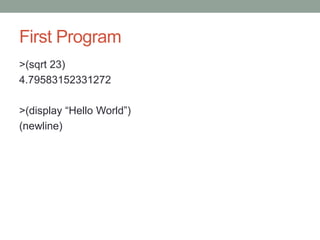
First Program
>(sqrt 23)
4.79583152331272
>(display “Hello World”)
(newline)
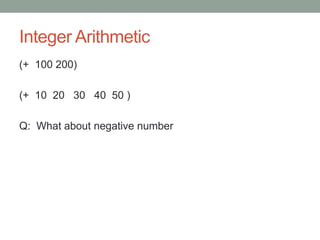
Integer Arithmetic
(+ 100 200)
(+ 10 20 30 40 50 )
Q: What about negative number
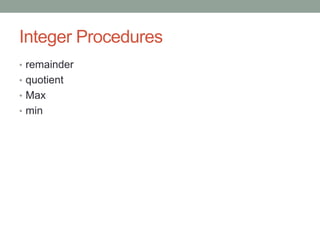
Integer Procedures
• remainder
• quotient
• Max
• min
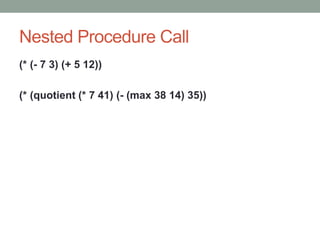
Nested Procedure Call
(* (- 7 3) (+ 5 12))
(* (quotient (* 7 41) (- (max 38 14) 35))
Definition
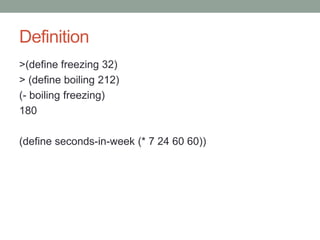
>(define freezing 32)
> (define boiling 212)
(- boiling freezing)
180
(define seconds-in-week (* 7 24 60 60))
Local & Global Binding
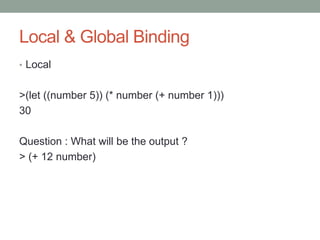
• Local
>(let ((number 5)) (* number (+ number 1)))
30
Question : What will be the output ?
> (+ 12 number)
Local & Global Binding
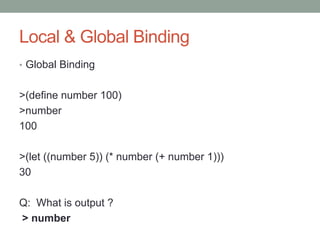
• Global Binding
>(define number 100)
>number
100
>(let ((number 5)) (* number (+ number 1)))
30
Q: What is output ?
> number
Internal Definition
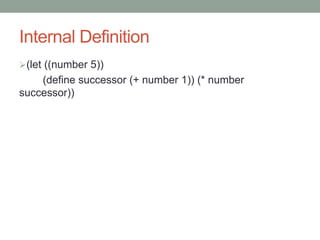
(let ((number 5))
(define successor (+ number 1)) (* number
successor))
Simple Procedure
Definition :
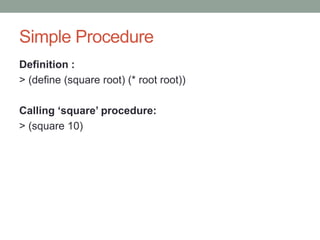
> (define (square root) (* root root))
Calling ‘square’ procedure:
> (square 10)
Lambda Expression
• Lambda
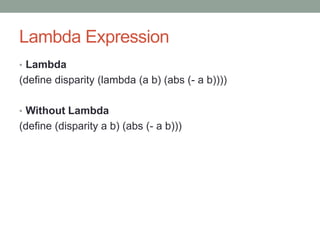
(define disparity (lambda (a b) (abs (- a b))))
• Without Lambda
(define (disparity a b) (abs (- a b)))
Boolean Expression
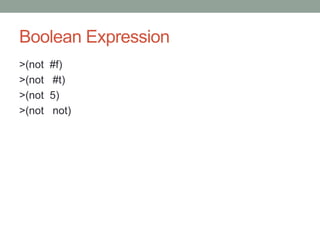
>(not #f)
>(not #t)
>(not 5)
>(not not)
Boolean Expression Continues…
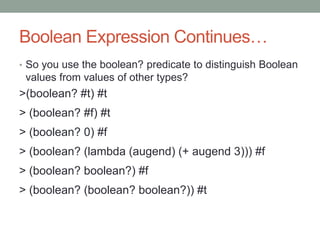
• So you use the boolean? predicate to distinguish Boolean
values from values of other types?
>(boolean? #t) #t
> (boolean? #f) #t
> (boolean? 0) #f
> (boolean? (lambda (augend) (+ augend 3))) #f
> (boolean? boolean?) #f
> (boolean? (boolean? boolean?)) #t
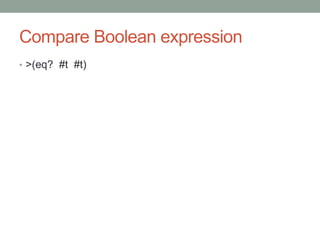
Compare Boolean expression
• >(eq? #t #t)
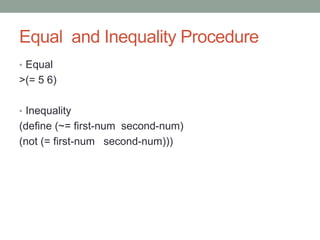
Equal and Inequality Procedure
• Equal
>(= 5 6)
• Inequality
(define (~= first-num second-num)
(not (= first-num second-num)))
Factorial Function
>(define (factorial n)
(if (zero? n)
1
(* (factorial (sub1 n)) n)))
>(factorial 0)
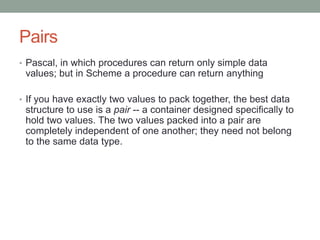
Pairs
• Pascal, in which procedures can return only simple data
values; but in Scheme a procedure can return anything
• If you have exactly two values to pack together, the best data
structure to use is a pair -- a container designed specifically to
hold two values. The two values packed into a pair are
completely independent of one another; they need not belong
to the same data type.
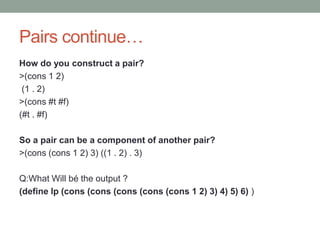
Pairs continue…
How do you construct a pair?
>(cons 1 2)
(1 . 2)
>(cons #t #f)
(#t . #f)
So a pair can be a component of another pair?
>(cons (cons 1 2) 3) ((1 . 2) . 3)
Q:What Will bé the output ?
(define lp (cons (cons (cons (cons (cons 1 2) 3) 4) 5) 6) )
Pairs continue…
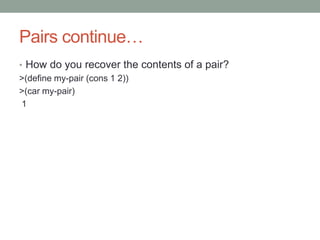
• How do you recover the contents of a pair?
>(define my-pair (cons 1 2))
>(car my-pair)
1
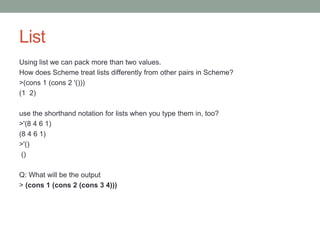
List
Using list we can pack more than two values.
How does Scheme treat lists differently from other pairs in Scheme?
>(cons 1 (cons 2 '()))
(1 2)
use the shorthand notation for lists when you type them in, too?
>'(8 4 6 1)
(8 4 6 1)
>'()
()
Q: What will be the output
> (cons 1 (cons 2 (cons 3 4)))
List continues…
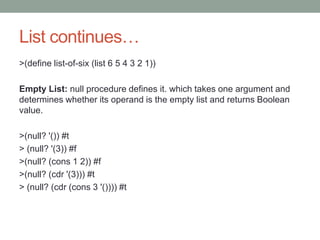
>(define list-of-six (list 6 5 4 3 2 1))
Empty List: null procedure defines it. which takes one argument and
determines whether its operand is the empty list and returns Boolean
value.
>(null? '()) #t
> (null? '(3)) #f
>(null? (cons 1 2)) #f
>(null? (cdr '(3))) #t
> (null? (cdr (cons 3 '()))) #t
List continues…
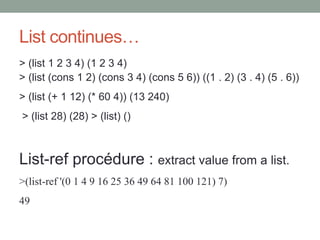
> (list 1 2 3 4) (1 2 3 4)
> (list (cons 1 2) (cons 3 4) (cons 5 6)) ((1 . 2) (3 . 4) (5 . 6))
> (list (+ 1 12) (* 60 4)) (13 240)
> (list 28) (28) > (list) ()
List-ref procédure : extract value from a list.
>(list-ref '(0 1 4 9 16 25 36 49 64 81 100 121) 7)
49
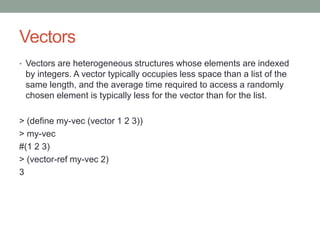
Vectors
• Vectors are heterogeneous structures whose elements are indexed
by integers. A vector typically occupies less space than a list of the
same length, and the average time required to access a randomly
chosen element is typically less for the vector than for the list.
> (define my-vec (vector 1 2 3))
> my-vec
#(1 2 3)
> (vector-ref my-vec 2)
3
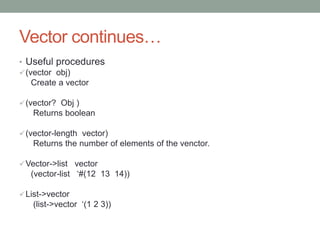
Vector continues…
• Useful procedures
(vector obj)
Create a vector
(vector? Obj )
Returns boolean
(vector-length vector)
Returns the number of elements of the venctor.
Vector->list vector
(vector-list ‘#(12 13 14))
List->vector
(list->vector ‘(1 2 3))
THANK YOU

Scheme language

  • 1.
    SCHEME LANGUAGE Jitendra Lenka Sr.Software Engineer, L&T Tech Services, Mysore
  • 2.
    Introduction • First appearedin 1975 • Functional programming language • Scheme was developed at the MIT AI Lab by Guy L. Steele and Gerald Jay Sussman • Scheme is influenced by Lisp • Scheme influenced Java Script, Ruby, Common Lisp • Clojure, Common Lisp, Dylan, EuLisp, Haskell, Hop, JavaScript, Kernel, Lua, R, Racket, Ruby • s-expressions, parenthesized lists in which a prefix operator is followed by its arguments. • It supports both in Windows and Linux platform.
  • 3.
    Introduction Continues… • Ituses small size interpreter • Uses in embedded system, compiler design, scripting. • Google App Inventor for Android uses Scheme, where Kawa is used to compile the Scheme code down to byte-codes for the Java Virtual Machine running on Android devices • List of Universities teach Scheme : • MIT • Northeastern University and Worcester Polytechnic Institute • Rice University, etc
  • 4.
    Scheme Variant • ChezScheme • Chicken Scheme • Racket Scheme
  • 5.
  • 6.
    Integer Arithmetic (+ 100200) (+ 10 20 30 40 50 ) Q: What about negative number
  • 7.
    Integer Procedures • remainder •quotient • Max • min
  • 8.
    Nested Procedure Call (*(- 7 3) (+ 5 12)) (* (quotient (* 7 41) (- (max 38 14) 35))
  • 9.
    Definition >(define freezing 32) >(define boiling 212) (- boiling freezing) 180 (define seconds-in-week (* 7 24 60 60))
  • 10.
    Local & GlobalBinding • Local >(let ((number 5)) (* number (+ number 1))) 30 Question : What will be the output ? > (+ 12 number)
  • 11.
    Local & GlobalBinding • Global Binding >(define number 100) >number 100 >(let ((number 5)) (* number (+ number 1))) 30 Q: What is output ? > number
  • 12.
    Internal Definition (let ((number5)) (define successor (+ number 1)) (* number successor))
  • 13.
    Simple Procedure Definition : >(define (square root) (* root root)) Calling ‘square’ procedure: > (square 10)
  • 14.
    Lambda Expression • Lambda (definedisparity (lambda (a b) (abs (- a b)))) • Without Lambda (define (disparity a b) (abs (- a b)))
  • 15.
    Boolean Expression >(not #f) >(not#t) >(not 5) >(not not)
  • 16.
    Boolean Expression Continues… •So you use the boolean? predicate to distinguish Boolean values from values of other types? >(boolean? #t) #t > (boolean? #f) #t > (boolean? 0) #f > (boolean? (lambda (augend) (+ augend 3))) #f > (boolean? boolean?) #f > (boolean? (boolean? boolean?)) #t
  • 17.
  • 18.
    Equal and InequalityProcedure • Equal >(= 5 6) • Inequality (define (~= first-num second-num) (not (= first-num second-num)))
  • 19.
    Factorial Function >(define (factorialn) (if (zero? n) 1 (* (factorial (sub1 n)) n))) >(factorial 0)
  • 20.
    Pairs • Pascal, inwhich procedures can return only simple data values; but in Scheme a procedure can return anything • If you have exactly two values to pack together, the best data structure to use is a pair -- a container designed specifically to hold two values. The two values packed into a pair are completely independent of one another; they need not belong to the same data type.
  • 21.
    Pairs continue… How doyou construct a pair? >(cons 1 2) (1 . 2) >(cons #t #f) (#t . #f) So a pair can be a component of another pair? >(cons (cons 1 2) 3) ((1 . 2) . 3) Q:What Will bé the output ? (define lp (cons (cons (cons (cons (cons 1 2) 3) 4) 5) 6) )
  • 22.
    Pairs continue… • Howdo you recover the contents of a pair? >(define my-pair (cons 1 2)) >(car my-pair) 1
  • 23.
    List Using list wecan pack more than two values. How does Scheme treat lists differently from other pairs in Scheme? >(cons 1 (cons 2 '())) (1 2) use the shorthand notation for lists when you type them in, too? >'(8 4 6 1) (8 4 6 1) >'() () Q: What will be the output > (cons 1 (cons 2 (cons 3 4)))
  • 24.
    List continues… >(define list-of-six(list 6 5 4 3 2 1)) Empty List: null procedure defines it. which takes one argument and determines whether its operand is the empty list and returns Boolean value. >(null? '()) #t > (null? '(3)) #f >(null? (cons 1 2)) #f >(null? (cdr '(3))) #t > (null? (cdr (cons 3 '()))) #t
  • 25.
    List continues… > (list1 2 3 4) (1 2 3 4) > (list (cons 1 2) (cons 3 4) (cons 5 6)) ((1 . 2) (3 . 4) (5 . 6)) > (list (+ 1 12) (* 60 4)) (13 240) > (list 28) (28) > (list) () List-ref procédure : extract value from a list. >(list-ref '(0 1 4 9 16 25 36 49 64 81 100 121) 7) 49
  • 26.
    Vectors • Vectors areheterogeneous structures whose elements are indexed by integers. A vector typically occupies less space than a list of the same length, and the average time required to access a randomly chosen element is typically less for the vector than for the list. > (define my-vec (vector 1 2 3)) > my-vec #(1 2 3) > (vector-ref my-vec 2) 3
  • 27.
    Vector continues… • Usefulprocedures (vector obj) Create a vector (vector? Obj ) Returns boolean (vector-length vector) Returns the number of elements of the venctor. Vector->list vector (vector-list ‘#(12 13 14)) List->vector (list->vector ‘(1 2 3))
  • 28.