Assets-based public health
Responding to the Policy and Practice challenges
Michael Shepherd
http://www.msresearch.co.uk/resources/Assets%20report.pdf
“A review of the evidence on health inequities and community
cohesion with recommendations for strengthening the health
assets approach.”
Dr Michael Shepherd, April 2012
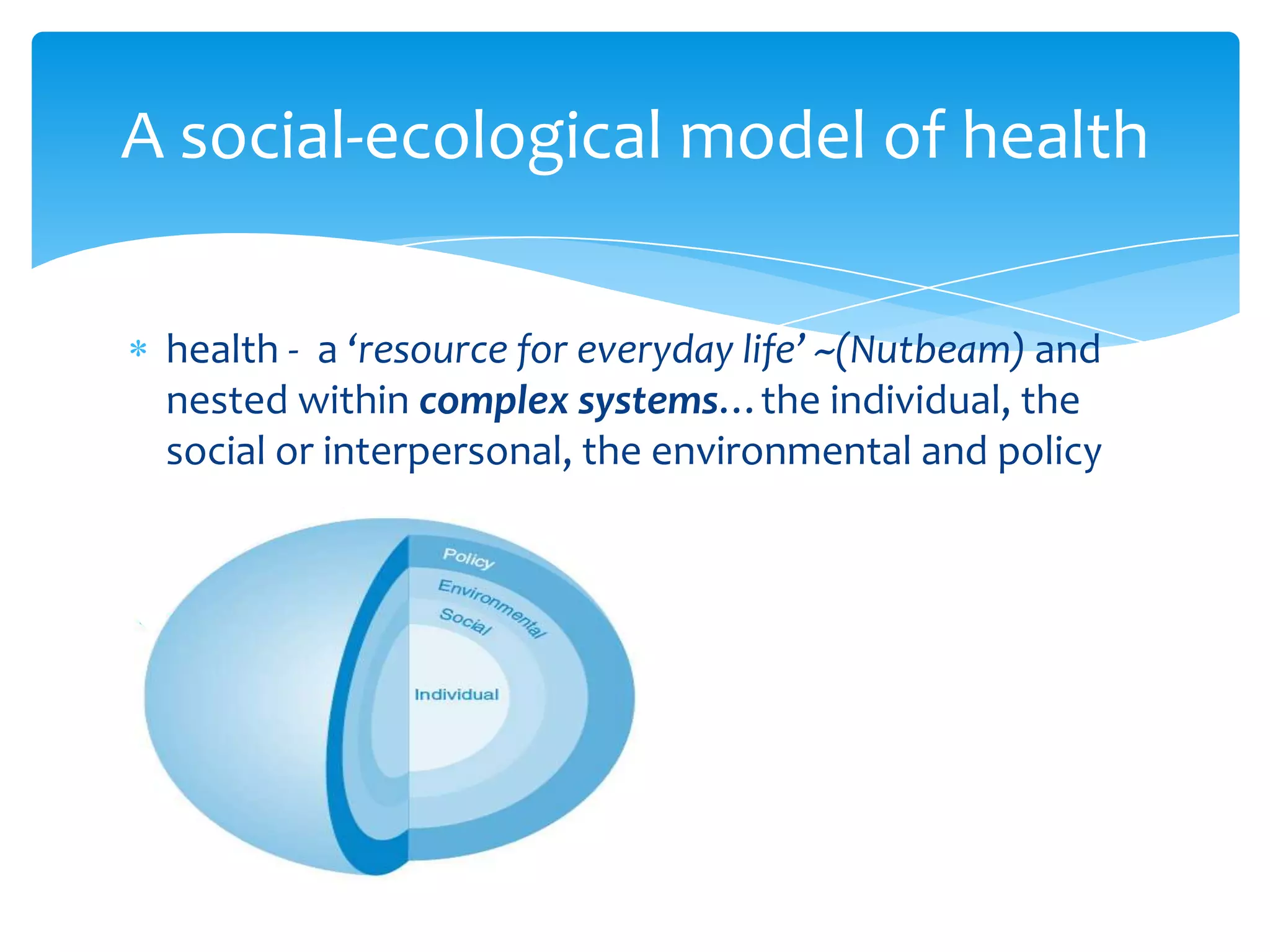
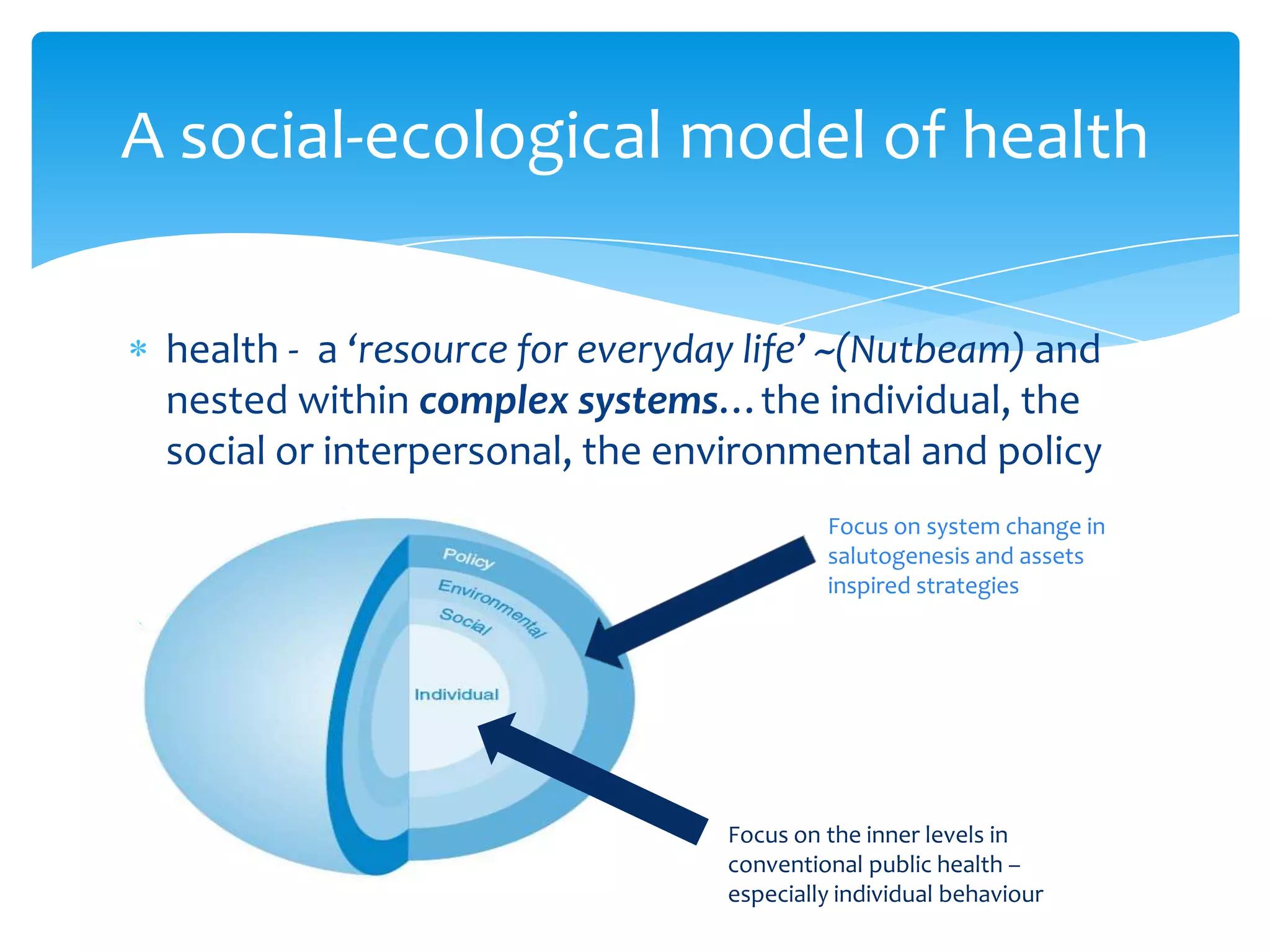
health - a ‘resource for everyday life’ ~(Nutbeam) and
nested within complex systems…the individual, the
social or interpersonal, the environmental and policy
A social-ecological model of health
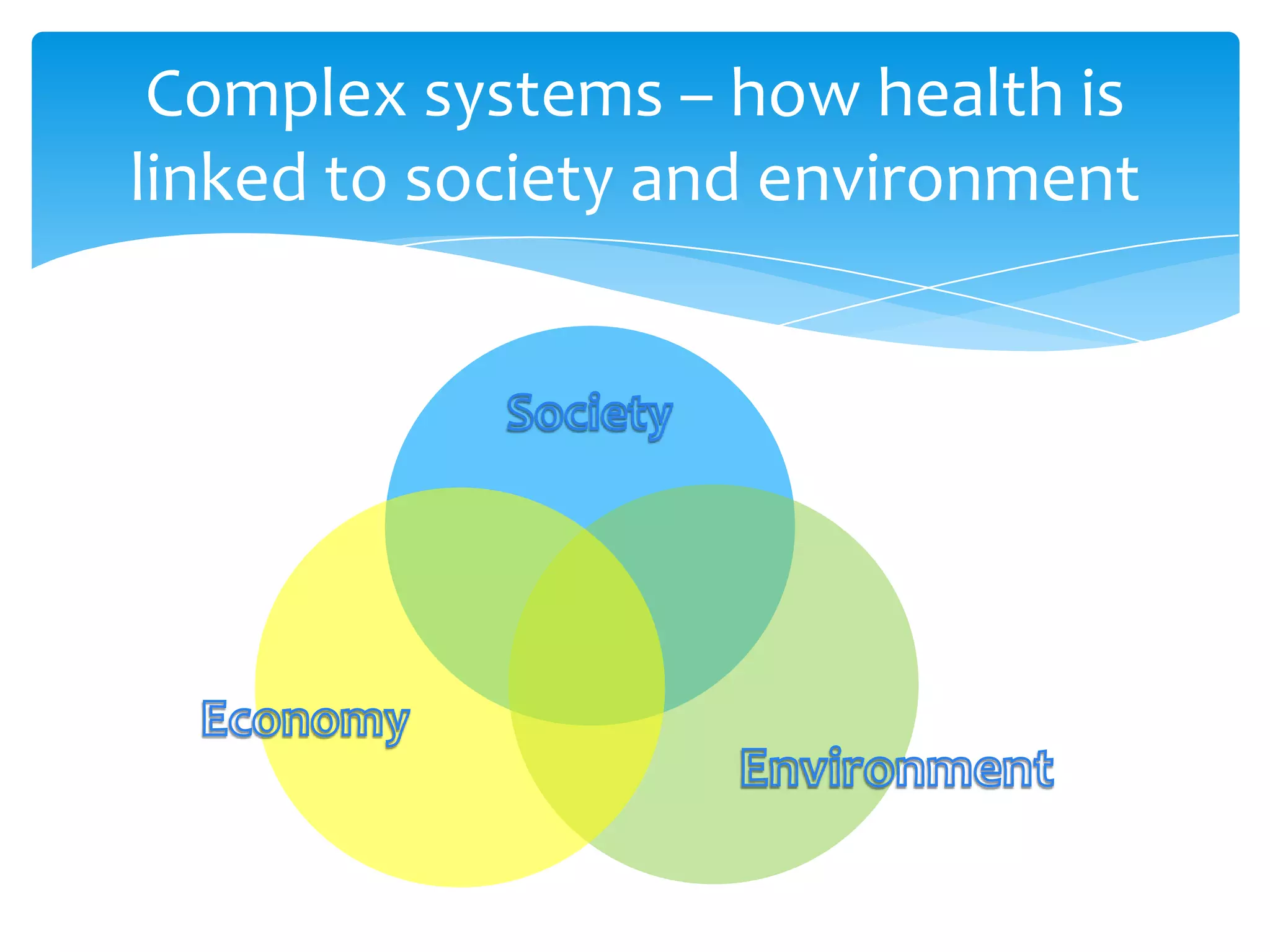
Complex systems – how health is
linked to society and environment
Composed of many component parts;
Difficult to define – to find boundaries;
Relationships between elements are not linear and
are often unpredictable;
Elements and systems learn and change;
Dynamic, constantly adapting;
Systems may be nested and/or inter-related;
The impact of change in one system can have
unpredictable and unexpected change in related
systems;
What are complex systems like?
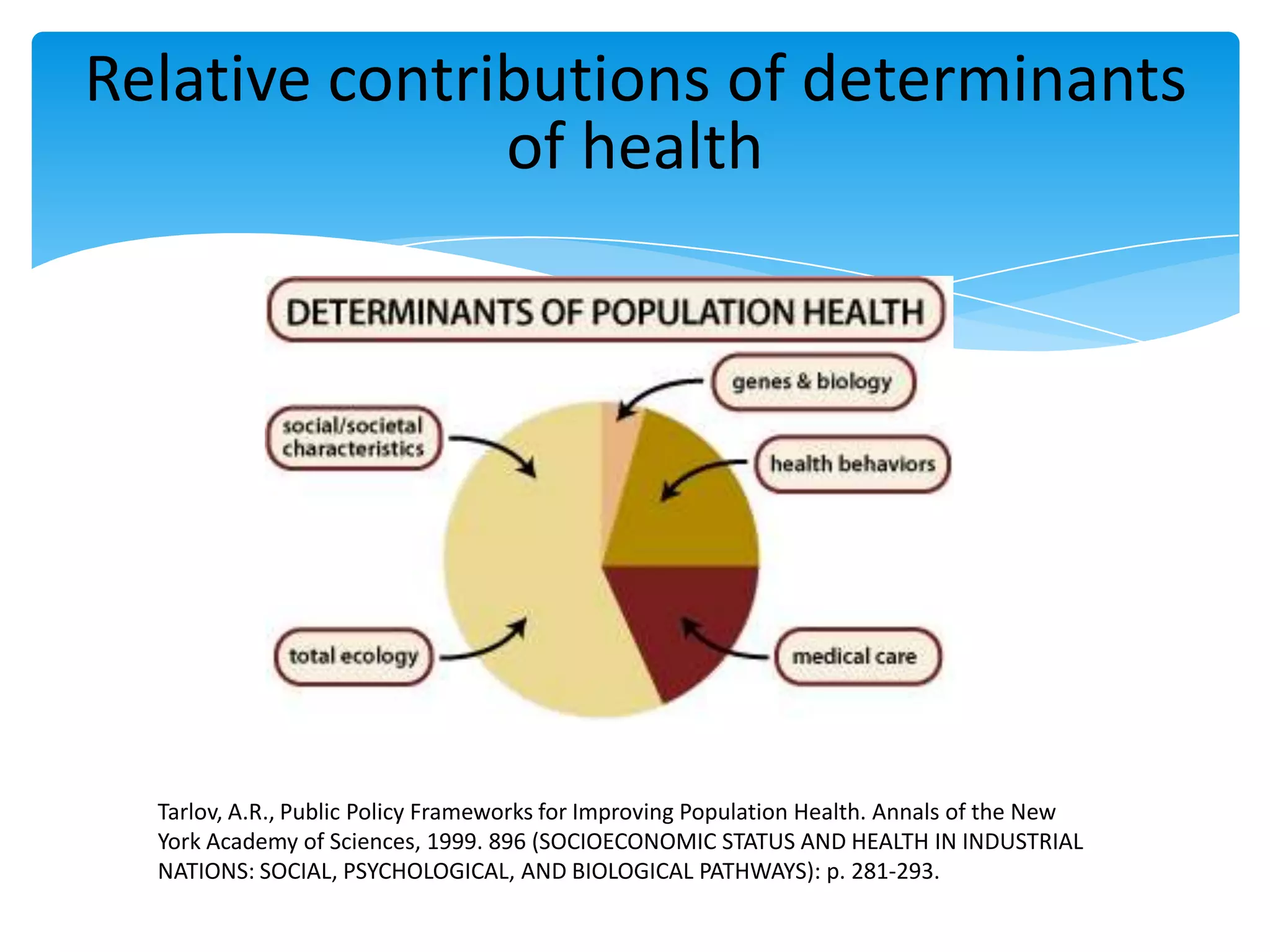
Relative contributions of determinants
of health
Tarlov, A.R., Public Policy Frameworks for Improving Population Health. Annals of the New
York Academy of Sciences, 1999. 896 (SOCIOECONOMIC STATUS AND HEALTH IN INDUSTRIAL
NATIONS: SOCIAL, PSYCHOLOGICAL, AND BIOLOGICAL PATHWAYS): p. 281-293.
Building healthy public policy
Creating supportive environments for health
Strengthening community action for health
Developing personal skills, and
Re-orienting health services
Ottawa Charter – priorities for action
Wealth and Wellbeing
“The Gross National Product counts air pollution and cigarette
advertising, and ambulances to clear our highways of carnage. It
counts special locks for our doors and the jails for the people who
break them… It counts the destruction of the redwood and the loss of
our natural wonder in chaotic sprawl… Yet the gross national product
does not allow for the health of our children, the quality of their
education, or the joy of their play. It does not include the beauty of
our poetry or the strength of our marriages, the intelligence of our
public debate or the integrity of our public officials… it measures
everything, in short, except that which makes life worthwhile.”
Bobby Kennedy 1968
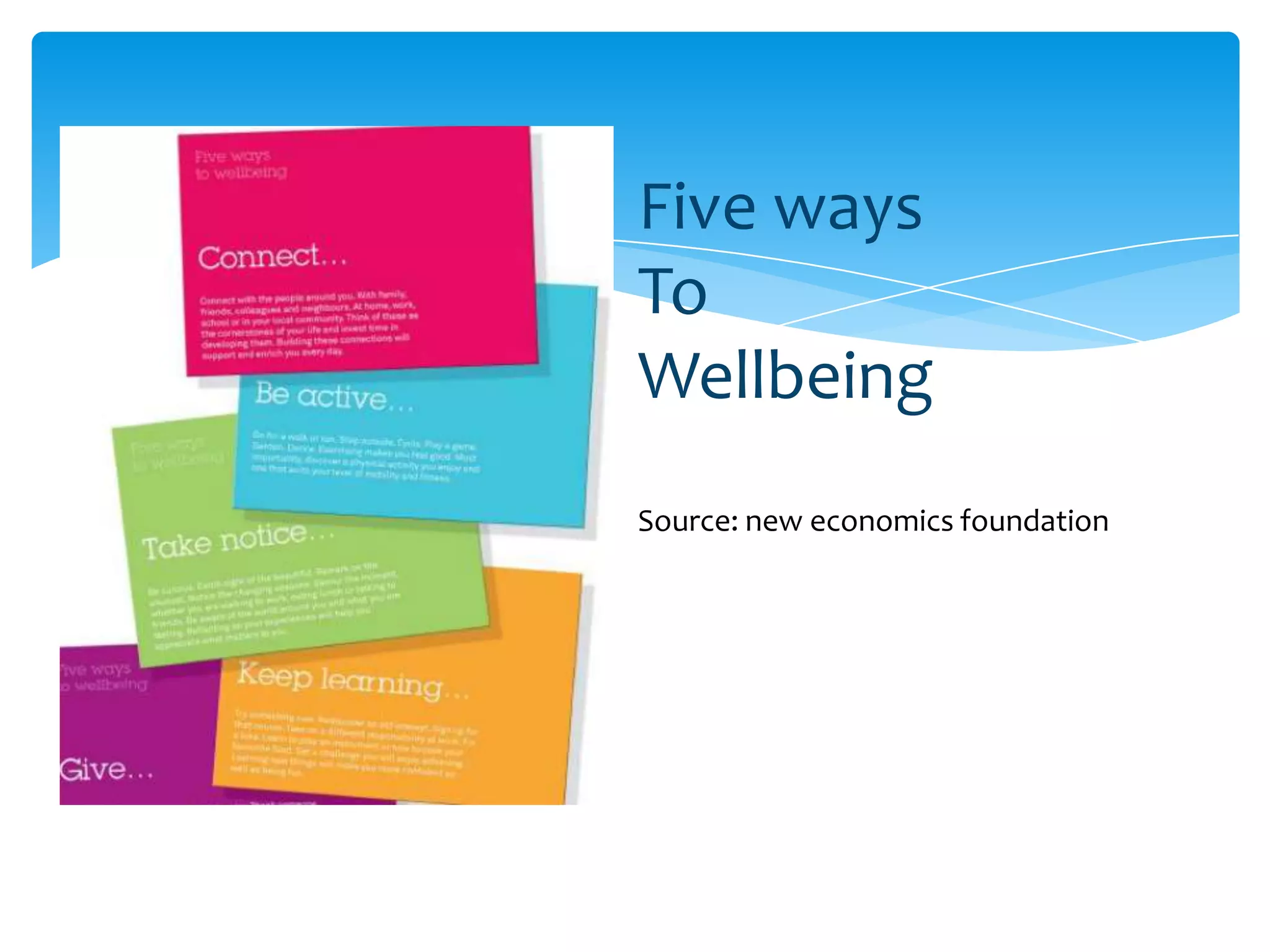
Five ways
To
Wellbeing
Source: new economics foundation
…increasing inequalities have complex causes including increased social and
economic inequality, deindustrialisation and a breakdown of community
structures resulting from (neoliberal) UK Government policies in the 1980s
(McCartney et al 2011, Elliott et al, 2011)
“the closure of the pits and steelworks represented not only a decline in the
local economy, but a cultural crisis… social networks were grounded in the
workplace and trade unions… there remains a deep sense of loss in communities
that had relied on these industries for their existence” (Shepherd, 2010)
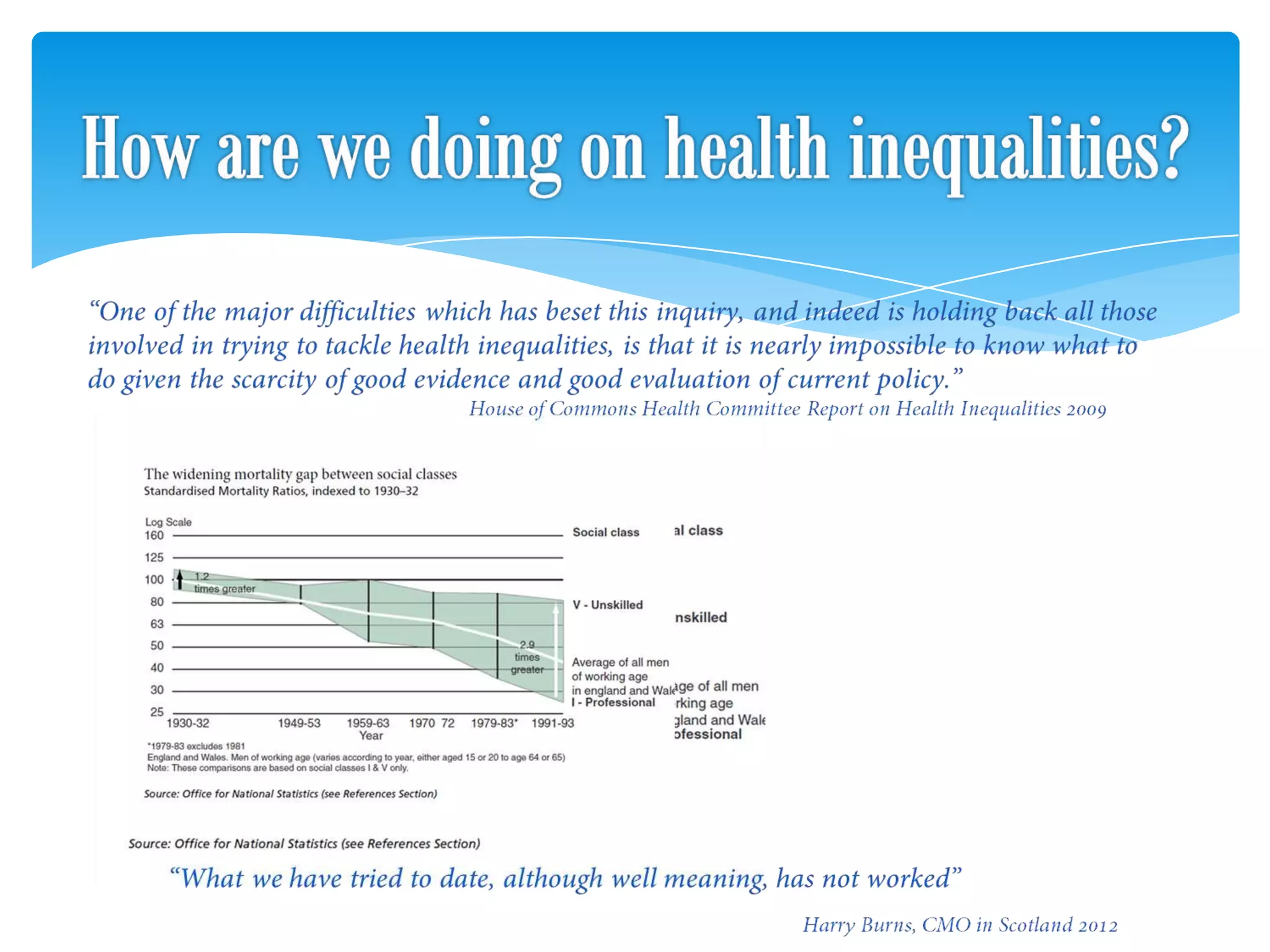
“what we have tried to date (although well meaning) has not
worked”
Harry Burns , Chief Medical Officer, Scotland
Health inequalities
A wicked issue is one imperfectly understood, to
which solutions are not clear or simple. It signifies an
intractable problem (eg. climate change, drug misuse,
inequalities).
Addressing wicked issues needs concerted action
across organisations and authorities, and at many
levels.
‘Wicked issues…’
Holistic (not partial or linear) thinking;
A capacity to think and work across organizational boundaries;
Ways of involving the public in developing solutions;
A willingness to think and work in completely new ways.
Willingness to entertain the unconventional and pursue the radical.
This implies: A new style of governing for a learning society.
Clarke & Stewart (1997) Handling the wicked issues. A challenge for
government. Birmingham: INLOGOV
How can we work together to tackle
‘wicked issues’ like inequalities in
health?
Health is not an end in itself, but a resource for everyday
life;
Health and wellbeing are the result of multiple factors and
the interaction of complex systems mostly outside of
health service policy;
Improving health needs collaboration between citizens
and with organizations from the statutory, voluntary and
private sectors;
It needs to involve different levels of government;
We get the best results when people (and organisations)
work together well.
Routes to health improvement and
equality in health
Strengthening individuals;
Strengthening communities;
Improving working and living conditions;
Macro-economic change.
Whitehead, M., 2007. A typology of actions to tackle social inequalities in
health. J Epidemiol Community Health 61, 473–478.
How do you address inequalities?
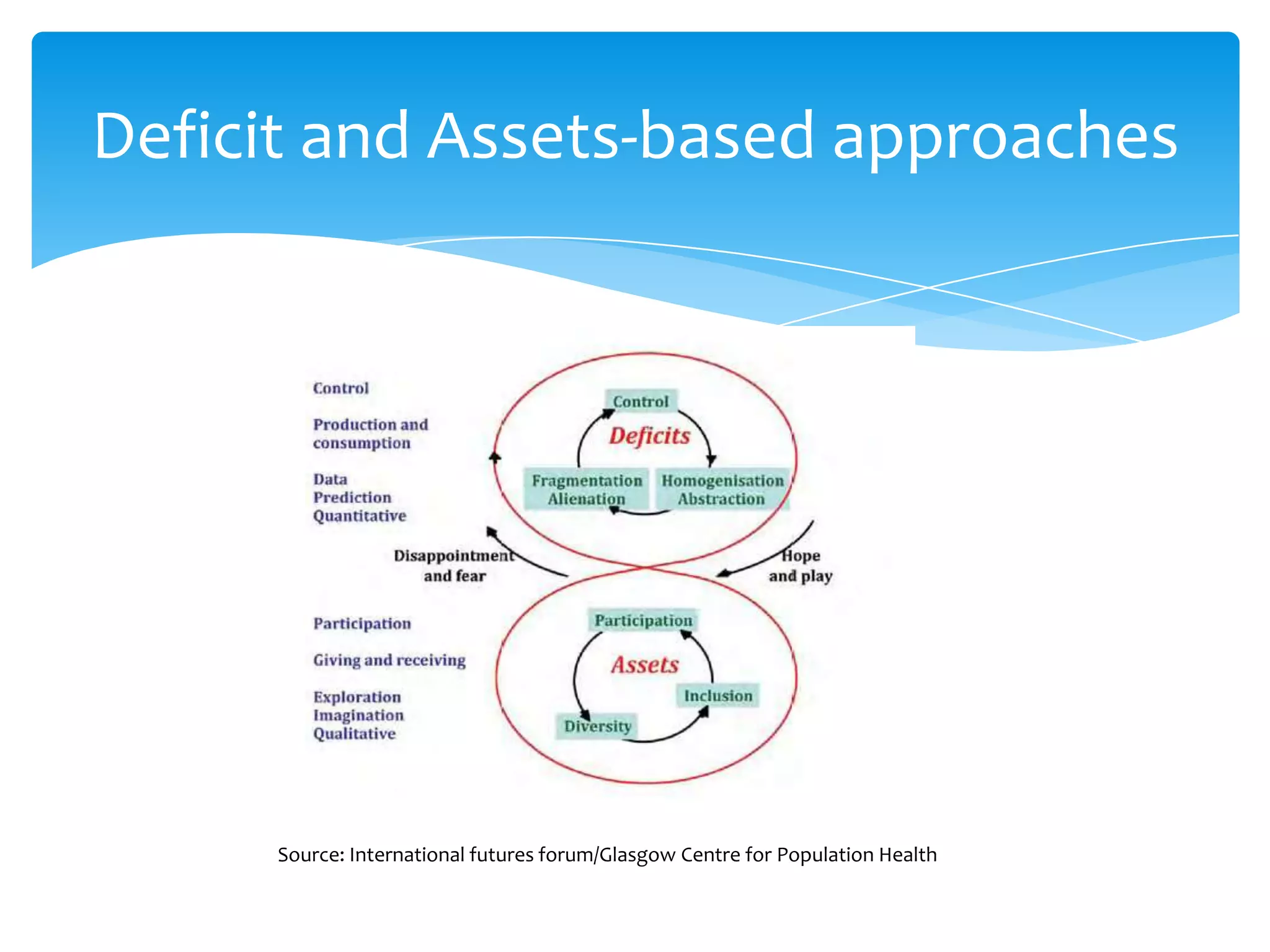
Deficit and Assets-based approaches
Source: International futures forum/Glasgow Centre for Population Health
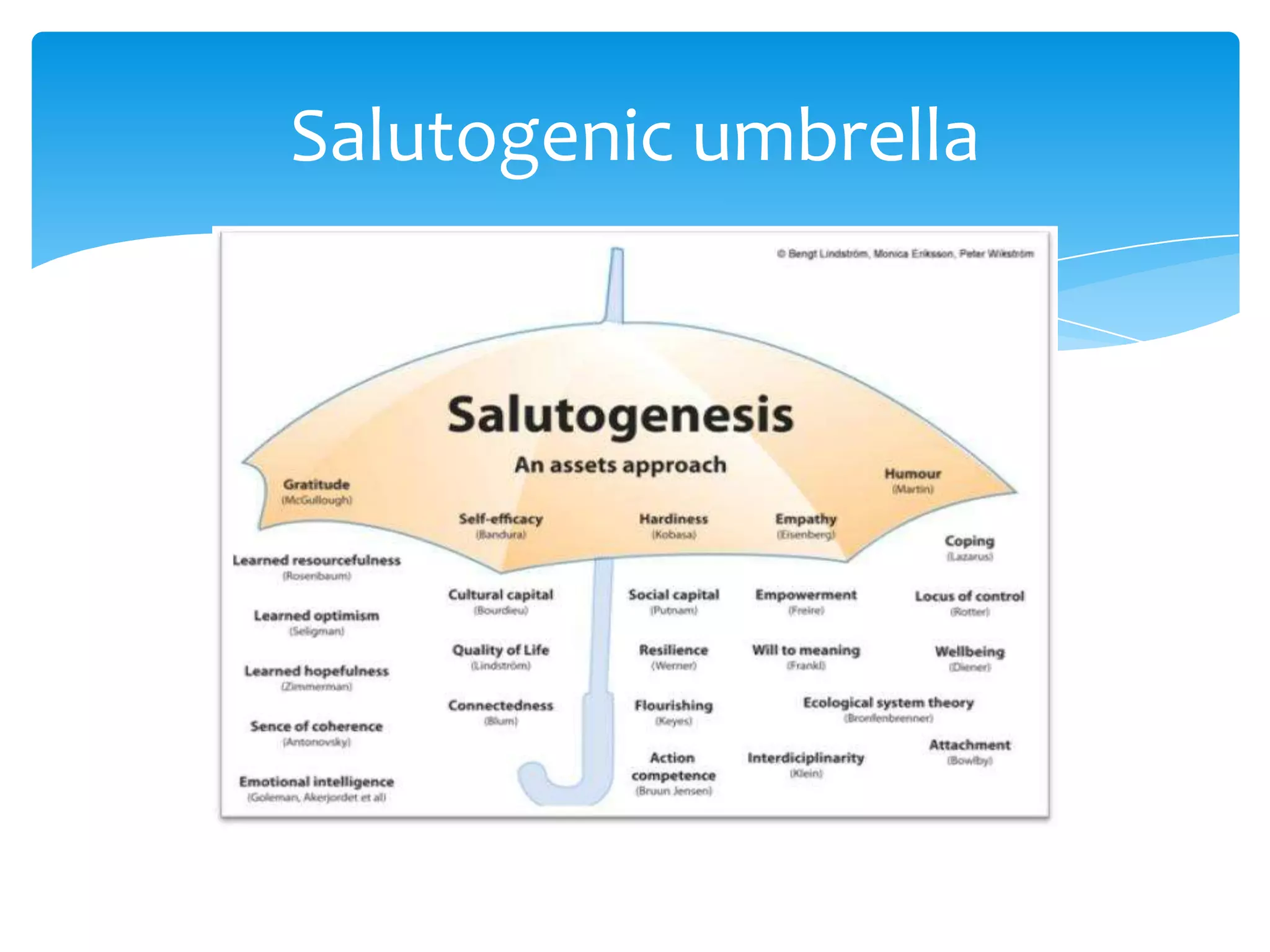
Salutogenic umbrella
“with the salutogenic model, the concern is with full
and active adaptation to environments that are
plagued by stress. To adapt, people look for those
inputs from the social… and physical
environments… as well as from their own personal
reserves…”
D. Korotkov, 1998 The sense of coherence: Making Sense of Chaos, in: Wong, P. Fry,
P. (eds) The Human Quest for Meaning: a Handbook of Psychological Research and
Clinical Applications, Personality and Clinical Psychology Series. Routledge, pp. 51–
70.
“If we had a garden, the kids wouldn’t always be under my feet, they wouldn’t get smacked
so much and then I wouldn’t feel guilty and get depressed like I do”
Bristol & Weston HA Public Health Report 1990
“Twenty-five years ago, there was nothing to do… twenty-five years on and there’s still
nothing to do…”
Bristol & Weston HA Public Health Report 1990
“I gets a bit frustrated… they just seem to discuss the same things over and over again…
this last time, I got really fed up and let them have it – they just never get on with it and do
things.”
MS - PhD (2005)
We live there… we should know!
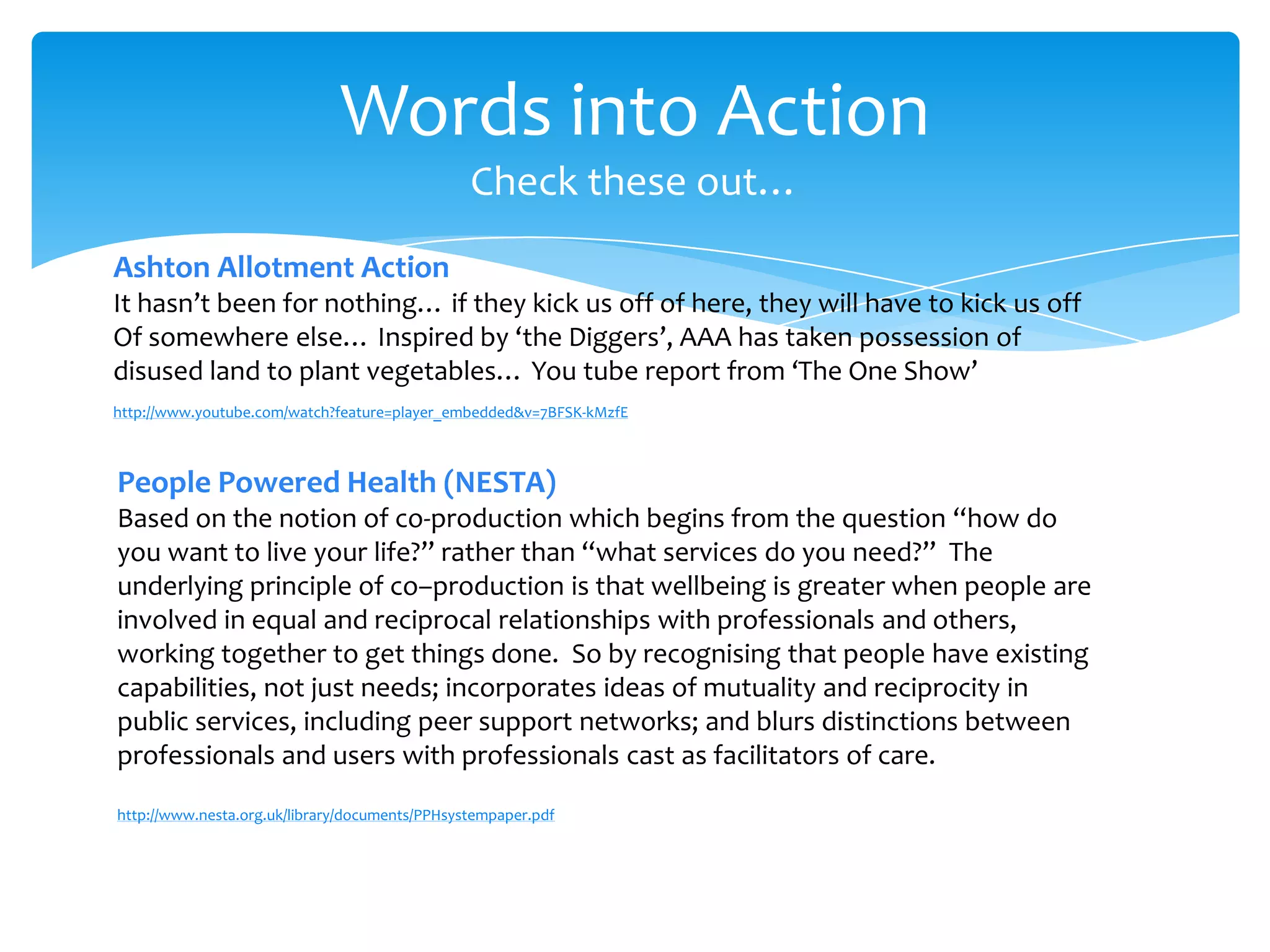
Words into Action
Check these out…
http://www.youtube.com/watch?feature=player_embedded&v=7BFSK-kMzfE
Ashton Allotment Action
It hasn’t been for nothing… if they kick us off of here, they will have to kick us off
Of somewhere else… Inspired by ‘the Diggers’, AAA has taken possession of
disused land to plant vegetables… You tube report from ‘The One Show’
People Powered Health (NESTA)
Based on the notion of co-production which begins from the question “how do
you want to live your life?” rather than “what services do you need?” The
underlying principle of co–production is that wellbeing is greater when people are
involved in equal and reciprocal relationships with professionals and others,
working together to get things done. So by recognising that people have existing
capabilities, not just needs; incorporates ideas of mutuality and reciprocity in
public services, including peer support networks; and blurs distinctions between
professionals and users with professionals cast as facilitators of care.
http://www.nesta.org.uk/library/documents/PPHsystempaper.pdf
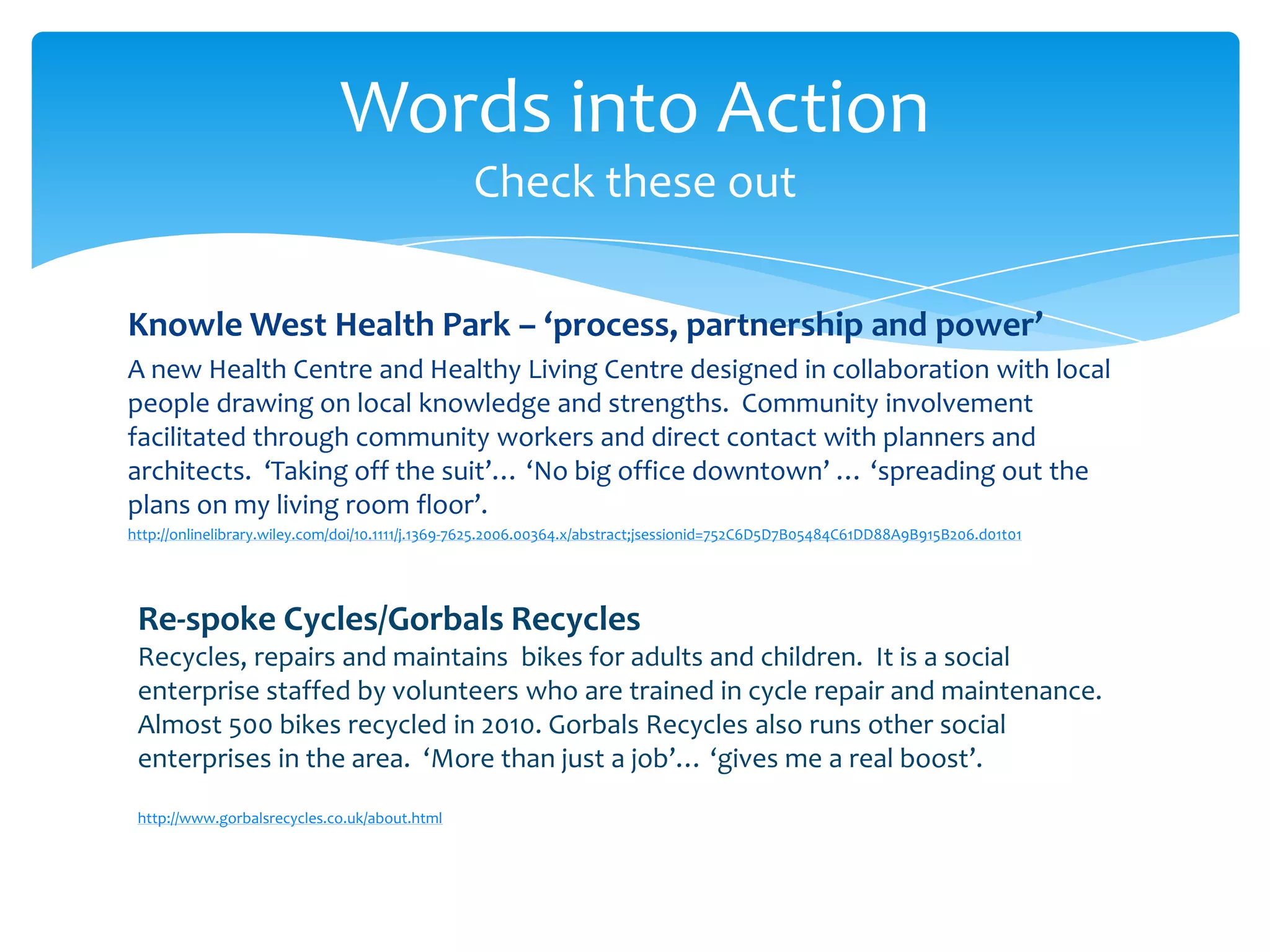
Knowle West Health Park – ‘process, partnership and power’
A new Health Centre and Healthy Living Centre designed in collaboration with local
people drawing on local knowledge and strengths. Community involvement
facilitated through community workers and direct contact with planners and
architects. ‘Taking off the suit’… ‘No big office downtown’ … ‘spreading out the
plans on my living room floor’.
http://onlinelibrary.wiley.com/doi/10.1111/j.1369-7625.2006.00364.x/abstract;jsessionid=752C6D5D7B05484C61DD88A9B915B206.d01t01
Words into Action
Check these out
Re-spoke Cycles/Gorbals Recycles
Recycles, repairs and maintains bikes for adults and children. It is a social
enterprise staffed by volunteers who are trained in cycle repair and maintenance.
Almost 500 bikes recycled in 2010. Gorbals Recycles also runs other social
enterprises in the area. ‘More than just a job’… ‘gives me a real boost’.
http://www.gorbalsrecycles.co.uk/about.html
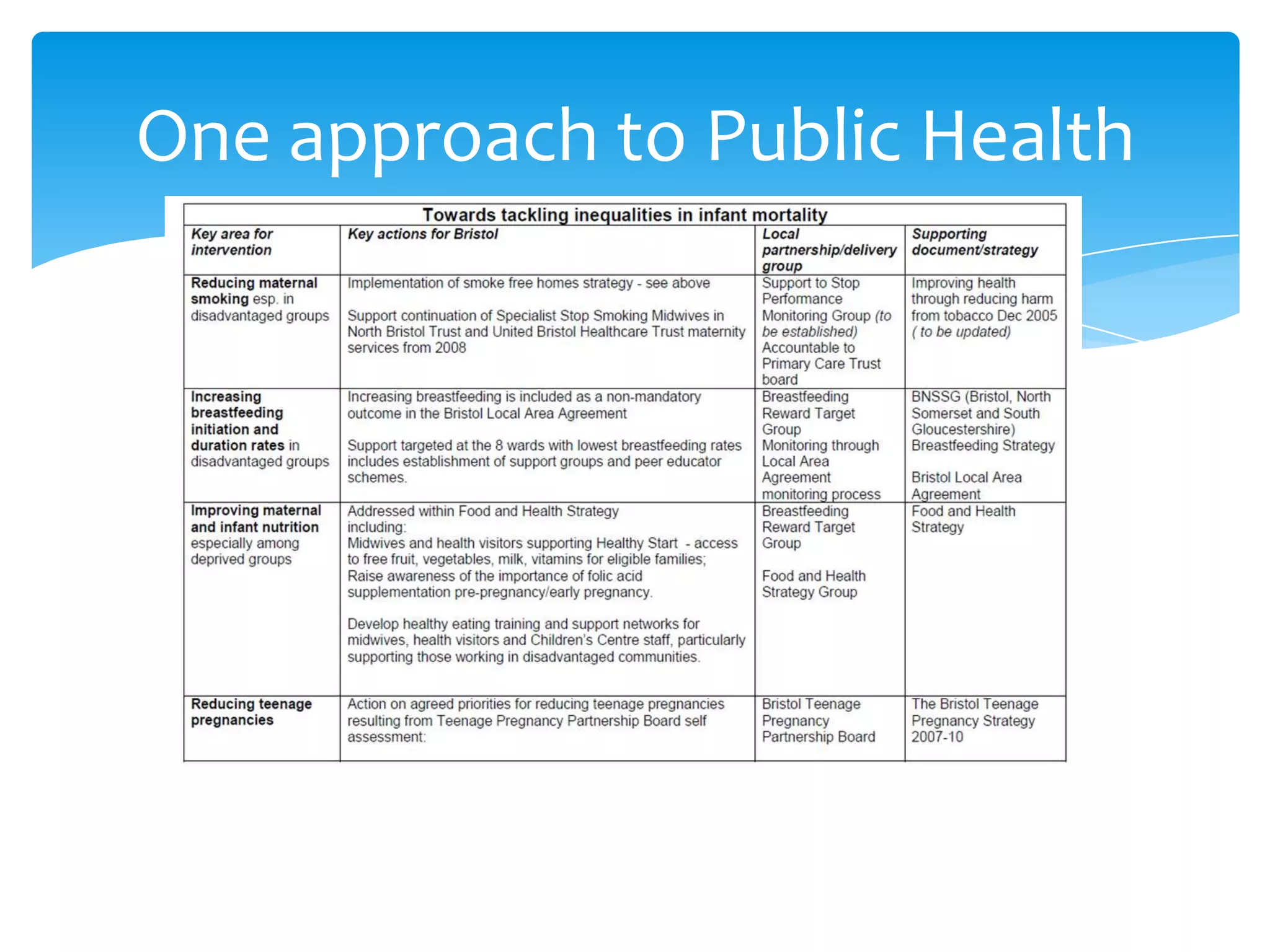
One approach to Public Health
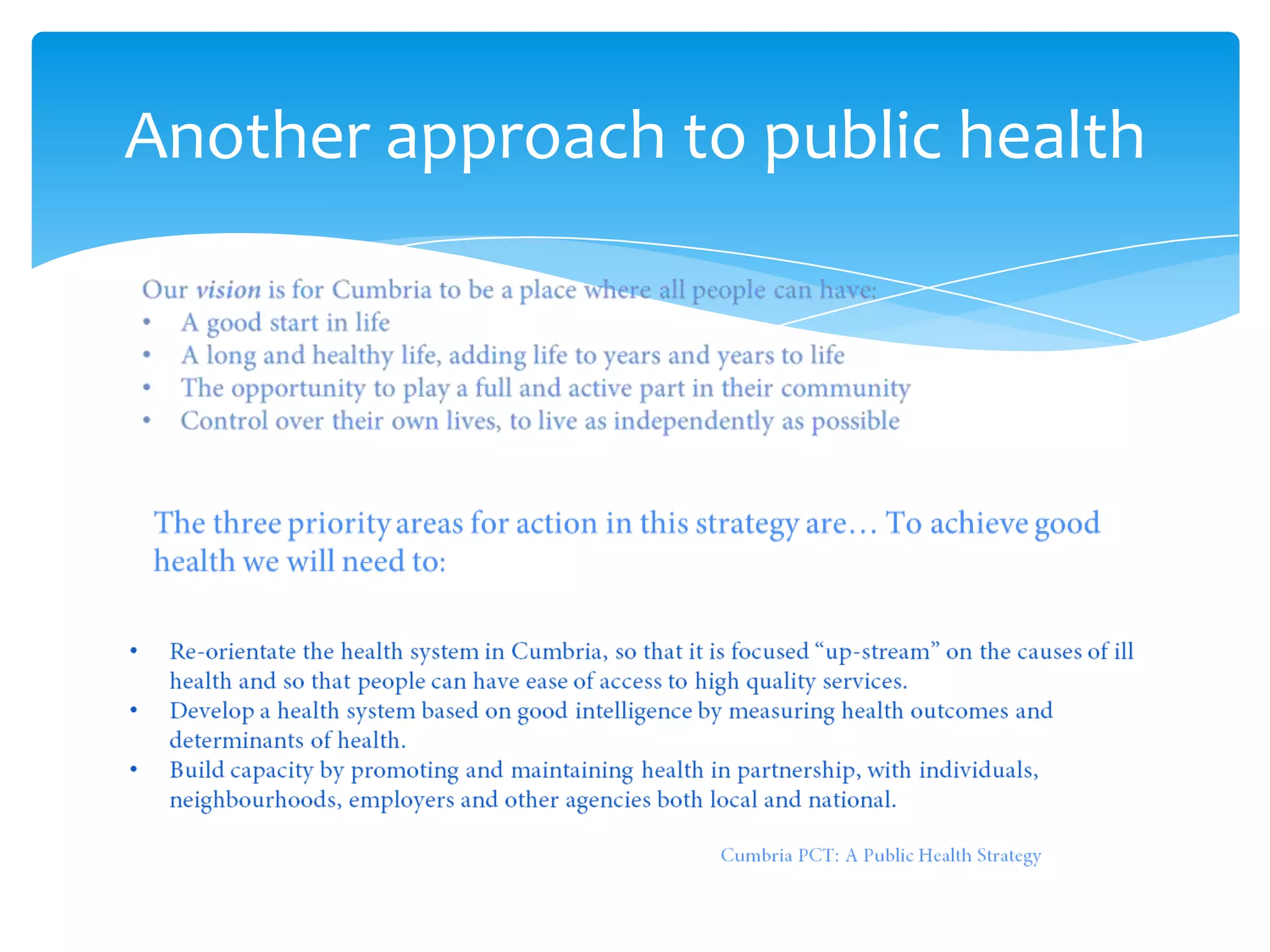
Another approach to public health
health - a ‘resource for everyday life’ ~(Nutbeam) and
nested within complex systems…the individual, the
social or interpersonal, the environmental and policy
A social-ecological model of health
Focus on the inner levels in
conventional public health –
especially individual behaviour
Focus on system change in
salutogenesis and assets
inspired strategies

Assets models seminar

  • 1.
    Assets-based public health Respondingto the Policy and Practice challenges Michael Shepherd
  • 2.
    http://www.msresearch.co.uk/resources/Assets%20report.pdf “A review ofthe evidence on health inequities and community cohesion with recommendations for strengthening the health assets approach.” Dr Michael Shepherd, April 2012
  • 3.
    health - a‘resource for everyday life’ ~(Nutbeam) and nested within complex systems…the individual, the social or interpersonal, the environmental and policy A social-ecological model of health
  • 4.
    Complex systems –how health is linked to society and environment
  • 5.
    Composed of manycomponent parts; Difficult to define – to find boundaries; Relationships between elements are not linear and are often unpredictable; Elements and systems learn and change; Dynamic, constantly adapting; Systems may be nested and/or inter-related; The impact of change in one system can have unpredictable and unexpected change in related systems; What are complex systems like?
  • 6.
    Relative contributions ofdeterminants of health Tarlov, A.R., Public Policy Frameworks for Improving Population Health. Annals of the New York Academy of Sciences, 1999. 896 (SOCIOECONOMIC STATUS AND HEALTH IN INDUSTRIAL NATIONS: SOCIAL, PSYCHOLOGICAL, AND BIOLOGICAL PATHWAYS): p. 281-293.
  • 7.
    Building healthy publicpolicy Creating supportive environments for health Strengthening community action for health Developing personal skills, and Re-orienting health services Ottawa Charter – priorities for action
  • 8.
    Wealth and Wellbeing “TheGross National Product counts air pollution and cigarette advertising, and ambulances to clear our highways of carnage. It counts special locks for our doors and the jails for the people who break them… It counts the destruction of the redwood and the loss of our natural wonder in chaotic sprawl… Yet the gross national product does not allow for the health of our children, the quality of their education, or the joy of their play. It does not include the beauty of our poetry or the strength of our marriages, the intelligence of our public debate or the integrity of our public officials… it measures everything, in short, except that which makes life worthwhile.” Bobby Kennedy 1968
  • 9.
  • 10.
    …increasing inequalities havecomplex causes including increased social and economic inequality, deindustrialisation and a breakdown of community structures resulting from (neoliberal) UK Government policies in the 1980s (McCartney et al 2011, Elliott et al, 2011) “the closure of the pits and steelworks represented not only a decline in the local economy, but a cultural crisis… social networks were grounded in the workplace and trade unions… there remains a deep sense of loss in communities that had relied on these industries for their existence” (Shepherd, 2010) “what we have tried to date (although well meaning) has not worked” Harry Burns , Chief Medical Officer, Scotland Health inequalities
  • 12.
    A wicked issueis one imperfectly understood, to which solutions are not clear or simple. It signifies an intractable problem (eg. climate change, drug misuse, inequalities). Addressing wicked issues needs concerted action across organisations and authorities, and at many levels. ‘Wicked issues…’
  • 13.
    Holistic (not partialor linear) thinking; A capacity to think and work across organizational boundaries; Ways of involving the public in developing solutions; A willingness to think and work in completely new ways. Willingness to entertain the unconventional and pursue the radical. This implies: A new style of governing for a learning society. Clarke & Stewart (1997) Handling the wicked issues. A challenge for government. Birmingham: INLOGOV How can we work together to tackle ‘wicked issues’ like inequalities in health?
  • 14.
    Health is notan end in itself, but a resource for everyday life; Health and wellbeing are the result of multiple factors and the interaction of complex systems mostly outside of health service policy; Improving health needs collaboration between citizens and with organizations from the statutory, voluntary and private sectors; It needs to involve different levels of government; We get the best results when people (and organisations) work together well. Routes to health improvement and equality in health
  • 15.
    Strengthening individuals; Strengthening communities; Improvingworking and living conditions; Macro-economic change. Whitehead, M., 2007. A typology of actions to tackle social inequalities in health. J Epidemiol Community Health 61, 473–478. How do you address inequalities?
  • 16.
    Deficit and Assets-basedapproaches Source: International futures forum/Glasgow Centre for Population Health
  • 18.
  • 19.
    “with the salutogenicmodel, the concern is with full and active adaptation to environments that are plagued by stress. To adapt, people look for those inputs from the social… and physical environments… as well as from their own personal reserves…” D. Korotkov, 1998 The sense of coherence: Making Sense of Chaos, in: Wong, P. Fry, P. (eds) The Human Quest for Meaning: a Handbook of Psychological Research and Clinical Applications, Personality and Clinical Psychology Series. Routledge, pp. 51– 70.
  • 20.
    “If we hada garden, the kids wouldn’t always be under my feet, they wouldn’t get smacked so much and then I wouldn’t feel guilty and get depressed like I do” Bristol & Weston HA Public Health Report 1990 “Twenty-five years ago, there was nothing to do… twenty-five years on and there’s still nothing to do…” Bristol & Weston HA Public Health Report 1990 “I gets a bit frustrated… they just seem to discuss the same things over and over again… this last time, I got really fed up and let them have it – they just never get on with it and do things.” MS - PhD (2005) We live there… we should know!
  • 21.
    Words into Action Checkthese out… http://www.youtube.com/watch?feature=player_embedded&v=7BFSK-kMzfE Ashton Allotment Action It hasn’t been for nothing… if they kick us off of here, they will have to kick us off Of somewhere else… Inspired by ‘the Diggers’, AAA has taken possession of disused land to plant vegetables… You tube report from ‘The One Show’ People Powered Health (NESTA) Based on the notion of co-production which begins from the question “how do you want to live your life?” rather than “what services do you need?” The underlying principle of co–production is that wellbeing is greater when people are involved in equal and reciprocal relationships with professionals and others, working together to get things done. So by recognising that people have existing capabilities, not just needs; incorporates ideas of mutuality and reciprocity in public services, including peer support networks; and blurs distinctions between professionals and users with professionals cast as facilitators of care. http://www.nesta.org.uk/library/documents/PPHsystempaper.pdf
  • 22.
    Knowle West HealthPark – ‘process, partnership and power’ A new Health Centre and Healthy Living Centre designed in collaboration with local people drawing on local knowledge and strengths. Community involvement facilitated through community workers and direct contact with planners and architects. ‘Taking off the suit’… ‘No big office downtown’ … ‘spreading out the plans on my living room floor’. http://onlinelibrary.wiley.com/doi/10.1111/j.1369-7625.2006.00364.x/abstract;jsessionid=752C6D5D7B05484C61DD88A9B915B206.d01t01 Words into Action Check these out Re-spoke Cycles/Gorbals Recycles Recycles, repairs and maintains bikes for adults and children. It is a social enterprise staffed by volunteers who are trained in cycle repair and maintenance. Almost 500 bikes recycled in 2010. Gorbals Recycles also runs other social enterprises in the area. ‘More than just a job’… ‘gives me a real boost’. http://www.gorbalsrecycles.co.uk/about.html
  • 23.
    One approach toPublic Health
  • 24.
    Another approach topublic health
  • 25.
    health - a‘resource for everyday life’ ~(Nutbeam) and nested within complex systems…the individual, the social or interpersonal, the environmental and policy A social-ecological model of health Focus on the inner levels in conventional public health – especially individual behaviour Focus on system change in salutogenesis and assets inspired strategies

Editor's Notes

  • #17 Deficit approaches tend to perpetuate need and dependency. Developing personal assets is harder in such an environmentAsset approaches are participative and dynamically generate strength and resilience