CHAPTER IV:
INTRODUCTION TO
CULINARY
TECHNIQUES AND
PRINCIPLES
Mise en Place (Meeze-ahn-
plahs)
A French phrase that means
“put in place”
The preparation and
assembly of ingredients,
pans, utensils and plates or
serving pieces needed for a
particular dish or service
period.22 Dec 07 2
Mise en Place (Meeze-ahn-
plahs)
Preparing the
ingredients correctly.
Gathering together the
tools needed to do the
work.
Setting up your work
22 Dec 07 3
DEFINITION OF
COOKING TERMS
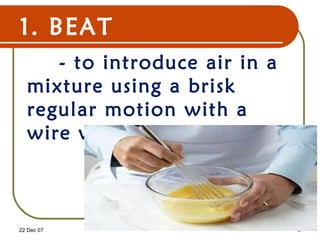
1. BEAT
- to introduce air in a
mixture using a brisk
regular motion with a
wire whip or whisk.
22 Dec 07 5
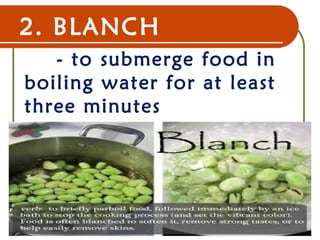
2. BLANCH
- to submerge food in
boiling water for at least
three minutes
22 Dec 07 6
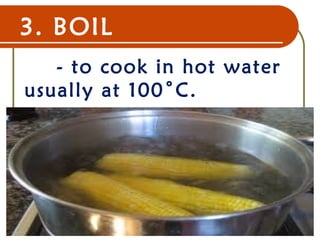
3. BOIL
- to cook in hot water
usually at 100˚C.
22 Dec 07 7
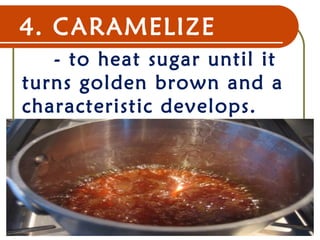
4. CARAMELIZE
- to heat sugar until it
turns golden brown and a
characteristic develops.
22 Dec 07 8
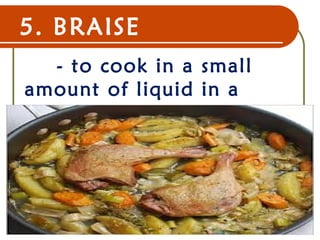
5. BRAISE
- to cook in a small
amount of liquid in a
covered pot.
22 Dec 07 9
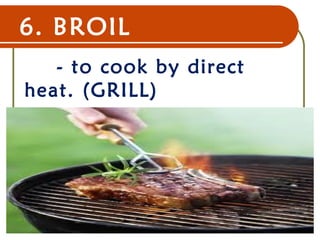
6. BROIL
- to cook by direct
heat. (GRILL)
22 Dec 07 10
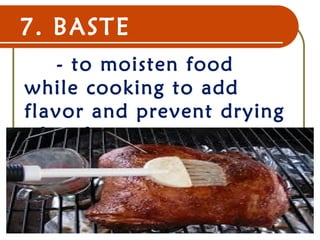
7. BASTE
- to moisten food
while cooking to add
flavor and prevent drying
of surface.
22 Dec 07 11
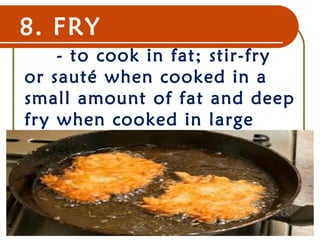
8. FRY
- to cook in fat; stir-fry
or sauté when cooked in a
small amount of fat and deep
fry when cooked in large
amount of fat.
22 Dec 07 12
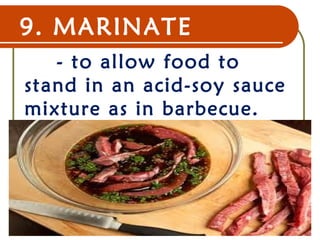
9. MARINATE
- to allow food to
stand in an acid-soy sauce
mixture as in barbecue.
22 Dec 07 13
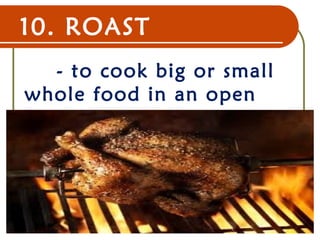
10. ROAST
- to cook big or small
whole food in an open
fire.
22 Dec 07 14
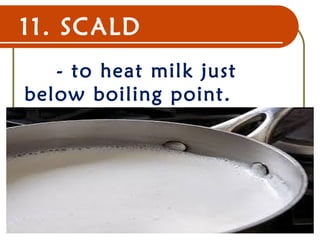
11. SCALD
- to heat milk just
below boiling point.
22 Dec 07 15
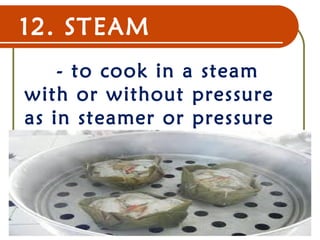
12. STEAM
- to cook in a steam
with or without pressure
as in steamer or pressure
cooker.
22 Dec 07 16
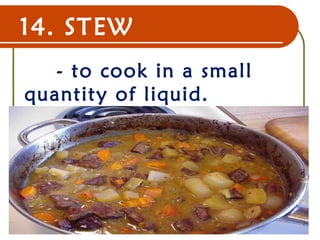
14. STEW
- to cook in a small
quantity of liquid.
22 Dec 07 17
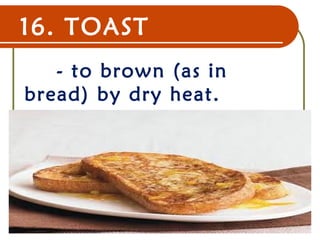
16. TOAST
- to brown (as in
bread) by dry heat.
22 Dec 07 18
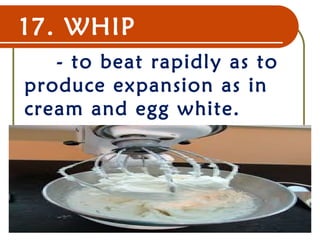
17. WHIP
- to beat rapidly as to
produce expansion as in
cream and egg white.
22 Dec 07 19
BASIC KNIFE
USE
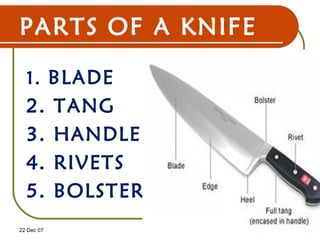
PARTS OF A KNIFE
1. BLADE
2. TANG
3. HANDLE
4. RIVETS
5. BOLSTERS
22 Dec 07 21
BLADE
- the flat cutting
part or edge of a
knife.
22 Dec 07 22
TANG
- This is the
continuation of the blade
that extends into the
knife’s handle.

FULL TANG

PARTIAL TANG

RAT-TAIL TANG
22 Dec 07 23
HANDLE
- this should fit the
hand comfortably. An
ideal material for a knife
is the rosewood, it has no
grain and is extremely
tough.
22 Dec 07 24
RIVETS
- are metal fasteners
used to secure the tang to
the handle.
22 Dec 07 25
BOLSTER
- is the collar or shank
of the knife that meets the
blade to the handle.
22 Dec 07 26
SHARPENING AND
HONING
STONES are used to
sharpen the edge once it
has grown dull through
ordinary use. STEELS are
used to remove the burrs
on a knife after sharpening
and to realign the edge on
your blade as you work.22 Dec 07 27
BASIC CUTS
TRIMMING AND
PEELING
Use peelers to remove thin
skins from carrots, potatoes
and similar items. (It works
in both directions)
Use a pairing knife to
trim or remove stems
and ends from vegetables
and fruits.22 Dec 07 29
CHOPPING AND
MINCING
- the term chopping is
sometimes used
interchangeably with
mincing, but minced foods
are generally cut into a
finer size.
22 Dec 07 30
CHOPPING AND
MINCING
Trim the root and stem
ends and peel the item if
necessary.
Slice or chop the food at
nearly regular intervals
until the cuts are relatively
uniform.
22 Dec 07 31
CHIFFONADE (shiff-en-
odd)
Roll individual leaves
into tight cylinders or
stack them before
cutting.
Use a chef’s knife to
make very fine, parallel
cuts for a fine, even22 Dec 07 32
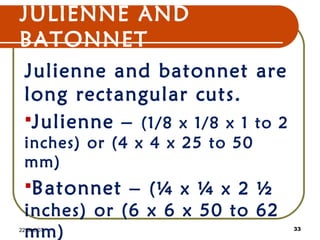
JULIENNE AND
BATONNET
Julienne and batonnet are
long rectangular cuts.
Julienne – (1/8 x 1/8 x 1 to 2
inches) or (4 x 4 x 25 to 50
mm)
Batonnet – (¼ x ¼ x 2 ½
inches) or (6 x 6 x 50 to 62
mm)22 Dec 07 33
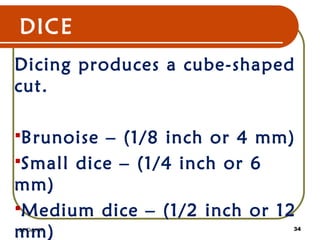
DICE
Dicing produces a cube-shaped
cut.
Brunoise – (1/8 inch or 4 mm)
Small dice – (1/4 inch or 6
mm)
Medium dice – (1/2 inch or 12
mm)22 Dec 07 34
22 Dec 07 35

Mise en place (ca)

  • 1.
  • 2.
    Mise en Place(Meeze-ahn- plahs) A French phrase that means “put in place” The preparation and assembly of ingredients, pans, utensils and plates or serving pieces needed for a particular dish or service period.22 Dec 07 2
  • 3.
    Mise en Place(Meeze-ahn- plahs) Preparing the ingredients correctly. Gathering together the tools needed to do the work. Setting up your work 22 Dec 07 3
  • 4.
  • 5.
    1. BEAT - tointroduce air in a mixture using a brisk regular motion with a wire whip or whisk. 22 Dec 07 5
  • 6.
    2. BLANCH - tosubmerge food in boiling water for at least three minutes 22 Dec 07 6
  • 7.
    3. BOIL - tocook in hot water usually at 100˚C. 22 Dec 07 7
  • 8.
    4. CARAMELIZE - toheat sugar until it turns golden brown and a characteristic develops. 22 Dec 07 8
  • 9.
    5. BRAISE - tocook in a small amount of liquid in a covered pot. 22 Dec 07 9
  • 10.
    6. BROIL - tocook by direct heat. (GRILL) 22 Dec 07 10
  • 11.
    7. BASTE - tomoisten food while cooking to add flavor and prevent drying of surface. 22 Dec 07 11
  • 12.
    8. FRY - tocook in fat; stir-fry or sauté when cooked in a small amount of fat and deep fry when cooked in large amount of fat. 22 Dec 07 12
  • 13.
    9. MARINATE - toallow food to stand in an acid-soy sauce mixture as in barbecue. 22 Dec 07 13
  • 14.
    10. ROAST - tocook big or small whole food in an open fire. 22 Dec 07 14
  • 15.
    11. SCALD - toheat milk just below boiling point. 22 Dec 07 15
  • 16.
    12. STEAM - tocook in a steam with or without pressure as in steamer or pressure cooker. 22 Dec 07 16
  • 17.
    14. STEW - tocook in a small quantity of liquid. 22 Dec 07 17
  • 18.
    16. TOAST - tobrown (as in bread) by dry heat. 22 Dec 07 18
  • 19.
    17. WHIP - tobeat rapidly as to produce expansion as in cream and egg white. 22 Dec 07 19
  • 20.
  • 21.
    PARTS OF AKNIFE 1. BLADE 2. TANG 3. HANDLE 4. RIVETS 5. BOLSTERS 22 Dec 07 21
  • 22.
    BLADE - the flatcutting part or edge of a knife. 22 Dec 07 22
  • 23.
    TANG - This isthe continuation of the blade that extends into the knife’s handle.  FULL TANG  PARTIAL TANG  RAT-TAIL TANG 22 Dec 07 23
  • 24.
    HANDLE - this shouldfit the hand comfortably. An ideal material for a knife is the rosewood, it has no grain and is extremely tough. 22 Dec 07 24
  • 25.
    RIVETS - are metalfasteners used to secure the tang to the handle. 22 Dec 07 25
  • 26.
    BOLSTER - is thecollar or shank of the knife that meets the blade to the handle. 22 Dec 07 26
  • 27.
    SHARPENING AND HONING STONES areused to sharpen the edge once it has grown dull through ordinary use. STEELS are used to remove the burrs on a knife after sharpening and to realign the edge on your blade as you work.22 Dec 07 27
  • 28.
  • 29.
    TRIMMING AND PEELING Use peelersto remove thin skins from carrots, potatoes and similar items. (It works in both directions) Use a pairing knife to trim or remove stems and ends from vegetables and fruits.22 Dec 07 29
  • 30.
    CHOPPING AND MINCING - theterm chopping is sometimes used interchangeably with mincing, but minced foods are generally cut into a finer size. 22 Dec 07 30
  • 31.
    CHOPPING AND MINCING Trim theroot and stem ends and peel the item if necessary. Slice or chop the food at nearly regular intervals until the cuts are relatively uniform. 22 Dec 07 31
  • 32.
    CHIFFONADE (shiff-en- odd) Roll individualleaves into tight cylinders or stack them before cutting. Use a chef’s knife to make very fine, parallel cuts for a fine, even22 Dec 07 32
  • 33.
    JULIENNE AND BATONNET Julienne andbatonnet are long rectangular cuts. Julienne – (1/8 x 1/8 x 1 to 2 inches) or (4 x 4 x 25 to 50 mm) Batonnet – (¼ x ¼ x 2 ½ inches) or (6 x 6 x 50 to 62 mm)22 Dec 07 33
  • 34.
    DICE Dicing produces acube-shaped cut. Brunoise – (1/8 inch or 4 mm) Small dice – (1/4 inch or 6 mm) Medium dice – (1/2 inch or 12 mm)22 Dec 07 34
  • 35.