Digital History Projects
as Boundary Objects
@MaxKemman
University of Luxembourg
Reflections on reading history from a distance
AIUCD 2017, 26-28 January 2017, Rome, Italy
Incentives for digital history projects
Official incentive: to build a new tool using new
technologies to be used for historical research
(in a new way)
Interviewing participants for individual incentives
(Weedman 1998):
• Reasons for joining the project
• Goals
• Expected effects of participation
Two case studies (10 participants)
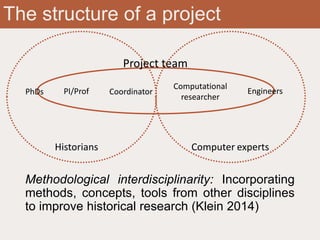
The structure of a project
Methodological interdisciplinarity: Incorporating
methods, concepts, tools from other disciplines
to improve historical research (Klein 2014)
PI/Prof
Computational
researcher
Coordinator
Project team
Historians Computer experts
EngineersPhDs
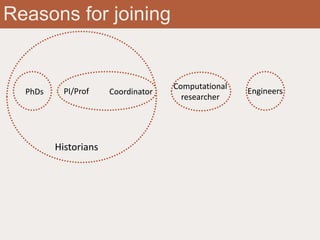
Reasons for joining
PI/Prof
Computational
researcher
Coordinator
Historians
EngineersPhDs
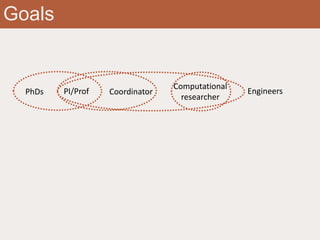
Goals
PI/Prof
Computational
researcher
Coordinator EngineersPhDs
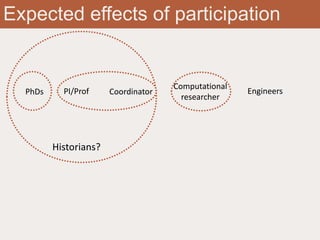
Expected effects of participation
PI/Prof
Computational
researcher
Coordinator
Historians?
EngineersPhDs
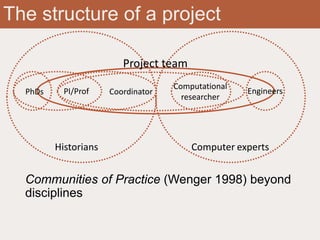
The structure of a project
Communities of Practice (Wenger 1998) beyond
disciplines
PI/Prof
Computational
researcher
Coordinator
Project team
Historians Computer experts
EngineersPhDs
Incentives per CoP
Research CoP
“if [the project] fails, it cannot be the case that my thesis
also fails. You can to some extent see it independent of
one another, as I do, so there is a secret clause, if [the
project] fails I just graduate with a historical thesis”
“what he must do is to write a thesis of 5 chapters that
are of [theoretical] value… And there he must just write
conventional stories, narratives. And at the same time he
uses digital means in his research”
PI/Prof
Computational
researcher
Coordinator EngineersPhDs
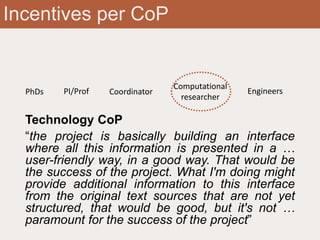
Incentives per CoP
Technology CoP
“the project is basically building an interface
where all this information is presented in a …
user-friendly way, in a good way. That would be
the success of the project. What I'm doing might
provide additional information to this interface
from the original text sources that are not yet
structured, that would be good, but it's not …
paramount for the success of the project”
PI/Prof
Computational
researcher
Coordinator EngineersPhDs
Incentives per CoP
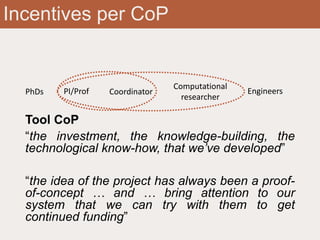
Tool CoP
“the investment, the knowledge-building, the
technological know-how, that we’ve developed”
“the idea of the project has always been a proof-
of-concept … and … bring attention to our
system that we can try with them to get
continued funding”
PI/Prof
Computational
researcher
Coordinator EngineersPhDs
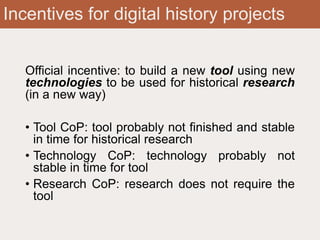
Incentives for digital history projects
Official incentive: to build a new tool using new
technologies to be used for historical research
(in a new way)
• Tool CoP: tool probably not finished and stable
in time for historical research
• Technology CoP: technology probably not
stable in time for tool
• Research CoP: research does not require the
tool
Digital history project as boundary object
“you have a research idea, and you fit that to the call
you’re applying to, and then you get funding … And
if you then hire researchers, yes they too have their
own idea of course, and their own line of research
they’re working on, and they try to fit that in the
research project”
Boundary objects: an object that maintains a
common identity among the different participants,
yet is shaped individually according to disciplinary
needs (Star and Griesemer 1989, Star 2010)
Why boundary objects?
Coordination of incentives
“we're supposed to be advising the team developing
the tool. And trying to then carry out research on a
specific case study. And so originally it was like wow
we're going to be able to use the tool, but very
quickly it became clear ok actually probably we're
not going to be able to use the tool”
Beyond disciplines
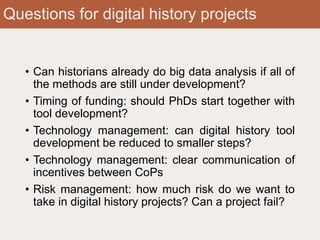
Questions for digital history projects
• Can historians already do big data analysis if all of
the methods are still under development?
• Timing of funding: should PhDs start together with
tool development?
• Technology management: can digital history tool
development be reduced to smaller steps?
• Technology management: clear communication of
incentives between CoPs
• Risk management: how much risk do we want to
take in digital history projects? Can a project fail?
Future research
• Revisiting case studies
• Looking at more digital history projects
• Analysing output of historians in such projects
Grazie
Thank you for listening
www.maxkemman.nl
@MaxKemman
max.kemman@uni.lu

Digital History Projects as Boundary Objects

  • 1.
    Digital History Projects asBoundary Objects @MaxKemman University of Luxembourg Reflections on reading history from a distance AIUCD 2017, 26-28 January 2017, Rome, Italy
  • 2.
    Incentives for digitalhistory projects Official incentive: to build a new tool using new technologies to be used for historical research (in a new way) Interviewing participants for individual incentives (Weedman 1998): • Reasons for joining the project • Goals • Expected effects of participation Two case studies (10 participants)
  • 3.
    The structure ofa project Methodological interdisciplinarity: Incorporating methods, concepts, tools from other disciplines to improve historical research (Klein 2014) PI/Prof Computational researcher Coordinator Project team Historians Computer experts EngineersPhDs
  • 4.
  • 5.
  • 6.
    Expected effects ofparticipation PI/Prof Computational researcher Coordinator Historians? EngineersPhDs
  • 7.
    The structure ofa project Communities of Practice (Wenger 1998) beyond disciplines PI/Prof Computational researcher Coordinator Project team Historians Computer experts EngineersPhDs
  • 8.
    Incentives per CoP ResearchCoP “if [the project] fails, it cannot be the case that my thesis also fails. You can to some extent see it independent of one another, as I do, so there is a secret clause, if [the project] fails I just graduate with a historical thesis” “what he must do is to write a thesis of 5 chapters that are of [theoretical] value… And there he must just write conventional stories, narratives. And at the same time he uses digital means in his research” PI/Prof Computational researcher Coordinator EngineersPhDs
  • 9.
    Incentives per CoP TechnologyCoP “the project is basically building an interface where all this information is presented in a … user-friendly way, in a good way. That would be the success of the project. What I'm doing might provide additional information to this interface from the original text sources that are not yet structured, that would be good, but it's not … paramount for the success of the project” PI/Prof Computational researcher Coordinator EngineersPhDs
  • 10.
    Incentives per CoP ToolCoP “the investment, the knowledge-building, the technological know-how, that we’ve developed” “the idea of the project has always been a proof- of-concept … and … bring attention to our system that we can try with them to get continued funding” PI/Prof Computational researcher Coordinator EngineersPhDs
  • 11.
    Incentives for digitalhistory projects Official incentive: to build a new tool using new technologies to be used for historical research (in a new way) • Tool CoP: tool probably not finished and stable in time for historical research • Technology CoP: technology probably not stable in time for tool • Research CoP: research does not require the tool
  • 12.
    Digital history projectas boundary object “you have a research idea, and you fit that to the call you’re applying to, and then you get funding … And if you then hire researchers, yes they too have their own idea of course, and their own line of research they’re working on, and they try to fit that in the research project” Boundary objects: an object that maintains a common identity among the different participants, yet is shaped individually according to disciplinary needs (Star and Griesemer 1989, Star 2010)
  • 13.
    Why boundary objects? Coordinationof incentives “we're supposed to be advising the team developing the tool. And trying to then carry out research on a specific case study. And so originally it was like wow we're going to be able to use the tool, but very quickly it became clear ok actually probably we're not going to be able to use the tool” Beyond disciplines
  • 14.
    Questions for digitalhistory projects • Can historians already do big data analysis if all of the methods are still under development? • Timing of funding: should PhDs start together with tool development? • Technology management: can digital history tool development be reduced to smaller steps? • Technology management: clear communication of incentives between CoPs • Risk management: how much risk do we want to take in digital history projects? Can a project fail?
  • 15.
    Future research • Revisitingcase studies • Looking at more digital history projects • Analysing output of historians in such projects
  • 16.
    Grazie Thank you forlistening www.maxkemman.nl @MaxKemman max.kemman@uni.lu

Editor's Notes

  • #5 PhDs: applied to a PhD position, no background in digital methods PI & Project core team: the project as 'their child' Engineers: hired Historians: want to explore new ways of doing research with their data Computational researcher: wants data to build models on Data providers: want uptake of data, funding for digitization
  • #6 PhDs: finishing thesis Computational researcher: generic (linguistic) model Core team: want a tool that helps the PhDs Core team + computational researcher: generic tool that can be built upon PI: want PhDs to finish their thesis
  • #7 PhDs: individual, some see it as way to distinguish, others want to focus on historical research Project team: learning lessons for future projects Computational researcher: (language) model probably not usable within this project, but basis for future research Historians: tool probably not usable within this project, but basis for future research