NATIONAL STATES GEOGRAPHIC INFORMATION COUNCIL DESTINATION & POINT OF BEGINNING? GIS Reaches Enterprise Status in Minnesota
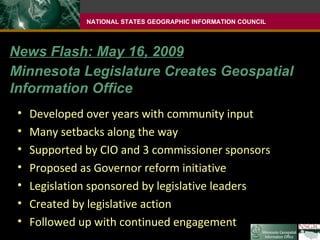
Developed over years with community input Many setbacks along the way Supported by CIO and 3 commissioner sponsors Proposed as Governor reform initiative Legislation sponsored by legislative leaders  Created by legislative action Followed up with continued engagement News Flash: May 16, 2009 Minnesota Legislature Creates Geospatial Information Office
The Journey:  Pack a Lunch! 1978: LMIC established – 1st state GIS program in nation? 1990: First Strategic Plan for State GIS (PlanGraphics) 1991: Executive Order creates Governor’s Council on GI 2004: Second Strategic Plan for State GIS (GCGI) 2006: FGDC CAP 50 States grant 2007:  Compass Points  retreat recommends priorities 2008: Enterprise GIS adopted as DTE Subcabinet initiative 2009: MGIO authorized by legislation The Journey: Pack a Lunch!
2008
GIS cost to government: Conservatively: $12,564,000 /yr Thus,  10% efficiency  would yield  >$1M/yr. savings At our first meeting, the State CIO, Gopal Khana asked: “What is the GIS cost to government?” So we figured it out (approximately).
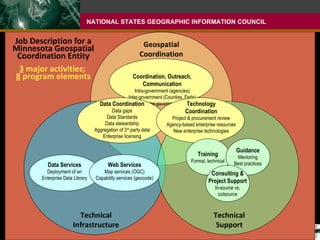
1 If we had an organization that did state government-wide, enterprise GIS coordination, what would it look like? We built a job description. Job Description for a Minnesota Geospatial Coordination Entity 3  major activities;  8  program elements Geospatial Coordination Technical Infrastructure Technical Support Coordination, Outreach, Communication Intra-government (agencies) Inter-government (Counties, Feds) Extra-government Data Coordination Data gaps Data Standards Data stewardship Aggregation of 3 rd  party data Enterprise licensing Technology Coordination Project & procurement review Agency-based enterprise resources New enterprise technologies Data Services Deployment of an Enterprise Data Library Web Services Map services (OGC) Capability services (geocode) Training Formal, technical Guidance Mentoring Best practices Consulting & Project Support In-source vs. outsource
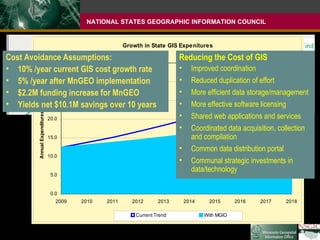
When GIS utilization continues to grow, how do you build an economic business case? Cost avoidance. 41 Cost Avoidance Assumptions: 10% /year current GIS cost growth rate 5% /year after MnGEO implementation $2.2M funding increase for MnGEO Yields net $10.1M savings over 10 years Reducing the Cost of GIS Improved coordination Reduced duplication of effort More efficient data storage/management More effective software licensing Shared web applications and services Coordinated data acquisition, collection and compilation Common data distribution portal Communal strategic investments in data/technology
Everybody’s watching, expectations are high, we’ve got one shot to make this work.  What are the risks? 39 Perceptions of insufficient transformation This must be more than re-branding Loss of agency GIS program support Continue transparency and active outreach to agencies Especially larger agencies w/ enterprise programs:  DOT, DNR, PCA  (they have the least to gain) Missing the unique timing of the Drive to Excellence initiative Inadequate funding Insufficient support for cross agency activities  Inadequate performance of shared services and resources
Priorities Match priorities to legislative mandate. Operational Evaluate existing services and make needed adjustments. Organizational Evaluate capacities and make needed adjustments. Resources Focus limited resources on high priorities and pursue options to fill the “resource gaps.” Partnerships Identify strategic partnerships and  work hard  to make them work . MnGeo’s Challenging Journey Ahead
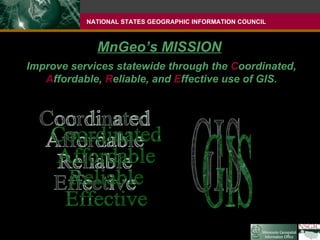
MnGeo’s MISSION   Improve services statewide through the  C oordinated,  A ffordable,  R eliable, and  E ffective use of GIS. Coordinated Affordable Reliable Effective GIS
Chief Information Officer Office of Enterprise Technology Commissioner Department of Administration
MnGeo Organization Funding 5.5 FTE – Geo 0.5 FTE – Admin  1.0 FTE -- IT
The Journey:  Pack a Lunch! Legislative awareness and support  Access to commissioners/cabinet Invitations to advise agencies on their business. Stimulus Funding/State Investments (Finance) Broadband (Commerce) Public Safety, Transportation, Economic Development, Corrections Agency contributions to enterprise data and service initiatives  The Journey: Worth the Trip!
Key Reminder!  Respect and Involve Your Stakeholders
For More Information About the Minnesota Experience http://www.gis.state.mn.us/committee/MSDI/dte.htm   David Arbeit –  [email_address] Michael Terner –  [email_address]

Minnesota GIS

  • 1.
    NATIONAL STATES GEOGRAPHICINFORMATION COUNCIL DESTINATION & POINT OF BEGINNING? GIS Reaches Enterprise Status in Minnesota
  • 2.
    Developed over yearswith community input Many setbacks along the way Supported by CIO and 3 commissioner sponsors Proposed as Governor reform initiative Legislation sponsored by legislative leaders Created by legislative action Followed up with continued engagement News Flash: May 16, 2009 Minnesota Legislature Creates Geospatial Information Office
  • 3.
    The Journey: Pack a Lunch! 1978: LMIC established – 1st state GIS program in nation? 1990: First Strategic Plan for State GIS (PlanGraphics) 1991: Executive Order creates Governor’s Council on GI 2004: Second Strategic Plan for State GIS (GCGI) 2006: FGDC CAP 50 States grant 2007: Compass Points retreat recommends priorities 2008: Enterprise GIS adopted as DTE Subcabinet initiative 2009: MGIO authorized by legislation The Journey: Pack a Lunch!
  • 4.
  • 5.
    GIS cost togovernment: Conservatively: $12,564,000 /yr Thus, 10% efficiency would yield >$1M/yr. savings At our first meeting, the State CIO, Gopal Khana asked: “What is the GIS cost to government?” So we figured it out (approximately).
  • 6.
    1 If wehad an organization that did state government-wide, enterprise GIS coordination, what would it look like? We built a job description. Job Description for a Minnesota Geospatial Coordination Entity 3 major activities; 8 program elements Geospatial Coordination Technical Infrastructure Technical Support Coordination, Outreach, Communication Intra-government (agencies) Inter-government (Counties, Feds) Extra-government Data Coordination Data gaps Data Standards Data stewardship Aggregation of 3 rd party data Enterprise licensing Technology Coordination Project & procurement review Agency-based enterprise resources New enterprise technologies Data Services Deployment of an Enterprise Data Library Web Services Map services (OGC) Capability services (geocode) Training Formal, technical Guidance Mentoring Best practices Consulting & Project Support In-source vs. outsource
  • 7.
    When GIS utilizationcontinues to grow, how do you build an economic business case? Cost avoidance. 41 Cost Avoidance Assumptions: 10% /year current GIS cost growth rate 5% /year after MnGEO implementation $2.2M funding increase for MnGEO Yields net $10.1M savings over 10 years Reducing the Cost of GIS Improved coordination Reduced duplication of effort More efficient data storage/management More effective software licensing Shared web applications and services Coordinated data acquisition, collection and compilation Common data distribution portal Communal strategic investments in data/technology
  • 8.
    Everybody’s watching, expectationsare high, we’ve got one shot to make this work. What are the risks? 39 Perceptions of insufficient transformation This must be more than re-branding Loss of agency GIS program support Continue transparency and active outreach to agencies Especially larger agencies w/ enterprise programs: DOT, DNR, PCA (they have the least to gain) Missing the unique timing of the Drive to Excellence initiative Inadequate funding Insufficient support for cross agency activities Inadequate performance of shared services and resources
  • 9.
    Priorities Match prioritiesto legislative mandate. Operational Evaluate existing services and make needed adjustments. Organizational Evaluate capacities and make needed adjustments. Resources Focus limited resources on high priorities and pursue options to fill the “resource gaps.” Partnerships Identify strategic partnerships and work hard to make them work . MnGeo’s Challenging Journey Ahead
  • 10.
    MnGeo’s MISSION Improve services statewide through the C oordinated, A ffordable, R eliable, and E ffective use of GIS. Coordinated Affordable Reliable Effective GIS
  • 11.
    Chief Information OfficerOffice of Enterprise Technology Commissioner Department of Administration
  • 12.
    MnGeo Organization Funding5.5 FTE – Geo 0.5 FTE – Admin 1.0 FTE -- IT
  • 13.
    The Journey: Pack a Lunch! Legislative awareness and support Access to commissioners/cabinet Invitations to advise agencies on their business. Stimulus Funding/State Investments (Finance) Broadband (Commerce) Public Safety, Transportation, Economic Development, Corrections Agency contributions to enterprise data and service initiatives The Journey: Worth the Trip!
  • 14.
    Key Reminder! Respect and Involve Your Stakeholders
  • 15.
    For More InformationAbout the Minnesota Experience http://www.gis.state.mn.us/committee/MSDI/dte.htm David Arbeit – [email_address] Michael Terner – [email_address]