Mining Software Repositories for Security: Data
Quality Issues Lessons from Trenches
Ali Babar
CREST – Centre for Research on Engineering Software Technologies
MSR4PS Workshop, 18th November, 2022
Brief Bio
M. Ali Babar
• Professor, School of Computer Science, University of
Adelaide, Australia – Nov. 2013 -
• Founding Lead – The Centre for Research on
Software Technologies (CREST) – Nov 2013 –
• Theme Lead – Platforms and Architectures for
Security as Service, Cyber Security Cooperative
Research Centre (CSCRC)
• For current research areas: please visit CREST
website: crest-centre.net
Previous Work History
• Senior research and academic positions in UK, Denmark
& Ireland
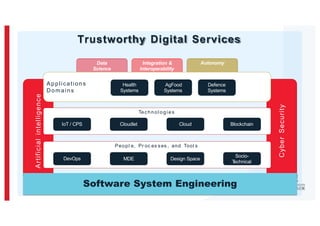
Trustworthy Digital Services
Data
Science
Integration &
Interoperability
Autonomy
Cyber
Security
Artificial
intelligence
Software System Engineering
DevOps
Peopl e, Pr oc es ses , and Tool s
MDE Design Space
Socio-
T
echnical
Technol ogies
IoT / CPS Cloudlet Cloud Blockchain
Applications
Domains
Health
Systems
AgFood
Systems
Defence
Systems
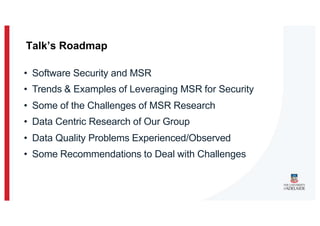
• Software Security and MSR
• Trends & Examples of Leveraging MSR for Security
• Some of the Challenges of MSR Research
• Data Centric Research of Our Group
• Data Quality Problems Experienced/Observed
• Some Recommendations to Deal with Challenges
Talk’s Roadmap
• Approximately 90% of cyber incidents are caused by the
vulnerabilities rooted in software – proprietary or sourced
• Software Bill Of Material (SBOM) is becoming ineffective in
answering critical questions
• Q1: Do we really know what’s in software coming into the organisation?
• Q2: How do we establish trust and preserve the security of software coming
into the organisation?
Software Security and MSR
Trends of Leveraging MSR4S
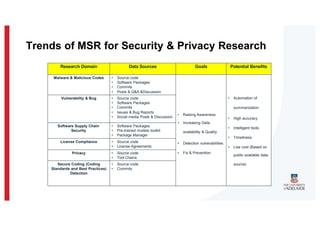
Research Domain Data Sources Goals Potential Benefits
Malware & Malicious Codes • Source code
• Software Packages
• Commits
• Posts & Q&A &Discussion
• Raising Awareness
• Increasing Data
availability & Quality
• Detection vulnerabilities
• Fix & Prevention
• Automation of
summarization
• High accuracy
• Intelligent tools
• Timeliness
• Low cost (Based on
public available data
source)
Vulnerability & Bug • Source code
• Software Packages
• Commits
• Issues & Bug Reports
• Social media Posts & Discussion
Software Supply Chain
Security
• Software Packages
• Pre-trained models toolkit
• Package Manager
License Compliance • Source code
• License Agreements
Privacy • Source code
• Tool Chains
Secure Coding (Coding
Standards and Best Practices)
Detection
• Source code
• Commits
Trends of MSR for Security & Privacy Research
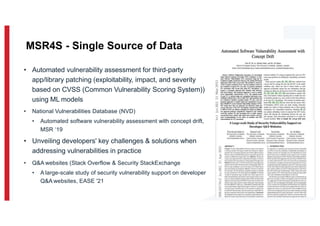
• Automated vulnerability assessment for third-party
app/library patching (exploitability, impact, and severity
based on CVSS (Common Vulnerability Scoring System))
using ML models
• National Vulnerabilities Database (NVD)
• Automated software vulnerability assessment with concept drift,
MSR ‘19
• Unveiling developers' key challenges & solutions when
addressing vulnerabilities in practice
• Q&A websites (Stack Overflow & Security StackExchange
• A large-scale study of security vulnerability support on developer
Q&A websites, EASE '21
8
MSR4S - Single Source of Data
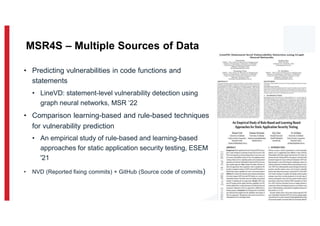
• Predicting vulnerabilities in code functions and
statements
• LineVD: statement-level vulnerability detection using
graph neural networks, MSR ‘22
• Comparison learning-based and rule-based techniques
for vulnerability prediction
• An empirical study of rule-based and learning-based
approaches for static application security testing, ESEM
'21
• NVD (Reported fixing commits) + GitHub (Source code of commits)
9
MSR4S – Multiple Sources of Data
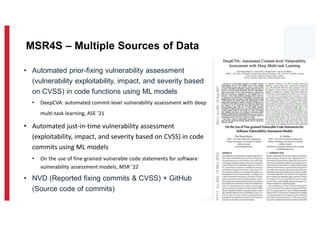
• Automated prior-fixing vulnerability assessment
(vulnerability exploitability, impact, and severity based
on CVSS) in code functions using ML models
• DeepCVA: automated commit-level vulnerability assessment with deep
multi-task learning, ASE '21
• Automated just-in-time vulnerability assessment
(exploitability, impact, and severity based on CVSS) in code
commits using ML models
• On the use of fine-grained vulnerable code statements for software
vulnerability assessment models, MSR ’22
• NVD (Reported fixing commits & CVSS) + GitHub
(Source code of commits)
10
MSR4S – Multiple Sources of Data
• Data Extraction Phase
• Limited support for automated extraction
• Keeping the extracted data up to data
• Keeping the data scraper up to date
• Data Pre-processing
• Different version control systems (e.g., git, CVS, SVN)
• Lack of standard in tools for bug reporting and data collection
• Data quality
• Data Integration Phase
• Correlating data points across technical domains
• Linking data from different resources (e.g GitHub data with stack overflow posts)
Challenges in MSR Research
Data Centric R&D for Software Security
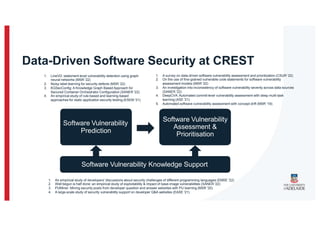
Data-Driven Software Security at CREST
Software Vulnerability
Prediction
Software Vulnerability
Assessment &
Prioritisation
Software Vulnerability Knowledge Support
1. A survey on data-driven software vulnerability assessment and prioritization (CSUR '22)
2. On the use of fine-grained vulnerable code statements for software vulnerability
assessment models (MSR '22)
3. An investigation into inconsistency of software vulnerability severity across data sources
(SANER '22)
4. DeepCVA: Automated commit-level vulnerability assessment with deep multi-task
learning (ASE '21)
5. Automated software vulnerability assessment with concept drift (MSR '19)
1. LineVD: statement-level vulnerability detection using graph
neural networks (MSR '22)
2. Noisy label learning for security defects (MSR '22)
3. KGSecConfig: A Knowledge Graph Based Approach for
Secured Container Orchestrator Configuration (SANER '22)
4. An empirical study of rule-based and learning-based
approaches for static application security testing (ESEM '21)
1. An empirical study of developers’ discussions about security challenges of different programming languages (EMSE '22)
2. Well begun is half done: an empirical study of exploitability & impact of base-image vulnerabilities (SANER '22)
3. PUMiner: Mining security posts from developer question and answer websites with PU learning (MSR '20)
4. A large-scale study of security vulnerability support on developer Q&A websites (EASE '21)
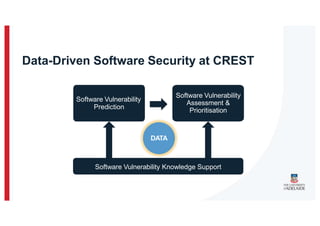
Software Vulnerability
Prediction
Software Vulnerability
Assessment &
Prioritisation
DATA
Software Vulnerability Knowledge Support
Data-Driven Software Security at CREST
Data Quality Challenges in MSR4S
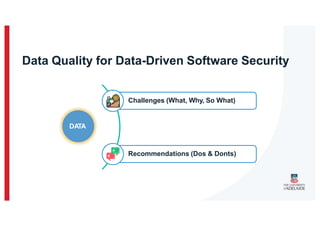
Data Quality for Data-Driven Software Security
DATA
Challenges (What, Why, So What)
Recommendations (Dos & Donts)
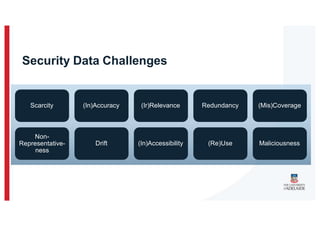
Security Data Challenges
Scarcity (In)Accuracy (Ir)Relevance Redundancy (Mis)Coverage
Non-
Representative-
ness
Drift (In)Accessibility (Re)Use Maliciousness
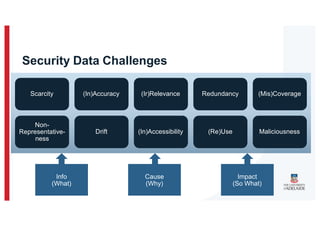
Info
(What)
Cause
(Why)
Impact
(So What)
Scarcity (In)Accuracy (Ir)Relevance Redundancy (Mis)Coverage
Non-
Representative-
ness
Drift (In)Accessibility (Re)Use Maliciousness
Security Data Challenges
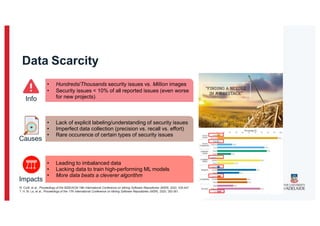
Data Scarcity
• Hundreds/Thousands security issues vs. Million images
• Security issues < 10% of all reported issues (even worse
for new projects)
Info
Causes
• Lack of explicit labeling/understanding of security issues
• Imperfect data collection (precision vs. recall vs. effort)
• Rare occurence of certain types of security issues
Impacts
• Leading to imbalanced data
• Lacking data to train high-performing ML models
• More data beats a cleverer algorithm
R. Croft, et al., Proceedings of the IEEE/ACM 19th International Conference on Mining Software Repositories (MSR), 2022, 435-447.
T. H. M. Le, et al., Proceedings of the 17th International Conference on Mining Software Repositories (MSR), 2020, 350-361.
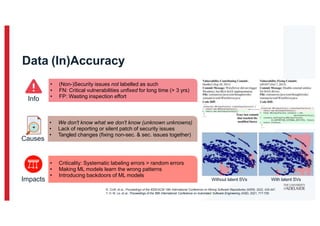
Data (In)Accuracy
• (Non-)Security issues not labelled as such
• FN: Critical vulnerabilities unfixed for long time (> 3 yrs)
• FP: Wasting inspection effort
Info
Causes
• We don't know what we don't know (unknown unknowns)
• Lack of reporting or silent patch of security issues
• Tangled changes (fixing non-sec. & sec. issues together)
Impacts
• Criticality: Systematic labeling errors > random errors
• Making ML models learn the wrong patterns
• Introducing backdoors of ML models
R. Croft, et al., Proceedings of the IEEE/ACM 19th International Conference on Mining Software Repositories (MSR), 2022, 435-447.
T. H. M. Le, et al., Proceedings of the 36th International Conference on Automated Software Engineering (ASE), 2021, 717-729.
Without latent SVs With latent SVs
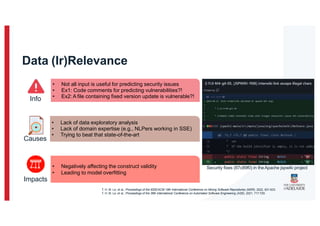
Data (Ir)Relevance
• Not all input is useful for predicting security issues
• Ex1: Code comments for predicting vulnerabilities?!
• Ex2: A file containing fixed version update is vulnerable?!
Info
Causes
• Lack of data exploratory analysis
• Lack of domain expertise (e.g., NLPers working in SSE)
• Trying to beat that state-of-the-art
Impacts
• Negatively affecting the construct validity
• Leading to model overfitting
Security fixes (87c89f0) in theApache jspwiki project
T. H. M. Le, et al., Proceedings of the IEEE/ACM 19th International Conference on Mining Software Repositories (MSR), 2022, 621-633.
T. H. M. Le, et al., Proceedings of the 36th International Conference on Automated Software Engineering (ASE), 2021, 717-729.
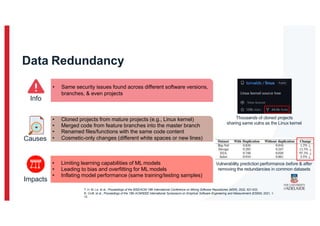
Data Redundancy
• Same security issues found across different software versions,
branches, & even projects
Info
Causes
• Cloned projects from mature projects (e.g., Linux kernel)
• Merged code from feature branches into the master branch
• Renamed files/functions with the same code content
• Cosmetic-only changes (different white spaces or new lines)
Impacts
• Limiting learning capabilities of ML models
• Leading to bias and overfitting for ML models
• Inflating model performance (same training/testing samples)
Thousands of cloned projects
sharing same vulns as the Linux kernel
Vulnerability prediction performance before & after
removing the redundancies in common datasets
T. H. M. Le, et al., Proceedings of the IEEE/ACM 19th International Conference on Mining Software Repositories (MSR), 2022, 621-633.
R. Croft, et al., Proceedings of the 15th ACM/IEEE International Symposium on Empirical Software Engineering and Measurement (ESEM), 2021, 1-
12.
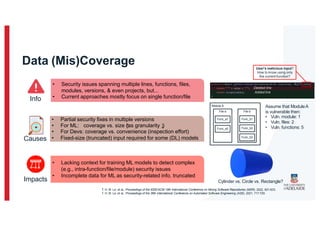
Data (Mis)Coverage
• Security issues spanning multiple lines, functions, files,
modules, versions, & even projects, but...
• Current approaches mostly focus on single function/file
Info
Causes
• Partial security fixes in multiple versions
• For ML: coverage vs. size (
↑
as granularity ↓
)
• For Devs: coverage vs. convenience (inspection effort)
• Fixed-size (truncated) input required for some (DL) models
Impacts
• Lacking context for training ML models to detect complex
(e.g., intra-function/file/module) security issues
• Incomplete data for ML as security-related info. truncated
User's malicious input?
How to know using only
the current function?
Deleted line
Added line
Func_a1 Func_b1
File b
Module A
File a
Func_a2 Func_b2
Func_b3
Assume that ModuleA
is vulnerable then:
• Vuln. module: 1
• Vuln. files: 2
• Vuln. functions: 5
T. H. M. Le, et al., Proceedings of the IEEE/ACM 19th International Conference on Mining Software Repositories (MSR), 2022, 621-633.
T. H. M. Le, et al., Proceedings of the 36th International Conference on Automated Software Engineering (ASE), 2021, 717-729.
Cylinder vs. Circle vs. Rectangle?
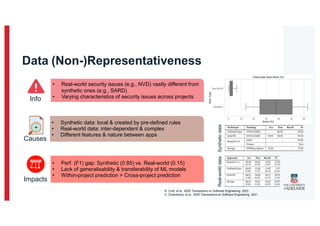
Data (Non-)Representativeness
• Real-world security issues (e.g., NVD) vastly different from
synthetic ones (e.g., SARD)
• Varying characteristics of security issues across projects
Info
Causes
• Synthetic data: local & created by pre-defined rules
• Real-world data: inter-dependent & complex
• Different features & nature between apps
Impacts
• Perf. (F1) gap: Synthetic (0.85) vs. Real-world (0.15)
• Lack of generalisability & transferability of ML models
• Within-project prediction > Cross-project prediction
R. Croft, et al., IEEE Transactions on Software Engineering, 2022.
S. Chakraborty, et al., IEEE Transactions on Software Engineering, 2021.
Real-world
data
Synthetic
data
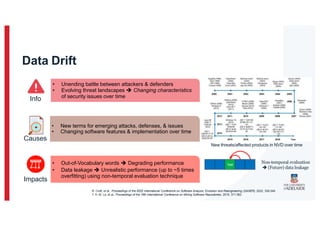
Data Drift
• Unending battle between attackers & defenders
• Evolving threat landscapes  Changing characteristics
of security issues over time
Info
Impacts
• Out-of-Vocabulary words  Degrading performance
• Data leakage  Unrealistic performance (up to ~5 times
overfitting) using non-temporal evaluation technique
R. Croft, et al., Proceedings of the IEEE International Conference on Software Analysis, Evolution and Reengineering (SANER), 2022, 338-348.
T. H. M. Le, et al., Proceedings of the 16th International Conference on Mining Software Repositories, 2019, 371-382.
• New terms for emerging attacks, defenses, & issues
• Changing software features & implementation over time
Causes
New threats/affected products in NVD over time
Test
Non-temporal evaluation
 (Future) data leakage
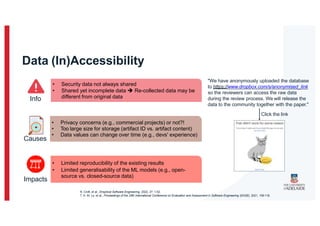
Data (In)Accessibility
• Security data not always shared
• Shared yet incomplete data  Re-collected data may be
different from original data
Info
Causes
• Privacy concerns (e.g., commercial projects) or not?!
• Too large size for storage (artifact ID vs. artifact content)
• Data values can change over time (e.g., devs' experience)
Impacts
• Limited reproducibility of the existing results
• Limited generalisability of the ML models (e.g., open-
source vs. closed-source data)
"We have anonymously uploaded the database
to https://www.dropbox.com/s/anonymised_link
so the reviewers can access the raw data
during the review process. We will release the
data to the community together with the paper."
Click the link
R. Croft, et al., Empirical Software Engineering, 2022, 27: 1-52.
T. H. M. Le, et al., Proceedings of the 25th International Conference on Evaluation and Assessment in Software Engineering (EASE), 2021, 109-118.
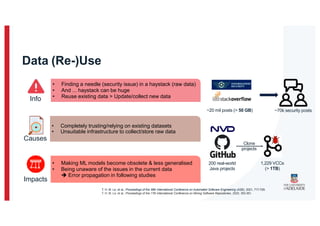
Data (Re-)Use
• Finding a needle (security issue) in a haystack (raw data)
• And ... haystack can be huge
• Reuse existing data > Update/collect new data
Info
• Completely trusting/relying on existing datasets
• Unsuitable infrastructure to collect/store raw data
Causes
Impacts
• Making ML models become obsolete & less generalised
• Being unaware of the issues in the current data
 Error propagation in following studies
1,229 VCCs
(> 1TB)
200 real-world
Java projects
Clone
projects
~70k security posts
~20 mil posts (> 50 GB)
T. H. M. Le, et al., Proceedings of the 36th International Conference on Automated Software Engineering (ASE), 2021, 717-729.
T. H. M. Le, et al., Proceedings of the 17th International Conference on Mining Software Repositories, 2020, 350-361.
Data Maliciousness
• Threat/security data is itself a threat (e.g., new vulns)
• Using/sharing threat data without precautions
Info
Causes
• Simply an oversight / afterthought
• Private experiment vs. Public disclosure (Big difference!)
• Open science vs. Responsible science
Impacts
• Violating ethics of the community
• Shared security data maybe exploited by attackers
• Affecting maintainers & users of target systems
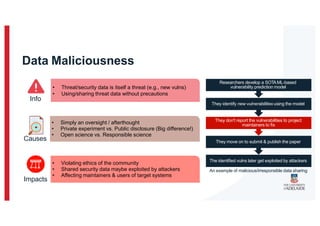
The identified vulns later get exploited by attackers
They move on to submit & publish the paper
They don't report the vulnerabilities to project
maintainers to fix
They identify new vulnerabilities using the model
Researchers develop a SOTAML-based
vulnerability prediction model
An example of malicious/irresponsible data sharing
Some Recommendations
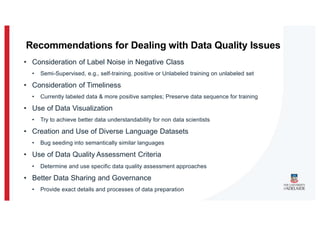
• Consideration of Label Noise in Negative Class
• Semi-Supervised, e.g., self-training, positive or Unlabeled training on unlabeled set
• Consideration of Timeliness
• Currently labeled data & more positive samples; Preserve data sequence for training
• Use of Data Visualization
• Try to achieve better data understandability for non data scientists
• Creation and Use of Diverse Language Datasets
• Bug seeding into semantically similar languages
• Use of Data Quality Assessment Criteria
• Determine and use specific data quality assessment approaches
• Better Data Sharing and Governance
• Provide exact details and processes of data preparation
Recommendations for Dealing with Data Quality Issues
Acknowledgements
• This talk is based on the research studies carried out by the CREST researchers,
particularly by Roland Croft, Triet Le, Yongzheng Xie, Mehdi Kholoosi.
• Triet Le led the efforts for developing the content for this presentation
• Discussions in the SSI cluster of the CREST provided insights included in this presentation
• Our research partially funded by the Cybersecurity CRC
• We are grateful to the students, RAs and Open Source data communities
CRICOS 00123M
Contact: Ali Babar
ali.babar@adelaide.edu.au

Mining Software Repositories for Security: Data Quality Issues Lessons from Trenches

  • 1.
    Mining Software Repositoriesfor Security: Data Quality Issues Lessons from Trenches Ali Babar CREST – Centre for Research on Engineering Software Technologies MSR4PS Workshop, 18th November, 2022
  • 2.
    Brief Bio M. AliBabar • Professor, School of Computer Science, University of Adelaide, Australia – Nov. 2013 - • Founding Lead – The Centre for Research on Software Technologies (CREST) – Nov 2013 – • Theme Lead – Platforms and Architectures for Security as Service, Cyber Security Cooperative Research Centre (CSCRC) • For current research areas: please visit CREST website: crest-centre.net Previous Work History • Senior research and academic positions in UK, Denmark & Ireland
  • 3.
    Trustworthy Digital Services Data Science Integration& Interoperability Autonomy Cyber Security Artificial intelligence Software System Engineering DevOps Peopl e, Pr oc es ses , and Tool s MDE Design Space Socio- T echnical Technol ogies IoT / CPS Cloudlet Cloud Blockchain Applications Domains Health Systems AgFood Systems Defence Systems
  • 4.
    • Software Securityand MSR • Trends & Examples of Leveraging MSR for Security • Some of the Challenges of MSR Research • Data Centric Research of Our Group • Data Quality Problems Experienced/Observed • Some Recommendations to Deal with Challenges Talk’s Roadmap
  • 5.
    • Approximately 90%of cyber incidents are caused by the vulnerabilities rooted in software – proprietary or sourced • Software Bill Of Material (SBOM) is becoming ineffective in answering critical questions • Q1: Do we really know what’s in software coming into the organisation? • Q2: How do we establish trust and preserve the security of software coming into the organisation? Software Security and MSR
  • 6.
  • 7.
    Research Domain DataSources Goals Potential Benefits Malware & Malicious Codes • Source code • Software Packages • Commits • Posts & Q&A &Discussion • Raising Awareness • Increasing Data availability & Quality • Detection vulnerabilities • Fix & Prevention • Automation of summarization • High accuracy • Intelligent tools • Timeliness • Low cost (Based on public available data source) Vulnerability & Bug • Source code • Software Packages • Commits • Issues & Bug Reports • Social media Posts & Discussion Software Supply Chain Security • Software Packages • Pre-trained models toolkit • Package Manager License Compliance • Source code • License Agreements Privacy • Source code • Tool Chains Secure Coding (Coding Standards and Best Practices) Detection • Source code • Commits Trends of MSR for Security & Privacy Research
  • 8.
    • Automated vulnerabilityassessment for third-party app/library patching (exploitability, impact, and severity based on CVSS (Common Vulnerability Scoring System)) using ML models • National Vulnerabilities Database (NVD) • Automated software vulnerability assessment with concept drift, MSR ‘19 • Unveiling developers' key challenges & solutions when addressing vulnerabilities in practice • Q&A websites (Stack Overflow & Security StackExchange • A large-scale study of security vulnerability support on developer Q&A websites, EASE '21 8 MSR4S - Single Source of Data
  • 9.
    • Predicting vulnerabilitiesin code functions and statements • LineVD: statement-level vulnerability detection using graph neural networks, MSR ‘22 • Comparison learning-based and rule-based techniques for vulnerability prediction • An empirical study of rule-based and learning-based approaches for static application security testing, ESEM '21 • NVD (Reported fixing commits) + GitHub (Source code of commits) 9 MSR4S – Multiple Sources of Data
  • 10.
    • Automated prior-fixingvulnerability assessment (vulnerability exploitability, impact, and severity based on CVSS) in code functions using ML models • DeepCVA: automated commit-level vulnerability assessment with deep multi-task learning, ASE '21 • Automated just-in-time vulnerability assessment (exploitability, impact, and severity based on CVSS) in code commits using ML models • On the use of fine-grained vulnerable code statements for software vulnerability assessment models, MSR ’22 • NVD (Reported fixing commits & CVSS) + GitHub (Source code of commits) 10 MSR4S – Multiple Sources of Data
  • 11.
    • Data ExtractionPhase • Limited support for automated extraction • Keeping the extracted data up to data • Keeping the data scraper up to date • Data Pre-processing • Different version control systems (e.g., git, CVS, SVN) • Lack of standard in tools for bug reporting and data collection • Data quality • Data Integration Phase • Correlating data points across technical domains • Linking data from different resources (e.g GitHub data with stack overflow posts) Challenges in MSR Research
  • 12.
    Data Centric R&Dfor Software Security
  • 13.
    Data-Driven Software Securityat CREST Software Vulnerability Prediction Software Vulnerability Assessment & Prioritisation Software Vulnerability Knowledge Support 1. A survey on data-driven software vulnerability assessment and prioritization (CSUR '22) 2. On the use of fine-grained vulnerable code statements for software vulnerability assessment models (MSR '22) 3. An investigation into inconsistency of software vulnerability severity across data sources (SANER '22) 4. DeepCVA: Automated commit-level vulnerability assessment with deep multi-task learning (ASE '21) 5. Automated software vulnerability assessment with concept drift (MSR '19) 1. LineVD: statement-level vulnerability detection using graph neural networks (MSR '22) 2. Noisy label learning for security defects (MSR '22) 3. KGSecConfig: A Knowledge Graph Based Approach for Secured Container Orchestrator Configuration (SANER '22) 4. An empirical study of rule-based and learning-based approaches for static application security testing (ESEM '21) 1. An empirical study of developers’ discussions about security challenges of different programming languages (EMSE '22) 2. Well begun is half done: an empirical study of exploitability & impact of base-image vulnerabilities (SANER '22) 3. PUMiner: Mining security posts from developer question and answer websites with PU learning (MSR '20) 4. A large-scale study of security vulnerability support on developer Q&A websites (EASE '21)
  • 14.
    Software Vulnerability Prediction Software Vulnerability Assessment& Prioritisation DATA Software Vulnerability Knowledge Support Data-Driven Software Security at CREST
  • 15.
  • 16.
    Data Quality forData-Driven Software Security DATA Challenges (What, Why, So What) Recommendations (Dos & Donts)
  • 17.
    Security Data Challenges Scarcity(In)Accuracy (Ir)Relevance Redundancy (Mis)Coverage Non- Representative- ness Drift (In)Accessibility (Re)Use Maliciousness
  • 18.
    Info (What) Cause (Why) Impact (So What) Scarcity (In)Accuracy(Ir)Relevance Redundancy (Mis)Coverage Non- Representative- ness Drift (In)Accessibility (Re)Use Maliciousness Security Data Challenges
  • 19.
    Data Scarcity • Hundreds/Thousandssecurity issues vs. Million images • Security issues < 10% of all reported issues (even worse for new projects) Info Causes • Lack of explicit labeling/understanding of security issues • Imperfect data collection (precision vs. recall vs. effort) • Rare occurence of certain types of security issues Impacts • Leading to imbalanced data • Lacking data to train high-performing ML models • More data beats a cleverer algorithm R. Croft, et al., Proceedings of the IEEE/ACM 19th International Conference on Mining Software Repositories (MSR), 2022, 435-447. T. H. M. Le, et al., Proceedings of the 17th International Conference on Mining Software Repositories (MSR), 2020, 350-361.
  • 20.
    Data (In)Accuracy • (Non-)Securityissues not labelled as such • FN: Critical vulnerabilities unfixed for long time (> 3 yrs) • FP: Wasting inspection effort Info Causes • We don't know what we don't know (unknown unknowns) • Lack of reporting or silent patch of security issues • Tangled changes (fixing non-sec. & sec. issues together) Impacts • Criticality: Systematic labeling errors > random errors • Making ML models learn the wrong patterns • Introducing backdoors of ML models R. Croft, et al., Proceedings of the IEEE/ACM 19th International Conference on Mining Software Repositories (MSR), 2022, 435-447. T. H. M. Le, et al., Proceedings of the 36th International Conference on Automated Software Engineering (ASE), 2021, 717-729. Without latent SVs With latent SVs
  • 21.
    Data (Ir)Relevance • Notall input is useful for predicting security issues • Ex1: Code comments for predicting vulnerabilities?! • Ex2: A file containing fixed version update is vulnerable?! Info Causes • Lack of data exploratory analysis • Lack of domain expertise (e.g., NLPers working in SSE) • Trying to beat that state-of-the-art Impacts • Negatively affecting the construct validity • Leading to model overfitting Security fixes (87c89f0) in theApache jspwiki project T. H. M. Le, et al., Proceedings of the IEEE/ACM 19th International Conference on Mining Software Repositories (MSR), 2022, 621-633. T. H. M. Le, et al., Proceedings of the 36th International Conference on Automated Software Engineering (ASE), 2021, 717-729.
  • 22.
    Data Redundancy • Samesecurity issues found across different software versions, branches, & even projects Info Causes • Cloned projects from mature projects (e.g., Linux kernel) • Merged code from feature branches into the master branch • Renamed files/functions with the same code content • Cosmetic-only changes (different white spaces or new lines) Impacts • Limiting learning capabilities of ML models • Leading to bias and overfitting for ML models • Inflating model performance (same training/testing samples) Thousands of cloned projects sharing same vulns as the Linux kernel Vulnerability prediction performance before & after removing the redundancies in common datasets T. H. M. Le, et al., Proceedings of the IEEE/ACM 19th International Conference on Mining Software Repositories (MSR), 2022, 621-633. R. Croft, et al., Proceedings of the 15th ACM/IEEE International Symposium on Empirical Software Engineering and Measurement (ESEM), 2021, 1- 12.
  • 23.
    Data (Mis)Coverage • Securityissues spanning multiple lines, functions, files, modules, versions, & even projects, but... • Current approaches mostly focus on single function/file Info Causes • Partial security fixes in multiple versions • For ML: coverage vs. size ( ↑ as granularity ↓ ) • For Devs: coverage vs. convenience (inspection effort) • Fixed-size (truncated) input required for some (DL) models Impacts • Lacking context for training ML models to detect complex (e.g., intra-function/file/module) security issues • Incomplete data for ML as security-related info. truncated User's malicious input? How to know using only the current function? Deleted line Added line Func_a1 Func_b1 File b Module A File a Func_a2 Func_b2 Func_b3 Assume that ModuleA is vulnerable then: • Vuln. module: 1 • Vuln. files: 2 • Vuln. functions: 5 T. H. M. Le, et al., Proceedings of the IEEE/ACM 19th International Conference on Mining Software Repositories (MSR), 2022, 621-633. T. H. M. Le, et al., Proceedings of the 36th International Conference on Automated Software Engineering (ASE), 2021, 717-729. Cylinder vs. Circle vs. Rectangle?
  • 24.
    Data (Non-)Representativeness • Real-worldsecurity issues (e.g., NVD) vastly different from synthetic ones (e.g., SARD) • Varying characteristics of security issues across projects Info Causes • Synthetic data: local & created by pre-defined rules • Real-world data: inter-dependent & complex • Different features & nature between apps Impacts • Perf. (F1) gap: Synthetic (0.85) vs. Real-world (0.15) • Lack of generalisability & transferability of ML models • Within-project prediction > Cross-project prediction R. Croft, et al., IEEE Transactions on Software Engineering, 2022. S. Chakraborty, et al., IEEE Transactions on Software Engineering, 2021. Real-world data Synthetic data
  • 25.
    Data Drift • Unendingbattle between attackers & defenders • Evolving threat landscapes  Changing characteristics of security issues over time Info Impacts • Out-of-Vocabulary words  Degrading performance • Data leakage  Unrealistic performance (up to ~5 times overfitting) using non-temporal evaluation technique R. Croft, et al., Proceedings of the IEEE International Conference on Software Analysis, Evolution and Reengineering (SANER), 2022, 338-348. T. H. M. Le, et al., Proceedings of the 16th International Conference on Mining Software Repositories, 2019, 371-382. • New terms for emerging attacks, defenses, & issues • Changing software features & implementation over time Causes New threats/affected products in NVD over time Test Non-temporal evaluation  (Future) data leakage
  • 26.
    Data (In)Accessibility • Securitydata not always shared • Shared yet incomplete data  Re-collected data may be different from original data Info Causes • Privacy concerns (e.g., commercial projects) or not?! • Too large size for storage (artifact ID vs. artifact content) • Data values can change over time (e.g., devs' experience) Impacts • Limited reproducibility of the existing results • Limited generalisability of the ML models (e.g., open- source vs. closed-source data) "We have anonymously uploaded the database to https://www.dropbox.com/s/anonymised_link so the reviewers can access the raw data during the review process. We will release the data to the community together with the paper." Click the link R. Croft, et al., Empirical Software Engineering, 2022, 27: 1-52. T. H. M. Le, et al., Proceedings of the 25th International Conference on Evaluation and Assessment in Software Engineering (EASE), 2021, 109-118.
  • 27.
    Data (Re-)Use • Findinga needle (security issue) in a haystack (raw data) • And ... haystack can be huge • Reuse existing data > Update/collect new data Info • Completely trusting/relying on existing datasets • Unsuitable infrastructure to collect/store raw data Causes Impacts • Making ML models become obsolete & less generalised • Being unaware of the issues in the current data  Error propagation in following studies 1,229 VCCs (> 1TB) 200 real-world Java projects Clone projects ~70k security posts ~20 mil posts (> 50 GB) T. H. M. Le, et al., Proceedings of the 36th International Conference on Automated Software Engineering (ASE), 2021, 717-729. T. H. M. Le, et al., Proceedings of the 17th International Conference on Mining Software Repositories, 2020, 350-361.
  • 28.
    Data Maliciousness • Threat/securitydata is itself a threat (e.g., new vulns) • Using/sharing threat data without precautions Info Causes • Simply an oversight / afterthought • Private experiment vs. Public disclosure (Big difference!) • Open science vs. Responsible science Impacts • Violating ethics of the community • Shared security data maybe exploited by attackers • Affecting maintainers & users of target systems The identified vulns later get exploited by attackers They move on to submit & publish the paper They don't report the vulnerabilities to project maintainers to fix They identify new vulnerabilities using the model Researchers develop a SOTAML-based vulnerability prediction model An example of malicious/irresponsible data sharing
  • 29.
  • 31.
    • Consideration ofLabel Noise in Negative Class • Semi-Supervised, e.g., self-training, positive or Unlabeled training on unlabeled set • Consideration of Timeliness • Currently labeled data & more positive samples; Preserve data sequence for training • Use of Data Visualization • Try to achieve better data understandability for non data scientists • Creation and Use of Diverse Language Datasets • Bug seeding into semantically similar languages • Use of Data Quality Assessment Criteria • Determine and use specific data quality assessment approaches • Better Data Sharing and Governance • Provide exact details and processes of data preparation Recommendations for Dealing with Data Quality Issues
  • 32.
    Acknowledgements • This talkis based on the research studies carried out by the CREST researchers, particularly by Roland Croft, Triet Le, Yongzheng Xie, Mehdi Kholoosi. • Triet Le led the efforts for developing the content for this presentation • Discussions in the SSI cluster of the CREST provided insights included in this presentation • Our research partially funded by the Cybersecurity CRC • We are grateful to the students, RAs and Open Source data communities
  • 33.
    CRICOS 00123M Contact: AliBabar ali.babar@adelaide.edu.au