RUN-TIME PATCHING AND UPDATING
IMPACT ESTIMATION
Centre for Research on Engineering Software
Technologies (CREST)
The University of Adelaide
Victor Prokhorenko
Overview
• Patching and updating
• Introduction
• Goals
• Taxonomies
• Existing Runtime Patching Approaches
• Practical challenges
• Features
• Strategies
• Patch Impact estimation
• Current work and preliminary results
• Next steps 2
Terminology
• Dynamic Software Updating (DSU)
• Hotpatching
• Hotfixes
• Live updating
• Live patching
• Run-time patching
• Run-time updates
• Monkey patching
• In our context – patch and update  change
3
Software evolution
• Changes due to: user demands, environment, etc.
• Expectations (wishes): adjusted behavior, consistent data, lack of
disruptions/downtime
• Actions: update, patch
• Common understanding of difference between patching and
updating – small fixes vs. functional changes (sometimes reflected
in versioning systems)
4
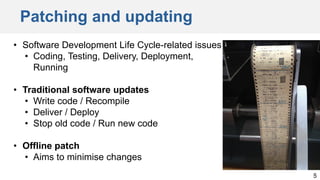
Patching and updating
• Software Development Life Cycle-related issues
• Coding, Testing, Delivery, Deployment,
Running
• Traditional software updates
• Write code / Recompile
• Deliver / Deploy
• Stop old code / Run new code
• Offline patch
• Aims to minimise changes
5
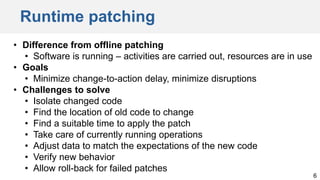
Runtime patching
• Difference from offline patching
• Software is running – activities are carried out, resources are in use
• Goals
• Minimize change-to-action delay, minimize disruptions
• Challenges to solve
• Isolate changed code
• Find the location of old code to change
• Find a suitable time to apply the patch
• Take care of currently running operations
• Adjust data to match the expectations of the new code
• Verify new behavior
• Allow roll-back for failed patches
6
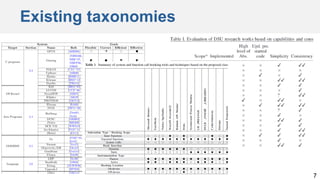
Existing taxonomies
7
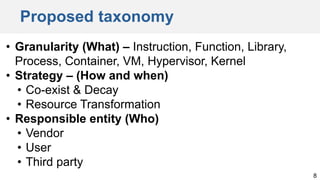
Proposed taxonomy
• Granularity (What) – Instruction, Function, Library,
Process, Container, VM, Hypervisor, Kernel
• Strategy – (How and when)
• Co-exist & Decay
• Resource Transformation
• Responsible entity (Who)
• Vendor
• User
• Third party
8
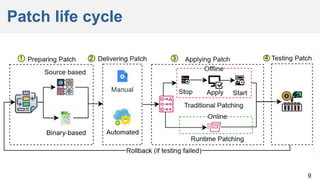
Patch life cycle
9
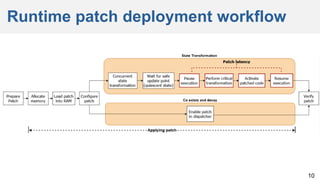
Runtime patch deployment workflow
10
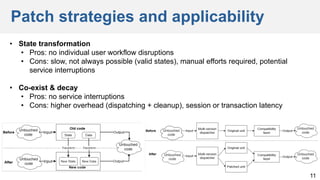
Patch strategies and applicability
11
• State transformation
• Pros: no individual user workflow disruptions
• Cons: slow, not always possible (valid states), manual efforts required, potential
service interruptions
• Co-exist & decay
• Pros: no service interruptions
• Cons: higher overhead (dispatching + cleanup), session or transaction latency
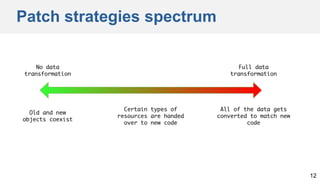
Patch strategies spectrum
12
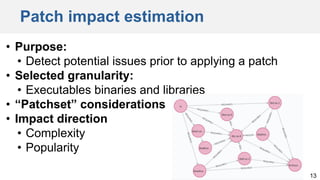
Patch impact estimation
• Purpose:
• Detect potential issues prior to applying a patch
• Selected granularity:
• Executables binaries and libraries
• “Patchset” considerations
• Impact direction
• Complexity
• Popularity
13
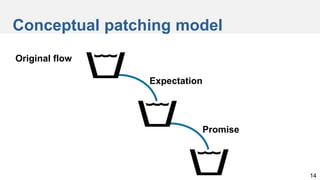
Conceptual patching model
14
Original flow
Expectation
Promise
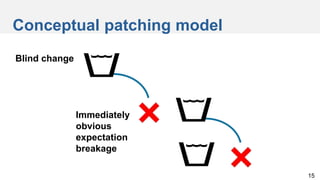
Conceptual patching model
15
Blind change
Immediately
obvious
expectation
breakage
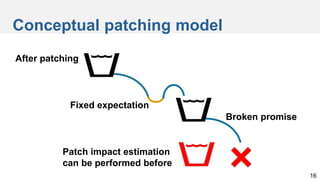
Conceptual patching model
16
After patching
Fixed expectation
Broken promise
Patch impact estimation
can be performed before
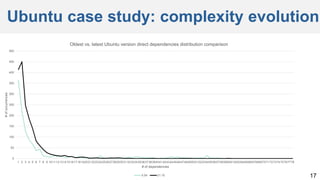
Ubuntu case study: complexity evolution
17
0
50
100
150
200
250
300
350
400
450
500
1 2 3 4 5 6 7 8 9 101112131415161718192021222324252627282930313233343536373839404142434445464748495051525354555657585960616263646566676869707172737475767778
#
of
occurrences
# of dependencies
Oldest vs. latest Ubuntu version direct dependencies distribution comparison
5.04 21.10
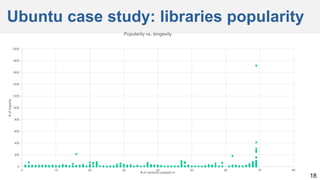
Ubuntu case study: libraries popularity
18
0
200
400
600
800
1000
1200
1400
1600
1800
2000
0 10 20 30 40 50 60 70 80
#
of
imports
# of versions present in
Popularity vs. longevity
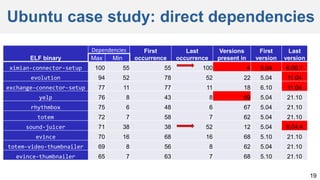
Ubuntu case study: direct dependencies
19
ELF binary
Dependencies First
occurrence
Last
occurrence
Versions
present in
First
version
Last
version
Max Min
ximian-connector-setup 100 55 55 100 4 5.04 6.06.1
evolution 94 52 78 52 22 5.04 11.04
exchange-connector-setup 77 11 77 11 18 6.10 11.04
yelp 76 8 43 8 69 5.04 21.10
rhythmbox 75 6 48 6 67 5.04 21.10
totem 72 7 58 7 62 5.04 21.10
sound-juicer 71 38 38 52 12 5.04 8.04.4
evince 70 16 68 16 68 5.10 21.10
totem-video-thumbnailer 69 8 56 8 62 5.04 21.10
evince-thumbnailer 65 7 63 7 68 5.10 21.10
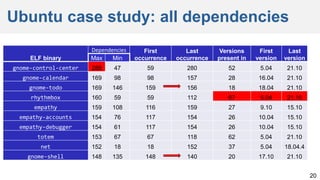
Ubuntu case study: all dependencies
20
ELF binary
Dependencies First
occurrence
Last
occurrence
Versions
present in
First
version
Last
version
Max Min
gnome-control-center 288 47 59 280 52 5.04 21.10
gnome-calendar 169 98 98 157 28 16.04 21.10
gnome-todo 169 146 159 156 18 18.04 21.10
rhythmbox 160 59 59 112 67 5.04 21.10
empathy 159 108 116 159 27 9.10 15.10
empathy-accounts 154 76 117 154 26 10.04 15.10
empathy-debugger 154 61 117 154 26 10.04 15.10
totem 153 67 67 118 62 5.04 21.10
net 152 18 18 152 37 5.04 18.04.4
gnome-shell 148 135 148 140 20 17.10 21.10
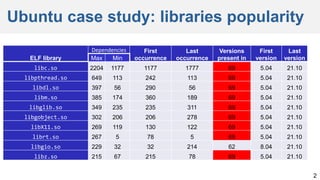
Ubuntu case study: libraries popularity
2
ELF library
Dependencies First
occurrence
Last
occurrence
Versions
present in
First
version
Last
version
Max Min
libc.so 2204 1177 1177 1777 69 5.04 21.10
libpthread.so 649 113 242 113 69 5.04 21.10
libdl.so 397 56 290 56 69 5.04 21.10
libm.so 385 174 360 189 69 5.04 21.10
libglib.so 349 235 235 311 69 5.04 21.10
libgobject.so 302 206 206 278 69 5.04 21.10
libX11.so 269 119 130 122 69 5.04 21.10
librt.so 267 5 78 5 69 5.04 21.10
libgio.so 229 32 32 214 62 8.04 21.10
libz.so 215 67 215 78 69 5.04 21.10
Current work: multi-language impact
22
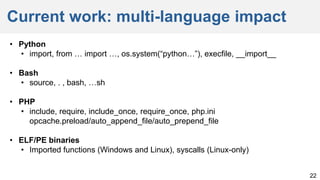
• Python
• import, from … import …, os.system(“python…”), execfile, __import__
• Bash
• source, . , bash, …sh
• PHP
• include, require, include_once, require_once, php.ini
opcache.preload/auto_append_file/auto_prepend_file
• ELF/PE binaries
• Imported functions (Windows and Linux), syscalls (Linux-only)
Future steps: patch impact metrics
23
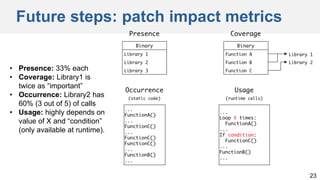
• Presence: 33% each
• Coverage: Library1 is
twice as “important”
• Occurrence: Library2 has
60% (3 out of 5) of calls
• Usage: highly depends on
value of X and “condition”
(only available at runtime).
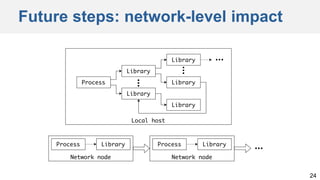
Future steps: network-level impact
24
Thank you and
questions

Run-time Patching and updating Impact Estimation

  • 1.
    RUN-TIME PATCHING ANDUPDATING IMPACT ESTIMATION Centre for Research on Engineering Software Technologies (CREST) The University of Adelaide Victor Prokhorenko
  • 2.
    Overview • Patching andupdating • Introduction • Goals • Taxonomies • Existing Runtime Patching Approaches • Practical challenges • Features • Strategies • Patch Impact estimation • Current work and preliminary results • Next steps 2
  • 3.
    Terminology • Dynamic SoftwareUpdating (DSU) • Hotpatching • Hotfixes • Live updating • Live patching • Run-time patching • Run-time updates • Monkey patching • In our context – patch and update  change 3
  • 4.
    Software evolution • Changesdue to: user demands, environment, etc. • Expectations (wishes): adjusted behavior, consistent data, lack of disruptions/downtime • Actions: update, patch • Common understanding of difference between patching and updating – small fixes vs. functional changes (sometimes reflected in versioning systems) 4
  • 5.
    Patching and updating •Software Development Life Cycle-related issues • Coding, Testing, Delivery, Deployment, Running • Traditional software updates • Write code / Recompile • Deliver / Deploy • Stop old code / Run new code • Offline patch • Aims to minimise changes 5
  • 6.
    Runtime patching • Differencefrom offline patching • Software is running – activities are carried out, resources are in use • Goals • Minimize change-to-action delay, minimize disruptions • Challenges to solve • Isolate changed code • Find the location of old code to change • Find a suitable time to apply the patch • Take care of currently running operations • Adjust data to match the expectations of the new code • Verify new behavior • Allow roll-back for failed patches 6
  • 7.
  • 8.
    Proposed taxonomy • Granularity(What) – Instruction, Function, Library, Process, Container, VM, Hypervisor, Kernel • Strategy – (How and when) • Co-exist & Decay • Resource Transformation • Responsible entity (Who) • Vendor • User • Third party 8
  • 9.
  • 10.
  • 11.
    Patch strategies andapplicability 11 • State transformation • Pros: no individual user workflow disruptions • Cons: slow, not always possible (valid states), manual efforts required, potential service interruptions • Co-exist & decay • Pros: no service interruptions • Cons: higher overhead (dispatching + cleanup), session or transaction latency
  • 12.
  • 13.
    Patch impact estimation •Purpose: • Detect potential issues prior to applying a patch • Selected granularity: • Executables binaries and libraries • “Patchset” considerations • Impact direction • Complexity • Popularity 13
  • 14.
    Conceptual patching model 14 Originalflow Expectation Promise
  • 15.
    Conceptual patching model 15 Blindchange Immediately obvious expectation breakage
  • 16.
    Conceptual patching model 16 Afterpatching Fixed expectation Broken promise Patch impact estimation can be performed before
  • 17.
    Ubuntu case study:complexity evolution 17 0 50 100 150 200 250 300 350 400 450 500 1 2 3 4 5 6 7 8 9 101112131415161718192021222324252627282930313233343536373839404142434445464748495051525354555657585960616263646566676869707172737475767778 # of occurrences # of dependencies Oldest vs. latest Ubuntu version direct dependencies distribution comparison 5.04 21.10
  • 18.
    Ubuntu case study:libraries popularity 18 0 200 400 600 800 1000 1200 1400 1600 1800 2000 0 10 20 30 40 50 60 70 80 # of imports # of versions present in Popularity vs. longevity
  • 19.
    Ubuntu case study:direct dependencies 19 ELF binary Dependencies First occurrence Last occurrence Versions present in First version Last version Max Min ximian-connector-setup 100 55 55 100 4 5.04 6.06.1 evolution 94 52 78 52 22 5.04 11.04 exchange-connector-setup 77 11 77 11 18 6.10 11.04 yelp 76 8 43 8 69 5.04 21.10 rhythmbox 75 6 48 6 67 5.04 21.10 totem 72 7 58 7 62 5.04 21.10 sound-juicer 71 38 38 52 12 5.04 8.04.4 evince 70 16 68 16 68 5.10 21.10 totem-video-thumbnailer 69 8 56 8 62 5.04 21.10 evince-thumbnailer 65 7 63 7 68 5.10 21.10
  • 20.
    Ubuntu case study:all dependencies 20 ELF binary Dependencies First occurrence Last occurrence Versions present in First version Last version Max Min gnome-control-center 288 47 59 280 52 5.04 21.10 gnome-calendar 169 98 98 157 28 16.04 21.10 gnome-todo 169 146 159 156 18 18.04 21.10 rhythmbox 160 59 59 112 67 5.04 21.10 empathy 159 108 116 159 27 9.10 15.10 empathy-accounts 154 76 117 154 26 10.04 15.10 empathy-debugger 154 61 117 154 26 10.04 15.10 totem 153 67 67 118 62 5.04 21.10 net 152 18 18 152 37 5.04 18.04.4 gnome-shell 148 135 148 140 20 17.10 21.10
  • 21.
    Ubuntu case study:libraries popularity 2 ELF library Dependencies First occurrence Last occurrence Versions present in First version Last version Max Min libc.so 2204 1177 1177 1777 69 5.04 21.10 libpthread.so 649 113 242 113 69 5.04 21.10 libdl.so 397 56 290 56 69 5.04 21.10 libm.so 385 174 360 189 69 5.04 21.10 libglib.so 349 235 235 311 69 5.04 21.10 libgobject.so 302 206 206 278 69 5.04 21.10 libX11.so 269 119 130 122 69 5.04 21.10 librt.so 267 5 78 5 69 5.04 21.10 libgio.so 229 32 32 214 62 8.04 21.10 libz.so 215 67 215 78 69 5.04 21.10
  • 22.
    Current work: multi-languageimpact 22 • Python • import, from … import …, os.system(“python…”), execfile, __import__ • Bash • source, . , bash, …sh • PHP • include, require, include_once, require_once, php.ini opcache.preload/auto_append_file/auto_prepend_file • ELF/PE binaries • Imported functions (Windows and Linux), syscalls (Linux-only)
  • 23.
    Future steps: patchimpact metrics 23 • Presence: 33% each • Coverage: Library1 is twice as “important” • Occurrence: Library2 has 60% (3 out of 5) of calls • Usage: highly depends on value of X and “condition” (only available at runtime).
  • 24.
  • 25.