Mind the Gaps – Professional Skill Development During Times of Illness
Who Am I? What Do I know? 1980 BA in Soc-Anthropology/Clinical Psychology from Western Illinois University (after 14 majors/minors)
1977-2001 Volunteered in various communities with low income and unemployed individuals to help find employment and develop job skills (Worked about 42 different  jobs.)
2002 Pfizer downsized office and I began caring for family with significant long & short term illnesses
2005 Graduated from SNL with MA while caring for family
2005-2008 Focused on skill development planning to help friends and others with illnesses – got others jobs.
2008- Present Part-time Job Coach / Developer for UCP in Chicago Mind the GapsThree Trends I have noticed:Simply doing your job well and “knowing the business” is no longer enough to get ahead.
Career development is no longer part of a corporate ladder while knowledge of career mapping is expected at the interview.
Manage your own job training expectations – There is a significant gap between what is expected to be  known for your job at time of hire and corporate training return on investment (RIO) over the first 90 days.The New Unspoken RulesHigher education no longer guarantees a job, higher pay, or automatic promotions. (Don’t count on employer to foot the education bill either.)Taking a yearly training course will not meet most employer expectations for performance of job skill or count as career development. (If it does- run.)The people not searching for a jobor a career? Perpetual learners and self-reliant adapters, who can prove they are capable in dealing with life, health, and economic surprises by developing new skills in “gap periods”..
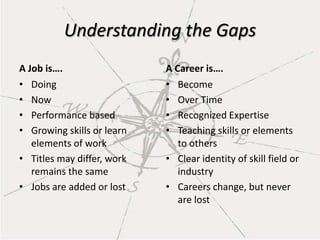
Understanding the GapsA Job is….DoingNowPerformance basedGrowing skills or learn elements of workTitles may differ, work remains the sameJobs are added or lostA Career is….BecomeOver TimeRecognized ExpertiseTeaching skills or elements to othersClear identity of skill field or industry Careers change, but never are lost
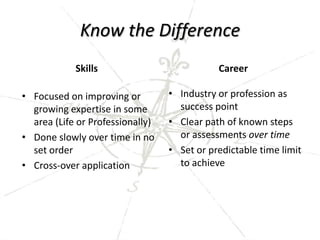
Know the DifferenceSkillsIndustry or profession as success pointClear path of known steps or assessments over timeSet or predictable time limit to achieve Focused on improving or growing expertise in some area (Life or Professionally)Done slowly over time in no set orderCross-over applicationCareer
Why Map?Managing your Career and your skill development is a long term investment of both your time and your money – don’t be cheap with either.In 2007, a UK career education research study found that life long skill development and career planning increases life time net income by over 45%.  CareerBuilder reports job seekers admit taking 2-10 unpaid days from a current job in order to pursue new training or skills to increase their overall pay 15-30% in their next position.Control over development is based upon self assessment of current competencies and seeing gaps in career path or current job responsibilities
Sage InsightsMake sure the reality of your expertise lives up to perceptions of those around you – if not, identify areas for improvement and fix NOW, not later.Reality shows prove that many of us think we have talents that make us stars or winners.  Mirror, Mirror on the wall. Who is the best worker? Syndrome -Performance reviews and co-worker comments are not best places to see reality for career choices.Remember : Jobs are the things we DO. Careers are what we BECOME.  Gaps can become the garden bridge between them.
Personal Mission StatementSimple one sentence statementEasily understood by 4th graderAble to memorize and repeat any time / anywhere / under any life stressGuides both personal and professional lifeClearly defines passion and life goal Simply is a life compass – States boldly “This is what I am about.”
Mind MappingWhat is mind mapping?According to Wikipedia: A mind map is a diagram used to represent words, ideas, tasks, or other items linked to and arranged around a central key word or idea. Mind maps are used to generate, visualize, structure, and classify ideas, and as an aid in study, organization, problem solving, decision making, and writing.A mind map is often created around a single word or text, placed in the center, to which associated ideas, words and concepts are added.
Mind MappingWho Invented it, really?Porphyry of Tyre(A.D. 234– 305),Ramon Llull (1235 – 1315 A.D),  Leonardo da Vinci (1451), Allan Collins (1960) Tony Buzan(1975)
 Resume GapsAny unexplained time period, usually noted in employment missing on a chronological or other styled resumeSkills mentioned without apparent education, training, or employment as “how learned”Unlinked progression of job development Missing data or information about career during interview
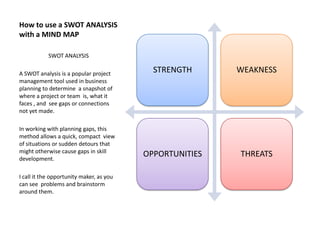
How to use a SWOT ANALYSIS with a MIND MAPSWOT ANALYSISA SWOT analysis is a popular project management tool used in business planning to determine  a snapshot of where a project or team  is, what it faces , and  see gaps or connections  not yet made.In working with planning gaps, this method allows a quick, compact  view of situations or sudden detours that might otherwise cause gaps in skill development. I call it the opportunity maker, as you can see  problems and brainstorm around them.
Mind MappingThe basic Rules: Use colors, pictures, images, words, symbols, etc. Use one word or very simple phrasesUse both straight and curved lines or arrows for branchesUse circles, boxes, etc to capture key sub-headings  and place in corners Depth or focus on sub-headings should be placed on separate “focus map”
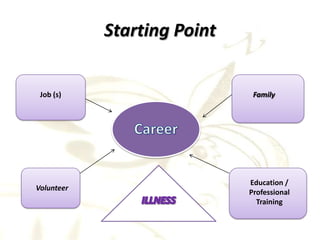
How to Map the GapsDrawing  a mind map: Start in the center of a blank page and draw or write central theme – This is the Career focus.  The “Illness” is under career.Place sub-heading in each corner  - These are areas of life such as hobbies, education, family, etc.  Connect sub-headings/areas of life  with branches/ arrows  to central theme if a relationship to career  or skill development opportunity can be shownFrom areas of life corners, more than one sub-heading activity can be placed. Consider all opportunities to learn or develop new skills and add to map with dashed lines and consider using  colors.
FamilyJob (s)FamilyCareerEducation / Professional Training Volunteer Volunteer Starting PointILLNESS
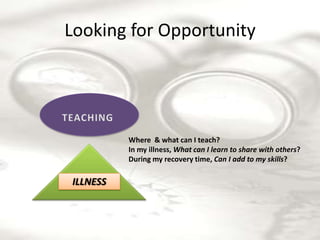
Looking for OpportunityTEACHINGWhere  & what can I teach? In my illness, What can I learn to share with others?During my recovery time, Can I add to my skills?ILLNESS
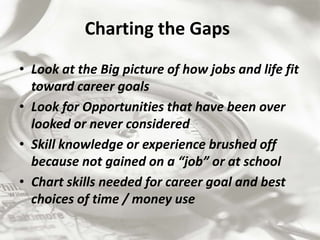
Charting the GapsLook at the Big picture of how jobs and life fit toward career goals Look for Opportunities that have been over looked or never consideredSkill knowledge or experience brushed off because not gained on a “job” or at schoolChart skills needed for career goal and best choices of time / money use
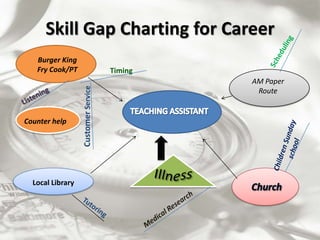
Skill Gap Charting for Career SchedulingBurger King Fry Cook/PTBurger King Fry Cook/PTTimingAM Paper RouteListeningTEACHING ASSISTANTCustomerServiceCounter helpChildren Sunday schoolIllnessLocal Library ChurchMedical ResearchTutoring
Lyn’s IllnessLyn’s  illness  Sudden, unpredicted, and mysteriousMultiple doctor and blood testing visits, etc.Forced to reconsider career Lyn’s career at the onset of illnessFull-time email engineer at a major corporationPart-time IT instructor at a community college
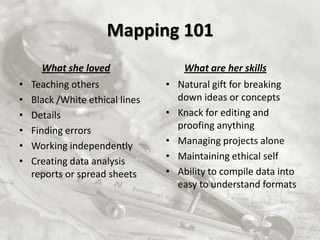
Mapping 101What she lovedTeaching othersBlack /White ethical linesDetails Finding errorsWorking independentlyCreating data analysis reports or spread sheetsWhat are her skills  Natural gift for breaking down ideas or conceptsKnack for editing and proofing anythingManaging projects aloneMaintaining ethical self  Ability to compile data into easy to understand formats
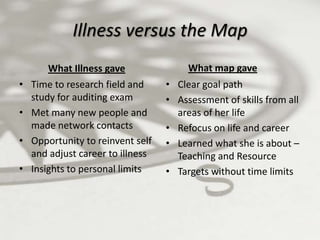
Illness versus the MapWhat Illness gaveTime to research field and study for auditing examMet many new people and made network contactsOpportunity to reinvent self and adjust career to illnessInsights to personal limitsWhat map gaveClear goal pathAssessment of skills from all areas of her lifeRefocus on life and career Learned what she is about – Teaching and Resource Targets without time limits

Mind The Gaps Long Version April 28, 2009

  • 1.
    Mind the Gaps– Professional Skill Development During Times of Illness
  • 2.
    Who Am I?What Do I know? 1980 BA in Soc-Anthropology/Clinical Psychology from Western Illinois University (after 14 majors/minors)
  • 3.
    1977-2001 Volunteered invarious communities with low income and unemployed individuals to help find employment and develop job skills (Worked about 42 different jobs.)
  • 4.
    2002 Pfizer downsizedoffice and I began caring for family with significant long & short term illnesses
  • 5.
    2005 Graduated fromSNL with MA while caring for family
  • 6.
    2005-2008 Focused onskill development planning to help friends and others with illnesses – got others jobs.
  • 7.
    2008- Present Part-timeJob Coach / Developer for UCP in Chicago Mind the GapsThree Trends I have noticed:Simply doing your job well and “knowing the business” is no longer enough to get ahead.
  • 8.
    Career development isno longer part of a corporate ladder while knowledge of career mapping is expected at the interview.
  • 9.
    Manage your ownjob training expectations – There is a significant gap between what is expected to be known for your job at time of hire and corporate training return on investment (RIO) over the first 90 days.The New Unspoken RulesHigher education no longer guarantees a job, higher pay, or automatic promotions. (Don’t count on employer to foot the education bill either.)Taking a yearly training course will not meet most employer expectations for performance of job skill or count as career development. (If it does- run.)The people not searching for a jobor a career? Perpetual learners and self-reliant adapters, who can prove they are capable in dealing with life, health, and economic surprises by developing new skills in “gap periods”..
  • 10.
    Understanding the GapsAJob is….DoingNowPerformance basedGrowing skills or learn elements of workTitles may differ, work remains the sameJobs are added or lostA Career is….BecomeOver TimeRecognized ExpertiseTeaching skills or elements to othersClear identity of skill field or industry Careers change, but never are lost
  • 11.
    Know the DifferenceSkillsIndustryor profession as success pointClear path of known steps or assessments over timeSet or predictable time limit to achieve Focused on improving or growing expertise in some area (Life or Professionally)Done slowly over time in no set orderCross-over applicationCareer
  • 12.
    Why Map?Managing yourCareer and your skill development is a long term investment of both your time and your money – don’t be cheap with either.In 2007, a UK career education research study found that life long skill development and career planning increases life time net income by over 45%. CareerBuilder reports job seekers admit taking 2-10 unpaid days from a current job in order to pursue new training or skills to increase their overall pay 15-30% in their next position.Control over development is based upon self assessment of current competencies and seeing gaps in career path or current job responsibilities
  • 13.
    Sage InsightsMake surethe reality of your expertise lives up to perceptions of those around you – if not, identify areas for improvement and fix NOW, not later.Reality shows prove that many of us think we have talents that make us stars or winners. Mirror, Mirror on the wall. Who is the best worker? Syndrome -Performance reviews and co-worker comments are not best places to see reality for career choices.Remember : Jobs are the things we DO. Careers are what we BECOME. Gaps can become the garden bridge between them.
  • 14.
    Personal Mission StatementSimpleone sentence statementEasily understood by 4th graderAble to memorize and repeat any time / anywhere / under any life stressGuides both personal and professional lifeClearly defines passion and life goal Simply is a life compass – States boldly “This is what I am about.”
  • 15.
    Mind MappingWhat ismind mapping?According to Wikipedia: A mind map is a diagram used to represent words, ideas, tasks, or other items linked to and arranged around a central key word or idea. Mind maps are used to generate, visualize, structure, and classify ideas, and as an aid in study, organization, problem solving, decision making, and writing.A mind map is often created around a single word or text, placed in the center, to which associated ideas, words and concepts are added.
  • 16.
    Mind MappingWho Inventedit, really?Porphyry of Tyre(A.D. 234– 305),Ramon Llull (1235 – 1315 A.D), Leonardo da Vinci (1451), Allan Collins (1960) Tony Buzan(1975)
  • 17.
    Resume GapsAnyunexplained time period, usually noted in employment missing on a chronological or other styled resumeSkills mentioned without apparent education, training, or employment as “how learned”Unlinked progression of job development Missing data or information about career during interview
  • 18.
    How to usea SWOT ANALYSIS with a MIND MAPSWOT ANALYSISA SWOT analysis is a popular project management tool used in business planning to determine a snapshot of where a project or team is, what it faces , and see gaps or connections not yet made.In working with planning gaps, this method allows a quick, compact view of situations or sudden detours that might otherwise cause gaps in skill development. I call it the opportunity maker, as you can see problems and brainstorm around them.
  • 19.
    Mind MappingThe basicRules: Use colors, pictures, images, words, symbols, etc. Use one word or very simple phrasesUse both straight and curved lines or arrows for branchesUse circles, boxes, etc to capture key sub-headings and place in corners Depth or focus on sub-headings should be placed on separate “focus map”
  • 20.
    How to Mapthe GapsDrawing a mind map: Start in the center of a blank page and draw or write central theme – This is the Career focus. The “Illness” is under career.Place sub-heading in each corner - These are areas of life such as hobbies, education, family, etc. Connect sub-headings/areas of life with branches/ arrows to central theme if a relationship to career or skill development opportunity can be shownFrom areas of life corners, more than one sub-heading activity can be placed. Consider all opportunities to learn or develop new skills and add to map with dashed lines and consider using colors.
  • 21.
    FamilyJob (s)FamilyCareerEducation /Professional Training Volunteer Volunteer Starting PointILLNESS
  • 22.
    Looking for OpportunityTEACHINGWhere & what can I teach? In my illness, What can I learn to share with others?During my recovery time, Can I add to my skills?ILLNESS
  • 23.
    Charting the GapsLookat the Big picture of how jobs and life fit toward career goals Look for Opportunities that have been over looked or never consideredSkill knowledge or experience brushed off because not gained on a “job” or at schoolChart skills needed for career goal and best choices of time / money use
  • 24.
    Skill Gap Chartingfor Career SchedulingBurger King Fry Cook/PTBurger King Fry Cook/PTTimingAM Paper RouteListeningTEACHING ASSISTANTCustomerServiceCounter helpChildren Sunday schoolIllnessLocal Library ChurchMedical ResearchTutoring
  • 25.
    Lyn’s IllnessLyn’s illness Sudden, unpredicted, and mysteriousMultiple doctor and blood testing visits, etc.Forced to reconsider career Lyn’s career at the onset of illnessFull-time email engineer at a major corporationPart-time IT instructor at a community college
  • 26.
    Mapping 101What shelovedTeaching othersBlack /White ethical linesDetails Finding errorsWorking independentlyCreating data analysis reports or spread sheetsWhat are her skills Natural gift for breaking down ideas or conceptsKnack for editing and proofing anythingManaging projects aloneMaintaining ethical self Ability to compile data into easy to understand formats
  • 27.
    Illness versus theMapWhat Illness gaveTime to research field and study for auditing examMet many new people and made network contactsOpportunity to reinvent self and adjust career to illnessInsights to personal limitsWhat map gaveClear goal pathAssessment of skills from all areas of her lifeRefocus on life and career Learned what she is about – Teaching and Resource Targets without time limits