MIMA:
Cultivating a User-Centered Culture
          January 19, 2011
# mima
Meghan (@irishgirl)   Nancy (@nylons)


    Who are the Geek Girls?
Follow. Friend. Stalk.
Work: clockwork.net
Blog & Podcast: geekgirlsguide.com
Facebook: facebook.com/geekgirlsguide
Twitter: @geekgirlsguide
User-centered Design

A philosophy in which the needs, wants,
and limitations of end users of an
interface or document are given
extensive attention at each stage of
the design process.

                                  - Wikipedia
User-centered Culture

A philosophy in which the needs, wants,
and limitations of end users of a
product or service are given
extensive attention at every level of
the organization.

                               - Geek Girls
A Few Truths

    Divides exist between:

•    Leadership & Employees
•    Agencies & Clients
•    Web Developers & End Users
Leadership
    &
Employees
Corporate structures haven’t
changed (much) since the 1800s.
But there were damn good reasons
       for charts like these.
1999   “Hyperlinks subvert hierarchy.

        In both markets and among
        employees, people are speaking to
        each other in a powerful new way.

        These conversations are enabling
        powerful new forms of social
        organization and knowledge
        exchange to emerge.”
2009
Agencies
   &
Clients
Agencies haven’t changed (much)
        since the 1960s.
“They need me and my big ideas.”
Old-school creatives
are used to controlling the deliverable.


     Old-school managers
 are used to controlling...everything.
Developers
    &
  Users
Typical Developer                                                                     Typical User

                    Male                                                                         Female

                19 - 29                                                                         35 - 54

                   White                                                                           White

  College Educated                                                        High School Education

  Doing job for 3 yrs or less


 Sources:
 http://aneventapart.com/alasurvey2009/
 http://www.istrategylabs.com/2010/01/facebook-demographics-and-statistics-report-2010-145-growth-in-1-year/
 http://www.census.gov/hhes/socdemo/education/data/cps/2009/tables.html
Mini-jackass   5
priceless.
Embracing users means
embracing chaos.

         It’s not easy.
You (mostly) don’t matter.

         Users do.
A note on nomenclature:


      Everyone is a user.
PART I:

Company culture is a product.
Employees are users.
Happy people do good work.
 It’s not about kegs and foosball.


             Image source: http://www.flickr.com/photos/sharynmorrow/2618698358/
What makes us happy?


          Autonomy: control time,
          technique, team, or task.
          Mastery: make progress
          and get better.
          Purpose: be part of
          something bigger.
1
Define your values.
It begins with leadership,
but involves everyone.
2
Align hiring decisions
with your values.


Job skills are table stakes.
Emotional Intelligence
                The ability to identify,
                   assess, and manage
                 the emotions of self,
                   others, and groups.
                    Necessary for
                       leadership,
              client management
                     and end-user
                       sensitivity.
3   Communicate openly.

    When resources are scarce,
    the way you communicate
    can either inspire panic or
    collaboration.

    Resources are always scarce.
4
Cultivate a sense of ownership.
Everybody owns the promises made,
the method of delivery, and the final
product.
PART II:

Companies are products.
Clients are users.
1
Find clients that align
with your values.


Don’t be afraid to say no.
2
Communicate openly.
Speak their language,
don’t expect them to speak yours.

Be honest about what’s realistic.
3
Listen.
Don’t just listen to what they say,
try to understand what they mean.
4
Treat the client as the expert.
You’re the idiot in the room.
PART III:

Web apps are products.
Users are users.
1
Extend your values
to your end product.
Be who you say you are
and it will be reflected in your work.
2
Don’t allow
“us vs. them”
attitudes.
To be user-centered,
you have to care.
3
Listen.
Ask the right questions,
find the real story.
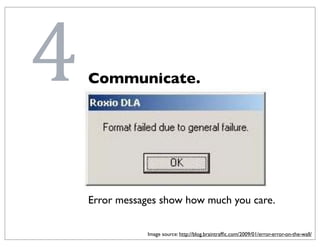
4   Communicate.


    Error messages show how much you care.

                Image source: http://blog.braintraffic.com/2009/01/error-error-on-the-wall/
5
Push your boundaries.


Remember what being a user
feels like.
Recommended Reading

•   The Cluetrain Manifesto

•   Here Comes Everybody, Clay Shirky

•   Drive, Daniel Pink

•   Happy Hour is From 9 to 5, Alexander Kjerulf

•   Peak, Chip Conley

•   Why Work Doesn’t Happen at Work, Jason Fried
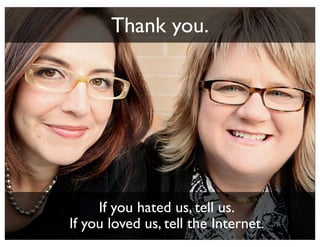
Thank you.


     If you hated us, tell us.
If you loved us, tell the Internet.

MIMA: Cultivating a User-Centered Culture