Millikan’s Oil Drop Experiment
I. Charge of electron – very important
application of uniform electric field
between two plate – Robert Millikan
(1868-1953)
A. Purpose: to find charge of an electron
John D. Bookstaver
St. Charles Community College
St. Peters, MO
 2006, Prentice Hall, Inc.
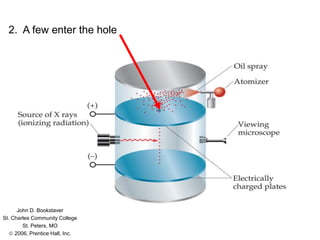
1. Fine oil sprayed into air in top – gravity causes them to fall
John D. Bookstaver
St. Charles Community College
St. Peters, MO
 2006, Prentice Hall, Inc.
2. A few enter the hole
John D. Bookstaver
St. Charles Community College
St. Peters, MO
 2006, Prentice Hall, Inc.
3. Potential difference between plates is applied – exerts a force
on the charged drops
John D. Bookstaver
St. Charles Community College
St. Peters, MO
 2006, Prentice Hall, Inc.
4. Top plate is positive enough that negative drops will rise
-
John D. Bookstaver
St. Charles Community College
St. Peters, MO
 2006, Prentice Hall, Inc.
5. Potential difference adjusted to suspend (float) particle
-
E*q = m*g
John D. Bookstaver
St. Charles Community College
St. Peters, MO
 2006, Prentice Hall, Inc.
6. Electric field was determined from potential difference
between two plates (E = V/d)
-
John D. Bookstaver
St. Charles Community College
St. Peters, MO
 2006, Prentice Hall, Inc.
7. Found velocity of charge when field was turned off. Using
velocity, mg was found. Using E & mg, the charge could be
calculated.
-
John D. Bookstaver
St. Charles Community College
St. Peters, MO
 2006, Prentice Hall, Inc.
8. The drops had a variety of charges. So, he ionized the air,
added or removed electrons. The change in charge was
always a multiple of -1.6 x 10⁻¹⁹ C. Thus, the charge on one
electron.
-
John D. Bookstaver
St. Charles Community College
St. Peters, MO
 2006, Prentice Hall, Inc.
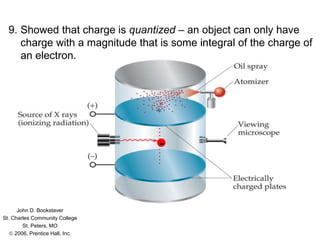
9. Showed that charge is quantized – an object can only have
charge with a magnitude that is some integral of the charge of
an electron.
-
Sharing of Charge
• Read pg. 438 & 439
Grounding
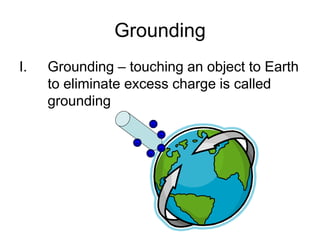
I. Grounding – touching an object to Earth
to eliminate excess charge is called
grounding
-
-
-
-
-
Chapter 21
I. Grounding – touching an object to Earth
to eliminate excess charge is called
grounding
-
-
-
-
-
Electric Field Near Conductors
II. Electric field near conductors – charges
on conductors are spread as far as
possible to keep energy of system low.
Result – all charges are on surface of
conductor
- -
- - -
- -
-
-
-
-
-
-
- -
-
-
-
Electric Field Near Conductors
II. Electric field near conductors –
Hollow? Excess charges move to outer
surface
-
http://www.engineersedge.com/motors/images/hollow11.gif
-
--
- -
- -
-
-
--
--
A closed, metal container will have no charge on the inside surface
Shielding
Electrons from the
lightning bolt
mutually repel and
spread over the outer
metal surface.
Although the electric
field set up may be
great outside the car,
the overall electric
field inside the car
practically cancels to
zero.
http://webphysics.ph.msstate.edu/
Electric Field Outside Conductors
III. Electric field outside conductors –
depends on shape of body and its
potential
-
-
-
-
-
-
---
-
-
-
-
-
----
A. Charges are close
together at sharp points,
so field lines are close
together, thus, the field
is stronger here.
Even if the objects are not spherical the charge is on the
outside. Note that where there are corners the charge
tends to bunch up. The charge inside is still zero.
http://webphysics.ph.msstate.edu/
Electric Field Outside Conductors
III. Electric field outside conductors –
depends on shape of body and its
potential
B. The can actually
cause nearby air
molecules to be
separated into electrons
and positive ions
-
-
-
-
-
-
---
-
-
-
-
-
----
- -
-
+
+
+
1. As they recombine,
energy is released and
blue corona can form
(St. Elmo’s fire)
http://www.commissionseast.org.uk/library/lowestoft/lowestoft_5.jpg
Electric Field Outside Conductors
III. Electric field outside conductors –
depends on shape of body and its
potential
C. To reduce this effect in
conductors that are highly charged
or operate at high potentials, the
conductors are made smooth in
shape
Electric Field Outside Conductors
III. Electric field outside conductors –
depends on shape of body and its
potential
D. Lightning rods –
made pointed so electric
field is strong near end of
rod; charges spark to a
rod rather than the roof of
a building
http://wblightningrods.com/images/gallery_concealed.jpg
Storing Electric Energy
IV. Storing Electric Energy – The Capacitor
A. 1746 – Peter Van Musschenbroek – Dutch Physicist
invented a device to store electric charge (Leyden jar)
http://upload.wikimedia.org/wikipedia/commons/thumb/c/c9/Pieter_van_Musschenbroek.jpeg/180px-Pieter_van_Musschenbroek.jpeg
Storing Electric Energy
IV. Storing Electric Energy – The Capacitor
B. Capacitance (C) – ratio of charge to potential difference
http://www.jianghai.com/image/da2.jpg
C. Capacitor – device used to have a
specific capacitance (large capacitance
in small device)
V Voltage
Farad (F)C = q [=] Coulomb (C) =
You can store electrical energy in
a device called a capacitor.
Capacitors are found in almost all
electronic circuits.
A capacitor is simply a device
that has two conducting
materials separated by an
insulating material.
Capacitors are usually between
10 pF (1 x 10 -12 F) and 500 μF (500
x 10-6 F)
http://webphysics.ph.msstate.edu/

Millikan

  • 1.
    Millikan’s Oil DropExperiment I. Charge of electron – very important application of uniform electric field between two plate – Robert Millikan (1868-1953) A. Purpose: to find charge of an electron
  • 2.
    John D. Bookstaver St.Charles Community College St. Peters, MO  2006, Prentice Hall, Inc. 1. Fine oil sprayed into air in top – gravity causes them to fall
  • 3.
    John D. Bookstaver St.Charles Community College St. Peters, MO  2006, Prentice Hall, Inc. 2. A few enter the hole
  • 4.
    John D. Bookstaver St.Charles Community College St. Peters, MO  2006, Prentice Hall, Inc. 3. Potential difference between plates is applied – exerts a force on the charged drops
  • 5.
    John D. Bookstaver St.Charles Community College St. Peters, MO  2006, Prentice Hall, Inc. 4. Top plate is positive enough that negative drops will rise -
  • 6.
    John D. Bookstaver St.Charles Community College St. Peters, MO  2006, Prentice Hall, Inc. 5. Potential difference adjusted to suspend (float) particle - E*q = m*g
  • 7.
    John D. Bookstaver St.Charles Community College St. Peters, MO  2006, Prentice Hall, Inc. 6. Electric field was determined from potential difference between two plates (E = V/d) -
  • 8.
    John D. Bookstaver St.Charles Community College St. Peters, MO  2006, Prentice Hall, Inc. 7. Found velocity of charge when field was turned off. Using velocity, mg was found. Using E & mg, the charge could be calculated. -
  • 9.
    John D. Bookstaver St.Charles Community College St. Peters, MO  2006, Prentice Hall, Inc. 8. The drops had a variety of charges. So, he ionized the air, added or removed electrons. The change in charge was always a multiple of -1.6 x 10⁻¹⁹ C. Thus, the charge on one electron. -
  • 10.
    John D. Bookstaver St.Charles Community College St. Peters, MO  2006, Prentice Hall, Inc. 9. Showed that charge is quantized – an object can only have charge with a magnitude that is some integral of the charge of an electron. -
  • 11.
    Sharing of Charge •Read pg. 438 & 439
  • 12.
    Grounding I. Grounding –touching an object to Earth to eliminate excess charge is called grounding - - - - -
  • 13.
    Chapter 21 I. Grounding– touching an object to Earth to eliminate excess charge is called grounding - - - - -
  • 14.
    Electric Field NearConductors II. Electric field near conductors – charges on conductors are spread as far as possible to keep energy of system low. Result – all charges are on surface of conductor - - - - - - - - - - - - - - - - - -
  • 15.
    Electric Field NearConductors II. Electric field near conductors – Hollow? Excess charges move to outer surface - http://www.engineersedge.com/motors/images/hollow11.gif - -- - - - - - - -- -- A closed, metal container will have no charge on the inside surface Shielding
  • 16.
    Electrons from the lightningbolt mutually repel and spread over the outer metal surface. Although the electric field set up may be great outside the car, the overall electric field inside the car practically cancels to zero. http://webphysics.ph.msstate.edu/
  • 17.
    Electric Field OutsideConductors III. Electric field outside conductors – depends on shape of body and its potential - - - - - - --- - - - - - ---- A. Charges are close together at sharp points, so field lines are close together, thus, the field is stronger here.
  • 18.
    Even if theobjects are not spherical the charge is on the outside. Note that where there are corners the charge tends to bunch up. The charge inside is still zero. http://webphysics.ph.msstate.edu/
  • 19.
    Electric Field OutsideConductors III. Electric field outside conductors – depends on shape of body and its potential B. The can actually cause nearby air molecules to be separated into electrons and positive ions - - - - - - --- - - - - - ---- - - - + + + 1. As they recombine, energy is released and blue corona can form (St. Elmo’s fire) http://www.commissionseast.org.uk/library/lowestoft/lowestoft_5.jpg
  • 20.
    Electric Field OutsideConductors III. Electric field outside conductors – depends on shape of body and its potential C. To reduce this effect in conductors that are highly charged or operate at high potentials, the conductors are made smooth in shape
  • 21.
    Electric Field OutsideConductors III. Electric field outside conductors – depends on shape of body and its potential D. Lightning rods – made pointed so electric field is strong near end of rod; charges spark to a rod rather than the roof of a building http://wblightningrods.com/images/gallery_concealed.jpg
  • 22.
    Storing Electric Energy IV.Storing Electric Energy – The Capacitor A. 1746 – Peter Van Musschenbroek – Dutch Physicist invented a device to store electric charge (Leyden jar) http://upload.wikimedia.org/wikipedia/commons/thumb/c/c9/Pieter_van_Musschenbroek.jpeg/180px-Pieter_van_Musschenbroek.jpeg
  • 23.
    Storing Electric Energy IV.Storing Electric Energy – The Capacitor B. Capacitance (C) – ratio of charge to potential difference http://www.jianghai.com/image/da2.jpg C. Capacitor – device used to have a specific capacitance (large capacitance in small device) V Voltage Farad (F)C = q [=] Coulomb (C) =
  • 24.
    You can storeelectrical energy in a device called a capacitor. Capacitors are found in almost all electronic circuits. A capacitor is simply a device that has two conducting materials separated by an insulating material. Capacitors are usually between 10 pF (1 x 10 -12 F) and 500 μF (500 x 10-6 F) http://webphysics.ph.msstate.edu/