Page | 1
INCORPORATING THE ENTREPRENEURIAL TRACK
INTO THE MILITARY LIFE CYCLE MODEL
Purpose
After revamping their transition assistance programs as part of the veterans employment initiative, the
armed services are currently developing a military life cycle model which incorporates the key elements of
the Transition GPS program into a broader plan for personal / professional growth and development
throughout a servicemember’s career. This fact sheet has been created to assist the armed services with
their efforts to incorporate the entrepreneurial track into that. It describes the programs and services
available through the Small Business Administration to servicemembers who wish to start their own
businesses and it discusses the ways those programs and services might best be used in that model.
Background
Before incorporating the entrepreneurial track into the military life cycle, it is important to note that the
process of starting a small business has many steps. And, in order to attain the goal of a “career-ready
military” where those interested in starting a business are prepared to do so the moment the step off from
their service, there are several things that need to be in place prior to separation.
Commanders have various mission requirements. However, due to budgetary constraints, certain programs
and services can only be offered at each installation quarterly. So, the entrepreneurial track must really be
fully integrated into the military training management cycle so that servicemembers have the chance to
pursue these self-development opportunities during periods of low operational tempo.
Page | 2
This fact sheet describes the programs and services available through the Small Business Administration in
order to ensure servicemembers who wish to start their own business meet what would be equivalent of
“career readiness standards” for self-employed / small business owners at separation.
However, one must bear in mind that there are also some businesses (i.e. personal training, web page
design, etc.) that servicemembers might wish to start while still serving in the military. And, spouses (i.e.
who might have been displaced from their occupation when they moved with the servicemember) are also
eligible for the programs and services.
Desired Outcome
Although there is no concrete definition for when a person is fully prepared to start their own business, an
ideal situation upon separation might be that a servicemember:
o Has a solid business plan in-hand.
o Is paired with an experienced counselor/mentor.
o Has any necessary financing lined up.
Pathway to Success
1.) Consider starting a business.
It is important that servicemembers and their spouses be exposed to the idea of self-employment and small
business ownership as early in the military life cycle as possible. The sooner they decide to pursue this
option, the more time they have to use the programs and services offered by the Small Business
Administration during their military career.
As the first part of the Boots to Business component of the Transition GPS program, the Small Business
Administration has developed a ten-minute video which serves as a primer on the considerations starting
and owning of one’s own business. Ideally, all servicemembers should be given the opportunity to watch this
video upon arrival at their first duty station.
2.) Start to plan and prepare.
As soon as a servicemember or a spouse expresses any interest in starting their own business, his or her
commander should help them get in contact with the Small Business Administration’s local district office to
set up an appointment with the business development specialist assigned to assist veterans in the area.
These personnel can walk servicemembers through the process of starting a small business, help them get
started on some basic market research, and guide them toward sound financial decisions early on so they
have the capital necessary to qualify for a small business loan. They can pair them up with a
mentor/counselor from SCORE – an experienced local small business owner who volunteers to assist others
just starting their own small business.
Page | 3
3.) Conduct a feasibility analysis.
As the second part of the Boots to Business component of the Transition GPS program, the Small Business
Administration offers servicemembers and spouses the opportunity to attend two days of classroom
instruction where they conduct a feasibility analysis to flesh out whether they have a sound idea for a
venture. This is a key decision point when servicemembers usually decide whether to go forward and try to
start a small business.
When fully funded, these classes will be offered quarterly at 150 CONUS installations and 50 OCONUS
installations with an online training module for those in remote locations who are unable to attend a
classroom session. The class could be fully integrated into the military training management cycle just like a
two-day college class that a servicemember might take at some point during his or her career – with a
commander simply designating the class site as the servicemembers place of duty for two days during a
period of low operational tempo.
4.) Create a business plan.
As the third part of the Boots to Business component of the Transition GPS program, the Small Business
Administration offers servicemembers and spouses the opportunity to enroll in an eight-week online
distance learning course that leads to the creation of a business plan. Students receive textbooks in the mail
and they interact with other students across the country and with professors in the entrepreneurship
program at the University of Syracuse.
Although there is no cost for the course, servicemembers and spouses must first complete the two day class
offered as the second part of the Boots to Business program in order to be eligible to enroll in this course.
Students are expected to put in 8-10 hours each week to fulfill the academic requirements. So, the course
can be completed by most servicemembers on off-duty hours during a period of low operational tempo.
Students come out of the course with a solid business plan – which is often a prerequisite for any type of
small business loan.
5.) Set-up any necessary financing.
After completing their business plan, servicemembers and spouses should get in contact with the Small
Business Administration’s local district office again to set up appointments with the Small Business
Development Center and the lender relations specialist. The Small Business Development Center will look at
their business plan and certify it as being sound – allowing them to apply for small business loans backed by
the Small Business Administration. And, the lender relations specialist will be able to discuss the plan that
the servicemember has put together to finance the new venture. If a small business loan is appropriate, the
lender relations specialist can also tell them which institutions are more likely to finance a venture like the
one he or she is starting.
Page | 4
The Small Business Administration offers a variety of loan programs. The Patriot Express Loan is a program
with an expedited application process exclusively for veterans. And, a microlending program specifically for
veterans is currently being developed. However, as the applications may sometimes take 3-6 months, it is
recommended that servicemembers and spouses start the process early.
6.) Start a small business.
Upon separation, a servicemember should have a solid business plan in-hand, be paired with an experienced
counselor/mentor, and have any necessary financing lined up.
Page | 5
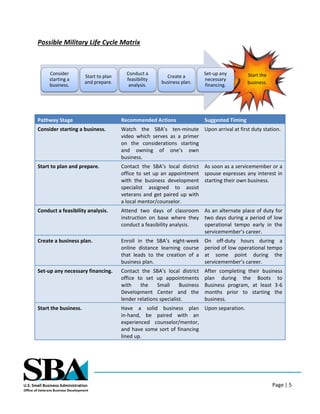
Possible Military Life Cycle Matrix
Pathway Stage Recommended Actions Suggested Timing
Consider starting a business. Watch the SBA’s ten-minute
video which serves as a primer
on the considerations starting
and owning of one’s own
business.
Upon arrival at first duty station.
Start to plan and prepare. Contact the SBA’s local district
office to set up an appointment
with the business development
specialist assigned to assist
veterans and get paired up with
a local mentor/counselor.
As soon as a servicemember or a
spouse expresses any interest in
starting their own business.
Conduct a feasibility analysis. Attend two days of classroom
instruction on base where they
conduct a feasibility analysis.
As an alternate place of duty for
two days during a period of low
operational tempo early in the
servicemember’s career.
Create a business plan. Enroll in the SBA’s eight-week
online distance learning course
that leads to the creation of a
business plan.
On off-duty hours during a
period of low operational tempo
at some point during the
servicemember’s career.
Set-up any necessary financing. Contact the SBA’s local district
office to set up appointments
with the Small Business
Development Center and the
lender relations specialist.
After completing their business
plan during the Boots to
Business program, at least 3-6
months prior to starting the
business.
Start the business. Have a solid business plan
in-hand, be paired with an
experienced counselor/mentor,
and have some sort of financing
lined up.
Upon separation.
Consider
starting a
business.
Start to plan
and prepare.
Conduct a
feasibility
analysis.
Create a
business plan.
Set-up any
necessary
financing.
Start the
business.
Page | 6
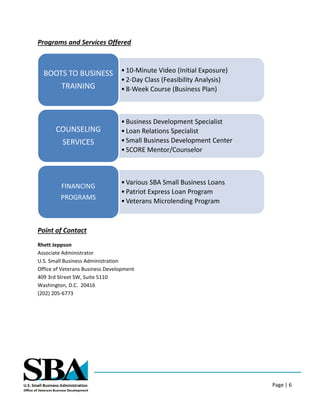
Programs and Services Offered
Point of Contact
Rhett Jeppson
Associate Administrator
U.S. Small Business Administration
Office of Veterans Business Development
409 3rd Street SW, Suite 5110
Washington, D.C. 20416
(202) 205-6773
•10-Minute Video (Initial Exposure)
•2-Day Class (Feasibility Analysis)
•8-Week Course (Business Plan)
BOOTS TO BUSINESS
TRAINING
•Business Development Specialist
•Loan Relations Specialist
•Small Business Development Center
•SCORE Mentor/Counselor
COUNSELING
SERVICES
•Various SBA Small Business Loans
•Patriot Express Loan Program
•Veterans Microlending Program
FINANCING
PROGRAMS

Military Life Cycle Paper

  • 1.
    Page | 1 INCORPORATINGTHE ENTREPRENEURIAL TRACK INTO THE MILITARY LIFE CYCLE MODEL Purpose After revamping their transition assistance programs as part of the veterans employment initiative, the armed services are currently developing a military life cycle model which incorporates the key elements of the Transition GPS program into a broader plan for personal / professional growth and development throughout a servicemember’s career. This fact sheet has been created to assist the armed services with their efforts to incorporate the entrepreneurial track into that. It describes the programs and services available through the Small Business Administration to servicemembers who wish to start their own businesses and it discusses the ways those programs and services might best be used in that model. Background Before incorporating the entrepreneurial track into the military life cycle, it is important to note that the process of starting a small business has many steps. And, in order to attain the goal of a “career-ready military” where those interested in starting a business are prepared to do so the moment the step off from their service, there are several things that need to be in place prior to separation. Commanders have various mission requirements. However, due to budgetary constraints, certain programs and services can only be offered at each installation quarterly. So, the entrepreneurial track must really be fully integrated into the military training management cycle so that servicemembers have the chance to pursue these self-development opportunities during periods of low operational tempo.
  • 2.
    Page | 2 Thisfact sheet describes the programs and services available through the Small Business Administration in order to ensure servicemembers who wish to start their own business meet what would be equivalent of “career readiness standards” for self-employed / small business owners at separation. However, one must bear in mind that there are also some businesses (i.e. personal training, web page design, etc.) that servicemembers might wish to start while still serving in the military. And, spouses (i.e. who might have been displaced from their occupation when they moved with the servicemember) are also eligible for the programs and services. Desired Outcome Although there is no concrete definition for when a person is fully prepared to start their own business, an ideal situation upon separation might be that a servicemember: o Has a solid business plan in-hand. o Is paired with an experienced counselor/mentor. o Has any necessary financing lined up. Pathway to Success 1.) Consider starting a business. It is important that servicemembers and their spouses be exposed to the idea of self-employment and small business ownership as early in the military life cycle as possible. The sooner they decide to pursue this option, the more time they have to use the programs and services offered by the Small Business Administration during their military career. As the first part of the Boots to Business component of the Transition GPS program, the Small Business Administration has developed a ten-minute video which serves as a primer on the considerations starting and owning of one’s own business. Ideally, all servicemembers should be given the opportunity to watch this video upon arrival at their first duty station. 2.) Start to plan and prepare. As soon as a servicemember or a spouse expresses any interest in starting their own business, his or her commander should help them get in contact with the Small Business Administration’s local district office to set up an appointment with the business development specialist assigned to assist veterans in the area. These personnel can walk servicemembers through the process of starting a small business, help them get started on some basic market research, and guide them toward sound financial decisions early on so they have the capital necessary to qualify for a small business loan. They can pair them up with a mentor/counselor from SCORE – an experienced local small business owner who volunteers to assist others just starting their own small business.
  • 3.
    Page | 3 3.)Conduct a feasibility analysis. As the second part of the Boots to Business component of the Transition GPS program, the Small Business Administration offers servicemembers and spouses the opportunity to attend two days of classroom instruction where they conduct a feasibility analysis to flesh out whether they have a sound idea for a venture. This is a key decision point when servicemembers usually decide whether to go forward and try to start a small business. When fully funded, these classes will be offered quarterly at 150 CONUS installations and 50 OCONUS installations with an online training module for those in remote locations who are unable to attend a classroom session. The class could be fully integrated into the military training management cycle just like a two-day college class that a servicemember might take at some point during his or her career – with a commander simply designating the class site as the servicemembers place of duty for two days during a period of low operational tempo. 4.) Create a business plan. As the third part of the Boots to Business component of the Transition GPS program, the Small Business Administration offers servicemembers and spouses the opportunity to enroll in an eight-week online distance learning course that leads to the creation of a business plan. Students receive textbooks in the mail and they interact with other students across the country and with professors in the entrepreneurship program at the University of Syracuse. Although there is no cost for the course, servicemembers and spouses must first complete the two day class offered as the second part of the Boots to Business program in order to be eligible to enroll in this course. Students are expected to put in 8-10 hours each week to fulfill the academic requirements. So, the course can be completed by most servicemembers on off-duty hours during a period of low operational tempo. Students come out of the course with a solid business plan – which is often a prerequisite for any type of small business loan. 5.) Set-up any necessary financing. After completing their business plan, servicemembers and spouses should get in contact with the Small Business Administration’s local district office again to set up appointments with the Small Business Development Center and the lender relations specialist. The Small Business Development Center will look at their business plan and certify it as being sound – allowing them to apply for small business loans backed by the Small Business Administration. And, the lender relations specialist will be able to discuss the plan that the servicemember has put together to finance the new venture. If a small business loan is appropriate, the lender relations specialist can also tell them which institutions are more likely to finance a venture like the one he or she is starting.
  • 4.
    Page | 4 TheSmall Business Administration offers a variety of loan programs. The Patriot Express Loan is a program with an expedited application process exclusively for veterans. And, a microlending program specifically for veterans is currently being developed. However, as the applications may sometimes take 3-6 months, it is recommended that servicemembers and spouses start the process early. 6.) Start a small business. Upon separation, a servicemember should have a solid business plan in-hand, be paired with an experienced counselor/mentor, and have any necessary financing lined up.
  • 5.
    Page | 5 PossibleMilitary Life Cycle Matrix Pathway Stage Recommended Actions Suggested Timing Consider starting a business. Watch the SBA’s ten-minute video which serves as a primer on the considerations starting and owning of one’s own business. Upon arrival at first duty station. Start to plan and prepare. Contact the SBA’s local district office to set up an appointment with the business development specialist assigned to assist veterans and get paired up with a local mentor/counselor. As soon as a servicemember or a spouse expresses any interest in starting their own business. Conduct a feasibility analysis. Attend two days of classroom instruction on base where they conduct a feasibility analysis. As an alternate place of duty for two days during a period of low operational tempo early in the servicemember’s career. Create a business plan. Enroll in the SBA’s eight-week online distance learning course that leads to the creation of a business plan. On off-duty hours during a period of low operational tempo at some point during the servicemember’s career. Set-up any necessary financing. Contact the SBA’s local district office to set up appointments with the Small Business Development Center and the lender relations specialist. After completing their business plan during the Boots to Business program, at least 3-6 months prior to starting the business. Start the business. Have a solid business plan in-hand, be paired with an experienced counselor/mentor, and have some sort of financing lined up. Upon separation. Consider starting a business. Start to plan and prepare. Conduct a feasibility analysis. Create a business plan. Set-up any necessary financing. Start the business.
  • 6.
    Page | 6 Programsand Services Offered Point of Contact Rhett Jeppson Associate Administrator U.S. Small Business Administration Office of Veterans Business Development 409 3rd Street SW, Suite 5110 Washington, D.C. 20416 (202) 205-6773 •10-Minute Video (Initial Exposure) •2-Day Class (Feasibility Analysis) •8-Week Course (Business Plan) BOOTS TO BUSINESS TRAINING •Business Development Specialist •Loan Relations Specialist •Small Business Development Center •SCORE Mentor/Counselor COUNSELING SERVICES •Various SBA Small Business Loans •Patriot Express Loan Program •Veterans Microlending Program FINANCING PROGRAMS