Immigration 
Movement of people into another country or region to which they are not native in order to settle there 
Immigrant 
A person who comes to another country for the purpose of living there
HISTORICAL OVERVIEW 
For centuries, European migration patterns consisted mainly of movement around the continent, or away from it. Millions fled religious persecution. Others were driven by hunger and poverty, including impoverished southern Europeans.
HISTORICAL OVERVIEW 
1950-60 Workers arrived in their millions to fill gaps in European labour markets. National policies were fairly liberal . 
•People from West-indies and India to UK 
•Migration from southern-european countries to northern-europe 
•Contacts with Turkey and Maghreb.
HISTORICAL OVERVIEW 
1950-60 
The numbers peaked in the early 1960s, creating a net European migration figure which is far higher than today's. These immigrants, mostly non-white, were not expected to stay
HISTORICAL OVERVIEW 
1950-60 
The numbers peaked in the early 1960s, creating a net European migration figure which is far higher than today's. These immigrants, mostly non-white, were not expected to stay
HISTORICAL OVERVIEW 
1970’s 
Policies became restrictive from the 1970s on. Satiation of labour market. 
1973: Migration stop
HISTORICAL OVERVIEW 
1980’s 
Recession. 
Some possibilities remained: family reunification, studies, seasonal work, …. This left the asylum system to carry the weight of the migration wave 
Some scholars, like sociolinguists (Hayley Johnson and Katlyn Archer), have said that the increase in immigration flows from the 1980s, are an expression of the growing of global inequalities between poor and rich countries
HISTORICAL OVERVIEW 
1990’s 
Germany (unification and close to Eastern-Europe) had the largest flows of migrants followed by the United Kingdom
HISTORICAL OVERVIEW 
2000’s 
A number of governments have been revising their policies to take better account of employment and demographic needs. 
Some country investing in return programmes.
HISTORICAL OVERVIEW 
Now 
Convergent policies 
Arab Spring 
Humanitarian crisis
1. Group of immigrants for citizenship
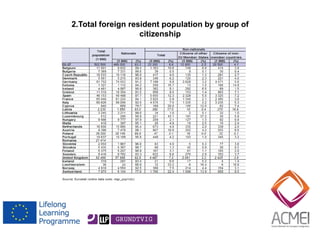
2.Total foreign resident population by group of citizenship
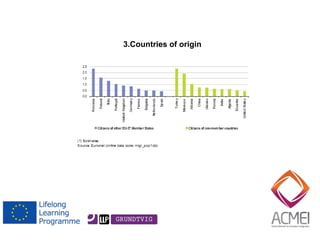
3.Countries of origin
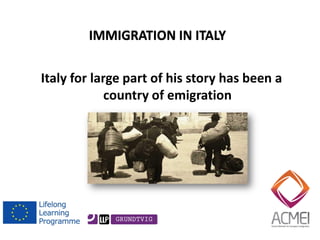
Italy for large part of his story has been a country of emigration 
IMMIGRATION IN ITALY
The phenomenon of immigration has reached a significant size in the early 1970’s, and has become an important phenomenon for the demographics of the country in the XXI°century 
IMMIGRATION IN ITALY
ITALY = DOOR OF EUROPE 
IMMIGRATION IN ITALY
IMMIGRATION IN ITALY 
4.Immigrants living in italy by country of origin
IMMIGRATION IN ITALY 
5. Percentage of the regional immigrant population 2011
IMMIGRATION IN ITALY 
Country 
2011 
Romania 
968.576 
Marocco 
482.627 
Albania 
452.424 
China 
209.934 
Fonte: ISTAT 2011 
6. Immigrants in the national territory
IMMIGRATION IN TURKEY 
Throughout history, Turkey has been affected by diverse forms of migratory movements and refugee flows. Traditionally, Turkey has been a country of emigration with large numbers of its citizens migrating to Western Europe, particularly Germany since the 1970s
IMMIGRATION IN TURKEY 
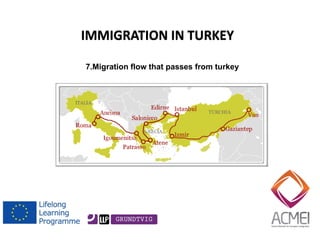
Since the early 1990s, the country has been positioned on the transit route 
for irregular migrants from Afghanistan, Bangladesh, Iraq, Iran, and Pakistan. 
Turkey remains a destination for human trafficking in the Black Sea region, with 
victims usually coming from Moldova, Ukraine, Russian Federation, Kyrgyzstan, 
and Uzbekistan.
IMMIGRATION IN TURKEY 
The country maintains a geographical limitation to its obligations under the 1951 Geneva Convention 
on the Status of Refugees in which it grants refugee status only to European 
asylum seekers. It has until recently ranked in the top three countries globally for 
resettlement of non-European refugees, with the main countries of destination for 
resettlement being the United States, Canada, and Australia.
IMMIGRATION IN TURKEY 
Migration issues in Turkey are shaped by its efforts to become a member 
of the European Union (EU), which are creating pressures for an overhaul of 
its immigration and asylum policies. This is because the alignment of Turkey’s 
migration policy and practice with the EU migration acquis and policies is one 
of the conditions for the country’s accession to the EU. An issue of concern in 
Europe at present relates to the possible negative consequence of Turkey’s potential 
membership in the EU, that is, the probability of a massive wave of migration 
from Turkey to EU’s more prosperous members.
IMMIGRATION IN TURKEY 
7.Migration flow that passes from turkey
IMMIGRATION IN TURKEY 
According to figures provided by Ankaraoffice of the UNHCR, as of 2005 total of 32,832 people are recorded as having made a valid asylum application in Turkey since 1998. As of 2005, 3900 Iranians and 2200 Iraqis, 400 Somalians and 300 Afghans are still in the country, while an additional 1400 Chechens, who are in a "refugee- like situation", are deemed of concern. 
These refugees are spread out to satellite cities with notable populations. 
These numbers greatly increased in the following years especially in regards to Afghans and Iraqis. As of January 2010, 25, 580 refugees and asylum seekers remain in the country. Of these, 5090 Iranians, 8940 Iraqis, 3850 Afghans and 2700 "other" (including Somalians, Sri Lankans, Pakistanis, Chinese, Uzbeks, Palestinians and others) are still in the country. with the number expected to rise to 8710 Iranians, 9560 Afghans, 7860 other while the Iraqis are expected to decrease to 7890 by December 2011. 
Notable here is that Afghans are expected to make up the largest refugee population in Turkey in the near future.
IMMIGRATION IN POLAND 
Poland for large part of his story has been a country of emigration 
Until the fall of communism and the transformation of Poland, West Germany was a special place for Polish refugees
IMMIGRATION IN POLAND 
Today the roles are reversed 
Poland has become one of the most attractive countries in which to live and make a career. 
Nearly six thousand German companies , mostly small and medium-sized enterprises , have moved to Poland. The value of the German investments is estimated at € 22 billion , amount that last year represented 21 percent of all foreign investments in Poland.
IMMIGRATION IN POLAND 
8.Number of persons having acquired the citizenship of an EU Member State, 2010
IMMIGRATION IN SPAIN 
Since the mid-'80s Spain was a country of net immigration. 
Confronted by this "new phenomenon" Spanish governments that will succeed for all the '90s and early 2000 adopt restrictive immigration policies markedly inspired by those of the countries of northern Europe
IMMIGRATION IN SPAIN 
In 2004, the new socialist government, compared the severity of the problem and the growing criticism at home and abroad, put in place a comprehensive reform of immigration policies.
IMMIGRATION IN SPAIN 
A comprehensive assessment of the effects of the crisis on the irregularity is still difficult. 
It would seem that at first its effect is to reduce it, mainly because it reduces the flow, but in the medium term could increase it. 
A more accurate assessment can be done, when, and if, the economy will recover recovery migratory flows
IMMIGRATION IN SPAIN 
0% 
10% 
20% 
30% 
40% 
50% 
60% 
70% 
80% 
90% 
100% 
2001 
2002 
2003 
2004 
2005 
2006 
2007 
2008 
2009 
2010 
Regolari 
Irregolari
With the support of the 
Lifelong Learning programme — Grundtvig of the European Union 
This project has been funded with support from the European Commission. This communication reflects the views only of the author, and the Commission cannot be held responsible for any use which may be made of the information contained therein

Acmei research final report

  • 2.
    Immigration Movement ofpeople into another country or region to which they are not native in order to settle there Immigrant A person who comes to another country for the purpose of living there
  • 3.
    HISTORICAL OVERVIEW Forcenturies, European migration patterns consisted mainly of movement around the continent, or away from it. Millions fled religious persecution. Others were driven by hunger and poverty, including impoverished southern Europeans.
  • 4.
    HISTORICAL OVERVIEW 1950-60Workers arrived in their millions to fill gaps in European labour markets. National policies were fairly liberal . •People from West-indies and India to UK •Migration from southern-european countries to northern-europe •Contacts with Turkey and Maghreb.
  • 5.
    HISTORICAL OVERVIEW 1950-60 The numbers peaked in the early 1960s, creating a net European migration figure which is far higher than today's. These immigrants, mostly non-white, were not expected to stay
  • 6.
    HISTORICAL OVERVIEW 1950-60 The numbers peaked in the early 1960s, creating a net European migration figure which is far higher than today's. These immigrants, mostly non-white, were not expected to stay
  • 7.
    HISTORICAL OVERVIEW 1970’s Policies became restrictive from the 1970s on. Satiation of labour market. 1973: Migration stop
  • 8.
    HISTORICAL OVERVIEW 1980’s Recession. Some possibilities remained: family reunification, studies, seasonal work, …. This left the asylum system to carry the weight of the migration wave Some scholars, like sociolinguists (Hayley Johnson and Katlyn Archer), have said that the increase in immigration flows from the 1980s, are an expression of the growing of global inequalities between poor and rich countries
  • 9.
    HISTORICAL OVERVIEW 1990’s Germany (unification and close to Eastern-Europe) had the largest flows of migrants followed by the United Kingdom
  • 10.
    HISTORICAL OVERVIEW 2000’s A number of governments have been revising their policies to take better account of employment and demographic needs. Some country investing in return programmes.
  • 11.
    HISTORICAL OVERVIEW Now Convergent policies Arab Spring Humanitarian crisis
  • 12.
    1. Group ofimmigrants for citizenship
  • 13.
    2.Total foreign residentpopulation by group of citizenship
  • 14.
  • 15.
    Italy for largepart of his story has been a country of emigration IMMIGRATION IN ITALY
  • 16.
    The phenomenon ofimmigration has reached a significant size in the early 1970’s, and has become an important phenomenon for the demographics of the country in the XXI°century IMMIGRATION IN ITALY
  • 17.
    ITALY = DOOROF EUROPE IMMIGRATION IN ITALY
  • 18.
    IMMIGRATION IN ITALY 4.Immigrants living in italy by country of origin
  • 19.
    IMMIGRATION IN ITALY 5. Percentage of the regional immigrant population 2011
  • 20.
    IMMIGRATION IN ITALY Country 2011 Romania 968.576 Marocco 482.627 Albania 452.424 China 209.934 Fonte: ISTAT 2011 6. Immigrants in the national territory
  • 21.
    IMMIGRATION IN TURKEY Throughout history, Turkey has been affected by diverse forms of migratory movements and refugee flows. Traditionally, Turkey has been a country of emigration with large numbers of its citizens migrating to Western Europe, particularly Germany since the 1970s
  • 22.
    IMMIGRATION IN TURKEY Since the early 1990s, the country has been positioned on the transit route for irregular migrants from Afghanistan, Bangladesh, Iraq, Iran, and Pakistan. Turkey remains a destination for human trafficking in the Black Sea region, with victims usually coming from Moldova, Ukraine, Russian Federation, Kyrgyzstan, and Uzbekistan.
  • 23.
    IMMIGRATION IN TURKEY The country maintains a geographical limitation to its obligations under the 1951 Geneva Convention on the Status of Refugees in which it grants refugee status only to European asylum seekers. It has until recently ranked in the top three countries globally for resettlement of non-European refugees, with the main countries of destination for resettlement being the United States, Canada, and Australia.
  • 24.
    IMMIGRATION IN TURKEY Migration issues in Turkey are shaped by its efforts to become a member of the European Union (EU), which are creating pressures for an overhaul of its immigration and asylum policies. This is because the alignment of Turkey’s migration policy and practice with the EU migration acquis and policies is one of the conditions for the country’s accession to the EU. An issue of concern in Europe at present relates to the possible negative consequence of Turkey’s potential membership in the EU, that is, the probability of a massive wave of migration from Turkey to EU’s more prosperous members.
  • 25.
    IMMIGRATION IN TURKEY 7.Migration flow that passes from turkey
  • 26.
    IMMIGRATION IN TURKEY According to figures provided by Ankaraoffice of the UNHCR, as of 2005 total of 32,832 people are recorded as having made a valid asylum application in Turkey since 1998. As of 2005, 3900 Iranians and 2200 Iraqis, 400 Somalians and 300 Afghans are still in the country, while an additional 1400 Chechens, who are in a "refugee- like situation", are deemed of concern. These refugees are spread out to satellite cities with notable populations. These numbers greatly increased in the following years especially in regards to Afghans and Iraqis. As of January 2010, 25, 580 refugees and asylum seekers remain in the country. Of these, 5090 Iranians, 8940 Iraqis, 3850 Afghans and 2700 "other" (including Somalians, Sri Lankans, Pakistanis, Chinese, Uzbeks, Palestinians and others) are still in the country. with the number expected to rise to 8710 Iranians, 9560 Afghans, 7860 other while the Iraqis are expected to decrease to 7890 by December 2011. Notable here is that Afghans are expected to make up the largest refugee population in Turkey in the near future.
  • 27.
    IMMIGRATION IN POLAND Poland for large part of his story has been a country of emigration Until the fall of communism and the transformation of Poland, West Germany was a special place for Polish refugees
  • 28.
    IMMIGRATION IN POLAND Today the roles are reversed Poland has become one of the most attractive countries in which to live and make a career. Nearly six thousand German companies , mostly small and medium-sized enterprises , have moved to Poland. The value of the German investments is estimated at € 22 billion , amount that last year represented 21 percent of all foreign investments in Poland.
  • 29.
    IMMIGRATION IN POLAND 8.Number of persons having acquired the citizenship of an EU Member State, 2010
  • 30.
    IMMIGRATION IN SPAIN Since the mid-'80s Spain was a country of net immigration. Confronted by this "new phenomenon" Spanish governments that will succeed for all the '90s and early 2000 adopt restrictive immigration policies markedly inspired by those of the countries of northern Europe
  • 31.
    IMMIGRATION IN SPAIN In 2004, the new socialist government, compared the severity of the problem and the growing criticism at home and abroad, put in place a comprehensive reform of immigration policies.
  • 32.
    IMMIGRATION IN SPAIN A comprehensive assessment of the effects of the crisis on the irregularity is still difficult. It would seem that at first its effect is to reduce it, mainly because it reduces the flow, but in the medium term could increase it. A more accurate assessment can be done, when, and if, the economy will recover recovery migratory flows
  • 33.
    IMMIGRATION IN SPAIN 0% 10% 20% 30% 40% 50% 60% 70% 80% 90% 100% 2001 2002 2003 2004 2005 2006 2007 2008 2009 2010 Regolari Irregolari
  • 34.
    With the supportof the Lifelong Learning programme — Grundtvig of the European Union This project has been funded with support from the European Commission. This communication reflects the views only of the author, and the Commission cannot be held responsible for any use which may be made of the information contained therein