Prepared by Ebru Ebren
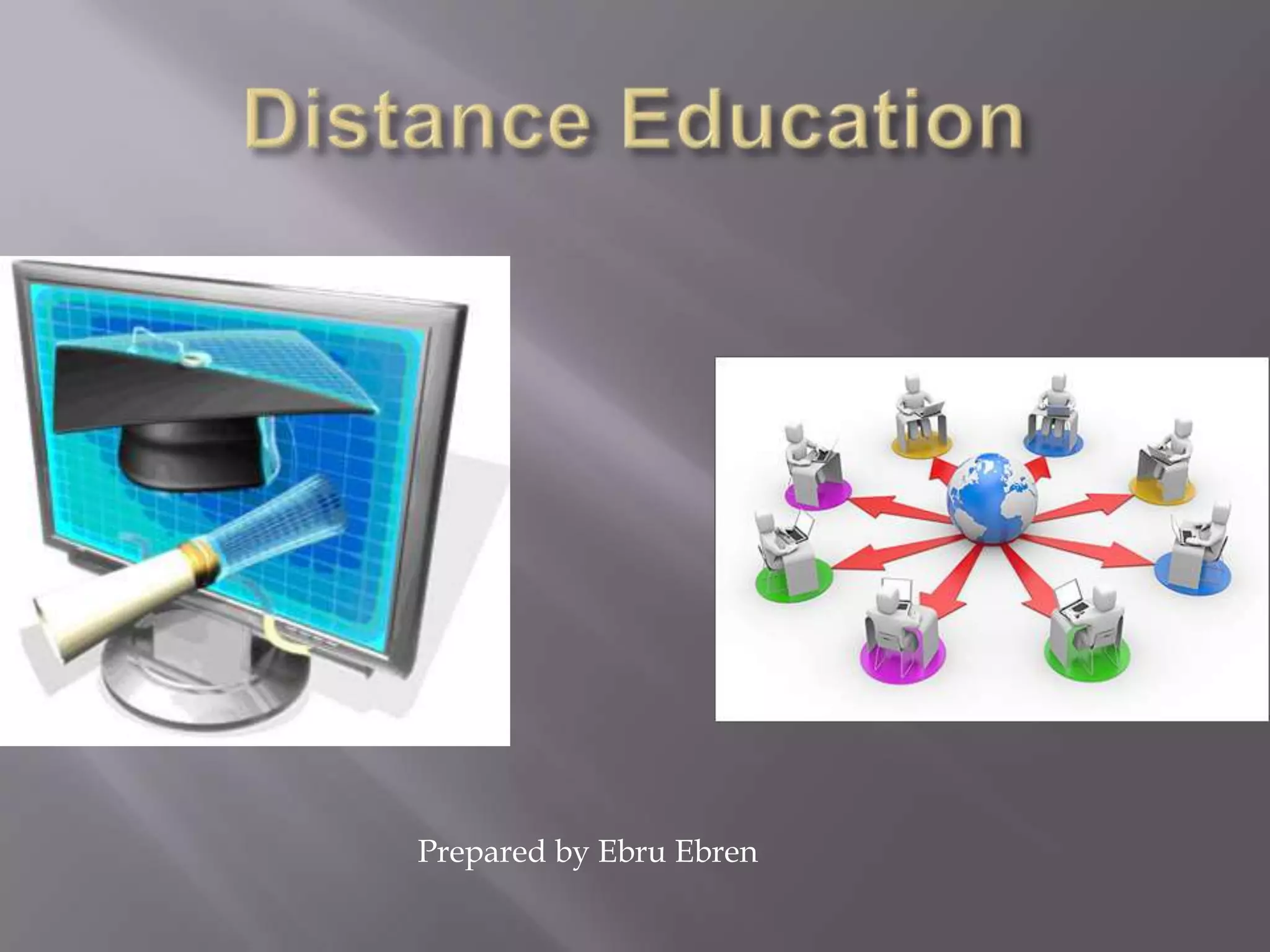
Distance education is educational process where
the vast majority of the teachings take places with
the teacher and student being apart. This means
that the process uses teaching methods that convey
education to students outside of the traditional
classroom through print equipment and supplies
such as: the computer, Internet, software
programs, electronic conferencing and other
resources
   Saving time and money.
    Self-paced learning that reduces stress and
    increases satisfaction.
   Lots of flexibility (students can complete
    their course work anywhere)
   Numerous choices for schools. (if you live
    in a community with few or no colleges
    distance learning allows you to choose from
    a wide variety of schools to complete your
    education)
   Taking computer and internet skills will gain
    you extra information and knowledge while
    you are learning.
   Study materials at own speed, without having
    to wait for the rest of your classmates or being
    overwhelmed in fast paced classroom.
   Web-based resources such as online
    textbooks, case studies, syllabi, study
    guides, workbooks, reading resources and
    more.
   Lack of social interaction
   Format isn’t ideal for all learners
   Requires adaptability to new technologies
   Not all courses required to complete the
    degree may be offered online
   Costly and complex technology
   Advance planning
   Distance learning does not offer immediate
    feedback
   Distance learning does not give students the
    opportunity to work on oral communication
    skills.
When teaching at a distance, educators must
address a different teaching challenge than
when teaching in a traditional classroom.
There are two alternative strategies for
  evaluation.
 The first is the traditional, positivist-empiricist
  approach to evaluation. This represents an
  attempt to apply the rules and procedures of
  the physical sciences to evaluation.
 The second is a more eclectic view of
  evaluation that incorporates qualitative and
  naturalistic techniques for the evaluation of
  distance education.
According to Woodley and Kirkwood (1986), six
  categories of evaluation information can be
  collected about distance education activities:

    Measures of activity: These measures are
    counts of the numbers of events, people, and
    objects. Administrative records often provide
    data for activity questions.
   Measures of efficiency:Measures of efficiency are
    closely related to measures of activity, and often
    administrative records can be the source of
    efficiency information.

   Measures of outcomes:Measures of adequate
    learning are usually considered the most
    important measures of outcomes of distance
    education activities.
   Measures of program aims: Some distance
    teaching programs specify their aims in terms
    of what and whom they intend to teach, and
    evaluation information is collected to establish
    the extent to which these aims were met.

   Measures of policy :Evaluation in the policy
    area often takes the form of market research.
   Measures of organizations: Sometimes it is
    important to evaluate a distance education
    institution in terms of its internal organization
    and procedures. Evaluators sometimes are
    asked to monitor the process of course
    development or program delivery to help an
    organization be more efficient.
   http://www.pacifichealthdialog.org.fj/Volum
    e%2014/No1/Original%20Papers/A%20Pilot%
    20Evaluation%20of%20Distance%20EMFHWU
    S.pdf
   http://kureselbilimlerakademisi.com/Content
    /image/uzaktan-egitim.jpg

Online text assignment

  • 1.
  • 2.
    Distance education iseducational process where the vast majority of the teachings take places with the teacher and student being apart. This means that the process uses teaching methods that convey education to students outside of the traditional classroom through print equipment and supplies such as: the computer, Internet, software programs, electronic conferencing and other resources
  • 4.
    Saving time and money.  Self-paced learning that reduces stress and increases satisfaction.  Lots of flexibility (students can complete their course work anywhere)  Numerous choices for schools. (if you live in a community with few or no colleges distance learning allows you to choose from a wide variety of schools to complete your education)
  • 5.
    Taking computer and internet skills will gain you extra information and knowledge while you are learning.  Study materials at own speed, without having to wait for the rest of your classmates or being overwhelmed in fast paced classroom.  Web-based resources such as online textbooks, case studies, syllabi, study guides, workbooks, reading resources and more.
  • 6.
    Lack of social interaction  Format isn’t ideal for all learners  Requires adaptability to new technologies  Not all courses required to complete the degree may be offered online
  • 7.
    Costly and complex technology  Advance planning  Distance learning does not offer immediate feedback  Distance learning does not give students the opportunity to work on oral communication skills.
  • 8.
    When teaching ata distance, educators must address a different teaching challenge than when teaching in a traditional classroom.
  • 9.
    There are twoalternative strategies for evaluation.  The first is the traditional, positivist-empiricist approach to evaluation. This represents an attempt to apply the rules and procedures of the physical sciences to evaluation.  The second is a more eclectic view of evaluation that incorporates qualitative and naturalistic techniques for the evaluation of distance education.
  • 10.
    According to Woodleyand Kirkwood (1986), six categories of evaluation information can be collected about distance education activities:  Measures of activity: These measures are counts of the numbers of events, people, and objects. Administrative records often provide data for activity questions.
  • 11.
    Measures of efficiency:Measures of efficiency are closely related to measures of activity, and often administrative records can be the source of efficiency information.  Measures of outcomes:Measures of adequate learning are usually considered the most important measures of outcomes of distance education activities.
  • 12.
    Measures of program aims: Some distance teaching programs specify their aims in terms of what and whom they intend to teach, and evaluation information is collected to establish the extent to which these aims were met.  Measures of policy :Evaluation in the policy area often takes the form of market research.
  • 13.
    Measures of organizations: Sometimes it is important to evaluate a distance education institution in terms of its internal organization and procedures. Evaluators sometimes are asked to monitor the process of course development or program delivery to help an organization be more efficient.
  • 14.
    http://www.pacifichealthdialog.org.fj/Volum e%2014/No1/Original%20Papers/A%20Pilot% 20Evaluation%20of%20Distance%20EMFHWU S.pdf  http://kureselbilimlerakademisi.com/Content /image/uzaktan-egitim.jpg