Prepared by: Fiona Ernesta
Chief Executive Officer
Seychelles Qualifications Authority
 Seychelles has a comprehensive, integrated, inclusive and co-educational
education and training system that includes the following characteristics:
The system
 accommodates both compulsory/non-compulsory and fee
paying/non-fee paying dimensions
 falls predominantly under the responsibility of the state,
supplemented by private initiatives
 provides for education from early childhood through to secondary
level, free of direct charge at point-of-use to all Seychellois children
for a period of 13 years (nominally from 3+ to 16+ years of age)
 makes tertiary education and training opportunities available through
cost sharing mechanisms to all Seychellois who meet the selection
criteria appropriate to the particular programme of study or training
for which the learner qualifies
 provides 11 years of compulsory education from primary 1 to
secondary 5.
 Formal early childhood or crèche education
 Lasts for two years and is available for children aged 3½ to 5½
years free of charge by the state in all districts.
 Non-compulsory, but almost all children in this age group
attend.
 Fee-paying private providers registered with the Ministry of
Education also provide formal early childhood education.
 Primary Education
 Lasts for six years (Primary 1 – Primary 6) and is compulsory
for all children.
 Offered by both state and fee-paying private providers.
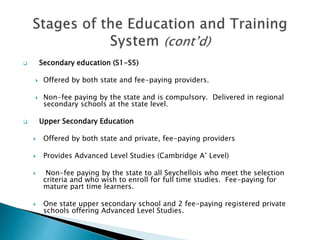
 Secondary education (S1-S5)
 Offered by both state and fee-paying providers.
 Non-fee paying by the state and is compulsory. Delivered in regional
secondary schools at the state level.
 Upper Secondary Education
 Offered by both state and private, fee-paying providers
 Provides Advanced Level Studies (Cambridge A’ Level)
 Non-fee paying by the state to all Seychellois who meet the selection
criteria and who wish to enroll for full time studies. Fee-paying for
mature part time learners.
 One state upper secondary school and 2 fee-paying registered private
schools offering Advanced Level Studies.
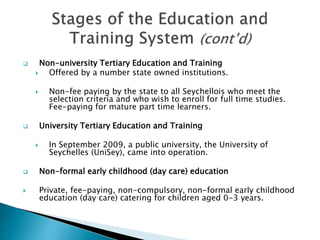
 Non-university Tertiary Education and Training
 Offered by a number state owned institutions.
 Non-fee paying by the state to all Seychellois who meet the
selection criteria and who wish to enroll for full time studies.
Fee-paying for mature part time learners.
 University Tertiary Education and Training
 In September 2009, a public university, the University of
Seychelles (UniSey), came into operation.
 Non-formal early childhood (day care) education
 Private, fee-paying, non-compulsory, non-formal early childhood
education (day care) catering for children aged 0-3 years.
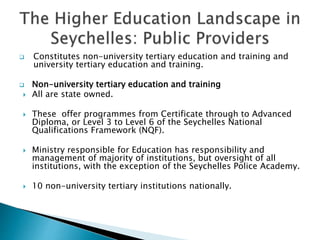
 Constitutes non-university tertiary education and training and
university tertiary education and training.
 Non-university tertiary education and training
 All are state owned.
 These offer programmes from Certificate through to Advanced
Diploma, or Level 3 to Level 6 of the Seychelles National
Qualifications Framework (NQF).
 Ministry responsible for Education has responsibility and
management of majority of institutions, but oversight of all
institutions, with the exception of the Seychelles Police Academy.
 10 non-university tertiary institutions nationally.
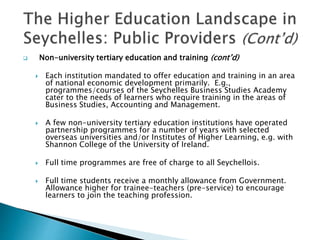
 Non-university tertiary education and training (cont’d)
 Each institution mandated to offer education and training in an area
of national economic development primarily. E.g.,
programmes/courses of the Seychelles Business Studies Academy
cater to the needs of learners who require training in the areas of
Business Studies, Accounting and Management.
 A few non-university tertiary education institutions have operated
partnership programmes for a number of years with selected
overseas universities and/or Institutes of Higher Learning, e.g. with
Shannon College of the University of Ireland.
 Full time programmes are free of charge to all Seychellois.
 Full time students receive a monthly allowance from Government.
Allowance higher for trainee-teachers (pre-service) to encourage
learners to join the teaching profession.
 University tertiary education and training
 The University of Seychelles (UniSey), the only university in
Seychelles is a public university. It generates its own funds and
one main source of funding is government scholarships.
 Students receive government scholarships (full or partial)
depending on their choice of subject and/or grades obtained.
 University-level education and training is also accessed overseas
through government sponsored/approved scholarships in key
fields matching the human resource needs of the country and in
areas not offered by UniSey.
 Level of self-financed/privately sponsored university education
and training generally insignificant although there is growing
interest in self-financed distance learning.
 Several initiatives toward internationalisation of higher education
with particular reference to the following activities:
 The international movement of students;
 The international movement of academic staff;
 International links through open/distance learning
programmes. Local students access distance education
programmes offered by higher education providers of other
countries.
 Bi-lateral links between governments and local and higher
institutions in different countries for collaboration in student
and staff exchange programmes/attachments, overseas
studies, and for teaching staff for local higher education
institutions.
Several kinds of partnerships between foreign higher
education institutions and local higher education
institutions. These include:
 Twinning and pathway models:
 students complete the early years of their study
programme in country and then complete on the
home campus of the institution providing the
award.
 There are instances where foreign universities give
credit or advanced standing for completed units of
study in the programmes of local institutions.
Franchising agreements extends to the following:
 Local higher education and training institutions
teaching the curriculum of foreign partner
institutions, e.g. the franchise agreement between
the UniSey and the University of London.
Curriculum, study materials and assessments are
provided by the University of London and this
conducts audits of the UniSey at set intervals to
ascertain quality.
 Staff from the foreign institution assisting with
teaching and assessment of the curriculum of
foreign partner institution.
 Blended learning initiatives, e.g. between the
National Institute of Health and Social Studies
and the University of Kwa-Zulu Natal of South
Africa where there is block teaching/students
meet locally in face-to-face instruction with
lecturers of the University and then communicate
with the lecturers virtually.
 Joint or dual degrees in specific fields of study
(e.g. MBA) are offered by a select few
recognized/accredited overseas institutions and
the UniSey.
 Private providers are registered with the Ministry
of Education.
 Operate as private enterprises/businesses.
 Offer short courses in specialised area, primarily
to develop specific skills, e.g. ICT.
 Courses are not accredited.
 There are no private providers offering
programmes leading to full qualifications.
 As espoused in the Tertiary Education Act
(2011), the Tertiary Education Commission
has the responsibility to co-ordinate the
sustainable and harmonized development of
tertiary/higher education nationally.
 The Education (Amended) Act, 2017 focusses
on all the other education levels (pre-school,
primary, secondary, etc.).
 The entire national education and training system of the Seychelles
is regulated by the National Qualifications Framework (NQF).
 The legal basis of the National Qualifications Framework (NQF) is the
Regulations of the National Qualifications Framework which was
signed into law by the Minister for Education in December 2008,
becoming operative in January 2009.
 The regulations legally define the scope of action for the Seychelles
Qualifications Authority (SQA).
 The SQA was established at the start of 2006 through the
enactment, in November 2005, of the National Qualifications
Authority Act.
 The Authority is mandated to develop and implement a National
Qualifications Framework (NQF).
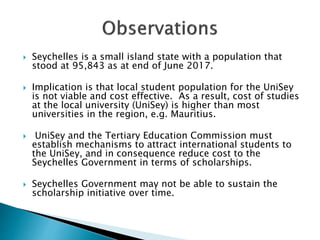
 Seychelles is a small island state with a population that
stood at 95,843 as at end of June 2017.
 Implication is that local student population for the UniSey
is not viable and cost effective. As a result, cost of studies
at the local university (UniSey) is higher than most
universities in the region, e.g. Mauritius.
 UniSey and the Tertiary Education Commission must
establish mechanisms to attract international students to
the UniSey, and in consequence reduce cost to the
Seychelles Government in terms of scholarships.
 Seychelles Government may not be able to sustain the
scholarship initiative over time.
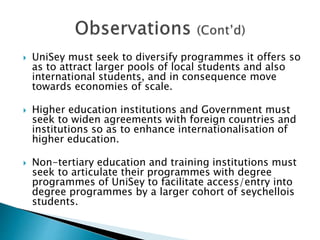
 UniSey must seek to diversify programmes it offers so
as to attract larger pools of local students and also
international students, and in consequence move
towards economies of scale.
 Higher education institutions and Government must
seek to widen agreements with foreign countries and
institutions so as to enhance internationalisation of
higher education.
 Non-tertiary education and training institutions must
seek to articulate their programmes with degree
programmes of UniSey to facilitate access/entry into
degree programmes by a larger cohort of seychellois
students.
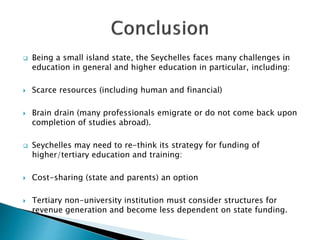
 Being a small island state, the Seychelles faces many challenges in
education in general and higher education in particular, including:
 Scarce resources (including human and financial)
 Brain drain (many professionals emigrate or do not come back upon
completion of studies abroad).
 Seychelles may need to re-think its strategy for funding of
higher/tertiary education and training:
 Cost-sharing (state and parents) an option
 Tertiary non-university institution must consider structures for
revenue generation and become less dependent on state funding.

Mid term assignment powerpoint

  • 1.
    Prepared by: FionaErnesta Chief Executive Officer Seychelles Qualifications Authority
  • 2.
     Seychelles hasa comprehensive, integrated, inclusive and co-educational education and training system that includes the following characteristics: The system  accommodates both compulsory/non-compulsory and fee paying/non-fee paying dimensions  falls predominantly under the responsibility of the state, supplemented by private initiatives  provides for education from early childhood through to secondary level, free of direct charge at point-of-use to all Seychellois children for a period of 13 years (nominally from 3+ to 16+ years of age)  makes tertiary education and training opportunities available through cost sharing mechanisms to all Seychellois who meet the selection criteria appropriate to the particular programme of study or training for which the learner qualifies  provides 11 years of compulsory education from primary 1 to secondary 5.
  • 3.
     Formal earlychildhood or crèche education  Lasts for two years and is available for children aged 3½ to 5½ years free of charge by the state in all districts.  Non-compulsory, but almost all children in this age group attend.  Fee-paying private providers registered with the Ministry of Education also provide formal early childhood education.  Primary Education  Lasts for six years (Primary 1 – Primary 6) and is compulsory for all children.  Offered by both state and fee-paying private providers.
  • 4.
     Secondary education(S1-S5)  Offered by both state and fee-paying providers.  Non-fee paying by the state and is compulsory. Delivered in regional secondary schools at the state level.  Upper Secondary Education  Offered by both state and private, fee-paying providers  Provides Advanced Level Studies (Cambridge A’ Level)  Non-fee paying by the state to all Seychellois who meet the selection criteria and who wish to enroll for full time studies. Fee-paying for mature part time learners.  One state upper secondary school and 2 fee-paying registered private schools offering Advanced Level Studies.
  • 5.
     Non-university TertiaryEducation and Training  Offered by a number state owned institutions.  Non-fee paying by the state to all Seychellois who meet the selection criteria and who wish to enroll for full time studies. Fee-paying for mature part time learners.  University Tertiary Education and Training  In September 2009, a public university, the University of Seychelles (UniSey), came into operation.  Non-formal early childhood (day care) education  Private, fee-paying, non-compulsory, non-formal early childhood education (day care) catering for children aged 0-3 years.
  • 6.
     Constitutes non-universitytertiary education and training and university tertiary education and training.  Non-university tertiary education and training  All are state owned.  These offer programmes from Certificate through to Advanced Diploma, or Level 3 to Level 6 of the Seychelles National Qualifications Framework (NQF).  Ministry responsible for Education has responsibility and management of majority of institutions, but oversight of all institutions, with the exception of the Seychelles Police Academy.  10 non-university tertiary institutions nationally.
  • 7.
     Non-university tertiaryeducation and training (cont’d)  Each institution mandated to offer education and training in an area of national economic development primarily. E.g., programmes/courses of the Seychelles Business Studies Academy cater to the needs of learners who require training in the areas of Business Studies, Accounting and Management.  A few non-university tertiary education institutions have operated partnership programmes for a number of years with selected overseas universities and/or Institutes of Higher Learning, e.g. with Shannon College of the University of Ireland.  Full time programmes are free of charge to all Seychellois.  Full time students receive a monthly allowance from Government. Allowance higher for trainee-teachers (pre-service) to encourage learners to join the teaching profession.
  • 8.
     University tertiaryeducation and training  The University of Seychelles (UniSey), the only university in Seychelles is a public university. It generates its own funds and one main source of funding is government scholarships.  Students receive government scholarships (full or partial) depending on their choice of subject and/or grades obtained.  University-level education and training is also accessed overseas through government sponsored/approved scholarships in key fields matching the human resource needs of the country and in areas not offered by UniSey.  Level of self-financed/privately sponsored university education and training generally insignificant although there is growing interest in self-financed distance learning.
  • 9.
     Several initiativestoward internationalisation of higher education with particular reference to the following activities:  The international movement of students;  The international movement of academic staff;  International links through open/distance learning programmes. Local students access distance education programmes offered by higher education providers of other countries.  Bi-lateral links between governments and local and higher institutions in different countries for collaboration in student and staff exchange programmes/attachments, overseas studies, and for teaching staff for local higher education institutions.
  • 10.
    Several kinds ofpartnerships between foreign higher education institutions and local higher education institutions. These include:  Twinning and pathway models:  students complete the early years of their study programme in country and then complete on the home campus of the institution providing the award.  There are instances where foreign universities give credit or advanced standing for completed units of study in the programmes of local institutions.
  • 11.
    Franchising agreements extendsto the following:  Local higher education and training institutions teaching the curriculum of foreign partner institutions, e.g. the franchise agreement between the UniSey and the University of London. Curriculum, study materials and assessments are provided by the University of London and this conducts audits of the UniSey at set intervals to ascertain quality.  Staff from the foreign institution assisting with teaching and assessment of the curriculum of foreign partner institution.
  • 12.
     Blended learninginitiatives, e.g. between the National Institute of Health and Social Studies and the University of Kwa-Zulu Natal of South Africa where there is block teaching/students meet locally in face-to-face instruction with lecturers of the University and then communicate with the lecturers virtually.  Joint or dual degrees in specific fields of study (e.g. MBA) are offered by a select few recognized/accredited overseas institutions and the UniSey.
  • 13.
     Private providersare registered with the Ministry of Education.  Operate as private enterprises/businesses.  Offer short courses in specialised area, primarily to develop specific skills, e.g. ICT.  Courses are not accredited.  There are no private providers offering programmes leading to full qualifications.
  • 14.
     As espousedin the Tertiary Education Act (2011), the Tertiary Education Commission has the responsibility to co-ordinate the sustainable and harmonized development of tertiary/higher education nationally.  The Education (Amended) Act, 2017 focusses on all the other education levels (pre-school, primary, secondary, etc.).
  • 15.
     The entirenational education and training system of the Seychelles is regulated by the National Qualifications Framework (NQF).  The legal basis of the National Qualifications Framework (NQF) is the Regulations of the National Qualifications Framework which was signed into law by the Minister for Education in December 2008, becoming operative in January 2009.  The regulations legally define the scope of action for the Seychelles Qualifications Authority (SQA).  The SQA was established at the start of 2006 through the enactment, in November 2005, of the National Qualifications Authority Act.  The Authority is mandated to develop and implement a National Qualifications Framework (NQF).
  • 16.
     Seychelles isa small island state with a population that stood at 95,843 as at end of June 2017.  Implication is that local student population for the UniSey is not viable and cost effective. As a result, cost of studies at the local university (UniSey) is higher than most universities in the region, e.g. Mauritius.  UniSey and the Tertiary Education Commission must establish mechanisms to attract international students to the UniSey, and in consequence reduce cost to the Seychelles Government in terms of scholarships.  Seychelles Government may not be able to sustain the scholarship initiative over time.
  • 17.
     UniSey mustseek to diversify programmes it offers so as to attract larger pools of local students and also international students, and in consequence move towards economies of scale.  Higher education institutions and Government must seek to widen agreements with foreign countries and institutions so as to enhance internationalisation of higher education.  Non-tertiary education and training institutions must seek to articulate their programmes with degree programmes of UniSey to facilitate access/entry into degree programmes by a larger cohort of seychellois students.
  • 18.
     Being asmall island state, the Seychelles faces many challenges in education in general and higher education in particular, including:  Scarce resources (including human and financial)  Brain drain (many professionals emigrate or do not come back upon completion of studies abroad).  Seychelles may need to re-think its strategy for funding of higher/tertiary education and training:  Cost-sharing (state and parents) an option  Tertiary non-university institution must consider structures for revenue generation and become less dependent on state funding.