The Higher Education system in
Mauritius
MS H.D.KOMAL BOODHUN
LECTURER IN CRIMINAL JUSTICE
UNIVERSITY OF MAURITIUS
1
Background of the educational system in
Mauritius
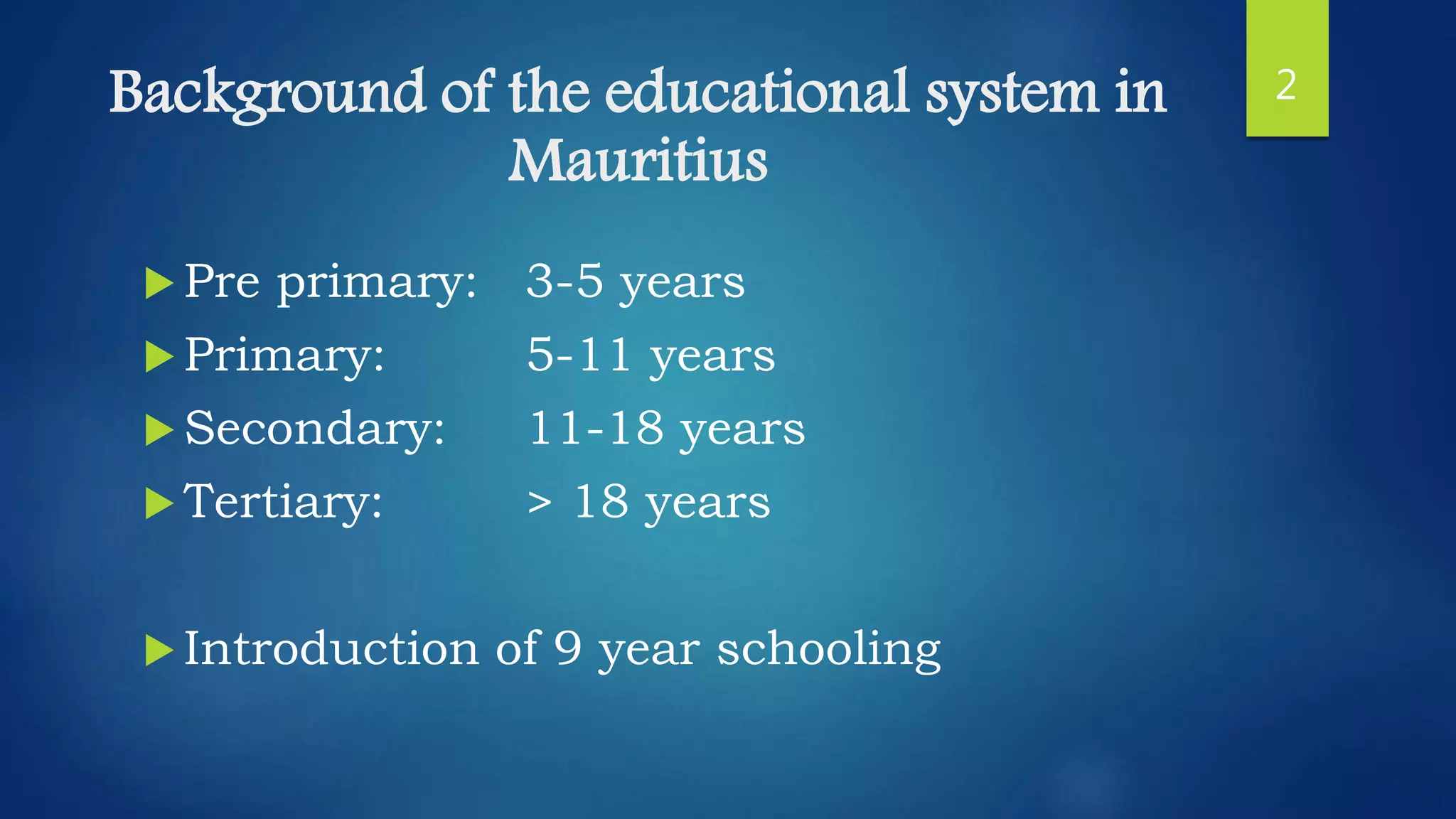
 Pre primary: 3-5 years
 Primary: 5-11 years
 Secondary: 11-18 years
 Tertiary: > 18 years
 Introduction of 9 year schooling
2
The Higher Education Landscape in
Mauritius
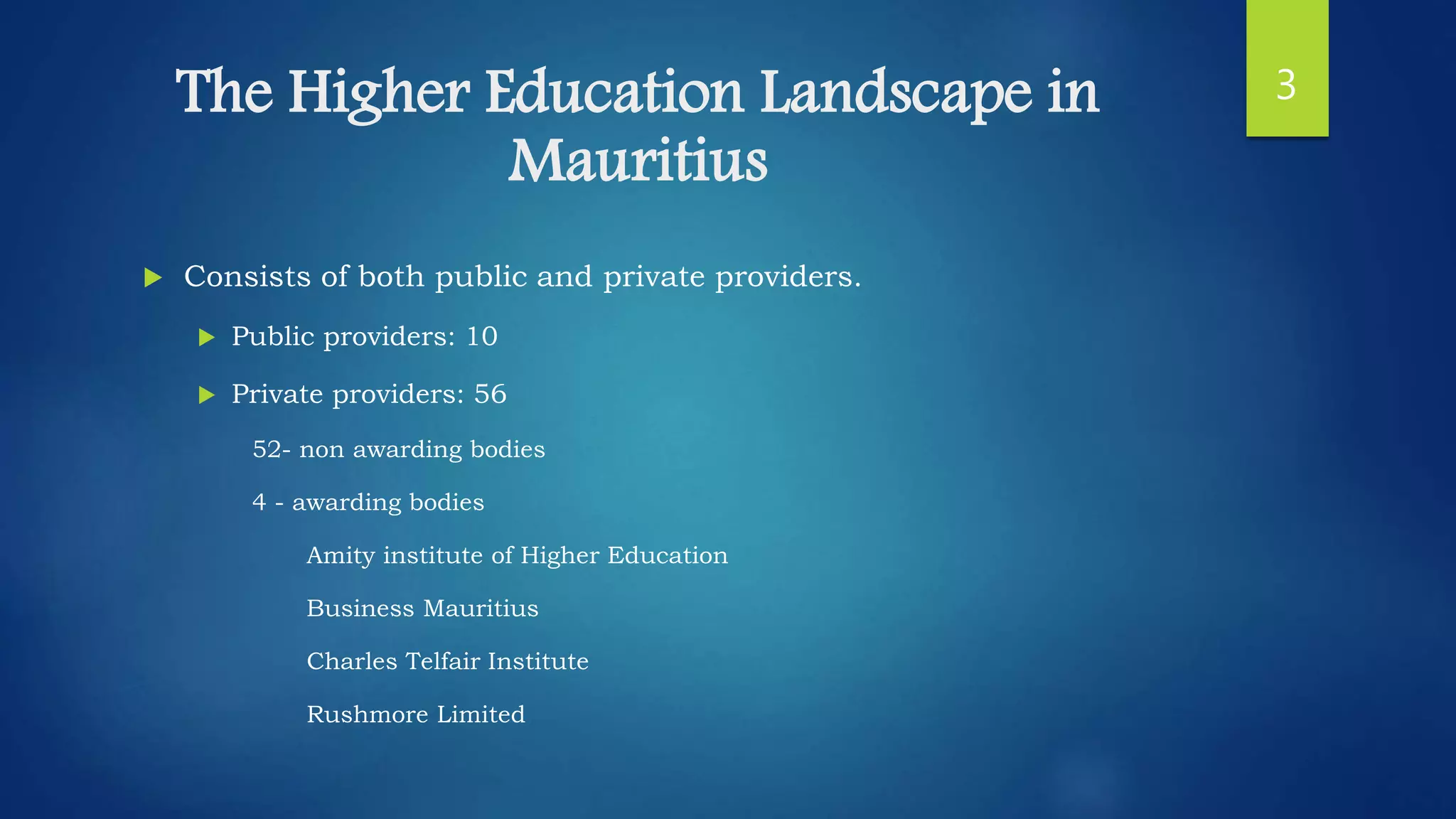
 Consists of both public and private providers.
 Public providers: 10
 Private providers: 56
52- non awarding bodies
4 - awarding bodies
Amity institute of Higher Education
Business Mauritius
Charles Telfair Institute
Rushmore Limited
3
Public providers 1
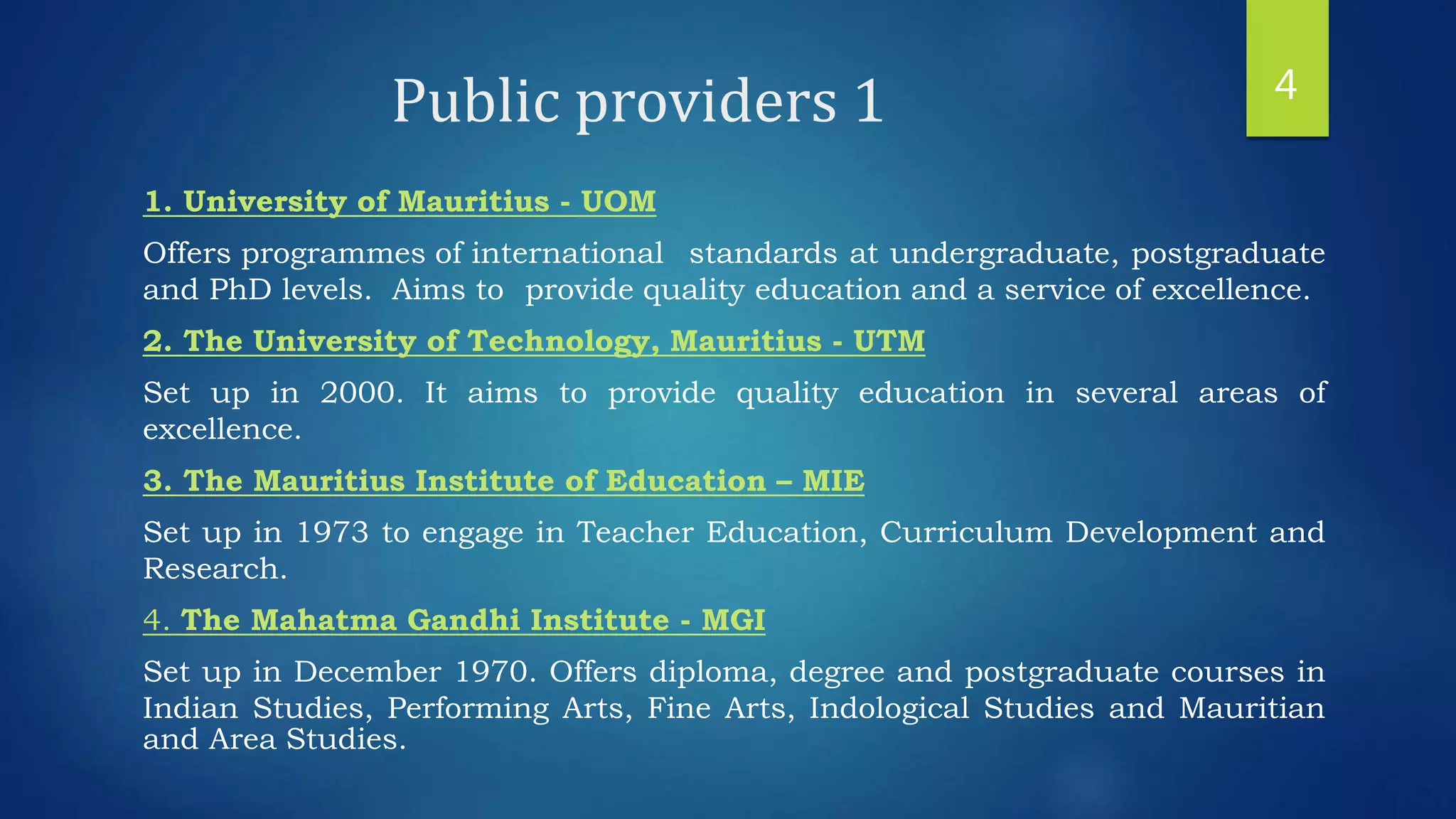
1. University of Mauritius - UOM
Offers programmes of international standards at undergraduate, postgraduate
and PhD levels. Aims to provide quality education and a service of excellence.
2. The University of Technology, Mauritius - UTM
Set up in 2000. It aims to provide quality education in several areas of
excellence.
3. The Mauritius Institute of Education – MIE
Set up in 1973 to engage in Teacher Education, Curriculum Development and
Research.
4. The Mahatma Gandhi Institute - MGI
Set up in December 1970. Offers diploma, degree and postgraduate courses in
Indian Studies, Performing Arts, Fine Arts, Indological Studies and Mauritian
and Area Studies.
4
Public providers 2
5. The Rabindranath Tagore Institute - RTI
Set up in 2002. The Institute offers Tertiary level programmes in Film
Production, Arts & Crafts and Dramatic Arts.
6. Open University of Mauritius – OU
Established in July 2012 OU is a Public University with full awarding powers,
fostering open and distance learning to enable access to both local and
international students.
7. Université des Mascareignes - UdM
UdM Act was proclaimed in September 2012. This public university offers an
innovative approach to higher education and learning.
5
Public providers 3
8. The Mauritius Institute of Training and Development - MITD
Became operational in 2009. Most of the programmes run are of Technical Vocational
Education and Training (TVET) nature. The programmes are offered on full-time, part-time
and apprenticeship modes from basic to diploma levels.
9. Mauritius Institute of Health - MIH
Statutory Body established in 1989. Operates as training & research arm of the Ministry of
Health & Quality of Life. Also acts as the Awarding Body for courses in Health and Social
Studies delivered by other registered Training Institutions.
10. The Fashion and Design Institute - FDI
Officially launched in 2009. Aims to promote excellence in the field of design education. Set
up by Government to rationalize resources in this sector and fostering a uniform and a
focused development of the fashion industry.
6
Private Providers
 56 private institutions have joined the tertiary education sector in the past few
years.
 They offer all types of programmes in an extensive number of disciplines such as
Management, Accountancy, Medicine, Dentistry and Information Technology.
 Most are local counterparts of overseas institutions and offer programmes ranging
from sub-degree to postgraduate ones through a mixed-mode system,
encompassing both distance learning and face-to face tutorials.
 The examinations are, in general, conducted by the Mauritius Examinations
Syndicate (MES), apart from a few which are organised and invigilated by overseas
institutions themselves in collaboration with the local partner.
7
Regulatory Framework 1
 Tertiary Education Commission (TEC) Act was proclaimed on 15 August
1988. The TEC was setup under an Act of parliament, functioned as a body
under the aegis of the Ministry of Education in Dec 1989.
 Following major landscape changes in the tertiary education sector, the
TEC Act was amended in 2005,
 TEC given additional responsibilities in regard to quality assurance.
 TEC endeavors to provide accessible but quality postsecondary education.
8
Regulatory Framework 2
 Tertiary Education Commission (TEC) oversees the tertiary education
institutions (TEIs).
 Responsible for allocating public funds and fostering, planning and
coordinating the development of post-secondary education and training.
 Since 2005, TEC has the mandate to regulate private post-secondary
education institutions locally through institutional registration and
programme accreditation to assure quality.
 TEC also determines the recognition and equivalence of post-secondary
qualifications.
9
Qualification Framework
 Tertiary Education Commission (TEC) has statutory responsibility to determine
the recognition and equivalence of academic or professional qualification at the
postsecondary education level obtained in or outside Mauritius.
 Recognition of qualifications is a process of formally acknowledging the
appropriateness of a certain qualification for a specific purpose including
enabling the qualification holder to access further and/or higher educational,
and/or employment activities.
 Equivalence of qualifications on the other hand is a process of formally
establishing as to whether two or more qualifications are equal or deemed to be
equal or comparable in value.
10
Observations 1
 There are both public and private service providers in Mauritius
 Private providers are mainly non awarding bodies, only 4 out of 56 are
awarding bodies.
 Courses given at certificate, diploma, degree, post graduate and doctoral
levels.
 Courses are offered full time, part time, online or even through distance
learning to address the needs of a variety of audience.
 Clientele of tertiary education range from students who have just completed
college to professionals wanting to increase their knowledge and market
value in the world of work.
11
Observations 2
 Subjects on offer vary greatly from business, management, finance,
engineering, arts, humanities, law, social science, health sciences, fashion
and design, travel and tourism, information and communication
technology, science, oceanography.
 Over the years there is an increase in number of service providers in the
tertiary sector.
 Many joint ventures and franchise agreements are being undertaken
between local institutions and foreign ones.
12
Observations 3
 Several foreign universities have opened campuses in Mauritius.
 Beneficial for Mauritian students who can earn international degrees while
staying in Mauritius.
 Quality education is also more affordable
 Greater access to education to individuals of all social classes.
 UoM only public university not to have tuition fees for most of its
undergraduate full time programs.
13
Conclusion
 Quantity of services v/s quality of education
 Education determines the future of a country and quality of education
cannot be compromised.
 Issues with regulatory framework recently
 Institutions allowed to provide service without relevant qualifications.
 Students penalized when institutions closed.
 TEC needs to review its system so that all tertiary education providers meet
the relevant criteria and no political or other type of interference is allowed.
14
15
Reference
 http://tec.intnet.mu/public_institutions
 Tertiary Education Commission website
 World data on education, 6th edition, 2006-2007.
16

Mid term assignment presentation ppt

  • 1.
    The Higher Educationsystem in Mauritius MS H.D.KOMAL BOODHUN LECTURER IN CRIMINAL JUSTICE UNIVERSITY OF MAURITIUS 1
  • 2.
    Background of theeducational system in Mauritius  Pre primary: 3-5 years  Primary: 5-11 years  Secondary: 11-18 years  Tertiary: > 18 years  Introduction of 9 year schooling 2
  • 3.
    The Higher EducationLandscape in Mauritius  Consists of both public and private providers.  Public providers: 10  Private providers: 56 52- non awarding bodies 4 - awarding bodies Amity institute of Higher Education Business Mauritius Charles Telfair Institute Rushmore Limited 3
  • 4.
    Public providers 1 1.University of Mauritius - UOM Offers programmes of international standards at undergraduate, postgraduate and PhD levels. Aims to provide quality education and a service of excellence. 2. The University of Technology, Mauritius - UTM Set up in 2000. It aims to provide quality education in several areas of excellence. 3. The Mauritius Institute of Education – MIE Set up in 1973 to engage in Teacher Education, Curriculum Development and Research. 4. The Mahatma Gandhi Institute - MGI Set up in December 1970. Offers diploma, degree and postgraduate courses in Indian Studies, Performing Arts, Fine Arts, Indological Studies and Mauritian and Area Studies. 4
  • 5.
    Public providers 2 5.The Rabindranath Tagore Institute - RTI Set up in 2002. The Institute offers Tertiary level programmes in Film Production, Arts & Crafts and Dramatic Arts. 6. Open University of Mauritius – OU Established in July 2012 OU is a Public University with full awarding powers, fostering open and distance learning to enable access to both local and international students. 7. Université des Mascareignes - UdM UdM Act was proclaimed in September 2012. This public university offers an innovative approach to higher education and learning. 5
  • 6.
    Public providers 3 8.The Mauritius Institute of Training and Development - MITD Became operational in 2009. Most of the programmes run are of Technical Vocational Education and Training (TVET) nature. The programmes are offered on full-time, part-time and apprenticeship modes from basic to diploma levels. 9. Mauritius Institute of Health - MIH Statutory Body established in 1989. Operates as training & research arm of the Ministry of Health & Quality of Life. Also acts as the Awarding Body for courses in Health and Social Studies delivered by other registered Training Institutions. 10. The Fashion and Design Institute - FDI Officially launched in 2009. Aims to promote excellence in the field of design education. Set up by Government to rationalize resources in this sector and fostering a uniform and a focused development of the fashion industry. 6
  • 7.
    Private Providers  56private institutions have joined the tertiary education sector in the past few years.  They offer all types of programmes in an extensive number of disciplines such as Management, Accountancy, Medicine, Dentistry and Information Technology.  Most are local counterparts of overseas institutions and offer programmes ranging from sub-degree to postgraduate ones through a mixed-mode system, encompassing both distance learning and face-to face tutorials.  The examinations are, in general, conducted by the Mauritius Examinations Syndicate (MES), apart from a few which are organised and invigilated by overseas institutions themselves in collaboration with the local partner. 7
  • 8.
    Regulatory Framework 1 Tertiary Education Commission (TEC) Act was proclaimed on 15 August 1988. The TEC was setup under an Act of parliament, functioned as a body under the aegis of the Ministry of Education in Dec 1989.  Following major landscape changes in the tertiary education sector, the TEC Act was amended in 2005,  TEC given additional responsibilities in regard to quality assurance.  TEC endeavors to provide accessible but quality postsecondary education. 8
  • 9.
    Regulatory Framework 2 Tertiary Education Commission (TEC) oversees the tertiary education institutions (TEIs).  Responsible for allocating public funds and fostering, planning and coordinating the development of post-secondary education and training.  Since 2005, TEC has the mandate to regulate private post-secondary education institutions locally through institutional registration and programme accreditation to assure quality.  TEC also determines the recognition and equivalence of post-secondary qualifications. 9
  • 10.
    Qualification Framework  TertiaryEducation Commission (TEC) has statutory responsibility to determine the recognition and equivalence of academic or professional qualification at the postsecondary education level obtained in or outside Mauritius.  Recognition of qualifications is a process of formally acknowledging the appropriateness of a certain qualification for a specific purpose including enabling the qualification holder to access further and/or higher educational, and/or employment activities.  Equivalence of qualifications on the other hand is a process of formally establishing as to whether two or more qualifications are equal or deemed to be equal or comparable in value. 10
  • 11.
    Observations 1  Thereare both public and private service providers in Mauritius  Private providers are mainly non awarding bodies, only 4 out of 56 are awarding bodies.  Courses given at certificate, diploma, degree, post graduate and doctoral levels.  Courses are offered full time, part time, online or even through distance learning to address the needs of a variety of audience.  Clientele of tertiary education range from students who have just completed college to professionals wanting to increase their knowledge and market value in the world of work. 11
  • 12.
    Observations 2  Subjectson offer vary greatly from business, management, finance, engineering, arts, humanities, law, social science, health sciences, fashion and design, travel and tourism, information and communication technology, science, oceanography.  Over the years there is an increase in number of service providers in the tertiary sector.  Many joint ventures and franchise agreements are being undertaken between local institutions and foreign ones. 12
  • 13.
    Observations 3  Severalforeign universities have opened campuses in Mauritius.  Beneficial for Mauritian students who can earn international degrees while staying in Mauritius.  Quality education is also more affordable  Greater access to education to individuals of all social classes.  UoM only public university not to have tuition fees for most of its undergraduate full time programs. 13
  • 14.
    Conclusion  Quantity ofservices v/s quality of education  Education determines the future of a country and quality of education cannot be compromised.  Issues with regulatory framework recently  Institutions allowed to provide service without relevant qualifications.  Students penalized when institutions closed.  TEC needs to review its system so that all tertiary education providers meet the relevant criteria and no political or other type of interference is allowed. 14
  • 15.
  • 16.
    Reference  http://tec.intnet.mu/public_institutions  TertiaryEducation Commission website  World data on education, 6th edition, 2006-2007. 16