Microwave –Terrestrial &
Satellite
Microwave transmission uses very-high frequency
signals
Frequency range:300MHz-300Ghz
Wavelengths range in air:100cm-1mm
 The two types of microwave transmission
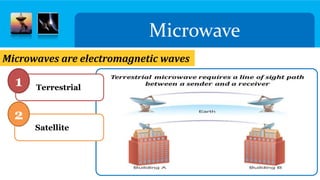
Microwaves are electromagnetic waves
Microwave
Terrestrial
Satellite
1
2
• Unidirectional
• Propagation is line-of sight.
• Repeaters are needed for long distance communication.
• Very high frequency microwaves cannot penetrate walls.
• Wave band is relatively wide almost 299GHZ → a high data rate
• Use of certain portion of the band requires permission from
authorities.
Microwave
Microwaves are used for unicast communication such as
cellular telephones, satellite networks, and wireless LANs.
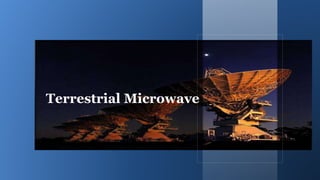
Terrestrial Microwave
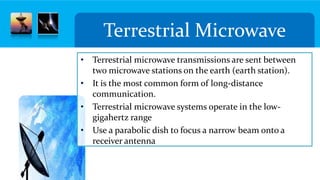
• Terrestrial microwave transmissions are sent between
two microwave stations on the earth (earth station).
• It is the most common form of long-distance
communication.
• Terrestrial microwave systems operate in the low-
gigahertz range
• Use a parabolic dish to focus a narrow beam onto a
receiver antenna
Terrestrial Microwave
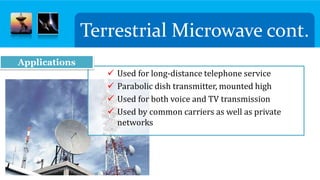
 Used for long-distance telephone service
 Parabolic dish transmitter, mounted high
 Used for both voice and TV transmission
 Used by common carriers as well as private
networks
Terrestrial Microwave cont.
Applications
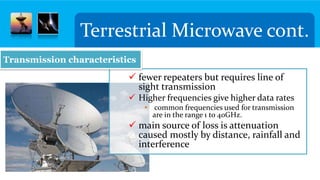
 fewer repeaters but requires line of
sight transmission
 Higher frequencies give higher data rates
• common frequencies used for transmission
are in the range 1 to 40GHz.
 main source of loss is attenuation
caused mostly by distance, rainfall and
interference
Terrestrial Microwave cont.
Transmission characteristics
Satellite Microwave
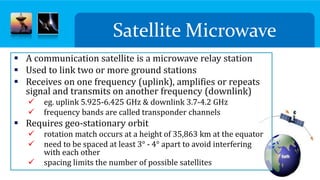
 A communication satellite is a microwave relay station
 Used to link two or more ground stations
 Receives on one frequency (uplink), amplifies or repeats
signal and transmits on another frequency (downlink)
 eg. uplink 5.925-6.425 GHz & downlink 3.7-4.2 GHz
 frequency bands are called transponder channels
 Requires geo-stationary orbit
 rotation match occurs at a height of 35,863 km at the equator
 need to be spaced at least 3° - 4° apart to avoid interfering
with each other
 spacing limits the number of possible satellites
Satellite Microwave
Satellite Microwave cont.
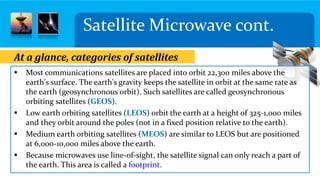
 Most communications satellites are placed into orbit 22,300 miles above the
earth's surface. The earth's gravity keeps the satellite in orbit at the same rate as
the earth (geosynchronous orbit). Such satellites are called geosynchronous
orbiting satellites (GEOS).
 Low earth orbiting satellites (LEOS) orbit the earth at a height of 325-1,000 miles
and they orbit around the poles (not in a fixed position relative to the earth).
 Medium earth orbiting satellites (MEOS) are similar to LEOS but are positioned
at 6,000-10,000 miles above the earth.
 Because microwaves use line-of-sight, the satellite signal can only reach a part of
the earth. This area is called a footprint.
At a glance, categories of satellites
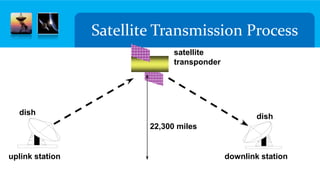
dish
dish
uplink station downlink station
satellite
transponder
22,300 miles
Satellite Transmission Process
Satellite Microwave cont.
 Private business networks
 satellite providers can divide capacity into channels to lease to individual business
users
 Television distribution
 programs are transmitted to the satellite then broadcast down to a number of
stations which then distributes the programs to individual viewers
 Direct Broadcast Satellite (DBS) transmits video signals directly to the home user
 Long-distance telephone transmission
 high-usage international trunks
 Global positioning
 Navstar Global Positioning System (GPS)
Applications
Satellite Microwave cont.
 the optimum frequency range for satellite transmission
is 1 to 10 GHz
 lower has significant noise from natural sources
 higher is attenuated by atmospheric absorption and precipitation
 satellites use a frequency bandwidth range of 5.925 to
6.425 GHz from earth to satellite (uplink) and a range of
3.7 to 4.2 GHz from satellite to earth (downlink)
 this is referred to as the 4/6-GHz band
 because of saturation the 12/14-GHz band has been developed
(uplink: 14 - 14.5 GHz; downlink: 11.7 - 12.2 GHz
Transmission characteristics
Microwave Transmission
advantages
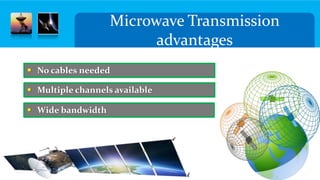
 No cables needed
 Multiple channels available
 Wide bandwidth
Microwave Transmission
Disadvantages
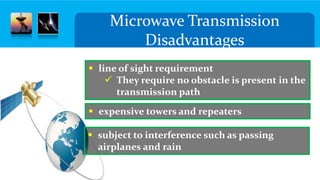
 line of sight requirement
 They require no obstacle is present in the
transmission path
 expensive towers and repeaters
 subject to interference such as passing
airplanes and rain
a presentation by-
Farhana Mishu
fp.mishu@gmail.com
Thank you

Microwave –Terrestrial & Satellite

  • 1.
  • 2.
    Microwave transmission usesvery-high frequency signals Frequency range:300MHz-300Ghz Wavelengths range in air:100cm-1mm  The two types of microwave transmission Microwaves are electromagnetic waves Microwave Terrestrial Satellite 1 2
  • 3.
    • Unidirectional • Propagationis line-of sight. • Repeaters are needed for long distance communication. • Very high frequency microwaves cannot penetrate walls. • Wave band is relatively wide almost 299GHZ → a high data rate • Use of certain portion of the band requires permission from authorities. Microwave Microwaves are used for unicast communication such as cellular telephones, satellite networks, and wireless LANs.
  • 4.
  • 5.
    • Terrestrial microwavetransmissions are sent between two microwave stations on the earth (earth station). • It is the most common form of long-distance communication. • Terrestrial microwave systems operate in the low- gigahertz range • Use a parabolic dish to focus a narrow beam onto a receiver antenna Terrestrial Microwave
  • 6.
     Used forlong-distance telephone service  Parabolic dish transmitter, mounted high  Used for both voice and TV transmission  Used by common carriers as well as private networks Terrestrial Microwave cont. Applications
  • 7.
     fewer repeatersbut requires line of sight transmission  Higher frequencies give higher data rates • common frequencies used for transmission are in the range 1 to 40GHz.  main source of loss is attenuation caused mostly by distance, rainfall and interference Terrestrial Microwave cont. Transmission characteristics
  • 8.
  • 9.
     A communicationsatellite is a microwave relay station  Used to link two or more ground stations  Receives on one frequency (uplink), amplifies or repeats signal and transmits on another frequency (downlink)  eg. uplink 5.925-6.425 GHz & downlink 3.7-4.2 GHz  frequency bands are called transponder channels  Requires geo-stationary orbit  rotation match occurs at a height of 35,863 km at the equator  need to be spaced at least 3° - 4° apart to avoid interfering with each other  spacing limits the number of possible satellites Satellite Microwave
  • 10.
    Satellite Microwave cont. Most communications satellites are placed into orbit 22,300 miles above the earth's surface. The earth's gravity keeps the satellite in orbit at the same rate as the earth (geosynchronous orbit). Such satellites are called geosynchronous orbiting satellites (GEOS).  Low earth orbiting satellites (LEOS) orbit the earth at a height of 325-1,000 miles and they orbit around the poles (not in a fixed position relative to the earth).  Medium earth orbiting satellites (MEOS) are similar to LEOS but are positioned at 6,000-10,000 miles above the earth.  Because microwaves use line-of-sight, the satellite signal can only reach a part of the earth. This area is called a footprint. At a glance, categories of satellites
  • 11.
    dish dish uplink station downlinkstation satellite transponder 22,300 miles Satellite Transmission Process
  • 12.
    Satellite Microwave cont. Private business networks  satellite providers can divide capacity into channels to lease to individual business users  Television distribution  programs are transmitted to the satellite then broadcast down to a number of stations which then distributes the programs to individual viewers  Direct Broadcast Satellite (DBS) transmits video signals directly to the home user  Long-distance telephone transmission  high-usage international trunks  Global positioning  Navstar Global Positioning System (GPS) Applications
  • 13.
    Satellite Microwave cont. the optimum frequency range for satellite transmission is 1 to 10 GHz  lower has significant noise from natural sources  higher is attenuated by atmospheric absorption and precipitation  satellites use a frequency bandwidth range of 5.925 to 6.425 GHz from earth to satellite (uplink) and a range of 3.7 to 4.2 GHz from satellite to earth (downlink)  this is referred to as the 4/6-GHz band  because of saturation the 12/14-GHz band has been developed (uplink: 14 - 14.5 GHz; downlink: 11.7 - 12.2 GHz Transmission characteristics
  • 14.
    Microwave Transmission advantages  Nocables needed  Multiple channels available  Wide bandwidth
  • 15.
    Microwave Transmission Disadvantages  lineof sight requirement  They require no obstacle is present in the transmission path  expensive towers and repeaters  subject to interference such as passing airplanes and rain
  • 16.
    a presentation by- FarhanaMishu fp.mishu@gmail.com Thank you