University of Engineering & Technology Peshawar
Department of Telecommunication Engineering ,Mardan Campus
1 |
University of Engineering & Technology Peshawar
Department of Telecommunication Engineering ,Mardan Campus
2 |
04-10-2012 First FYP Presentation,Batch-08
Transmission Lines(TLs)
What is a Transmission Line?
 Transmit energy from one point to another
(source load). i.e. Connections b/w:
◦ Transmitter and Antenna
◦ Computer networks
◦ Cable provider and TV receivers, etc.
◦ Devices on PCBs @ high frequencies
Microwave Engineering 3
Wave Phenomenon on TLs
 Large distance b/w Source (S) &
Destination (D) Delay-induced phase
delay
 If the distance between system
components ( S & D) is of the order of
wavelength or more then we deal with
wave phenomenon like that in free space &
dielectrics.
Microwave Engineering 4
TLs....
TLs....
 Lumped elements: If the time delay by a wave in
traversing the elements is negligible then they are called
lumped elements, such as:
 Resistor (R) Ω
 Capacitor (C) F
 Inductor (L) H
 Distributed Elements: Those elements or interconnects
(such as TLs) which are large enough (of the order of
wavelength or more), their (R, L, C) characteristics are
evaluated on per-unit length basis, are called distributed
elements.
 Field distributions for both uniform TLs and Plane waves  TEM
(Transverse ElectroMagnetic)
Microwave Engineering 5
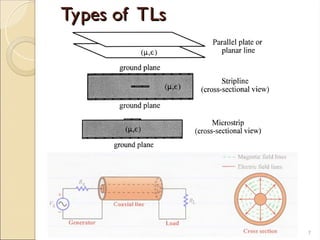
Types of TLs
Types of TLs
Microwave Engineering 6
Types of TLs
Types of TLs
Microwave Engineering 7
TL: Role of wavelength
Microwave Engineering 8
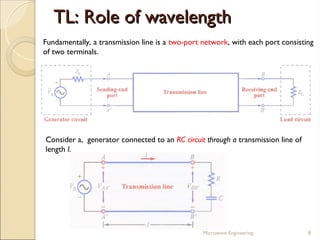
Fundamentally, a transmission line is a two-port network, with each port consisting
of two terminals.
Consider a, generator connected to an RC circuit through a transmission line of
length I.
TL
TL
Microwave Engineering 9
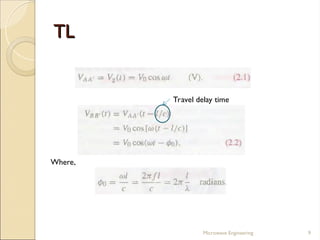
Travel delay time
Where,
TL
TL
Microwave Engineering 10
Microwave Engineering 11
Microwave Engineering 12
TL: Lumped Element Model
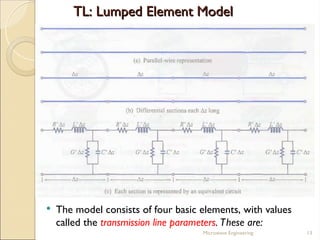
 The model consists of four basic elements, with values
called the transmission line parameters. These are:
Microwave Engineering 13
TL: Lumped Element Model
Microwave Engineering 14
The prime superscript is used as a reminder that the line parameters are differential
quantities whose units are per unit length.
Transmission Line Equation
Microwave Engineering 15
Transmission Line Equation
Microwave Engineering 16
Node : N Node : N+1
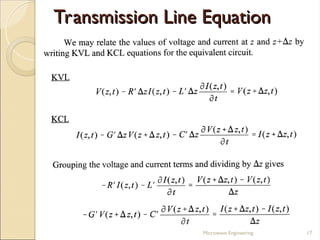
Transmission Line Equation
Microwave Engineering 17
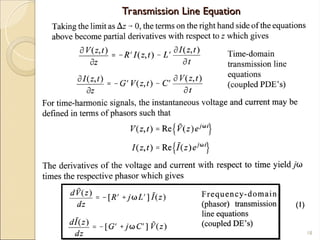
Transmission Line Equation
Microwave Engineering 18
(1)
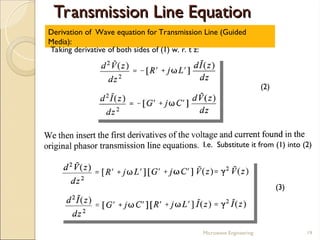
Transmission Line Equation
Microwave Engineering 19
Derivation of Wave equation for Transmission Line (Guided
Media):
Taking derivative of both sides of (1) w. r. t z:
(2)
I.e. Substitute it from (1) into (2)
(3)
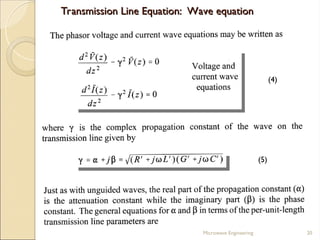
Transmission Line Equation: Wave equation
Microwave Engineering 20
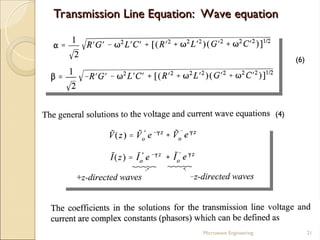
(4)
(5)
Transmission Line Equation: Wave equation
Microwave Engineering 21
(6)
(4)
Transmission Line Equation: Wave equation
Microwave Engineering 22
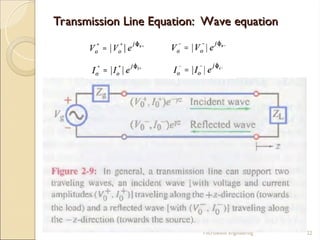
Transmission Line Equation: Wave equation
Microwave Engineering 23
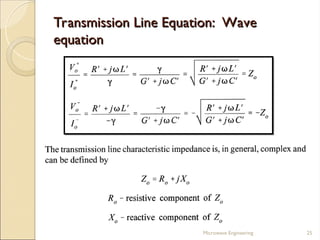
(7)
Transmission Line Equation: Wave
equation
equation
Microwave Engineering 24
Transmission Line Equation: Wave
equation
equation
Microwave Engineering 25
Transmission Line Equation: Wave
equation
equation
Microwave Engineering 26
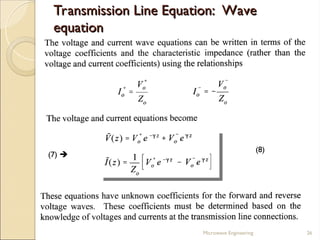
(7) 
(8)
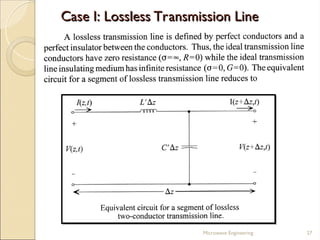
Case I: Lossless Transmission Line
Microwave Engineering 27
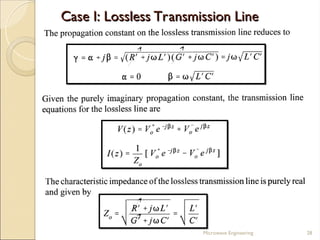
Case I: Lossless Transmission Line
Microwave Engineering 28
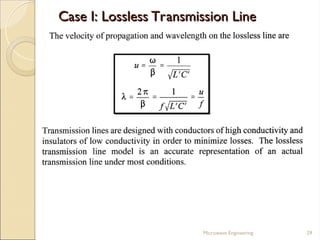
Case I: Lossless Transmission Line
Microwave Engineering 29
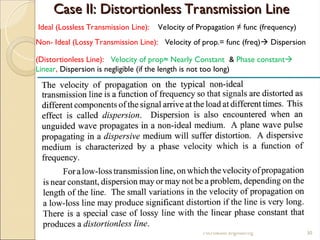
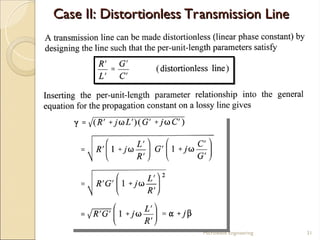
Case II: Distortionless Transmission Line
Microwave Engineering 30
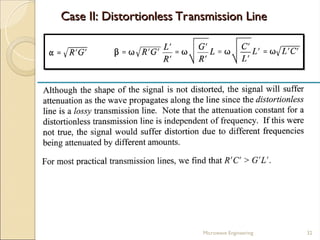
Ideal (Lossless Transmission Line): Velocity of Propagation ≠ func (frequency)
Non- Ideal (Lossy Transmission Line): Velocity of prop.= func (freq) Dispersion
(Distortionless Line): Velocity of prop≈ Nearly Constant & Phase constant
Linear, Dispersion is negligible (if the length is not too long)
Case II: Distortionless Transmission Line
Microwave Engineering 31
Case II: Distortionless Transmission Line
Microwave Engineering 32
Generality of TL Theory
Microwave Engineering 33
It was mentioned in the last lecture that transmission lines could be used to
model the voltage and current waves on any structure supporting only TEM
waves.
What changes from structure to structure are the values for L, C, R, and G, as
shown below in Table 2.1 for three common TEM structures:
Consequently, the values of Z0, vp,  (and ) generally all change from one
TL to another. The numerical values can also be changed within a type of
TL by varying the dimensions and construction materials
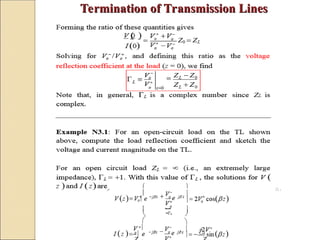
Termination of Transmission Lines
We will now consider the termination of TLs that are excited by sinusoidal
steady state sources.
Adding terminations produces reflections so that the total voltage and current
anywhere on the TL are sums of forward and reverse propagating waves. The
voltage and current on the TL will have the form
The “lumped load” ZL that terminates the TL is considered a boundary
condition for the voltage and current
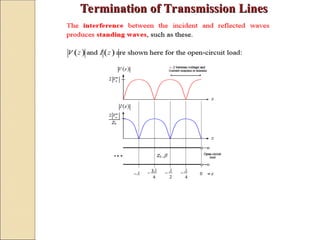
Termination of Transmission Lines
04-10-2012 First FYP Presentation,Batch-08
Any Question…?
Any Question…?
04-10-2012 First FYP Presentation,Batch-08
Have A Nice

Microwave Engineering_Lecture_2-Transmission Line Equation.ppt

  • 1.
    University of Engineering& Technology Peshawar Department of Telecommunication Engineering ,Mardan Campus 1 |
  • 2.
    University of Engineering& Technology Peshawar Department of Telecommunication Engineering ,Mardan Campus 2 | 04-10-2012 First FYP Presentation,Batch-08 Transmission Lines(TLs)
  • 3.
    What is aTransmission Line? What is a Transmission Line?  Transmit energy from one point to another (source load). i.e. Connections b/w: ◦ Transmitter and Antenna ◦ Computer networks ◦ Cable provider and TV receivers, etc. ◦ Devices on PCBs @ high frequencies Microwave Engineering 3
  • 4.
    Wave Phenomenon onTLs Wave Phenomenon on TLs  Large distance b/w Source (S) & Destination (D) Delay-induced phase delay  If the distance between system components ( S & D) is of the order of wavelength or more then we deal with wave phenomenon like that in free space & dielectrics. Microwave Engineering 4
  • 5.
    TLs.... TLs....  Lumped elements:If the time delay by a wave in traversing the elements is negligible then they are called lumped elements, such as:  Resistor (R) Ω  Capacitor (C) F  Inductor (L) H  Distributed Elements: Those elements or interconnects (such as TLs) which are large enough (of the order of wavelength or more), their (R, L, C) characteristics are evaluated on per-unit length basis, are called distributed elements.  Field distributions for both uniform TLs and Plane waves  TEM (Transverse ElectroMagnetic) Microwave Engineering 5
  • 6.
    Types of TLs Typesof TLs Microwave Engineering 6
  • 7.
    Types of TLs Typesof TLs Microwave Engineering 7
  • 8.
    TL: Role ofwavelength TL: Role of wavelength Microwave Engineering 8 Fundamentally, a transmission line is a two-port network, with each port consisting of two terminals. Consider a, generator connected to an RC circuit through a transmission line of length I.
  • 9.
  • 10.
  • 11.
  • 12.
  • 13.
    TL: Lumped ElementModel TL: Lumped Element Model  The model consists of four basic elements, with values called the transmission line parameters. These are: Microwave Engineering 13
  • 14.
    TL: Lumped ElementModel TL: Lumped Element Model Microwave Engineering 14 The prime superscript is used as a reminder that the line parameters are differential quantities whose units are per unit length.
  • 15.
    Transmission Line Equation TransmissionLine Equation Microwave Engineering 15
  • 16.
    Transmission Line Equation TransmissionLine Equation Microwave Engineering 16 Node : N Node : N+1
  • 17.
    Transmission Line Equation TransmissionLine Equation Microwave Engineering 17
  • 18.
    Transmission Line Equation TransmissionLine Equation Microwave Engineering 18 (1)
  • 19.
    Transmission Line Equation TransmissionLine Equation Microwave Engineering 19 Derivation of Wave equation for Transmission Line (Guided Media): Taking derivative of both sides of (1) w. r. t z: (2) I.e. Substitute it from (1) into (2) (3)
  • 20.
    Transmission Line Equation:Wave equation Transmission Line Equation: Wave equation Microwave Engineering 20 (4) (5)
  • 21.
    Transmission Line Equation:Wave equation Transmission Line Equation: Wave equation Microwave Engineering 21 (6) (4)
  • 22.
    Transmission Line Equation:Wave equation Transmission Line Equation: Wave equation Microwave Engineering 22
  • 23.
    Transmission Line Equation:Wave equation Transmission Line Equation: Wave equation Microwave Engineering 23 (7)
  • 24.
    Transmission Line Equation:Wave Transmission Line Equation: Wave equation equation Microwave Engineering 24
  • 25.
    Transmission Line Equation:Wave Transmission Line Equation: Wave equation equation Microwave Engineering 25
  • 26.
    Transmission Line Equation:Wave Transmission Line Equation: Wave equation equation Microwave Engineering 26 (7)  (8)
  • 27.
    Case I: LosslessTransmission Line Case I: Lossless Transmission Line Microwave Engineering 27
  • 28.
    Case I: LosslessTransmission Line Case I: Lossless Transmission Line Microwave Engineering 28
  • 29.
    Case I: LosslessTransmission Line Case I: Lossless Transmission Line Microwave Engineering 29
  • 30.
    Case II: DistortionlessTransmission Line Case II: Distortionless Transmission Line Microwave Engineering 30 Ideal (Lossless Transmission Line): Velocity of Propagation ≠ func (frequency) Non- Ideal (Lossy Transmission Line): Velocity of prop.= func (freq) Dispersion (Distortionless Line): Velocity of prop≈ Nearly Constant & Phase constant Linear, Dispersion is negligible (if the length is not too long)
  • 31.
    Case II: DistortionlessTransmission Line Case II: Distortionless Transmission Line Microwave Engineering 31
  • 32.
    Case II: DistortionlessTransmission Line Case II: Distortionless Transmission Line Microwave Engineering 32
  • 33.
    Generality of TLTheory Generality of TL Theory Microwave Engineering 33 It was mentioned in the last lecture that transmission lines could be used to model the voltage and current waves on any structure supporting only TEM waves. What changes from structure to structure are the values for L, C, R, and G, as shown below in Table 2.1 for three common TEM structures: Consequently, the values of Z0, vp,  (and ) generally all change from one TL to another. The numerical values can also be changed within a type of TL by varying the dimensions and construction materials
  • 34.
    Termination of TransmissionLines Termination of Transmission Lines We will now consider the termination of TLs that are excited by sinusoidal steady state sources. Adding terminations produces reflections so that the total voltage and current anywhere on the TL are sums of forward and reverse propagating waves. The voltage and current on the TL will have the form The “lumped load” ZL that terminates the TL is considered a boundary condition for the voltage and current
  • 35.
    Termination of TransmissionLines Termination of Transmission Lines
  • 36.
    Termination of TransmissionLines Termination of Transmission Lines
  • 37.
    04-10-2012 First FYPPresentation,Batch-08 Any Question…? Any Question…?
  • 38.
    04-10-2012 First FYPPresentation,Batch-08 Have A Nice