MME 214
Metallography
Dr. Md Muktadir Billah
Assistant Professor
MME, BUET
Cast Iron
 Iron with 2 to 4.5% carbon and 0.5 to 3% silicon
 Lower melting point and more fluid than steel (better
castability)
 Low cost material usually produced by sand casting
 A wide range of properties, depending on
composition & cooling rate
 Strength
 Hardness
 Ductility
 Thermal conductivity
 Damping capacity
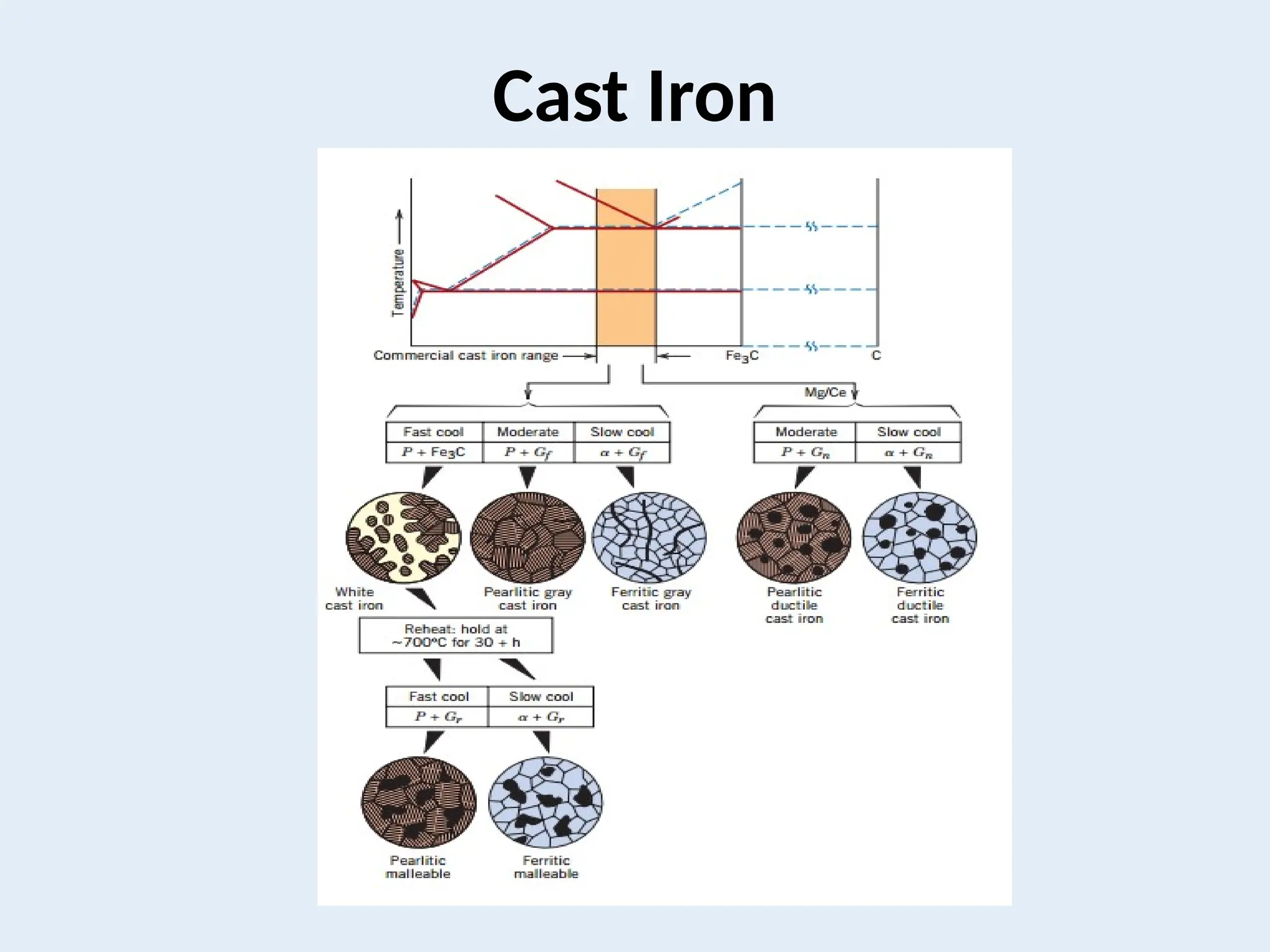
Cast Iron
Cooling Rate & Composition Effect
 Slow cooling favors formation of graphite
 Rapid cooling promotes carbides with high
hardness
 Tendency to form graphite is regulated by
composition as well
 Graphite formation is promoted by the presence
of silicon in concentrations greater than about 1
wt. %
 Both microstructure and mechanical behavior
depend on composition and heat treatment
Fe-Fe3C Phase Diagram
Graphite as a Stable Phase
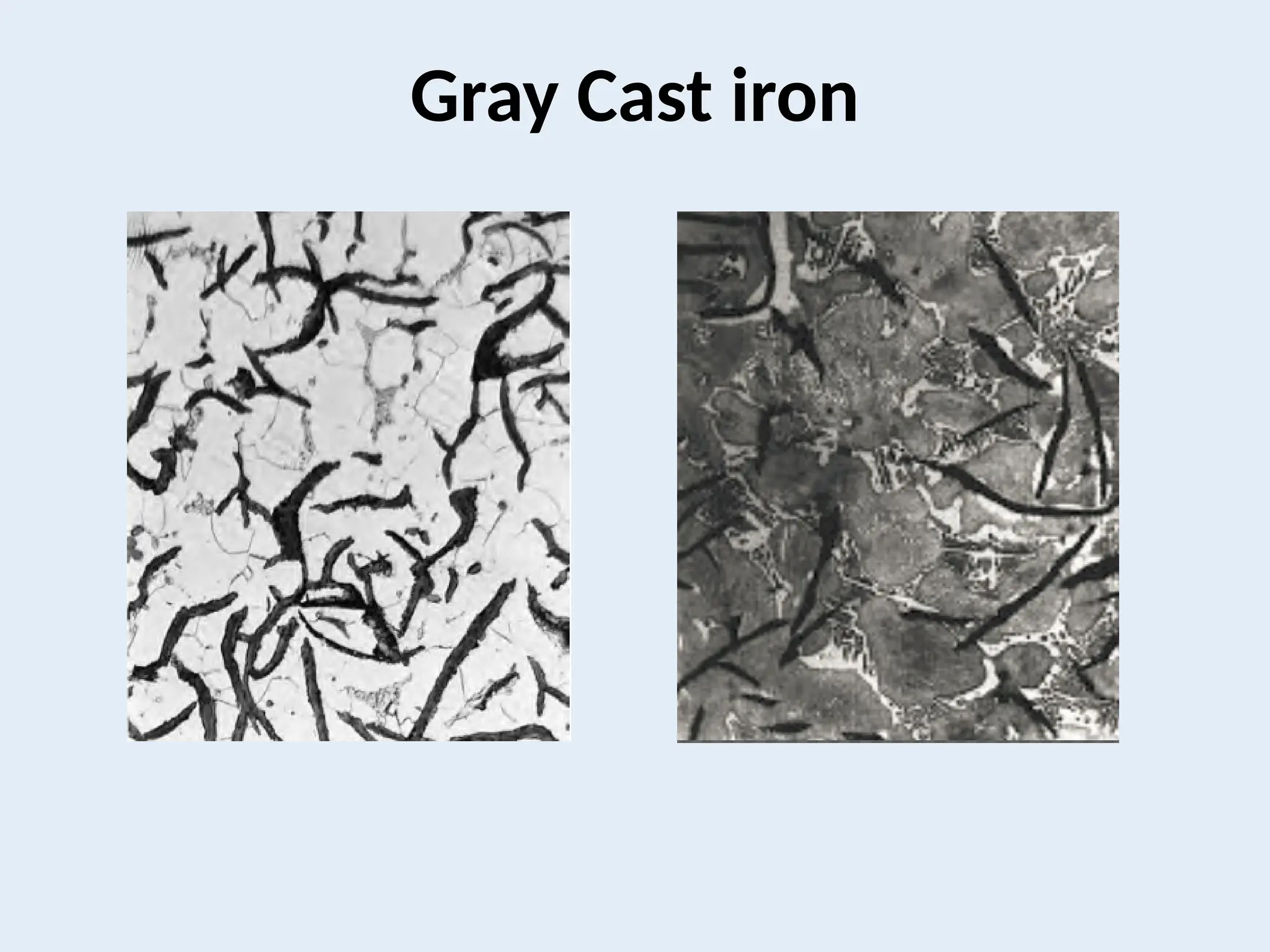
Gray Cast iron
 Carbon and silicon contents vary between 2.5
and 4.0 wt. % and 1.0 and 3.0 wt. %
respectively
 For most of these cast irons, the graphite exists
in the form of flakes
 Flakes are normally surrounded by ferrite or
pearlite matrix
 Because of these graphite flakes, a fractured
surface takes on a gray appearance, hence its
name.
Gray Cast iron
 Gray irons having different microstructures are
generated by adjustment of composition
and/or by using an appropriate treatment
 Lowering silicon content or increasing cooling
rate may prevent complete dissociation of
cementite to form graphite
 Under these circumstances microstructure
consists of graphite flakes embedded in a
pearlite matrix
 High silicon and faster cooling rate results
ferritic matrix
Gray Cast iron
Gray Cast iron
 Mechanically, gray iron is comparatively weak and
brittle in tension
 Graphite flakes tip are sharp and pointed, may serve
as points of stress concentration
 Strength & ductility much higher under compression
 Effective in damping vibrational energy
 Base structures for machines and heavy equipment
that are exposed to vibrations
 Gray irons exhibit a high resistance to wear
 High fluidity at casting temp., permits casting with
intricate shapes; low casting shrinkage
 Least expensive of all metallic materials
White Cast iron
 For low-silicon cast irons (less than 1.0 wt % Si)
and rapid cooling rates, most of the carbon
exists as cementite instead of graphite
 Fracture surface has white appearance, so
termed white CI
 Thick sections may have only a surface layer of
white iron that was “chilled” during the casting
process
 Gray iron forms at interior regions, which cool
more slowly
White Cast iron
 Extremely hard but also very brittle, virtually
unmachinable
 Use is limited to applications that necessitate a
very hard and wear-resistant surface, without a
high degree of ductility
 For example, as rollers in rolling mills
 Generally, white iron is used as an intermediary
in the production of yet another cast iron,
malleable iron
White Cast iron

Microstructure of Cast Iron(Part-01).pptx

  • 1.
    MME 214 Metallography Dr. MdMuktadir Billah Assistant Professor MME, BUET
  • 2.
    Cast Iron  Ironwith 2 to 4.5% carbon and 0.5 to 3% silicon  Lower melting point and more fluid than steel (better castability)  Low cost material usually produced by sand casting  A wide range of properties, depending on composition & cooling rate  Strength  Hardness  Ductility  Thermal conductivity  Damping capacity
  • 3.
  • 4.
    Cooling Rate &Composition Effect  Slow cooling favors formation of graphite  Rapid cooling promotes carbides with high hardness  Tendency to form graphite is regulated by composition as well  Graphite formation is promoted by the presence of silicon in concentrations greater than about 1 wt. %  Both microstructure and mechanical behavior depend on composition and heat treatment
  • 5.
  • 6.
    Graphite as aStable Phase
  • 7.
    Gray Cast iron Carbon and silicon contents vary between 2.5 and 4.0 wt. % and 1.0 and 3.0 wt. % respectively  For most of these cast irons, the graphite exists in the form of flakes  Flakes are normally surrounded by ferrite or pearlite matrix  Because of these graphite flakes, a fractured surface takes on a gray appearance, hence its name.
  • 8.
    Gray Cast iron Gray irons having different microstructures are generated by adjustment of composition and/or by using an appropriate treatment  Lowering silicon content or increasing cooling rate may prevent complete dissociation of cementite to form graphite  Under these circumstances microstructure consists of graphite flakes embedded in a pearlite matrix  High silicon and faster cooling rate results ferritic matrix
  • 9.
  • 10.
    Gray Cast iron Mechanically, gray iron is comparatively weak and brittle in tension  Graphite flakes tip are sharp and pointed, may serve as points of stress concentration  Strength & ductility much higher under compression  Effective in damping vibrational energy  Base structures for machines and heavy equipment that are exposed to vibrations  Gray irons exhibit a high resistance to wear  High fluidity at casting temp., permits casting with intricate shapes; low casting shrinkage  Least expensive of all metallic materials
  • 11.
    White Cast iron For low-silicon cast irons (less than 1.0 wt % Si) and rapid cooling rates, most of the carbon exists as cementite instead of graphite  Fracture surface has white appearance, so termed white CI  Thick sections may have only a surface layer of white iron that was “chilled” during the casting process  Gray iron forms at interior regions, which cool more slowly
  • 12.
    White Cast iron Extremely hard but also very brittle, virtually unmachinable  Use is limited to applications that necessitate a very hard and wear-resistant surface, without a high degree of ductility  For example, as rollers in rolling mills  Generally, white iron is used as an intermediary in the production of yet another cast iron, malleable iron
  • 13.

Editor's Notes