Agenda
IPv6 Evolution
• ISATAP tunneling for IPv6 enablement for development and research
started in 2006.
• Operating Systems IPv6 capable
•  Client and Server OS’s on the corporate network IPv6 capable and prefer v6 by default
• Transition Technologies
•  ISATAP deployed and then deprecated in favour of dual-stack
•  Initial IPv6 only pilot
• Native deployed in selected locations
IPv6 Evolution continued…
• World IPv6 Day June 8, 2011
• Corporate wide interest and excitement leading up to World IPv6
launch day!!
• World IPv6 Launch June 6, 2012…..YAY!
Enabling IPv6
•  Routing Protocols
• IGP
• VPNv6
•  Security infrastructure v6 aware
•  Firewalls v6 enabled
•  Other security components (AMA, APT, DLP, IDS) v6 capable
•  NetFlow v9 deployed
•  Corporate on-prem datacenters IPv6 enabled
•  Includes hardware load balancers
•  Internet Peering
•  IPv6 internet peering enabled
•  Enabling direct v6 internet into labs on request
Internet Routing Challenges
• Initial announcement of ARIN /32 from HQ in Seattle
• Lack of certainty about advertising space from one
regional RIR in another region
• Questions about geolocation
• Considered PI /48s
• Proceeded to procure one /32 per region
• No IPv6 NAT for first implementation
– Therefore could only announce in one location in the region
– E.g. Tokyo in Asia and Dublin in EMEA
IPv6 Challenges
•  Enabling dual-stack at the user edge created some scaling issues
• ARP and ND timers – much increased traffic
• Increased control plane traffic – SSDP, LLMNR
•  Challenges with introducing IPv6 into MPLS
•  Issues with OSPFv2/v3 taking different paths through the network.
Mostly solved by IS-IS J
•  Extension Headers – quickly fixed by vendor
•  Quirks introduced by IPv6 – eg DAD on WAN links
•  Staff training
•  IPv6 addressing seems to be hard
•  Ensuring consistency between IPv4 and IPv6 during new deployment
•  Operational issues with IPv6
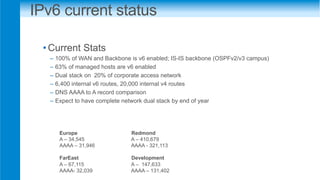
IPv6 current status
• Current Stats
–  100% of WAN and Backbone is v6 enabled; IS-IS backbone (OSPFv2/v3 campus)
–  63% of managed hosts are v6 enabled
–  Dual stack on 20% of corporate access network
–  6,400 internal v6 routes, 20,000 internal v4 routes
–  DNS AAAA to A record comparison
–  Expect to have complete network dual stack by end of year
Europe Redmond
A – 34,545 A – 410,679
AAAA – 31,946 AAAA - 321,113
FarEast Development
A – 67,115 A – 147,633
AAAA- 32,039 AAAA – 131,402
IPv6 Killer App…
• I know you have more v4 addresses…
Vanishing RFC1918 space – Options
• Start looking at internal NAT44 OR NAT64
• We are piloting v6-only using NAT64 (with DNS64).
•  For wired we are using DNS64 via Direct Access* deployment
•  DHCPv6 stateful on existing DHCP server
•  Cisco ASR1K for NAT64
• Wireless Guest Network
•  BIND9 on Windows Server 2012
•  DHCPv6 stateless on Windows Server 2016
•  Cisco ASR1K for NAT64
*Microsoft VPN solution
V6-Only Pilot Deployment
IPv6-only Pilot Results – what works
•  Native IPv6
•  Office 365
•  Xbox.com
•  Microsoft.com
•  Windows update (test)
•  Skype for Business
•  Applications via NAT64; no noticeable performance degradation
•  SharePoint
•  Yammer
•  Bing search
•  Windows RPC/SMB
•  Windows RDP
•  Xbox VOD, video playback
IPv6-only Pilot Results– what doesn’t work
•  Applications
•  Skype
•  Other applications with IPv4 embedded addresses
•  X-Windows applications
•  Microsoft homegrown applications
•  Non-client devices
•  IP phones
•  Conference room schedule monitor
•  Security cameras
IPv6 w/NAT64 Pilot Results
• Switching between v6-only wired and dual-stack wireless
•  Had to disable Ethernet when switch to dual-stack wireless (Ethernet preferred
over Wi-Fi)
•  Without Stateful DHCPv6, no “release6, renew6” had to issue PowerShell
“restart-netadapter”
• Still have to figure out IPv4 embedded
•  464xlat for mobile, what about wired
• Operations and Troubleshooting
•  Issues when one troubleshooting step is to turn off IPv6
Generally things just worked
Future Thoughts
§ DHCPv6 or SLAAC or both?
§ DNS64 deployed globally
§ IPv6 Multicast
§ NAT64 redundancy testing
§ TE - Segment Routing?
§ Management
2 0 0 1 : 4 8 9 8 : 0 0 0 0: 0 0 0 0 :0:0:0:0
0010 0000 0000 0001 0100 1000 1001 1000 0 000 0000 0000 0000 0000 0000 0000 … 0000
32 bit prefix
8 site
bits 64 bit IID
“I” bit 6 block
bits
/40 /48 /64
16 subnet
bits
“D” bit
0000 0000
1) Bit 33 0=Corpnet
1=Internet
2) Bit 34 0=Corpnet
1=Delegations
3) Bits 35-40 Regional Blocks
Puget Sound, Canada, Americas
EMEA
APJ
4) Bits 41-48 Site Bits
Site = Hub location ROW
PS core aggregation pair
First /48 reserved for infastructure
5) Bits 49-64 User Subnets
6) Bits 65-128 Host identifiers
AMA - Advanced Malware Analysis
DLP - Data Loss Prevention
IDS - Intrusion Detection System
APT - Advanced Persistent Threats
Appendix: Acronyms
Disclaimer
§ This presentation and the content therein cannot be, duplicated,
modified or excerpted without the express written approval of Marcus
Keane marcus.keane@microsoft.com
20

Microsoft IT's IPv6 Killer App

  • 3.
  • 4.
    IPv6 Evolution • ISATAP tunnelingfor IPv6 enablement for development and research started in 2006. • Operating Systems IPv6 capable •  Client and Server OS’s on the corporate network IPv6 capable and prefer v6 by default • Transition Technologies •  ISATAP deployed and then deprecated in favour of dual-stack •  Initial IPv6 only pilot • Native deployed in selected locations
  • 5.
    IPv6 Evolution continued… • WorldIPv6 Day June 8, 2011 • Corporate wide interest and excitement leading up to World IPv6 launch day!! • World IPv6 Launch June 6, 2012…..YAY!
  • 6.
    Enabling IPv6 •  RoutingProtocols • IGP • VPNv6 •  Security infrastructure v6 aware •  Firewalls v6 enabled •  Other security components (AMA, APT, DLP, IDS) v6 capable •  NetFlow v9 deployed •  Corporate on-prem datacenters IPv6 enabled •  Includes hardware load balancers •  Internet Peering •  IPv6 internet peering enabled •  Enabling direct v6 internet into labs on request
  • 7.
    Internet Routing Challenges • Initialannouncement of ARIN /32 from HQ in Seattle • Lack of certainty about advertising space from one regional RIR in another region • Questions about geolocation • Considered PI /48s • Proceeded to procure one /32 per region • No IPv6 NAT for first implementation – Therefore could only announce in one location in the region – E.g. Tokyo in Asia and Dublin in EMEA
  • 8.
    IPv6 Challenges •  Enablingdual-stack at the user edge created some scaling issues • ARP and ND timers – much increased traffic • Increased control plane traffic – SSDP, LLMNR •  Challenges with introducing IPv6 into MPLS •  Issues with OSPFv2/v3 taking different paths through the network. Mostly solved by IS-IS J •  Extension Headers – quickly fixed by vendor •  Quirks introduced by IPv6 – eg DAD on WAN links •  Staff training •  IPv6 addressing seems to be hard •  Ensuring consistency between IPv4 and IPv6 during new deployment •  Operational issues with IPv6
  • 9.
    IPv6 current status • CurrentStats –  100% of WAN and Backbone is v6 enabled; IS-IS backbone (OSPFv2/v3 campus) –  63% of managed hosts are v6 enabled –  Dual stack on 20% of corporate access network –  6,400 internal v6 routes, 20,000 internal v4 routes –  DNS AAAA to A record comparison –  Expect to have complete network dual stack by end of year Europe Redmond A – 34,545 A – 410,679 AAAA – 31,946 AAAA - 321,113 FarEast Development A – 67,115 A – 147,633 AAAA- 32,039 AAAA – 131,402
  • 10.
    IPv6 Killer App… • Iknow you have more v4 addresses…
  • 11.
    Vanishing RFC1918 space– Options • Start looking at internal NAT44 OR NAT64 • We are piloting v6-only using NAT64 (with DNS64). •  For wired we are using DNS64 via Direct Access* deployment •  DHCPv6 stateful on existing DHCP server •  Cisco ASR1K for NAT64 • Wireless Guest Network •  BIND9 on Windows Server 2012 •  DHCPv6 stateless on Windows Server 2016 •  Cisco ASR1K for NAT64 *Microsoft VPN solution
  • 12.
  • 13.
    IPv6-only Pilot Results– what works •  Native IPv6 •  Office 365 •  Xbox.com •  Microsoft.com •  Windows update (test) •  Skype for Business •  Applications via NAT64; no noticeable performance degradation •  SharePoint •  Yammer •  Bing search •  Windows RPC/SMB •  Windows RDP •  Xbox VOD, video playback
  • 14.
    IPv6-only Pilot Results–what doesn’t work •  Applications •  Skype •  Other applications with IPv4 embedded addresses •  X-Windows applications •  Microsoft homegrown applications •  Non-client devices •  IP phones •  Conference room schedule monitor •  Security cameras
  • 15.
    IPv6 w/NAT64 PilotResults • Switching between v6-only wired and dual-stack wireless •  Had to disable Ethernet when switch to dual-stack wireless (Ethernet preferred over Wi-Fi) •  Without Stateful DHCPv6, no “release6, renew6” had to issue PowerShell “restart-netadapter” • Still have to figure out IPv4 embedded •  464xlat for mobile, what about wired • Operations and Troubleshooting •  Issues when one troubleshooting step is to turn off IPv6 Generally things just worked
  • 16.
    Future Thoughts § DHCPv6 orSLAAC or both? § DNS64 deployed globally § IPv6 Multicast § NAT64 redundancy testing § TE - Segment Routing? § Management
  • 18.
    2 0 01 : 4 8 9 8 : 0 0 0 0: 0 0 0 0 :0:0:0:0 0010 0000 0000 0001 0100 1000 1001 1000 0 000 0000 0000 0000 0000 0000 0000 … 0000 32 bit prefix 8 site bits 64 bit IID “I” bit 6 block bits /40 /48 /64 16 subnet bits “D” bit 0000 0000 1) Bit 33 0=Corpnet 1=Internet 2) Bit 34 0=Corpnet 1=Delegations 3) Bits 35-40 Regional Blocks Puget Sound, Canada, Americas EMEA APJ 4) Bits 41-48 Site Bits Site = Hub location ROW PS core aggregation pair First /48 reserved for infastructure 5) Bits 49-64 User Subnets 6) Bits 65-128 Host identifiers
  • 19.
    AMA - AdvancedMalware Analysis DLP - Data Loss Prevention IDS - Intrusion Detection System APT - Advanced Persistent Threats Appendix: Acronyms
  • 20.
    Disclaimer § This presentation andthe content therein cannot be, duplicated, modified or excerpted without the express written approval of Marcus Keane marcus.keane@microsoft.com 20