Making Governance Easier
with the Microsoft Cloud
Adoption Framework for
Azure
[Presenter Name]
[Partner Organization Name]
[Partner Logo]
Partner overview slide
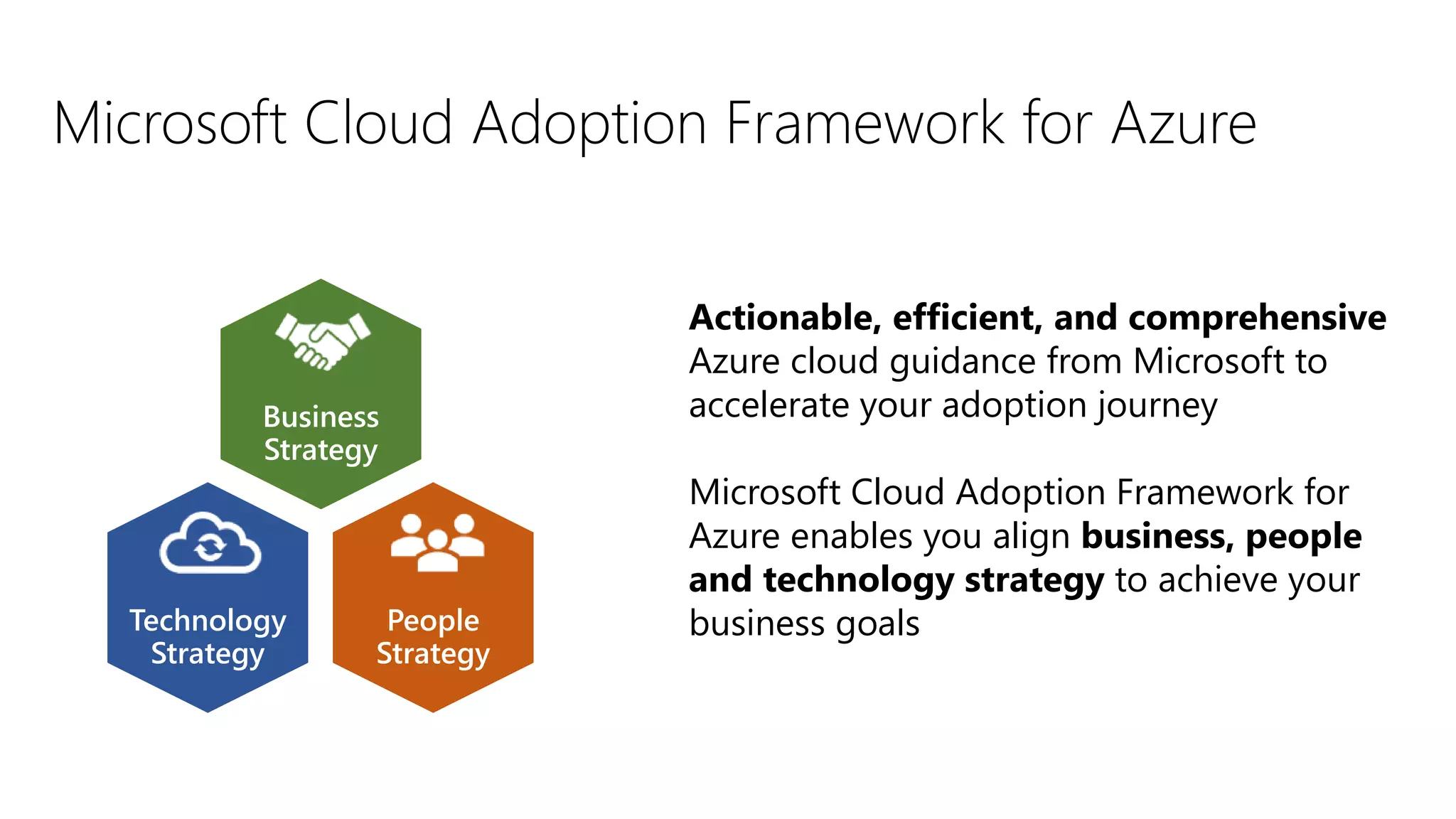
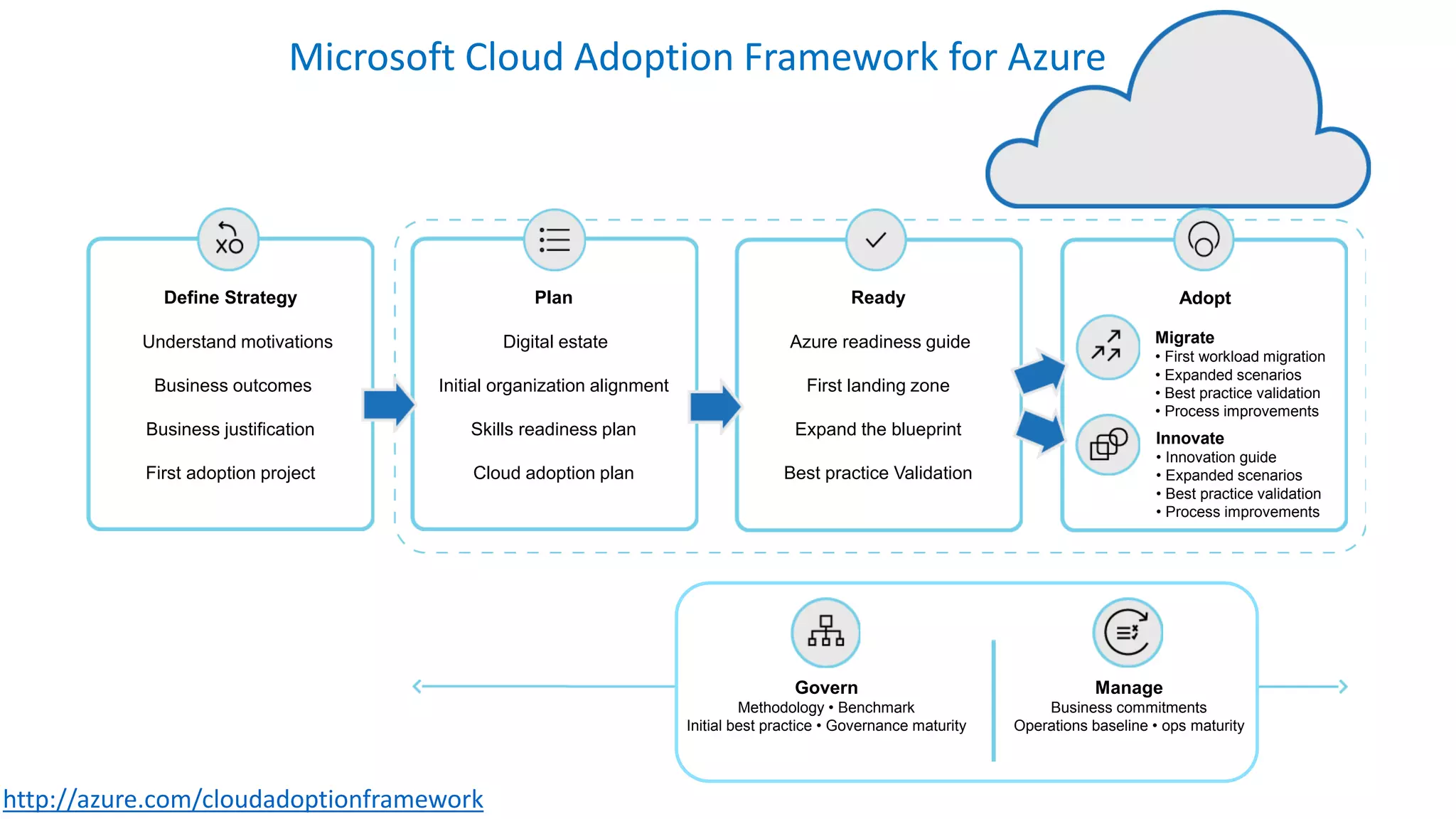
Microsoft Cloud Adoption Framework for Azure
Business
Strategy
Technology
Strategy
People
Strategy
Actionable, efficient, and comprehensive
Azure cloud guidance from Microsoft to
accelerate your adoption journey
Microsoft Cloud Adoption Framework for
Azure enables you align business, people
and technology strategy to achieve your
business goals
Plan
Digital estate
Initial organization alignment
Skills readiness plan
Cloud adoption plan
Ready
Azure readiness guide
First landing zone
Expand the blueprint
Best practice Validation
Define Strategy
Understand motivations
Business outcomes
Business justification
First adoption project
Migrate
• First workload migration
• Expanded scenarios
• Best practice validation
• Process improvements
Innovate
• Innovation guide
• Expanded scenarios
• Best practice validation
• Process improvements
Adopt
Govern
Methodology • Benchmark
Initial best practice • Governance maturity
Manage
Business commitments
Operations baseline • ops maturity
Microsoft Cloud Adoption Framework for Azure
http://azure.com/cloudadoptionframework
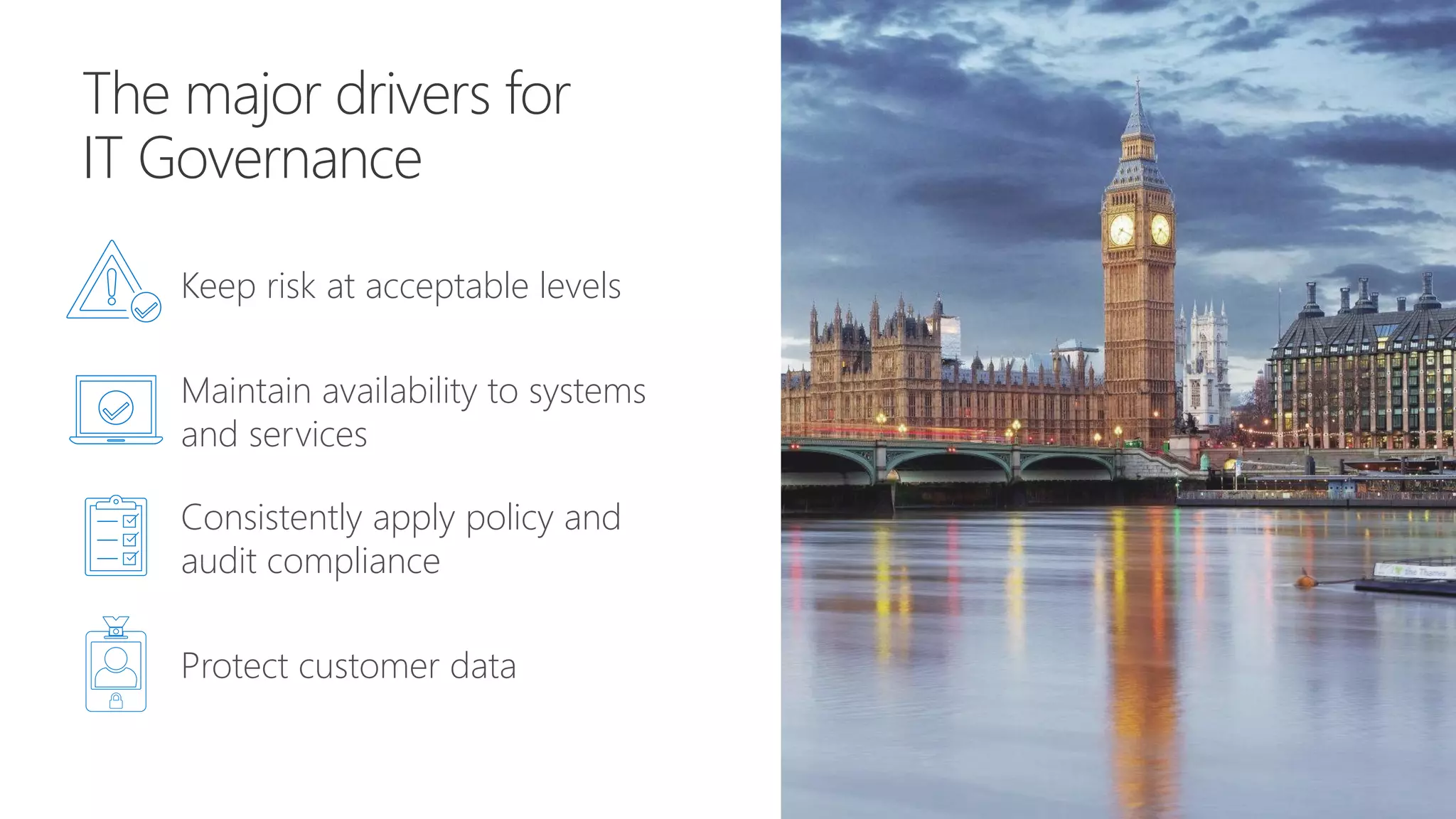
The major drivers for
IT Governance
Keep risk at acceptable levels
Maintain availability to systems
and services
Consistently apply policy and
audit compliance
Protect customer data
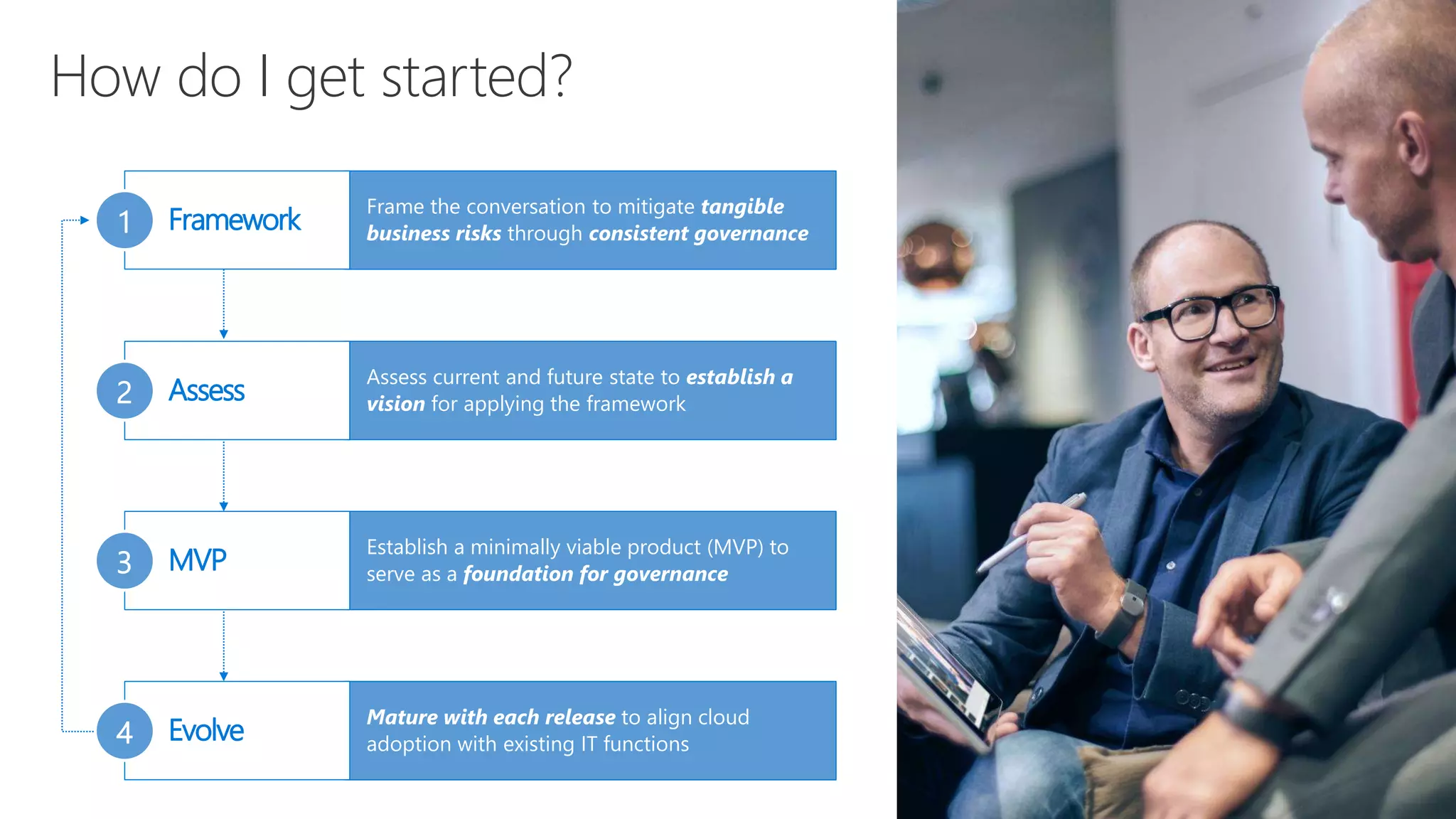
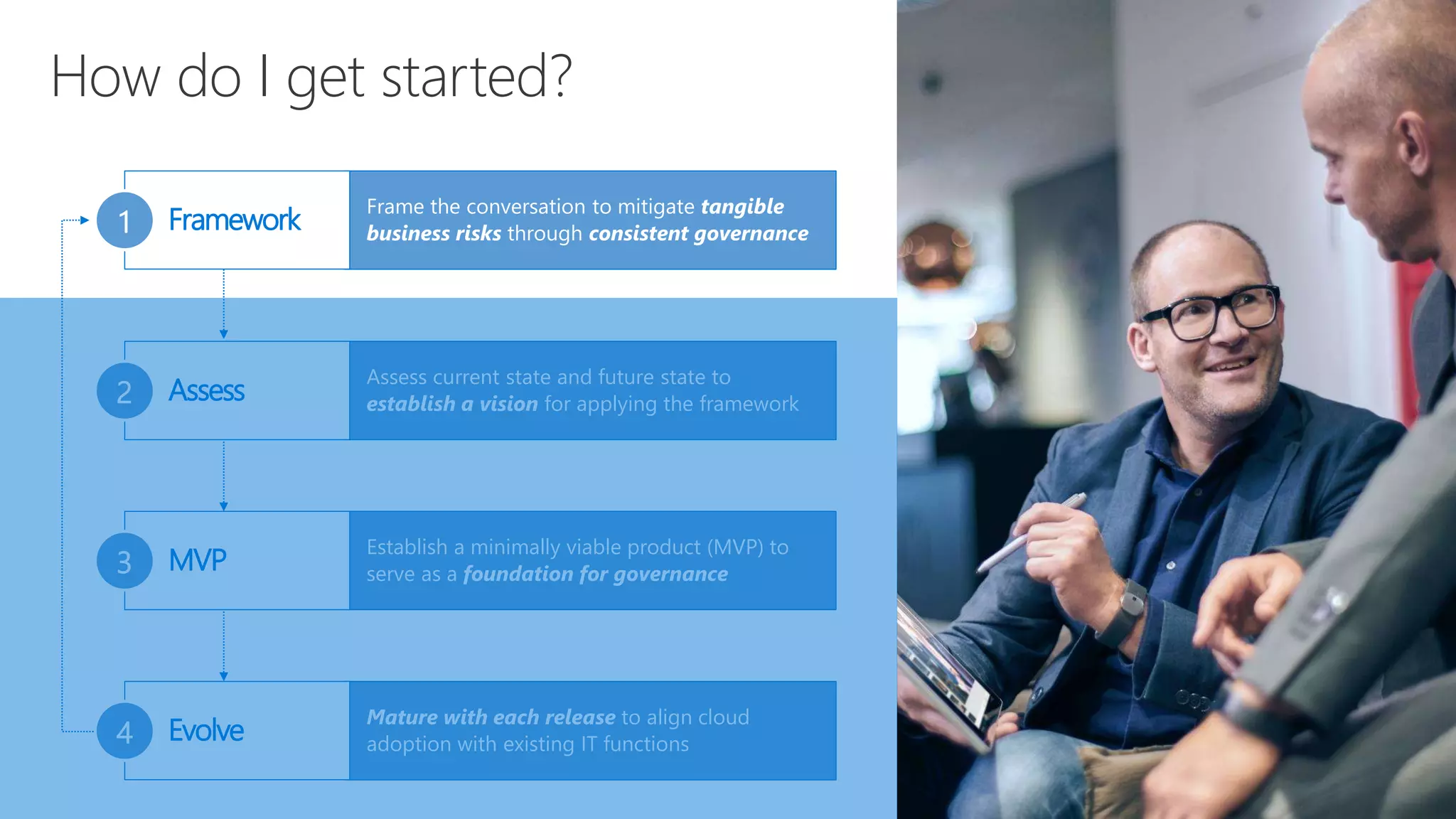
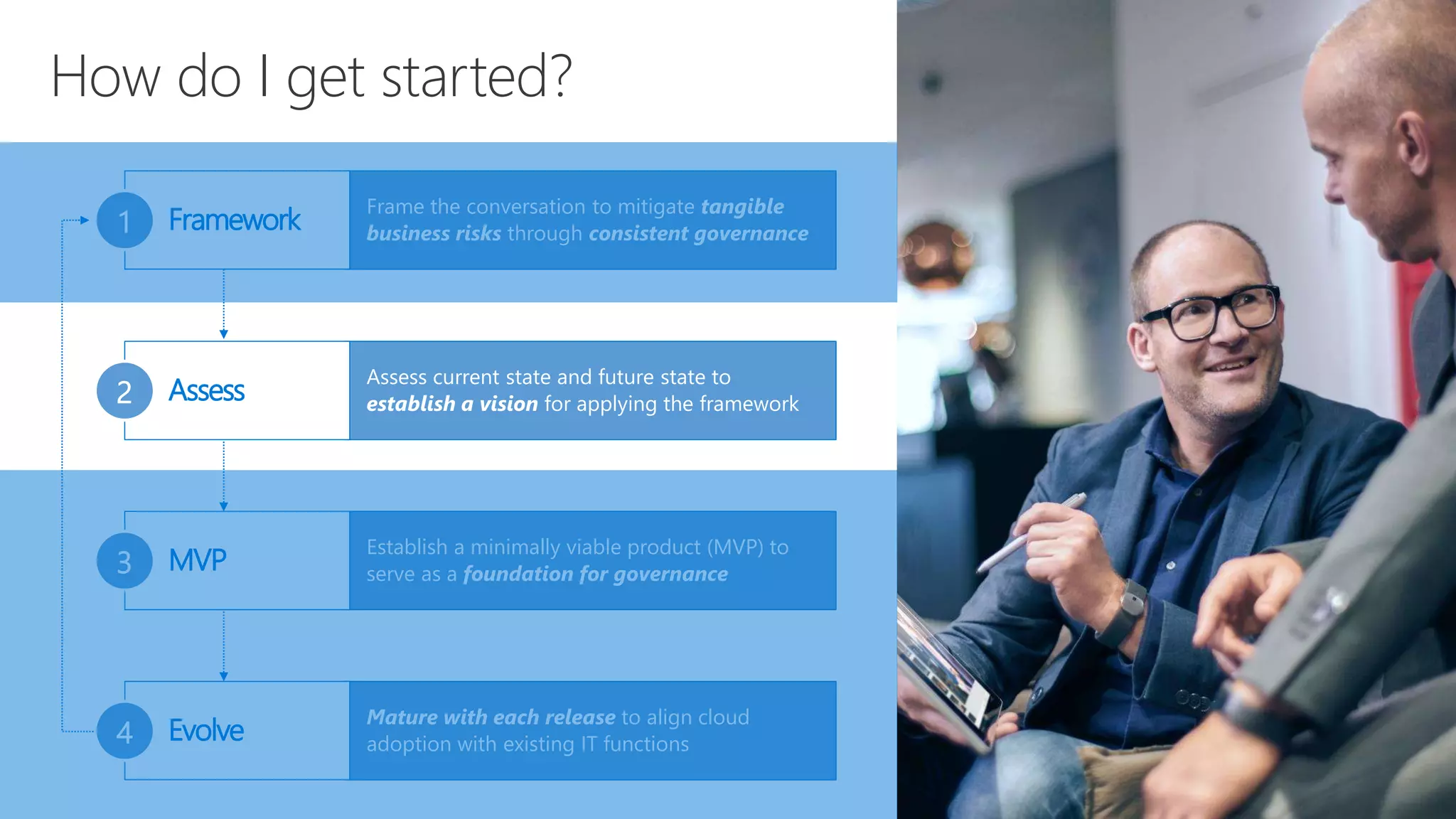
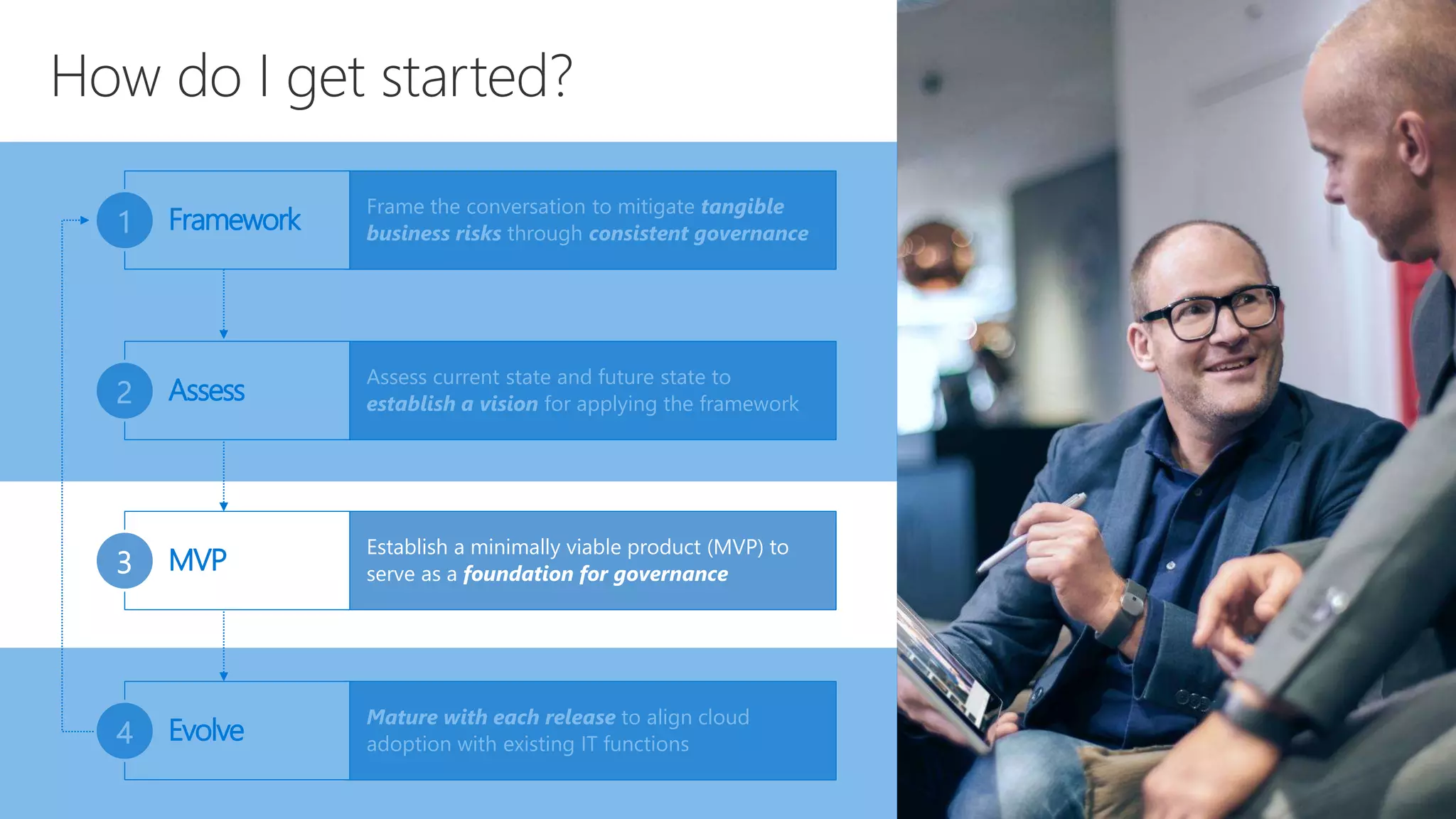
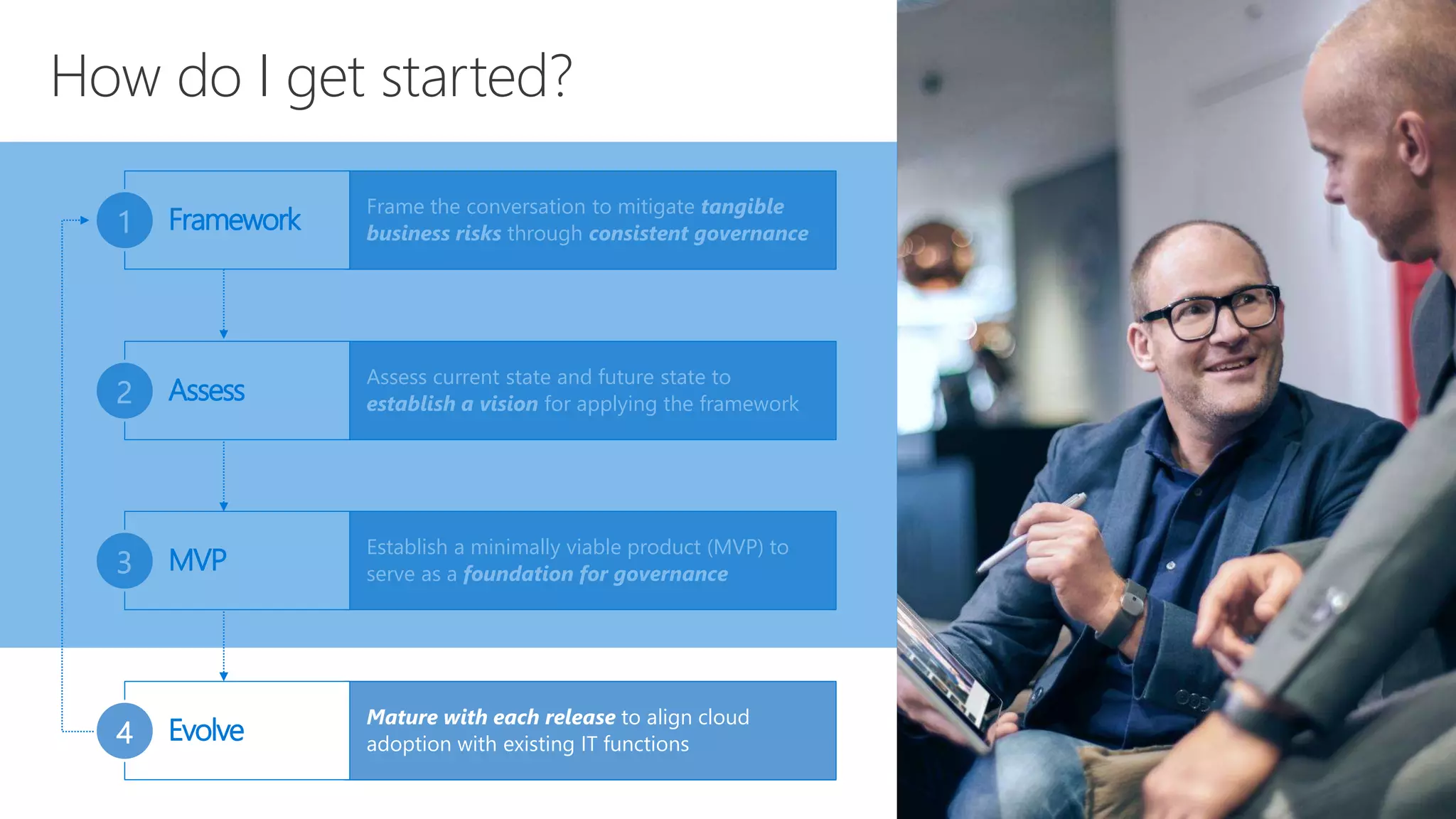
How do I get started?
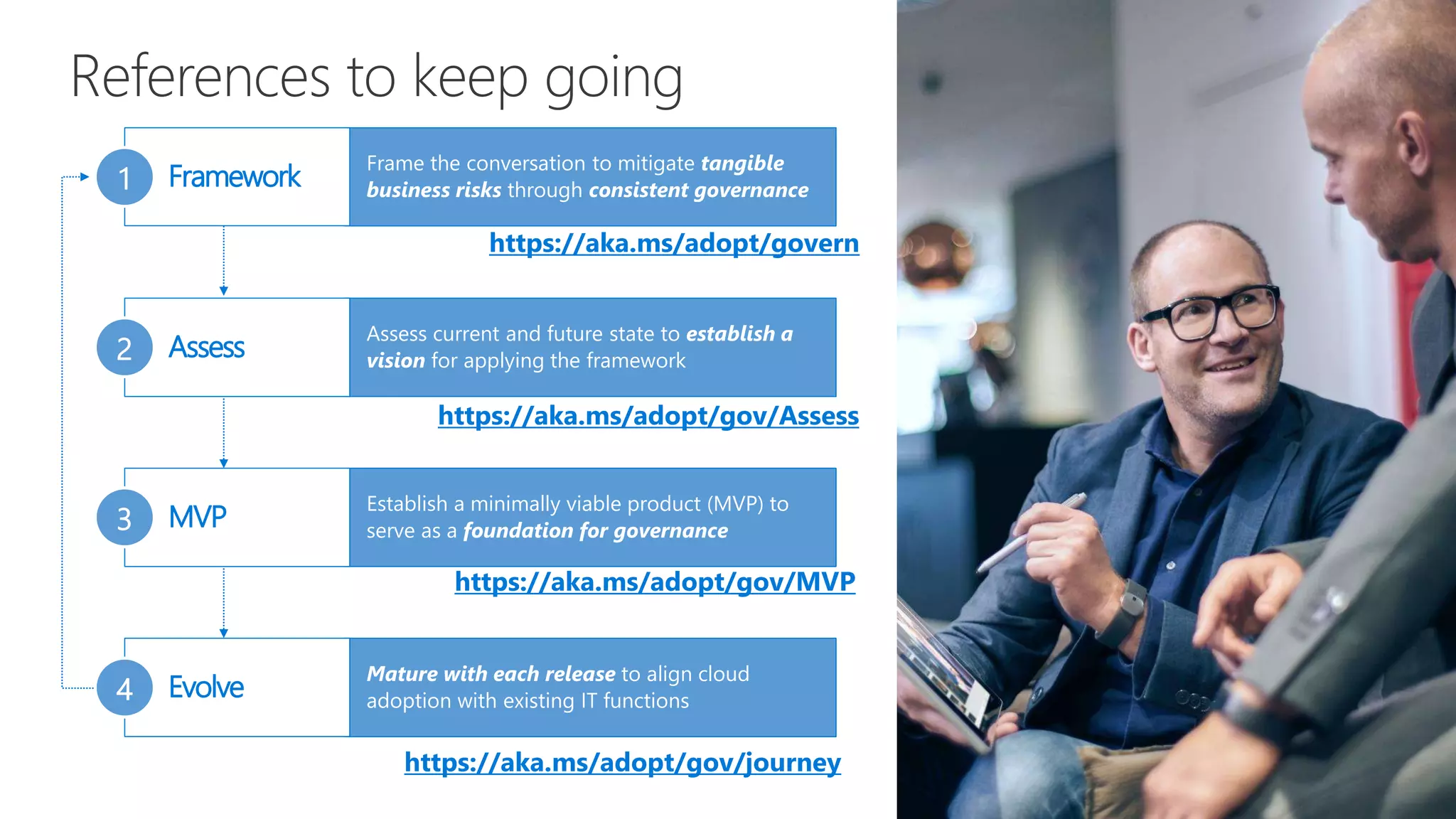
Frame the conversation to mitigate tangible
business risks through consistent governance
Framework1
Assess current and future state to establish a
vision for applying the framework
Assess2
Establish a minimally viable product (MVP) to
serve as a foundation for governance
MVP3
Mature with each release to align cloud
adoption with existing IT functions
Evolve4
Approaching the
Governance Conversation
Assess current state and future state to
establish a vision for applying the framework
Assess2
Establish a minimally viable product (MVP) to
serve as a foundation for governance
MVP3
How do I get started?
Frame the conversation to mitigate tangible
business risks through consistent governance
Framework1
Mature with each release to align cloud
adoption with existing IT functions
Evolve4
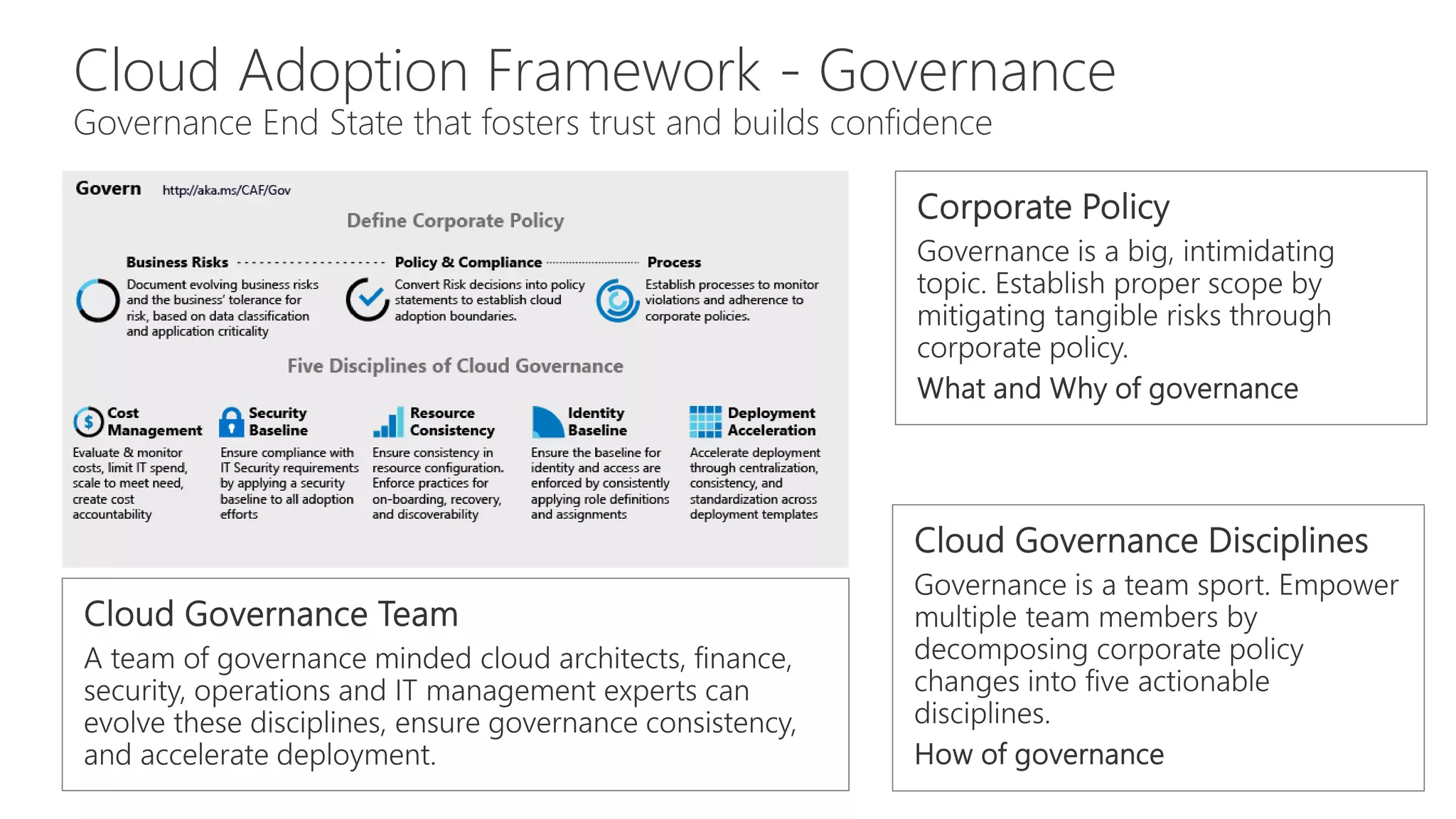
Cloud Adoption Framework - Governance
Governance End State that fosters trust and builds confidence
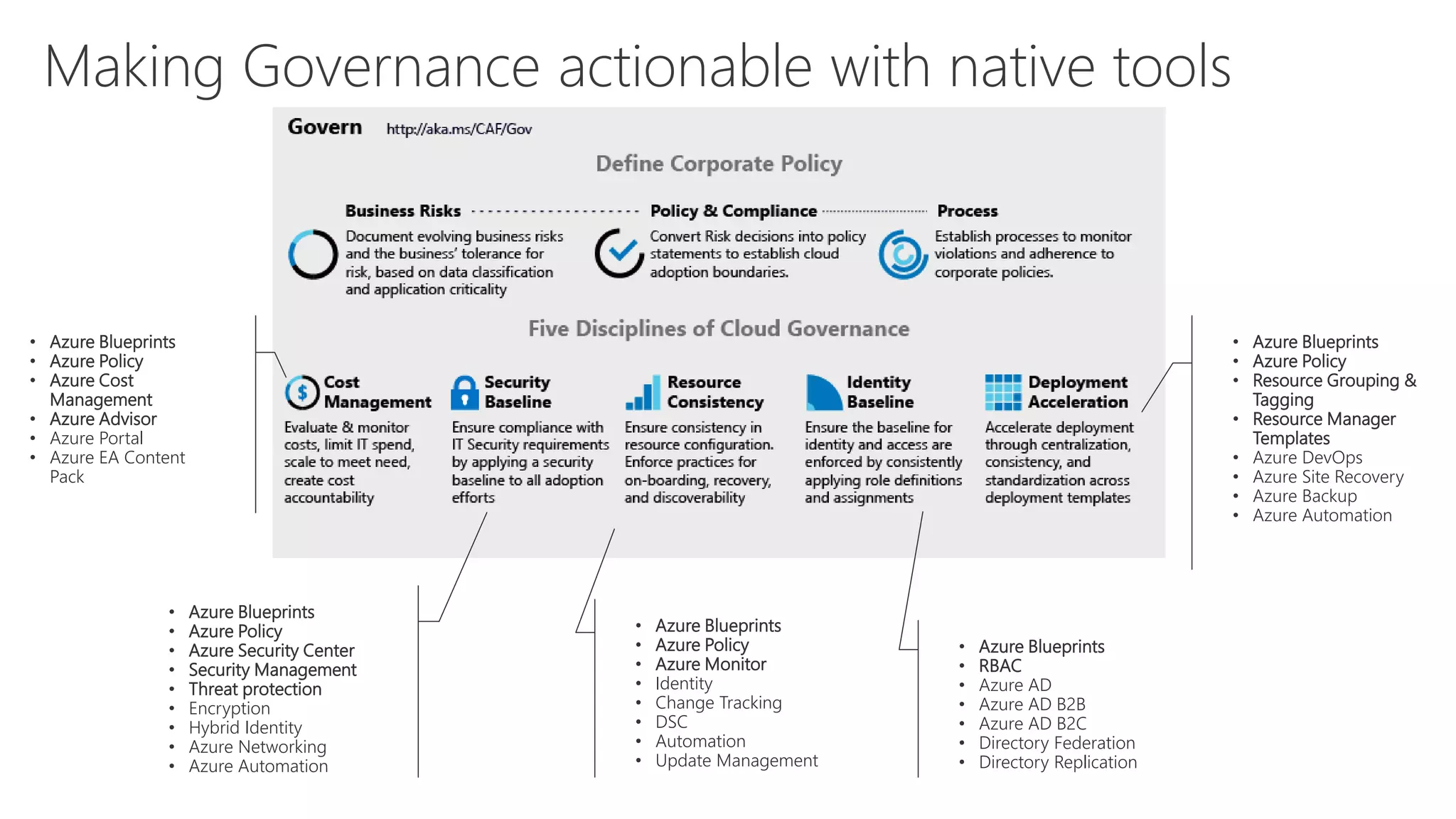
Making Governance actionable with native tools
• Azure Blueprints
• Azure Policy
• Azure Cost
Management
• Azure Advisor
• Azure Portal
• Azure EA Content
Pack
• Azure Blueprints
• Azure Policy
• Azure Security Center
• Security Management
• Threat protection
• Encryption
• Hybrid Identity
• Azure Networking
• Azure Automation
• Azure Blueprints
• Azure Policy
• Azure Monitor
• Identity
• Change Tracking
• DSC
• Automation
• Update Management
• Azure Blueprints
• RBAC
• Azure AD
• Azure AD B2B
• Azure AD B2C
• Directory Federation
• Directory Replication
• Azure Blueprints
• Azure Policy
• Resource Grouping &
Tagging
• Resource Manager
Templates
• Azure DevOps
• Azure Site Recovery
• Azure Backup
• Azure Automation
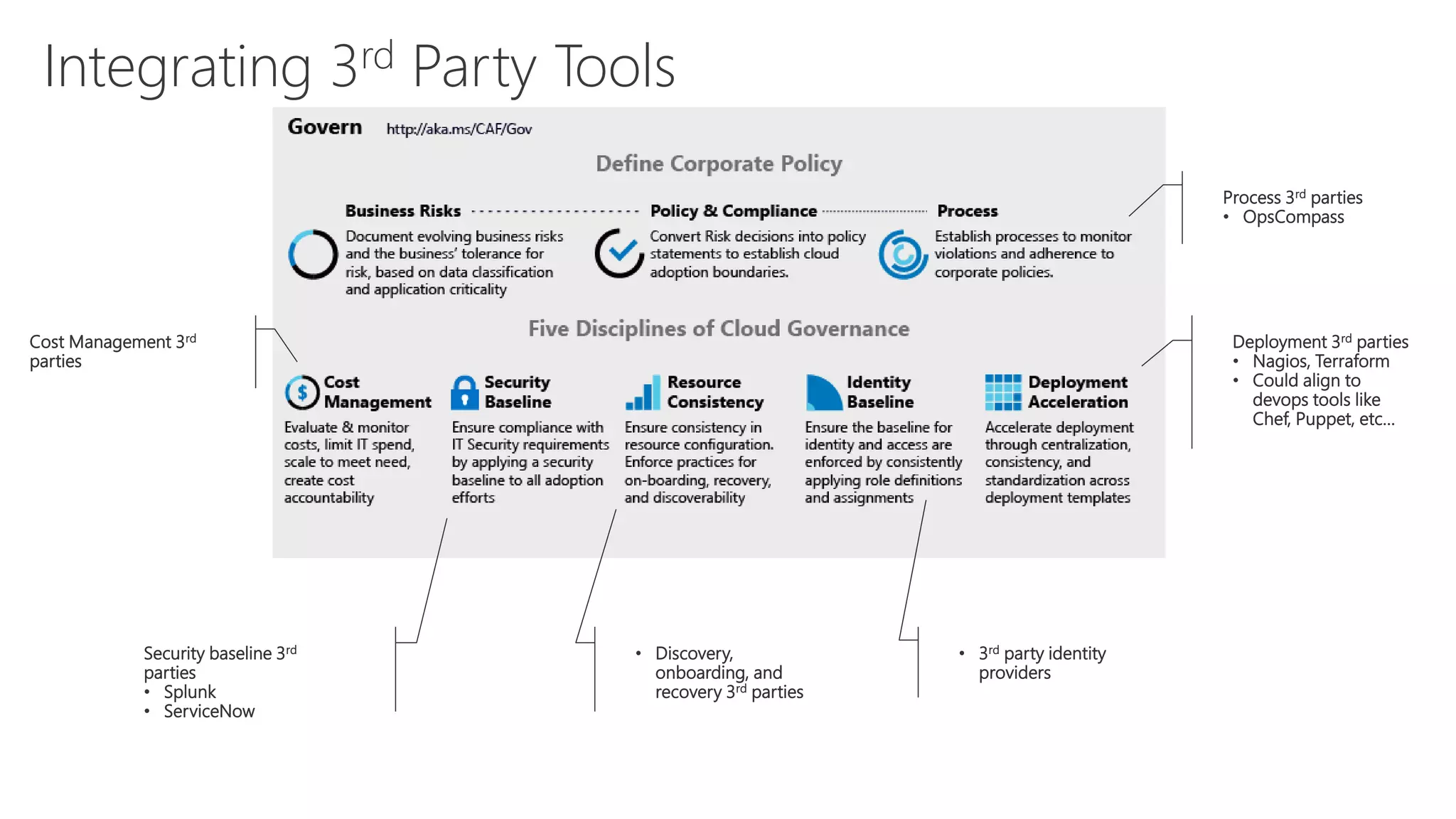
Integrating 3rd Party Tools
Cost Management 3rd
parties
Security baseline 3rd
parties
• Splunk
• ServiceNow
• Discovery,
onboarding, and
recovery 3rd parties
• 3rd party identity
providers
Deployment 3rd parties
• Nagios, Terraform
• Could align to
devops tools like
Chef, Puppet, etc…
Process 3rd parties
• OpsCompass
Assessing the Situation
Assess current state and future state to
establish a vision for applying the framework
Assess2
Establish a minimally viable product (MVP) to
serve as a foundation for governance
MVP3
How do I get started?
Frame the conversation to mitigate tangible
business risks through consistent governance
Framework1
Mature with each release to align cloud
adoption with existing IT functions
Evolve4
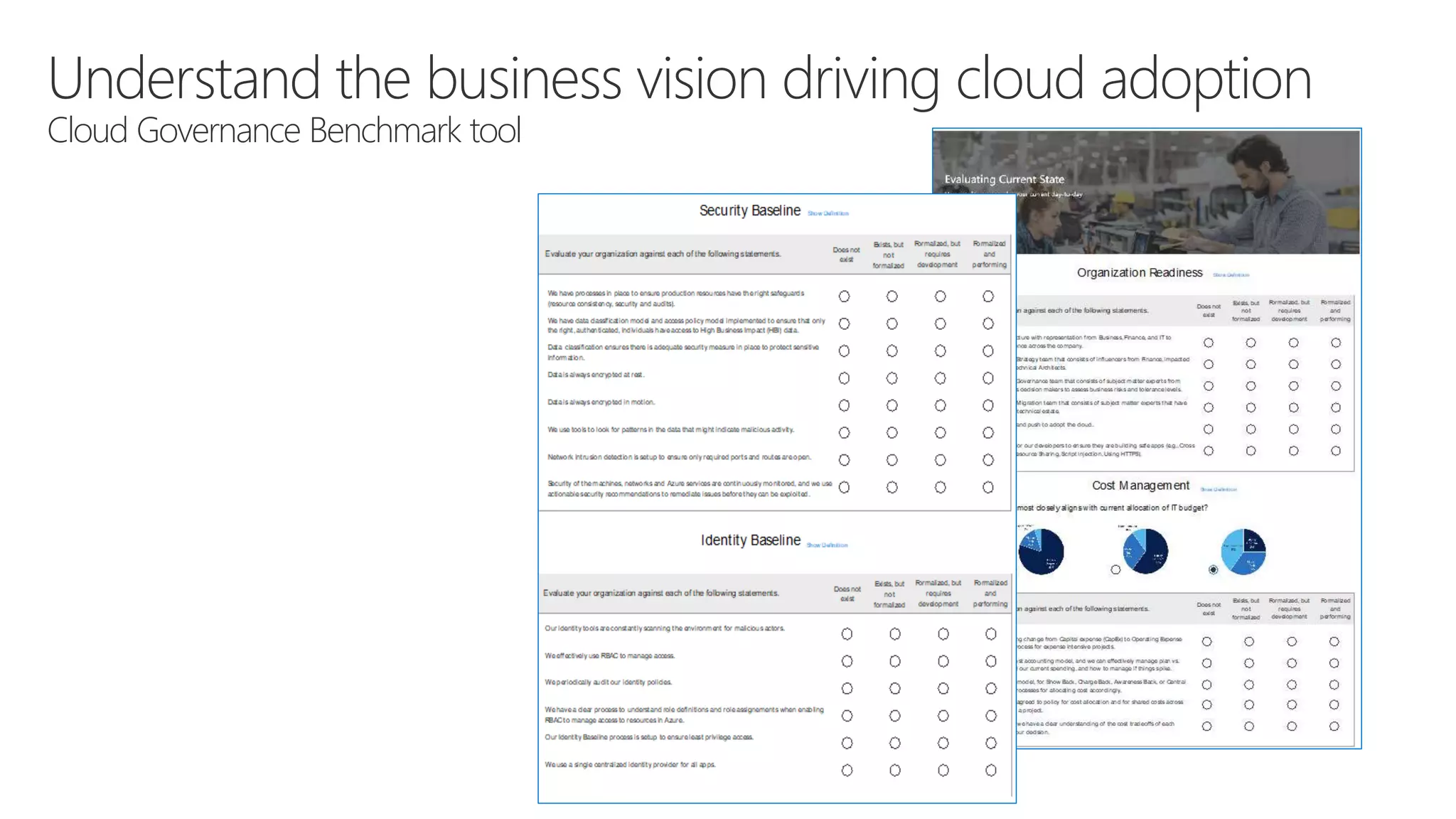
Understand the business vision driving cloud adoption
Cloud Governance Benchmark tool
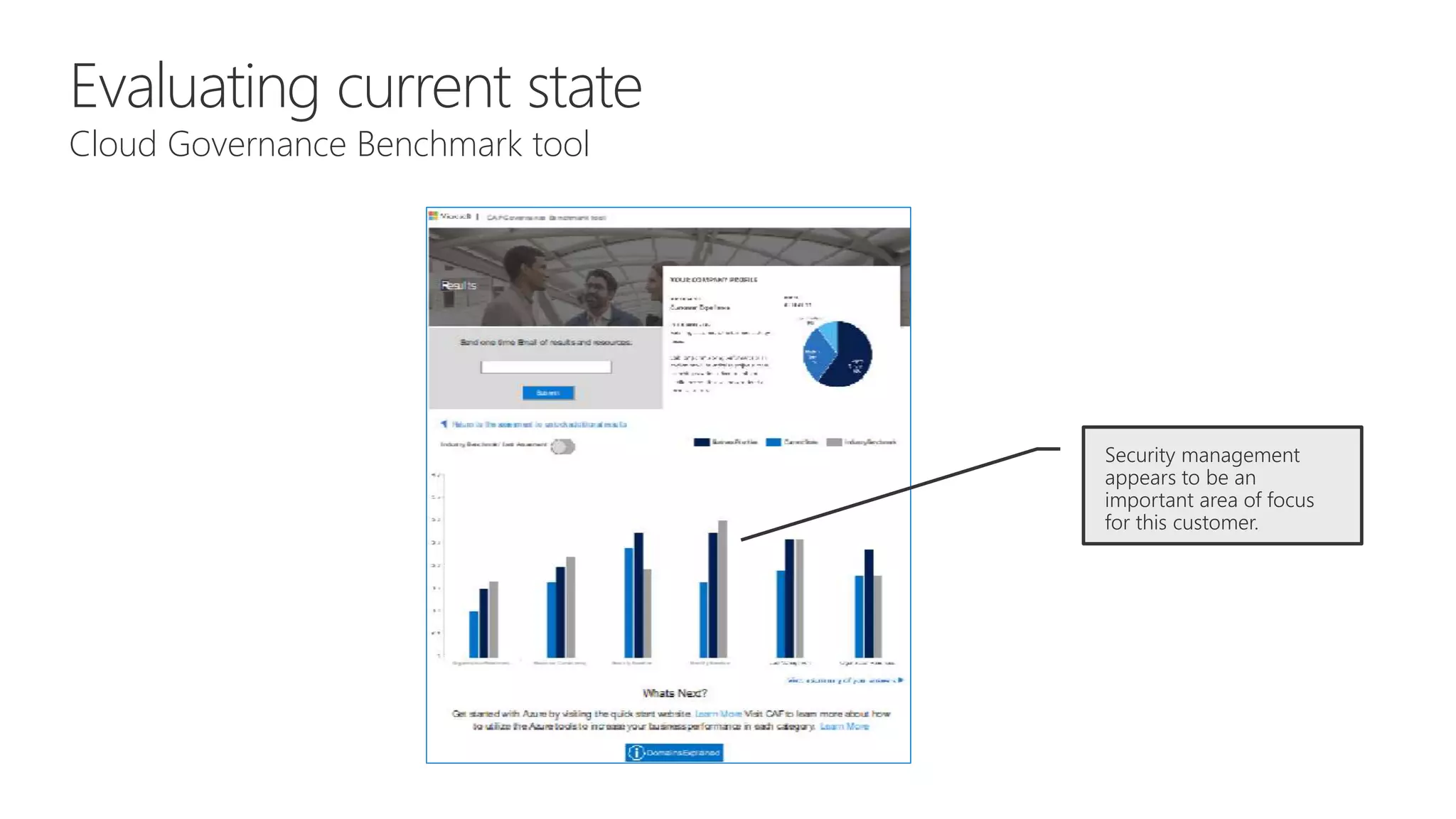
Evaluating current state
Cloud Governance Benchmark tool
Security management
appears to be an
important area of focus
for this customer.
Discussion - Establishing a
cloud governance MVP
Assess current state and future state to
establish a vision for applying the framework
Assess2
Establish a minimally viable product (MVP) to
serve as a foundation for governance
MVP3
Frame the conversation to mitigate tangible
business risks through consistent governance
Framework1
Mature with each release to align cloud
adoption with existing IT functions
Evolve4
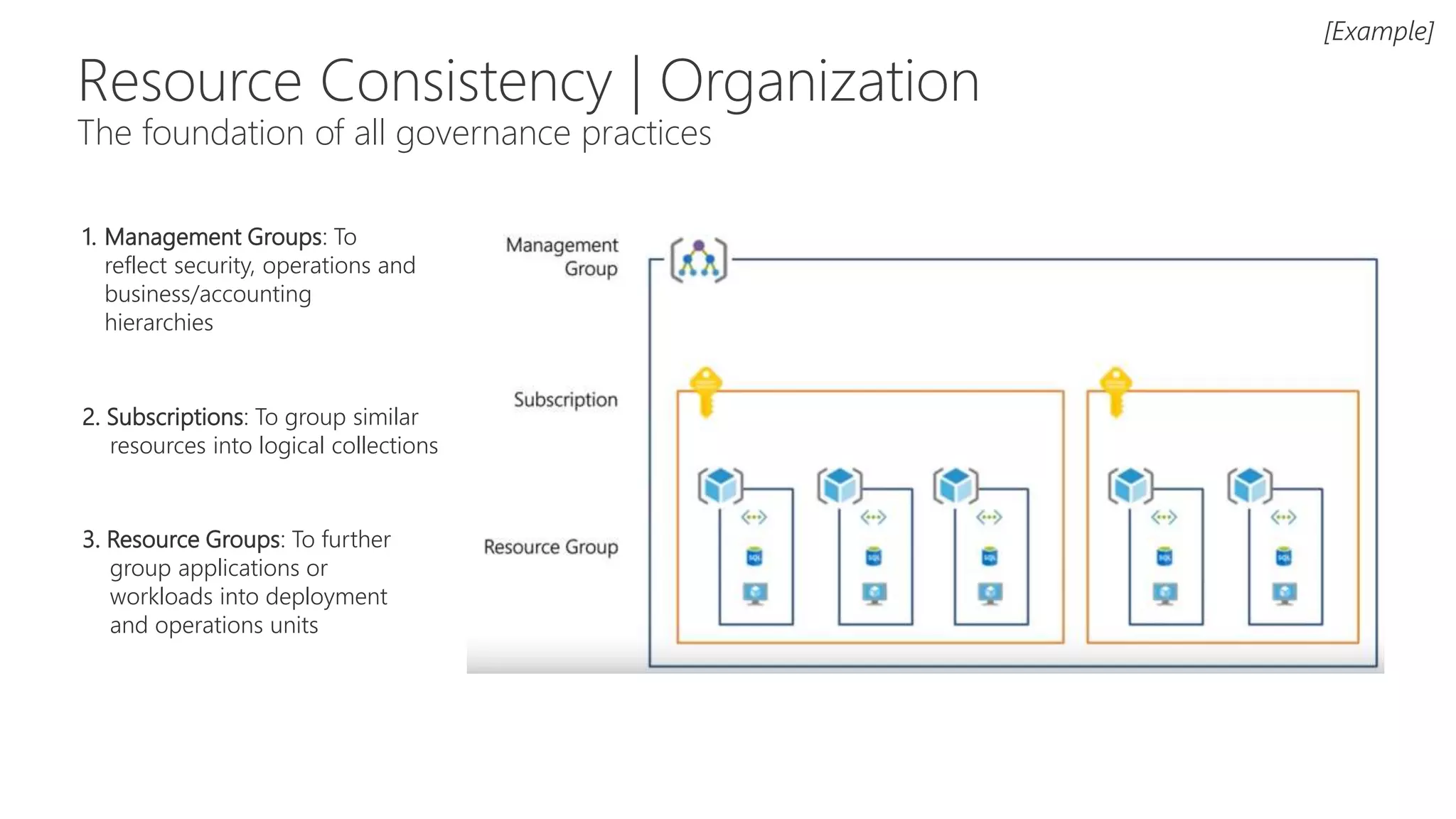
2. Subscriptions: To group similar
resources into logical collections
1. Management Groups: To
reflect security, operations and
business/accounting
hierarchies
Resource Consistency | Organization
The foundation of all governance practices
3. Resource Groups: To further
group applications or
workloads into deployment
and operations units
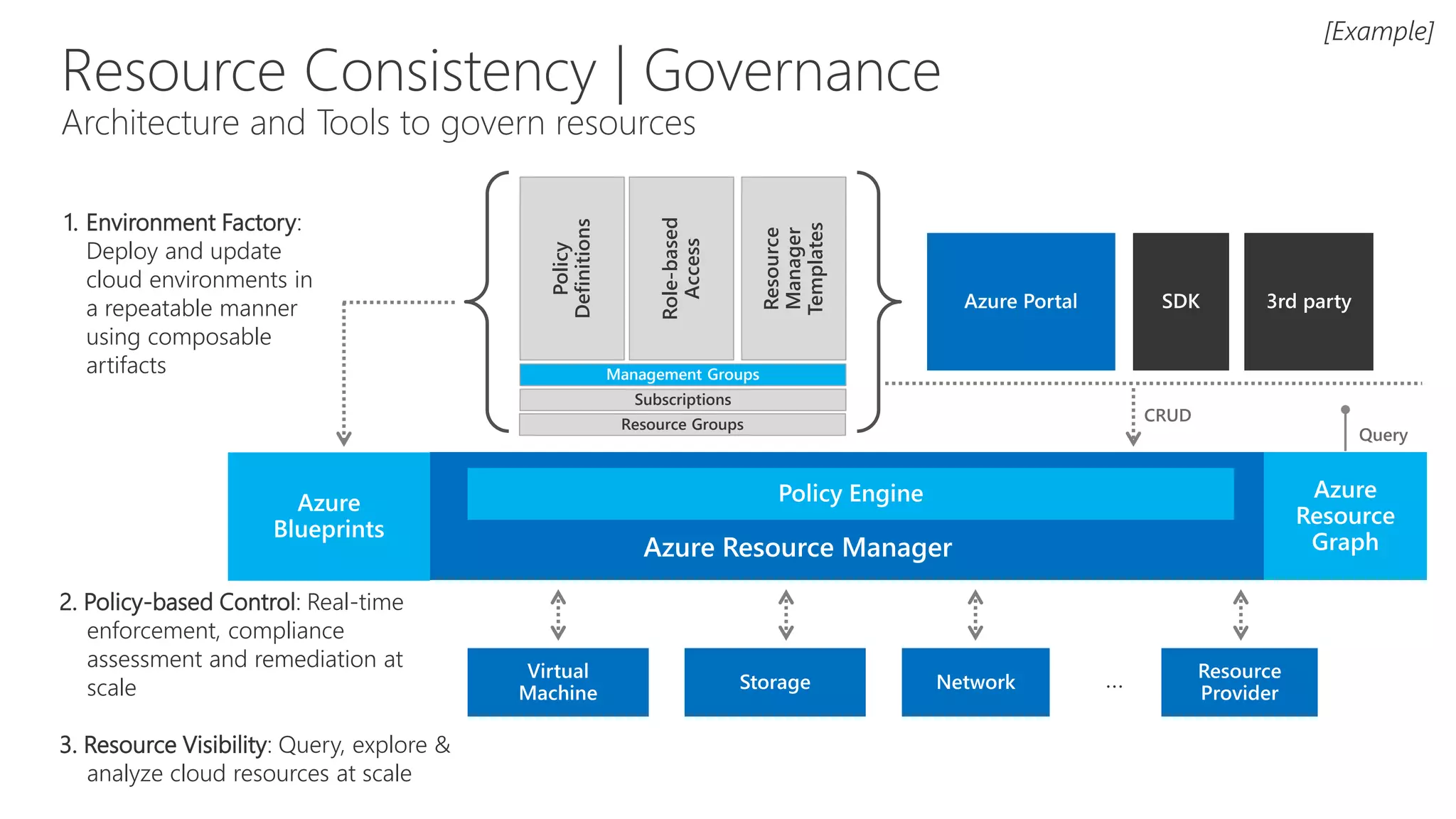
CRUD
Azure Resource Manager
Query
2. Policy-based Control: Real-time
enforcement, compliance
assessment and remediation at
scale
3. Resource Visibility: Query, explore &
analyze cloud resources at scale
1. Environment Factory:
Deploy and update
cloud environments in
a repeatable manner
using composable
artifacts
Role-based
Access
Policy
Definitions
Resource
Manager
Templates
Management Groups
Subscriptions
Resource Groups
Resource Consistency | Governance
Architecture and Tools to govern resources
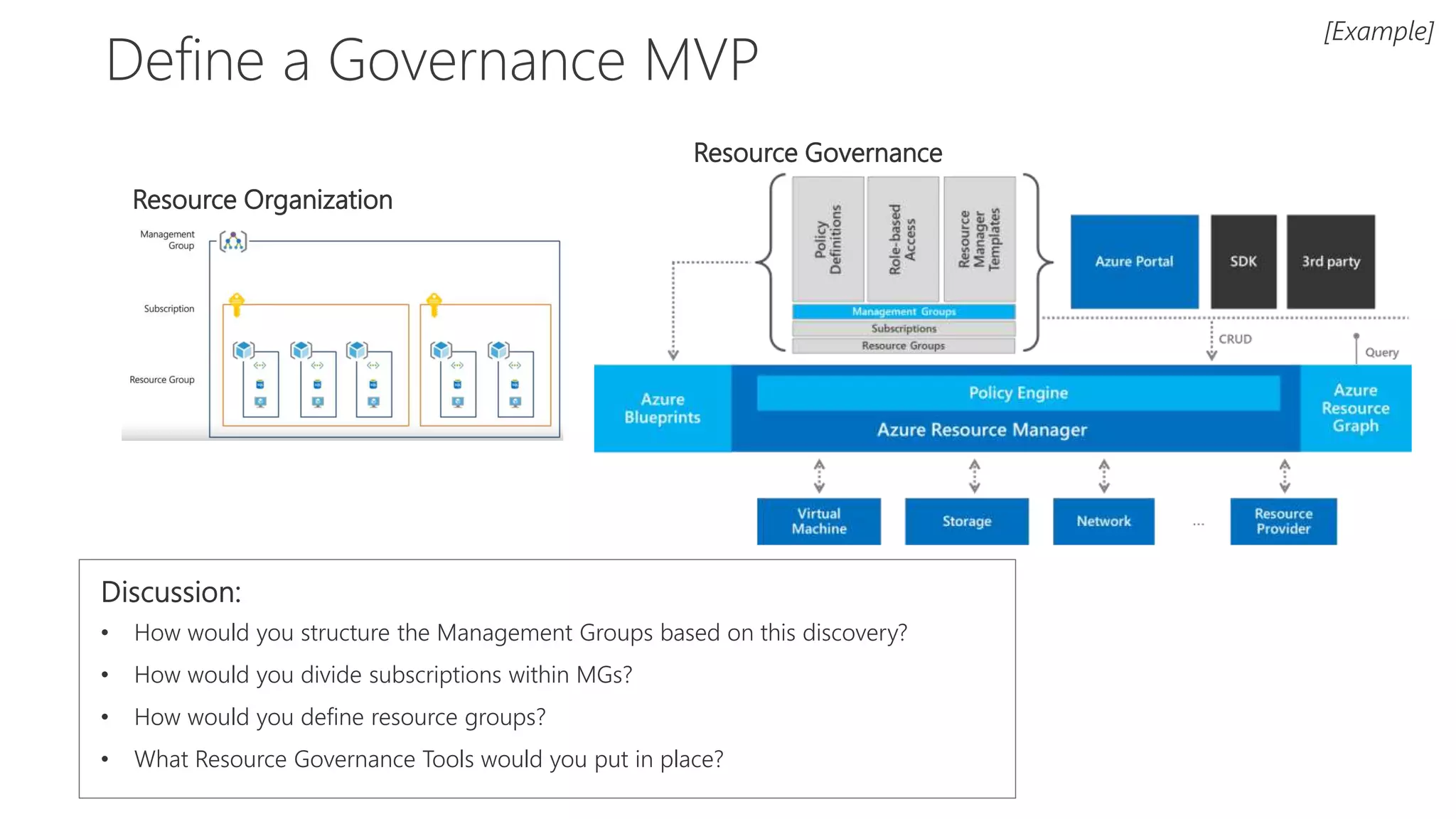
Define a Governance MVP
• How would you structure the Management Groups based on this discovery?
• How would you divide subscriptions within MGs?
• How would you define resource groups?
• What Resource Governance Tools would you put in place?
Resource Organization
Resource Governance
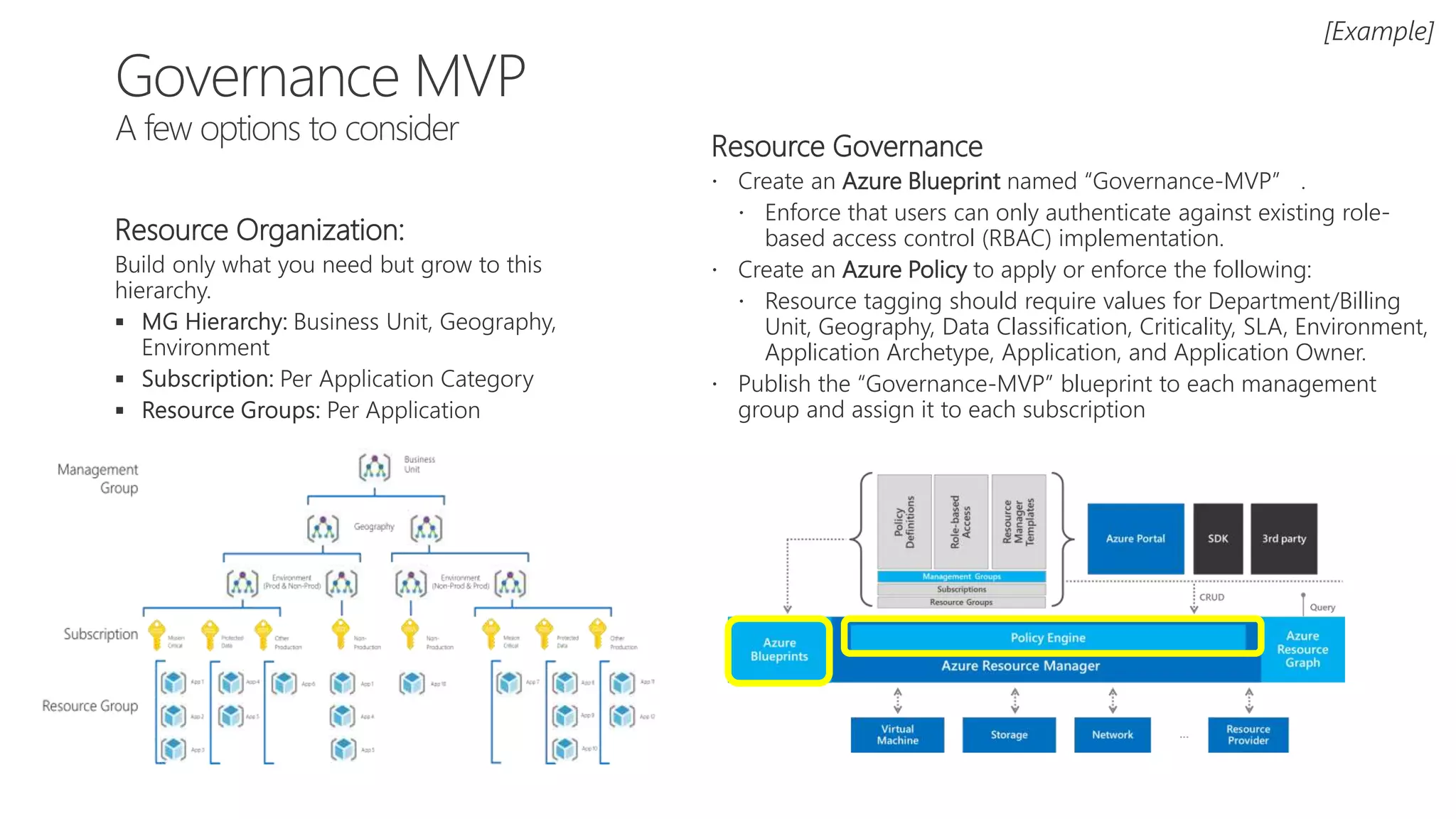
Resource Organization:
Governance MVP
A few options to consider Resource Governance
 Create an Azure Blueprint named “Governance-MVP” .
 Enforce that users can only authenticate against existing role-
based access control (RBAC) implementation.
 Create an Azure Policy to apply or enforce the following:
 Resource tagging should require values for Department/Billing
Unit, Geography, Data Classification, Criticality, SLA, Environment,
Application Archetype, Application, and Application Owner.
 Publish the “Governance-MVP” blueprint to each management
group and assign it to each subscription
We are here to help establish
and evolve cloud governance
Assess current state and future state to
establish a vision for applying the framework
Assess2
Establish a minimally viable product (MVP) to
serve as a foundation for governance
MVP3
How do I get started?
Frame the conversation to mitigate tangible
business risks through consistent governance
Framework1
Mature with each release to align cloud
adoption with existing IT functions
Evolve4
Partner offering slides to continue the Governance
conversation
Closing
Partner proposed next steps
References to keep going
Frame the conversation to mitigate tangible
business risks through consistent governance
Framework1
Assess current and future state to establish a
vision for applying the framework
Assess2
Establish a minimally viable product (MVP) to
serve as a foundation for governance
MVP3
Mature with each release to align cloud
adoption with existing IT functions
Evolve4
https://aka.ms/adopt/govern
https://aka.ms/adopt/gov/Assess
https://aka.ms/adopt/gov/MVP
https://aka.ms/adopt/gov/journey
Thank you

Microsoft Cloud Adoption Framework for Azure: Thru Partner Governance Workshop

  • 1.
    Making Governance Easier withthe Microsoft Cloud Adoption Framework for Azure [Presenter Name] [Partner Organization Name] [Partner Logo]
  • 3.
  • 5.
    Microsoft Cloud AdoptionFramework for Azure Business Strategy Technology Strategy People Strategy Actionable, efficient, and comprehensive Azure cloud guidance from Microsoft to accelerate your adoption journey Microsoft Cloud Adoption Framework for Azure enables you align business, people and technology strategy to achieve your business goals
  • 6.
    Plan Digital estate Initial organizationalignment Skills readiness plan Cloud adoption plan Ready Azure readiness guide First landing zone Expand the blueprint Best practice Validation Define Strategy Understand motivations Business outcomes Business justification First adoption project Migrate • First workload migration • Expanded scenarios • Best practice validation • Process improvements Innovate • Innovation guide • Expanded scenarios • Best practice validation • Process improvements Adopt Govern Methodology • Benchmark Initial best practice • Governance maturity Manage Business commitments Operations baseline • ops maturity Microsoft Cloud Adoption Framework for Azure http://azure.com/cloudadoptionframework
  • 7.
    The major driversfor IT Governance Keep risk at acceptable levels Maintain availability to systems and services Consistently apply policy and audit compliance Protect customer data
  • 8.
    How do Iget started? Frame the conversation to mitigate tangible business risks through consistent governance Framework1 Assess current and future state to establish a vision for applying the framework Assess2 Establish a minimally viable product (MVP) to serve as a foundation for governance MVP3 Mature with each release to align cloud adoption with existing IT functions Evolve4
  • 9.
  • 10.
    Assess current stateand future state to establish a vision for applying the framework Assess2 Establish a minimally viable product (MVP) to serve as a foundation for governance MVP3 How do I get started? Frame the conversation to mitigate tangible business risks through consistent governance Framework1 Mature with each release to align cloud adoption with existing IT functions Evolve4
  • 11.
    Cloud Adoption Framework- Governance Governance End State that fosters trust and builds confidence
  • 12.
    Making Governance actionablewith native tools • Azure Blueprints • Azure Policy • Azure Cost Management • Azure Advisor • Azure Portal • Azure EA Content Pack • Azure Blueprints • Azure Policy • Azure Security Center • Security Management • Threat protection • Encryption • Hybrid Identity • Azure Networking • Azure Automation • Azure Blueprints • Azure Policy • Azure Monitor • Identity • Change Tracking • DSC • Automation • Update Management • Azure Blueprints • RBAC • Azure AD • Azure AD B2B • Azure AD B2C • Directory Federation • Directory Replication • Azure Blueprints • Azure Policy • Resource Grouping & Tagging • Resource Manager Templates • Azure DevOps • Azure Site Recovery • Azure Backup • Azure Automation
  • 13.
    Integrating 3rd PartyTools Cost Management 3rd parties Security baseline 3rd parties • Splunk • ServiceNow • Discovery, onboarding, and recovery 3rd parties • 3rd party identity providers Deployment 3rd parties • Nagios, Terraform • Could align to devops tools like Chef, Puppet, etc… Process 3rd parties • OpsCompass
  • 14.
  • 15.
    Assess current stateand future state to establish a vision for applying the framework Assess2 Establish a minimally viable product (MVP) to serve as a foundation for governance MVP3 How do I get started? Frame the conversation to mitigate tangible business risks through consistent governance Framework1 Mature with each release to align cloud adoption with existing IT functions Evolve4
  • 16.
    Understand the businessvision driving cloud adoption Cloud Governance Benchmark tool
  • 17.
    Evaluating current state CloudGovernance Benchmark tool Security management appears to be an important area of focus for this customer.
  • 18.
    Discussion - Establishinga cloud governance MVP
  • 19.
    Assess current stateand future state to establish a vision for applying the framework Assess2 Establish a minimally viable product (MVP) to serve as a foundation for governance MVP3 Frame the conversation to mitigate tangible business risks through consistent governance Framework1 Mature with each release to align cloud adoption with existing IT functions Evolve4
  • 20.
    2. Subscriptions: Togroup similar resources into logical collections 1. Management Groups: To reflect security, operations and business/accounting hierarchies Resource Consistency | Organization The foundation of all governance practices 3. Resource Groups: To further group applications or workloads into deployment and operations units
  • 21.
    CRUD Azure Resource Manager Query 2.Policy-based Control: Real-time enforcement, compliance assessment and remediation at scale 3. Resource Visibility: Query, explore & analyze cloud resources at scale 1. Environment Factory: Deploy and update cloud environments in a repeatable manner using composable artifacts Role-based Access Policy Definitions Resource Manager Templates Management Groups Subscriptions Resource Groups Resource Consistency | Governance Architecture and Tools to govern resources
  • 22.
    Define a GovernanceMVP • How would you structure the Management Groups based on this discovery? • How would you divide subscriptions within MGs? • How would you define resource groups? • What Resource Governance Tools would you put in place? Resource Organization Resource Governance
  • 23.
    Resource Organization: Governance MVP Afew options to consider Resource Governance  Create an Azure Blueprint named “Governance-MVP” .  Enforce that users can only authenticate against existing role- based access control (RBAC) implementation.  Create an Azure Policy to apply or enforce the following:  Resource tagging should require values for Department/Billing Unit, Geography, Data Classification, Criticality, SLA, Environment, Application Archetype, Application, and Application Owner.  Publish the “Governance-MVP” blueprint to each management group and assign it to each subscription
  • 24.
    We are hereto help establish and evolve cloud governance
  • 25.
    Assess current stateand future state to establish a vision for applying the framework Assess2 Establish a minimally viable product (MVP) to serve as a foundation for governance MVP3 How do I get started? Frame the conversation to mitigate tangible business risks through consistent governance Framework1 Mature with each release to align cloud adoption with existing IT functions Evolve4
  • 26.
    Partner offering slidesto continue the Governance conversation
  • 27.
  • 28.
  • 29.
    References to keepgoing Frame the conversation to mitigate tangible business risks through consistent governance Framework1 Assess current and future state to establish a vision for applying the framework Assess2 Establish a minimally viable product (MVP) to serve as a foundation for governance MVP3 Mature with each release to align cloud adoption with existing IT functions Evolve4 https://aka.ms/adopt/govern https://aka.ms/adopt/gov/Assess https://aka.ms/adopt/gov/MVP https://aka.ms/adopt/gov/journey
  • 30.

Editor's Notes

  • #7 Pablo
  • #10 Governance is about achieving strategic objectives (performance) while meeting legal, regulatory, contractual, and other obligatory requirements often supported by policies (conformance). The goal is to achieve both in a balanced way.
  • #14 Talk track: The CAF model to governance is a way of approaching governance that allows us to decompose complex and emotional topics into smaller units of actionable change. In the sections on Defining Corporate Policy, we change the topic from alignment to current IT governance requirements to a realistic look at tangible risks created by cloud adoption. Those risks can generate policy & compliance statements and recurring processes, which augment existing IT Governance Policy. Actioning on those policy statements, is done in one of five buckets of activity that span the governance conversations. In each of the five disciplines, the Cloud Governance Team leverages the Configuration Management capabilities of the Azure Govern and Azure Manage tools to help IT Governance, IT Security, Identity, and Networking teams apply requirements consistently across all Azure adoption. In this session, we will focus on the tools that establish a foundation for governance in Azure, which can be used to accelerate all five disciplines. These tools will aid in ensuring that the requirements of each discipline is consistently applied, audited, & enforced.
  • #15 Talking points: The five disciplines of cloud governance is a grouping of challenges faced by cloud customers (Both Azure customers and the users of other clouds). This grouping was devised and validated through direct conversations and independent studies across hundreds of hours of interviews. The five disciplines are universal to cloud users as cloud agnostic guiding principles. They are ranked in order of concern, based on user feedback. Unfortunately, implementation of those disciplines is very cloud specific. Lets step through approaches to action on the five disciplines in Azure. Animation 1: Configuration Management – Is the first of 2 bookends that represent the domain of the Cloud Governance Team. Cloud Governance shares many commonalities with DevOps and is rooting firmly in configuration management. Establishing a Governance MVP rooting in proper nomenclature, subscription strategies, resource grouping, and resource tagging strategies is vital. Those initial strategies (AND ALL OTHER GOVERNANCE IMPLEMENTATION) is then executed through governance tools consisting of Azure Blueprints, Azure Policy, Azure Resource Manager Templates, Azure Management Groups, and Azure Resource Groups. Master these tools and concepts and incremental governance will flow smoothly. Additional partners in this discipline should include Disaster Recovery, Business Continuity, and/or DevOps specialists, when available. Animation 2: Identity is still the domain of identity experts. As identity policies and requirements are defined, governance tooling and processes from the Configuration Management discipline can govern application of those requirements across all deployments. Animation 3: Resource management is the domain of IT ops or Cloud operations. However, the governance team aids in identifying what needs monitoring & to what level of criticality. Governance tooling and processes from the Configuration Management discipline enforces the discoverability of assets and other operations requirements, across all deployments. Animation 4: Security Management is the domain of IT Security or Cyber Security specialists. They should define all security requirements. However, the governance team aids in identifying data classifications and protection levels. Governance tooling and processes from the Configuration Management discipline enforces the application of security requirements, across all deployments. Animation 5: Cost Management is the second book end for the domain of the Cloud Governance Team. It is also one of the most common concerns among customers. Just as configuration management is important to rapid governance implementation. Azure Cost Management or Cloudyn is important for control of costs in the cloud. Providing a holistic view of spend and a centralized means of controlling spend is a very important aspect of Cloud Governance. In fact, it is commonly the first and clearest justification for investments in Cloud Governance. Cloud governance depends on a partnership with many teams. Likewise, those teams will come to depend on Cloud Governance for comprehensive and swift application of policy across cloud solutions. This model helps better align corporate policy to governance actions and the impacted teams.
  • #16 What third parties can be used to accomplish similar goals?
  • #17 For each of these questions, assume the Cloud Adoption Team and Cloud Governance Team are in the room for planning discussions.
  • #22 For each of these questions, assume the Cloud Adoption Team and Cloud Governance Team are in the room for planning discussions.
  • #25 Example of an MVP for resource consistency.
  • #27 EXAMPLE Current State - Sales and operations in multiple geographies – global customer base - Three business units - Budget is a complex matrix across business unit and geography - 20 privately-owned datacenters around the globe - Loosely-coupled global WAN - All end user email accounts are in Office 365 - The CIO and CFO want to move two data centers and 5,000 VMs in 36 mo - There is no interest in investing in cloud governance, but a few cloud architects want to get ready for the inevitable. IT governance policy states that customer personally identifiable information (PII), financial data, and mission critical workloads must be hosted on assets owned directly by the company. The CIO is working on changing this policy.
  • #32 Talk track: The CAF model to governance is a way of approaching governance that allows us to decompose complex and emotional topics into smaller units of actionable change. In the sections on Defining Corporate Policy, we change the topic from alignment to current IT governance requirements to a realistic look at tangible risks created by cloud adoption. Those risks can generate policy & compliance statements and recurring processes, which augment existing IT Governance Policy. Actioning on those policy statements, is done in one of five buckets of activity that span the governance conversations. In each of the five disciplines, the Cloud Governance Team leverages the Configuration Management capabilities of the Azure Govern and Azure Manage tools to help IT Governance, IT Security, Identity, and Networking teams apply requirements consistently across all Azure adoption. In this session, we will focus on the tools that establish a foundation for governance in Azure, which can be used to accelerate all five disciplines. These tools will aid in ensuring that the requirements of each discipline is consistently applied, audited, & enforced. Corporate Policy Data Breach is the primary risk. All policy statements should focus on reducing the risk of breach through segmentation, isolation, authentication control, etc… Risk Discovered Adoption plans now include a need to host protected data in the cloud. This data is sensitive but not governed by 3rd party compliance. Suggestions: This could consume a lot of time. The time could be higher for those that are not native English speakers Where is the reference materials to help them think through potential solutions
  • #33 Risk discovered Costs are mushrooming. The CFO is concerned with budget overrun. A report is needed to show spend by business unit. Controls are needed to limit expenses. Review and adjust this pattern to fit before presenting to the customer.