CLOUD NATIVE CAMEL RIDING WITH
KUBERNETES AND OPENSHIFT
@christianposta
17 June 2016
If	change	is	happening	on	the	outside		
faster	than	on	the	inside	the	end	is	in	sight.	
Jack Welch, former CEO, GE
Company listed on Standard & Poors life expectancy
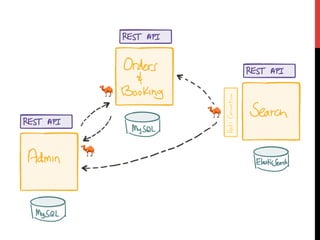
Do we need “integration?”
What kind of challenges are we going to run into?
Where do Containers fit into this?
WE’RE OFF TO DO MICROSERVICES!
Christian Posta
Principal Middleware Architect @ Red Hat
Twitter: @christianposta
Blog: http://blog.christianposta.com
Email: christian@redhat.com
•  “Microservices for Java developers” (6/2016)
•  Committer Apache Camel, ActiveMQ, Fabric8
•  Worked with large Microservices, web-scale,
unicorn company
•  Blogger, speaker about DevOps, integration,
and microservices
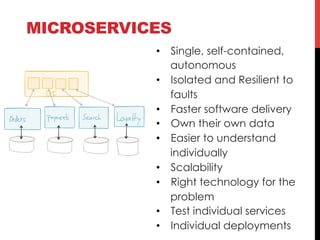
•  Single, self-contained,
autonomous
•  Isolated and Resilient to
faults
•  Faster software delivery
•  Own their own data
•  Easier to understand
individually
•  Scalability
•  Right technology for the
problem
•  Test individual services
•  Individual deployments
MICROSERVICES
Infrastructure for scale
Organizational structure
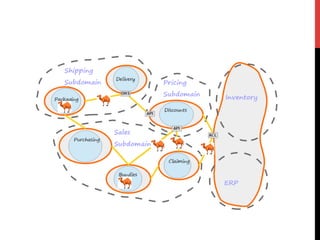
Identify a useful domain model with boundaries
TRANSFORMATION CHALLENGES
DOMAIN COMPLEXITY IS REAL
•  Break things into smaller,
understandable models
•  Surround a model and its
“context” with a boundary
•  Implement the model in
code or get a new model
•  Explicitly map between
different contexts
•  Model transactional
boundaries as aggregates
Book checkout / purchase Title Search
Recommendations
Weekly reporting
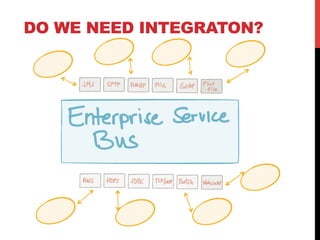
DO WE NEED INTEGRATON?
•  REST, RPC
•  Messaging (ActiveMQ, JMS, AMQP, STOMP, Kafka,
etc)
•  Legacy (SOAP, mainframe, file processing,
proprietary)
•  Managed file processing
•  Streaming
•  Message transformation
•  EIPs
DO WE NEED INTEGRATON?
REAL DEVELOPERS RIDE CAMELS!
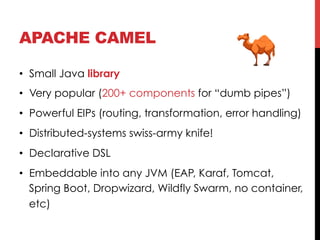
•  Small Java library
•  Very popular (200+ components for “dumb pipes”)
•  Powerful EIPs (routing, transformation, error handling)
•  Distributed-systems swiss-army knife!
•  Declarative DSL
•  Embeddable into any JVM (EAP, Karaf, Tomcat,
Spring Boot, Dropwizard, Wildfly Swarm, no container,
etc)
APACHE CAMEL
INTEGRATION HEAVY LIFTING:
APACHE CAMEL
•  Automatic retries, back-off algorithms
•  Dynamic routing
•  Powerful testing/mocking framework
•  Circuit breakers, fallbacks
•  Idempotent consumers
•  Backpressure mechanisms
•  Beautiful REST DSL with built in Swagger support
CAMEL FOR RESILIENT
MICROSERVICES
public class OrderProcessorRouteBuilder extends RouteBuilder {	
	
@Override	
public void configure() throws Exception {	
	
rest().post(“/order/socks”)	
	.description(“New Order for pair of socks”)	
	.consumes(“application/json”)	
	.route()	
	 	.to(“activemq:topic:newOrder”)	
	 .log(“received new order ${body.orderId}”)	
.to(“ibatis:storeOrder?statementType=Insert”);	
}	
	
EXPOSE REST END POINT
public class OrderProcessorRouteBuilder extends RouteBuilder {	
	
@Override	
public void configure() throws Exception {	
	
from(“jms:topic:foo”)	
	.hystrix()	
	 	.to(“http://fooservice/”)	
	.onFallback()	
	 	.transform().constant(“fallback foo!”)	
	.end()	
	
}	
CIRCUIT BREAKER/FALLBACK
public class OrderProcessorRouteBuilder extends RouteBuilder {	
	
@Override	
public void configure() throws Exception {	
	
from(“jms:topic:foo”)	
	.idempotentConsumer(header(“fooMessageId”),	
	 	memoryCache)	
	.to(“http://fooservice/”)	
	.log(“got response ${body}”);	
		
}	
IDEMPOTENT CONSUMER
•  How to run them all locally?
•  How to package them (dependency
management)
•  How to test?
•  Vagrant? VirtualBox? VMs?
•  Specify configuration
•  Process isolation
•  Service discovery
•  Multiple versions?
PROBLEMS DEVELOPING
MICROSERVICES
LINUX CONTAINERS
RED HAT OPENSHIFT
•  Developer focused workflow
•  Enterprise ready, supported
•  Higher level abstraction above containers for delivering
technology and business value
•  Build/deployment triggers
•  Software Defined Networking (SDN)
•  Docker native format/packaging
•  CLI/Web based tooling
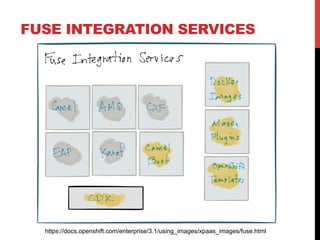
FUSE INTEGRATION SERVICES
https://docs.openshift.com/enterprise/3.1/using_images/xpaas_images/fuse.html
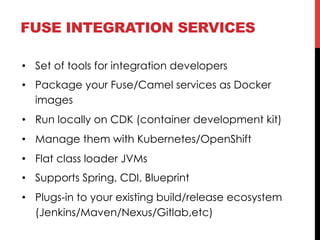
•  Set of tools for integration developers
•  Package your Fuse/Camel services as Docker
images
•  Run locally on CDK (container development kit)
•  Manage them with Kubernetes/OpenShift
•  Flat class loader JVMs
•  Supports Spring, CDI, Blueprint
•  Plugs-in to your existing build/release ecosystem
(Jenkins/Maven/Nexus/Gitlab,etc)
FUSE INTEGRATION SERVICES
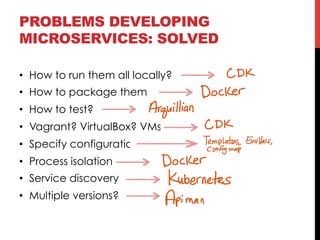
•  How to run them all locally?
•  How to package them
•  How to test?
•  Vagrant? VirtualBox? VMs?
•  Specify configuration
•  Process isolation
•  Service discovery
•  Multiple versions?
PROBLEMS DEVELOPING
MICROSERVICES: SOLVED
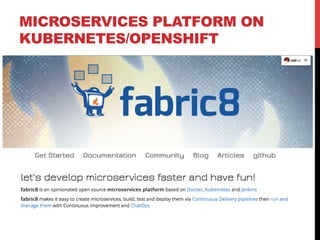
MICROSERVICES PLATFORM ON
KUBERNETES/OPENSHIFT
Christian Posta
Principal Middleware Specialist/Architect
Twitter: @christianposta
Blog: http://blog.christianposta.com
Email: christian@redhat.com
Questions, Discussion, Demo!

Microservices with Apache Camel, DDD, and Kubernetes

  • 1.
    CLOUD NATIVE CAMELRIDING WITH KUBERNETES AND OPENSHIFT @christianposta 17 June 2016
  • 2.
  • 3.
    Do we need“integration?” What kind of challenges are we going to run into? Where do Containers fit into this? WE’RE OFF TO DO MICROSERVICES!
  • 4.
    Christian Posta Principal MiddlewareArchitect @ Red Hat Twitter: @christianposta Blog: http://blog.christianposta.com Email: christian@redhat.com •  “Microservices for Java developers” (6/2016) •  Committer Apache Camel, ActiveMQ, Fabric8 •  Worked with large Microservices, web-scale, unicorn company •  Blogger, speaker about DevOps, integration, and microservices
  • 5.
    •  Single, self-contained, autonomous • Isolated and Resilient to faults •  Faster software delivery •  Own their own data •  Easier to understand individually •  Scalability •  Right technology for the problem •  Test individual services •  Individual deployments MICROSERVICES
  • 6.
    Infrastructure for scale Organizationalstructure Identify a useful domain model with boundaries TRANSFORMATION CHALLENGES
  • 8.
    DOMAIN COMPLEXITY ISREAL •  Break things into smaller, understandable models •  Surround a model and its “context” with a boundary •  Implement the model in code or get a new model •  Explicitly map between different contexts •  Model transactional boundaries as aggregates
  • 9.
    Book checkout /purchase Title Search Recommendations Weekly reporting
  • 11.
    DO WE NEEDINTEGRATON? •  REST, RPC •  Messaging (ActiveMQ, JMS, AMQP, STOMP, Kafka, etc) •  Legacy (SOAP, mainframe, file processing, proprietary) •  Managed file processing •  Streaming •  Message transformation •  EIPs
  • 12.
    DO WE NEEDINTEGRATON?
  • 13.
  • 14.
    •  Small Javalibrary •  Very popular (200+ components for “dumb pipes”) •  Powerful EIPs (routing, transformation, error handling) •  Distributed-systems swiss-army knife! •  Declarative DSL •  Embeddable into any JVM (EAP, Karaf, Tomcat, Spring Boot, Dropwizard, Wildfly Swarm, no container, etc) APACHE CAMEL
  • 15.
  • 16.
    •  Automatic retries,back-off algorithms •  Dynamic routing •  Powerful testing/mocking framework •  Circuit breakers, fallbacks •  Idempotent consumers •  Backpressure mechanisms •  Beautiful REST DSL with built in Swagger support CAMEL FOR RESILIENT MICROSERVICES
  • 18.
    public class OrderProcessorRouteBuilderextends RouteBuilder { @Override public void configure() throws Exception { rest().post(“/order/socks”) .description(“New Order for pair of socks”) .consumes(“application/json”) .route() .to(“activemq:topic:newOrder”) .log(“received new order ${body.orderId}”) .to(“ibatis:storeOrder?statementType=Insert”); } EXPOSE REST END POINT
  • 19.
    public class OrderProcessorRouteBuilderextends RouteBuilder { @Override public void configure() throws Exception { from(“jms:topic:foo”) .hystrix() .to(“http://fooservice/”) .onFallback() .transform().constant(“fallback foo!”) .end() } CIRCUIT BREAKER/FALLBACK
  • 20.
    public class OrderProcessorRouteBuilderextends RouteBuilder { @Override public void configure() throws Exception { from(“jms:topic:foo”) .idempotentConsumer(header(“fooMessageId”), memoryCache) .to(“http://fooservice/”) .log(“got response ${body}”); } IDEMPOTENT CONSUMER
  • 22.
    •  How torun them all locally? •  How to package them (dependency management) •  How to test? •  Vagrant? VirtualBox? VMs? •  Specify configuration •  Process isolation •  Service discovery •  Multiple versions? PROBLEMS DEVELOPING MICROSERVICES
  • 23.
  • 24.
    RED HAT OPENSHIFT • Developer focused workflow •  Enterprise ready, supported •  Higher level abstraction above containers for delivering technology and business value •  Build/deployment triggers •  Software Defined Networking (SDN) •  Docker native format/packaging •  CLI/Web based tooling
  • 25.
  • 26.
    •  Set oftools for integration developers •  Package your Fuse/Camel services as Docker images •  Run locally on CDK (container development kit) •  Manage them with Kubernetes/OpenShift •  Flat class loader JVMs •  Supports Spring, CDI, Blueprint •  Plugs-in to your existing build/release ecosystem (Jenkins/Maven/Nexus/Gitlab,etc) FUSE INTEGRATION SERVICES
  • 27.
    •  How torun them all locally? •  How to package them •  How to test? •  Vagrant? VirtualBox? VMs? •  Specify configuration •  Process isolation •  Service discovery •  Multiple versions? PROBLEMS DEVELOPING MICROSERVICES: SOLVED
  • 31.
  • 33.
    Christian Posta Principal MiddlewareSpecialist/Architect Twitter: @christianposta Blog: http://blog.christianposta.com Email: christian@redhat.com Questions, Discussion, Demo!