Microservices: Organizing a Large
Team for Rapid Delivery
By Jason Goth, Micah Blalock, Patricia Anderson
@jgothtx, @micah_blalock, @patricia_sooner
About Us
Jason Goth
jgoth@credera.com
@jgothtx
Micah Blalock
mblalock@credera.com
@micah_blalock
Patricia Anderson
panderson@credera.com
@patricia_sooner
Microservices are great hard
3
Managing teams developing microservices is not
so great much harder
4
Objectives
• Share lessons learned on a few real world microservices projects:
• Several customer projects
• One internal project
• Topics:
• Organizational structure for rapid delivery
• Design/Development practices to support these organizations
• Communication across multiple teams
5
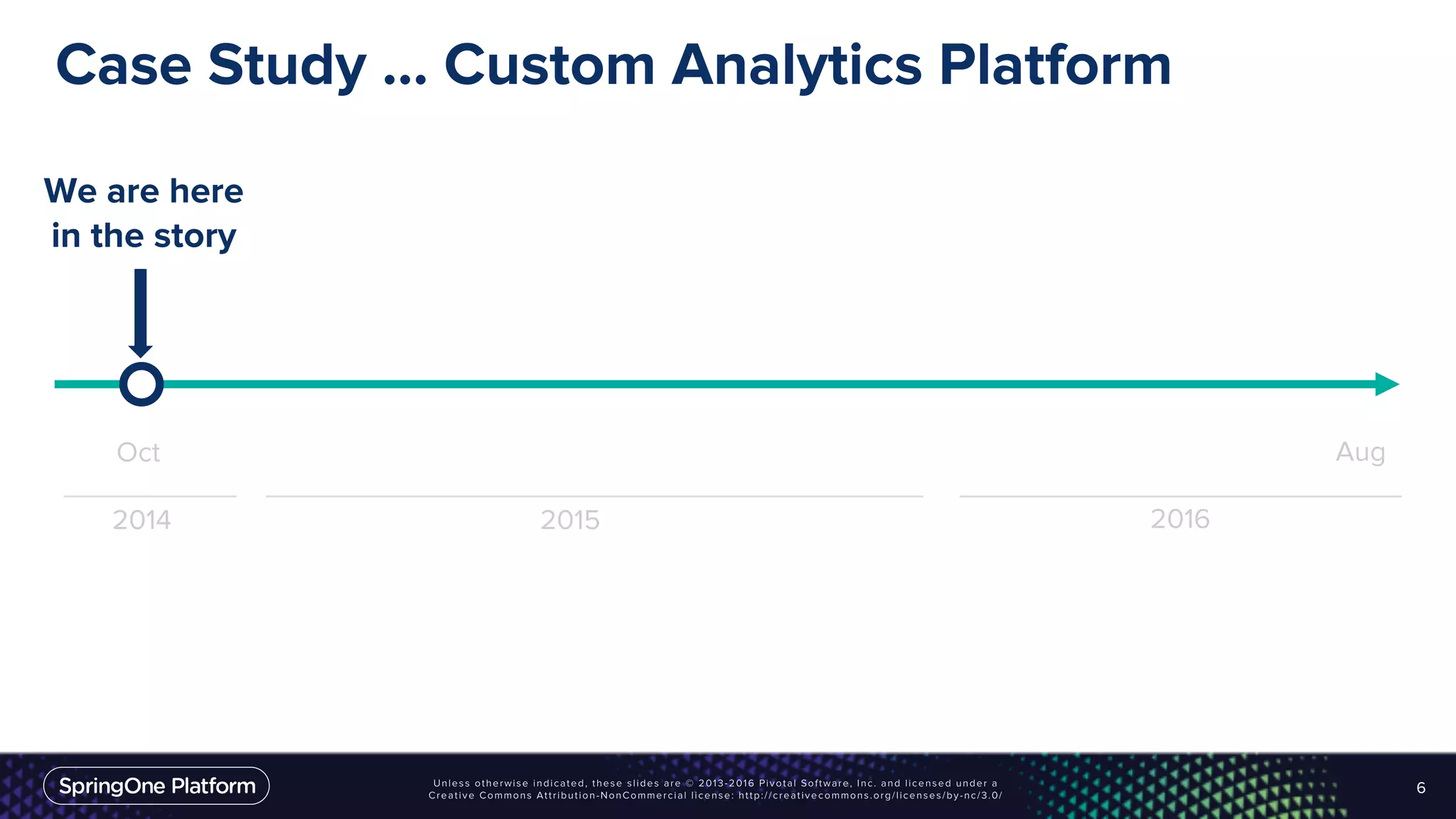
Case Study … Custom Analytics Platform
6
We are here
in the story
2014 2015 2016
AugOct
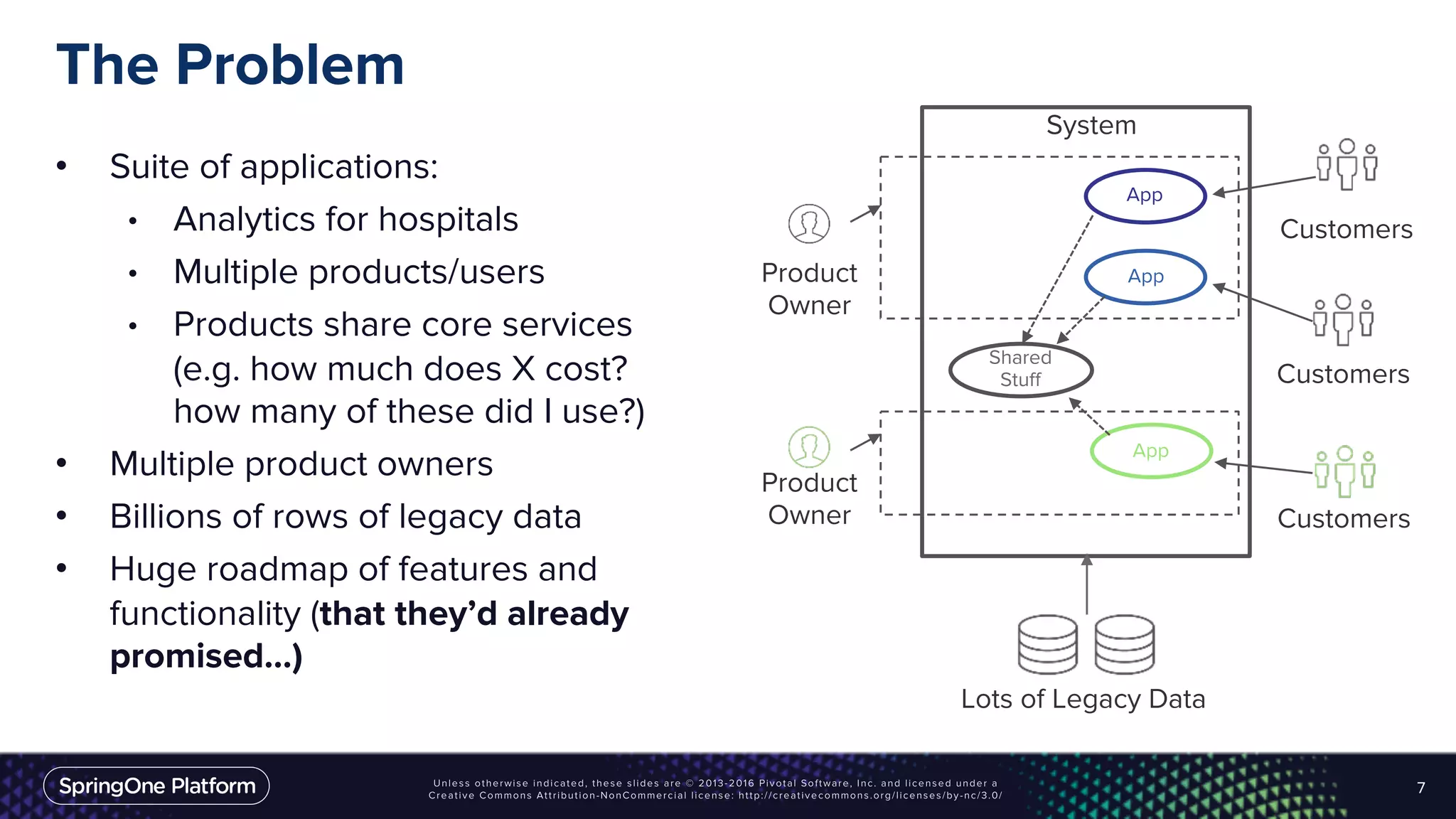
The Problem
• Suite of applications:
• Analytics for hospitals
• Multiple products/users
• Products share core services
(e.g. how much does X cost?
how many of these did I use?)
• Multiple product owners
• Billions of rows of legacy data
• Huge roadmap of features and
functionality (that they’d already
promised…)
7
Lots of Legacy Data
Product
Owner
Product
Owner
Customers
Customers
App
App
App
Shared
Stuff Customers
System
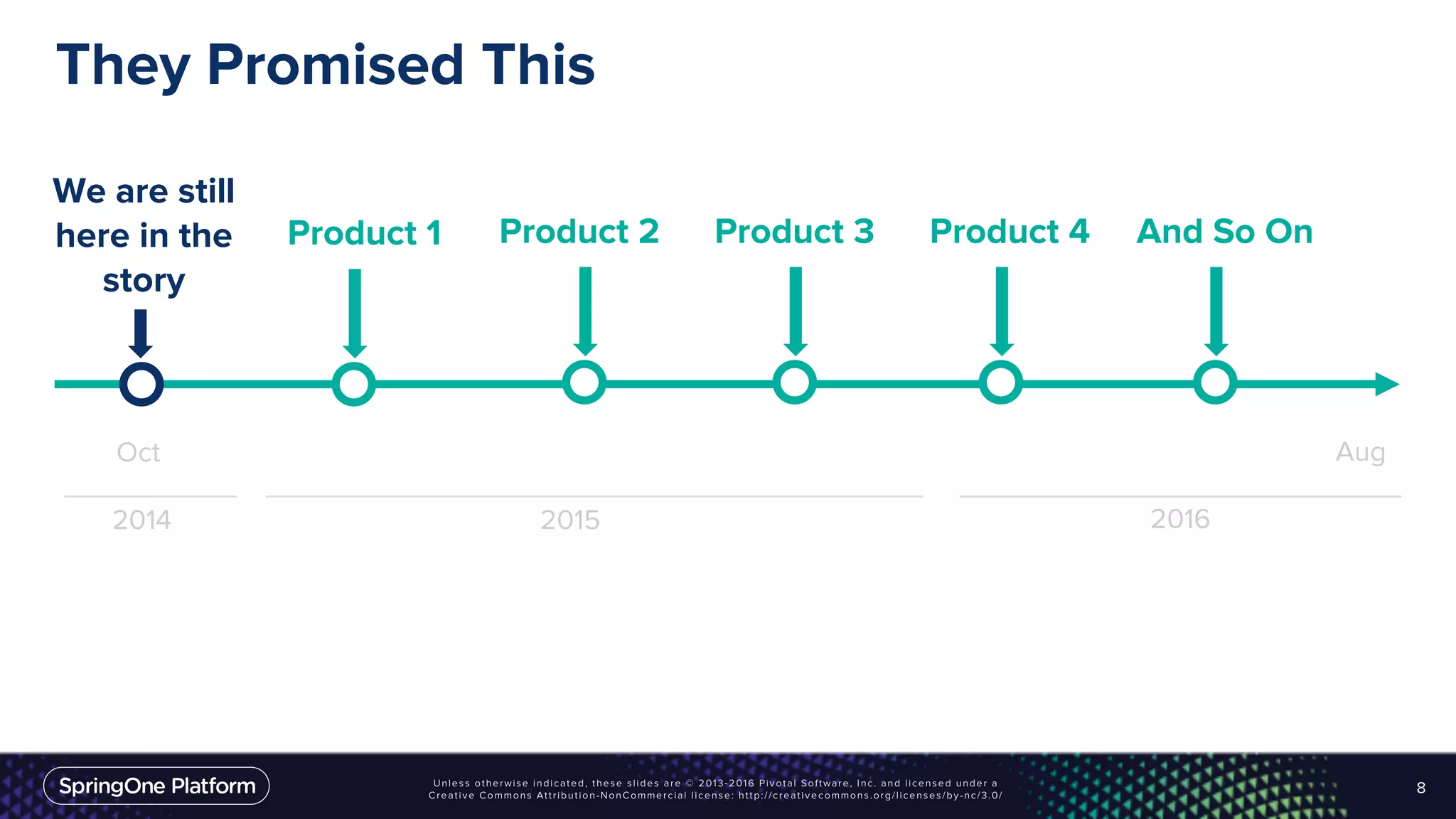
They Promised This
8
We are still
here in the
story
2014 2015 2016
AugOct
Product 1 Product 2 Product 3 Product 4 And So On
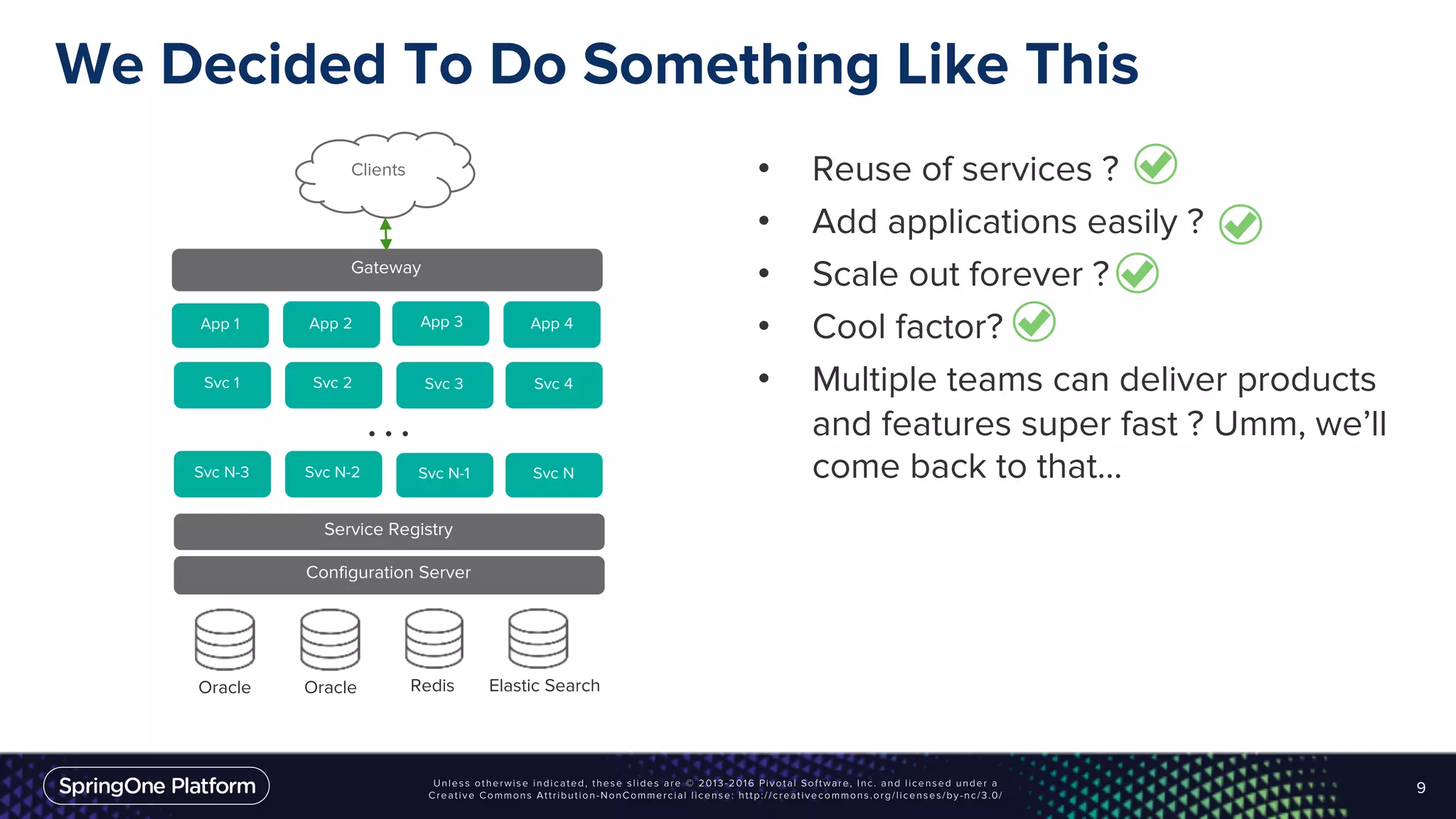
We Decided To Do Something Like This
• Reuse of services ?
• Add applications easily ?
• Scale out forever ?
• Cool factor?
• Multiple teams can deliver products
and features super fast ? Umm, we’ll
come back to that...
9
Clients
Gateway
App 1
Svc 2Svc 1
App 2 App 3 App 4
Svc 3 Svc 4
Service Registry
Configuration Server
Oracle Redis Elastic SearchOracle
Svc N-2Svc N-3 Svc N-1 Svc N
. . .
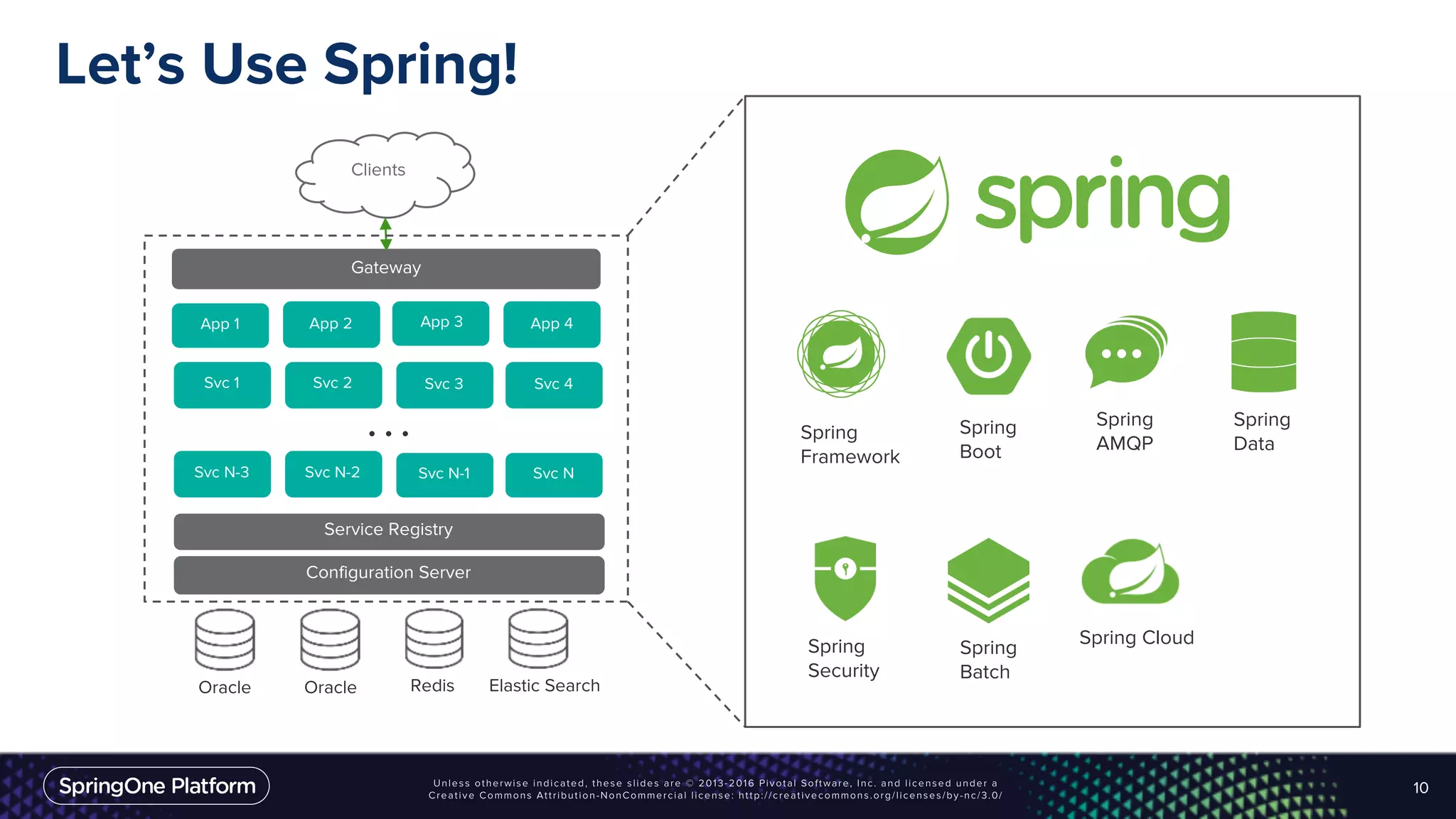
Let’s Use Spring!
10
Clients
Gateway
App 1
Svc 2Svc 1
App 2 App 3 App 4
Svc 3 Svc 4
Oracle Redis Elastic SearchOracle
Svc N-2Svc N-3 Svc N-1 Svc N
. . . Spring
Boot
Spring
Framework
Spring
Security
Spring
Data
Spring
Batch
Spring
AMQP
Spring Cloud
Service Registry
Configuration Server
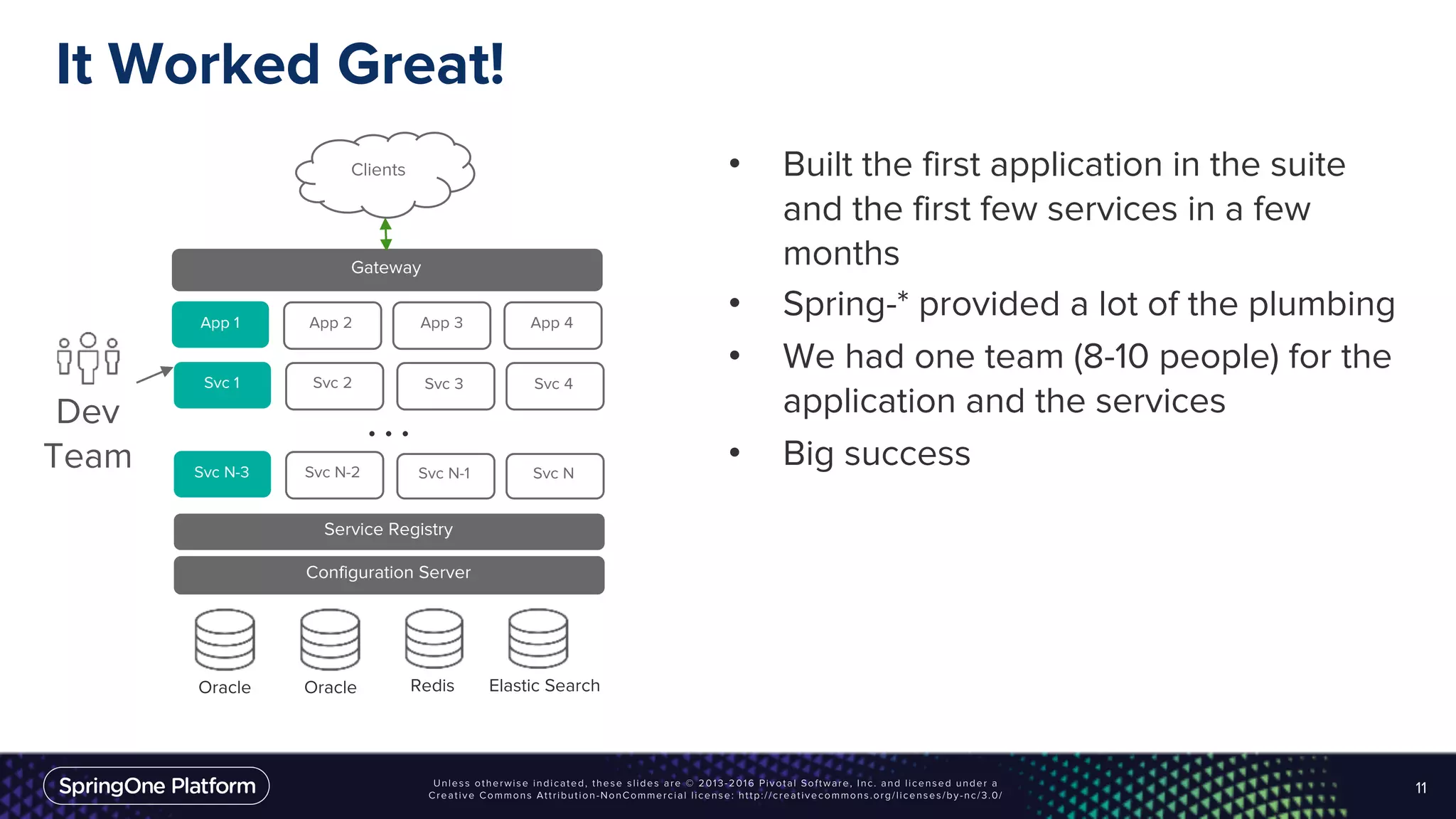
It Worked Great!
• Built the first application in the suite
and the first few services in a few
months
• Spring-* provided a lot of the plumbing
• We had one team (8-10 people) for the
application and the services
• Big success
11
Clients
Gateway
App 1
Svc 2Svc 1
App 2 App 3 App 4
Svc 3 Svc 4
Service Registry
Configuration Server
Oracle Redis Elastic SearchOracle
Svc N-2Svc N-3 Svc N-1 Svc N
. . .Dev
Team
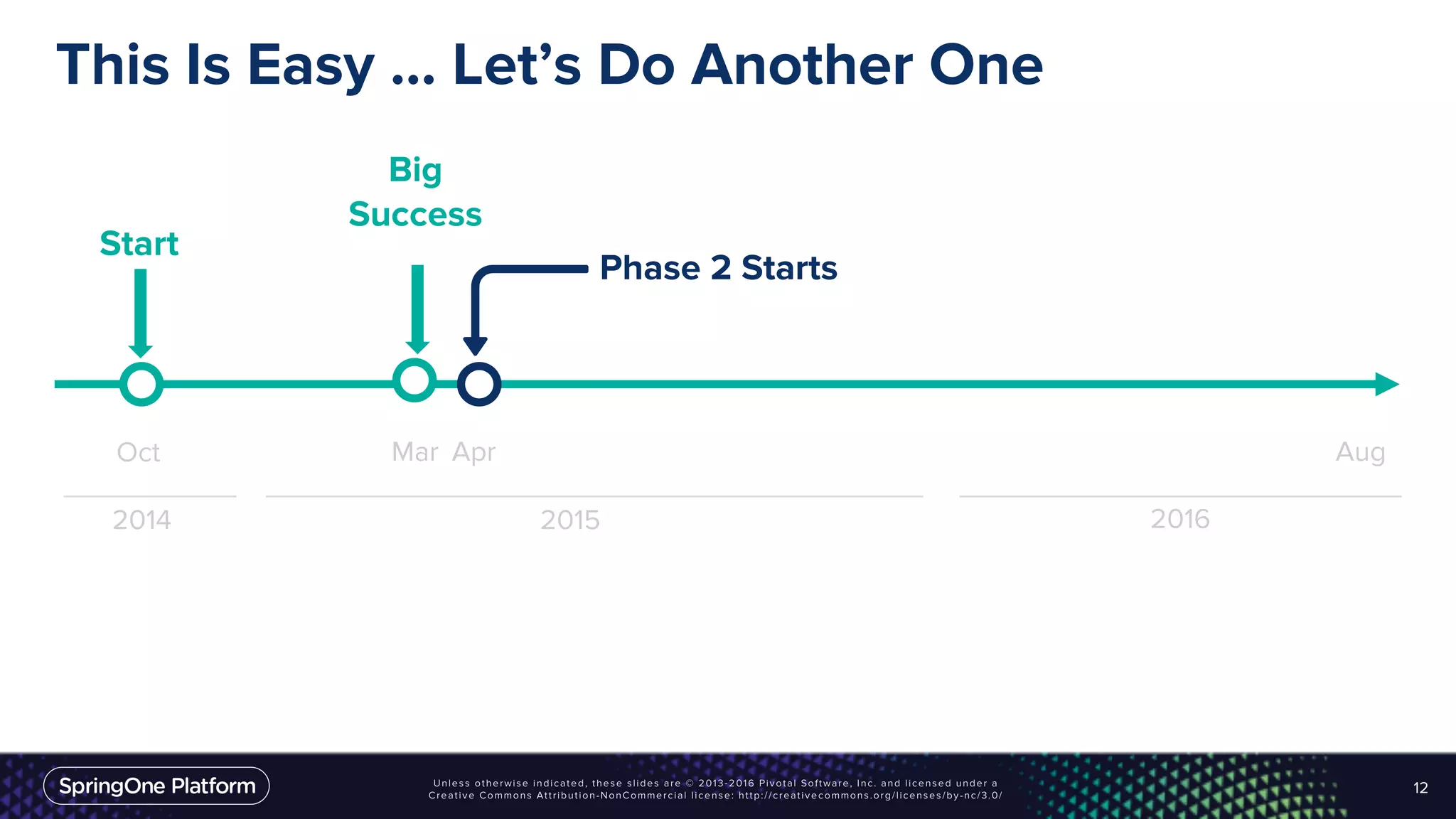
This Is Easy … Let’s Do Another One
12
Phase 2 Starts
Start
Big
Success
2014 2015 2016
AugOct AprMar
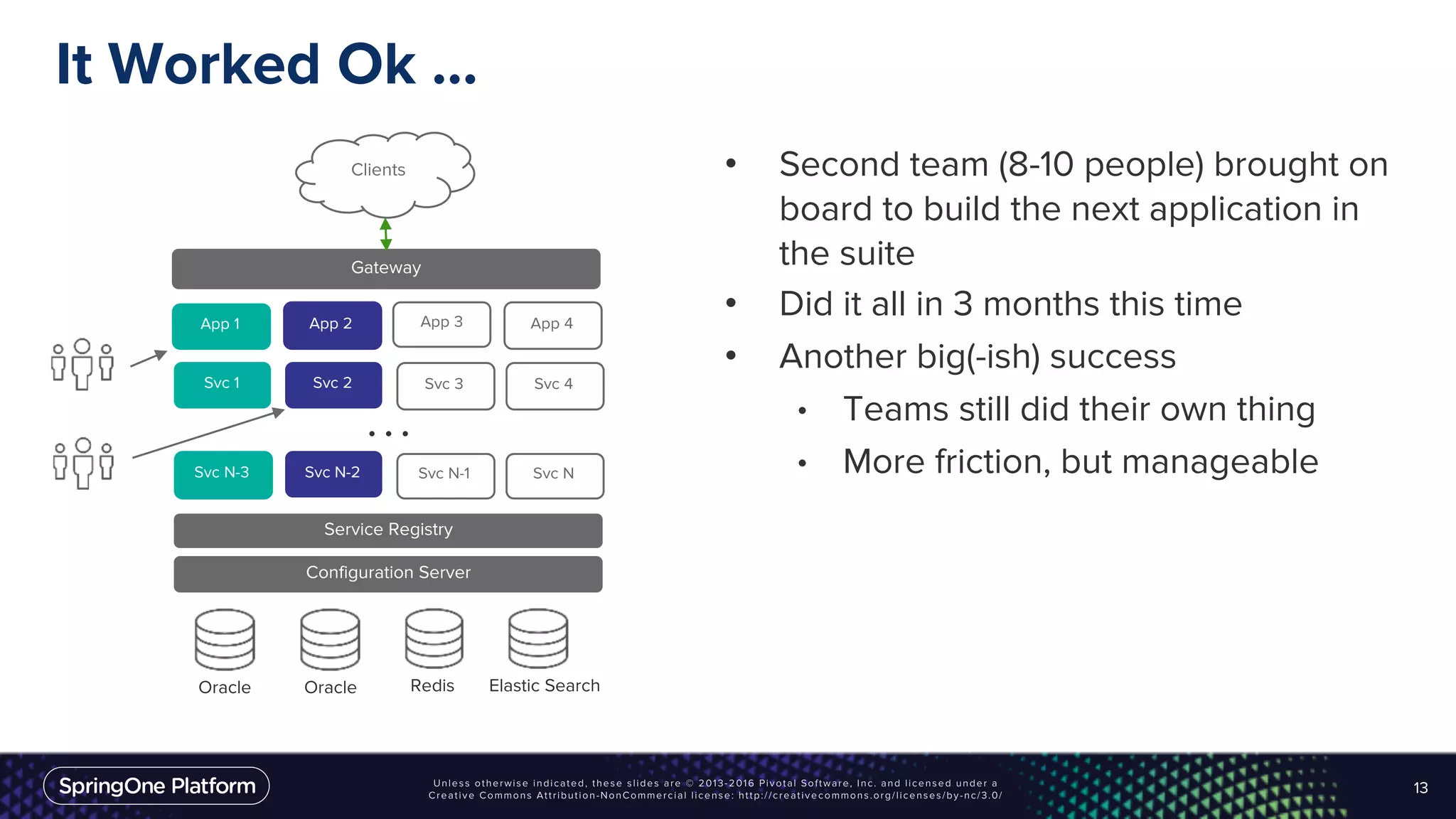
It Worked Ok …
• Second team (8-10 people) brought on
board to build the next application in
the suite
• Did it all in 3 months this time
• Another big(-ish) success
• Teams still did their own thing
• More friction, but manageable
13
Clients
Gateway
App 1
Svc 2Svc 1
App 2 App 3 App 4
Svc 3 Svc 4
Service Registry
Configuration Server
Oracle Redis Elastic SearchOracle
Svc N-2Svc N-3 Svc N-1 Svc N
. . .
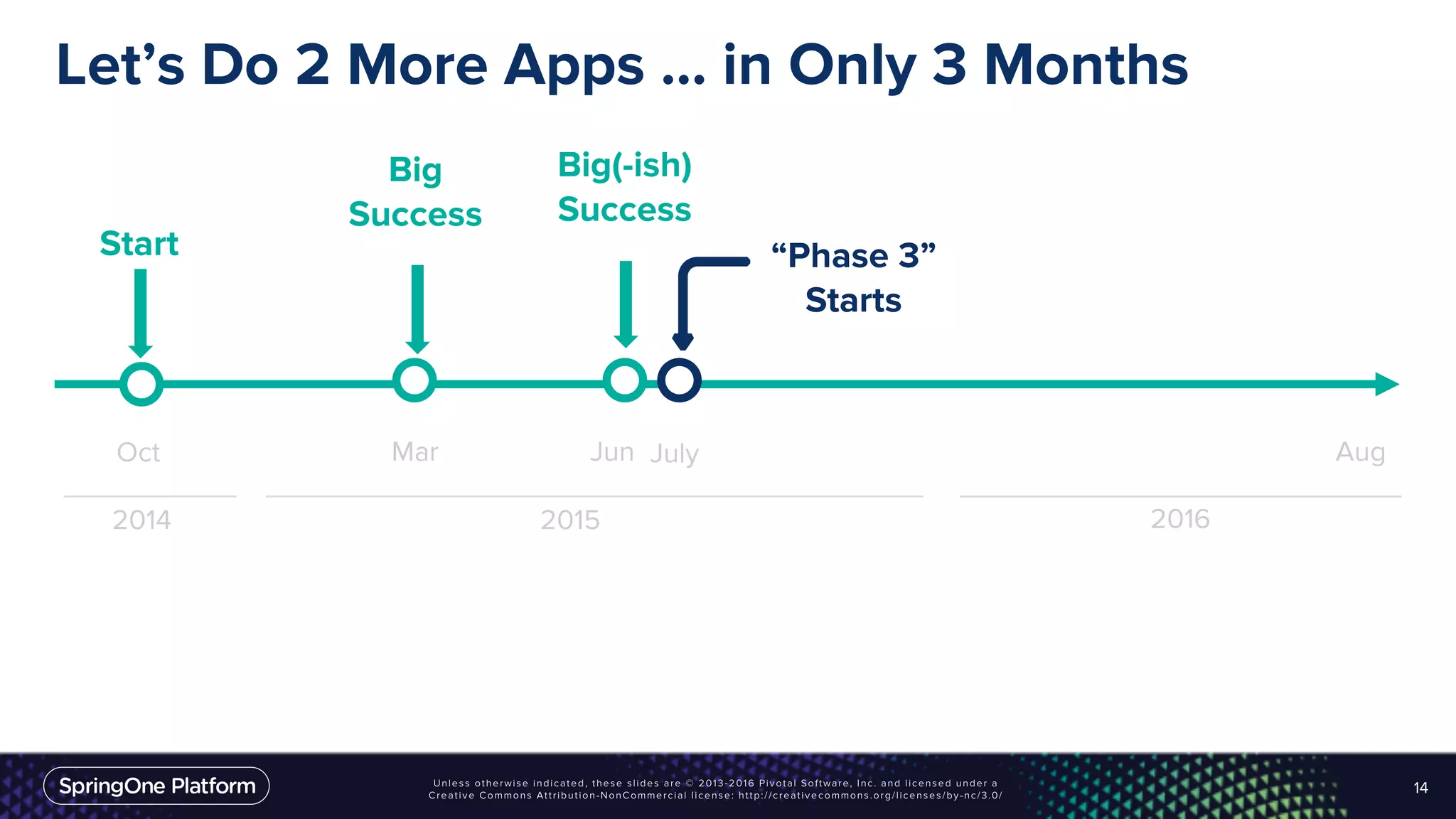
Let’s Do 2 More Apps … in Only 3 Months
14
“Phase 3”
Starts
Start
Big
Success
2014 2015 2016
AugOct Mar Jun July
Big(-ish)
Success
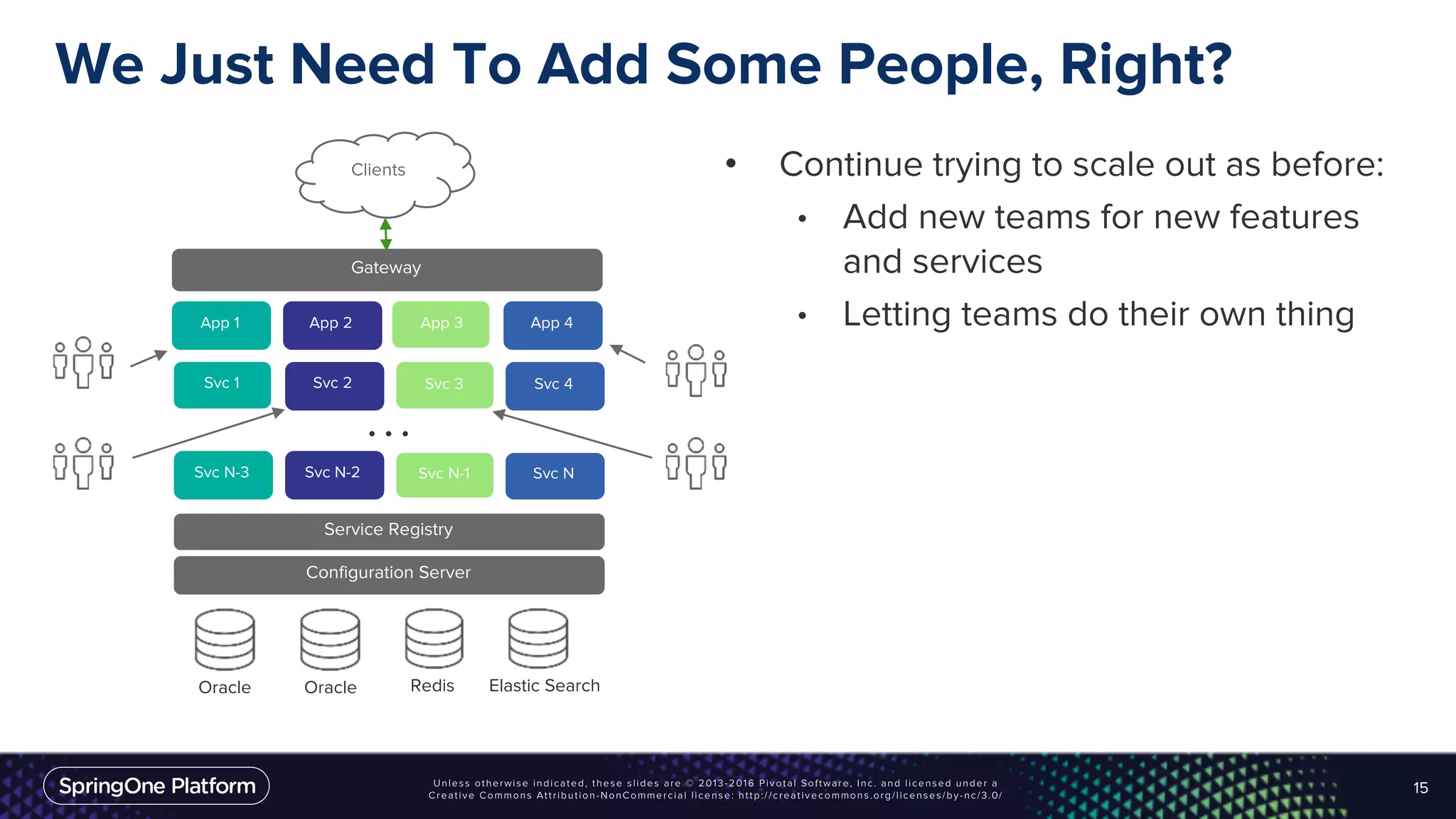
We Just Need To Add Some People, Right?
• Continue trying to scale out as before:
• Add new teams for new features
and services
• Letting teams do their own thing
15
Clients
Gateway
App 1
Svc 2Svc 1
App 2 App 3 App 4
Svc 3 Svc 4
Service Registry
Configuration Server
Oracle Redis Elastic SearchOracle
Svc N-2Svc N-3 Svc N-1 Svc N
. . .
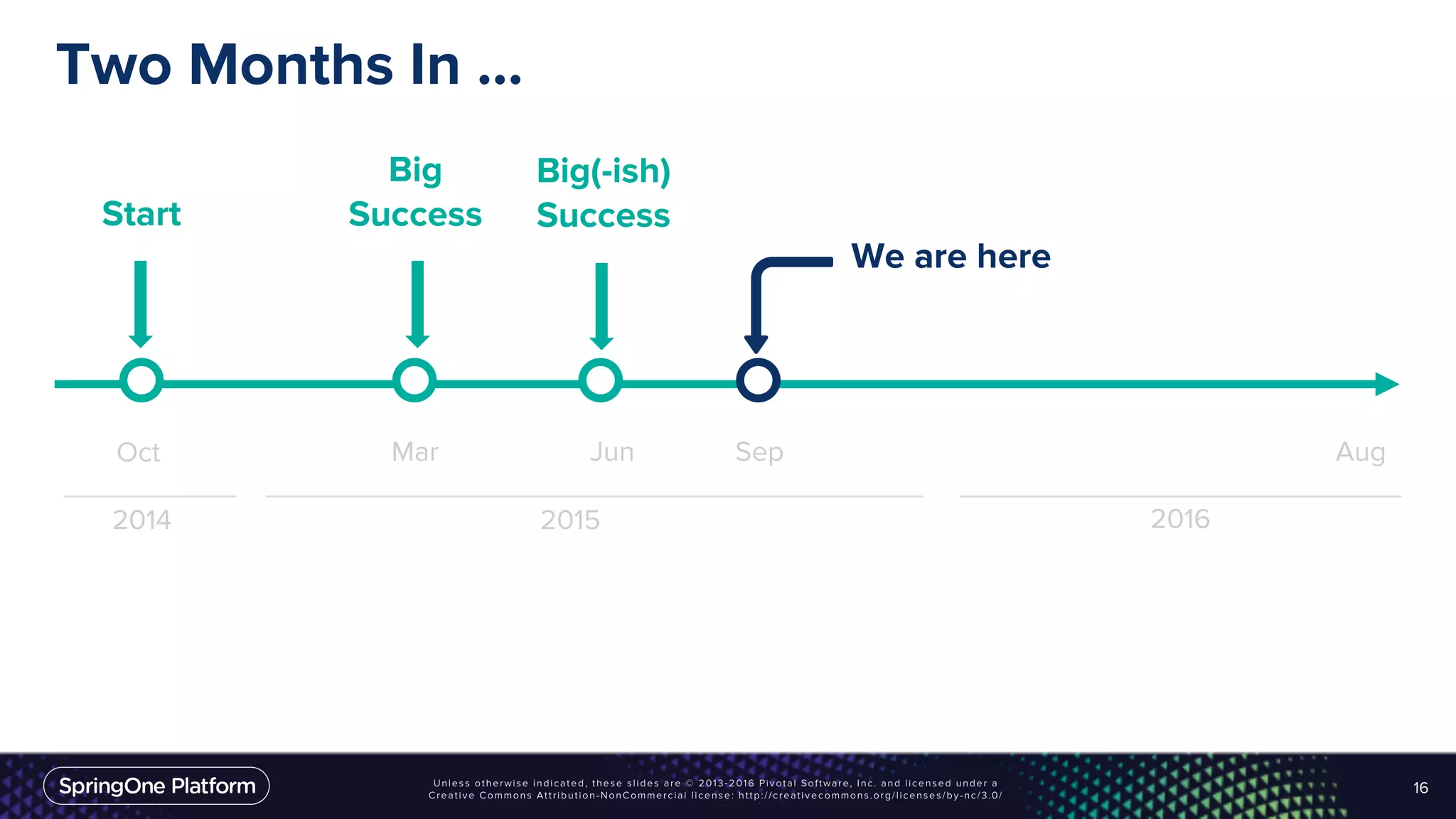
Two Months In …
16
Start
Big
Success
2014 2015 2016
AugOct Mar Jun
Big(-ish)
Success
We are here
Sep
It All Came to a Screeching Halt
17
Why?
18
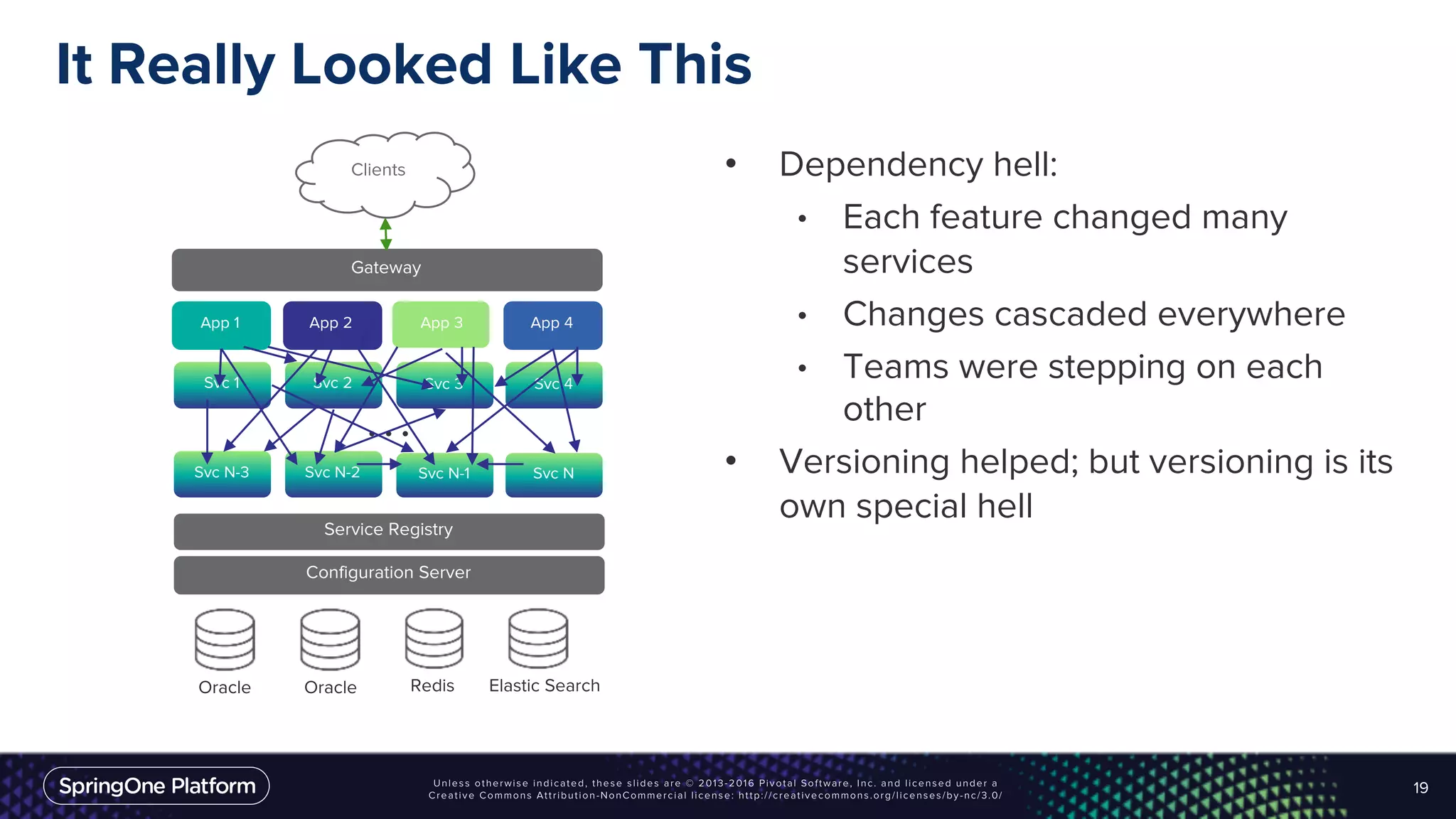
It Really Looked Like This
• Dependency hell:
• Each feature changed many
services
• Changes cascaded everywhere
• Teams were stepping on each
other
• Versioning helped; but versioning is its
own special hell
19
Clients
Gateway
App 1
Svc 1
App 2 App 3 App 4
Service Registry
Configuration Server
Oracle Redis Elastic SearchOracle
Svc 2 Svc 3 Svc 4
Svc N-2Svc N-3 Svc N-1 Svc N
. . .
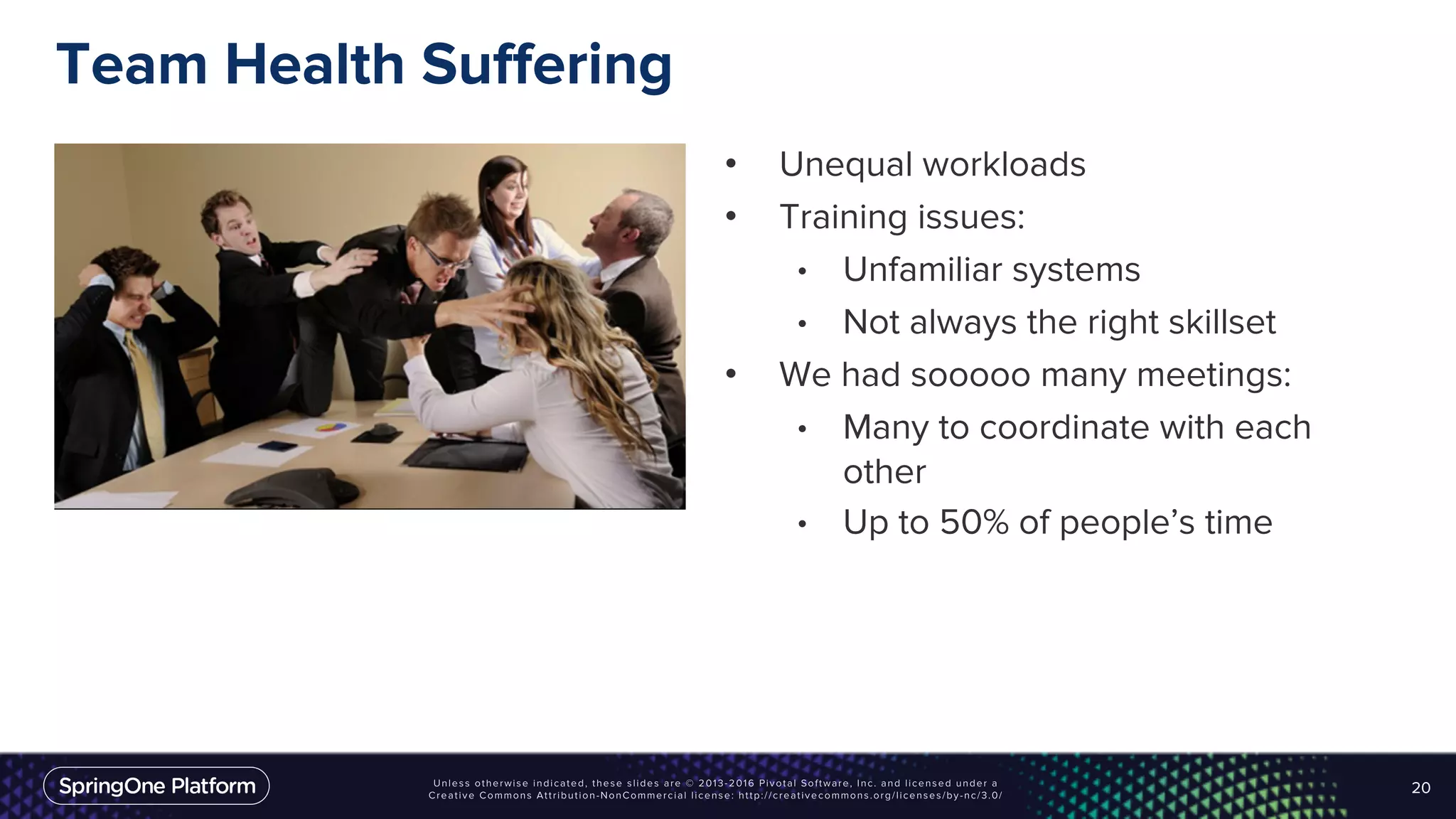
Team Health Suffering
• Unequal workloads
• Training issues:
• Unfamiliar systems
• Not always the right skillset
• We had sooooo many meetings:
• Many to coordinate with each
other
• Up to 50% of people’s time
20
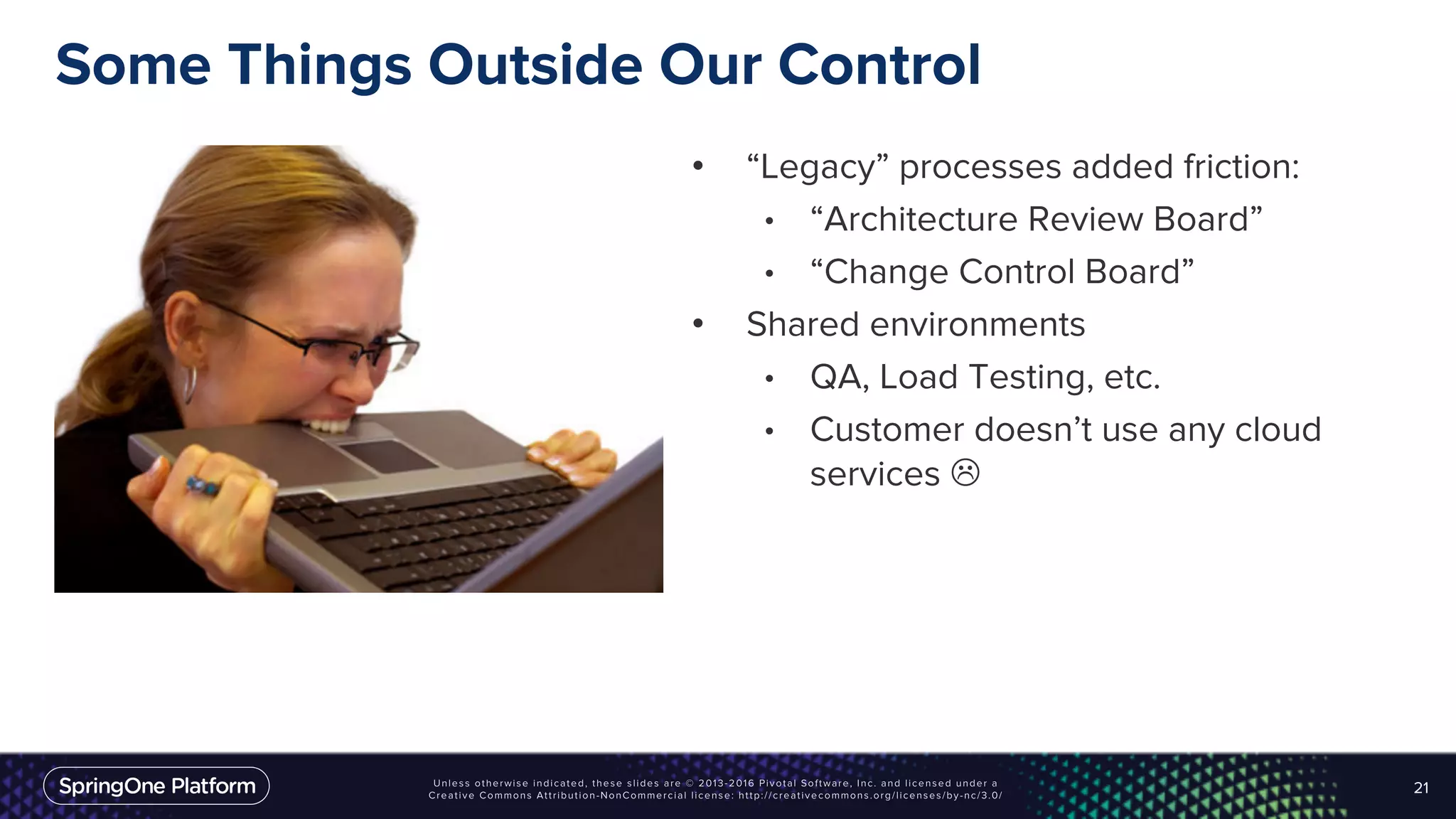
Some Things Outside Our Control
• “Legacy” processes added friction:
• “Architecture Review Board”
• “Change Control Board”
• Shared environments
• QA, Load Testing, etc.
• Customer doesn’t use any cloud
services L
21
Isn’t this supposed to be faster?
22
It can be faster, if you align the solution
and the organization
23
Main Point
of This Talk
Alignment
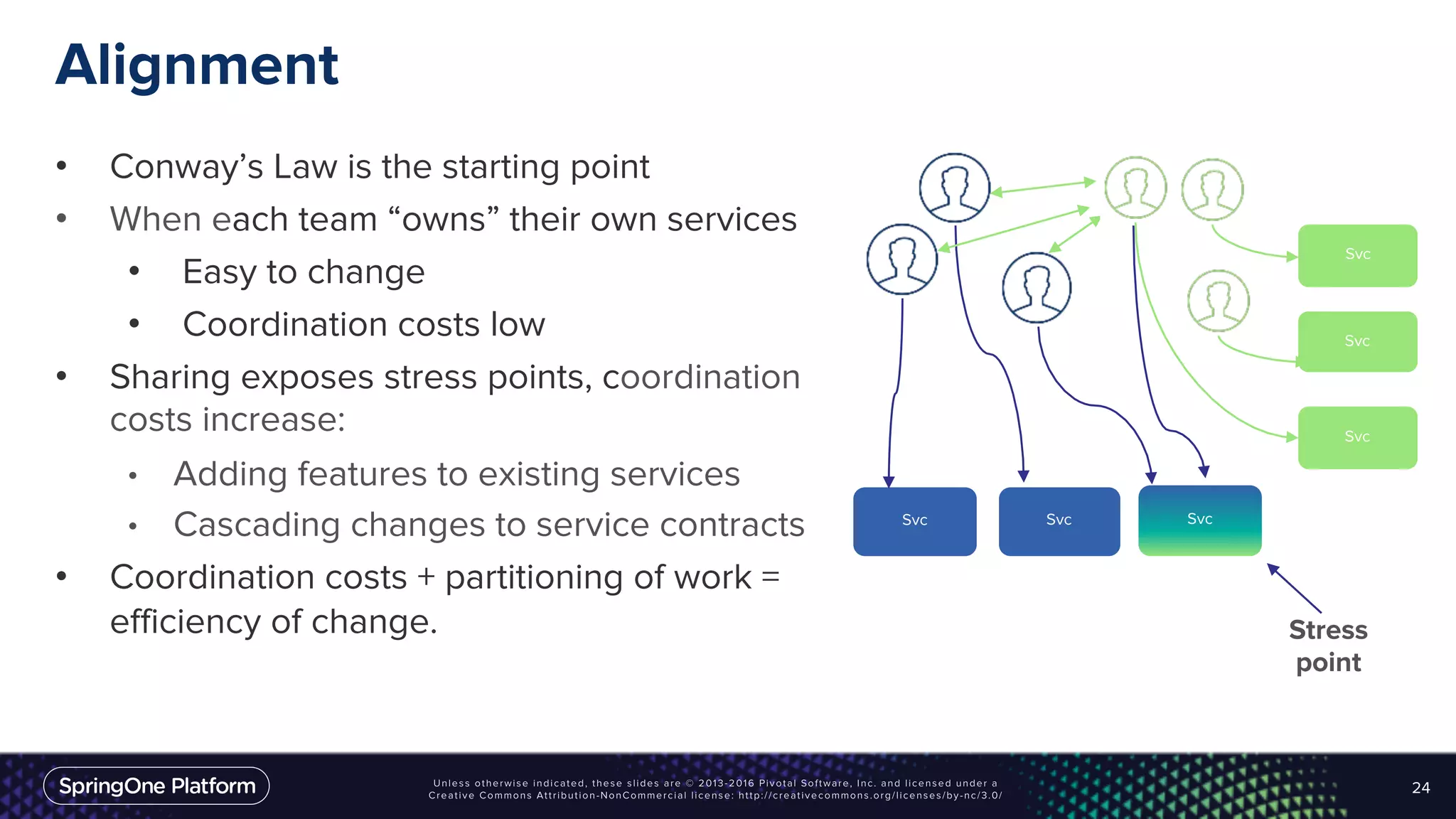
• Conway’s Law is the starting point
• When each team “owns” their own services
• Easy to change
• Coordination costs low
• Sharing exposes stress points, coordination
costs increase:
• Adding features to existing services
• Cascading changes to service contracts
• Coordination costs + partitioning of work =
efficiency of change.
24
SvcSvc Svc
Svc
Svc
Svc
Stress
point
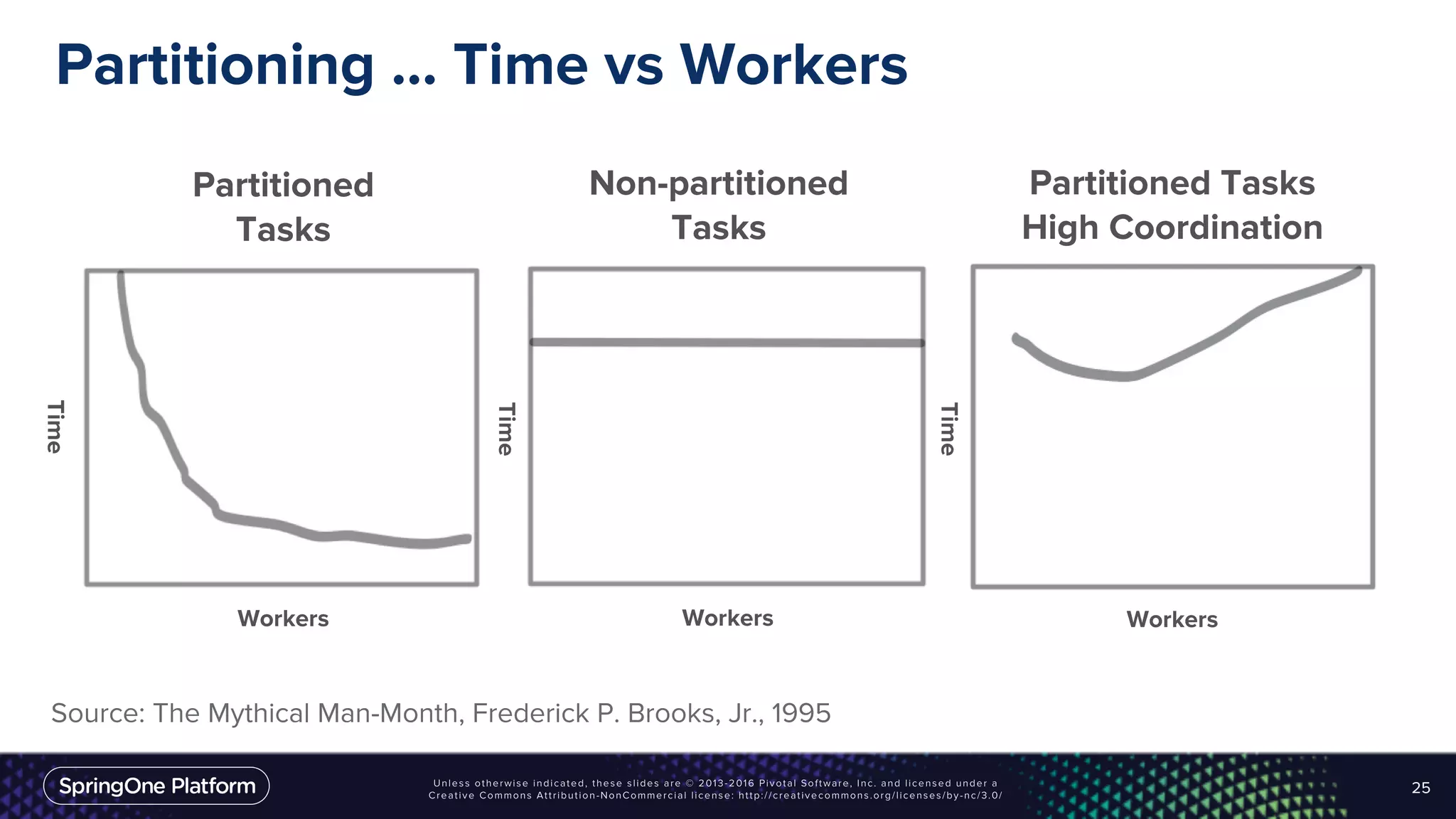
Partitioning … Time vs Workers
25
Partitioned
Tasks
Non-partitioned
Tasks
Partitioned Tasks
High Coordination
Time
Workers Workers Workers
Time
Time
Source: The Mythical Man-Month, Frederick P. Brooks, Jr., 1995
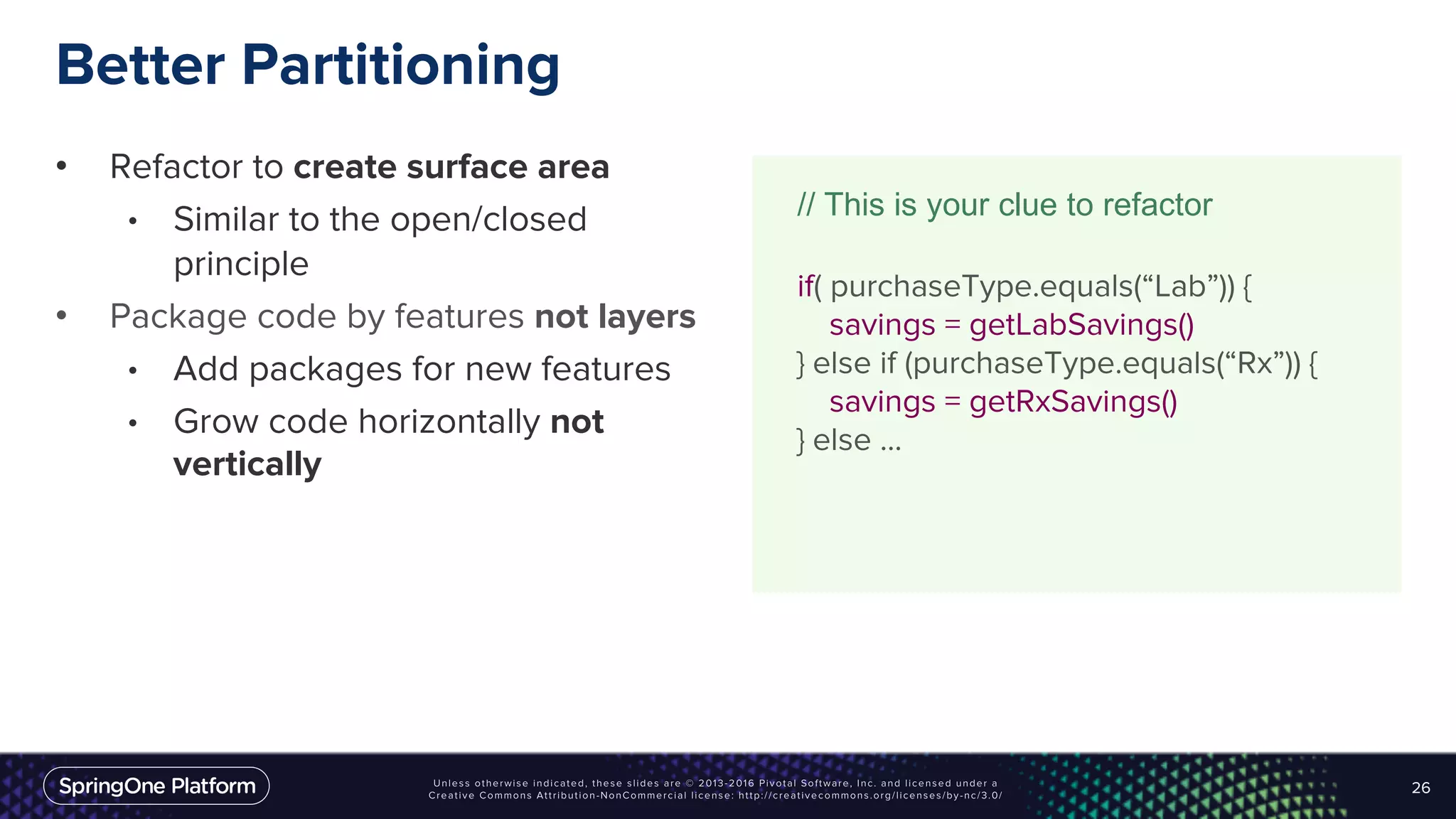
Better Partitioning
• Refactor to create surface area
• Similar to the open/closed
principle
• Package code by features not layers
• Add packages for new features
• Grow code horizontally not
vertically
26
// This is your clue to refactor
if( purchaseType.equals(“Lab”)) {
savings = getLabSavings()
} else if (purchaseType.equals(“Rx”)) {
savings = getRxSavings()
} else ...
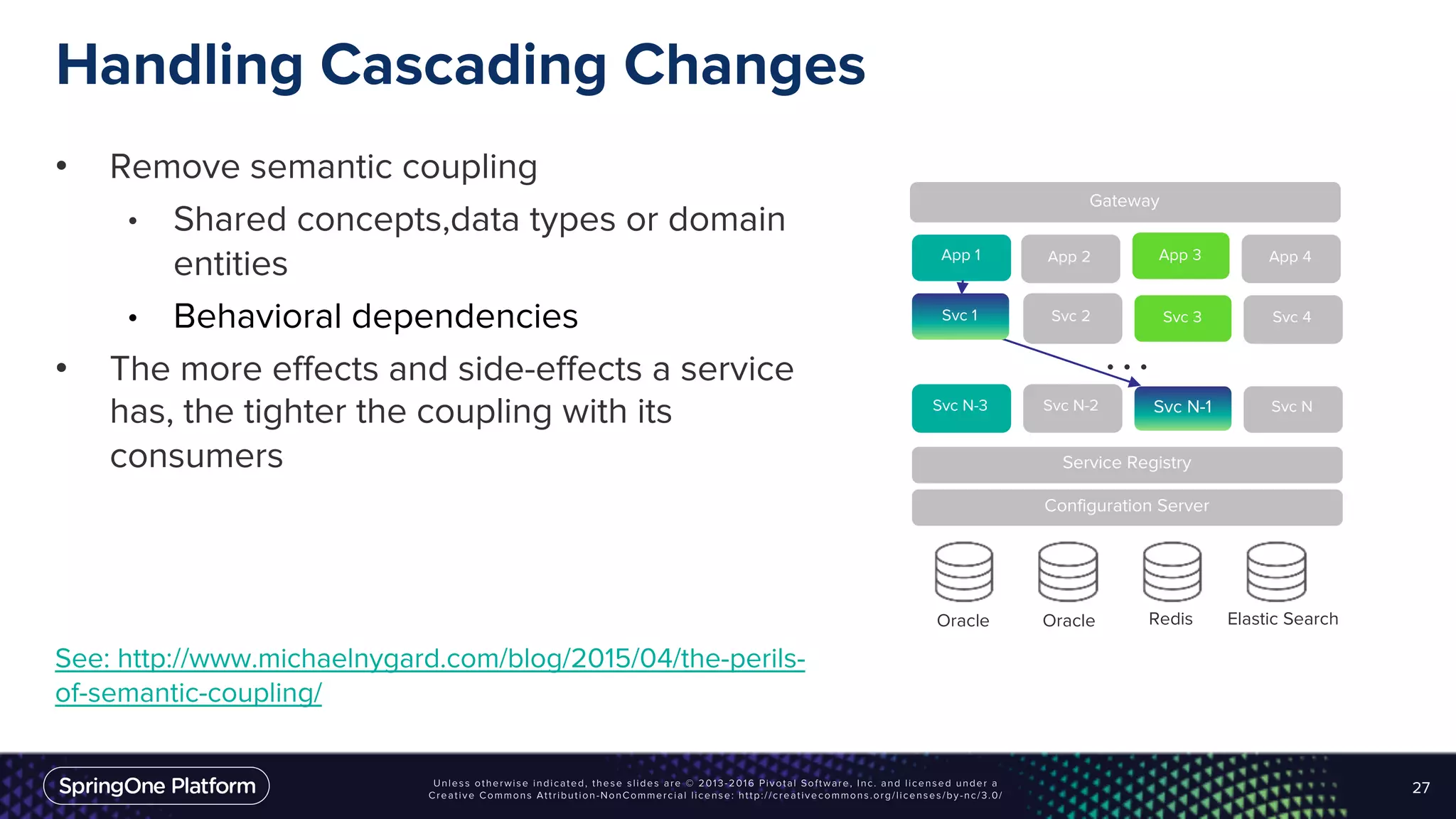
Handling Cascading Changes
• Remove semantic coupling
• Shared concepts,data types or domain
entities
• Behavioral dependencies
• The more effects and side-effects a service
has, the tighter the coupling with its
consumers
See: http://www.michaelnygard.com/blog/2015/04/the-perils-
of-semantic-coupling/
27
Oracle Redis Elastic SearchOracle
Gateway
Svc 2
App 2 App 3 App 4
Svc 3 Svc 4
Service Registry
Configuration Server
Svc N-2Svc N-3 Svc N-1 Svc N
. . .
Svc 1
App 1
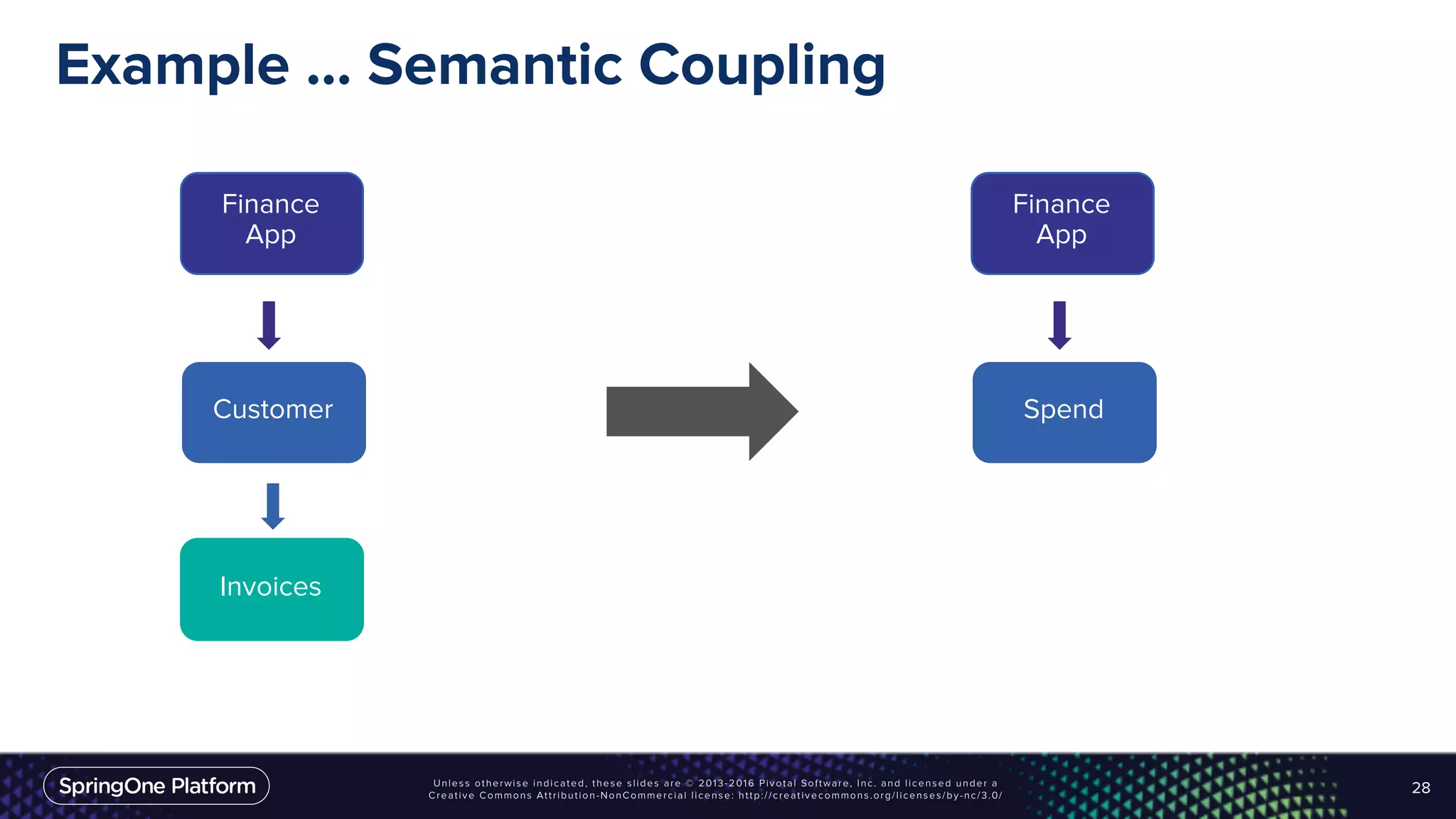
Example ... Semantic Coupling
28
Invoices
Customer
Finance
App
Spend
Finance
App
Eliminate Shared Dependencies
• Warning architecture purists … you will not like this…
• Shared dependencies increase coordination costs:
• Some redundancies are ok
• GARY (Go Ahead, Repeat Yourself)
29
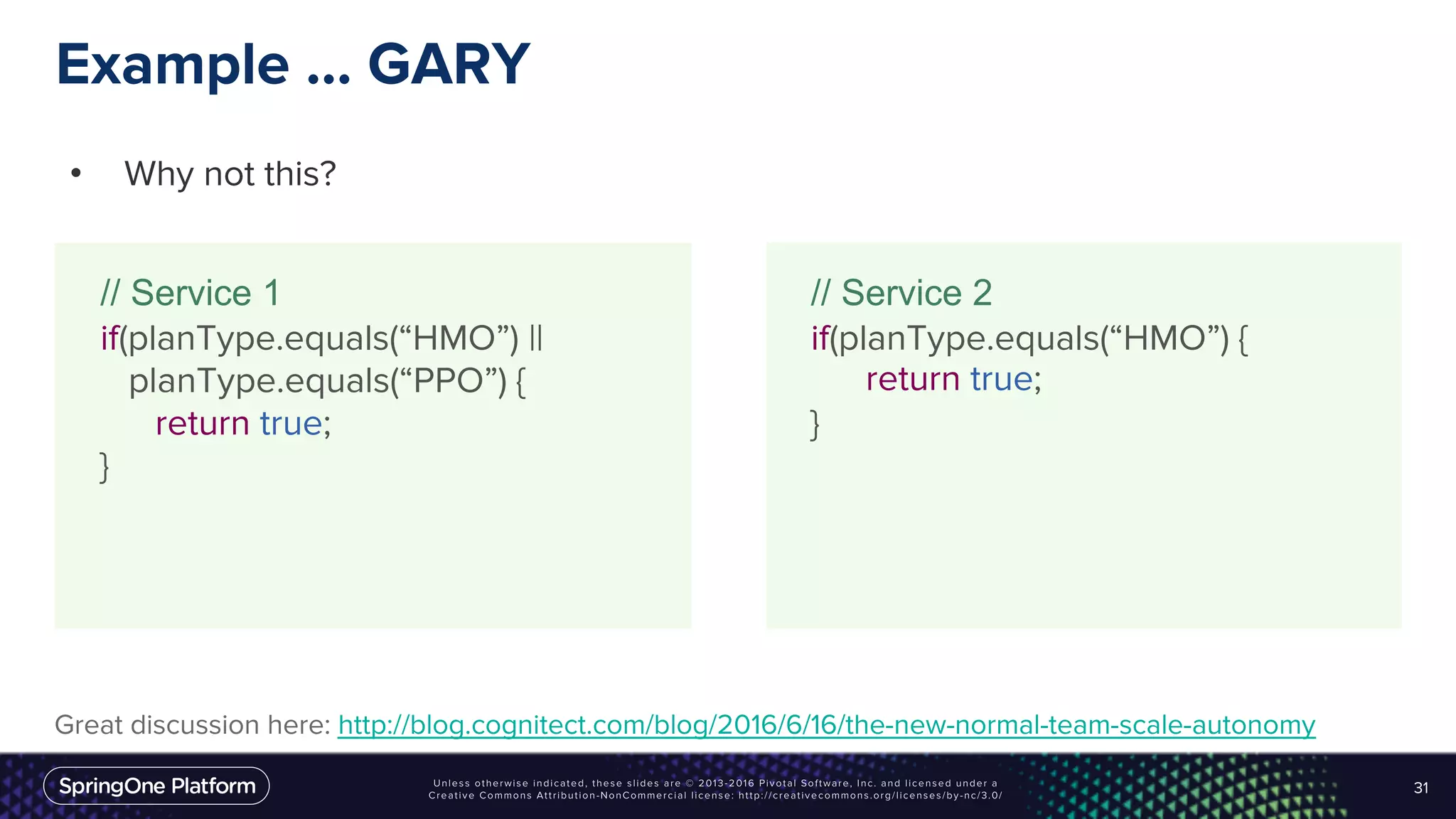
Example … GARY
30
// Does every service need to include a shared component (JAR) to validate
plan types?
import java.utils.Arrays;
private static String [] PLAN_TYPES= {“HMO”, “PPO”};
public static boolean isValidPlanType(String planType) {
return Arrays.stream(PLAN_TYPES).anyMatch(planType::equals)
}
What if different services accept different types of plans? Are all services using
Java 8?
Example … GARY
31
// Service 1
if(planType.equals(“HMO”) ||
planType.equals(“PPO”) {
return true;
}
// Service 2
if(planType.equals(“HMO”) {
return true;
}
• Why not this?
Great discussion here: http://blog.cognitect.com/blog/2016/6/16/the-new-normal-team-scale-autonomy
Your design will evolve constantly … refactor
ruthlessly
32
Ok, now let’s address the team problems
33
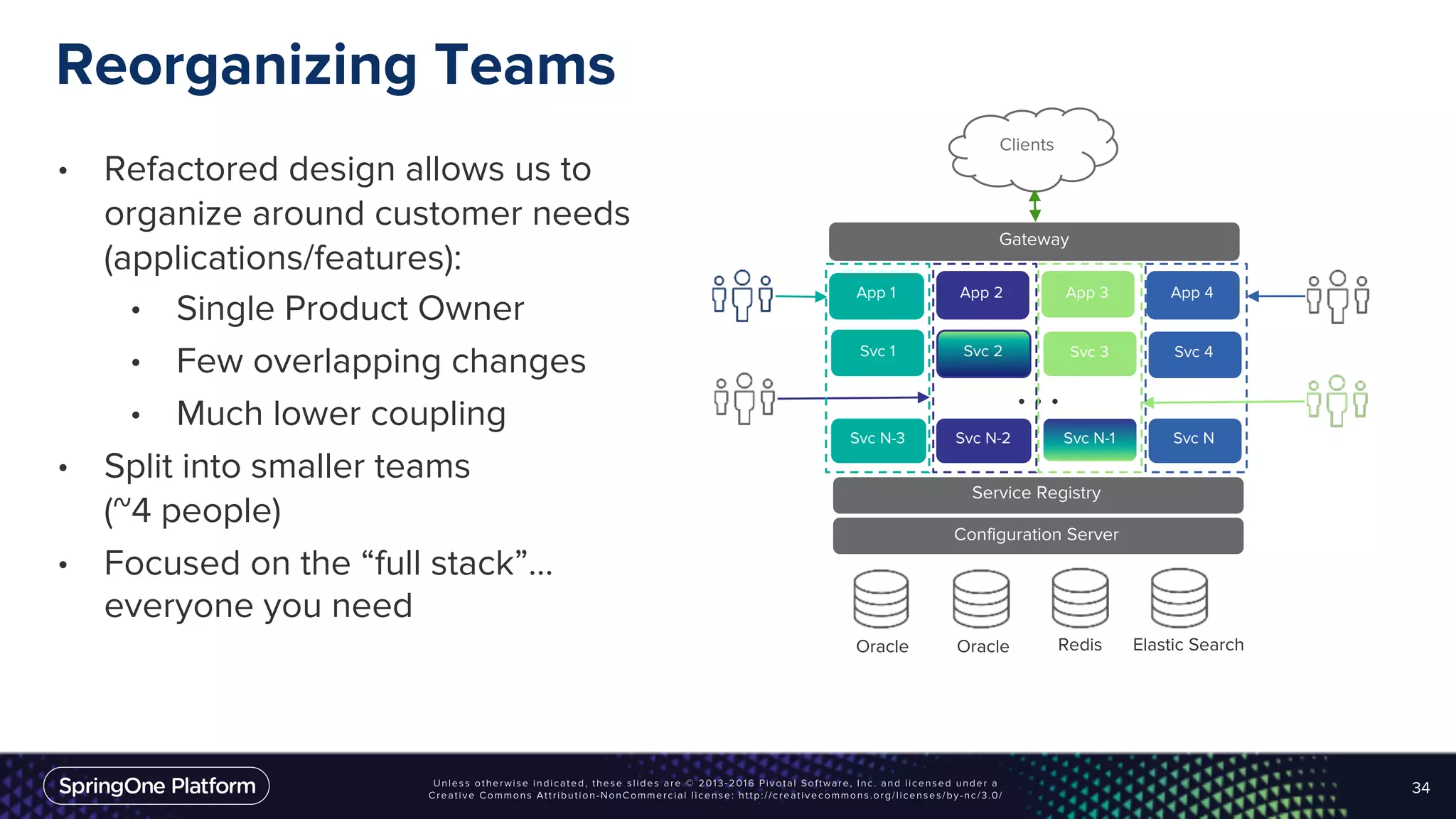
Reorganizing Teams
• Refactored design allows us to
organize around customer needs
(applications/features):
• Single Product Owner
• Few overlapping changes
• Much lower coupling
• Split into smaller teams
(~4 people)
• Focused on the “full stack”…
everyone you need
34
Clients
Gateway
App 1
Svc 2Svc 1
App 2 App 3 App 4
Svc 3 Svc 4
Service Registry
Configuration Server
Oracle Redis Elastic SearchOracle
Svc N-2Svc N-3 Svc N-1 Svc N
. . .
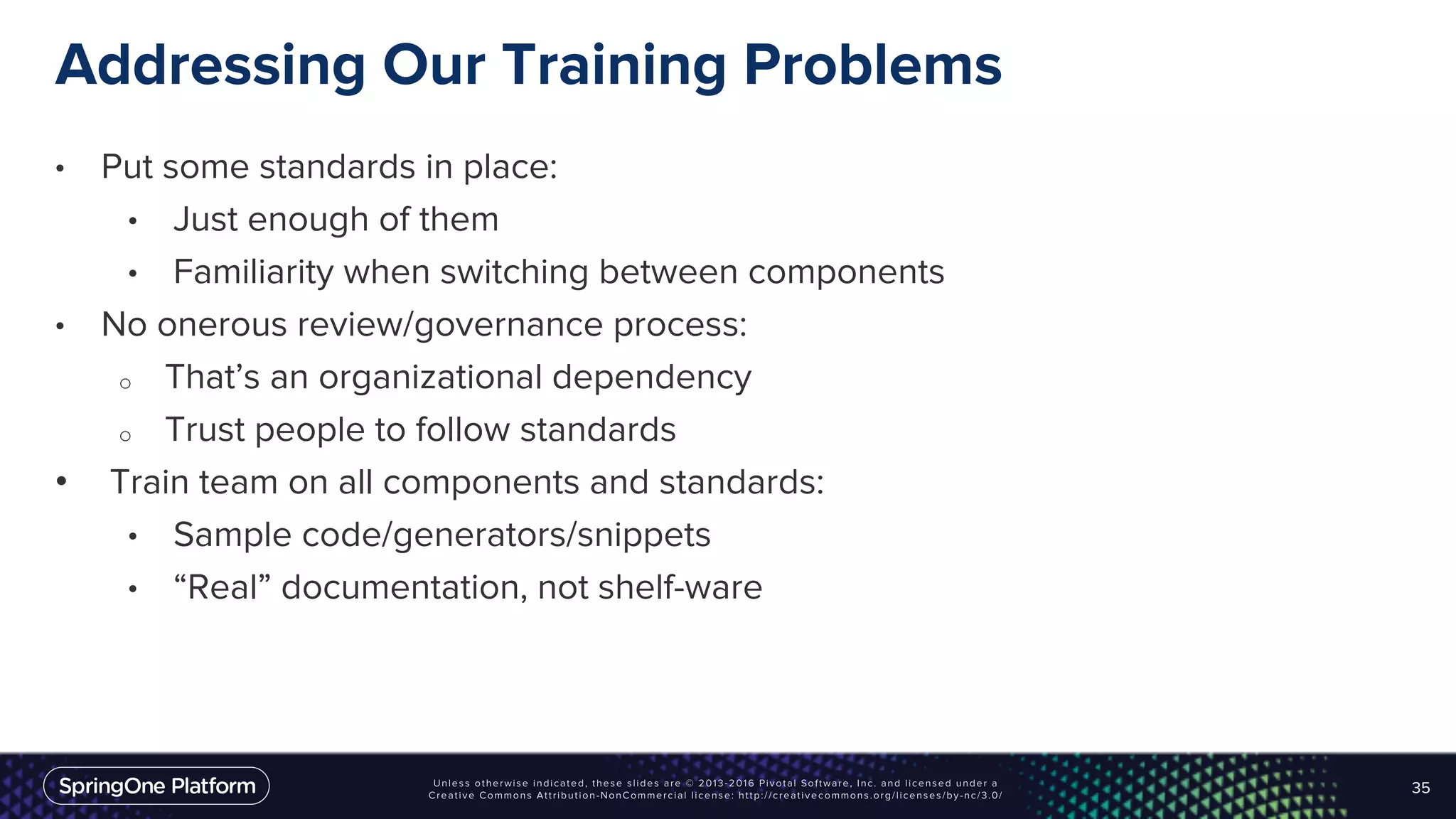
Addressing Our Training Problems
• Put some standards in place:
• Just enough of them
• Familiarity when switching between components
• No onerous review/governance process:
o That’s an organizational dependency
o Trust people to follow standards
• Train team on all components and standards:
• Sample code/generators/snippets
• “Real” documentation, not shelf-ware
35
Addressing Our Workload Problems
• Warning Scrum Masters ... you will
not like this…
• We shift our resources all the time
• Our standards and consistency
make this easy to do
• Do you want to predict velocity
or do you want to have
velocity?
• Over time it averages out
36
Clients
Gateway
App 1
Svc 2Svc 1
App 2 App 3 App 4
Svc 3 Svc 4
Service Registry
Configuration Server
Oracle Redis Elastic SearchOracle
Svc N-2Svc N-3 Svc N-1 Svc N
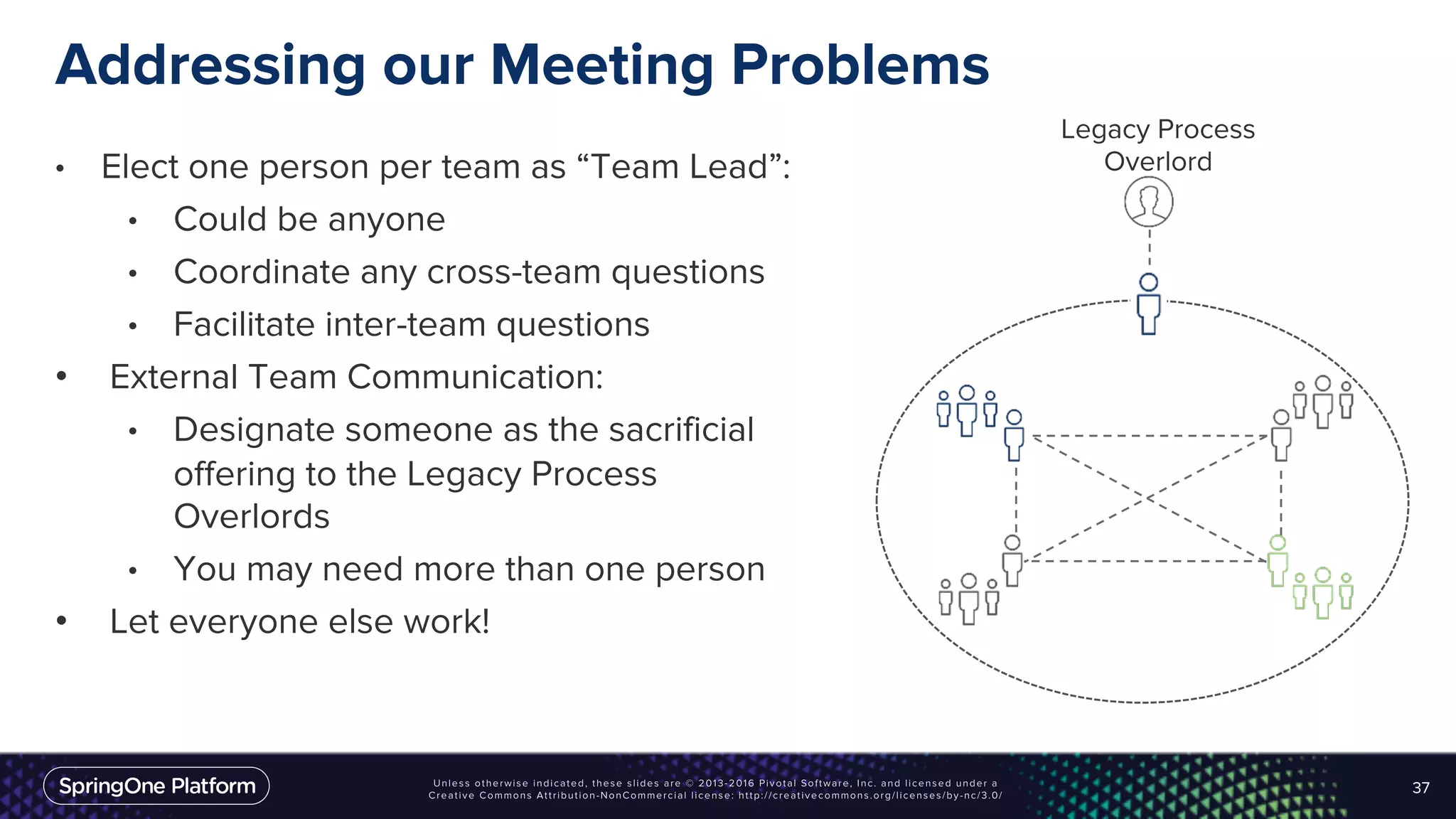
Addressing our Meeting Problems
• Elect one person per team as “Team Lead”:
• Could be anyone
• Coordinate any cross-team questions
• Facilitate inter-team questions
• External Team Communication:
• Designate someone as the sacrificial
offering to the Legacy Process
Overlords
• You may need more than one person
• Let everyone else work!
37
Legacy Process
Overlord
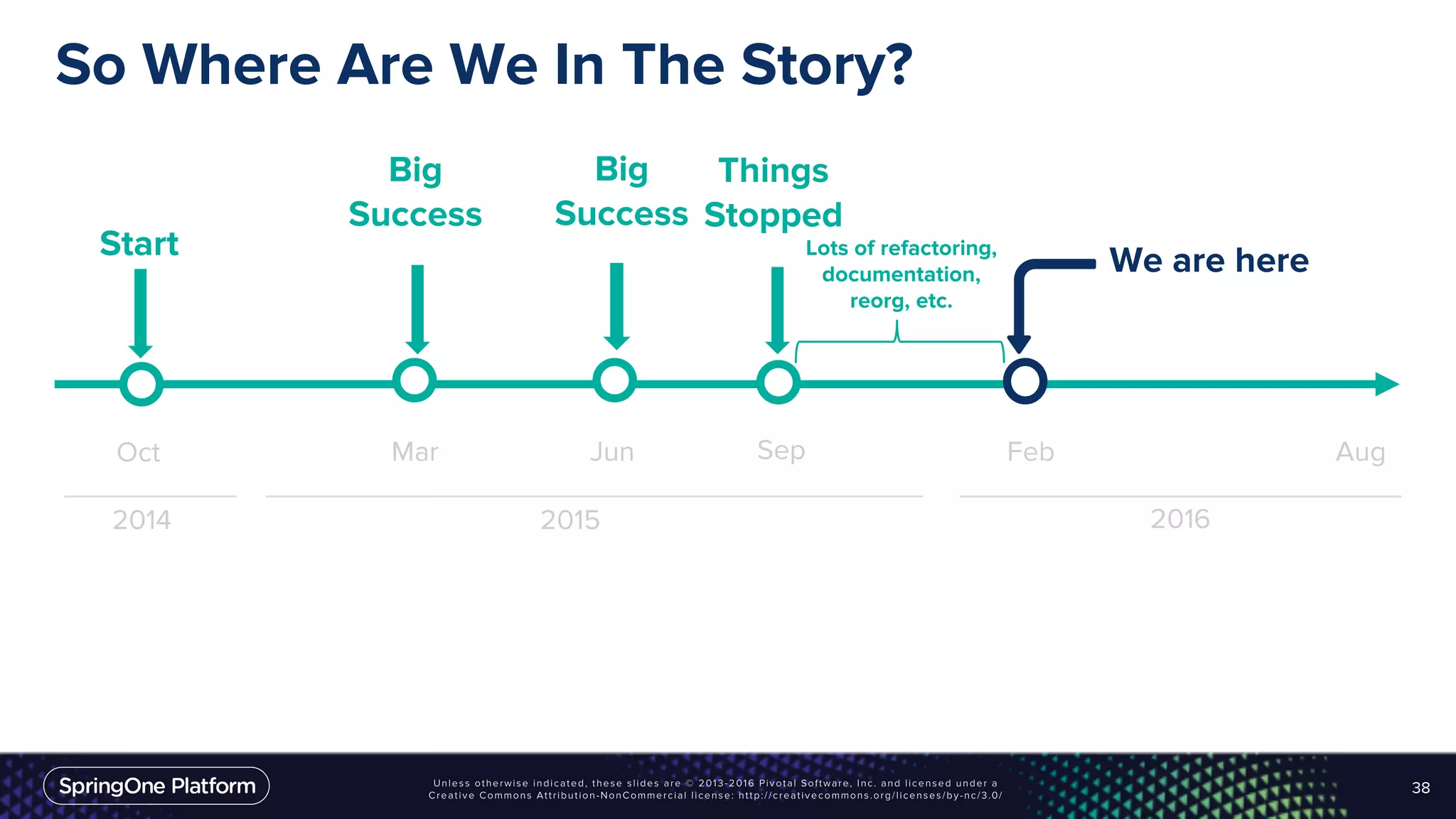
So Where Are We In The Story?
38
Start
Big
Success
2014 2015 2016
AugOct Mar Jun
Big
Success
Sep Feb
Things
Stopped
We are hereLots of refactoring,
documentation,
reorg, etc.
We Started Gaining Momentum
• Teams working (mostly) independently
• Meeting frequency greatly reduced
• Not as much cross-team coordination
• Legacy Process Overlords appeased
39
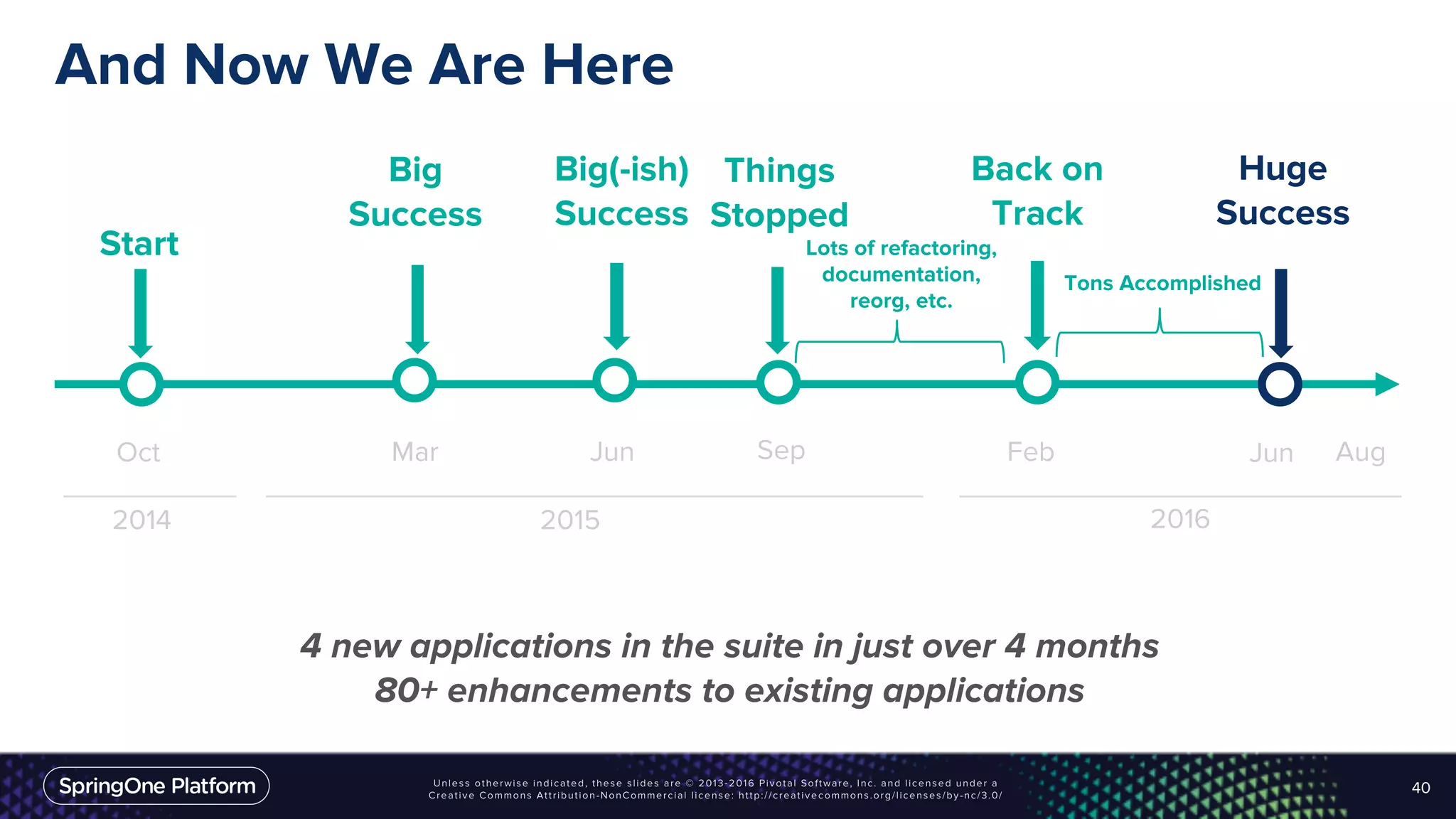
And Now We Are Here
40
Start
Big
Success
2014 2015 2016
AugOct Mar Jun
Big(-ish)
Success
Sep Feb
Things
Stopped
Back on
Track
Tons Accomplished
Huge
Success
Jun
Lots of refactoring,
documentation,
reorg, etc.
4 new applications in the suite in just over 4 months
80+ enhancements to existing applications
Have a Need for Speed?
41
So, have a need for speed?
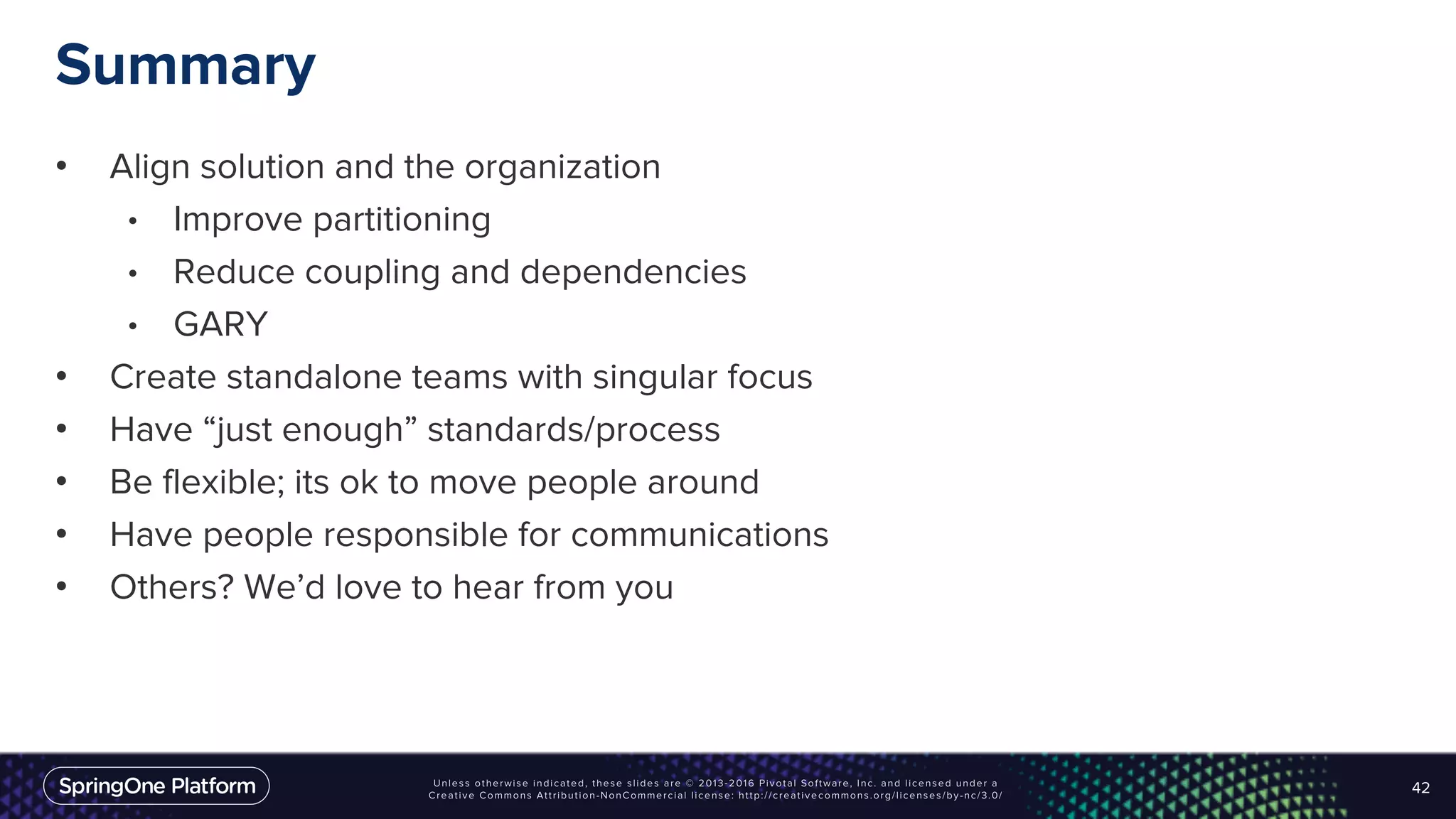
Summary
• Align solution and the organization
• Improve partitioning
• Reduce coupling and dependencies
• GARY
• Create standalone teams with singular focus
• Have “just enough” standards/process
• Be flexible; its ok to move people around
• Have people responsible for communications
• Others? We’d love to hear from you
42
Learn More. Stay Connected.
@springcentral
spring.io/blog
@pivotal
pivotal.io/blog
@pivotalcf
http://engineering.pivotal.io

Microservices: Organizing Large Teams for Rapid Delivery

  • 1.
    Microservices: Organizing aLarge Team for Rapid Delivery By Jason Goth, Micah Blalock, Patricia Anderson @jgothtx, @micah_blalock, @patricia_sooner
  • 2.
    About Us Jason Goth jgoth@credera.com @jgothtx MicahBlalock mblalock@credera.com @micah_blalock Patricia Anderson panderson@credera.com @patricia_sooner
  • 3.
  • 4.
    Managing teams developingmicroservices is not so great much harder 4
  • 5.
    Objectives • Share lessonslearned on a few real world microservices projects: • Several customer projects • One internal project • Topics: • Organizational structure for rapid delivery • Design/Development practices to support these organizations • Communication across multiple teams 5
  • 6.
    Case Study …Custom Analytics Platform 6 We are here in the story 2014 2015 2016 AugOct
  • 7.
    The Problem • Suiteof applications: • Analytics for hospitals • Multiple products/users • Products share core services (e.g. how much does X cost? how many of these did I use?) • Multiple product owners • Billions of rows of legacy data • Huge roadmap of features and functionality (that they’d already promised…) 7 Lots of Legacy Data Product Owner Product Owner Customers Customers App App App Shared Stuff Customers System
  • 8.
    They Promised This 8 Weare still here in the story 2014 2015 2016 AugOct Product 1 Product 2 Product 3 Product 4 And So On
  • 9.
    We Decided ToDo Something Like This • Reuse of services ? • Add applications easily ? • Scale out forever ? • Cool factor? • Multiple teams can deliver products and features super fast ? Umm, we’ll come back to that... 9 Clients Gateway App 1 Svc 2Svc 1 App 2 App 3 App 4 Svc 3 Svc 4 Service Registry Configuration Server Oracle Redis Elastic SearchOracle Svc N-2Svc N-3 Svc N-1 Svc N . . .
  • 10.
    Let’s Use Spring! 10 Clients Gateway App1 Svc 2Svc 1 App 2 App 3 App 4 Svc 3 Svc 4 Oracle Redis Elastic SearchOracle Svc N-2Svc N-3 Svc N-1 Svc N . . . Spring Boot Spring Framework Spring Security Spring Data Spring Batch Spring AMQP Spring Cloud Service Registry Configuration Server
  • 11.
    It Worked Great! •Built the first application in the suite and the first few services in a few months • Spring-* provided a lot of the plumbing • We had one team (8-10 people) for the application and the services • Big success 11 Clients Gateway App 1 Svc 2Svc 1 App 2 App 3 App 4 Svc 3 Svc 4 Service Registry Configuration Server Oracle Redis Elastic SearchOracle Svc N-2Svc N-3 Svc N-1 Svc N . . .Dev Team
  • 12.
    This Is Easy… Let’s Do Another One 12 Phase 2 Starts Start Big Success 2014 2015 2016 AugOct AprMar
  • 13.
    It Worked Ok… • Second team (8-10 people) brought on board to build the next application in the suite • Did it all in 3 months this time • Another big(-ish) success • Teams still did their own thing • More friction, but manageable 13 Clients Gateway App 1 Svc 2Svc 1 App 2 App 3 App 4 Svc 3 Svc 4 Service Registry Configuration Server Oracle Redis Elastic SearchOracle Svc N-2Svc N-3 Svc N-1 Svc N . . .
  • 14.
    Let’s Do 2More Apps … in Only 3 Months 14 “Phase 3” Starts Start Big Success 2014 2015 2016 AugOct Mar Jun July Big(-ish) Success
  • 15.
    We Just NeedTo Add Some People, Right? • Continue trying to scale out as before: • Add new teams for new features and services • Letting teams do their own thing 15 Clients Gateway App 1 Svc 2Svc 1 App 2 App 3 App 4 Svc 3 Svc 4 Service Registry Configuration Server Oracle Redis Elastic SearchOracle Svc N-2Svc N-3 Svc N-1 Svc N . . .
  • 16.
    Two Months In… 16 Start Big Success 2014 2015 2016 AugOct Mar Jun Big(-ish) Success We are here Sep
  • 17.
    It All Cameto a Screeching Halt 17
  • 18.
  • 19.
    It Really LookedLike This • Dependency hell: • Each feature changed many services • Changes cascaded everywhere • Teams were stepping on each other • Versioning helped; but versioning is its own special hell 19 Clients Gateway App 1 Svc 1 App 2 App 3 App 4 Service Registry Configuration Server Oracle Redis Elastic SearchOracle Svc 2 Svc 3 Svc 4 Svc N-2Svc N-3 Svc N-1 Svc N . . .
  • 20.
    Team Health Suffering •Unequal workloads • Training issues: • Unfamiliar systems • Not always the right skillset • We had sooooo many meetings: • Many to coordinate with each other • Up to 50% of people’s time 20
  • 21.
    Some Things OutsideOur Control • “Legacy” processes added friction: • “Architecture Review Board” • “Change Control Board” • Shared environments • QA, Load Testing, etc. • Customer doesn’t use any cloud services L 21
  • 22.
    Isn’t this supposedto be faster? 22
  • 23.
    It can befaster, if you align the solution and the organization 23 Main Point of This Talk
  • 24.
    Alignment • Conway’s Lawis the starting point • When each team “owns” their own services • Easy to change • Coordination costs low • Sharing exposes stress points, coordination costs increase: • Adding features to existing services • Cascading changes to service contracts • Coordination costs + partitioning of work = efficiency of change. 24 SvcSvc Svc Svc Svc Svc Stress point
  • 25.
    Partitioning … Timevs Workers 25 Partitioned Tasks Non-partitioned Tasks Partitioned Tasks High Coordination Time Workers Workers Workers Time Time Source: The Mythical Man-Month, Frederick P. Brooks, Jr., 1995
  • 26.
    Better Partitioning • Refactorto create surface area • Similar to the open/closed principle • Package code by features not layers • Add packages for new features • Grow code horizontally not vertically 26 // This is your clue to refactor if( purchaseType.equals(“Lab”)) { savings = getLabSavings() } else if (purchaseType.equals(“Rx”)) { savings = getRxSavings() } else ...
  • 27.
    Handling Cascading Changes •Remove semantic coupling • Shared concepts,data types or domain entities • Behavioral dependencies • The more effects and side-effects a service has, the tighter the coupling with its consumers See: http://www.michaelnygard.com/blog/2015/04/the-perils- of-semantic-coupling/ 27 Oracle Redis Elastic SearchOracle Gateway Svc 2 App 2 App 3 App 4 Svc 3 Svc 4 Service Registry Configuration Server Svc N-2Svc N-3 Svc N-1 Svc N . . . Svc 1 App 1
  • 28.
    Example ... SemanticCoupling 28 Invoices Customer Finance App Spend Finance App
  • 29.
    Eliminate Shared Dependencies •Warning architecture purists … you will not like this… • Shared dependencies increase coordination costs: • Some redundancies are ok • GARY (Go Ahead, Repeat Yourself) 29
  • 30.
    Example … GARY 30 //Does every service need to include a shared component (JAR) to validate plan types? import java.utils.Arrays; private static String [] PLAN_TYPES= {“HMO”, “PPO”}; public static boolean isValidPlanType(String planType) { return Arrays.stream(PLAN_TYPES).anyMatch(planType::equals) } What if different services accept different types of plans? Are all services using Java 8?
  • 31.
    Example … GARY 31 //Service 1 if(planType.equals(“HMO”) || planType.equals(“PPO”) { return true; } // Service 2 if(planType.equals(“HMO”) { return true; } • Why not this? Great discussion here: http://blog.cognitect.com/blog/2016/6/16/the-new-normal-team-scale-autonomy
  • 32.
    Your design willevolve constantly … refactor ruthlessly 32
  • 33.
    Ok, now let’saddress the team problems 33
  • 34.
    Reorganizing Teams • Refactoreddesign allows us to organize around customer needs (applications/features): • Single Product Owner • Few overlapping changes • Much lower coupling • Split into smaller teams (~4 people) • Focused on the “full stack”… everyone you need 34 Clients Gateway App 1 Svc 2Svc 1 App 2 App 3 App 4 Svc 3 Svc 4 Service Registry Configuration Server Oracle Redis Elastic SearchOracle Svc N-2Svc N-3 Svc N-1 Svc N . . .
  • 35.
    Addressing Our TrainingProblems • Put some standards in place: • Just enough of them • Familiarity when switching between components • No onerous review/governance process: o That’s an organizational dependency o Trust people to follow standards • Train team on all components and standards: • Sample code/generators/snippets • “Real” documentation, not shelf-ware 35
  • 36.
    Addressing Our WorkloadProblems • Warning Scrum Masters ... you will not like this… • We shift our resources all the time • Our standards and consistency make this easy to do • Do you want to predict velocity or do you want to have velocity? • Over time it averages out 36 Clients Gateway App 1 Svc 2Svc 1 App 2 App 3 App 4 Svc 3 Svc 4 Service Registry Configuration Server Oracle Redis Elastic SearchOracle Svc N-2Svc N-3 Svc N-1 Svc N
  • 37.
    Addressing our MeetingProblems • Elect one person per team as “Team Lead”: • Could be anyone • Coordinate any cross-team questions • Facilitate inter-team questions • External Team Communication: • Designate someone as the sacrificial offering to the Legacy Process Overlords • You may need more than one person • Let everyone else work! 37 Legacy Process Overlord
  • 38.
    So Where AreWe In The Story? 38 Start Big Success 2014 2015 2016 AugOct Mar Jun Big Success Sep Feb Things Stopped We are hereLots of refactoring, documentation, reorg, etc.
  • 39.
    We Started GainingMomentum • Teams working (mostly) independently • Meeting frequency greatly reduced • Not as much cross-team coordination • Legacy Process Overlords appeased 39
  • 40.
    And Now WeAre Here 40 Start Big Success 2014 2015 2016 AugOct Mar Jun Big(-ish) Success Sep Feb Things Stopped Back on Track Tons Accomplished Huge Success Jun Lots of refactoring, documentation, reorg, etc. 4 new applications in the suite in just over 4 months 80+ enhancements to existing applications
  • 41.
    Have a Needfor Speed? 41 So, have a need for speed?
  • 42.
    Summary • Align solutionand the organization • Improve partitioning • Reduce coupling and dependencies • GARY • Create standalone teams with singular focus • Have “just enough” standards/process • Be flexible; its ok to move people around • Have people responsible for communications • Others? We’d love to hear from you 42
  • 43.
    Learn More. StayConnected. @springcentral spring.io/blog @pivotal pivotal.io/blog @pivotalcf http://engineering.pivotal.io