Why Microservices?
Drawbacks of Monolithic Applications
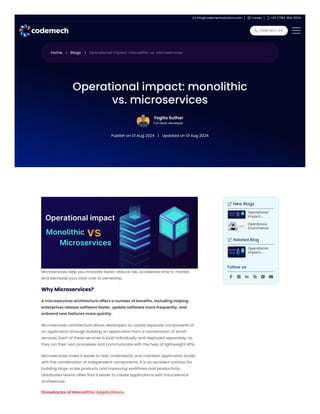
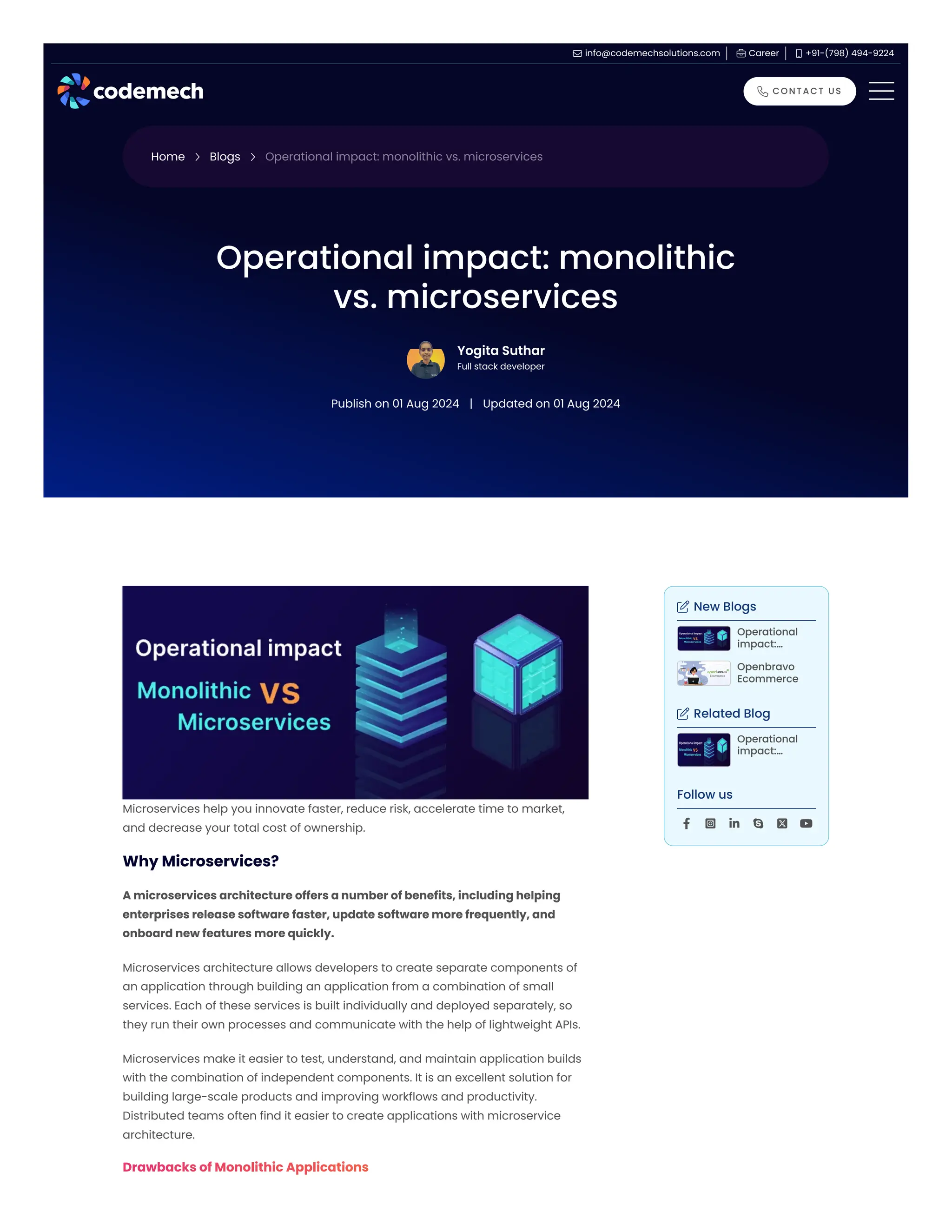
Microservices help you innovate faster, reduce risk, accelerate time to market,
and decrease your total cost of ownership.
A microservices architecture offers a number of benefits, including helping
enterprises release software faster, update software more frequently, and
onboard new features more quickly.
Microservices architecture allows developers to create separate components of
an application through building an application from a combination of small
services. Each of these services is built individually and deployed separately, so
they run their own processes and communicate with the help of lightweight APIs.
Microservices make it easier to test, understand, and maintain application builds
with the combination of independent components. It is an excellent solution for
building large-scale products and improving workflows and productivity.
Distributed teams often find it easier to create applications with microservice
architecture.
Operational impact: monolithic
vs. microservices
Yogita Suthar
Full stack developer
Publish on 01 Aug 2024 | Updated on 01 Aug 2024
 New Blogs
 Related Blog
Follow us
Operational
impact:…
Openbravo
Ecommerce
Operational
impact:…
     
Home  Blogs  Operational impact: monolithic vs. microservices
 info@codemechsolutions.com  Career  +91-(798) 494-9224
 CONTACT US
Benefits of Microservices
Monolithic architecture vs. Microservices architecture
When to use monolithic vs. microservices architecture
1. Size and Complexities Limitation Monolithic applications are highly
constrained by Size and complexities. To make an application bigger, the
organization has to incorporate more services into it, making it slower to deploy
and execute.
2. Difficult to Update Updating a monolithic application is one of the most
daunting tasks for any business. The reason being, to update a monolithic
application, organizations have to redeploy the entire application costing them
time and money. Moreover, if an organization manages to update a monolithic
application, the changes are not very well understood by the stakeholders; hence
rigorous manual testing is required.
3. Poor Scalability Monolithic applications can be challenging to scale when
different modules have conflicting resource requirements. This because several
services call for resources that are interconnected with other services of the
application. Therefore, when called, the engagement of resources avoids avoid
hampering the scalability of the application.
4. Meagre Reliability Reliability is one of the most impacting factors propelling
the stakeholders to migrate monolithic applications to microservices. For
instance, in the case of a bug, the entire process of the monolithic application is
hampered. Moreover, the application might have the same service for multiple
instances. In that case, the bug will reflect an entire application.
5. Innovate faster Monolithic architecture limits an organization's ability to
introduce new business capabilities and technologies in existing applications.
Developers cannot rebuild certain parts of the code base with new technological
frameworks, which delays your organization in adopting modern technological
trends.
1. Smoothen the Complexities The microservice architecture on AWS tackles over
complexities of a monolithic application by decomposing the application into a
set of manageable services. These services are faster to develop and easier to
understand, making them swift to use and maintain.
2. No Barriers to New Technologies Adoption Microservice architecture reduces
the barrier to adopting new technologies. The architecture provides this flexibility
as developers are free to choose whatever technologies make sense for their
service and are not bound to the choices made at the start of the project.
Microservices are independent software components that developers can build
with different frameworks and software technologies. The loose coupling between
microservices allows businesses to innovate certain components more quickly.
3. Independent Deployment The architecture allows businesses to deploy
microservices independently. This makes continuous deployment possible for
organizations.
4. Better Agility Any fault in a microservices application affects only a particular
service, not the whole solution. So all the changes and experiments are
implemented with lower risks and fewer errors.
Both monolithic and microservices architecture help developers to build
applications with different approaches. It's important to understand that
microservices don't reduce the complexity of an application. Instead, the
microservices structure reveals underlying complexities and allows developers to
build, manage, and scale large applications more efficiently.
Conclusion
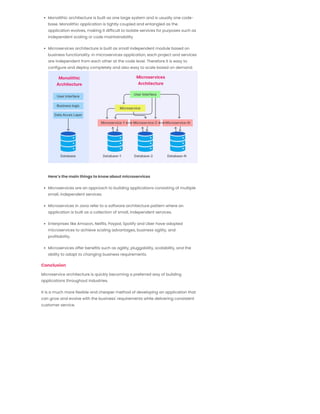
Monolithic architecture is built as one large system and is usually one code-
base. Monolithic application is tightly coupled and entangled as the
application evolves, making it difficult to isolate services for purposes such as
independent scaling or code maintainability
Microservices architecture is built as small independent module based on
business functionality. In microservices application, each project and services
are independent from each other at the code level. Therefore it is easy to
configure and deploy completely and also easy to scale based on demand.
Here’s the main things to know about microservices
Microservices are an approach to building applications consisting of multiple
small, independent services.
Microservices in Java refer to a software architecture pattern where an
application is built as a collection of small, independent services.
Enterprises like Amazon, Netflix, Paypal, Spotify and Uber have adopted
microservices to achieve scaling advantages, business agility, and
profitability.
Microservices offer benefits such as agility, pluggability, scalability, and the
ability to adapt to changing business requirements.
Microservice architecture is quickly becoming a preferred way of building
applications throughout industries.
It is a much more flexible and cheaper method of developing an application that
can grow and evolve with the business' requirements while delivering consistent
customer service.
We provide hassle-free service and solutions for web and mobile applications.
Support

(Mon-Fri)
10:00am - 7:00pm(IST)
 info@codemechsolutions.com
 (Sales) + 91 798 494-9224
 (HR) + 91 635 104-3147
     
Resources
About
Portfolio
Career
Recent Solutions
Case study
Blogs
Sitemap
Services
Java Development
Angular Development
iPhone Development
Android Development
Hybrid Development
Aws Cloud Services
Integration
Services
Docker/Kubernetes
Container Services
CI/CD Deployment
ERP/E-commerce
Development
Hire Developers
Locations
India
403, Swasthi Business Center, SP Ring Rd. Nikol Ahmedabad
GJ 382350
Ireland
11, Derravaragh Abbey Multyfarnham, Co. Westmeath,
Ireland N91N7F8.
Copyright @ 2024 Codemech Solutions Terms and Conditions
Our Highly skilled IT Service team is ready to support you within a very short
period and also it will be available on-demand.
Codemech's Value
Customers
Support & Services
CONTACT US

Operational impact: monolithic vs. microservices

  • 1.
    Why Microservices? Drawbacks ofMonolithic Applications Microservices help you innovate faster, reduce risk, accelerate time to market, and decrease your total cost of ownership. A microservices architecture offers a number of benefits, including helping enterprises release software faster, update software more frequently, and onboard new features more quickly. Microservices architecture allows developers to create separate components of an application through building an application from a combination of small services. Each of these services is built individually and deployed separately, so they run their own processes and communicate with the help of lightweight APIs. Microservices make it easier to test, understand, and maintain application builds with the combination of independent components. It is an excellent solution for building large-scale products and improving workflows and productivity. Distributed teams often find it easier to create applications with microservice architecture. Operational impact: monolithic vs. microservices Yogita Suthar Full stack developer Publish on 01 Aug 2024 | Updated on 01 Aug 2024  New Blogs  Related Blog Follow us Operational impact:… Openbravo Ecommerce Operational impact:…       Home  Blogs  Operational impact: monolithic vs. microservices  info@codemechsolutions.com  Career  +91-(798) 494-9224  CONTACT US
  • 2.
    Benefits of Microservices Monolithicarchitecture vs. Microservices architecture When to use monolithic vs. microservices architecture 1. Size and Complexities Limitation Monolithic applications are highly constrained by Size and complexities. To make an application bigger, the organization has to incorporate more services into it, making it slower to deploy and execute. 2. Difficult to Update Updating a monolithic application is one of the most daunting tasks for any business. The reason being, to update a monolithic application, organizations have to redeploy the entire application costing them time and money. Moreover, if an organization manages to update a monolithic application, the changes are not very well understood by the stakeholders; hence rigorous manual testing is required. 3. Poor Scalability Monolithic applications can be challenging to scale when different modules have conflicting resource requirements. This because several services call for resources that are interconnected with other services of the application. Therefore, when called, the engagement of resources avoids avoid hampering the scalability of the application. 4. Meagre Reliability Reliability is one of the most impacting factors propelling the stakeholders to migrate monolithic applications to microservices. For instance, in the case of a bug, the entire process of the monolithic application is hampered. Moreover, the application might have the same service for multiple instances. In that case, the bug will reflect an entire application. 5. Innovate faster Monolithic architecture limits an organization's ability to introduce new business capabilities and technologies in existing applications. Developers cannot rebuild certain parts of the code base with new technological frameworks, which delays your organization in adopting modern technological trends. 1. Smoothen the Complexities The microservice architecture on AWS tackles over complexities of a monolithic application by decomposing the application into a set of manageable services. These services are faster to develop and easier to understand, making them swift to use and maintain. 2. No Barriers to New Technologies Adoption Microservice architecture reduces the barrier to adopting new technologies. The architecture provides this flexibility as developers are free to choose whatever technologies make sense for their service and are not bound to the choices made at the start of the project. Microservices are independent software components that developers can build with different frameworks and software technologies. The loose coupling between microservices allows businesses to innovate certain components more quickly. 3. Independent Deployment The architecture allows businesses to deploy microservices independently. This makes continuous deployment possible for organizations. 4. Better Agility Any fault in a microservices application affects only a particular service, not the whole solution. So all the changes and experiments are implemented with lower risks and fewer errors. Both monolithic and microservices architecture help developers to build applications with different approaches. It's important to understand that microservices don't reduce the complexity of an application. Instead, the microservices structure reveals underlying complexities and allows developers to build, manage, and scale large applications more efficiently.
  • 3.
    Conclusion Monolithic architecture isbuilt as one large system and is usually one code- base. Monolithic application is tightly coupled and entangled as the application evolves, making it difficult to isolate services for purposes such as independent scaling or code maintainability Microservices architecture is built as small independent module based on business functionality. In microservices application, each project and services are independent from each other at the code level. Therefore it is easy to configure and deploy completely and also easy to scale based on demand. Here’s the main things to know about microservices Microservices are an approach to building applications consisting of multiple small, independent services. Microservices in Java refer to a software architecture pattern where an application is built as a collection of small, independent services. Enterprises like Amazon, Netflix, Paypal, Spotify and Uber have adopted microservices to achieve scaling advantages, business agility, and profitability. Microservices offer benefits such as agility, pluggability, scalability, and the ability to adapt to changing business requirements. Microservice architecture is quickly becoming a preferred way of building applications throughout industries. It is a much more flexible and cheaper method of developing an application that can grow and evolve with the business' requirements while delivering consistent customer service.
  • 4.
    We provide hassle-freeservice and solutions for web and mobile applications. Support  (Mon-Fri) 10:00am - 7:00pm(IST)  info@codemechsolutions.com  (Sales) + 91 798 494-9224  (HR) + 91 635 104-3147       Resources About Portfolio Career Recent Solutions Case study Blogs Sitemap Services Java Development Angular Development iPhone Development Android Development Hybrid Development Aws Cloud Services Integration Services Docker/Kubernetes Container Services CI/CD Deployment ERP/E-commerce Development Hire Developers Locations India 403, Swasthi Business Center, SP Ring Rd. Nikol Ahmedabad GJ 382350 Ireland 11, Derravaragh Abbey Multyfarnham, Co. Westmeath, Ireland N91N7F8. Copyright @ 2024 Codemech Solutions Terms and Conditions Our Highly skilled IT Service team is ready to support you within a very short period and also it will be available on-demand. Codemech's Value Customers Support & Services CONTACT US