Download to read offline
![MUMBAI UNIVERSITY
QUESTION PAPER
MICROPROCESSOR ARCHITECTURE
(APRIL – 2017 | 75:25 PATTERN)
B.SC.IT
(SEMESTER – II)
KjT MUMBAI B.SC.IT STUDY
FACEBOOK | TWITTER | INSTAGRAM | GOOGLE+ | YOUTUBE | SLIDESHARE | TUMBLR | GITHUB
PAGE
1
Time: 2 ½ Hours Total Marks: 75
N.B.: (1) All Question are Compulsory.
(2) Make Suitable Assumptions Wherever Necessary And State The Assumptions Made.
(3) Answer To The Same Question Must Be Written Together.
(4) Number To The Right Indicates Marks.
(5) Draw Neat Labeled Diagrams Wherever Necessary.
(6) Use of Non – Programmable Calculator is allowed.
Q.1 ATTEMPT ANY THREE QUESTIONS: (15 MARKS)
(A) Differentiate between Higher Level and Lower Level Programming Language. Also differentiate between
Machine Language and Assembly Language.
(5)
(B) Draw and explain the block diagram of a computer with Microprocessor as CPU. (5)
(C) Which are the basic operations performed by the microprocessor? Explain the bus structure of 8085
Microprocessor with necessary diagram.
(5)
(D) Illustrate the memory address range of a memory chip with 1K bytes of memory. Explain how range can be
changed by modifying the hardware.
(5)
(E) With a neat diagram explain the functional pin configuration of the 40 pin IC8085. (5)
(F) What is the use of memory segment 8155 in a SDK-85 System? Draw the block diagram of 8155. How is
interfacing of 8155 Memory Section Done?
(5)
Q.2 ATTEMPT ANY THREE QUESTIONS: (15 MARKS)
(A) Explain the use of OUT instruction. Also explain how the instruction is executed with the help of Relevant Timing
Diagram.
(5)
(B) Explain how 8 DIP switches can be interfaced with 8 bit 8085 microprocessor. Draw a neat diagram to show how
data and address bus of the microprocessor can be used for interfacing.
(5)
(C) With a neat diagram discuss the programming model of 8085 microprocessor. (5)
(D) Explain One Byte, Two Byte and Three Byte instructions. Give at least one example for each. (5)
(E) List different addressing modes used by 8085 microprocessor. Write any one 1 byte and any one 2 byte
instruction to perform arithmetic operation using 8085 microprocessor.
(5)
(F) Differentiate between conditional and unconditional jump used in 8085 microprocessor. Explain different
conditional jump instructions.
(5)
Q.3 ATTEMPT ANY THREE QUESTIONS: (15 MARKS)
(A) A data FF H is stored at a memory location C050 H. Write three different ways of moving this data segment to
Accumulator.
(5)
(B) Explain how 8085 microprocessor performs logical operation of comparing two data. (5)
(C) What is Time Delay? Why is it needed? Explain how time delay can be generated using a register pair. (5)
(D) Write an 8085 assembly language program to count continuously in hexadecimal from FF H to 00 H (in
descending order) in a system with 0.5𝜇𝑠 clock period. Use register C to set up 1 ms delay between each count
and display the number at one of the output ports.
(5)
(E) What is Stack? Explain the use of SP register in 8085. Discuss the instructions PUSH and POP. Write a code to
demonstrate use of any one instruction.
(5)
(F) Explain the following concepts for subroutine program:
(i) Nesting
(ii) Multiple Ending Subroutine
(5)
[TURN OVER]](https://image.slidesharecdn.com/75-25-ma-apr-17-qp-180619012850/85/Microprocessor-Architecture-Question-Paper-April-2017-75-25-Pattern-1-320.jpg)
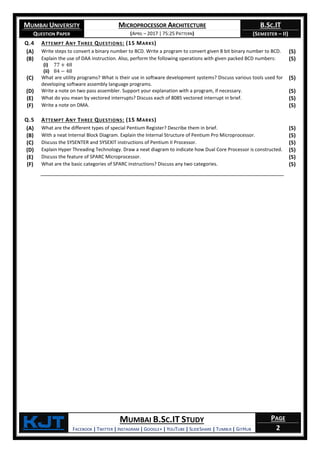

The document is a question paper for a B.Sc. IT microprocessor architecture course from Mumbai University, dated April 2017. It contains a series of questions divided into five sections, focusing on topics such as programming languages, microprocessor operations, assembly language, and various related concepts. Each question requires the student to attempt any three questions from a set and is structured to assess their understanding of microprocessor architecture and operations.
![ASP.NET With C# (May – 2018) [IDOL: Revised Course | Question Paper]](https://cdn.slidesharecdn.com/ss_thumbnails/asp-180827152003-thumbnail.jpg?width=640&height=640&fit=bounds)
![Internet Of Things (November – 2018) [Choice Based | Question Paper]](https://cdn.slidesharecdn.com/ss_thumbnails/iot-cbcs-nov-2018-qp-191111054925-thumbnail.jpg?width=640&height=640&fit=bounds)
![Advanced Java (May – 2018) [IDOL: Revised Course | Question Paper]](https://cdn.slidesharecdn.com/ss_thumbnails/aj-180827152043-thumbnail.jpg?width=640&height=640&fit=bounds)
![Object Oriented Programming (Question Paper) [April – 2017 | 75:25 Pattern]](https://cdn.slidesharecdn.com/ss_thumbnails/75-25-oop-apr-17-qp-180619012827-thumbnail.jpg?width=640&height=640&fit=bounds)
![Advanced Web Programming (November – 2018) [Choice Based | Question Paper]](https://cdn.slidesharecdn.com/ss_thumbnails/awp-cbcs-nov-2018-qp-191111054947-thumbnail.jpg?width=640&height=640&fit=bounds)
![Artificial Intelligence (November – 2018) [Choice Based | Question Paper]](https://cdn.slidesharecdn.com/ss_thumbnails/ai-cbcs-nov-2018-qp-191111054942-thumbnail.jpg?width=640&height=640&fit=bounds)
![Internet Technologies (May - 2018) [IDOL - Revised Course | Question Paper]](https://cdn.slidesharecdn.com/ss_thumbnails/it-idol-revised-course-may-2018-qp-180814024221-thumbnail.jpg?width=640&height=640&fit=bounds)
![Internet Technologies (April – 2015) [Question Paper | IDOL: Revised Course]](https://cdn.slidesharecdn.com/ss_thumbnails/idol-it-apr-2015-180708053053-thumbnail.jpg?width=640&height=640&fit=bounds)
![Internet Of Things (Question Paper) [October – 2018 | Choice Based Syllabus]](https://cdn.slidesharecdn.com/ss_thumbnails/iot-oct-2018-181112024446-thumbnail.jpg?width=640&height=640&fit=bounds)
![Next Generation Technologies (November – 2018) [Choice Based | Question Paper]](https://cdn.slidesharecdn.com/ss_thumbnails/ngt-cbcs-nov-2018-qp-191111054931-thumbnail.jpg?width=640&height=640&fit=bounds)
![Internet Technologies (December – 2017) [Question Paper | IDOL: Revised Course]](https://cdn.slidesharecdn.com/ss_thumbnails/idol-it-dec-2017-180708053056-thumbnail.jpg?width=640&height=640&fit=bounds)
![Software Project Management (November – 2018) [Choice Based | Question Paper]](https://cdn.slidesharecdn.com/ss_thumbnails/spm-cbcs-nov-2018-qp-191111054937-thumbnail.jpg?width=640&height=640&fit=bounds)
![Internet Technologies (October – 2014 ) [Question Paper | CBSGS: 75:25 Pattern]](https://cdn.slidesharecdn.com/ss_thumbnails/cbsgs-it-oct-2014-180708051829-thumbnail.jpg?width=640&height=640&fit=bounds)
![Enterprise Java (November – 2018) [Choice Based | Question Paper]](https://cdn.slidesharecdn.com/ss_thumbnails/ej-cbcs-nov-2018-qp-191111054920-thumbnail.jpg?width=640&height=640&fit=bounds)
![Linux System Administration (November – 2018) [Choice Based | Question Paper]](https://cdn.slidesharecdn.com/ss_thumbnails/lsa-cbcs-nov-2018-qp-191111055022-thumbnail.jpg?width=640&height=640&fit=bounds)


![Internet Technologies (October – 2015) [Question Paper | CBSGS: 75:25 Pattern]](https://cdn.slidesharecdn.com/ss_thumbnails/cbsgs-it-oct-2015-180708051832-thumbnail.jpg?width=640&height=640&fit=bounds)
![B.Sc.IT: Semester - VI (October - 2013) [IDOL - Revised Course | Question Paper]](https://cdn.slidesharecdn.com/ss_thumbnails/bscit-sem-vi-oct-idol-2013-qp-180803214355-thumbnail.jpg?width=640&height=640&fit=bounds)
![Internet Technologies (May – 2016) [Question Paper | IDOL: Revised Course]](https://cdn.slidesharecdn.com/ss_thumbnails/idol-it-may-2016-180708053036-thumbnail.jpg?width=640&height=640&fit=bounds)

![Advanced Java (Revised Syllabus) [QP / October - 2012]](https://cdn.slidesharecdn.com/ss_thumbnails/aj-qp-rs-oct-2012-171002230119-thumbnail.jpg?width=640&height=640&fit=bounds)
![Geographic Information Systems (December - 2018) [IDOL - Revised Course]](https://cdn.slidesharecdn.com/ss_thumbnails/gis-idol-dec-2018-qp-190220202540-thumbnail.jpg?width=640&height=640&fit=bounds)


![[Question Paper] Microprocessor and Microcontrollers (Revised Course) [Octobe...](https://cdn.slidesharecdn.com/ss_thumbnails/mm-qprevisedcourseoct-2016-170713044200-thumbnail.jpg?width=640&height=640&fit=bounds)
![[Question Paper] Microprocessor and Microcontrollers (Revised Course) [April ...](https://cdn.slidesharecdn.com/ss_thumbnails/mm-qprevisedcourseapr-2015-170713044202-thumbnail.jpg?width=640&height=640&fit=bounds)


![[Question Paper] Microprocessor and Microcontrollers (Revised Course) [Septem...](https://cdn.slidesharecdn.com/ss_thumbnails/mm-qprevisedcoursesep-2013-170713044201-thumbnail.jpg?width=640&height=640&fit=bounds)
![[Question Paper] Digital Computer Fundamental (Old Course) [April / 2014]](https://cdn.slidesharecdn.com/ss_thumbnails/dcf-qpoldcourseapr-2014-170714180908-thumbnail.jpg?width=640&height=640&fit=bounds)


![[Question Paper] Microprocessor and Microcontrollers (Revised Course) [June /...](https://cdn.slidesharecdn.com/ss_thumbnails/mm-qprevisedcoursejun-2014-170713050810-thumbnail.jpg?width=640&height=640&fit=bounds)


![Project Management (October - 2016) [CBSGS - Paper Solution] {Mumbai University}](https://cdn.slidesharecdn.com/ss_thumbnails/pm-cbsgs-oct-2016-ps-190613193656-thumbnail.jpg?width=640&height=640&fit=bounds)
![Internet Technology (Practical Questions Paper) [CBSGS - 75:25 Pattern] {Apri...](https://cdn.slidesharecdn.com/ss_thumbnails/it-cbsgs-apr-2016-pq-190611111615-thumbnail.jpg?width=640&height=640&fit=bounds)
![Internet Technology (Practical Questions Paper) [CBSGS - 75:25 Pattern] {2013...](https://cdn.slidesharecdn.com/ss_thumbnails/it-cbsgs-2013-2014-manual-pq-190611111641-thumbnail.jpg?width=640&height=640&fit=bounds)
![Internet Technology (Practical Questions Paper) [CBSGS - 75:25 Pattern] {Apri...](https://cdn.slidesharecdn.com/ss_thumbnails/it-cbsgs-apr-2017-pq-190611111623-thumbnail.jpg?width=640&height=640&fit=bounds)
![Business Intelligence (May – 2019) [Choice Based | Question Paper]](https://cdn.slidesharecdn.com/ss_thumbnails/bi-cbcs-may-2019-qp-190709204624-thumbnail.jpg?width=640&height=640&fit=bounds)
![Project Management (April - 2017) [CBSGS - Paper Solution] {Mumbai University}](https://cdn.slidesharecdn.com/ss_thumbnails/pm-cbsgs-apr-2017-ps-190613193628-thumbnail.jpg?width=640&height=640&fit=bounds)
![Enterprise Networking (May – 2019) [Choice Based | Question Paper]](https://cdn.slidesharecdn.com/ss_thumbnails/en-cbcs-may-2019-qp-190709204648-thumbnail.jpg?width=640&height=640&fit=bounds)
![Project Management (October - 2015) [CBSGS - Paper Solution] {Mumbai University}](https://cdn.slidesharecdn.com/ss_thumbnails/pm-cbsgs-oct-2015-ps-190613193648-thumbnail.jpg?width=640&height=640&fit=bounds)
![Software Quality Assurance (May – 2019) [Choice Based | Question Paper]](https://cdn.slidesharecdn.com/ss_thumbnails/sqa-cbcs-may-2019-qp-190709204616-thumbnail.jpg?width=640&height=640&fit=bounds)
![Project Management (May - 2018) [CBSGS - Paper Solution] {Mumbai University}](https://cdn.slidesharecdn.com/ss_thumbnails/pm-cbsgs-may-2018-ps-190613193636-thumbnail.jpg?width=640&height=640&fit=bounds)
![Project Management (April - 2016) [CBSGS - Paper Solution] {Mumbai University}](https://cdn.slidesharecdn.com/ss_thumbnails/pm-cbsgs-apr-2016-ps-190613193722-thumbnail.jpg?width=640&height=640&fit=bounds)
![Data Warehousing (Practical Questions Paper) [CBSGS - 75:25 Pattern] {April -...](https://cdn.slidesharecdn.com/ss_thumbnails/dw-cbsgs-apr-2017-pq-190611082246-thumbnail.jpg?width=640&height=640&fit=bounds)
![Project Management (October - 2017) [CBSGS - Paper Solution] {Mumbai University}](https://cdn.slidesharecdn.com/ss_thumbnails/pm-cbsgs-oct-2017-ps-190613193706-thumbnail.jpg?width=640&height=640&fit=bounds)
![Project Management (April - 2014) [CBSGS - Paper Solution] {Mumbai University}](https://cdn.slidesharecdn.com/ss_thumbnails/pm-cbsgs-apr-2014-ps-190613193621-thumbnail.jpg?width=640&height=640&fit=bounds)
![Project Management (April - 2015) [CBSGS - Paper Solution] {Mumbai University}](https://cdn.slidesharecdn.com/ss_thumbnails/pm-cbsgs-apr-2015-ps-190613193714-thumbnail.jpg?width=640&height=640&fit=bounds)

![Project Management (October - 2014) [CBSGS - Paper Solution] {Mumbai University}](https://cdn.slidesharecdn.com/ss_thumbnails/pm-cbsgs-oct-2014-ps-190613193642-thumbnail.jpg?width=640&height=640&fit=bounds)
![Internet Technology (Practical Questions Paper) [CBSGS - 75:25 Pattern] {2017...](https://cdn.slidesharecdn.com/ss_thumbnails/it-cbsgs-2017-manual-pq-190611111707-thumbnail.jpg?width=640&height=640&fit=bounds)
![Data Warehousing (Practical Questions Paper) [CBSGS - 75:25 Pattern] {2015 Ma...](https://cdn.slidesharecdn.com/ss_thumbnails/dw-cbsgs-2015-pq-190611082327-thumbnail.jpg?width=640&height=640&fit=bounds)
![Internet Technology (Practical Questions Paper) [CBSGS - 75:25 Pattern] {Mast...](https://cdn.slidesharecdn.com/ss_thumbnails/it-cbsgs-master-code-pq-190611111626-thumbnail.jpg?width=640&height=640&fit=bounds)


