Download to read offline
![B.SC.IT: SEMESTER – V
[CBCS – Choice Based]
NEXT
GENERATION
TECHNOLOGIES](https://image.slidesharecdn.com/ngt-cbcs-nov-2018-qp-191111054931/85/Next-Generation-Technologies-November-2018-Choice-Based-Question-Paper-1-320.jpg)

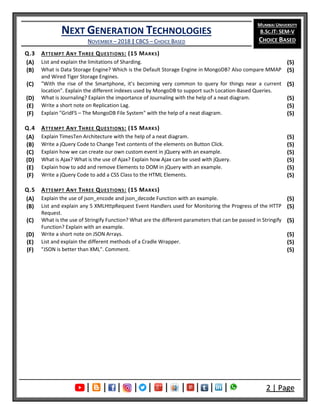

This document outlines the structure and questions for a B.Sc. IT semester 5 exam focusing on next generation technologies. It contains 5 sections with 3 questions each, covering topics like Big Data, NoSQL databases, MongoDB, jQuery, JSON, and more. Students must attempt 3 questions from each section. The exam is 2.5 hours long and carries a total of 75 marks. Diagrams and examples should be provided as needed. Use of calculators or other electronic devices is not permitted during the exam.


![Internet Of Things (Question Paper) [October – 2018 | Choice Based Syllabus]](https://cdn.slidesharecdn.com/ss_thumbnails/iot-oct-2018-181112024446-thumbnail.jpg?width=640&height=640&fit=bounds)
![Advanced Web Programming (November – 2018) [Choice Based | Question Paper]](https://cdn.slidesharecdn.com/ss_thumbnails/awp-cbcs-nov-2018-qp-191111054947-thumbnail.jpg?width=640&height=640&fit=bounds)


![Next Generation Technologies – Syllabus (2018 - 2019) [Mumbai University]](https://cdn.slidesharecdn.com/ss_thumbnails/ngt-180824054505-thumbnail.jpg?width=640&height=640&fit=bounds)


![Linux System Administration (November – 2018) [Choice Based | Question Paper]](https://cdn.slidesharecdn.com/ss_thumbnails/lsa-cbcs-nov-2018-qp-191111055022-thumbnail.jpg?width=640&height=640&fit=bounds)
![Artificial Intelligence (November – 2018) [Choice Based | Question Paper]](https://cdn.slidesharecdn.com/ss_thumbnails/ai-cbcs-nov-2018-qp-191111054942-thumbnail.jpg?width=640&height=640&fit=bounds)
![Software Project Management (November – 2018) [Choice Based | Question Paper]](https://cdn.slidesharecdn.com/ss_thumbnails/spm-cbcs-nov-2018-qp-191111054937-thumbnail.jpg?width=640&height=640&fit=bounds)
![Internet Of Things (November – 2018) [Choice Based | Question Paper]](https://cdn.slidesharecdn.com/ss_thumbnails/iot-cbcs-nov-2018-qp-191111054925-thumbnail.jpg?width=640&height=640&fit=bounds)
![Enterprise Java (November – 2018) [Choice Based | Question Paper]](https://cdn.slidesharecdn.com/ss_thumbnails/ej-cbcs-nov-2018-qp-191111054920-thumbnail.jpg?width=640&height=640&fit=bounds)
![Enterprise Networking (May – 2019) [Choice Based | Question Paper]](https://cdn.slidesharecdn.com/ss_thumbnails/en-cbcs-may-2019-qp-190709204648-thumbnail.jpg?width=640&height=640&fit=bounds)
![Business Intelligence (May – 2019) [Choice Based | Question Paper]](https://cdn.slidesharecdn.com/ss_thumbnails/bi-cbcs-may-2019-qp-190709204624-thumbnail.jpg?width=640&height=640&fit=bounds)
![Software Quality Assurance (May – 2019) [Choice Based | Question Paper]](https://cdn.slidesharecdn.com/ss_thumbnails/sqa-cbcs-may-2019-qp-190709204616-thumbnail.jpg?width=640&height=640&fit=bounds)
![Project Management (April - 2016) [CBSGS - Paper Solution] {Mumbai University}](https://cdn.slidesharecdn.com/ss_thumbnails/pm-cbsgs-apr-2016-ps-190613193722-thumbnail.jpg?width=640&height=640&fit=bounds)
![Project Management (April - 2015) [CBSGS - Paper Solution] {Mumbai University}](https://cdn.slidesharecdn.com/ss_thumbnails/pm-cbsgs-apr-2015-ps-190613193714-thumbnail.jpg?width=640&height=640&fit=bounds)
![Project Management (October - 2017) [CBSGS - Paper Solution] {Mumbai University}](https://cdn.slidesharecdn.com/ss_thumbnails/pm-cbsgs-oct-2017-ps-190613193706-thumbnail.jpg?width=640&height=640&fit=bounds)
![Project Management (October - 2016) [CBSGS - Paper Solution] {Mumbai University}](https://cdn.slidesharecdn.com/ss_thumbnails/pm-cbsgs-oct-2016-ps-190613193656-thumbnail.jpg?width=640&height=640&fit=bounds)
![Project Management (October - 2015) [CBSGS - Paper Solution] {Mumbai University}](https://cdn.slidesharecdn.com/ss_thumbnails/pm-cbsgs-oct-2015-ps-190613193648-thumbnail.jpg?width=640&height=640&fit=bounds)
![Project Management (October - 2014) [CBSGS - Paper Solution] {Mumbai University}](https://cdn.slidesharecdn.com/ss_thumbnails/pm-cbsgs-oct-2014-ps-190613193642-thumbnail.jpg?width=640&height=640&fit=bounds)
![Project Management (May - 2018) [CBSGS - Paper Solution] {Mumbai University}](https://cdn.slidesharecdn.com/ss_thumbnails/pm-cbsgs-may-2018-ps-190613193636-thumbnail.jpg?width=640&height=640&fit=bounds)
![Project Management (April - 2017) [CBSGS - Paper Solution] {Mumbai University}](https://cdn.slidesharecdn.com/ss_thumbnails/pm-cbsgs-apr-2017-ps-190613193628-thumbnail.jpg?width=640&height=640&fit=bounds)
![Project Management (April - 2014) [CBSGS - Paper Solution] {Mumbai University}](https://cdn.slidesharecdn.com/ss_thumbnails/pm-cbsgs-apr-2014-ps-190613193621-thumbnail.jpg?width=640&height=640&fit=bounds)
![Internet Technology (Practical Questions Paper) [CBSGS - 75:25 Pattern] {2017...](https://cdn.slidesharecdn.com/ss_thumbnails/it-cbsgs-2017-manual-pq-190611111707-thumbnail.jpg?width=640&height=640&fit=bounds)
![Internet Technology (Practical Questions Paper) [CBSGS - 75:25 Pattern] {2013...](https://cdn.slidesharecdn.com/ss_thumbnails/it-cbsgs-2013-2014-manual-pq-190611111641-thumbnail.jpg?width=640&height=640&fit=bounds)
![Internet Technology (Practical Questions Paper) [CBSGS - 75:25 Pattern] {Mast...](https://cdn.slidesharecdn.com/ss_thumbnails/it-cbsgs-master-code-pq-190611111626-thumbnail.jpg?width=640&height=640&fit=bounds)


