Download to read offline
![Question Paper
[IDOL – REVISED COURSE]
DIGITAL
SIGNALS AND SYSTEMS](https://image.slidesharecdn.com/idol-dss-dec-2017-180708053904/75/Digital-Signals-and-Systems-December-2017-Question-Paper-IDOL-Revised-Course-1-2048.jpg)
![MUMBAI UNIVERSITY
QUESTION PAPER
DIGITAL SIGNAL AND SYSTEMS
(DECEMBER – 2017 | REVISED COURSE)
B.SC.IT
(SEMESTER – VI)
KjT MUMBAI B.SC.IT STUDY
FACEBOOK | TWITTER | INSTAGRAM | GOOGLE+ | YOUTUBE | SLIDESHARE | TUMBLR | GITHUB
PAGE
1
Time: 3 Hours Total Marks: 100
N.B.: (1) All Question are Compulsory.
(2) Make Suitable Assumptions Wherever Necessary And State The Assumptions Made.
(3) Answer To The Same Question Must Be Written Together.
(4) Number To The Right Indicates Marks.
(5) Draw Neat Labeled Diagrams Wherever Necessary.
(6) Use of Non – Programmable Calculator is allowed.
Q.1 ATTEMPT ANY TWO QUESTIONS: (10 MARKS)
(A) What are the advantages of Digital Signal Processing (DSP) over Analog Signal Processing (ASP)? (5)
(B) What is Region of Convergence? (5)
(C) With reference to z-Transform, State and the Initial and Final Value Theorem. (5)
(D) Define the terms:
(i) Linearity
(ii) Causality
(5)
Q.2 ATTEMPT ANY THREE QUESTIONS: (15 MARKS)
(A) Define & give the Graphical representation of Unit step and Unit Impulse. (5)
(B) Discuss the classification of systems. (5)
(C) Draw and explain the block diagram of an Analog-To-Digital Converter. (5)
(D) What is meant by Sampling? State Sampling Theorem. (5)
(E) What is meant by Quantisation and Encoding? (5)
(F) Write a note on Dirichlet’s Conditions. (5)
Q.3 ATTEMPT ANY THREE QUESTIONS: (15 MARKS)
(A) Find the Laplace Transform of Cosine Function. (5)
(B) Find Laplace transform of the periodic sawtooth waveform with period of one cycle T. (5)
(C) State any five properties of Laplace transform. (5)
(D) Define the network transfer function & explain how to obtain output impulse & step response using
transfer function.
(5)
(E) State and explain Laplace Transform and its inverse transform. (5)
(F) Obtain Laplace transform for step and Impulse Responses of Series R-L Circuit. (5)
Q.4 ATTEMPT ANY THREE QUESTIONS: (15 MARKS)
(A) Define z-Transform. Explain the use of z-Transform. (5)
(B) Compare the properties of two-sided z-transform with those of one-sided z-Transform. (5)
(C) What is the condition for z-Transform to exist? (5)
(D) Obtain the Z-Transform of 𝑥(𝑛) = 𝑛2
𝑢(𝑛). (5)
(E) How is z-Transform obtained from Laplace Transform? (5)
(F) State and explain the properties of z-Transform. (5)
Q.5 ATTEMPT ANY THREE QUESTIONS: (15 MARKS)
(A) Simple problems to check the Linearity and Causality of the signals. (5)
(B) Explain briefly the Paley-Wiener Criterion. (5)
(C) Explain stability in Linear Time Invariant System. What is the condiction for a System to be BIBO
Stable?
(5)
(D) What is Convolution? What are the properties of Convolution? (5)
(E) What is Frequency Response? What are the properties of frequency response? (5)
(F) Check whether the system 𝐹[𝑥(𝑛)] = 𝑛[𝑥(𝑛)]2
is Linear and Time-Variant. (5)
[TURN OVER]](https://image.slidesharecdn.com/idol-dss-dec-2017-180708053904/75/Digital-Signals-and-Systems-December-2017-Question-Paper-IDOL-Revised-Course-2-2048.jpg)
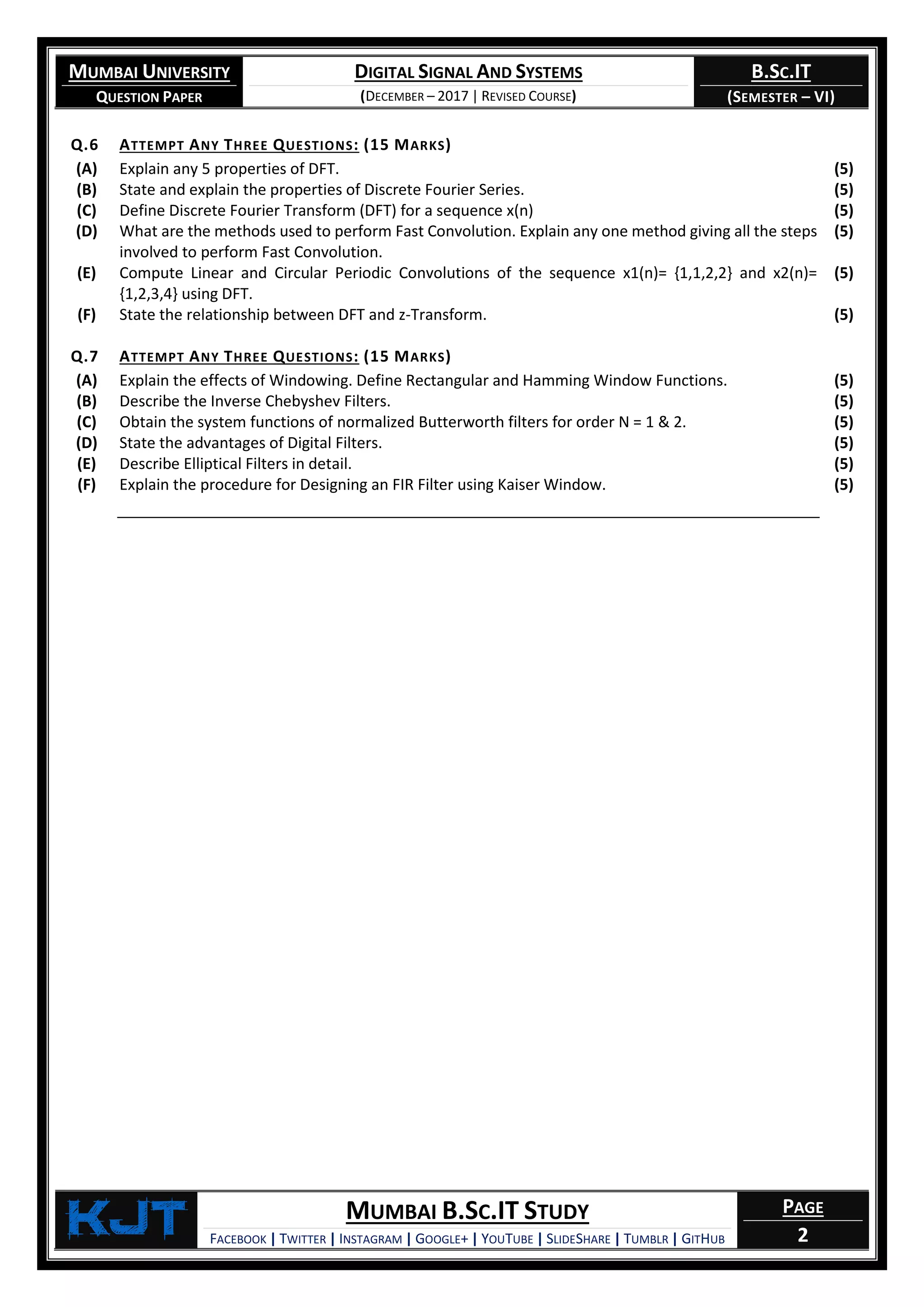

The document is a question paper for the Digital Signals and Systems course from Mumbai University, focusing on various aspects of digital signal processing (DSP). It includes multiple questions concerning topics such as z-transform, Laplace transform, stability of systems, convolution, and filter design, with specific instructions on answering format and marking. Additionally, the paper is structured into several questions, each with options to attempt, testing students' knowledge on fundamental principles and applications of digital signals and systems.
![Digital Signals and Systems (May – 2016) [Question Paper | IDOL: Revised Course]](https://cdn.slidesharecdn.com/ss_thumbnails/idol-dss-may-2016-180708053843-thumbnail.jpg?width=640&height=640&fit=bounds)


![[Question Paper] Data Communication and Network Standards (Revised Course) [J...](https://cdn.slidesharecdn.com/ss_thumbnails/dcns-qprevisedcoursejun-2014-170714195207-thumbnail.jpg?width=640&height=640&fit=bounds)

![[Question Paper] Microprocessor and Microcontrollers (Revised Course) [April ...](https://cdn.slidesharecdn.com/ss_thumbnails/mm-qprevisedcourseapr-2015-170713044202-thumbnail.jpg?width=640&height=640&fit=bounds)
![[Question Paper] Microprocessor and Microcontrollers (Revised Course) [Octobe...](https://cdn.slidesharecdn.com/ss_thumbnails/mm-qprevisedcourseoct-2016-170713044200-thumbnail.jpg?width=640&height=640&fit=bounds)
![Digital Signals and System (April – 2015) [Revised Syllabus | Question Paper]](https://cdn.slidesharecdn.com/ss_thumbnails/dss-rs-qp-april-2015-180428083802-thumbnail.jpg?width=640&height=640&fit=bounds)

![Geographic Information System (May – 2016) [75:25 Pattern | Question Paper]](https://cdn.slidesharecdn.com/ss_thumbnails/gis-75-25-qp-may-2016-180428091913-thumbnail.jpg?width=640&height=640&fit=bounds)
![Internet Technologies (October – 2014 ) [Question Paper | CBSGS: 75:25 Pattern]](https://cdn.slidesharecdn.com/ss_thumbnails/cbsgs-it-oct-2014-180708051829-thumbnail.jpg?width=640&height=640&fit=bounds)
![[Question Paper] Fundamentals of Digital Computing (Revised Course) [January ...](https://cdn.slidesharecdn.com/ss_thumbnails/fdc-qprevisedcoursejan-2017-170712141825-thumbnail.jpg?width=640&height=640&fit=bounds)
![[Question Paper] Computer Graphics (Revised Course) [January / 2017]](https://cdn.slidesharecdn.com/ss_thumbnails/cg-qprevisedcoursejan-2017-170717110028-thumbnail.jpg?width=640&height=640&fit=bounds)
![[Question Paper] Computer Graphics (Revised Course) [April / 2014]](https://cdn.slidesharecdn.com/ss_thumbnails/cg-qprevisedcourseapr-2014-170717110036-thumbnail.jpg?width=640&height=640&fit=bounds)

![[Question Paper] Microprocessor and Microcontrollers (Revised Course) [Septem...](https://cdn.slidesharecdn.com/ss_thumbnails/mm-qprevisedcoursesep-2013-170713044201-thumbnail.jpg?width=640&height=640&fit=bounds)

![Internet Technologies (April – 2015) [Question Paper | IDOL: Revised Course]](https://cdn.slidesharecdn.com/ss_thumbnails/idol-it-apr-2015-180708053053-thumbnail.jpg?width=640&height=640&fit=bounds)
![Digital Signals and System (May – 2016) [Revised Syllabus | Question Paper]](https://cdn.slidesharecdn.com/ss_thumbnails/dss-rs-qp-may-2016-180428083739-thumbnail.jpg?width=640&height=640&fit=bounds)

![Internet Technologies (April – 2013) [Question Paper | IDOL: Revised Course]](https://cdn.slidesharecdn.com/ss_thumbnails/idol-it-apr-2013-180708053049-thumbnail.jpg?width=640&height=640&fit=bounds)
![[Question Paper] Computer Graphics (Revised Course) [April / 2015]](https://cdn.slidesharecdn.com/ss_thumbnails/cg-qprevisedcourseapr-2015-170717110025-thumbnail.jpg?width=640&height=640&fit=bounds)
![[Question Paper] Data Communication and Network Standards (Revised Course) [O...](https://cdn.slidesharecdn.com/ss_thumbnails/dcns-qprevisedcourseoct-2016-170714195210-thumbnail.jpg?width=640&height=640&fit=bounds)
![[Question Paper] Data Communication and Network Standards (Revised Course) [J...](https://cdn.slidesharecdn.com/ss_thumbnails/dcns-qprevisedcoursejun-2016-170714195209-thumbnail.jpg?width=640&height=640&fit=bounds)
![[Question Paper] Data Communication and Network Standards (Revised Course) [A...](https://cdn.slidesharecdn.com/ss_thumbnails/dcns-qprevisedcourseapr-2015-170714195212-thumbnail.jpg?width=640&height=640&fit=bounds)
![[Question Paper] Fundamentals of Digital Computing (Revised Course) [April / ...](https://cdn.slidesharecdn.com/ss_thumbnails/fdc-qprevisedcourseapr-2015-170712141829-thumbnail.jpg?width=640&height=640&fit=bounds)
![[Question Paper] Multimedia (Revised Course) [September / 2013]](https://cdn.slidesharecdn.com/ss_thumbnails/m-qp-revised-course-september-2013-170802133608-thumbnail.jpg?width=640&height=640&fit=bounds)
![[Question Paper] Electronic and Communication Technology (Revised Course) [Ap...](https://cdn.slidesharecdn.com/ss_thumbnails/ect-qprevisedcourseapr-2014-170712140807-thumbnail.jpg?width=640&height=640&fit=bounds)
![B.Sc.IT: Semester - VI (October - 2016) [IDOL - Revised Course | Question Paper]](https://cdn.slidesharecdn.com/ss_thumbnails/bscit-sem-vi-idol-oct-2016-qp-180803214341-thumbnail.jpg?width=640&height=640&fit=bounds)
![B.Sc.IT: Semester - VI (April - 2015) [IDOL - Revised Course | Question Paper]](https://cdn.slidesharecdn.com/ss_thumbnails/bscit-sem-vi-idol-apr-2015-qp-180803214455-thumbnail.jpg?width=640&height=640&fit=bounds)
![B.Sc.IT: Semester - VI (May - 2018) [IDOL - Revised Course | Question Paper]](https://cdn.slidesharecdn.com/ss_thumbnails/bscit-sem-vi-idol-revised-course-may-2018-qp-180814024258-thumbnail.jpg?width=640&height=640&fit=bounds)
![B.Sc.IT: Semester - VI (April - 2017) [CBSGS - 75:25 Pattern | Question Paper]](https://cdn.slidesharecdn.com/ss_thumbnails/bscit-sem-vi-cbsgs-apr-2017-qp-180803213236-thumbnail.jpg?width=640&height=640&fit=bounds)
![Digital Signals and System (April – 2017) [75:25 Pattern | Question Paper]](https://cdn.slidesharecdn.com/ss_thumbnails/dss-75-25-qp-april-2017-180428083754-thumbnail.jpg?width=640&height=640&fit=bounds)


![Digital Signals and System (October – 2016) [Revised Syllabus | Question Paper]](https://cdn.slidesharecdn.com/ss_thumbnails/dss-rs-qp-october-2016-180428083748-thumbnail.jpg?width=640&height=640&fit=bounds)

![Artificial Intelligence (November – 2018) [Choice Based | Question Paper]](https://cdn.slidesharecdn.com/ss_thumbnails/ai-cbcs-nov-2018-qp-191111054942-thumbnail.jpg?width=640&height=640&fit=bounds)
![Enterprise Java (November – 2018) [Choice Based | Question Paper]](https://cdn.slidesharecdn.com/ss_thumbnails/ej-cbcs-nov-2018-qp-191111054920-thumbnail.jpg?width=640&height=640&fit=bounds)
![Software Project Management (November – 2018) [Choice Based | Question Paper]](https://cdn.slidesharecdn.com/ss_thumbnails/spm-cbcs-nov-2018-qp-191111054937-thumbnail.jpg?width=640&height=640&fit=bounds)
![Linux System Administration (November – 2018) [Choice Based | Question Paper]](https://cdn.slidesharecdn.com/ss_thumbnails/lsa-cbcs-nov-2018-qp-191111055022-thumbnail.jpg?width=640&height=640&fit=bounds)
![Next Generation Technologies (November – 2018) [Choice Based | Question Paper]](https://cdn.slidesharecdn.com/ss_thumbnails/ngt-cbcs-nov-2018-qp-191111054931-thumbnail.jpg?width=640&height=640&fit=bounds)
![Business Intelligence (May – 2019) [Choice Based | Question Paper]](https://cdn.slidesharecdn.com/ss_thumbnails/bi-cbcs-may-2019-qp-190709204624-thumbnail.jpg?width=640&height=640&fit=bounds)
![Advanced Web Programming (November – 2018) [Choice Based | Question Paper]](https://cdn.slidesharecdn.com/ss_thumbnails/awp-cbcs-nov-2018-qp-191111054947-thumbnail.jpg?width=640&height=640&fit=bounds)
![Internet Of Things (November – 2018) [Choice Based | Question Paper]](https://cdn.slidesharecdn.com/ss_thumbnails/iot-cbcs-nov-2018-qp-191111054925-thumbnail.jpg?width=640&height=640&fit=bounds)
![Software Quality Assurance (May – 2019) [Choice Based | Question Paper]](https://cdn.slidesharecdn.com/ss_thumbnails/sqa-cbcs-may-2019-qp-190709204616-thumbnail.jpg?width=640&height=640&fit=bounds)
![Project Management (October - 2016) [CBSGS - Paper Solution] {Mumbai University}](https://cdn.slidesharecdn.com/ss_thumbnails/pm-cbsgs-oct-2016-ps-190613193656-thumbnail.jpg?width=640&height=640&fit=bounds)
![Project Management (October - 2015) [CBSGS - Paper Solution] {Mumbai University}](https://cdn.slidesharecdn.com/ss_thumbnails/pm-cbsgs-oct-2015-ps-190613193648-thumbnail.jpg?width=640&height=640&fit=bounds)
![Project Management (April - 2016) [CBSGS - Paper Solution] {Mumbai University}](https://cdn.slidesharecdn.com/ss_thumbnails/pm-cbsgs-apr-2016-ps-190613193722-thumbnail.jpg?width=640&height=640&fit=bounds)
![Project Management (October - 2017) [CBSGS - Paper Solution] {Mumbai University}](https://cdn.slidesharecdn.com/ss_thumbnails/pm-cbsgs-oct-2017-ps-190613193706-thumbnail.jpg?width=640&height=640&fit=bounds)
![Project Management (April - 2017) [CBSGS - Paper Solution] {Mumbai University}](https://cdn.slidesharecdn.com/ss_thumbnails/pm-cbsgs-apr-2017-ps-190613193628-thumbnail.jpg?width=640&height=640&fit=bounds)
![Project Management (April - 2015) [CBSGS - Paper Solution] {Mumbai University}](https://cdn.slidesharecdn.com/ss_thumbnails/pm-cbsgs-apr-2015-ps-190613193714-thumbnail.jpg?width=640&height=640&fit=bounds)
![Project Management (April - 2014) [CBSGS - Paper Solution] {Mumbai University}](https://cdn.slidesharecdn.com/ss_thumbnails/pm-cbsgs-apr-2014-ps-190613193621-thumbnail.jpg?width=640&height=640&fit=bounds)
![Enterprise Networking (May – 2019) [Choice Based | Question Paper]](https://cdn.slidesharecdn.com/ss_thumbnails/en-cbcs-may-2019-qp-190709204648-thumbnail.jpg?width=640&height=640&fit=bounds)
![Project Management (May - 2018) [CBSGS - Paper Solution] {Mumbai University}](https://cdn.slidesharecdn.com/ss_thumbnails/pm-cbsgs-may-2018-ps-190613193636-thumbnail.jpg?width=640&height=640&fit=bounds)
![Internet Technology (Practical Questions Paper) [CBSGS - 75:25 Pattern] {2017...](https://cdn.slidesharecdn.com/ss_thumbnails/it-cbsgs-2017-manual-pq-190611111707-thumbnail.jpg?width=640&height=640&fit=bounds)
![Project Management (October - 2014) [CBSGS - Paper Solution] {Mumbai University}](https://cdn.slidesharecdn.com/ss_thumbnails/pm-cbsgs-oct-2014-ps-190613193642-thumbnail.jpg?width=640&height=640&fit=bounds)


