FOLLOW ME –
ON FB- MONU PANCHAL (ARJUN)
ON INSTAGRAM-
MONUARJUN010
ON E-MAIL.
MONUPANCHAL002@GMAIL.COM
SCIENCE PROJECT
Doctors always advise people to eat fresh
food . This is because , cooking food left in
open for a few hours may contain harmful
disease causing organisms or germs.
These organisms are so small that
we cannot see then with naked eyes.
Since they can be seen only through
the microscope ,they are called
microorganisms or microbes .
Microorganisms live almost in every
place,sch as air, water(cold water and salty
water ),polar regions, food even inside the
body of other organisms. Microorganism can
survive in extreme condition –Some have
been known to survive even in volcanic
eruptions. In Unfavorable condition ,
microorganism develop a hard outer covering
around themselves known as cyst.
Microorganism remain inactive with the cyst
till conditions like tempratureand humidity
become favorable again.
Types of microorganisms
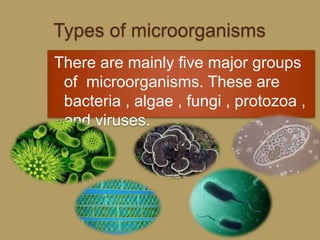
There are mainly five major groups
of microorganisms. These are
bacteria , algae , fungi , protozoa ,
and viruses.
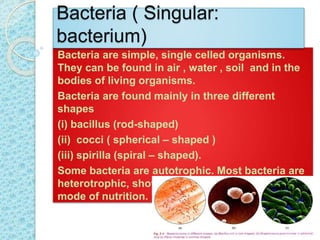
Bacteria are simple, single celled organisms.
They can be found in air , water , soil and in the
bodies of living organisms.
Bacteria are found mainly in three different
shapes
(i) bacillus (rod-shaped)
(ii) cocci ( spherical – shaped )
(iii) spirilla (spiral – shaped).
Some bacteria are autotrophic. Most bacteria are
heterotrophic, showing saprotrophic or parasitic
mode of nutrition.
Bacteria ( Singular:
bacterium)
Algae
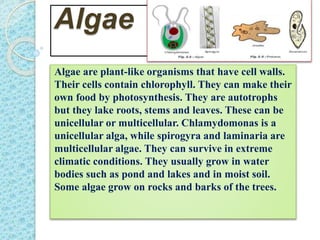
Algae are plant-like organisms that have cell walls.
Their cells contain chlorophyll. They can make their
own food by photosynthesis. They are autotrophs
but they lake roots, stems and leaves. These can be
unicellular or multicellular. Chlamydomonas is a
unicellular alga, while spirogyra and laminaria are
multicellular algae. They can survive in extreme
climatic conditions. They usually grow in water
bodies such as pond and lakes and in moist soil.
Some algae grow on rocks and barks of the trees.
Fungi
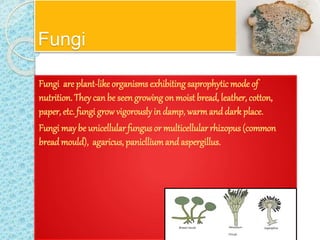
Fungi are plant-like organisms exhibitingsaprophytic mode of
nutrition. They canbe seengrowing on moist bread, leather, cotton,
paper, etc. fungi growvigorously in damp, warmanddark place.
Fungi may be unicellular fungus or multicellular rhizopus (common
breadmould), agaricus, paniclliumand aspergillus.
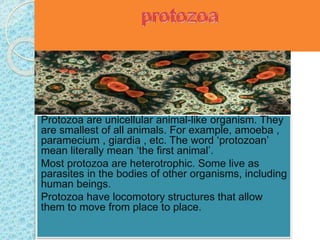
Protozoa are unicellular animal-like organism. They
are smallest of all animals. For example, amoeba ,
paramecium , giardia , etc. The word ‘protozoan’
mean literally mean ‘the first animal’.
Most protozoa are heterotrophic. Some live as
parasites in the bodies of other organisms, including
human beings.
Protozoa have locomotory structures that allow
them to move from place to place.
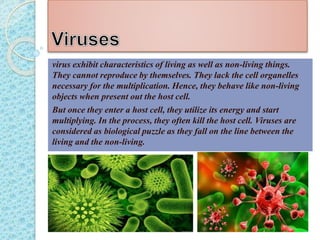
virus exhibit characteristics of living as well as non-living things.
They cannot reproduce by themselves. They lack the cell organelles
necessary for the multiplication. Hence, they behave like non-living
objects when present out the host cell.
But once they enter a host cell, they utilize its energy and start
multiplying. In the process, they often kill the host cell. Viruses are
considered as biological puzzle as they fall on the line between the
living and the non-living.
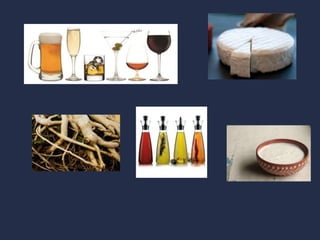
All kind of microorganisms are not harmful.
Some of them are even useful to us.
For replenishment of nutrients in soil.
For food processing.
For medicinal purposes.
For environment cleanliness.
And for other uses.
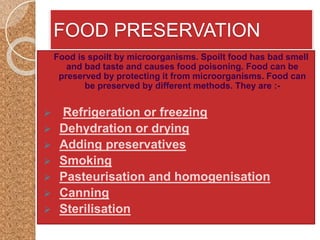
(i) Some microorganisms cause diseases in
plants and animals. Such disease causing
microorganisms are called pathogens.
(ii) Some microorganisms grow in food
substances and produce toxic substances
and makes the food poisonous. Food
poisoning causes illness and even death.
(iii) Some microorganisms spoil materials like
clothing, leather, wood etc.
Disease causing microorganisms in Humans
:-
Disease causing microorganisms enter our
body through air, water, food, contact or
insects. These microorganisms are called
pathogens.
Diseases which can spread from an infected
person to a healthy person are called
communicable diseases.
Ex :- cholera, common cold, chicken pox,
tuberculosis etc.
Some insects and animals act as carriers of
disease causing microbes.
Ex :- House fly, Female anopheles mosquito
(malaria), Female aedes mosquito (dengue
fever) etc.
FOOD PRESERVATION
Food is spoilt by microorganisms. Spoilt food has bad smell
and bad taste and causes food poisoning. Food can be
preserved by protecting it from microorganisms. Food can
be preserved by different methods. They are :-
 Refrigeration or freezing
 Dehydration or drying
 Adding preservatives
 Smoking
 Pasteurisation and homogenisation
 Canning
 Sterilisation
Microorganisms

Microorganisms

  • 1.
    FOLLOW ME – ONFB- MONU PANCHAL (ARJUN) ON INSTAGRAM- MONUARJUN010 ON E-MAIL. MONUPANCHAL002@GMAIL.COM SCIENCE PROJECT
  • 3.
    Doctors always advisepeople to eat fresh food . This is because , cooking food left in open for a few hours may contain harmful disease causing organisms or germs. These organisms are so small that we cannot see then with naked eyes. Since they can be seen only through the microscope ,they are called microorganisms or microbes .
  • 4.
    Microorganisms live almostin every place,sch as air, water(cold water and salty water ),polar regions, food even inside the body of other organisms. Microorganism can survive in extreme condition –Some have been known to survive even in volcanic eruptions. In Unfavorable condition , microorganism develop a hard outer covering around themselves known as cyst. Microorganism remain inactive with the cyst till conditions like tempratureand humidity become favorable again.
  • 5.
    Types of microorganisms Thereare mainly five major groups of microorganisms. These are bacteria , algae , fungi , protozoa , and viruses.
  • 6.
    Bacteria are simple,single celled organisms. They can be found in air , water , soil and in the bodies of living organisms. Bacteria are found mainly in three different shapes (i) bacillus (rod-shaped) (ii) cocci ( spherical – shaped ) (iii) spirilla (spiral – shaped). Some bacteria are autotrophic. Most bacteria are heterotrophic, showing saprotrophic or parasitic mode of nutrition. Bacteria ( Singular: bacterium)
  • 7.
    Algae Algae are plant-likeorganisms that have cell walls. Their cells contain chlorophyll. They can make their own food by photosynthesis. They are autotrophs but they lake roots, stems and leaves. These can be unicellular or multicellular. Chlamydomonas is a unicellular alga, while spirogyra and laminaria are multicellular algae. They can survive in extreme climatic conditions. They usually grow in water bodies such as pond and lakes and in moist soil. Some algae grow on rocks and barks of the trees.
  • 8.
    Fungi Fungi are plant-likeorganisms exhibitingsaprophytic mode of nutrition. They canbe seengrowing on moist bread, leather, cotton, paper, etc. fungi growvigorously in damp, warmanddark place. Fungi may be unicellular fungus or multicellular rhizopus (common breadmould), agaricus, paniclliumand aspergillus.
  • 9.
    Protozoa are unicellularanimal-like organism. They are smallest of all animals. For example, amoeba , paramecium , giardia , etc. The word ‘protozoan’ mean literally mean ‘the first animal’. Most protozoa are heterotrophic. Some live as parasites in the bodies of other organisms, including human beings. Protozoa have locomotory structures that allow them to move from place to place.
  • 10.
    virus exhibit characteristicsof living as well as non-living things. They cannot reproduce by themselves. They lack the cell organelles necessary for the multiplication. Hence, they behave like non-living objects when present out the host cell. But once they enter a host cell, they utilize its energy and start multiplying. In the process, they often kill the host cell. Viruses are considered as biological puzzle as they fall on the line between the living and the non-living.
  • 11.
    All kind ofmicroorganisms are not harmful. Some of them are even useful to us. For replenishment of nutrients in soil. For food processing. For medicinal purposes. For environment cleanliness. And for other uses.
  • 13.
    (i) Some microorganismscause diseases in plants and animals. Such disease causing microorganisms are called pathogens. (ii) Some microorganisms grow in food substances and produce toxic substances and makes the food poisonous. Food poisoning causes illness and even death. (iii) Some microorganisms spoil materials like clothing, leather, wood etc.
  • 15.
    Disease causing microorganismsin Humans :- Disease causing microorganisms enter our body through air, water, food, contact or insects. These microorganisms are called pathogens. Diseases which can spread from an infected person to a healthy person are called communicable diseases. Ex :- cholera, common cold, chicken pox, tuberculosis etc. Some insects and animals act as carriers of disease causing microbes. Ex :- House fly, Female anopheles mosquito (malaria), Female aedes mosquito (dengue fever) etc.

  • 16.
    FOOD PRESERVATION Food isspoilt by microorganisms. Spoilt food has bad smell and bad taste and causes food poisoning. Food can be preserved by protecting it from microorganisms. Food can be preserved by different methods. They are :-  Refrigeration or freezing  Dehydration or drying  Adding preservatives  Smoking  Pasteurisation and homogenisation  Canning  Sterilisation