


Liquidity is the new Capital

                               © Microgen plc 2013   Page 1
Agenda
•   The goals of Basel III
•   Why is Basel III such a challenge?
•   Historical positioning for Liquidity Reporting
•   Why Basel III is a catalyst for change
•   How to make Liquidity Reporting a valuable Business Asset
•   What are the success factors?
•   How do you move forward?


                                                                © Microgen plc 2013   Page 2
Why is Basel III such a challenge?

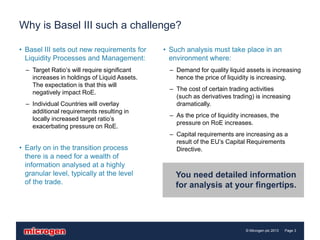
• Basel III sets out new requirements for     • Such analysis must take place in an
  Liquidity Processes and Management:           environment where:
  – Target Ratio’s will require significant     – Demand for quality liquid assets is increasing
    increases in holdings of Liquid Assets.       hence the price of liquidity is increasing.
    The expectation is that this will
                                                – The cost of certain trading activities
    negatively impact RoE.
                                                  (such as derivatives trading) is increasing
  – Individual Countries will overlay             dramatically.
    additional requirements resulting in
                                                – As the price of liquidity increases, the
    locally increased target ratio’s
                                                  pressure on RoE increases.
    exacerbating pressure on RoE.
                                                – Capital requirements are increasing as a
                                                  result of the EU’s Capital Requirements
• Early on in the transition process              Directive.
  there is a need for a wealth of
  information analysed at a highly
  granular level, typically at the level          You need detailed information
  of the trade.                                   for analysis at your fingertips.


                                                                             © Microgen plc 2013   Page 3
Why is Basel III such a challenge?

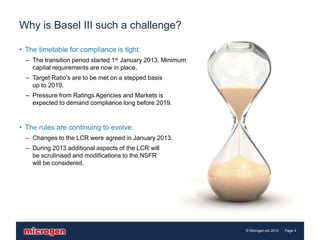
• The timetable for compliance is tight:
  – The transition period started 1st January 2013. Minimum
    capital requirements are now in place.
  – Target Ratio’s are to be met on a stepped basis
    up to 2019.
  – Pressure from Ratings Agencies and Markets is
    expected to demand compliance long before 2019.


• The rules are continuing to evolve:
  – Changes to the LCR were agreed in January 2013.
  – During 2013 additional aspects of the LCR will
    be scrutinised and modifications to the NSFR
    will be considered.


                                                              © Microgen plc 2013   Page 4
Why is Basel III such a challenge?

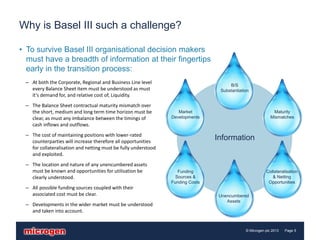
• To survive Basel III organisational decision makers
  must have a breadth of information at their fingertips
  early in the transition process:
 – At both the Corporate, Regional and Business Line level
                                                                                     B/S
   every Balance Sheet item must be understood as must                           Substantiation
   it’s demand for, and relative cost of, Liquidity.
 – The Balance Sheet contractual maturity mismatch over
   the short, medium and long term time horizon must be            Market                                   Maturity
   clear, as must any imbalance between the timings of          Developments                               Mismatches
   cash inflows and outflows.
 – The cost of maintaining positions with lower-rated
   counterparties will increase therefore all opportunities
                                                                                Information
   for collateralisation and netting must be fully understood
   and exploited.
 – The location and nature of any unencumbered assets
   must be known and opportunities for utilisation be              Funding                              Collateralisation
   clearly understood.                                            Sources &                                & Netting
                                                                Funding Costs                            Opportunities
 – All possible funding sources coupled with their
   associated cost must be clear.                                                Unencumbered
                                                                                    Assets
 – Developments in the wider market must be understood
   and taken into account.


                                                                                             © Microgen plc 2013   Page 5
Moving towards a ‘Business Asset’

• Turning an ‘Overhead’ into a ‘Business Asset’
  – Liquidity Management must now rank equally in
    importance alongside:
  • Risk Management
  • Capital Planning
  • Business Strategy
  • Balance Sheet Management

  – Only when Liquidity Management is a component part
    of the day-to-day management of an organisation can
    there be full transparency as to the impact Liquidity
    can have on a business.


  Only then can a business start               With Liquidity Management being a core
  to meet the requirements of                  component of day-to-day business
  the regulators.                              management you have also gained a
                                               very powerful business asset.


                                                                        © Microgen plc 2013   Page 6
Creating the ‘Business Asset’

• What are the success factors?
  – Information must be timely:
    • Useful in the ‘front-line’.
    • Contribute to forward-looking decisions.

  – Deployment of Liquid Funds must be clearly identifiable – it is a scarce resource:
    • Are all liquid assets deployed efficiently?
    • The cost of NOT utilising excess liquidity should be clear.
    • Liquidity should be ‘priced’ when decisions are made, not after the fact.

  – Are new sources of Liquidity available, and at what price?
    • New business opportunities could be progressed if Liquidity is available.

  – Liquidity concentrations across different business should be apparent:
    • Scenario modelling then allows management of these concentrations.

  – Changes and flexes in the Balance Sheet and its impact on Liquidity should be
    easily understood allowing effective Balance Sheet management over time.


                                                                                   © Microgen plc 2013   Page 7
Case Study: Business Challenges

 Group Treasury were facing increasing demands
 from external and internal stakeholders:
 • Financial Markets / Investors:
   – Returns expected with low tolerance for volatility
   – Continuous product and market development

 • Financial Regulation / Ratings Agencies:
   – Regulations and ratings agencies were more demanding
   – Focus on Capital and Liquidity Requirements
   – Increasing reporting requirements and visibility

 • Internal Drivers:
   – Grow the business in the ‘Right Areas’
   – Support the prioritisation of resources
   – Focus on Liquidity, Capital and Balance Sheet Management
   – Optimise Costs – the ‘New Normal’


                                                                © Microgen plc 2013   Page 8
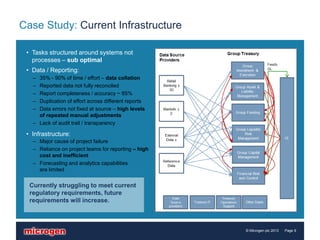
Case Study: Current Infrastructure

 • Tasks structured around systems not
   processes – sub optimal
 • Data / Reporting:
   – 35% - 90% of time / effort – data collation
   – Reported data not fully reconciled
   – Report completeness / accuracy ~ 85%
   – Duplication of effort across different reports
   – Data errors not fixed at source – high levels
     of repeated manual adjustments
   – Lack of audit trail / transparency

 • Infrastructure:
   – Major cause of project failure
   – Reliance on project teams for reporting – high
     cost and inefficient
   – Forecasting and analytics capabilities
     are limited


  Currently struggling to meet current
  regulatory requirements, future
  requirements will increase.


                                                      © Microgen plc 2013   Page 9
Case Study: The Catalyst for Change


   Basel III was viewed as a
   catalyst for change.


   Basel III moved budget spend
   associated with the ‘Group
   Treasury Vision’ Project from
   Discretionary to Mandatory.


   Group Treasury were able to
   prove that they couldn’t meet new
   regulatory requirements given
   their existing infrastructure and
   associated business processes.


                                       © Microgen plc 2013   Page 10
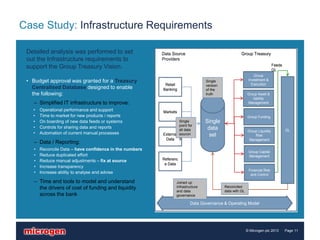
Case Study: Infrastructure Requirements

 Detailed analysis was performed to set                   Data Source                                  Group Treasury
 out the Infrastructure requirements to                   Providers
 support the Group Treasury Vision.                                                                                            Feeds
                                                                                                                               GL
                                                                                                                Group
 • Budget approval was granted for a Treasury                                      Single                    Investment &
                                                           Retail                  version                     Execution
   Centralised Database designed to enable                Banking                  of the
   the following:                                                                  truth                    Group Asset &
                                                                                                               liability
    – Simplified IT infrastructure to improve:                                                              Management

   •    Operational performance and support               Markets
   •    Time to market for new products / reports                                                           Group Funding
   •    On boarding of new data feeds or systems                   Single          Single
                                                                   point for
   •    Controls for sharing data and reports                                       data
                                                                   all data                                  Group Liquidity           GL
   •    Automation of current manual processes            External sourcin           set                         Risk
                                                           Data g                                             Management
    – Data / Reporting:
    •   Reconcile Data – have confidence in the numbers
                                                                                                             Group Capital
    •   Reduce duplicated effort                                                                             Management
    •   Reduce manual adjustments – fix at source         Referenc
                                                           e Data
    •   Increase transparency
                                                                                                             Financial Risk
    •   Increase ability to analyse and advise                                                                and Control

    – Time and tools to model and understand                      Joined up
      the drivers of cost of funding and liquidity                Infrastructure             Reconciled
                                                                  and data                   data with GL
      across the bank                                             governance

                                                                          Data Governance & Operating Model


                                                                                                            © Microgen plc 2013        Page 11
Case Study: Evaluation Criteria

 Corporate policy is to buy ‘Off the Shelf’ when is it not
 possible to leverage existing solutions.
 All options were therefore considered with the objective
 of minimising delivery risk and accelerating the time
 to market.

 Evaluation Criteria:
 • Solution Flexibility                • Total Cost of Ownership
 • Solution Functionality              • Implementation Time
 • Operational Risk                    • In-house skills/resources required
 • Implementation Risk


                           Data
   Off the Shelf       Warehouse
   Configurable       led Solution             Custom                Do
   Liquidity Risk    with Integrated           Database            Nothing
   Management         Finance and
      Solution          Risk Data
                         Model


                                                                              © Microgen plc 2013   Page 12
Case Study: Infrastructure Choices

 During the analysis phase a range of both Tactical and Strategic
 options for the delivery of the Treasury Centralised Database
 were considered:

  • Buy an ‘Off the Shelf’ Treasury Solution: a configurable application
    designed to deliver a high proportion of the requirements ‘out of the box’.         ✓
  • Include the Treasury Centralised Database requirements within an
    existing Data Warehouse Solution.                                                   ✗
  • Develop a custom Treasury Centralised Database Solution.                            ✗
  • Develop a Treasury Centralised Database using their existing Liquidity
    Reporting Database.                                                                 ✗
  • As-is with forced technical upgrades to meet minimum technical
    requirements. This option excluded any new business requirement.                    ✗

                                                                                  © Microgen plc 2013   Page 13
Contact us for more information on
Microgen’s Basel III Liquidity Risk
Monitoring Product


Product Brochure
marketing@microgen.com
UK: + 44 20 7496 8100
US: + 1 617 273 8289
www.microgen.com/liquidity
                                      © Microgen plc 2013   Page 14

Microgen Basel III Liquidity Risk

  • 1.
    Liquidity is thenew Capital © Microgen plc 2013 Page 1
  • 2.
    Agenda • The goals of Basel III • Why is Basel III such a challenge? • Historical positioning for Liquidity Reporting • Why Basel III is a catalyst for change • How to make Liquidity Reporting a valuable Business Asset • What are the success factors? • How do you move forward? © Microgen plc 2013 Page 2
  • 3.
    Why is BaselIII such a challenge? • Basel III sets out new requirements for • Such analysis must take place in an Liquidity Processes and Management: environment where: – Target Ratio’s will require significant – Demand for quality liquid assets is increasing increases in holdings of Liquid Assets. hence the price of liquidity is increasing. The expectation is that this will – The cost of certain trading activities negatively impact RoE. (such as derivatives trading) is increasing – Individual Countries will overlay dramatically. additional requirements resulting in – As the price of liquidity increases, the locally increased target ratio’s pressure on RoE increases. exacerbating pressure on RoE. – Capital requirements are increasing as a result of the EU’s Capital Requirements • Early on in the transition process Directive. there is a need for a wealth of information analysed at a highly granular level, typically at the level You need detailed information of the trade. for analysis at your fingertips. © Microgen plc 2013 Page 3
  • 4.
    Why is BaselIII such a challenge? • The timetable for compliance is tight: – The transition period started 1st January 2013. Minimum capital requirements are now in place. – Target Ratio’s are to be met on a stepped basis up to 2019. – Pressure from Ratings Agencies and Markets is expected to demand compliance long before 2019. • The rules are continuing to evolve: – Changes to the LCR were agreed in January 2013. – During 2013 additional aspects of the LCR will be scrutinised and modifications to the NSFR will be considered. © Microgen plc 2013 Page 4
  • 5.
    Why is BaselIII such a challenge? • To survive Basel III organisational decision makers must have a breadth of information at their fingertips early in the transition process: – At both the Corporate, Regional and Business Line level B/S every Balance Sheet item must be understood as must Substantiation it’s demand for, and relative cost of, Liquidity. – The Balance Sheet contractual maturity mismatch over the short, medium and long term time horizon must be Market Maturity clear, as must any imbalance between the timings of Developments Mismatches cash inflows and outflows. – The cost of maintaining positions with lower-rated counterparties will increase therefore all opportunities Information for collateralisation and netting must be fully understood and exploited. – The location and nature of any unencumbered assets must be known and opportunities for utilisation be Funding Collateralisation clearly understood. Sources & & Netting Funding Costs Opportunities – All possible funding sources coupled with their associated cost must be clear. Unencumbered Assets – Developments in the wider market must be understood and taken into account. © Microgen plc 2013 Page 5
  • 6.
    Moving towards a‘Business Asset’ • Turning an ‘Overhead’ into a ‘Business Asset’ – Liquidity Management must now rank equally in importance alongside: • Risk Management • Capital Planning • Business Strategy • Balance Sheet Management – Only when Liquidity Management is a component part of the day-to-day management of an organisation can there be full transparency as to the impact Liquidity can have on a business. Only then can a business start With Liquidity Management being a core to meet the requirements of component of day-to-day business the regulators. management you have also gained a very powerful business asset. © Microgen plc 2013 Page 6
  • 7.
    Creating the ‘BusinessAsset’ • What are the success factors? – Information must be timely: • Useful in the ‘front-line’. • Contribute to forward-looking decisions. – Deployment of Liquid Funds must be clearly identifiable – it is a scarce resource: • Are all liquid assets deployed efficiently? • The cost of NOT utilising excess liquidity should be clear. • Liquidity should be ‘priced’ when decisions are made, not after the fact. – Are new sources of Liquidity available, and at what price? • New business opportunities could be progressed if Liquidity is available. – Liquidity concentrations across different business should be apparent: • Scenario modelling then allows management of these concentrations. – Changes and flexes in the Balance Sheet and its impact on Liquidity should be easily understood allowing effective Balance Sheet management over time. © Microgen plc 2013 Page 7
  • 8.
    Case Study: BusinessChallenges Group Treasury were facing increasing demands from external and internal stakeholders: • Financial Markets / Investors: – Returns expected with low tolerance for volatility – Continuous product and market development • Financial Regulation / Ratings Agencies: – Regulations and ratings agencies were more demanding – Focus on Capital and Liquidity Requirements – Increasing reporting requirements and visibility • Internal Drivers: – Grow the business in the ‘Right Areas’ – Support the prioritisation of resources – Focus on Liquidity, Capital and Balance Sheet Management – Optimise Costs – the ‘New Normal’ © Microgen plc 2013 Page 8
  • 9.
    Case Study: CurrentInfrastructure • Tasks structured around systems not processes – sub optimal • Data / Reporting: – 35% - 90% of time / effort – data collation – Reported data not fully reconciled – Report completeness / accuracy ~ 85% – Duplication of effort across different reports – Data errors not fixed at source – high levels of repeated manual adjustments – Lack of audit trail / transparency • Infrastructure: – Major cause of project failure – Reliance on project teams for reporting – high cost and inefficient – Forecasting and analytics capabilities are limited Currently struggling to meet current regulatory requirements, future requirements will increase. © Microgen plc 2013 Page 9
  • 10.
    Case Study: TheCatalyst for Change Basel III was viewed as a catalyst for change. Basel III moved budget spend associated with the ‘Group Treasury Vision’ Project from Discretionary to Mandatory. Group Treasury were able to prove that they couldn’t meet new regulatory requirements given their existing infrastructure and associated business processes. © Microgen plc 2013 Page 10
  • 11.
    Case Study: InfrastructureRequirements Detailed analysis was performed to set Data Source Group Treasury out the Infrastructure requirements to Providers support the Group Treasury Vision. Feeds GL Group • Budget approval was granted for a Treasury Single Investment & Retail version Execution Centralised Database designed to enable Banking of the the following: truth Group Asset & liability – Simplified IT infrastructure to improve: Management • Operational performance and support Markets • Time to market for new products / reports Group Funding • On boarding of new data feeds or systems Single Single point for • Controls for sharing data and reports data all data Group Liquidity GL • Automation of current manual processes External sourcin set Risk Data g Management – Data / Reporting: • Reconcile Data – have confidence in the numbers Group Capital • Reduce duplicated effort Management • Reduce manual adjustments – fix at source Referenc e Data • Increase transparency Financial Risk • Increase ability to analyse and advise and Control – Time and tools to model and understand Joined up the drivers of cost of funding and liquidity Infrastructure Reconciled and data data with GL across the bank governance Data Governance & Operating Model © Microgen plc 2013 Page 11
  • 12.
    Case Study: EvaluationCriteria Corporate policy is to buy ‘Off the Shelf’ when is it not possible to leverage existing solutions. All options were therefore considered with the objective of minimising delivery risk and accelerating the time to market. Evaluation Criteria: • Solution Flexibility • Total Cost of Ownership • Solution Functionality • Implementation Time • Operational Risk • In-house skills/resources required • Implementation Risk Data Off the Shelf Warehouse Configurable led Solution Custom Do Liquidity Risk with Integrated Database Nothing Management Finance and Solution Risk Data Model © Microgen plc 2013 Page 12
  • 13.
    Case Study: InfrastructureChoices During the analysis phase a range of both Tactical and Strategic options for the delivery of the Treasury Centralised Database were considered: • Buy an ‘Off the Shelf’ Treasury Solution: a configurable application designed to deliver a high proportion of the requirements ‘out of the box’. ✓ • Include the Treasury Centralised Database requirements within an existing Data Warehouse Solution. ✗ • Develop a custom Treasury Centralised Database Solution. ✗ • Develop a Treasury Centralised Database using their existing Liquidity Reporting Database. ✗ • As-is with forced technical upgrades to meet minimum technical requirements. This option excluded any new business requirement. ✗ © Microgen plc 2013 Page 13
  • 14.
    Contact us formore information on Microgen’s Basel III Liquidity Risk Monitoring Product Product Brochure marketing@microgen.com UK: + 44 20 7496 8100 US: + 1 617 273 8289 www.microgen.com/liquidity © Microgen plc 2013 Page 14