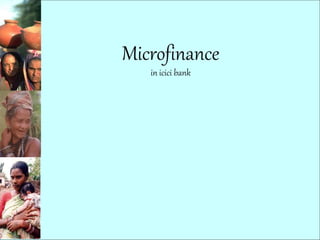
Microfinance
in icici bank
• 
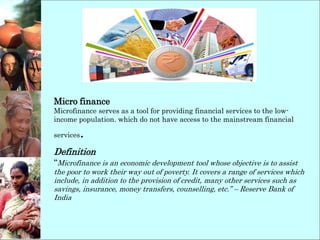
Micro finance
Microfinance serves as a tool for providing financial services to the low-
income population. which do not have access to the mainstream financial
services.
Definition
“Microfinance is an economic development tool whose objective is to assist
the poor to work their way out of poverty. It covers a range of services which
include, in addition to the provision of credit, many other services such as
savings, insurance, money transfers, counselling, etc.” – Reserve Bank of
India
 ICICI bank was originally promoted in 1994 by ICICI ltd, an Indian financial institution, and
was its wholly owned subsidiary
 ICICI bank is India’s second largest financial services company headquartered in Mumbai,
Maharashtra. It offers wide range of banking products and financial services.
 ICICI bank has network of 2533 branches and 6800 ATMs in India, and has a presence in 19
countries including India.
 ICICI Foundation for Inclusive Growth (ICICI Foundation) was founded by the ICICI Group in
2008 to give focus to its efforts to promote inclusive economic growth amongst low-income
Indian households.
Micro-finance in india
 India’s well-developed financial sector .
 In India it is consist of 27 government owned banks more than 20
major private banks, of which ICICI bank by far largest, and over
100000 corperative banks the financial sector is strictly regulated and
supervised.
 Micro finance came very late to India.
 Micro-Finance is emerging as a powerful instrument for poverty
alleviation in the new economy.
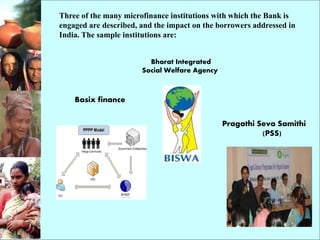
Three of the many microfinance institutions with which the Bank is
engaged are described, and the impact on the borrowers addressed in
India. The sample institutions are:
Basix finance
Pragathi Seva Samithi
(PSS)
Bharat Integrated
Social Welfare Agency
Conti….
ICICI bank provide microfinance
ICICI Bank provides financial assistance to select MFIs in the form
of term loans. The Bank also invests in Pass through
Certificates where the underlying comprises of loans originated
by MFIs. Besides, the Bank also provides other value added
services to MFIs like cash management services, made-to-
order current accounts, savings/salary accounts for their staff
and treasury products, which enable them to invest their liquid
funds.
Objective of study
 To understand how microfinance serves as a tool for providing
financial services to the low-income population.
 The objective of the study is how ICICI bank introduces micro-
finance and banking in India and describes how banks in India are
currently engaging in micro-finance.
 To study what are the policy and practices are followed by ICICI
bank.
 To study how low income people get being help by MFI’s.
 To study how ICICI bank provides financial assistance to select
MFIs in the form of term loans.
Conti….
This study does the research about the microfinance in ICICI how
microfinance work were the MFIs are situated in India and how ICICI
bank expands the microfinance in India and give advice about the
microfinance There are a number of microfinance companies in India,
which play some pivotal roles to the development of India. India's
microfinance sector is fragmented with more than 3000 microfinance
companies (MGIs), NGOs and NGO-MFIs. The top 10 microfinance
companies in India are estimated to account for almost 74 per cent of
the total loans outstanding. It can be added here that the total loan
outstanding of Indian microfinance sector lies between ` 160-175 billion.
As on March 31, 2009, almost 17 Indian microfinance companies have
more ` 1 million outstanding loans.
Scope of the study
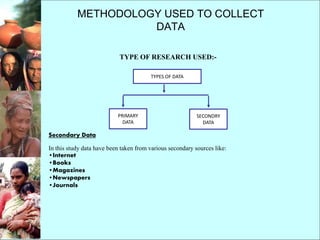
Secondary Data
In this study data have been taken from various secondary sources like:
•Internet
•Books
•Magazines
•Newspapers
•Journals
METHODOLOGY USED TO COLLECT
DATA
TYPE OF RESEARCH USED:-
PRIMARY
DATA
SECONDRY
DATA
TYPES OF DATA
LIMITATIONS
As the study made with Secondary research, there are certain limitations to
the study to be noticed.
As the data collected is through secondary method reliability of the data can
be doubted.
Time was the major constrain.
Analysis can be biased as information shared may not be true.
Bankers where not ready to reveal the data due to privacy policy.
Limited availability of data.
Review of literature
Empowering Women through Microfinance
Has examined that poor women and men in the developing world
need access to microfinance and donors should continue to facilitate
this. Research suggests that equity and efficiency arguments for
targeting credit to women remain powerful: the whole family is more
likely to benefit from credit targeted to women, where they control
income, than when it is targeted to men. Microfinance must also be
re-assessed in the light of evidence that the poorest families and the
poorest women are not able to access credit. A range of microfinance
packages is required to meet the needs of the poorest, both women
and men. Donors need to revisit arguments about the sustainability of
microfinance programmes. Financial sustainability must be balanced
against the need to ensure that some credit
Hunt, J&Kasynathan(2002)
ICICI Bank has taken a stake of under 20 per cent in Financial Information Network
and Operations Private Ltd (FINO), which was launched on Thursday, July 13, 2001.
FINO would provide technological solutions as well as services to finance providers
to reach the underserved in the country. ICICI Bank is the lead facilitator.
According to Mr. NachiketMor, Deputy Managing Director, ICICI Bank, FINO is an
independent entity. "We would reduce our stake in the company when required," he
said.
ICICI Bank expects to target 200 micro-finance institutions (MFIs) by March 2007,
he said, speaking on the sidelines of the press conference to launch FINO. At present,
the bank has tie-ups with 100 MFIs.
FINO is an initiative in the micro-finance sector. It would target 300-400 million
people who do not have access to basic financial services, said Mr. Manish Khera, CEO,
FINO. The company has an authorized capital of Rs.50 crore. MFIs, NBFCs, RRBs, co-
operative banks, etc. would directly or indirectly tie up with FINO to use its services, he
said. FINO would charge Rs.25-30 per account every year.
Contd..
Technology
Business correspondent
Multiple products
Hybrid channels
ICICI Bank entered the micro-finance market in 2002. Among the reasons for
entering the market is its goal to lead in every field of Indian banking.
 The reverse merger.
 ICICI had purchased privately owned bank.
 Micro –finance loans were high quality
 ICICI banks are highly visible
 Social initiative groups
 Act as a private sector bank
 ICICI bank aims to increase the micro-finance portfolio
 The MFIs opens a fixed deposit for the required amount,
 The MFI is given an overdraft limit with ICICI Bank,
 The fees which are paid by the clients to the intermediary MFIs are
locked in a separate account with the Bank until the debts are fully
cleared.
 A third party can deposit the necessary guarantee on behalf of the MFI.
ICICI Bank’s appraisal process is very simple
The Bank is quite clear that their intention is not to rate the strength
of the MFI’s own balance sheet, but its capacity to facilitate the
relationships between the Bank and SHGs or other actual borrowers to
whom the Bank will lend.
The Bank is aware that if an MFI collapsed they would have some
difficulties
The Bank is also experimenting with a variety of technology-based
approaches
Sources: Survey on SAKHI
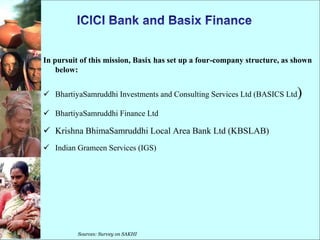
In pursuit of this mission, Basix has set up a four-company structure, as shown
below:
 BhartiyaSamruddhi Investments and Consulting Services Ltd (BASICS Ltd)
 BhartiyaSamruddhi Finance Ltd
 Krishna BhimaSamruddhi Local Area Bank Ltd (KBSLAB)
 Indian Grameen Services (IGS)
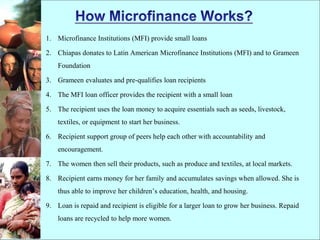
1. Microfinance Institutions (MFI) provide small loans
2. Chiapas donates to Latin American Microfinance Institutions (MFI) and to Grameen
Foundation
3. Grameen evaluates and pre-qualifies loan recipients
4. The MFI loan officer provides the recipient with a small loan
5. The recipient uses the loan money to acquire essentials such as seeds, livestock,
textiles, or equipment to start her business.
6. Recipient support group of peers help each other with accountability and
encouragement.
7. The women then sell their products, such as produce and textiles, at local markets.
8. Recipient earns money for her family and accumulates savings when allowed. She is
thus able to improve her children’s education, health, and housing.
9. Loan is repaid and recipient is eligible for a larger loan to grow her business. Repaid
loans are recycled to help more women.
 The financial impact of the ICICI loans on final borrowers
 It is useful to compare the three different routes through which loans are
reaching SHGs:
1. Local bank branches to SHGs – 12 percent, but reducing in Warangal
and elsewhere in India to 9 percent or possibly even less.
2. CASHE revolving loan fund to PSS to MACS to SHGs – 8 percent to
PSS, 10 percent to MACS, 18 percent to SHGs.
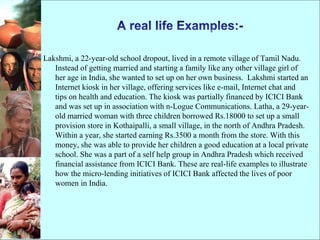
Lakshmi, a 22-year-old school dropout, lived in a remote village of Tamil Nadu.
Instead of getting married and starting a family like any other village girl of
her age in India, she wanted to set up on her own business. Lakshmi started an
Internet kiosk in her village, offering services like e-mail, Internet chat and
tips on health and education. The kiosk was partially financed by ICICI Bank
and was set up in association with n-Logue Communications. Latha, a 29-year-
old married woman with three children borrowed Rs.18000 to set up a small
provision store in Kothaipalli, a small village, in the north of Andhra Pradesh.
Within a year, she started earning Rs.3500 a month from the store. With this
money, she was able to provide her children a good education at a local private
school. She was a part of a self help group in Andhra Pradesh which received
financial assistance from ICICI Bank. These are real-life examples to illustrate
how the micro-lending initiatives of ICICI Bank affected the lives of poor
women in India.
Conti…….
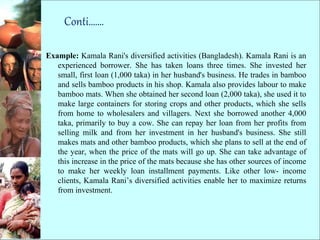
Example: Kamala Rani's diversified activities (Bangladesh). Kamala Rani is an
experienced borrower. She has taken loans three times. She invested her
small, first loan (1,000 taka) in her husband's business. He trades in bamboo
and sells bamboo products in his shop. Kamala also provides labour to make
bamboo mats. When she obtained her second loan (2,000 taka), she used it to
make large containers for storing crops and other products, which she sells
from home to wholesalers and villagers. Next she borrowed another 4,000
taka, primarily to buy a cow. She can repay her loan from her profits from
selling milk and from her investment in her husband's business. She still
makes mats and other bamboo products, which she plans to sell at the end of
the year, when the price of the mats will go up. She can take advantage of
this increase in the price of the mats because she has other sources of income
to make her weekly loan installment payments. Like other low- income
clients, Kamala Rani’s diversified activities enable her to maximize returns
from investment.
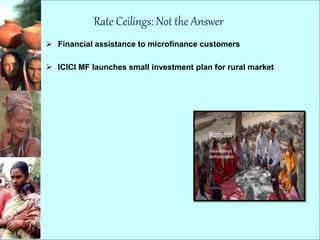
Rate Ceilings: Not the Answer
 Financial assistance to microfinance customers
 ICICI MF launches small investment plan for rural market
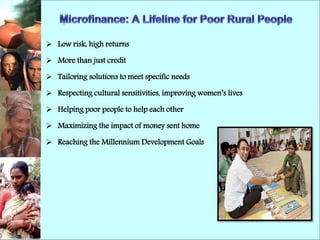
 Low risk, high returns
 More than just credit
 Tailoring solutions to meet specific needs
 Respecting cultural sensitivities, improving women’s lives
 Helping poor people to help each other
 Maximizing the impact of money sent home
 Reaching the Millennium Development Goals
Thank you

Microfinanceppt

  • 1.
  • 2.
    • Micro finance Microfinanceserves as a tool for providing financial services to the low- income population. which do not have access to the mainstream financial services. Definition “Microfinance is an economic development tool whose objective is to assist the poor to work their way out of poverty. It covers a range of services which include, in addition to the provision of credit, many other services such as savings, insurance, money transfers, counselling, etc.” – Reserve Bank of India
  • 3.
     ICICI bankwas originally promoted in 1994 by ICICI ltd, an Indian financial institution, and was its wholly owned subsidiary  ICICI bank is India’s second largest financial services company headquartered in Mumbai, Maharashtra. It offers wide range of banking products and financial services.  ICICI bank has network of 2533 branches and 6800 ATMs in India, and has a presence in 19 countries including India.  ICICI Foundation for Inclusive Growth (ICICI Foundation) was founded by the ICICI Group in 2008 to give focus to its efforts to promote inclusive economic growth amongst low-income Indian households.
  • 4.
    Micro-finance in india India’s well-developed financial sector .  In India it is consist of 27 government owned banks more than 20 major private banks, of which ICICI bank by far largest, and over 100000 corperative banks the financial sector is strictly regulated and supervised.  Micro finance came very late to India.  Micro-Finance is emerging as a powerful instrument for poverty alleviation in the new economy.
  • 5.
    Three of themany microfinance institutions with which the Bank is engaged are described, and the impact on the borrowers addressed in India. The sample institutions are: Basix finance Pragathi Seva Samithi (PSS) Bharat Integrated Social Welfare Agency
  • 6.
    Conti…. ICICI bank providemicrofinance ICICI Bank provides financial assistance to select MFIs in the form of term loans. The Bank also invests in Pass through Certificates where the underlying comprises of loans originated by MFIs. Besides, the Bank also provides other value added services to MFIs like cash management services, made-to- order current accounts, savings/salary accounts for their staff and treasury products, which enable them to invest their liquid funds.
  • 7.
    Objective of study To understand how microfinance serves as a tool for providing financial services to the low-income population.  The objective of the study is how ICICI bank introduces micro- finance and banking in India and describes how banks in India are currently engaging in micro-finance.  To study what are the policy and practices are followed by ICICI bank.  To study how low income people get being help by MFI’s.  To study how ICICI bank provides financial assistance to select MFIs in the form of term loans.
  • 8.
    Conti…. This study doesthe research about the microfinance in ICICI how microfinance work were the MFIs are situated in India and how ICICI bank expands the microfinance in India and give advice about the microfinance There are a number of microfinance companies in India, which play some pivotal roles to the development of India. India's microfinance sector is fragmented with more than 3000 microfinance companies (MGIs), NGOs and NGO-MFIs. The top 10 microfinance companies in India are estimated to account for almost 74 per cent of the total loans outstanding. It can be added here that the total loan outstanding of Indian microfinance sector lies between ` 160-175 billion. As on March 31, 2009, almost 17 Indian microfinance companies have more ` 1 million outstanding loans. Scope of the study
  • 9.
    Secondary Data In thisstudy data have been taken from various secondary sources like: •Internet •Books •Magazines •Newspapers •Journals METHODOLOGY USED TO COLLECT DATA TYPE OF RESEARCH USED:- PRIMARY DATA SECONDRY DATA TYPES OF DATA
  • 10.
    LIMITATIONS As the studymade with Secondary research, there are certain limitations to the study to be noticed. As the data collected is through secondary method reliability of the data can be doubted. Time was the major constrain. Analysis can be biased as information shared may not be true. Bankers where not ready to reveal the data due to privacy policy. Limited availability of data.
  • 11.
    Review of literature EmpoweringWomen through Microfinance Has examined that poor women and men in the developing world need access to microfinance and donors should continue to facilitate this. Research suggests that equity and efficiency arguments for targeting credit to women remain powerful: the whole family is more likely to benefit from credit targeted to women, where they control income, than when it is targeted to men. Microfinance must also be re-assessed in the light of evidence that the poorest families and the poorest women are not able to access credit. A range of microfinance packages is required to meet the needs of the poorest, both women and men. Donors need to revisit arguments about the sustainability of microfinance programmes. Financial sustainability must be balanced against the need to ensure that some credit Hunt, J&Kasynathan(2002)
  • 12.
    ICICI Bank hastaken a stake of under 20 per cent in Financial Information Network and Operations Private Ltd (FINO), which was launched on Thursday, July 13, 2001. FINO would provide technological solutions as well as services to finance providers to reach the underserved in the country. ICICI Bank is the lead facilitator. According to Mr. NachiketMor, Deputy Managing Director, ICICI Bank, FINO is an independent entity. "We would reduce our stake in the company when required," he said. ICICI Bank expects to target 200 micro-finance institutions (MFIs) by March 2007, he said, speaking on the sidelines of the press conference to launch FINO. At present, the bank has tie-ups with 100 MFIs. FINO is an initiative in the micro-finance sector. It would target 300-400 million people who do not have access to basic financial services, said Mr. Manish Khera, CEO, FINO. The company has an authorized capital of Rs.50 crore. MFIs, NBFCs, RRBs, co- operative banks, etc. would directly or indirectly tie up with FINO to use its services, he said. FINO would charge Rs.25-30 per account every year.
  • 13.
  • 14.
    ICICI Bank enteredthe micro-finance market in 2002. Among the reasons for entering the market is its goal to lead in every field of Indian banking.  The reverse merger.  ICICI had purchased privately owned bank.  Micro –finance loans were high quality  ICICI banks are highly visible  Social initiative groups  Act as a private sector bank  ICICI bank aims to increase the micro-finance portfolio
  • 15.
     The MFIsopens a fixed deposit for the required amount,  The MFI is given an overdraft limit with ICICI Bank,  The fees which are paid by the clients to the intermediary MFIs are locked in a separate account with the Bank until the debts are fully cleared.  A third party can deposit the necessary guarantee on behalf of the MFI.
  • 16.
    ICICI Bank’s appraisalprocess is very simple The Bank is quite clear that their intention is not to rate the strength of the MFI’s own balance sheet, but its capacity to facilitate the relationships between the Bank and SHGs or other actual borrowers to whom the Bank will lend. The Bank is aware that if an MFI collapsed they would have some difficulties The Bank is also experimenting with a variety of technology-based approaches
  • 17.
    Sources: Survey onSAKHI In pursuit of this mission, Basix has set up a four-company structure, as shown below:  BhartiyaSamruddhi Investments and Consulting Services Ltd (BASICS Ltd)  BhartiyaSamruddhi Finance Ltd  Krishna BhimaSamruddhi Local Area Bank Ltd (KBSLAB)  Indian Grameen Services (IGS)
  • 18.
    1. Microfinance Institutions(MFI) provide small loans 2. Chiapas donates to Latin American Microfinance Institutions (MFI) and to Grameen Foundation 3. Grameen evaluates and pre-qualifies loan recipients 4. The MFI loan officer provides the recipient with a small loan 5. The recipient uses the loan money to acquire essentials such as seeds, livestock, textiles, or equipment to start her business. 6. Recipient support group of peers help each other with accountability and encouragement. 7. The women then sell their products, such as produce and textiles, at local markets. 8. Recipient earns money for her family and accumulates savings when allowed. She is thus able to improve her children’s education, health, and housing. 9. Loan is repaid and recipient is eligible for a larger loan to grow her business. Repaid loans are recycled to help more women.
  • 19.
     The financialimpact of the ICICI loans on final borrowers  It is useful to compare the three different routes through which loans are reaching SHGs: 1. Local bank branches to SHGs – 12 percent, but reducing in Warangal and elsewhere in India to 9 percent or possibly even less. 2. CASHE revolving loan fund to PSS to MACS to SHGs – 8 percent to PSS, 10 percent to MACS, 18 percent to SHGs.
  • 20.
    Lakshmi, a 22-year-oldschool dropout, lived in a remote village of Tamil Nadu. Instead of getting married and starting a family like any other village girl of her age in India, she wanted to set up on her own business. Lakshmi started an Internet kiosk in her village, offering services like e-mail, Internet chat and tips on health and education. The kiosk was partially financed by ICICI Bank and was set up in association with n-Logue Communications. Latha, a 29-year- old married woman with three children borrowed Rs.18000 to set up a small provision store in Kothaipalli, a small village, in the north of Andhra Pradesh. Within a year, she started earning Rs.3500 a month from the store. With this money, she was able to provide her children a good education at a local private school. She was a part of a self help group in Andhra Pradesh which received financial assistance from ICICI Bank. These are real-life examples to illustrate how the micro-lending initiatives of ICICI Bank affected the lives of poor women in India.
  • 21.
    Conti……. Example: Kamala Rani'sdiversified activities (Bangladesh). Kamala Rani is an experienced borrower. She has taken loans three times. She invested her small, first loan (1,000 taka) in her husband's business. He trades in bamboo and sells bamboo products in his shop. Kamala also provides labour to make bamboo mats. When she obtained her second loan (2,000 taka), she used it to make large containers for storing crops and other products, which she sells from home to wholesalers and villagers. Next she borrowed another 4,000 taka, primarily to buy a cow. She can repay her loan from her profits from selling milk and from her investment in her husband's business. She still makes mats and other bamboo products, which she plans to sell at the end of the year, when the price of the mats will go up. She can take advantage of this increase in the price of the mats because she has other sources of income to make her weekly loan installment payments. Like other low- income clients, Kamala Rani’s diversified activities enable her to maximize returns from investment.
  • 22.
    Rate Ceilings: Notthe Answer  Financial assistance to microfinance customers  ICICI MF launches small investment plan for rural market
  • 23.
     Low risk,high returns  More than just credit  Tailoring solutions to meet specific needs  Respecting cultural sensitivities, improving women’s lives  Helping poor people to help each other  Maximizing the impact of money sent home  Reaching the Millennium Development Goals
  • 24.