Microbiology
Laboratory
Audit
Presented by : Ram Gulumkar
Guided by : Dr. Varsha Jadhav
Bharati vidyapeeth college of pharmacy,
Navi Mumbai.
Here’s what you’ll find in this Presentation
● Microbilogical evaluation of water
● Raw material
● Environmental monitoring
● Microbiological monitoring of product
Contents of This Template
Water Testing
The microbiology laboratory will
typically have a defined schedule for
sampling and testing of both
pharmaceutical grade water, from
both process control points and from
user outlets.
Sampling
Procedure
It should describe the way by which water is
sampled, such as the volumes required or the
need to sanitize an outlet and/or to fit a hose
prior to sampling
—WHO
Guideline
Water used in microbiology laboratory
as purified water should be qualified
as per WHO norms with an ongoing
phase 3 testing all across the entire
year which will include both MLT
(Microbial Limit Test ) and BET
(Bacterial Endotoxin Test)
Audit Questions and Checklist
Questions Checklist
● How are water samples drawn ?
● What is the flush time and what is this based
upon ?
● Does a sample record contain a time sample
is taken, sampler's name, sample site, time
sample delivered to laboratory?
● Is the expiration date on those stored water
sampling bottles supported by a study (or any
data) ?
● What is the number of hours that may elapse
between sampling and BET, is the actual time
or hour of sampling recorded along with date
● Asses the method of bioburden testing,
whether this is by membrane filtration or
by pour plate.
● The selection of culture medium, if not set
out in compendia, must be justified, along
with the volume of sample tested and the
incubation conditions
● Evidence of trend analysis should be
available to demonstrate the water
system is in control.
How to Prevent Bacterial Diseases
Raw Material Testing
● Purity, identity and quality of raw materials.
● Refer to USP monographs and perform
analytical tests like HPLC, GC-MS, pH etc.
● Take help of microbiology labs.
Environmental Monitoring
Air flow Monitoring
Particle counting, active
air sampling, UDAF
Recovery studies
Although environmental monitoring
methods cannot be 'validated' , the
microbiology laboratory should have
understanding of limitations of
testing.
Method Suitability
Effect of residual
disinfectants
Defined procedure
Which describes the
rationales for different
monitoring locations &
frequencies.
Site microbiologist
Considerable local
variations
Documented
procedure
Define limits and
separate procedures to
tackle out of limits.
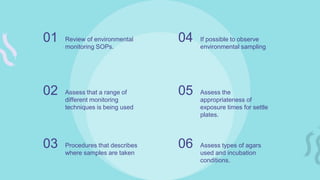
Review of environmental
monitoring SOPs.
01 If possible to observe
environmental sampling
04
Assess that a range of
different monitoring
techniques is being used
02 Assess the
appropriateness of
exposure times for settle
plates.
05
Procedures that describes
where samples are taken
03 Assess types of agars
used and incubation
conditions.
06
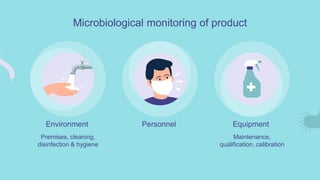
Microbiological monitoring of product
Environment
Premises, cleaning,
disinfection & hygiene
Personnel Equipment
Maintenance,
qualification, calibration
References
● MANOHAR POTDAR (2021). Audit and Regulatory
Compliance Nirali Prakashan
● WHO
CREDITS: This presentation
template was created by Slidesgo,
including icons by Flaticon, and
infographics & images by Freepik
Thanks
Please keep this slide for attribution
Do you have any
questions?

microbiological audit performed in pharmaceutical industry

  • 1.
    Microbiology Laboratory Audit Presented by :Ram Gulumkar Guided by : Dr. Varsha Jadhav Bharati vidyapeeth college of pharmacy, Navi Mumbai.
  • 2.
    Here’s what you’llfind in this Presentation ● Microbilogical evaluation of water ● Raw material ● Environmental monitoring ● Microbiological monitoring of product Contents of This Template
  • 3.
    Water Testing The microbiologylaboratory will typically have a defined schedule for sampling and testing of both pharmaceutical grade water, from both process control points and from user outlets.
  • 4.
    Sampling Procedure It should describethe way by which water is sampled, such as the volumes required or the need to sanitize an outlet and/or to fit a hose prior to sampling
  • 5.
    —WHO Guideline Water used inmicrobiology laboratory as purified water should be qualified as per WHO norms with an ongoing phase 3 testing all across the entire year which will include both MLT (Microbial Limit Test ) and BET (Bacterial Endotoxin Test)
  • 6.
    Audit Questions andChecklist Questions Checklist ● How are water samples drawn ? ● What is the flush time and what is this based upon ? ● Does a sample record contain a time sample is taken, sampler's name, sample site, time sample delivered to laboratory? ● Is the expiration date on those stored water sampling bottles supported by a study (or any data) ? ● What is the number of hours that may elapse between sampling and BET, is the actual time or hour of sampling recorded along with date ● Asses the method of bioburden testing, whether this is by membrane filtration or by pour plate. ● The selection of culture medium, if not set out in compendia, must be justified, along with the volume of sample tested and the incubation conditions ● Evidence of trend analysis should be available to demonstrate the water system is in control.
  • 7.
    How to PreventBacterial Diseases Raw Material Testing ● Purity, identity and quality of raw materials. ● Refer to USP monographs and perform analytical tests like HPLC, GC-MS, pH etc. ● Take help of microbiology labs.
  • 8.
    Environmental Monitoring Air flowMonitoring Particle counting, active air sampling, UDAF Recovery studies Although environmental monitoring methods cannot be 'validated' , the microbiology laboratory should have understanding of limitations of testing. Method Suitability Effect of residual disinfectants Defined procedure Which describes the rationales for different monitoring locations & frequencies. Site microbiologist Considerable local variations Documented procedure Define limits and separate procedures to tackle out of limits.
  • 9.
    Review of environmental monitoringSOPs. 01 If possible to observe environmental sampling 04 Assess that a range of different monitoring techniques is being used 02 Assess the appropriateness of exposure times for settle plates. 05 Procedures that describes where samples are taken 03 Assess types of agars used and incubation conditions. 06
  • 10.
    Microbiological monitoring ofproduct Environment Premises, cleaning, disinfection & hygiene Personnel Equipment Maintenance, qualification, calibration
  • 11.
    References ● MANOHAR POTDAR(2021). Audit and Regulatory Compliance Nirali Prakashan ● WHO
  • 12.
    CREDITS: This presentation templatewas created by Slidesgo, including icons by Flaticon, and infographics & images by Freepik Thanks Please keep this slide for attribution Do you have any questions?