Business Economics
Chapter 1
Managers, Profits, & Markets
Learning Objectives
Explain the difference between economic and
accounting profit and relate economic profit to the value
of the firm.
Explain the difference between price-taking and price-
setting firms and discuss the characteristics of the four
market structures.
Discuss the primary opportunities and threats
presented by the globalization of markets in business.
What is economics?
Economics :
The study of how the forces of supply and
demand allocate scarce resources. Subdivided
into microeconomics, which examines the
behavior of firms, consumers and the role of
government;
And macroeconomics, which looks at inflation,
unemployment, industrial production, and the
role of government.
What is economics?
•Scarcity is a condition that exists when
resources are limited relative to the demand
for their use.
•Another way of describing this condition is to
state that scarcity exists when resources are
not available in unlimited amounts. When
resources are available in unlimited amounts,
economists consider them to be “free” goods.
What is economics?
•It is reasonable to assume that all organizations have to
work with scarce resources, no matter how large or
profitable.
•A key role that managers play is to decide how best to
allocate their organizations’ scarce resources.
•From an economic standpoint, optimal decisions involve
their weighing of the benefits associated with a particular
decision against the opportunity cost of this decision.
What is economics?
“What?”—This involves deciding what goods and services to
produce and in what quantities (e.g. capital goods versus
consumer goods, etc.)
“How?”—This involves deciding how best to allocate a country’s
resources in the production of particular goods or services (e.g.,
capital intensive versus labor intensive, domestic production versus
foreign production etc.).
“For whom?”—This involves deciding how to distribute a country’s
total output of goods and services (e.g., income and wealth
distribution).
Business Economics & Theory
Business economics applies microeconomic theory
to business problems
◦ How to use economic analysis to make decisions to
achieve firm’s goal of profit maximization
Economic theory helps managers understand real-
world business problems
◦ Uses simplifying assumptions to turn complexity into
relative simplicity
Microeconomics
Microeconomics
◦ Study of behavior of individual consumers, business firms,
and markets
Business practices or tactics
◦ Routine business decisions managers must make to earn the
greatest profit under prevailing market conditions
◦ Using marginal analysis, microeconomics provides the
foundation for understanding everyday business decisions
Economic Forces that Promote Long-
Run Profitability
Industrial organization identifies seven economic forces that
promote long-run profitability:
few close substitutes
strong entry barriers
weak rivalry within markets
 low market power of input suppliers
 low market power of consumers
 abundant complementary products
limited harmful government intervention
Economic Forces that Promote Long-
Run Profitability (Figure 1.1)
Measuring and Maximizing
Economic Profit
The primary purpose of this text is to show
managers how to make decision that will generate
the most profit for their businesses.
It’s the mount by which revenues exceed costs.
How to measure the economic costs businesses
incur when using resources to produce goods or
services?
Economic Cost of Resources
Opportunity cost is:
◦ What firm owners must give up to use resources
to produce goods and services
Market-supplied resources
◦ Owned by others and hired, rented, or leased
Owner-supplied resources
◦ Owned and used by the firm
Because of the scarcity of resources, choices have to
be made about their allocation among competing uses.
Each choice is considered by economists to involve an
“opportunity cost” because the use of scarce resources
in one activity implies that they cannot be used in an
alternative one.
In other words, this opportunity cost is the amount
that is sacrificed when choosing one activity over its
next best alternative
Opportunity cost
Total Economic Cost
Total Economic Cost
◦ Sum of opportunity costs of both market-supplied
resources and owner-supplied resources
Explicit Costs
◦ Monetary opportunity costs of using market-supplied
resources
Implicit Costs
◦ Nonmonetary opportunity costs of using owner-supplied
resources
Types of Implicit Costs
Businesses may incur numerous kinds of implicit
costs, but the three most important types of implicit
costs are:
(1) Opportunity cost of cash provided by owners
◦ Equity capital (money provided to businesses by the
owners)
(2) Opportunity cost of using land or capital owned
by the firm
(3) Opportunity cost of owner’s time spent managing
or working for the firm
Summarize
Measuring the economic cost of using resources in a
principle:
Principle: The opportunity cost of using resources is the amount the
firm gives up by using these resources. Opportunity costs can be
either explicit costs or implicit costs. Explicit costs are the costs of
using market-supplied resources, which are the monetary payments
to hire, rent, or lease resources owned by others. Implicit costs are
the costs of using owner-supplied resources, which are the greatest
earnings forgone from using resources owned by the firm in the firm’s
own production process. Total economic cost is the sum of explicit
and implicit costs.
Economic Cost of Using Resources
(Figure 1.2)
Explicit Costs
of
M arket-Supplied Resources
The monetary paym ents to
resource owners
Implicit Costs
of
O wner-Supplied Resources
The returns forgone by not taking
the owners’ resources to m arket
+
=
Exercise
Exercise
Exercise
Exercise
http://open.163.com/newview/movie/free?pid=M8LHSGLJP&mid=M8LI
42A0Q
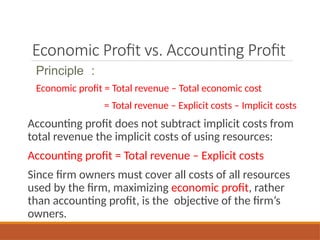
Economic profit is the difference between total
revenue and total economic cost.
Accounting profit is the difference between total
revenue and explicit costs.
Economic Profit vs. Accounting Profit
Economic profit = Total revenue – Total economic cost
= Total revenue – Explicit costs – Implicit costs
Accounting profit does not subtract implicit costs from
total revenue the implicit costs of using resources:
Accounting profit = Total revenue – Explicit costs
Since firm owners must cover all costs of all resources
used by the firm, maximizing economic profit, rather
than accounting profit, is the objective of the firm’s
owners.
Principle :
Exercise
a. Explicit cost = $80,000
Implicit cost =0.14  500,000= $70,000
Total economic cost =80,000 + 70,000= $150,000
b. Economic profit = 175,000 – 150,000= $25,000
c. Accounting profit = 175,000 – 80,000= $95,000
d. Total economic cost = 80,000 + 0.2  500,000 = $180,000
Economic profit = 175,000 – 180,000= -$5,000
Solutions of Exercise
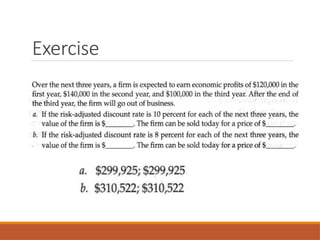
Maximizing the Value of a Firm
Value of a firm
◦ Price for which it can be sold
◦ Equal to the present value of expected future
profits
Current value (Present value )
http://open.163.com/newview/movie/free?pid=M8DOH67K8&mid=M8
DOHEL0P
Maximizing the Value of a Firm
◦Value of a firm =
𝜋0+
𝜋1
(1+𝑟)
+
𝜋2
(1+𝑟)
2
+…+
𝜋𝑇
(1+𝑟)
𝑇
=∑
𝑡=0
𝑇
𝜋𝑇
(1+𝑟)
𝑡
Current value
Choice 1 Choice 2 Choice 3
Today $ 100 $ 20
Year 1 $ 50
Year 2 $ 110 $ 35
Assume the risk-free rate is 5%, which one do you choose?
http://open.163.com/newview/movie/free?pid=M8DOH67K8&mid=M8DOHGQRG
Exercise
Market structure and
managerial decision making
Price-Takers vs. Price-Setters
Price-taking firm
◦ Cannot set price of its product
◦ Price is determined strictly by market forces of demand &
supply
Price-setting firm
◦ Can set price of its product
◦ Has a degree of market power, which is the ability to raise
price without losing all sales
What is a Market?
A market goods or services, resources used for production, or, in general,
anything of value.
Markets reduce transaction costs
Buyers wishing to purchase something must spend valuable time and other
resources finding sellers, gathering information about prices and qualities
Sellers wishing to sell something must spend valuable resources locating buyers
(or pay a fee to sales agents to do so), gathering information about potential
buyers (e.g., verifying creditworthiness or legal entitlement to buy).
These costs of making a transaction happen, which are additional costs of doing
business over and above the price paid, are known as transaction costs.
◦Transaction costs: the costs of making a transaction
◦Costs of making a transaction happen, other than the price of the good or
service itself
Market Process: The use of supply, demand
and material incentives (e.g., the profit
motive) to decide how scarce resources are
to be allocated. It answers the three
questions of what, how and for whom in the
following ways:
What is a Market?
“What?”—Whatever is profitable will be produced. Profitability in
turn depends on the strength of a society’s demand for a particular
good or service and the cost to producers of providing such a good or
service.
“How?”—Resources should be allocated and combined in the least
costly way.
“For whom?”—The output of goods and services should be allocated
to whoever is willing and able to pay for them. Of course the ability
to pay depends on the country’s distribution of income. Many factors
may account for the distribution of income in a market economy. For
economists, one of the most important is the “productivity principle.”
This states that income is allocated according to the relative
productivity of the various factors of production.
What is a Market?
Market Structures
Market Structures is a set of market characteristics that
determine the economic environment in which a firm
operates.
The list of main economics characteristics of market
Structures:
◦ Number and size of firms in market
◦ Degree of product differentiation among competing firms
◦ Likelihood of new firms entering market when incumbent firms
are earning economic profits
Perfect Competition
Large number of relatively small firms
Undifferentiated product
Price takers with no market power (Managers of firms
operating in perfectly competitive markets are price-
takers )
No barriers to entry
◦ Any economic profit earned will vanish as new firms enter
http://open.163.com/newview/movie/free?pid=M8LHS
GLJP&mid=M8LI4FHDR
(to 5m30s)
Monopoly
Single firm
Produces product with no close substitutes
Protected by a barrier to entry
◦ Allows the monopolist to raise its price without concern
that economic profits will attract new firms
http://open.163.com/newview/movie/free?pid=M8LHSGLJP&
mid=M8LI4C5GU
Monopolistic Competition
Large number of relatively small firms
Differentiated products
◦ Gives the monopolistic competitor some degree of
market power
Price setters
No barriers to entry
◦ Ensures any economic profits will be bid away by new
entrants
Oligopoly
Few firms produce all or most of market output
Profits are interdependent
◦ Actions by any one firm will affect sales and profits of the
other firms
http://open.163.com/newview/movie/free?pi
d=M8LHSGLJP&mid=M8LI4KQBJ
Globalization of Markets
Economic integration of markets located in nations around
the world
◦ Provides opportunity to sell more goods & services to foreign buyers
◦ Presents threat of increased competition from foreign producers
This trend toward economic integration of markets changes
the way managers must view the structure of the markets in
which they sell their products or services, as well as the ways
they choose to organize production.
https://www.bilibili.com/video/BV1DW411F77d/?spm_id_from=333.7
88.videocard.0
Summary
Managerial economics applies concepts/theories from
microeconomics and industrial organization
◦ Marginal analysis provides the foundation for everyday
business practices or tactics
Opportunity cost of using any resource is what the firm owners
must give up to use the resource
◦ Unlike economic profit, accounting profit does not subtract
implicit (opportunity) costs from total revenue
For price-taking firms, price is determined solely by market forces
of supply and demand, while price-setters have some degree of
market power to set price
Summary in detail
(a) Managerial economics applies the most useful concepts and theories from
microeconomics and industrial organization to create a systematic, logical way of
analyzing business practices and tactics designed to maximize profit, as well as
formulating strategies for sustaining or protecting these profits in the long run.
Marginal analysis provides the foundation for understanding the everyday business
decisions managers routinely make in running a business. Such decisions are
frequently referred to as business practices or tactics. Strategic decisions differ from
routine business practices or tactics because strategic decisions seek to alter the
conditions under which a firm competes with its rivals in ways that will increase
and/or protect the firm’s long-run profit. Industrial organization identifies seven
economic forces that promote long-run profitability: few close substitutes, strong
entry barriers, weak rivalry within markets, low market power of input suppliers,
low market power of consumers, abundant complementary products, and limited
harmful government intervention.
Summary in detail
(b) The economic cost of using resources to produce a good or service is the
opportunity cost to the owners of the firm using those resources. The opportunity
cost of using any kind of resource is what the owners of the firm must give up to
use the resource. Total economic cost is the sum of the opportunity costs of
market-supplied resources (explicit costs) plus the opportunity costs of owner-
supplied resources (implicit costs). Economic profit is the difference between total
revenue and total economic cost. Accounting profit differs from economic profit
because accounting profit does not subtract the implicit costs of using resources
from total revenue. The value of a firm is the price for which it can be sold, and
that price is equal to the present value of the expected future profit of the firm. The
risk associated with not knowing future profits of a firm requires calculating the
present value of the firm’s future profits.
Summary in detail
(c) A price-taking firm cannot set the price of the product it sells because price is
determined strictly by the market forces of demand and supply. A price setting firm
sets the price of its product because it possesses some degree of market power,
which is the ability to raise price without losing all sales. A market is any
arrangement that enables buyers and sellers to exchange goods and services,
usually for money payments. Markets exist to reduce transaction costs, which are
the costs of making a transaction. Market structure is a set of characteristics that
determines the economic environment in which a firm operates: (1) the number
and size of firms operating in the market, (2) the degree of product differentiation,
and (3) the likelihood of new firms entering. Markets may be structured as one of
four types: perfect competition, monopoly, monopolistic competition, and
oligopoly.
Summary in detail
(d) Globalization of markets, which is the process of integrating markets
located in nations around the world, is not a new phenomenon but rather
an
ongoing historical process that brings opportunities and challenges to
business managers. Globalization provides managers with an opportunity
to sell more goods and services to foreign buyers and to find new and
cheaper sources of labor, capital, and raw material inputs in other
countries, but along with these benefits comes the threat of intensified
competition by foreign businesses.
Summary
Exercise
1. When economic profit is positive,
a. total revenue exceeds total economic cost.
b. the firm’s owners have successfully solved the
principle-agent problem.
c. the firm’s owners experience a decrease in their wealth.
d. foreign companies experience loss of market share
Answer: a
Exercise
2. Consider a firm that employs some resources that are
owned by the firm. When accounting profit is zero,
economic profit
a. must also equal zero.
b. is sure to be positive.
c. must be negative.
d. cannot be computed accurately, but the firm is
breaking even nonetheless.
Answer: c
Exercise
3. When a firm is a price-taking firm,
a. the price of the product it sells is determined by the
intersection of the market demand and supply curves for the
product.
b. raising the price of the product above the market-
determined price will cause sales to fall nearly to zero.
c. many other firms produce a product that is identical to the
output produced by the rest of the firms in the industry.
d. all of the above
Answer: d

modified Chapter 1 Managers, Profits, & Markets.pptx

  • 1.
  • 2.
  • 3.
    Learning Objectives Explain thedifference between economic and accounting profit and relate economic profit to the value of the firm. Explain the difference between price-taking and price- setting firms and discuss the characteristics of the four market structures. Discuss the primary opportunities and threats presented by the globalization of markets in business.
  • 4.
    What is economics? Economics: The study of how the forces of supply and demand allocate scarce resources. Subdivided into microeconomics, which examines the behavior of firms, consumers and the role of government; And macroeconomics, which looks at inflation, unemployment, industrial production, and the role of government.
  • 5.
    What is economics? •Scarcityis a condition that exists when resources are limited relative to the demand for their use. •Another way of describing this condition is to state that scarcity exists when resources are not available in unlimited amounts. When resources are available in unlimited amounts, economists consider them to be “free” goods.
  • 6.
    What is economics? •Itis reasonable to assume that all organizations have to work with scarce resources, no matter how large or profitable. •A key role that managers play is to decide how best to allocate their organizations’ scarce resources. •From an economic standpoint, optimal decisions involve their weighing of the benefits associated with a particular decision against the opportunity cost of this decision.
  • 7.
    What is economics? “What?”—Thisinvolves deciding what goods and services to produce and in what quantities (e.g. capital goods versus consumer goods, etc.) “How?”—This involves deciding how best to allocate a country’s resources in the production of particular goods or services (e.g., capital intensive versus labor intensive, domestic production versus foreign production etc.). “For whom?”—This involves deciding how to distribute a country’s total output of goods and services (e.g., income and wealth distribution).
  • 8.
    Business Economics &Theory Business economics applies microeconomic theory to business problems ◦ How to use economic analysis to make decisions to achieve firm’s goal of profit maximization Economic theory helps managers understand real- world business problems ◦ Uses simplifying assumptions to turn complexity into relative simplicity
  • 10.
    Microeconomics Microeconomics ◦ Study ofbehavior of individual consumers, business firms, and markets Business practices or tactics ◦ Routine business decisions managers must make to earn the greatest profit under prevailing market conditions ◦ Using marginal analysis, microeconomics provides the foundation for understanding everyday business decisions
  • 11.
    Economic Forces thatPromote Long- Run Profitability Industrial organization identifies seven economic forces that promote long-run profitability: few close substitutes strong entry barriers weak rivalry within markets  low market power of input suppliers  low market power of consumers  abundant complementary products limited harmful government intervention
  • 12.
    Economic Forces thatPromote Long- Run Profitability (Figure 1.1)
  • 13.
    Measuring and Maximizing EconomicProfit The primary purpose of this text is to show managers how to make decision that will generate the most profit for their businesses. It’s the mount by which revenues exceed costs. How to measure the economic costs businesses incur when using resources to produce goods or services?
  • 14.
    Economic Cost ofResources Opportunity cost is: ◦ What firm owners must give up to use resources to produce goods and services Market-supplied resources ◦ Owned by others and hired, rented, or leased Owner-supplied resources ◦ Owned and used by the firm
  • 15.
    Because of thescarcity of resources, choices have to be made about their allocation among competing uses. Each choice is considered by economists to involve an “opportunity cost” because the use of scarce resources in one activity implies that they cannot be used in an alternative one. In other words, this opportunity cost is the amount that is sacrificed when choosing one activity over its next best alternative Opportunity cost
  • 16.
    Total Economic Cost TotalEconomic Cost ◦ Sum of opportunity costs of both market-supplied resources and owner-supplied resources Explicit Costs ◦ Monetary opportunity costs of using market-supplied resources Implicit Costs ◦ Nonmonetary opportunity costs of using owner-supplied resources
  • 17.
    Types of ImplicitCosts Businesses may incur numerous kinds of implicit costs, but the three most important types of implicit costs are: (1) Opportunity cost of cash provided by owners ◦ Equity capital (money provided to businesses by the owners) (2) Opportunity cost of using land or capital owned by the firm (3) Opportunity cost of owner’s time spent managing or working for the firm
  • 18.
    Summarize Measuring the economiccost of using resources in a principle: Principle: The opportunity cost of using resources is the amount the firm gives up by using these resources. Opportunity costs can be either explicit costs or implicit costs. Explicit costs are the costs of using market-supplied resources, which are the monetary payments to hire, rent, or lease resources owned by others. Implicit costs are the costs of using owner-supplied resources, which are the greatest earnings forgone from using resources owned by the firm in the firm’s own production process. Total economic cost is the sum of explicit and implicit costs.
  • 19.
    Economic Cost ofUsing Resources (Figure 1.2) Explicit Costs of M arket-Supplied Resources The monetary paym ents to resource owners Implicit Costs of O wner-Supplied Resources The returns forgone by not taking the owners’ resources to m arket + =
  • 20.
  • 21.
  • 22.
  • 23.
  • 24.
    http://open.163.com/newview/movie/free?pid=M8LHSGLJP&mid=M8LI 42A0Q Economic profit isthe difference between total revenue and total economic cost. Accounting profit is the difference between total revenue and explicit costs. Economic Profit vs. Accounting Profit
  • 25.
    Economic Profit vs.Accounting Profit Economic profit = Total revenue – Total economic cost = Total revenue – Explicit costs – Implicit costs Accounting profit does not subtract implicit costs from total revenue the implicit costs of using resources: Accounting profit = Total revenue – Explicit costs Since firm owners must cover all costs of all resources used by the firm, maximizing economic profit, rather than accounting profit, is the objective of the firm’s owners. Principle :
  • 26.
  • 27.
    a. Explicit cost= $80,000 Implicit cost =0.14  500,000= $70,000 Total economic cost =80,000 + 70,000= $150,000 b. Economic profit = 175,000 – 150,000= $25,000 c. Accounting profit = 175,000 – 80,000= $95,000 d. Total economic cost = 80,000 + 0.2  500,000 = $180,000 Economic profit = 175,000 – 180,000= -$5,000 Solutions of Exercise
  • 28.
    Maximizing the Valueof a Firm Value of a firm ◦ Price for which it can be sold ◦ Equal to the present value of expected future profits
  • 29.
    Current value (Presentvalue ) http://open.163.com/newview/movie/free?pid=M8DOH67K8&mid=M8 DOHEL0P
  • 30.
    Maximizing the Valueof a Firm ◦Value of a firm = 𝜋0+ 𝜋1 (1+𝑟) + 𝜋2 (1+𝑟) 2 +…+ 𝜋𝑇 (1+𝑟) 𝑇 =∑ 𝑡=0 𝑇 𝜋𝑇 (1+𝑟) 𝑡
  • 31.
    Current value Choice 1Choice 2 Choice 3 Today $ 100 $ 20 Year 1 $ 50 Year 2 $ 110 $ 35 Assume the risk-free rate is 5%, which one do you choose? http://open.163.com/newview/movie/free?pid=M8DOH67K8&mid=M8DOHGQRG
  • 32.
  • 33.
    Market structure and managerialdecision making Price-Takers vs. Price-Setters Price-taking firm ◦ Cannot set price of its product ◦ Price is determined strictly by market forces of demand & supply Price-setting firm ◦ Can set price of its product ◦ Has a degree of market power, which is the ability to raise price without losing all sales
  • 34.
    What is aMarket? A market goods or services, resources used for production, or, in general, anything of value. Markets reduce transaction costs Buyers wishing to purchase something must spend valuable time and other resources finding sellers, gathering information about prices and qualities Sellers wishing to sell something must spend valuable resources locating buyers (or pay a fee to sales agents to do so), gathering information about potential buyers (e.g., verifying creditworthiness or legal entitlement to buy). These costs of making a transaction happen, which are additional costs of doing business over and above the price paid, are known as transaction costs. ◦Transaction costs: the costs of making a transaction ◦Costs of making a transaction happen, other than the price of the good or service itself
  • 35.
    Market Process: Theuse of supply, demand and material incentives (e.g., the profit motive) to decide how scarce resources are to be allocated. It answers the three questions of what, how and for whom in the following ways: What is a Market?
  • 36.
    “What?”—Whatever is profitablewill be produced. Profitability in turn depends on the strength of a society’s demand for a particular good or service and the cost to producers of providing such a good or service. “How?”—Resources should be allocated and combined in the least costly way. “For whom?”—The output of goods and services should be allocated to whoever is willing and able to pay for them. Of course the ability to pay depends on the country’s distribution of income. Many factors may account for the distribution of income in a market economy. For economists, one of the most important is the “productivity principle.” This states that income is allocated according to the relative productivity of the various factors of production. What is a Market?
  • 37.
    Market Structures Market Structuresis a set of market characteristics that determine the economic environment in which a firm operates. The list of main economics characteristics of market Structures: ◦ Number and size of firms in market ◦ Degree of product differentiation among competing firms ◦ Likelihood of new firms entering market when incumbent firms are earning economic profits
  • 38.
    Perfect Competition Large numberof relatively small firms Undifferentiated product Price takers with no market power (Managers of firms operating in perfectly competitive markets are price- takers ) No barriers to entry ◦ Any economic profit earned will vanish as new firms enter http://open.163.com/newview/movie/free?pid=M8LHS GLJP&mid=M8LI4FHDR (to 5m30s)
  • 39.
    Monopoly Single firm Produces productwith no close substitutes Protected by a barrier to entry ◦ Allows the monopolist to raise its price without concern that economic profits will attract new firms http://open.163.com/newview/movie/free?pid=M8LHSGLJP& mid=M8LI4C5GU
  • 40.
    Monopolistic Competition Large numberof relatively small firms Differentiated products ◦ Gives the monopolistic competitor some degree of market power Price setters No barriers to entry ◦ Ensures any economic profits will be bid away by new entrants
  • 41.
    Oligopoly Few firms produceall or most of market output Profits are interdependent ◦ Actions by any one firm will affect sales and profits of the other firms http://open.163.com/newview/movie/free?pi d=M8LHSGLJP&mid=M8LI4KQBJ
  • 42.
    Globalization of Markets Economicintegration of markets located in nations around the world ◦ Provides opportunity to sell more goods & services to foreign buyers ◦ Presents threat of increased competition from foreign producers This trend toward economic integration of markets changes the way managers must view the structure of the markets in which they sell their products or services, as well as the ways they choose to organize production. https://www.bilibili.com/video/BV1DW411F77d/?spm_id_from=333.7 88.videocard.0
  • 43.
    Summary Managerial economics appliesconcepts/theories from microeconomics and industrial organization ◦ Marginal analysis provides the foundation for everyday business practices or tactics Opportunity cost of using any resource is what the firm owners must give up to use the resource ◦ Unlike economic profit, accounting profit does not subtract implicit (opportunity) costs from total revenue For price-taking firms, price is determined solely by market forces of supply and demand, while price-setters have some degree of market power to set price
  • 44.
    Summary in detail (a)Managerial economics applies the most useful concepts and theories from microeconomics and industrial organization to create a systematic, logical way of analyzing business practices and tactics designed to maximize profit, as well as formulating strategies for sustaining or protecting these profits in the long run. Marginal analysis provides the foundation for understanding the everyday business decisions managers routinely make in running a business. Such decisions are frequently referred to as business practices or tactics. Strategic decisions differ from routine business practices or tactics because strategic decisions seek to alter the conditions under which a firm competes with its rivals in ways that will increase and/or protect the firm’s long-run profit. Industrial organization identifies seven economic forces that promote long-run profitability: few close substitutes, strong entry barriers, weak rivalry within markets, low market power of input suppliers, low market power of consumers, abundant complementary products, and limited harmful government intervention.
  • 45.
    Summary in detail (b)The economic cost of using resources to produce a good or service is the opportunity cost to the owners of the firm using those resources. The opportunity cost of using any kind of resource is what the owners of the firm must give up to use the resource. Total economic cost is the sum of the opportunity costs of market-supplied resources (explicit costs) plus the opportunity costs of owner- supplied resources (implicit costs). Economic profit is the difference between total revenue and total economic cost. Accounting profit differs from economic profit because accounting profit does not subtract the implicit costs of using resources from total revenue. The value of a firm is the price for which it can be sold, and that price is equal to the present value of the expected future profit of the firm. The risk associated with not knowing future profits of a firm requires calculating the present value of the firm’s future profits.
  • 46.
    Summary in detail (c)A price-taking firm cannot set the price of the product it sells because price is determined strictly by the market forces of demand and supply. A price setting firm sets the price of its product because it possesses some degree of market power, which is the ability to raise price without losing all sales. A market is any arrangement that enables buyers and sellers to exchange goods and services, usually for money payments. Markets exist to reduce transaction costs, which are the costs of making a transaction. Market structure is a set of characteristics that determines the economic environment in which a firm operates: (1) the number and size of firms operating in the market, (2) the degree of product differentiation, and (3) the likelihood of new firms entering. Markets may be structured as one of four types: perfect competition, monopoly, monopolistic competition, and oligopoly.
  • 47.
    Summary in detail (d)Globalization of markets, which is the process of integrating markets located in nations around the world, is not a new phenomenon but rather an ongoing historical process that brings opportunities and challenges to business managers. Globalization provides managers with an opportunity to sell more goods and services to foreign buyers and to find new and cheaper sources of labor, capital, and raw material inputs in other countries, but along with these benefits comes the threat of intensified competition by foreign businesses.
  • 48.
  • 49.
    Exercise 1. When economicprofit is positive, a. total revenue exceeds total economic cost. b. the firm’s owners have successfully solved the principle-agent problem. c. the firm’s owners experience a decrease in their wealth. d. foreign companies experience loss of market share Answer: a
  • 50.
    Exercise 2. Consider afirm that employs some resources that are owned by the firm. When accounting profit is zero, economic profit a. must also equal zero. b. is sure to be positive. c. must be negative. d. cannot be computed accurately, but the firm is breaking even nonetheless. Answer: c
  • 51.
    Exercise 3. When afirm is a price-taking firm, a. the price of the product it sells is determined by the intersection of the market demand and supply curves for the product. b. raising the price of the product above the market- determined price will cause sales to fall nearly to zero. c. many other firms produce a product that is identical to the output produced by the rest of the firms in the industry. d. all of the above Answer: d