






Welcome! Please share where you are located and where in the world you have trained.
The world is in your webcam
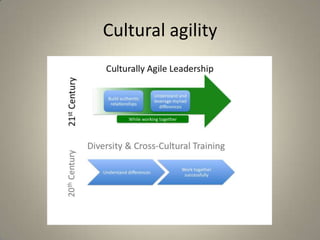
Outdated cultural approach
Cultural Agility is criticalFor today’s global organisations,cultural agility is the new competitive edge.			- The Financial Times  Open new markets
  Able to play in future growth
  Enhance career path
  Better classroom outcomes
  More satisfied clientsMastering Cultural AgilityA breakthrough approach for greater successaround the globeand at homeMichelle Randall, MBAPresidentEnriching Leadership International
PreviewWhy the old approach doesn’t workUnderstanding the Kitty Hawk momentMastering Cultural Agility
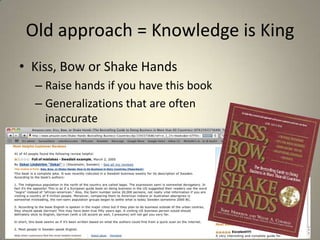
Old approach = Knowledge is KingKiss, Bow or Shake HandsRaise hands if you have this bookGeneralizations that are often inaccurate
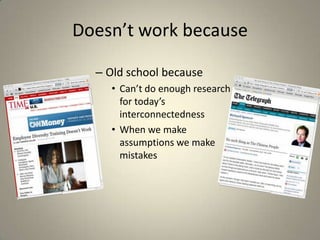
Doesn’t work becauseOld school becauseCan’t do enough research for today’s interconnectednessWhen we make assumptions we make mistakes
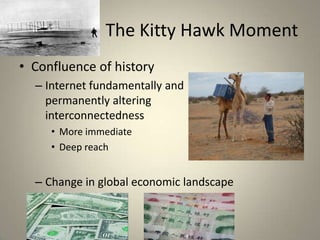
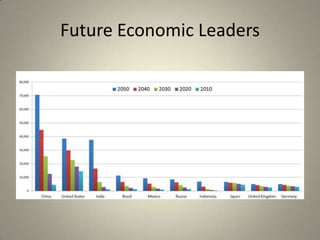
The Kitty Hawk MomentConfluence of historyInternet fundamentally andpermanently altering interconnectednessMore immediateDeep reachChange in global economic landscape
Future Economic Leaders
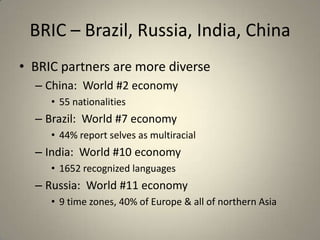
BRIC – Brazil, Russia, India, ChinaBRIC partners are more diverseChina:  World #2 economy55 nationalitiesBrazil:  World #7 economy44% report selves as multiracialIndia:  World #10 economy1652 recognized languagesRussia:  World #11 economy9 time zones, 40% of Europe & all of northern Asia
What does this mean for you?
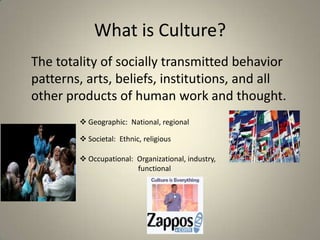
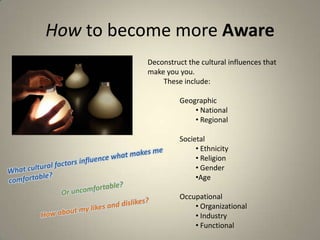
What is Culture?	The totality of socially transmitted behavior patterns, arts, beliefs, institutions, and all other products of human work and thought. Geographic:  National, regional
 Societal:  Ethnic, religious
 Occupational:  Organizational, industry,                                functional
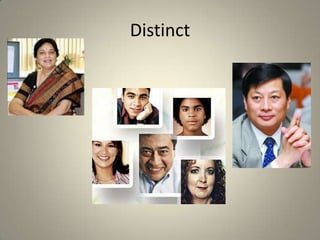
Distinct
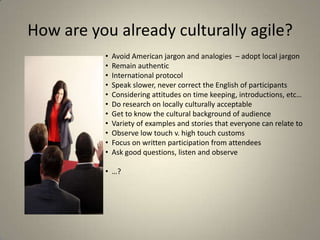
How are you already culturally agile?  Avoid American jargon and analogies  – adopt local jargon
  Remain authentic
  International protocol
  Speak slower, never correct the English of participants
  Considering attitudes on time keeping, introductions, etc…
  Do research on locally culturally acceptable
  Get to know the cultural background of audience
  Variety of examples and stories that everyone can relate to
  Observe low touch v. high touch customs
  Focus on written participation from attendees
  Ask good questions, listen and observe
  …?Agility
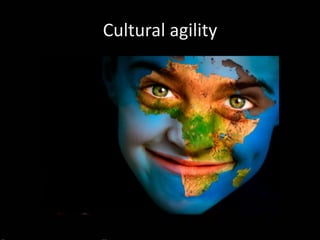
Cultural agility
Cultural agility
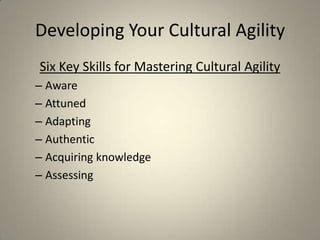
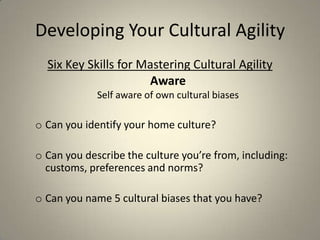
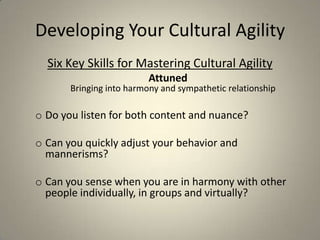
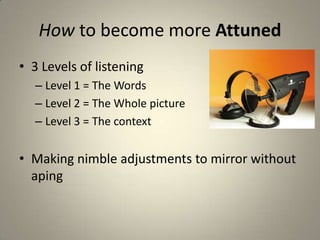
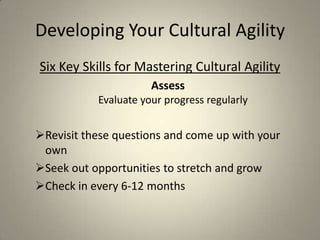
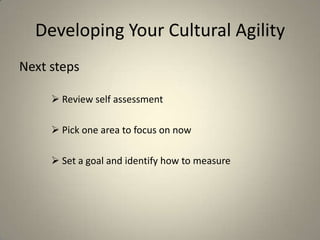
Developing Your Cultural AgilitySix Key Skills for Mastering Cultural AgilityAwareAttunedAdaptingAuthenticAcquiring knowledgeAssessing

Michelle randall cultural agility webinar

  • 1.
    Welcome! Please sharewhere you are located and where in the world you have trained.
  • 2.
    The world isin your webcam
  • 3.
  • 4.
    Cultural Agility iscriticalFor today’s global organisations,cultural agility is the new competitive edge. - The Financial Times Open new markets
  • 5.
    Ableto play in future growth
  • 6.
    Enhancecareer path
  • 7.
    Betterclassroom outcomes
  • 8.
    Moresatisfied clientsMastering Cultural AgilityA breakthrough approach for greater successaround the globeand at homeMichelle Randall, MBAPresidentEnriching Leadership International
  • 9.
    PreviewWhy the oldapproach doesn’t workUnderstanding the Kitty Hawk momentMastering Cultural Agility
  • 10.
    Old approach =Knowledge is KingKiss, Bow or Shake HandsRaise hands if you have this bookGeneralizations that are often inaccurate
  • 11.
    Doesn’t work becauseOldschool becauseCan’t do enough research for today’s interconnectednessWhen we make assumptions we make mistakes
  • 12.
    The Kitty HawkMomentConfluence of historyInternet fundamentally andpermanently altering interconnectednessMore immediateDeep reachChange in global economic landscape
  • 13.
  • 14.
    BRIC – Brazil,Russia, India, ChinaBRIC partners are more diverseChina: World #2 economy55 nationalitiesBrazil: World #7 economy44% report selves as multiracialIndia: World #10 economy1652 recognized languagesRussia: World #11 economy9 time zones, 40% of Europe & all of northern Asia
  • 15.
    What does thismean for you?
  • 16.
    What is Culture? Thetotality of socially transmitted behavior patterns, arts, beliefs, institutions, and all other products of human work and thought. Geographic: National, regional
  • 17.
    Societal: Ethnic, religious
  • 18.
    Occupational: Organizational, industry, functional
  • 19.
  • 20.
    How are youalready culturally agile? Avoid American jargon and analogies – adopt local jargon
  • 21.
    Remainauthentic
  • 22.
  • 23.
    Speakslower, never correct the English of participants
  • 24.
    Consideringattitudes on time keeping, introductions, etc…
  • 25.
    Doresearch on locally culturally acceptable
  • 26.
    Getto know the cultural background of audience
  • 27.
    Varietyof examples and stories that everyone can relate to
  • 28.
    Observelow touch v. high touch customs
  • 29.
    Focuson written participation from attendees
  • 30.
    Askgood questions, listen and observe
  • 31.
  • 32.
  • 33.
  • 34.
    Developing Your CulturalAgilitySix Key Skills for Mastering Cultural AgilityAwareAttunedAdaptingAuthenticAcquiring knowledgeAssessing

Editor's Notes

  • #3 Travel isn’t the only wayVirtual offers more opportunities
  • #4 Complication:After WW2 US a major economic powerTrading with Germany and Japan – two homogenous cultures could get by with a playbookNow trading with diverse countries
  • #5 Position & benefits
  • #6 I assume you’re good at dealing with different cultures already, so I’ll be speaking at your levelAction: Participate, will call on individually, Become acquainted with an advanced leadership skill set to further your own impact
  • #9 if people from 18 countries on call too much to attempt to knowalso can’t customize for everyoneExample this call, I don’t know who will hear this when, I have to be relevant to everyoneThere is no such thing as “The Chinese” just as there is no such thing as “The Americans”look at the amount we invest in diversity training and still get it wrong
  • #11 When I first glanced at at this graph – expected the US on the far left – it isn’tThis is a permanent shiftMandel has become globalVery heavily into China – Some are already training in BrazilBringing trainers on in India and Russia Long term this training company based in Capitola will increase focus and depth internationally in order to satisfy client requirements and grow
  • #12 Define BRICVery diverse – US Americans understand communicating in a multicultural society – also know that there are cultural differences – not ‘The Americans’
  • #13 How will impact you now and in the future?
  • #14 Then intro each bullet with graphicHow we define insider / outsiderAlso used as a smokescreen
  • #15 How important is culture? Are we becoming vanilla/mocha?Story of Ganesh – sitting in an office for hours, no phone, nothing to read, just looking at this pictureFirst looking for familiarities, then looking at differences and realizing that even though I’ve travelled extensively and speak three languages, I didn’t have a shared frame of reference for this cultureShared this observation with an Indian friend – she agreed, ‘No you don’t’
  • #16 Not becoming a global mocha. May look more similar on the surface, but have deeply ingrained cultural comforts, preferences and biases.
  • #17 Whether working globally or domestically, work requires ability to communicate and be relevant across cultures. Communication trainers must set the bar.How have you been doing that so far?
  • #18 Start with agility – the ability to respond to fast-changing conditions and stimuli quickly and powerfully.I looked it up in the dictionary and this is what I found (show photos)
  • #19 When strip back all the differences we’re connecting with other people
  • #20 Cultural agility is the set of skills that allow you to perceive and respond to fast-changing conditions and stimuli quickly and powerfully.Foundation is set of skills not knowledge – knowledge is important, but agility is in the skills to perceive, make sense and interact in a way that pierces through the veils of culture.
  • #21 6 Skills for Cultural Agility
  • #22 Survey asked biggest questions regarding training an increasingly global and virtual audience – a great response was “Cultural Bias. Mine.”Aware = Self aware
  • #23 My story about being flattered as being adopted as an honorary European – but then having to correct that I’m a North AmericanIt can be hard to see ourselves.Ask friends from other cultures for their observations
  • #25 Being attuned to your environment: as one person responded on how she was being culturally agile: listening and observing – salesman and the bat - attuned to pick up fine nuances
  • #27 Question in prep survey: How can I really understand another culture when I’m not not from that culture? You can’t – me 20 years with GermansThe knowledge model created comfort through an illusion of controlBecome comfortable with ambiguitytrust self like me being lost
  • #28 Question in prep survey: on how showing cultural agility – One respondent: talk about utilizing culture and language to an advantage by remaining authentic – Betsy elaborate?In the Mandel guide on culture says not to say good morning b/c many time zones. My tendency would be to say good morning here in California and the time one you’re joining us from – makes it more personalSaying what you believe with a fine feeling for what can be offensive
  • #29 Question in prep survey: on how showing cultural agility – One respondent: talk about utilizing culture and language to an advantage by remaining authentic – Betsy elaborate?In the Mandel guide on culture says not to say good morning b/c many time zones. My tendency would be to say good morning here in California and the time one you’re joining us from – makes it more personalSaying what you believe with a fine feeling for what can be offensive
  • #30 Sociology major, lifelong learner of culture, know a lot, know there’s far more I don’t know, travel & engage with people & grocery stores, read, entertainment – there are myriad ways to learnOne of my favorites is to get lost – story of Beijing – HK point at the menu, nod and smile when waiter said something
  • #31 This is the easiest because of the knowledge model – there’s a lot of knowledge out thereCommitt to being a spongeExplore in your own town with books like Culture Shock, and demographic info, films, go to local ethnic grocery stores
  • #32 Question in prep survey: How can I really understand another culture when I’m not not from that culture? You can’t – me 20 years with GermansBecome comfortable with ambiguity
  • #34 Culture is everywhere all the time – need Cultural Agility to make the connectionDevelop your cultural agility skills furtherBetter outcomes for participants & more fulfillment for yourself
  • #35 No matter where you are it will create better outcomes for participants & more fulfillment for yourself