Mhc Protocols 1st Edition James Robinson Steven G E Marsh Auth
Mhc Protocols 1st Edition James Robinson Steven G E Marsh Auth
Mhc Protocols 1st Edition James Robinson Steven G E Marsh Auth
Mhc Protocols 1st Edition James Robinson Steven G E Marsh Auth
Mhc Protocols 1st Edition James Robinson Steven G E Marsh Auth
1.
Mhc Protocols 1stEdition James Robinson Steven
G E Marsh Auth download
https://ebookbell.com/product/mhc-protocols-1st-edition-james-
robinson-steven-g-e-marsh-auth-928766
Explore and download more ebooks at ebookbell.com
2.
Here are somerecommended products that we believe you will be
interested in. You can click the link to download.
Mhc Protocols 1st Edition James Robinson Steven G E Marsh Auth
https://ebookbell.com/product/mhc-protocols-1st-edition-james-
robinson-steven-g-e-marsh-auth-2348580
Mhc Protocols 1st Edition James Robinson Steven G E Marsh Auth
https://ebookbell.com/product/mhc-protocols-1st-edition-james-
robinson-steven-g-e-marsh-auth-1346252
Mhc Class I Antigens In Malignant Cells Immune Escape And Response To
Immunotherapy 1st Edition Natalia Aptsiauri
https://ebookbell.com/product/mhc-class-i-antigens-in-malignant-cells-
immune-escape-and-response-to-immunotherapy-1st-edition-natalia-
aptsiauri-4395410
Mhc Classi Loss And Cancer Immune Escape 1st Ed Federico Garrido
https://ebookbell.com/product/mhc-classi-loss-and-cancer-immune-
escape-1st-ed-federico-garrido-10487654
3.
The Major HistocompatibilityComplex Mhc Hla In Medicine A Personal
Recollection 2024th Edition Federico Garrido
https://ebookbell.com/product/the-major-histocompatibility-complex-
mhc-hla-in-medicine-a-personal-recollection-2024th-edition-federico-
garrido-58445416
4.
HUMANA PRESS
Methods inMolecular BiologyTM
Edited by
Stephen H. Powis
Robert W. Vaughan
MHC
Protocols
HUMANA PRESS
Methods in Molecular BiologyTM
VOLUME 210
Edited by
Stephen H. Powis
Robert W. Vaughan
MHC
Protocols
5.
医网琴声 www.dnathink.org
September 2002
(ISBN1-59259-291-0)
MHC Protocols
1. HLA Informatics: Accessing HLA Sequences from Sequence
Databases
Robinson, James; Marsh, Steven G. E.
pp. 03-22
(288
KB)
2. Accessing HLA Sequencing Data Through the 6ace Database
Horton, Roger; Beck, Stephan
pp. 23-42
(592
KB)
3. HLA Typing by Restriction Fragment Length Polymorphism
Analysis
Vaughan, Robet W.
pp. 45-60
(172
KB)
4. PCR-Restriction Fragment Length Polymorphism Typing of
Class I and II Alleles
Vaughan, Robert W.
pp. 61-66
5. PCR-Sequence-Specific Oligonucleotide Probe Typing for
HLA-A, -B, and -DR
Middleton, Derek; Williams, F.
pp. 67-112
(880
KB)
6. HLA-DPA1 and -DPB1 Typing Using the PCR and
Nonradioactive Sequence-Specific Oligonucleotide Probes
Steiner, Lori L.; Moonsamy, Priscilla V.; Bugawan,
Teodorica L.; Begovich, Ann B.
pp. 113-142
(456
KB)
7. PCR-Sequence-Specific Primer Typing of HLA Class I and
Class II Alleles
Bunce, Mike
pp. 143-172
(536
KB)
6.
8. HLA TypingWith Reference Strand-Mediated Conformation
Analysis
Argüello, J. Rafael; Pérez-Rodríguez, Martha; Pay, Andrea;
Fisher, Gaby; McWhinnie, Alasdair; Madrigal, J. Alejandro
pp. 173-190
(220
KB)
9. Sequencing Protocols for Detection of HLA Class I
Polymorphism
Dunn, Paul P. J.; Cox, Steven T.; Little, Ann-Margaret
pp. 191-222
(500
KB)
10. HLA-E and HLA-G Typing
Martinez-Laso, Jorge; Gomez-Casado, Eduardo; Arnaiz-
Villena, Antonio
pp. 223-236
(156
KB)
11. Typing Alleles of HLA-DM
Teisserenc, Hélène
pp. 237-246
(144
KB)
12. Typing Alleles of TAP1 and TAP2
Powis, Stephen H.
pp. 249-258
(148
KB)
13. Determining Alleles of the C2 Gene by Southern Blotting
Zhu, Zeng-Bian; Volanakis, John E.
pp. 259-268
(148
KB)
14. Complement C4 Protein and DNA Typing Methods
Schneider, Peter M.; Mauff, Gottfried
pp. 269-296
(292
KB)
15. Typing of Tumor Necrosis Factor Alleles
Wilson, Anthony Gerard
pp. 297-304
(148
KB)
16. Molecular Typing of the MHC Class I Chain-Related Gene
Locus
Collins, R. W. M.; Stephens, Henry A. F.; Vaughan, Robert
W.
pp. 305-322
(216
KB)
17. HLA Microsatellite Analysis
Carrington, Mary
pp. 325-332
(152
KB)
4 Robinson andMarsh
chapter will provide information on the various options available to
the user, to permit an informed decision when selecting a database.
The main databases discussed in this article are the large public
sequence databases, protein structure databases and databases spe-
cializing in the human major histocompatibility complex (MHC).
All of the databases mentioned in this chapter are accessed via
the Internet. The advent of the Internet has revolutionized the dis-
semination of sequence information, allowing scientists from all
over the world to log on and access the many databases that relate to
gene sequences using the World Wide Web (WWW). The uniform
resource locators (URLs) of all the databases discussed will be in-
cluded in Section 6. of this chapter.
2. Generalist Nucleotide Sequence Databases
2.1. EMBL/GenBank/DDBJ
The generalist databanks are not HLA-specific, but rather large
international data repositories for all organisms. The three main gen-
eral nucleotide sequence databases are the EMBL (1), GenBank (2),
and the DDBJ (3). These three databases form an international col-
laboration and exchange sequences daily, so that each contains iden-
tical data. Most published sequences can be found in these
databases. The retrieval of HLA sequences from these systems is
possible through a number of tools. The EMBL database will be
used as the model system for all examples in this chapter.
A number of different methods can be used to retrieve HLA
sequences. A conceptually simple approach would be to copy the
entire database to the users system and then to remove all nonrel-
evant entries leaving a smaller HLA-related database. However, this
method would actually take longer than most search tools, as only a
small subset (around 0.001%) of the database represents HLA data.
A more pragmatic approach is to use the search tools provided,
although these may be time-consuming if large numbers of
sequences are being retrieved. Search tools allow you to perform
complex queries and download the retrieved entries in a specified
9.
HLA Informatics 5
format.The search engines for EMBL are maintained by the Euro-
pean Bioinformatics Institute (EBI). The search engines are also
mirrored at other sites on the Internet, allowing the user to access a
local server. The EMBL database is very large database containing
over 17 million nucleotide sequences, and to this are linked other
databases like SWISS-PROT and TREMBL (translations of EMBL)
(4). All these databases are available and can be searched at the EBI
Web site. In this chapter, we will only discuss the retrieval of nucle-
otide sequences, although the same methods apply for the retrieval
of protein sequences from the appropriate database.
The EMBL database receives around 14,000 sequences/12
megabases of sequence per day, and this data is processed and made
available through flat files. These files include sequence features,
which provide a large amount of additional data allowing for ad-
vanced queries. Sequence features are best described as a number of
different motifs, references and data particular to the DNA se-
quence. The most common sequence features are the source of se-
quence (species, cell type, etc.), coding details, exon coordinates,
and protein translation. Additional sequence features include pro-
moter sequences and their coordinates and complimentary se-
quences. There are two main approaches for sequence searching.
One is to search on particular keywords or features contained within
the sequence documentation, and the other is to search for the actual
nucleotide or protein sequence.
2.2. Sequence Similarity Searches
Sequence similarity searches look for matches to the actual
sequence from larger databases. These matches are based on a num-
ber of similarity measures and, in general, retrieve identical or
highly similar sequences. The most recognized sequence similarity
search tool is the Basic Local Alignment Search Tool (BLAST)
algorithm (5). This widely distributed algorithm has been refined
over many years (6) and is now the premier sequence similarity
search tool. There are number of tools within the BLAST family,
BLASTN for nucleotides, BLASTP for proteins, and BLASTX for
10.
6 Robinson andMarsh
translated sequences. BLAST works by searching for areas of local
similarity between sequences (see Fig. 1). These regions are then
linked to form a score for a particular sequence. The higher the
score, the more accurate the match. The BLAST algorithm does
suffer from a particular problem when using it to identify some HLA
sequences. The first general problem with BLAST is that very short
sequences cannot be used, the minimum sequence length is 20 bps.
The second problem associated with HLA sequences is due to the
high similarity between HLA alleles. BLAST can accurately
retrieve HLA entries from a database where there are a huge range
of sequences, i.e., EMBL. However, when used on a more specialist
subset of data, care is needed when analyzing the results. BLAST
has its own scoring system and uses this rather than sequence iden-
tity. In this system, a 546-bp sequence of approx 95% identity may
score higher than a shorter (e.g., 270 bps) sequence of 100% iden-
tity. Users should therefore study the large output files carefully, as
identical matches may not appear first in the output.
2.3. Sequence Search Tools
The EBI provides one of the most advanced flat file search tools,
the Sequence Retrieval System (SRS) (7). This tool allows the user
to search on any of the sequence features, accession numbers, key-
words, or sequence description and is probably the best method of
retrieving HLA sequences from a general nucleotide database. The
disadvantage of the SRS system is that it does require some famil-
iarity with the flat file format (see Fig. 2). Once users are accus-
tomed to the way data is presented, they can quickly build up very
complex queries. An advantage of the SRS tool is that it can also be
Fig. 1. (opposite page) SRS search tool showing flat file output. The
figure shows the standard output of a flat file, which is a text-based file
that identifies different sections by the line headings, e.g., AC, accession
number; DE, description; KW, keywords; DR, cross references to other
databases; and SQ, sequence. Lines also begin with O, phylogeny;
R, references; and F, features. The output file shown is taken from the
EMBL Nucleotide Sequence Database.
HLA Informatics 9
usedto launch other applications, e.g., BLAST. The SRS tool also
allows the users to customize the output of searches, meaning that
you can quickly see how relevant entries are to the search criteria.
SRS can be found at the EBI Web site and can be used to search a
number of different databases.
The GenBank search engine, Entrez (8) also works on accession
numbers, but provides several advanced options. These include bulk
retrievals of entries in a preformatted manner. This is very useful
for retrieving sequences, once a list of known accession numbers is
available. The search engine for DDBJ is restricted to searching via
accession numbers.
2.4. Other Generalist Sequence Databases
There are other databases that are not included in the EMBL/
GenBank/DDBJ collaboration. These systems also have their own
search engines and retrieval facilities, and similar problems with
regard to data integrity and sequence retrieval also apply, which
will be discussed later (see Subheading 2.5.).
The Genome Sequence DataBase (GSDB) (9) is run by the National
Center for Genome Resources, USA. The GSDB database is included
here, as there are a number of HLA sequences unique to this database
and GSDB does not automatically forward these to the other main
databases. The GSDB search engine retrieves entries and sequence
features, but only by accession number. This means that an accession
number must be known before a sequence can be retrieved.
Fig. 2. (opposite page) Example BLAST outputs. Selected sections of
a standard BLAST output for a search using the A*01011 sequence
against the EMBL database. The first part of the figure shows the
sequences and descriptions retrieved by the EMBL accession numbers.
The variation in Keywords and Description can be seen here; also note
the lack of official nomenclature. Please note inclusion of Pygmy Chim-
panzee (Pan paniscus) sequence which is high in the scoring due to their
high sequence similarity. The second part of this figure shows how
BLAST displays the sequence identities. Identity is shown by a pipe (|)
between the bases, and mismatches have no join.
14.
10 Robinson andMarsh
The Human Genome Project’s Genome Database (GDB) (10) is
the official repository for genomic mapping data from the human
genome project. It includes data on genes, clones, and polymerase
chain reaction (PCR) markers and details on the variation within the
human genome for polymorphisms and mutations, including allele
frequency data. The main obvious advantage to this system is that
this site is only for human data, and the user does not need to imme-
diately restrict the search options.
2.5. Advantages and Disadvantages
of Generalist Databases
The advantage of using the generalist sequence databases is the
large number of sequences available, covering a wide range of data
relating to HLA. Also, the generalist databases contain sequences
from other species, which may not be included in the specialist
databases. However, there are also problems associated with
accessing sequences from the generalist databanks. The main prob-
lem lies in the definition of the sequence. Upon submission to
EMBL, a number of steps are taken to ensure that the sequence is
accurately described and up-to-date. The generalist databanks pro-
vide checks on all entries, but the author assigns keywords and
description, and these can vary. Therefore, despite the work of the
World Health Organization (WHO) Nomenclature Committee for
Factors of the HLA System in monitoring the HLA allele designa-
tions and maintaining the sequences, they have no control of how
sequences are defined in the generalist databanks. Simply search-
ing for the HLA keyword will not retrieve all relevant entries.
Alleles may be incorrectly named, i.e., A*01011 may not be the
sequence found under all entries described as A*01011. Some
entries contain outdated or unofficial designations, such as HLA-
DS now renamed HLA-DQ, causing further confusion, as the exact
nature of the sequence is not always apparent. Additional compli-
cations occur as sequences are updated or become out of date.
Updating a sequence can only be done by the author, so if a
sequence is shown to contain errors or is incorrectly named, it is
15.
HLA Informatics 11
downto the individual author to update these sequences. Other
common sequence errors are the inclusion of primer sequence in
an entry and the addition of bases presumed to exist at the start of
an exon to ensure the first codon is complete. These problems are
currently being addressed by EMBL, but it can be seen that it can
be difficult to accurately retrieve the sequences required.
The general databanks provide a good initial source of data for the
HLA user, although the accuracy of some sequences cannot be guar-
anteed. Indeed, for some work, the sequences provided may be suit-
able. The facilities provided by the EBI through SRS give a very
efficient search engine capable of highly complex queries. The fea-
ture qualifiers contained within the EMBL database provide the most
detailed source of additional data currently available. For detailed
work on noncoding sequences, the EMBL database is currently the
best source of information. For other types of HLA-based research,
this database may not be suitable due to the problems discussed.
3. Specialist HLA Sequence Databases
Recently, several specialist databases for the human MHC have
been developed. In each case, the curators of these databases work
within the field of histocompatibility and immunogentics, and the
data contained is of a greater quality and is usually annotated in
much more detail. However, with all databases maintained by insti-
tutes not directly involved with the WHO Nomenclature Commit-
tee for Factors of the HLA System (11), there can be problems with
consistency in naming and the accuracy of sequences used.
The Chromosome 6 (6ace) database previously known as MHC-
DB (12,13) holds data on the complete genomic structure of the
human MHC, and those wanting to access a genomic view of the
HLA region should use this database. The 6ace database is covered
in detail in Chapter 2, “Accessing HLA Sequencing Data Through
the 6ace Database.”
The MHCPEP (14) database maintained at the Walter and Eliza
Hall Institute, Australia, is a specialist database of peptide binding
sequences available for the MHC. This a curated database and con-
16.
12 Robinson andMarsh
tains over 13,000 peptide sequences. The database can be searched
using the SRS search engine and is currently linked to other data-
bases like SWISS-PROT. Although not directly used for retrieving
HLA alleles, this database provides additional data on the specific
area of MHC-bound peptides.
During 1999, the human mutations database was developed at
the EBI. This provides an alternative database that can be used for
searching for mutations in polymorphic systems. The human muta-
tion database (15) works with the IMGT/HLA database to provide
flat files for the SRS server, which indicates mutations. The flat file
format is based on the standard reference sequence for each allele
and details all mutations compared to the reference sequence. In the
case of HLA alleles, the flat file features detail the sequence posi-
tion and the change, i.e., G->T. This provides the user with a list of
mutations, but restricts how the actual sequences can be accessed
and used in various applications. This database is very specialized
and may therefore only be suited to certain types of research.
3.1. IMGT/HLA Sequence Database
This IMGT/HLA database was released in 1998 and was designed
to provide the HLA community with a specialist HLA sequence data-
base (16). The database was designed in collaboration with the WHO
Nomenclature Committee for Factors of the HLA System and the
EBI and can be considered as the primary source for HLA data. The
database is part of the international IMGT database project (17,18).
This project includes the IMGT/HLA database and IMGT/LIGM
database, which contains immunoglobulin (Ig) and T-cell receptor
(TcR) sequences. The IMGT/LIGM database will not be discussed in
this chapter, but readers should be aware of its existence.
The IMGT/HLA database provides the user with a database con-
taining only sequences officially recognized and named by the
WHO Nomenclature Committee for Factors of the HLA System.
The sequences originally derived from flat file entries in the EMBL
database have been expertly annotated to remove known errors and
to assign standardized keywords and descriptions, thus ensuring a
17.
HLA Informatics 13
consistencybetween entries that was not previously available. The
database also contains multiple EMBL-derived sequences for single
alleles, allowing the component sequences to be combined to create
a virtual sequence for each allele (see Fig. 3). A standard entry from
the IMGT/HLA database contains information on the individual
alleles together with information on the source cell or individual
from which the allele was sequenced.
The IMGT/HLA database is available in a number of different
formats including via the Web site, flat files, EBI SRS server,
EMBL CD-ROM and FTP. The flat files available on the EMBL
CD-ROM, SRS server, and FTP are specific to the IMGT/HLA
database and contain standardized keywords and description to aid
in retrieval. The FTP site allows users to download the database in a
variety of formats (FASTA, Protein Information Resource [PIR],
multiple sequence format [MSF], text alignments, and flat files),
which are suitable for the majority of sequence analysis tools.
3.1.1. IMGT/HLA Web Site and On-Line Tools
The IMGT/HLA Web site is the main access point for the HLA
community. The Web site provides a centralized resource with tools
Fig. 3. Construction of a virtual sequence. A virtual sequence is con-
structed for each allele, which represents the longest available sequence
for each allele. This is generated by combining the component entries
from EMBL/GenBank/DDBJ to create a single entry. The diagram shows
three component entries aligned and merged to form a virtual sequence.
18.
14 Robinson andMarsh
to access and analyze the HLA sequences. The database also
includes the background information and documentation to support
the use of these tools. The main tools are for allele queries, the gen-
eration of sequence alignments, and cell queries, and each of these
tools is unique to the IMGT/HLA database.
The allele query tool is designed to allow the user to retrieve the
full sequence and nomenclature for any allele. The user-friendly
interface prompts the user to enter the locus and allele name, i.e.,
Locus “A” and allele name “0101” or a wildcard to permit the user
to do a more general search. The output includes data on the source
individual or cell, ethnic origin, references, and the official nucle-
otide and protein sequence. Other features include hypertext links
to Medline and cross references to other sequence databases, as well
as local links to the cell database and help pages. The sequences are
provided in a standard alignment format. The IMGT/HLA flat files
replicate this output using the standardized EMBL flat file format.
Essentially, the Web tool should be used for the basic enquiries on
any specific allele. If a more complex query is required, then the
SRS search tool can be used to selectively search the IMGT/HLA
database. The output from the query tool is also linked to the SRS
output for each flat file, meaning that users can easily navigate
between the two tools.
Sequence similarity searches for unknown sequences can be
performed using the BLAST search tool. The IMGT/HLA data-
base provides the only BLAST engine containing the official
WHO Nomenclature for Factors of the HLA System sequences. It
is therefore recommended that for sequence similarity searches,
this database should be used wherever possible. BLAST searches
using EMBL or other databases cannot guarantee to match against
official sequences.
The database provides an interactive tool for viewing the official
HLA sequence alignments. The options available allow the user to
customize the type of alignment and sequence selected as well as
the output format. The alignment tool retains the same format as
the text alignments, however users are no longer restricted to down-
loading an alignment of an entire locus just to view a single allele
19.
HLA Informatics 15
(seeFig. 4). The full locus text alignments are still available as
before and can be downloaded from the Anthony Nolan Research
Institute (ANRI) Web site (see Subheading 4.).
The database also provides access to a searchable database of the
source cells or individuals for every allele. This data is used to pro-
vide background information on each allele and is unique to the
IMGT/HLA database.
3.1.2. Submissions to the WHO Nomenclature
for Factors of the HLA System
As well as providing HLA sequences for retrieval, the IMGT/
HLA Web site also provides the submission tools for submitting
new and confirmatory sequences to the WHO Nomenclature for
Factors of the HLA System (11). This is now the accepted method
for submitting new sequences to the committee and includes sec-
tions for information on the source cell, references, and sequence
features. Submissions are sent directly to the committee for pro-
cessing, where they are assigned an official name before being
loaded into the IMGT/HLA database. Details of new confirmatory
and extended sequences submitted to the WHO Nomenclature for
Factors of the HLA System are included in nomenclature update
reports, which are published monthly in the journals Tissue Anti-
gens, Human Immunology, and the European Journal of Immuno-
genetics (19–21) and also made available on the ANRI Web site.
3.1.3. Future Developments
At the present time, the database contains only HLA exon
sequence data. The data contained within IMGT/HLA has to be
expertly annotated before inclusion, and as such, it has taken longer
to include all the feature information from other databases into the
IMGT/HLA database. Therefore, at the time of writing, the EMBL
database may contain additional, though largely unvalidated, data
to that included in the IMGT/HLA database. In order to remedy
this, a comprehensive review of all genomic HLA sequence data is
currently underway, and it is expected that a future release of the
HLA Informatics 17
databasewill include both intron sequences and that derived from 5'
and 3' untranslated regions. Other tools for HLA sequence manipu-
lation and visualization are also being developed.
4. Sequence Alignments Web Sites
An alternative source of HLA sequences is the sequence align-
ment files that have been made available on a regular basis since
1989 as both publications in journals and also via the WWW. These
sequences were originally produced and released in Tissue Antigens,
Human Immunology, and the European Journal of Immunogenetics
(22,23). As the WWW became more available, these sequences
were provided on a number of Web pages. The official sites were
originally maintained by the Imperial Cancer Research Fund and
then from 1996 by the ANRI. These Web sites were constructed
from the data held in the HLA database (24), maintained by Steven
Marsh for the WHO Nomenclature Committee for factors of the
HLA System, which, though not accessible to the public, was used
to produce the sequence alignments. In addition to the official site,
these alignments have also been made available by different insti-
tutes and societies. As part of the work of the IMGT/HLA database,
these preformatted static sequence alignments continue to be made
available on the ANRI Web site and are updated with each new
release of the database (Fig. 5).
Fig. 4. (opposite page) Alignment formats available from the IMGT/
HLA database. The examples shown are all based on alignment A, which
shows seven DRB1*01 alleles. Alignment B shows these sequences with
the mismatches highlighted and the sequence split into codons. In these
alignments, a hyphen (-) indicates identity to the reference sequence, and
an asterisk (*) denotes an unsequenced base. Alignment C shows how an
alternative reference sequence can be used. Here for example, we have
used a DRB1 consensus sequence. Alignment D represents a translation
of the nucleotide sequence to produce a protein sequence alignment. In
alignments A and C, the numbering is given for nucleotides, in align-
ments B and C, it is for codon or amino acid position.
22.
18 Robinson andMarsh
Fig. 5. Detail of a static HLA sequence alignment format available
from the ANRI Web site. In the alignments, a hyphen (-) indicates iden-
tity to the reference sequence, DRB1*0101, and an asterisk (*) denotes
an unsequenced base. The exon/intron boundary is indicated by a pipe (|).
The sequence is numbered by both nucleotide position, numbering from
1 the A of the ATG of the initiation methionine and the start of exon 1,
and by the protein sequence, codons being numbered from 1, the first
amino acid residue of the mature protein.
The advantage to this type of data source is that it is relatively
quick and easy to access the basic sequence. The disadvantages are
that there is no flexibility in searching, and the user is unable to
perform any type of complex query. For that type of analysis, the
IMGT/HLA database is recommended.
5. Conclusion
As can be seen, when accessing HLA sequences, the user has the
option of a number of systems depending on the amount of informa-
tion and accuracy in the data required. General requests for sequences
can be made to the generalist databanks, and although these contain
the greatest amount of sequence data information, the accuracy of
these sequences can vary. Accessing sequences from approved sites
can improve the quality of sequence, but maybe at the cost of addi-
tional information. The static HLA sequence alignment pages pro-
vide detailed source of sequences, but do not allow the user to specify
any of the parameters used to produce the alignments. The IMGT/
HLA database has overcome many of the problems discussed, but is
23.
HLA Informatics 19
stillunder development in some areas (intron sequences, protein struc-
ture). However, once this system is completed, it will provide the
most accurate and up-to-date database for accessing HLA informa-
tion. Used together, the specialist databases provide a good source of
high quality data covering a range of areas important in the study of
HLA. The 6ace and IMGT/HLA database illustrate this, with the
IMGT/HLA database designed at the alleleic level and 6ace provid-
ing a genomic overview. Retrieving HLA sequences is becoming
more straightforward, but the user should be prepared to spend time
assessing all the databases before retrieving any sequences. This
should ensure that data of the relevant type and quality is retrieved.
6. Electronic Resources
6.1. Sequence Databases
DDBJ—http://www.nig.ac.jp/
EMBL Nucleotide Sequence Database—http://www.ebi.ac.uk/embl/
GenBank—http://www.ncbi.nlm.nih.gov/Genbank/
Human Genome Mapping Project (GDB)—http://www.gdb.org/
Human Mutation Database—http://ebi.ac.uk/mutations/
SWISS-PROT Database—http://www.ebi.ac.uk/swissprot/
6.2. Search Tools
DDBJ Search Tools—http://www.nig.ac.uk.jp/
EBI BLAST Server—http://www.ebi.ac.uk/blast2/
EBI SRS Search Engine—http://srs.ebi.ac.uk/
GenBank Entrez Search Tool—http://www.ncbi.nlm.nih.gov/Entrez/
6.3. Specialist HLA Databases
HLA Informatics Group (ANRI)—http://www.anthonynolan.org.uk/
HIG/
Human Chromosome 6 Database (6ace)—http://www.sanger.ac.uk/HGP/
Chr6/
IMGT/HLA Sequence Database—http://www.ebi.ac.uk/imgt/hla/
IMGT/LIGM Database—http://imgt.cnusc.fr:8104/
MHCPEP—http://wehih.wehi.edu.au/mhcpep/
24.
20 Robinson andMarsh
References
1. Baker, W., van den Broek, A., Camon, E., Hingamp, P., Sterk, P.,
Stoesser, G., and Tuli, M. A. (2000) The EMBL nucleotide sequence
database. Nucleic Acids Res. 28, 19–23.
2. Benson, D. A., Karsch-Mizrachi, I., Lipman, D. J., Ostell, J., Rapp, B.
A., and Wheeler, D. L. (2000) GenBank. Nucleic Acids Res. 28, 15–18.
3. Tateno, Y., Miyazaki, S., Ota, M., Sugawara, H., and Gojobori, T.
(2000) DNA data bank of Japan (DDBJ) in collaboration with mass
sequencing teams. Nucleic Acids Res. 28, 24–26.
4. Bairoch, A. and Apweiler, R. (2000) The SWISS-PROT protein se-
quence database and its supplement TrEMBL in 2000. Nucleic Acids
Res. 28, 45–48.
5. Altschul, S. F., Gish, W., Miller, W., Myers, E. W., and Lipman, D. J.
(1990) Basic local alignment search tool. J. Mol. Biol. 215, 403–410.
6. Altschul, S. F., Madden, T. L., Schaffer, A. A., et al. (1997) Gapped
BLAST and PSI-BLAST: a new generation of protein database search
programs. Nucleic Acids Res. 25, 3389–3402.
7. Etzold, T., Ulyanov, A., and Argos, P. (1996) SRS: information re-
trieval system for molecular biology data banks. Methods Enzymol.
266, 114–128.
8. Schuler, G. D., Epstein, J. A., Ohkawa, H., and Kans, J. A. (1996)
Entrez: molecular biology database and retrieval system. Methods
Enzymol. 266, 141–162.
9. Harger, C., Chen, G., Farmer, A., et al. (2000) The Genome Sequence
DataBase. Nucleic Acids Res. 28, 31–32.
10. Talbot, C. C. and Cutticchia, A. J. (1999) Human Mapping Data-
bases, Current Protocols in Human Genetics. John Wiley & Sons,
New York, pp. 1.13.1–1.13.12.
11. Bodmer, J. G., Marsh, S. G., Albert, E. D., et al. (1999) Nomenclature
for factors of the HLA system, 1998. Tissue Antigens 53, 407–446.
12. Newell, W. R., Trowsdale, J., and Beck, S. (1994) MHCDB—data-
base of the human MHC. Immunogenetics 40, 109–115.
13. Newell, W. R., Trowsdale, J., and Beck, S. (1996) MHCDB: data-
base of the human MHC (release 2). Immunogenetics 45, 6–8.
14. Brusic, V., Rudy, G. and Harrison, L. C. (1998) MHCPEP, a data-
base of MHC-binding peptides: update 1997. Nucleic Acids Res. 26,
368–371.
15. Lehvaslaiho, H., Stupka, E. and Ashburner, M. (2000) Sequence
25.
HLA Informatics 21
variationdatabase project at the European Bioinformatics Institute.
Hum. Mutat. 15, 52–56.
16. Robinson, J., Malik, A., Parham, P., Bodmer, J. G. and Marsh, S. G.
(2000) IMGT/HLA database—a sequence database for the human
major histocompatibility complex. Tissue Antigens 55, 280–287.
17. Giudicelli, V., Chaume, D., Bodmer, J., et al. (1997) IMGT, the inter-
national ImMunoGeneTics database. Nucleic Acids Res. 25, 206–211.
18. Ruiz, M., Giudicelli, V., Ginestoux, C., et al. (2000) IMGT, the inter-
national ImMunoGeneTics database. Nucleic Acids Res. 28, 219–221.
19. Marsh, S. G. E. (2000) Nomenclature for factors of the HLA System,
update March 2000. Tissue Antigens 27, 163.
20. Marsh, S. G. E. (2000) Nomenclature for factors of the HLA System,
update March 2000. Hum. Immunol. 61, 718.
21. Marsh, S. G. E. (2000) Nomenclature for factors of the HLA System,
update March 2000. Eur. J. Immunogen. 27, 163.
22. Mason, P. M. and Parham, P. (1998) HLA class I region sequences,
1998. Tissue Antigens 51, 417–466.
23. Marsh, S. G. E. (1998) HLA class II region sequences, 1998. Tissue
Antigens 51, 467–507.
24. Marsh, S. G. E. and Bodmer, J. G. (1993) HLA Class II Sequence
Databank. Hum. Immunol. 36, 44.
24 Horton andBeck
melanogaster, Arabidopsis thaliana, Schizosaccharomyces pombe,
and many more.
ACEDB can be used via an Xwindows graphical interface
(XACE) (do not confuse with Xace, which is a chromosome-spe-
cific database), via TACE (a command line textural interface), or
via WEBACE (T. Hubbard, personal communication), which is a
Web browser interface. XACE versions allow data to be viewed not
only as text fields but also as genetic and physical maps, or by using
applications external to ACEDB to view images or sequence align-
ments. The maps are emulated in the WEBACE versions.
2.2. 6ace and MHCDB
The sequencing effort on human chromosome 6 was initially fo-
cused on the MHC, with the data being accumulated in the MHC
database, MHCDB (2). These data were later merged in the Chro-
mosome 6 database (3), 6ace, the use of which is described here.
Although MHC peptides were formerly included in MHCDB, these
are now catalogued in an independent database, MHCPEP, at the
Walter and Eliza Hall Institute of Medical Research in Melbourne,
Australia (http://wehih.wehi.edu.au/mhcpep/) (4). The 6ace data-
base incorporates data not just from the Sanger Centre Chromo-
some 6 Project (5,6) but from the whole chromosome 6 community.
2.3. 6ace Content
As there is rapid progress in the sequencing of the human genome,
it is difficult to provide an up-to-date picture of the content of any
genomic database. Table 1 provides a snapshot of the situation in
early 1998. Tools are available within the database for the user to
gain information on the current status of the data at any time.
3. Access to 6ace
There are three means of getting access to 6ace. If you have your
own UNIX system, you may copy the database from the Sanger
Centre ftp site. If you are a registered user of the computing facili-
29.
Accessing HLA SequencingThrough 6ace 25
Table 1
Summary of the Content of the 6ace Database
Database content
(MHC data in parenthesis)
Class Subclass Number Megabase
Sequence Genome_sequence 86 (32) 7.53 (1.19)
- Sequenced_by = SC 59 (13) 6.20
(0.75 ⬅ MHC class II)
Locus Gene 402 (73)
Pseudogene 50 (29)
Allele 662 (662)
Image 27 (27)
STS 2532
(RH mapped)
cosmid 499 (264)
BAC 124 (0)
PAC 6084 (11)
YAC 69 (69)
ties of the Human Genome Mapping Project Resource Centre
(HGMP), you may access 6ace on-line. Finally, there is access via
the Web to the Sanger Centre, where pages allow interactive use of
6ace. These means of access can be all reached from the Sanger
Centre Chromosome 6 Web page (http://www.sanger.ac.uk/HGP/
Chr6/) by looking under the Chromosome 6 Database entry.
3.1. Getting 6ace by ftp from the Sanger Centre
Releases of the Sanger Centre chromosome-specific databases
take place at the beginning of each calendar month with weekly
updates. The releases can be obtained from (ftp://ftp.sanger.ac.uk/
pub/human/chr6/RELEASES/).
30.
26 Horton andBeck
The weekly updates are found in (ftp://ftp.sanger.ac.uk/pub/hu-
man/chr6/weekly_release/).
There are README files in the directories, which give full in-
struction for installing the databases. Basically, it is required to copy
a file of the form:
6ace_release_mm-yy.tar.Z
where mm and yy are month and year numbers, respectively. This
file needs to be uncompressed (unzipped) and extracted using the
UNIX tar command to give a 6ace directory.
The current release of the ACEDB code will also be required.
This can be obtained from (ftp://ftp.sanger.ac.uk/pub/acedb/). The
current version (4.5) of the code is in a directory ace4_5/.
3.2. Using 6ace at the HGMP
Details of registration and use of HGMP computing facilities can
be obtained at (http://www.hgmp.mrc.ac.uk/). If suitable computer
facilities are available, this enables the use of the graphical inter-
face to 6ace. The HGMP database currently uses the monthly 6ace
releases, but not the weekly updates. The HGMP also organizes
training courses in the use of ACEDB.
3.3. Web Access to 6ace
The Sanger Web pages provide both graphical and textural
access to 6ace. Major developments of this route of access are cur-
rently being made so as to provide better access to Sanger Centre
data, in particular with WEBACE.
The WEBACE home page is at (http://webace.sanger.ac.uk/)
and has a link to the full set of Sanger Centre ACEDB databases
including 6ace. The user is then guided through the class structure
of 6ace, and, if a suitable browser is being used, both graphics and
textural objects can be displayed. This means of access will
become increasingly popular with the expansion of applications
available.
31.
Accessing HLA SequencingThrough 6ace 27
For those with a knowledge of TACE, the text version of ACEDB,
another page (http://www.sanger.ac.uk/HGP/db_query/query.
shtml) gives the user access to the QUERY THE CHROMOSOME
SPECIFIC DATABASES page. Clicking on the “Open access” but-
ton leads to a TACE query form. Consult the help pages for a
description of how to use TACE.
4. Abbreviations and Conventions
In describing the use of 6ace, the following abbreviations and
conventions will be used here. In the majority of cases, they apply
to the use of XACE.
CMW; Class Menu Window, the first menu window that appears in XACE.
MKS; Main KeySet window generated LMB DC on a Class in the CMW.
LMB, RMB; Left and Right Mouse Button, respectively.
SC, DC; Single and Double Click, respectively.
“text”; Text as it appears on the screen in 6ace.
‘text’; Text to be entered from the keyboard by the user.
↵; The keyboard RETURN key.
The convention within ACEDB (apart from in the CMW and
some of its menus) is that bold text is a link to further data and if
clicked (LMB DC; LMB SC simply highlights the entry) will open
up a further window.
Quit; This has two meanings in XACE. In all windows except the CMW,
it may be present as a Quit button or may be selected from the RMB
pull-down menu. When selected, it closes the window concerned.
In the CMW selected from the RMB menu, it closes and exits
ACEDB after the warning: “Do you really want to quit acedb?
Yes No”.
In TACE, typing ‘quit’ closes 6ace immediately.
5. Structure of ACEDB Databases
The structure of data storage within an ACEDB database can be
likened to a tree. The main menu access is via the trunk. This leads
32.
28 Horton andBeck
to classes that are the branches of the tree. Within classes, there are
a number of objects like twigs on the branches. If the structure is
followed through, eventually a tag field is reached, likened to a leaf,
which contains an item of data. The skill in using the database is to
know your way around this tree structure.
The structure in each class is contained within its Model. Look-
ing at the Models can be of great help when trying to access and
interpret data.
It should be remembered that many of the commonly encoun-
tered objects belong to subclasses. Thus, finished sequences are
put in the Genome_sequence subclass, which is part of the
Sequence class distinguished (or filtered) by having the Properties
tag “Genomic_canonical”. Similarly, Gene and Pseudogene are
subclasses of Locus, filtered by the Type tag “Gene” and “Pseudo-
gene”, respectively.
In XACE, a list of classes and subclasses can be accessed by
clicking (LMB DC) on the 䉲 after “In class:” in the CMW. Model
is itself a class that can be displayed and selected from. In TACE,
typing “Classes” lists the classes and the number of objects they
each contain. The command “Model”, followed by a class name,
will show the model structure.
WEBACE restricts the accessible classes to those on the menu
lists. Browsing a class from the main Classes page generates a fur-
ther page listing objects in the selected class. At the foot of this page
is a “View…model” clickable button, leading to a display of the
model structure.
At the UNIX level the model structures are all contained in the
6ace/wspec/ directory in the models.wrm file, whereas
subclasses.wrm contains each subclass with its parent class on an
“Is_a_subclass_of” tag together with the filter used. The appear-
ance of data represented in a graphical form in XACE is deter-
mined by the Methods. These Methods can be viewed in XACE
by selecting “Query” from the pull down menu found by holding
down the RMB in the CMW. Entering ‘find method’ in the yellow
“Query:” box lists the Methods. ‘Find Method’ can also be used in
TACE even though TACE cannot display graphical objects.
33.
Accessing HLA SequencingThrough 6ace 29
6. 6ace in Use
6.1. XACE
Perhaps the most familiar version of the database, XACE con-
tains a menu of commonly used classes, presented as a list in a win-
dow (CMW). List Items are clickable (LMB DC) and lead to
windows containing KeySets (sic) of the selected class. The KeySets
list entries are in turn clickable (if depicted in bold type) and can
eventually lead to the display of the particular object of interest.
Pull-down menus are available via the RMB, and windows buttons
lead to other options. Fig. 1 shows the 6ace CMW (first to appear
when 6ace is opened) with “Genome_sequence” selected to give
the MKS, and the object E1448 further selected in text mode to
show full details of the entry for this cosmid. Note that, when there
is a choice, XACE will try to display an object graphically. The text
version of E1448 was selected by clicking on the toggle button at
the top left of MKS “Show As…:” to select Text. An alternative for
an object is to highlight the object name LMB SC and then select
“Show as text” on the menu.
LMB SC on “Genome_sequence” and then entering ‘E1448 ↵ ’
in the yellow “Search:” box would generate a KeySet with just one
entry and open the E1448 map directly.
6.2. TACE
In contrast to XACE, TACE provides textural access to ACEDB
databases. It uses the query language that is also employed by the
graphical version. On UNIX systems, TACE can be opened with
the command ‘tace’ if paths have been set correctly. It may also be
used via the Sanger Centre Web pages at (http://www.sanger.ac.uk/
HGP/db_query/query.shtml) as described in Subheading 3.
TACE is not immediately user-friendly, in that the operator needs
to know some commands to type in order to get started, whereas the
XACE version has the advantage of menus and clickable entries in
object lists, but, to the initiated, TACE provides a rapid tool for the
interrogation of the database. Typing ‘?’ at the TACE prompt (>)
Accessing HLA SequencingThrough 6ace 31
will list a help file of the commands and their function. Typing
‘classes’ lists the classes in the database and the number of objects
each contains. To get the output obtained in XACE above for E1448
would require just the following two commands (at the > prompt,
with output lines beginning //):
>find genome_sequence E1448
//Found 1 objects in this class
//1 Active Objects
>show
The data generated are of such a volume as to be virtually un-
readable. To overcome this, write the data to a file using the com-
mand >write E1448.ace and examine your UNIX directory for
the output.
6.3. WEBACE
Here, the window lists of XACE are replaced by selectable lists
in windows within the Web pages. 6ace can be selected by clicking
“acedb6” and then the “Browse DB” button. To obtain the E1448
details given above, it is necessary to make selections as follows (as
illustrated in Fig. 2): “—>Genome_sequence” below “Sequence”
and click the “Browse” button on the Classes page and then select
“E1448” in the window generated. There is also the option of Text,
Graphics (passive), and Graphics (active). Selecting the first fol-
lowed by clicking the “show object(s)” button generates a “Sequence:
E1448” page with the data as seen in XACE above. Links are shown
in hypertext, and where the volume of data is large in a tag field, it
may be in a compressed form beneath an “Expand” hypertext.
Fig. 1. (opposite page) Text display of Sequence E1448 in 6ace
(XACE). Class Menu Window (top left) with the class “Genome_
Sequence” selected; the Main KeySet for Genome_Sequence (top right)
with the sequence name E1448 selected, and the “Show As…:” button
toggled to Text; and the resulting Sequence: E1448 text window showing
some of the database entries for the sequence.
Accessing HLA SequencingThrough 6ace 33
7. Examples
It is impossible here to give a complete set of examples of all the
functions of 6ace, but the user is encouraged to explore the data-
bases to gain experience. A novice user need not fear causing dam-
age, as only those with write access can initiate changes. Only when
users are running a local copy of the database and this is opened
with TACE are they likely to have write access without specifically
asking for it.
The MHC, also known as the HLA complex, is located on the
short arm of human chromosome 6 (6p21.3). It is the most polymor-
phic and gene dense region of the human genome. The examples
selected here, therefore, have been chosen to illustrate different
types of variation and polymorphism present in HLA sequences.
7.1. Maps and Images in XACE
This example uses maps and images to illustrate the representa-
tion of variation in 6ace. A variation is either a substitution, inser-
tion, or deletion of bases in the DNA sequence. XACE has the
advantage over TACE of being able to display graphical objects
such as the ACEDB genetic and physical maps. As WEBACE emu-
lates XACE, it is also able to display these maps. Selecting “Maps”
from the CMW lists all the genetic maps in 6ace. Of particular rel-
evance to those with an interest in the HLA region will be “Chr_6”
(the map of the entire chromosome) and “6p21_3ctg” (the map of
the MHC region). These appear superimposed in Fig. 3. This shows,
from left to right, the chromosome 6 ideogram flanked by a scale, in
kb (kilobases), and the chromosome bands. The boxes (red) along
the ideogram indicate regions selected for sequencing or where
sequencing is already in progress. (Note: all colors given here are
Fig. 2. (opposite page) Text display of Sequence E1448 in 6ace
(WEBACE). The three pages used to select the 6ace database (acedb6;
top left), the Genome_Sequence class (top center), and the E1448 se-
quence text (top right), together with the resulting Sequence: E1448 text
page (bottom).
Accessing HLA SequencingThrough 6ace 35
the default colors generally used in the XACE and WEBACE ver-
sions of 6ace. In XACE, it is possible for the user to alter these
colors). The box associated with the MHC region (6p21_3ctg) has
been selected using LMB SC. This selection changes the box color
to pale blue, and the contig name appears highlighted in blue. The
zoomed in view of 6p21_3ctg shows the status of the 4000 kb MHC
region. To the left of the scale, the approximate positions and sizes
of all yeast artificial chromosome (YAC), bacterial artificial chro-
mosome (BAC), P1-based artificial chromosome (PAC), and
cosmid clones are shown. A LMB SC on any clone or clone name
will highlight the corresponding clone name or clone in pale blue.
To the right of the scale the sequencing tiling path and correspond-
ing clone names are shown. The key to the color-coded status of
each clone can be viewed by LMB DC on the Status bar (green) at
the foot of the map (grey, sequencing in progress; red, sequencing
finished; black, analyzed and submitted to a public database). The
mirrored tiling path to the right indicates where a particular clone is
being or has been sequenced (pale blue, Sanger Centre; purple, oth-
ers). LMB DC on any clone will bring up a text window with full
details of its sequencing and with links to sequencing laboratory
location and names of investigators involved. Finally, on the far
right hand side, the names of genes are displayed alongside the
clones in which they are encoded. The limitation of space in the
magnification shown here results in the truncation or exclusion of
some gene names. This may easily be overcome by repeated LMB
SC on the “Zoom in” button until the required magnification is dis-
played. During zooming, the middle mouse button can be used to
center on the object to be enlarged by SC on it or to scroll by SC at
the top or bottom of the window.
Switching between different maps is very easy. The text window
produced above (LMB DC on any clone) will contain a tag “DNA”
Fig. 3. (opposite page) The 6ace Chromosome 6 (left) and MHC (right)
maps. The position of the latter (6p21_3ctg) is highlighted in the former.
For further details see text.
Accessing HLA SequencingThrough 6ace 37
followed by the clone name in bold text. This is a link to the physi-
cal map of the clone DNA sequence. LMB DC on this bold text
brings up a map as shown in Fig. 4 (main picture), in this case for
clone E1448. On the left is a locator bar (light red when whole map
is viewed, but changing to green when zoomed in) next to a box
representing the clone (black outline; LMB DC on this box returns
to the sequence text window). Names of genes within the clone are
superimposed on the locator bar, as is that for HLA-DQB1 here. To
the right is a vertical bar (yellow) and scale in bases for the
sequence in view. All the other details in the map relate to features
of the DNA annotated using the HPREP analysis suite (G. Micklem
and R. Durdin, personal communication). Those to the left of the
yellow bar and scale represent features of the reverse complement,
whereas those to its right represent features of the positive strand.
The features include significant matches determined using Basic
Local Alignment Search Tool (BLAST) (7) to entries in the protein
databases (BLASTX; light blue boxes), to entries in the nucleotide
databases (BLASTN; yellow boxes), and to vertebrate mRNA
(brown boxes). At the far right, similarity to expressed sequence tag
(EST) clusters are shown as pale violet boxes. Repeat sequences
determined using RepeatMasker2 (8) (http://ftp.genome.
washington.edu/cgi-bin/RepeatMasker) are also shown (Alus as
green boxes, others in dark blue). Further information can be gained
for all of the features, either by LMB SC on a box that brings up
brief details in the banner line (light blue) at the top of the map, or
by LMB DC that will call up a text window giving fuller details.
At the foot of the map, immediately to the right of the scale, is an
exon and intron diagram for the HLA-DQB1 gene (dark blue outline
boxes and lines). The strength of ACEDB, in its ability to present a
Fig. 4. Representation of variation in 6ace. The sequence map of E1448
(top left) showing annotation of substitutions and of indels (for full de-
scription, see text); the DQ-pocket Image with residues color-coded ac-
cording to variability (inset, right); a Blixem output of aligned
HLA-DQB1 allele sequences (bottom) compared with that of HLA-
DQB1*0402.
42.
38 Horton andBeck
combination of results visually, is illustrated by the concentration
of features showing matches to the protein and DNA
databases and the absence of repeat elements in the region of this
gene. The presence of allele sequences is recorded as boxes (red) to
the right of, and at the same horizontal level, as the gene exons.
Holding down RMB on these allele-display boxes reveals a pull-
down menu from which may be chosen “show multiple DNA align-
ment of just this kind of homolgies”. This selects an external
application, Blixem (9) which enables the display of aligned DNA
sequences of the gene’s alleles (Fig. 4, foot). This application high-
lights the allelic variation in this gene. The allele sequences of HLA
class I genes were taken from Arnett and Parham (10) and those of
the class II region from Marsh and Bodmer (11).
Central features of the map are two horizontal bar graphs repre-
senting GC content and variation rate. The former (red) shows GC
content calculated for intervals of 250 bases on a scale arranged a
round a midpoint of 50%. The latter shows the variation rate, using
the same intervals, between E1448 and an overlapping sequence
from a different haplotype (p797a11). The GC content is highest in
the sequence adjacent to the second exon in DQB1, which coincides
with the presence of a CpG island (yellow box) directly to the left of
the bar graph. It is also of interest to note that the variation reaches
local maxima of up to 10% (which is the highest level of sequence
variation reported in the human genome so far) and that it extends
far beyond the transcriptional unit of DQB1 (12). The three gaps in
the variation bar graph are due to major indels (cerise boxes), which,
in this case, are all of retroviral origin (long terminal repeat [LTR]
sequences). The relatively high GC content around the gene is also
emphasized. The nature of individual variations are also shown as
text, far right, and as small boxes (red) immediately to the left of the
gene diagram, where they often form a continuous bar because they
are so numerous.
Although all these features can be seen in text form in TACE, only
the maps in XACE and WEBACE allow their spacial visualization.
6ace via XACE also provides a means to view the structures and
structural variability of HLA molecules using either xv (John Brad-
43.
Accessing HLA SequencingThrough 6ace 39
ley; ftp://ftp.cis.upenn.edu) or RasMol (13) if these applications are
installed on the computer system in use. With the former, images
constructed using Prepi suite (14), in which residues are color-coded
according to their variability from constant (white) to most variable
(red) according to their Shannon entropy, (15) can be displayed.
With the latter, a 3D interactive display enables the rotation of im-
ages of protein tertiary structure.
To access these, LMB DC on the class Image in the CMW and
then select from the MKS in which external image files are listed.
Select (LMB DC) from the MKS and in the Image object window
LMB DC on “Pick_me_to_call”. Selecting, thus, for the
“DQ_pocket” image calls the structure shown as an inset in Fig. 4,
in which the positions within the structure of the DQ antigen, which
are most variable, are banded in red.
In summary, Fig. 4 illustrates the different ways in which HLA
variation and polymorphism data can be accessed and viewed in
6ace.
7.2. Obtaining the DNA Sequences of
All HLA-DQB1 Alleles
Obtaining DNA sequences in a format compatible with analysis
software is a common problem in bioinformatics. The 6ace data-
base contains allele sequences for genes in the MHC region im-
ported from external databases (10,11). This example shows how
to obtain the sequences for all the alleles of an HLA gene in fasta
format.
7.2.1. XACE
In the CMW enter HLA-DQB1* in the yellow “Search:” box and
LMB DC on 䉲 after “In class:”. From the menu window, which
appears LMB DC on Allele, to bring up a MKS of all HLA-DQB1
alleles. These are, of course, objects in the Allele class. What we
want are the Sequence objects associated with them. To get a KeySet
of these, LMB SC on “Query…” in the MKS, and in the resulting
“Query:” yellow box type ‘follow sequence ↵’. A further KeySet
44.
40 Horton andBeck
window will appear with the Sequences listed. RMB on the
“Export…” button in this window gives a menu from which select
“DNA in FASTA format”. Enter a file name in the yellow “File:”
box (note that ACEDB will add the extention .dna to this), check
that the green “Directory:” box contains an entry you are happy to
write to, and press ↵. You should get a message similar to “# I wrote
28 sequences Continue”. Click “Continue”. Examine your UNIX
directory for a file containing all the allele DNA sequences in
FASTA format beginning as follows:
>HLA-DQB1*0201
agagactctcccgaggatttcgtgtaccagtttaagggcatgtgctactt
caccaacgggacagagcgcgtgcgtcttgtgagcagaagcatctataacc
gagaagagatcgtgcgcttcgacagcgacgt.............
7.2.2. TACE
In TACE, the following session leads to the writing of a file,
dqb1.dna, containing all the allele sequences:
> find allele HLA-DQB1*
// Found 34 objects in this class
// 34 Active Objects
> follow sequence
// Autocompleting sequence to Sequence
// Found 28 objects
// 28 Active Objects
> dna dqb1.dna
// 28 object dumped// 28 Active Objects
>
Note that although 34 alleles are listed, only 28 appear to have a
DNA sequence attached.
45.
Accessing HLA SequencingThrough 6ace 41
7.2.3. WEBACE
This facility is not yet available in WEBACE.
8. Conclusion
The examples above give an idea of the variety of HLA data
available in the 6ace database, but there is much that has not been
described, such as the ability to query the database and to use
analysis and gene finding tools, to which the user may progress
with experience. Those working on the HLA region may also want
to take advantage of other databases, such as IMGT (ImMuno-
GeneTics; http://www.ebi.ac.uk/imgt/) a database of nucleotide
sequences of important genes of the immune system, or the HLA
Peptide Binding Prediction database (16) (http://bimas.dcrt.
nih.gov/molbio/hla_bind/). There is a wealth of information avail-
able to those willing to explore.
Acknowledgments
The writers would like to acknowledge the contribution made to
the 6ace database by their colleagues at the Sanger Centre and, in
particular, to the members of the Chromosome 6 Project group
(http://www.sanger.ac.uk/HGP/Chr6/) and also to the wider com-
munity of those working on the chromosome and in the MHC re-
gion for free access to the data now included in the database. The
curation of the 6ace database is funded by the Wellcome Trust.
References
1. Durbin, R. and Thierry-Mieg, J. (1994) The ACEDB genome data-
base, in Computational Methods in Genome Research (Suhai, S., ed.),
Plenum Press, New York, pp. 45–55.
2. Newell, W. R., Trowsdale, J., and Beck, S. (1996) MHCDB database
of the human MHC (release 2). Immunogenetics 45, 6–8.
3. Theaker, A. J., Maslen, G. L., Scott, C. E., et al. (1997) The chromo-
some 6 database at the Sanger Centre. DNA Seq. 8, 167–172.
4. Brusic, V., Rudy, G., Kyne, A. P., and Harrison, L. C. (1998)
46.
42 Horton andBeck
MHCPEP, a database of MHC-binding peptides: update 1997.
Nucleic Acids Res. 26, 368–371.
5. Avis, T., Clark, E. K., Flack, T. L., et al. (1997) The chromosome 6
sequencing project at the Sanger Centre. DNA Seq. 8, 131–136.
6. Mungall, A. J., Humphray, S. J., Randby, S. A., et al. (1997) From
long range mapping to sequence-ready contigs on human chromo-
some 6. DNA Seq. 8, 113–154.
7. Altschul, S. F., Gish, W., Miller, W., Myers, E. W., and Lipman D. J.
(1990) Basic local alignment search tool. J. Mol. Biol. 215, 403–410.
8. Smit, A. F. A. and Green, P., unpublished results.
9. Sonnhammer, E. L. L., and Durbin, R. (1994) A workbench for large
scale sequence homology analysis. Comput. Appl. Biosci. 10, 301–307.
10. Arnett, K. L., and Parham, P. (1995) HLA Class I nucleotide se-
quences. Tissue Antigens 46, 217–257.
11. Marsh, S. G. E. and Bodmer, J. G. (1995) HLA Class II region nucle-
otide sequences. Tissue Antigens 46, 258–280.
12. Horton, R., Niblett, D., Milne, S., et al. (1998) Large-scale sequence
comparisons reveal unusually high levels of variation in the HLA-
DQB1 locus in the class II region of the human MHC. J. Mol. Biol.
282, 71–97.
13. Sayle, R. A. and Milnerwhite, E. J. (1995) Rasmol-biomolecular
graphics for all. Trends Biochem. Sci. 20, 374–376.
14. Islam, S. and Sternberg, M. J. E., unpublished results (http://www/
sbg.ic.ac.uk/prepi/).
15. Shannon, C. E. and Weaver, W. (1949) The Mathematical Theory of
Communication. University of Illinois Press, Urbana.
16. Parker, K. C., Bednarek, M. A., and Coligan, J. E. (1994) Scheme for
ranking potential HLA-A2 binding peptides based on independent
binding of individual peptide side-chains. J. Immunol. 152, 163–175.
46 Vaughan
2. Materials
1.Swelling buffer: 10 mM Tris-HCl, pH 7.5, 20 mM NaCl, 5 mM MgCl2.
2. TE: 10 mM Tris-HCl, pH 7.5, 1 mM EDTA, pH 8.0.
3. Nuclei lysis buffer: 10 mM Tris-HCl, pH 8.2, 400 mM NaCl, 2 mM
EDTA, pH 8.0.
4. Phenol. Phenol must be buffered to a pH above 7.8 to ensure the
DNA remains in the aqueous phase. Solid phenol is melted at 37°C,
and an equal volume of 0.5 M Tris-HCl, pH 8.0, is added. The mix-
ture is stirred and left to separate into two phases. The upper aqueous
phase is aspirated off and the process is repeated until pH paper gives
a reading of pH 8.0 for the phenol. An equal vol of 0.1 M Tris-HCl,
pH 8.0, is added, and the solution is stored at 4°C. A pinch of
8-hydroxyquinoline may be added to slow oxidation (and color the
phenol phase pale yellow). The phenol should be discarded if any
pink coloration is visible, as this indicates oxidation.
5. Chloroform. Warning: Chloroform is toxic and volatile. Care should
be taken to minimize exposure, and it should be used in a frame with
a hood.
6. UV transilluminator. Protective goggles should be worn at all times
and exposure to skin should be minimized.
7. Horizontal submarine gel apparatus and power pack.
8. 5X TBE electrophoresis buffer: 108 g Trizma base (Sigma, St. Louis,
MO, USA), 27.5 g boric acid, 20 mL. 0.5 M EDTA, pH 8.0, made up
to 1 L with water. Use at 0.5X TBE for agarose gel electrophoresis
9. 20X SSC: 350.6 g NaCl, 175.4 g sodium citrate, made up to 2 L with
water.
10. Denaturing solution: 175.4 g NaCl, 40 g NaOH, made up to 2 L with
water.
11. Neutralizing solution: 175.4 g NaCl, 242.2 g Tris base, 1500 mL
water. Adjust to pH 7.0 with concentrated hydrochloric acid (about
50 mL), and make solution up to 2 L.
12. Ethidium bromide. Ethidium bromide is a powerful mutagen, and
extreme care should be exercised in its use. Gloves should be worn
when handling solutions containing it, and, when weighing out the
powder, a mask should also be worn. Solutions and spills may be
decontaminated with activated charcoal, and the residue may then be
sealed and incinerated.
13. 6X Gel loading buffer (GLB): 0.25% bromophenol blue, 0.25%
xylene cynaol FF, 15% Ficoll (Type 400, Pharmacia) in water.
49.
HLA Typing byRFLP 47
14. Oligolabeling buffer (OLB). Solution O: 6.25 mL 2 M Tris-HCl, pH
8.0, 1.25 mL 1 M MgCl2, 2.5 mL water (filtered and stored at 4°C).
Solution A: 1 mL solution O, 5 mL of 0.1 M dTTP, dATP, and dGTP
(store at –20°C). Solution B: 2 M Hepes, pH 7.0 (store at 4°C). Solu-
tion C: Hexanucleotide primers at 90 OD U/mL in TE (store at –
20°C). To make 5X OLB, solutions A, B, and C are mixed together
in the ratio of 100:250:150. Aliquots can be stored at –20 C.
15. Hybridization fluid: 25 mL 20X SSC, 10 mL 100X Denhardt’s,
10 mL 20% sodium dodecyl sulfate (SDS), 55 mL water.
16. 50X Denhardt’s Solution: 5 g Ficoll (Type 400; Amersham
Pharmacia Biotech, Piscataway, NJ, USA), 5 g polyvinyl-
pyrrolidone, 5 g bovine serum albumin (Fraction V, Sigma), made
up to 500 mL with water, filtered and stored at –20°C.
17. Sonicated salmon sperm. A solution of 10 mg/mL of salmon sperm
DNA (Sigma) is made up in water and sonicated for 10 min. The
solution is then boiled and aliquoted and stored at –20°C.
18. LB medium: 10 g NaCl, 5 g Bacto yeast extract (Difco, Detroit,
MI, USA), 10 g Bacto tryptone (Difco), make to 1 L with water and
autoclave.
3. Methods
3.1. Separation of Genomic DNA from Peripheral Blood
(see Notes 1 and 2)
3.1.1. Phenol/Chloroform Extraction
1. Twenty milliliters of peripheral blood is taken and anticoagulated
with 0.5 mL. of 0.5 M EDTA buffered to pH 7.5 with sodium
hydroxide. (NB heparin may interfere with restriction enzymes.)
The blood may be stored at –20°C prior to extraction of the DNA or
used immediately.
2. The thawed or fresh blood is mixed with an equal vol of swelling
buffer and centrifuged 1000 g for 10 min. The supernatant is re-
moved, and the pellet is resuspended in 40 mL of swelling buffer,
and the process is repeated. On resuspension for the second time, 0.5
mL of 10% Nonidel P-40® (NP40) is added to the swelling buffer
and the suspension is kept on ice for 15 min before centrifugation at
1000 g for 10 min.
3. The pellet should now consist of a rather slimy pale mass of cells and
nuclei, with most of the red cells lysed. If this is not the case, a fur-
50.
48 Vaughan
ther swellingbuffer wash may be included. The pellet is resuspended
in 5 mL of nuclei lysis buffer, and 200 µL of 20% SDS is added
together with 150 µL proteinase K solution. The mixture is resus-
pended using a wide bore plastic pipet, and left to incubate at 37°C
overnight. If there is some urgency to the separation, then 2 h incu-
bation at 55°C is sufficient.
4. After the proteinase K digestion, the suspension should be gluti-
nous, as most of the DNA will be in solution. To separate the pro-
tein from the DNA, 5 mL of buffered phenol is added, and the
solution is roller-mixed for 15 min. Chloroform (1 mL) is then
added, and the solution is centrifuged for 10 min at 1000g. The
upper aqueous phase is removed to a clean tube using a cut-off
plastic pipet, and the process repeated.
5. The aqueous solution is then washed twice with chloroform to
remove any traces of phenol. Chloroform (5 mL) is added to the
aqueous phase, and the mixture is centrifuged at 1000 g for 5 min.
The upper aqueous phase is removed carefully, using a wide bore
plastic pipet to a clean tube and this stage is repeated.
6. The aqueous phase containing the DNA is then dialyzed against TE
overnight at 4°C in dialysis tubing bags.
7. The final stage is to precipitate the purified DNA from solution.
The DNA solution is cut from the dialysis bags and poured into a
50-mL Falcon® tube. One milliliter of 5 M sodium chloride is added
and mixed gently. Double the vol of absolute alcohol is added care-
fully, and the DNA forms a white fibrous precipitate, which can be
spooled-out on a plastic rod. The DNA is resuspended in TE and
left to dissolve at 4°C. This process can be encouraged by a 30-min
incubation at 65°C, but may still take about 1 week.
3.1.2. Salt Extraction (see ref. 2)
As in Subheading 3.1. for steps 1–3, but:
3. Particular care should be taken to ensure a pale pellet before the
Proteinase K digestion.
Then:
4. Add 2 mL of saturated sodium chloride solution (6 M NaCl) to the
DNA solution and shake vigorously for 30 s. Centrifuge the solution
at 1250 g for 20 min to precipitate the protein. The upper phase
51.
HLA Typing byRFLP 49
should be a clear fluid containing the DNA. This fluid is transferred
to a clean tube avoiding any strands of protein.
5. The DNA is precipitated by adding 2X the vol of absolute alcohol
and spooling-out the white fibrils of DNA using a plastic rod.
3.2. Spectrophotometric Determination of DNA
Concentration
1. DNA solution (20 µL) is diluted in 980 µL TE, and the optical den-
sity of the solution is read on a spectrophotometer at 260 and 280 nm.
2. TE alone is the reference negative control.
3. A solution of double-stranded DNA at 50 µg/mL has an optical den-
sity at 260 nm of 1. Therefore, the concentration of the unknown is
given by the formula: OD at 260 nm ⫻ 50 (dilution factor) ⫻ 50 =
Concentration (µg/mL). The purity of the DNA solution can also be
estimated, as the ratio of the OD at 260/280 is greater than 1.8 for
pure DNA. A lower ratio indicates protein contamination.
3.3. Restriction Enzyme Digestion
1. The selection of the appropriate restriction enzyme will depend on
the gene to be examined (see Table 1). For example TaqI recognizes
and cuts double-stranded DNA at the sequence 5'-TCGA-3' and has
been found to be most useful for the analysis of HLA-DRB, -DQA,
and -DQB genes, as it gives informative fragments that correlate
well with serologically detected polymorphism.
2. Genomic DNA (5–10 µg) is mixed with 5 µL of 10X restriction
buffer and 50 U of the restriction enzyme. Distilled water is added to
make a final vol of 50 mL.
3. TaqI (Life Technologies, Rockville, MD, USA) is incubated at 65°C
for 4–6 h.
4. To ensure digestion is complete, 5mL aliquots are electrophoresed
through a 0.6% agarose minigel (see Subheading 3.4.1.).
5. If streaking is obvious when viewed under UV light, further enzyme
is added and the incubation is continued.
6. The fully digested DNA is electrophoresed for 16 h. at 3 V/cm
through 0.6% agarose gels containing 1 µg/mL ethidium bromide in
0.5X TBE buffer (see Subheading 3.4.2.).
7. DNA digested with HindIII is used as a size marker for each gel.
52.
50 Vaughan
3.4. SubmarineGel Electrophoresis
3.4.1. Minigel
1. Add 0.6 g agarose (BRL 5510UA) to 100 mL 1X TAE buffer. Boil
and cool in a 65°C water bath.
2. Add 5 µL ethidium bromide (10 mg/mL), stir gently, and pour into
the gel plate with tape sealed ends. Insert comb to form wells and
ensure no air bubbles have formed. Allow to set.
3. Remove tape and comb, and fully immerse gel in tank containing 1X
TAE to which 0.5 µg/L ethidium bromide has been added.
4. Add 5 µL of enzyme-digested DNA mixed with 2.5-µL GLB to each
well and electophorese at 100 V for 2 h.
5. Place gel on a UV transilluminator, check for enzyme digestion
(absence of streaking), and equal DNA quantities.
Table 1
The 10th International Histocompatibility Workshop,
Restriction Enzymes and Probes Used
Restriction enzymes used Probes used Reference
TaqI class I (8)
EcoRI DRB (9)
MspI DRA (10)
BamHI DQB (11)
PstI DQA (12)
BglII DOB (13)
HindIII DNA (14)
SstI DPB (15)
EcoRV DPA (16)
PvuII C4 (17)
KpnI 21-OH (18)
HincII C2 (19)
BF (20)
The method was carefully standardized and 58 laboratories contributed infor-
mation. Those interested should refer to the chapters in ref. 21.
53.
HLA Typing byRFLP 51
3.4.2. Transfer Gel
1. The transfer gel is prepared and loaded in a similar way to the
minigel, however 300 mL of agarose is made up for a 20 ⫻ 20 cm
gel in 0.5X TBE.
2. Depending on well size, 25–45 µL of digested DNA is loaded with 5
µL of GLB.
3. It is important to include two lanes of /HindIII digested DNA in
marker lanes.
4. The gel is run at 50 V for 16 h (overnight).
5. Check at the end of the electrophoresis run that the 2.0 Kb /HindIII
marker has run at least 15 cm into the gel.
3.5. Southern Blotting
1. After electrophoresis, the gels are photographed under UV light with
a ruler placed along the marker track to measure the migration of the
known band sizes.
2. The gels are then soaked in denaturing solution for 30 min, followed
by two 15-min immersions in neutralizing solution. This process ren-
ders the DNA single-stranded.
3. The DNA is then transferred to a nylon membrane (Hybond® N,
Amersham International) by capillary blotting (3) in 5X SSC. The
transfer is complete after 16 h, whereupon the filter is washed briefly
in 5X SSC to remove any adherent agarose and air-dried. The DNA
is then fixed to the membrane by UV irradiation, 5 min on the tran-
silluminator or automatically in the Stratalinker. The filters are then
sealed in a plastic bag and kept at 4°C before use.
3.6. Preparation of cDNA Probes
Two methods may be used to prepare cDNA probes. The conven-
tional method is to transform Escherichia coli with a plasmid con-
taining the desired probe as an insert and use the in vivo
amplification of bacterium and plasmid. Purification of the plasmid
DNA from the bacterial DNA is followed by excision of the probe
and the separation of insert from plasmid DNA on an agarose gel.
The PCR method (Subheading 3.6.6.) is much quicker and cheaper.
of a churchto that part of the sky in which the sun arose
on the Feast of the Patron Saint.]
{17}
But if the walls of Jerusalem, 'which is built as a city that is at unity
with itself,' [Footnote 135] were, by the Prophet's command, raised by
the Jews, with how much greater zeal should we raise the walls of
our churches! For the material church, wherein the people assemble
to set forth God's holy praise, symboliseth that Holy Church which is
built in heaven of living stones.
[Footnote 135: Psalm cxxii (Laetatus sum), 3. ]
9. This is that House of the Lord, built with all strength, 'upon the
foundations of the apostles and prophets, Jesus Christ Himself being
the chief cornerstone. [Footnote 136] Her [Footnote 137] foundations are in
the holy mountains.' The walls built upon these are the Jews and
Gentiles; who come from the four parts of the world unto Christ, and
who have believed, believe, or shall believe on Him.
[Footnote 136: Eph. ii, 20.]
[Footnote 137: Psalm lxxxvii (Fundamenta ejus), I. ]
The faithful predestinated to eternal life, are the stones in the
structure of this wall which shall continually be built up unto the
world's end. And one stone is added to another, when masters in the
Church teach and confirm and strengthen those who are put under
them: and whosoever in Holy Church undertaketh painful labours
from brotherly love, he as it were beareth up the weight of stones
which have been placed above him. Those stones which are of larger
size, and polished, or squared, and placed on the outside and at the
angles of the building, are men of holier life than others, who by
their merits and prayers retain weaker brethren in Holy Church.
56.
10. The cement,without which there can be no stability of the walls,
is made of lime, sand, and water. The lime is fervent charity, which
joineth to itself the sand, that is, undertakings for the temporal
welfare of our brethren: {18} because true charity taketh care of the
widow and the aged, and the infant, and the infirm: and they who
have it study to work with their hands, that they may possess
wherewith to benefit them. Now the lime and the sand are bound
together in the wall by an admixture of water. But water is an
emblem of the Spirit. And as without cement the stones cannot
cohere, so neither can men be built up in the heavenly Jerusalem
without charity, which the Holy Ghost worketh in them. All the
stones are polished and squared—that is, holy and pure, and are
built by the hands of the Great Workman into an abiding place in the
Church: whereof some are borne, and bear nothing, as the weaker
members: some are both borne and bear, as those of moderate
strength: and some bear, and are borne of none save Christ, the
corner-stone, as they that are perfect. All are bound together by one
spirit of charity, as though fastened with cement; and those living
stones are knit together in the bond of peace. Christ was our wall in
His conversation: and our outer wall in His Passion.
11. When the Jews were rebuilding the walls of Jerusalem, their
enemies strove hard to let the works: so that 'they built with one
hand, and held their weapons of war in the other.' And round us too
do enemies gather, while we are building the walls of our Church:
our own sins, or ungodly men, willing to hinder our success.
Whence, while we build our walls, that is, while we add virtue to
virtue, we must fight with the enemy, and grasp our weapons firmly:
we must 'take the helmet of salvation, the shield of faith, the
breastplate of righteousness: and for our sword the word of God,'
[Footnote 138] that we may defend ourselves against them: and God's
priest shall be unto us in Christ's stead, to teach us by his lessons,
and defend us by his prayers.
[Footnote 138: Eph. vi, 16, 17.]
57.
{19}
12. Furthermore, ofwhat the tabernacle was made the Lord hath
told us, saying unto Moses, 'Take the first fruits,'—that is, the most
precious gifts—'of the children of Israel: but from him alone who
willingly offereth gold, and silver, and brass, and precious stones,
and purple and linen twice dyed'; namely cloth of the colours of
blue, purple, and scarlet: and of biss, which is a kind of Egyptian
linen white and soft: 'and goat's hair, and rams' skins dyed red,'
which we call Parthian, because the Parthians first dyed them thus,
'and purple skins and shittim wood' (shittim is the name of a
mountain, and also of a tree: its leaves are like the white thorn, and
to be injured neither by fire nor by decay): 'and oil for the lights,
frankincense, and ointment of a sweet savour, onyx stones, and
sard-onyxes, and jewels: and let them make Me a house, that I may
dwell in the midst of them: and that they may not weary themselves
in returning to this mountain.' [Footnote 139]
[Footnote 139: Exodus xxv, 2.]
14. The arrangement of a material church resembleth that of the
human body: the chancel, or place where the altar is, representeth
the head: the transepts, the hands and arms, and the remainder—
towards the west—the rest of the body. The sacrifice of the altar
denoteth the vows of the heart. Furthermore, according to Richard
de Sancto Victore, the arrangement of a church typifieth the three
states in the Church: of virgins, of the continent, of the married.
{20} The sanctuary [Footnote 140] is smaller than the chancel, and this
than the nave: because the virgins are fewer in number [Footnote 141]
than the continent, and these than the married. And the sanctuary is
more holy than the chancel: and the chancel than the nave: because
the order of virgins is more worthy than that of the continent, and
the continent more worthy than the married.
[Footnote 140: The sanctuary of course means that
eastermost division in churches consisting of three parts,
58.
which still remainsin many Norman buildings, and of
which Kilpeck, in Herefordshire, may be taken as a type.
These churches are generally apsidal: but there are
instances to the contrary, as Bishopstone, in Sussex. A
view of the sanctum sanctorum and chancel arches in this
church is given in the Cambridge Camden Society's
'Illustrations of Monumental Brasses,' part iv.]
[Footnote 141: This passage is somewhat obscure; but
the difference between the virgins and the continent
appears to be this: by the former are meant those who
have taken vows of celibacy; by the latter, those who
practise it, without, however, having bound themselves to
it by vow.]
15. Furthermore, the church consisteth of four walls, that is, is built
on the doctrine of the Four Evangelists; and hath length, breadth,
and height: the height representeth courage, the length fortitude,
which patiently endureth till it attaineth its heavenly home; the
breadth is charity, which, with long suffering, loveth its friends in
God, and its foes for God; and again, its height is the hope of future
retribution, which despiseth prosperity and adversity, hoping 'to see
the goodness of the Lord in the land of the living.' [Footnote 142]
[Footnote 142: Psalm xxvii (Dominus illuminatio), 13.]
16. Again, in the temple of God, the foundation is faith, which is
conversant with unseen things: the roof, charity, 'which covereth a
multitude of sins.' [Footnote 143] The door, obedience, of which the
Lord saith, 'If thou wilt enter into life, keep the commandments.'
[Footnote 144] The pavement, humility, of which the Psalmist saith, 'My
soul cleaveth to the pavement.' [Footnote 145]
[Footnote 143: I S. Peter iv, 8.]
[Footnote 144: S. Matthew xix, 17.]
59.
[Footnote 145: Psalmcxix (Adhaesit pavimento), 25.]
17. The four side-walls, the four cardinal virtues, justice, fortitude,
temperance, prudence. Hence the Apocalypse saith, 'The city lieth
four-square.' [Footnote 146] The windows are hospitality with
cheerfulness, and tenderness with charity.
[Footnote 146: Rev. xxi, 16.]
60.
{21}
Concerning this housesaith the Lord, 'We will come unto him, and
make our abode with him.' [Footnote 147] But some churches are built
in the shape of a cross, to signify, that we are crucified to the world,
and should tread in the steps of the Crucified, according to that
saying, 'If any man will come after Me, let him deny himself and take
up his cross, and follow Me.' [Footnote 148] Some also are built in the
form of a circle: [Footnote 149] to signify that the Church hath been
extended throughout the circle of the world, as saith the Psalmist:
'And their words unto the end of the world.' [Footnote 150] Or because
from the circle of this world, we reach forth to that crown of eternity
which shall encircle our brows.
[Footnote 147: S. John xiv, 23.]
[Footnote 148: S. Matthew xvi, 18.]
[Footnote 149: This of course refers to the Church of the
Holy Sepulchre, the prototype of these buildings. There
are four, as it is well known, in England yet standing, and
two in ruins—namely, Temple Aslackby, in Lincolnshire,
and the church in Ludlow Castle.]
[Footnote 150: Psalm xix (Caeli enarrant), 4.]
18. The choir is so called from the harmony of the clergy in their
chanting, or from the multitude collected at the divine offices. The
word chorus is derived from chorea, or from corona. For in early
times they stood like a crown round the altar, and thus sung the
Psalms in one body: but Flavianus and Theodorus taught the
antiphonal method of chanting, having received it from S. Ignatius,
who himself learnt it by inspiration. The two choirs then typify the
angels, and the spirits of just men, while they cheerfully and
mutually excite each other in this holy exercise. Others derive
chorus from concord, which consisteth of charity; because he who
61.
hath not charity,cannot sing with the spirit. But what this choir
signifieth, and why the greatest in it sit last, shall be explained in the
fourth book. [Footnote 151] And observe, that when one sings, it is
called in Greek a monody, in Latin tycinium. When two sing, it is
called bicinium; when many, a chorus.
[Footnote 151: We may observe that Prynne perverts the
fact, that the westernmost seats in the choir are the most
honourable, to a depreciation of the Catholic custom of
the position of the altar. See his 'Pacific Examination,' s.v.]
{22}
19. The exedra is an apsis, separated a little from a temple or
palace; so called because it projecteth a little from the wall (in Greek
), and signifieth the lay portion of the faithful joined to Christ
and the Church. The crypts, or subterranean caves, which we find in
some churches, are hermits who are devoted to a solitary life.
20. The open court signifieth Christ, by Whom an entrance is
administered into the heavenly Jerusalem: this is also called porch,
from porta, a gate, or because it is aperta, open.
21. The towers are the preachers and prelates of the Church, which
are her bulwark and defence. Whence the bridegroom in the
Canticles saith to the bride, 'Thy neck is like the tower of David
builded for an armoury.' [Footnote 152] The pinnacles of the towers
signify the life or the mind of a prelate which aspireth heavenwards.
[Footnote 152: Canticles iv, 4.]
22. The cock at the summit of the church is a type of preachers. For
the cock, ever watchful even in the depth of night, giveth notice how
the hours pass, wakeneth the sleepers, predicteth the approach of
day, but first exciteth himself to crow by striking his sides with his
wings. There is a mystery conveyed in each of these particulars. The
62.
night is thisworld: the sleepers are the children of this world who
are asleep in their sins. The cock is the preacher, who preacheth
boldly, and exciteth the sleepers to cast away the works of darkness,
exclaiming, 'Woe to them that sleep! Awake thou that sleepest!
[Footnote 153] And these foretell the approach of day when they speak
of the Day of Judgment, and the glory that shall be revealed: and
like prudent {23} messengers, before they teach others, arouse
themselves from the sleep of sin by mortifying their bodies. Whence
the Apostle, 'I keep under my body.' [Footnote 154] And as the
weathercock faceth the wind, they turn themselves boldly to meet
the rebellious by threats and arguments: lest they should be guilty,
'when the wolf cometh, of leaving the sheep and fleeing.'
[Footnote 155] The iron rod, whereon the cock sitteth, representeth the
discourse of the preacher, that he speaketh not of man but of God:
according to that saying, 'If any man speak, let him speak as the
oracles of God.' [Footnote 156] But in that the iron rod is placed above
the cross, on the summit of the church, it signifieth that Holy
Scripture is now consummated and confirmed. Whence saith our
Lord in His Passion, 'It is finished': and that title is written indelibly
over Him.
[Footnote 153: Eph. v, 14.]
[Footnote 154: 1 Cor. ix, 27.]
[Footnote 155: S. John x, 12.]
[Footnote 156: I S. Peter iv, 11.]
23. The cone, that is the summit of the church, of great height, and
of round shape, signifieth how perfectly and inviolably the Catholic
faith must be held: which faith except a man do keep whole and
undefiled, without doubt he shall perish everlastingly.
24. The glass windows in a church are Holy Scriptures, which expel
the wind and the rain, that is all things hurtful, but transmit the light
63.
of the trueSun, that is, God, into the hearts of the faithful. These
are wider [Footnote 157] within than without, because the mystical
sense is the more ample, and precedeth the literal meaning. Also, by
the windows the senses of the body are signified: which ought to be
shut to the vanities of this world, and open to receive with all
freedom spiritual gifts.
[Footnote 157: This passage is particularly to be
observed, for the reason given in the Introduction.]
25. By the lattice work [Footnote 158] of the windows, we understand
the prophets or other obscure teachers of the Church Militant: in
which windows there are often two shafts, signifying the two
precepts of charity, or because the apostles were sent out to preach
two and two.
[Footnote 158: See Appendix I.]
{24}
26. The door of the church is Christ: according to that saying in the
Gospel, 'I am the door.' [Footnote 159] The apostles are also called
doors.
[Footnote 159: S. John x, 9.]
27. The piers of the church are bishops and doctors: who specially
sustain the Church of God by their doctrine. These, from the majesty
and clearness of their divine message, are called silver, according to
that in the Song of Songs, 'He made silver columns.' [Footnote 160]
Whence also Moses at the entering in of the tabernacle, placed five
columns, and four before the oracle, that is, the holy of holies.
Although the piers are more in number than seven, yet they are
called seven, according to that saying, 'Wisdom hath builded her
house, she hath hewn out her seven pillars': [Footnote 161] because
bishops ought to be filled with the sevenfold influences of the Holy
Ghost: [Footnote 162] and SS. James and John, as the Apostle testifieth,
64.
'seemed to bepillars.' [Footnote 163] The bases of the columns are the
apostolic bishops, [Footnote 164] who support the frame of the whole
church. The capitals of the piers are the opinions of the bishops and
doctors. For as the members are directed and moved by the head,
so are our words and works governed by their mind. The ornaments
of the capitals are the words of Sacred Scripture, to the meditation
and observance of which we are bound.
[Footnote 160: Canticles viii, 9.]
[Footnote 161: Prov. viii, I.]
[Footnote 162: Compare the Veni Creator:
Thou the anointing Spirit art,
Who dost Thy sevenfold gifts impart.]
[Footnote 163: Gal ii, 9.]
[Footnote 164: That is, it may be supposed, bishops of
those sees which were founded by the apostles
themselves, e.g. Rome, Crete, Ephesus.]
28. The pavement of the church is the foundation of our faith. But in
the spiritual Church, the pavement is the poor, of Christ: the poor in
spirit, who humble themselves in all thing: wherefore on account of
their {25} humility they are likened to the pavement. Again, the
pavement, which is trodden under foot, representeth the multitude,
by whose labours the Church is sustained.
29. The beams [Footnote 165] which join together the church are the
princes of this world or the preachers who defend the unity of the
Church, the one by deed, the other by argument.
[Footnote 165: Beams. That is, probably, tie-beams:
here is another reference to the architectural
arrangements of Early English date.]
65.
30. The stallsin the church signify the contemplative, in whom God
dwelleth without hindrance, who, from their high dignity and the
glory of eternal life, are compared to gold. Whence He saith in the
Canticles, 'He made a golden seat.' [Footnote 166]
[Footnote 166: See Appendix I.]
31. The beams in the church are preachers, who spiritually sustain
it. The vaulting also, or ceiling, representeth preachers, who adorn
and strengthen it, concerning whom, seeing that they are not
corruptible through vice, the bridegroom glorieth in the same
Canticles, saying 'the beams of our house are cedar, and its ceiling,
fir.' For God hath built His Church of living stones, and imperishable
wood, according to that saying, 'Solomon made himself a litter of
cedar wood;' [Footnote 167] that is, Christ, of His saints who wear the
white robe of chastity.
[Footnote 167: It is very difficult to find the right meaning
of the word ferculum here. The English version gives the
passage from the Canticles, 'King Solomon made himself
a chariot (marg. reading, bed) of the wood of Lebanon.
In the extremely beautiful treatise of Hugo de S. Victore,
De Nuptiis Spiritualibus (cap. iii), the fercula
nuptialia appear to mean the marriage feast, which is
to perform its part in the general Sensuum refectio, by
its sweet savours; as the bed or chariot of Solomon is
noted for the odour of its cedar wood. However, the same
writer devotes five Tituli of his Erudit. Theolog. Ex
Miscellan. namely, lix—lxii of the first book, and cxxi of
the second, to the consideration of this Ferculum
Solomonis: which he decides to be a lectica sen
vehiculum, a litter or sedan (such as is now used in
Sicily under the name of lettiga), differing from the
lectulus or bed (Cant, i, 16), inasmuch as this denotes
the repose of the contemplative life, while the ferculum
typifies the laborious exercise of the active life; and
66.
differing again fromthe currus or chariot (the only other
vehicle mentioned in Holy Scripture), since the latter is
drawn on the earth with a grating noise, and represents a
depraved heart clinging to earthly things, but the former
is borne smoothly and quietly above the ground, an
image of the righteous soul despising earthly and seeking
heavenly things. Lastly, the ferculum, or litter, typifies
the Church, from carrying, a ferendo, as doth the
Church her children unto Heavenly Rest.]
{26}
The chancel, that is, the head of the church, being lower [Footnote 168]
than its body, signifieth how great humility there should be in the
clergy, or in prelates, according to that saying, 'And the more thou
art exalted, humble thyself in all things.' The rail, by which the altar
[Footnote 169] is divided from the choir, teacheth the separation of
things celestial from things terrestrial.
[Footnote 168: The fact that in many unaltered and
unmutilated churches the chancel is lower than the nave,
appears to have been unnoticed by ecclesiologists.
Wherever it occurs, William Dowsing, or some of his
puritanical coadjutors, have been supposed agents in the
matter. But there exist chancels, which, whether from the
height of the piscina and sedilia, or on other accounts,
cannot have been lowered, to which nevertheless there is
a descent from the nave. Such an one is that of S. Giles's
at Cambridge: and the arrangement is very common in
the little churches of the south-west part of Sussex.]
[Footnote 169: This is another very remarkable passage:
and one which proves that the injunction of Abp. Laud for
the erection of altar rails was not a novelty. And though
their abolition is much to be wished, as well from the
ugliness of all existing specimens, as from the irreverence
67.
which they seemto pre-suppose, the Church in England
can scarcely be charged with the adoption of an
innovation in giving her sanction to them.]
32. The seats in the choir admonish us that the body must
sometimes be refreshed: because that which hath not alternate rest
wanteth durability.
33. The pulpit in the church is the life of the perfect: and is so called
from being public, or placed in a public place. For we read, 'Solomon
made a brazen scaffold, and set it in the midst of the temple, and
stood upon it, and stretching forth his hands spake to the people of
God.' Esdras also made a wooden scaffold for speaking: in which
when he stood, he was higher than the rest of the people.
[Footnote 170]
[Footnote 170: 3 Kings vi, 13.]
34. The analogium (rood-loft) is so called because in it the Word of
God is read and delivered. Which also is called ambo, from ambire,
[Footnote 171] to surround, because it surroundeth him that entereth
in.
[Footnote 171: This is, of course, a false derivation. The
important subject of Rood-lofts has been treated with
admirable learning by Father Thiers, in his treatise 'Sur
les jubés,' to which the reader is referred. See also
Appendix C.]
{27}
35. The horologium, by means of which the hours are read, teacheth
the diligence that should be in priests to observe at the proper times
the canonical hours: as he saith, 'Seven times a day do I praise
thee.' [Footnote 172]
[Footnote 172: Psalm (cxix), Beati immaculati, 164.]
68.
36. The tiles[Footnote 173] of the roof which keep off the rain are the
soldiers, who preserve the Church from paynim, and from enemies.
[Footnote 173: This passage deserves to be noticed, as
proving that lead was not the only roofing employed in
the Norman churches.]
37. The circular staircases, which are imitated from Solomon's
temple, are passages which wind among the walls, and point out the
hidden knowledge which they only have who ascend to celestial
things. Concerning the steps, by which ascent is made to the altar,
hereafter.
38. The sacristy, or place where the holy vessels are deposited, or
where the priest putteth on his robes, is the womb of the Blessed
Mary, where Christ put on his robes of humanity. The priest, having
robed himself, cometh forth into the public view, because Christ,
having come from the womb of the Virgin, proceeded forth into the
world.
The bishop's throne in the church is higher than the rest.
39. Near to the altar, which signifieth Christ, is placed the piscina, or
lavacrum, that is, the pity of Christ, in which the priest washeth his
hands, thereby denoting that by baptism and penitence we are
purged from the filth of sin: which is drawn from the Old Testament.
For he saith in Exodus, 'And Moses made a laver of brass, with his
basin, in the which Aaron the priest and his sons should wash,
before they went up to the altar, that they might offer an offering.
[Footnote 174]
[Footnote 174: Exodus xxxviii, 8.]
{28}
40. The lamp in the church is Christ: as He saith, 'I am the light of
the world'; [Footnote 175] and again, 'That was the true light.'
69.
[Footnote 176] 'Orthe light in a church may denote the apostles and
other doctors, by whose doctrine the Church is enlightened, as the
sun and moon: concerning whom saith the Lord, 'Ye are the light of
the world: [Footnote 177] that is, an example of good works. Wherefore
He saith to them in His admonitions, 'Let your light shine before
men.' [Footnote 178] But the Church is enlightened by the precepts of
the Lord; wherefore it saith in the before-quoted place, 'Speak unto
the sons of Aaron that they offer oil-olive most pure, that the lamp
may burn continually in the tabernacle of the testimony.' [Footnote 179]
Moses made also seven lights, which are the seven gifts of the Holy
Ghost: for they in the darkness of this world shine forth with
brightness: and they rest in candlesticks, because in Christ rested
'the spirit of wisdom and knowledge, the spirit of counsel and might,
the spirit of learning and piety, the spirit of the fear of the Lord, by
which He preached wisdom to the captives.' [Footnote 180] The number
of lights showeth the number of graces in the faithful.
[Footnote 175: S. John viii, 12.]
[Footnote 176: S. John i, 6.]
[Footnote 177: S. Matthew v, 14.]
[Footnote 178: S. Matthew v, 16.]
[Footnote 179: Lev. xxiv, 2.]
[Footnote 180: Isaiah lxi, i.]
41. In many places a triumphal cross is placed in the midst of the
church; to teach us, that from the midst of our hearts we must love
the Redeemer: who, after Solomon's pattern, 'paved the midst of his
litter (ferculum) with love for the daughters of Jerusalem:'
[Footnote 181] and that all, seeing the sign of victory, might exclaim.
Hail, thou Salvation of the whole world, Tree of our Redemption: and
that we should never forget the love of God, who, to redeem His
70.
servants, gave Hisonly son, that we might imitate Him crucified. But
the cross is exalted on high, to signify the victory of Christ. Why a
church is ornamented within and not without, shall be said hereafter.
[Footnote 181: Cantic. iii, 10.]
{29}
42. The cloisters, as Richard, Bishop of Cremona, testifieth, had their
rise either in the watchings of the Levites around the tabernacle, or
from the chambers of the priests, or from the porch of Solomon's
temple. 'For the Lord commanded Moses, that he should not number
the Levites with the rest of the children of Israel; but should set
them over the tabernacle of the testimony to carry it and to keep it.'
[Footnote 182] On account of which divine commandment, while the
Holy Mysteries are in celebration, the clergy should in the church
stand apart from the laity. Whence the Council of Mayence ordained
that the part which is separated with rails from the altar should be
appropriated altogether to the priests choral. Furthermore, as the
church signifieth the Church Triumphant, so the cloister signifieth the
celestial Paradise, where there will be one and the same heart in
fulfilling the commands of God and loving Him: where all things will
be possessed in common, because that of which one hath less, he
will rejoice to see more abounding in another, for 'God shall be all in
all.' [Footnote 183] Therefore the regular clergy who live in the cloisters,
and are of one mind, rising to the service of God and leaving worldly
things, lead their lives in common. The various offices in the cloister
signify the different mansions, and the difference of rewards in the
Kingdom: for 'In My Father's House are many mansions,' [Footnote 184]
saith our Lord. But in a moral sense the cloister is the contemplative
state, into which the soul betaking itself, is separated from the crowd
of carnal thoughts, and meditateth on celestial things only. In this
cloister there are four sides: denoting, namely, contempt of self,
contempt of the world, love of God, love of our neighbour. Each side
hath his own row of Columns. Contempt of self hath humiliation of
71.
soul, mortification ofthe flesh, humility of speech, and the like. The
base of all the columns is patience.
[Footnote 182: Numbers i, 47; xviii, 6.]
[Footnote 183: I Corinth, xv, 28.]
[Footnote 184: S. John xv, 2.]
{30}
43. In this cloister the diversity of office-chambers is the diversity of
virtues. The chapter-house is the secret of the heart: concerning
this, however, we shall speak differently hereafter. The refectory is
the love of holy meditation. The cellar, Holy Scripture. The dormitory,
a clean conscience. The oratory, a spotless life. The garden of trees
and herbs, the collection of virtues. The well, the dew of God's
heavenly gifts; which in this world mitigateth our thirst, and
hereafter will quench it.
44. The Episcopal throne, which according to the injunctions of Saint
Peter has been of old consecrated in each city (as shall be said
below), the piety of our forefathers dedicated, not in memory of
confessors, but to the honour of apostles and martyrs, and
especially of the Blessed Virgin Mary.
45. But we therefore go to church, that we may there ask for the
pardon of our sins, and assist in the divine praises: as shall be said
in the proeme of the fifth book, and that there we may hear God's
proceedings [Footnote 185] with the good and the ill, and learn and
receive the knowledge of God, and that we may there feed on the
Lord's body.
[Footnote 185: Such is probably the meaning of the
passage. The original is ut iti bona sive mala judicia
audiamus.]
72.
46. In church,men and women sit apart: which, according to Bede,
we have received from the custom of the ancients: and thence it
was that Joseph and Mary lost the Child Jesus; since the one who
did not behold Him in his own company, thought Him to be with the
other. . . . But the men remain on the southern, the {31} women on
the northern side: [Footnote 186] to signify that the saints who be most
advanced in holiness should stand against the greater temptations of
this world: and they who be less advanced, against the less; or that
the bolder and the stronger sex should take their place in the
position fittest for action: because the Apostle saith, 'God is faithful,
Who will not suffer you to be tempted above that ye are able.'
[Footnote 187] To this also pertaineth the vision of S. John, who 'beheld
a mighty angel placing his right foot in the sea.' [Footnote 188] For the
stronger members are opposed to the greater dangers. But,
according to others, the men are to be in the fore part [i.e.
eastward], the women behind: because 'the husband is the head of
the wife,' [Footnote 189] and therefore should go before her.
[Footnote 186: This is the practice in some parts of
England even to this day: more especially in
Somersetshire. Bp. Montague in his 'Visitation Articles'
(reprinted Camb. 1841) asks (p. 17), 'Do men and
women sit together in those seats indifferently and
promiscuously? or (as the fashion was of old), do men sit
together upon one side of the church, and women upon
the other?' And, indeed, of old there was a still further
separation on each side, into the married and unmarried.
The restoration of the practice recommended by Bp.
Montague is much to be wished.]
[Footnote 187: 1 Corinth, x, 13.]
[Footnote 188: Apocalypse x, 7.]
[Footnote 189: Eph. v, 23.]
73.
47. A womanmust cover her head in the church, because she is not
the image of God, and because by woman sin began. And therefore
in the church, out of respect for the priest, who is the vicar of Christ,
in his presence, as before a judge, she hath her head covered, and
not at liberty: and on account of the same reverence she hath not
the power of speaking in the church before him. Of old time, men
and women wearing long hair stood in church with uncovered heads
glorying in their locks: which was a disgrace unto them.
48. But what should be our conversation in church the Apostle
teacheth, saying, 'Speaking to yourselves in psalms and hymns and
spiritual songs.' [Footnote 190] Whence we must, when we be there,
abstain from superfluous words: {32} according to that saying of S.
Chrysostome, When thou goest into a king's palace, set in order thy
conversation and thy habit. For the angels of the Lord are there: and
the House of God is full of incorporeal virtues. [Footnote 191] And the
Lord saith to Moses, and so doth the angel to Joshua, 'Put off thy
shoes from off thy feet: for the place where thou standest is holy
ground.' [Footnote 192]
[Footnote 190: Coloss. iii, 16.]
[Footnote 191: The passage referred to is as follows:—'
Regiam quidem ingrediens, et habitu et aspectu et
incessu et omnibus aliis te ornas et componis: Hic autem
vera est Regia et plane hic talia qualia caelestia:—et
rides? Atque scio quidem quod tu non vides. Audi autem
quod ubique adsunt angeli, et maxima in Domo Dei
adsistunt Regis, et omnia sunt impleta incorporeis illus
Potestatibus.]
[Footnote 192: Exod. iii, 5. Josh, v, 15.]
49. In the last place, a consecrated church defendeth murderers
who take sanctuary in it from losing life or limb, provided that they
have not offended in it, or against it. Whence it is written that 'Joab
74.
fled to thetabernacle, and laid hold on the horns of the altar.'
[Footnote 193] The same privilege is possessed also by an
unconsecrated church, if the divine offices be therein celebrated.
[Footnote 193: 2 Kings i, 28.]
50. But the body of Christ received by such persons, doth not defend
them nor those who fly to it: partly because the privilege is granted
to a church as a church: and therefore not to be misbestowed on
other things: partly because that food is the support of the soul, and
not of the body: whence it freeth the soul and not the body.
51. Churches are moved from one place to another on three
accounts. First, on account of the necessity arising from persecutors:
secondly, on account of the difficulty of access or habitation, such as
the unwholesomeness of air: thirdly, when they are oppressed with
the society of evil men: and then with the consent of the Pope or the
bishop. Wherefore he that entereth into a church fortifieth himself
with the sign of the cross, shall be said in the proeme of the fifth
book.' [Footnote 194]
[Footnote 194: See Appendix.]
{33}
75.
CHAPTER II
OF THEALTAR
The First Builders of Altars—The Difference between Altare and Ara
—Various Significations of Various Kinds of Altars—The Ark of the
Testimony—It is preserved in the Lateran Church—What a Man
needeth that he may be the Temple of God—What the Table
Signifieth—Of the Candlestick—Of the Ark—Of the Altar—Of the Altar
Cloths—Of Steps to the Altar.
I. The altar hath a place in the church on three accounts, as shall be
said in speaking of its dedication. We are to know that Noe
[Footnote 195] first, then Isaac [Footnote 196] and Abraham [Footnote 197]
and Jacob made, as we read, altars: which is only to be understood
of stones set upright, on which they offered and slew the victims
and burnt them with fire laid beneath them. Also Moses made an
altar [Footnote 198] of shittim wood: and the same was made as an
altar of incense, and covered with pure gold: as we read in the xxvth
chapter of Exodus, where also the form of the altar is described.
From these of the ancient fathers, the altars of the moderns have
their origin, being erected with four horns at the corners. Of which
some are of one stone, and some are put together of many.
[Footnote 195: Gen. viii, 20.]
[Footnote 196: Gen. xxvi, 25. xxxiii, 20.]
[Footnote 197: Gen. xiii, 18.]
76.
[Footnote 198: Exodusxxvii, i.]
2. And sometimes the words altare and ara are used in the same
sense. Yet is there a difference. For altare, derived from alta res,
or alta ara, is that on which {34} the priests burnt incense. But
ara, which is derived from area, or from ardeo, is that on which
sacrifices were burnt. [Footnote 199]
[Footnote 199: The true ecclesiastical distinction between
altare and ara is that the former means the altar of the
true God, and is therefore alone used in the Vulgate,
answering to the Greek , as opposed to ara (
), an altar with an image above it. See Mede.
Folio 386. ]
3. And note, that many kinds of altars are found in Scripture: as a
higher, a lower, an inner, an outer; of which each hath both a plain
and a symbolical signification. The higher altar is God the Trinity: of
which it is written, 'Thou shalt not go up by steps to my altar.'
[Footnote 200] And it also signifieth the Church Triumphant: of which it
is said, 'Then shall they offer bullocks upon mine altar.' [Footnote 201]
But the lower altar is the Church Militant, of which it is said, 'If thou
wilt make an altar of stone, thou shalt not make it of hewn stone.'
[Footnote 202] Also it is the table of the temple. Of which he saith,
'Appoint a solemn day for your assembly even unto the horns of the
altar.' [Footnote 203] And in the Third of Kings, it is said that Solomon
made a golden altar. [Footnote 204 ] But the interior altar is a clean
heart, as shall be said below. It is also a type of faith in the
incarnation, of which in Exodus, 'An altar of earth ye shall make Me.'
[Footnote 205] And an interior altar is the altar of the cross. This is the
altar on which they offered the evening sacrifice. Whence in the
Canon of the Mass it is said, Jube hoc in sublime Altare Tuum
perferri. [Footnote 206] Moreover the external altar representeth the
sacraments of the Church: of which it is said, 'Even thine altars, O
Lord of hosts, my King, and my God.' [Footnote 207] Again, the altar is
77.
our mortification inour heart, in which carnal motions are consumed
by the fervour of the Holy Spirit.
[Footnote 200: Exodus XX, 26.]
[Footnote 201: Psalm li (Miserere mei), 19.]
[Footnote 202: Exodus XX, 25.]
[Footnote 203: Psalm cxviii (Confitemini), 27.]
[Footnote 204: III Kings vi. 22.]
[Footnote 205: Exodus xx 26.]
[Footnote 206: This prayer, which immediately precedes
the Commemoration of the Dead, runs thus: Supplices Te
rogamus, omnipotens Deus, jube hoc perferri per manus
Sancti Angeli Tui, in conspectu Divinae Majestatis Tuae:
ut quotquot ex hac Altaris participatione sacrosanctum
Filii Tui Corpus et Sanguinem sumpserimus, omni
benedictione caelesti et gratia repleamur. Per.]
[Footnote 207: Psalm lxxxiv (Quam dilecta), 4.]
{35}
4. Secondly, it also signifieth the Spiritual Church: and its four horns
teach how she hath been extended into the four quarters of the
world. Thirdly, it signifieth Christ, without whom no gift is offered
acceptable to the Father. Whence also the Church addresseth her
prayers to the Father through Christ alone. Fourthly, it signifieth the
body of Christ, as shall be explained in the fifth book. Fifthly, it
signifieth the table at which Christ did feast with His disciples.
78.
5. It iswritten in Exodus, that in the Ark of the Testament or of the
Testimony the witness was laid up: [Footnote 208] that is, the tables on
which the law was written: and it is said that the Testimony was
there laid up, because it was a bearing witness that the law
imprinted on our hearts by nature God had reimprinted by writing.
Also, there was laid up the golden pot full of manna, for a testimony
that He had given the children of Israel bread from heaven. And the
rod of Aaron, for a testimony that all power is from God. And the
second tables of the law, in testimony of the covenant in which they
had said, 'All that the Lord hath spoken we will do.' [Footnote 209] And
on these accounts it is called the Ark of the Testimony or Testament;
and also the tabernacle of the testimony thence deriveth its title. But
over the ark was made a mercy seat: of which we shall speak in the
proeme of the fourth book. In imitation whereof some churches
have over the altar an ark or tabernacle, in which the body of the
Lord and relics are preserved. The Lord also commanded that a
candlestick should be made of beaten pure gold. It is written in the
third book of Kings, that in the Ark of the Covenant was nothing else
than the two tables of stone which Moses put therein in Horeb:
when the Lord made a covenant with the children of Israel in the
day that they came out of the land of Egypt.
[Footnote 208: Exodus xxv, 16.]
[Footnote 209: Exodus xix, 8.]
{36}
6. And note that in the time of S. Silvester, Pope, [Footnote 210]
Constantine the Emperor built the Lateran church, in which he
placed the Ark of the Testament, which the Emperor Titus had
brought from Jerusalem, and the golden candlestick with his seven
branches. In which ark are these things: the rings and the staves of
gold: the tables of the testimony: the rod of Aaron: manna: barley
loaves: the golden pot: the seamless garment: the reed: a garment
79.
of S. JohnBaptist, and the scissors with which the hair of S. John
the Evangelist was shorn.
[Footnote 210: It is very remarkable that no notice
whatever is taken of these relics by Ciampini in his very
minute description of the Lateran Basilica: although in his
account both of this, and of all the other Basilican
churches built by Constantine, he copies verbatim the
list of the donations of the Emperor which is given in the
life of Pope S. Sylvester, compiled by an unknown
librarian of the Vatican. It is clear that either Durandus
was misinformed, or that the present passage is corrupt.
Again, it is not likely that the vest of S. John Baptist, or
the scissors of S. John Evangelist would have been kept
in the ark besides its proper contents. Yet Durandus had
obviously some facts to go upon, since the Lateran
Church, having been originally dedicated to the Saviour,
was now under the Invocation of the two SS. John; and
the sufferings of both these saints were depicted in a
very ancient mosaic, those of the Evangelist having over
them the following inscription, which we give as
describing a Confession of this Martyr in will, now little
known.
Martyrii calicem bibit hic Athleta Johannes
Principium Verbi cernere qui meruit.
Verberat hunc fuste Proconsul, forfice tondet,
Quem fervens oleum laedere non valuit.
Conditus hic oleum, dolium, cruor, atque capilli,
Quae consecrantur libera Roma tibi.
To return, we may be satisfied that these Jewish
memorials did not exist, since Ciampini, while composing
his account, consulted the former writers upon the
Lateran Basilica; viz. the poet Prudentius, an unedited
80.
MS. of Panvinius,Severanus De Septem Urbis Ecclesiis,
and the work of Caesar Cardinal Rasponus.]
7. Man, if he hath an altar, a table, a candlestick, and an ark, he is
the temple of God. He must have an altar, whereon rightly to offer
and rightly to distribute. The altar is our heart, on which we ought to
offer. {37} Whence the Lord commandeth in Exodus: 'Thou shalt
offer burnt offerings on mine altar.' [Footnote 211] Since from the heart
words, set on fire of charity, ought to proceed. Holocaust is derived
from holos, whole, and cauma, a burning: therein signifying a
thing wholly burnt. On this altar we must rightly offer, and we must
rightly divide. We offer rightly when we bring any good thought to
perfection. But we do not rightly divide if we do it not discreetly. For
a man often thinketh to do good, and doeth ill: and sometimes with
one hand he doeth good and with the other ill; and thus himself
buildeth, and himself knocketh down. But we then rightly divide
when the good which we do we attribute, not to ourselves, but to
God alone.
[Footnote 211: Exodus ix, 2.]
8. It behoveth also man to have a table, whence he may take the
bread of the Word of God. By the table we understand Holy
Scripture, concerning which the Psalm, 'Thou preparest a table
before me in the presence of mine enemies.' [Footnote 212] That is,
Thou hast given me Scripture against the temptations of the devil.
This table then we must have, that is, must lay up in our minds, that
thence we may take the Word of God. Of the deficiency of this bread
saith Jeremiah: 'The little ones sought bread, and there was none to
break it unto them. [Footnote 213] It behoveth man likewise to have a
candlestick, that he may shine with good works.
[Footnote 212: Psalm xxiii (Dominus regit me), 5.]
[Footnote 213: Jeremiah xvi, 7.]
81.
Welcome to ourwebsite – the perfect destination for book lovers and
knowledge seekers. We believe that every book holds a new world,
offering opportunities for learning, discovery, and personal growth.
That’s why we are dedicated to bringing you a diverse collection of
books, ranging from classic literature and specialized publications to
self-development guides and children's books.
More than just a book-buying platform, we strive to be a bridge
connecting you with timeless cultural and intellectual values. With an
elegant, user-friendly interface and a smart search system, you can
quickly find the books that best suit your interests. Additionally,
our special promotions and home delivery services help you save time
and fully enjoy the joy of reading.
Join us on a journey of knowledge exploration, passion nurturing, and
personal growth every day!
ebookbell.com


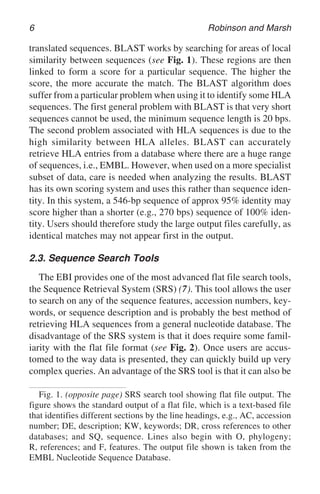
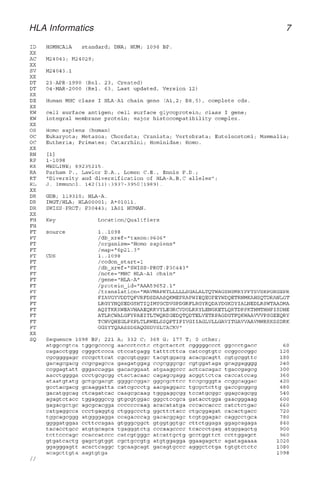
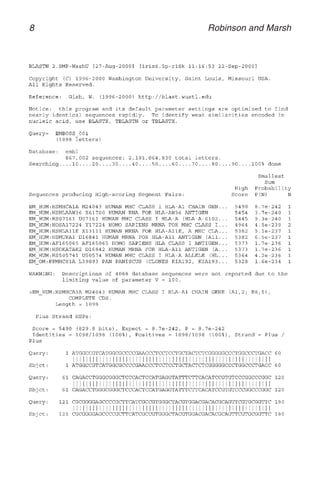
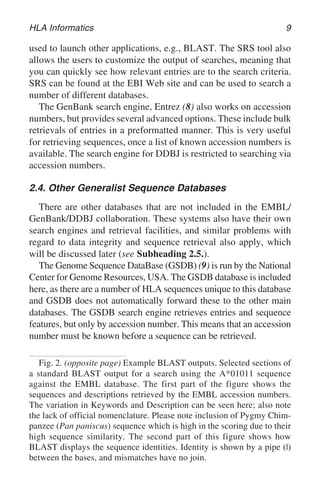
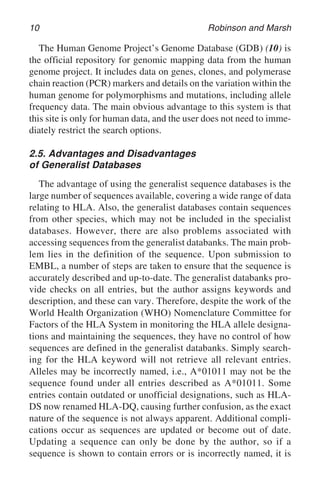
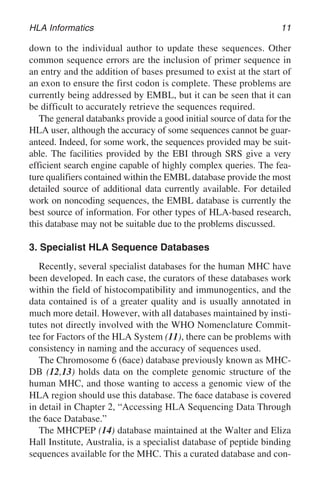
![HLA Informatics 13
consistency between entries that was not previously available. The
database also contains multiple EMBL-derived sequences for single
alleles, allowing the component sequences to be combined to create
a virtual sequence for each allele (see Fig. 3). A standard entry from
the IMGT/HLA database contains information on the individual
alleles together with information on the source cell or individual
from which the allele was sequenced.
The IMGT/HLA database is available in a number of different
formats including via the Web site, flat files, EBI SRS server,
EMBL CD-ROM and FTP. The flat files available on the EMBL
CD-ROM, SRS server, and FTP are specific to the IMGT/HLA
database and contain standardized keywords and description to aid
in retrieval. The FTP site allows users to download the database in a
variety of formats (FASTA, Protein Information Resource [PIR],
multiple sequence format [MSF], text alignments, and flat files),
which are suitable for the majority of sequence analysis tools.
3.1.1. IMGT/HLA Web Site and On-Line Tools
The IMGT/HLA Web site is the main access point for the HLA
community. The Web site provides a centralized resource with tools
Fig. 3. Construction of a virtual sequence. A virtual sequence is con-
structed for each allele, which represents the longest available sequence
for each allele. This is generated by combining the component entries
from EMBL/GenBank/DDBJ to create a single entry. The diagram shows
three component entries aligned and merged to form a virtual sequence.](https://image.slidesharecdn.com/464383-250520120404-37899f29/85/Mhc-Protocols-1st-Edition-James-Robinson-Steven-G-E-Marsh-Auth-17-320.jpg)
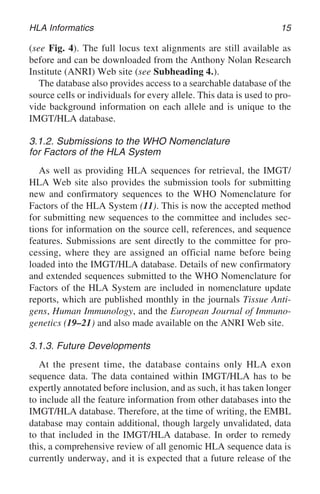
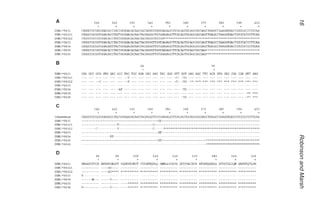
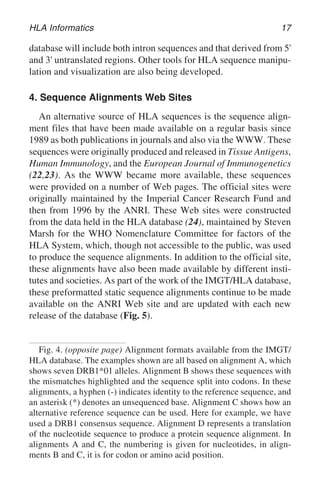
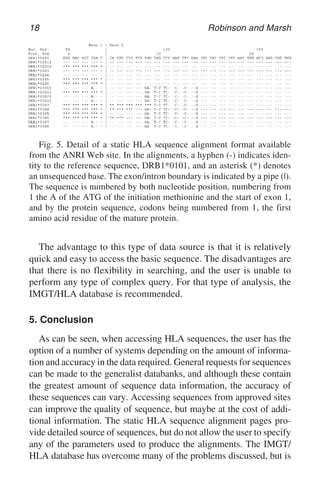

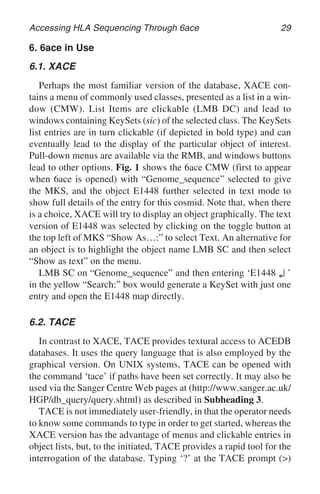
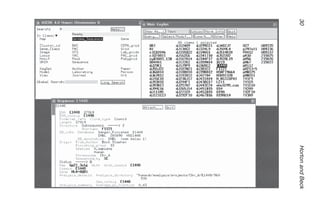
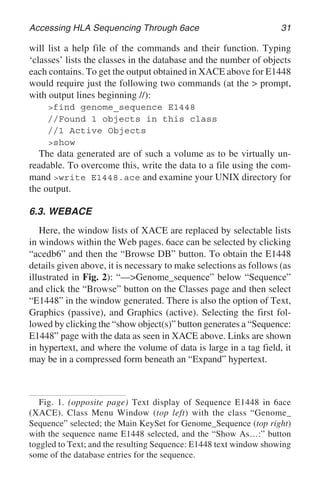
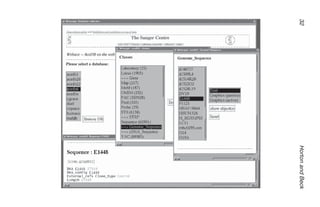
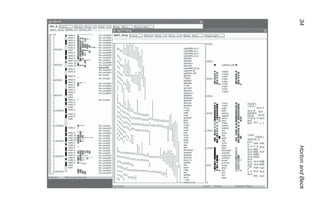
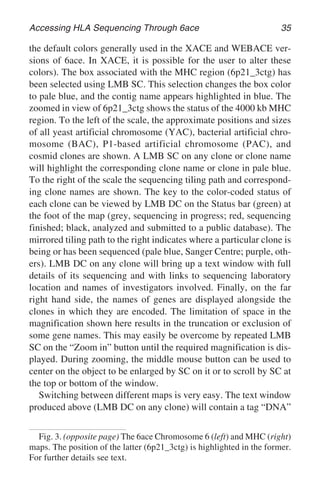
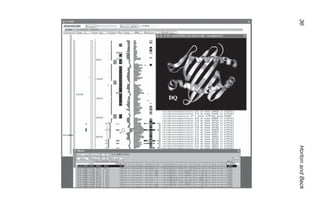
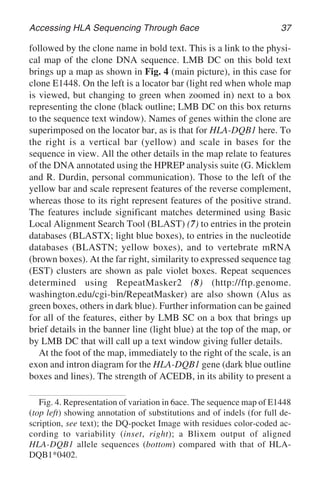
![38 Horton and Beck
combination of results visually, is illustrated by the concentration
of features showing matches to the protein and DNA
databases and the absence of repeat elements in the region of this
gene. The presence of allele sequences is recorded as boxes (red) to
the right of, and at the same horizontal level, as the gene exons.
Holding down RMB on these allele-display boxes reveals a pull-
down menu from which may be chosen “show multiple DNA align-
ment of just this kind of homolgies”. This selects an external
application, Blixem (9) which enables the display of aligned DNA
sequences of the gene’s alleles (Fig. 4, foot). This application high-
lights the allelic variation in this gene. The allele sequences of HLA
class I genes were taken from Arnett and Parham (10) and those of
the class II region from Marsh and Bodmer (11).
Central features of the map are two horizontal bar graphs repre-
senting GC content and variation rate. The former (red) shows GC
content calculated for intervals of 250 bases on a scale arranged a
round a midpoint of 50%. The latter shows the variation rate, using
the same intervals, between E1448 and an overlapping sequence
from a different haplotype (p797a11). The GC content is highest in
the sequence adjacent to the second exon in DQB1, which coincides
with the presence of a CpG island (yellow box) directly to the left of
the bar graph. It is also of interest to note that the variation reaches
local maxima of up to 10% (which is the highest level of sequence
variation reported in the human genome so far) and that it extends
far beyond the transcriptional unit of DQB1 (12). The three gaps in
the variation bar graph are due to major indels (cerise boxes), which,
in this case, are all of retroviral origin (long terminal repeat [LTR]
sequences). The relatively high GC content around the gene is also
emphasized. The nature of individual variations are also shown as
text, far right, and as small boxes (red) immediately to the left of the
gene diagram, where they often form a continuous bar because they
are so numerous.
Although all these features can be seen in text form in TACE, only
the maps in XACE and WEBACE allow their spacial visualization.
6ace via XACE also provides a means to view the structures and
structural variability of HLA molecules using either xv (John Brad-](https://image.slidesharecdn.com/464383-250520120404-37899f29/85/Mhc-Protocols-1st-Edition-James-Robinson-Steven-G-E-Marsh-Auth-42-320.jpg)
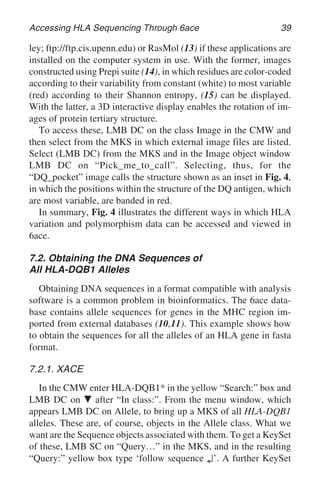
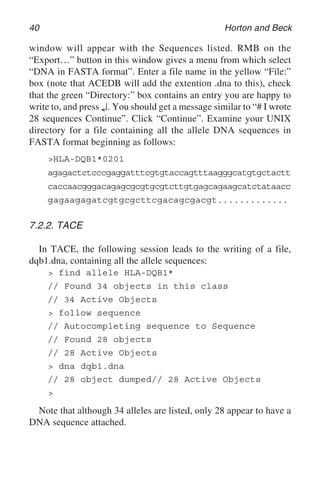
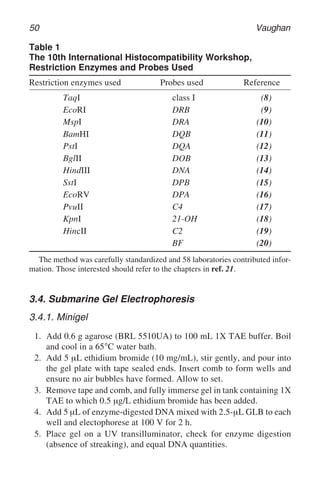

![of a church to that part of the sky in which the sun arose
on the Feast of the Patron Saint.]
{17}
But if the walls of Jerusalem, 'which is built as a city that is at unity
with itself,' [Footnote 135] were, by the Prophet's command, raised by
the Jews, with how much greater zeal should we raise the walls of
our churches! For the material church, wherein the people assemble
to set forth God's holy praise, symboliseth that Holy Church which is
built in heaven of living stones.
[Footnote 135: Psalm cxxii (Laetatus sum), 3. ]
9. This is that House of the Lord, built with all strength, 'upon the
foundations of the apostles and prophets, Jesus Christ Himself being
the chief cornerstone. [Footnote 136] Her [Footnote 137] foundations are in
the holy mountains.' The walls built upon these are the Jews and
Gentiles; who come from the four parts of the world unto Christ, and
who have believed, believe, or shall believe on Him.
[Footnote 136: Eph. ii, 20.]
[Footnote 137: Psalm lxxxvii (Fundamenta ejus), I. ]
The faithful predestinated to eternal life, are the stones in the
structure of this wall which shall continually be built up unto the
world's end. And one stone is added to another, when masters in the
Church teach and confirm and strengthen those who are put under
them: and whosoever in Holy Church undertaketh painful labours
from brotherly love, he as it were beareth up the weight of stones
which have been placed above him. Those stones which are of larger
size, and polished, or squared, and placed on the outside and at the
angles of the building, are men of holier life than others, who by
their merits and prayers retain weaker brethren in Holy Church.](https://image.slidesharecdn.com/464383-250520120404-37899f29/85/Mhc-Protocols-1st-Edition-James-Robinson-Steven-G-E-Marsh-Auth-55-320.jpg)
![10. The cement, without which there can be no stability of the walls,
is made of lime, sand, and water. The lime is fervent charity, which
joineth to itself the sand, that is, undertakings for the temporal
welfare of our brethren: {18} because true charity taketh care of the
widow and the aged, and the infant, and the infirm: and they who
have it study to work with their hands, that they may possess
wherewith to benefit them. Now the lime and the sand are bound
together in the wall by an admixture of water. But water is an
emblem of the Spirit. And as without cement the stones cannot
cohere, so neither can men be built up in the heavenly Jerusalem
without charity, which the Holy Ghost worketh in them. All the
stones are polished and squared—that is, holy and pure, and are
built by the hands of the Great Workman into an abiding place in the
Church: whereof some are borne, and bear nothing, as the weaker
members: some are both borne and bear, as those of moderate
strength: and some bear, and are borne of none save Christ, the
corner-stone, as they that are perfect. All are bound together by one
spirit of charity, as though fastened with cement; and those living
stones are knit together in the bond of peace. Christ was our wall in
His conversation: and our outer wall in His Passion.
11. When the Jews were rebuilding the walls of Jerusalem, their
enemies strove hard to let the works: so that 'they built with one
hand, and held their weapons of war in the other.' And round us too
do enemies gather, while we are building the walls of our Church:
our own sins, or ungodly men, willing to hinder our success.
Whence, while we build our walls, that is, while we add virtue to
virtue, we must fight with the enemy, and grasp our weapons firmly:
we must 'take the helmet of salvation, the shield of faith, the
breastplate of righteousness: and for our sword the word of God,'
[Footnote 138] that we may defend ourselves against them: and God's
priest shall be unto us in Christ's stead, to teach us by his lessons,
and defend us by his prayers.
[Footnote 138: Eph. vi, 16, 17.]](https://image.slidesharecdn.com/464383-250520120404-37899f29/85/Mhc-Protocols-1st-Edition-James-Robinson-Steven-G-E-Marsh-Auth-56-320.jpg)
![{19}
12. Furthermore, of what the tabernacle was made the Lord hath
told us, saying unto Moses, 'Take the first fruits,'—that is, the most
precious gifts—'of the children of Israel: but from him alone who
willingly offereth gold, and silver, and brass, and precious stones,
and purple and linen twice dyed'; namely cloth of the colours of
blue, purple, and scarlet: and of biss, which is a kind of Egyptian
linen white and soft: 'and goat's hair, and rams' skins dyed red,'
which we call Parthian, because the Parthians first dyed them thus,
'and purple skins and shittim wood' (shittim is the name of a
mountain, and also of a tree: its leaves are like the white thorn, and
to be injured neither by fire nor by decay): 'and oil for the lights,
frankincense, and ointment of a sweet savour, onyx stones, and
sard-onyxes, and jewels: and let them make Me a house, that I may
dwell in the midst of them: and that they may not weary themselves
in returning to this mountain.' [Footnote 139]
[Footnote 139: Exodus xxv, 2.]
14. The arrangement of a material church resembleth that of the
human body: the chancel, or place where the altar is, representeth
the head: the transepts, the hands and arms, and the remainder—
towards the west—the rest of the body. The sacrifice of the altar
denoteth the vows of the heart. Furthermore, according to Richard
de Sancto Victore, the arrangement of a church typifieth the three
states in the Church: of virgins, of the continent, of the married.
{20} The sanctuary [Footnote 140] is smaller than the chancel, and this
than the nave: because the virgins are fewer in number [Footnote 141]
than the continent, and these than the married. And the sanctuary is
more holy than the chancel: and the chancel than the nave: because
the order of virgins is more worthy than that of the continent, and
the continent more worthy than the married.
[Footnote 140: The sanctuary of course means that
eastermost division in churches consisting of three parts,](https://image.slidesharecdn.com/464383-250520120404-37899f29/85/Mhc-Protocols-1st-Edition-James-Robinson-Steven-G-E-Marsh-Auth-57-320.jpg)
![which still remains in many Norman buildings, and of
which Kilpeck, in Herefordshire, may be taken as a type.
These churches are generally apsidal: but there are
instances to the contrary, as Bishopstone, in Sussex. A
view of the sanctum sanctorum and chancel arches in this
church is given in the Cambridge Camden Society's
'Illustrations of Monumental Brasses,' part iv.]
[Footnote 141: This passage is somewhat obscure; but
the difference between the virgins and the continent
appears to be this: by the former are meant those who
have taken vows of celibacy; by the latter, those who
practise it, without, however, having bound themselves to
it by vow.]
15. Furthermore, the church consisteth of four walls, that is, is built
on the doctrine of the Four Evangelists; and hath length, breadth,
and height: the height representeth courage, the length fortitude,
which patiently endureth till it attaineth its heavenly home; the
breadth is charity, which, with long suffering, loveth its friends in
God, and its foes for God; and again, its height is the hope of future
retribution, which despiseth prosperity and adversity, hoping 'to see
the goodness of the Lord in the land of the living.' [Footnote 142]
[Footnote 142: Psalm xxvii (Dominus illuminatio), 13.]
16. Again, in the temple of God, the foundation is faith, which is
conversant with unseen things: the roof, charity, 'which covereth a
multitude of sins.' [Footnote 143] The door, obedience, of which the
Lord saith, 'If thou wilt enter into life, keep the commandments.'
[Footnote 144] The pavement, humility, of which the Psalmist saith, 'My
soul cleaveth to the pavement.' [Footnote 145]
[Footnote 143: I S. Peter iv, 8.]
[Footnote 144: S. Matthew xix, 17.]](https://image.slidesharecdn.com/464383-250520120404-37899f29/85/Mhc-Protocols-1st-Edition-James-Robinson-Steven-G-E-Marsh-Auth-58-320.jpg)
![[Footnote 145: Psalm cxix (Adhaesit pavimento), 25.]
17. The four side-walls, the four cardinal virtues, justice, fortitude,
temperance, prudence. Hence the Apocalypse saith, 'The city lieth
four-square.' [Footnote 146] The windows are hospitality with
cheerfulness, and tenderness with charity.
[Footnote 146: Rev. xxi, 16.]](https://image.slidesharecdn.com/464383-250520120404-37899f29/85/Mhc-Protocols-1st-Edition-James-Robinson-Steven-G-E-Marsh-Auth-59-320.jpg)
![{21}
Concerning this house saith the Lord, 'We will come unto him, and
make our abode with him.' [Footnote 147] But some churches are built
in the shape of a cross, to signify, that we are crucified to the world,
and should tread in the steps of the Crucified, according to that
saying, 'If any man will come after Me, let him deny himself and take
up his cross, and follow Me.' [Footnote 148] Some also are built in the
form of a circle: [Footnote 149] to signify that the Church hath been
extended throughout the circle of the world, as saith the Psalmist:
'And their words unto the end of the world.' [Footnote 150] Or because
from the circle of this world, we reach forth to that crown of eternity
which shall encircle our brows.
[Footnote 147: S. John xiv, 23.]
[Footnote 148: S. Matthew xvi, 18.]
[Footnote 149: This of course refers to the Church of the
Holy Sepulchre, the prototype of these buildings. There
are four, as it is well known, in England yet standing, and
two in ruins—namely, Temple Aslackby, in Lincolnshire,
and the church in Ludlow Castle.]
[Footnote 150: Psalm xix (Caeli enarrant), 4.]
18. The choir is so called from the harmony of the clergy in their
chanting, or from the multitude collected at the divine offices. The
word chorus is derived from chorea, or from corona. For in early
times they stood like a crown round the altar, and thus sung the
Psalms in one body: but Flavianus and Theodorus taught the
antiphonal method of chanting, having received it from S. Ignatius,
who himself learnt it by inspiration. The two choirs then typify the
angels, and the spirits of just men, while they cheerfully and
mutually excite each other in this holy exercise. Others derive
chorus from concord, which consisteth of charity; because he who](https://image.slidesharecdn.com/464383-250520120404-37899f29/85/Mhc-Protocols-1st-Edition-James-Robinson-Steven-G-E-Marsh-Auth-60-320.jpg)
![hath not charity, cannot sing with the spirit. But what this choir
signifieth, and why the greatest in it sit last, shall be explained in the
fourth book. [Footnote 151] And observe, that when one sings, it is
called in Greek a monody, in Latin tycinium. When two sing, it is
called bicinium; when many, a chorus.
[Footnote 151: We may observe that Prynne perverts the
fact, that the westernmost seats in the choir are the most
honourable, to a depreciation of the Catholic custom of
the position of the altar. See his 'Pacific Examination,' s.v.]
{22}
19. The exedra is an apsis, separated a little from a temple or
palace; so called because it projecteth a little from the wall (in Greek
), and signifieth the lay portion of the faithful joined to Christ
and the Church. The crypts, or subterranean caves, which we find in
some churches, are hermits who are devoted to a solitary life.
20. The open court signifieth Christ, by Whom an entrance is
administered into the heavenly Jerusalem: this is also called porch,
from porta, a gate, or because it is aperta, open.
21. The towers are the preachers and prelates of the Church, which
are her bulwark and defence. Whence the bridegroom in the
Canticles saith to the bride, 'Thy neck is like the tower of David
builded for an armoury.' [Footnote 152] The pinnacles of the towers
signify the life or the mind of a prelate which aspireth heavenwards.
[Footnote 152: Canticles iv, 4.]
22. The cock at the summit of the church is a type of preachers. For
the cock, ever watchful even in the depth of night, giveth notice how
the hours pass, wakeneth the sleepers, predicteth the approach of
day, but first exciteth himself to crow by striking his sides with his
wings. There is a mystery conveyed in each of these particulars. The](https://image.slidesharecdn.com/464383-250520120404-37899f29/85/Mhc-Protocols-1st-Edition-James-Robinson-Steven-G-E-Marsh-Auth-61-320.jpg)
![night is this world: the sleepers are the children of this world who
are asleep in their sins. The cock is the preacher, who preacheth
boldly, and exciteth the sleepers to cast away the works of darkness,
exclaiming, 'Woe to them that sleep! Awake thou that sleepest!
[Footnote 153] And these foretell the approach of day when they speak
of the Day of Judgment, and the glory that shall be revealed: and
like prudent {23} messengers, before they teach others, arouse
themselves from the sleep of sin by mortifying their bodies. Whence
the Apostle, 'I keep under my body.' [Footnote 154] And as the
weathercock faceth the wind, they turn themselves boldly to meet
the rebellious by threats and arguments: lest they should be guilty,
'when the wolf cometh, of leaving the sheep and fleeing.'
[Footnote 155] The iron rod, whereon the cock sitteth, representeth the
discourse of the preacher, that he speaketh not of man but of God:
according to that saying, 'If any man speak, let him speak as the
oracles of God.' [Footnote 156] But in that the iron rod is placed above
the cross, on the summit of the church, it signifieth that Holy
Scripture is now consummated and confirmed. Whence saith our
Lord in His Passion, 'It is finished': and that title is written indelibly
over Him.
[Footnote 153: Eph. v, 14.]
[Footnote 154: 1 Cor. ix, 27.]
[Footnote 155: S. John x, 12.]
[Footnote 156: I S. Peter iv, 11.]
23. The cone, that is the summit of the church, of great height, and
of round shape, signifieth how perfectly and inviolably the Catholic
faith must be held: which faith except a man do keep whole and
undefiled, without doubt he shall perish everlastingly.
24. The glass windows in a church are Holy Scriptures, which expel
the wind and the rain, that is all things hurtful, but transmit the light](https://image.slidesharecdn.com/464383-250520120404-37899f29/85/Mhc-Protocols-1st-Edition-James-Robinson-Steven-G-E-Marsh-Auth-62-320.jpg)
![of the true Sun, that is, God, into the hearts of the faithful. These
are wider [Footnote 157] within than without, because the mystical
sense is the more ample, and precedeth the literal meaning. Also, by
the windows the senses of the body are signified: which ought to be
shut to the vanities of this world, and open to receive with all
freedom spiritual gifts.
[Footnote 157: This passage is particularly to be
observed, for the reason given in the Introduction.]
25. By the lattice work [Footnote 158] of the windows, we understand
the prophets or other obscure teachers of the Church Militant: in
which windows there are often two shafts, signifying the two
precepts of charity, or because the apostles were sent out to preach
two and two.
[Footnote 158: See Appendix I.]
{24}
26. The door of the church is Christ: according to that saying in the
Gospel, 'I am the door.' [Footnote 159] The apostles are also called
doors.
[Footnote 159: S. John x, 9.]
27. The piers of the church are bishops and doctors: who specially
sustain the Church of God by their doctrine. These, from the majesty
and clearness of their divine message, are called silver, according to
that in the Song of Songs, 'He made silver columns.' [Footnote 160]
Whence also Moses at the entering in of the tabernacle, placed five
columns, and four before the oracle, that is, the holy of holies.
Although the piers are more in number than seven, yet they are
called seven, according to that saying, 'Wisdom hath builded her
house, she hath hewn out her seven pillars': [Footnote 161] because
bishops ought to be filled with the sevenfold influences of the Holy
Ghost: [Footnote 162] and SS. James and John, as the Apostle testifieth,](https://image.slidesharecdn.com/464383-250520120404-37899f29/85/Mhc-Protocols-1st-Edition-James-Robinson-Steven-G-E-Marsh-Auth-63-320.jpg)
!['seemed to be pillars.' [Footnote 163] The bases of the columns are the
apostolic bishops, [Footnote 164] who support the frame of the whole
church. The capitals of the piers are the opinions of the bishops and
doctors. For as the members are directed and moved by the head,
so are our words and works governed by their mind. The ornaments
of the capitals are the words of Sacred Scripture, to the meditation
and observance of which we are bound.
[Footnote 160: Canticles viii, 9.]
[Footnote 161: Prov. viii, I.]
[Footnote 162: Compare the Veni Creator:
Thou the anointing Spirit art,
Who dost Thy sevenfold gifts impart.]
[Footnote 163: Gal ii, 9.]
[Footnote 164: That is, it may be supposed, bishops of
those sees which were founded by the apostles
themselves, e.g. Rome, Crete, Ephesus.]
28. The pavement of the church is the foundation of our faith. But in
the spiritual Church, the pavement is the poor, of Christ: the poor in
spirit, who humble themselves in all thing: wherefore on account of
their {25} humility they are likened to the pavement. Again, the
pavement, which is trodden under foot, representeth the multitude,
by whose labours the Church is sustained.
29. The beams [Footnote 165] which join together the church are the
princes of this world or the preachers who defend the unity of the
Church, the one by deed, the other by argument.
[Footnote 165: Beams. That is, probably, tie-beams:
here is another reference to the architectural
arrangements of Early English date.]](https://image.slidesharecdn.com/464383-250520120404-37899f29/85/Mhc-Protocols-1st-Edition-James-Robinson-Steven-G-E-Marsh-Auth-64-320.jpg)
![30. The stalls in the church signify the contemplative, in whom God
dwelleth without hindrance, who, from their high dignity and the
glory of eternal life, are compared to gold. Whence He saith in the
Canticles, 'He made a golden seat.' [Footnote 166]
[Footnote 166: See Appendix I.]
31. The beams in the church are preachers, who spiritually sustain
it. The vaulting also, or ceiling, representeth preachers, who adorn
and strengthen it, concerning whom, seeing that they are not
corruptible through vice, the bridegroom glorieth in the same
Canticles, saying 'the beams of our house are cedar, and its ceiling,
fir.' For God hath built His Church of living stones, and imperishable
wood, according to that saying, 'Solomon made himself a litter of
cedar wood;' [Footnote 167] that is, Christ, of His saints who wear the
white robe of chastity.
[Footnote 167: It is very difficult to find the right meaning
of the word ferculum here. The English version gives the
passage from the Canticles, 'King Solomon made himself
a chariot (marg. reading, bed) of the wood of Lebanon.
In the extremely beautiful treatise of Hugo de S. Victore,
De Nuptiis Spiritualibus (cap. iii), the fercula
nuptialia appear to mean the marriage feast, which is
to perform its part in the general Sensuum refectio, by
its sweet savours; as the bed or chariot of Solomon is
noted for the odour of its cedar wood. However, the same
writer devotes five Tituli of his Erudit. Theolog. Ex
Miscellan. namely, lix—lxii of the first book, and cxxi of
the second, to the consideration of this Ferculum
Solomonis: which he decides to be a lectica sen
vehiculum, a litter or sedan (such as is now used in
Sicily under the name of lettiga), differing from the
lectulus or bed (Cant, i, 16), inasmuch as this denotes
the repose of the contemplative life, while the ferculum
typifies the laborious exercise of the active life; and](https://image.slidesharecdn.com/464383-250520120404-37899f29/85/Mhc-Protocols-1st-Edition-James-Robinson-Steven-G-E-Marsh-Auth-65-320.jpg)
![differing again from the currus or chariot (the only other
vehicle mentioned in Holy Scripture), since the latter is
drawn on the earth with a grating noise, and represents a
depraved heart clinging to earthly things, but the former
is borne smoothly and quietly above the ground, an
image of the righteous soul despising earthly and seeking
heavenly things. Lastly, the ferculum, or litter, typifies
the Church, from carrying, a ferendo, as doth the
Church her children unto Heavenly Rest.]
{26}
The chancel, that is, the head of the church, being lower [Footnote 168]
than its body, signifieth how great humility there should be in the
clergy, or in prelates, according to that saying, 'And the more thou
art exalted, humble thyself in all things.' The rail, by which the altar
[Footnote 169] is divided from the choir, teacheth the separation of
things celestial from things terrestrial.
[Footnote 168: The fact that in many unaltered and
unmutilated churches the chancel is lower than the nave,
appears to have been unnoticed by ecclesiologists.
Wherever it occurs, William Dowsing, or some of his
puritanical coadjutors, have been supposed agents in the
matter. But there exist chancels, which, whether from the
height of the piscina and sedilia, or on other accounts,
cannot have been lowered, to which nevertheless there is
a descent from the nave. Such an one is that of S. Giles's
at Cambridge: and the arrangement is very common in
the little churches of the south-west part of Sussex.]
[Footnote 169: This is another very remarkable passage:
and one which proves that the injunction of Abp. Laud for
the erection of altar rails was not a novelty. And though
their abolition is much to be wished, as well from the
ugliness of all existing specimens, as from the irreverence](https://image.slidesharecdn.com/464383-250520120404-37899f29/85/Mhc-Protocols-1st-Edition-James-Robinson-Steven-G-E-Marsh-Auth-66-320.jpg)
![which they seem to pre-suppose, the Church in England
can scarcely be charged with the adoption of an
innovation in giving her sanction to them.]
32. The seats in the choir admonish us that the body must
sometimes be refreshed: because that which hath not alternate rest
wanteth durability.
33. The pulpit in the church is the life of the perfect: and is so called
from being public, or placed in a public place. For we read, 'Solomon
made a brazen scaffold, and set it in the midst of the temple, and
stood upon it, and stretching forth his hands spake to the people of
God.' Esdras also made a wooden scaffold for speaking: in which
when he stood, he was higher than the rest of the people.
[Footnote 170]
[Footnote 170: 3 Kings vi, 13.]
34. The analogium (rood-loft) is so called because in it the Word of
God is read and delivered. Which also is called ambo, from ambire,
[Footnote 171] to surround, because it surroundeth him that entereth
in.
[Footnote 171: This is, of course, a false derivation. The
important subject of Rood-lofts has been treated with
admirable learning by Father Thiers, in his treatise 'Sur
les jubés,' to which the reader is referred. See also
Appendix C.]
{27}
35. The horologium, by means of which the hours are read, teacheth
the diligence that should be in priests to observe at the proper times
the canonical hours: as he saith, 'Seven times a day do I praise
thee.' [Footnote 172]
[Footnote 172: Psalm (cxix), Beati immaculati, 164.]](https://image.slidesharecdn.com/464383-250520120404-37899f29/85/Mhc-Protocols-1st-Edition-James-Robinson-Steven-G-E-Marsh-Auth-67-320.jpg)
![36. The tiles [Footnote 173] of the roof which keep off the rain are the
soldiers, who preserve the Church from paynim, and from enemies.
[Footnote 173: This passage deserves to be noticed, as
proving that lead was not the only roofing employed in
the Norman churches.]
37. The circular staircases, which are imitated from Solomon's
temple, are passages which wind among the walls, and point out the
hidden knowledge which they only have who ascend to celestial
things. Concerning the steps, by which ascent is made to the altar,
hereafter.
38. The sacristy, or place where the holy vessels are deposited, or
where the priest putteth on his robes, is the womb of the Blessed
Mary, where Christ put on his robes of humanity. The priest, having
robed himself, cometh forth into the public view, because Christ,
having come from the womb of the Virgin, proceeded forth into the
world.
The bishop's throne in the church is higher than the rest.
39. Near to the altar, which signifieth Christ, is placed the piscina, or
lavacrum, that is, the pity of Christ, in which the priest washeth his
hands, thereby denoting that by baptism and penitence we are
purged from the filth of sin: which is drawn from the Old Testament.
For he saith in Exodus, 'And Moses made a laver of brass, with his
basin, in the which Aaron the priest and his sons should wash,
before they went up to the altar, that they might offer an offering.
[Footnote 174]
[Footnote 174: Exodus xxxviii, 8.]
{28}
40. The lamp in the church is Christ: as He saith, 'I am the light of
the world'; [Footnote 175] and again, 'That was the true light.'](https://image.slidesharecdn.com/464383-250520120404-37899f29/85/Mhc-Protocols-1st-Edition-James-Robinson-Steven-G-E-Marsh-Auth-68-320.jpg)
![[Footnote 176] 'Or the light in a church may denote the apostles and
other doctors, by whose doctrine the Church is enlightened, as the
sun and moon: concerning whom saith the Lord, 'Ye are the light of
the world: [Footnote 177] that is, an example of good works. Wherefore
He saith to them in His admonitions, 'Let your light shine before
men.' [Footnote 178] But the Church is enlightened by the precepts of
the Lord; wherefore it saith in the before-quoted place, 'Speak unto
the sons of Aaron that they offer oil-olive most pure, that the lamp
may burn continually in the tabernacle of the testimony.' [Footnote 179]
Moses made also seven lights, which are the seven gifts of the Holy
Ghost: for they in the darkness of this world shine forth with
brightness: and they rest in candlesticks, because in Christ rested
'the spirit of wisdom and knowledge, the spirit of counsel and might,
the spirit of learning and piety, the spirit of the fear of the Lord, by
which He preached wisdom to the captives.' [Footnote 180] The number
of lights showeth the number of graces in the faithful.
[Footnote 175: S. John viii, 12.]
[Footnote 176: S. John i, 6.]
[Footnote 177: S. Matthew v, 14.]
[Footnote 178: S. Matthew v, 16.]
[Footnote 179: Lev. xxiv, 2.]
[Footnote 180: Isaiah lxi, i.]
41. In many places a triumphal cross is placed in the midst of the
church; to teach us, that from the midst of our hearts we must love
the Redeemer: who, after Solomon's pattern, 'paved the midst of his
litter (ferculum) with love for the daughters of Jerusalem:'
[Footnote 181] and that all, seeing the sign of victory, might exclaim.
Hail, thou Salvation of the whole world, Tree of our Redemption: and
that we should never forget the love of God, who, to redeem His](https://image.slidesharecdn.com/464383-250520120404-37899f29/85/Mhc-Protocols-1st-Edition-James-Robinson-Steven-G-E-Marsh-Auth-69-320.jpg)
![servants, gave His only son, that we might imitate Him crucified. But
the cross is exalted on high, to signify the victory of Christ. Why a
church is ornamented within and not without, shall be said hereafter.
[Footnote 181: Cantic. iii, 10.]
{29}
42. The cloisters, as Richard, Bishop of Cremona, testifieth, had their
rise either in the watchings of the Levites around the tabernacle, or
from the chambers of the priests, or from the porch of Solomon's
temple. 'For the Lord commanded Moses, that he should not number
the Levites with the rest of the children of Israel; but should set
them over the tabernacle of the testimony to carry it and to keep it.'
[Footnote 182] On account of which divine commandment, while the
Holy Mysteries are in celebration, the clergy should in the church
stand apart from the laity. Whence the Council of Mayence ordained
that the part which is separated with rails from the altar should be
appropriated altogether to the priests choral. Furthermore, as the
church signifieth the Church Triumphant, so the cloister signifieth the
celestial Paradise, where there will be one and the same heart in
fulfilling the commands of God and loving Him: where all things will
be possessed in common, because that of which one hath less, he
will rejoice to see more abounding in another, for 'God shall be all in
all.' [Footnote 183] Therefore the regular clergy who live in the cloisters,
and are of one mind, rising to the service of God and leaving worldly
things, lead their lives in common. The various offices in the cloister
signify the different mansions, and the difference of rewards in the
Kingdom: for 'In My Father's House are many mansions,' [Footnote 184]
saith our Lord. But in a moral sense the cloister is the contemplative
state, into which the soul betaking itself, is separated from the crowd
of carnal thoughts, and meditateth on celestial things only. In this
cloister there are four sides: denoting, namely, contempt of self,
contempt of the world, love of God, love of our neighbour. Each side
hath his own row of Columns. Contempt of self hath humiliation of](https://image.slidesharecdn.com/464383-250520120404-37899f29/85/Mhc-Protocols-1st-Edition-James-Robinson-Steven-G-E-Marsh-Auth-70-320.jpg)
![soul, mortification of the flesh, humility of speech, and the like. The
base of all the columns is patience.
[Footnote 182: Numbers i, 47; xviii, 6.]
[Footnote 183: I Corinth, xv, 28.]
[Footnote 184: S. John xv, 2.]
{30}
43. In this cloister the diversity of office-chambers is the diversity of
virtues. The chapter-house is the secret of the heart: concerning
this, however, we shall speak differently hereafter. The refectory is
the love of holy meditation. The cellar, Holy Scripture. The dormitory,
a clean conscience. The oratory, a spotless life. The garden of trees
and herbs, the collection of virtues. The well, the dew of God's
heavenly gifts; which in this world mitigateth our thirst, and
hereafter will quench it.
44. The Episcopal throne, which according to the injunctions of Saint
Peter has been of old consecrated in each city (as shall be said
below), the piety of our forefathers dedicated, not in memory of
confessors, but to the honour of apostles and martyrs, and
especially of the Blessed Virgin Mary.
45. But we therefore go to church, that we may there ask for the
pardon of our sins, and assist in the divine praises: as shall be said
in the proeme of the fifth book, and that there we may hear God's
proceedings [Footnote 185] with the good and the ill, and learn and
receive the knowledge of God, and that we may there feed on the
Lord's body.
[Footnote 185: Such is probably the meaning of the
passage. The original is ut iti bona sive mala judicia
audiamus.]](https://image.slidesharecdn.com/464383-250520120404-37899f29/85/Mhc-Protocols-1st-Edition-James-Robinson-Steven-G-E-Marsh-Auth-71-320.jpg)
![46. In church, men and women sit apart: which, according to Bede,
we have received from the custom of the ancients: and thence it
was that Joseph and Mary lost the Child Jesus; since the one who
did not behold Him in his own company, thought Him to be with the
other. . . . But the men remain on the southern, the {31} women on
the northern side: [Footnote 186] to signify that the saints who be most
advanced in holiness should stand against the greater temptations of
this world: and they who be less advanced, against the less; or that
the bolder and the stronger sex should take their place in the
position fittest for action: because the Apostle saith, 'God is faithful,
Who will not suffer you to be tempted above that ye are able.'
[Footnote 187] To this also pertaineth the vision of S. John, who 'beheld
a mighty angel placing his right foot in the sea.' [Footnote 188] For the
stronger members are opposed to the greater dangers. But,
according to others, the men are to be in the fore part [i.e.
eastward], the women behind: because 'the husband is the head of
the wife,' [Footnote 189] and therefore should go before her.
[Footnote 186: This is the practice in some parts of
England even to this day: more especially in
Somersetshire. Bp. Montague in his 'Visitation Articles'
(reprinted Camb. 1841) asks (p. 17), 'Do men and
women sit together in those seats indifferently and
promiscuously? or (as the fashion was of old), do men sit
together upon one side of the church, and women upon
the other?' And, indeed, of old there was a still further
separation on each side, into the married and unmarried.
The restoration of the practice recommended by Bp.
Montague is much to be wished.]
[Footnote 187: 1 Corinth, x, 13.]
[Footnote 188: Apocalypse x, 7.]
[Footnote 189: Eph. v, 23.]](https://image.slidesharecdn.com/464383-250520120404-37899f29/85/Mhc-Protocols-1st-Edition-James-Robinson-Steven-G-E-Marsh-Auth-72-320.jpg)
![47. A woman must cover her head in the church, because she is not
the image of God, and because by woman sin began. And therefore
in the church, out of respect for the priest, who is the vicar of Christ,
in his presence, as before a judge, she hath her head covered, and
not at liberty: and on account of the same reverence she hath not
the power of speaking in the church before him. Of old time, men
and women wearing long hair stood in church with uncovered heads
glorying in their locks: which was a disgrace unto them.
48. But what should be our conversation in church the Apostle
teacheth, saying, 'Speaking to yourselves in psalms and hymns and
spiritual songs.' [Footnote 190] Whence we must, when we be there,
abstain from superfluous words: {32} according to that saying of S.
Chrysostome, When thou goest into a king's palace, set in order thy
conversation and thy habit. For the angels of the Lord are there: and
the House of God is full of incorporeal virtues. [Footnote 191] And the
Lord saith to Moses, and so doth the angel to Joshua, 'Put off thy
shoes from off thy feet: for the place where thou standest is holy
ground.' [Footnote 192]
[Footnote 190: Coloss. iii, 16.]
[Footnote 191: The passage referred to is as follows:—'
Regiam quidem ingrediens, et habitu et aspectu et
incessu et omnibus aliis te ornas et componis: Hic autem
vera est Regia et plane hic talia qualia caelestia:—et
rides? Atque scio quidem quod tu non vides. Audi autem
quod ubique adsunt angeli, et maxima in Domo Dei
adsistunt Regis, et omnia sunt impleta incorporeis illus
Potestatibus.]
[Footnote 192: Exod. iii, 5. Josh, v, 15.]
49. In the last place, a consecrated church defendeth murderers
who take sanctuary in it from losing life or limb, provided that they
have not offended in it, or against it. Whence it is written that 'Joab](https://image.slidesharecdn.com/464383-250520120404-37899f29/85/Mhc-Protocols-1st-Edition-James-Robinson-Steven-G-E-Marsh-Auth-73-320.jpg)
![fled to the tabernacle, and laid hold on the horns of the altar.'
[Footnote 193] The same privilege is possessed also by an
unconsecrated church, if the divine offices be therein celebrated.
[Footnote 193: 2 Kings i, 28.]
50. But the body of Christ received by such persons, doth not defend
them nor those who fly to it: partly because the privilege is granted
to a church as a church: and therefore not to be misbestowed on
other things: partly because that food is the support of the soul, and
not of the body: whence it freeth the soul and not the body.
51. Churches are moved from one place to another on three
accounts. First, on account of the necessity arising from persecutors:
secondly, on account of the difficulty of access or habitation, such as
the unwholesomeness of air: thirdly, when they are oppressed with
the society of evil men: and then with the consent of the Pope or the
bishop. Wherefore he that entereth into a church fortifieth himself
with the sign of the cross, shall be said in the proeme of the fifth
book.' [Footnote 194]
[Footnote 194: See Appendix.]
{33}](https://image.slidesharecdn.com/464383-250520120404-37899f29/85/Mhc-Protocols-1st-Edition-James-Robinson-Steven-G-E-Marsh-Auth-74-320.jpg)
![CHAPTER II
OF THE ALTAR
The First Builders of Altars—The Difference between Altare and Ara
—Various Significations of Various Kinds of Altars—The Ark of the
Testimony—It is preserved in the Lateran Church—What a Man
needeth that he may be the Temple of God—What the Table
Signifieth—Of the Candlestick—Of the Ark—Of the Altar—Of the Altar
Cloths—Of Steps to the Altar.
I. The altar hath a place in the church on three accounts, as shall be
said in speaking of its dedication. We are to know that Noe
[Footnote 195] first, then Isaac [Footnote 196] and Abraham [Footnote 197]
and Jacob made, as we read, altars: which is only to be understood
of stones set upright, on which they offered and slew the victims
and burnt them with fire laid beneath them. Also Moses made an
altar [Footnote 198] of shittim wood: and the same was made as an
altar of incense, and covered with pure gold: as we read in the xxvth
chapter of Exodus, where also the form of the altar is described.
From these of the ancient fathers, the altars of the moderns have
their origin, being erected with four horns at the corners. Of which
some are of one stone, and some are put together of many.
[Footnote 195: Gen. viii, 20.]
[Footnote 196: Gen. xxvi, 25. xxxiii, 20.]
[Footnote 197: Gen. xiii, 18.]](https://image.slidesharecdn.com/464383-250520120404-37899f29/85/Mhc-Protocols-1st-Edition-James-Robinson-Steven-G-E-Marsh-Auth-75-320.jpg)
![[Footnote 198: Exodus xxvii, i.]
2. And sometimes the words altare and ara are used in the same
sense. Yet is there a difference. For altare, derived from alta res,
or alta ara, is that on which {34} the priests burnt incense. But
ara, which is derived from area, or from ardeo, is that on which
sacrifices were burnt. [Footnote 199]
[Footnote 199: The true ecclesiastical distinction between
altare and ara is that the former means the altar of the
true God, and is therefore alone used in the Vulgate,
answering to the Greek , as opposed to ara (
), an altar with an image above it. See Mede.
Folio 386. ]
3. And note, that many kinds of altars are found in Scripture: as a
higher, a lower, an inner, an outer; of which each hath both a plain
and a symbolical signification. The higher altar is God the Trinity: of
which it is written, 'Thou shalt not go up by steps to my altar.'
[Footnote 200] And it also signifieth the Church Triumphant: of which it
is said, 'Then shall they offer bullocks upon mine altar.' [Footnote 201]
But the lower altar is the Church Militant, of which it is said, 'If thou
wilt make an altar of stone, thou shalt not make it of hewn stone.'
[Footnote 202] Also it is the table of the temple. Of which he saith,
'Appoint a solemn day for your assembly even unto the horns of the
altar.' [Footnote 203] And in the Third of Kings, it is said that Solomon
made a golden altar. [Footnote 204 ] But the interior altar is a clean
heart, as shall be said below. It is also a type of faith in the
incarnation, of which in Exodus, 'An altar of earth ye shall make Me.'
[Footnote 205] And an interior altar is the altar of the cross. This is the
altar on which they offered the evening sacrifice. Whence in the
Canon of the Mass it is said, Jube hoc in sublime Altare Tuum
perferri. [Footnote 206] Moreover the external altar representeth the
sacraments of the Church: of which it is said, 'Even thine altars, O
Lord of hosts, my King, and my God.' [Footnote 207] Again, the altar is](https://image.slidesharecdn.com/464383-250520120404-37899f29/85/Mhc-Protocols-1st-Edition-James-Robinson-Steven-G-E-Marsh-Auth-76-320.jpg)
![our mortification in our heart, in which carnal motions are consumed
by the fervour of the Holy Spirit.
[Footnote 200: Exodus XX, 26.]
[Footnote 201: Psalm li (Miserere mei), 19.]
[Footnote 202: Exodus XX, 25.]
[Footnote 203: Psalm cxviii (Confitemini), 27.]
[Footnote 204: III Kings vi. 22.]
[Footnote 205: Exodus xx 26.]
[Footnote 206: This prayer, which immediately precedes
the Commemoration of the Dead, runs thus: Supplices Te
rogamus, omnipotens Deus, jube hoc perferri per manus
Sancti Angeli Tui, in conspectu Divinae Majestatis Tuae:
ut quotquot ex hac Altaris participatione sacrosanctum
Filii Tui Corpus et Sanguinem sumpserimus, omni
benedictione caelesti et gratia repleamur. Per.]
[Footnote 207: Psalm lxxxiv (Quam dilecta), 4.]
{35}
4. Secondly, it also signifieth the Spiritual Church: and its four horns
teach how she hath been extended into the four quarters of the
world. Thirdly, it signifieth Christ, without whom no gift is offered
acceptable to the Father. Whence also the Church addresseth her
prayers to the Father through Christ alone. Fourthly, it signifieth the
body of Christ, as shall be explained in the fifth book. Fifthly, it
signifieth the table at which Christ did feast with His disciples.](https://image.slidesharecdn.com/464383-250520120404-37899f29/85/Mhc-Protocols-1st-Edition-James-Robinson-Steven-G-E-Marsh-Auth-77-320.jpg)
![5. It is written in Exodus, that in the Ark of the Testament or of the
Testimony the witness was laid up: [Footnote 208] that is, the tables on
which the law was written: and it is said that the Testimony was
there laid up, because it was a bearing witness that the law
imprinted on our hearts by nature God had reimprinted by writing.
Also, there was laid up the golden pot full of manna, for a testimony
that He had given the children of Israel bread from heaven. And the
rod of Aaron, for a testimony that all power is from God. And the
second tables of the law, in testimony of the covenant in which they
had said, 'All that the Lord hath spoken we will do.' [Footnote 209] And
on these accounts it is called the Ark of the Testimony or Testament;
and also the tabernacle of the testimony thence deriveth its title. But
over the ark was made a mercy seat: of which we shall speak in the
proeme of the fourth book. In imitation whereof some churches
have over the altar an ark or tabernacle, in which the body of the
Lord and relics are preserved. The Lord also commanded that a
candlestick should be made of beaten pure gold. It is written in the
third book of Kings, that in the Ark of the Covenant was nothing else
than the two tables of stone which Moses put therein in Horeb:
when the Lord made a covenant with the children of Israel in the
day that they came out of the land of Egypt.
[Footnote 208: Exodus xxv, 16.]
[Footnote 209: Exodus xix, 8.]
{36}
6. And note that in the time of S. Silvester, Pope, [Footnote 210]
Constantine the Emperor built the Lateran church, in which he
placed the Ark of the Testament, which the Emperor Titus had
brought from Jerusalem, and the golden candlestick with his seven
branches. In which ark are these things: the rings and the staves of
gold: the tables of the testimony: the rod of Aaron: manna: barley
loaves: the golden pot: the seamless garment: the reed: a garment](https://image.slidesharecdn.com/464383-250520120404-37899f29/85/Mhc-Protocols-1st-Edition-James-Robinson-Steven-G-E-Marsh-Auth-78-320.jpg)
![MS. of Panvinius, Severanus De Septem Urbis Ecclesiis,
and the work of Caesar Cardinal Rasponus.]
7. Man, if he hath an altar, a table, a candlestick, and an ark, he is
the temple of God. He must have an altar, whereon rightly to offer
and rightly to distribute. The altar is our heart, on which we ought to
offer. {37} Whence the Lord commandeth in Exodus: 'Thou shalt
offer burnt offerings on mine altar.' [Footnote 211] Since from the heart
words, set on fire of charity, ought to proceed. Holocaust is derived
from holos, whole, and cauma, a burning: therein signifying a
thing wholly burnt. On this altar we must rightly offer, and we must
rightly divide. We offer rightly when we bring any good thought to
perfection. But we do not rightly divide if we do it not discreetly. For
a man often thinketh to do good, and doeth ill: and sometimes with
one hand he doeth good and with the other ill; and thus himself
buildeth, and himself knocketh down. But we then rightly divide
when the good which we do we attribute, not to ourselves, but to
God alone.
[Footnote 211: Exodus ix, 2.]
8. It behoveth also man to have a table, whence he may take the
bread of the Word of God. By the table we understand Holy
Scripture, concerning which the Psalm, 'Thou preparest a table
before me in the presence of mine enemies.' [Footnote 212] That is,
Thou hast given me Scripture against the temptations of the devil.
This table then we must have, that is, must lay up in our minds, that
thence we may take the Word of God. Of the deficiency of this bread
saith Jeremiah: 'The little ones sought bread, and there was none to
break it unto them. [Footnote 213] It behoveth man likewise to have a
candlestick, that he may shine with good works.
[Footnote 212: Psalm xxiii (Dominus regit me), 5.]
[Footnote 213: Jeremiah xvi, 7.]](https://image.slidesharecdn.com/464383-250520120404-37899f29/85/Mhc-Protocols-1st-Edition-James-Robinson-Steven-G-E-Marsh-Auth-80-320.jpg)