PATIENT
HEALTH
INFORMATION
• ALETHA RATCLIFF
• MHA 690 HEALTH CARE CAPSTONE
• HWANGJI LU
• APRIL 23, 2020
WHAT IS PATIENT INFORMATION?
• Patient information is also called personal
health information (PHI).
• What is (PHI)?
Personal health information has been
defined as any healthcare information
pertaining to their health status, payments for
healthcare, or health provision pertaining to or
collected by a covered entity.
WHAT CAN BE CONSIDERED AS PHI?
• Patient names
• Patient hospitalization days
• Patient phone numbers
• Patient email addresses
• Patient social security
numbers
• Medical record numbers
• Account numbers
• Pictures of patients
• Any other unique
identifiers
WHY IS PROTECTING PHI IMPORTANT?
• Protect the patient’s dignity
• To protect the healthcare organization’s
integrity
• This information may
• Personal autonomy
• Respect
• A patient’s medical records includes the
most intimate details about a person’s life.
• HIPAA fines and incarceration
• Privacy Rule
PRIVACY
RULE
• In April 2003, requirements of the HIPAA
Privacy Rule was enacted. The HIPAA Privacy
Rule covers personal health information PHI.
Personal health information is information that
is maintained, transmitted, created, or received
by a healthcare organization or a covered
entity.
• These privacy rules protect all categories of
protected health information [PHI], these
include paper, electronic, and verbal
information (Vanderpool, 2019). This type of
information easily identifies the individual
connected to the information and details the
individual's mental or physical health,
payments associated with care, and the
provision of healthcare (Wager, Lee, Glaser,
2017).
PRIVACY RULE (CONT’D)
• On the other hand, the HIPAA security rule secures personal health
information that is electronically maintained or transmitted. This rule
applies to all electronic media, to include, personal computers,
servers, magnetic tapes and discs, and optical disks.
• If these HIPAA regulations are violated in the resolution agreement is
not a here too, the Health Care Organization Can Face Money
penalties for not complying. Resolution agreement often, already
include payments of resolution amounts.
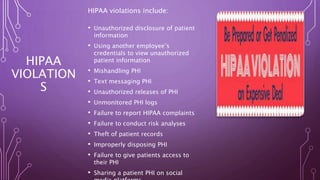
HIPAA
VIOLATION
S
HIPAA violations include:
• Unauthorized disclosure of patient
information
• Using another employee’s
credentials to view unauthorized
patient information
• Mishandling PHI
• Text messaging PHI
• Unauthorized releases of PHI
• Unmonitored PHI logs
• Failure to report HIPAA complaints
• Failure to conduct risk analyses
• Theft of patient records
• Improperly disposing PHI
• Failure to give patients access to
their PHI
• Sharing a patient PHI on social
EXAMPLE OF A
BREACH OF
CONFIDENTIALI
TY
(UCLA HOSPITAL
STAFF
MEMBERS)
A report from the California Department of Public Health
stated that “More than 120 workers at a Los Angeles hospital
looked at celebrities' medical records and other personal
information without permission between January 2004 and
June 2006” (Fox News, 2008, para.1).
The California state regulators blamed the healthcare
organization for not ensuring adequate steps were made to
maintain patient confidentiality and security.
Another report by the Los Angelos Times made on the same
incident acknowledged that the UCLA employees accessed
medical records of celebrity patients that included California
first lady Maria Shriver, Farrah Fawcett and Britney Spears
(Fox News, 2008).One of their employees reportedly looked at records of about
900 of their patients, viewed Social Security numbers with
out legitimate reason, authorization, or permission and
viewed health insurance information and addresses, in 2007.
The former employees face federal criminal charges for
violations of patient privacy
One employee used their supervisor’s credentials in order to
view a patient’s personal health information
WHY IS CONFIDENTIALITY TRAINING
EFFECTIVE?
• This training explains to the employees how important it is to keep
patient information confidential.
• This training explains what the consequences are for breaching patient
confidentiality.
• Not only does patient confidentiality breaches affect the employee, it also
affects the organizations integrity as well as their reputation.
• This training explains that patient privacy it of the utmost importance.
• This training shows an example of a healthcare organization that
breached patient confidentiality.
• This training shows employees what to do as well as what not to do.
REFERENCES
• Fox News. (2008). Report: Over 120 UCLA hospital staff saw celebrity health
records (Links to an external site.). Retrieved
from https://www.foxnews.com/story/report-over-120-ucla-hospital-
staff-saw-celebrity-health-records
• Vanderpool, D. (2019). HIPAA Compliance: A common sense approach.
Retrieved from: http://eds.b.ebscohost.com.proxy-
library.ashford.edu/eds/pdfviewer/pdfviewer?vid=2&sid=3ee8659b-029c-
4657-ae72-1256cfd719c0%40sessionmgr101
• Wager, K. A., Lee, F. W., & Glaser, J. P. (2017). Health care information
systems: A practical approach for health care management (4th
ed.). Retrieved from https://content.ashford.edu

Mha690 week 1 discusssion 2

  • 1.
    PATIENT HEALTH INFORMATION • ALETHA RATCLIFF •MHA 690 HEALTH CARE CAPSTONE • HWANGJI LU • APRIL 23, 2020
  • 2.
    WHAT IS PATIENTINFORMATION? • Patient information is also called personal health information (PHI). • What is (PHI)? Personal health information has been defined as any healthcare information pertaining to their health status, payments for healthcare, or health provision pertaining to or collected by a covered entity.
  • 3.
    WHAT CAN BECONSIDERED AS PHI? • Patient names • Patient hospitalization days • Patient phone numbers • Patient email addresses • Patient social security numbers • Medical record numbers • Account numbers • Pictures of patients • Any other unique identifiers
  • 4.
    WHY IS PROTECTINGPHI IMPORTANT? • Protect the patient’s dignity • To protect the healthcare organization’s integrity • This information may • Personal autonomy • Respect • A patient’s medical records includes the most intimate details about a person’s life. • HIPAA fines and incarceration • Privacy Rule
  • 5.
    PRIVACY RULE • In April2003, requirements of the HIPAA Privacy Rule was enacted. The HIPAA Privacy Rule covers personal health information PHI. Personal health information is information that is maintained, transmitted, created, or received by a healthcare organization or a covered entity. • These privacy rules protect all categories of protected health information [PHI], these include paper, electronic, and verbal information (Vanderpool, 2019). This type of information easily identifies the individual connected to the information and details the individual's mental or physical health, payments associated with care, and the provision of healthcare (Wager, Lee, Glaser, 2017).
  • 6.
    PRIVACY RULE (CONT’D) •On the other hand, the HIPAA security rule secures personal health information that is electronically maintained or transmitted. This rule applies to all electronic media, to include, personal computers, servers, magnetic tapes and discs, and optical disks. • If these HIPAA regulations are violated in the resolution agreement is not a here too, the Health Care Organization Can Face Money penalties for not complying. Resolution agreement often, already include payments of resolution amounts.
  • 7.
    HIPAA VIOLATION S HIPAA violations include: •Unauthorized disclosure of patient information • Using another employee’s credentials to view unauthorized patient information • Mishandling PHI • Text messaging PHI • Unauthorized releases of PHI • Unmonitored PHI logs • Failure to report HIPAA complaints • Failure to conduct risk analyses • Theft of patient records • Improperly disposing PHI • Failure to give patients access to their PHI • Sharing a patient PHI on social
  • 8.
    EXAMPLE OF A BREACHOF CONFIDENTIALI TY (UCLA HOSPITAL STAFF MEMBERS) A report from the California Department of Public Health stated that “More than 120 workers at a Los Angeles hospital looked at celebrities' medical records and other personal information without permission between January 2004 and June 2006” (Fox News, 2008, para.1). The California state regulators blamed the healthcare organization for not ensuring adequate steps were made to maintain patient confidentiality and security. Another report by the Los Angelos Times made on the same incident acknowledged that the UCLA employees accessed medical records of celebrity patients that included California first lady Maria Shriver, Farrah Fawcett and Britney Spears (Fox News, 2008).One of their employees reportedly looked at records of about 900 of their patients, viewed Social Security numbers with out legitimate reason, authorization, or permission and viewed health insurance information and addresses, in 2007. The former employees face federal criminal charges for violations of patient privacy One employee used their supervisor’s credentials in order to view a patient’s personal health information
  • 9.
    WHY IS CONFIDENTIALITYTRAINING EFFECTIVE? • This training explains to the employees how important it is to keep patient information confidential. • This training explains what the consequences are for breaching patient confidentiality. • Not only does patient confidentiality breaches affect the employee, it also affects the organizations integrity as well as their reputation. • This training explains that patient privacy it of the utmost importance. • This training shows an example of a healthcare organization that breached patient confidentiality. • This training shows employees what to do as well as what not to do.
  • 10.
    REFERENCES • Fox News.(2008). Report: Over 120 UCLA hospital staff saw celebrity health records (Links to an external site.). Retrieved from https://www.foxnews.com/story/report-over-120-ucla-hospital- staff-saw-celebrity-health-records • Vanderpool, D. (2019). HIPAA Compliance: A common sense approach. Retrieved from: http://eds.b.ebscohost.com.proxy- library.ashford.edu/eds/pdfviewer/pdfviewer?vid=2&sid=3ee8659b-029c- 4657-ae72-1256cfd719c0%40sessionmgr101 • Wager, K. A., Lee, F. W., & Glaser, J. P. (2017). Health care information systems: A practical approach for health care management (4th ed.). Retrieved from https://content.ashford.edu